#tools-and-devops
1 messages · Page 5 of 1
 tawdry needle
this is why i use compose even for projects with 1 image/container/service. i prefer a declarative config instead of a big messy command line.
 red oxide
Here's my settings:
Dockerfile
FROM python:3.10.4-alpine3.15
WORKDIR /app
COPY . .
RUN apk add build-base musl-dev mariadb-connector-c-dev  # You don't need this if you are not running DB
RUN pip3 install -r requirements.txt
CMD [ "uvicorn", "main:app", "--host", "0.0.0.0", "--port", "1111" ]
docker-compose.yml
version: '3.1'

networks:
  oxy-node-net:
    name: oxy-node-net
    driver: bridge

services:
  oxy-node-server:
    build: .
    image: oxy-node-server:latest
    container_name: oxy-node-server
    restart: always
    networks:
      - oxy-node-net
    expose:
      - 1111
    ports:
      - 1111:1111
as @tawdry needle mentioned, use docker compose, makes things much easier
tawdry needle
red oxide
Here's my settings:
# Dockerfile
```yml
FROM python:3.10.4-alpine3.15
WORKDIR /a...
doesn't compose implicitly create a "network" if you don't specify one? or do you just like having control over the name?
same goes for the image tag and container name
red oxide
I like having control over names cause now I can run another compose with same network work name if I would like to share it with some other app
very helpful under situations when, eg:
You run nginx-proxy with acme and stuff first under a network, then you can use the same network and start individual apps whenever you wish
tawdry needle
i like this, i'm going to start doing it. handy with multiple compose-based projects on the same machine
red oxide
yup, very much!
tawdry needle
i also just learned from the spec that you can set a top-level project name with name: in the compose file
i've been using the cli flag until now
red oxide
by default it uses the project folder name i guess?
tawdry needle
unsure!
red oxide
I saw this behaviour on docker desktop, let me try
indeed

version: '3.1'

services:
  my-ip:
    build: .
    image: my-ip:latest
    container_name: my-ip
    restart: always
    networks:
      - nginx-net
    expose:
      - 8000


networks:
  nginx-net:
    name: nginx-net
    driver: bridge
 red oxide
Can pi-hole mess up the internet inside containers?
I'm running pi-hole on my pi4, I also wanna run speedtest exporter with prom and grafana but I notice I am not getting internet in any of my containers which just results into errors in speedtest exporter container. I checked my pi-hole query logs and dsn seems to be resolved there:

inside rpi speedtest exporter container


 rapid sparrow
 heavy knot

Read some documentation to proper TOML format, and compare with what u wrote
Install TOML syntax linters to show u where are errors automatically (works great in vscode)
tawdry needle
rapid sparrow
it's interesting how many people come in here and ask questions because they simply did not read their own error message
 tropic olive
I did that as well
 blissful ice
Hi, I'm having trouble understanding how publishing packages to PyPI works. When I use pypa/gh-action-pypi-publish in GitHub Actions for uploading packages, how does PyPI determine the project to which the uploaded wheels belong to? There is no "create project" function in PyPI, and none of the GitHub/twine tutorials mention any kind of "target" to publish to, other than using the test-repository. And this one is giving me a
HTTPError: 403 Forbidden from https://test.pypi.org/legacy/
         Invalid or non-existent authentication information.
this error looks to be due to incorrect authentication setup, as per the error message
if the sdist or wheel is built correctly, the project name should be possible from the filename
blissful ice
tawdry needle
if the sdist or wheel is built correctly, the project name should be possible fr...
Ah, so if the package-name determines the project under which the package lives within PyPI.. there are probably some restrictions for uploading packages with different users? I.e. PyPI probably won't let Alice upload a new package with a project-name that is already in use by Bob?
 flat path
blissful ice
Ah, so if the package-name determines the project under which the package lives ...
flat path
blissful ice
Ah, so if the package-name determines the project under which the package lives ...
Yup, it's first come first serve
I'll note the distribution/project name is not always the same as the importable name
 crimson stump
Currently struggling with a basic docker command but its not working, i have a wrapper script i've built which is in the dockerfile, called init.sh
I am trying to alias it but the alias isn't showing up in the file i am appending it too, am i doing something wrong?
RUN echo "alias init='/usr/bin/init.sh'" >> ~/.bashrc
When i check in my pipeline and read the output of bashrc i get
$ cat ~/.bashrc
# .bashrc
# Source global definitions
if [ -f /etc/bashrc ]; then
    . /etc/bashrc
fi
# Uncomment the following line if you don't like systemctl's auto-paging feature:
# export SYSTEMD_PAGER=
# User specific aliases and functions
Figured this out
~ was causing the issue as its a unicode character
Now however i get the following 😭
$ init
/usr/bin/bash: line 182: init: command not found
mkdocs - love from first site
https://www.mkdocs.org/getting-started/
So simple.... yet powerful. Good thing when Sphinx is too much
 thorny shell
if it's called init.sh, then you can't just type init; you have to spell out the complete name, including the .sh
crimson stump
thorny shell
if it's called `init.sh`, then you can't just type `init`; you have to spell out...
i just read apparently it wont work at all because of how docker filelayers work 😦
so the alias wont register in the bash session for the pipeline
crimson stump
thorny shell
if it's called `init.sh`, then you can't just type `init`; you have to spell out...
RUN echo "alias init='/usr/bin/init.sh'" >> ~/.bashrc
its called init.sh but the alias is just init?
thorny shell
aliases make my brain hurt; I never use them
also, they're meant for interactive use only, iirc; it's odd that you're creating aliases in a dockerfile -- most of the time, Docker is for (say) services, not interactive use.
crimson stump
im just really bad with bash but i really need a way to call a command in a pipeline which points to a script 😦
i thought alias would achieve that
Do you have any other ideas @thorny shell ?
I've just been struggling with this for days
omg you were right @thorny shell i dont think i even need the alias
i have init script stored in /usr/bin
so i can just call it
ffs
i just wasted 2 days
thorny shell
yeah I don't understand what you're trying to do, but ... aliases ain't the way 🙂
thorny shell
heh
crimson stump
just need to set the permission for execution right
crimson stump
thorny shell
yeah I don't understand what you're trying to do, but ... aliases ain't the way ...
just in case you are wondering, preventing devs from modifying compliance testing within a pipeline, so wrapping up all the compliance testing in a script and executing it in a single command
thorny shell
you must work where I work 🙂 I spend 50% of my time with compliance
thorny shell
no idea what that is, but ... please don't explain
thorny shell
it'll just make me grumpy
crimson stump
Look into it, open policy agent, basically can traverse through any JSON or YAML and allows you to create custom rules
quite a popular devops tool these days
thorny shell
oh pipelines make sense to me. I don't particularly like dealing with them, but I will admit they solve a real problem, and I can't think of a better way to solve it
crimson stump
yeah, they do, but unless things are planned really well in advance the tech debt is astronomical over time
pipeline and solution planning within devops is like the one thing id advocate all companies spend more time than they think is necessary brainstorming with as many minds as possible
just seen so many botched platforms over the years ive worked
admitedly not that many yet 😄
 weak heath
is this correct way run docker when starting file is in backend folder last line
 rapid sparrow
weak heath
is this correct way run docker when starting file is in backend folder last line
rapid sparrow
weak heath
is this correct way run docker when starting file is in backend folder last line
Lock node to specific version
Don't copy . ., Copy specific stuff
Otherwise fine to me. Except expose does not make to much sense to have
weak heath
ok
 gentle solstice
I usually have a PORT env var. Services like heroku tend to use those to tell your app what port it should use. And I don't think heroku does proper port forwarding via -p 1234:80
That's also assuming your app loads the port value from env like gunicorn does
 copper tundra
Hi, really basic git question (figured I'd ask here as git is technically a tool)
Just as you can pin repos to your github profile, is there a way to pin a commit/PR to your profile?
Made a trivial PR to the cpython repo and after about 1.5 months it was accepted. Can I pin that PR or commit to my profile?
 rugged hare
That's a GitHub question, not a git question. I don't think you can pin commits.
But your profile can have anything you want in it.
copper tundra
Sorry, you are correct I had a GitHub question
copper tundra
Ok thanks, didn't know if there was already a builtin way using the pin repo feature to pin a commit/PR
I'll look into the profile README
rugged hare
 loud bear
copper tundra
Just as you can pin repos to your github profile, is there a way to pin a commit...
loud bear
copper tundra
Just as you can pin repos to your github profile, is there a way to pin a commit...
You can pin an issue or PR in your repo, not your profile unless you link it manually
copper tundra
Thanks @rugged hare, will take a look
Unfortunately @loud bear it's the official cpython repo so can't pin the PR, but thanks for the info good to know
copper tundra
i'm a fairly new open-source contributor and its the first "big" pr I've made to a notable organization
crimson stump
For anyone decent with Docker, why doesn't the bridge network, automatically at the IP hostname mapping to /etc/hosts on the Docker VM so that bridge network containers can communicate with each other via hostname, not just IP?
Also why does the bridge network not have its own DNS server included, it uses the Docker VM DNS server but additional networks created do?
That is also confusing
thorny shell
by "the docker VM" do you mean "the machine on which I run the docker daemon"?
The answer is probably: because it doesn't have root access
crimson stump
Yeah i assume so
Well I'm watching a tutorial
And its telling me the Docker containers sit on a VM, by VM i guess it just means the device you're using then
crimson stump
Okay that makes sense, no root access. But why not come with its own DNS server to handle it?
thorny shell
er
crimson stump
And it necessary go through the bridge network and use the host DNS server
If new networks do have their own DNS
thorny shell
are you asking about name resolution on your laptop, or inside the container?
those are two different things
crimson stump
Sorry inside the container
So i have two containers
They can't communicate via hostname if they both sit within the bridge network
But they can if they are inside a custom network
Typo
thorny shell
huh, well I don't know enough about docker to understand how they can resolve each other's names
crimson stump
Because apparently custom networks have their own DNS resolver
thorny shell
I dimly recall there's a platform-specific trick whereby you can get some magic name to resolve, inside the container, to the IP address that corresponds to your laptop
dunno if that's helpful
crimson stump
It makes sense i was just curious, what is the limitation of the bridge network that means it cant have its own dns resolver, where custom networks can
but yeah thanks mate
I managed to fix that docker thing pretty quickly after your tip yesterday lol, just completely unblocked me
thorny shell
yay me
 dawn sedge
Hello, somebody know another alternative of agora to play músic in another app?
 leaden tapir
does anyone know why does buildozer failed to compiling a kivy project?
 dawn spade
Hiii !!
I've to create an automated code.......to calculate the number of commits for each pull request which every user does.
So I've to fetch the data from the bitbucket repository and calculate the number of times the changes have been done to each pull request
Basically calculating the build statistics corresponding to each pull request and the total number of times build has triggered. What should be the approach ?
loud bear
How do I pin a dependency to use latest git commit in requirements.txt?
loud bear
 brazen forge
although, it should just work
brazen forge
although, it should just work
It will just install latest published version if I don't use anything
Do I use the pip install git+ syntax?
brazen forge
yeah
 glacial sand
I don't have version dependent code, should I run coverage on every tox test environment anyway ? Currently I only use coverage for the latest python version
rapid sparrow
glacial sand
I don't have version dependent code, should I run coverage on every tox test env...
why do u not have version dependent code, but having tox tests and therefore code? 
something potentially wrong was made steps before that
glacial sand
rapid sparrow
why do u not have version dependent code, but having tox tests and therefore cod...
It's to automate testing with gh actions and test with multiple interpreter versions. Also helps as sanity check to ensure it builds correctly everywhere (isolated build)
rapid sparrow
glacial sand
It's to automate testing with gh actions and test with multiple interpreter vers...
so u a having version controlled code then
u can't be in gh actions without git
i don't understand your question then
glacial sand
Oh yes, I meant that the code is not python version dependent (i.e. it doesn't do different things on different versions of python)
of course it is version controlled
rapid sparrow
glacial sand
Oh yes, I meant that the code is not python version dependent (i.e. it doesn't d...
well, run coverage at least once for one python version. All u really need having it outputed and easily being visible
glacial sand
rapid sparrow
well, run coverage at least once for one python version. All u really need havin...
yes that's what I'm currently doing, was just wondering if there would be a reason to run cov on every version
rapid sparrow
glacial sand
yes that's what I'm currently doing, was just wondering if there would be a reas...
technically there is, in different version different code will be covered from having executed different amount of code, but i would say difference will be so minor and rare that i would have prefered to ignore it
unless u are building 100'000 code lines+ software in one repo, it should not be important
glacial sand
All for the better, fewer things to wait on 🙂
 urban needle
Hello, in Docker I have a question:
FROM is for getting an image, and I've read that docker will automatically use the last FROM as the image, what if I want to get the python image into a ubuntu image? or a mono image to the ubuntu image?
like can I do
FROM ubuntu
FROM mono
- when I build a docker image downloading these packages it just takes way too long to build
 indigo zenith
urban needle
Hello, in Docker I have a question:
FROM is for getting an image, and I've read ...
indigo zenith
urban needle
Hello, in Docker I have a question:
FROM is for getting an image, and I've read ...
No, one image per container. If you need a custom image you can build it yourself. https://docs.docker.com/develop/develop-images/baseimages/
 urban needle
indigo zenith
No, one image per container. If you need a custom image you can build it yoursel...
urban needle
indigo zenith
No, one image per container. If you need a custom image you can build it yoursel...
so its about getting a base image or create from scratc h and downloading packages until the desired image satisfied?
rapid sparrow
urban needle
so its about getting a base image or create from scratc h and downloading packa...
essentially yes, but not always
your base image could be only BUILD stage, where you compiled result to binary
or made build of static frontend assets
Results in multi stage building is moved from base image into another layer after that
Example: First FROM contains node.js building frontend into static assets, second FROM contains Nginx to serve those static assets as web server.
Together they are still one multi stage dockerfile
urban needle
rapid sparrow
essentially yes, but not always
your base image could be only `BUILD` stage, whe...
does the second track the first?
rapid sparrow
here example for you
FROM node:lts-alpine3.12 AS build

COPY package-lock.json package-lock.json
COPY package.json package.json

RUN npm install

COPY . .

RUN npm run build

FROM nginx:1.21.3-alpine-perl As runner
COPY --from=build dist/ /usr/share/nginx/html # we copied from Build stage dist/ folder into new FROM stage
After u apply FROM second (or more) time, final image will not have image layers from previous steps before that
this is used to minify size of final docker image
urban needle
wait like the first image is just used to download packages then, the second image just forgets about the first but still have the packages?
rapid sparrow
urban needle
wait like the first image is just used to download packages then, the second ima...
in my case, first image downloads packages and uses them to compile frontend content into static assets html/css/js of a small size
second image gets copied only html/css/js static assets and forgets about first image ( that it had packages to build them)
thus having very small size 🙂
urban needle
the build image owns its own directory right?
rapid sparrow
urban needle
the build image owns its own directory right?
each FROM contains its own filesystem inside. So yes, it has entirely different OS inside
urban needle
ooh okay, so this filesystem is for the build image right?
--from= build
bcuz u specified AS Build
rapid sparrow
urban needle
ooh okay, so this filesystem is for the build image right?
yeah, as u can see i made alias FROM node as build
rapid sparrow
urban needle
--from= build
i specify COPY from build stage in this case
urban needle
yes yes, okay then u copied that diretory to the current image were working on
rapid sparrow
urban needle
yes yes, okay then u copied that diretory to the current image were working on
yup. And current image is having entirely different filesystem
of Nginx image
i copied result to where Nginx expects files to serve as default web site location
urban needle
yes, I got that! Thanks, but I have another question.
rapid sparrow
sure
urban needle
why downloading packages just takes too much time for me. I dont understand if I am doing something wrong because its literally taking more than 2k+ seconds and I stopped it.
I tried to apt-get install packagees like tkinter
I use a ubuntu image
rapid sparrow
urban needle
why downloading packages just takes too much time for me. I dont understand if I...
Umm. somewhere error i guess. Share code to see
urban needle
Okay just a min
FROM ubuntu
RUN apt-get update \
    && apt-get install --assume-yes \
    python3 \
    python3-pip \
    git \
    python3-tk

WORKDIR /app
COPY . /app

CMD python3 ./python-scripts/script.py
Also recommendation to deepen knowledge with this awesome book btw
 rapid sparrow
urban needle
```dockerfile
FROM ubuntu
RUN apt-get update \
&& apt-get install --assume-y...
rapid sparrow
urban needle
```dockerfile
FROM ubuntu
RUN apt-get update \
&& apt-get install --assume-y...
print your log output
urban needle
its just keeps Building:
Building 1852.1s (5/9)
>
>
>
>
>
error is found. u would have found it if... u have read log
Setting up tzdata (2022c-0ubuntu0.22.04.0) ...
debconf: unable to initialize frontend: Dialog
debconf: (TERM is not set, so the dialog frontend is not usable.)
debconf: falling back to frontend: Readline
Configuring tzdata
------------------

Please select the geographic area in which you live. Subsequent configuration
questions will narrow this down by presenting a list of cities, representing
the time zones in which they are located.

  1. Africa   3. Antarctica  5. Arctic  7. Atlantic  9. Indian    11. US
  2. America  4. Australia   6. Asia    8. Europe    10. Pacific  12. Etc
Geographic area:
it encounters user interactive step
therefore unable to proceed next without user input
it is solved with ENV flag, a moment
urban needle
oooh okay, I have used assume-yes
rapid sparrow
urban needle
oooh okay, I have used assume-yes
not enough
RUN DEBIAN_FRONTEND=noninteractive TZ=Etc/UTC apt-get -y install tzdata
install like that before that
https://serverfault.com/questions/949991/how-to-install-tzdata-on-a-ubuntu-docker-image easy to google tzdata docker

Server Fault
I have the following line in the Dockerfile.
RUN apt-get install -y tzdata
When I run it, it asks for my input. After I provided my input, it hung there. Does anybody know how to solve this probl...
urban needle
okay what about other packages how do I know if there is parameters?
urban needle
rapid sparrow
```
RUN DEBIAN_FRONTEND=noninteractive TZ=Etc/UTC apt-get -y install tzdata
``` ...
btw I put this before my main RUN right?
rapid sparrow
urban needle
btw I put this before my main RUN right?
yes, like that
FROM ubuntu
RUN apt-get update
RUN DEBIAN_FRONTEND=noninteractive TZ=Etc/UTC apt-get -y install tzdata

RUN apt-get install --assume-yes \
    python3 \
    python3-pip \
    git \
    python3-tk
i would like also to note that u were... using
RUN apt-get update \
    && apt-get install --assume-yes \
    python3 \
    python3-pip \
    git \
    python3-tk
``` multi install in one command without knowing how it works in regards to dockerOkay.... does that makes a problem?
rapid sparrow
urban needle
btw I put this before my main RUN right?
a moment
rapid sparrow
urban needle
Okay.... does that makes a problem?
okay, if u have code that it not trying to minimize docker image size, then it is more comfortable to have those steps on separate RUN commands (easier to debug usually)
But if u are trying to optimize Docker image size
https://www.metricfire.com/blog/how-to-build-optimal-docker-images/
Then it makes sense to have appropriate Apt cache deleting instruction at the end (rm -rf) (for ubuntu can be different)
FROM debian:stable

WORKDIR /var/www

RUN apt-get update && \
    apt-get -y --no-install-recommends install curl \
        ca-certificates && \
    curl https://raw.githubusercontent.com/gadiener/docker-images-size-benchmark/master/main.go -o main.go && \
    apt-get purge -y curl \
        ca-certificates && \
    apt-get autoremove -y && \
    apt-get clean && \
    rm -rf /var/lib/apt/lists/*
The point is Docker saves new Layer as RESULT of complete step completion. So the size increase of image only for files that changed/were added in step
That's why people compress into one step apt update, installations and deleting apt cache, so that it will not affect image size increase further

Learn how to optimize Docker images to make your images light, portable, and to increase the security of your software.
urban needle
rapid sparrow
okay, if u have code that it not trying to minimize docker image size, then it i...
so seperating RUN commands increase performance (w/cache) and decreases image size?
so, doing mine will naturally take that long?
bcuz its still taking way too long 500+ seconds until now
rapid sparrow
urban needle
so seperating RUN commands increase performance (w/cache) and decreases image si...
no no. Separating RUN commands is just easier to debug
But combining them into one allows to decrease image size if u used correctly to clean cache in it (intermediate files appearing in current step)
urban needle
rapid sparrow
no no. Separating RUN commands is just easier to debug
But combining them into o...
oh okay yes I understood what u mean
rapid sparrow
urban needle
bcuz its still taking way too long 500+ seconds until now
500 seconds? that's weird. My PC builds your image in.. 60 seconds
may be not enough CPU u have
it can build faster though
rapid sparrow
urban needle
oh okay yes I understood what u mean
reuse common existing official docker images
FROM python:3.10

RUN apt-get update \
    && apt-get install --assume-yes \
    git \
    python3-tk

WORKDIR /app
COPY . /app

CMD python3 ./python-scripts/script.py
10 seconds build now at my PC
google Docker hub python (or anything else) to find stuff
urban needle
rapid sparrow
reuse common existing official docker images
```
FROM python:3.10
RUN apt-get u...
Okay so it differs for CPU capiabilties
rapid sparrow
u install python in the way it required C compiling. It was very CPU heavy
 pine nacelle
I need help I created an azure VM and I am not able access its server which i hosted using go
urban needle
rapid sparrow
google Docker hub `python` (or anything else) to find stuff
is it possible to do that as an image alias so I can use python in my ubnutu image?
rapid sparrow
urban needle
is it possible to do that as an image alias so I can use python in my ubnutu ima...
read docker hub explanations / dockerfile
python:3.10 is essentially debian image + installed python as far as i know
there is a choice to choose alpine based pythons too though
with different tags
debian is essentially same ubuntu, same OS family
urban needle
okay thats better so python image is enough
I also have another question, f its possible I think I took lot of time for that sry
I wanted to run a graphical program with mono, but it went wrong because there is no x server or similar. Also, is this for all graphical programs if I want to run with docker?
rapid sparrow
urban needle
I wanted to run a graphical program with mono, but it went wrong because there i...
Graphical programs aren't meant to run in Docker. It is possible though at advanced level if u will pass necessary devices from host into containers (some perverts even serve Linux Desktop in container and allow remote connection into it)
Docker is meant to serve web (or CLI) applications, frontend, backend. If u want serving GUI with docker, make localhost served website that serves as a GUI to your service inside docker, that's how pgadmin does for example
urban needle
rapid sparrow
Graphical programs aren't meant to run in Docker. It is possible though at advan...
Okay, Thanks! very informative. Also, thanks for the book recomendation!
tawdry needle
urban needle
Okay, Thanks! very informative. Also, thanks for the book recomendation!
what was your original objective? on linux for example, if you just want some amount of dependency isolation and maybe a little sandboxing, you can do it in flatpak or appimage
although i have gotten discord and spotify running in podman on fedora, under x11 (not wayland)
the latter was nontrivial, i'd have to dig up my files to show how it worked
urban needle
tawdry needle
what was your original objective? on linux for example, if you just want some am...
Theres a program that I want to make a container for it since it depends on other things to be run and installed, but its not that easy right?
indigo zenith
pine nacelle
I need help I created an azure VM and I am not able access its server which i ho...
I doubt anyone can help without more information. How exactly are you trying to access this server. What does "hosted using go" mean exactly?
 ruby fossil
I need some help with mypy
I tried making a custom log record factory and this happened...
 tawdry needle
ruby fossil
I tried making a custom log record factory and this happened...
tawdry needle
ruby fossil
I tried making a custom log record factory and this happened...
did you name your own module logging.py?
ruby fossil
Idk why this happens but it does
ruby fossil
tawdry needle
did you name your own module `logging.py`?
I did but it is under src folder

Something like this
Should I change the name?
tawdry needle
ruby fossil
Should I change the name?
yes. if logging is a python package in the python search path, then it will take precedence over the built-in one
ruby fossil
Alright
tawdry needle
you can put it inside another package, but it can't be a top-level name
so you can do this
src/
  myapp/
    __init__.py
    logging/
      __init__.py
      custom_record.py
because the module name will be myapp.logging.custom_record
but you can't do this
src/
  logging/
    __init__.py
    custom_record.py
Ohhh
But why does that src folder not count
Like, my configs are in a folder called Applic and it has src as subfolder
something like this
Application root
 |- src
     |- logging
 |- config files
Another question but it's probably for #type-hinting
 fallow smelt
Is there any way to get VSCode to show each parameter on a new line in the hover tooltip?
rapid sparrow
fallow smelt
Is there any way to get VSCode to show each parameter on a new line in the hover...
do u mean, showing parameter value during debugging session in visual interface?
 rapid sparrow
fallow smelt
Would prefer if each property was on a new line since kinda complex signature
rapid sparrow
fallow smelt
Would prefer if each property was on a new line since kinda complex signature
if u need reading complex signature, use Show definition functionality and traverse through the function code that made this tooltip
rapid sparrow
fallow smelt
Would prefer if each property was on a new line since kinda complex signature
Document your function in docstrings
First string in the body of a function works as documentation added to tooltip too
It can be even used later in autodoc of Sphinx to autocompile static asset documentation after that
loud bear
brazen forge
yeah
It doesn't work
GitHub
FL Studio project file parser. Contribute to demberto/PyFLP development by creating an account on GitHub.
brazen forge
try
construct-typing @ git+https://github.com/timrid/construct-typing
 foggy snow
Hey folks , can anyone help to get commit history between jenkins builds ?
 south forum
Hey folks,
I run a py script with selenium to get some data.
I run this in a docker , and the official standalone-selenium-chrome docker with "docker compose".
Problem is: I get a lot of errors by selenium..
"ConnectionRefuseError: [Errno 111] Connection refused."
"urllib3.execptions.NewConnectionError: ... failed to establish a connection "
"urllib3.execptions.MaxRetryError: ..."
Anyone experience with setting up a selenium web scraper in docker? would appreciate some help. Thx
loud bear
brazen forge
try
```
construct-typing @ git+https://github.com/timrid/construct-typing
```
Works. found it documented here https://pip.pypa.io/en/latest/topics/vcs-support/#git
 rugged flame
Would there be any advantage to an organisation grouping together all of their packages into a single namespace package?
Also disadvantages.
thorny shell
if you mean "every python package that we produce in our org will provide modules named lx-org.something, that sounds reasonable
rugged flame
thorny shell
if you mean "every python package that we produce in our org will provide module...
Yeah that's what I had in mind.
thorny shell
disadvantages: you already have tons of existing packages in random namespaces, and converting them will be a pain.
advantages: sanity, simplicity, stuff should Just Work® if you ever open-source it
rapid sparrow
rugged flame
Would there be any advantage to an organisation grouping together all of their p...
There is recommendation to do it not through single folder defining all of them
but through defining shared_namespaces.your_package_name as a single name for folder
In this way u will keep ability to have their... locations independent
if u will ever do it
 silver cradle
how do i upgrade pip in windows terminal?
rapid sparrow
silver cradle
how do i upgrade pip in windows terminal?
it can self upgrade itself, python -m pip install --upgrade pip
silver cradle
my terminal keeps saying no module named pip (normal & admin priv) but my ide pycharm is using pip
Pastebin
Pastebin.com is the number one paste tool since 2002. Pastebin is a website where you can store text online for a set period of time.
getting this too
i managed to update it using pycharm
im trying to install PIL now tho, and its saying this
https://pastebin.com/YubDi4h2
Pastebin
Pastebin.com is the number one paste tool since 2002. Pastebin is a website where you can store text online for a set period of time.
 civic grove
silver cradle
im trying to install PIL now tho, and its saying this
https://pastebin.com/YubD...
civic grove
silver cradle
im trying to install PIL now tho, and its saying this
https://pastebin.com/YubD...
try pillow instead of PIL
 leaden flame
Hey guys, I'm working on a project that's actually not a programming project per-se but rather a guide for beginners on all the tools that will help them in their programming journey. Think like project templates, website bookmarks, blogs to follow and read, command line tools, desktop tools, things like that.
It's most similar to "tools and devops" subject-wise, but it's not just that
I haven't yet decided if it's going to be a book, or a course, or some other form yet, but I'm getting together all the information for it
And for now I'm primarily targeting windows and linux (I don't have a mac to try to find the mac alternatives yet)
So I was wondering if I could get some suggestions from you guys on what sorts of tools or things I might be missing
The idea is a beginner can pick this up and have the tools and know how to use them to be effective as they first learn programming, and then as they write programs and software as a developer.
What I have so far is...
First things First
- Chocolatey & Chocolatey GUI
System Tools
- Powershell 7 - Latest Powershell Update
- WSL 2 - Linux on windows
- Autohotkey - A programmable hotkey and automation tool
- Power Automate - Automate repeated tasks on your computer
- 7-Zip - Easily unzip anything from the context menu
- Winaero Tweaker - Make tweaks to the way Windows behaves
- Powertoys - A bunch of cool extra hidden features
Command Line Tools
- Posh-git - Shows your git status in your powershell prompt
- Win32 Peco - Pico editor for Windows
- Ripgrep - Grep for windows, better than GNU
- GNU Sed - Stream EDitor
- SnakeTail - Tail clone for windows
- Neovim - Terminal Power-Editor, Configured by lua scripts
- GNU Awk - Programmable Text processor
- Github CLI - Programmatic Access to Github from the command line
- Git - Distributed Version control system
- GNU WGet - Download files from the internet directly
- Curl - programmatically interact with web service
- Selenium - programmatically interact with websites
Helper Programs
- Ditto Clipboard Manager - Saves a history of clipboard clips
- XMing - Allows you to use GUI programs in WSL
- Keypirhanna - A highly configurable launcher
- Quicklook for Windows - Allows you to press spacebar on a file to preview it
- Wincompose - Allows you to compose special characters from the keyboard
- (Not Free) - Insync - Manage your Dropbox, Google Drive, and OneDrive
- Just Color Picker - detects the color value on screen and gives you various formats to replicate color
Primary Software
- VSCode - Super Powerful Code Editor with extensions and JSON config files
- Pencil Wireframes - Free tool to wireframe a program you're writing
- LibreOffice - You primarily want the drawing and math tools
- Kitty SSH - A Better Putty that will allow you to connect to remote servers
- WinSCP - Copy files using SSH
- Notepad++ - Good all around text editor
- Adobe Acrobat Reader - To read PDF files
- SQLite Studio - Open and mess around with SQLite data files
- HxD - Hex editor, very useful
- Ghidra - Reverse Engineering
- Gauge - Test Automation Tool
- NSIS - Installer Package Creator
- Obsidian - Markdown Based Notes in a hive
- XMind - Mind Mapping software
Online Accounts and Services
- Github Account
- Stack Overflow Account
- Gmail Account
- Discord Account
- Slack Account
 rancid schoonerBOT
:incoming_envelope: :ok_hand: applied mute to @leaden flame until <t:1666830204:f> (10 minutes) (reason: links rule: sent 24 links in 10s).
The <@&831776746206265384> have been alerted for review.
leaden flame
I also have a set of suggested sites/pages to bookmark and how to organize them:
Links to Setup in Browser Toolbar
- Grimoire -> Links to articles and stack overflow posts
- Servers -> Links to manage servers and to connect to web interface for them
- Documentation -> Links to sites that host the documentation for a product
- VSCode
- Markdown
- Markdown Guide
- JSON
- XML Official Docs
- W3Schools
- Chocolatey
- MDN
- Powershell
- Power Automate
- Powertoys
- Winaero Tweaker
- Windows Subsystem for Linux
- AutoHotKey Documentation
- Posh Git
- Ripgrep
- GNU Sed
- GNU Awk
- Neovim Editor
- Github CLI Documentation
- Git SCM
- GNU Wget
- cURL Documentation
- Selenium
- Ditto Clipboard Manager
- XMing X Server
- KeyPirhanna
- Pencil Wireframes
- LibreOffice
- Kitty SSH
- WinSCP
- Notepad++
- SQLite Studio
- HxD Hex Editor
- Ghidra
- Gauge Test Automation
- NSIS Installer Creator
- Obsidian
- XMind Mind Mapper
- Docker
- Microsoft API and Reference Catalog
- IETF RFC Database
- Regular Expressions
- Geeks For Geeks
- BEM
- Accounts -> Links to sites that you can log into
- Repositories -> Links to places to download software
- Projects -> Project Hosting sites
- Read The Docs
- Documentation.Help
- Github
- Tools -> Sites that work as tools for you
- Stock Sources -> Sites that provide images, drawings, sound effects, music, fonts, etc
- Content Delivery Networks -> Delivery Networks to access libraries
Extensions and Settings
-
VSCode Extensions
-
Windows Settings and little seen features
- Fonts
- Fira Code Font
- Places to get Fonts
File Formats to Learn About
- Markdown
- JSON
- XML
rapid sparrow
leaden flame
## Links to Setup in Browser Toolbar ##
- Grimoire -> Links to articles and stac...
Idea is nice of course, but i am kind of strongly disliking how you threw into one pile ecosystem of Windows and Linux together
 sly sleet
w3schools
geeksforgeeks
sly sleet
rapid sparrow
Idea is nice of course, but i am kind of strongly disliking how you threw into o...
aside from half of the cli tools, i dont think any of them are linux
and these are undercategorized
b/c you have web dev tools mixed with general software mixed with desktop app tools
sly sleet
leaden flame
Also WSL is a thing
...but you mention plenty of tools that are obsoleted by wsl's existence
 knotty kettle
hey all, had a quick Jenkins question. has anyone run into an issue where Jenkins doesn't inherit system environment variables? I recently upgraded our Jenkins instance and now none of our jobs are seeing system variables (this used to work)
tawdry needle
leaden flame
## Links to Setup in Browser Toolbar ##
- Grimoire -> Links to articles and stac...
i would distinguish "important utilities that you are likely to encounter everywhere" (git) from "nice fun cli tools" (posh git)
also posh git is just for powershell
ideally you would use tags instead of or in addition categories
e.g. posh git could be tagged with git and powershell, for example
 graceful light
For having multiple Python versions installed on a Windows system, what's the best way to manage setting up / running different versions through something like poetry?
I've heard of pyenv but seems to not officially support Windows
rapid sparrow
graceful light
For having multiple Python versions installed on a Windows system, what's the be...
Clarify usage case better
Different python for different projects
Or testing same project with different pythons
graceful light
I have different projects with different dependencies, where I want to upgrade to the newer versions of Python, and others I have to wait until the associated libraries release compatible versions
rapid sparrow
graceful light
I have different projects with different dependencies, where I want to upgrade t...
I solve it with docker and CI
For u I would recommend trying to solve with Poetry first.
Poetry is very nice package manager, best today
U can set Python version in its config
It will auto create venv with necessary python for project
graceful light
The issue is that installing multiple versions of Python on windows and adding them to the env path means that I HAVE to use poetry to make sure I'm using the correct version of python, otherwise I would be using the newest one by default in a non-virtualenv situation
My cheap workaround is to make a copy of each python executable and rename them to their version (IE Python 3.9 would go from python.exe to python39.exe
rapid sparrow
graceful light
The issue is that installing multiple versions of Python on windows and adding t...
In Linux installed new pythons are actually by default gaining corresponding version namings xD
python3.9, python3.10 and etc
So u repeated Linux solution
I used at the first it with related venvs
copper tundra
leaden tapir
does anyone know why does buildozer failed to compiling a kivy project?
Try asking in the Kivy discord, they have support channels for questions just like these :)
tawdry needle
graceful light
For having multiple Python versions installed on a Windows system, what's the be...
just install them using the official installers, as long as they have different minor versions (3.9, 3.10, etc) they won't collide at all. use the py.exe launcher instead of invoking python.exe, py.exe is basically pyenv for windows.
there's also a windows port of pyenv
ideally you don't need to add any python.exe's to path, you just use py to create venvs, and invoke those directly
things get a bit trickier when using poetry i suppose
but if you install poetry into a venv to begin with, i think it will "do the right thing" and reuse that same venv. not sure if it requires the venv to be active though
graceful light
Oh my god, I didn't know py did that, I just thought it was a shorthand for existing python.exe, this fixes my issue completely, thank you!
tawdry needle
yeah, check py -0p to see a list of all the python installations that it can detect on your system
graceful light
My only remaining question is how to get VS Code to see that poetry has a virtual env to enter into - sometimes the prompt comes up when I create the env, but I don't know how to have VS Code enter it otherwise
And for context, I don't just mean having poetry's virtual env usable in the VS Code terminal, I mean VS Code seeing the imported libraries of the virtual env for autocompleting 3rd party library methods (IE: doing from tqdm import tqdm and then typing tqdm() would show you the available arguments).
Without the virtual env, the autocomplete stuff doesn't happen unless I install the library globally
tawdry needle
graceful light
My only remaining question is how to get VS Code to see that poetry has a virtua...
i believe you need to tell vs code to use the python.exe that's in the venv
 frigid plover
Hello Everyone
anyone here who have taken kodekloud devops course ...
If yes, please let me know
I have some queries
 unreal fable
anyone using airflow?
im a data engineer and running one on vineyard
trying to clear my xcoms like this
@provide_session
def cleanup_xcom(context, session=None):
    for task_instance in context['dag'].tasks:
        XCom.clear(
            task_id = task_instance.task_id,
            run_id=task_instance.run_id,
            dag_id = task_instance.dag_id,
            execution_date = context['execution_date'])
but when a task finishes with failed state, the callback fails with
AttributeError: '_PythonDecoratedOperator' object has no attribute 'run_id'
so how shall one pass run id here ? im stuck
or if anyone has a debug environment set up, would help me too
loud bear
So TIL pypi doesn't allow publishing wheels having direct git dependencies
ERROR    HTTPError: 400 Bad Request from https://upload.pypi.org/legacy/
         Invalid value for requires_dist. Error: Can't have direct dependency: 'construct-typing @
         git+https://github.com/timrid/construct-typing.git@ce871936d9e885c84f2f507c723fc5a7e99c9096'
not surprising; many git repos are non-public, pypi probably can't (or doesn't want to) figure out which are and which aren't; and they certainly don't want to distribute a package whose users will run into a 404 when trying to install it
loud bear
thorny shell
not surprising; many git repos are non-public, pypi probably can't (or doesn't w...
isn't it super simple to find that a repo is non-private?
what should I do now? i already told the library author about this
thorny shell
no idea, sorry
thorny shell
loud bear
isn't it super simple to find that a repo is non-private?
it'd take time and network bandwidth. Sure, not much of each; but they'd want to do this for every project, and they'd want to do it periodically, since a repo that's private today may become public tomorrow, and vice versa. I imagine that'd add up.
anyway I'm just guessing as to the reason; it might be for some other reason.
loud bear
but this arbitrary dependency can be installed via setup.py explicitly right?
imagine falling back from pyproject.toml to setup.py
thorny shell
dunno tbh
never run into this
also I've never published anything on pypi
I am but a consumer
loud bear
its hard to get good help about pip, pypi in general
some useful information hidden deep inside some github issue usually
thorny shell
well there is https://packaging.python.org/en/latest/
The Python Packaging User Guide (PyPUG) is a collection of tutorials and guides for packaging Python software.
that site has a lot in it, and it's reasonably well written
loud bear
is that new?
thorny shell
I don't think it existed 5 years ago
thorny shell
it feels new-ish to me 🙂
loud bear
I never ever remember seeing this
https://packaging.python.org/en/latest/overview/
 loud bear
thorny shell
I don't think it existed 5 years ago
loud bear
thorny shell
I don't think it existed 5 years ago
it didn't
https://readthedocs.org/projects/python-packaging-user-guide/builds/?page=47
Says 4 years 1 month ago
loud bear
!pep 582
rancid schoonerBOT

**PEP 582 - Python local packages directory**
Status
Draft
Python-Version
3.12
Created
16-May-2018
Type
Standards Track
loud bear
seems like a node_modules copy surely
https://peps.python.org/pep-0582/#rejected-ideas python_modules 😆
Python Enhancement Proposals (PEPs)
 errant bison
hey there :)
what are your experiences with pyinstaller, nuitka, etc.?
any good articles about speeding up python program execution and single executable distribution with these that compare them?
tawdry needle
loud bear
seems like a node_modules copy surely
that's exactly what it is. pdm i think is the only package manager that implements this
tawdry needle
errant bison
hey there :)
what are your experiences with pyinstaller, nuitka, etc.?
any good ...
i've only messed around with nuitka and mypyc a bit. but some applications (e.g. Black) are starting to use mypyc and finding substantial speedups.
i've used cython and numba a few times and seen significant improvements in hot codepaths
the major downside is having to now compile your code and worry about distribution and cross-compiling
pyinstaller i think occupies a different space, it's intended for distributing python applications as self-contained binaries
leaden flame
sly sleet
...but you mention plenty of tools that are obsoleted by wsl's existence
That's true, but even on linux I prefer ripgrep, and having these tools means not dropping into wsl for them. I only do that if I want to use a full linux environment. Those tools though are just nice to have on windows.
leaden flame
tawdry needle
also posh git is just for powershell
I have something similar to it set up on wsl and on my linux servers. I'll have to go back and see how I did that. I'm only just getting started.
 worthy dew
I mean how to get into some Tools for example Hazard Nuker-a and then somehow get inside it and then remove the virus and work like before
 wet dune
!rule 5
rancid schoonerBOT
5. Do not provide or request help on projects that may break laws, breach terms of services, or are malicious or inappropriate.
wet dune
Sounds like it to me 🫣
 burnt quiver
!pip simpletwitter
rancid schoonerBOT

Python package for making twitter bot with less code
Bad argument
Converting to "int" failed for parameter "pep_number".
loud bear
does vscode not understand pep582?
python extension scans 2500 files eveeytime i save one of my source files
and its extremely slow
ahh too bad vsc doesn't support it
gentle solstice
You configured it with the PYTHONPATH?
tawdry needle
loud bear
does vscode not understand pep582?
most tools don't, unless you set pythonpath manually. pep 582 wasn't actually accepted afaik
!pep 582
rancid schoonerBOT
**PEP 582 - Python local packages directory**
Status
Draft
Python-Version
3.12
Created
16-May-2018
Type
Standards Track
loud bear
gentle solstice
You configured it with the PYTHONPATH?
No PDM has something
But the PDM suggestions break Python extension of VScode
gentle solstice
loud bear
Yes
It makes VSCode scan tons of files
Everytime code is saved
Starts after about 10 seconds or so
gentle solstice
See the box that says "Using Pylance/Pyright?"
loud bear
Yes I added the config for pyright and mypy in pyproject.toml
Its not caused by type checkers
Its cause by the Python extension, not Pylance
gentle solstice
Did you read this? https://github.com/microsoft/pylance-release/issues/1150
GitHub
To prevent pylance from indexing particularly large subdirectories (a la node_modules), or symlinks to such, it would be nice to have a VS Code setting (e.g. pylance.analysis.excludes) that mimics ...
loud bear
Its this config which causes that
{
  "python.autoComplete.extraPaths": ["__pypackages__/<major.minor>/lib"],
  "python.analysis.extraPaths": ["__pypackages__/<major.minor>/lib"]
}
add it to python.analysis.exclude
gentle solstice
{
  "python.autoComplete.extraPaths": ["__pypackages__/<major.minor>/lib"],
  "python.analysis.extraPaths": ["__pypackages__/<major.minor>/lib"],
  "python.analysis.exclude": [
    "__pypackages__",
  ]
}
or it might be ignore instead of exclude
loud bear
Don't 2nd and 3rd line cancel out each other?
2nd line adds
3rd line excludes
Total: nothing
gentle solstice
then use ignore instead
loud bear
That would probably work
 muted cobalt
Uhm so, I have this workflow that has worked forever, but when running it again now I get this weird error...
 gentle solstice
Got a link to the file or is it a private repo?
loud bear
GA has become increasingly complaining, it once complained about " instead of '
Who even cares about ' or "
gentle solstice
Maybe the yaml parser they use was updated or changed
heavy knot
I have some github actions that are running when I click the 'Actions' tab but when I click the checkmark/x only a subset of my workflows are showing up. I know they updated the UI recently has anyone else seen this?
heavy knot
nvm figured it out
heavy knot
Hello guys how can i add proxy for tool ?
rapid sparrow
heavy knot
Hello guys how can i add proxy for tool ?
explain your wish better, it sounds quite vague at the moment. Proxies can be working in entirely opposite ways
 zealous timber
anyone that can help me distribute an app with nuitka?
i get these errors after i try running it, compiled it with --standalone
 tawdry needle
zealous timber
i get these errors after i try running it, compiled it with --standalone
tawdry needle
zealous timber
i get these errors after i try running it, compiled it with --standalone
show the full error?
zealous timber
tawdry needle
show the full error?
i fixed it, just used pyinstaller and worked first time
 fervent fjord
is there a possibility to convert a mkv to mp3 with python?
indigo zenith
fervent fjord
is there a possibility to convert a mkv to mp3 with python?
I googled it for you: https://www.codegrepper.com/search.php?answer_removed=1&q=python convert mkv to mp3
fervent fjord
indigo zenith
I googled it for you: https://www.codegrepper.com/search.php?answer_removed=1&q=...
I can add all of a folder keeping the same name
graceful light
Can someone with more knowledge of pyeprf help me understand the arguments that it takes? The documentation states the following: “runs”: Number of spawned processes, -p/--processes command line option “values”: Number of value per run, -n/--values command line option “warmups”: Number of warmup per run used to warmup the benchmark, -w/--warmups command line option “loops”: Number of outer-loop iterations per value, -l/--loops command line option “inner_loops”: Number of inner-loop iterations per value, hardcoded in benchmark.
But there's no other explanation of what these arguments are
What I can infer from dumping a benchmark into a JSON file is this:
runsis the number of individual processes that are spun up to run the benchmark, to prevent the Python interpreter from caching the function callsvaluesis the actual number of times the function is called within a single processwarmupsare how many times the process will run the function to prevent outlier results to happen when calling a function for the first few times
But as forloopsandinnter_loops, I'm not able to find anything mentioning what they actually do. Doesloopshandle how many times a process runs the function for a given value? IE 10 processes with 15 values and 5 loops would be 10x15x5 total function calls?
 vague star
Anyone here I can DM that has experience using AWS Code Repos?
 old thistle
How can I make my local directory in vscode match the last commit in my git history? I have tried git checkout -- and git reset --hard but it doesn't seem to actually change anything in my local directory
rapid sparrow
old thistle
How can I make my local directory in vscode match the last commit in my git hist...
try git checkout branch_name
master / main branch if u wish default one
rancid schoonerBOT
:incoming_envelope: :ok_hand: applied mute to @iron lark until <t:1667476814:f> (10 minutes) (reason: duplicates rule: sent 4 duplicated messages in 10s).
The <@&831776746206265384> have been alerted for review.
 harsh linden
Are there some tools which can help me build a proper requirements.txt, minimal required versions of packages and Python itself etc?
I developed my current project in a virtual environment via conda but a simple conda list -e > requirements.txt not only contains the packages required to actually run my program but also things related to development like black. Apparently, it also can't filter packages which have been installed as dependencies and were not explicitly installed.
thorny shell
probably -- look at https://packaging.python.org/en/latest/key_projects/#poetry
Warning -- sorta overwhelming 😦
 hazy echo
harsh linden
Are there some tools which can help me build a proper `requirements.txt`, minima...
hazy echo
harsh linden
Are there some tools which can help me build a proper `requirements.txt`, minima...
Hi @harsh linden I have the same question, but not much urgency yet for the answer. I suspect that the matter of min req version will be a topic for the testing channel.
 floral smelt
I need to sharpen my skills with data streaming and Kubernetes. So far I'm running kinda dry on mini-project ideas.
 wet valve
poetry can be used to generate a version-locked requirements.txt based on your pyproject.toml
 crude hedge
wet valve
poetry can be used to generate a version-locked `requirements.txt` based on your...
crude hedge
wet valve
poetry can be used to generate a version-locked `requirements.txt` based on your...
do you know offhand if that can include transient dependencies, or only whatever's defined in your pyproject.toml?
 tawny temple
crude hedge
do you know offhand if that can include transient dependencies, or only whatever...
tawny temple
crude hedge
do you know offhand if that can include transient dependencies, or only whatever...
Yes, Poetry includes transitive dependencies in the lock file.
If you really meant "transient" rather than "transitive" then you'll have to elaborate on what you mean by that.
burnt quiver
!pip simpletwitter
rancid schoonerBOT
Python package for making twitter bot with less code
 tardy isle
Hey guys was referred here. I'm having an issue with my import location being cached. When I import models.blip from BLIP it looks like the import location gets cached and passed on to another import AdaBins that uses models inside one of its classes. I'm stumped!


Any help is much appreciated
tawny temple
tardy isle
Hey guys was referred here. I'm having an issue with my import location being ca...
I think whoever directed you here was mistaken; a help channel would be more appropriate. To briefly answer: I'm guessing these are two different modules both names models. You should use absolute imports to import them to avoid the naming conflict.
 cloud axle
what is the best way to distribute a project which includes files that arent python like database files or templates for flask and some files which have to be generated on setup like certificates?
rapid sparrow
!rule 6 delete. I would not have asked it if u had a real quality stuff, but I have read your study plan.. and I think it is totally wrong one for 80% of it at least
Plus general scamness vibe from the offer is not helping too
rapid sparrow
<@&831776746206265384> rule 6
tardy isle
tawny temple
I think whoever directed you here was mistaken; a help channel would be more app...
I kept getting redirected, and thank you for the response. This defenitely gets me on the right track. Thank you!
floral smelt
Can we use a Docker image exclusively used to pass and validate tests within a pipeline? As in, the container is launched, the tests are executed and when everything passes, the container is destroyed.
rapid sparrow
floral smelt
Can we use a Docker image exclusively used to pass and validate tests within a p...
yes, docker run --rm image_name makes sure automatically destroying container once its main process is finished
image still remains though and u will need to clean it after that in addition
floral smelt
Ok that's good to know. 👍
tawdry needle
floral smelt
Can we use a Docker image exclusively used to pass and validate tests within a p...
isn't this how most CI environments work?
floral smelt
tawdry needle
isn't this how most CI environments work?
Yeah I was wondering how Github CI worked behind the scenes
tawdry needle
it's the beauty of containers
 mighty cape
anyone here to help pewease
tawdry needle
mighty cape
anyone here to help pewease
heavy knot
Hey lads, would you mind helping me figure out why my GNU gettext translation tool isn't working?
My folder structure is the following:
/
|- src
|    |- __init__.py
|    |- main.py
|- locales
     |- ru
          |- LC_MESSAGES
               |- base.mo
               |- base.po
the top of my main.py reads like this:
import argparge
import gettext

argparser = argparse.ArgumentParser()
argparser.add_argument("--language", required=False, default="en")
cmd_args = argparser.parse_args()
match cmd_args.language:
    case "english":
        cmd_args.language = "en"
    case "russian":
        cmd_args.language = "ru"
translation = gettext.translation(
    "base", localedir="locales", languages=[cmd_args.language]
)
translation.install()
_ = gettext.gettext
And yet, when I try to run the script in Russian, I still get an error:
FileNotFoundError: [Errno 2] No translation file found for domain: 'base'
What am I doing wrong?
south forum
Hey I get the following error on my ubuntu server wen trying to install deadsnake ppa
"Unable to locate package python-openssl"
Wen trying to "sudo apt install python-openssl" I get the same error. Also tried to update and upgrade.
Ubuntu version is 22.10 and kinetic
Thanks for help
gentle solstice
Isn't it python3-openssl?
did you sudo apt update first?
you also may need to specify the python version. python27-openssl if using python 2.7
You also may need to use pip if those libraries aren't provided
I personally would suggest using pyenv to install old pythons
thorny shell
I found that building with pyenv works but was surprisingly fiddly
I had to install a ton of dependencies before pyenv would build a "proper" python -- one with ssl support, sqlite support, lzma, &c
here's what I had to do for 22.04 "jammy"
sudo apt build-dep -y python3-pip python3-openssl python3-cffi python3-tk python3
sudo apt install -y libssl-dev libbz2-dev libncurses-dev libreadline-dev liblzma-dev libsqlite3-dev
 peak iris
conda activate should work the same as source ${env}/bin/activate for venv, right?
i see the (conda env) indicator in my shell but it doesn't find any packages when i run it
 jaunty cargo
does anyone know how to make/work discord tools?
gentle solstice
like a bot?
 frozen oxide
I'm trying to wrap my head around pdm's pep582 support, I THINK I have read that when I enable pep582 support when I do pdm add <package> it should be added to __pypackages__ in my project directory. As that didn't happen I feel I'm missing part of the enabling pdm pep582 support.
I ran pdm --pep582 and added the output to the bottom of my .zshrc file, Is there more I need to do?
frozen oxide
aha, got it sorted. the docs page does not include this tidbit that the github page does. pdm config python.use_venv false
gentle solstice
pdm uses pep582 if the __pypackages__ folder exists
 native shadow
an app that can read the content of a notification and display a custom icon or message to a 10x10 pixel display
 hallow cypress
How do I know if hive metastore is active or not ? Using cli
 subtle quarry
a question on github cli tool, i want to use gh cli tool on one machine with two different profiles. each will have access to different repos. i searched on gh cli docs but cant find a way to do it. is it possible?
rapid sparrow
subtle quarry
a question on github cli tool, i want to use gh cli tool on one machine with two...
What is github CLI tool
do u mean Git CLI tool, https://git-scm.com/downloads ?
if yes, then it is resolved with...
having ~/.ssh/config file
Host github.com-petprojects
  HostName github.com
  User darkwind-petprojects
  IdentityFile /home/naa/.ssh/id_rsa.petprojects
  IdentitiesOnly yes

Host github.com-work
  HostName github.com
  User darkwind-work
  IdentityFile /home/naa/.ssh/id_rsa.work
  IdentitiesOnly yes
Then all is needed to fix git clone command git@github.com-petprojects:my_project_group/my_pet_project_infrastructure.git
or correcting for existing local repo through git remote set-url origin new_corrected_url
this helps to set different SSH keys without conflicts to same Git remote resource
brazen forge
subtle quarry
a question on github cli tool, i want to use gh cli tool on one machine with two...
you can have multiple hosts, but not so much different profiles for the same hosts with the gh CLI
brazen forge
rapid sparrow
What is github CLI tool
GitHub
GitHub’s official command line tool. Contribute to cli/cli development by creating an account on GitHub.
rapid sparrow
brazen forge
https://github.com/cli/cli/
interesting. And equal gitlab CLI tool is present too
https://glab.readthedocs.io/en/latest/
brazen forge
yep, use it often
it's nice to review and merge PRs from the CLI
fun fact: it was developed by a volunteer before GitLab decided to take it under their umbrella
subtle quarry
brazen forge
you can have multiple hosts, but not so much different profiles for the same hos...
How to set up different hosts? I have two personal access tokens. Would that work in this case?
subtle quarry
rapid sparrow
if yes, then it is resolved with...
having `~/.ssh/config` file
```
Host github....
Yeah it's GitHub cli. We use pat tokens but will see if I can set up ssh keys
brazen forge
different hosts as in, github.com and some github enterprise domain
either way, I'd recommend using SSH
subtle quarry
That may work. I indeed need GitHub and GitHub Enterprise access
brazen forge
in that case, gh creates a hosts.yml in its config directory
there might be some docs about it, lemme check
apparently, you can just pass --hostname to gh auth login and it'll take care of it
subtle quarry
brazen forge
apparently, you can just pass `--hostname` to `gh auth login` and it'll take car...
Thank you. Perfect. I missed that in docs. I mean i saw this flag but didn't think it is used for that.
 young marlin
hello py maximalists.
our team is packaging python into a single binary (hooray).
went down the route of pyinstaller,
but we'd rather run cython pre-processor/compiler,
then bundle that into a binary w/ single pyinstaller file (main.py).
only insufficient tutorials on the internet.
anyone have a good example project on github to acheive this?
tawdry needle
young marlin
hello py maximalists.
our team is packaging python into a single binary (hooray)...
i'm not sure how pyinstaller works specifically, but you'll probably have to build a binary "wheel" package for your application that includes the compiled cython extensions, and then try using pyinstaller with that
 crude hedge
tawny temple
Yes, Poetry includes transitive dependencies in the lock file.
crude hedge
tawny temple
Yes, Poetry includes transitive dependencies in the lock file.
oof yeah, i did mean transitive. that was silly. thanks.
tawdry needle
young marlin
hello py maximalists.
our team is packaging python into a single binary (hooray)...
follow the cython docs instructions for using cython with setuptools. you can use python setup.py bdist_wheel but that's deprecated and python-build is considered the "correct" choice for new projects
you can also use pyproject.toml to specify everything and just use setup.py for the cython parts
young marlin
thanks @tawdry needle! cython gets us into a build state of .c files/.so libraries (quite easy, 4 lines of setup.py), but not to the executable. hence the additional step of pyinstaller into a single executable. we're having quite some trouble bundling the two (given the # of files, all examples online are trivially 1/2 py modules)
tawdry needle
young marlin
thanks <@389497659087650836>! cython gets us into a build state of .c files/.so ...
what happens if you do that first, install it into your project environment, and then use pyinstaller?
young marlin
output into a /build folder .so files - that pyinstaller can/would bundle into a single primary file (main.py)
the challenge this last step! how does one bundle those 54 .so? looking for a good repo w/ example of this 🙂
tawdry needle
young marlin
output into a /build folder .so files - that pyinstaller can/would bundle into a...
tell setuptools to include them in your package and/or use the setuptools cython extension to have them included in your package for you
maybe if you add build/ to PYTHONPATH it could work too
note that i haven't used pyinstaller, but it seems like it will pull in compiled modules as long as they're in a place where it knows to look
and it seems like that would be "anywhere in the standard module search path"
young marlin
....certainly does not auto index them from trial/error
....otherwise our approach to glob the folder would suffice!
tawdry needle
young marlin
....certainly does not auto index them from trial/error
....otherwise our approa...
how do you currently run this? without pyinstaller
if you dump the .so's in to a build/ folder, python won't find those naturally
so you must be doing something special here
young marlin
nothing special. the .so's automatically generate into the build/ folder.
# app/compile.py
from setuptools import setup
from setuptools.extension import Extension
from Cython.Build import cythonize
from Cython.Distutils import build_ext
setup(
  name="mods",
  ext_modules=cythonize(
    [ Extension('mod.*', ['mod/*.py']) ],
    build_dir="build",
    compiler_directives={
      'language_level' : "3",
      'always_allow_keywords': True,
    },
  ),
  cmdclass=dict(
    build_ext=build_ext
  ),
  packages=['mod']
)
your typical cython compilation 🙂
 wise valve
should i use Pycharm or VS code or Atom or Sublime?
tawdry needle
young marlin
nothing special. the .so's automatically generate into the build/ folder.
```
# ...
what happens if you take out build_dir? try removing that option and using python-build to build a wheel
that build_dir is outside any package that python knows about and it's not in the python search path. ergo python (and therefore pyinstaller) can't find them, unless you're adding that directory to pythonpath/sys.path in your application
although you don't even need to install from the wheel, you should be able to just pip install . to install your own package into your own environment
 pseudo kiln
Hi does any know how to make a saltstack script that adds a task to the task scheduler on windows (the criteria for the task is to execute a python script every 1 min? If so could you maybe send an example? plz tag/reply or dm me.
young marlin
Thanks @tawdry needle - very kind. none of this working, we’ll ask else where 🙂
 short peak
hello. I'm using a private repository with poetry and I want to install black (which is not coming from the private repo. I have this setup in my pyproject.toml
name = "my-private-repo"
url = "https://my-private-repo.hostname"```
it usually works without problems but I'm now getting this
```  403 Client Error: Forbidden for url: https://my-private-repo.hostname/black/```

I also execute this

```poetry config repositories.my-private-repo https://my-private-repo.hostname/```

it looks like it is trying to pull `black` from the private repo. Any idea why?If package sources are defined for a project, these will take precedence over PyPI. If you do not want this to be the case, you should declare all package sources to be secondary.
https://python-poetry.org/docs/repositories/#project-configuration
subtle quarry
brazen forge
in that case, gh creates a hosts.yml in its config directory
How can I find out hostname for GitHub Enterprise? 😅 tried some hostnames but didn't work.
harsh linden
Am I understanding Poetry https://python-poetry.org/ correctly: it is a more sophisticated way of using virtual environments like venv or conda environments? My main interest in it is that I can export a clean requirements.txt. Clean here means that it is not cluttered with development-related packages like black or packages which were only installed as a dependency, i.e. I only want to export the packages required to actually run the program or script.
rapid sparrow
harsh linden
Am I understanding Poetry https://python-poetry.org/ correctly: it is a more sop...
i think, in first order it is a better requirements.txt alterantive
it controls venv too in addition just for nice dev env
rapid sparrow
harsh linden
Am I understanding Poetry https://python-poetry.org/ correctly: it is a more sop...
your main root dependencies will be cleanly... shown in forgot the name of file.toml, with clear separated section for dev dependencies like black
secondary dependencies will be locked in poetry.lock or smth like that
and for docker image purposes u will be always able to export stuff to requirements.txt, which will be always messy but u will not care because your forgot the name.toml will be source of truth`
 keen junco
Not sure if this is the correct channel for this; but does anyone have experience implementing a python script into a Rhino3D file using Grasshopper?
Strange question, I know. But I would like to run a python script that does some calculations based on the geometry in the part file...
If there's a better channel for a question like this, let me know.
 lament dirge
Can find some here:

A list of 50+ open source tools which you can start with, based on your profession! Calling all the Developers, DevOps, QA Testers, Product Managers and UI/UX Designers
subtle quarry
in github actions i can create repo secrets and variables. to access secrets i can use ${{ secrets.SECRET_NAME_HERE }} how do i access repository variables?
 tawdry needle
harsh linden
Am I understanding Poetry https://python-poetry.org/ correctly: it is a more sop...
tawdry needle
harsh linden
Am I understanding Poetry https://python-poetry.org/ correctly: it is a more sop...
poetry does 3 separate things: 1) help you manage dependencies, 2) help you manage venvs, 3) act a as a "build backend" for building python packages for distribution on pypi
 opaque cliff
tawdry needle
poetry does 3 separate things: 1) help you manage dependencies, 2) help you mana...
opaque cliff
tawdry needle
poetry does 3 separate things: 1) help you manage dependencies, 2) help you mana...
Flutter or kivy is better
civic grove
opaque cliff
Flutter or kivy is better
Flutter
 vagrant heart
Hi, I'm looking for some feedback on managing locked and unlocked dependencies for internal and externally used packages.
I want the option for end uses to easily install an application with the exact dependencies I used for testing.
This seems to be not solved by seperating requirements.txt and setup.py (or similar alternatives using pyproject.toml etc).
I've a process that seems to meet my needs but seems unique and I'd like some review/feedback - I've not seen it in my explorations around the web.
See #help-chocolate
 red locust
how to check memory that i am using on remote ssh?
free -g shows combined for all users and not me specifically
subtle quarry
subtle quarry
in github actions i can create repo secrets and variables. to access secrets i c...
found it. it's secrets.REPO_VARIABLE_NAME
 pine fern
@rapid sparrow have you seen this? https://www.docker.com/blog/docker-wasm-technical-preview/
Learn more about the Docker+Wasm Technical Preview that enables all developers to quickly & easily build applications that target Wasm runtimes.
rapid sparrow
pine fern
<@370435997974134785> have you seen this? https://www.docker.com/blog/docker-wa...
Sure. nice to know it will be one day. But technically not really important technology too much in terms of docker
we need only Linux platform, the rest of platforms are optional ;b
i solved multi architecture problems also with buildx already
plus it is really immature at the moment. So one day later to include more non-linux developers, which aren't that needed in web dev in the first place.
rapid sparrow
Although u know...
i wonder if this tech will be able to compile once and making cross CPU architecture image. One image for amd64/arm64 and etc
@pine fern in this case it could be really useful
pine fern
they were right when they said web assembly would unlock many other tech it seems like
pine fern
rapid sparrow
<@446424248479645706> in this case it could be really useful
oh yeah
and faster runtimes
rapid sparrow
because apperently Arm64 tech is several times cheaper tham amd64
pine fern

rapid sparrow
pine fern
<:PikaThink:869207765262950410>
it would be awesome. Having completely hardware abstracted programs
not caring what is under the hood except of raw CPU/RAM/SSD power xD
to hell with hardware details
 hazy echo
@tawdry needle: suggested I come here from #unit-testing because we're talking about automating Sphinx and tweaking it a bit to consume Markdown.
(Disclosure: I'm not a fan of Markdown, but I can understand how .rST is not for everyone)
So, there's a byproduct of the Jupyter community which produces:
https://myst-parser.readthedocs.io/en/v0.15.1/sphinx/intro.html#enable-myst-in-sphinx
and markdown folks love it to pieces.

This page describes how to get started with the MyST parser, with a focus on enabling it in the Sphinx documentation engine. Install the MyST Parser: PyPI Conda Installing the MyST parser provides ...
tawdry needle
hazy echo
<@389497659087650836>: suggested I come here from <#463035728335732738> because...
to be clear: i'm not actually interested in markdown right now
people can write rst in docstrings
but i'm using apidoc because i don't want them to manually create .rst docs files
heck, i don't want to do that
heavy knot
am making a discord bot and i wanna make it when it runs a cmd procces i dont want it to pause the discord bot session i want it to make it so its like opens a new cmd tab and does the procces in it and if another and another and another user does it keeps on opening more cmd procces so it still doesnt pause the discord bot so i need someone to make this code "os.system(f"py read.py {args1} 200")" turned into a one thaat does the same function but it does it in a new cmd tab
tawdry needle
i'd rather have auto-generated docs than try to setup a ci check that enforces that modules are documented
heavy knot
:(
hazy echo
tawdry needle
i'd rather have auto-generated docs than try to setup a ci check that enforces t...
I see, in that case, have you considered sphinx-autoapi
https://github.com/readthedocs/sphinx-autoapi#installation
(I know, yet another confusing name)
GitHub
A new approach to API documentation in Sphinx. Contribute to readthedocs/sphinx-autoapi development by creating an account on GitHub.
tawdry needle
i considered it, but didn't want to mess with learning another tool
i just want to move my conf.py 🙂
hazy echo
tawdry needle
i just want to move my `conf.py` 🙂
I feel your pain. And we can do that.
For spectators:
Our colleague runs a Makefile with two targets, the first runs sphinx-apidoc to prepare a skeleton directory tree of rST files.
The next runs sphinx-build using source/conf.py
which means that make is running two python processes, each with it's own system.path
tawdry needle
hazy echo
I feel your pain. And we can do that.
For spectators:
Our colleague runs a `Mak...
that's a good summary. and i just want to move ./source/conf.py to ./conf.py and leave everything else the same
hazy echo
so you could probably get away with it by modifying the system.path in ./conf.py
tawdry needle
hazy echo
so you could probably get away with it by modifying the `system.path` in `./conf...
so you suggested setting source dir to . and then adding source/ to the system path inside ./conf.py, but that doesn't help sphinx find the rst sources in source
or am i misunderstanding?
heavy knot
can you drag and drop issues on the jira mobile app from one column to another? i swear i did this once but it's not working now
ok idk it works now weird
heavy knot
nvm it only works sometimes and i don't know why
hazy echo
tawdry needle
or am i misunderstanding?
The way I would think about it is: conf.py tells Sphinx where to find whatever files it needs.
- In the first stage, sphinx runs apidoc and uses
conf.pyto find the python files and create.rstfiles. - In the second stage, sphinx runs build and uses
conf.pyto find the.rstfiles AND the jinja, CSS, etc. to create HTML. So conf.py will have the paths for finding HTML themes, Static images, CSS stylesheets, Jinja templates, and more.
@tawdry needle Where is gets tricky is that you're launching the python modules from make and passing along some references, which might not be what you intend.
 twin hull
Is there a way to limit codecov access to my github? I only want to use it for public repo, so it doesn't need read access to private ones, nor write at all, and neither it needs my email address
tawdry needle
hazy echo
The way I would think about it is: `conf.py` tells Sphinx where to find whatever...
i actually think there's just a bug in sphinx-build with the -M option
i filed a bug report https://github.com/sphinx-doc/sphinx/issues/10968

GitHub
Describe the bug $ sphinx-build -M html -c . ./source ./build -W Running Sphinx v5.3.0 Configuration error: config directory doesn't contain a conf.py file (<elided>/my-projec...
it's certainly not behaving as described in the docs
hazy echo
Ok. I'm around today if you want to jump on a session together
 hollow aspen
which one do you prefer, virtual env or conda env?
rapid sparrow
hollow aspen
which one do you prefer, virtual env or conda env?
poetry. best virt env manager (+and package manager for that matter)
tawdry needle
hollow aspen
which one do you prefer, virtual env or conda env?
venv, unless you specifically need conda
there's also virtualenv and virtualenvwrapper, both of which have extra features for creating venvs
and yes, a lot of other tools use venvs internally: poetry, hatch, pipenv, pipx
they're well supported and easy to work with
hollow aspen
thank you, it seems Ive used conda for too long.
tawdry needle
hollow aspen
thank you, it seems Ive used conda for too long.
i like conda a lot, but for general software dev it's not the best choice
if you're doing data science, it's a better choice (although nowadays you can get by with a venv too, because so many libraries publish binary wheels)
subtle quarry
hollow aspen
thank you, it seems Ive used conda for too long.
Why you say for too long? Just curious. Conda user myself:)
hollow aspen
subtle quarry
Why you say for too long? Just curious. Conda user myself:)
oh I just thought if I aim at software development, I shouldnt use conda that much.
I even install my python via conda.
rapid sparrow
hollow aspen
oh I just thought if I aim at software development, I shouldnt use conda that mu...
software development is quite broad thing to say.
we could clarify, do we use conda for regular backend development? then answer will be no.
tawdry needle
hollow aspen
oh I just thought if I aim at software development, I shouldnt use conda that mu...
yeah, you can use conda for general-purpose development, but it's not done very often, so the ecosystem support won't be very good
 quaint fox
how can i get data from a website / api but only spit out a certain part
tawdry needle
quaint fox
how can i get data from a website / api but only spit out a certain part
it depends on the format of the data. e.g. if it's json, json data types map cleanly to python data types (list, dict, int, etc), so you can parse them as python data types and then work with those.
html requires an html parser, xml requires an xml parser, etc.
quaint fox
tawdry needle
it depends on the format of the data. e.g. if it's json, json data types map cle...
no no just json im using a neat thing called "bored api" it sends you a random thing to do when your bored but i dont want to print "{activity: blah blah blah}
i just want what comes after activity
tawdry needle
quaint fox
no no just json im using a neat thing called "bored api" it sends you a random t...
{activity: blah blah blah} this looks like json to me
rather, {"activity": "blah blah blah"} would be valid json
so you need to make your http request to the api using whatever library you are already using (requests? httpx? aiohttp?), parse the body of the response as json, and proceed from there using the python objects that you get as a result
quaint fox
 dark grove
We prefer you didn't - even if spoilered
dark grove
We prefer you didn't - even if spoilered
yes sir sorry didnt know i respect it!
dark grove
Can you edit your message to remove it.
tawdry needle
can someone with AWS experience help me to understand what Elastic Beanstalk does that ECS doesn't do? my naïve impression was that EB was a layer on top of ECS, but it looks like you can't use EB with Fargate, but you can use "plain" ECS with Fargate. i am so confused 😵💫
heavy knot
whats the difference between epics and tasks with subtasks in jira? I'm wondering why use epics
rapid sparrow
tawdry needle
can someone with AWS experience help me to understand what Elastic Beanstalk doe...
Out of curiosity scanned documentation of ElasticBeanstalk and can say...
difference between ECS and Beanstalk like difference between Kubernetes and Heroku.
in ECS u a essentially having Kubernetes cluster imitation, you create cluster, attach to its ec2 nodes, and u launch docker containers into it.
possible to launch container into fargate stuff for serverless option. You build docker image in order to deploy into ECS. ECS = Container orchestration service essentially.
Heroku ElasticBeanstalk strictly offers only already built images for your server base, for python they suggest
https://docs.aws.amazon.com/elasticbeanstalk/latest/platforms/platforms-supported.html#platforms-supported.python
Python 3.8 AL2 version 3.4.1 Python 3.8.5 pipenv 2021.11.9
Python 3.7 AL2 version 3.4.1 Python 3.7.10 pipenv 2021.11.9
Beanstalk expects you to have your dependencies only as requirements.txt saved for python, which it will install on its own. U do not have control what will be installed in image.
https://docs.aws.amazon.com/elasticbeanstalk/latest/dg/create-deploy-python-django.html
you are only expected to write .ebextensions in root folder
option_settings:
  aws:elasticbeanstalk:container:python:
    WSGIPath: ebdjango.wsgi:application
which in their proprietary settings will tell how to launch wsgi of an application
if u need any customization... it is again their very custom proprietary settings. like those ones to make migrations before starts.
container_commands:
  01_migrate:
    command: "source /var/app/venv/*/bin/activate && python3 manage.py migrate"
    leader_only: true
option_settings:
  aws:elasticbeanstalk:application:environment:
    DJANGO_SETTINGS_MODULE: ebdjango.settings
U can use only their already premade infrastructure, deploying application + deploying S3 bucket. Everything else, DNS and etc is handled for you!
Decreasing complexity of deployment, in tradeoff of even less controlling our application and having less flexibility of its infra
Consider it is.... Application Deployment tool. Abstraction of deployment remains at Application level, without diving into what are Docker images/Linux servers. Same DigitalOcean offers too now.
P.S. scanning terraform code features of Beanstalk helped me to evaluate it faster
https://registry.terraform.io/providers/hashicorp/aws/latest/docs/resources/elastic_beanstalk_application
additional documentation for reading about fixed offered infrastructure solutions in beanstalk: U have only web app and worker applications (may be something else)
https://docs.aws.amazon.com/elasticbeanstalk/latest/dg/concepts-webserver.html


The following diagram shows an example Elastic Beanstalk architecture for a web server environment tier, and shows how the components in that type of environment tier work together.
tawdry needle
@rapid sparrow EB also supports running arbitrary docker images too, so there's overlap in that respect
Everything else, DNS and etc is handled for you
is this not handled for you with ECS?
rapid sparrow
tawdry needle
<@370435997974134785> EB also supports running arbitrary docker images too, so t...
nice. DigitalOcean offers that too in their Application Deployment
rapid sparrow
tawdry needle
> Everything else, DNS and etc is handled for you
is this _not_ handled for you ...
Umm, technically u can configure VPC and subnets for beanstalk too. So if u want, u configure DNS too.
lets attempt to find another difference
ECS is a scheduling system of container orchestration, it gives flexibility to launch multiple containers in one EC2 instance. Requesting hardware resources where to launch them, limiting how much they can use

From what i see in Beanstalk = One EC2 instance is one app here.
rapid sparrow
tawdry needle
<@370435997974134785> EB also supports running arbitrary docker images too, so t...
Also, where did u find it can launch arbitary docker image?
there is no mentions of it anywhere in terraform docs
nvm, found
https://docs.aws.amazon.com/elasticbeanstalk/latest/dg/create_deploy_docker.html
it can have Docker instance
Deploy, manage, and scale your web applications to Elastic Beanstalk using eb (an updated command line interface) and Git.
@tawdry needle https://docs.aws.amazon.com/elasticbeanstalk/latest/dg/create_deploy_docker_ecstutorial.html
Follow the steps in this tutorial to configure containers and prepare source code for a Docker environment that uses two containers.
Hmm
@tawdry needle
{
  "AWSEBDockerrunVersion": 2,
  "volumes": [
    {
      "name": "php-app",
      "host": {
        "sourcePath": "/var/app/current/php-app"
      }
    },
    {
      "name": "nginx-proxy-conf",
      "host": {
        "sourcePath": "/var/app/current/proxy/conf.d"
      }
    }
  ],
  "containerDefinitions": [
    {
      "name": "php-app",
      "image": "php:fpm",
      "essential": true,
      "memory": 128,
      "mountPoints": [
        {
          "sourceVolume": "php-app",
          "containerPath": "/var/www/html",
          "readOnly": true
        }
      ]
    },
    {
      "name": "nginx-proxy",
      "image": "nginx",
      "essential": true,
      "memory": 128,
      "portMappings": [
        {
          "hostPort": 80,
          "containerPort": 80
        }
      ],
      "links": [
        "php-app"
      ],
      "mountPoints": [
        {
          "sourceVolume": "php-app",
          "containerPath": "/var/www/html",
          "readOnly": true
        },
        {
          "sourceVolume": "nginx-proxy-conf",
          "containerPath": "/etc/nginx/conf.d",
          "readOnly": true
        },
        {
          "sourceVolume": "awseb-logs-nginx-proxy",
          "containerPath": "/var/log/nginx"
        }
      ]
    }
  ]
}

literally EBE can run on ECS
what is difference?
difference in scale?
We are seeing here essentially... ECS Daemon(scheduling strategy) deployment, with ability to point numbers of created ECS2/Nodes of our cluster @tawdry needle
@tawdry needle conclusion: EBE is a very simplified ECS, out of daemon scheduling only deployment strategy of one task definition, across N replicated machines.
tawdry needle
right, there seems to be so much overlap
i guess with ECS you have to set up ELB yourself
whereas EB is a central place to set up ECS + ELB + Route53
but i find it really weird that you can't run Fargate inside EB!
so i want the convenience of EB but i don't want to do capacity planning... sucks to suck, you can't use Fargate, and you need to go back and DIY all that stuff again
rapid sparrow
tawdry needle
so i want the convenience of EB but i don't want to do capacity planning... suck...
EBE automatically configures Auto scaling group, with Cloud watch alarm to trigger scaling operations.
https://docs.aws.amazon.com/elasticbeanstalk/latest/dg/using-features.managing.as.html
Automatically launch or terminate Amazon EC2 instances based on user-defined triggers, including specific dates and times, by using Amazon EC2 Auto Scaling with your Elastic Beanstalk application. Use Amazon EC2 Spot and On-Demand Instances to achieve scale, performance and cost optimization.
tawdry needle
rapid sparrow
EBE automatically configures Auto scaling group, with Cloud watch alarm to trigg...
i see, but you're still stuck with "discrete" EC2 instances
rapid sparrow
EBE is kind of very opinionated ECS cluster
tawdry needle
as opposed to Fargate just setting a CPU usage
rapid sparrow
oh, like Heroku it allows to configure databases inside EBE!
https://docs.aws.amazon.com/elasticbeanstalk/latest/dg/using-features.managing.db.html
Set up, operate, and scale a relational database in the cloud for your Elastic Beanstalk application with Amazon Relational Database Service (Amazon RDS). Decouple the database from the Elastic Beanstalk environment while keeping the environment in a healthy state.
rapid sparrow
tawdry needle
i see, but you're still stuck with "discrete" EC2 instances
Ergh, the meaning of EBE to be simple solution i guess, that boilerplated everything
once people outgrew it, they are supposed to migrate to ECS at least
https://docs.aws.amazon.com/elasticbeanstalk/latest/dg/migrate-to-ec2-AL2-platform.html
at least so this guide suggests
Migrate platform branch Multi-container Docker running on 64bit Amazon Linux to ECS Running on 64bit Amazon Linux 2.
rapid sparrow
tawdry needle
i see, but you're still stuck with "discrete" EC2 instances
anyway, thanks for saying about existence of EBE. Now i will now what i will recommend to novices to AWS.
Definitely good novice solution i think
at least if to skip AWS Lightsail existence
@tawdry needle quite heavy overlap with Lightsail too
https://registry.terraform.io/providers/hashicorp/aws/latest/docs/resources/lightsail_container_service_deployment_version
it allows easier solution to getting server, deploying container.
Difference in lack of Platform as a Service approach with already available Python environts, and
that if u want load balanced solution, u will need to create load balancers on your own and attaching it
data "aws_availability_zones" "available" {
  state = "available"

  filter {
    name   = "opt-in-status"
    values = ["opt-in-not-required"]
  }
}

resource "aws_lightsail_lb" "test" {
  name              = "test-load-balancer"
  health_check_path = "/"
  instance_port     = "80"
  tags = {
    foo = "bar"
  }
}

resource "aws_lightsail_instance" "test" {
  name              = "test-instance"
  availability_zone = data.aws_availability_zones.available.names[0]
  blueprint_id      = "amazon_linux"
  bundle_id         = "nano_1_0"
}

resource "aws_lightsail_lb_attachment" "test" {
  lb_name       = aws_lightsail_lb.test.name
  instance_name = aws_lightsail_instance.test.name
}
More hands on controlled approach.
so, i guess without autoscaling group stuff then. Good old, single servers
okay, i think Lightsail is still better to get started in AWS then xD
tawdry needle
rapid sparrow
at least if to skip AWS Lightsail existence <:pithink:652247559909277706>
ugh wtf, i've never even heard of lightsail
i guess it's even more specifically optimized for websites vs. just "general apps"?
rapid sparrow
tawdry needle
ugh wtf, i've never even heard of lightsail
it is nice. It is like very simple providers DigitalOcean/Linode/Hetzner. You create single Linux server and u a already happy.
tawdry needle
it's insane how many overlapping features they have
i see, lightsail is like a traditional VPS built on top of S3, EC2, etc?
rapid sparrow
tawdry needle
i see, lightsail is like a traditional VPS built on top of S3, EC2, etc?
Yeah, traditional VPS on top of EC2.
- simplified Load Balancer for them
- simplified DB
everything is a separate very simplified entity to configure/launch
rapid sparrow
tawdry needle
i see, lightsail is like a traditional VPS built on top of S3, EC2, etc?
tawdry needle
makes sense
rapid sparrow
xD https://registry.terraform.io/providers/hashicorp/aws/latest/docs/resources/lightsail_static_ip static IP like in simple providers
tawdry needle
so it sounds like lightsail is the easiest thing if you just need to deploy a website or web app
rapid sparrow
tawdry needle
so it sounds like lightsail is the easiest thing if you just need to deploy a we...
No and Yes
tawdry needle
EB is the easiest way set up a multi-container app with docker compose, and/or to set up a few interacting apps in various languages and/or docker images
rapid sparrow
tawdry needle
so it sounds like lightsail is the easiest thing if you just need to deploy a we...
in Lightsail you go oldschool, u get one Linux server (or can deploy one docker image only https://registry.terraform.io/providers/hashicorp/aws/latest/docs/resources/lightsail_container_service_deployment_version), but usually u go with Linux server.
U need to learn how to work with Linux servers usually from CLI
rapid sparrow
tawdry needle
EB is the easiest way set up a multi-container app with docker compose, and/or t...
EB is easier to deploy, because platform as a service, already configured server which you aren't supposed to configure
but Lightsail gives more oldschool flexibility... because in oldschool way u can install stuff in a manual way to server (or with Ansible xD)
rapid sparrow
tawdry needle
so it sounds like lightsail is the easiest thing if you just need to deploy a we...
is is still more recommended to advice novices to Lightsail, for the sake of people learning how to work with Linux servers from CLI xD
better them learning what is Load balancer and configuring as separate entity on their own
instead of jumping to EBE where everything is already premade
rapid sparrow
tawdry needle
so it sounds like lightsail is the easiest thing if you just need to deploy a we...
in a manual way, don't forget how much oldschool manual complexity is involved... u need to know how to open firewall, launching web server as a daemon task, configuring HTTPS certificates, working with Linux CLI. xD learning how to SSH connect to server and adding public keys
rapid sparrow
tawdry needle
so it sounds like lightsail is the easiest thing if you just need to deploy a we...
well... Lightsail is ideal (from AWS) solution at least for Homelab though. Because...
manual server is ideal for homelab, for the sake of maximum money economy, at the cost of u configure everything on your own
And launching 10+ services to the maximum of available hardware resources
tawdry needle
yeah that all makes sense
lightsail is the traditional VPS experience
EB is an easy all-in-one "multi server" experience
annoyingly you can't use Fargate with EB, but who the hell knows why
then there's ECS (+Fargate optionally, as well as various other options like EC2 and their mobile edge computing stuff)
or there's EKS if you really want to use kubernetes instead of whatever proprietary thing ECS is
rapid sparrow
except AWS EKS has 80$ per month+ starting cost for initialization of cluster 😐 for managing interface or something like that
tawdry needle
yeah i assume EKS is targeted at bigger orgs that want a lot of control over the kubernetes stuff
and/or are migrating from kubernetes on other platforms
rapid sparrow
tawdry needle
yeah i assume EKS is targeted at bigger orgs that want a lot of control over the...
AWS prefers to trap customers into EBE/ECS
so they would not go away, which they can do with kubernetes
rapid sparrow
tawdry needle
yeah i assume EKS is targeted at bigger orgs that want a lot of control over the...
even Azure... M$, only makes u paying for VM instances of kubernetes cluster xD. Paying only for EC2 instances of cluster.
regretfully GCP asks for 72$ per month to start with GKE too
rapid sparrow
tawdry needle
yeah i assume EKS is targeted at bigger orgs that want a lot of control over the...
so... cheap managed kubernetes clusters options only.. Azure, DigitalOcean, CIVO
CIVO is nuts how cheap
5$ per month starting cost xD
short peak
rapid sparrow
CIVO is nuts how cheap
have you used it?
rapid sparrow
short peak
have you used it?
no, only registered and knowing they have cost optimized because they run it on K3

they offer 250$ trial for 2 weeks or months or something
DigitalOcean
1 CPU 1(2) RAM = 12$
2 CPU 1(2) RAM = 18$
4 CPU 6(8) RAM = 48
8 CPU + 13(16) RAM = 96
CIVO
1 CPU + 1 RAM = 5$
2 CPU + 4 RAM = 20$
4 CPU + 8 RAM = 40$

difference... CIVO is 17% cheaper + u can use hardware resources not taken by fully fledged kubernetes cluster
- just less minimal instance cost due to ability for them to run weaker instance because of K3
https://registry.terraform.io/providers/civo/civo/latest
terraform access is present like in DO
tawdry needle
rapid sparrow
so they would not go away, which they can do with kubernetes
oof that's a good point. charge money to keep people away from using EKS unless they're really "serious" customers
rapid sparrow
Still sucks in comparison to Hetzner prices though. If u are capable to afford... installing microk8s/k3s on your own. (overhead in ansible scripts at least)

Hetzner is greater for homelab for the sake of having more hardware resources xD Around 2 times cheaper for same resources.
- when u use kubernetes volumes, i suspect CIVO will cost you additionallal price like it is in DO.
So with manual kubernetes cluster is greater economy
heavy knot
heavy knot
whats the difference between epics and tasks with subtasks in jira? I'm wonderin...
bump
rapid sparrow
heavy knot
whats the difference between epics and tasks with subtasks in jira? I'm wonderin...
Epics are large bodies of work that can be broken down into a number of smaller tasks (called stories).
https://www.atlassian.com/agile/project-management/epics-stories-themes
googled for you. Epic is a mega fat tasks splittable into regular tasks
Atlassian
These popular agile methodologies help teams strike a healthy balance between structure and flexibility
 heavy knot
right but i can make subtasks with tasks too
i guess it's you can have multiple stories per epic
tawdry needle
heavy knot
whats the difference between epics and tasks with subtasks in jira? I'm wonderin...
epics are projects spanning a longer period of time. stories are top-level units of work. tasks and subtasks subdivide stories. that's how i think most people use it.
 arctic flicker
why does pycharm run off with the execution and not stay in the location in my code where the exception was encountered? The result is that I can't check the parameter values in that place, which I always used to be able to do. Instead, I can only access the variables of the Xtree module function....
 heavy knot
https://docs.ansible.com/ansible/latest/user_guide/playbooks_variables.html#understanding-variable-precedence
I don't understand what 4. and 5. mean.
4. inventory group_vars/all
5. playbook group_vars/all
I tried:
inventory/group_vars/all and playbook/group_vars/all but it's not it
I can't find additional info about these two points. everything I find is copy/paste from original docs
where do I define group_vars for 4. and where for 5.?
red oxide
I'm trying to run my ansible playbook but ansible is not respecting values in hosts.ini
# hosts.ini
[nodeServer]
172.17.176.1 ansible_port=2200 asnible_user=vagrant
# ping
>> ansible nodeServer -m ping
172.17.176.1 | UNREACHABLE! => {
    "changed": false,
    "msg": "Failed to connect to the host via ssh: avi@172.17.176.1: Permission denied (publickey,password).",
    "unreachable": true
}
as you can see, it's not using the user and port mentioned in the hosts.ini file
 real hedge
I have a python application running behind NGINX. I'm constantly seeing this in my logs as a GET uri path.
\u0016\u0003\u0001\u0001H\u0001\u0000\u0001D\u0003\u0003<���i�Q����\u0004��I�/�����w\u0013\u001F�#�\u00116\tH x�Z�*�Z+�<=�\u00148��2M�\u0019K��'��\u001D�N\u0000b\u0013\u0002\u0013\u0003\u0013\u0001�,�0�+�/̨̩\u0000�\u0000�\u0000�\u0000�̪�����$�(�
Any ideas what that could be?
gentle solstice
red oxide
I'm trying to run my ansible playbook but ansible is not respecting values in `h...
You misspelled ansible_user
asnible_user
red oxide
gentle solstice
You misspelled ansible_user
oh nooooo T_T
I wish ansible threw a more accurate error 😦
gentle solstice
It did the best it could.
red oxide
thanks for pointing it out tho, I looked at eveything but that lol
rapid sparrow
red oxide
I wish ansible threw a more accurate error 😦
U could try installing syntax highlighter/linter. May be it would have caught
gentle solstice
It's just an ini file. There's no schema for that
red oxide
I do have one but it only works on my mac, I can't vagrant there because of virtual box support on m1
and this sucks on windows
gentle solstice
ansible is designed so you don't have to write any code to do what you need to do. (most common tasks)
red oxide
Ansible VS Code Extension by Red Hat I use this, but it works on and off and never worked on windows
gentle solstice
it's mostly a jinja template in yaml
rapid sparrow
gentle solstice
It's just an ini file. There's no schema for that
Technically there is, you can only in certain way building inventory at least in yaml format
Btw yaml format is superior xD
gentle solstice
yet another markup language 😔
have you ever tried parsing yaml? There's so many options, it isn't funny
Who knew yaml could be as dangerous as xml
rapid sparrow
gentle solstice
yet another markup language 😔
U can be even yaml developer, you know
 rapid sparrow
gentle solstice
Who knew yaml could be as dangerous as xml
rapid sparrow
gentle solstice
Who knew yaml could be as dangerous as xml
There is no better alternatives xD
real hedge
rapid sparrow
There is no better alternatives xD
Hold my beer 😆
errant bison
heya! are there any good lists for http(s)/socks proxies?
searching for a bit more speed in order to scrape some data of seriously rate limited sites (<50requests per hour)
not sure if this would be better suited for #networks or #web-development instead, if im wrong here please let me know :)
 timber umbra
Is there some python linter that can check whether the code is compatible with a number of python versions?
Got it: pylint's --py-version can do that.
rapid sparrow
timber umbra
Is there some python linter that can check whether the code is compatible with a...
https://docs.github.com/en/actions/using-jobs/using-a-matrix-for-your-jobs
A more modern and 99.9% having reliability way to handle this problem will be written CI pipeline doing verification in matrix of python versions
name: Django CI

on:
  push:
    branches: [ "master" ]
  pull_request:
    branches: [ "master" ]

jobs:
  build:

    runs-on: ubuntu-latest
    strategy:
      max-parallel: 4
      matrix:
        python-version: [3.7, 3.8, 3.9]

    steps:
    - uses: actions/checkout@v3
    - name: Set up Python ${{ matrix.python-version }}
      uses: actions/setup-python@v3
      with:
        python-version: ${{ matrix.python-version }}
    - name: Install Dependencies
      run: |
        python -m pip install --upgrade pip
        pip install -r requirements.txt
    - name: Run Tests
      run: |
        python manage.py test
then all tests will be invoked automatically under different python versions
timber umbra
oh, I saw that done actually, though usually via tox and not just github actions
and yeah, that's far better than just static analysis, the latter can sadly catch very little
rapid sparrow
timber umbra
oh, I saw that done actually, though usually via `tox` and not just github actio...
tox is local... i guess it can be useful for the sake of having test code less CI tool dependent and invokable locally
hmm but using CI tool things it will be better parallized
and faster finished
better going with CI things there, but compensating their awkwardness through building docker image with build arg perhaps for testing if neceesary
 lusty forge
I've noticed a lot of experienced programmers choose Debian over Ubuntu for VPS' in some cases. What are the reasons for this? Are there other notable distros for a VPS?
 tiny jungle
the general reasons that debian is chosen for anything is that it updates in a manner that places an extremely strong emphasis on reliability over newness. for servers, it's usually okay to have a few programs a year or so out-of-date if you can get more uptime and/or less errors
wet valve
debian has a reputation for stability
indigo zenith
lusty forge
I've noticed a lot of experienced programmers choose Debian over Ubuntu for VPS'...
Are there other notable distros for a VPS?
Red Hat, etc.
rapid sparrow
lusty forge
I've noticed a lot of experienced programmers choose Debian over Ubuntu for VPS'...
 red oxide
# Ansible task
- name: Start ssh-agent.
  ansible.builtin.shell: eval `ssh-agent -s`

- name: Load local SSH key.
  ansible.builtin.shell: ssh-add ~/.ssh/id_rsa
# Problem
ansible executes Start ssh-agent task but for some reason the next step always fails.
This works fine when I run eval ssh-agent -s first before running the playbook.
# Questions
- What could be the reason for this behaviour?
- How can I execute eval
ssh-agent -sthe right way so I can simply run the playbook? - What
evaldoes exactly? Cause if I run onlyssh-agent -sthen although it seems the the command was successful, the play book still fails at that second step
tawdry needle
@red oxide it helps to check the manual 🙂
-s Generate Bourne shell commands on stdout. This is the default if SHELL does not look like it's a csh style of shell.
so ssh-agent -s generates a shell script. eval runs a string as a shell script. so you are generating a shell script, and then running it. that shell script sets up the current shell session so that ssh-add calls will be directed to the running ssh agent.
red oxide
i see, so why won't it run with ansible?
tawdry needle
red oxide
i see, so why won't it run with ansible?
probably because they run in separate shells
try ansible.builtin.shell: 'eval "$(ssh-agent -s)" && ssh-add ~/.ssh/id_rsa'
i know nothing about ansible but that would hopefully run the two commands in the same shell script
thorny shell
has something changed with how github does authentication? In the last couple of weeks? Now when I do "git fetch", even from a public repo, it pops up a browser page and asks me to auth; it never did this before.
This behavior is annoying, since I can no longer update all my repos non-interactively.
I cannot find anything about this at https://github.blog/changelog/label/2FA,authentication,securitykeys,SSH,tokenauthentication/

The GitHub Blog
tawdry needle
thorny shell
has something changed with how github does authentication? In the last couple o...
git fetch in particular? this sounds like something in the credential helper you have on your system. maybe it's a git-for-windows feature or something
thorny shell
it does I guess, but I don't think I've ever needed credential helper before; I have a running ssh-agent that's properly set up, which I assume is necessary for private repos
also I'm using MacOS, not Windows, fwiw
heavy knot
I've been reading more about building tools and dependency management systems, what do people use on Python in the case of a monorepo? I've heard about Bazel which seems to be good enough but I can't seem to find much information on IDE integration, for example if my dependencies are managed by it, how would it work for development (in the case of for example typehinting)
shared/ -> shared Python files
services/
|- service1/
|-- ...
|- service2/
mainproject/
|- ...
Sounds like it's https://github.com/GitCredentialManager/ which I do indeed have installed

GitHub
Secure, cross-platform Git credential storage with authentication to Azure Repos, GitHub, and other popular Git hosting services. - Git Credential Manager
tawdry needle
thorny shell
Sounds like it's https://github.com/GitCredentialManager/ which I do indeed have...
are you trying to push to an https repo? i thought github disabled that anyway
tawdry needle
ah yep. i always use ssh for any repo that i control anyway
tawdry needle
but it still brought you to a browser login page??
oh i see
maybe they switched it to private later
thorny shell
I saw the browser login page before I purged github-credntial-wozzit from my system 🙂
tawdry needle
from what i remember on windows, that git credential manager is actually pretty useful
i think it acts like the mac keychain where it can save your ssh key passphrases and such
thorny shell
I think I use it at work where it's all ADO all the time
 somber falcon
is it common practice to include functions/methods that are only called internally within a library in official documentation?
i have methods/functions that i never intend any user to be worried about, see, or even call, but for contributors they should definitely be documented
subtle quarry
how do i auto tag and realease python package to github releases, like for this package for example: https://github.com/fastai/fastai/releases
edit: reading docs: https://docs.github.com/en/repositories/releasing-projects-on-github/about-releases
subtle quarry
what's the purpose of these releases? can people install packages using pip from there?
harsh linden
You should not use camel case in Python but you should also not use a mix of snake and camel case if one of your libraries uses camel case. In my case, I will be building an application with PyQt. Black and Pylint both expect snake case. Is there some kind of switch to tell them that my project uses camel case. Do I need other tools for their jobs?
tawdry needle
somber falcon
i have methods/functions that i never intend any user to be worried about, see, ...
arguably you shouldn't include these in the public api documentation. you might want to have a separate section of the docs for internal-only interfaces. consider moving such things to a separate module
e.g. the public interface goes in mylib/__init__.py and the internal stuff goes in mylib/_core.py. and the docs for the latter would include a stern warning that it's only meant for developers and to not rely on it as a public interface.
or if you define it all in _core, you can import and re-export the public stuff. there are various ways to handle this with tools like sphinx, although they aren't particularly elegant. the sphinx ecosystem i think is really lacking in good automatic api doc generation tools.
 timid haven
im not able to install python3.7 with pyenv
configure:

  By default, distutils will build C++ extension modules with "clang++".
  If this is not intended, then set CXX on the configure command line.

checking for the platform triplet based on compiler characteristics... darwin
configure: error: internal configure error for the platform triplet, please file a bug report
make: *** No targets specified and no makefile found.  Stop.
i need 3.7 exectuable
Im new to poetry, I wonder how to dockerize application. I see some examples use this image ```js
FROM --platform=linux/amd64 ghcr.io/chrislovering/python-poetry-base:3.10-slim
Do u need to use this image?
looks like your platform isnt supported but i find that surprising. how did you install pyenv? what command did you run to install 3.7? what version of mac are you using? intel or m1?
tawdry needle
timid haven
Im new to poetry, I wonder how to dockerize application. I see some examples use...
no, you can install poetry yourself in the container if you want. i do that with pipenv in a current project i have
rapid sparrow
timid haven
Im new to poetry, I wonder how to dockerize application. I see some examples use...
docker --version
By default u can only build for OS mentioned in your docker version under OS/Arch:
in order to build for other platforms additional configuration is required (module buildx can do this)
timid haven
tawdry needle
looks like your platform isnt supported but i find that surprising. how did you ...
I have macbook m1 MAX
I tried to install python 3.7 by doing ```js
pyenv install 3.7.0
First i checked if it was available with ```js
pyenv install --list
macbooks work on arm64 architecture. They can't build for amd64 without buildx/virtualization stuff
tawdry needle
timid haven
I tried to install python 3.7 by doing ```js
pyenv install 3.7.0
```
ah, older python versions don't support m1. you might have to try using python-build or just use docker
rapid sparrow
tawdry needle
ah, older python versions don't support m1. you might have to try using `python-...
FROM --platform=linux/amd64 ghcr.io/chrislovering/python-poetry-base:3.10-slim i mean he tried building docker image with amd64 arch as source
tawdry needle
yeah you will need to run the compiler under rosetta or something. messy
tawdry needle
rapid sparrow
`FROM --platform=linux/amd64 ghcr.io/chrislovering/python-poetry-base:3.10-slim`...
well that should work with amd or arm base
rapid sparrow
Anyway, that's why using mac is not a great idea in the world where 98% of pcs and servers run on amd64 xD
rapid sparrow
tawdry needle
well that should work with amd or arm base
it should not He is not supposed to be able building amd64 in default settings on arm64
tawdry needle
ive had zero trouble on my work m1 with py 3.10+
runs natively on arm64
3.7 could be an issue
timid haven
cant i just change to this ```js
FROM --platform=linux/arm64 ghcr.io/chrislovering/python-poetry-base:3.10-slim
arm64 instead of amd64
tawdry needle
timid haven
cant i just change to this ```js
FROM --platform=linux/arm64 ghcr.io/chrisloveri...
for 3.10 it should work
but amd64 should also work, albeit slower
rapid sparrow
timid haven
cant i just change to this ```js
FROM --platform=linux/arm64 ghcr.io/chrisloveri...
it depends on if they published docker image under different architecture in their docker registry
tawdry needle
oh true, i assumed they would
the underlying python debian images are
id just use that tbh, and pip install poetry in the dockerfile
rapid sparrow
https://hub.docker.com/_/python
Supported architectures: (more info)
amd64, arm32v5, arm32v6, arm32v7, arm64v8, i386, mips64le, ppc64le, s390x, windows-amd64
yeah u can start from python docker image at least
Python is an interpreted, interactive, object-oriented, open-source programming language.
tawdry needle
or export a requirements.txt (i think poetry supports that?)
rapid sparrow
tawdry needle
or export a requirements.txt (i think poetry supports that?)
exactly
tawdry needle
pipenv does that, it's what i use
although pipenv also works fine in docker if you pip install it
timid haven
rapid sparrow
it depends on if they published docker image under different architecture in the...
if they havent cant i just easily get the amd64 version and convert it to arm64
When i build a docker image I have used --platform before to specify arm64 instead of amd64
isnt it possbile to easily covert?
tawdry needle
is there a way to ask docker CLI to rebuild an image?
rapid sparrow
timid haven
if they havent cant i just easily get the amd64 version and convert it to arm64
buildx plugin enabled or its alternative is required in order to build cross platform docker images.
tawdry needle
buildx is available on docker desktop and colima though
rapid sparrow
in default CLI in linux it is available too, it is just not configured
timid haven
buildx sounds familiar
tawdry needle
colima is awesome btw, so much faster and less memory. everything i ever wanted from podman
tawdry needle
timid haven
buildx sounds familiar
it's the next generation "build backend", the thing that does the actual image building part. there is a particular environment variable you need to set in order to tell docker to use it
when i'm back on the computer i can look all the stuff up from my actual work projects, because that's exactly what i do
rapid sparrow
next gen is going to be running wasm images xD
https://docs.docker.com/desktop/wasm/
removing need for platform
build once, reuse everywhere.
timid haven
❯ pyenv --version
pyenv 2.2.5
❯ pyenv versions
* system (set by /Users/user/.pyenv/version)
  3.9.5
``` I only have python 3.9.5Damn arm64 is hell
i cant install shit
😄
rapid sparrow
timid haven
Damn arm64 is hell
Now u become understanding what is Apple 😄
timid haven
Apple wants their own cpu instead of intel, so they force their users to adapt to get more monopoly
subtle quarry
I'm looking for a automated way of making python package release from GitHub repo. Do you have any pointers where i could look for some inspiration? Thanks!
tawdry needle
subtle quarry
I'm looking for a automated way of making python package release from GitHub rep...
are you talking about automatically publishing a new release to pypi when you tag a new release in git and push that to github? if so, look into Github Actions
subtle quarry
tawdry needle
are you talking about automatically publishing a new release to pypi when you ta...
Yes want to use GitHub actions. Want to Auto bump package version and publish to GitHub releases and potentialy to pypi
Can't find any inspiration i can use
🙂
tawdry needle
subtle quarry
Yes want to use GitHub actions. Want to Auto bump package version and publish to...
there are probably pre-existing "actions" for these, but github actions ultimately are just shell scripts that you define in a yaml file
subtle quarry
tawdry needle
there are probably pre-existing "actions" for these, but github actions ultimate...
Yes creates some basic ones. This one struggling a bit. No preexisting templates for that if you click on actions create new
tawdry needle
im not sure how this works with pypi credentials though. maybe you use github "secrets" for that
tawdry needle
subtle quarry
Yes creates some basic ones. This one struggling a bit. No preexisting templates...
i mean, the actions marketplace probably has "upload to pypi" and "publish github release"
subtle quarry
tawdry needle
i mean, the actions marketplace probably has "upload to pypi" and "publish githu...
Oh. Let me check marketplace. Thanks
tawdry needle
subtle quarry
Oh. Let me check marketplace. Thanks
do audit the code and be careful that you trust the source. these are your pypi credentials after all!
subtle quarry
Ideally i want update version acc to semver on push to main
tawdry needle
should be possible to tag, release, build wheels, push to pypi
 tranquil slate
Hey! Not sure if this is the correct channel, but relating to kubernetes, I just wanted to ask what the benefit of deploying a monolith to kubernetes is?
From what Im understanding, the main benefit comes when using a microservice architecture
short peak
tranquil slate
Hey! Not sure if this is the correct channel, but relating to kubernetes, I just...
hmm we use it for both. Not sure about clear benefits but a reason why we use it for monolith is that we use Django and using k8s you can setup CI/CD quick, in a startup, time to market, etc that's key. If you have no experience with k8s already the "quick" part might not apply. For microservices we use it to handle hundreds of microservices with different traffic load, for this I'm not sure about benefits we use it mostly because our platform was designed years ago and it was "the way to go" and now it might be expensive to move out of it (time wise). We don't see using k8s as a problem, once you set it up, maintenance is not crazy. Also, I don't pay the infrastructure bill 😅 but there're some providers offering good/cheap service for a managed k8s solution. I'd say, if you have infrastructure skills, budget and you want it "quick", k8s could be a valid option. Notice that you will need to deal with kubernetes file specifications, bash scripts to automate deployments, possibly docker registry, load balancer, etc
tawdry needle
tranquil slate
Hey! Not sure if this is the correct channel, but relating to kubernetes, I just...
you can deploy a monolith app in 3 different containers and route different requests to different containers. we did this at a previous company, we had one pod handling a webook and another pod handling a rest api. same exact codebase, same exact docker image. we used istio to handle the request routing to the right pod.
that is, the python app was "monolithic", but it was still being deployed as kind of a microservice. it did share a database with the other app instances handling the other workloads, but that made sense for our use case anyway.
it wouldnt have made sense to build these as two separate apps even if they were functionally separate services as seen from the outside, because the underlying code and logic was almost entirely identical
rapid sparrow
tranquil slate
Hey! Not sure if this is the correct channel, but relating to kubernetes, I just...
Besides stuff mentioned by salt rock lamp, i can add that with using Kubernetes, you gain access to its Monitoring/Logging/Load balancing/Or even SSL installing solutions, you get access to ecosystem that is not depended on cloud provider, and being done in declarative way at the level of containers.
Less infrastructure pollution basically.
Instead of using AWS Cloudwatch, u use Helm deployed Prometheus/Loki/Grafana for example
and there is no need to operate with Linux Servers (if u use managed kubernetes), everything is declarative
U can consider Kubernetes being... sort of... Cloud infrastructure ecosystem in itself.
tawdry needle
rapid sparrow
Instead of using AWS Cloudwatch, u use Helm deployed Prometheus/Loki/Grafana for...
you get to avoid vendor lock-in this way too
(at least theoretically)
 mystic void
tawdry needle
you get to avoid vendor lock-in this way too
mystic void
tawdry needle
you get to avoid vendor lock-in this way too
opentelemetry can help with that decoupling as well
tawdry needle
meanwhile at my company literally everything is AWS and we'd probably go out of business if anything bad happened with that business relationship
mystic void
tawdry needle
meanwhile at my company literally everything is AWS and we'd probably go out of ...
not even looked at new relic, datadog or chronosphere?
tawdry needle
actually sorry, we do use datadog and teamcity
but it's all kind of secondary to the AWS stuff
thorny shell
we're using datadog, and it's a hell of a lot better than what we had before
red oxide
- name: Clone or update *** repo.
  ansible.builtin.git:
    repo: git@github.com:***/***.git
    dest: "{{ config_dir }}/***"
    clone: yes
    update: yes
    force: yes
    accept_hostkey: yes
  become: true
  become_user: "{{ ansible_user }}"
I'm trying to clone/update a private repository but I'm struggling with permissions.
Permission denied (publickey).\r\nfatal: Could not read from remote repository.\n\nPlease make sure you have the correct access rights\nand the repository exists
It works well when I test it on vagrant VM but it's again having this issues when I'm trying to make it work on actual server.
and yes, I'm already adding id_rsa with this task:
- name: Add SSH key.
  ansible.builtin.shell: eval `ssh-agent -s` && ssh-add ~/.ssh/id_rsa
are the "Add SSH key" and "Clone or update repo" tasks "close together"?
not sure what I mean by that, but, if they run in separate processes, that might explain why the ssh auth info isn't getting from the "Add SSH key" task to the "Clone or update repo" task.
I'd see if ansible.builtin.git lets you specify ssh options, and if so, add one like -i ~/.ssh/id_rsa
[although I'd have expected ssh to grab that private key even without being told to]
another possibility: ssh is reading that private key, but it's the wrong one
again, if ansible.builtin.git lets you pass options to ssh, then pass -v, so you can see a bit more about what's going on
red oxide
I add ssh-key at the very beginning of the playbook, this is a very long playbook with many tasks broken down in separate files .
What amazes me is why it would work in a vagrant VM and not in an actual server, shouldn't it behave the same?
thorny shell
🤷
red oxide
thorny shell
I'd see if `ansible.builtin.git` lets you specify ssh options, and if so, add on...
there is an option for key_file, and I tried that already, no luck 😦
thorny shell
another debugging idea: have your playbook dump out the complete environment, both in vagrant and real-server land; sort those two lists, then compare them
red oxide
--verbose?
thorny shell
?
red oxide
thorny shell
another debugging idea: have your playbook dump out the complete environment, bo...
how can I do this? I'm still learning ansible
thorny shell
dunno! 🙂
haven't touched ansible in years
probably easy though
at worst, have it invoke a shell command, and make that command be env | sort
red oxide
i see, oki, I'll try it out
rapid sparrow
red oxide
```yml
- name: Clone or update *** repo.
ansible.builtin.git:
repo: git@gi...
File permissions are main pain
Let me find correct ones
 upper portal
Hi, I have a question regarding private pypi servers. I am trying to setup a workflow that helps my team version and install pypi packages in the most lean way (not a devops here).
I found out about pywharf project, but it looks stale and I cannot find any contenders.
I have also found a couple blog posts explaining how it is possible to use pip install package from github and use it as a pypi server. However I find it a bit hackish and I am not so found of the fact that the repo needs to contains only the pip package code (AFAIU).
So, my questions are :
- What's the best way to use Github with private pip package ?
- If I have code relying on a particular pip package, does it have to be in a separate repo ?
- Does the index necessarily have to be public ?
- Are there any better (simpler but fully featured) solutions ?
(If I am in the wrong chan, I apologize and will post to the correct one after deleting this post)
rapid sparrow
red oxide
```yml
- name: Clone or update *** repo.
ansible.builtin.git:
repo: git@gi...

Unix & Linux Stack Exchange
I need to use SSH on my machine to access my website and its databases (setting up a symbolic link- but I digress).
Following problem
I enter the command:
ssh-keygen -t dsa
To generate public/priv...
Ensure correct permissions and correct user owner to your operations
Folder leading to .ssh can be affecting too
tranquil slate
@tawdry needle @rapid sparrow @short peak Sorry for the ping! Just saw your messages and wanted to say thank you all so much for your help, I really appreciate it 😄 Its very clear now!
red oxide
rapid sparrow
https://unix.stackexchange.com/questions/257590/ssh-key-permissions-chmod-settin...
I checked just now, seems like I have correct permissions
I think I understand the issue
so this is what I did just now:
I generated a new ssh-key on the server and added it to my git and ran playbook, and guess what?! It works now!
So, for some reason, it's not respecting the key I'm passing
tranquil slate
Hi! I have a question regarding kuberenetes, specifically when used in GKE.
I think I am generally getting confused in terms of mixing the functionalities of what GKE and kuberenetes offer, and hence want to confirm my understanding and ask some questions:
From my understanding: GKE will host a kubernetes cluster on the cloud. GKE offers other services such as metrics, logging etc. and from what im understnading, these monitor the cluster as a whole. We can use kubectl to directly control the kubernetes cluster itself. Hence, GKE just focuses on hosting and managing the cluster as a whole, while kubectl will let us interact specifically with the cluster.
I've played a bit around with minikube, which I kind of see as being GKE In this case. Ie defining num of cores, nodes etc would be the job of minikube and GKE, and actually managing the cluster's internals (ie pods etc) would be the duty of kubectl/whats stated int he deployment config thats applied via kubectl
My questions are:
-
Relating to load balancing, would i still have to specify this is a deployment config, or does GKE handle load balancing within the kubernetes cluster?
-
Regarding replication of pods, does GKE handle this automatically depending on load? Or does this have to be explicitly defined in a deployment config?
rapid sparrow
tranquil slate
Hi! I have a question regarding kuberenetes, specifically when used in GKE.
I t...
-
Kubernetes has
ClusterIP,NodePortandLoadBalancerServices, all of them allowing to load balance traffic.
All kubernetes cluster usually supportClusterIPandNodePort, even if they are... some very local micro tools.
LoadBalanceron another hand relies... on additional plugins installed to cluster. If u useGKECluster, then during its creation it should create some kind of cloud google load balancer for cluster
If u use self hosted microk8s cluster, u can usemetallbplugin to... achieve using hosts for similar purposes. -
u define in whatever way you need amount of pods replicas, in any strategy you wish. be it Deployment-Replica / DaemonSet or anything else
GKEbrings autoscaling node groups for you for automated increase of resources for cluster at least.
Does have kubernetes some additional ways to autoscale amount of pods? It does already in DaemonSet at least, making them equal to amount of nodes.
May beGKEbrings additional features / or may be something was added for regularReplicaSet? i haven't seen it yet
rapid sparrow
tranquil slate
Hi! I have a question regarding kuberenetes, specifically when used in GKE.
I t...
- Additional answer: Kubernetes made part of its defaykt syntax to autoscale replicasets of deployment too
https://kubernetes.io/docs/tasks/run-application/horizontal-pod-autoscale/
Or i missed it seeing before xD
Oh, it is present from 1.23 kubernetes version
 torn oar
in terms of security is there a major difference between using a service like heroku vs barebones linux vps from linode?
short peak
torn oar
in terms of security is there a major difference between using a service like he...
at app level, probably there's not much difference. At operative system level, you might need extra work to secure your vps e.g. blocking undesired traffic, throttle incoming connections when attack is detected, setup user access, etc
torn oar
short peak
at app level, probably there's not much difference. At operative system level, y...
and would these services make this a bit easier or automate it?
short peak
torn oar
and would these services make this a bit easier or automate it?
usually yes. It's more expensive than a VPS but if you include the time you invest doing that for yourself, it might be cheaper. Unless your unix skills are not a problem but usually that takes time to setup and to maintain
rapid sparrow
torn oar
and would these services make this a bit easier or automate it?
Especially it is better from the point that... learning bareboned linux, you prepare yourself for usage of container deployment strategies (docker). Which are usually... the best modern approach today.
torn oar
short peak
usually yes. It's more expensive than a VPS but if you include the time you inve...
that's perfect, I would love to learn all this and planning to but I have to do that in the future. Going live, safely takes precedence
torn oar
rapid sparrow
Especially it is better from the point that... learning bareboned linux, you pre...
so you think going the barebones route with docker is the best approach?
rapid sparrow
torn oar
so you think going the barebones route with docker is the best approach?
umm, no. i recommend learning barebones route, in order to learn eventually going docker route at barebones, in order eventually going docker-compose route at barebones, in order eventually going docker-deployment-straight-into-cloud route and/or docker-deployment-into-kubernetes route.
mystic void
rapid sparrow
umm, no. i recommend learning barebones route, in order to learn eventually goin...
dokku is nice for beginners, at least those in between
torn oar
so I need something that covers all that as a service so I can run my app and then learn these steps at a later time
rapid sparrow
mystic void
dokku is nice for beginners, at least those in between
😆
rapid sparrow
mystic void
dokku is nice for beginners, at least those in between
or actually using then Digital Ocean Apps deployment or AWS Beanstalk
as the most beginner friendly ones. AWS Beanstalk is very scalable too
short peak
torn oar
so I need something that covers all that as a service so I can run my app and th...
here is your later - https://roadmap.sh/devops

roadmap.sh
Community driven, articles, resources, guides, interview questions, quizzes for DevOps. Learn to become a modern DevOps engineer by following the steps, skills, resources and guides listed in this roadmap.
torn oar
short peak
here is your later - https://roadmap.sh/devops
tyvm, saving this for later
torn oar
rapid sparrow
or actually using then `Digital Ocean Apps deployment` or `AWS Beanstalk`
checking those two out now too, thanks
mystic void
rapid sparrow
or actually using then `Digital Ocean Apps deployment` or `AWS Beanstalk`
yeah these are nice too
tranquil slate
rapid sparrow
1) Kubernetes has `ClusterIP`, `NodePort` and `LoadBalancer` Services, all of th...
Thanks for your reply! I just wanted to confirm my understanding on ur answer:
So GKE already makes the load balancer for k8s, and hence i don't have to specify this in the deployment config (ie gke configrues this for us)? OR is it that GKE provides a load balancer for the LoadBalancer service in kubernetes. Hence, in the deployment config, I would just have to tell kubernetes to use the LoadBalancer service (and kubernetes would just use GKE's provided load balancer?)
For 2), so just to confirm, GKE handles the resources for the cluster as a whole, and kubernetes has an auto way of doing it via num of pods = num of nodes. Hence, If I want a more custom way of replication, I could specify this in the deployment config rather than GKE/kuberenets managing this automatically?
rapid sparrow
GKE provides a load balancer for the LoadBalancer service in kubernetes
Hence, in the deployment config, I would just have to tell kubernetes to use the LoadBalancer service
yes
For 2), so just to confirm, GKE handles the resources for the cluster as a whole, and kubernetes has an auto way of doing it via num of pods = num of nodes. Hence, If I want a more custom way of replication, I could specify this in the deployment config rather than GKE/kuberenets managing this automatically?
not understood
tranquil slate
"GKE brings autoscaling node groups for you for automated increase of resources for cluster at least."
Does this mean that GKE only handles the load for the cluster - Ie, GKE will provide more resources if the cluster as a whole requires it (and hence, GKE does not manage adding more pods for example)
"Does have kubernetes some additional ways to autoscale amount of pods? It does already in DaemonSet at least, making them equal to amount of nodes."
Does this mean that kubernetes already load balances automatically via creating the same amount of pods equal to the amount of nodes?
tranquil slate
rapid sparrow
yes
AHhh ok its starting to make sense: https://cloud.google.com/kubernetes-engine/docs/concepts/ingress#:~:text=In a GKE cluster%2C you,with a set of Pods.&text=Note%3A To use Ingress%2C you,Load Balancing add-on enabled. I read through this documentation and it links super nice to what u said.

Google Cloud
This page explains what Ingress for HTTP(S) Load Balancing is and how it works in Google Kubernetes Engine (GKE).
lusty forge
I've got a ZMQ receiver running in a Docker container (using compose) on tcp://127.0.0.1:5555.
I'd like to be able to send and receive messages from this from outside the Docker network, i.e. the OS from another Python script, though I'm not sure how I'd go about 'connecting' these ports, and how the binding works.
tranquil slate
Hey! I have a question regarding gitlab CI/CD and GKE. ```yml
deploy:
stage: deploy
image: google/cloud-sdk
script:
Authenticate with GKE
- echo "$SERVICE_ACCOUNT_KEY" > key.json
- gcloud auth activate-service-account --key-file=key.json
- gcloud config set project GCP_PROJECT_NAME
- gcloud config set container/cluster GKE_CLUSTER_NAME
- gcloud config set compute/zone asia-south1-c
- gcloud container clusters get-credentials GKE_CLUSTER_NAME --zone asia-south1-c --project GCP_PROJECT_NAME
- sed -i "s/<VERSION>/${CI_COMMIT_SHORT_SHA}/g" deployment.yaml
- kubectl apply -f deployment.yaml ``` config is from: https://blog.searce.com/gitlab-ci-cd-to-deploy-applications-on-gke-using-shared-runner-47f8c42817ac .
my question is mainly about the last line, in which the deployment.yaml file is applied to the GKE cluster. Lets say I specify 2 things in deployment.yaml: 1) the deployment of my application 2) a load balancer service. Would it make sense to apply this deployment config each time for example a merge is made to master - I am mainly wondering this as wouldn't the load balancer be re-deployed each time as well?
Or, does kubernetes know that the loadbalancer service itself is the same, and hence does not re-apply the configuration for the load balancer each time this config is applied?
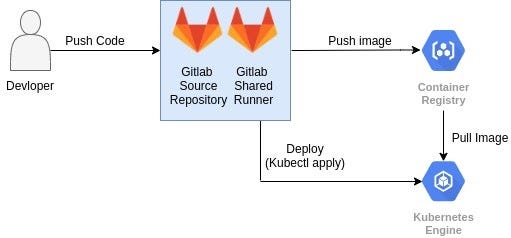
Medium
In this blog , we will demonstrate how to create a Gitlab CI/CD pipeline that uses a Gitlab Runner to build and push images to GCR and…
rapid sparrow
tranquil slate
Hey! I have a question regarding gitlab CI/CD and GKE. ```yml
deploy:
stage: de...
it knows by its name, hence will not reapply.
But i recommend learning stuff like helm
Because it gives ability to gather objects into packages, which u can apply to cluster
if u delete some objects/files form helm package => objects is surely deleted too during next apply of helm
may be there are alternative technologies to achieve the same i suspect another tech can do similar stuff
helm works great with skaffold together (skaffold allows at yaml level to set some of helm settings for applying + additional stuff)
tranquil slate
Gonna take a look into it (I remember using it to connect gitlab to the cluster i think), sounds super interesting! Thank you so much for your help 🙂
tranquil slate
Hey, I have another question related to deploying a django application to GKE.
I currently have a django app that uses sqlite3. I initially thought that I could just do this:
- Put the entire app into a docker container
- deploy this container to the kubernetes cluster on GKE.
Now, I am wondering about 2 things:
- if I have 3 pod replicas for example, would these pods be able to share the sqlite database between them? Each pod would just run one container which contains the django app and sqlite.
- https://cloud.google.com/python/django/kubernetes-engine according to the GKE docs, they use cloud sql, and I believe they deploy it as a separate resource. I know that sqlite isnt really the best option for deploying to kubernetes, but is there still a way to use it?
- As stated above, everything from my django application is in a single docker container. Would it in any way be better/make kubernetes deployment easier if I split the sqlite3 database into its own container? Hence, each pod on kubernetes would have 2 containers: 1) the actualy django app, 2) the database.
thorny shell
- tl;dr: not a good idea.
https://sqlite.org/useovernet.html
rapid sparrow
-
- a bit better idea will be migrating to normal database like postgresql. (pip install psycopg2-binary for its possible usage in django)
thorny shell
sqlite is wonderful, but it's not really usable by multiple "machines", and in your case, a pod is basically a machine. You should really look into a real database like Postgresql, or some cloud-based system that Google offers
tranquil slate
Hmm alright thanks, imma take a look into that 🙂
rapid sparrow
tranquil slate
Hmm alright thanks, imma take a look into that 🙂
feel free to give a look to ... (checking cheat sheet) Google Cloud SQL with Postgresql Engine too then.
Managed databases are way better idea than trying to fit db into kubernetes

u a always free to have db in kubernetes though, if u don't care about its resizing/backups/loss of data (basically it is temporal db)(ideal for redis for example)
tranquil slate
Ahh i see
So basically, cloudsql would be hosted outside of the gke cluster
But in that case, couldnt I just host an SQlite database on google cloud instead of a cloud sql database?
tranquil slate
thorny shell
1) tl;dr: not a good idea.
https://sqlite.org/useovernet.html
Quick question about this - I may be miss understanding the page u sent, but isnt that related to if the SQlite database is hosted separately from the django app?
Rather than having django and sqlite running within the same container
thorny shell
uh, yes; isn't that exactly your situation?
you have three separate pods, all running django
they want to share the same data
therefore they must share a single database
which cannot, by definition, exist on all three pods
tranquil slate
Ahhh ok I see, yeah alright I was under the assumption that you could have a database in each and that they could somehow sync
thorny shell
not sqlite
fancier databases can sync with each other, I think, sorta, maybe; but I get the sense that that's out of fashion
the cool kids are all using nosql now (or, they were 10-15 years ago; there's probably something even cooler now 🙂 )
rapid sparrow
tranquil slate
But in that case, couldnt I just host an SQlite database on google cloud instead...
SQlite database is not cloud friendly (and not friendly to be used over network in general), that's why it will be not offered in managed Cloud SQL database object.
There will be options only for postgresql/mariadb and other friendly for usage over network dbs
SQLite is ideal for local usage...when no need to send network requests between different PCs
Application at user desktop using it for local stuff to parse and query results / keeping state of app locally.
Application at client side in user browser can be even using it probably in some form. (in frontend framework like React/Vue)
+Sqlite is too feature simple, and having lack of many validations normal database over network should have.
rapid sparrow
tranquil slate
But in that case, couldnt I just host an SQlite database on google cloud instead...
get book Docker Deep Dive and learn using docker. then u can get locally postgresql easily. with docker u can use in your dev environment locally(+in tests included) before deploying to managed db+GKE
rapid sparrow
tranquil slate
Ahh i see
Actually, conviniently, i am writing article at the moment... about how to dockerize python web applications
and as part of it... i provide code examples of running tests in postgresql over docker-compose, locally and in Github Actions + Gitlab CI
https://github.com/darklab8/darklab_article_docker_python
Examples for Django and FastAPI are available already
https://github.com/darklab8/darklab_article_docker_python/tree/master/example_frm_django
https://github.com/darklab8/darklab_article_docker_python/tree/master/example_frm_fastapi
U can see example of postgresql usage in docker-compose
https://github.com/darklab8/darklab_article_docker_python/blob/master/example_frm_django/docker-compose.dev.yml
- needed to install stuff + configuring settings.py file
CI examples to run tests automatically
https://github.com/darklab8/darklab_article_docker_python/blob/master/.github/workflows/build.yml
https://github.com/darklab8/darklab_article_docker_python/blob/master/.gitlab-ci.yml
tranquil slate
This is really great! Thank you both so much, I really appreciate all of your help 😄
 thorn portal
rapid sparrow
Actually, conviniently, i am writing article at the moment... about how to docke...
thorn portal
rapid sparrow
Actually, conviniently, i am writing article at the moment... about how to docke...
repo looks pretty neat!
- you might also want to pin poetry version for increased confidence in reproducibility (still curling a 3rd party script 🤷♂️)
- I used to also use Makefile a lot like this, then i found https://taskfile.dev/ to be a better alternative for me personally, perhaps you will find it useful as well (i really hated the necessity of tabs in make)
- personally, i have my volume mount definitions placed in the docker-compose spec (the dev variant of course) instead of in ad-hoc
docker-compose run, i believe that is a more consistent behaviour (i.e. if you spin up docker-compose base dev env and change a file on local fs, it's going to be reflected in your docker container 100% of the time)
rapid sparrow
thorn portal
repo looks pretty neat!
- you might also want to pin poetry version for increase...
- personally, i have my volume mount definitions placed in the docker-compose spec (the dev variant of course) instead of in ad-hoc docker-compose run , i believe that is a more consistent behaviour (i.e. if you spin up docker-compose base dev env and change a file on local fs, it's going to be reflected in your docker container 100% of the time)
Good note. i thought to leave volume out of docker-compose file for the sake of reusing same compoe file for CI pipeline where it should not be used though
- you might also want to pin poetry version for increased confidence in reproducibility (still curling a 3rd party script 🤷♂️)
yeah, i was lazy. I will fix it. Thanks
- I used to also use Makefile a lot like this, then i found https://taskfile.dev/ to be a better alternative for me personally, perhaps you will find it useful as well (i really hated the necessity of tabs in make)
OMG, i can't believe it!

Task is a task runner / build tool that aims to be simpler and easier to use
i tried to find tool like that but was not able
and i exactly look like that wished already to implement on my own!
The dream comes true!
This tool answers my prays in building CI language agnostic workflows!
(funny enough i thought building it in golang like the tool above)
brazen forge
there's also just
https://github.com/casey/just
GitHub
🤖 Just a command runner. Contribute to casey/just development by creating an account on GitHub.
rapid sparrow
brazen forge
there's also just
https://github.com/casey/just
nah. that's completely ugly in comparison
brazen forge
¯_(ツ)_/¯
rapid sparrow
brazen forge
there's also just
https://github.com/casey/just
I wished tool written in yaml with syntax being.. readable/user friendly and reminidng me about Gitlab CI syntax, easily chaining stuff, easily supplying environment vars
taskfile exactly like this
rapid sparrow
brazen forge
there's also just
https://github.com/casey/just
the only thing taskfile is missing from my dreams -> having ability to run some tasks in one off docker image runs
thorn portal
devops people are just yaml engineers tbh
yaml is quite nice 😛 love your yaml anchor usage btw
thorn portal
rapid sparrow
the only thing `taskfile` is missing from my dreams -> having ability to run som...
i think you can achieve this with CLI_ARGS in task
write {{.CLI_ARGS}} in taskfile.yml
invoke with task docker-exec -- sleep 999d e.g.
i think that works, but slightly clunky
rapid sparrow
thorn portal
i think you can achieve this with `CLI_ARGS` in `task`
write `{{.CLI_ARGS}}` in...
i see, thanks.
yummi. having full specter of writing CI workflows locallly in CI agnostic language!
CI that can be running locally!
isn't it the dream, in the world of too many CI tools around, that can be run only when git pushing to cloud xD
thorn portal
you mean you don't enjoy git pushing to remote, then proceed to twiddle your thumb for 20 mins? (edit: and yes my old job indeed has 20 minutes CI)
shocking 🙀
rapid sparrow
thorn portal
shocking 🙀
for some time i was actually avoiding the problem of Makefile with just straight writing workflows in Python though
#!/usr/bin/env python3.10
import subprocess
import argparse
from enum import Enum, auto
from types import SimpleNamespace
from contextlib import contextmanager
from typing import Generator, Callable

class EnumNames:
    environment: str = "environment"
    action: str = "action"

class TestEnvActions(Enum):
    shell = "enable shell in test env of docker compose"

class DevEnvActions(Enum):
    run = auto()

class Environment(Enum):
    testenv = TestEnvActions
    devenv = DevEnvActions

def enum_name(enum):
    return enum.__name__.lower()

def register_actions(envs, env: str, actions: Enum):
    space = SimpleNamespace()
    space.environment_parser = envs.add_parser(env)
    space.environment_subparsers = space.environment_parser.add_subparsers(dest=EnumNames.action, required=True)

    for action in actions:
        setattr(space, action.name, space.environment_subparsers.add_parser(action.name, help=str(action.value)))
    return space

def parser(input_args) -> SimpleNamespace:
    parser = argparse.ArgumentParser()
    envs = parser.add_subparsers(dest=enum_name(Environment), required=True)

    testenv = register_actions(envs=envs, env=Environment.testenv.name, actions=TestEnvActions)
    devenv = register_actions(envs=envs, env=Environment.devenv.name, actions=DevEnvActions)

    args = parser.parse_args(input_args)
    args.environment = Environment[args.environment]
    args.action = args.environment.value[args.action]
    return args

def shell(cmd):
    print(f"{cmd=}")
    subprocess.run(cmd, shell=True, check=True)
@contextmanager
def docker_compose(file, build_args = "") -> Generator[Callable[[str],None], None, None]:
    try:
        shell(f"docker-compose -f {file} build {build_args}")
        def compose_executor(cmd):
            shell(f"docker-compose -f {file} {cmd}")
        yield compose_executor
    finally:
        shell(f"docker-compose -f {file} down")

def run_action(args):
    match args.environment, args.action:
        case Environment.testenv, TestEnvActions.shell:
            with docker_compose(file="docker-compose.test.yml", build_args="-- web") as executor:
                executor("run --rm -u 0 -v $(pwd):/code -w /code web bash")
        case Environment.devenv, DevEnvActions.run:
            with docker_compose(file="docker-compose.yml") as executor:
                executor("up")

def main(input_args=None):
    args = parser(input_args)
    run_action(args)

if __name__=="__main__":
    main()
The only little problem is quite a bunch of you know... code to boilerplate each time / not very consistent
and this decision is welcome only in python projects, and still not always
argparse + Enum + match-case, and it all worked nicely
thorn portal
well i don't think makefile is a problem per se, it's just that i prefer task 😛 and it's just a single binary to be dropped into wherever you need it and it's not that intrusive
i think if you are in a python-based shop, this is completely acceptable as well!
(iirc in my old job, we made heavy use of paver and went for a less homebrewed solution)
(also getting fancy with the match case already eh? - i haven't used it like at all yet)
rapid sparrow
(also getting fancy with the match case already eh? - i haven't used it like at all yet)
yeah, it is useful alternative to writingif,elif, or making hackydictionariescontaininglambdas
rapid sparrow
thorn portal
well i don't think makefile is a problem per se, it's just that i prefer `task` ...
paver is like... click python library already almost
hmm, it can be installed without polluting pip packages? 🤔
well, i need to try task and paver i guess
thorn portal
i prefer task these days, yaml all the way haha