#voice-chat-text-0
1 messages · Page 200 of 1
 thin fox
I'll accept your cookies
 short owl
ahhhhh the mere mention of coffee
 sour willow
imma head out if anyone could help just ping
 oblique ridge
sour willow
imma head out if anyone could help just ping
oblique ridge
sour willow
imma head out if anyone could help just ping
you want this to keep the same functionality as it has rn? like it's working as expected, yes?
sour willow
oblique ridge
you want this to keep the same functionality as it has rn? like it's working as ...
yes
 wise cargoBOT
@whole bear :warning: Your 3.12 eval job has completed with return code 0.
[No output]
 whole bear
!e
print([list(range(1+(n*10), (n*10)+10)) for n in range(0, 10)])
@whole bear :white_check_mark: Your 3.12 eval job has completed with return code 0.
[[1, 2, 3, 4, 5, 6, 7, 8, 9], [11, 12, 13, 14, 15, 16, 17, 18, 19], [21, 22, 23, 24, 25, 26, 27, 28, 29], [31, 32, 33, 34, 35, 36, 37, 38, 39], [41, 42, 43, 44, 45, 46, 47, 48, 49], [51, 52, 53, 54, 55, 56, 57, 58, 59], [61, 62, 63, 64, 65, 66, 67, 68, 69], [71, 72, 73, 74, 75, 76, 77, 78, 79], [81, 82, 83, 84, 85, 86, 87, 88, 89], [91, 92, 93, 94, 95, 96, 97, 98, 99]]
some function on this range(1, 101)
short owl
tabulate OR itertools which is better
oblique ridge
!e
from itertools import count, islice

numbers = count(start=1)
result = [list(islice(numbers, 9)) for _ in range(11)]

for row in result:
    print(row)
@oblique ridge :white_check_mark: Your 3.12 eval job has completed with return code 0.
001 | [1, 2, 3, 4, 5, 6, 7, 8, 9]
002 | [10, 11, 12, 13, 14, 15, 16, 17, 18]
003 | [19, 20, 21, 22, 23, 24, 25, 26, 27]
004 | [28, 29, 30, 31, 32, 33, 34, 35, 36]
005 | [37, 38, 39, 40, 41, 42, 43, 44, 45]
006 | [46, 47, 48, 49, 50, 51, 52, 53, 54]
007 | [55, 56, 57, 58, 59, 60, 61, 62, 63]
008 | [64, 65, 66, 67, 68, 69, 70, 71, 72]
009 | [73, 74, 75, 76, 77, 78, 79, 80, 81]
010 | [82, 83, 84, 85, 86, 87, 88, 89, 90]
011 | [91, 92, 93, 94, 95, 96, 97, 98, 99]
... (truncated - too many lines)
Full output: https://paste.pythondiscord.com/KMQ7H44HA2LMUU4DF5MOQKJD5M
 stuck furnace
!e In python 3.12, you can now do this: ```py
from itertools import batched
mylist = list(batched(range(1, 101), n=10))
print(mylist)
@stuck furnace :white_check_mark: Your 3.12 eval job has completed with return code 0.
[(1, 2, 3, 4, 5, 6, 7, 8, 9, 10), (11, 12, 13, 14, 15, 16, 17, 18, 19, 20), (21, 22, 23, 24, 25, 26, 27, 28, 29, 30), (31, 32, 33, 34, 35, 36, 37, 38, 39, 40), (41, 42, 43, 44, 45, 46, 47, 48, 49, 50), (51, 52, 53, 54, 55, 56, 57, 58, 59, 60), (61, 62, 63, 64, 65, 66, 67, 68, 69, 70), (71, 72, 73, 74, 75, 76, 77, 78, 79, 80), (81, 82, 83, 84, 85, 86, 87, 88, 89, 90), (91, 92, 93, 94, 95, 96, 97, 98, 99, 100)]
@whole bear :white_check_mark: Your 3.12 eval job has completed with return code 0.
[(<list_iterator object at 0x7f837cd574c0>,), (<list_iterator object at 0x7f837cd574c0>,), (<list_iterator object at 0x7f837cd574c0>,), (<list_iterator object at 0x7f837cd574c0>,), (<list_iterator object at 0x7f837cd574c0>,), (<list_iterator object at 0x7f837cd574c0>,), (<list_iterator object at 0x7f837cd574c0>,), (<list_iterator object at 0x7f837cd574c0>,), (<list_iterator object at 0x7f837cd574c0>,), (<list_iterator object at 0x7f837cd574c0>,)]
@sour willow 
whole bear
!e
i = iter(list(range(1, 101)))
print(list(zip(*([i] * 10))))
@whole bear :white_check_mark: Your 3.12 eval job has completed with return code 0.
[(1, 2, 3, 4, 5, 6, 7, 8, 9, 10), (11, 12, 13, 14, 15, 16, 17, 18, 19, 20), (21, 22, 23, 24, 25, 26, 27, 28, 29, 30), (31, 32, 33, 34, 35, 36, 37, 38, 39, 40), (41, 42, 43, 44, 45, 46, 47, 48, 49, 50), (51, 52, 53, 54, 55, 56, 57, 58, 59, 60), (61, 62, 63, 64, 65, 66, 67, 68, 69, 70), (71, 72, 73, 74, 75, 76, 77, 78, 79, 80), (81, 82, 83, 84, 85, 86, 87, 88, 89, 90), (91, 92, 93, 94, 95, 96, 97, 98, 99, 100)]
im on 11.5 sadly
stuck furnace
Without batched, I'd do something like this:```py
mylist = [
[10*i + j + 1 for j in range(10)]
for i in range(10)
]
Let me just check that's correct 😅
!e ```py
mylist = [
[10*i + j + 1 for j in range(10)]
for i in range(10)
]
print(mylist)
@stuck furnace :white_check_mark: Your 3.12 eval job has completed with return code 0.
[[1, 2, 3, 4, 5, 6, 7, 8, 9, 10], [11, 12, 13, 14, 15, 16, 17, 18, 19, 20], [21, 22, 23, 24, 25, 26, 27, 28, 29, 30], [31, 32, 33, 34, 35, 36, 37, 38, 39, 40], [41, 42, 43, 44, 45, 46, 47, 48, 49, 50], [51, 52, 53, 54, 55, 56, 57, 58, 59, 60], [61, 62, 63, 64, 65, 66, 67, 68, 69, 70], [71, 72, 73, 74, 75, 76, 77, 78, 79, 80], [81, 82, 83, 84, 85, 86, 87, 88, 89, 90], [91, 92, 93, 94, 95, 96, 97, 98, 99, 100]]
damn thanks
whole bear
whole bear
!e
```py
i = iter(list(range(1, 101)))
print(list(zip(*([i] * 10))))
```
!e
def groupN(i, N):
  return zip(*([i]*N))

print(list(groupN(list(range(1, 101)), 10)))
@whole bear :white_check_mark: Your 3.12 eval job has completed with return code 0.
[(1, 1, 1, 1, 1, 1, 1, 1, 1, 1), (2, 2, 2, 2, 2, 2, 2, 2, 2, 2), (3, 3, 3, 3, 3, 3, 3, 3, 3, 3), (4, 4, 4, 4, 4, 4, 4, 4, 4, 4), (5, 5, 5, 5, 5, 5, 5, 5, 5, 5), (6, 6, 6, 6, 6, 6, 6, 6, 6, 6), (7, 7, 7, 7, 7, 7, 7, 7, 7, 7), (8, 8, 8, 8, 8, 8, 8, 8, 8, 8), (9, 9, 9, 9, 9, 9, 9, 9, 9, 9), (10, 10, 10, 10, 10, 10, 10, 10, 10, 10), (11, 11, 11, 11, 11, 11, 11, 11, 11, 11), (12, 12, 12, 12, 12, 12, 12, 12, 12, 12), (13, 13, 13, 13, 13, 13, 13, 13, 13, 13), (14, 14, 14, 14, 14, 14, 14, 14, 14, 14), (15, 15, 15, 15, 15, 15, 15, 15, 15, 15), (16, 16, 16, 16, 16, 16, 16, 16, 16, 16), (17, 17, 17, 17, 17, 17, 17, 17, 17, 17), (18, 18, 18, 18, 18, 18, 18, 18, 18, 18), (19, 19, 19, 19, 19, 19, 19, 19, 19, 19), (20, 20, 20, 20, 20, 20, 20, 20, 20, 20), (21, 21, 21, 21, 21, 21, 21, 21, 21, 21), (22, 22, 22, 22, 22, 22, 22, 22, 22, 22), (23, 23, 23, 23, 23, 23, 23, 23, 23, 23), (24, 24, 24, 24, 24, 24, 24, 24, 24, 24), (25, 25, 25, 25, 25, 25, 25, 25, 25, 25), (26, 26, 26, 26, 26, 26, 26, 26, 26, 26
... (truncated - too long)
Full output: https://paste.pythondiscord.com/OXATW6CETKM3QXZKCYHSO5BUFM
sour willow
yeah tried that gave an error
i think imma use alex's for now since thats the only one i can fully understand
well those were cool thnx to all of you guys
whole bear
wise cargo
<@456226577798135808> :white_check_mark: Your 3.12 eval job has completed with r...
..
oblique ridge
!e ```py
from itertools import count, islice
result = [list(islice(count(start=1), 9)) for _ in range(11)]
print(*result, sep='\n')
@oblique ridge :white_check_mark: Your 3.12 eval job has completed with return code 0.
001 | [1, 2, 3, 4, 5, 6, 7, 8, 9]
002 | [1, 2, 3, 4, 5, 6, 7, 8, 9]
003 | [1, 2, 3, 4, 5, 6, 7, 8, 9]
004 | [1, 2, 3, 4, 5, 6, 7, 8, 9]
005 | [1, 2, 3, 4, 5, 6, 7, 8, 9]
006 | [1, 2, 3, 4, 5, 6, 7, 8, 9]
007 | [1, 2, 3, 4, 5, 6, 7, 8, 9]
008 | [1, 2, 3, 4, 5, 6, 7, 8, 9]
009 | [1, 2, 3, 4, 5, 6, 7, 8, 9]
010 | [1, 2, 3, 4, 5, 6, 7, 8, 9]
011 | [1, 2, 3, 4, 5, 6, 7, 8, 9]
... (truncated - too many lines)
Full output: https://paste.pythondiscord.com/TXGVSEPGPM4WZOF4DAHJQSOH4M
sour willow
imma head out now , again thanks to everyone
stuck furnace
This is approximately the same as itertools.batched (although will truncate the iterable if its length is not a multiple of n): ```py
def batched(iterable, n):
iterators = [iter(iterable)] * n
return zip(*iterators)
Understanding how the above works is a good exercise for better understanding iterators.
Btw, if you're using an older version of python, there are a bunch of recipes at the bottom of the itertools documentation for functions that may be added in later versions. https://docs.python.org/3.11/library/itertools.html?highlight=itertools#itertools-recipes

Python documentation
This module implements a number of iterator building blocks inspired by constructs from APL, Haskell, and SML. Each has been recast in a form suitable for Python. The module standardizes a core set...
Some of them are pretty handy. I think all of them are in the third-party more-itertools package.
short owl
would itertools ( looping ) improve speed in a tkinter loop ????
whole bear
no one knows
i didnt mean to be discouraging but something like this is what you have to try and find out
 rugged root
Harder to test something like that given all the additional overhead running
oblique ridge
perf_counter and cProfile gang
short owl
itertools for efficiency is sparking a curioussity - seen it mentioned many times here there
whole bear
sure but if the difference is not noticiable, is the optimization even worth it
itertools is just a library of functions which work on iterators
oblique ridge
itertools is like crack and i feel like i'm cheating every time i use it
whole bear
iterators are actually not an optimization technique but just a way to abstract away pure for and while loops
what you would do using iterators, would translate the a for/while loop in C
in an imperative way vs declarative way
short owl
maybe good for fast translating , 32 bit data tables ( for ASM - assembler ) , cross CPU assembler translating , CHIP-8 and others , wink wink
whole bear
leetcode absolutely cannot test ones skills
most leetcode problems are solvable only if you knew the solution beforehand
rugged root
That's one of the things I hate about it
stuck furnace
It's just companies copying Google
rugged root
This
Rabbit says it the best, people need to stop trying to copy FAANG
Odds are good that what they're doing do not apply to x company
whole bear
does zip return a iterator of iterators or an iterator of tuples
stuck furnace
The latter, I think, yeah.
rugged root
!d zip
wise cargoBOT
zip(*iterables, strict=False)```
Iterate over several iterables in parallel, producing tuples with an item from each one.

Example:

```py
>>> for item in zip([1, 2, 3], ['sugar', 'spice', 'everything nice']):
...     print(item)
...
(1, 'sugar')
(2, 'spice')
(3, 'everything nice')
```...
Similar names: 2to3fixer.zip
whole bear
yea but it still would allocate the size of tuple every iteration and deallocate it
oblique ridge
!e ```py
some_list = [1, 2, 3]
some_zip = zip(some_list)
print(type(some_zip))
print(type(next(some_zip)))
@oblique ridge :white_check_mark: Your 3.12 eval job has completed with return code 0.
001 | <class 'zip'>
002 | <class 'tuple'>
Python documentation
The Python interpreter has a number of functions and types built into it that are always available. They are listed here in alphabetical order.,,,, Built-in Functions,,, A, abs(), aiter(), all(), a...
whole bear
i guess the internal allocator would somehow deal with repeated allocation and deallocation of this tuple
stuck furnace
Conventionally, tuples are analogous to C structs. I.e. they're used to represent a grouping of a handful of elements of hetrogenous type.
whole bear
but they wont be ever stored on the C stack
stuck furnace
But they're sometimes used as "just an immutable list".
short owl
did you ever have a , Kim-1 , computer ? @rugged root
stuck furnace
whole bear
but they wont be ever stored on the C stack
I just mean like, in terms of how they're intended to be thought about.
oblique ridge
>>> some_list = ['a', 'b', 'c']
>>> some_tuple = (some_list, 'd', 'e')
>>> some_tuple[0] += 'f'
Traceback (most recent call last):
  File "<stdin>", line 1, in <module>
TypeError: 'tuple' object does not support item assignment
>>> some_tuple
(['a', 'b', 'c', 'f'], 'd', 'e')
comparing , CHIP-8 and KIM-1 , asm code @rugged root
stuck furnace
Weird how the item is added despite the exception 
rugged root
Gotta love it
rugged root
!e
meats = ["ham", "pork", "beef"]
tuple_ = (meats, 3, 4)
tuple_[0].append("spam")
print(tuple_)
@rugged root :white_check_mark: Your 3.12 eval job has completed with return code 0.
(['ham', 'pork', 'beef', 'spam'], 3, 4)
Vec::with_capacity(10)
oblique ridge
[None for _ in range(10)]
!e
meats = {"ham": 1, "pork": 2, "beef": 3}
tuple_ = (meats, 3, 4)
tuple_[0]["spam"] = 5
print(tuple_)
!e ```
l = [None]*10
print(l)
@oblique ridge :white_check_mark: Your 3.12 eval job has completed with return code 0.
[None, None, None, None, None, None, None, None, None, None]
@rugged root :white_check_mark: Your 3.12 eval job has completed with return code 0.
({'ham': 1, 'pork': 2, 'beef': 3, 'spam': 5}, 3, 4)
!e ```py
import sys
print(sys.getsizeof([]))
print(sys.getsizeof([None for _ in range(10)]))
print(sys.getsizeof([None]*10))
@oblique ridge :white_check_mark: Your 3.12 eval job has completed with return code 0.
001 | 56
002 | 184
003 | 136
(0..10).collect::<Vec<_>>()
so an ExactSizedIterator would know its exact length
and like that could be used for some optimizations
yea the main bottleneck is bad cache performance
due to everything being a reference
cat /dev/zero >> /dev/ram0
https://github.com/aspizu/onyo
my prog lang
rugged root

Bun
Bundle, install, and run JavaScript & TypeScript — all in Bun. Bun is a new JavaScript runtime with a native bundler, transpiler, task runner, and npm client built-in.
oblique ridge
 short owl
its a pork dumpling
whole bear
gomonade
short owl
blue gatorade + hydrocarbon + lemon_wedge
rugged root

 whole bear
https://github.com/aspizu/onyo mascot is a onion
short owl
tread softly carry a big trunk..
sour willow
wait is alex lp?
rugged root
No, very different person
sour willow
that profile really reminded me of lp for some odd reason
rugged root
@thorn sequoia What's the context?
 quaint oyster
whole bear
quaint oyster
whole bear
@stuck furnace would you let me stream
short owl
choice coffee + boxes of donuts = mighty fine bribe
stuck furnace
sour willow
that profile really reminded me of lp for some odd reason
I used to be LX 🤔
stuck furnace
whole bear
<@476543547210858506> would you let me stream
What do you want to stream?
whole bear
coding
stuck furnace
Sure 👍
whole bear
thanks
stuck furnace
!stream 939196353362419722 1h
wise cargoBOT
✅ @whole bear can now stream until <t:1697138220:f>.
sour willow
stuck furnace
I used to be LX 🤔
ah still on that instant coffee grind?
sour willow
whole bear
actually ricing
wm?
whole bear
shod
stuck furnace
sour willow
ah still on that instant coffee grind?
I gave up caffeine for a while, but gave in and started drinking it again.
 whole bear
theprimagen
oblique ridge

GitHub
Python binding to Modest and Lexbor engines (fast HTML5 parser with CSS selectors). - GitHub - rushter/selectolax: Python binding to Modest and Lexbor engines (fast HTML5 parser with CSS selectors).
stuck furnace
Has anyone had an issue on windows where your time keeps getting 1 hour out of sync?
whole bear
i am one of the people of all time
stuck furnace
Yeah it's really weird.
Erm, we do have summer time. I can't remember whether it's in the summer or winter where we're off from UTC by one hour.
 gentle flint
help
I forgot what this is called
whole bear
 pulsar light
@oblique ridge
oblique ridge
yo
pulsar light
def power(base,power_num):
    result = 1
    for i in range(power_num):
        if power_num == 0:
            result = 1
        elif power_num == 1:
            result = base
        elif power_num > 1:
            result = result * base
    return result

print(power(2,3))
is there a library to parse derive(Debug) from rust in python?
 umbral stone
anyone knows how to replace the python version in windows like i have python 11 so how can i do into python 12
oblique ridge
pulsar light
```py
def power(base,power_num):
result = 1
for i in range(power_num):
...
def power(a, n):
    result = 1
    for _ in range(n):
        result *= a
    return result
but it's the exact same idea
but, wouldn't you want to do your if power_num checks outside your loop?
 tall ridge
whole bear
is there a library to parse `derive(Debug)` from rust in python?
tall ridge
whole bear
is there a library to parse `derive(Debug)` from rust in python?
would this work: https://pypi.org/project/rustimport/. ?
 rugged root
Huh, neat
tall ridge
I'll be AFK
 prime bobcat
whats the output of round 1.5?
oblique ridge
Python documentation
The Python interpreter has a number of functions and types built into it that are always available. They are listed here in alphabetical order.,,,, Built-in Functions,,, A, abs(), aiter(), all(), a...
oblique ridge
prime bobcat
whats the output of round 1.5?
>>> round(1.5)
2
>>> round(2.5)
2
what why
oblique ridge
floating point arithmetic magic
rugged root
oblique ridge
floating point arithmetic magic
Crappy magic
oblique ridge
1.50 should round up to 2
decimal 2.5 should also round up to 3
but we're working with floats, not decimals
oblique ridge
>>> round(Decimal(1.5))
2
>>> round(Decimal(2.5))
2
Python documentation
Source code: Lib/decimal.py The decimal module provides support for fast correctly rounded decimal floating point arithmetic. It offers several advantages over the float datatype: Decimal “is based...
 gilded rivet


The king receives a lesson in government from Dennis...
Alternative Link from ThePirateBay: https://thepiratebay.org/torrent/9066073/Monty.Python.and.the.Holy.Grail.1975.1080p.BluRay.x264.anoXmous
Original Link (Dead, for archival purposes only): http://kickass.to/monty-python-and-the-holy-grail-720p-best-quality-murdoc47-t6439813.html
https:/...
gentle flint
 oblique ridge

https://www.cameo.com/labeast
Do you want a Personalized L.A. BEAST Video Shout Out??
Happy Birthday Wishes, Good Luck before the big game,
or just a simple Have A Good Day?!?!?
Check out my Cameo Profile Here:
Support On PATREON:
https://www.patreon.com/LABEAST
BEST OF THE BEST LA BEAST VIDEOS PLAYLIST:
https://www.youtube.com/playlist?lis...
prime bobcat
im trying to solve the round problem but i got stuck lol
throw that thing away and let us know where
example 1.51
take 1.51 as X
y = x/x with only 2 characters thas equals 1.5
take 1.51 and divide by 1.5
1.50/1.5 = 1
1.51/1.5 = 1.006
so you can solve this
prime bobcat
gilded rivet
this
gilded rivet
 prime bobcat
how do you solve that then if your number has 200000 decimals
gilded rivet
You use alternative ways of representing the number
prime bobcat
even if i compare them?
will be the same
oh
sorry im new with this lol
didnt knew " " = ' '
rugged root
rugged root
prime bobcat
dm code
lol
Floating-point arithmetic is considered an esoteric subject by many people
oh they talk about the rounding error
i think w3schools doesnt have all the methods at least if you dont look for them for youself
 sturdy panther
Use regex 🙃
pulsar light
@oblique ridge also for neg numbers:```py
def power(base,power_num):
result = 1
for i in range(power_num):
if power_num == 0:
result = 1
elif power_num == 1:
result = base
elif power_num > 1:
result = result * base
for _ in range(power_num, 0):
if power_num < 1:
result = result / base
return result
print(power(2,-3))
 still shell
yo what up
oblique ridge
nice
prime bobcat
my wife customized my keyboard to encourage me to coding lol
sour willow
prime bobcat
my wife customized my keyboard to encourage me to coding lol
how does any of that add up
prime bobcat
idk
but someone supporting you is cool
im stuck with some stuff and is hard to keep learning
i hate the loops
hello sir
 alpine crow
pulsar light
<@586321204047249423> also for neg numbers:```py
def power(base,power_num):
...
alpine crow
pulsar light
<@586321204047249423> also for neg numbers:```py
def power(base,power_num):
...
whats wrong with py print(2 ** -3)
pulsar light
ahh he told me to not use it for learnin purposes
alpine crow
valid reason lol
pulsar light
haha
alpine crow
nice function tho
alpine crow
pulsar light
<@586321204047249423> also for neg numbers:```py
def power(base,power_num):
...
the if power_num == 0 is actually impossible to happen tho
yeah
alpine crow
yeah if u put 2,0 for i in (0) does nothing
pulsar light
give me smt to do to up my lvl in coding
pulsar light
alpine crow
yeah if u put 2,0 for i in (0) does nothing
wait rly?
 toxic arch
why are you speaking here if not in vc
alpine crow
lol bc the chats were here
toxic arch
life
is roblox
NAHH
WTFF
true..
liufe is defo python
wrong chat
nahhhh wrong chat
guys
do you wannna see my discord bot?

GitHub
A discord bot that connects to your jb ps4 to allow other people to do save things with it - GitHub - Zhaxxy/eZwizard2-bot: A discord bot that connects to your jb ps4 to allow other people to do sa...
can you give mea star
pls
yay
alpine crow
not bad
pulsar light
 toxic arch
i broke python wtf
alpine crow
 pulsar light
 toxic arch
pulsar light
toxic arch
pulsar light
whats that
pulsar light
toxic arch
words?
oh hangman
i done fucked up my python
install
smh
nah
we cant
we need a role
still cant stream
can we call a mod
pulsar light
@rugged root
stuck furnace
Hello 👀
toxic arch
oh cmon on
stuck furnace
I may have been lurking in #python-discussion
stuck furnace
Erm, who wants to share screen sorry?
Alright
My minds blanked an I've forgotten the command one sec 😅
!stream 133817562646577153 1h
wise cargoBOT
✅ @alpine crow can now stream until <t:1697147519:f>.
stuck furnace
toxic arch
it wont let me unisntall python
Windows?
toxic arch
stuck furnace
Windows?
yes
pulsar light
hah how?
stuck furnace
What happens when you try to uninstall?


 stuck furnace
@toxic arch Try the steps in this SO answer: https://superuser.com/a/1301610

Super User
I installed python 3.6.2 recently on my windows 10 machine, but I cannot seem to uninstall it at all
The error I get is:
No python 3.6 installation was detected
then
0x800070643 Fatal error
Let me know if that works.
toxic arch
damn rip my modules i installed then
hmm i wonder if i can find my old
coin counter thing
!paste
wise cargoBOT
Pasting large amounts of code
If your code is too long to fit in a codeblock in Discord, you can paste your code here:
https://paste.pythondiscord.com/
After pasting your code, save it by clicking the Paste! button in the bottom left, or by pressing CTRL + S. After doing that, you will be navigated to the new paste's page. Copy the URL and post it here so others can see it.
whole bear
yo i just made a python script that helps you find any info about any topic its really helpful for research. lmk if you want the link i promise to you its not malicious i swear on my life i just made it safe and helpful. i just want to make researching easier. + it gives you MLA citations for each article without needing easybib or an equivalent
I originally made it for myself but put it up on github
toxic arch
nope @stuck furnace it didnt work
stuck furnace
toxic arch
nope <@476543547210858506> it didnt work
You followed all the steps and there was no change?
toxic arch
stuck furnace
You followed all the steps and there was no change?
yep i deleted the python folder and its still saing that error
in appdata
stuck furnace
Ah right. And you tried repairing after deleting that folder?
 stuck furnace
toxic arch
stuck furnace
toxic arch
Did you have python installed on a different drive?
toxic arch
stuck furnace
Did you have python installed on a different drive?
yeah i did recently
but its not plugged in
i dont have access to it right now
stuck furnace
toxic arch
i dont have access to it right now
Oh ok. So the drive that python was installed on is no longer connected to your PC?
toxic arch
stuck furnace
Oh ok. So the drive that python was installed on is no longer connected to your ...
yes
prime bobcat
guys how many space i need for all python methods
stuck furnace
toxic arch
yes
I've found this advice, but for nodejs: https://stackoverflow.com/questions/41364644/can-not-use-or-uninstall-node-js

Stack Overflow
I am using windows and installed Node.js a while ago and I now can not use it or uninstall it as it is on drive D:\ which is no longer with me. I have looked at the windows regedit solution but cou...
toxic arch
what
prime bobcat
just in case someone would get a tatoo of them
lol
do you think i have plenty space on my body, only visible parts for me
stuck furnace
All python methods
toxic arch
stuck furnace
I've found this advice, but for nodejs: https://stackoverflow.com/questions/4136...
there was a python there, i deleted it but
its still there
i mean
the error
prime bobcat
and what about methods and simple examples
stuck furnace
Python documentation
The Python interpreter has a number of functions and types built into it that are always available. They are listed here in alphabetical order.,,,, Built-in Functions,,, A, abs(), aiter(), all(), a...
prime bobcat
small ones
stuck furnace
¯_(ツ)_/¯
toxic arch
 alpine crow
toxic arch
alpine crow
toxic arch
 prime bobcat
maybe only the name
and if i see them ill try to memorize everything
i will try and let you know exactly how much
alpine crow
 prime bobcat
im using this btw https://www.w3schools.com/python/python_reference.asp

W3Schools offers free online tutorials, references and exercises in all the major languages of the web. Covering popular subjects like HTML, CSS, JavaScript, Python, SQL, Java, and many, many more.
alpine crow
alpine crow
alpine crow
https://docs.python.org/3/
u can use this too
prime bobcat
oh yeah, thats better
i had problems calling stuff from a dictionary on another module
and w3schools doesnt have a lot of explanation
 haughty fog
yea, s-lang would work
pulsar light
 haughty fog
prime bobcat
im realizing, maybe i cant get all of the python methods tattooed
haughty fog
prime bobcat
im realizing, maybe i cant get all of the python methods tattooed
get s-lang tattooed much easier
toxic arch
where on earth does it store this?
stuck furnace
toxic arch
there was a python there, i deleted it but
Erm, I'm not sure I know enough about Windows to advise on editing the registry. Perhaps try this: https://superuser.com/a/1482475
Super User
Currently I'm trying to install a program I used a long time ago. It's a newer version of the old program. The problem lies with the previous install. I installed it on an external HDD that no longer
 lavish rover
i don't really use windows, not sure
prime bobcat
haughty fog
get s-lang tattooed much easier
whats s lang?
pulsar light
stuck furnace
toxic arch
i deleted mutiple registries
Try the troubleshooter in the linked answer, and let me know if anything changes.
stuck furnace
¯_(ツ)_/¯
Code jam is once a year in the summer. PyWeek is twice a year.
PyWeek isn't actually organised by us but the code jam is.
We're a large, friendly community focused around the Python programming language. Our community is open to those who wish to learn the language, as well as those looking to help others.
haughty fog
prime bobcat
whats s lang?
s-lang (snake-language)
the best programming language, all functions are different lengths of "s"s and any other letter beside "s" are seen as a comment
"hello world" would be:
s ('s+8 s+5 s+12 1s+2 s+0 s+15 s+23 s+15 s+18 s+12 s+4')
lavish rover
!resources
wise cargoBOT
Resources
The Resources page on our website contains a list of hand-selected learning resources that we regularly recommend to both beginners and experts.
lavish rover
from random import choice
while True:
  input("Enter Rock/Paper/Scissors:")
  print(choice(["You win!", "You lose", "draw"]))
s+8 = h?
haughty fog
a= 1, b = 2, c = 3, d = 4, e = 5, f = 6, g = 7, h = 8
toxic arch
whoever told me to install python to a disk
dont do that
any way to get the modules like tkinter in a python embdeded paCKAGE?
i found the disk
stuck furnace
toxic arch
any way to get the modules like tkinter in a python embdeded paCKAGE?
As in a single exe?
toxic arch
stuck furnace
As in a single exe?
no just the .zip
it says tkinker not found
spooky music
in reccomended
lavish rover

GitHub
Ray tracing engine, from scratch, in C++. Contribute to mustafaquraish/rt development by creating an account on GitHub.
toxic arch

GitHub
im lost. Zhaxxy has 15 repositories available. Follow their code on GitHub.
why not
@alpine crow
its thew namer of the savefile in lbp
look
prime bobcat
i had that question too
 prime bobcat
pygame has sound?
prime bobcat
playsound module for tkinter?
GeeksforGeeks
A Computer Science portal for geeks. It contains well written, well thought and well explained computer science and programming articles, quizzes and practice/competitive programming/company interview Questions.
toxic arch
    import winsound
    duration = 1000  # milliseconds
    freq = 440  # Hz
    winsound.Beep(freq, duration)
this works
yay my python fixed now
stuck furnace
toxic arch
yay my python fixed now
Did the troubleshooter actually work?
toxic arch
stuck furnace
Did the troubleshooter actually work?
no i just found the disk
and uninstalled it
stuck furnace
Ah right I see
toxic arch
sad though
sigh i told them soo many times to install python on the pcs
but they wont
 stuck furnace
.xkcd 710
 viscid lagoonBOT
The Strong Collatz Conjecture states that this holds for any set of obsessively-hand-applied rules.
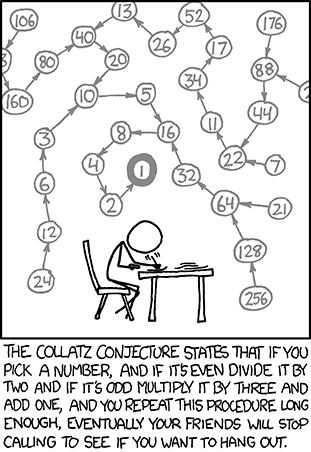
2010/3/5 - #710, 'Collatz Conjecture'
toxic arch
rabbit hole
pulsar light
haha
pulsar light
nah cmd dubs
toxic arch
pulsar light
nah cmd dubs
how
pulsar light
its just do
 alpine crow
!e py def collatz(n): if n == 1: return 1 elif n % 2 == 0: print(n) return collatz(n/2) else: print(n) return collatz(3*n+1) collatz(4) collatz(21)
wise cargoBOT
@alpine crow :white_check_mark: Your 3.12 eval job has completed with return code 0.
001 | 4
002 | 2.0
003 | 21
004 | 64
005 | 32.0
006 | 16.0
007 | 8.0
008 | 4.0
009 | 2.0
!e
def collatz(n):
    if n == 1:
        return 1
    elif n % 2 == 0:
        print(n)
        return collatz(n/2)
    else:
        print(n)
        return collatz(3*n+1)
collatz(4)
collatz(23423423)
@toxic arch :white_check_mark: Your 3.12 eval job has completed with return code 0.
001 | 4
002 | 2.0
003 | 23423423
004 | 70270270
005 | 35135135.0
006 | 105405406.0
007 | 52702703.0
008 | 158108110.0
009 | 79054055.0
010 | 237162166.0
011 | 118581083.0
... (truncated - too many lines)
Full output: https://paste.pythondiscord.com/CRMLNY7GGGH7VNEYZF6Q2OUWEY
alpine crow
In computability theory, the halting problem is the problem of determining, from a description of an arbitrary computer program and an input, whether the program will finish running, or continue to run forever. The halting problem is undecidable, meaning that no general algorithm exists that solves the halting problem for all possible program–in...
pulsar light
YESSSSSSS
alpine crow
toxic arch
Inocorrect
what is?
 alpine crow
this problem can't be solved by computers bc of the halting problem
toxic arch
i swear it was working fine before
toxic arch
damn
lavish rover
import sys

lines = open(sys.argv[1]).read().split('\n')
if lines == []: exit(0)

height = max([len(line) for line in lines])
width = height + len(lines) - 1
matrix = [[' ' for x in range(width)] for y in range(height)]

for i, line in enumerate(lines):
    llen = len(line)
    for j, char in enumerate(line):
        matrix[height-j-1][i+j] = char

for line in matrix:
    print(''.join(line))
 lavish rover
hello there
test
this is the diagonalizer
to
                         r
                        e
                       z
                      i
                     l
                    a
                   n
                  o
                 g
                a
               i
              d

          e e
         r h
        e t
       h
      t s
       i
    o
   lts
  lsi
 eeh
htt
@alpine crow brother do you follow the calling convetions of c/c++
in your custom code thing
man
tkinker is finicky
time to make a search bar
11:01pm here
stuck furnace
👋
pulsar light
 toxic arch
pulsar light
toxic arch
pulsar light
@pulsar light what ya trying to do with this
why is there a extra bracket here
thje blue one
its extra
no
that the yellow one
slowly coming together...


yess looks good
 wise loom

http://handmadehero.org is a project designed to capture and teach the process of coding a complete, professional-quality game from scratch.

Handmade Hero
A limbless child receives a magical gift that allows him to set off on the adventure he always dreamed of.
toxic arch
cya
toxic arch
wise loom
https://www.youtube.com/watch?v=A2dxjOjWHxQ
https://handmadehero.org/
nice
wait
let me watch
of course
i got anti adblock
but i got a filtere to bypass it
ez
wise loom
toxic arch
i got anti adblock

Molly Rocket | Invidious
http://handmadehero.org is a project designed to capture and teach the process of coding a complete, professional-quality game from scratch.
wise loom
I didn't make it, but liked the idea
 shy raft
hi guys
wise loom
remember when Unity changed the pricing scheme on their licenses to charge game developers per install?
and their CEO quit his job a few months after the decision because it backfired
wise loom
he thought he was so clever, such a big brain and financially-driven economist mind..
and then he quit
F that guy
toxic arch

GAVILÁN II (Visualizer) - Peso Pluma, Tito Double P
Double P Records©
➸ ESCUCHA / LISTEN GÉNESIS: https://orcd.co/ppgenesis
➸Música
Interpretación - Peso Pluma, Tito Double P
Composición - Jesus Roberto Laija Garcia
Producción - Jesús Iván Leal Reyes “Parka”, Jesús Roberto Laija García
➸Letra
Chau!
Ya me escucharon por ahí
mitotes han ...
 somber heath
@naive ravine 👋
 naive ravine
somber heath
<@1089941799558197438> 👋
naive ravine
somber heath
<@1089941799558197438> 👋
cc
coucou
i want help in program
but the question is with french language
naive ravine
Ecrire un programme en Python qui demande à l'utilisateur de saisir deux nombres a et b et de lui afficher leur maximum.
somber heath
!d max
wise cargoBOT
max(iterable, *, key=None)``````py

max(iterable, *, default, key=None)``````py

max(arg1, arg2, *args, key=None)```
Return the largest item in an iterable or the largest of two or more arguments.

If one positional argument is provided, it should be an [iterable](https://docs.python.org/3/glossary.html#term-iterable). The largest item in the iterable is returned. If two or more positional arguments are provided, the largest of the positional arguments is returned.

There are two optional keyword-only arguments. The *key* argument specifies a one-argument ordering function like that used for [`list.sort()`](https://docs.python.org/3/library/stdtypes.html#list.sort). The *default* argument specifies an object to return if the provided iterable is empty. If the iterable is empty and *default* is not provided, a [`ValueError`](https://docs.python.org/3/library/exceptions.html#ValueError) is raised.fonction max
somber heath
!e py print(max(10, 5))
wise cargoBOT
@somber heath :white_check_mark: Your 3.12 eval job has completed with return code 0.
10
!e py print(5 > 10)
wise cargoBOT
@somber heath :white_check_mark: Your 3.12 eval job has completed with return code 0.
False
!e py print(5 < 10) print(5 == 10)
wise cargoBOT
@somber heath :white_check_mark: Your 3.12 eval job has completed with return code 0.
001 | True
002 | False
!e py if 5 > 10: print('A') else: print('B')
wise cargoBOT
@somber heath :white_check_mark: Your 3.12 eval job has completed with return code 0.
B
!e
wise cargoBOT
Missing required argument
code
naive ravine
!e print(max(10,200))
wise cargoBOT
@naive ravine :white_check_mark: Your 3.12 eval job has completed with return code 0.
200
!e py arr = [5, 1, -10, +4, 10] print(max(arr))
wise cargoBOT
@somber heath :white_check_mark: Your 3.12 eval job has completed with return code 0.
10
thnks
somber heath
!e py float('*#£@1gh')
wise cargoBOT
@somber heath :x: Your 3.12 eval job has completed with return code 1.
001 | Traceback (most recent call last):
002 |   File "/home/main.py", line 1, in <module>
003 |     float('*#£@1gh')
004 | ValueError: could not convert string to float: '*#£@1gh'
!e py try: float('*#£@1gh') except ValueError: print('A')
wise cargoBOT
@somber heath :white_check_mark: Your 3.12 eval job has completed with return code 0.
A
!e py v = 0 while v != 5: print(v) v += 1 print('.')
wise cargoBOT
@somber heath :white_check_mark: Your 3.12 eval job has completed with return code 0.
001 | 0
002 | 1
003 | 2
004 | 3
005 | 4
006 | .
!e py for i in range(5): print(i)
wise cargoBOT
@somber heath :white_check_mark: Your 3.12 eval job has completed with return code 0.
001 | 0
002 | 1
003 | 2
004 | 3
005 | 4
@somber heath :warning: Your 3.12 eval job timed out or ran out of memory.
[No output]
 fervent grail
!e
result = ""
for i in range (5) :
    result += f"{i}, "
result = result[:-1]
print (result)
@fervent grail :white_check_mark: Your 3.12 eval job has completed with return code 0.
0, 1, 2, 3, 4,
!e
result = ""
for i in range (5) :
    result += f"{i}, "
result = result[:-2]
print (result)
@fervent grail :white_check_mark: Your 3.12 eval job has completed with return code 0.
0, 1, 2, 3, 4
!e py v = 0 while v != 5: print(v) v += 1 if v == 2: break print('.')
wise cargoBOT
@somber heath :white_check_mark: Your 3.12 eval job has completed with return code 0.
001 | 0
002 | 1
003 | .
!e
result = ""
c = 0
whiel 5 > c :
    result += f"{c}, "
    c += 1
result = result[:-2]
print (result)
@fervent grail :x: Your 3.12 eval job has completed with return code 1.
001 |   File "/home/main.py", line 3
002 |     whiel 5 > c :
003 |           ^
004 | SyntaxError: invalid syntax
!e
result = ""
c = 0
while 5 > c :
    result += f"{c}, "
    c += 1
result = result[:-2]
print (result)
@fervent grail :white_check_mark: Your 3.12 eval job has completed with return code 0.
0, 1, 2, 3, 4
!e
result = ""
c = 0
while 5 > c :
    result += f"{c}, "
    c += 1
    if c == 3 : break
result = result[:-2]
print (result)
@fervent grail :white_check_mark: Your 3.12 eval job has completed with return code 0.
0, 1, 2
 SyntaxWarning: invalid decimal literal
  print(tabulate([[10*i+j+1for j in range(10)] for i in range(10)], tablefmt="grid"))
anyone know how i can fix this?
oops wrong channel
somber heath
sour willow
```
SyntaxWarning: invalid decimal literal
print(tabulate([[10*i+j+1for j in ...
1for?
No.
sour willow
yeah got it thnx though
sour willow
it runs anyway
somber heath
!e py 1for
wise cargoBOT
@somber heath :x: Your 3.12 eval job has completed with return code 1.
001 | /home/main.py:1: SyntaxWarning: invalid decimal literal
002 |   1for
003 |   File "/home/main.py", line 1
004 |     1for
005 |      ^^^
006 | SyntaxError: invalid syntax
Oh, okay.
sour willow
!e
print([[10*ifor j in range(1)]for i in range(2)])
@sour willow :x: Your 3.12 eval job has completed with return code 1.
001 |   File "/home/main.py", line 1
002 |     print([[10*ifor j in range(1)]for i in range(2)])
003 |             ^^^^^^^^^^^^^^^^^^^^^
004 | SyntaxError: invalid syntax. Perhaps you forgot a comma?
Are you sure you mean ^ and not ** ?
wise cargoBOT
Missing required argument
code
sour willow
why would that be an arg if its only gonna support 3.12 lol
somber heath
I suspect there's a disparity between that description and what is actually implemented.
I may also have goofed the syntax of it.
 vocal basin
sour willow
huh on 3.11.5 it runs
vocal basin
sour willow
huh on 3.11.5 it runs
<stdin>:1: SyntaxWarning: invalid decimal literal
did it get promoted to an error?
!e
[1for _ in []]
@vocal basin :white_check_mark: Your 3.12 eval job has completed with return code 0.
001 | /home/main.py:1: SyntaxWarning: invalid decimal literal
002 |   [1for _ in []]
no, not yet
pulsar light
toxic arch
somber heath
!e ```py
try:
float('*#£@1gh')
except ValueError:
print('A')```
insane
oh
nvm
i didnt see the except
somber heath
toxic arch
i didnt see the except
I get that, too, sometimes. "Oh, right, completely obvious thing I completely missed right there."
 karmic obsidian
hey hi @glass atlas
somber heath
@glass atlas 👋
 glass atlas
Hello
wise cargoBOT
somber heath
!voice
wise cargoBOT
Voice verification
Can’t talk in voice chat? Check out #voice-verification to get access. The criteria for verifying are specified there.
glass atlas
Hello
somber heath
class MyClass:
    def __init__(self, ...):  # <-- Show me this.
        ...

MyClass(...) # <-- Show me this.```I don't do DM stuff.
Bar exceptions.
somber heath
Just the lines I indicated.
oblique ridge
pulsar light
ayy good stuff. i have a collatz problem for you
pulsar light
i did it
somber heath
I need to see the class you're trying to use and the place where you're trying to create an instance of it.
oblique ridge
A website dedicated to the fascinating world of mathematics and programming
somber heath
That's part of the traceback.
oblique ridge
oblique ridge
https://projecteuler.net/problem=14
try this out. very fun problem with learning optimization @pulsar light
somber heath
Okay, and the instantiation call?
pulsar light
oblique ridge
try this out. very fun problem with learning optimization <@469419943755120650>
somebody solved this?
oblique ridge
ye this is from a site where all the problems are solvable. some of them are insanely tough, but many of the first problems are relatively easy
pulsar light
.... ok ill give it a try
somber heath
Show me what you're doing where you gopy Material(...)
pulsar light
@oblique ridge come vc
oblique ridge
also this isn't specific to this problem. you should test out your solutions on smaller sets you can confirm manually to see if what you wrote works in a reasonable time before doing it on a larger set like the thing the problem asks
oblique ridge
pulsar light
<@586321204047249423> come vc
finishing up a call rn
 noble solstice
oblique ridge
try this out. very fun problem with learning optimization <@469419943755120650>
noble solstice
oblique ridge
try this out. very fun problem with learning optimization <@469419943755120650>
I can try this!
somber heath
@pulsar light 👋
oblique ridge
absolutely, give it a go
pulsar light
oblique ridge
finishing up a call rn
kk
oblique ridge
either of yall lmk if you need help
noble solstice
printing the ans or storing in a list?
oblique ridge
the final solution is one number. so you'd wanna print that to see what it is
if you create an account with the site, you're actually able to submit the answer you get to confirm. if you don't wanna do that, just ask me if your answer is right and i can confirm
noble solstice
we need to loop until num becomes 1 and apply odd even comdition?
pulsar light
u want the code?
#3n+1
import time

t= True
a = True


print('''   Hello there, this is a programme that you use to test some numbers in Collatz conjecture.

        Incase you weren't familiar with it here is what it does:

            • First, you type a positive number.
            • If the number is even, you divide it by 2.
            • If the number is odd, you multiply by 3 and add 1.
            • The conjecture states that there is no number that wont end up in 1 if you applied this operations to it.

            You think you can find a number that can't satisfy this conjecture?. Goodluck!

                If you want to exit type 0.


      ''')

while t:
    n = int(input('Type a number :     '))
    if n ==0:
        print(' \n \n         Quit. \n \n')
        break
    print(n)
    while a:
        if n % 2 == 0:
                n //= 2
                print(n)
                time.sleep(0.1)
        else:
                n = 3*n + 1
                print(n)
                time.sleep(0.1)
        if n ==1:
            break
```ye if you send code it's nicer, but the important part is coming up with the solution
noble solstice
pulsar light
```py
#3n+1
import time
t= True
a = True
print(''' Hello there, this is a ...
Great!
noble solstice
oblique ridge
the final solution is one number. so you'd wanna print that to see what it is
ask one more problem bro!
oblique ridge
oh did you solve? 👀
this is another nice one. should be easier
https://projecteuler.net/problem=7
A website dedicated to the fascinating world of mathematics and programming
somber heath
wise cargoBOT
@somber heath :white_check_mark: Your 3.12 eval job has completed with return code 0.
001 | Hello. I am Peter.
002 | Hello. I am Paul.
you can solve this one slowly, but optimizing is the better fun
somber heath
!paste @rain salmon
wise cargoBOT
Pasting large amounts of code
If your code is too long to fit in a codeblock in Discord, you can paste your code here:
https://paste.pythondiscord.com/
After pasting your code, save it by clicking the Paste! button in the bottom left, or by pressing CTRL + S. After doing that, you will be navigated to the new paste's page. Copy the URL and post it here so others can see it.
somber heath
Post all the code.
For the pastebin? How big is it?
Search for any mention of Material( in your code.
The traceback/error message might give you a clue as to the line it's snagging on.
noble solstice
oblique ridge
you can solve this one slowly, but optimizing is the better fun
||```py
def SieveOfEratosthenes(n):
prime = [True for i in range(n+1)]
p = 2
while (p * p <= n):
if (prime[p] == True):
        for i in range(p * p, n+1, p):
            prime[i] = False
    p += 1

count=0
for p in range(2, n+1):
    if prime[p]:
        count+=1
        # print(p)
        if count==n**0.5:
            print(p)
SieveOfEratosthenes(10001*10001)
Right, so the Material class is asking to be provided with seven arguments in the call. The call is being given five arguments.
!e ```py
class MyClass:
def init(self, a, b, c, d, e, f, g):
print('Success')
MyClass(1, 2, 3, 4, 5, 6, 7)```
wise cargoBOT
@somber heath :white_check_mark: Your 3.12 eval job has completed with return code 0.
Success
!e ```py
class MyClass:
def init(self, a, b, c, d, e, f, g):
print('Success')
MyClass(1, 2, 3, 4, 5)```
wise cargoBOT
@somber heath :x: Your 3.12 eval job has completed with return code 1.
001 | Traceback (most recent call last):
002 |   File "/home/main.py", line 5, in <module>
003 |     MyClass(1, 2, 3, 4, 5)
004 | TypeError: MyClass.__init__() missing 2 required positional arguments: 'f' and 'g'
@edgy viper ||104743|| Answer?
somber heath
@rain salmon This is essentially what your problem is.
oblique ridge
noble solstice
||```py
def SieveOfEratosthenes(n):
prime = [True for i in range(n+1)]
...
ah i used the sieve for problem 10
func main() {
    primes := utils.PrimeSieve(2_000_000)
    sum := utils.SumInts(primes)
    fmt.Println(sum)
}
```lol somber heath
!e py 'abc' % 123
wise cargoBOT
@somber heath :x: Your 3.12 eval job has completed with return code 1.
001 | Traceback (most recent call last):
002 |   File "/home/main.py", line 1, in <module>
003 |     'abc' % 123
004 |     ~~~~~~^~~~~
005 | TypeError: not all arguments converted during string formatting
!e py 123 % 456
wise cargoBOT
@somber heath :warning: Your 3.12 eval job has completed with return code 0.
[No output]
!e
print(3*'a')
@oblique ridge :white_check_mark: Your 3.12 eval job has completed with return code 0.
aaa
!e ```py
print(3+'a')
@oblique ridge :x: Your 3.12 eval job has completed with return code 1.
001 | Traceback (most recent call last):
002 |   File "/home/main.py", line 1, in <module>
003 |     print(3+'a')
004 |           ~^~~~
005 | TypeError: unsupported operand type(s) for +: 'int' and 'str'
 coarse rock
im bad at math 😭
 obsidian dragon
def is_prime(num):
    if num <= 1:
        return False
    if num <= 3:
        return True
    if num % 2 == 0 or num % 3 == 0:
        return False
    i = 5
    while i * i <= num:
        if num % i == 0 or num % (i + 2) == 0:
            return False
        i += 6
    return True

def find_primes(n):
    prime_list = []
    num = 2  # Start with the first prime number

    while len(prime_list) < n:
        if is_prime(num):
            prime_list.append(num)
        num += 1

    return prime_list

# Example usage:
n = 10  # Change this to the number of prime numbers you want
prime_numbers = find_primes(n)
print(prime_numbers)
!e ```py
def add(a, b):
return a + b
print(add(5, 4))
print(add(3, 2))
print(add(2))```
wise cargoBOT
@somber heath :x: Your 3.12 eval job has completed with return code 1.
001 | 9
002 | 5
003 | Traceback (most recent call last):
004 |   File "/home/main.py", line 6, in <module>
005 |     print(add(2))
006 |           ^^^^^^
007 | TypeError: add() missing 1 required positional argument: 'b'
!e
def is_prime(num):
    if num <= 1:
        return False
    if num <= 3:
        return True
    if num % 2 == 0 or num % 3 == 0:
        return False
    i = 5
    while i * i <= num:
        if num % i == 0 or num % (i + 2) == 0:
            return False
        i += 6
    return True

def find_primes(n):
    prime_list = []
    num = 2  # Start with the first prime number

    while len(prime_list) < n:
        if is_prime(num):
            prime_list.append(num)
        num += 1

    return prime_list

# Example usage:
n = 10  # Change this to the number of prime numbers you want
prime_numbers = find_primes(n)
print(prime_numbers)
@obsidian dragon :white_check_mark: Your 3.12 eval job has completed with return code 0.
[2, 3, 5, 7, 11, 13, 17, 19, 23, 29]
hmm i think it can be simplified with nested loop
 dry jasper

Listen to "Karma Chameleon" by the Culture Club, and sing along with the HD lyrics on screen!
Remember! I DO NOT own this song or the background image! ALL RIGHTS belong to their respectful owners!
Image source: https://mewallpaper.com/687-purple-night-sky-wallpaper-download-free
Culture Club YT: https://www.youtube.com/channel/UCdfnMLE8x9...
obsidian dragon
!e
def is_prime(num):
    if num <= 1:
        return False
    if num <= 3:
        return True
    if num % 2 == 0 or num % 3 == 0:
        return False
    i = 5
    while i * i <= num:
        if num % i == 0 or num % (i + 2) == 0:
            return False
        i += 6
    return True

def find_primes(n):
    prime_list = []
    num = 2  # Start with the first prime number

    while len(prime_list) < n:
        if is_prime(num):
            prime_list.append(num)
        num += 1

    return prime_list

# Example usage:
n = 10000  # Change this to the number of prime numbers you want
prime_numbers = find_primes(n)
print(prime_numbers)
@obsidian dragon :white_check_mark: Your 3.12 eval job has completed with return code 0.
[2, 3, 5, 7, 11, 13, 17, 19, 23, 29, 31, 37, 41, 43, 47, 53, 59, 61, 67, 71, 73, 79, 83, 89, 97, 101, 103, 107, 109, 113, 127, 131, 137, 139, 149, 151, 157, 163, 167, 173, 179, 181, 191, 193, 197, 199, 211, 223, 227, 229, 233, 239, 241, 251, 257, 263, 269, 271, 277, 281, 283, 293, 307, 311, 313, 317, 331, 337, 347, 349, 353, 359, 367, 373, 379, 383, 389, 397, 401, 409, 419, 421, 431, 433, 439, 443, 449, 457, 461, 463, 467, 479, 487, 491, 499, 503, 509, 521, 523, 541, 547, 557, 563, 569, 571, 577, 587, 593, 599, 601, 607, 613, 617, 619, 631, 641, 643, 647, 653, 659, 661, 673, 677, 683, 691, 701, 709, 719, 727, 733, 739, 743, 751, 757, 761, 769, 773, 787, 797, 809, 811, 821, 823, 827, 829, 839, 853, 857, 859, 863, 877, 881, 883, 887, 907, 911, 919, 929, 937, 941, 947, 953, 967, 971, 977, 983, 991, 997, 1009, 1013, 1019, 1021, 1031, 1033, 1039, 1049, 1051, 1061, 1063, 1069, 1087, 1091, 1093, 1097, 1103, 1109, 1117, 1123, 1129, 1151, 1153, 1163, 1171, 1181, 1187, 1193, 1201, 1213, 1217, 12
... (truncated - too long)
Full output: https://paste.pythondiscord.com/FYOWLKQASGH5LKF73QTOFRDSWM
oblique ridge
!e ```py
def is_prime(n: int) -> bool:
if n < 2:
return False
for i in range(2, int(n ** .5) + 1):
if n % i == 0:
return False
return True
prime = 0
i = 2
while prime < 10_0001:
if is_prime(i):
prime += 1
print(i)
i += 1
Sorry, an unexpected error occurred. Please let us know!
JSONDecodeError: Expecting value: line 1 column 1 (char 0)
oblique ridge
!e ```py
def is_prime(n: int) -> bool:
if n < 2:
return False
for i in range(2, int(n ** .5) + 1):
if n % i == 0:
return False
return True
prime = 0
i = 2
while prime < 10_0001:
if is_prime(i):
prime += 1
print(i)
i += 1
@oblique ridge :x: Your 3.12 eval job timed out or ran out of memory.
001 | 2
002 | 3
003 | 5
004 | 7
005 | 11
006 | 13
007 | 17
008 | 19
009 | 23
010 | 29
011 | 31
... (truncated - too many lines)
Full output: unable to upload
pulsar light
u rn:
 oblique ridge
!e ```py
def is_prime(n: int) -> bool:
if n < 2:
return False
fo...
oblique ridge
oblique ridge
!e ```py
def is_prime(n: int) -> bool:
if n < 2:
return False
fo...
oh i went one sigfig higher lol
i'm stupid
!e ```py
def is_prime(n: int) -> bool:
if n < 2:
return False
for i in range(2, int(n ** .5) + 1):
if n % i == 0:
return False
return True
prime = 0
i = 2
while prime < 10_001:
if is_prime(i):
prime += 1
print(i)
i += 1
@oblique ridge :white_check_mark: Your 3.12 eval job has completed with return code 0.
001 | 2
002 | 3
003 | 5
004 | 7
005 | 11
006 | 13
007 | 17
008 | 19
009 | 23
010 | 29
011 | 31
... (truncated - too many lines)
Full output: unable to upload
obsidian dragon
!e
def is_perfect_number(n):
    divisors = [1]
    for i in range(2, int(n**0.5) + 1):
        if n % i == 0:
            divisors.extend([i, n // i])
    return sum(divisors) == n

def find_perfect_numbers_in_range(start, end):
    perfect_numbers = []
    for number in range(start, end + 1):
        if is_perfect_number(number):
            perfect_numbers.append(number)
    return perfect_numbers

start_range = 1  # Define your start range here
end_range = 1000000  # Define your end range here

perfect_numbers_in_range = find_perfect_numbers_in_range(start_range, end_range)
print("Perfect numbers in the range [{}, {}]: ".format(start_range, end_range))
print(perfect_numbers_in_range)
@obsidian dragon :white_check_mark: Your 3.12 eval job has completed with return code 0.
001 | Perfect numbers in the range [1, 10000]:
002 | [1, 6, 28, 496, 8128]
#prime

'''
can we use the mod != 0 and lets say 'n' is the prime num before it ,so if p % n,n-1,n-2,...,3,2 and also lets use the reverse and the list[1:]
'''
wise cargoBOT
@obsidian dragon :warning: Your 3.12 eval job timed out or ran out of memory.
[No output]
#prime
'''
can we use the mod != 0 and lets say 'n' is the prime num before it ,so if p % n,n-1,n-2,...,3,2 and also lets use the reverse and the list[1:]
'''
!e
print('Hello, S-lang is better')
wise cargoBOT
@haughty fog :white_check_mark: Your 3.12 eval job has completed with return code 0.
Hello, S-lang is better
i know
coarse rock
!code
wise cargoBOT
coarse rock
i = 5
y = 1
prime = 0
for x in range(1, i):
    if i % x == 0:
        prime += 1

if prime > 1:
    print(i, " not prime")

else:
    print(i, " is prime")
Watch the tutorial series I wrote down when you've recovered.
It'll get you situated.
oblique ridge
!e ```py
i = 5
y = 1
prime = 0
for x in range(1, i):
if i % x == 0:
prime += 1
if prime > 1:
print(i, " not prime")
else:
print(i, " is prime")
@oblique ridge :white_check_mark: Your 3.12 eval job has completed with return code 0.
5 is prime
mods could I stream please
rugged root
!stream 939196353362419722
wise cargoBOT
✅ @whole bear can now stream until <t:1697207489:f>.

 rugged tundra
 rugged root
Hey Focus
somber heath
@grave hollow 👋
rugged root
 somber heath
@proper sparrow 👋
rugged root
 whole bear
i have a oled display
somber heath
OLED or OILED? You decide!
whole bear
i am oiled
somber heath
Human Oil sounds like a product out of Rick and Morty.
oblique ridge
 rugged root

Enjoy Wi-Fi 6 connectivity for every device with the Archer AX4400 tri-band Wi-Fi 6 router.
 molten pewter

The Hacker News
Recent LastPass breach was caused by a simple mistake - an engineer's failure to update Plex on his home computer.
 wise loom
@amber raptor have you had any water 🚰 today?
rugged root
Interestingly, looking at custom router firmware, there aren't many for ones that have 802.11ax or Wifi 6
alpine crow

When it comes to performance, the Lenovo G27-20 gaming monitor's got game. Let's start with its 27-inch 1920 x 1080 full HD resolution In-Plane Switching (IPS) panel display that delivers startlingly life-like lighting effects to gameplay in a luminous 400 cd/m2, thanks to HDR decoding on-the-fly...
rugged root
I don't want to put a custom on it, just interesting
alpine crow
 still shell
thats crazy
gentle flint
rugged root
https://www.tp-link.com/us/home-networking/wifi-router/archer-ax4400/
it looks like an inverted cave spider from Minecraft
 dry jasper
@gentle flint are you in the VC later?
oblique ridge
whole bear
i think they just told you to do their job
i've had actually this happen lol
guy was a startup and the takehome was to build this app that was exactly what they wanted
whole bear
the thing is, if its a good challenge, id do it
 oblique ridge
whole bear
the thing is, if its a good challenge, id do it
oblique ridge
whole bear
the thing is, if its a good challenge, id do it
issue is it was something relatively easy to do, but the asks were so specific, it was pretty obvious they wanted a starting point from me
toxic arch
its not done yet though
gentle flint
dry jasper
<@473859714162360320> are you in the VC later?
I'm here now
won't be later
oblique ridge
i can tell you it's a million times better than a UI i'd make
coarse rock
oblique ridge
!e ```py
def is_prime(n: int) -> bool:
if n < 2:
return False
fo...
this is maybe really late for this prime shiz
you can make the program more efficient if the program stop when there is more than two factor
i = 3
is_prime = True
prime = 0
for x in range(1, i):
    if i % x == 0:
        prime += 1
    if prime >= 2:
        is_prime = False
        break
@midnight temple Yo
 midnight temple
rugged root
<@734972591248506882> Yo
midnight temple
rugged root
<@734972591248506882> Yo
Sup
 hallow charm
im just checking if my headset works guys dw
rugged root
oblique ridge
coarse rock
this is maybe really late for this prime shiz
you can make the program more effi...
wait i dont get it
dry jasper

 cobalt cloak
 rugged root
Divide the number by 2. If the result is a whole number, the number is not prime.
Divide the number by prime numbers, such as 3, 5, 7, and 11. If the number is divisible by any of these numbers, it is not prime.
Find the biggest perfect square less than or equal to the number.
Write out all the primes less than or equal to the perfect square.
Test if the number is divisible by each of the primes on your list. If the number is divisible by any of the primes, it is not prime.
Hmm

John Harvey Kellogg (February 26, 1852 – December 14, 1943) was an American businessman, inventor, physician, and advocate of the Progressive Movement. He was the director of the Battle Creek Sanitarium in Battle Creek, Michigan, founded by members of the Seventh-day Adventist Church. It combined aspects of a European spa, a hydrotherapy instit...
This guy was really interesting. And I was right, it was his brother that invented breakfast cereal corn flakes
short owl
there is a movie about this ...
from prime numbers to old fart jokes .... its my first coffee
molten pewter

U.S.
The world's oldest recorded joke has been traced back to 1900 BC and suggests toilet humor was as popular with the ancients as it is today.
short owl
no jokes allowed in the MATH room ..... but here is ok
rugged root
Yeah don't please
 craggy mirage
I'm sorry
rugged root
It's disruptive
craggy mirage
🙏🏾
rugged root
Thanks

Joseph Pujol (June 1, 1857 – August 8, 1945), better known by his stage name Le Pétomane (, French pronunciation: [ləpetɔman]), was a French flatulist (professional farter) and entertainer. He was famous for his remarkable control of the abdominal muscles, which enabled him to seemingly fart at will. His stage name combines the French verb péter...
coarse rock
oblique ridge
wait i dont get it
prime number is a number that can be divided by itself and 1
so if there is other number that can divide it
then it is not prime
so if the factor is more than 2, then its not prime
rugged root
Right that I get
dry jasper
rugged root
https://en.wikipedia.org/wiki/Le_P%C3%A9tomane
He was famous for his remarkable control of the abdominal muscles.....
short owl

Fart along with The Worlds Only Performing Flatulist; Mr Methane - The Farting Man!
coarse rock
hmm you could do that
short owl
what have you started
oblique ridge
i = 3
is_prime = True
for x in range(2, i):
    if i % x == 0:
        is_prime = False
i think a religion has started from less
coarse rock
oblique ridge
```py
i = 3
is_prime = True
for x in range(2, i):
if i % x == 0:
is_...
wow thats way better
 obsidian dragon
are we still on this? what is the goal of the code?
oblique ridge
coarse rock
wow thats way better
you can do one better
whole bear
 oblique ridge
instead of checking all the way up to 1 less than i, you can check up to the square root of i
short owl
renn and stimpy -- logs...
oblique ridge
because if a number has a factor, it's got 2
short owl
mental subversion
oblique ridge
so 15 is divisible by 3 and 5
and those are just above and below sqrt(15)
sour willow
sup prop, hem, potato, magic
oblique ridge
so ```py
i = 3
is_prime = True
for x in range(2, int(i**.5) + 1):
if i % x == 0:
is_prime = False
def is_prime(n: int) -> bool:
    if n < 2:
        return False
    for i in range(2, int(n ** .5) + 1):
        if n % i == 0:
            return False
    return True
would you call what your discussing , numerical analysis ?
coarse rock
sameeeee
short owl
tortoise and hare -- how about xerces ( zerk see ) problem of the messenger
coarse rock
Gojo's power
vocal basin
oblique ridge
so ```py
i = 3
is_prime = True
for x in range(2, int(i**.5) + 1):
if i % x =...
!d math.isqrt
wise cargoBOT
math.isqrt(n)```
Return the integer square root of the nonnegative integer *n*. This is the floor of the exact square root of *n*, or equivalently the greatest integer *a* such that *a*² ≤ *n*.

For some applications, it may be more convenient to have the least integer *a* such that *n* ≤ *a*², or in other words the ceiling of the exact square root of *n*. For positive *n*, this can be computed using `a = 1 + isqrt(n - 1)`.

New in version 3.8.didnt feel like importing math 😩
 ionic flicker
good morning guys
vocal basin
int(n ** .5) gets quite wrong with large numbers
... though at that point you wouldn't be exhaustively checking divisors
(hopefully)
short owl
Xerxes
who was the tall guy in the movie 300
duck search --- i had to learn how to spell it
molten pewter
-.+0
rugged root
coarse rock
do you know that turtle can breath from ze ass
I did know that.
Because of course I do
Why do I know these things
short owl
In computing, the Two Generals' Problem is a thought experiment meant to illustrate the pitfalls and design challenges of attempting to coordinate an action by communicating over an unreliable link. In the experiment, two generals are only able to communicate with one another by sending a messenger through enemy territory. The experiment asks ho...
this a old one --- but i cant find the xerces one - maybe its called something else
room died - was it the turtle fart...
i just realized turtles and politicians have something in common...
pulsar light
imoport sevseg


The Arduino programming language Reference, organized into Functions, Variable and Constant, and Structure keywords.
GitHub
Seven segment display controller library for Arduino - GitHub - DeanIsMe/SevSeg: Seven segment display controller library for Arduino
 turbid sandal
print(1)
 oblique ridge
GitHub
A simple Python module that produces ASCII art of seven-segment display numbers. - GitHub - asweigart/sevseg: A simple Python module that produces ASCII art of seven-segment display numbers.
Stack Overflow
I am attempting an exercise where the user inputs a positive integer and the output should be a seven-segment display conversion.
Each digit is converted using hashed symbols so whatever digit is
 turbid sandal
!paste
wise cargoBOT
Pasting large amounts of code
If your code is too long to fit in a codeblock in Discord, you can paste your code here:
https://paste.pythondiscord.com/
After pasting your code, save it by clicking the Paste! button in the bottom left, or by pressing CTRL + S. After doing that, you will be navigated to the new paste's page. Copy the URL and post it here so others can see it.
pulsar light
Al Sweigart - The Big Book of Small Python Projects_ 81 Easy Practice Programs (2021, No Starch Press) -
turbid sandal
oblique ridge
!e ```py
representations = {
'0': ('###', '# #', '# #', '# #', '###'),
'1': (' #', ' #', ' #', ' #', ' #'),
'2': ('###', ' #', '###', '# ', '###'),
'3': ('###', ' #', '###', ' #', '###'),
'4': ('# #', '# #', '###', ' #', ' #'),
'5': ('###', '# ', '###', ' #', '###'),
'6': ('###', '# ', '###', '# #', '###'),
'7': ('###', ' #', ' #', ' #', ' #'),
'8': ('###', '# #', '###', '# #', '###'),
'9': ('###', '# #', '###', ' #', '###'),
'.': (' ', ' ', ' ', ' ', ' #'),
}
def seven_segment(number):
# treat the number as a string, since that makes it easier to deal with
# on a digit-by-digit basis
digits = [representations[digit] for digit in str(number)]
# now digits is a list of 5-tuples, each representing a digit in the given number
# We'll print the first lines of each digit, the second lines of each digit, etc.
for i in range(5):
print(" ".join(segment[i] for segment in digits))
seven_segment(420.69)
@oblique ridge :white_check_mark: Your 3.12 eval job has completed with return code 0.
001 | # #  ###  ###       ###  ###
002 | # #    #  # #       #    # #
003 | ###  ###  # #       ###  ###
004 |   #  #    # #       # #    #
005 |   #  ###  ###    #  ###  ###
.
turbid sandal
# ### ### ###
# # # # # #
### # # ###
# # # # #
### ### # ###
oblique ridge
# #  ###  ###       ###  ###
# #    #  # #       #    # #
###  ###  # #       ###  ###
  #  #    # #       # #    #
  #  ###  ###    #  ###  ###
That's really cool. Hadn't thought about arranging the characters like that to store them for ascii art
pulsar light
exactly i said that too
oblique ridge
definitely beats this
 rugged root
Oh god
short owl
hes right
oblique ridge
Python documentation
Source code: Lib/datetime.py The datetime module supplies classes for manipulating dates and times. While date and time arithmetic is supported, the focus of the implementation is on efficient attr...
!e ```py
from datetime import datetime
now = datetime.now()
print(now)
@oblique ridge :white_check_mark: Your 3.12 eval job has completed with return code 0.
2023-10-13 17:43:01.811866
informatics
oblique ridge
!e
from datetime import timedelta
countdown = timedelta(seconds=10)
while countdown >= timedelta(seconds=0):
    countdown -= timedelta(seconds=1)
    print(countdown)
@oblique ridge :white_check_mark: Your 3.12 eval job has completed with return code 0.
001 | 0:00:09
002 | 0:00:08
003 | 0:00:07
004 | 0:00:06
005 | 0:00:05
006 | 0:00:04
007 | 0:00:03
008 | 0:00:02
009 | 0:00:01
010 | 0:00:00
011 | -1 day, 23:59:59
... (truncated - too many lines)
Full output: https://paste.pythondiscord.com/EHUHVLBWYZVDCJAPTWKVEZT5VE
oblique ridge
Python documentation
Source code: Lib/datetime.py The datetime module supplies classes for manipulating dates and times. While date and time arithmetic is supported, the focus of the implementation is on efficient attr...
oblique ridge
oblique ridge
!e ```py
representations = {
'0': ('###', '# #', '# #', '# #', '###'),
'...
!e
seven_segment = lambda number: print(*["  ".join(segment[i] for segment in [{'0': ('###', '# #', '# #', '# #', '###'),'1': ('  #', '  #', '  #', '  #', '  #'),'2': ('###', '  #', '###', '#  ', '###'),'3': ('###', '  #', '###', '  #', '###'),'4': ('# #', '# #', '###', '  #', '  #'),'5': ('###', '#  ', '###', '  #', '###'),'6': ('###', '#  ', '###', '# #', '###'),'7': ('###', '  #', '  #', '  #', '  #'),'8': ('###', '# #', '###', '# #', '###'),'9': ('###', '# #', '###', '  #', '###'),'.': ('   ', '   ', '   ', '   ', '  #')}[digit] for digit in str(number)]) for i in range(5)], sep="\n")

seven_segment(420.69)
@oblique ridge :white_check_mark: Your 3.12 eval job has completed with return code 0.
001 | # #  ###  ###       ###  ###
002 | # #    #  # #       #    # #
003 | ###  ###  # #       ###  ###
004 |   #  #    # #       # #    #
005 |   #  ###  ###    #  ###  ###
def foo(bar):
    return bar * bar
# is equal to
foo = lambda bar: bar * bar
Python documentation
The Python interpreter has a number of functions and types built into it that are always available. They are listed here in alphabetical order.,,,, Built-in Functions,,, A, abs(), aiter(), all(), a...
!e ```py
def square(a):
return a ** 2
nums = [1, 2, 3, 4, 5]
print(*map(square, nums))
@oblique ridge :white_check_mark: Your 3.12 eval job has completed with return code 0.
1 4 9 16 25
 novel tangle
toxic arch
oblique ridge
novel tangle
toxic arch
oblique ridge
!e ```py
nums = [1, 2, 3, 4, 5]
print(*map(lambda a: a ** 2, nums))
@oblique ridge :white_check_mark: Your 3.12 eval job has completed with return code 0.
1 4 9 16 25
iterable has
__next__
in it
method
@oblique ridge how did you get that other role
advent of code
can you give me stream permissions?
oblique ridge
string.upper()
upper is a method
str.__next__()
for i in str:
i = next(str)
def next(foo):
    return foo.__next__()
i forgot
toxic arch
!e
class Hello:
    def __init__(self):
        self.i = 1
    def __next__(self):
        self.i += 1
        if self.i == 4:
            raise StopIteration()
        return self.i

for i in Hello:
 print(i)
@toxic arch :x: Your 3.12 eval job has completed with return code 1.
001 | Traceback (most recent call last):
002 |   File "/home/main.py", line 10, in <module>
003 |     for i in Hello:
004 | TypeError: 'type' object is not iterable
!e
wise cargoBOT
Missing required argument
code
 Command Help
!eval [python_version] <code, ...>
Can also use: e
Run Python code and get the results.
This command supports multiple lines of code, including formatted code blocks. Code can be re-evaluated by editing the original message within 10 seconds and clicking the reaction that subsequently appears.
The starting working directory /home, is a writeable temporary file system. Files created, excluding names with leading underscores, will be uploaded in the response.
If multiple codeblocks are in a message, all of them will be joined and evaluated, ignoring the text outside them.
Currently only 3.12 version is supported.
We've done our best to make this sandboxed, but do let us know if you manage to find an issue with it!
toxic arch
!e
class Hello:
    def __init__(self):
        self.i = 1
    def __iter__ (self):
        return self
    def __next__(self):
        self.i += 1
        if self.i == 4:
            raise StopIteration()
        return self.i

for i in Hello():
 print(i)
@toxic arch :x: Your 3.12 eval job has completed with return code 1.
001 | Traceback (most recent call last):
002 |   File "/home/main.py", line 10, in <module>
003 |     for i in Hello():
004 | TypeError: 'Hello' object is not iterable
sad
!e
class Hello:
    def __init__(self):
        self.i = 1
    def __iter__ (self):
        return self
    def __next__(self):
        self.i += 1
        if self.i == 4:
            raise StopIteration()
        return self.i

for i in Hello():
 print(i)
@toxic arch :white_check_mark: Your 3.12 eval job has completed with return code 0.
001 | 2
002 | 3
 shrewd olive
!e
print(True > True < False)
@shrewd olive :x: Your 3.12 eval job has completed with return code 1.
001 | Traceback (most recent call last):
002 |   File "/home/main.py", line 1, in <module>
003 |     print(true > true < false)
004 |           ^^^^
005 | NameError: name 'true' is not defined. Did you mean: 'True'?
!e
print(True > True < False)
@shrewd olive :white_check_mark: Your 3.12 eval job has completed with return code 0.
False
!e
print(True >= True < False)
wise cargoBOT
@toxic arch :white_check_mark: Your 3.12 eval job has completed with return code 0.
False
!e
print(True <= True < False)
wise cargoBOT
@toxic arch :white_check_mark: Your 3.12 eval job has completed with return code 0.
False
!e
print(True >= True > False)
wise cargoBOT
@toxic arch :white_check_mark: Your 3.12 eval job has completed with return code 0.
True
!e
print(True == True > False)
@shrewd olive :white_check_mark: Your 3.12 eval job has completed with return code 0.
True
 somber heath
@sage cape 👋
somber heath
!voice
wise cargoBOT
Voice verification
Can’t talk in voice chat? Check out #voice-verification to get access. The criteria for verifying are specified there.
 sage cape
but I need help with a quick thing in Python
so can we do a private call?
I need help with moving a file from my downloads to my user directory
 boreal abyss
sage cape
I need help with moving a file from my downloads to my user directory
boreal abyss
sage cape
I need help with moving a file from my downloads to my user directory
\\ have os call bash commands to move files from ~/downloads/ --> ~/
?
boreal abyss
import shutil
import os

# Define the source and destination directories
source_directory = 'source_folder'
destination_directory = 'destination_folder'

# List the files in the source directory
files = os.listdir(source_directory)

# Iterate through the files and move them to the destination directory
for file in files:
    source_path = os.path.join(source_directory, file)
    destination_path = os.path.join(destination_directory, file)

    try:
        shutil.move(source_path, destination_path)
        print(f"Moved {file} to {destination_directory}")
    except Exception as e:
        print(f"Failed to move {file}: {str(e)}")
via chatgpt
non?
somber heath
!rule 10
boreal abyss
ah
 boreal abyss
sage cape
What am I doing wrong here?
boreal abyss
sage cape
What am I doing wrong here?
ur on winblows
sage cape
I have a FIT file and I am trying to move it to my designated user directory
boreal abyss
you should use arch linux gentoo
somber heath
!d pathlib
wise cargoBOT
New in version 3.4.
Source code: Lib/pathlib.py
This module offers classes representing filesystem paths with semantics appropriate for different operating systems. Path classes are divided between pure paths, which provide purely computational operations without I/O, and concrete paths, which inherit from pure paths but also provide I/O operations.
 If you’ve never used this module before or just aren’t sure which class is right for your task,
 Path is most likely what you need. It instantiates a concrete path for the platform the code is running on.
Pure paths are useful in some special cases; for example:
somber heath
!d shutil
wise cargoBOT
Source code: Lib/shutil.py
The shutil module offers a number of high-level operations on files and collections of files. In particular, functions are provided which support file copying and removal. For operations on individual files, see also the os module.
Warning
Even the higher-level file copying functions (shutil.copy(), shutil.copy2()) cannot copy all file metadata.
On POSIX platforms, this means that file owner and group are lost as well as ACLs. On Mac OS, the resource fork and other metadata are not used. This means that resources will be lost and file type and creator codes will not be correct. On Windows, file owners, ACLs and alternate data streams are not copied.
somber heath
!d open
wise cargoBOT
open(file, mode='r', buffering=- 1, encoding=None, errors=None, newline=None, closefd=True, opener=None)```
Open *file* and return a corresponding [file object](https://docs.python.org/3/glossary.html#term-file-object). If the file cannot be opened, an [`OSError`](https://docs.python.org/3/library/exceptions.html#OSError) is raised. See [Reading and Writing Files](https://docs.python.org/3/tutorial/inputoutput.html#tut-files) for more examples of how to use this function.

*file* is a [path-like object](https://docs.python.org/3/glossary.html#term-path-like-object) giving the pathname (absolute or relative to the current working directory) of the file to be opened or an integer file descriptor of the file to be wrapped. (If a file descriptor is given, it is closed when the returned I/O object is closed unless *closefd* is set to `False`.)
also wtf am i doing wrong here
I dont understand any of this
all I want is to extract data from a FIT file but it isn't doing it's job
 wise cargoBOT
@vocal basin :x: Your 3.12 eval job has completed with return code 1.
001 |   File "/home/main.py", line 1
002 |     r'a\'
003 |     ^
004 | SyntaxError: unterminated string literal (detected at line 1)
!e
print(r'a\\')
@vocal basin :white_check_mark: Your 3.12 eval job has completed with return code 0.
a\\
there isn't a way around
sage cape
Well
vocal basin
!e
print(r'a\
')
@vocal basin :white_check_mark: Your 3.12 eval job has completed with return code 0.
a\
>>> Path("C:\\Users\\User\\")
WindowsPath('C:/Users/User')
>>> Path("C:/Users/User/")
WindowsPath('C:/Users/User')
!d pathlib.Path
wise cargoBOT
class pathlib.Path(*pathsegments)```
A subclass of [`PurePath`](https://docs.python.org/3/library/pathlib.html#pathlib.PurePath), this class represents concrete paths of the system’s path flavour (instantiating it creates either a [`PosixPath`](https://docs.python.org/3/library/pathlib.html#pathlib.PosixPath) or a [`WindowsPath`](https://docs.python.org/3/library/pathlib.html#pathlib.WindowsPath)):

```py
>>> Path('setup.py')
PosixPath('setup.py')
``` *pathsegments* is specified similarly to [`PurePath`](https://docs.python.org/3/library/pathlib.html#pathlib.PurePath).But none of my friends used any of this
vocal basin
it even has an open method