In cryptography, a zero-knowledge password proof (ZKPP) is an interactive method for one party (the prover) to prove to another party (the verifier) that it knows a value of a password, without revealing anything other than the fact that it knows that password to the verifier. The term is defined in IEEE P1363.2, in reference to one of the benef...
#cybersecurity
7 messages · Page 44 of 1
 hallow vortex
in this scenario, does the verifier know the password?
wikipedia worded it weird so im not sure
hallow vortex
hallow vortex
in this scenario, does the verifier know the password?
if they do know, or if they have a hash of it, 0 knowledge proofs would be a bit redundant
in my case, i want only the prover to know the password
but that seems pretty complicated
 deft flare
hallow vortex
in this scenario, does the verifier know the password?
deft flare
hallow vortex
in this scenario, does the verifier know the password?
According to the article, yeah
deft flare
hallow vortex
in my case, i want only the prover to know the password
Doesn’t that defeat the purpose? Only the verifier knows the password for a reason, is up to the “prover” to prove he knows it as well, I think that’s the stragedy to prevent any guesses.
The Wikipedia explains the difference between ZKPP and zero knowledge proof
hallow vortex
deft flare
Doesn’t that defeat the purpose? Only the verifier knows the password for a reas...
hmm thats what i was thinking, it would be cool if what i mentioned was possible
 thorn obsidian
anyone have any complicated mathematic problems in python that return the number 1
 honest minnow
hey what vulnerability could it bring for my website password field to not have a lenght maximum when registering an account
deft flare
honest minnow
hey what vulnerability could it bring for my website password field to not have ...
Definitely DDoS
Or it could lead to it
deft flare
np
deft flare
I’ve seen a few vulnerabilities like this, it definitely could lead to a DDoS.
thorn obsidian
Anyone here want a lesson on 802.11 packet injection right now?
 keen minnow
@thorn obsidian yess
 gentle salmon

Hey guys I wanted to ask, how difficult is it to make this encryption algo into code?
 sour wind
Hi! just wondering if anybody knows of a cool list of cyber projects to write in Python? I'm a total noob and I'm still learning!
thorn obsidian
sour wind
Hi! just wondering if anybody knows of a cool list of cyber projects to write in...
maybe a simple spyware in python, with a keylogger, screenshot grabber etc.
ofc all for educational purposes and dont use that on people lol
only on you
 shy olive
deft flare
sour wind
Hi! just wondering if anybody knows of a cool list of cyber projects to write in...
shy olive
deft flare
sour wind
Hi! just wondering if anybody knows of a cool list of cyber projects to write in...
cybersecurity projects? it depends, is it for blue team, read team and etc.. If it's more towards pentesting you can look at the Black Hat Python books.
 fading plaza
sour wind
Hi! just wondering if anybody knows of a cool list of cyber projects to write in...
fading plaza
sour wind
Hi! just wondering if anybody knows of a cool list of cyber projects to write in...
port scanner?
deft flare
fading plaza
port scanner?
Meh lol
I mean if he’s a beginner than yeah, you’ll learn some socket programming in the process
And intrusion detection system would be better, something similar to snort
I’ve coded a few tools for bug bounty like a directory bruteforcer, a crawler, a tool that can manipulate headers and etc..
thorn obsidian
@sour wind Learning network is a very beneficial thing.
Like @deft flare mentioned, an IDS is a very good approach as far as "harder to do". A library like scapy can easily make an IDS.
deft flare
thorn obsidian
<@!525416242060853258> Learning network is a very beneficial thing.
Definitely, having knowledge of TCP/IP, OSI Model and etc.. is very beneficial for hacking.
thorn obsidian
I love being able to tear apart a packet in scapy.
deft flare
You always talk about scapy lol
thorn obsidian
Yep.
It's that powerful. Almost like a dash of LSD mixed in with redbull and a couple steroids.
802.11 is unique in itself. Leverage something like scapy and you can see like you were superman, xray vision and all. It's an awesome technique for CVE reverse engineering, etc.
As an example, IDS work. I wrote my own IDS using scapy and the UDP logs already being fed to our SIEM.
It keeps up with "enterprise" level traffic, etc.
I just wish I could get the timing right to spark a discussion on how to do X with a tool like scapy. Love teaching it.
 lusty flare

Ars Technica
It's likely only a matter of time until PwnKit is exploited in the wild.
patch your shit.
local priv esc, no RCE angle.
 devout sonnet
Try base64 encoding, it's more like to be encoded than encrypted
 shut apex
Hello, I've always wanted to get into cybersecurity tho I don't know if python is a good language for that or any other things like what type of skillset I have to ahve to even begin this journey.
 livid laurel
Howdy, I'm wondering if there's anyone here that works with django who could answer some questions about secrets. Currently I'm testing a django project with a docker container, and I've been putting my secrets in a git ignored file, for it to draw from.
However when services like travis-ci or, if I deployed this to AWS or something, this file wouldn't exist on the repository, how would I pass my secrets when I can't use this file reference method I'm using locally? Or is there a way to implement that I don't know about?
My 3 hunches of methods were:
- Maybe have a seperate private github repo and somehow pull the key data from there
- Insert the key as an environmental variable for docker/travis-ci(though in those .yaml files the data is just as exposed)
- Make a django project that has all my keys in it, and have my other project perform a get request to get the secrets. I feel like for a big team this would be the way(though where do you store that project's secrets...) but it might be thinking too much about it for just me. There's got to be something I'm overlooking. Thanks.
If you have anything to say on this matter, I'd really appreciate hearing about it. Thanks for your time.
 cerulean stag
could someone help me find resources for hacking most of those i find are security and prevention against hacking but that's clearly not what i want
 torn basalt
Does anyone know if a rubber ducky attack will fail if the user has an alternate keyboard layout? Mostly asking out of curiosity since I use an alternate keyboard layout 😂
 past starBOT
Hey @distant vessel!
It looks like you tried to attach a Python file - please use a code-pasting service such as https://paste.pythondiscord.com
 jade rover
I want to start to learn cyber security on my own. What would you recommend to learn, which books to buy etc.? So far i am good in python and shell scripting and maths...
livid laurel
Does anyone here know how the Azure Key Vault service functions? Not about how to set one up I just mean how are they keeping their secrets?
deft flare
lusty flare
https://arstechnica.com/information-technology/2022/01/a-bug-lurking-for-12-year...
and there's already a PoC code 😐
deft flare
shut apex
Hello, I've always wanted to get into cybersecurity tho I don't know if python i...
Python is definitely a good programming language for hacking. The most common type of skillset that you need is coding, networking, and learning the fundamentals. Having hand on experience is major, try playing CTF on hackthebox or tryhackme and keep learning from there
 deft lagoon
I'm a noobie with this python shtuff and was if I could make anything kinda cyber-sec related but didn't know where to start, any pointers?
shut apex
deft flare
Python is definitely a good programming language for hacking. The most common ty...
Okay thanks. Imma try ctf but idk any networking guides or fundamentals ig. Can you maybe give me a direction?
deft flare
jade rover
I want to start to learn cyber security on my own. What would you recommend to l...
There's tons of books you can search online and a lot of materials as well. Check out things like Udemy, hackthebox, youtube channels like iipsec, john hammond, nahamsec. Also sites like portswiggers academy, hackerone, bugcrowd, pentesterslab and etc..
deft lagoon
looks like someone beat me to my own question
deft flare
deft lagoon
I'm a noobie with this python shtuff and was if I could make anything kinda cybe...
Black Hat Python 2nd edition is one of the best books for creating hacking tools.
The Hacker Playbook 2 & 3 are pretty good as well
lusty flare
deft flare
and there's already a PoC code 😐
which is why you patch
because there's a patch.
deft flare
lusty flare
because there's a patch.
right 😛
 undone pewter
some help

File "/usr/lib/python3/dist-packages/PyInstaller/building/build_main.py", line 243, in init
self.postinit()
File "/usr/lib/python3/dist-packages/PyInstaller/building/datastruct.py", line 158, in postinit
self.assemble()
File "/usr/lib/python3/dist-packages/PyInstaller/building/build_main.py", line 575, in assemble
self._check_python_library(self.binaries)
File "/usr/lib/python3/dist-packages/PyInstaller/building/build_main.py", line 666, in _check_python_library
python_lib = bindepend.get_python_library_path()
File "/usr/lib/python3/dist-packages/PyInstaller/depend/bindepend.py", line 914, in get_python_library_path
python_libname = findLibrary(name)
File "/usr/lib/python3/dist-packages/PyInstaller/depend/bindepend.py", line 778, in findLibrary
utils.load_ldconfig_cache()
File "/usr/lib/python3/dist-packages/PyInstaller/depend/utils.py", line 375, in load_ldconfig_cache
path = m.groups()[-1]
AttributeError: 'NoneType' object has no attribute 'groups'
 feral hare
hey, how can we store a session's infos in a python desktop app (windows) like that when you re-open the app it automatically log you on your session?
deft flare
feral hare
hey, how can we store a session's infos in a python desktop app (windows) like t...
store it physically maybe? in a json or a text file, and then just have the app read the creds from there. Make sure to have some type of encryption if you store it physically.
or have it fetch it from some where more secure
like a databse or something
feral hare
I already have it in a json file
But the problem is that it's in plain text so anyone can just change the ids and log to any account
deft flare
feral hare
But the problem is that it's in plain text so anyone can just change the ids and...
Encrypt it
feral hare
deft flare
Encrypt it
And how do i decrypt it after
deft flare
with a private key if you use asymmetric encription
feral hare
And the key where do i store it?
shut apex
anyone knows any good VMs?
honest minnow
hey
anyone knows of a python script that checks if a list of subdomains is alive or dead (200 or no response)
 hushed wagon
a questionn guys ,
The following message contains the email address to contact us. It has been encrypted using
XOR and put in base64. Retrieve the plaintext content, and follow the instructions.
Tip: the resolution of challenges 1 to 6 of http://cryptopals.com/sets/1 will be useful.
NwMDXGRwQB0wcB1MHBw0PHFMVGhkLUFExAAAUwcCxYXFgUaFlNEVSkXBRwcEBZZBRwRBwlZM
CVFBhkLUxD0KAR4cUxIBBwkKABAZFGA0QH1MBEEEaGxIXDA4dFl4AEG0EKEAoJGQ05EAoHEB4OE
gcGHUIfAV9FFA8aHB4VFAsXsNpFERlZEBwBEEwIBhZFAFwMMAFMEAwkDUwYRHAAQZALDMVRw
WBgFFGg4NFh0MB0waFlMIEB8KEhQAW0Fw3HAYWVRoWBgBFBwkaHB0RFA8NFgEZKGx9ZFxILBk
wVFgBFBQDAMAFMHBwkfADFMBtsUVEhoWVQ0PFhBFAAIcUwMXGhDwWABoRHAMXUxcAVR4cHRc
AD0EPHCAYWWw==
what to do after reverse basing64?
deft flare
shut apex
anyone knows any good VMs?
For?
deft flare
honest minnow
anyone knows of a python script that checks if a list of subdomains is alive or ...
I made one a long time ago but you can use httpx or httprobe
honest minnow
deft flare
I made one a long time ago but you can use httpx or httprobe
thanks
deft flare
GitHub
Take a list of domains and probe for working HTTP and HTTPS servers - GitHub - tomnomnom/httprobe: Take a list of domains and probe for working HTTP and HTTPS servers
honest minnow
yeah looking at it rn
deft flare
np
I made this one which scans for subdomains and then it probes the list of subdomains https://github.com/gotr00t0day/subrecon/blob/main/subrecon.py

GitHub
scans for subdomains and probes the domains. Contribute to gotr00t0day/subrecon development by creating an account on GitHub.
It doesn’t have any threading or multiprocessing so httprobe is probably better and faster lol
It gives you the IP address for the domains as well
deft flare
feral hare
And the key where do i store it?
I guess it will just be better to store the credentials in a secure database and fetch it from there?
honest minnow
deft flare
It doesn’t have any threading or multiprocessing so httprobe is probably better ...
yeah true
ill try both
shut apex
deft flare
For?
Not sure yet, but for getting linux or smth
feral hare
deft flare
I guess it will just be better to store the credentials in a secure database and...
But i already have that
I use it when i log in
To verify the connection with a hashed password
But i want to do a "don't forget me" button that when activated it automatically log me in my account when i start the app next time
 weak shale
Does anyone use scapy?
when i do "sniff(iface="eth0", count=5)" in the scapy cli i get this error....
OSError: b'eth0: No such device exists (No such device exists)'```i was just following some geeks https://www.geeksforgeeks.org/packet-sniffing-using-scapy/

GeeksforGeeks
A Computer Science portal for geeks. It contains well written, well thought and well explained computer science and programming articles, quizzes and practice/competitive programming/company interview Questions.
fading plaza
weak shale
when i do "sniff(iface="eth0", count=5)" in the scapy cli i get this error.... ...
you need to listen from a network interface that your computer has
to get a list of all of them, ip link show in command line for linux
weak shale
fading plaza
to get a list of all of them, `ip link show` in command line for linux
i don't have linux
fading plaza
weak shale
i don't have linux
netsh interface show interface then
 summer mason
undone pewter
some help
summer mason
undone pewter
some help
lmao kali user
 fading plaza
yea
 fallow prairie
guys does the instashell work?
weak shale
fading plaza
yea
i was checking an article of realpython abt scapy and i changed sniff(filter="port 80", prn=process_packet, iface=eth0, store=False) to iface=Wi-Fi and got this error
@fading plaza

it worked in the cli though
honest minnow
Could anyone please explain me what does this part of an HTTP header does :
X-Original-URL: /e08f3mfu6x?e08f3mfu6x=1
X-Rewrite-URL: /e08f3mfu6x?e08f3mfu6x=1
 livid thicket
e
fallow prairie
fallow prairie
guys does the instashell work?
does anyone know?
 chrome ember
Hi there, anyone willing to help me a bit with AnonymousUser permissions? 😄 I'm lost and the deadline is getting shorter
Problem is I have to use the User model
Due to GraphQL right?
deft flare
honest minnow
Could anyone please explain me what does this part of an HTTP header does :
X-O...
Those are non standard headers (made up headers) what they do is override the URL.
honest minnow
deft flare
Those are non standard headers (made up headers) what they do is override the UR...
ahhh thanks
 stone pond
@deft flare hi brother, i need some help regarding a project. i want to build a project which uses face as a key so when u move away from a pc it autolocks the computer.
fallow prairie
does anyone know about instashell guys?
fallow prairie
stone pond
<@483195253793226753> hi brother, i need some help regarding a project. i want ...
also that is fairly simple you just use cv or FR and os
deft flare
stone pond
<@483195253793226753> hi brother, i need some help regarding a project. i want ...
OpenCV is the library you're looking for
maybe this example can guide you https://realpython.com/face-detection-in-python-using-a-webcam/

Let's look at an example of using Python and OpenCV to perform face recognition using a Webcam.
deft flare
shut apex
Not sure yet, but for getting linux or smth
If you're into pentesting / cybersecurity than install Kali Linux in VMWare or VirtualBox.
and if you're looking for virtual machines to hack into, try vulnhub.com , they have a whole bunch of ctf machines you can try.
if you're not into CTF, try DVWA or metasploitable.
shut apex
Aight ty. I tried somewhat of a ctf, but i juat have no knowledge of hacking n cybersecurity, i tried looking on youtube google but everyone says different skillsets n stuff. I looked into cryptology but i didnt have enough time to get deeper. Im not sure what to learn and learning everything seems a little too hard.
deft flare
shut apex
Aight ty. I tried somewhat of a ctf, but i juat have no knowledge of hacking n c...
Start with the fundamentals, you can start off with tryhackme they will guide you / hold your hand through most of the east machines, and also watch videos or walkthroughs
shut apex
Okay tysm
 simple silo
I have a log file which it has a line of report which a module try to run this python code:
python -c 'import crypt; print crypt.crypt("bmp","$5$n0Gdq6e8")'
why a linux module try to use this code? is it suspicious?
thorn obsidian
this function just produces a hash
of the word "bmp"
you can look up hashing online, its easy, but the general idea is, you take a word such as "bmp", pass it through the function and as the output you get a random string of characters, a gibberish
but that gibberish is a signature of this word, and you cant reverse the process, so you cant get the original word from the gibberish, this is mostly used for storing passwords (we store hashes of passwords instead of actual passwords)
honest minnow
hey guys from yall personal experiences do you prefer parrotOS or kali linux as an installation on a VM
deft flare
honest minnow
hey guys from yall personal experiences do you prefer parrotOS or kali linux as ...
I prefer Kali Linux, but everyone is different and it all comes down to preference, there's also Black Arch Linux which is another pentesting distro. You can use a normal linux distro and install pentesting tools as well.
honest minnow
deft flare
I prefer Kali Linux, but everyone is different and it all comes down to preferen...
bet ty ill take a look at all 3 and make a decision based on the pros and cons
probably to dual boot tho
with windows
 red cairn
I need to store and use multiple SMTP credentials, so how should I go about securely storing passwords in a way that I can decode them?
honest minnow
i guess you could hash and salt them and store them in a sqlite db
red cairn
How do I decode them later?
honest minnow
red cairn
How do I decode them later?

GeeksforGeeks
A Computer Science portal for geeks. It contains well written, well thought and well explained computer science and programming articles, quizzes and practice/competitive programming/company interview Questions.
red cairn
I thought about that or using something like RSA
 winged totem
Maybe I’m stupid but one thing I’ve been rly confused on is how two parties are able to encrypt and decrypt a message without the decryption key being intercepted. I tried to read about public and private keys, but I don’t understand how the keys are communicated between the parties / how the keys are established or set
red cairn
winged totem
Maybe I’m stupid but one thing I’ve been rly confused on is how two parties are ...
In asymmetric encryption you generate two keys - a public one which you can give anyone, and a private one which you must keep to yourself. Data can be encrypted using the public key, but it can only be decripted with the private key which is again kept secret. If you want, for example, exchange messages with someone, both of you will have to generate a pair of keys. You'll encrypt your message with your friend's public key, and decrypt the messages they send to you with your own private key
winged totem
So in total are there two public keys and two private keys?
red cairn
In this example, yes
winged totem
I have a public and private key and my friend has the same?
Ok
Makes sense lmao maybe I just needed to read it in simpler terms
Thank you
 distant vessel
is it technicly possible to make a spyware for ios with python?
 analog fulcrum
Technically but I would not recommend it you could get in trouble.
thorn obsidian
Anyone interested in participating in a network CTF?
 twin acorn
 tight scroll
Hi guys, Django beginner here. I want to salt and hash my password but I don't know how to compare a password that was input from the frontend against the salted password stored in the DB?
honest minnow
distant vessel
is it technicly possible to make a spyware for ios with python?
!rule 5
past starBOT
5. Do not provide or request help on projects that may break laws, breach terms of services, or are malicious or inappropriate.
tight scroll
I understand that we send a post request but how do I compare the plaintext string in the request with the hashed password in the backend?
honest minnow
tight scroll
I understand that we send a post request but how do I compare the plaintext stri...
i recommand you read this https://docs.djangoproject.com/en/4.0/topics/auth/passwords/
tight scroll
honest minnow
i recommand you read this https://docs.djangoproject.com/en/4.0/topics/auth/pass...
Thanks, mate. Reading it
 warm owl
can i change system settings even without actiaved windows license? i was going to use kali linux, but somehow i get error when i activate windows support for linux systems
deft flare
Are you talking about WSL?
 gusty rapids
!e
a = "a"
while a = "a":
print("1")
honest minnow
warm owl
can i change system settings even without actiaved windows license? i was going ...
if you are talking about WSL as c0deninja said i personally was able to activate it even without have windows 10 activated
 zenith dagger
anyobody has scripting experience here
I want to make a script that runs skipfish and stores the output file in my local machine
 smoky turtle
zenith dagger
I want to make a script that runs skipfish and stores the output file in my loca...
smoky turtle
zenith dagger
I want to make a script that runs skipfish and stores the output file in my loca...
Ppl will guide you but you ll have to do the work yourself.
As far as i understood you can use the subprocess module and then run skipfish using the subprocess.run(['skipfish','parameters','go','here',])
Skipfish accepts an -o flag so u can use tht so save the output
 cobalt hinge
Hi all! Would it be suggested that I make my own password manager using python? And what are its drawbacks if I do make it? Compared to a let’s say a free version ??
smoky turtle
cobalt hinge
Hi all! Would it be suggested that I make my own password manager using python? ...
Unless you are learning app development you need to be really good at security and software development to build something that is resilient and secure.
If its to learn then go ahead. But if you want to use a good password manager look into bitwarden. Its open source and free
zenith dagger
smoky turtle
Ppl will guide you but you ll have to do the work yourself.
Yeah sure man
zenith dagger
smoky turtle
As far as i understood you can use the subprocess module and then run skipfish u...
Yeah but I was unable to figure out how to get the script to press a key so the scan can begin
Later on I found out that input parameter can be used for that and I got the desired result
Thanks for the help
Just a quick question
I wasn't able to get any stdout on my terminal after running my python script even though I did stdout=subprocess.PIPE and the skipfish report was also fine but no output on my terminal
smoky turtle
I havent used the subprocess module in a while so i ll have to look but if i remember correctly the stdout is stored in an attribute of the created object and tht you just have to print that attribute
@zenith dagger its object.stdout
but its a bytes object so u can do a print(object.stdout.decode()) to get clean output
zenith dagger
smoky turtle
but its a bytes object so u can do a print(object.stdout.decode()) to get clean ...
I did that and was able to get output for ls and whoami
But not for skipfish
smoky turtle
@zenith dagger can u share the subprocess.run command you are executing?
thorn obsidian
I've been hearing recently about "image loggers" which are pretty scary. I saw this one video and it could be fake but it got me thinking about all of this. Supposedly they can remotely execute code on your pc, with you only clicking an image. I don't know if it's fake to just scam people. But if it's real, how would that work and how can I avoid it?
fading plaza
thorn obsidian
I've been hearing recently about `"image loggers"` which are pretty scary. I saw...
usually only happens if there's a zero day exploit in the image parser
should be fine if you keep updated to latest and be aware of related news
thorn obsidian
fading plaza
usually only happens if there's a zero day exploit in the image parser
sorry but what do you mean with " zero day exploit in the image parser"
 acoustic lynx
thorn obsidian
sorry but what do you mean with " zero day exploit in the image parser"
acoustic lynx
thorn obsidian
sorry but what do you mean with " zero day exploit in the image parser"
Zero day means a newly discovered exploit
cobalt hinge
smoky turtle
If its to learn then go ahead. But if you want to use a good password manager lo...
Just for learning purposes tbh
zenith dagger
smoky turtle
<@!459212196270833687> can u share the subprocess.run command you are executing?
I'll share in some time
 quaint bear
 fluid dragon
how is python good for hacking
 vagrant mist
fluid dragon
how is python good for hacking
vagrant mist
fluid dragon
how is python good for hacking
quick development time and strong networking capabilities. You can develop very specific tools very quickly to leverage basically any exploit
 eager void
import random

c = int(input("How many characters do you want?"))
i = 0
l = ["1", "2", "3", "4", "5", "6", "7", "8", "9", "0"
                                                  "a", "b", "c", "d", "e", "f", "g", "h", "i", "j", 'k', "l", "m", "n",
     "o", "p", "q", "r", "s", "t", "u", "v", "w", "x", "y", "z"]
with open("password.txt", "r") as f:
    z = (len(f.readlines()))
if z > 0:
    f = open("password.txt", 'r+')
    f.truncate(0)
while i < c:
    l1 = (random.choice(l))
    f = open("password.txt", "a")
    f.write(l1)
    f.close()
    i = i + 1
x = open("password.txt", "r")
s = (x.read())
print("your password is", s)
password generator
thorn obsidian
would you like me to give feedback?
eager void
yup
thorn obsidian
sure
eager void
you need a file named password.txt
fading plaza
import random
import string
c = int(input("How many characters do you want?"))
pwd = "".join(random.choices(string.ascii_lowercase + string.digits, k=c))
with open("password.txt", "w") as f:
  f.write(pwd)
print("your password is", pwd)
is all you need
thorn obsidian
eager void
```py
import random
c = int(input("How many characters do you want?"))
i = 0
l ...
so first of all, the random module is not cryptographically secure, see https://security.stackexchange.com/questions/242492/is-pythons-secrets-module-using-the-same-code-as-the-random-module
You might want to use the secrets module, its an in-built module in python, see https://docs.python.org/3/library/secrets.html
Second of all, instead of truncating the file, then opening it in a mode, a lot of code can be eliminated by just doing
open("password.txt","w").write(password)
Then, it creates a new file if there is not an existing password file.
Also, manually writing all the characters l you can do:
import string
l = string.ascii_letters + string.digits + string.punctuation
open("password.txt","w").write(password)
-1, usewithinstead
 proven perch
Hi, does anyone know where I can find a Python implementation of the SHA3 algorithm (in pure python, without C libraries) ? I'm trying to implement it myself using the official NIST documentation but I can't make it work properly and I would like to check my code by comparing it to a working code. Thank you !
honest minnow
proven perch
Hi, does anyone know where I can find a Python implementation of the SHA3 algori...

GitHub
Python implementation of FIPS SHA3 and SHAKE. Contribute to bjornedstrom/python-sha3 development by creating an account on GitHub.
proven perch
honest minnow
https://github.com/bjornedstrom/python-sha3
The source code is in C, I want a python only implementation
 spiral dagger
I am interested in python programming
honest minnow
most people in here are too 🙂
 main bough
Hello, does anyone know encode data with a private key and decrypt it with a public key? It would be very much appreciated if you could give me a short and easy code but you could also give me a longer one.
honest minnow
main bough
Hello, does anyone know encode data with a private key and decrypt it with a pub...
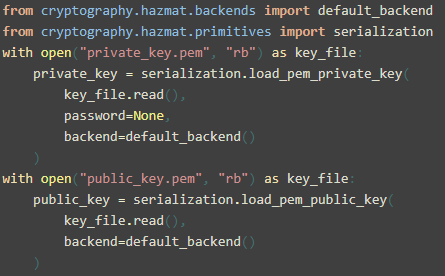
In this post, I demonstrate the usage of the cryptography module in Python by using using the asymmetric key method RSA to encrypt and decrypt messages.
main bough
Thanks but it is encrypting the data with the public key and decrypting it with the private one. I need the oposite.
Now that i think about it, i could use signatures.
To explain what i am doing:
I am coding an advanced form of cryptocurrency that need less computing power. I need a way to check if you are the owner of a coin.
I was thinking that i could use either a signature function or an encryption function. Sadly, I can't find a way to implement the stuff to my code.
main bough
honest minnow
https://nitratine.net/blog/post/asymmetric-encryption-and-decryption-in-python/
Could you help me?
honest minnow
main bough
Could you help me?
am not really knowledgeable when it comes to cryptography but am sure that if you post your issue in a help channel someone with the knowledge will come and give you a hand 🙂 #❓|how-to-get-help
main bough
Ok, but I have already tryed 2 times in the help channels: help-kiwi and help-candy
 tawny pagoda

 charred merlin
Hey, i'm Mathis, a middle schooler, so yeah i'm pretty young and i'm trying to learn Python, sooo
Basically, i don't know anything about it, where should I start ? How to learn ?
proven perch
Basic tutorials on Youtube are great, that's how I learned the basics
thorn obsidian
proven perch
Basic tutorials on Youtube are great, that's how I learned the basics
True
i started with tutorials on youtube
charred merlin
Alright, i'll give it a look, thank you
 neat rampart
I am designing an account system for a web app I have, and I'm looking to use bcrypt to salt/hash passwords. Is there any way to lock other data and encrypt it such that it can only be decrypted with the salt/hash/something generated from the user's password?
As the app owner, I want to have no way to access these tidbits of information except through the user's login.
vagrant mist
neat rampart
I am designing an account system for a web app I have, and I'm looking to use bc...
you cannot decrypt a (secure) hash, that's kinda the point........
neat rampart
That's not what I was wanting to do at all. I wanted to use the password or some intermediary data as an encryption/decryption key.
 tired dome
spiral dagger
I am interested in python programming
tired dome
spiral dagger
I am interested in python programming
This is the python discord actually.
 tall kite
charred merlin
Hey, i'm Mathis, a middle schooler, so yeah i'm pretty young and i'm trying to l...
tall kite
charred merlin
Hey, i'm Mathis, a middle schooler, so yeah i'm pretty young and i'm trying to l...
Pick something you want to make as a first project as well. Could scrape news data, make a game, make a temperature monitor with a raspberry pi, or do something crazy and make an encryption tool like I did!
This way you aren't just learning a bunch of coding concepts but you have direction in your learning and can explore how other people did what you want to do.
neat rampart
I am developing a chat app and I want to make it such that users' direct messages are encrypted, so that I cannot read them from the database. As of now, my train of thought is that I would generate an RSA keypair for each direct message "room", with the public key stored in it and a copy of the private key stored in the accounts of all users who have access to it. That way, the users could request the data from that room and the server would retrieve it, retrieve the key from the user's account, and fetch & decrypt the requested data.
The fly in my ointment is storing the private keys in user accounts. How can I generate an encryption/decryption key from the user's password? I am already using bcrypt for the salting/hashing for logins, but that's not really helpful here.
charred merlin
tall kite
Pick something you want to make as a first project as well. Could scrape news da...
I’ll give it a try too, thank you for the advice !
 tardy forge
Question for code obfuscation, can I have a txt file with all the imports, read it, exec() it, and use it in the py file as though I had imported it from the actual code
 dense knoll
neat rampart
I am developing a chat app and I want to make it such that users' direct message...
dense knoll
neat rampart
I am developing a chat app and I want to make it such that users' direct message...
Since its a hash there is no way back to the plain password. Can’t you just use the hash as the key?
Keep in mind that if you let the users change they passwords you could have problems in the future
 midnight bloom
neat rampart
I am developing a chat app and I want to make it such that users' direct message...
midnight bloom
neat rampart
I am developing a chat app and I want to make it such that users' direct message...
a key derivation function is what you want but this scheme is just one-step removed from storing the messages in plaintext, since the information needed to decrypt them is stored alongside it. As per the usual don't roll your own crypto advice, I would recommend looking at libsignal for end to end chat encryption
I dunno if there's any good python bindings for libsignal though
 leaden crater
Could make your own?
Assuming you have some sort of c/cpp knowledge
In theory you could write the wrapper using PyBind11.
neat rampart
I don't need it all encrypted end-to-end, I just need to encrypt the data stored on the database
 flat bronze
neat rampart
I am developing a chat app and I want to make it such that users' direct message...
flat bronze
neat rampart
I am developing a chat app and I want to make it such that users' direct message...
it is called asymmetric cryptography https://medium.com/@ashiqgiga07/asymmetric-cryptography-with-python-5eed86772731

Medium
A Python article on asymmetric or public-key encryption algorithms like RSA and ECC (Elliptic-Curve Cryptography)
you can encrypt anything by public key, but you cannot decrypt
and private key can encrypt AND decrypt 😉 (+generating new public keys)
neat rampart
Yes, I am aware of asymmetric cryptography. Still doesn't explain how to generate keypairs from passwords, unless I can simply encode the password in utf and use it as a seed for the random number generator, but I doubt that will yield the same primes or anything like that every time
 errant yoke
neat rampart
Yes, I am aware of asymmetric cryptography. Still doesn't explain how to generat...
errant yoke
neat rampart
Yes, I am aware of asymmetric cryptography. Still doesn't explain how to generat...
Generate the keypair on the client
flat bronze
I have a goal to generate RSA key pair, that can be used for encryption decryption in a code, and as a SSH private/public pair at the same time
I achieved goal to generate RSA key pair, that can encrypt and decrypt
I achieved goal to save public key in OpenSSH format (similar to what linux in ssh-keygen generates)
I have the problem to save private key in a format compatible to connect the server now %
I am working from this example
from Crypto.Cipher import PKCS1_OAEP
from Crypto.PublicKey import RSA
from binascii import hexlify

#The message to be encrypted
message = b'Public and Private keys encryption'

#Generating private key (RsaKey object) of key length of 1024 bits
private_key = RSA.generate(4096)

#Generating the public key (RsaKey object) from the private key
public_key = private_key.publickey()
print(type(private_key), type(public_key))

#Converting the RsaKey objects to string
private_pem = private_key.export_key().decode()
public_pem = public_key.export_key().decode()
print(type(private_pem), type(public_pem))
#Writing down the private and public keys to 'pem' files
with open('private_pem.pem', 'w') as pr:
    pr.write(private_pem)
with open('public_pem.pem', 'w') as pu:
    pu.write(public_pem)

#Importing keys from files, converting it into the RsaKey object
pr_key = RSA.import_key(open('private_pem.pem', 'r').read())
pu_key = RSA.import_key(open('public_pem.pem', 'r').read())

print(type(pr_key), type(pu_key))
#Instantiating PKCS1_OAEP object with the public key for encryption
cipher = PKCS1_OAEP.new(key=pu_key)
#Encrypting the message with the PKCS1_OAEP object
cipher_text = cipher.encrypt(message)
print(cipher_text)
#Instantiating PKCS1_OAEP object with the private key for decryption
decrypt = PKCS1_OAEP.new(key=pr_key)
#Decrypting the message with the PKCS1_OAEP object
decrypted_message = decrypt.decrypt(cipher_text)
print(decrypted_message)
Exported public OpenSSH key with
public_key.export_key("OpenSSH").decode()
Question, how to save private key in the way that will work for linux Unubuntu 20.04 default SSH application to connect the server
flat bronze
nvm
I succeded
used answer for python generating ssh key pair from cryptography
and used it to be imported as a key for the thing above, with skipping the generation, it worked fine
 turbid light
is there any more secure way of storing passwords other then
random = 2 digit random number
salt = random 10 chars base 64
pepper = read_secret_from_file()
result = hash(password + salt + pepper + random)

for x in range(1000):
    result = hash(result + salt + pepper + random)
database.insert(f"{result},{salt}")
I mean this is still reversable
hard to do but it is
even more so if we are let's say hashing user names from another platform
so there is like only 3000 possible values
turbid light
Can you guys ping me if you find out?
fading plaza
turbid light
is there any more secure way of storing passwords other then
```py
random = 2 d...
what is "random"
this just seems like pbkdf2
but roll-your-own
should still be secure assuming hash isn't something bad, though you should really use something from a trusted library
turbid light
fading plaza
this just seems like pbkdf2
pbkdf2 doesn't have pepper tho
the random is just randomly generate number
what's not clear about that?
turbid light
fading plaza
*should* still be secure assuming hash isn't something bad, though you should re...
well it's not secure
since it's pretty easily reversable
if you have list of possible values
 last ivy
turbid light
is there any more secure way of storing passwords other then
```py
random = 2 d...
last ivy
turbid light
is there any more secure way of storing passwords other then
```py
random = 2 d...
hash changes its values between runs
so it just won't work
Just use something battle-tested like bcrypt
turbid light
Bcrypt is easily reversible
turbid light
last ivy
`hash` changes its values between runs
Yeah but it would not metter
last ivy
turbid light
Yeah but it would not metter
the passwords will be dropped when you restart the program?
last ivy
turbid light
Bcrypt is easily reversible
I challenge you to reverse $2b$12$Lzy3MHBNMx8uftQHizmrDeZmf/S5EwKUuLOGroUneJqIryx2DyJIK
If you have a list of known values, there is no way to make it non-reversible
I mean, just logically
turbid light
For example secret pepper would make un reversible
last ivy
what's preventing you from using a pepper with bcrypt?
turbid light
last ivy
the passwords will be dropped when you restart the program?
Nop you would have to brute force those 2 digits
last ivy
wdym?
hash will produce different results when you restart the program, so hashes will no longer work
!e
print(hash("foo"))
@last ivy :white_check_mark: Your eval job has completed with return code 0.
7814480978635085837
!e
print(hash("foo"))
@last ivy :white_check_mark: Your eval job has completed with return code 0.
-1907129312318368269
On verification you would try all 100 combinations
turbid light
last ivy
what's preventing you from using a pepper with bcrypt?
I am not asking for implantation
I am asking for theoretically unbreakable hash method
If even possible which I doubt
turbid light
last ivy
I challenge you to reverse `$2b$12$Lzy3MHBNMx8uftQHizmrDeZmf/S5EwKUuLOGroUneJqIr...
Give list of 300 000 possible values and 2 minutes
last ivy
turbid light
Give list of 300 000 possible values and 2 minutes
A peppered hash isn't really "uncrackable". It is very crackable if you find the pepper.
Similarly, storing passwords in plain text is not a vulnerability on its own, if there is mathematical certainty that an attacker can't get hold of the passwords.
turbid light
last ivy
ok took me longer then I would like to admit but the python script is running
turbid light
last ivy
A peppered hash isn't really "uncrackable". It is very crackable if you find the...
that's why I am asking for better alternative
last ivy
turbid light
ok took me longer then I would like to admit but the python script is running
Should take about 20 hours
Unless you're parallelizing
turbid light
I am
24 threads
but still it will take some time that's true I don't argue with that
I am just saying it is reversible
turbid light
last ivy
A peppered hash isn't really "uncrackable". It is very crackable if you find the...
I was sugggesting having it in file loading it into RAM and the unplugging the USB with the file
last ivy
turbid light
I was sugggesting having it in file loading it into RAM and the unplugging the U...
You can still dump the memory of a process if you have access to the server. Or leak the contents due to a vulnerability
turbid light
that's my point
that's exactly what I mean
how do I make it more secure
I am glad we are on the same line now
last ivy
What are your threat models?
last ivy
Well, you can't make an application abstractly secure 🙂
turbid light
Well I just want to be more secure
😄
then what I have now
ok maybe 300 000 was way to much but I am pretty much done
it will take 30 minutes
but in real word scenario you could limit that number of entries to something like 3 000
or order them from lowest to highest chance of success
fading plaza
turbid light
I am asking for theoretically unbreakable hash method
xor with urandom
fading plaza
turbid light
is there any more secure way of storing passwords other then
```py
random = 2 d...
wait hash here is a crypto function, right?
not the hash built-in
fluid dragon
what can I do with python as far as hacking the local pizza place and getting fr ee piozza deliveries ?
What can I do with python as far as hacking the local pizza place and getting free pizza deliveries?
 zinc field
!rule 5
past starBOT
5. Do not provide or request help on projects that may break laws, breach terms of services, or are malicious or inappropriate.
 smoky moat
fluid dragon
What can I do with python as far as hacking the local pizza place and getting fr...
smoky moat
fluid dragon
What can I do with python as far as hacking the local pizza place and getting fr...
LMFAO
last ivy
fluid dragon
What can I do with python as far as hacking the local pizza place and getting fr...
Find a job in Python, earn the money to buy a pizza.
vagrant mist
last ivy
Find a job in Python, earn the money to buy a pizza.
That was a really wholesome answer, I respect that
 upbeat monolith
fluid dragon
What can I do with python as far as hacking the local pizza place and getting fr...
upbeat monolith
fluid dragon
What can I do with python as far as hacking the local pizza place and getting fr...
Step 1: Become a black hat hacker.
Step 2: ???
Step 3: Profit
last ivy
Step 2.5: go to jail
 spice sequoia
rofl
 light rapids
is python good for cryptocurrency? I heard it's no great for security
 sharp sparrow
light rapids
is python good for cryptocurrency? I heard it's no great for security
sharp sparrow
light rapids
is python good for cryptocurrency? I heard it's no great for security
python is great for security
light rapids
cool
thorn obsidian
it depends: a programming language designed for security is rust.
thorn obsidian
Can anyone help me please?
How can I check my private browsing history? and how to stop someone who is tracking my history remotely?
last ivy
thorn obsidian
How can I check my private browsing history? and how to stop someone who is trac...
One of the features of "private browsing" is that it doesn't record history.
You can't track someone else's history, even if you intercept all their network traffic, as long as they are using HTTPS.
fading plaza
last ivy
You can't track someone else's history, even if you intercept all their network ...
technically speaking dns requests can still be tracked
and mitm is also possible
last ivy
fading plaza
technically speaking dns requests can still be tracked
Yeah, you can record which IP addresses someone talks to

 quaint token
what's the best tool to obfuscate code (free or paid)
fading plaza
quaint token
what's the best tool to obfuscate code (free or paid)
security by obscurity is bad
neat rampart
I just saw one of the best ways to patch social engineering-based security holes! This is what you get when you hit F12 on Discord in a browser (access to console, element inspector, etc):
 fading plaza
will that even work on the target audience of those scams
also easily bypassed by javascript: urls
 nova hollow
is there a way in which i can have users input username & password in the safest way such that I do not have access to it but I can use the username/password into my code?
by using I mean; a simple request to a certain API
quaint token
fading plaza
https://en.wikipedia.org/wiki/Kerckhoffs%27s_principle
how can i host a server then so people can have access to my code without having access to my code?
fading plaza
what
 heady fable
fading plaza
heady fable
fading plaza
there's plenty of methods to deobfuscate it
a search on Google turns up quite a few, though I can't vouch for any of them
tardy forge
K
thorn obsidian
eh
 magic narwhal
Hi guys I really don't know where to start To learn how to protect python Source code so if I send for example my code to a friend he\she can't change or see my source code ,
I read that cython can convert python code and from there I can decrypt the source code is it true?
magic narwhal
quaint token
how can i host a server then so people can have access to my code without having...
That where the use of Api you cant host your project in a server and create an API so the user will get use for your code throw it .
tardy forge
Then why sending source code lol?
thorn obsidian
neat rampart
I just saw one of the best ways to patch social engineering-based security holes...
i thought everybody knew that
thorn obsidian
@thorn obsidian
thorn obsidian
thorn obsidian
i thought everybody knew that
same, it's been there since late 2018
 gleaming coral
neat rampart
I just saw one of the best ways to patch social engineering-based security holes...
gleaming coral
neat rampart
I just saw one of the best ways to patch social engineering-based security holes...
or just disable the console altogether
gleaming coral
last ivy
You can't track someone else's history, even if you intercept all their network ...
You partially can, SNI is public and visible, it can be used to track all addresses you talk to
This is how websites are blocked and censored within isps
 tender mesa
anyone here
help me airecrack-ng
showing wlan0 is on channel 1 but AP is on channel 3
 craggy copper
I'm trying to figure out what I want to do for my senior project. I'm majoring in computer science but have a minor in computer security. I want to do some project with cybersecurity and programming of some sorts. Any of you guys have any ideas for a project?
 errant epoch
craggy copper
I'm trying to figure out what I want to do for my senior project. I'm majoring i...
errant epoch
craggy copper
I'm trying to figure out what I want to do for my senior project. I'm majoring i...
Have you looked into previous similar projects and/or do you have any personal projects that have to do with cs security? I've absolutely no clue but feel obliged to answer something to an open eded question like this before asking mine xD
So, I've heard eval is a big baddie when it comes to security, and ast.literal_eval is much better. I'm using literal_eval in my code currently, and I guess it's the best alternative after looking a bit into it, but call me out if I'm wrong!
I get a 2d-list from from a text file written by another program which is already formatted like a python file, literally [[1,2],[3,4]]-style.
What I currently do (basically):
from ast import literal_eval

filepath = "in.txt"
with open(filepath, 'r', encoding="utf8") as text_file:
    text_file_data = text_file.read()

the_list = literal_eval(text_file_data)
Thanks for answering. It’s a little bit of a hard question to answer. Thanks for your response🙂
fading plaza
errant epoch
So, I've heard `eval` is a big baddie when it comes to security, and `ast.litera...
use json.load instead?
 mortal perch
^ your goal is serialising data to disk, and then deserialising it into memory at a later point. using json works a lot better for this kind of data storage
 hushed vessel
Does sharing a IDENTITY column number of DB rows in a server response pose a vulnerability?
I mean, i query the db based on clients request and provide them also my IDENTITY number to track any changes between the data sent and in the DB
gleaming coral
tender mesa
help me airecrack-ng
!rule 5
past starBOT
5. Do not provide or request help on projects that may break laws, breach terms of services, or are malicious or inappropriate.
gleaming coral
magic narwhal
Hi guys I really don't know where to start To learn how to protect python Source...
You can use a packager like pyoxidizer that packges the whole python interpreter to bypass and mitigate the problem that fundamentally python is an interpreted language that can only be converted into bytecode which is also a giant flaw because your packaged binary could be reverse engineered with uncompyle6 and then the memory representation of the code could be unmarshalled.. If you want to know more: https://nedbatchelder.com/blog/200804/the_structure_of_pyc_files.html
I spent some time digging around in the Python code to understand how .pyc files work. It turns out they are fairly simple, then kind of complex.
gleaming coral
hushed vessel
I mean, i query the db based on clients request and provide them also my IDENTIT...
Not really, but if your database system's unique id generation system is incremental then yes, a user could simply lookup other records which would be a huuuuuuuuge privacy issue, or someone could write up a program to incrementally log everything in your database (which is visible to the user)
hushed vessel
gleaming coral
Not really, but if your database system's unique id generation system is increme...
All right, yes, my id generation is incremental, so I should switch to, e.g. UUID? Could you point me to some resources about it, or write some keywords for googling? I don't understand how can user look up other records if i'm spoon feeding him only his own data
magic narwhal
gleaming coral
You can use a packager like pyoxidizer that packges the whole python interpreter...
Thanks bro , it is a good point to start with 👍
thorn obsidian
Hey guys I trying to make a login in and username password this is what I've done so far, i can't seem to figure out how to make sure when your asked to enter your password and username the programme checks that the password you've used is correct here's what I've wrote so far
CODE -
import time
print('Welcome to Login V.1')
print('-----------------')
time.sleep(1)
username = input("Enter your username ")
print('-----------------')
time.sleep(2)
password = input("Enter your password ")
print('-----------------')
time.sleep(3)
print("Your username is "+ username)
print('-----------------')
time.sleep(3)
print("Your password is "+ password)
print('-----------------')
time.sleep(3)
print('Please remember these credentials!')
print('-----------------')
time.sleep(3)
print(' --- Login --- ')
print('-----------------')
time.sleep(2)
attempts=0
while attempts<3:
username=input(' please enter your username ')
password=input(' please enter your password ')
if username== '+ password' and password=='correctpassword':
print('you are in!')
else:
attempts+=1
print('incorrect!')
if attempts==3:
print('too many attempts')
 pliant cedar
You should assign a variable to the username and password and check if they are the same using if statement
thorn obsidian
Thankyou!
I'm sure this will work right?
while userName == userName and password == password: # The Input will always lead to this while loop, so we can see if their username and password is wrong or correct.
If I change the variables that's should work?
pliant cedar
thorn obsidian
while userName == userName and password == password: # The Input will always lea...
I think so
Is there any error you are getting
thorn obsidian
Thank you for help! Yes there is but that's because of the issue here --
if username== '+ password' and password=='correctpassword':
That's the issue. But I believe I can resolve it :)
The code is working fine but when I put the right password and username it says 'you are in!' But... it continuously spams 'you are in!'
import time
print('Welcome to Login V.1')
print('-----------------')
time.sleep(1)
username = input("Enter your username ")
print('-----------------')
time.sleep(2)
password = input("Enter your password ")
print('-----------------')
time.sleep(3)
print("Your username is "+ username)
print('-----------------')
time.sleep(3)
print("Your password is "+ password)
print('-----------------')
time.sleep(3)
print('Please remember these credentials!')
print('-----------------')
time.sleep(3)
print(' --- Login --- ')
print('-----------------')
time.sleep(2)
attempts=0
while attempts<3:
username=input(' please enter your username ')
password=input(' please enter your password ')
while username == username and password == password:
print('you are in!')
else:
attempts+=1
print('incorrect!')
if attempts==3:
print('too many attempts')
print('-----------------')
print('Exiting programme...')
quit(1)
thorn obsidian
It's still spams you are in!
pliant cedar
import time
print('Welcome to Login V.1')
print('-----------------')
time.sleep(1)
username = input("Enter your username ")
print('-----------------')
time.sleep(2)
password = input("Enter your password ")
print('-----------------')
time.sleep(3)
print("Your username is "+ username)
print('-----------------')
time.sleep(3)
print("Your password is "+ password)
print('-----------------')
time.sleep(3)
print('Please remember these credentials!')
print('-----------------')
time.sleep(3)
print(' --- Login --- ')
print('-----------------')
time.sleep(2)
attempts=0
while attempts<3:
username1 = input(' please enter your username ')
password1 = input(' please enter your password ')
if username == username1 and password == password1:
print('you are in!')
break
else:
attempts+=1
print('incorrect!')
if attempts==3:
print('too many attempts')
I tested it, it shouldn’t spam the you are in message
send me ur code
gleaming coral
hushed vessel
All right, yes, my id generation is incremental, so I should switch to, e.g. UUI...
In your question you said how you will give the user the id number so that they can lookup their record, if not then please correct me. So for example, someone has an id number of 10, and it is incrementally generated then they could loop up everything from 0-10 and further if the data has been created. Switching id systems would depend on your database
 broken spruce
Can anyone tell me some basic security based project i can do with python?
 forest wind
broken spruce
Can anyone tell me some basic security based project i can do with python?
forest wind
broken spruce
Can anyone tell me some basic security based project i can do with python?
Google has some great answers for that question. Any reason they don't work for you?
hushed vessel
gleaming coral
In your question you said how you will give the user the id number so that they ...
Ok, let me clarify. Idea is to have a web app in which users can import their bank statements, and have full overview of their transaction history, with dynamic filtering, some summarization and so on. Additionally, they should be able to manually change some details of these transactions, in case bank statements were not complete in information, or if they want to, e.g. categorize these transactions. Till now, I've queried these transactions from DB and provided all the details about transaction to the user, except of transaction ID. Now, when the user can modify few values of transaction, I need a way to recognize which transaction was modified, to subsequently update it in the DB (and for this I want to use transaction ID, but now i have to include it into web response sent to the user)
As I am a complete newbie, I've read somewhere that passing ID of records from table to the clients could be a dangerous thing to do, altho I have no idea if this applies to my case. To my feeling, not really.
 rapid mountain
hushed vessel
Ok, let me clarify. Idea is to have a web app in which users can import their ba...
rapid mountain
hushed vessel
Ok, let me clarify. Idea is to have a web app in which users can import their ba...
This should all be done with HTTPS of course and two factor authentication since it is a banking app
rapid mountain
hushed vessel
Ok, let me clarify. Idea is to have a web app in which users can import their ba...
Yeah I get it previously it was read only and now it will be read write making it necessary to expose the transaction ID... it is a risk to expose the ID but you need it
Maybe implement a tranaction hash

A transaction hash or ID is a string of unique characters that are provided to every verified transaction added on the blockchain.
thorn obsidian
broken spruce
Can anyone tell me some basic security based project i can do with python?
Making a login in and password script it a basic, it can become advanced depending on how your planning to use it :")
past starBOT
@solid agate, looks like you posted a Discord webhook URL. Therefore, your message has been removed, and your webhook has been deleted. You can re-create it if you wish to. If you believe this was a mistake, please let us know.
 solid agate
 thorn obsidian
Not sure what you need help with.
Hey you guys wants to laugh? https://www.newsweek.com/exclusive-fbi-warns-russia-may-launch-cyber-attacks-us-ukraine-tensions-rise-1681012

Newsweek
An FBI report obtained by Newsweek warns "the private sector about the threat of Russian state-sponsored advanced persistent threat (APT) cyber activities, while tensions with Russia are heightened."
An FBI report obtained by Newsweek has called on the U.S. private sector to be prepared for potential state-sponsored cyber attacks to be launched by Russia as tensions over Ukraine threaten to spill into an all-out conflict in Eastern Europe.
hahahaha
The US private sector... prepared... for russian cyber attacks 😆 😂 🤣
broken spruce
thorn obsidian
Making a login in and password script it a basic, it can become advanced dependi...
Okay i will try to make the basic version first. Thanks for the advice!
smoky turtle
 west oxide
is anyone here can help me with it?
west oxide
is anyone here can help me with it?
Look at Tryhackme and Hackthebox. Good introduction to cybersec topics
west oxide
smoky turtle
Look at Tryhackme and Hackthebox. Good introduction to cybersec topics
where can i get that?
smoky turtle
Rule no1 in tech. Google it my friend
thorn obsidian
:)))
thorn obsidian
broken spruce
Okay i will try to make the basic version first. Thanks for the advice!
If you need any help or advice dm me and ill help you out
thorn obsidian
!rule
past starBOT
The rules and guidelines that apply to this community can be found on our rules page. We expect all members of the community to have read and understood these.
thorn obsidian
@dire osprey dm me
 stiff mauve
Lol💀
tardy forge
if a system is attacked by ransomware while a py script is running, and encrypts any file regarding the python language, or c language files etc, will it continue to run on ram?
 pallid wedge
O_o
 raw dome
tardy forge
if a system is attacked by ransomware while a py script is running, and encrypts...
raw dome
tardy forge
if a system is attacked by ransomware while a py script is running, and encrypts...
If you're playing a game and get attacked by ransomware, (which includes the files the game is currently depending on, with memory in RAM) does the game keep running?
tardy forge
in python yes, but i dont know about source files, aka not the ones i wrote
like the actual language
 dire osprey
Why is Linux the preferred os when it comes to cybersecurity?
 shy wren
dire osprey
Why is Linux the preferred os when it comes to cybersecurity?
shy wren
dire osprey
Why is Linux the preferred os when it comes to cybersecurity?
The number of open source tools specially crafted for cybersecurity tasks and plus many servers run on linux
 white ice
dire osprey
Why is Linux the preferred os when it comes to cybersecurity?
white ice
dire osprey
Why is Linux the preferred os when it comes to cybersecurity?
I think one of the reasons is the flexibility that Linux gives you in terms of what runs in your system. You can have a barebones install with only minimal packages of even recompile the kernel to remove all the unnecesary modules you wont need for your purpose... You can basically customize any part of a Linux system to your needs... The less software you have running, the harder it will be to exploit.
dire osprey
Ah cool. I'm currently using windows, is it adviced and possible for me to use Linux instead?
 silk fiber
Using it for what?
smoky turtle
dire osprey
Ah cool. I'm currently using windows, is it adviced and possible for me to use L...
If you are interested in cybersec then yes it is better to start using linux distros
 paper ridge
سلام دوستان burp suite رو کجا میتونم یاد ب
گیرم؟
ممنون میشم اگه منبع خوبی میشناسید معرفی کنید.
 short wadi
can anyone assist me with some dnspython issues regarding docker?
im trying to get the dnskey from a website, however it cant seem to establish a connection to the dns server from docker but runs locally, does anyone have any suggestions and or has dealt with this directly?
 graceful cape
I have a few questions about asymmetric encryption
A key is applied to an algorithm to encrypt some data. That encrypted data can be used as a key to the algorithm run in reverse to produce the original key.
With asymmetric encryption — reverse application of the algorithm will yield the original key used. But all one has at that point is the key and and the encrypted data, not the original copy.
So, having the key is useless.
That's how that is supposed to work, right?
thorn obsidian
graceful cape
A key is applied to an algorithm to encrypt some data. That encrypted data can b...
you can't get the original "key"
you can get the original plaintext data
before encryption
for asymmetric encryption, all you do is generate 2 keys, then choose which one will be "public" and which one will be "private", then you take a simple plaintext data such as "my secret message", pass it through the encryption algorithm while providing the "private" key
as a result you get a gibberish
then to decrypt that gibberish into "my secret message" you can use the "public" key
aka the other key you had unused
graceful cape
All of that is well and good
Aghghghghg
XD I need to study the concepts more before I can proper phrase my questions
I'l be back, perhaps
midnight bloom
all you do is generate 2 keys, then choose which one will be "public" and which one will be "private"
there's multiple asymmetric crypto schemes out there but in general you generate them as a pair and you don't get to pick which one is public and which is private
graceful cape
Okay, so...
I guess my question is this
If I apply a key to an algorithm to encrypt some text
How is it that, if I apply the steps of the algorithm in reverse, I do not yield the original text?
thorn obsidian
midnight bloom
there's multiple asymmetric crypto schemes out there but in general you generate...
hm, i heard the opposite, thanks, good to know
thorn obsidian
graceful cape
How is it that, if I apply the steps of the algorithm in reverse, I do not yield...
because when you go one way, you use key #1
and when you go the other way
you use key #2
graceful cape
Yes, but how
thorn obsidian
how what exactly?
I do not yield the original text? - if you call encryption() function and provide key #1 to it, then calling decryption() and proving the same key #1 will not yield the original text, thats expected behaviour
thats why its asymmetric encryption, not symmetric
instead when you call decrypt() you provide key #2
then it will yield the original data
midnight bloom
I think you're asking why the encryption is not reversible with just the public key. The answer to that depends on the exact scheme you're using, to make this more concrete I would fix one to study like RSA
graceful cape
def step_1(key, text):
  """some sequence of steps"""

def step_1_reversed(key, text):
  """every line of code in step 1, reverse order"""

def step_2(key, text):
  """some sequence of steps"""

def step_2_reversed(key, text):
  """every line of code in step 2, reverse order"""

def step_3(key, text):
  """some sequence of steps"""

def step_3_reversed(key, text):
  """every line of code in step 3, reverse order"""

def encrypt(key, decrypted):

  tmp = step_1(key, decrypted)
  tmp = step_2(key, tmp)
  tmp = step_3(key, tmp)

  return tmp

def decrypt(key, encrypted):

  tmp = step_1_reversed(key, encrypted)
  tmp = step_2_reversed(key, tmp)
  tmp = step_3_reversed(key, tmp)

  return tmp
Somehow, the steps in the decryption would have to fail if the original key is provided instead of the secret key
thorn obsidian
because thats the way its supposed to work
you can't just encrypt and decrypt data
using just one key
thats why its called asymmetric encryption
thorn obsidian
to encryp() you'd pass key #1 and to decrypt() you'd pass key #2
then everything will work
graceful cape
You're just saying "it just works"
thorn obsidian
as you're expecting
thorn obsidian
graceful cape
You're just saying "it just works"
if you want a rundown on the way how encryption and decryption works
at the level of manipulating bytes
then you can find some good articles online
but it's not what you are asking is it?
i think you are just not understanding the keys
would have to fail if the original key is provided instead of the secret key
can you elaborate on that
so you are passing same key to both encrypt and decrypt right?
midnight bloom
they understands how asymmetric schemes works, they're just asking what properties make it possible for you to write a function that you can go encrypt(data, key) without being able to reverse it with that same key
and the answer is: it depends on the scheme
thorn obsidian
and the scheme can only be explained at the lower level
midnight bloom
RSA uses prime factors and exponentiation to achieve it
graceful cape
😛 Thanks y'all
graceful cape
Ohhhhhhhhkay.... so....
The number 12
Can be produced by multiplying the numbers 4 and 3, or the numbers 2 and 6
So if I'm looking at the number 12, I have no way of knowing which two numbers were used to produce it
Is it a bit like that?
midnight bloom
yup exactly, it's a similar process to that
graceful cape
2 seconds
def encrypt(key, data):
  return str([chr(ord(character) * key) for character in data])
obviously this one can be trivially reversed with the key in hand
just divide each ciphertext character by key
to obtain the original
graceful cape
Well that's what I'm getting at. Without the key, every character could be the result of pretty much any character multiplied by pretty much any key
But with the key, easy peasy
Can you think of just a simple example of a function with one way properties?
midnight bloom
heh it's easy to make one that's one way, but going back the other way with a linked key is the hard part
and is the crux of asymmetric cryto
consider a hash function like sha1 for example, it'll go one way
good luck finding what was the input
but in an asymmetric crypto scheme we do want to be able to reverse it with a corresponding private key
and that usually needs some hard math problem backing it like prime factorization or discrete logarithms
graceful cape
Okay, cool
XD I'm tasked with writing a few paragraphs about Kerchoff's Principle
And I could bullshit my way through it — the principal is sound even if I don't know exactly how the math waorks
But as a matter of good faith, I want to do some studying just so I can say I actually learned something
graceful cape
So, I think I've come to the conclusion
Lemme make sure this is right
Any encryption algorithm can by definition be cracked. However, the time it takes to crack the algorithm increases to a prohibitive amount given sufficient complexity
Even if all the steps are known, if it will take a million years for a super computer to crack an encryption then it is effectively uncrackable
So, the fundamental problem becomes the sharing of the keys
Using the same key for every communication is obviously out of the question
But if you want to establish a secure line of communication with anyone who wants it, you must generate a new password randomly each time
The problem becomes this: there is no way to prevent the generated key from being intercepted in transmission, or knowing if the receiving party's "infrastructure" is compromised (malware could be watching, they could be deceived into sharing their key, etc) [you yourself could in theory be compromised, but you have the agency over yourself to take the appropriate steps, you have no way of knowing if the other party is doing the same]
The only way to ensure a password remains secure, therefore, is to never share the password.
With asymmetric encryption, a password is shared which can encrypt, but cannot decrypt
To achieve this, some kind of operation is perform which transforms a bit of information according to a key, but which cannot be reversed using that same key
But which can be reversed using a different key, one which is never shared
The nature of the math involved in these operations is complex — but perfectly possible in a broad sense
And so the important factors in these steps are:
A relationship must exist between two randomly generated passwords
Some operation must exist which can be performed in one direction with one key, but cannot be reversed using that same key
That same operation can be reversed using the second key
Is that the jist of it?
 gusty tendon
That, at least to me, would be the jist of it
 radiant timber
How can I remove and scan for malware?
 vagrant moss
radiant timber
How can I remove and scan for malware?
vagrant moss
radiant timber
How can I remove and scan for malware?
Depends on the nature of the malware imo. If you got some known malware not specifically targeted at you, you should be able to see least scan and detect it with a modern anti-virus program (try several), at least of you scan your disk from a Linux boot session(e.g. a USB boot disk).
It's recommended you copy what data you need and then do a clean reinstall though, you can't be sure what's lurking in your system after an infection imo. :(
https://www.theverge.com/2022/2/25/22951376/nvidia-incident-alleged-cyberattack-february-2022
Maybe hold off updating or installing stuff for a while?

The Verge
Maybe that’s why Nvidia pushed back an announcement.
radiant timber
Ok Ty
vagrant moss
In general you should scan downloaded files you don't trust, especially executable ones. You can use https://www.virustotal.com for instance by uploading them to have them scanned by several scanners. Personally I don't trust files if they get even just one or two detections on there.
 proper idol
Anyone here know about implementing Diffie-Hellman key exchange end to end encryption? I am trying to get multiple clients in a chat room to share a secret key. The wikipedia article outlines a method of distributing the public keys in an iterative process, but It seems pretty complicated to implement. I had another idea of simply caching the public key of each client so that when a new user join a chat room, the client can add its public key to the cache. After the new public key is cached, the new set of public keys is pushed to each client so that they can regenerate there secrets keys using the combined public keys. Wikipedia article for reference: https://en.wikipedia.org/wiki/Diffie–Hellman_key_exchange#Operation_with_more_than_two_parties

Just wondering if what I outlined is possible and secure
 tulip holly
It would have to be asymmetric otherwise Alice removes Alice's public key from shared secret and uses Bob's private key to authorise a transfer of some currency from Bob to Alice.
radiant timber
vagrant moss
Depends on the nature of the malware imo. If you got some known malware not spec...
Do you know any tutorials on how to do it?
vagrant moss
The best advice I can give is really to search for tutorials or how to's. Sorry
 proper idol
tulip holly
It would have to be asymmetric otherwise Alice removes Alice's public key from s...
proper idol
tulip holly
It would have to be asymmetric otherwise Alice removes Alice's public key from s...
Sorry not sure I understood you. Alice should not have access to Bob's secret key in this situation (I think) she should only get access to g**b where b is bob's secret. But you can't separate bob's secret easily after g**b % p
My plan is to regenerate the secret key for each user by recombining all of the public keys when a user join or leaves
Then all new messages will be sent using the new secret as a password
do you mean that Alice will still have access to Bob's secret key that they generated together? I think I can get around this by regenerating the shared secret whenever someone leaves or joins a room. (Client stores one secret key per chat channel, this can be removed from memory at any time and replaced with a new key)
proper idol
Okk soo scrap that key cache idea. There is no way to make g^a and g^b become g^(ab)^c... because it just results in g^(a+b)^c
proper idol
Aww yiss now just time to implement it on a server 😅
!e ```py
class PartialKey:
"""Class to represent a public key which is built up by multiple clients"""
def init(self, base: int, prime: int):
self.base = base
self.prime = prime
self.value: int = pow(base, 1, prime)
def mix_paint(self, private_key: int):
    self.value: int = pow(self.value, private_key, self.prime)
    return self.value
g = 2
p = 997
a, b, c = 80085, 1337, 69420
carol
partial_key = PartialKey(g, p)
partial_key.mix_paint(a)
partial_key.mix_paint(b)
c_secret = partial_key.mix_paint(c)
alice
partial_key = PartialKey(g, p)
partial_key.mix_paint(b)
partial_key.mix_paint(c)
a_secret = partial_key.mix_paint(a)
bob
partial_key = PartialKey(g, p)
partial_key.mix_paint(a)
partial_key.mix_paint(c)
b_secret = partial_key.mix_paint(b)
print(c_secret, b_secret, a_secret)
@proper idol :white_check_mark: Your eval job has completed with return code 0.
888 888 888
!e
 hollow fossil
hi, how long does python take to learn from zero. for cybersecurity
 hot anchor
So my company is slow to adopt pretty much anything, and they've been using Java 4 / 6 for some apps that I am convincing them to let me rewrite in modern Python (3.9 / 3.10)
They asked on how I could secure the source files from being read in the case of a security intrusion on the server, and I don't actually know the answer to that
Is there a process by which a python file can be encrypted and still usable? I'm sure there's still security considerations for the Python runtime being able to decrypt the code, and then you could read that from the system memory, but I figure
- these servers are internal only, so external security issues aren't really a factor (unless the intruder got in to our entire network, which itself is a minefield)
- encryption and setting the right read/write/execute permissions on the server would be enough
 cold coyote
hot anchor
So my company is slow to adopt pretty much anything, and they've been using Java...
cold coyote
hot anchor
So my company is slow to adopt pretty much anything, and they've been using Java...
You could take a look at this:
https://dev.to/richard_scott/encryption-for-protecting-python-source-code-4ckg

DEV Community
Python is a great programming language, it has so many uses, but one thing that it doesn’t do well is...
Pretty sure this thing has a dependency that decrypts the source code before using it, haven't gotten a good look at it, I suppose that can help you find a reasonable solution somehow.
hot anchor
Hey that's pretty much what I'm looking for!
It does work on a paid subscription, or otherwise the trial version limits the amount of time your encryption will last to be 24 hours - but I'm sure that either my company would be willing to pay for it, or I'll just re-encrypt the files every 24 hours
Thanks again!
If I wanted to go full-bore on preventing a user from reading my files. I figure I could do something like this:
- obfuscate code with some obfuscation library
- encrypt with source defender
- compile to C or C++ with Cython
- generate executable with pyinstaller
hot anchor
Step #4 also means I don't need to have a Python installation on the machine itself
tender mesa
i have some handshakes file and i am not able to crack them can anyone here do that
pls dm me
silk fiber
hot anchor
If I wanted to go full-bore on preventing a user from reading my files. I figure...
so why not just something simple like chmod 600 your_python_files? I'm legitimately curious about why you think that doesn't suit your use case
hot anchor
silk fiber
so why not just something simple like `chmod 600 your_python_files`? I'm legitim...
Already doing that, but management wants to add more security in case an intruder can somehow gain root access
It's not likely but you never know what new vulnerability gets found
silk fiber
that's... pretty silly
if an intruder gains root access it doesn't matter if your files are encrypted. They do a remote backup, wipe the server, and demand a few dozen bitcoin
IMO the marginal cost in operational complexity from encrypting your source files is probably much higher than the amortized cost of a potential source code leak over the same time period
but like, it actually should barely matter. If you're storing your secrets with a secretsmanager, and not in the source code, you in theory can just give away your source code for the asking and nobody can hurt you with it
this is like putting the keys to the safe in another safe that's in the same place. Either way all the intruder has to do is search your house for one set of keys.
 formal mauve
:v
!e import sourcedefender
from os import environ
environ["SOURCEDEFENDER_PASSWORD"] = "1234abcd"
environ["SOURCEDEFENDER_SALT"] = "dcba4321"
import mycode
past starBOT
@formal mauve :x: Your eval job has completed with return code 1.
001 | Traceback (most recent call last):
002 |   File "<string>", line 1, in <module>
003 | ModuleNotFoundError: No module named 'sourcedefender'
!e pip install sourcedefender
past starBOT
@formal mauve :x: Your eval job has completed with return code 1.
001 |   File "<string>", line 1
002 |     pip install sourcedefender
003 |         ^^^^^^^
004 | SyntaxError: invalid syntax
:V
 frank charm
!e
past starBOT
 Command Help
!eval [code]
Can also use: e
*Run Python code and get the results.
This command supports multiple lines of code, including code wrapped inside a formatted code block. Code can be re-evaluated by editing the original message within 10 seconds and clicking the reaction that subsequently appears.
We've done our best to make this sandboxed, but do let us know if you manage to find an issue with it!*
frank charm
!e while True:
print("hello world")
past starBOT
@frank charm :x: Your eval job has completed with return code 143 (SIGTERM).
001 | hello world
002 | hello world
003 | hello world
004 | hello world
005 | hello world
006 | hello world
007 | hello world
008 | hello world
009 | hello world
010 | hello world
011 | hello world
... (truncated - too many lines)
Full output: too long to upload
hot anchor
silk fiber
if an intruder gains root access it doesn't matter if your files are encrypted. ...
I suppose this is something I have to talk about with the team that manages OpenShift at my work place. I know you can set up secret stores, so as long as that's set I'd get the clearance from upper management
hot anchor
Seems that management doesn't because of some built-in security measures that the OpenShift team is using, so less work for me!
graceful cape
Can I get a check on this answer?
The question: What are the steps, from the instantiation of a secure communication channel to the decryption of a message, of an asymmetric encryption scheme?

 tepid rover
what package would you guys recommend from encryption and decryption for fun? I want to try to make my own symmetric ciphers (i know this is bad idea generally speaking and inefficient)
or some kind of encryption algorithms with adjustable parameters like custom block size or variable key length or rounds that i can play around with.
tepid rover
you mean use ssl package for non https use?
hmm cool never even considered that before thanks!
 spice acorn


 verbal jolt
hello everyone
🧬 : 4 / 61
⛔️ APEX
╰ Malicious
⛔️ SentinelOne
╰ Static AI - Suspicious PE
⛔️ Webroot
╰ W32.Malware.Gen
⛔️ MaxSecure
╰ Trojan.Malware.300983.susgen
is it danger?
thorn obsidian
Hey, anyone would like to join me for a matrix (messaging protocol not the movie) inspired project?
graceful cape
Hey all
Could someone give this a look-see and let me know if I'm missing anything?
Question: What are the steps, from the instantiation of a secure communication channel to the decryption of a message, of an asymmetric encryption scheme?
· Party-A requests secure communication with party B
· Party-B generates a pair of public and private encryption keys (these keys may already exist)
· Party-B transmits its public key to Party-A
· Party-A generates a third key, a session key, for use in subsequent encryption
· Party-A encrypts the session key with the public key
· Party-A transmits the encrypted session key to Party-B
· Party-B decrypts the session key with its private key
· Party-A encrypts and transmits a message with the session key
· Party-B receives and decrypts the message with the session key
· Everyone goes out for beers
that looks good
past starBOT
:incoming_envelope: :ok_hand: applied mute to @compact hearth until <t:1646332317:f> (9 minutes and 59 seconds) (reason: discord_emojis rule: sent 69 emojis in 10s).
 bitter grove
!unmute 713003400547270676
past starBOT
:incoming_envelope: :ok_hand: pardoned infraction mute for @compact hearth.
bitter grove
please don't spam emojis
 compact hearth
past star
:incoming_envelope: :ok_hand: pardoned infraction **mute** for <@713003400547270...
compact hearth
past star
:incoming_envelope: :ok_hand: pardoned infraction **mute** for <@713003400547270...
thank you
compact hearth
bitter grove
please don't spam emojis
оk
graceful cape
midnight bloom
that looks good
My teacher really needs to be more specific with his questions
What he actually wanted was this:
· Parties A and B both exchange their public keys
· Party-A encrypts a message with Party-B's public key
· Party-B decrypts the message with its private key
· Party-B encrypts a reply with Party-A's public key
· Party-A decrypts the reply with its private key
So, a two-pair scheme
-_-
 twilit quail
Hi , I wanted some resources/techniques on finding the actual IP addresses behind a proxy/VPN IP address. Its for a project Im working for, not getting much info regarding this.
 spring rapids
graceful cape
What he *actually* wanted was this:
```
· Parties A and B both exchange their pu...
spring rapids
graceful cape
What he *actually* wanted was this:
```
· Parties A and B both exchange their pu...
in a sense RSA?
 shell depot
hi guys
thorn obsidian
You can use the Fritz vpn from a Fritzbox, If you have one, this is a free VPN created by your router
shell depot
!e print("Hello world")
past starBOT
@shell depot :white_check_mark: Your eval job has completed with return code 0.
Hello world
!e import tkinter as tk
from tkinter import *
past starBOT
@shell depot :x: Your eval job has completed with return code 1.
001 |   File "<string>", line 2
002 |     from tkinter import *
003 | IndentationError: unexpected indent
!e import tkinter as tk
from tkinter import *
root=tk.Tk()
root.mainloop()
past starBOT
@shell depot :x: Your eval job has completed with return code 1.
001 |   File "<string>", line 2
002 |     from tkinter import *
003 | IndentationError: unexpected indent
!e import tkinter as tk
from tkinter import * root=tk.Tk()
root.mainloop()
past starBOT
@shell depot :x: Your eval job has completed with return code 1.
001 |   File "<string>", line 2
002 |     from tkinter import * root=tk.Tk()
003 |                           ^^^^
004 | SyntaxError: invalid syntax
!e import tkinter as tk
from tkinter import *
root=tk.Tk()
root.mainloop()
past starBOT
@shell depot :x: Your eval job has completed with return code 1.
001 | Traceback (most recent call last):
002 |   File "<string>", line 1, in <module>
003 |   File "/usr/local/lib/python3.10/tkinter/__init__.py", line 37, in <module>
004 |     import _tkinter # If this fails your Python may not be configured for Tk
005 | ImportError: libtk8.6.so: cannot open shared object file: No such file or directory
!eval [code]
Can also use: e
*Run Python code and get the results.
This command supports multiple lines of code, including code wrapped inside a formatted code block. Code can be re-evaluated by editing the original message within 10 seconds and clicking the reaction that subsequently appears.
We've done our best to make this sandboxed, but do let us know if you manage to find an issue with it!*
Hey @shell depot!
You either uploaded a .txt file or entered a message that was too long. Please use our paste bin instead.
thorn obsidian
hmm... opera vpn? but its only in the opera browser and very slow... tor vpns(like orbot) would also work, but are a little bit slow
thorn obsidian
orbort is a relativly good coice for vpn, because its based on the tor system
thorn obsidian
what are you willing to do with it, if its browsing try the tor browser(also win linux etc.)
Hmm... sorry, for desktop I don't know anymore who are free, the problem is that most of the free use data to pay their servers, what isn't that what you want(I guess) 😦 only vpns based on tor would work, but are slowww...
I dont know much about proxies sorry... I don't want to tell you false stuff xD
uhh... MS defender is relatively good, if you are connected to the internet, otherwise it is 💩 When I used free antivirus stuff, I used Kaspersky Free, but with the Russia war... I don't trust kaspersky anymore... but that is only my opinion. Kaspersky free is creatively good rated by chip etc. but I don't remember if it had real time protection
because MS defender uses AI when you have Internet
smoky moat
best approach to validate that a string is a valid bitcoin address of any address type?
 tidal gorge
-882253-284945-24526
 boreal cairn
download openvpn and download a free courvix server config
fading plaza
windows defender, malwarebytes
 frigid matrix
Hey guys, I'm not into the security side of python so I don't know anything about it really but i stumbled over this discord bot RAT thingy (https://github.com/moom825/Discord-RAT). How does this work? You can't just add this bot to a server and it gives you access to other people's computers, right? That would seem like a bit easy
So the person has to run the file
?
Okay thx
 copper shoal
ayoo
thorn obsidian
copper shoal
ayoo
Ask away
 agile leaf
Is using keyrings safe to store a master password that is used to access an encrypted database?
 astral phoenix
agile leaf
Is using keyrings safe to store a master password that is used to access an encr...
astral phoenix
agile leaf
Is using keyrings safe to store a master password that is used to access an encr...
As long as the password is encrypted then you should be fine, but I would double check with someone else to make sure that I’m correct.
 south coral
Hey how can i take a forensic image of a android device, without using ADB or rooting my phone, just need a method name to look into
 fleet mango
Can one of you help me out in #help-candy real quick? I'm trying to make a buffer overflow exploit for a cybersecurity class, but I'm running into issues setting it all up. My sys.stdout.write statements are being displayed out of order..
 cobalt geode
Hi, I would like to make a system that translates messages, and that people themselves can host, but how to make sure that the host (the people who translate) can't read the message, but only the code? Because a message can contain personal information. Or a way to check that he didn't modify the code for read message.

I can't encrypt the message, because it will need the key to decrypt the message for translate
thorn obsidian
cobalt geode
I can't encrypt the message, because it will need the key to decrypt the message...
What u mean u can’t ?
cobalt geode
well I can but the one who translates the message must have the key, so it is useless
thorn obsidian
cobalt geode
well I can but the one who translates the message must have the key, so it is us...
Yes but why useless ? For example if I’m sniffing the network I won’t be available to decrypt because I don’t have the key
cobalt geode
yes it is used for this case, but it can simply modify the code that translates to retrieve the messages
The person who translates is not necessarily reliable
so if I encrypt the message, he just has to modify the code that translates to get the decryption key
I need that even the translator can't get the key
only the "code"
or else a way for example by looking at the hash of the code, and therefore can not use that user who has modified the data

I can post the key on the first connection, but it can sniff the traffic to see it, or read the ram, or edit the code for print the key.
 celest gyro
I'm not sure if this is the right place to ask, but I'm not sure how I'm going to be dealing with sending and storing of passwords for my App, it's got a Python FastAPI backend.
My idea was to encrypt it front end (and salt and hash) on the App, and then when logging in, compare that email and hashed+salted password against the local API copy, does this sound like a decent idea?
Since the passwords will be encrypted and salted, there should be no point at which passwords are vulnerable right?
I only need one way encryption for this right?
Please ping me if you have any thoughts
smoky moat
celest gyro
I'm not sure if this is the right place to ask, but I'm not sure how I'm going t...
you have an app, and you want user accounts to register and save a file locally with their hashed password, and compare their credentials to that on login? is that right
@celest gyro
celest gyro
Sorry, I meant locally on the API server
So you log in, type your password
It gets bcrypt hashed on the app side, sent over to the API, which either puts it in the database (if it's account creation), or compares it against a previously put in hash, to see if they're logging in correctly (compares email and hashed password to verify log in)
smoky moat
sounds like normal practice to me
celest gyro
Is there better ways to do it?
 shrewd thorn
Hello, my gentleman
Can any of you could me informe how much a pentester or ethical hacker earn per years ?
Its is worth all the study and sacrifice ?
celest gyro
Isn't that what he's doing now? Conducting research on how much he should expect in that position?
To see if it's worthwhile?
🤨
thorn obsidian
shrewd thorn
Can any of you could me informe how much a pentester or ethical hacker earn per ...
Depends where u live what will be a bug bounty or a binary exploitation
thorn obsidian
shrewd thorn
Its is worth all the study and sacrifice ?
Yes company’s hier them to improve there system from black hats
shrewd thorn
Whats is the difference betweein bug bounty and a binary exploitation ?
Is a kind of thing that grey hats do ?
thorn obsidian
shrewd thorn
Whats is the difference betweein bug bounty and a binary exploitation ?
Bug bounty is web penetration testing (ez to learn)
but binary exploitation is not ez
here u have to change the behavior of the binary
and here u have use ur brain
u have to understand the program how it’s working and how can I break it? Where is the loop hole?
but web penetration is mostly found in market
shrewd thorn
So, binary exploration, is harder but pays better than bug bounty? Because a less demand at the market
And are rare to finds this kind of professionals,like Cobol senior's
Has less**
@thorn obsidian
past starBOT
The rules and guidelines that apply to this community can be found on our rules page. We expect all members of the community to have read and understood these.
 vocal beacon
!rule5
we won't answer this
!rules5
! Rule 5
Do not provide or request help on projects that may break laws, breach terms of services, or are malicious or inappropriate.
thorn obsidian
shrewd thorn
So, binary exploration, is harder but pays better than bug bounty? Because a les...
Yes, but as I said salary depends
This is a joke
thorn obsidian
smhhhh
fluid dragon
How useful is Python for cyber security ?
thorn obsidian
fluid dragon
How useful is Python for cyber security ?
It's the most common scripting language for security tools/libraries and the main scripting language of IDA.
For almost any role in computers nowadays, you should have a basic ability to read and write object-oriented Python,
but for security it's usually not necessary to have an advanced knowledge of it (e.g. few security tools use its parallelism features)
thorn obsidian
Woah
Hello People I'am new
And I'am No american
I'am Turkish
But I know small english Language
Not used translate
Hello!
 woven gazelle
hi!
your english is good, but "I'am" -> "I'm" and "small english language" -> "not much English"/"a little English" is better
or "I'am" -> "I am"
smoky moat
Hi
 blissful narwhal
se'u'i'ty
smoky moat
can someone help with SSL
smoky moat
Hi, any pentesters here???
 light gorge
dont ask to ask, just ask
 ashen garden
dont ask to ask, just ask
thorn obsidian
dont ask to ask, just ask
smoky moat
who wants to pentest my site I made in python
 north rover
smoky moat
who wants to pentest my site I made in python
north rover
smoky moat
who wants to pentest my site I made in python
this is not really what the channel‘s purpose is, it‘s rather for asking questions regarding security aspects of specific parts of your code, or e.g. how to implement cryptographic functionality in python. if you ask in one of the off-topic channels, someone may want to take a look at it though
if you have nothing useful to contribute to the conversation then why contribute in the first place?
north rover
absolutely, i buy all of that.
 ionic maple
Hello can someone learn me how to recover ur own password?
 light moss
ionic maple
Hello can someone learn me how to recover ur own password?
light moss
ionic maple
Hello can someone learn me how to recover ur own password?
forget password
 loud comet
I am taking over a project at work that deals with webscraping from a website that requires login credentials. I would like to make sure that in the process I am storing the password safely and inputting in the login portal.
Is pycryptodome a way to solve this issue?
I know that azure key vault is a safe way to do it with cloud but was wondering if there was an alternative for on-prem.
 weary patrol
Hi, is there someone who has experience with the MVT tool from amnesty international? (docs.mvt.re) or maybe with adb in python?
thorn obsidian
 west sky
Hi,
i wanted to perform an encryption/decryption on a file
client side encryption
server side decryption
 nimble lava
[ Jinja2Template/FastAPI ]
How do I get the bearer token in the header from the local storage?
@router.get("/dashboard", status_code = 200)
def dashboard_page(request: Request, token: str = Depends(auth_handler.oauth_scheme)):
    return templates.TemplateResponse("dashboard.html", {
        "request": request
    })
 thick turtle
If I want to protect my Python code from being read,
What options should I use of Pyinstaller?
 proud scroll
is there any way to make a script which can detect python malwares? if so what approach should I take to make such script
last ivy
Is tempfile.mktemp really that unsafe? The chance of a collision between two names is 1 in 3.5 trillion
 olive crater
thick turtle
If I want to protect my Python code from being read,
What options should I use o...
olive crater
thick turtle
If I want to protect my Python code from being read,
What options should I use o...
Make it Obfuscated
thick turtle
olive crater
Make it Obfuscated
What does it mean and how can I do that?
 white spire
Hey guys I have a text file on my server and I just want it to be accessible by a python file on the same server.....people cant view it....as in if some1 types its address its unviewable so should I set the file permission as 700...will that help?
 pearl viper
white spire
Hey guys I have a text file on my server and I just want it to be accessible by ...
pearl viper
white spire
Hey guys I have a text file on my server and I just want it to be accessible by ...
I think I understand what you mean but im not sure... do you have an error message from the terminal when someone uses your command ?
white spire
pearl viper
I think I understand what you mean but im not sure... do you have an error messa...
Umm am not using any command am currently using cpanel to manage it
woven gazelle
you just need to not host the text file
assuming you want the python program to be able to access it as a file, not as a URL
 orchid oriole
how do i prevent select statements from being sql injected into?
with insert it goes like this:sql VALUES (%s, %s, %s, %s)", (interaction.guild.id, channel.id, message, round(T.time())))
but with insert would i do the same thing to just go like this?
mycursor.execute("SELECT * FROM `uploads` WHERE serverid = `uploads`(`id1`, `id2`, `id3`) VALUES (%s, %s, %s)", (value1,value2,value3)));```figured it out already
smoky moat
oh nice
orchid oriole
having another error now
i thought this was correct
mycursor.execute("SELECT * FROM uploads WHERE short_id = %s", (img_id))```error:```mysql.connector.errors.ProgrammingError: 1064 (42000): You have an error in your SQL syntax; check the manual that corresponds to your MariaDB server version for the right syntax to use near '%s' at line 1``` vernal ice
how can i decrypt passwords obtained from my computer with sqlite3 using win32cryPT?
past starBOT
uuid.uuid4()```
Generate a random UUID.def get_auth(env_user_key: str,
env_pass_key: str) -> tuple:
"""
:param env_user_key: Access username from .env
:param env_pass_key: Access password from .env
:return: Tuple of strings
"""
return (
os.getenv(env_user_key),
os.getenv(env_pass_key)
)
is this bad?
like, in the way of accessing the environment based on input?
thorn obsidian
without any extra checks
so that sensetive info doens't get leaked
yes
its quite bad
what are you trying to achieve with this?
rapid mountain
 cedar imp
what are the chances to repeat a uuid4 sequence
cedar imp
what are the chances to repeat a uuid4 sequence
Based on https://datatracker.ietf.org/doc/html/rfc4122.html ..
128 bit .
Extremely low if implemented right
A Universally Unique IDentifier (UUID) URN Namespace (RFC )
Lol it says
This specification defines a Uniform Resource Name namespace for UUIDs (Universally Unique IDentifier), also known as GUIDs (Globally Unique IDentifier). A UUID is 128 bits long, and can guarantee uniqueness across space and time. UUIDs were originally used in the Apollo Network Computing System and later in the Open Software Foundation's (OSF) Distributed Computing Environment (DCE), and then in Microsoft Windows platforms.
cedar imp
rapid mountain
Based on https://datatracker.ietf.org/doc/html/rfc4122.html ..
128 bit .
Extreme...
wow
time to make it go wrong
thanks
 stray dawn
hi
can somebody explain to me
https://news.ing.nl/bess/get?id=12494.-1:jgw8tn5u what does get to in this url
and why is this a real url
thorn obsidian
thorn obsidian
what are you trying to achieve with this?
just having variable info in the .env for different sites.
After writing it i realized that's kinda bad, so i'll undo that.
This is my first attempt at incorporating proxies and other 'unnecessary' request context specified in the requests. I tried to make it able to handle anything
def get_response(
        test_url: str = "https://ipv4.webshare.io/",
        protocol: Optional[str] = WEBSHARE_IO_PROTOCOL,
        env_auth_prefix: Optional[str] = None,
        additional_headers: Optional[dict] = None,
        cookies: Optional[object] = None
) -> requests.Response:
    """
    Send a web request with auth, headers, and proxies. Take a protocol to add proxies, a dotenv prefix to access
    auth info, and a dict to add additional headers to boilerplate headers
    :param test_url: web address
    :param protocol: 'http' or 'sock5' or None
    :param env_auth_prefix: prefix for accessing username and password for .env file
    :param additional_headers: None or a dict with modifying headers
    :param cookies: optional requests.RequestsCookieJar object
    :return: requests.Response object
    """
    r = requests.get(
        test_url,
        headers=get_headers(
            additional_headers=additional_headers
        ) if additional_headers is not None else get_headers(),
        proxies=None if protocol is None else get_proxies(protocol),
        auth=None if env_auth_prefix is None else get_auth(
            f"{env_auth_prefix}_USERNAME",
            f"{env_auth_prefix}_PASSWORD"
        ),
        cookies=None if cookies is None else cookies
    )
    r.raise_for_status()
    return r
this is where it comes from https://github.com/shaenr/proxy-requests-template
I tried to make a request wrapper to have some built in defaults
def get_proxies(
        proxy_protocol: str = WEBSHARE_IO_PROTOCOL
) -> dict:
    """
    Get context info for proxy requests: uses dotenv for https://proxy.webshare.io/
    :param proxy_protocol: 'http' or 'sock5'
    :return: dict of proxy addresses and credentials
    """
    dotenv.load_dotenv()
    proxy_address = os.getenv('PROXY_ADDRESS')
    proxy_port = os.getenv('PROXY_PORT')
    proxy_username = os.getenv('PROXY_USERNAME')
    proxy_password = os.getenv('PROXY_PASSWORD')
    assert proxy_protocol == "http" or proxy_protocol == "socks5"
    return {
        "http": f"{proxy_protocol}://{proxy_username}:{proxy_password}@{proxy_address}:{proxy_port}/",
        "https": f"{proxy_protocol}://{proxy_username}:{proxy_password}@{proxy_address}:{proxy_port}/"
    }


def get_headers(
        ua: str = UserAgent().chrome,
        additional_headers: Optional[dict] = None
) -> dict:
    """
    Boilerplate headers context.
    :param ua: a user-agent string
    :param additional_headers: optional dict to update the boilerplate headers with
    :return: a headers dict
    """
    headers = {
        "User-Agent": ua,
        "Accept-Language": "en-gb",
        "Accept-Encoding": "br,gzip,deflate",
        "Accept": "test/html,application/xhtml+xml,application/xml;q=0.9,*/*;q=0.8",
        "Referer": "http://www.google.com"
    }
    if additional_headers is not None:
        headers.update(additional_headers)
    return headers
(This one turned out better, less over engineering for no reason https://github.com/shaenr/cli-tool-template)
distant vessel
whats the encoding for this? "\xb1v\xa5P\xb8\x8cD\xc8\xae~\x8c\xd5=\x05\xfe\xab\xa0\xcf\xa7\x89\xf2\xb8b\xc0\x0eCW#x\xe2\xd8E"
 jovial yoke
can someone exopain encrypt date
 rancid verge

 raw mango
anybody can recommend where to start learning cyber security? hackthebox and tryhackme are pretty restrictive for non premium accounts
 cedar sphinx
@raw mango I would highly recommend getting a subscription to either of the services
They are phenomenal
I can’t really recommend other ways, I’m sure there is a plethora of ways to learn but in my opinion, hands on is the best way to learn for this type of field
raw mango
i mean, there got to be another (also free) way, how did the ones before learn?
thorn obsidian
raw mango
anybody can recommend where to start learning cyber security? hackthebox and try...
I recommend the IBM cybersec course available at coursera.org
You can watch all the courses for free, or pay for the course and get a certificate
udemy usually has sales and offers. there are a few CompTIA courses to prepare you for cybersec
cedar sphinx
thorn obsidian
I recommend the IBM cybersec course available at coursera.org
Just looked into that and it looks great
thorn obsidian
cedar sphinx
Just looked into that and it looks great
it is for entry level, but has a good content to get started and familiarized with concepts and terms
cedar sphinx
And it’s rated for 4 hours a week @ 8 months so it can obviously be finished quicker
thorn obsidian
cedar sphinx
And it’s rated for 4 hours a week @ 8 months so it can obviously be finished qui...
Yes, I did it in two months
It really is up to your pace. You can pay for a month and complete like half of the course
cedar sphinx
Only thing bad about udemy is the plague of emails I receive from them 😂
thorn obsidian
@raw mango check https://www.youtube.com/watch?v=a83ASGn_V_s. basically: get certified

In this video I will be breaking down the steps anyone can take to get a job and start a career in cybersecurity. If you follow these steps and do the BEST you can at each step, it's only a matter of time before you will find yourself working in cyber or at the very least, working in IT and well on your way. Best of luck!
🙇♂️ - Patreon - 🙇♂️...
thorn obsidian
cedar sphinx
Only thing bad about udemy is the plague of emails I receive from them 😂
I opted-out of all emails as soon as I made my account hehe
 thorny abyss
have you tried typing "what skills are required to work in IT security" or smth like that in your browser?
thorn obsidian
literally my HEAD~3 msg
thorn obsidian
what do
 thorn obsidian
print(colored(...))
 grizzled sleet
Hello uhh how would I go about speeding up my hash brute forcer?
last ivy
just sharing a very interesting talk about the security of smart cards:
https://www.youtube.com/watch?v=ET0MFkRorbo

By Ross Anderson
"The USA is starting to introduce EMV, the Europay-Mastercard-Visa system for making payments using chip cards instead of the old mag strip variety. EMV is already in wide use in Europe, and has started to appear in countries from Canada to India.
In theory, smartcards should have reduced fraud by making bankcards much harder t...
 vernal inlet
hey guys anyone has any idea how do i access all utf-8 encoding characters?
thorn obsidian
thorn obsidian
I recommend the IBM cybersec course available at coursera.org
can u give me a link to that pls there is a lot of similar ones
thorn obsidian
thorn obsidian
can u give me a link to that pls there is a lot of similar ones
I dmed you
errant yoke
vernal inlet
hey guys anyone has any idea how do i access all utf-8 encoding characters?
Which ones are you having trouble accessing?
 silver sail
Would encryption of a folder be a good way to store personal data?
I would be using the RSA module?
 barren plank
nice
thorn obsidian
silver sail
Would encryption of a folder be a good way to store personal data?
Yes and no, it really depends on what ur storing and if u lose ur key ur data is gone
errant yoke
silver sail
Would encryption of a folder be a good way to store personal data?
Probably best to use your OS full disk encryption
raw mango
can someone recommend some books on cyber security? i have average knowledge about the topics, i know networking, linux basics
thorn obsidian
raw mango
can someone recommend some books on cyber security? i have average knowledge abo...
"Network Security Essentials" by William Stallings
 unborn linden
#bot-commands
 jaunty ermine
i need help with some homework on linux its basic stuff im behind in school. i will pay for the help
 coral echo
Hi everyone. Does anyone know how this sight is accessing the match data that fills there website? They are not officially apart of pokemon unite and I can't find a public API being offered by the game so I am curious how they are doing it.
 jolly bay
!code
past starBOT
Here's how to format Python code on Discord:
```py
print('Hello world!')
```
These are backticks, not quotes. Check this out if you can't find the backtick key.
devout sonnet
last ivy
just sharing a very interesting talk about the security of smart cards:
https://...
I watched this talk before, it quite interesting. also it's done by one of people on computerphile.
 light garnet
https://github.com/ManuelMaM/IPfuscation fun little obfuscator
GitHub
Obfuscate binary code into ipv4 or ipv6 addresses. - GitHub - ManuelMaM/IPfuscation: Obfuscate binary code into ipv4 or ipv6 addresses.
 raven frost
raw mango
anybody can recommend where to start learning cyber security? hackthebox and try...
raven frost
raw mango
anybody can recommend where to start learning cyber security? hackthebox and try...
"cyber security" is too broad of a term. You can't really "learn cyber security" instead, you want to pick specific subtopics within that realm to learn
Currently, I analyze code vulnerabilities/assist product team with patches, work on tools that assist with these tasks, perform security code audits both manually and semi-automated.
That is WAY different from example, monitoring antivirus and logs in IT
Both would be called "security" or "cybersecurity" by some
Broadly speaking, there are folks who do more IT-side stuff such as network security, log monitoring, operating whats called a "SOC" or security operations center, responding to potential attacks etc...
There are also some folks who work more on the "code side", analyzing code, patching, etc... like I do. Then there are people who are "regular" software engineers but they work on a security product, such as authentication, firewall, security portions of the kernel, etc...
FInally, there are pentesters and red teamers. Pentesters are basically legal hackers who actually break into systems and write reports about it to their clients, red teamers emulate adversaries and could include things like even breaking into buildings, tricking security guards, etc...
My suggestion would be, explore these areas and discover what interests you. Dabble in a few.
Note that even what I stated was no where near exhaustive. Another such example is there are malware researchers who reverse computer viruses and malware for a living (I used to do this also), usually they work for an anitvirus company, but sometimes can also work for other orgs or the government. Even these jobs differ. You can be a malware researcher who responds to emergencies and does some forensics analysis, or you can be a proactive researcher who is trying to spot trends and bolster up the antivirus solution.
raven frost
silver sail
Would encryption of a folder be a good way to store personal data?
I don’t think it matters how it’s stored as long as it’s encrypted. I would not use RSA for that I would use a symmetric system like AES/rijndael
RSA is useful for having to work with others, if you just want to encrypt some shit with a password RSA definitely isn’t needed.
silver sail
hmm
im not storing passwords tho
im making the softwqare for a robot with facial recognition and logging, so its just general file encryption is what i need.
raven frost
I see. So typically AES or another symmetric system is used to encrypt files because RSA again is mostly for sharing things and it’s way slower. So practical example: say I want to encrypt a directory or files on disk and I also need to share it with you... this is what I would do:
- Use AES and encrypt the files (when I said password I meant the password/key you would encrypt the files with)
- Put the password in another file or otherwise encrypt it with RSA or another asymmetric system. You would encrypt that document with the AES key/password to your files with my RSA public key
- Send me both the encrypted (with AES) files and the encrypted (with RSA) password
That gives you the benefits that you can encrypt thousands or more files very fast as AES is fast. You only need to encrypt the password with RSA and that also benefits you because now nobody else can see the AES key since it’s encrypted with my key.
So basically if you just need to encrypt some stuff in your own control; you can use AES. If you need to send it and such you’d also want a asymmetric system.
 scarlet shore
does anyone have any material on best practices on mitigating rainbow table attacks?
 untold stratus
hey so what is this system 32 file
someone told me to delete it
i contains a virs
*virus
so should i delete it?
 raven frost
scarlet shore
does anyone have any material on best practices on mitigating rainbow table atta...
raven frost
scarlet shore
does anyone have any material on best practices on mitigating rainbow table atta...
Yeah salt your hashes
raven frost
untold stratus
hey so what is this system 32 file
Is this a serious question?
Im not on Windows right now but go into it and look at the contents. I can say that system32 at one point and probably still is a necessary system folder. You won’t be able to delete it if it is. However a common malware technique is to mimic or impersonate legitimate windows files. Windows Defender should handle it. Someone may be pulling your leg
If you’re worried something is a malware you can upload it to https://virustotal.com too and it’ll get scanned by all antivirus software sans give you results. Just don’t upload anything with sensitive personal info there.
VirusTotal
raw mango
raven frost
Note that even what I stated was no where near exhaustive. Another such example ...
ok, i see, so lets say i want to learn to reverse viruses, where do i start, should i learn assembly, should i learn to use dissasemblers?
 ebon wave
hi guys i need some help with my python project can anyone help me
raven frost
raw mango
ok, i see, so lets say i want to learn to reverse viruses, where do i start, sho...
Yes. Get "Ghidra", learn to use a native debugger like X64Dbg on Windows, also get the (older but teaches fundamentals) book Practical Malware Analysis. You'll going to need a virtual machine software like VirtualBox or VMWare and get an older Windows image for it. Youre going to also want to check out youtbe channels "Colin Hardy", "Malware Analysis for hedgehogs", "OALabs". Some peolple use IDA Pro rather than Ghidra which you can also do (use the free version; paid version is very expensive)
Note that Python is still relevant because the way you script most of these tools is via Python
There is also one called Binary Ninja which has a super nice Python API. First learn to do it manually though of course. 🙂
Also lots of malware is also in javascript, vbscript, C#/.NET/powershell now too. So for those you can use tools like dnSpy. javascript should be self explanatory.
raw mango
Ok, thx a lot
last ivy
!ban 713602315478892576 Seems like you're only here to advertise an upwork scam
past starBOT
:incoming_envelope: :ok_hand: applied ban to @arctic cliff permanently.
raven frost
last ivy
!ban 713602315478892576 Seems like you're only here to advertise an upwork scam
Yeah I reported his lame site too and the platform removed it today.
 rapid widget
raw mango
anybody can recommend where to start learning cyber security? hackthebox and try...
rapid widget
raw mango
anybody can recommend where to start learning cyber security? hackthebox and try...
Hard disagree. They tell you the topics there teaching in the course module; You can go to YouTube or google and search for these topics and educate yourself. And to practice you have a bunch of CTF’s to do and if you find hose too hard, you can search on google.
rapid widget
raw mango
anybody can recommend where to start learning cyber security? hackthebox and try...
But the most ideal is to just subscribe. I promise you it’s worth it.
rapid widget
smoky moat
who wants to pentest my site I made in python
Can I?
rapid widget
thorn obsidian
It's the most common scripting language for security tools/libraries and the mai...
Agreed over all but few things to note: Python is used heavily in malware analysis, host discovery, the sending and decoding of packets, accessing servers, port scanning, and network scanning, just to name a few.
Bash can be used for automation too.
I use bash when pentesting but big processes such as maybe scanning through all ports. sudo nmap -PN -p-
To customize this kind of process I would prolly automate it with scapy.
rapid widget
fluid dragon
How useful is Python for cyber security ?
Python is good to know but bash is better.
 sick basin
@raven frost So one other thing to keep in mind is that some of that baseline complexity is further extended by human inability to keep everything organized (we are not perfect). So we add some more complexity like designing OOP systems and such. It's purely for the humans working on the program, even though it's technically worse for the computer / complexity.
raven frost
sick basin
<@!198549600745816064> So one other thing to keep in mind is that some of that b...
True. Like for example the bloatedness isn't there just because we want to make slow inefficient software - there are reasons. Of course past a threshold it gets ridiculous though. But yes this relates directly to security as the more code shipped the more likely it is to have security flaws.
sick basin
One approach is that many people try to use methods that actually measure this / optimize for the human overhead.
An example is compression oriented programming which tries to put an objective measure on it.
Basically not adding unnecessary complexity to the code.
OOP and such (SOLID, etc) are rules that we feel might make it better, but nobody is actually measuring it AFAIK.
So they might be, but it's unknown.
And IMO if programmers want to move programming forward for speed, robustness, maintainability, and especially security, they need to start measuring things. Right now nobody is doing that.
Like, if we choose SOLID, time how long it takes for someone new to understand your code. And how many bug reports do we get. And does the code keep changing and why, etc.
raven frost
Its certainly not common in the general sense (Jow Blow app developer at X startup etc). It does happen in certain specialized areas or niches though.
sick basin
Yeah, but not enough. And software is too important for this to not be a thing, it affects too many people.
raven frost
I do agree. It will also require the business side of things to cooperate too though. I honestly don't think it's just on the programmers.
sick basin
It's not, but programmers are the ones that will be blamed, so, being passive on this is not going to fix anything.
raven frost
From what I've seen in my experience -> If you want change, it must show the business in some (usually large) dollar amount how they will either mitigate huge losses or make huge profits.
I would be interested in seeing the number of complaints from customers before e.g. something entirely insecure or slow gets proper resources/focus for a fix.
I have no visibility into that, or at least havent at my last few jobs.
sick basin
It's also an expectations issue that programmers set forth. Your boss thinks you can add features faster than you actually can. And it comes from being able to add features fast in the beginning, but as the complexity increases it slows down. But your boss does not understand that and still expects the original speed. A solution is to start slow to set expectations (which also leaves you will less of a mess later).
Go slow to go fast.
We moved here from #algos-and-data-structs but now we probably should be in #software-architecture lol
It's all connected to the core idea of unnecessary complexity.
raven frost
I mean it's very relevant to security.
In fact, I would say thats the main cause of security issues
sick basin
Yeah and that humans are even easier (social engineering) targets than programs for cost/effort payoff ratio.
raven frost
Orgs lose control and tracking over their shipped software and its dependencies. One of my former bosses used to say "We can't secure what we don't even know about."
Most of the fight was just wrangling up what the hell we were shipping and accounting for it... I think its also a side effect of security being more of an afterthought a decade or two ago, and needing to bring it in after the fact.
I mean, even SolarWinds... Okay it was a supply chain attack... But end of day they were shipping things they didnt even know they were shipping

A blog from the world class Intelligence Group, Talos, Cisco's Intelligence Group
sick basin
Yeah, there is this general idea that somehow libraries don't count towards your programs complexity, because you did not write them, but they do. And for example, CPython is to be considered part of the complexity of every Python program that uses it, and so it needs to be considered as an attack target, and for speed, and maintainability (what if they just decide to stop / it's not the cool thing anymore (is the source code documented? Is it reasonable? (not really if you have read it (50 function calls deep with gotos for errors)))), etc.
Or another example, since I work on AGI, OpenCV. If you have ever read OpenCV, I feel you. If you have not, keep your sanity.
raven frost
Oh gosh I remember working on a vuln that the product depended on a library, and long story short I went upstream to the library (OSS), and contacted the "maintainer" who worked with me on a patch, but stated "You know, Im actually not the maintainer. I'm just a random developer like you who was the only one left when this project got abandoned."
I'm thinking "Oh, lovely"
sick basin
Yet so many projects rely on OpenCV (in robots! which can cause physical immediate harm!).
We don't use OpenCV with our robots, it's all custom because of this stuff.
Keep it simple.
Take a page out of NASA's book.
raven frost
What I look for with projects like that is:
- Is it well-maintained?
- Is upstream responsive?
- Does upstream have a security policy?
It can be done right, but sometimes it does need to be forked by folks who know it well.