#cybersecurity
7 messages · Page 31 of 1
 thorn obsidian
 woven gazelle
i mean yeah if you're doing legit portscanning then use nmap
but no one who is doing legitimate portscanning needs an api to anonymise them
 noble heart
Just curious besides peepdf, is there a way to take out all js in a pdf?
 lusty flare
might be able to use something like pypdf4
thorn obsidian
say that you cannot hack website or you go to jail then nobody hack website iq 1000
 solar sphinx
wonderful contribution
 wispy vale
Morning
noble heart
Thank you for the tip @bisk I will check it out
 brave epoch
On a GitHub Repo, only your added collaborators can push and pull code
Is that what you are asking?
 warped hatch
Hey guys
I am trying to use John the Ripper to crack a simple hash I generated
But I need the executable
All help is appreciated
 kindred pollen
which languages are a must for data security?
 fading plaza
yes
 neat rampart
How long of an RSA key is considered secure these days?
 jolly veldt
5v maybe @neat rampart
neat rampart
5v?
neat rampart
thanks
thorn obsidian
so i got an issue rn basically its a discord bot that gathers messages from users and stores them in a list, problem is if a user decides to put code in the list instead of a normal word (like sql injection) the command will be ran from the list when i use the eval() function, here is my simplified example
equations = ["os.system('tasklist')"]
for equation in range(0, len(equations)):
    eval(equations[equation])```
anyone know a way around this so cmds aren't ran from a list just @ me thankswhy are you
what
firstly why are they called equations
secondly why not do for equation in equations
thirdly why are you doing this at all
thorn obsidian
@woven gazelle its supposed to be a discord bot that people put equations in the chat and after everyone puts their equation in it adds them all up and spits back the answer
i figured out a good way to do it anyway
woven gazelle
what is it
thorn obsidian

 (never trust user input)
fading plaza
(never trust user input)
fading plaza
__import__("os").system("ls")
thats literally all it takes
and dont try to sanitize inputs to eval either
 fluid verge
once an attacker gets access to os, your system is literally dead
fading plaza
@thorn obsidian ^
fluid verge
talking about sanitizing inputs in Python for eval, there was a conference about creating a language-level sandbox (basically what you want), and why it's inefficient: http://web.mit.edu/jesstess/www/pytennessee_sandbox.pdf
thorn obsidian
@fading plaza got another idea on how i could do it without using eval()?
 thorn obsidian
@fading plaza ty, I knew about rce attacks prior to this just never that eval() had so many security flaws within it lol
woven gazelle
Ye
Would be nice to have a more sandboxed eval
But there are a lot of problems with the idea
thorn obsidian
yeah thats what i was thinking but you could still access any class right?
woven gazelle
Well the first thing that jumps out to me is that you would have to restrict imports
thorn obsidian
right but there will always be a way around that
fading plaza
sandboxing eval is basically impossible
if you block imports, there are still bypasses
ex: [].__class__.mro()[1].__subclasses__()[132].close.__globals__["system"]("ls")
brave epoch
Anyone know eval() vs exec()?
It's probably a simple question... I'm just bad at theory
fading plaza
eval is for expressions and it returns the value of the expr
exec is for statements and it always returns None
so exec("x = 2;print(x)") prints 2 but eval("x = 2;print(x)") errors
 trail mauve
eval can be seen as lambda
brave epoch
So eval executes code (makes x = 2) but doesn't return?
If so, then what is the purpose of using eval over exec?
trail mauve
exec executes the code and returns nothing eval returns whatever happens in the string (just like lambda)... eval('{1:2}') would return the dictionary object, exec('{1:2}') would create the dictionary object but it wouldn't return it
Just like (lambda: {1:2})() would retuen thw dictionary object
brave epoch
So then why would you ever use exec over eval? Does it save time? Security concerns?
trail mauve
exec doesn't have the same restrictions as lambda
brave epoch
I mean if you wanted to execute code, why would you ever think of using exec when you can just use eval?
trail mauve
Imagine you want to execute code from a string (think of python bots eval command) and don't need to return anything and just want to execute code with no restrictions
brave epoch
So eval has restrictions?
trail mauve
Yes
code = """
def foo():
    print('bar')
foo()
"""
eval(code) # syntax error
exec(code) # works
If you want a better understanding of the restrictions you should look at lambda
brave epoch
But isn't lambda a one-line function?
trail mauve
Yes
trail mauve
Well lambda: def foo(): print('bar') wouldnt be valid either so lambda restrictions aren't simply having to be one line
brave epoch
Yeah true...
Cause a lambda is a function in itself, so...
You can't define a function in it
So... then why use eval() instead of lambda?
trail mauve
You can indeed define an lambda in an lambda
trail mauve
You can
brave epoch
Wait...
trail mauve
lambda: x = "foo" is also invalid
brave epoch
Wait I thought you can only return things inside a lambda, and printing is invalid
trail mauve
You can call functions and the value of what that function returns will be returned by the lambda
brave epoch
Well
lambda: def foo(): print('bar')wouldnt be valid either so lambda restrictions aren't simply having to be one line
@trail mauve Wait so then what's the problem?
trail mauve
It's just a restriction of lambda
You can't create a function without using lambda inside if an lambda
But you can call one
thorn obsidian
someone knows how to decrypt the file with the chrome passwords? (AppData\Local\Google\Chrome\User Data\Default and it's the Login Data file.)
 gaunt moth
That doesn't sound sketchy at all
fading plaza
why though
 magic barn
What do you call it when a hashing algorithm is guaranteed to have a unique output for each input within a given range?
fluid verge
I don't know if I understand the question, could you rephrase it a bit?
magic barn
@fluid verge suppose you want to have a hashing algorithm that is only designed for integers from 0 to 100
Whether or not one chooses to try to hash something outside that range doesn't matter
And there can't be any collisions for numbers in that range.
fluid verge
so if you got h your hash function, x, y two inputs, you want to have x != y => h(x) != h(y)? Is that the property you are looking for?
in which case, h is injective/ an injection
magic barn
@fluid verge yes, that sounds right
thorn obsidian
Hi everyone! I hope someone can help me with this error message:
xmlsec binary not found: /usr/local/bin/xmlsec1
This is in my settings.py file: XMLSEC_BINARY_PATH = '/usr/local/bin/xmlsec1'
I installed xmlsec1 on my mac by using: brew install libffi libxmlsec1
So I don't understand why it is not being taken into account. When typing 'which xmlsec1' in the terminal I get: /usr/local/bin/xmlsec1
Any help would be highly appreciated as I have been stuck on this for a while. Please let me know if I am missing any info. Thanks in advance!
wispy vale
morning
 magic oracle
Hello!, i'm building an app that allows my user to register with a username and password, i store these as plaintext in my sqlite3 database, but i recently learned its a big nono, so i looked up how it should be done, i can either encrypt the passwords, or the database itself, i'm hoping to do the latter, but the documentation is confusing to a beginner like me, everything works i just need to encrypt and decrypt my database when my app uses it, any help would be appreciated.
woven gazelle
not encrypt, hash
you don't encrypt and decrypt passwords you hash and salt them when storing and checking them
so that it's basically impossible to get the original password back again
magic oracle
ah thanks i'll read into hashing and salting a bit
kindred pollen
where can i start data security from
kindred pollen
hi?
 stray ore
hello @kindred pollen
kindred pollen
hi @stray ore
can u tell me about some sources where i can start data security from
(i don't know anything atm)
stray ore
@kindred pollen Im sure there are lots of angles/resources to that. One item I am dealing with currently is Amazon's "Well Architected Framework". Specifically their "Security Pillar" is a solid place to start and spider out.
https://d1.awsstatic.com/whitepapers/architecture/AWS-Security-Pillar.pdf
 indigo zealot

kindred pollen
thx
thorn obsidian
hi. i want to encrypt my data with my custom encryption. how can i split string input one by one?
i mean seperate all input one by one
fluid verge
If you want to securely encrypt your data, you don't use a custom encryption, as you can't be sure it is not deeply flawed. A custom implementation maybe, but not a custom encryption system
fluid verge
depends what your input is
thorn obsidian
just a single string
fluid verge
block cipher?
fluid verge
block cipher or flow cipher, because they are really not the same
thorn obsidian
are they library?
fluid verge
I'm not sure, and I don't think so, but it wholly depends on what encryption system you want to use
thorn obsidian
i dont need a strong encrpytion method. i dont planning to do public online messaging program
fluid verge
If you have a block cipher, you need to separate your inputs into blocks of the correct size, in which case you can just iterate over blocks of your_string[k*block_size:(k+1)*block_size]
If you have a cipher like RSA, you transform your message into an integer, and cipher it whole, so it's not a problem
fluid verge
If you have a Cesar-like cipher, you need to work letter by letter
ord('A') will give the Unicode code-point of A. You can couple it with chr, which given a Unicode code-point will give you the character
fluid verge
It only works with single characters
woven gazelle
Well just iterate over characters
fluid verge
what do you mean "separate your input one by one"?
thorn obsidian
input: "aaaaaa"
i need to seperate it like "a a a a a a"
and transfer them to a list
["a", "a", "a", "a", "a", "a",]
can i convert them to unicode by doing this
fluid verge
if you only need the list: list("aaaaa") == ['a', 'a', 'a', 'a', 'a']
Also, [ord(char) for char in "abcdef"] == [97, 98, 99, 100, 101, 102]
thorn obsidian
can ord() deconvert unicode?
fluid verge
[chr(x) for x in (97, 98, 99, 100, 101, 102)] == ['a', 'b', 'c', 'd', 'e', 'f']
and finally, if you have a list of strings that you want to turn into a single string, you can do "".join(your_list)
fluid verge
welcome
 fast willow
hi, i’m not sure to post this so i hope here is ok, i’ve been trying to convert a .py file into a .exe file using pyinstaller but it comes up with an error when i try to run the .exe file saying “ModuleNotFound error”. i used pyautogui and time modules so i’m guessing it’s the pyautogui module that’s causing the problem. what can i do to fix this?
fast willow
no it doesn’t
 ebon mesa
hi
 tired magnet
Hi
 fading basalt
So, is there a place where people can have like a 1 v 1? One of them are randomly assigned red team and the other blue team and then the attacker writes their program and the other guy/gal builds a defense? Or they could both be doing an offensive attack on the same system (not working together though) and whoever hacks in first wins? I guess a third option is who could successfully defend against the same attack.
fading plaza
hmmm
tryhackme koth?
a bunch of people try to root the same machine
to become king
and you need to defend your king role from others by patching vulns
@fading basalt
fading basalt
hmm
 pliant siren
whats a good programm or modul to obfuscate python??
woven gazelle
why do you want to do that
if you freeze to an executable it will make it a little bit harder for people to read the source code
fading basalt
Any discord servers dedicated to pentesting, hacking, etc?
fading plaza
hacker101
@woven gazelle you can still extract the bytecode from executables generated using pyinstaller
woven gazelle
yeah
but they did say obfuscate
generally i'd say there are very few good reasons that people have here for wanting to obfuscate
it's normally having put a password in the program or something
fading plaza
or cython
 safe bear
Cython only supports a subset of python and requires special syntax in the code. It's an option but requires a lot more work.
 mortal perch
that mightve been true in the past, but isnt now
first up, any python file is valid cython
youll get some performance improvements etc but not as much as if you specifiy types
in terms of limitations of cython:
- no
inspectsupport for cython funcs - stack frames are not fully completed (no
localsorco_code) - literals of inferred types are not guaranteed to be the same object
i'd be surprised if you managed to run into any of these tbh
i never have
imo the only hard part is setting up a build process for cython, it took me a while to get used to and ive heard that it's worse on windows
mortal perch
only if type inference is active
which isnt the default iirc
here's the example they give
oh, and that example will always work as there's no type changes
sorry for not clarifying
woven gazelle
wait so only floats

anyone doing float is float deserves a lot worse than it just not working sometimes lol
mortal perch
no, not that
since the type of b and c was inferred statically and then changes at runtime given a specific condition, new objects are created for each one in that scenario from a
fading plaza
@woven gazelle you shouldn't be doing that anyways
fading plaza
but cython only really works with setuptools
trying to do it manually using the CLI tool
is pain
mortal perch
eh it's ok (at least on linux) if you have just a couple files
but if you have a complex setup then yeah youve got setuptools build config fun ahead
 gentle bay
help i have been pwned from one website i changed my password and i checked it again and im still pwned
gentle bay
wdym new pwd
fading plaza
which password did you search in haveibeenpwnrd
gentle bay
wait
to get in the same page here we're talking about thes right
Have I Been Pwned allows you to search across multiple data breaches to see if your email address has been compromised.
gentle bay
i dont think i can check my password in that
gentle bay
sorry, im not sure if i understand what youre saying
Xkcd correct horse battery staple
what does this mean
fading plaza
that's a better method to generate your passwords
gentle bay
is that a website?

The moment their arms spun freely in our air, they were doomed -- for Man has earned his right to hold this planet against all comers, by virtue of occasionally producing someone totally batshit insane.
wait what
alternative energy revolution?
 thorn warren
can I ask scripting question to search certain passwords in csv file?
my regex is not working properly
fading plaza
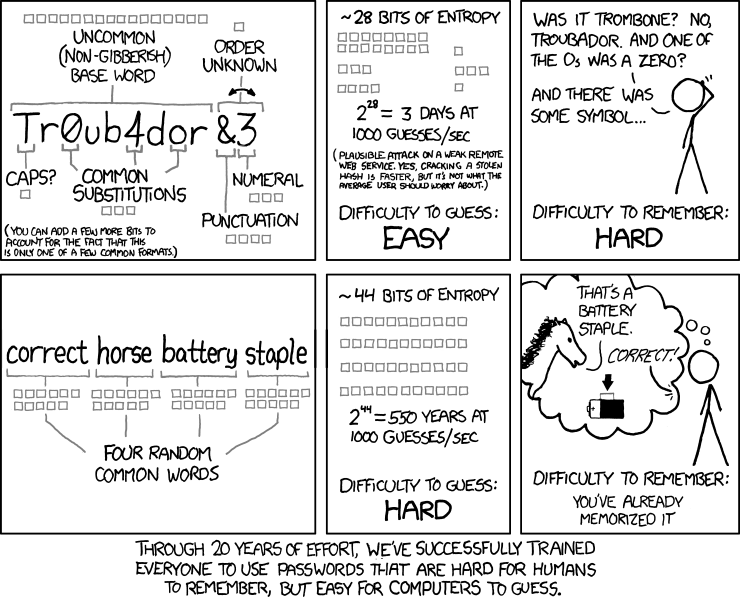
To anyone who understands information theory and security and is in an infuriating argument with someone who does not (possibly involving mixed case), I sincerely apologize.
 peak fiber
cool
 elder bison
thorn obsidian
elder bison
thorn obsidian
I don't know sorry|| @elder bison ||
 polar rover
@elder bison Why do you want to use dapps??
mortal perch

Today we reinstated youtube-dl, a popular project on GitHub, after we received additional information about the project that enabled us to reverse a Digital Millennium Copyright Act (DMCA) takedown.
 bold ice
I'm not sure what's the correct channel for this but is there someone that can help me with some logic quetions about Timing Attacks?
 void aspen
I’m afraid this would fall under the rule 5
bold ice
Oh
void aspen
We can’t heelp you with that, sorry
void aspen
No worries
bold ice
Just for general knowledge it's for educational project at my school 🙂
void aspen
But we have no way of verifying what you will actually do
woven gazelle
Does it really break rule 5?
Seems like you basically couldn't actually talk about security here in that case
lusty flare
it's a fine line between talking about something in the abstract and going into specifics
always tricky to weigh up a question
fluid verge
Side channel attacks are still an open area of research, so... I don't think it breaks rule 5
lusty flare
i'm sure some generalised questions about side chan attacks would be fine
fluid verge
Especially about talking about preventing them
woven gazelle
yeah and honestly if you have the technical knowledge to actually implement a side channel attack from something you learn here
you're gonna figure it out anyway
it's not like teaching someone how to run nmap on a website or something
fading plaza
if you're implementing side channel attacks, its a lot more likely that you actually know stuff about sec and aren't a script kiddie
kindred pollen
Books for beginners?
woven gazelle
any specific areas?
 fallen parrot
I would reccomend anything that has to do with networking and how devices and networks communicate with each other and the outside world. I'll see if I can find a link to a good book for ya @primal lily
This is a tad outdated but sstill has relevant information that I still use to this day https://www.amazon.com/Computer-Networking-Beginners-guide-Mastering-ebook/dp/B077PZXZF1
thorn obsidian
How I start in pentest?
what topics I need to research to start in pentest?
fallen parrot
I would recommend looking at web app and common OSINT and experiment with common pentesting operating systems. At least thats what I did. Also look into content creators like 'The Cyber Mentor' and 'NahamSec' as they are pros at this stuff
thorn obsidian
what is OSINT?
fallen parrot
Open Source Intelligence
thorn obsidian
ok thanks for the help
fallen parrot
no problem
thorn obsidian
would anyone recommend some tools for OSINT?
 sudden ibex
If we get some obvious phishing attempts (e.g. someone impersonating Jason), how do we report them?
 swift onyx
thorn obsidian
How I start in pentest?
what topics I need to research to start in pentest?
swift onyx
thorn obsidian
How I start in pentest?
what topics I need to research to start in pentest?
This is not the group and python is not the language for it if in the end you're gonna use wrapper libraries anyway
Honestly, I would recommend learning networking and other topics first and then pentesting. You could try studying for OSCP as well
thorn obsidian
Thanks
 unreal wadi
hey guys i need help with the following:
securing the api keys so you could pull them from a git repo but wont be available to copy or use, any way to encrypt the api key or something similar
i was told there is a a pythonic way to do it
unreal wadi
im doing a devops course and we were told to use a free currency converter API, he API I found has a key and I was told by my instructors to find a way to make sure it is not in the code but still useable when we upload everything to github
I cannot upload the key itself into git
its a free API key that is open to the public
fading plaza
put the key in a .env file or something
add that to .gitignore
and then use os.getenv to read its value in your code
@unreal wadi
 lapis radish
@unreal wadi you can encrypt API keys before push, but it's a bad practice to publish this kind of data
thorn obsidian
Hey guys i know this is for python but i have a virus on my pc and i took my op perms
It broke my pc
Pls help
woven gazelle
op perms
 dense mist
thorn obsidian
Hey guys i know this is for python but i have a virus on my pc and i took my op ...
dense mist
thorn obsidian
Hey guys i know this is for python but i have a virus on my pc and i took my op ...
avast, metadefender, malwarebites protect your pc next time ;-;
 restive hazel
Hey guys, is there any recommanded open source library or framework for creating Threat Intelligence. I found YETI, but it not longer maintained. Thanks 🙂
thorn obsidian
I use kaspersky its better
 astral gull
if salt is basically a bunch of random special characters that help in secure hashing
then pepper is just a private salt that isnt saved?
 quasi steppe
Lol ok
 summer coral
How can I inject a webpage in my local network?
Like e.g., opening instagram will display Webpage blocked.html instead of instagram webpage
ping me if you can help
quasi steppe
you need to modify the dns somehow, not sure
lusty flare
there's a few methods, the most common is to set up a DNS server and then have DHCP hand out the info for it
then catch attempts to resolve a domain and direct it to something else.
that's probably the most reliable solution
you could do some janky IP address based rules on the router
which means even when users aren't using your DNS server they're still holed.
lusty flare
hmm... if you're unfamiliar with running a domain name server you could probably look into "Pi-Hole"
i think you can get some images which you could install as a virtual device on a PC on your network
then adjust your router's DNS settings to point to that virtual machine
it's the sort of thing where you need a dedicate device to act as the DNS server
thorn obsidian
@fluid bay I dont think this is the right channel for such a question
 fluid bay
Ok
 quasi shadow
Anyone know if snekbox supports arbitrary dependencies somehow? Fortunately it has a lot of the libraries I need for my project, buttt
I forsee wanting to do some data visualization in a safe environment like snekbox (e.g. with matplotlib) but I don't see any way to install it as a dependency on snekbox
fading plaza
Isn't gambling illegal in most states?
fluid verge
I was assuming the least illegal case for them
 past starBOT
5. Do not provide or request help on projects that may break laws, breach terms of services, be considered malicious or inappropriate. Do not help with ongoing exams. Do not provide or request solutions for graded assignments, although general guidance is okay.
fading plaza
what does the trans flag have to do with this
fluid verge
also my question: what does it have to do here?
careful, or you're gonna fall under rule 6
!rule 6
past starBOT
6. No spamming or unapproved advertising, including requests for paid work. Open-source projects can be shared with others in #python-general and code reviews can be asked for in a help channel.
 low rivet
!ban 542103124542881808 homophobia
past starBOT
:incoming_envelope: :ok_hand: applied ban to @half sparrow permanently.
fluid verge
thank you for that
quasi shadow
Came back to check for responses and was seriously confused for a moment lol
woven gazelle
naughty
uh yeah so re your original question
i think you may need to rebuild the docker image
fluid verge
Yeah, I forgot to remove my messages to the banned user
woven gazelle
what were they even doing in #cybersecurity
fluid verge
The user was trying to access online gambling sites accessible only to New Jersey residents, while he was in Washington state. they tried several things to bypass the restrictions through several things, and in the end, was asking for help on how to bypass the restrictions, because he could not think of anything more (they even asked for a NJ friend to leave they computer on and TeamViewer their way to the gambling sites, but that one failed as well)
woven gazelle
wow this really isn't the place for that lmao
thorn obsidian
Hey so I am coding a custom test encryptor and I am making it so that every character you convert is a 100 character string. For example:
H = fwherfhr874jfusitmghhct6s834...
Do you think that if I put important things into it and encrypt it, would any other people be able to decrypt it? I am making this so that I can store passwords securely and something to do for a couple days
fading plaza
dont roll your own crypto
you can write your own crypto code, but never, ever, use your own crypto code as actual crypto
also
unless you actually know crypto in depth (hint: you probably don't unless thats your job description)
any crypto implementations you make will probably be flawed in some way
and even actual cryptographers mess up their crypto algos

Information Security Stack Exchange
Why shouldn't we create our own security schemes?
I see a lot of questions around here about custom crypto and custom security mechanisms, especially around password hashing.
With that in mind, I'm
@thorn obsidian
can you post your algo?
i wanna see if i can break it
thorn obsidian
Still coding it @fading plaza
thorn obsidian
I'll post the actual encryptor and you can analyze it if you want. No one is going to have access to the program except for everyone here, but I will definitely change it and improve it.
I read that thing you posted about and I am not going to use it for anything important. I might improve it and use it with friends to make secret messages
Once it is done tho
Which will take a couple days since I also have school
lapis radish
fading plaza
dont roll your own crypto
 for not creating own crypto algorithms
There are so much knowledge to earn and you still don't know that you missed something
lapis radish
thorn obsidian
Hey so I am coding a custom test encryptor and I am making it so that every char...
What purpose is for storing password? Do you want to store it like passwords managers do or you want to store in some kind of database like web services do?
thorn obsidian
I am going to use a password manager
I was just thinking of making a personal text encryptor
But I saw that J shouldn't do that
I am just going to make it so that I can text friends secrets if I need to or something
lapis radish
If you want to make your own password manager just use some well known KDF (key derivation function) to generate key from your passwornd and AES for encryption
You can use Argon2 as KDF or PBKDF2 with SHA-3 for example
thorn obsidian
Ok. Thanks for the suggestion!
lapis radish
Your welcome!
Remember about safe and unsafe cipher modes (forget about ECB, you should consider GCM or CCM)
void aspen
quasi shadow
Anyone know if snekbox supports arbitrary dependencies somehow? Fortunately it h...
If you are talking about pydis snekbox, then yes! You just need to add the dependency to the Pipfile, relock and rebuild the container, if you have any other question, feel free to ask in #dev-contrib
 daring briar
hi
thorn obsidian
Accidentally sent that lol
 cosmic monolith
Is it possible to detect http requests / other requests using sockets? I am making a "firewall" (just for fun) that scans all incoming http requests and denies them (does not send them) if they are malicious
lapis radish
cosmic monolith
Is it possible to detect http requests / other requests using sockets? I am maki...
How about nfqueue?
I used nfqueue to catch outgoing DNS traffic to make some kind of DNS cache
I used this module https://pypi.org/project/NetfilterQueue/

But I think that maybe is more #networks than #cybersecurity
 fringe elbow
@cosmic monolith +1 you want NFqueue for that, its an option for IPtables that will allow you to write a packet filter/manipulator and run it in userspace so you dont need to escalate it to kernel level. I wouldn't use it for any performant networking requirements tho. https://home.regit.org/netfilter-en/using-nfqueue-and-libnetfilter_queue/
neat rampart
I need to sandbox or filter user code so that it only has access to a subset of objects in the main program. This is for in-game scripting for a game that I am looking to write. How can I achieve this?
fluid verge
In general, but for Python in particular, you need to deploy a sandbox around the interpreter. If you want to build a language-level sandbox, you'll inevitably fail miserably (someone will play with your sandbox to try and destroy your system, and most likely succeed eventually)
 empty salmon
hello! I was curious about something. I honestly did not understand encryption much other than "It makes things secure". But lately I found myself interested in learning more. I just want to ask if I understand the basic concept of encryption correct.
Encryption is using large numbers, such as from binary numbers and converting those numbers to another number base (like base64) with letters in it right? So, the idea is that when the binary numbers are converted to base64 they turn into letters. Which builds a meaningful text and thus creates a safe communication or something like that, say, between two friends. And you use binary system for large numbers so that encryption takes longer time to crack, right ?
I might have went quite off the rails here but like I said, I am very poor when it comes to understanding encryption
lapis radish
First of all, base64 is not an encryption - it's encoding
First encryption schemes were not about big numbers or even bits - many centuries ago people had different tools to do it
 humble isle
CAESAR CIPHER, etc are examples of these
there purpose is to make the message illegible without a key
Some encryptions nowadys too work like that
To decrypt, you need to give the key.
lapis radish
For example you can write whole alphabet from a to z: abcd...xyz
You can precede this with your key-word like "cat" for example and delete duplicates so you have: catbdef...xyz
Then exchange a to c, b to a, c to t and so on
It's simple encryption scheme
humble isle
however, some encryptions nowadays use algorithms to convert the string to digits. They are strong and cannot be reversed
They are used for storing data which needs one way acess, eg: passwords
empty salmon
I see. So encoding does not really help with encryption then
lapis radish
Encoding is just different tool - for example if you want to transfer binary data as text, then you can use base64
Encryption is to protect data but you can encode ciphertext ofc
empty salmon
Ah gotcha
It’s just a tiny part of the whole scheme
So I should say then that what I was interested at was using programming for encryption
But above examples seems like less programming based?
The one with alphabet and CC thingy
lapis radish
empty salmon
So I should say then that what I was interested at was using programming for enc...
I think that I don't understand - do you want to learn how ciphers work by implementing them?
empty salmon
I was thinking about using programming in python to essentially create(even if very simple) encryptions which I can use. Like programming encryption to send an encrypted message to my friend that has a gif inside it. Kind of small stuff like that
lapis radish
It's bad idea, making safe cipher is very hard thing
You should use well-known encryption schemes
There are many packages in Python that are ready to use so you can pick one of them and don't be afraid about safety of your data
empty salmon
Hmm, so I can’t really combine learning python with learning encryption I assume.
It’s just better to use libraries
What about cryptopals? Is that good way to understand encryption better.
lapis radish
There are two cases - first is how ciphers works
You can implement DES or even AES for educational purposes, it's nothing wrong with it
But second one is making own cipher - just don't do it
lapis radish
empty salmon
What about cryptopals? Is that good way to understand encryption better.
https://cryptopals.com/ ? I don't know it, but looks fine
empty salmon
Yeah that website.
lapis radish
I think that it's nice place to start
empty salmon
I see, thanks for the help
lapis radish
Your welcome!
empty salmon
I will try to learn more about encoding part. Seems like a good start
Also to be clear. I didn’t meant creating my own encryptions for serious stuff.
It was more about training little bit in coding by coding encryptions, and then use them effectively in really life by doing normal silly stuff
Like sending a cat gif
lapis radish
So start with simple and old ciphers like mentioned Caesar cipher, Playfair is nice too
Then you can try XOR ciphers
When you feel a little bit stronger you can try to implement DES and even AES but it needs some advance in developing cryptographic primitives
Feistel network is fine tool to produce ciphers and you can find some articles about this concept
thorn obsidian
how would one go about creating a hash function in python?
lapis radish
thorn obsidian
how would one go about creating a hash function in python?
What hash function do you want to create? Your own?
thorn obsidian
yes my own
lapis radish
What do you want to achieve? Is it for educational purposes?
For production usage you should use already existing modules
thorn obsidian
yes its just for myself so i can learn, not planning to use if professionally or anything
i want to be able to have a function that i can call and pass a string to and it returns a hashed version of the string
lapis radish
Do you have an algorithm which do you want to implement?
thorn obsidian
yes i want to try to create my own algorithm to hash the string
is that too hard or what?
lapis radish
It's not too hard to create hash function itself but it's extremely hard to create secure hash function
You can check how old functions were constructed - like MD5 or SHA-1 - and based of this knowledge you can create your own
xxHash is also nice hash function but it's not cryptographic hash function - so it's not secure but it's really fast and good of hashmaps implementations for example
thorn obsidian
security is not a concern for me i just want to go from: e.g hello world to: 74f76D76fkjjhYd67
something like this
like maybe for examplei can loop through all the letters and randomize them?
lapis radish
Hash functions are not random - these algorithms are deterministic so for given input you always get same output
The simplest way is to create some variable, call them acc
Fill it with random value like acc = 0xAABBCCDD
Then you iterate trough 4-bytes blocks of text and xors these blocks into your acc
acc ^= block[i]
thorn obsidian
if i do this its not randomized?
lapis radish
You need to add padding to your text if it doesn't met this condition that it's dividable into 4-bytes blocks
thorn obsidian
ohhh i see
lapis radish
thorn obsidian
if i do this its not randomized?
Hash functions are not random functions
For given input you always get same output
thorn obsidian
when exactly can i find the source code for it ?
lapis radish
How about in your search?
"MD5 source code Python"
thorn obsidian

GitHub
Python implementation of the message digest 5 (MD5) algorithm - timvandermeij/md5.py
is this it?
lapis radish
It looks nice and simple
thorn obsidian
but if its just available to the public like this then if someone still uses it can they get hacked ?
since the source code is public
so anyone can crack it right?
lapis radish
No, there is something like Kerckhoffs's principle
thorn obsidian
and what is that?
lapis radish
Algorithm can be publicly available and it shouldn't cause that it is breakable
You can read more about this rule in books or Wikipedia for example, my English is not good enough to explain it here in details
lapis radish
Okay
 vital gyro
Hey could someone give me a hashing library I should be using
lapis radish
vital gyro
Hey could someone give me a hashing library I should be using
hashlib?
vital gyro
a hashing library that is supposed to hash passwords
lapis radish
So use hashlib and SHA-3 for example
Do you want to store this passwords in database?
vital gyro
yes
lapis radish
Then maybe use bcrypt or Argon2 if it's possible
lapis radish
Good choice
As far as I remember there were recommended parameters in Argon2 specs for storing passwords
Oh, yes - https://www.cryptolux.org/images/0/0d/Argon2.pdf page 17
vital gyro
>> from argon2 import PasswordHasher
>>> ph = PasswordHasher()
>>> hash = ph.hash("s3kr3tp4ssw0rd")
>>> hash
'$argon2id$v=19$m=102400,t=2,p=8$tSm+JOWigOgPZx/g44K5fQ$WDyus6py50bVFIPkjA28lQ'
>>> ph.verify(hash, "s3kr3tp4ssw0rd")
True
in the docs it shows this.
it is comparing the hash with the password.
So while checking would we need to store the password as well?
lapis radish
If you have database, where you store hashes, and you want to compare one hash to given password there is no need to store this password in database
But you need this password somewhere in RAM ofc
lapis radish
First of all please write what you are building, when I get the concept it will be easier for me to find solution
vital gyro
a password manager
vital gyro
gui
lapis radish
First what you need is encryption algorithm - block cipher like AES would be good choice
Using cipher you can protect data that you keep
vital gyro
oh i would need an alg?
I thought i would just have to hash the password and send it to db
lapis radish
But cipher is reversable, so you can decrypt ciphertext - you cannot reverse hash function
vital gyro
right
lapis radish
Start with creating simple file that stores ONE password
fluid verge
A cryptographic hash function (like SHA-x) should not be reversible
vital gyro
lapis radish
Start with creating simple file that stores ONE password
hashed or not?
lapis radish
vital gyro
hashed or not?
No, you need to store password in plaintext - it's password manager so you want to retrieve your passwords
vital gyro
then isn't that pointless
fluid verge
well, it should probably be ciphered, rather than in plaintext
vital gyro
in what different way?
lapis radish
Check some use cases
But creating password manager without basic knowledge of cryptography is pointless in my opinion
vital gyro
oh
lapis radish
You should start with something simpler
fluid verge
definitely
vital gyro
hmmm
lapis radish
Hash function, block cipher, padding, key derivation function - it's just a few terms that you should know
fluid verge
The point of a password manager is being able to safely (as in nobody not having a password should be able to access the database) store potentially critical information
lapis radish
Exactly
vital gyro
fluid verge
The point of a password manager is being able to safely (as in nobody not having...
wdym by "nobody not having a password"
fluid verge
If you can't ensure that you can 1) retrieve information with the master password or any form of authentification, 2) nobody without the means of authentification you decided upon should be able to access your database, then what you have is not a secure password manager (fail number 1, you have a hashed database; fail number 2 and you basically have a plaintext database)
vital gyro
oh
 sonic drum
How does ph.verify work in Argon2 for Python? How can it verify if the hash matches the password? Does it like save the password and hash somewhere?
lusty flare
when the user puts in a password it's hashed (and salted depending) and compared against the existing hash in the database
it does not store the password
void aspen
When you save a password using argon2, it will create a string made of the password hash and its salt, and if you feed this string to the verify function along with the user input, behind the scene it will append the salt to the user input, hash it, and check if it match the first part of the string
fluid verge
only the hashed version if you really need to store something
lusty flare
i mean for a login system you totally need to store their hash
there's uhh... no other way to verify
fluid verge
well, obviously
fluid verge
except maybe another means of authentification
void aspen
lusty flare
you *never* need to store a users password
tell that to my school
fluid verge
plaintext password storage should be illegal, if it's not already
lusty flare
sounds like your school is too lazy to create some form of impersonation Aky.
it's not illegal
annoyingly
void aspen
But you will make it mandatory to have another account to use your services
lusty flare
Vodafone still use plain text
as they send you your password in the mail
but it's stored hashed in their database
fluid verge
😱
fluid verge
well, it's basically plaintext
void aspen
One of these day I should just rainbow one of the school account and be like “you see why it is bad to not hash password?” >.>
sonic drum
lusty flare
you *never* need to store a users password
wdym
void aspen
You should only store the hash
sonic drum
yeah that's what I meant
lusty flare
i don't mean email, btw, they actually physically mail you your password
and here's the logic

@Freakyclown Posting it to you is secure, as it's illegal to open someone else's mail. ^JGS
Retweets
1343
Likes
2170
 Twitter
·
Twitter
·
10/10
void aspen
Wait what
lusty flare
nah
sonic drum
do emails need to be hashed with a salt?
lusty flare
nope
lusty flare
nope
sonic drum
so not hashed at all????
lusty flare
how can you do a password reset if you don't know their email?
lusty flare
i mean it is.
void aspen
Because bruteforce attacks are legal?
lusty flare
do you want a quick rundown on best practice password storage SomeDude?
sonic drum
sure
lusty flare
in like... procedural steps
- users visits your thing and types in username / pass
- you receive that info and immediately run your hash algo over the pass
- you compare the hashed password you got from that login attempt against the hashed password stored in the DB for that username
- if it matches, you login. if it doesn't, you reject.
the password is never stored.
if done properly it exists in memory temporarily
as it's hashed
unless you specifically set something up between receiving the login attempt and hashing the password for that attempt (if using something like argon)
you will never know what anyone's password is
sonic drum
how do I store an argon hash?
I get this for Python '$argon2id$v=19$m=102400,t=2,p=8$Igc9sf3IoT4xCtLMR1XXug$0Cs+THo5Haf7kGQq5czdGw'
do I just store the entire thing
lusty flare
i haven't used argon yet as no projects since i learned about it have login systems
but i'd assume yes
i'd highly recommend going through an argon2 + python tutorial to have a quick read
lapis radish
It's salted
lusty flare
i still sha ¬_¬
void aspen
.>
 manic obsidian
lusty flare
manic obsidian
lusty flare
i don't think this is #cybersecurity related you probably want to look at #❓|how-to-get-help and explain what you're trying to do etc in a help channel

 rose plover
Also probably not a good idea to store a password in plain text at least put it in hash or something
thorn obsidian
Anyone know any good bruteforcing tools
rose plover
burp suite?
is a pretty good one for all-around stuff
Well a combination of tools
Metasploit is also a good one you can try
rose plover
Oh ok that's pretty good to.
Wait are you doing a login?
Have you tried logging in regularly? without forcing it first
If not try an sql injection
Here's a website I found which tells you how to do it https://portswigger.net/web-security/sql-injection
fading plaza
@lusty flare single sha? o_O
not even pbkdf 😦
@thorn obsidian first, make sure what you're doing is legal
secondly, hydra is pretty decent for bf
rose plover
It's legal as long as you have permission from the owner :)
sonic drum
Why is Argon2 so slow compared to other hashing algorithms?
rose plover
Idk
sonic drum
I think maybe because it goes through million iterations to salt the hash?
fading basalt
So, I'm getting started with hacking now and I want to know what not to do so that I don't do it. Any place online I can find like a list or something of no no's of hacking?
rose plover
The 10 Rules of ethical hacking you must never ever break and if ya do you can well... You get some unwanted attention ;) https://www.dummies.com/programming/networking/obeying-the-ten-commandments-of-ethical-hacking/
These commandments were not brought down from Mount Sinai, but thou shalt follow these commandments shouldst thou decide to become a believer in the doctrine of ethical hacking. Thou shalt set thy goals Your evaluation of the security of a wireless network should seek answers to three basic questions: What can an intruder see on […]
Oh yeah and dont break into anything that is not yours or you don't have permission
for
 viral hawk
okay thanks!
rose plover
Did you have a question Heymanlol0n?
viral hawk
nope!
lapis radish
sonic drum
Why is Argon2 so slow compared to other hashing algorithms?
You have several parameters to determine algorithm speed like number of lanes or time and memory cost
bcrypt for example has just work factor but Argon2 has many more parameters and you can tune algorithm to your needs
 crimson fable
Hey, can someone tell if a file has been copied at all? Like is there a digital footprint of sorts for that?
Asking for a friend
crimson fable
Well the file was a python file they were working on andnwas in a hidden folder. They believe someone copied it because the code he was working on ended up elsewhere, line per line exact same. But he doesn't have proof it happened. So that's why he was wondering if there is some way to tell.
lapis radish
Do you have access to machine with copied file?
crimson fable
I do not. They asked me because I know some stuffs, but I never dived deep into security. And I wasn't sure
Let me rephrase, I don't have access but they do to both machines
lapis radish
I don't see a way to proof that file is copied in that scenario
crimson fable
Ah darn, alright. Thanks for responding though!
lapis radish
Your welcome! If you find a way you can share it here
crimson fable
Ya I will see what I can maybe do to help em!
void aspen
@crimson fable if the device wasn't mounted with noatime you can check the last access time, assuming you didn't opened it in the meantime
kindred pollen
where to start this entire concept of security from.
no idea so asking 
lapis radish
kindred pollen
where to start this entire concept of security from.
no idea so asking <:pithink...
What do you want to achieve?
kindred pollen
idk learn atm
and later get a job if possible lol @lapis radish
lapis radish
Ofc but there are several roles in security - you can be security architect or pentester and so on
kindred pollen
data security
lapis radish
There are two sides, always fighting lol
kindred pollen
kindred pollen
data security
if its a thing
lapis radish
kindred pollen
data security
I think you should start with "what is encryption" and how can you protect data
lapis radish
Data has some attributes that you can protect using different methods
lapis radish
It's joke
kindred pollen
umm ok
 native edge
!warn 690641855045697653 don't post harmful commands
past starBOT
:incoming_envelope: :ok_hand: applied warning to @lapis radish.
lapis radish
😦
lapis radish
Sorry
lapis radish
Catch some help channel
kindred pollen
okay
and sorry u got a warn bcoz of me
lapis radish
Yep, I am dev and I am working with security related project
kindred pollen
:O
lapis radish
But it's kinda offtopic
kindred pollen
how much do u earn
if u can tell
lapis radish
Grab some free help channel, we can talk about "how to enter into cyber security"
kindred pollen
i did
lapis radish
Which one?
kindred pollen
lapis radish
Okay
 limpid peak
hello
 final forum
hey
 steel ridge
is this channel about cyber security?
fading plaza
yes
 grim tulip
steel ridge
is this channel about cyber security?
grim tulip
steel ridge
is this channel about cyber security?
Well, it's about python related to security. Considering all of that would be on your electronic devices and or related to the security of your application. Most instances you'd be talking about "cyber security". Which is about as vague as "security".
steel ridge
understood
will be checking here more then
I plan to start a career in cybersecurity and recently have been learning python at university
figured it would be a great asset to have
grim tulip
steel ridge
figured it would be a great asset to have
I'm not an expert, but I am a fan and subscriber of pentesteracademy.com . It taught me a lot about python and security. You should check it out! Could give you a reason to post in the channel for others 🙂
rose plover
If anyone needs help with anything security related just send a dm
lusty flare
we prefer to keep things in this channel
as in the future other users may find it useful
 wintry reef
void aspen
wintry reef
void aspen
@Freakyclown Posting it to you is secure, as it's illegal to open someone else's mail. ^JGS
Retweets
1343
Likes
2169
Twitter
·
void aspen
Hahaha yes
thorn obsidian
is it possible to prevent rootkit using python
how long or how much experience it will take me to make a software that prevent rookit attacks
 worthy lodge
why and how do shell injection attacks take place?
void aspen
Why : because it will allow you to do things you aren't allowed to
How : rule 5, but let's just say that you gotta mess around with the parser
worthy lodge
i want to prevent shell injection attacks because here's what i'm doing
Setup.exe --install-dir="<can be malicious code but its in quotes>"
That can be subject to injecting if the code contains quotes
worthy lodge
i'm checking for malicious strings and commands like so
forbidden_list = [
    'system32',
    'Remove-Item',
    'erase',
    'del',
    'ri',
    'rd',
    'rm',
    'rmdir'
]
@void aspen well see the user needs to run the command for my cli like this
mycli install randompackage --install-dir="del C:\WINDOWS\system32"
And when my cli runs the installation:
Setup.exe --install-dir="del C:\WINDOWS\system32"
@void aspen is this a decent way to validate the command?
void aspen
I'd say that you could use a path validator for that @worthy lodge
worthy lodge
@void aspen does there exist any module in python for that?
void aspen
I don't think so, but you should be able to make a little regex for that
worthy lodge
yes lol
fading plaza
@worthy lodge shlex.quote?
rose plover
lol
thorn obsidian
Lol
rose plover
Hey #cybersecurity happy thanksgiving to everyone and hope you all have a good night anyways I have a question for you all what are some holiday hacks you have done before and if you have what was it a friendly prank on your friends or something... else?
rose plover
Somewhat
 onyx nacelle
I'm wondering bcs i was working with hashlib and then I saw sha512
fading plaza
@onyx nacelle its better to use neither
and to instead use an actual kdf
such as scrypt bcrypt or argon2(the recommended one iirc)
scrypt is in hashlib
argon2 is at https://pypi.org/project/argon2-cffi/
worthy lodge
@fading plaza i'm using shlex.quote now instead of "" but i don't see much of a difference between
Setup.exe /DIR='C:\Users\Shared'
and
Setup.exe /DIR="C:\Users\Shared"
what is the upside to using shlex.quote() ?
i am guessing it just inserts a quote on both sides of the string
lemme know if anyone knows about the use of shlex.quote()
fading plaza
oh wait this is windows
i have no idea how cmd.exe quoting works
but i think shlex is for unixy shells only?
my bad
worthy lodge
@fading plaza ooh no this is a really big vulnerability
how do i prevent this from happening? i take the part after /D= as user input
ooh no
fading plaza
whats your full code
also is it possible for this setup.exe to take args like --install-dir "some/path"?
instead of an equals
thorn obsidian
So ya'll know how any phone number with 555 in it makes it a fake number right
is there an equivelent to that for credit cards
I'm trying to make a fake profile generator
worthy lodge
@fading plaza it can take --install-dir="Some/path" yes
worthy lodge
@fading plaza yes that works too
in that case it just inserts the = its almost the same
fading plaza
hm
then you can just use subprocess.run with a list arg
like subprocess.run(["setup.exe","--install-dir","some/path"])
instead of whatever you're currently using
@worthy lodge
since this way, it skips running a shell altogether
avoiding any shell command injections
worthy lodge
aah alright thank you : )
lusty flare
@thorn obsidian
Our tutorial on credit card processing walks developers through the payment process.
not sure if those would help
they at least match the format of cards.
 shadow dock
so i made a login system that just uses a txt file, now that is not safe, what is a better and safer version of a txt file
ping me if response
lusty flare
use something like argon2
with a database
sqlite is a good way to get started with databases
as you don't need to install any software, there's a native python library
shadow dock
thanks
lusty flare
👌
 spiral path
Hello
lapis radish
Hello
 cloud falcon
Im making a password manager. I am trying to store encryted passwords in a database. I want to be able to decrypt them with a masterpassword such as 'password'. Can someone help i have been trying for hours with No success. @ me plz.
thorn obsidian
cloud falcon
Im making a password manager. I am trying to store encryted passwords in a datab...
So you're wanting to hash passwords?
lusty flare
not hash though, surely?
since to unhash you'd need to know the password
which defeats the point of a password manager
sooo, encrypt and store
fading plaza
@cloud falcon check out aes
 viral zinc
hello i need help for a pyhton scritp
fading plaza
wait actually aes might not be the best due to fixed key len
uh checkout other symmetric encryption
viral zinc
can someone help me ?
fading plaza
you need to tell us what you need help with
viral zinc
ok so i just want to do a script to communicate with a IRC serverbut i don't how i cant send and receive data from an IRC bot
I do a script with socket lib
my script can actually connect to the IRC server but i dt know how i can send and receive data from a bot IRC
lusty flare
the IRC protocol contains info on how messages are sent / received
lapis radish
viral zinc
my script can actually connect to the IRC server but i dt know how i can send an...
How is it related with #cybersecurity ?
viral zinc
hmmm good question
lusty flare
i can think of one way
viral zinc
ok i go in networking thx
 severe frost
Hey guys I was wondering if I should use Oauth2 providers like google to verify/create the user. Then I generate a token from my server to the client(app) to verify if the user is logged in?
For some context I am using FastAPI for my webserver, and flutter for the frontend.
 edgy cloak
Is there a more secure way to call functions and variables than having them in a seperate file and doing:
from functions import * print(var1) function1()
woven gazelle
Secure how
Generally that isn't a very good idea just because it's hard to tel what's going on
edgy cloak
Wdym secure how
Like a better way for like making the code thingy for a discord bot in a seperate file so thst nobody can find out
Whaat it is
woven gazelle
how would it be insecure
edgy cloak
If someone had the bot id, because i am planning on putting my prograb on github but i cant let them use my code
So i need to have the bot id seperate from the main code
woven gazelle
you mean the token?
generally you include that by setting it as an environment variable when you run the program
 light quartz
hello guys, I've recently got into learning stuff about security, networking and databases mostly for ethical hacking. Do you have any sites you would recommend for practice or in general how you can apply those skills in an controlled environment?
lapis radish
light quartz
hello guys, I've recently got into learning stuff about security, networking and...
I used https://root-me.org
Root Me est une plateforme permettant à chacun de tester et d'améliorer ses connaissances dans le domaine de la sécurité informatique et du hacking à travers la publication de challenges, de solutions, d'articles.
light quartz
Thanks @lapis radish, will check it out, seems like a very useful tool.
rose plover
www.tryhackme.com is a good one and hackthebox
 atomic pilot
It is a brute force script
 honest vale
Is django default security worth it? Can it defend cyber attacks?
 iron wadi
Is this bad
source .env

# ...

ENDPOINT="https://$GITUSER:$GITPASS@$DOMAIN/$GITUSER/$PROJECT.git"

# ...

git push $ENDPOINT master
People always say not to supply the url to the shell because it remains in the git history
I dont think this beats that does it?
fringe elbow
Use a github personal access token instead
iron wadi
with an ssh key? Ive seen that feature but havent gotten around to it yet
fringe elbow
Or, (better) a SSH keypair
Once you enable 2FA on GitHub you can't push like that anyway with the username/password combo
I have an SSH key for my dev machines, then for servers or CI/CD if I just need to pull a copy I setup a read-only access token
I only ever use my password for logging into the GitHub website, with 2FA
never, ever, ever for pushing code
If there's any PyCharm users in this channel, I run a static code analysis extension ($0) for security flaws. It has a lot of specifications for Django https://pycharm-security.readthedocs.io/en/latest/
Even if you don't use PyCharm (or the extension) the documentation has a list of common mistakes (under "List of Checks")
its similar to Bandit, but it has more checks, and fewer false positives because it uses the PyCharm type system and Python API
Bandit is also great 🙂
 magic lodge
 dire sleet
anyone here any good with aes
lapis radish
dire sleet
anyone here any good with aes
What do you want to know?
fluid verge
well, what's the problem?
fluid verge
you'd probably need to do a ^= a >> 1
fluid verge
indeed, looks like it. The shifting kills invertability
lapis radish
@thorn obsidian
fluid verge
It's probably the linearity killer of a cryptographic hash function
lapis radish
Probably yes
lapis radish
You cannot reverse shift operation
If you have for example 4-bit length vector like [1100] and you shift one time left you get [1000]
If you want to "unshift" it which bit should be on the first position? 1 or 0? @thorn obsidian
You don't know it
So you get [x100] where x can be either 1 or 0
In this code you lost 13 bits from left and 4 bits from right so you have 2 ^ 17 possibilities or 1 / (2 ^ 17) chance to get the correct value
sonic drum
Got any recommended libraries for end-to-end encryption? I'm gonna make a terminal communications app
I want it to be secure
 hard frost
anybody recommend any videos for python for cyber security
fringe elbow
red or blue?
@hard frost offence or defence?
LiveOverflow's channel is pretty good. https://www.youtube.com/channel/UClcE-kVhqyiHCcjYwcpfj9w

YouTube
just a wannabe hacker... making videos about various IT security topics and participating in hacking competitions. -=[ ❤️ Support me ]=- Patreon per Video: h...
The good stuff is normally in conference talks, instead of a dedicated channel
hard frost
defense
cyber security analyst is the goal after college
than convert over to read team
I have a fundemental level of python
 delicate nymph
How do you make more secure passwords in python? Bruteforced a sha2-256 password in seconds today. Seemed way to easy, maybe it was simply just an easy password
fading plaza
dont use raw sha2
use a dedicated kdf with a salt
such as argon2
which is a:slower and b:not vulnerable to rainbow tables
fringe elbow
dont use MD5, SHA1, RIPEMD-160, Whirlpool, SHA256 or SHA512 🙂
and a salt like hmmm said
fringe elbow
those are the length-extension ones, the collision (weak) ones are MD4, MD5, SHA1. Short version is use blake2 + salt
 wicked raven
Hi, I have a requirement of fetching MS Active Directory User hashes. Is it possible to do so without ntds.dit?
sonic drum
Is Bcrypt still recommended for passwords?
delicate nymph
Have you guys heard about the geforce 3090s password cracking speeds? Said to cut the time way back. Not sure why that was something they advertised for it though
woven gazelle
was it
fading plaza
@vital lava do you mean stdlib crypt?
 abstract badger
ah btw i want to ask a thing what thing should i use to encyrpt a string with a salt aka
a = something("thisismystring", "thisissalt")
print(a) #should return a hash that can only be decrypted by salt - "thisissalt"
fringe elbow
Yep that warning from bandit is right
 fallen ginkgo
i didnt realize ctf exercises were just googling exercises
fading plaza
yeah pycrypto is really old
pycryptodome is a maintained lib that's almost fully api compatible
though cryptography would be better for new applications
thorn obsidian
how can i stop botnet using python
because i need to save people from these dirty malicious software
I'm still learning about all attacks
lapis radish
You need Anty DDoS software or something
 river nest
thorn obsidian
how can i stop botnet using python
river nest
thorn obsidian
how can i stop botnet using python
depends on what the attack is doing, no? If it's a DDoS then cloudflare, if its individual PCs then anti virus.
Either way, it's unlike you can code something in Python that's better than what already exists 😄
thorn obsidian
@river nest My aim to defeat malwares
woven gazelle
not much you can do with python against a botnet
and it's not like you can build a program that just miscellaneously fights botnets
thorn obsidian
@woven gazelle not botnet, i want to defeat malwares using my python program
any suggestion
thorn obsidian
yeah a antivirus
 wanton gust
Can it be detected by other applications that I screen sharing from Discord, for example a system I entered via Google ?
 violet abyss
not sure if this question pertains to this channel but is there any way to prevent access to certain python class variables besides the .__ naming convention which doesn't actually prevent access
 wraith temple
anyone exp with akamai?
fading plaza
@violet abyss whats wrong with the current convention?
violet abyss
fading plaza
<@!754006029896777789> whats wrong with the current convention?
The variable can still be accessed and changed if you just do classname.__varName
On that note how are secure applications built into python
even if you're not storing passwords/sensitive information you don't want class variables to accidentally be changed either
fading plaza
because thats not how security works
its supposed to protect against users
not against other code
violet abyss
now i'm kind of confused, if there are no private variables in python, can the user at anytime read those variables
if so lets say you were using/moving/manipulating/analyzing potentially information that needs to be secured, how would you prevent it from being read
besides not allowing the user to directly interact with it...it seems like someone could use the python script and just watch the information that moves in and out of it if that makes sense
fading plaza
if the user can interface with your code
they can straight up just attach a debugger
and bypass any runtime checks you have
your code should trust other code that it uses/is used by
the untrusted input comes from the application's users
violet abyss
fading plaza
and bypass any runtime checks you have
can you elaborate on what this would entail...is it good convention to have runtime safety checks
violet abyss
fading plaza
your code should trust other code that it uses/is used by
so essentially if you make an application through python, the user should never directly interact with it
in other words do you use some other programming language or tool where you take user input which then sends that input to your application, the application manages the input, and sends back an output to your trusted application
fading plaza
@violet abyss you dont necessarily need another language in between
its fine if the user input is passed directly to the app
as long as they can't write code that interacts with it
or other similar methods
fading plaza
violet abyss
can you elaborate on what this would entail...is it good convention to have runt...
that was poorly worded, sorry
what i meant was that a debugger can bypass whatever method you have for creating a "private" variable
thorn obsidian
Just check if there is any process of any debugger on