#cybersecurity
7 messages · Page 18 of 1
 thorn obsidian
 dusk heron
i mean i dont know what im looking for lol
im looking for a way to pass binary numbers to the hash function
i have no idea if this is right
thorn obsidian
What do you mean by binary numbers?
dusk heron
you know how i generate random strings for my project now
thorn obsidian
Yep I see that
dusk heron
the prof told me to also generate hashes for all binary numbers up to 2^16 and analyze hashes for that too
so if i make a for loop and just pass the loop variable which is type string
i dont know if thats the same
im assuming no
thorn obsidian
Okay then sounds like you just need to pass in the bin(n)[2:]
dusk heron
im not sure the hash function will take bin(n)[2:] as argument but i havent tried it
thorn obsidian
Bin returns a string
dusk heron
yes but what happens when you encode that string
thorn obsidian
Hence the idea of the binary numbers being a little weird, either that means some encoding of strings of ones and zeros, or it just means all the numbers.
What interesting behaviour are we expecting?
dusk heron
lol yeah im lost
which way is "correct" lol
as in passing the actual bytes representation of a binary number
thorn obsidian
The objective isn't well defined so it's impossible to say, i don't think you want the bytes method as that's treating the ones and zeros as decimal digits, the truncated bin output would seem to maintain the idea of dealing with 'binary numbers'.
Or rather 'stringified binary representations of numbers'
dusk heron
so the second approach where i first convert to binary then to_bytes yeah?
thorn obsidian
Nope just the bin(n)[2:]
But since you're hashing them I don't think you're going to see any interesting biases at all.
 compact sail
Is there a way to encrypt a string in a way that allows it to be decrypted afterwards using a key?
thorn obsidian
Can you define key?
 hexed quest
@compact sail Yes there is
thorn obsidian
Because there exists Asymmetric encryption and Symmetric encryption. Asymmetric is like public key/private key, like SSH or PGP.
Whereas Symmetric is like AES, and can be decrypted using a passphrase.
compact sail
I'm looking for a reliable way to store a user's password in my software
hexed quest
use a database
compact sail
oh wait hol up
compact sail
no but you see the password has to be stored
thorn obsidian
https://passlib.readthedocs.io/en/stable/ - Hash the passwords with a master password
hexed quest
if so, the password is correct
compact sail
because the program is supposed to auto-login into a website
that's kind of the point of the program
for the user to not have to constantly type in their credentials
hexed quest
like you can do requests to a webserver
 neon jewel
I see, is this some kind of password manager
compact sail
nope
thorn obsidian
@hexed quest I don't think you understand
compact sail
so essentially my school has this really bad learning management system
and I'm writing an app that makes it usable
just a gui that allows you to see your lessons and tasks quickly
it webscrapes info from the bad website and makes it readable, however the website requires a user and a pass
and whatever you do you have to enter it in, and that's annoying
so I made a system that saves the user's username and password
but I need a way to make it secure
hexed quest
@thorn obsidian explain in pm
thorn obsidian
@hexed quest Please don't PM me
@compact sail What would prevent you from using KeePass/Bitwarden/etc then?
compact sail
that still doesn't solve the issue of the website having extremely bad design
it'd be ideal if I could kind of "lock" the string
with a key
thorn obsidian
the string?
compact sail
i was thinking of something like this as a system... but I don't know if it'll be secure:
user's password --> encrypted with user's password as a key --> encrypted piece of text
encrypted piece of text --> attempted decryption using user's password as a key --> either gibberish or user's password
the password
thorn obsidian
I don't see why this would be better than a password database that has already been audited.
What website(s) are extremely bad design?
compact sail
Daymap, my school's learning management system.
neon jewel
(not a security expert) I use gpg in symmetric mode to encrypt some of my files, there seems to be a library called python-gnupg that lets you interface with gpg. That way you can have a single passphrase to decrypt the user data.
compact sail
let me go check that out, seems like what I need for the most part 👍
neon jewel
Yep iirc that's the command line flag
 obtuse harness
I want to start cryptopals.com training but first I would like to get some advise about the topics that I am going to learn.
The first challenge in the first set is something that I can do in 5 minutes, or may be I could just use some online converters to do it for me
Now what type of approach should I choose to learn crypto:
1: Read theory about Hexadecimal & base64, then learn how to convert them using some libraries made by other people
or
2: Read theory about Hexadecimal & base64, implement **your own** libraries or code to convert them
or
3: Read theory about Hexadecimal & base64, convert stuff manually on paper then create tools from scratch for automation
Which one do you think I should do to upgrade my python skills as well crypto?
 versed scroll
@obtuse harness you should use a project with 1
thorn obsidian
hexadecimal/base64 can be done in the standard library
 hoary marten
they are also not crypto
this exercice is really supposed to be a warm up for cryptopals, don't spend a month on it imo
obtuse harness
thanks @versed scroll
@thorn obsidian well I am talking about libraries in general, do I need to read those libraries and see how they do the converting? is it really necessary? or just know what is Hex and how to do encode/decode?
@hoary marten thanks
thorn obsidian
Look at base64 - https://docs.python.org/3/library/base64.html and https://docs.python.org/3/library/codecs.html , as well as how to encode() and decode()
obtuse harness
@thorn obsidian well this is pretty easy and I can finish set1 in few hours, I thought I needed to look inside the libs
thanks
versed scroll
@obtuse harness np
thorn obsidian

Ars Technica
AMD shipped Ryzen 3000 with a serious microcode bug in its random number generator.
"oops"
thorn obsidian
@thorn obsidian I found AMD's RDRAND implementation's source
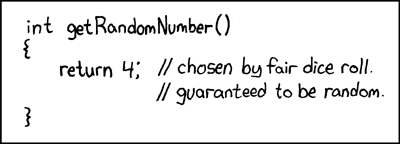
You sure that isn't Sony's? zing

 spiral iron
@marble dawn What type of pen-testing is not red-teaming?
 marble dawn
Pentesting is more about finding all the issues you can find
red-teaming is more about a focused effort to figure out the realistic risks an organisation is taking
it's hard to explain in so many words, but this seems like a good explanation https://www.redteamsecure.com/penetration-testing-vs-red-teaming-whats-difference/

Penetration testing versus red teaming. We often hear them used interchangeably, but in fact they’re two distinct things. So what exactly is the difference between the terms pen test vs. red team? In this article
spiral iron
Ok, so it's kinda like pen-testing is a wide-reaching security evaluation, while red-teaming is like a stress test.
First you do pen-testing and shore up your defenses, and then you do a red-team test to see if it paid off?
marble dawn
I think it's more that pentesting is all about approaching a company through the eyes of a bad guy
vs red-teaming being more like standardised testing and security policy review
although they more or less address the same issues I think
spiral iron
Are you sure it's not the other way around?
Cause it sounds like you flipped the definitions
Judging by that article at the very least
Red teamers take their time, wanting to avoid detection (just as the cybercriminal would).
marble dawn
One entertaining way to look at it is that the pen testers are pirates — ready to rampage and pillage wherever and whenever they can. In this analogy, red teamers would be more like ninjas, stealthily planning multi-faceted, controlled, focused attacks.
It's kind of hard to define honestly
I think deviant ollam has a video on the difference
 snow mortar
So I want to get into ethical hacking.. .
should i get a raspberry pi for hacking...and what are the advantages
 tepid rover
Is there any need to set up a passphrase for RSA?
I am trying to set up SSH authentication but I am not sure why the guide says that using RSA without passphrase is insecure
 bold grotto
passphrase in rsa context is that whenever you want to use your pvt key, you need to enter a passphrase
secure in this context is that even if your hard disk / usb / whatever, somehow your pvt key is compromised, other people can't use it still, since they don't have your pass
 quartz terrace
@tepid rover it might be the thing you're SSHing to is a critical server. Normally even if someone got hold of your computer, they couldn't access the server without a login password even if they stole your laptop. But if you have passphrase-less key, then they just copy the key off your computer and can now access the server
thorn obsidian
@spiral iron https://danielmiessler.com/study/red-blue-purple-teams/
Found this, might be worth a read(?)

Daniel Miessler
Clear articulation of the differences between red, blue, and purple teams—including how the term "Purple Team" is being misused…
spiral iron
Ok, so according to this article, a red team is characterized by trying to simulate an attack by a particular threat actor over an extended period of time. Whereas a pentester tries to attack through any and all attack vectors for shorter periods.
But, they also note that:
There is debate on this point within the community.
thorn obsidian
@quartz terrace Even if that was the case, I'd hope you were using FDE
I believe red team is more physical, isn't it?
I'm bad at explaning - but I think that isn't part of the red/blue team approach to it, but rather just physical pen testing
Physcial pentesting could be just a guy with a clipboard social engeineering your front desk secretary to giving access to X area that is supposed to be off limit
thorn obsidian
"Hey, I'm Gregory and I'm here to test the elevator."
hi-viz jacket and a ladder are a better lockpick than any literal lockpick
 tough rain
No staff's going to mistake a guy in a hoodie with a lockpick. But a hi-viz jacket and a ladder... and a lockpick? Oh the dude's just a contractor.
 lost crystal
Any good security modules to use?
thorn obsidian
then you need to choose another language than python
 lusty flare
a surprisingly common question recently
thorn obsidian
Yeah, oddly enough.
 tepid oriole
Don't want people to be able to steal.it
No matter what, if the client can run the code, if they are motivated enough, they can take anything from it. Some languages hide it better than others, but if the client runs the code, their machine has full knowledge of at minimum the byte code it compiles down to. Without more info about what you re actually trying to protect, there's no real reccomendations to be had.
 mortal perch
if the code runs at some point, it can be read. it's simply about how hard you make it to extract the code. a bit like with video copy protection, if you see the video you can copy it, even if that means resorting to recording your screen with a camera (disclaimer: dont do this piracy is illegal)
thorn obsidian
Contra
The following interactive tutorial is a reconstruction of Capital One's data breach incident that exposed the records of almost 106 million customers.
lost crystal
I'm looking for a good key Auth system for my code anyone know any?
thorn obsidian
@lost crystal Can you describe what you mean by "key auth system"?
compact sail
my friend recently gave me this audio file to try to decode, i searched far and wide but I don't know what method was used to encode it and how I can decode it, help!
thorn obsidian
¯_(ツ)_/¯
 blissful raven
To sanitize my datas input and avoid sql injection, using psycopg2, is parsing the inputs as parameters sufficient?
thorn obsidian

Matt's Blog
Back in August I found a vulnerability in Slack which allowed me to keylog slack input via custom themes.
Nice
neon jewel
Getting address unreachable error, here's the hackerone report https://hackerone.com/reports/679969
thorn obsidian
@neon jewel They were working on their home lab apparently, should be up now.
thorn obsidian
@blissful raven use prepared statements
thorn obsidian
The Labour party has faced a second cyber-attack, a day after experiencing what it called a “sophisticated and large-scale” attempt to disrupt its digital systems.
ddos
sophisticated
please allow me to laugh

the Guardian
Party understood to be subject of second distributed denial of service (DDoS) attack on Tuesday afternoon
thorn obsidian
The DDoS that happened to Spamhaus was sophisticated because of the sheer size of it.
renting a botnet from dnm requires no sophistication
dnm?
thorn obsidian
darknetmarkets
@thorn obsidian
sorry, ii've just realised it's not a term everyone's used to
bold grotto
🤔
thorn obsidian
List of Awesome Red Team / Red Teaming Resources
https://github.com/yeyintminthuhtut/Awesome-Red-Teaming/blob/master/README.md

GitHub
List of Awesome Red Teaming Resources. Contribute to yeyintminthuhtut/Awesome-Red-Teaming development by creating an account on GitHub.
thorn obsidian
@thorn obsidian There's a lot there.
@violet notch 
thorn obsidian
I've not gone through it all, but yeah.. There is a lot 🙂
thorn obsidian

Some of the vulnerabilities call for "a reasonable amount of change in the protocol."
 devout sage
I want to learn about security
bold grotto
there are many areas in security
devout sage
like?
bold grotto
?
like lock picking? like when you put multiple doors / laser + alerts in your vault?
thorn obsidian
Computer security types can be like: malware, phishing, networking, etc @devout sage
Protecting code
Encryption
 peak aspen
sup, I'm studying cyber security second year and I am wanting to work on some sort of project in my spare time but i'm not sure what I could do really
any ideas?
bold grotto
wouldn't really be projects or python programming in my experience
school probably gonna teach you some math
practically you wanna understand how asymmetric crypto applied in TLS
and OWASP if you're into web security
peak aspen
Already covered maths and stuff, I just want to get some more work done in my spare time so I could talk about it in my interviews for my internships
bold grotto
if you're into CTF, then some interesting topics that can make use of python:
- crypto/math
- RE - binary exploits (use python to construct payloads)
peak aspen
Yeah I guess so
bold grotto
for web, there is heavily uses of python requests, practical too
peak aspen
Last year I made subnet calculator on python where you input ip and amount of bits it will have an it calculates all available ip's etc
bold grotto
for various network exploits, there's python socket (over TCP)
peak aspen
So i am looking to do another project like that, some kind of tool
peak aspen
yeah more security related
bold grotto
something on top of my mind: make an "app" that run various nmap commands, and produce a friendly reports on a target server
don't spam nmap random servers online though you can be sued
peak aspen
Yeah that sounds something I could do
Reckon I could do some sort of tool that checks for vulnerabilities in websites?
bold grotto
they're usually kinda wack
 past starBOT
@thorn obsidian, it looks like you tried to attach a file type we don't allow. Feel free to ask in #community-meta if you think this is a mistake.
bold grotto
not very useful / lots of false positive
thorn obsidian
Ok then
peak aspen
Ah i see
bold grotto
but ZAProxy has some API iirc?
thorn obsidian
@peak aspen ill send u a pdf that teaches u good stuff about hacking with python
peak aspen
yeah sure
bold grotto
hacking with python
okay
bold grotto
i'm speaking with python in mind
peak aspen
I will check it out for sure and see what is there
thorn obsidian
Its introductory stuff but cool
bold grotto
keep in mind that practical security usually comes in forms that don't really fit these "toy projects"
thorn obsidian
Well at least what you need to know to learn it all
No what i sent him literally just teaches u malicious things to do with python
bold grotto
commonly you're either on the developer's side - make your system more reasonably secure,
or tester side - a lot less on programming, but more on using tools to poke a system
thorn obsidian
Yeah
bold grotto
if you're wanna be a tools developer that helps testers, now that's too specific of a job
peak aspen
This is great stuff, we are only just started working with linux and started scripting with shell and this allows me to get head start using python
thorn obsidian
Yeah i think theres some linux stuff in there too
peak aspen
@thorn obsidian how old is this?
thorn obsidian
Idk
I dont even remember where i found jt
Its a book is alls i know
2017 @peak aspen
peak aspen
yeah just found out
might be some what outdated
but I will for sure study it a little and see whats popping
thorn obsidian
Eh still pretty decent i doubt youd find any trouble
peak aspen
I have never done this but how hard would be to put on web tkinter python app?
thorn obsidian
@bold grotto
on tester side - a lot less on programming, but more on using tools to poke a system
as someone "on the tester side", 90% of the tools I use I wrote myself
with some exceptions being the obvious like burp, binwalk, etc
and yes, most of them (the tools i've written) are in python
two in golang
bold grotto
sure
you'd be amazed how many badly written apps/ badly configured servers out there that get serviced to pentesters
in such case i don't need to spend most of my time developing tools, instead i'll start using existing tools first
just because your specific job is more demanding in developing your own tools doesnt mean typical pentesters do what you do
the more common programming would be developing exploits / PoC, specific to particular apps serviced for the pentesting project
thorn obsidian
my specific job is pentesting
I've just found most tools I've used have been lackluster or just entirely nonexistent
as for pocs, each finding we list in the report is accompanied by a poc
"no poc no proof"
usually, the poc is just a step-by-step of what you need to to do to reproduce the issue
however, a lot of findings have attack chains that are either too complex or too long to write out step-by-step, so a poc script or such is provided instead
bold grotto
and you're saying your pentesting role in your team applies to majority of pentesters?
that was not my point what you do, how could i possibly know? i didnt need to know either, i'm sure smart people like you, who test complicated systems exist, that no open source tool can even provide what they need.
doesn't mean thats the only security / pentesting job you should aim to get
thorn obsidian
So what is your pentesting role then @bold grotto ? Since you know so much about this topic.. 🤔
bold grotto
my previous role wasn't like an on going pentest / part of devops / QA for a specific project / team, which i think xx tasks would apply more
since you grow familiar with the team development habit and can identify which tools to make for reusability
thorn obsidian
@bold grotto if your job is defined by the tools you use, what's the point of the job? anyone can run a tool
and what I said applies to pretty much everyone in my company
bold grotto
we got a lot of widely different apps from different clients
so we'd start right away poking around their services they expose publicly, intentionally or not
at the same time, the main app in scope required for testing will also get tested (different testers on the same project)
tasks carried depend on whether the app is commercial use, or internal use
thorn obsidian
also,
my previous role wasn't like an on going pentest / part of devops / QA for a specific project / team, which i think xx tasks would apply more
I work on 3-4 different projects (from different clients) a week
bold grotto
you tests 3 different projects a week, and you need to map out the whole functionality of the app while finding vulns,
and your main tasks are developing tools?
okay
thorn obsidian
when did I say my main task was developing tools?
bold grotto
why bring that up then
thorn obsidian
the tools I mostly use I've already written before, sure I change functionality when and where I see fit but it's barely "active development"
bold grotto
if you read my initial comment, i said it has a lot less focus on programming
thorn obsidian
if you're not capable of developing tools to cater to your needs as a pentester, you're a shit pentester
is why i'm bringing it up
bold grotto
i said not capable?
less focus mean the time spent
not where your skills are distributed
thorn obsidian
okay, sure, I get that, but it's a skill which is still imho quite necessary
bold grotto
feel free to call me shit pentesters though, i would make the same comment regardless since op was asking about how to get into security
also this isnt an argument anymore since i don't disagree with your point
thorn obsidian
i should clarify that I didn't mean you you specifically when I said "you're a shit pentester"
it was, like, a general statement
bold grotto
at my team we started not too long ago, many of my development time in the team involves with workflows improvement, issues tracking, exploit repository, etc. instead of like a better nmap or automated scan, or something along those lines
someone else do some of that (not a lot)
but then the whole team benefits from their works
 tight abyss
if code needs to be secure, it must not run on the client machine. everything else is just obfuscation and can be reversed by someone dedicated enough.
may I ask what kind of application that is? Such requirements sound weird to me.
thorn obsidian
I'd make it into a Django/Flask app
Then it can be done via a website, and you don't need to give anyone any code other than an account.
bold grotto
do you ship this exe to multiple users, and don't want their computer's malwares to RE the exe
thorn obsidian
Heyy guys somebody knows about php security’s?
thorn obsidian
@amber hemlock Yep
thorn obsidian
Good luck, as that's not gonna happen.
Developer tools in Chome/Firefox are trivial to use to monitor network traffic
bold grotto
@amber hemlock maybe experiment with an obfuscator https://pypi.org/project/pyarmor/

PyPI
A tool used to obfuscate python scripts, bind obfuscated scripts to fixed machine or expire obfuscated scripts.
for traffic you may want to construct your own way of e2ee, so the data leaving your application is encrypted even before entering into the network
keep in mind that even with e2ee, data from server back to your application is much less secret
also its still subject to a debugger attached to your exe, if someone is dedicated enough
also do you use pyinstaller or something? would compile into static C code with cython, and then C compile that be feasible in your case?
thorn obsidian
@bold grotto Except, you don't want to roll your own encryption because you're bound to get it wrong.
bold grotto
wdym wrong
bold grotto
also i forgot to mention cert-pinning as well (esp for native client and mobile app), in case rogue CA or user add bad cert
thorn obsidian
@bold grotto I mean.. are you skilled with cryptography?
That's why you don't roll your own.
bold grotto
you re not replacing tls, its for the content
in some occasional scenarios you dont trust the traffic after load balancer or something like that
thorn obsidian
construct your own way of e2ee sure sounds like you're telling them to roll their own crypto :p
bold grotto
i'm not suggesting abolishing TLS/HTTPS, just adding encryption of the contents, so any point that did not go through TLS get an additional protection
i mean when you're even worried about the user's computer having malwares that dump your memory stack ...
any obfuscation could further help
but i wanna say it'd be less of priority than getting the basics right, like TLS version, force HTTPS, or cert pinning
thorn obsidian
i mean when you're even worried about the user's computer having malwares that dump your memory stack ...
I mean, in that case, it's game over already
 orchid notch
in some occasional scenarios you dont trust the traffic after load balancer or something like that
Im very sorry but if you have "in some occasional scenarios" and "or something like that" in a sentence doubting security of load balancers (which is yes indeed perfectly correct assuming the load balancer does perform TLS termination because then the info is decrypted at the load balancer and it could manipulate it without your knowledge, so its not a "in some occasional situations" but rather with some load balancer implementations) you should probably learn about how exactly TLS/HTTPS can be attacked before
a) doubting its security
b) suggesting an enhancement
and then learn much more about cryptography before you
c) ship your own addition to it
this is not meant as an insult but just what i think
thorn obsidian
Nix is right, also it's weird when you're saying
i'm not suggesting abolishing TLS/HTTPS, just adding encryption of the contents, so any point that did not go through TLS get an additional protection
when no one brought up HTTPS.
You should be using HSTS to force HTTPS - there should be no option that it can be stripped/removed in a downgrade attack.
bold grotto
you’re right though @orchid notch , ive never actually developed such exploit, or perform it in a practice simulation close enough to a real attack. this is what i think from testing an implementation aiming to mitigate those attacks, and some readings
i suggested those cause i have a vague idea that tls is an absolute protection, especially in some traffic that does not go through encryption.
also i might not be capable to, but op’s team might, and it would help as extra obfuscation over the contents
its also that others can give better insights into them instead of saying things like “seems like odd requirements to me”
thorn obsidian
can we do some PGP encryptions with python ?
orchid notch
Yes
thorn obsidian
I tried doing shutdown -i on my mac but it doesn't open the Remote shutdown dialog, does anyone know why or how to do this?
I also tried sudo shutdown -i but it only returned `
usage: shutdown [-] [-h [-u] [-n] | -r [-n] | -s | -k] time [warning-message ...]
`
so I need a some help
thorn obsidian
@thorn obsidian That's not really security related, though. #ot0-fear-of-python
thorn obsidian
the description for the channel is hacking and other things
I think it's related
shutdown 10.1.139.29 -h now when I entered this it returned:
shutdown: -h, -r, -s, or -k is required usage: shutdown [-] [-h [-u] [-n] | -r [-n] | -s | -k] time [warning-message ...]
but I already put -h
I'm really confused
 midnight lava
How is this related to hacking - security?
thorn obsidian
cause I'm trying to shutdown another computer remotely from mine
anyways
shutdown -h now 239.255.255.250 I tried doing this
and it shutdown my computer
this isn't even my ip address
what am I doing wrong?
orchid notch
.......you cant shutdown another computer with shutdown(8)
shutdown(8) is meant to give all logged in users on a Unix machine a notice that the machine is going down at timestamp x and then shut it down at that time stamp
some distros will interprert shutdown a little different and just move to some other runlevel like for example openbsd is gonna go from runlevel 2 to 0 which can be useful in some situations
but youre just using shutdown completely wrong and clearly not understanding what youre doing
@thorn obsidian
thorn obsidian

How to shut down other computers on your network. how to remotely shutdown a computer remotely shutdown computer remote shutdown computer shutdown remote com...
I just used this video
why is it wrong? If so, how do I shut down another computer remotely?
orchid notch
jesus christ
get away from that moron hes trolling lol
and next time you watch a yt video actually learn what the command does before executing it
 velvet field
lol
midnight lava
lol?
velvet field
how is the upvote ratio so high?
orchid notch
i have no idea
midnight lava
people dont understand
velvet field
they probably upvote before trying
orchid notch
I am deeply depressed now
velvet field
do man shutdown and you'll see there is no option for a host
midnight lava
I was like how tf is that related to hacking
thorn obsidian
I'm not a moron
I know I have to ssh into the computer first
but need help doing that
orchid notch
no im saying the guy who made the video is a moron
thorn obsidian
oh srry my bad
but yeah I'm getting problems with the ssh
2025-HILLMAN:~ 38167$ SSH 46349@10.1.132.115
Password:
46349@10.1.132.115's password:
Connection closed by 10.1.132.115 port 22
here is what happened
velvet field
huh? the guy who made the video is trolling? he's not a moron
thorn obsidian
so why is my command not working
velvet field
do you know the password for the user
thorn obsidian
it keeps saying the connection is closed
and yes
I put the password of the user
I own the two computers
velvet field
uh, yes, might have to be before the other part, I dunno
also why are you using SSH and not ssh? is SSH a custom alias or script you have?
thorn obsidian
OpenSSH_7.6p1, LibreSSL 2.6.2
debug1: Reading configuration data /etc/ssh/ssh_config
debug1: /etc/ssh/ssh_config line 48: Applying options for *
debug1: Connecting to 10.1.132.115 port 22.
debug1: Connection established.
debug1: key_load_public: No such file or directory
debug1: identity file /Users/38167/.ssh/id_rsa type -1
debug1: key_load_public: No such file or directory
debug1: identity file /Users/38167/.ssh/id_rsa-cert type -1
debug1: key_load_public: No such file or directory
debug1: identity file /Users/38167/.ssh/id_dsa type -1
debug1: key_load_public: No such file or directory
debug1: identity file /Users/38167/.ssh/id_dsa-cert type -1
debug1: key_load_public: No such file or directory
debug1: identity file /Users/38167/.ssh/id_ecdsa type -1
debug1: key_load_public: No such file or directory
debug1: identity file /Users/38167/.ssh/id_ecdsa-cert type -1
debug1: key_load_public: No such file or directory
debug1: identity file /Users/38167/.ssh/id_ed25519 type -1
debug1: key_load_public: No such file or directory
debug1: identity file /Users/38167/.ssh/id_ed25519-cert type -1
debug1: Local version string SSH-2.0-OpenSSH_7.6
debug1: Remote protocol version 2.0, remote software version OpenSSH_7.8
debug1: match: OpenSSH_7.8 pat OpenSSH* compat 0x04000000
debug1: Authenticating to 10.1.132.115:22 as '46349'
debug1: SSH2_MSG_KEXINIT sent
debug1: SSH2_MSG_KEXINIT received
debug1: kex: algorithm: curve25519-sha256
debug1: kex: host key algorithm: ecdsa-sha2-nistp256
debug1: kex: server->client cipher: chacha20-poly1305@openssh.com MAC: <implicit> ```debug1: kex: client->server cipher: chacha20-poly1305@openssh.com MAC: <implicit> compression: none
debug1: expecting SSH2_MSG_KEX_ECDH_REPLY
debug1: Server host key: ecdsa-sha2-nistp256 SHA256:A3LwG5/s+pc5qY9B8+eHcOZNvVSbh3jg+hOytqEButM
debug1: Host '10.1.132.115' is known and matches the ECDSA host key.
debug1: Found key in /Users/38167/.ssh/known_hosts:1
debug1: rekey after 134217728 blocks
debug1: SSH2_MSG_NEWKEYS sent
debug1: expecting SSH2_MSG_NEWKEYS
debug1: SSH2_MSG_NEWKEYS received
debug1: rekey after 134217728 blocks
debug1: SSH2_MSG_EXT_INFO received
debug1: kex_input_ext_info: server-sig-algs=<ssh-ed25519,ssh-rsa,rsa-sha2-256,rsa-sha2-512,ssh-dss,ecdsa-sha2-nistp256,ecdsa-sha2-nistp384,ecdsa-sha2-nistp521>
debug1: SSH2_MSG_SERVICE_ACCEPT received
debug1: Authentications that can continue: publickey,password,keyboard-interactive
debug1: Next authentication method: publickey```debug1: Next authentication method: publickey
debug1: Trying private key: /Users/38167/.ssh/id_rsa
debug1: Trying private key: /Users/38167/.ssh/id_dsa
debug1: Trying private key: /Users/38167/.ssh/id_ecdsa
debug1: Trying private key: /Users/38167/.ssh/id_ed25519
debug1: Next authentication method: keyboard-interactive
Password:
@velvet field
SSH 46349@10.1.132.115 -v
``` this is what I typedand after you type the password?
velvet field
yours
thorn obsidian
Password:
debug1: Authentications that can continue: publickey,password,keyboard-interactive
I also tried putting the other computer's password and got Password: Connection closed by 10.1.132.115 port 22
velvet field
oh, I didn't realize what you were asking, the password you are entering is for the user on the remote host.
velvet field
I think you might just be typing the password wrong
if you have access to the remote host, you can check the ssh logs to see why it's failing
thorn obsidian
how?
velvet field
it depends on what linux you are on, for ubuntu and some others/var/log/auth.log will contain SSH password failures
velvet field
sudo grep 'Failed to authenticate' /var/log/secure.log on SSH server
thorn obsidian
security find-generic-password -wa labnol I'm trying to get the wiki password but it said could not be found
am I missing something in the command
thorn obsidian
ok this is related to the channel, is there any way of shutting down all the users connected to a wifi network?
 errant pilot
Unplug it
 spiral turtle
¯_(ツ)_/¯
thorn obsidian
whenever I try to ssh into another computer it keeps saying the connection was lost
does anyone know why?
Connection closed by [SERVER_IP]
please help me
thorn obsidian
Like I've said before, this is not security related, please move your discussion to #unix
thorn obsidian
it's about hacking tho?
you're debugging an issue with ssh
i fail to see how this is about hacking
 leaden blaze
@thorn obsidian Are you trying to get access to other computers you should not have access to?
leaden blaze
Well, then it doesn't really fall under hacking, but rather, like @thorn obsidian said, it would be a topic for #unix or maybe even just off-topic, since it's probably not Python-related, but just ssh related.
thorn obsidian
I'm not on unix
leaden blaze
Well, it's clearly not related to this channel; we have a #491524019825278977 channel if you're on Windows, but if it's not Python-related, an off-topic channel would probably be better
thorn obsidian
I'm on mac
 safe lark
out of curiosity of opinion, if i were to hash a master username and password and encrypt accounts in AES-256 for a password manager, who would believe that to be sufficient security?
hashing with blake2b and a salt* i must add. scrypt was not a preferred method for me as the byte response would potentially be too much for a small sqlite storage option.
orchid notch
that depends how you use AES to encrypt the passwords
if you actually want it to be secure and you cant answer yourself the question wether your design is secure you should probably rather use something exisitng
if its okay to be insecure build your own
 glad cobalt
any vim ninja?
any vim ninja?
so in my one file, txt is like this
127.0.0.1localhost
i want to remove only 127.0.0.1
there are 400 lines
thorn obsidian
sed 's/127\.0\.0\.1//g' file
@glad cobalt
if that looks good to you, add the -i flag to edit the file in place
but this isn't related to security... please, in the future, ask questions like this in #unix :)
safe lark
@orchid notch I do believe it to be secure, I was just curious of other's opinions. Currently I just use system user with the master password (asking for it with a prompt) instead of its hexdigest. That, at least in my eyes prevents an attacker from gaining access to any of the accounts without knowing the actual master password and passing that victim's system user name as well or just using brute force
orchid notch
That as I already said depends on how you used AES
There are ways to use AES that would make it trivial to attack even with a 32 character password
safe lark
do you have an example of a different way to use it then? i just create a new AES object with the previously mentioned items as the key ensuring the key is 32 bytes, and then use that to encrypt and decrypt.
orchid notch
There are many ways to encrypt using a key and the AES algorithm
AES is a cryptographic primitive meant to be used in a certain block cipher operation mode
Plain AES aka AES in ECB mode is easy to crack
While things like AES CBC or if you want an authenticated cipher even AES GCM are way harder
thorn obsidian
@safe lark You'd use KeePass or the like, rather than rolling your own.
safe lark
i use the suggested EAX mode. i was aware of the operation modes yes, and certainly wasn't going to use the other modes
and philip i already use something else. it was a project i felt like doing and i did it
i am fully aware how pointless it would be to use mine. it was simply something that occupied me for a day
hence why when i came here i asked out of curiosity for other's opinions on the methods i was using, rather than asking if i should
i must say though, please just discuss with people if their method would be secure and if not how to go about making it better. I'm sure KeePass and the like wasn't made when someone told the developers just to use LastPass or the like
thorn obsidian
You'd be correct, since KeePass ( according to https://keepass.info at least ) has been around since 2003.
KeePass is an open source password manager. Passwords can be stored in highly-encrypted databases, which can be unlocked with one master password or key file.
safe lark
?
thorn obsidian
I'm sure KeePass and the like wasn't made when someone told the developers just to use LastPass or the like
safe lark
yeah, my point was don't just tell somebody "don't try, you won't do any better. use what's there" i wasn't actually referring to release dates
thorn obsidian
Also, this is #cybersecurity - and it'd be more secure to not roll your own encryption/ciphers/hashes/etc, and instead go with a system that's been audited. Have you thought of timing attacks to your implementations? Do you have a Phd in math/cryptography? This isn't meant to bring you down or be seen as a personal attack. If it's for learning, by all means, but otherwise I'd suggest using KeePass/Bitwarden instead.
safe lark
i'd argue that this entire server is based on learning or helping others further themselves. seriously coming at me and saying "if you don't have a PhD don't waste our time lol" is rude and degrading even though i don't care what you think
thorn obsidian
I think you've misconstrued what I've said.
orchid notch
As long as he is calling into library provided methods like he said he does it's not his fault if he has timing attack vulnerabilities, at least read what he says before criticizing him
safe lark
thank you Nix, truly
thorn obsidian
@orchid notch I have read what he's said.
safe lark
and yes, i use pycryptodome. since the original pycrypto was abandoned (at least to my knowledge) and pycryptodome was a fork that carried it along
safe lark
according to them directly
PyCryptodome is not a wrapper to a separate C library like OpenSSL. To the largest possible extent, algorithms are implemented in pure Python. Only the pieces that are extremely critical to performance (e.g. block ciphers) are implemented as C extensions.
could you help me understand how essential that is to the security of it as a whole?
thorn obsidian
@orchid notch Everything from the beginning of the conversation of using sqlite, to your response of if you actually want it to be secure and you cant answer yourself the question wether your design is secure you should probably rather use something exisitng. The condescending at least read what he says before criticizing him isn't appreciated.
But, this is where I leave the conversation regardless. Good luck @safe lark
orchid notch
@thorn obsidian I mean the first statement is basically a mirror of your: use something existing but provided with an actual reason when he should do that and why
 serene schooner
is there a way for people to know whether im using recaptcha v2 or v3 on my website?
is there any clue that gives it out?
 little scroll
How to track location using mobile number?
past starBOT
5. Do not provide or request help on projects that may break laws, breach terms of services, be considered malicious/inappropriate or be for graded coursework/exams.
thorn obsidian
Then you need to contact law enforcement, not us
blissful raven
It may be legal if you track your own phone, but it’s a bit silly
On second though it’s not about who, but about how
safe lark
Many ways to if they visit places they shouldn't or give it to people they can't trust
thorn obsidian
I think this is the place to go.
I am trying to import an SSL self signed cert with Python 3.8 to the cert store in order to connect to and pass requests to my device.
I have spent a lot of time and sorted out many issues, just stuck getting cert_human working
If anyone knows how to import, add and verify a cert with python, that would be very helpful
I had a heck of a time getting to the point I am, so any help would be appreciated.
This is for a non profit in Uganda ^_^
thorn obsidian
@thorn obsidian You'll need to present some code, as we have no idea what cert_human is
thorn obsidian
I think I made a mistake @thorn obsidian. I'm going to try again and then post something.
Let's try a help channel?
Sure
!free
past starBOT
**Looking for a free help channel?**
Doesn't look like any channels are available right now. You're welcome to check for yourself to be sure. If all channels are truly busy, please be patient as one will likely be available soon.
thorn obsidian
Ouch..
Well, in a bit, then.
Not urgent. Neet to eat etc
Sure, no problem 👍
Thank you very much. First python day was fun
thorn obsidian
Looks like they wanna go unsecured, so no more issues with that in python. Moving on to the payload and log in bits. I'll be back if still struggling, (read as, "I'll be back.").
thorn obsidian
...
usrnm = input()
passwd = getpass()
usrnm_hash = sha512(usrnm)
passwd_hash = sha512(passwd)
hs = usrnm_hash + passwd_hash
f = Fernet(base64.urlsafe_b64encode(hashlib.blake2s(hs.encode()).digest()))
...
Is this good encryption key to encrypt personal files ?
thorn obsidian
so you're getting the sha512 of your username and your password, concatenating the hashes, hashing those with BLAKE, encoding as base64, and finally using that as a Fernet key...?
dunno dude, seems like a lot of steps to achieve.. not a lot
and the definition of "good encryption" depends entirely on your threat model
thorn obsidian
@thorn obsidian If you're encrypting personal files, VeraCrypt or LUKS are the go-tos.
thorn obsidian
These patterns are used to secure banknotes ~ money
I have also seen them in exam booklets
thorn obsidian
@thorn obsidian How is this related to the channel?
thorn obsidian
@thorn obsidian @thorn obsidian thank you guys
thorn obsidian

Up to 10 percent of the Internet is encrypted by the groovy, random motion of this wall of lava lamps. Read more about these lava lamps here: https://www.atl...
 dark walrus
Last time i've read an article about this wall, they were saying they didn't use it really for production purposes
Ah seems it's really used https://www.cloudflare.com/learning/ssl/lava-lamp-encryption/
 fading grail
@thorn obsidian what kind of programs
like open source projects?
then go to #303934982764625920
note that it has to be mostly Python
and open source
thorn obsidian
thank you
 midnight delta
anybody knows about MyLockbox software?
 sage folio
in a client/server system, where encryption is done by a key exchange handshake, which party should be expected to initiate the handshake? the client or the server?
orchid notch
the client
thorn obsidian
depends on the implementation, but 90% of the times it's a Client Hello first
 noble escarp
Can I get some help creating rainbow tables?
Im following this guide http://kestas.kuliukas.com/RainbowTables/
Problem is I keep having false positives on identifying wether a hash in a given chain
orchid notch
As you could use those go be a very very bad person and crack other people's passwords
I don't think you're gonna be help
 fossil halo
@orchid notch You can do evil things with a lot of things, but you can only prevent them if you know how they work
As a Sysadmin, I regularly attack our network maliciously
orchid notch
Yeah and it's cool that you do that
However the server rules state that we shall not help with such behaviour because we can never know the intentions behind the person asking the question
sage folio
....nice, posted a question here and instantly forgot about it lol
late, but thanks nix and xx \\🐱/
thorn obsidian
is there a way of shutting down computers around me without sshing?
past starBOT
5. Do not provide or request help on projects that may break laws, breach terms of services, be considered malicious/inappropriate or be for graded coursework/exams.
 obtuse siren
Aside from obfuscation, since Python is generally interpreted, is there other ways secure your source code? Like non-"security through obscurity" ways? Or is it just "if you're that worried pick a different language" situation.
 plucky geode
How would I protect my .exe file running on compiled .py code from being cracked and reverse-engineered?
thorn obsidian
You wouldn't
midnight lava
U can't hah
 swift thorn
It's a bad practice to carry a master password as private method initialized in a class?
 olive lark
I don't understand the question at all, and yet I'm pretty sure the answer is "yes"
swift thorn
My situation is this
The user gives me a master psw
with that he unlocks all his passwords and can save new ones
But I don't want him to write it for every action
So I thought that after he writes it one time, and it's checked, I should temporarily store it in a variable of the class
olive lark
my guess is: if you're writing code that accepts a password from a user, you're already doing it wrong
security/crypto stuff is notoriously hard to get right; the wise engineer uses ready-made stuff as much as possible
swift thorn
can I show you what I did?
olive lark
sure
swift thorn

GitHub
A password manager with encription, graphical interface and sqlite3, made with python - kuttz-dev/Password-manager
Many things are in spanish
but let me explain it to you
olive lark
ah! well a password manager is the rare case where it does make sense to ask for a password from the user 🙂
I assume you're doing this mostly for fun
swift thorn
To learn as much as I can, and to use it so I don't have mines in a txt
olive lark
for heaven's sake, use a real password manager, not one you wrote yourself
swift thorn
I don't expect it to be really secure, but to be better than a txt
olive lark
if you use a Mac, you have one already, called "Keychain access"
swift thorn
I don't use Mac
olive lark
ok, if your expectations are low, then I guess you're fine
swift thorn
yes they are low, I wan't it more like to organize passwords for me base on categories and pages
olive lark
I do not intend to read your code carefully; that'd take too much effort. But if you can post maybe 10 lines of code that demonstrates your question, I'll look at it
swift thorn
yes I was going to do that
To save a password, I ask for a master password, wich I use for creating a key
olive lark
it's odd, but I can't think of a good open source password manager
swift thorn
using this:
It the same if it is not open source, people who whant to hack it can open files and see what they like
def generar_key(contraseña):
    contraseña = contraseña.encode()  # Convert to type bytes

    salt = b"\xb8M\xce\x94\xbd\xfa\x0f\x1e\x04\r\x83\xea\xa1\xbbD'"  # CHANGE THIS - recommend using a key from os.urandom(16), must be of type bytes
    kdf = PBKDF2HMAC(
        algorithm=hashes.SHA256(),
        length=32,
        salt=salt,
        iterations=100000,
        backend=default_backend()
    )

    key = base64.urlsafe_b64encode(kdf.derive(contraseña))  # Can only use kdf once
return key```Then with that key, I encrypt a little message and save it to a db
swift thorn
how can I do to not ask the user to enter the master password every time he want's to do something in the same session
olive lark
ah
sure, save it in memory somewhere
there are reasons that's insecure, but I doubt you care about that
an attribute on an instance is as good as any place, I guess
swift thorn
but if I store it as a variable of the class, then anyone creates a new file, imports it and then he can send an email with it
I want to do it as much secure as my knowledge admits
olive lark
I didn't understand your first sentence there
swift thorn
I mean, that if in __init__ I have self.master = "" and later I assing the real master, anyone could get it doing that
olive lark
?
certainly you're not going to enter the master password into your source code
I wasn't suggesting that
swift thorn
no no no me neither
I mean, I create a blank variable in initialize, and later when the user enters the master password, I store the value in that variable if it is correct, and it will get ereased when the program stops
olive lark
yes, of course it will get erased when the program stops
if you want to preserve the password after the program stops, then you're screwed.
There's no way to do that that's any more secure than storing the list of other passwords
swift thorn
I don't wan't to store it after the program is stopped
thorn obsidian
well yes
olive lark
then I don't understand your problem
swift thorn
I mean, that the problem if doing self.master_password = master_password is that anyone could create a new file, import MyClass, and do print(MyClass.master_password)
olive lark
it sounds like you're not in control of the computer you're using
what kind of computer is this, that has random strangers on it, able to access your running program's memory?
I strongly suspect you're worried about something that isn't a real problem
swift thorn
Butttttttttt 😦
olive lark
I also suspect you cannot demonstrate the problem you're actually worried about
write 10 lines that demonstrates the problem. Then we'll talk.
olive lark
heh
swift thorn
in that new file i will do another instance of that class
olive lark

In software engineering, rubber duck debugging is a method of debugging code. The name is a reference to a story in the book The Pragmatic Programmer in which a programmer would carry around a rubber duck and debug their code by forcing themselves to explain it, line-by-line,...
swift thorn
well it's still insecure if you execute it from that new file
or if you modify the main
but
that would be
olive lark
a) I don't understand what you mean; b) I don't believe you anyway 🙂
olive lark
I won't discourage you from exploring security programming; but I will suggest you be very humble
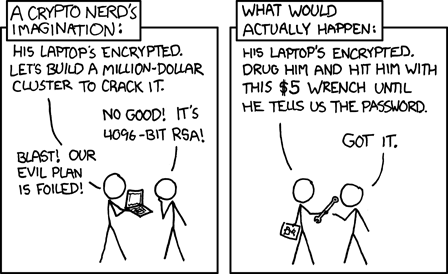 swift thorn
i know I don't expect of this to be secure as lastPass or any real program like that, but I want to do the best I can, that inclues to fix any possible problem
olive lark
sure
but you won't be able to fix every problem you think of.
you'll think of 10 problems. Five won't be worth worrying about. Three you'll fix. The other two you won't know how to fix.
Then there will be 20 problems you didn't even think of.
swift thorn
I know, but I won't stop till those two are fixed or that's what I want to think
olive lark
take a look at https://docs.python-guide.org/scenarios/crypto/ ... it recommends a couple of libraries that will do most of the heavy lifting for you

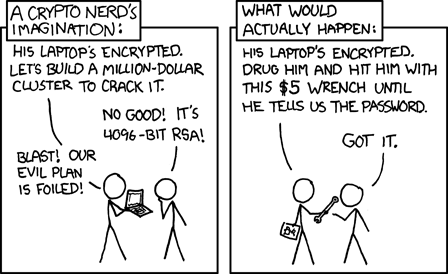 swift thorn
thank you very much
olive lark
I personally would avoid the GPG library, since GPG terrifies me
sage folio
sorry if this isnt the place, but
[6:50 PM] offby1: it's odd, but I can't think of a good open source password manager
by this do you mean "good" as in "secure"? or just in terms of a nice interface?
olive lark
both
terrible interface == insecure, as far as I'm concerned
since I'll probably use it wrong
the Keychain thing built into Macs isn't a really good interface, but it's good enough
sage folio
hm i guess thats pretty fair lol
when i was choosing i couldnt find anything bad about kpxc (what i went with) other than being a bit clunk
olive lark
in practice I use LastPass, which I kind of hate, but it does work, and I'm in too deep to switch 😐
never heard of KPXC, but I'd tried keypass ages ago and found it too clunky to use
huh, I can install it via homebrew, which is very encouraging
sage folio
i like it a lot, especially that you can set a global keybind, which then reads the title of the active window and opens a popup to pick a password to autotype
olive lark
slightly creepy but probably handy 🙂
sage folio
with a browser plugin it can also read current web address but thats the line for me personally lol
olive lark
if you're serious, you have to study the source code to kpxc and the browser plugin
and hell, the browser itself 😦
sage folio
oh theres no way im ever touching that plugin
didnt get anywhere trying to read kpxc but as far as i can tell from behavior, its only smart enough for window titles; if you press the bind on a terminal window with a title like a website, it offers those passwords
olive lark
that UI really looks like amateur hour 😐
I admit I'm a bigot, and that I judge apps by their UI polish.
but if they can't afford to make a good initial impression, I fear they also can't afford to get the code right
sage folio
pay no attention to the default icons with white feathering around the edges in dark mode 
olive lark
couldn't help but 😐
swift thorn
@olive lark do you want to see my UI?
but if you don't like keepassxc ui I dont think you will like mine
olive lark
no thanks; I probably won't like it, but won't be able to offer any helpful suggestions, either
I just complain a lot
thorn obsidian
@olive lark keepassxc is widely acknowledged as the best password manager, i'm sorry the UI has turned you off but as time goes on, you'll come to realise that the better a programmer is, the worse their graphics sense is, and we're big endorsers of "simplicity is key"
LastPass I would stay far away from, personally
 tall haven
I do think programmers have a tendency to overcomplicate GUIs so depending on your interpretation, "simplicity is key" doesn't apply.
Or maybe it's just a lack of thought that naturally makes it look complicated with clutter
I dunno
thorn obsidian
cluttered, yeah, maybe
noble escarp
any rainbow table experts out there
im trying to find a good reduction function for my tables
 rapid torrent
Hello!
thorn obsidian
Hey there
olive lark
wat
lusty flare
hello
tight abyss

The Hacker News
A new vulnerability, tracked as CVE-2019-14899, affecting most Linux and Unix-like operating systems could allow hackers to spy on and hijack encrypted VPN connections.
 obtuse glacier
if you want to get the passwords for all stored wifi's, then use this
from subprocess import check_output
from re import split

output1 = [split(r' +: +', i.strip())[1] for i in check_output("netsh wlan show profiles", shell=False).decode("utf-8").split("\n") if ": " in i]

print("Wifi Passwords:", end="\n\n")
for wifiNames in output1:
    output2 = [split(r' +: +', i.strip())[1] for i in check_output("netsh wlan show profiles \"" + wifiNames + "\" key=clear", shell=False).decode("utf-8").split("\n") if (": " in i and split(r' +: +', i.strip())[0] in ("Key Index", "Security key", "Key Content"))]
    print(f"{wifiNames:<40}:", end="")
    if(output2[0] == "Present"):
        print(f"{output2[1]}")
    else:
        print()

__import__("os").system("pause")
For windows
midnight lava
uhm...
 kind estuary
Aloha
spiral turtle
vamos
 olive fog
out of interest, would you be able to plug in a camera and a mic to a raspberry pi and from there be able to use it in a python module, or is there any config first beforehand?
spiral turtle
I don't think this is related to #cybersecurity
olive fog
well i want a secure server with a facial recognition and voice recognition
spiral turtle
think its more #algos-and-data-structs or #microcontrollers maybe
spiral turtle
np 😄
tepid rover
does anyone know how android encrypts disks and sdcards and how i would decrypt it if my device breaks?
olive lark
not me
thorn obsidian
@tepid rover https://source.android.com/security/encryption/
Android Open Source Project
Note: Full-disk encryption is not allowed on new devices running Android 10 and higher. For new devices, use file-based encryption.
 haughty epoch
i just sucsesfully printed hello world and now i want to hack nasa
 eternal veldt
This is a little off topic but could I potentially infect my machine by webscraping with free proxies from the internet? I’m only using requests and no browser, but I haven’t been able to find an answer regarding my specific usecase. Thanks
orchid notch
As long as whatever you're using the scrape the websites is not evaluating JavaScript + as long as whatever tool you are using to evaluate your results is not vulnerable to some parsing flaws (both highly unlikely) you're gonna be good
 safe bear

ZDNet
One library was available for only two days, but the second was live for nearly a year.
 median heath
Does anyone know of any good sources to help protect the scripts source code etc from 'sneaky eyes' / thiefs.. E.G I plan to compile all my script into a .EXE file e.g py2exe but was hoping to protect it as best as possible from reverse engineers?
thorn obsidian
@median heath You wouldn't
median heath
Why so?
thorn obsidian
You'd put in considerably more effort than is worth it, and it's trivial to decompile.
plucky geode
@median heath use Nuitka, compiles Python code into C's executable, which is much harder to crack
Also, anyone knows a good way to create a whitelist/authentication system for the program running on Python?
I am using Postgresql database on the server to store all user credentials
but I am not sure where to start and how to exactly organize the communication between the database on my server with all the credentials, and the user running the program.
median heath
@plucky geode I'll take a look in a second.. 🙂
How many end-users are you going to have?
median heath
I'm using an external company which uses a licensing system upon opening to validate if the users license is valid and then it can be limited to one PC/multiple etc.
It's only a few lines on code
of*
median heath
Take a peek, very user friendly. There is some cost, dependant on user-amount. I think it's reasonable
plucky geode
Yeah, looks sleek, but I was thinking about building the system myself, so that I could customize the code if needed
median heath
Same!, I've been looking also, would much rather manage myself. But for now it'll do
plucky geode
Plus don't really want to get into monthly subscription thingy
median heath
I didn't have much luck when trying to find something that;ll work for me and that I could manage of my own DB etc
But i'm a rookie, so eh
plucky geode
Hmm, I was thinking about creating separate users for the database. Basically, 1 user = 1 license.
Therefore, people will connect to the database automatically via their DB username, and program will authenticate them.
It works with the Postgresql, but I don't think such thing exists for the SQLite or MySQL?
median heath
In theory, sounds easy, I guess the security aspect is the issue
plucky geode
Yeah, maybe someone with more experience will share his thoughts
thorn obsidian
@plucky geode I hope you're not letting users operate on the db directly... that's a recipe for disaster
I recommend setting up an API. Users are handed API keys which can be used to start sessions
I'd make it so you can't have more than one session active per API key
Then, the session identifier/whatever can be used to talk to the API, which operates on the database
This way you can easily restrict who has access to what parts of the database without having to mess around with DB users
plucky geode
@thorn obsidian Thanks for the help, I think that Postgres has native users features, and I can restrict access to what parts of DB users have, as well as what they can only read or write to. Natually, users won't know the credentials to access the DB on their own. I will make program communicate with DB instead of actual users.
API and Sessions sounds like a good idea, and I might implement it in the future, but I need a rough and fast way for now XP
 north rover
if you plan to use postgres users for permissions then this is also an interesting topic: https://www.postgresql.org/docs/12/ddl-rowsecurity.html
 chilly elk
I've been working on an encryption/cipher technology for a while now and I've just merged a PR to implement AES encryption. Could somebody take a look maybe and let me know if they see any glaring issues in it? It's not a lot of code and just 1 file. https://github.com/M4cs/Pixcryption

GitHub
:camera: Pixel Safe Encryption - Now Cryptographically Secure :lock: - M4cs/pixcryption
olive lark
the first issue is: you're rolling your own encryption. If you're just doing it for fun and learning, great; but please don't use this on anyone else's data
 smoky goblet
@olive lark why is rolling his own encryption a problem? i'm just curious.
olive lark
typically people who know a lot about crypto warn newbies to be careful, because it's much harder than it looks
https://security.stackexchange.com/questions/18197/why-shouldnt-we-roll-our-own <-- second google hit, e.g.

Information Security Stack Exchange
Why shouldn't we create our own security schemes?
I see a lot of questions around here about custom crypto and custom security mechanisms, especially around password hashing.
With that in mind, I'm
chilly elk
I'm not rolling my own encryption. It's using AES for encryption. I'm rolling my own cipher layer on top of AES
olive lark
shrug
thorn obsidian
@olive lark has a point. I've been around encryption/ciphers for 15~ years and know AES a little bit, and I'd still recommend not rolling your own.
orchid notch
@chilly elk there is using AES and there is using AES properly
just because you use AES does not make your system secure
in fact you can create a false sense of security for your users if you say "we're using military grade encryption" just because youre doing AES
AES has to be used with a proper implementation thats invulnerable to side channel and timing attacks
in a proper mode
with proper parameters
and exactly at that point it becomes secure
thorn obsidian
Ok I'm under 18 rn
so I want to do cyber security
I'm confused with CEH and OSCP
Which should I do
Is CEH good for getting jobs
And others like CompTIA are required or no?
thorn obsidian
OSCP holds far more value than CEH
thorn obsidian
ik that but is CEH good enough to get a decent job in Cyber Security?
thorn obsidian
meh, it's less about your certifications and more your portfolio
like things you've done, projects etc
I'm employed in infosec atm and I have 0 certs :) (apart from CCNA, but it's not really related to my field)
lusty flare
friend of mine got a low level job at a security company. started by just doing secure erase or following scripts to compile diagnostics for smarter people.
worked his way up the chain
thorn obsidian
yea that's the way to do it
if you prove you know what you're doing, you'll have no issues with that
thorn obsidian
yeah, same here
company's paying for me to get my certs
which is.. really cool, I guess
lusty flare
yeah
con watching is probably how i got into reading security stuff in the first place
 snow summit
Hi guys, just a completely out of the blue question here, not relating anything to do with python (maybe some to do with security, not sure where to ask this). Has anyone purchased an e-gift card before? And if you have, do you know if it contains like a Card Number or a Card PIN?
mortal perch
if you mean a store specific card like a steam card, it will have a code on the back which you enter in usually
thorn obsidian
https://eng.getwisdom.io/hacking-github-with-unicode-dotless-i/
As it turns out, .lower(), .upper() or .casefold() on unicode in regards to e-mails is bad. 😄

Wisdom Engineering
From combining emoji marks and astral planes, Unicode is under appreciated and poorly understood. One lesser known attack vector is Unicode Case Mapping Collisions— an edge case that many of the best devs don't understand— even at Github.
spiral turtle
o.O
 high creek

 stark vortex
ouch about sending to the provided email, because it clashes, that's very easy to overlook when coding
 tough otter
Hi, question. Does anyone here have any experience in digital forensics? If so I could really use some help
I'm trying to mount a .img file that is supposed to be a forensic copy of a hard drive. But neither Kali nor Windows will let me mount it. Says it is corrupt
thorn obsidian
You don't mount direct images of disks, you use forensics tools to look through them
 fossil iris
can use some tools like volatility
 fallow lark
hello
thorn obsidian
hello
 brazen osprey
hello
olive lark
well we're about to have mac and cheese, and I'm sorry to say we didn't invite you over
 distant dew
guys want inputs as in material, things to learn.... on cyber security threat analysis-- like where to start.....or any suggestions
was looking into materials from https://medium.com/cyberdefenders/python-for-cybersecurity-lesson-4-network-traffic-analysis-with-python-6321f4c9d3f7
but this does not share any insights on threat analysis.....
do share your inputs
🙂
 dim prawn
My one suggestion is be carful with things you download: noobs in this realm are often targeted for trojans, etc. Good luck o7
thorn obsidian
hey, how best to start writing a security system in Python?
lusty flare
"security system"?
olive lark
my question exactly
thorn obsidian
@thorn obsidian What's a "security system"?
thorn obsidian
@thorn obsidian it has resolved itself
high creek
Why my recommendation in IG is too relevant for me...but I didn’t even search anything related to it
Does google collect all cookies and distribute it to other companies?
 noble kraken
yes
or ads on instagram are powered by google ads
beacuse it's literally what i searched few minutes before
lusty flare
instagram is owned by facebook
does facebook purchase google data? who knows.
but they have enough of their own ad data gathering techniques
facebook are insanely good at targeting ads
doesn't matter if you have a facebook account or not.
any site with a "share to facebook" button is probably supplying data to facebook about your browsing habits
i mean they know your IP, your browser, your browser version, likely operating system, etc, etc
it's enough data to build a semi-unique fingerprint
 novel river
so i got a voicemail transcript this morning of what sounded like two kids using a kind of dialer and putting in numbers
i have the whole thing recorded
they put in like 35 different numbers in a specific sequence
i have google call screening so if i had been awake they wouild have been sent to the bot
now i have the whole transcript and the entire convo recorded
what do i do with it
i feel like they were trying some shenanigans to get past my 2fa that i have on my gmail
i doubt they did it
olive lark
people can control your bot by placing a phone call?
novel river
no i think they were trying to bypass 2fa
olive lark
well I wouldn't worry about that
novel river
Vocaroo is a quick and easy way to share voice messages over the interwebs.
if you wanna hear it
olive lark
google should know what they're doing as far as security goes
novel river
theres one idiot using the phone and the other sounds like hes in a vc telling him what to do
olive lark
shrug
novel river
like i legit have no idea what they were trying to do
and it looks like they used a real phone to do it?? cause im able to call and text it
and it shows up as being a real number
so theyre getting call bombed rn
novel river
so he responded to my text
i spent like an hour trying to get him to tell me what he was doing
i called his local police and like a minute later the kid actually called ME and i TALKED to him. he just said the same bullshit he was saying in the sms
orchid notch
whats a cyber project
 daring sedge
Implement TOTP from scratch?
 icy saffron
What's TOTP @daring sedge ?
daring sedge
The Time-based One-Time Password algorithm (TOTP) is an extension of the HMAC-based One-time Password algorithm (HOTP) generating a one-time password by instead taking uniqueness from the current time. It has been adopted as Internet Engineering Task Force standard RFC 6238, ...
icy saffron
Oh
Well that sounds cool
thanks 🙂
also does anybody know a library that messes with linux's login?
orchid notch
there is no such thing as "the linux api"
if you wanna login as a user just use the login command line tool imo
thorn obsidian
@icy saffron Are you talking about hooking into Linux authentication via PAM?
tight abyss
no.
You can just ask your question. The server has over 30k people. If someone reads your question and knows a thing, they might respond.
 rocky horizon
😩 😩
any of u ever used JonDo proxy?? How is it any comments?
does it like change server/ip after some interval of time ??
 tribal stag
it looks like a mostly abandoned alternative to tor that has 15 downloads a week and is written in java
It looks like you define the hops from a list of publically accessible nodes. If your aim is to layer proxies, you are probably looking for proxychains
@rocky horizon
if your aim is 'anonymity, good enough unless your adversary is a nation state', you're looking for tor
thorn obsidian
I've heard of JonDo proxy, but never used it. I didn't know it was still a thing, and wouldn't use it now.
@tribal stag is right. You'd want Tor unless you've pissed off the NSA, which in that case gg.
past starBOT
5. Do not provide or request help on projects that may break laws, breach terms of services, be considered malicious/inappropriate or be for graded coursework/exams.
thorn obsidian
<@&267629731250176001>
safe bear
!warn 311919809895858177 "That discussion is not appropriate for this server"
past starBOT
:incoming_envelope: :ok_hand: applied warning to @rocky horizon.
rocky horizon
Umm its my local server so🙄🙄🙄🙄
 silent pier
Does not change the nature of it.
rocky horizon
I just asked if jondoe will do my shit
blissful raven
Hey, between a ssh connexion, and a VNC connexion, which one is the safest?
blissful raven
I guess it's best to use ssh + X11
orchid notch
weeeeeeeeeellll
blissful raven
since I'm not a cmd killer, I think I would need sometimes a interface
orchid notch
there are some security concerns with a certain mode of X forwarding over ssh
as is mentioned in the OpenSSH client manpage
     -X      Enables X11 forwarding.  This can also be specified on a per-host basis in a configuration file.

             X11 forwarding should be enabled with caution.  Users with the ability to bypass file permissions on the remote host (for the user's X authorization data‐
             base) can access the local X11 display through the forwarded connection.  An attacker may then be able to perform activities such as keystroke monitoring.

             For this reason, X11 forwarding is subjected to X11 SECURITY extension restrictions by default.  Please refer to the ssh -Y option and the
             ForwardX11Trusted directive in ssh_config(5) for more information.


     -Y      Enables trusted X11 forwarding.  Trusted X11 forwardings are not subjected to the X11 SECURITY extension controls.
An attacker may then be able to perform activities such as keystroke monitoring On server-side, or from the controller computer?
orchid notch
i think what's meant is that a user that has compromised your server could get access to your local X11 server as the X forwarding allows the remote connection to act as an X client. And as X is a protocol not caring much about security the principle is that every keystroke is sent to every x client
which could in theory allow an attacker on the server to keylog you via this connection
at least thats what i think they mean
blissful raven
hum ok. I'll stick with ssh command line for now then.
olive lark
X over ssh is painfully slow, whenever I've tried it
orchid notch
i remember a colleague of mine having a nice program that helps with that
but i dunno remember the name
olive lark
yeah at work some people use some super-complex thing that claims to make it go faster, but it too sucks. I just use console-mode only for my remote stuff
https://www.nomachine.com/ is what they use. I found it not worth the effort.

NoMachine
Get to your desktop at the speed of light. NoMachine is the fastest remote desktop you have ever tried. Control any computer in the world and start working on it as if it was right in front of you. Free for individual use.
orchid notch
i mean im all for console there was justone occasion he had to use it
and it wasnt really complex at all, just some command line tool
olive lark
if your network connection is snappy, your "screen" is small, and your personality is patient, plain X over SSH will be fine 🙂
 glad parrot
what is the best way to Encrypt Android phone ?
 sly sonnet
Hey. What would be the best way to go about securing some on-disk json data with a password? From what I can tell, a key derivation algorithm like argon2 to generate the key for an algorithm like chacha20 or an AES mode should be good? I'm a little hazy on the IV component though. Is it alright to be saving that as plaintext along with the encrypted bytes to a file?
This is very small amounts of data so performance won't be an issue
thorn obsidian
How are you using the information?
i.e., are you storing it in a DB? Is it just random JSON data stored on-disk? If it's the latter, VeraCrypt/LUKS would work. We need more information.
sly sonnet
Data that needs to be store on disk of the users of the application I'm doing
And transportable as a file
olive lark
who are you protecting the data from?
sly sonnet
Malicious entities/software
sly sonnet
If a computer is compromised the data is not
sly sonnet
I guess it is possible for keyboard inputs to be captured
olive lark
they surely can
sly sonnet
But that's unimportant
olive lark
including when the guy is typing in his password
the only case I can think of, where on-disk encyption makes sense, is: someone steals the computer and takes the disk out, and wants to get the information off of it.
but if there's evil software running on the computer, game over; we all lose.
sly sonnet
Not necessarily
olive lark
yeah yeah if the evil software is running under some user account that doesn't have privilege to read your file, sure OK fine
sly sonnet
From a software perspective, yes
Not from a human one
Stealing a folder from a hardcoded path is much easier than setting up a keylogger and sifting through possibly weeks of data for 7 keystrokes
olive lark
knock yourself out
sly sonnet
The way I see it, there's no reason not to encrypt this data
It decreases the attack surface and adds a time and effort barrier
This application would be password protected anyhow so the user isn't suffering
 wind fable
@sly sonnet is this software running on end-users machines or ones you control?
sly sonnet
End user machines
wind fable
there's a few ways you could go about this
depending on who you're protecting against
if it's other software with filesystem access to the user's data at rest (ie when your software is not running), then:
generate N random bytes to use as a key. Store them in the system keyring. Then access that key from the system keyring on startup and use a good symmetric cipher to decrypt the user's data.
sly sonnet
That sounds quite good but wouldn't that hurt portability?
wind fable
yes
sly sonnet
I would rather the files be self contained so they could be transported
wind fable
system keyring support is better on Windows and Mac than on Linux afaik
oh hm
Yeah you could do that as an export/import system
backup/restore
where it reencrypts with a random key and gives the key to the user
sly sonnet
That does sound like a good solution but this would ultimately needs to support all three platforms as well though
wind fable
I don't have experience working with OS keyrings. it's something you could look into.
keep in mind that portability often means special casing all platforms 🤷
Maybe there's a library that abstracts it
sly sonnet
How come?
wind fable
If they all do the same thing differently then you don't have much of a choice
Something potentially easier and more portable, but trickier in other ways, is to do the same thing, but have the user store the symmetric key, and using argon2 or some other key-stretching algorithm.
sly sonnet
Already using argon2
wind fable
yes
anyway the gist is the same
use argon2 to derive a symmetric key
use a symmetric cipher to encrypt the data at rest
sly sonnet
Yep doing that
And the nonce component?
Just store that in plaintext along with the encrypted data on disk yes?
wind fable
I'm a bit over my head here but I don't think you need a stream cipher here
lemme read a bit more
sly sonnet
Oh I'm just as hopeless don't worry
wind fable
from what I can tell you'd be better off with a block cipher such as AES
but I don't think AES is the right choice here either…? since it's asymmetric you need a public and private key
sly sonnet
I don't believe AES is asymmetric
orchid notch
AES is absolutely not asymmetric
sly sonnet
With everything I read I get more and more confused as to watch I should use
As it does not matter whether the same plaintext always produces the same ciphertext, AES mode SIV seems to be good for my purpose
thorn obsidian
I don't understand what you're making, @sly sonnet
I was under the impression this was on a server or some such. What's the JSON and what's it doing on an end-user's machine? Why does it need protected?
 edgy wharf
okay so, I have a key based auth for a flask app, connects to a server and verifies key and then renders the next page. ill mention Ive only done the backend (py) and we hired someone else to do the front end.theres a problem with the way it is right now tho. when youre at the login page, you can manually go to the url of one of yhe other pages, bypassing the auth. whats something I can do to avoid this? should it be backend or front end? ill also mention that the urls of the other pages are in the html
orchid notch
first of all authentication should obviously be handled in the backend
and
just have a cookie that shows the user is logged in or not and if he isnt dont allow the access i guess
edgy wharf
yeah the auth is backend, which was done by me. and okay so youre saying that my problem is on the front end?
orchid notch
well i dont understand how your issue is even possible if the key gets verified
edgy wharf
it gets verified, then renders home.html. but the way the html is set up, I guess it has like each page url hardcoded in, so like if you just put in a url, it jumps auth and everything is fully functioning. granted this app isnt gonna be reaching a bunch of people, and doesnt hold sensitive information, this is more or less practice with larger projects, and me working on security. im not sure what to do at this point tho, as everything ive done to try to eliminate functionality just returns internal server errors
aka breaks the entire thing
orchid notch
that just bullshit
that design
if you for example have a profile
you should have a profile.html template in your backend written in jinja2 for flask
that gets filled the information from the account thats associated with the key
edgy wharf
so which part is bullshit? lol as I said, I didnt write the html/css/js so if thats it, I have to talk to the person who did. if its something else, thats on me
edgy wharf
 okay but as I said, first time doing this shit, you’re acting like I do this for a living
people gotta start somewhere g
orchid notch
nah if i was acting like you were doing this for a living i wouldve told you to stop doing^^
edgy wharf
when someone asks for advice, they need help obviously. the proper response isnt to call everything bullshit lol
orchid notch
well im just saying the entire design is flawed
because youre asking for what part is flawed
edgy wharf
k thanks
orchid notch
so
usually when designing a website that has authentication, or any user stuff in general with for example a profiles page
you have a template written in https://jinja.palletsprojects.com/en/2.10.x/ when youre using Flask. Then once you get a request you verify the API token and find the associated user in your DB, fill out the flask template with the info you got and send it back. so for example youd have the URL
which gets a request with a JSON content like
{
  "token": "uuid4 thingy or so",
}
then you check in your DB if "token" is
- a valid token
- for what accoutn its valid
Then fetch all profile info from that account, fill it into the template which will generate you some html
and then return that to the web browser
edgy wharf
okay thank u
sly sonnet
@thorn obsidian Sorry about any confusion. This is an application run by users which has sensitive information personal to the user that needs to be stored on disk and password protected
thorn obsidian
Im trying to write a telnet honeypot to for IoT goal is to report nets but need help with login system as it needs all login to be true
 ancient nacelle
I suggested that @thorn obsidian should look into telnetlib but I have no actual experience with this, so I sent him here to get help. you guys are so talented, maybe anyone have an idea?
thorn obsidian
yeah i know nothing abt telnetlib im using sockets trying diffrent things atm