#web-development
2 messages · Page 13 of 1
 oblique steeple
i mean, i'm sure it works, but i'm wondering if spyder's focus on scientific development has downsides for web development
 proper hinge
Isn't spyder geared for scientific use
Yeah
I've never used it personally
I'd suggest something like VS Code or Atom as a light weight editor
oblique steeple
that's probably a better idea
proper hinge
Here's a tutorial from MS for VS Code if it helps https://code.visualstudio.com/docs/python/tutorial-flask

Python Flask tutorial showing IntelliSense, debugging, and code navigation support in the Visual Studio Code editor.
oblique steeple
thanks!
 upper mango
def admin(request):
    return render(request, "./templates/adminpage.html")

urlpatterns = [
    path(r'admin/', views.admin),
    path(r'about/', views.about),
    path(r'home/', views.home)
]
this does not work it says no template found
but there is
nvm i fixed it
 winter pagoda
Do Selenium questions go here?
 native tide
I find Atom pretty heavy
Notepad++ is very lightweight and will do alright with the NppExec plugin to add a terminal
 meager anchor
calling atom or vscode lightweight is a bit of a far stretch 🤔
anyways, @winter pagoda, yes
proper hinge
its all relative
idk what its like to have a potato pc
even my 2011 baseline macbook managed to run pycharm
winter pagoda
@meager anchor thanks, I got some help in #help-croissant which pointed out that element.screenshot() works on Firefox but not Chrome because ?
Do people here that use Selenium have a preference between Chrome and Firefox?
I've done all my stuff in Chrome until now, my one attempt at running one of my scripts in Firefox seemed to have it not waiting properly and trying to find elements while pages were still loading
But I certainly didn't give it much of a fair try
 rigid turtle
native tide
rigid turtle
native tide
resources for web dev?
 buoyant ledge
What is required to do to a web server to see updated content like your backend when you push a new update? Is it a restart of nginx or something else?
buoyant ledge
I guess by backend I mean if I clone a GitHub repository in place so the .py files are different than they were before. Do you have to restart nginx? Does disabling caching work?
 little nexus
if you have got the new .py files, restart gunicorn/whatever server you use
nginx is the just the reverse proxy so that makes no difference
caching could affect it; depends exactly what is being cached
buoyant ledge
Kk
rigid turtle

GitHub
awesome-python - A curated list of awesome Python frameworks, libraries, software and resources
 pale relic
need web developer urgent, not very deep pockets, still please help
 brave mantle
We don't have a recruiting system here
If you're a developer yourself, feel free to ask questions about your issue
 wicked path
How does everyone feel about webscraping?
 crystal obsidian
@wicked path I've read that question 3 times and it makes me wonder... is there a correct answer to it? What is the actual response you'd expect to receive? xD
 tame viper
webscraping is fine as long as the website in question doesn't prohibit it
wicked path
I just want to know peoples mindset is regarding scraping that's all
crystal obsidian
I think it's cool
especially using python where it's made almost as simple as it could be
 unreal dagger
Anyone ever use wagtail or django based CMS?
meager anchor
for sure. don't ask to ask if you have a question
 stark yarrow
Hey what are the ways to send data between routes?
I am building a system to list products on a marketplace.
I have a route with a form for writing the product info. From that, it sends through a function to build a JSON file with that info, then I send it through their server to validate this json.
If it's valid I want to send to another route to confirm the post. My problem is that the JSON file is relatively big, and I create 4 versions of it, with different prices.
I tried to send it via session cookie(eg: session['json']). But the data is bigger than what is allowed, and if the user opens several tabs with different products, it'll overwrite the variable.
I then tried to save it to the database, but it'll also be overwritten if the user opens several tabs.
The only one working properly is sending the data via URL, but the URL is too long now, and makes it harder to debug.
Anyways, is there another (better) way to do it?
Oh, and I'm using flask
 queen needle
Cache?
You use the session cookie as a key component for a value stored in a caching server, memcached or redis or w/e
If you're not deploying to the masses, you can also just keep it in memory
Try Flask_Session
@stark yarrow ping since it was an hour ago
By default it will keep the server side session in memory
Just make sure you're not storing hundreds of MB of json
stark yarrow
@queen needle Thank you. I will check it out!
 keen ore
anyone here who can help with authlib?
meager anchor
!t ask
 lavish prismBOT
ask
Asking good questions will yield a much higher chance of a quick response:
• Don't ask to ask your question, just go ahead and tell us your problem.
• Try to solve the problem on your own first, we're not going to write code for you.
• Show us the code you've tried and any errors or unexpected results it's giving
• Keep your patience while we're helping you.
You can find a much more detailed explanation on our website.
keen ore
how can i make it work properly, im following the documentation and keep getting errors about missing tokesn etc
authlib.common.errors.AuthlibBaseError: invalid_request: A required parameter "client_secret" is missing
when i do
oauth.register('linkedin',
               client_id='xxxxx',
               client_secret='xxx',
               access_token_url='https://www.linkedin.com/oauth/v2/accessToken',
               authorize_url='https://www.linkedin.com/oauth/v2/authorization',
               api_base_url='https://api.linkedin.com/v1/',
               client_kwargs={'scope': 'r_basicprofile r_emailaddress'},
               )

@app.route('/oauth/linkedin')
def oauth_login():
    client = oauth.create_client('linkedin')
    redirect_uri = url_for('oauth_authorize', _external=True)
    logs.debug("Redirecting user to linkedin authorize url")
    logs.debug(client.authorize_redirect(redirect_uri))
    return client.authorize_redirect(redirect_uri)


@app.route('/authorize/linkedin')
def oauth_authorize():
    client = oauth.create_client('linkedin')
    logs.debug("Created client")
    logs.debug(client.client_secret)
    token = client.authorize_access_token()
which line does that error occur on?
keen ore
i can pass client_secret to it by doing client.authorize_access_token(client_secret=client.client_secret) but that is not documented in anwhere properly,
but now, when i do
resp = client.get('people/~?format=json', token=token)
i get KeyError: 'token_type'
@meager anchor
meager anchor
can't really look into it right now but maybe the source can help you out, I think this marks the spot https://github.com/lepture/authlib/blob/ee4ae9c41c3b8bde16c8f2760e9c3d3f070d6524/authlib/client/oauth2_auth.py#L39

GitHub
The ultimate Python library in building OAuth and OpenID Connect servers. JWS,JWE,JWK,JWA,JWT included. - lepture/authlib
 strong sonnet
There's absolutely no way of doing the equivalent of await while in a callback that's not async is there?
async def pointless1():
    print("pointless1")
    await asyncio.sleep(2)
    return 1
    print("pointless1.1")


def pointless2() -> Task:
    print("pointless2")
    loop: AbstractEventLoop = asyncio.get_event_loop()
    task: Task = loop.create_task(pointless1())
    # There is no way here to wait until the task is complete and continue
    # Exception:
    #loop.run_until_complete(task)
    # Invalid state error:
    #task.result()
    return task

async def pointless3():
    print("pointless3")
    task = pointless2()
    # even here it can't be done.
    print("pointless3.1")

loop: AbstractEventLoop = asyncio.get_event_loop()
loop.run_until_complete(loop.create_task(pointless3()))
 neat nest
why can't it be done in pointless3, @strong sonnet?
keen ore
wtf, linkedin only allows selected partners that use their job listings to access the user skills via the api
strong sonnet
@worn sapphire it's just an example. pointless3 might call a constructor which is pointless2. You can't make constructors async, so you're basically stuck
You really want the class to be fully initialized by the time init returns, but if pointless2 is and init then you're left with a partially initialised class.
Yes you can create a callback, but it gets messy.
neat nest
why make pointless2 an __init__? it can be a factory function that returns an awaitable future like it essentially is right now
strong sonnet
It's not always possible or practical to do that. Yes I guess you can redefine your entire code-base to make everything be async, but it doesn't always work out like that
Like... init functions should be the way to initialise a class. That's their entire purpose. You could maybe have an ainit function instead I guess, but having a factory method is untidy
keen ore
hmm im having trouble with oauth2 again
im using the token i recieved after authneticating with authorization token but i keep getting The token used in this request has been revoked by the user
well i solved it
linked in cannot understand that some apps can use the token almsot immiteadly
by adding a small time delay of 5 secs it works perfectly
neat nest
@strong sonnet
(a) it's always possible to wrap an object's creation in an async factory and I have a hard time believing it's frequently impractical
(b) who said anything about making everything async? this is only to address the case of the rare class that needs to be asynchronously initialized
(c) factory patterns are extremely common and in no way, shape, or form inherently untidy unless you've implemented them poorly
native tide
Hey guys, I got asked a question to review on my in-person interview: "What is your viewpoint on development flow?" What is development flow exactly? Like... agile development or scrum environments?
 rugged wolf
can someone help me with django? I have the form like
class UploadForm(forms.ModelForm):

    class Meta:
        model = Video
        fields = ('title', 'video')
and view like
    if request.method == 'POST':
        form = UploadForm(request.POST)

        print(request.POST.get('title'))

        if form.is_valid():
            return HttpResponse('test')
    else:
        form = UploadForm()

    return render(request, 'upload.html', {'form': form})
and the problem is form.is_valid() is never true.
it always dumping my form with error under title - This field is required
 elfin mirage
Does anyone have experience with setting up multiple python sites in IIS using wfastcgi? I'm not sure how I properly set the PYTHONPATH variable for each without them colliding
 brazen stirrup
good morning guys!
I'm looking for flask boilerplate(starter)
is there some recommendation?
tame viper
https://github.com/sloria/cookiecutter-flask i like to follow the general structure of this when creating flask apps.

GitHub
A flask template with Bootstrap 3, asset bundling+minification with webpack, starter templates, and registration/authentication. For use with cookiecutter. - sloria/cookiecutter-flask
@brazen stirrup
brazen stirrup
@tame viper thank you for your recommendation
tame viper
👌
 idle osprey
im trying to input multi-lined strings into flask templates, but the " ` " keeps getting through the safe filter. Is there a prevent it
idle osprey
if i try .replace it sanitizes the sanitize
 thorny scaffold
from flask import Flask, jsonify

app = Flask(__name__)

@app.route('/simplecrypter/<string:message>/<int:key>/<int:choice>', methods=['GET'])
def s_crypter(message, key, choice):
    alph = 'bILsNC3Jv1w2Vj6u4AhWMPDmBlQ7 rtKHZfEa9XFocpnY5eUGxdyzTkRSiO80qg'
    newmessage = ''
    out_message = {'message': newmessage}

    for c in message:
        if c in alph:
            pos = alph.find(c)
            if choice == 0:
                new_pos = pos + key % 63
            elif choice == 1:
                new_pos = pos - key % 63
            newc = alph[new_pos]
            newmessage += newc
        else:
            newmessage += c
    return jsonify(out_message)

if __name__ == '__main__':
    app.run(debug=True)
I am learning to build APIs using Flask
I am getting an error of index out of bound for newc = alph[new_pos]
can anyone who has knowledge on APIs in Flask check this and point me what am I doing wrong?
 pearl kite
You may want
new_pos = (pos + key) % 63
That way the modulus operator correctly works on the whole position and not just the key part
(Same with the pos - key line)
thorny scaffold
yes Now it works but returns an empty string
Oh yeah
i have to add it to the dict first
stupid me
😅
thank You @pearl kite
 shrewd sand
Can i have 2 websites on the same server?
tame viper
yes
shrewd sand
@tame viper im confused why my second domain will not work
tame viper
okay
shrewd sand
server {
  listen 433;
  listen [::]:433;

  server_name code.mcadesigns.co.uk;
  location / {
    return 301 https://github.com/Sharpz7;
  }
}

server {
  listen 433;
  listen [::]:433;

  root /var/www/mcadesigns.co.uk;

  index index.html;

  server_name mcadesigns.co.uk www.mcadesigns.co.uk;

  location / {
    try_files $uri $uri/ =404;
  }

  error_page 404 /404.html;
  error_page 500 502 503 504 /50x.html;
  location = /50x.html {
      root /usr/share/nginx/html;
  }
}
IMPORTANT NOTES:
 - The following errors were reported by the server:

   Domain: code.mcadesigns.co.uk
   Type:   unauthorized
   Detail: Invalid response from
   http://code.mcadesigns.co.uk/.well-known/acme-challenge/DoriRmKpGoGWkz_jrFo0uPDvKVX6v5l7pectxlNesPs:
   "<!DOCTYPE html>
   <!--[if lt IE 7]> <html class="no-js ie6 oldie" lang="en-US">
   <![endif]-->
   <!--[if IE 7]>    <html class="no-js "

   Domain: mcadesigns.co.uk
   Type:   unauthorized
   Detail: Invalid response from
   http://mcadesigns.co.uk/.well-known/acme-challenge/TUc4rHuuANSLQRjgbSVNyhMsM_llXV7N1LePtVDLoQA:
   "<!DOCTYPE html>
   <!--[if lt IE 7]> <html class="no-js ie6 oldie" lang="en-US">
   <![endif]-->
   <!--[if IE 7]>    <html class="no-js "

   Domain: www.mcadesigns.co.uk
   Type:   unauthorized
   Detail: Invalid response from
   http://www.mcadesigns.co.uk/.well-known/acme-challenge/5yB3RrojzdCFTgQzWJJmuAp0VULxRwa3zXwMGQyxNVA:
   "<!DOCTYPE html>
   <!--[if lt IE 7]> <html class="no-js ie6 oldie" lang="en-US">
   <![endif]-->
   <!--[if IE 7]>    <html class="no-js "

   To fix these errors, please make sure that your domain name was
   entered correctly and the DNS A/AAAA record(s) for that domain
   contain(s) the right IP address.
Running service nginx restart produces no errors
tame viper
what's your domain configuration?
shrewd sand
Wait a sec
I think a friend of mine
Smashed the wrong number
When i typed it in
 tame viper
hm
tame viper
oh okay
meager anchor
@shrewd sand Did you get let's encrypt to work?
meager anchor
Are you visiting your website on HTTP or HTTPS?
your port 80 is closed
Oh, yeah, you don't have any listen 80s
Is that intentional?
meager anchor
And you can‘t reach your server on 443?
shrewd sand
xd
meager anchor
I mean
meager anchor
You're listening on 443, but don't specify certificates, clients won't like that
shrewd sand
Ohhhhh
meager anchor
What
shrewd sand
I added certs
meager anchor
Okay
shrewd sand
dw
server {
  listen 433;
  listen [::]:433;

  server_name code.mcadesigns.co.uk;
  location / {
    return 301 https://github.com/Sharpz7;
  }

  ssl on;
  ssl_certificate /etc/letsencrypt/live/mcadesigns.co.uk/fullchain.pem;
  ssl_certificate_key /etc/letsencrypt/live/mcadesigns.co.uk/privkey.pem;

}

server {
  listen 433;
  listen [::]:433;

  root /var/www/mcadesigns.co.uk;

  index index.html;

  server_name mcadesigns.co.uk www.mcadesigns.co.uk;

  location / {
    try_files $uri $uri/ =404;
  }

  error_page 404 /404.html;
  error_page 500 502 503 504 /50x.html;
  location = /50x.html {
      root /usr/share/nginx/html;
  }

  ssl on;
  ssl_certificate /etc/letsencrypt/live/mcadesigns.co.uk/fullchain.pem;
  ssl_certificate_key /etc/letsencrypt/live/mcadesigns.co.uk/privkey.pem;

}
Wait a sec
error_page 500 502 503 504 /50x.html;
502 is covered
🤔
meager anchor
NGINX is running, correct?
shrewd sand
Yep
meager anchor
The site is symlinked to /etc/nginx/sites-enabled?
shrewd sand
Or my other domain wouldn't be up
meager anchor
sudo nginx -T outputs these configurations?
meager anchor
Can you try telling nginx to listen on 80?
meager anchor
Not sure
Did you follow this? https://www.digitalocean.com/community/tutorials/how-to-host-a-website-using-cloudflare-and-nginx-on-ubuntu-16-04

DigitalOcean
In this tutorial you will secure your website served by Nginx with an Origin CA certificate from Cloudflare and configure Nginx to use authenticated pull requests. The advantages of using this setup are that you benefit from Cloudflare's CDN and fast
shrewd sand
No
Lets not get into how long this took me to do the first time ;D
What i am saying is
Cloudflare automatically changes http to https
meager anchor
Ah, I see
Do you get anything popping up in your nginx access or error log?

NGINX Documentation
Capture detailed information about errors and request processing in log files, either locally or via syslog.
shrewd sand
@meager anchor got something
Disabled auto https
And listens to 80
You get this
meager anchor
What?
 meager anchor
Where did you put that?
meager anchor
In an existing server block?
shrewd sand
Can you try telling nginx to listen on 80?
server {
  listen 80;
  listen [::]:80;

  server_name code.mcadesigns.co.uk;
  location / {
    return 301 https://github.com/Sharpz7;
  }

  ssl on;
  ssl_certificate /etc/letsencrypt/live/mcadesigns.co.uk/fullchain.pem;
  ssl_certificate_key /etc/letsencrypt/live/mcadesigns.co.uk/privkey.pem;

}

server {
  listen 80;
  listen [::]:80;

  root /var/www/mcadesigns.co.uk;

  index index.html;

  server_name mcadesigns.co.uk www.mcadesigns.co.uk;

  location / {
    try_files $uri $uri/ =404;
  }

  error_page 404 /404.html;
  error_page 500 502 503 504 /50x.html;
  location = /50x.html {
      root /usr/share/nginx/html;
  }

  ssl on;
  ssl_certificate /etc/letsencrypt/live/mcadesigns.co.uk/fullchain.pem;
  ssl_certificate_key /etc/letsencrypt/live/mcadesigns.co.uk/privkey.pem;

}
you have listen 80 and ssl on there
shrewd sand
Yeah ok
433 gives a 502 error from cloudflare
So my main server listens 2 433
This one to 80?
meager anchor
In your case, make an extra server block:
server {
    listen 80;
    listen [::]:80;

    server_name code.mcadesigns.co.uk www.mcadesigns.co.uk mcadesigns.co.uk;

    return 301 https://$server_name$request_uri;
}
Add that
Then change 80 back to 443
in your other configs
shrewd sand
A website to show of my skills in Python and as Owner of Sharpbot.
It works
Ill add your changes now ;D
meager anchor
Is that with cloudflare?
meager anchor
ah
shrewd sand
@meager anchor what is that code actually solving
I don't see how it solves the problem
meager anchor
It was in response to you adding the listen 80 in the wrong spots, what I meant was to set up a redirect to https
shrewd sand
But i don't need to do that?
server {
  listen 80;
  listen [::]:80;

  server_name code.mcadesigns.co.uk;
  location / {
    return 301 https://github.com/Sharpz7;
  }

  ssl off;
  ssl_certificate /etc/letsencrypt/live/mcadesigns.co.uk/fullchain.pem;
  ssl_certificate_key /etc/letsencrypt/live/mcadesigns.co.uk/privkey.pem;

}

server {
  listen 80;
  listen [::]:80;

  root /var/www/mcadesigns.co.uk;

  index index.html;

  server_name mcadesigns.co.uk www.mcadesigns.co.uk;

  location / {
    try_files $uri $uri/ =404;
  }

  error_page 404 /404.html;
  error_page 500 502 503 504 /50x.html;
  location = /50x.html {
      root /usr/share/nginx/html;
  }

  ssl off;
  ssl_certificate /etc/letsencrypt/live/mcadesigns.co.uk/fullchain.pem;
  ssl_certificate_key /etc/letsencrypt/live/mcadesigns.co.uk/privkey.pem;

}
this is the config that is getting the server working
cloudflare is automatically converting to https aswell
meager anchor
ah
shrewd sand
So why does it break, when i make the port 433?
Should i have everything in one file?
Idk
 meager anchor
as to "why does it break" I'm not sure, check the guide I linked, there is a client certificate configured there
and "should i have everything in one file", thats up to you, i have one file per http / https per domain managed via ansible
shrewd sand
Yeah
I just don't see why one domain is working
And one isnt
xd
When they have the same configs
@meager anchor followed that link
Set it all back up to port 433
Get the error.......
And the log is empty
;D
Really confused now.....
shrewd sand
@meager anchor do i have 2 processes using the same port?
Is that the problem?

Server Fault
I have an API and a web application that are running in the same docker cluster.
- Is it best to have one nginx container loadbalancing the two or have two separate nginx containers load balanc...
meager anchor
Sorry, I'm somewhat busy, if two services try to use the same port then one of them will break, and if your nginx doesn't blarg something like [emerg] could not bind you're good
idle osprey
is flask auto-converting strings to ints (if possible)?
keen ore
hmm, how can i package a python flask app in a way that "normal" people can easily run it on their local machine
 deep cave
buy a domain :P
it's a webserver. you should serve it on the web.
but if you really must, I guess you'd have to make an installer or something.
stark yarrow
Hey, I'm trying to build a form of a dynamic list of categories for product categorization. I'll be getting this information from a server dynamically. I'm trying to figure out the best way to do it.
eg: First the user selects a root category ('Eletronics, Sport and Fitness, Beauty, ...'). Then if it has children categories, I need to create a new list of values, with its children.
For example, if I select Eletronics create a new list with 'Smart TV', 'Home theather', 'Sound System', etc. Then if the new chosen category has childrens do it again until it doesn't return more categories. This will all be pulled from a json file provided by the request to the server.
I'm using Flask but I guess it wouldnt work but I still need to be able to retrieve the post data in Flask. I could do this using JavaScript but I don't how would I do it properly.
Because I'm dealing with over 150 thousand categories and subcategories I don't know the best way to handle this.
Can anyone give me a direction? I have a picture of exactly what I want.
 naive wing
native tide
naive wing
native tide
use django
 grand badge
stick with flask if you prefer it
meager anchor
@naive wing depends on what you want to do. I don't think that flask has something built-in for that. You might be able to use something like at or cron. would be good to get some more info
@native tide your "answer" is absolutely useless. if you plan to help, provide some useful information, django does not have any built-in way to schedule tasks and even if it had, your message doesn't provide any useful arguments that would help in solving the original question
native tide
When i want to do web dev with python should i just dive right in django or somethig else. Or learn python itself first?
And is django for example able to make a Full website without any other language?
meager anchor
you should learn Python itself before taking on a bigger project, yes
depends on what you define as a "full website"
for front-end you generally need at least HTML
 digital bluff
@native tide if you want to make a website with a python framework, you should probably learn python first
 brave otter
heyooo
anyone in here a react guru? or even moderately good at react? lol
I mean I know this is a python channel but if it helps this is in a django application w/ a react front end 😃
meager anchor
Don't ask to ask
brave otter
Sorry .. it's just a lot to type out in a python channel if there's no one here familiar w/ react that's all.
This is just one of the more active discords and I know developers tend to be multi-disciplined lots of times.
 olive wharf
What is the correct way to layout a navigation menu if i have html <header> <nav> <ul> <li></li> <li></li> </ul> </nav> </header> and want each li element to be a full on box to be clickable
Do i put the link tag inside the list element with a span or something to set the boundaries, or wrap each list element in a link tag
I found trying to style a link tag a with a clickable box... to be weird
While im at it, is it more semantically correct to have a logo/gotohome-image be within nav, or just header
proper hinge
I think either way is fine - logo in header or in the navbar
generally i dont bother wrapping the nav in a header element
I have only found it to be redundant in my experience
olive wharf
I thought i'd create a generic nav bar template i imported to all other templates
proper hinge
but I suppose it depends on your design
olive wharf
So figured i'd do it as correct as possible to just be.. correct
And if i put the logo outside of nav, header kind of makes sense
    <header>
        <img src="static/logo.png">
        <nav>
            <ul>
<li></li>```I'll just do that
Any idea on a good practice for nav bar <a> tag placement though?
proper hinge
There really is no correct way with these semantic tags imo
olive wharf
True, but it does effect the google algorithm
proper hinge
there are various combinations which all can make sense
well that's a different story
olive wharf
Stuff like just having a header tag bumps you up quite a bit.
So i just kind of want to make it a habbit
proper hinge
I only use is if I really need it as a list. I usually just go with divs or spans at that point
May I ask, do you really need a ul for your navigation?
sorry my internet is cutting out 😡
olive wharf
where it seems like a list, a ul/ol makes sense
The web design course I'm taking heavily focuses on correct semantics as well
So stay away from divs
 dusty spruce
Ordered lists are better for navbars
olive wharf
and spans for inline styling
dusty spruce
In my opinion
olive wharf
Any particular reason to why?
I mean, sure.. It is ordered in a sense
But it's order does not matter(?)
God I have a feeling this course is going to hurt me in the end 
proper hinge
Proper semantics is great and all but I don't think the list elements suit navbars very well. Unless it's vertical and you're not hiding the bullet points. Even then, I feel like the lists should be reserved to text most of the time
dusty spruce
But it has pweddy liddl numbers
olive wharf
Point of the list is to the semantics of showing, things are listed in some fashion here.
But.. eh
A list was correct according to my lecturer at least
olive wharf

proper hinge
If you Google around on whether or not you should use lists as the markup for navigation on websites, you'll find no debate. Every article suggest that
I like the alternative
where you just have the anchor elements directly in the nav
much cleaner looking
the list just feels completely redundant
proper hinge
it's just a dummy wrapper around what you actually want to display
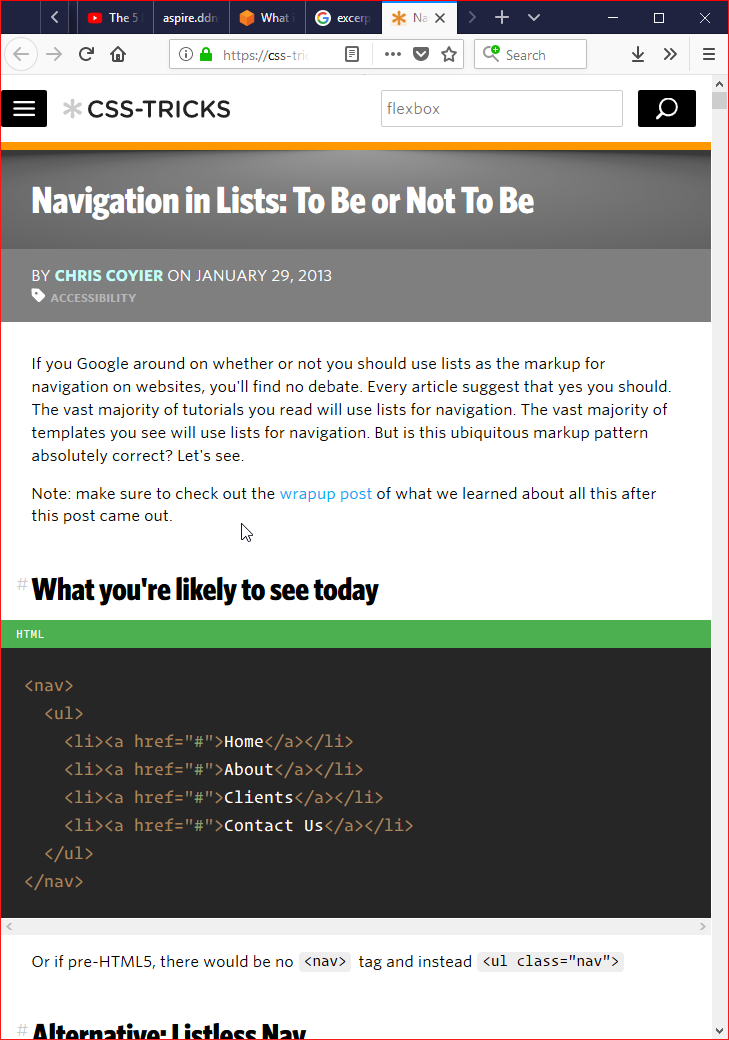
 proper hinge
Main thing to take away from this is that there isn't a set in stone way of doing things
olive wharf
True
proper hinge
as you can see there are various arguments for how to do this
olive wharf
But I do want to do what pleases the lecturer the most 
dusty spruce
<script>
 var as = true;
</script>
I keep on doing the python at the beginning
Sorry
But no scripts!
That's appauling
dusty spruce
They are easier though
olive wharf
Never found it easier, nor cleaner
dusty spruce
Clean - Ness is an issue
olive wharf
view-source:http://www.galehuset.org/
dusty spruce
I was never taught how to import
olive wharf
Copy paste the line, it's the project for my last web dev course
dusty spruce
But that is owing toe self teaching myself
proper hinge
@olive wharf By the way what do you find weird about styling an anchor as a button?
Like implementation wise
or semantically?
olive wharf
The part where I specify width and height on the <a> tag it self
It didnt seem to actually gain the height, nor width
dusty spruce
I self taught myself python, c#(didn't want to, but Unity was like heyyyyyyyyy), js, java, Pascal and a bit of c++
proper hinge
I've managed to successfully do it
olive wharf
Only if i wrapped it in, say a div would the entire block act as a link
olive wharf
I believe i did as well
proper hinge
here's is what I had html <nav> <a href="" class="nav-link current" id="nav-link-1">Item 1</a> <a href="" class="nav-link" id="nav-link-2">Item 2</a> <a href="" class="nav-link" id="nav-link-3">Item 3</a> <a href="" id="button-close">❌</a> </nav>
olive wharf
<li class="project">
    <a class="projectLink" href="project1/sub-directories/natalie.html">
        <figure>
            <img class="projectImg" src="visuals/treehouse.jpg" alt="broccolitreehouse">
            <figcaption class="projectCap">Lab 1. - Fun Facts</figcaption>
        </figure >
    </a>
</li>```i what I have for https://dikult105.k.uib.no/2018H/students/tpe044/
Wait..
Nvm?
olive wharf
I was sure I ended up with the a outside of the li tag
proper hinge
looked like
dusty spruce
Couldn't you use a <form> <input type="button" id="egid"> </form>
proper hinge
lol no
dusty spruce
For examplw
proper hinge
you wouldnt use forms for nav bars
olive wharf
Forms isnt really made for navigation bars :v
 olive wharf
pls no spam
proper hinge
@olive wharf ok for your site it's different cause it isn't just a simple nav bar
I wouldn't only use an anchor there obviously
olive wharf
True
proper hinge
Even though it can work
olive wharf
But i had issues with the entire block being a link
wait, no that was project 2
ah yeah
        <nav>
            <ul>
                <li>
                    <a href="#">Series</a>
</li>```Where only text is click-able
proper hinge
🤢
proper hinge
c ya
dusty spruce
Wait for it
proper hinge
I remember I also encountered that issue
there is a fix for it, just dont remember it
olive wharf
Guess ill look for that then
dusty spruce
Send random people friend requests
proper hinge
some way to change the clickable area for the anchor
olive wharf
I'd hate to wrap list elements with a tags
But I am questioning one thing about the post you sent btw, mark
proper hinge
and that would be'
olive wharf
Does this say.. it made it better, or worse for screen readers
Cause that's pretty much the edge case here
proper hinge
Not sure either
olive wharf
And i should stop reading things from end to start
Lol
post above basically explained it
if it just reads it like that..
See no point
proper hinge
yeah
olive wharf
Shame I can't use any form of scripting / backend tools for the course
But this gives me a bit of practice at least
proper hinge
Just read an interesting thing
If your logo links to e.g. the home page
it'd make sense to put it inside nav
otherwise, don't
 proper hinge
since it doesnt navigate the user to anything
The nav element represents a section of a page that links to other pages or to parts within the page: a section with navigation links.```discussed it an hour ago with a class mate as well
proper hinge
Doesn't look like you have it linking to anything
olive wharf
not yet, no
proper hinge
Then so far, I'd say you did the right thing with the header
olive wharf
I'll still keep the header
proper hinge
if it's clickable I'd move it inside the nav bar
proper hinge
🤔
olive wharf
easier to copy paste 😂
... does that help me? lol
it's fighting my case
https://webaim.org/techniques/screenreader/ Seems like a worthwhile read at least
olive wharf
Yeah
That's what I ment
Maybe I'll use header as .. the head of the sites content
like
nav
header
main
footer
Anywho thanks for your time @proper hinge Imma hit the hay
proper hinge
gn
 hearty birch
what does reqparse do in flask
 kind steppe
Flask doesn't have anything called reqparse
Do you mean this? https://github.com/smitthakkar96/flask-reqparse

GitHub
flask_reqparse is a simple wrapper around flask request module that helps to parse args efficently - smitthakkar96/flask-reqparse
hearty birch
ahh it's in flask-restful nvm
anyway, i was wondering what would be the best way to check if a user who is sending a POST request's json file is in the right format
I want it like this
{
"username": "mushy"
}
anything else it would reject and return a 404
on flask btw
kind steppe
add a list of expected fields and if one is not there, raise a NotFound or BadRequest exception
tame viper
(also, don't return a 404, that's for when they try to access a page that doesn't exist)
422 might be a good one, though 400 is also fine (but too broad imo)
kind steppe
if you are looking up a user (which that request body might be doing) 404 should be fine
hearty birch
yeah I was looking up a user
kind steppe
in that case, 404 is appropriate
tame viper
but a bad POST request format calls for 400/422 does it not?
hearty birch
add a list of expected fields to what
kind steppe
hmm actually
it might be the one yeah
a list of expected fields in the POST request
tame viper
https://pythondiscord.com/api/ uses schemas but idk where they're from :D
kind steppe
we made them
tame viper
oh huh okay
kind steppe
i think
kind steppe
@app.route("/search", methods=["POST"])
def search():
    expected_fields = ("username",)
    for field in expected_fields:
        if not request.json.get(field):
            raise werkzeug.exceptions.BadRequest(f"The required field, {field}, was not found in the request")
something along the lines of that
I just threw that together in Discord so I can't confirm it works
tame viper
yeah, something like that ought to do it.
hearty birch
yeah I was thinking something like that
tame viper
but if you do that a lot, i recommend putting it in a decorator like we have
hearty birch
but i would have to do that for every endpoint right?
kind steppe
if you are using it across requests it wouldn't be hard to put that into a decorator
kind steppe
Oh yeah you are right juan, schemas are from https://pypi.org/project/schema
 hearty birch
also, when doing
request.data
it just returns an empty byte when printing
but when I do request.get_data().decode('utf-8) it returns it normally
whys that?
well
whats the difference between request.data and request.get_data()
is a better question
tame viper
"request.data Contains the incoming request data as string in case it came with a mimetype Flask does not handle."
kind steppe
yeah, if the data has been parsed (e.g. placed into request.json) I don't think it appears in request.data
tame viper
which is.. not good design, imo
kind steppe
It is a little odd
tame viper
inconsistencies make me upset
hearty birch
oh so I should be able to access it with request.json
tame viper
certainly
hearty birch
naisu
kind steppe
if the data is json, request.json will be a dictionary
hearty birch
yeah it's a json
tame viper
nah, get the error sorted now while you can
hearty birch
what error might be thrown?
hearty birch
wait, doesn't flask do it already
kind steppe
I think 400 should be used for not json
hearty birch
ill check actually one sec
tame viper
oh hmm
kind steppe
because 422 suggests that the syntax is correct but the instructions could not be carried out
400 suggests that the request is invalid
kind steppe
yeah, but looking it up seems to show that the syntax is valid for 422 errors, it just can't be processed
tame viper
but really, 400 can work for all 4xx errors, it's just broad
it's the Exception of exceptions

kind steppe
yeah
tame viper
"sorry, i don't know how to say this, so.. 400 Bad Request"
what's the highest status number a HTTP response can have?
hearty birch
oh hm
so i used request.json
and it's returning a nonetype now
omg
nvm im an idiot
tame viper
oh hey, that makes two of us
native tide
Good evening. In which Channel can i post question for discord api?
hearty birch
oh yikes, gotta fix up the schedule school opens soon 👀
tame viper
questions about using discord.py can be asked in the dedicated channels, but if it's a general question about the discord API then here should be fine
@native tide
hearty birch
Okay so I should retun 403 forbidden if they dont have a token in their header, and 401 unauthorized for wrong token
tame viper
401 for both
i believe
403 is when they try to access a file that the server doesn't have permissions to view, for example
@kind steppe can you confirm?
kind steppe
I can't remember exactly
One of them is you'll never have permission, one is that you aren't logged in iirc but i may be wrong
 strange thorn
401 means authentication is possible but has failed or not been provided
403 means server noticed request but won't respond to it even if you provide login credentials
HTTP status codes and how to use them in RESTful API or Web Services.
kind steppe
That's the one
native tide
finished my forum software 😄
olive wharf
Can i have global templates in django?
If i wanted to create multiple apps, with their own respective templates etc, and have them all inherit a global navigation bar from the main projects templates
meager anchor
Yeah!
I'm doing exactly that in our django rewrite
Basically, by default the template loader looks for the app paths
However, you can add the projects path or whatever else you like
olive wharf
Ay yeah I figured out through a bit of trial and error c:
meager anchor

GitLab
Open-source code for our website
olive wharf
Ah that's the magic
but yeah, It generated a templated folder in the projects dir so I plonked by base template there, and could use it anywhere in my apps
actually... is it working? 
<body>
<nav class="nav-bar" role="navigation">
<img id="logo" src="static/logo.png" alt="Logo of website">
<a class="nav-element" href="/">Home</a>
<a class="nav-element" href="/projects/">Projects</a>
<a class="nav-element" href="/blog/">Blog</a>
<a class="nav-element" href="/about/">About</a>
<a class="nav-element" href="/contact/">Contact</a>
</nav>
<header>
</header>
<main>
</main>
<footer>
<span>Copyrighted © Floppy-Mc. Flopson</span>
</footer>
</body>
</html>
<h1>Hello</h1>``` I got thisfrom doing this ```html
{% include "base.html" %}
{% block header %}
<h1>Hello</h1>
{% endblock header %}
with a base like this html <header> {% block header %} {% endblock header%} </header> <main> {% block main %} {% endblock main %} </main> <footer> <span>Copyrighted © Floppy-Mc. Flopson</span> </footer> </body>
olive wharf
Uh~
olive wharf
What's the difference of include and extends here?
meager anchor
You have a base and a navbar template?
Include just ... includes the thing
Extends allows you to change blocks and whatnot
olive wharf
I have a base which is basically navbar + footer with blocks for header and main
Oof, i probably want extends then
Ah yeah, there we go
Didn't need super c:
just the mistake of using include over extends
 raven harbor
no sir
meager anchor
so where does the pages app come from?
hearty birch
@tame viper having trouble writing the decorator to check the fields
I haven't written a proper decorator before, but I have this so far
def parse_fields(expected_fields):
    def field_decorator(func):
        def func_wrapper():
            print("Called fuction wrapper.")
            data = request.json
            for field in expected_fields:
                if field not in data:
                    return BadRequest(f"The required field, {field} is missing.")
        return func_wrapper
    return field_decorator
and trying to call it in my route like so
@app.route('/api/v1/user/', methods=['POST'])
@parse_fields(["username"])
def user_info():
    data = request.json
    user = User.query.filter_by(username=data['username']).first()
    if user is None:
        return BadRequest(f"That user does not exist.")
    user_data = {
        "uuid": user.id,
        "username": user.username,
        "email": user.email,
        "first_name": user.first_name,
        "last_name": user.last_name,
        "last_seen": user.last_seen,
        "about_me": user.about_me
    }
    return jsonify(user_data)
@meager anchor ya sir i created it using startapp command
meager anchor
ok. can you show us the migration?
hearty birch
Anyone have any ideas?
The decorator works for the most part, as when I enter an incorrect field in the JSON post request, it picks it up and throws a badrequest
raven harbor
how can i show sir
hearty birch
however, when it's correct, I get this:
TypeError: The view function did not return a valid response. The function either returned None or ended without a return statement.
you never actually return the result of the function in the decorator
try
def parse_fields(expected_fields):
    def field_decorator(func):
        def func_wrapper(*args, **kwargs):
            print("Called fuction wrapper.")
            data = request.json
            for field in expected_fields:
                if field not in data:
                    return BadRequest(f"The required field, {field} is missing.")
            return func(*args, **kwargs)
        return func_wrapper
    return field_decorator
what would this do?
raven harbor
where i can find those migrationns
hearty birch
I just want it to check if theres a bad request, if there isn't then the view function can continue
ill try this though one sec
yeah that worked @meager anchor thanks, could you explain what that did? if you dont mind
meager anchor
@raven harbor pages/migrations
@hearty birch your code replaces your original request function with func_wrapper, which returns None if all fields are present
and flask expects responses to be returned
meager anchor
well, a view gets called in response to someone visiting a URL
what would you expect a view to do?
hearty birch
no i mean the decorator, why will it not just continue with the function instead of returning None
meager anchor
because you don't call it
hearty birch
ah ok
say I have a backend in Flask and frontend react, how would I handle things such as logging in?
 knotty lark
There are many ways to deal with layout in CSS. One solution is to set the cards to have a display: inline-block property
raven harbor
@knotty lark can u edit a lil bro so that i can understand.. please
knotty lark
Do you know CSS at all?
knotty lark
you can add display: inline-block; to the style tags of your cards and it should do the trick.
raven harbor
but im new to this ide and pythoon codes so.. feels unusual bro
okay ill do that and get back to u in a min ....bro
meager anchor
I'm not your "bro". Does pages/migrations/__init__.py contain anything?
raven harbor
@knotty lark thanks for the idea .. it worked
@meager anchor sorry if that was wrong please tell me how can i address u with
@meager anchor nothing it is empty
meager anchor
you gotta migrate your app before you can run it properly
hearty birch
Ah, i've run into a problem with the decorator
if I use it for another route
AssertionError: View function mapping is overwriting an existing endpoint function: func_wrapper
raven harbor
i used ---> python manage.py migrate this is the only time i used migrate command
@meager anchor is there any command that i need to use to fix it..?
hearty birch
so it's thinking that func_wrapper is an endpoint function 😠
hearty birch
yeah I can't get this to work
native tide
Can anyone here help me with something?
im stuck on it and ive tried everything.
tag me if you can
knotty lark
!t ask
lavish prismBOT
ask
Asking good questions will yield a much higher chance of a quick response:
• Don't ask to ask your question, just go ahead and tell us your problem.
• Try to solve the problem on your own first, we're not going to write code for you.
• Show us the code you've tried and any errors or unexpected results it's giving
• Keep your patience while we're helping you.
You can find a much more detailed explanation on our website.
native tide
nvm i fixed it
stupid error
didnt indent
lol
When I try to delete a entry from my model I get this 'bool' object is not callable
any ideas?
olive wharf
How are you trying to delete it
knotty lark
Show us the code..
native tide
    name = models.CharField(max_length=30, unique=True)
    description = models.CharField(max_length=100)

    def __str__(self):
return self.name```Thats my model
I got it.


 knotty lark
@raven harbor It's functionality provided by the bootstrap template you're using. On smaller resolutions the menu bar collapses into a drop down.
raven harbor
but previously it was working fine is there any way to bring them back in position
raven harbor
lol sorry for my stupidity .. those are completely new for me...
knotty lark
Ignorance != Stupidity 😃 that's how you learn 
raven harbor
can u suggest me any tutorial to learn using bootstrap and font-awesome on django..
knotty lark
Well they're seperate topics from django, just visit the bootstrap website and the font-awesome website 😛 They're just things you use in your client side html/css
raven harbor
But the code is different than normal html page to python html page so im confused.. I hope soon I'll learn
knotty lark
Well, there are some embedded statements in it because you're using a templating system but it's still just regular ol' HTML outside those {% %}s
queen needle
I think there might be "helper" modules for bootstrap on Django just like Flask has the (outdated) flask-bootstrap
Google will tell
idle osprey
is there a difference between flask.escape and flask.Markup.escape
olive wharf
Tias?
raven harbor
? cant get u ...
olive wharf
Try it and see
raven harbor
It didn't bro I got a white screen then nothing happened after refresh I got my page normally
 patent aspen
how good is python for the backend of websites
digital bluff
if u mean django/flask, it's good
queen needle
@patent aspen mind-blowingly good
even besides django/flask there are several valuable web frameworks depending on your needs: aiohttp, tornado, falcon, hug
raven harbor
please help me with that preloader code
queen needle
@idle osprey flask.escape is pulled from jinja2 which in turns imports it from the markupsafe module.
Markup.escape is basically a wrapper around the markupsafe.escape function as its docstring says:
    @classmethod
    def escape(cls, s):
        """Escape the string.  Works like :func:`escape` with the difference
        that for subclasses of :class:`Markup` this function would return the
        correct subclass.
        """
        rv = escape(s)
        if rv.__class__ is not cls:
            return cls(rv)
        return rv
(might as well add the whole code)
patent aspen
@queen needle Cool! Thanks
raven harbor
okay thanks..
digital bluff
@raven harbor ur welcome. come back next time with useful information and we may be able to help.
raven harbor
sure im learning python from 2 days and i need to konw lots of infos from u all ill be back when i stuck with anything complicated
digital bluff
i dont have idea what you said, but the code you posted was css, not pythoh
raven harbor
im new to python and i need to know lots from u all
may i know that can i use sql server with python ? or any specific database to use
digital bluff
you want to know what database you can use?
raven harbor
S sir
digital bluff
any of 'em, pretty much
queen needle
Last time I tried MS SQL Server with python, the modules worked "meh" and didn't support all the features, so I wouldn't recommend that one
For the rest, MySQL, postgre, mongo, all work finely so break a leg
It was 3 years ago but I wasn't satisfied with either pymssql or pyodbc
raven harbor
Then I'll stick with my SQL ..
By any chance can I view my website in my phone .. while developing itself..like local hist
Host*
tame viper
run the site on 0.0.0.0 instead of localhost or 127.0.0.1, then connect to your computer's local IP from your phone. it must be on the same network though.
raven harbor
🤑
native tide
do i need to include the app? (django) i ran the program with including and without including and both worked..

 grand badge
is that an app you created yourself? @native tide
oh i see that you are following thenewboston's django tutorial
include it
native tide
yeah.. i do
Ok now i know why i need to include it
because if i do not it won't be read by the database and the thing won't show up on the website
but thanks! @grand badge
grand badge
np
raven harbor
i cant find login page on my screen where i went wrong ..i think i missed some python code
digital bluff
not exactly super helpful, you should post the backend code
why is your file icon /*
raven harbor
sorry to ask but can u please tell me how to find backend code and whats it?
i got it i was missing {% block conent %} now its fine
digital bluff
if you dont know what your backend code is, how on earth did you get that to run?
raven harbor
im learning things now and ill soon understand things like this situations
 elfin trench
so i wanna use python for back-end but javascript for small scripting stuff, so im not sure how would i connect the python stuff to the front end html, would I do this with django or idk.. i'm experienced with HTML and CSS stuff but idk where to start for the back-end and how to connect it
neat nest
django, flask, sanic, aiohttp, the standard library http.server...
all of these are viable options, which you pick will depend on the particulars of your project
http.server is great for playing around with simple request handling and building it yourself from the ground up, Flask is a very well-documented framework that makes routing and handling various kinds of requests very easy
Django is a much larger (and we often call it "more opinionated") framework but if you'd like to start with it it's also very well documented
elfin trench
someone told me (idk if this is true) but u can connect python to node.js
or something..?
is that true xD
neat nest
I'm sure there's a myriad of ways. I don't see why you'd want to do that in the general case
elfin trench
all of these still use HTML, CSS, and JS right?
neat nest
they're just HTTP servers, they don't care what kind of file they server
elfin trench
oh
elfin trench
hmm the problem is i dont know which one to pick xD
neat nest
but yes, all these frameworks have mechanisms for sending that across, and some have templating engines for generating HTML
well, what's your project?
elfin trench
its like a multi-purpose website
like to show what i've made
login system to sell stuff
maybe stats from other APIs..?
neat nest
my personal recommendation would be to start with Flask, then
elfin trench
and whys that? just asking so i could learn more
neat nest
it's very easy to get started, it's got so much documentation it's not even funny, and it can be connected easily to robust server software like Apache and Nginx
elfin trench
what about the other ones? can they do the same?
neat nest
Django is not as easy to get started with, but yes. Sanic and aiohttp are both asyncio-based and therefore probably not suitable for someone just getting started, but also yes
and those are just the ones I'm most familiar with
there's other stuff out there
Flask, though, is really the golden child of beginning web development, and it's even professionally viable
I don't think you'd regret working with it
neat nest
👍
neat nest
I'm not sure what you mean by vid, but if you mean to show off your work, I feel like building a website is more development relevant than a video
plus it's very easy to update a website and a little harder to update a video
neat nest
sure
elfin trench
so while looking at the flask documentation whats the difference between a module and package
neat nest

Stack Overflow
What's the difference between a Python module and a Python package?
See also: What's the difference between "package" and "module" (for other languages)
buoyant ledge
Just as a heads up Corey just uploaded a huge video series on Django
neat nest
oh that's right! have you seen any of it?
elfin trench
oh
its like java  why didnt i think of that
so when i create a package would i put in __init__.py would it just be like all the pages or what
i just want to have good practices with Flask and stuff @neat nest
grand badge
!t
lavish prismBOT
**Current tags**
» ask
» classmethod
» codeblock
» enumerate
» except
» f-strings
» global
» iterate_dict
» listcomps
» no-dm
» or-gotcha
» pep8
» resources
» traceback
» with
To show a tag, type !tags <tagname>. (Page 1/2)
 raw seal
Um! Hi! I've been developing a small CMS with flask for me and two other people to use, it has posting, searching, and a WYSIWG editor for the two people who didn't work on the code side of things. I wrapped up the app and tried to set it up on digital ocean using NGINX and Gunicorn, but it seems like my search method [Elasticsearch] isn't working at all, even though it's on the VPS and running. However, that's not my only problem, logging in doesn't save across pages on the VPS, but it does in the development environment. I'm not sure what's going on, honestly. I'm not getting any console errors on the droplet, and I'm not sure if NGINX is throwing errors because I don't know where to look for those.
Everything works perfectly in the development environment, so I'm not sure what to do.
elfin trench
for some reason when i open my __init__.py it doesnt use the stylesheet but when i open my index.html it uses the stylesheet
whys that
raw seal
Where are you linking your stylesheet?
elfin trench
i put it in the same place where my html file is @raw seal
grand badge
what framework are you using? @elfin trench
 knotty summit
@elfin trench It seems you include static files incorrectly so server can't find them. Check you browser console for 404 errors for static files. Also I would recommend flask mega tutorial for you https://blog.miguelgrinberg.com/post/the-flask-mega-tutorial-part-i-hello-world It is better for beginners and still provides information about best practices. I think flask quickstart requires a little more experience in web-development and web-frameworks
elfin trench
@knotty summit i got that but now my CSS file can't get a image
and i have the image in the static folder
btw im using Flask
native tide
Is there anyone here who wouldnt mind helping me with dynamic fields in wtforms within a flask app?
native tide
Hi i'm using wtforms, i want a DecimalField to be separated by comma, not dot. I guess I have to insert number_format but I don't get how
 polar wasp
@native tide i don't know about wtforms but maybe look for locale based features
raven harbor
i cant change the logo of a template .. the same logo remains after deleting the logo from the location .. what may be the reason. it works fine in html file but when i use this in python that problem occers
polar wasp
@native tide https://wtforms.readthedocs.io/en/stable/fields.html look for use_locale it mentions 'babel' needs to be installed
@raven harbor did you restart it?
raven harbor
no please hold on ill tell u after restarting
polar wasp
i meant just restart the python script, not your computer
maybe also do a hard reload in your browser
(shift-f5 or ctrl-f5)
 nocturne plover
find . -name lg.png and file $path
It may not be at that path
or it may be broken
raven harbor
ya its in path
no problem with that file
i found something that i cant keep new logo which i add to the folder but i can keep existing file in the folder without any issue why is it so
nocturne plover
Is it being served with a bad MIME?
 vestal hinge
ah wtf why why hasnt my dns updated in 2 days?
native tide
@polar wasp I figured out that there isn't a way to do that. I had to manually change it
 brittle copper
I have a model in django
And I'm ordering it by some field like
Title.objects.get(whatever).entry_set.objects.order_by('points')
Everything is good so far
From this query set
I want to have the object that has pk=x
The previous of that object in the same order
And the next in the same order
So long story short
Title.objects.get(whatever).entry_set.objects.order_by('points')
is the query set
Entry.objects.get(pk=5)
``` is the object
I want the next Entry object inside the queryset relative to the object I haveI'm not sure what I asking for
brittle copper
I can't make it more clearer
brittle copper
That's just a query set
I want to have the next item in a query set given an item as reference point
[1,3,8,2,7,0] and given item 2, I want to get 7
vestal hinge
you could do limit 2 and go from there?
brittle copper
I've never heard of that
Is that queryset.limit or something like that?
Oh just getitem syntax
But then I can't know if the object is in that part or not
patent aspen
can anyone recommend me a good tutorial on how to get started with the backend of websites using ptyon
python*
patent aspen
thanks
brittle copper

patent aspen
which would u recommend, flask or django
brittle copper
They serve slightly different purposes, django while is giving you lots of tools you need out of the box has little options in which where you can make it more customized
To customize it, you need to work harder than you'd in flask, but in flask you can't get a huge website up and running as fast as in django
But in total vibora is faster than both, but is async so you need to know async
brittle copper

Rewriting my question
Title.objects.get(whatever).entry_set.order_by('points')```

from this query set I want to get the next object after `Entry.objects.get(pk=x)` and the object is definetly inside the querysetwhat is x? the ID of the first thing returned by that query?
brittle copper
Not the first, just a random one that sure is inside the query
The actual query is something like
def _get_queryset(self):
    entry = Entry.objects.get(pk=self.kwargs['pk'])
    self.entry_cache = entry
    queryset = entry.title.entry_set.order_by('points')
    return queryset
def get_object(self):
return self.entry_cache```And as extra context to the template, I want to include the next and previous entries inside that queryset
raven harbor
this is the actual html code.. and i can change images in this
this is the python code and here i cannot change images
the image that works with html is not appearing in python.The images came with the template only apearing
even i delete them in the source its appearing when i use the name of the file
native tide
Hey guys, i have the: base.html
and inside of it there's a code in the middle of the page with:
{% block content %} {% endblock %}
I have my index page with this code with jinja:
{% block content %}
<div class="gtco-section border-bottom">
        <div class="gtco-container">
            <div class="row">
                <div class="col-md-8 col-md-offset-2 text-center gtco-heading">
                    <h2>Artigos</h2>
                    <p>Descrição sobre seus artigos.</p>
                </div>
      </div>
      {% for post in posts %}
            <div class="row">
                <div class="col-lg-4 col-md-4 col-sm-6">
                    <a href="images/img_2.jpg" class="fh5co-project-item image-popup">
                        <figure>
                            <div class="overlay"><i class="ti-plus"></i></div>
                            <img src="images/img_2.jpg" alt="Image" class="img-responsive">
                        </figure>
                        <div class="fh5co-text">
              <h2>{{ post['title'] }}</h2>
              <p>by {{ post['username'] }} on {{ post['created'].strftime('%Y-%m-%d')}} </p>
            </div>

            {% if g.user['id'] == post['author_id'] %}
              <a class="action" href="{{ url_for('blog.update', id=post['id']) }}">Edit</a>
            {% endif %}
          </a>
        </div>
        {% if not loop.last%}
          <hr>
        {% endif %}

      {% endfor %}
        </div>
    </div>
</div>
{% endblock %}
And when i run, i get this erro:
jinja2.exceptions.TemplateAssertionError: block 'content' defined twice
When i use: {% block page_content%} {%endblock %}, work but the style looks...
Anyone please can help me?
mark me if answer
raven harbor
Iv completed my template and now I don't know where to start , I need to make a login using database . Can anyone help me with a link or an example file please that will mean the world to me
meager anchor
which web framework are you using?
raven harbor
Django
meager anchor
use the built-in authentication system
raven harbor
Can I use sqlite in django to run a shopping site ?
To access my login page I wanna create a new python file as login.py to code them into database?
meager anchor
sqlite and django are just tools to get something done, your question is like “can i use fork and knife to eat salad”
yes, you can, and your second question is incomprehensible
raven harbor
How can I make login process done . Now I just have html file ,how can I link python to it . It may be hard to explain. Can u send link to any video or a blog where I can learn
I searched many I can't find the apt one
patent aspen
So im pretty new to this and i was just wondering what people mean by add this file to your "working directory"
meager anchor
working directory usually means the folder you're currently in
like the folder you run code from and whatnot
In computing, the working directory of a process is a directory of a hierarchical file system, if any, dynamically associated with each process. It is sometimes called the current working directory (CWD), e.g. the BSD getcwd(3) function, or just current directory. When the pr...
 stone pelican
2 popular libs for website development are Flask and Django (although there are others, such as sanic and vibora)
I would suggest looking at Corey Schaefer's tutorials on YouTube about Flask and Django
This is assuming you have a moderate knowledge of python already
 cobalt moat
Thank you.
grand badge
I think we need to pin an explanation of the differences of flask and django in this channel because it keeps getting asked
little nexus

raven harbor
@native tide need ur help
grand badge
if you just started with python i suggest you learn the basics of the language first before you move onto web development @raven harbor
!t resources
lavish prismBOT
resources
It can be difficult to know where to begin when you are first starting out with Python. On our website, we have compiled a list of both free and paid resources that we recommend for learning and mastering Python.
It is hard to say exactly where you should start, as everyone will have a different prefered method of learning, but whether you like video tutorials, books or courses, you should find a suitable resource on our resources page
elfin trench
why wont my CSS image load? im using flask btw
the image is in my static folder too
@import url("https://fonts.googleapis.com/css?family=Roboto");

body {
    background: url("{{url_for('static', filename='/imgs/background.png')}}");
    margin: 0;
    font-family: "Roboto", sans-serif;
}

.navbar {
    display: flex;
    justify-content: center;
    align-items: center;
    position: fixed;
    width: 100%;
}

.navbar div {
    display: inline-block;
    margin: 27px 0 0;
}

.navbar div:not(:last-child) {
    margin-right: 30px;
}

.navbar div a {
    text-transform: uppercase;
    font-weight: bold;
    color: rgba(0, 0, 0, 0.7);
    padding: 12px;
    text-decoration: none;
    font-size: 15px;
    box-shadow: 0 0 20px rgba(0, 0, 0, 0.3);
    background: #fff;
    border-radius: 5px;
    transition: all 0.25s ease;
}

.navbar div a:hover {
    color: rgba(0, 0, 0, 0.4);
    transition: all 0.25s ease;
}

.navbar div .active {
    color: #000;
}

#splash {
    min-height: 100%;
    display: flex;
    justify-content: center;
    align-items: center;
}

#profile {
    box-shadow: 0 0 50px rgba(0, 0, 0, 0.3);
}

#profile, #title {
    display: inline-block;
}

#profile {
    width: 200px;
    border-radius: 50%;
    margin-right: 15px;
}

#title {
    margin-left: 15px;
    color: #fff;
}

#title h4 {
    font-weight: 100;
    color: rgba(255, 255, 255, 0.7);
}

#title h1, #title h4 {
    margin: 0;
}
^ is my css code too
native tide
url("{{url_for('static', filename='/imgs/background.png')}}");
i dont think jinja2 works in .css files
native tide
<link rel="stylesheet" type="text/css" href="../static/nav.css">
yea
and make sure this is in your html
elfin trench
huh now it works
native tide
and rename the css file to whever it is
elfin trench
<html>
  <head>
    <title>SoulSen - A Developer</title>
    <link rel="stylesheet" href="{{url_for('static', filename='assets/css/indexstylesheet.css')}}"/>
  </head>
  <body>
    <div class="navbar">
      <div><a class="active" href="#">Home</a></div>
      <div><a href="//somewhere">Minecraft</a></div>
      <div><a href="//somewhere">Applications</a></div>
      <div><a href="//somewhere">Login</a></div>
    </div>
    <div id="splash">
      <img id="profile" src="https://i.imgur.com/JjcWXJF.gif">
      <div id="title">
        <h4>Hello, I am</h4>
        <h1>SoulSenGaming</h1>
      </div>
    </div>
    <script src="{{url_for('static', filename='assets/js/scripts.js')}}"></script>
  </body>
</html>
thats my html
from flask import *
app = Flask(__name__)

username = 'This Is A Person'

@app.route('/')
def index():
    return render_template('pages/index.html')

if __name__ == '__main__':
    app.run(debug=False)
__init__.py
native tide
ok
elfin trench
all good?
native tide
np
Ok now I have a question for someone if they could help me out?
I'm helping a college prof out by creating some web application for him. It's something to do with electrical engineering, but just wants to record data. He has given me these requirements:
At the home page, there is one form, a text field and a submit button. This form creates a new page and uses what was in the text box as the title.
The navigation bar updates with the page that was created (THIS IS DONE)
On the pages that are created, there is one form that has a dynamic number of fields. This is where it gets tricky for me. He wants to start out with one empty text field and a button that says "Add Note". So when you click this button, it adds a new empty text field. The page also has a second button that is for saving the notes. (THIS IS DONE)
What I don't know how to handle is the generation of new pages. I can certainly add text to a navbar when a form is submitted, but not sure how to keep generate a new page and then view it dynamically. One thought was to literally create a new file page1.html and add in html and jinja2 code in a method somewhere. I can easily create a file and add some text do it, but didn't know if I'm overthinking this?
elfin trench
also one more thing i know this isnt a CSS discord but how would i make something happen on click of a image?
digital bluff
that's not really css
knotty lark
You'd need to look into dom events
If the result you want from the click is a change in CSS you can perform that change from the script by either adding styles to the element or adding a class
knotty lark
oh okay
elfin trench
well for my website