#data-science-and-ml
1 messages · Page 351 of 1
 mellow ivy
When we speak we create sound waves which could make different objects vibrate.
Would it be possible “in theory” to create a device which could read the vibration of an window for example and translate this into understandable language?
This device is supposed to be from afar
 desert oar
i think that actually exists. i remember seeing something where some researchers had a video camera pointed at a bag of potato chips, and they could infer with some accuracy what people in the room were saying
i might be mis-remembering

MIT News | Massachusetts Institute of Technology
Algorithm recovers speech from the vibrations of a potato-chip bag filmed through soundproof glass.
mellow ivy
Ah! Cool! Thank you! 🙏
desert oar
https://youtu.be/FKXOucXB4a8?t=122 that's an impressive result. i'm sure with improved hardware and algorithms nowadays they could do even better

The Visual Microphone: Passive Recovery of Sound from Video
by:
Abe Davis
Michael Rubinstein
Neal Wadhwa
Gautham J. Mysore
Fredo Durand
Wialliam T. Freeman
Project webpage:
http://people.csail.mit.edu/mrub/VisualMic/
desert oar
 stark bough
can i ask for help in ETL issues in AWS Glue?
stark bough
can i ask for help in ETL issues in AWS Glue?
you can. i saw your question in #databases , but i think the (very few) spark users here are more likely to see it in this channel
however your question is very specific and i don't know if anyone here has experience with what you're asking about
i've certainly never had to process xml with spark
stark bough
oh well understood.
desert oar
stark bough
oh well understood.
it would help if you posted your code, then maybe someone can take a look
!paste
 arctic wedgeBOT
Pasting large amounts of code
If your code is too long to fit in a codeblock in discord, you can paste your code here:
https://paste.pythondiscord.com/
After pasting your code, save it by clicking the floppy disk icon in the top right, or by typing ctrl + S. After doing that, the URL should change. Copy the URL and post it here so others can see it.
 main fox
(I'm on mobile)
Comparing SQL queries to Pandas equivalents. Although the pandas equivalent could probably be better.

 royal crest
i want to help but my neck pain is too immense
 tropic stream
Does anyone know how Pretext tasks apply to Downstream task in Self-Supervised Learning?
 wanton sleet
how can we make api for tensorflow model?
can anyone provide me some links about this?
tropic stream
wanton sleet
how can we make api for tensorflow model?
do you have your AI model trained?
wanton sleet
yes already
tropic stream
then just export a pickle file and wrap it using any Python API framework such as FastAPI 🤔
 next lance
I am also leaning but is there any way to not make sooo many folders and setups for Tenserflow Image detection API
wanton sleet
tropic stream
then just export a pickle file and wrap it using any Python API framework such a...
okay thanks
next lance
next lance
I am also leaning but is there any way to not make sooo many folders and setups ...
I wanna learn like something basic, I think I mostly spoon feeding myself
tropic stream
next lance
I wanna learn like something basic, I think I mostly spoon feeding myself
This series with simple explanations and hand-holding steps might help you discover more about hands-on experience with Tensorflow

When we start a machine learning project, the first mandatory question is where we get data from and how the data is prepared. Only when this stage has been completed, does we can go to the training.

In this post, we will continue to work on that dataset and show some basic techniques to improve the performance of a neural network

Deep learning is often thought of as a black-box. Though cannot fully understand what a deep network does to give a prediction, we still have some visualization techniques to obtain information
next lance
Cool, I think I will be able to learn why we make so many folders and how to detect objects,Thanks
 velvet thorn
main fox
(I'm on mobile)
Comparing SQL queries to Pandas equivalents. Although the pandas...
velvet thorn
main fox
(I'm on mobile)
Comparing SQL queries to Pandas equivalents. Although the pandas...
screenshot + rotated
that’s the ultimate sin 
main fox
velvet thorn
that’s the ultimate sin <:ducky_devil:637925314982576139>
😔 guess I'll burn
 lapis sequoia
main fox
(I'm on mobile)
Comparing SQL queries to Pandas equivalents. Although the pandas...
lapis sequoia
main fox
(I'm on mobile)
Comparing SQL queries to Pandas equivalents. Although the pandas...
The time complexity is also a factor. Not just the result. Also I assume you are doing on some small data. You should check the results of time too on big data before the conclusion.
main fox
On big data, SQL will outperform pandas
main fox
There wasn't really a point with the image when I sent it, other than "look how these compare"
But thinking on it now, I'd assume a big part of preprocessing would be done in SQL
When working with big data
lapis sequoia
Tho I'm pretty sure there would be ways to create good indexes in pandas to out perform what we simply do of course.
 scarlet cairn
i have a question
what if i had a website and i wanted to make a button that'll send them an email, do I need to learn ai for that?
 polar widget
Hi guys, does anyone know anything about Random Forests?
I am trying to construct a subbagging random forest. Can someone look over what I have built so far?
I want to form the forest over binom(n,s) possible s-element subsets of X. The subsets are to be created by drawing without laying back and no subset is to be used twice, i.e. I can form at most a forest of binom(n,s) trees.
My idea is, I form all possible index sets first. Then I shuffle. And take the first N pieces and build a tree for each, using the whole index set. With N I mean the number of trees in the forest ( N <= binom(n,s) )
import numpy as np
import random
from numpy import linalg as LA
from sklearn.ensemble import RandomForestRegressor as RF
from sklearn.tree import export_graphviz
import pydot
import math
import itertools
random.seed(10)
np.random.seed(10)

n = 5
p = 3
s = 3
# Max Combinations
l = math.comb(n,s)
print('Anzahl der maximalen Möglichen Teilmengen bei Ziehen ohne Zurücklegen beträgt {}.'.format(l))


#Erstelle eine Liste mit allen Kombinationen bei s-maligen Ziehen ohen Zurücklegen aus 1,...,n
C_N = list(itertools.combinations(range(n), s))
random.shuffle(C_N)
C_N = np.array(C_N)

################################
#Regression with Y = f(X)  + \epsiolon
#with f(x) = norm(x) = || x ||
X = np.random.uniform(0, 10, size=(n, p))
Y = np.array([ LA.norm(X[i]) + random.normalvariate(0,1) for i in range(n) ])

X_0 = np.random.uniform(0, 10, size=(1, p))
Y_0 = LA.norm(X_0)
###############################
#Number of Trees used
N = round(n/2)

M = 1
mtry = 2
nodesize = 2

for i in range(N):
    rf = RF(n_estimators=M, random_state=10, max_samples=s, max_features=mtry,
            min_samples_split=nodesize + 1)  #

    rf.fit(X[C_N[i]],Y[C_N[i]])
    RandomTrees[i] = rf.predict(X_0)

print(RandomTrees)
print(RandomTrees.mean(),Y_0)
 prisma mulch
what different types of models are there apart from sequential in keras?
that was exceedingly fast to delete that spam
lapis sequoia
could someone guide me how to make prediction of audio spectrogram from already trained model?
prisma mulch
lapis sequoia
could someone guide me how to make prediction of audio spectrogram from already ...

A guide for leveraging the power of Python's SciPy and Matplotlib to create audio spectrograms.
lapis sequoia
prisma mulch
https://dolby.io/blog/beginners-guide-to-visualizing-audio-as-a-spectogram-in-py...
this page don't have a code
to predict i am new to this
i copied my code from here

KDnuggets
A brief introduction to audio data processing and genre classification using Neural Networks and python.
i just want the predict part where i fit audio into an array and put it in model to predict
prisma mulch
lapis sequoia
this page don't have a code
I thought you wanted to visualize
look into wavenet
 pallid badge
Hi, I am trying to learn xarray. I have not understood what are coordinates. There are dimensions too. I wish to read many hdf5 files, extract the numpy arrays (3D), and store all of them in an xarray dataarray probably. I used xr.open_dataarray to open hdf5 files, but I am not sure if they are really open, for example. I don't find anybody I can chat with this about. Hope, maybe here somebody has some knowledge. Thank you.
 inner anchor
is ML just about csv files?

 lapis sequoia
https://nothing-to-see-he.re/5d_NXQdSt.png
lapis sequoia
lapis sequoia
https://nothing-to-see-he.re/5d_NXQdSt.png
this
 hasty grail
That didn't work well with Flask, the table created in memory before running the application "doesn't exist" when handling user requests (I suspect it's because of threading issues)
Ended up using temporary files
import os
from pathlib import Path
import uuid
from weakref import finalize

from sqlalchemy import create_engine

def _create_workspace_engine() -> Engine:
    workspace_dir = Path(__file__).parent / 'workspace'
    workspace_dir.mkdir(exist_ok=True)

    filepath = workspace_dir / str(uuid.uuid4())
    while filepath.exists():
        # Avoid overwriting existing file
        filepath = workspace_dir / str(uuid.uuid4())

    engine = create_engine(f'sqlite+pysqlite:///{filepath}')

    # Free up storage space automatically
    finalize(engine, os.remove, filepath)

    return engine
 serene scaffold
 swift oxide
So how can I use SQL and Pandas simultanously
swift oxide
So how can I use SQL and Pandas simultanously
specifically, are you asking how you can use pandas to connect to an SQL database?
!docs pandas.read_sql_query
arctic wedgeBOT
pandas.read_sql_query(sql, con, index_col=None, coerce_float=True, params=None, parse_dates=None, chunksize=None, dtype=None)```
Read SQL query into a DataFrame.

Returns a DataFrame corresponding to the result set of the query string. Optionally provide an index\_col parameter to use one of the columns as the index, otherwise default integer index will be used.there's a few other functions for reading SQL stuff.
 serene scaffold
 hollow ember
<@!253696366952316929> help please
hollow ember
<@!253696366952316929> help please
do you understand the error message?
hollow ember
no
serene scaffold
the index argument has to be a list or something
it's not the name of the index column
hollow ember
so instead of an array i need to make a list?
serene scaffold
right now you have index='Price', presumably because you want the name of the index column to be "Price", yes?
hollow ember
Yes
serene scaffold
but that's not what the index= argument is for.
hollow ember
oh
serene scaffold
you pass something that can actually be used as an index
hollow ember
 serene scaffold
did that work?
hollow ember
yeah
serene scaffold

hollow ember
@serene scaffold
the whole thing

index with weekdays worked tho
but the below index still gives out an error
serene scaffold
hollow ember
but the below index still gives out an error
I can't know what you mean by "it gives out an error" without seeing the whole error message.
 weak tiger
why nobody answered me?
hollow ember
@serene scaffold https://paste.pythondiscord.com/atimarusoc.py
serene scaffold
hollow ember
<@!253696366952316929> https://paste.pythondiscord.com/atimarusoc.py
sales=pd.DataFrame(prices.reshape(1,3), index="Price", columns=["Almond","Peanut","Cashew"])
We already talked about why you can't pass a string for the index= argument.
 serene scaffold
hollow ember
thank you @serene scaffold
lapis sequoia
Hi... Everyone...
Is anyone conversant with skfuzzy... I've been having an error for days...
 slim spear
Can somebody help me understand dtree.predict() ? I can't find the docs for it.
Nevermind.
 quasi sparrow
If python is used for data science: where do R programming languages come in handy?
 safe birch
Can someone help to look through all my 8 puzzle problem program. I am struggling with how to use # to represent 0. I can run my programme but I can't use # to represent 0.
 slow vigil
Anyone know how to scrape data from a website when all the html is inside a Node webapp?
 wise pelican
So I'm taking creating exponentially weight moving window object from pandas for a given series of data
EWM only supports mean, variance, std dev, cov, and corr functions, but I'd like to aggregate my own functions on to it.
Problem is that ExponentialMovingWindow objects don't support this
Is there a way I could either apply other functions to an ExponentialMovingWindow series or do something like calculate the EWM myself into a series?
 tidal bough
Looking at the source of, say, the variance:
https://github.com/pandas-dev/pandas/blob/v1.3.4/pandas/core/window/ewm.py#L498-L531
they end up doing ._apply. So you can maybe apply your own function, though you'd need to be careful to make your function have the same form as theirs
It may be easier to calculate your own EWM
velvet thorn
tidal bough
Looking at the source of, say, the variance:
<https://github.com/pandas-dev/pand...
wow
I literally just looked at the source too
and was about to say the same thing
I wonder why it's not part of public aPI
tidal bough
it might just be because _apply takes some pretty scary function
wise pelican
I was just going through the source code but you beat me to the good stuff, thank you!
 distant trout
Anyone know newton algorithm with adapting step size?
 median idol
Hey guys, maybe there is anyone that is good at data science as I wanted to ask help about studying it. could anyone please advise me is my approach is good for learning skills to become data scientist. As I’m in the process of learning. I thought of doing learn- practice this particular topic - move on to the next topic. And repeat in that pattern until I come to learn scikit ( Right now I’m practicing pandas, seaborn ) . And only after I would start looking at others good and doing my own projects connecting all the knowledge I got. Do you think it is fine to study like this ? Or maybe is it better to start already looking through others code? ( but I think that I will not understand much only knowing Python and vital libraries: pandas, seaborn, numpy )
lapis sequoia
median idol
Hey guys, maybe there is anyone that is good at data science as I wanted to ask ...
There is no exact thumb rule. You can look at others' code if it helps. But as i said there is no thumb rule. Going through one library at a time and being efficient in them does seem like a good approach. I'd say you can stay on this path and if you want you can try other ways too! Whatever floats your boat is best way for learning.
distant trout
median idol
Hey guys, maybe there is anyone that is good at data science as I wanted to ask ...
Best idea is to get somehow first job and work with ppl better than you.
 stoic musk
Hi all, I'm running my first solo Kaggle competition and am running into a data imbalance issue.
The challenge is a binary classification problem, with 13 features and 299 examples, with the following distribution:
0 203
1 96
Name: DEATH_EVENT, dtype: int64
So far, I've:
- resampled the positive cases (doubled the positive cases to balance the data set)
- run 3 models on the resampled data.
The best performer so far has an accuracy of ~84%
How else would you balance the data to garner more accurate results?
 wheat orbit
hi! anyone with experience with numba's parallel mode here?
I'm basically applying a map over a large numpy array (~2 million rows) which looks roughly like this:
for i in prange(arr.shape[0]):
    x = compute some stuff with arr[i]
    arr[i] = x
arr is a matrix but I am mapping over the rows
given the computations in each iteration are rather expensive I'd like to parallelize it (thus prange)
My question is: when I write into arr in a parallel loop it is fine for the parallel code to reference the shared array since they write to different sections. Does numba do this or does it make copies of the array for each parallel thread?
prisma mulch
prisma mulch
what different types of models are there apart from sequential in keras?
may I bump?
 charred creek
Does anyone here have experience working with SB3 (stable-baselines3) A2C model? I have a question about its reward range, and how it works if someone can help please. Thank you! 🙂
 bitter harbor
im having a bit of trouble trying to use requests, I'm getting the request back but the api says it returns a json list but I'm only getting the html and im not sure why that is/how to parse it
nvm I just was using the wrong url format
 tender hearth
lapis sequoia
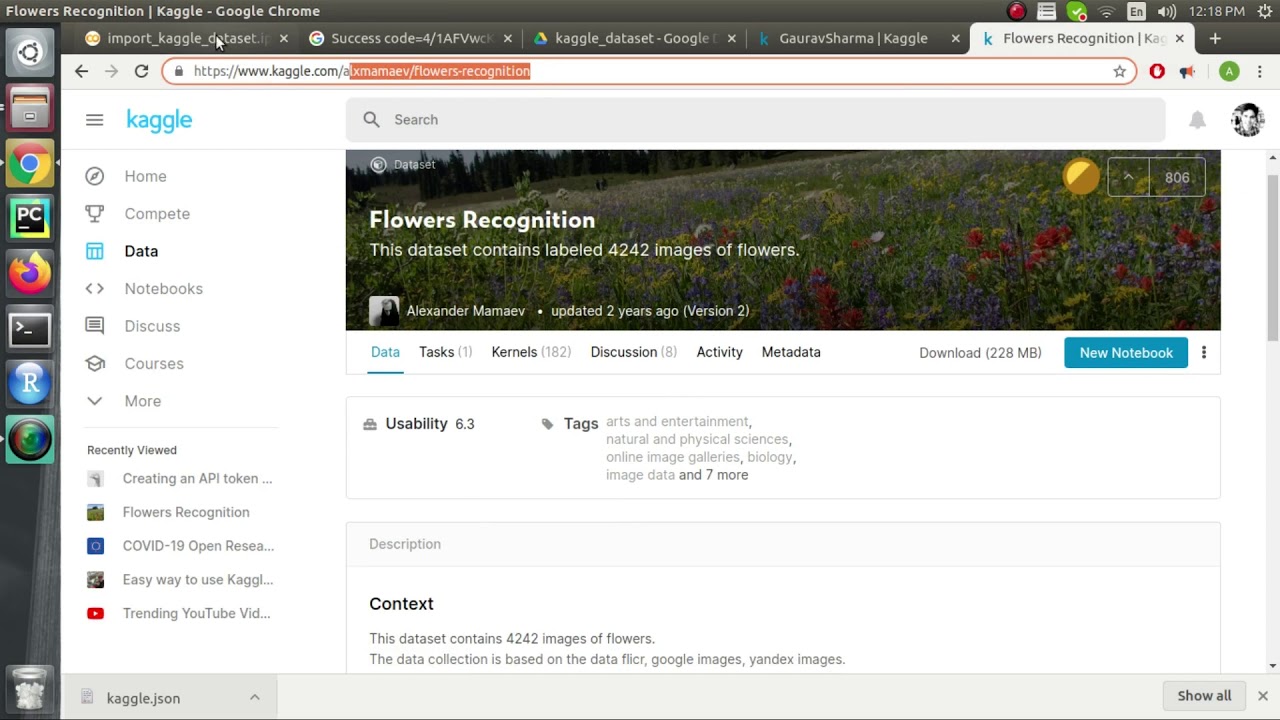
how to import a kagale data set?
tender hearth
lapis sequoia
how to import a kagale data set?
You download the dataset
If it's a common dataset there's probably already a utility class in TensorFlow to interface with the dataset
You just need to download it
If it's not a common dataset you need to write your own class to read and parse the dataset
lapis sequoia
oo i see
so like how do i find out if it has utility class?
i mean it was on the home page i would assume it is
tender hearth
lapis sequoia
i mean it was on the home page i would assume it is
can you share the link?
These are links to all utility classes that TensorFlow has

TensorFlow
lapis sequoia

11 clinical features for predicting heart disease events.
idk what i am doing tbh
i just wanted to build a mode after i learned how to make a linear regression model
tender hearth
lapis sequoia
https://www.kaggle.com/fedesoriano/heart-failure-prediction
Ah alright
Well you download the .csv here

Then you use a library like pandas to load it into a nice object that has useful methods and can easily interact with
 robust charm
Hi quick question. If I make a model using stable_baseline3 can I use Tensor flow Lite so that I can use the model on my microcontroller?
 grave frost
prisma mulch
what different types of models are there apart from sequential in keras?
grave frost
prisma mulch
what different types of models are there apart from sequential in keras?
are you referring to functional API?
hollow ember
Last time i used img it worked but now it doesn't.
 serene scaffold
hollow ember
Last time i used img it worked but now it doesn't.
serene scaffold
hollow ember
Last time i used img it worked but now it doesn't.
it looks to me like it's trying to parse and execute that as Python
hollow ember
yeah
serene scaffold
that's definitely HTML or something.
Python only uses < as an infix operator, so it can't be the start of an expression
hollow ember
yeah
royal crest
can't have img src as a variable name either
 median fulcrum
Hello, I had already done a facial recognition of people even without classifying who the person is. I have a project that requires me to have a training database and then the algorithm tells me who that object and/or person is. I would use Pillow and open cv. Any articles, docs, or materials that talk about this? I searched, but I end up finding more about facial recognition in video etc.
 late olive
could someone please help me with a datascience ish problem in #help-chocolate
lapis sequoia
I'm close
 lapis sequoia
Wrong channel bruh
prisma mulch
what are the default arguments of all the layers?
stark bough
desert oar
it would help if you posted your code, then maybe someone can take a look
Hi guys. Here is the Glue ETL job code that is causing headaches to me
That line takes almost 4 minutes to execute for just one register
this job tries to struct XML texts
these texts are stored un pyspark dataframe column. Very long texts
and i need to loop that column to pass texts to extract functions. Tried with collect() and ToLocalIterator() and now with ToPandas()
have the same result. Really need your help guys :c

 wicked grove
@desert oarim really stuck again, i tried logistic regression too and i got the accuracy as 78%
I think my code follows the tutorial, but the accuracy never hits 80
 vague relic
Does anyone know how to extract details like street name, House name, pincode etc. from a string that represents full address?
 eternal niche
Heya Guys!
Nice to join you!
I am an Electrical and Electronic Engineering student
And just started a masters In machine learning!
So I’m very new to this
I’m starting to use pytorch
And for now I’m learning basic linear regression
Using neural networks
But I am struggling to understand what this line is intentes for:
(1 sec)
 somber prism
damn bro dont go straight to neural netwowrks
eternal niche
What is this LeakyReLU exactly used for?
 eternal niche
somber prism
damn bro dont go straight to neural netwowrks
eternal niche
somber prism
damn bro dont go straight to neural netwowrks
Hahaha thanks a lot, but it’s one of the first modules on the masters hahaha
And I’m just lost hahaha
I tried searching online, and play around to see how the model changes, but I haven’t got a clue
 vast yacht
hi guys, any recommendation on Data Science/Machine Learning books?
somber prism
eternal niche
What is this LeakyReLU exactly used for?
its an activation function, there are lot of activation function each one have their pros and cons
can someone tell me how to implement rating system like kaggle does ?
eternal niche
somber prism
its an activation function, there are lot of activation function each one have t...
Thank you very much!!!
 topaz grove

Anyone can help me with this
?
Original image is

I wanna know where this line will end

The red line is what i wanted
but i dont know how to do it

 lapis sequoia
topaz grove
lapis sequoia
topaz grove
you trynna make a hack for 8 ball pool xD
 burnt knot
So I haven't been able to figure out how to successfully build my voice cloning model
I'm following the steps
But I think it comes down to whatever kind of dataset I downloaded for building the model
I mean, I have an English dataset and a Japanese dataset
But when I encode and synthesise the audio for them, no matter which dataset I decide to use (I have switched them out) I can't get to move on with the process
 lime ocean
Does anybody know what I am doing wrong here?
model = make_pipeline(TfidfVectorizer(), MultinomialNB())
model.fit(train['Consumer_complaint'], train['Product'], tfidfvectorizer__ngram_range=(1,1), multinomialnb__sample_weight=sample)
it works just fine until I add the arg tfidfvectorizer__ngram_range=(1,1)
then I get
TypeError: fit_transform() got an unexpected keyword argument 'ngram_range'
as far as I can tell, TfidfVectorizer should accept an ngrams arg
it says it does in the doc :/
so I think I must be doing something wrong, doubt it's sklearn's fault
scikit-learn
Examples using sklearn.feature_extraction.text.TfidfVectorizer: Biclustering documents with the Spectral Co-clustering algorithm Biclustering documents with the Spectral Co-clustering algorithm, To...
median fulcrum
median fulcrum
Hello, I had already done a facial recognition of people even without classifyin...
|___| <--- 👆 --->
 uneven stirrup
#help-popcorn anyone know anything about this
 zealous burrow
Hi everyone
I am beginner of ML
I don't understand should I start learn ML with scikit learn or google cloud platform ?
What the difference between them?
 neon imp
zealous burrow
Hi everyone
I am beginner of ML
I don't understand should I start learn ML with ...
neon imp
zealous burrow
Hi everyone
I am beginner of ML
I don't understand should I start learn ML with ...
One is a platform by Google, basically a whole bunch of different technologies that do different things. SciKit is a python library. You should follow a course to get your head in the game and learn some basics.
 frail oxide
zealous burrow
Hi everyone
I am beginner of ML
I don't understand should I start learn ML with ...
frail oxide
zealous burrow
Hi everyone
I am beginner of ML
I don't understand should I start learn ML with ...
I think RealPython did a few examples. I dont know anything about ML, but I remember seeing the article. Maybe check this? https://realpython.com/tutorials/machine-learning/

All tutorials tagged "machine-learning" on Real Python.
 olive shore
Anyone good with ai related to linear regression and stock market prwdiction? I need help
wicked grove
lime ocean
as far as I can tell, TfidfVectorizer should accept an ngrams arg
i was getting a similar error when i used tfidf,try passing analyzer = lambda x:x in TfidfVectorizer()
lime ocean
oh man, I just realized what I was doing wrong 😅
lime ocean
lime ocean
```py
model = make_pipeline(TfidfVectorizer(), MultinomialNB())
model.fit(train[...
ngram_range is an argument to TfidfVectorizer's constructor, not model.fit()
lime ocean
wicked grove
i was getting a similar error when i used tfidf,try passing analyzer = lambda x:...
thanks for the help, wouldn't have figured it out without you :)
main fox
olive shore
Anyone good with ai related to linear regression and stock market prwdiction? I ...
Generally, linear regression and ARIMA models perform poorly for this. Predicting the stock market in this way is almost impossible. There is a python package by Stefanie Molin you can check out that pulls stock market data and performs forecasting with those two models if you want to check it out. It's a GitHub repo.
 austere swift
eternal niche
What is this LeakyReLU exactly used for?
austere swift
eternal niche
What is this LeakyReLU exactly used for?
its ReLU but it allows values below 0, although shrunk by a small factor (used to fix the diminishing gradients that ReLU can sometimes cause)
in case you didnt know what ReLU is, it's pretty much just max(0, x)
so if its less than 0, it returns 0, if its greater than 0 then it leaves it untouched
LeakyReLU would be like 0.01*x if x < 0 else x
(0.01 is the negative slope parameter, which is adjustable but defaults to 0.01)
zealous burrow
neon imp
One is a platform by Google, basically a whole bunch of different technologies t...
@neon imp thanks for replying
Because the Google cloud got offer ML course to someone with zero knowledge about ML while
Scikit learn is always said to be the first library for ML beginner to learn
So its really confusing me of which should i choose
zealous burrow
frail oxide
I think RealPython did a few examples. I dont know anything about ML, but I reme...
Tks @frail oxide
For sharing a great tutorials
 dim herald
hi guys is there anybody who understands something in docker (especially in airflow running with docker)
median fulcrum
median fulcrum
Hello, I had already done a facial recognition of people even without classifyin...
|___| <--- 👆 --->
 peak halo
2021-10-30 17:42:26.601289: I tensorflow/core/common_runtime/pluggable_device/pluggable_device_factory.cc:305] Could not identify NUMA node of platform GPU ID 0, defaulting to 0. Your kernel may not have been built with NUMA support.
2021-10-30 17:42:26.601390: I tensorflow/core/common_runtime/pluggable_device/pluggable_device_factory.cc:271] Created TensorFlow device (/job:localhost/replica:0/task:0/device:GPU:0 with 0 MB memory) -> physical PluggableDevice (device: 0, name: METAL, pci bus id: <undefined>)
2021-10-30 17:42:26.864031: I tensorflow/compiler/mlir/mlir_graph_optimization_pass.cc:185] None of the MLIR Optimization Passes are enabled (registered 2)
2021-10-30 17:42:26.864189: W tensorflow/core/platform/profile_utils/cpu_utils.cc:128] Failed to get CPU frequency: 0 Hz
Epoch 1/10
2021-10-30 17:42:26.949280: I tensorflow/core/grappler/optimizers/custom_graph_optimizer_registry.cc:112] Plugin optimizer for device_type GPU is enabled.
what do i do??
im using an M1 mac
 void sail
is there something I can do to make the training smoother? (pretrained resnet18)

or is this to be expected, the volatile curve
 edgy brook
Hey guys, do you need to find the coefficients of Stochastic Gradient Descent in order to evaluate the predictive model? Cus for knn, I think it's not needed
 bronze skiff
?? coeffs of sgd? you mean like the learning rate? and knn doesn't use sgd... or any iterative process to train
velvet thorn
bronze skiff
?? coeffs of sgd? you mean like the learning rate? and knn doesn't use sgd... or...
well, I suppose technically if you're building some sort of data structure to avoid bruteforce search during inference, that might be considered iterative 🥴
bronze skiff
i'm guessing that at the point you gotta do that, you're already too high dimension for knn
gotta go for that sweet sweet LSH
velvet thorn
bronze skiff
i'm guessing that at the point you gotta do that, you're already too high dimens...
can you elaborate on that reasoning
p sure sklearn uses some sort of tree by default? I think it's a ball tree
as long as it has more than 15 (I think) samples?
(unrelated to dimension, which I understand to be feature count)
bronze skiff
yes, you're right i was confusing this with sometime else
velvet thorn
bronze skiff
gotta go for that sweet sweet LSH
I didn't know this was a thing
TIL
that's p cool
is it commonly used?
bronze skiff
yes, especially since in high dimensions knn becomes useless
bronze skiff
no idea
only ever used it for that
though the wider scope of "probabilistic data structures" is useful for any large data analysis
 wintry ether
hello can any1 help me make a ai minecraft bot?
which u can give commands and it does it
median fulcrum
median fulcrum
Hello, I had already done a facial recognition of people even without classifyin...
|___| <--- 👆 --->
 shut trail
wintry ether
which u can give commands and it does it
shut trail
wintry ether
which u can give commands and it does it
sort of like a sentient Alexa for minecraft ?
 kindred whale
hi,
how i can turn off function in jupyter notebook, when i running my code block new code block making auto, how to turn it off?
serene scaffold
kindred whale
hi,
how i can turn off function in jupyter notebook, when i running my code bloc...
You could comment it out?
 slim bone
Is there a website that gathers quality ML resources into it like Full-stack Python?
serene scaffold
slim bone
Is there a website that gathers quality ML resources into it like Full-stack Pyt...
what do you mean by "full-stack python"? "full stack" usually refers to a web developer who can do front and back end development. it doesn't really have a machine learning engineer analogue.
slim bone
Oh I meant the website "Full-stack Python". It's a site with a long list of useful resources that cover nearly all of the aspects of back-frontend web development in Python
I was wondering if theres something similar to the AI and Machine Learning field.
Should've been clearer, my apologies @serene scaffold
serene scaffold
slim bone
Oh I meant the website "Full-stack Python". It's a site with a long list of usef...
For future reference, editing a message and adding a mention doesn't cause a ping.
But no problem. And I'm not really familiar with one. Maybe try Kaggle?
slim bone
Never heard of Kaggle, I'll look into it
serene scaffold
slim bone
Never heard of Kaggle, I'll look into it
do you have any prior experience with AI?
slim bone
Not at all
serene scaffold
slim bone
Not at all
keep in mind that there's going to be a lot of math and the "rate of reward" probably isn't going to be as favorable as with other areas of programming. you'll need to become comfortable with probability, statistics, combinatorics, and linear algebra.
slim bone
@serene scaffold Good thing you told me. Is there any place where I can strengthen my mathematical knowledge?
serene scaffold
slim bone
<@253696366952316929> Good thing you told me. Is there any place where I can str...
I dunno, khan academy? I did it the old fashioned way (four year degree)
slim bone
Software engineering or something else?@serene scaffold
serene scaffold
slim bone
Software engineering or something else?<@253696366952316929>
computer science/data science
kindred whale
im new in data science and learn numpy now
slim bone
serene scaffold
computer science/data science
I see, and you had experience with AI in Uni/College?
serene scaffold
kindred whale
im new in data science and learn numpy now
one should not seek to "learn numpy" but instead do things where they could accomplish what they're trying to do more effectively with numpy.
serene scaffold
slim bone
I see, and you had experience with AI in Uni/College?
ye
slim bone
serene scaffold
ye
Ah, I see. And you dont know about resources that teach ML from scratch?
Also, are all of the topics you mentioned earlier(probability, statistics...) cover the field or AI? Or are there other topics I should focus on as well?
kindred whale
serene scaffold
one should not seek to "learn numpy" but instead do things where they could acco...
i have one question
serene scaffold
slim bone
Ah, I see. And you dont know about resources that teach ML from scratch?
Also, a...
so, one of the most common things one does in AI is classification. which is where you build a program that can take something and say what group it belongs to
kindred whale
why when i makin
a = np.empty((5, 2), dtype='int16')
I have result
array([[123,   0],
       [  2,   0],
       [  3,   0],
       [  4,   0],
       [  5,   0]], dtype=int16)

```,
why 123?for example, you might have a program that tries to guess if someone is a man or a woman based on their height and weight. statistically, men are taller and heavier
so the program might learn that if someone is above a certain height, the probability of them being a man is, say, 60%.
serene scaffold
kindred whale
why when i makin
```py
a = np.empty((5, 2), dtype='int16')
```
I have result
```...
do you know how numbers are stored inside a computer? np.empty just allocates an array of the given shape, and the numbers you get just depend on the current state of whichever bits Python decides will be part of the array.
median fulcrum
median fulcrum
Hello, I had already done a facial recognition of people even without classifyin...
|___| <--- 👆 --->
serene scaffold
as opposed to np.zeros, which will flip all the bits to 0 for you.
!e import numpy as np; print(np.empty((5, 2), dtype='int16'))
arctic wedgeBOT
@serene scaffold :white_check_mark: Your eval job has completed with return code 0.
001 | [[     0      0]
002 |  [     0      0]
003 |  [     0      0]
004 |  [     0      0]
005 |  [-17360  -4320]]
yh
lapis sequoia
is this where i can ask questions ab torch?
slim bone
@serene scaffold I see, so focus on classification. Any other topics?
serene scaffold
slim bone
<@253696366952316929> I see, so focus on classification. Any other topics?
I was just giving an example of how statistics is used in AI
slim bone
Ah, I see
serene scaffold
there was probably a better one I could have thought of
slim bone
No its okay I got the point I believe
serene scaffold
but yes, if you make your first goal "make a classifier for some dataset on Kaggle", that should keep you positively occupied for a while.
slim bone
@serene scaffold Will Kaggle teach me how to do that though?
serene scaffold
slim bone
<@253696366952316929> Will Kaggle teach me how to do that though?
I'm not sure.
I must disappear for a while
slim bone
Okay, you've been very helpful
lapis sequoia
I'm tryna make an ml model w torch, but torch doesnt notice my gpu
slim bone
Thank you very much
lapis sequoia
only thing is that i downloaded the drivers for my gpu, i downloaded cuda, and i downloaded torch w cuda
so youd expect it to work, but torch still doesnt pick up a gpu
serene scaffold
lapis sequoia
I'm tryna make an ml model w torch, but torch doesnt notice my gpu
Show the command you used to install torch
Also what os
And what gpu
lapis sequoia
pip3 install torch==1.10.0+cu113 torchvision==0.11.1+cu113 torchaudio===0.10.0+cu113 -f https://download.pytorch.org/whl/cu113/torch_stable.html
this is the command i used
I'm using Windows 10
GTX 1050 Ti on a laptop
i pulled the command straight from the pytorch website
wicked grove
lime ocean
thanks for the help, wouldn't have figured it out without you :)
🙈🙈no problem:)
I just read what a constructor is,should i start learning oops to know more about classes,constructors?
serene scaffold
lapis sequoia
`pip3 install torch==1.10.0+cu113 torchvision==0.11.1+cu113 torchaudio===0.10.0+...
okay, and then what code did you run that communicated to you that torch hasn't noticed your gpu?
and what was the result?
serene scaffold
wicked grove
🙈🙈no problem:)
I just read what a constructor is,should i start learning oops ...
OOP is more than just "having classes" and includes some software design concepts that Python doesn't really encourage.
wicked grove
Ohh okayy!!
Could you please check my final code
https://paste.pythondiscord.com/ocosulaxef.py
I got this accuracy from it
           0       0.77      0.77      0.77     39752
           1       0.77      0.77      0.77     40248

    accuracy                           0.77     80000
   macro avg       0.77      0.77      0.77     80000
weighted avg       0.77      0.77      0.77     80000
I tried to match the code to the tutorial i was following and this is the max i can get
Could you please tell me if this is okay
lapis sequoia
serene scaffold
okay, and then what code did you run that communicated to you that torch hasn't ...
im using this module detecto that uses torch under the hood:https://detecto.readthedocs.io/en/latest/usage/quickstart.html
when i go to actually train the model it tells me it's only using cpu, lemme run it rq to get the message
https://paste.pythondiscord.com/yabokusave.py here's the code
serene scaffold
@lapis sequoia for one thing, do python -c "import torch; print(torch.cuda.is_available())" and show the result.
lapis sequoia
ya thats the problem tho
serene scaffold
lapis sequoia
ya thats the problem tho
what does it display
lapis sequoia
even after installing torch w cuda it shows up as false
arctic wedgeBOT
Pasting large amounts of code
If your code is too long to fit in a codeblock in discord, you can paste your code here:
https://paste.pythondiscord.com/
After pasting your code, save it by clicking the floppy disk icon in the top right, or by typing ctrl + S. After doing that, the URL should change. Copy the URL and post it here so others can see it.
lapis sequoia
nvidia-smi?
lapis sequoia
 serene scaffold
lapis sequoia
serene scaffold
lapis sequoia
in the future, please always copy and paste everything as text; I won't read screenshots.
except this one
serene scaffold
lapis sequoia
`pip3 install torch==1.10.0+cu113 torchvision==0.11.1+cu113 torchaudio===0.10.0+...
what happens if you do pip install torch==1.10.0+cu113, without the -f part?
the cu113 part means "cuda 11.3", but you have 11.5.
granted, so does +cu113, but if you don't use the -f part, that might force it to compile locally instead of using a precompiled version
lapis sequoia
ERROR: Could not find a version that satisfies the requirement torch==1.10.0+cu113 (from versions: 0.1.2, 0.1.2.post1, 0.1.2.post2, 1.7.1, 1.8.0, 1.8.1, 1.9.0, 1.9.1, 1.10.0) ERROR: No matching distribution found for torch==1.10.0+cu113
serene scaffold
okay, let me see
lapis sequoia
also
Looking in indexes: https://pypi.org/simple, https://pypi.ngc.nvidia.com
it should be in pypi tho
serene scaffold
try pip install --pre torch -f https://download.pytorch.org/whl/nightly/cu113/torch_nightly.html
(that's what worked for this person five days ago: https://discuss.pytorch.org/t/error-installing-with-python-3-8-and-cuda-11-5/134914/6)
lapis sequoia
Looking in indexes: https://pypi.org/simple, https://pypi.ngc.nvidia.com Looking in links: https://download.pytorch.org/whl/nightly/cu113/torch_nightly.html Requirement already satisfied: torch in c:\users\ashib\anaconda3\lib\site-packages (1.10.0) Requirement already satisfied: typing_extensions in c:\users\ashib\anaconda3\lib\site-packages (from torch) (3.7.4.3)
lemme run rq
serene scaffold
oh, you're using anaconda?
serene scaffold
so why does it say Requirement already satisfied: torch in c:\users\ashib\anaconda3\lib\site-packages (1.10.0)
lapis sequoia
i installed conda to see if having a diff interpreter would work
um
thats a very good question
lapis sequoia
says which isnt a cmdlet
serene scaffold
let me find the equivalent command
lapis sequoia
its going thru conda when i run which pip in git bash
serene scaffold
lapis sequoia
its going thru conda when i run `which pip` in git bash
okay, try conda install cudatoolkit=11.3
serene scaffold
and then do conda install torch again
I don't know how to run python programs with conda, though.
lapis sequoia
im using vsc to run my code
serene scaffold
also funny thing, I haven't eaten today. I think I need to do that.
lapis sequoia
!paste
 mystic prairie
I wanted to make an AI that could generate a certain type of images given a dataset, I have no background knowledge where should I start learning things
lapis sequoia
mit has a really great online lecture series ab ml
ml being machine learning
i think they also go through code
that's where im starting
lapis sequoia
could some one help me at #help-avocado message
lapis sequoia
@serene scaffold its still downloading stuff
or no, its examining conflicts
warnings.filterwarnings('ignore')

cmap = plt.get_cmap('inferno')
plt.figure(figsize=(8,8))
genres = 'blues classical country disco hiphop jazz metal pop reggae rock'.split()


for g in genres:
    pathlib.Path(f'img_data/{g}').mkdir(parents=True, exist_ok=True)
    for filename in os.listdir(f'C:\\Users\\jimmy\\Downloads\\genres\\{g}'):
        songname = f'C:\\Users\\jimmy\\Downloads\\genres\\{g}\\{filename}'
        y, sr = librosa.load(songname, mono=True, duration=5)
        plt.specgram(y, NFFT=2048, Fs=2, Fc=0, noverlap=128, cmap=cmap, sides='default', mode='default', scale='dB')
        plt.axis('off')
        plt.savefig(f'img_data/{g}/{filename[:-3].replace(".", "")}.png')
        plt.clf()

header = 'filename chroma_stft rmse spectral_centroid spectral_bandwidth rolloff zero_crossing_rate'
for i in range(1, 21):
    header += f' mfcc{i}'
header += ' label'
header = header.split()

file = open('dataset.csv', 'w', newline='')
with file:
    writer = csv.writer(file)
    writer.writerow(header)
genres = 'blues classical country disco hiphop jazz metal pop reggae rock'.split()```for g in genres:
for filename in os.listdir(f'C:\\Users\\jimmy\\Downloads\\genres\\{g}'):
songname = f'C:\\Users\\jimmy\\Downloads\\genres\\{g}\\{filename}'
y, sr = librosa.load(songname, mono=True, duration=30)
rmse = librosa.feature.rms(y=y)
chroma_stft = librosa.feature.chroma_stft(y=y, sr=sr)
spec_cent = librosa.feature.spectral_centroid(y=y, sr=sr)
spec_bw = librosa.feature.spectral_bandwidth(y=y, sr=sr)
rolloff = librosa.feature.spectral_rolloff(y=y, sr=sr)
zcr = librosa.feature.zero_crossing_rate(y)
mfcc = librosa.feature.mfcc(y=y, sr=sr)
to_append = f'{filename} {np.mean(chroma_stft)} {np.mean(rmse)} {np.mean(spec_cent)} {np.mean(spec_bw)} {np.mean(rolloff)} {np.mean(zcr)}'
for e in mfcc:
to_append += f' {np.mean(e)}'
to_append += f' {g}'
file = open('dataset.csv', 'a', newline='')
with file:
writer = csv.writer(file)
writer.writerow(to_append.split())
data = pd.read_csv('dataset.csv')
data.head()# Dropping unneccesary columns
data = data.drop(['filename'],axis=1)#Encoding the Labels
genre_list = data.iloc[:, -1]
encoder = LabelEncoder()
y = encoder.fit_transform(genre_list)#Scaling the Feature columns
scaler = StandardScaler()
X = scaler.fit_transform(np.array(data.iloc[:, :-1], dtype = float))
X_train, X_test, y_train, y_test = train_test_split(X, y, test_size=0.2)#Dividing data into training and Testing set
model = Sequential()
model.add(layers.Dense(256, activation='relu', input_shape=(X_train.shape[1],)))
model.add(layers.Dense(128, activation='relu'))
model.add(layers.Dense(64, activation='relu'))
model.add(layers.Dense(10, activation='softmax'))
model.compile(optimizer='adam',
loss='sparse_categorical_crossentropy',
metrics=['accuracy'])```classifier = model.fit(X_train,
y_train,
epochs=100,
batch_size=128)
score = model.evaluate(X_test, y_test, verbose=0)
print(score)
model = keras.models.load_model('audio classification.h5')```well ihave this code which convert a audio file into spectogram
i just want a predict function
in which function i give audio file and it predicts which class it belongs to
!paste
median fulcrum
median fulcrum
Hello, I had already done a facial recognition of people even without classifyin...
|___| <--- 👆 --->
arctic wedgeBOT
:incoming_envelope: :ok_hand: applied mute to @narrow basin until <t:1635635061:f> (9 minutes and 59 seconds) (reason: duplicates rule: sent 4 duplicated messages in 10s).
 empty aurora
let's say I have two columns, entry and exit, and I want to count how many exits happen within 30 minutes of each entry, is there a way to do it without apply?
velvet thorn
empty aurora
let's say I have two columns, entry and exit, and I want to count how many exits...
((df['exit'] - df['entry']) <= timedelta(minutes=30)).sum()
thanks, this works if exit and entry are same row, i want to count how many entries happen within 30 minutes of each entry
example: if row 1 is entry 8 am, i want to count how many entries happen within 8 and 830 am
def next_closest_dep_calc(row):
    nxt_dep = (tstflights['STD_UTC'][
        (tstflights.STD_UTC <= row.STA_UTC + pd.Timedelta("600 minutes"))
        & (tstflights.STD_UTC > row.STA_UTC)].min())
    print(f"{x.STA_UTC} next dep {nxt_dep} in {nxt_dep - x.STA_UTC} minutes")
    return 0
tstflights['nuevo'] = tstflights.apply(count_deps_52mins, axis=1)
oh.
empty aurora
this is what I am doing right now, with an apply, and of course here i am finding the closest STD_UTC to each rows STA_UTC
velvet thorn
that's more complicated
 thin palm
Hi, can someone explain weights to me in Deep Neural Network?
Because when I Google this there is no simple solution
empty aurora
i've no idea either, one way i was thinking was using joins, which i have done in the past its like a super application of branch and cut something like that lol
velvet thorn
empty aurora
i've no idea either, one way i was thinking was using joins, which i have done i...
like cross joins?
it's not hard
empty aurora
yeah. and then count and go back to the first df
velvet thorn
you could use like np.subtract.outer
empty aurora
but now you counted what joined
mmm
thats nice, ill explore that numpy is always super fast
thanks
velvet thorn
which would make the most sense to me
there might be a faster than quadratic algorithm
not sure
 undone mirage
hello i want to learn about machine learning, where should i start?
 simple ivy
hey yall! question- when implementing object detection with custom trained models, does the process always require that you manually label images in your dataset?
lapis sequoia
simple ivy
hey yall! question- when implementing object detection with custom trained model...
i just recently got into this, but usually, ya
unless u can find a dataset online
theres a ton of datasets online
or ya know
u can always pay someone to label for ya
or just get like a 5 yr old a chocolate bar for a few hours worth of work
child labor for the win
simple ivy
hahaha
wait but is that also the case for datasets with over 100,000+ rows of data?
that doesn't seem... possible to label each and every single image
lapis sequoia
ya im pretty sure theyre usually hand labeled by a shit ton of people or theres already a pretrained model churning out datasets
 rugged oyster
Hi, We want to build python 3 (latest release) on windows for a xeon machine we are testing against nuclear and solar radiation. What build syntax would I use that would include PGO as well as remove source files and leave only the required files/folders (../lib, ../include, etc...) on a win7pro machine? (xeon) The machine will be doing a lot of mobile device testing. The build needs to be secure and geared towards working with devices over usb-c.
vague relic
How do AI engineers know what machine learning model to use for a particular task? For example, if it is a whether prediction task and you've been given some variables like date, latitude, longitude, elevation, etc. How do you know what model to choose?
rugged oyster
Optimally a added install switch to have a shadow copy auto generate would be the best route in addition to that. Thank you all so much!
 quiet vault
vague relic
How do AI engineers know what machine learning model to use for a particular tas...
quiet vault
vague relic
How do AI engineers know what machine learning model to use for a particular tas...
For this kind of problem, a neural network will probably be the best option because there are multiple variables to learn
Choosing the model really depends on how difficult the problem is to predict for, the time that you have to develop the model and what kind of problem it is
For example, you have a time series dataset and it is a regression problem. If the problem is not very complicated, and you don’t have much time you should choose ARIMA or SARIMA. If you have a lot of time and the problem is difficult, you could chose deep learning such as lstm
Nearly every computer vision task these days should use a CNN. There isn’t really any exceptions on that one
quiet vault
simple ivy
wait but is that also the case for datasets with over 100,000+ rows of data?
Yeah ImageNet Large Scale Visual Recognition Challenge (ILSVRC) is an anual computer vision competition and it has around 1 million images. I’m pretty sure they are all done by hand
quiet vault
undone mirage
hello i want to learn about machine learning, where should i start?
I would start with a 6 hour long tutorial video from TechWithTim. i am pretty sure the video is called “Deep learning for beginners”. It explains the concept and application of tensor flow on multiple different types of models which is really cool. From there, you can look at different resources to expand your knowledge in specific fields
edgy brook
bronze skiff
?? coeffs of sgd? you mean like the learning rate? and knn doesn't use sgd... or...
Hmm, I think so? I actually don't know since we only covered this in a lecture before we're handed an assignment about machine learning. I'm just trying to rely on their examples with linear regression and information on sklearn
This is from the sgd page in scikit, not sure if I should stick with coef_ or just change it to densify

I just needed some evaluation tools so I went with the coefficients, rsquare and the rmse
thin palm
Hi guys, I applied to a Machine Learning Engineer position and the recruiter responded a few days later saying this:
Thanks for your application for the position of Machine Learning Engineer!
I'd like to schedule a call with you. When are you available for a whatsapp call? What about Monday at 3:30pm time?
Looking forward to hearing from you!
What does this mean exactly? Will this be a technical interview from the get-go or a simple phone call? Do I need to be studying like hell in the next 2 days?
royal crest
if they say it's a call i'd assume it's a call
but i cannot speak for the cultural embedding
thin palm
royal crest
if they say it's a call i'd assume it's a call
Correct, but a call about technical skills or more just about their company and why I'd like the role?
royal crest
could you not ping me please
i'm not entirely sure how one could conduct a "technical interview" through a WhatsApp call
but again, that might be commonplace where you live
besides, i think this is going off-topic
!rule 7
arctic wedgeBOT
7. Keep discussions relevant to the channel topic. Each channel's description tells you the topic.
thin palm
I pinged you to let you know that I was responding...
royal crest
i'm right here
edgy brook
what would you use to evaluate a neural network regression model? I already have RMSE, MAE and R-squared. Are there better evaluation techniques someone can recommend so is the 3 above good? I was thinking SSE but since it's used to calculate RMSE, I don't think its needed???]
 halcyon storm
Hello
Can someone help me with a project
?
Is it possible if u can help me with my project cuz I need help with a guider cuz I don’t understand. So basically I’m trying to create a algorithm that will detect brain tumors by using a yes n no brain tumor data set. And one of my teachers told me to use a tensor flow guide to follow the steps from there n then do the coding on to the google collaborative notebook
 dull turtle
i am working with pandas dataframe
i have in that date & time column
in that i have value python bnf_date&time 598 2017-03-02 09:15:59 599 2017-03-02 09:15:59 600 2017-03-02 09:16:58 601 2017-03-02 09:16:59 602 2017-03-02 09:17:41 603 2017-03-02 09:17:59 604 2017-03-02 09:18:54 605 2017-03-02 09:18:59 606 2017-03-02 09:19:57 607 2017-03-02 09:19:58 608 2017-03-02 09:20:58 609 2017-03-02 09:20:59 610 2017-03-02 09:21:05 611 2017-03-02 09:21:59
this way . i want to remove each minute first value for that i get only second value for each minute
so my expected output is python bnf_date&time 599 2017-03-02 09:15:59 601 2017-03-02 09:16:59 603 2017-03-02 09:17:59 605 2017-03-02 09:18:59 607 2017-03-02 09:19:58 609 2017-03-02 09:20:59 611 2017-03-02 09:21:59 this way
ping me when replying
 glacial gale
Hi can anyone help me with finding a reliable way to analyze football plays based on video footage?
halcyon storm
Hello
So basically i am working on creating an algorithm that will detect brain tumors with a yes and no response ok using a MVP version for the algorithm. And my teacher told me to firstly import the brain tumor data set onto a new google collab project notebook. And then order me to follow a tutorial guide called tensor flow that will help me out To Split the dataset into training / testing / validation sets which is the other step. However, I don’t comprehend the tutorial guide cuz it seems confusing? Can u be able to help me guide n tell what I should be doing throughout the process
Below is the tutorial guide
https://www.kaggle.com/navoneel/brain-mri-images-for-brain-tumor-detection
Here is the tutorial guide
https://codelabs.developers.google.com/codelabs/cloud-tensorflow-mnist#1
https://colab.research.google.com
That is the google collaboratory notebook website to get all the work completed

Google Codelabs
In this codelab, you will teach the computer to recognise handwritten digits with 99% accuracy, in 100 lines of Python / Keras code.

 willow seal
lapis sequoia
willow seal
lapis sequoia
figure you guys might know, how do i get jupyter's notebook to stop changing the number of loops on each %timeit run?

 cobalt jetty
%timeit -n <xx> should let you set the number of loops.
though I'd not recommend it in general because timeit fixes that number depending on the length that previous iterations took.
lapis sequoia
i see thank you
ya that makes sense but i thought i should know
tender hearth
Annoying how torch.nn.utils.rnn.pad_sequence can't pad along an arbitrary axis

Grr
vast yacht
Hi i'm new to Data Science and i'm planning on a project that deals with real-time data. How to make the code run non-stop on a specific task? Do I have to put the code in a live hosting site? I have code for crawling products data from a webpage in order to transfer data in a pipe to my database.
 pseudo igloo
halcyon storm
So basically i am working on creating an algorithm that will detect brain tumors...
pseudo igloo
halcyon storm
So basically i am working on creating an algorithm that will detect brain tumors...
Post it in #help-donut or one of that Chanel
halcyon storm
Hey
 random moth
 cinder schooner
any one knows how to use logistic regression to create a scoring method?
cinder schooner
any one knows how to use logistic regression to create a scoring method?
kind of
#Building a Logistic Regression Model with Sklearn
import pandas as pd
from sklearn.linear_model import LogisticRegression#importing the logistic regression model

df = pd.read_csv("titanic.csv")
df["Male"] = df["Sex"] == "male"

#It is convention to call our 2d array of features X and our 1d array of target values y
X = df[['Pclass', 'Male', 'Age', 'Siblings/Spouses', 'Parents/Children', 'Fare']].values
y = df['Survived'].values

#all sklearn models are built as classes
model = LogisticRegression()#initiating the class
model.fit(X, y)#building the model

print(f"{model.coef_}\n\n{model.intercept_}\n")#the resulting equation is: 0 = 0.0161594x + -0.01549065y + -0.51037152

#we can use the predict method to make predictions
#the syntax is: model.predict(X)
print(model.predict([[2, True, 20.0, 1, 0, 7.25]]))#example, output says whether or not the program expects the person to have died
print("")

n = 14#numper of datapoints to be tested
print(model.predict(X[:n]))
print("")
print(y[:n])


if all(model.predict(X[:n]) == y[:n]):#with larger n, less likely to be completely correct
    print(f"\nThe model was completely correct for {n} datapoints.\n")#14 is the largest n to yield a completely correct result

#we can see how good our model is by scoring it based on the number of datapoints correctly predicted, this is called an accuracy score
y_pred = model.predict(X)#an array of the predicted y values
y == y_pred#we create an array of boolean values of whether we predicted each passenger correctly or not
print((y == y_pred).sum(), "\n")#we use the numpy sum method to see how many we got correct

#to get the percent of passengers, we divide the number of correct predictions by the total number of passengers
print((y == y_pred).sum() / y.shape[0], "\n")

#alternatively, we could use the score method
print(model.score(X, y))
this is what I have
 odd meteor
cinder schooner
any one knows how to use logistic regression to create a scoring method?
odd meteor
cinder schooner
any one knows how to use logistic regression to create a scoring method?
Can you elucidate?
What do you mean by scoring method? Do you mean metric for evaluating model performance?
 lone drum
hello i have a dataframe
in one of column i have activity_type values
this way i have my dataframe

i want to keep my activity column in such a way that sell can not came when day is starting
it will only came when previous was buy
means day is start with buy only not sell
if sell is coming at day start them i have to do nothing at that time
if there is buy then only sell will happen
ping me when u reply i will anything other info u need
 next phoenix

 spiral wolf
hi, i am about to write my bachelor thesis in hybrid intelligence in the field of Hybrid intelligence/XAI, and my prof told me to play around with python demo data sets if I am going to plan a practical part. I dont know much about python. He suggested me three frameworks, LIME, SHAP and ANCHORS. What exactly can I imagine about play around with demo data sets. and what exactly would be programmed in this domain with python? It's a pity that My programming skills are not the best. Any help is appreciated. 🙂
quiet vault
halcyon storm
So basically i am working on creating an algorithm that will detect brain tumors...
Are u just using pictures to detect the tumor or some other kind of data?
If it is just pictures, this is an image classification problem
Tensorflow is a library used to create machine learning models. There could be a guide on tensorflow but tensorflow is self is not a guide


 hollow shell
https://github.com/ultralytics/yolov5
check this

GitHub
YOLOv5 🚀 in PyTorch > ONNX > CoreML > TFLite. Contribute to ultralytics/yolov5 development by creating an account on GitHub.
quiet vault
Will do
hollow shell
Using labelimg you can make your own datasets
hollow shell
Yep
quiet vault
How much vram does it take
hollow shell
24
quiet vault
Have you tested the fps
 quiet vault
Alright
I really want to play around with it
But I don’t have 24 gigs of vram
Sad
hollow shell
Training takes a lot of resources and it takes less than a second to recognize an object.
Use pre-trained models
austere swift
quiet vault
Same as training?
no, a lot less
hollow shell
It's light enough to be executed in cpu.
austere swift
training also needs to store grads and optimizer information, inference just needs the model and sample
 pseudo igloo
quiet vault
But I don’t have 24 gigs of vram
pseudo igloo
quiet vault
But I don’t have 24 gigs of vram
Uhh you can pick up a ripjaw kit around black Friday or used ballistics

austere swift
pseudo igloo
Uhh you can pick up a ripjaw kit around black Friday or used ballistics
vram not ram
pseudo igloo
Oh nvm brain fart
pseudo igloo
austere swift
vram not ram
Hm curious now. Two 3080tis and a nvlink, will that due?
austere swift
pseudo igloo
Hm curious now. Two 3080tis and a nvlink, will that due?
3080ti doesnt have nvlink
hollow shell
3090
austere swift
yeah only the 3090 does
but anyways, a single 3080ti will more than do for inference
pseudo igloo
austere swift
3080ti doesnt have nvlink
Wooow... I'm outdated as hell
quiet vault
What do people use to train these models?
austere swift
quiet vault
What do people use to train these models?
what models?
quiet vault
Yolov5
austere swift
that can be trained on a single multi-gpu system
quiet vault
Alright
hollow shell
It seems to be used in proportion to the vram you have.
(It can be trained on cpu too)
Smaller batch size -> less ram usage
Or small image to learn
austere swift
hollow shell
(It can be trained on cpu too)
its completely unfeasible to train yolov5 (or any somewhat decently sized model) on cpu
quiet vault
 halcyon storm
quiet vault
Tensorflow is a library used to create machine learning models. There could be a...
halcyon storm
quiet vault
Tensorflow is a library used to create machine learning models. There could be a...
Yeah ur right. Is it possible if u can help me guide through this process plz? I would appreciate so much. I just need to first the
(1) Import the dataset into a fresh Google Collab project
(2) Split the dataset into training / testing / validation sets And that’s all. Can u help me ?
quiet vault
Very affordable
austere swift
quiet vault
people rarely buy them and run locally, most of the time its provided by cloud
or its large institutions that buy multi million dollar datacenters filled with them
quiet vault
halcyon storm
Yeah ur right. Is it possible if u can help me guide through this process plz? I...
First go to google drive and create a new document. Instead of selecting one of the most common options (docs, slides) put more and then google colab. Now you can go on and code like normal
I’m not sure how to import the dataset but once you have it imported you have to check to see if the y is in numbers
If it isn’t you have to make it 0 or 1 because machine learning models use numbers
0 for no brain tumors and 1 for brain tumor
After that you can use the train_test_split function from sklearn to split it
pseudo igloo
quiet vault
I’m not sure how to import the dataset but once you have it imported you have to...
I was helpimg her on that project but the instructions that she was following god knows how out dated it is.
halcyon storm
quiet vault
If it isn’t you have to make it 0 or 1 because machine learning models use numbe...
Hey according to my teacher i have to use google collab
halcyon storm
halcyon storm
Hey according to my teacher i have to use google collab
I found this video on YouTube can u help me guide https://youtu.be/T8xEQI8XXGs
 quiet vault
pseudo igloo
I was helpimg her on that project but the instructions that she was following go...
quiet vault
pseudo igloo
I was helpimg her on that project but the instructions that she was following go...
Oh no
halcyon storm
Is it possible u can help me guide using that video ? I’m just confused bc i m not an expert at coding
quiet vault
Do you know python
You need to know python to do ai
It is way to complicated to learn both at once
 arctic wedgeBOT
Hey @pseudo igloo!
It looks like you tried to attach file type(s) that we do not allow (.ipynb). We currently allow the following file types: .gif, .jpg, .jpeg, .mov, .mp4, .mpg, .png, .mp3, .wav, .ogg, .webm, .webp, .flac, .m4a.
Feel free to ask in #community-meta if you think this is a mistake.
pseudo igloo
huh...
it's a ipynb file....
@quiet vaultdo i have to get permeation for this type of file?
quiet vault
pseudo igloo
it's a ipynb file....
Yeah that’s what colab is
quiet vault
pseudo igloo
<@!645750811753709615>do i have to get permeation for this type of file?
I’m not sure
halcyon storm
quiet vault
It is way to complicated to learn both at once
Ohh I see . Do u know how long it takes to to complete these first steps
?
halcyon storm
pseudo igloo
No not yet but will do
quiet vault
halcyon storm
Ohh I see . Do u know how long it takes to to complete these first steps
Which first steps
The ones that I told you or learning how to code python
 pastel valley
guys i am watching about convolutional neural networks
and all about this layers i see that there is something like default layers on tensor flow
but i dont understand like if i like to create a cnn to classify diff types of cars how do i change or what to change on that default cnn?
pseudo igloo
quiet vault
The ones that I told you or learning how to code python
uh the plug ins are there on the tutorial page
she don't know how to plug in
wicked grove
quiet vault
The ones that I told you or learning how to code python
Hello,I'm stuck on a problem could you please guide me
I have a project where i have to work to with the diabetic retinopathy dataset on kaggle
The training zip has 8k images and a csv file for the labels
It's my first time using jupyter notebook and im really new to deep learning
Could you please tell me if i should follow this code to import the dataset
https://stackoverflow.com/questions/62218611/how-to-train-a-model-with-a-dataset-in-which-image-dataset-is-given-and-label-fo

Stack Overflow
I have a dataset in which image files are given separately and label for that image files given in separate csv file with 1st column as the image file name and 2nd column its respective label.
|I...
wicked grove
I cant understand why they have used the the tensorflow part tho
I just want to load the dataset and do the preprocessing w opencv
quiet vault
You can replace the tensorflow part with opencv
I normally work with tensorflow though
wicked grove
Oh okayy, thank you😁
Also, this dataset is for multi class and
I want to do a binary classification
I thought i would get rid of mild column, and combine the other 3 labels(is the approach correct)
But i cannot understand how i can get rid of the mild images
wicked grove
quiet vault
I normally work with tensorflow though
Is that better for preprocessing compared to open cv
quiet vault
I’m not sure. I have never worked with opencv before. The best tool is the one that works for you
wicked grove
Alrightt thankss:))
cinder schooner
@random moth @odd meteor
i'm trying to help someone in a research for medecine
and for medecine they use scores like this:
AGE >65 : 2points
AGE<=65: 0 points
DIABETES: YES 1 point
No: 0points
ETC
then they take the sum of the points they get for that patient
and they can tell from the formula if he has big chance or low chance to have the disese or to die etc
and this is given by logistic regression
i found the solution to how to get a score like this from a dataset of patients that have or not the disese
but i dont understand whats the odds ratio for logistic regression
and how to use it for my scoring formula
odd meteor
cinder schooner
and how to use it for my scoring formula

Odds are basically the ratio of some event happening to some event not happening. This article is about odds and odd ratios, their variants.
 cinder schooner
this is what i always find about odds ratio
but i have a table
with odds ratio of each Beta in the logistic regression
exp(B0),exp(B1) etc
what do i do with that
pseudo igloo
@quiet vaultwould you join on a call yo help @halcyon storm ?
odd meteor
odd meteor
@cinder schooner use the formula in pic to compute your odds ratio. P in the above formula = probability
I presume you're working on a binary classification problem.
-
For class 0 ( No diabetes) , calculate this for your P0 /1 - P0
-
For Class 1 (Diabetes), calculate this as well P1/1-P1
-
Then divide #1 by #2
pseudo igloo
quiet vault
I’m working right now
alright. I just can't find the file.
quiet vault
I’ll help once I’m done
median fulcrum
median fulcrum
Hello, I had already done a facial recognition of people even without classifyin...
|___| <--- 👆 --->
halcyon storm
quiet vault
I’ll help once I’m done
Hey can u help me thx ?
halcyon storm
quiet vault
I’ll help once I’m done
When ur done can u help. Can u help n join on a hop on a discord call ?
quiet vault
I can now
I’m on my phone though
So you should share your screen
Are u in a call with 000
halcyon storm
Ok bet
pseudo igloo
quiet vault
Add me to the call
i don't know how to add you.
 sturdy plover
Where to start with python & ai?
My goal is an ai which detects if a link is malicious
(I already know python)
quiet vault
sturdy plover
Where to start with python & ai?
My goal is an ai which detects if a link is mal...
I would start with a tutorial made by TechWithTim. It explains the concepts and coding on many different models
I’m pretty sure the tutorial is called deep learning for beginners

Learn how to use TensorFlow 2.0 in this full tutorial course for beginners. This course is designed for Python programmers looking to enhance their knowledge and skills in machine learning and artificial intelligence.
Throughout the 8 modules in this course you will learn about fundamental concepts and methods in ML & AI like core learning alg...
Here is the link
simple ivy
hey folks, i just used labelImg to label my data but noticed that it saved the labels as .txt files and im looking at a tutorial that says they should be .xml files, does this mean that ill have to convert the file type or is it okay to proceed with txt?
my assumption is the former, but i wanted to check in here in case anyone has some insight
wicked grove
wicked grove
Oh okayy, thank you😁
Also, this dataset is for multi class and
I want to do a ...
Hello @quiet vault
Could you please help me w this,i am not getting it
quiet vault
wicked grove
Hello <@645750811753709615>
Could you please help me w this,i am not getting it
So you want to turn a multi classification problem in binary classification?
wicked grove
Yess
quiet vault
So how many classification options are there
wicked grove
5 classes
quiet vault
And which one are u looking for
Cuz you could do 1 class is equal to 1 and the other 4 are 0
wicked grove
wicked grove
5 classes
This is the dataset https://www.kaggle.com/c/diabetic-retinopathy-detection/data

Identify signs of diabetic retinopathy in eye images
wicked grove
quiet vault
Cuz you could do 1 class is equal to 1 and the other 4 are 0
Yeahh,i want to keep 0 as no and 1 is dr
wicked grove
Because the difference is very less
The features of mild aren't as prominent
quiet vault
Ok
Makes sense
So do you have this data in a pandas dataframe
Stack Overflow
I have the following DataFrame:
daysago line_race rating rw wrating
line_date
2007-03-31 62 11 56 1.00...
Here’s a link on how to remove rows according to a value in a pandas dataframe
wicked grove
quiet vault
So do you have this data in a pandas dataframe
I do have the labels in a csv but not the images
Like how do i get rid of the mild images too
wicked grove
quiet vault
https://stackoverflow.com/questions/18172851/deleting-dataframe-row-in-pandas-ba...
Thank youu!!
quiet vault
wicked grove
I do have the labels in a csv but not the images
Like how do i get rid of the m...
Oh wait these are images
Wait nvm
That link won’t work
Honestly I’m not sure how to remove the mild values
lone drum
lone drum
i want to keep my activity column in such a way that `sell` can not came when da...
Can anyone help me in this?
wicked grove
quiet vault
Honestly I’m not sure how to remove the mild values
Oh okay
Also how can i make the other 3 labels as 1
Indicating dr
quiet vault
In this guide, you'll see how to replace values in Pandas DataFrame. Several examples will be reviewed for demonstration purposes.
df['column name'] = df['column name'].replace(['2'],'1')
df['column name'] = df['column name'].replace(['3'],'1')
Etc
wicked grove
Ahh okayy,thanks a lott!! I will do this
quiet vault
No problem
quiet vault
lone drum
Can anyone help me in this?
I don’t know, sorry
 modern dragon
Not sure if this is the right channel, but I was wondering if this laptop would be good for machine learning, and Uni:
https://www.bestbuy.ca/en-ca/product/lenovo-yoga-c940-14-touchscreen-2-in-1-laptop-intel-ci7-1065g7-512gb-ssd-32gb-optane-16gb-ram-en/15341476
Take care of your daily work and entertainment needs with this Lenovo Yoga C940 2-in-1 laptop. The thin-bezel Ultra HD touchscreen with 4K VESA DisplayHDR 400 technology showcases everything clearly in vivid colours. Thanks to the Intel Core i7-1065G7 processor, this laptop promises outstanding battery life and optimal performance in every mode.
royal crest
probably wiser to use google colab
having a 4K touch screen is not going to help with training models unfortunately
modern dragon
royal crest
probably wiser to use google colab
What's that?
royal crest
modern dragon
What's that?
Google Colab or Colaboratory is a free cloud platform Machine Learning supported by Google. It allows its users to use free CPU and GPU services. It's great for people and small scale companies working in Machine Learning but doesn't have a GPU lying around. COLAB uses Jupyter Notebook files and does not require any kind of setup.
this sums it up well.
if you're doing a hobbyist level of ML then google colab will suffice
modern dragon
royal crest
if you're doing a hobbyist level of ML then google colab will suffice
What if I want to go into computer science for Uni? or do ML at work?
royal crest
my students use google colab for most of their ML work, and if you're doing serious ML as a job, then your work should provide you with the necessary hardware/access
modern dragon
royal crest
my students use google colab for most of their ML work, and if you're doing seri...
Ohh ok thanks!
 last echo
#help-cookie halp
 proven rock
hi
wicked grove
quiet vault
Yeah the code looks good
Before i put the path as an argument for pd.read_csv should i load the dataset in one of the folders of jupyter notebook. Currently the excel file is in my c drive
lone drum
Traceback (most recent call last):
File "E:\nifty_banknifty\banknifty_nifty_backtest4.py", line 151, in <module>
condition15 = [end_df3['date'].shift(1) != end_df3['date'] & end_df3['bnf/nf'] > 2.5]
File "C:\Users\Admin\anaconda3\lib\site-packages\pandas\core\ops\common.py", line 65, in new_method
return method(self, other)
File "C:\Users\Admin\anaconda3\lib\site-packages\pandas\core\arraylike.py", line 59, in and
return self.logical_method(other, operator.and)
File "C:\Users\Admin\anaconda3\lib\site-packages\pandas\core\series.py", line 4989, in _logical_method
res_values = ops.logical_op(lvalues, rvalues, op)
File "C:\Users\Admin\anaconda3\lib\site-packages\pandas\core\ops\array_ops.py", line 355, in logical_op
res_values = na_logical_op(lvalues, rvalues, op)
File "C:\Users\Admin\anaconda3\lib\site-packages\pandas\core\ops\array_ops.py", line 272, in na_logical_op
result = libops.vec_binop(x.ravel(), y.ravel(), op)
File "pandas_libs\ops.pyx", line 248, in pandas._libs.ops.vec_binop
File "pandas_libs\ops.pyx", line 241, in pandas._libs.ops.vec_binop
TypeError: unsupported operand type(s) for &: 'datetime.date' and 'float'
How to fix this error
arctic wedgeBOT
:incoming_envelope: :ok_hand: applied mute to @chilly sable until <t:1635761006:f> (9 minutes and 59 seconds) (reason: duplicates rule: sent 4 duplicated messages in 10s).
royal crest
i think the last line of the error message states it clearly
lapis sequoia
I want to become data scientist
How shall i start
I am 15 years old and i want to become data scientist in future
median fulcrum
median fulcrum
Hello, I had already done a facial recognition of people even without classifyin...
|___| <--- 👆 --->
 wide meadow
Can I choose SVM as base learner in boosting algorithms like adaboost and xgboost?
tender hearth
Are padded tokens also positionally encoded in transformers?
 timid rivet
what're some good (and free) resources to learn data science and machine learning?
i tried datacamp but its not free
but i did like the way their courses were structured
so are there any free websites like datacamp?
wide meadow
timid rivet
what're some good (and free) resources to learn data science and machine learnin...
Statquest's machine learning playlist, Krish Naik's playlist, Hands on machine learning with scikit learn and tensorflow book (structured), Introduction to Statistical Learning book
wide meadow
timid rivet
but i did like the way their courses were structured
You can try Coursera, they generally provide Financial aid to students
timid rivet
wide meadow
You can try Coursera, they generally provide Financial aid to students
but im not a college student, im like, 13 y/o
timid rivet
wide meadow
Statquest's machine learning playlist, Krish Naik's playlist, Hands on machine l...
thank you so much :)
i'll check out all of these
wide meadow
timid rivet
but im not a college student, im like, 13 y/o
No problem, you may still get that. Just try applying. You may check Andrew Ng's ML course and Applied Machine Learning with Python Specialization on Coursera. Also, you can freely watch the videos on Coursera (audit the course) but you need to pay for getting the certificate and accessing the assignments.
wide meadow
No problem :)
lone drum
hello my dataframe https://cdn.discordapp.com/attachments/366673247892275221/904397684192976956/unknown.png this way

i want to check if there is new day then buy occur first then only sell occur
no sell occur for every new day
always activity happen buy then sell this way
my code here ```python
end_df3['last_col'] = [(end_df3['date'].shift(1) != end_df3['date']) & (end_df3['bnf/nf'] > 2.5)]
but i am getting ```python
Traceback (most recent call last):
File "F:\nifty_banknifty_data\bnf_nf_backtest4.py", line 160, in <module>
end_df3['last_col'] = [(end_df3['date'].shift(1) != end_df3['date']) & (end_df3['bnf/nf'] > 2.5)]
File "C:\Users\shubh\anaconda3\lib\site-packages\pandas\core\internals\construction.py", line 751, in sanitize_index
raise ValueError(
ValueError: Length of values (1) does not match length of index (3677)``` this error
my code here https://paste.pythondiscord.com/imisidovod.go
 plush leaf
Hi, I'll enter a Tensorflow Certification exam at the end of November of the beginning of December. Accordingly, I try to find some examples which I'll used as it's a open-source exam. I've found this kind of resources up till now. Here are the links: https://github.com/nicholasjhana/tensorflow-certification-study-guide , https://github.com/btcnhung1299/tfcert-practice , https://github.com/holic1021/tfcert, https://github.com/GianniVCettolo/DeepLearning.AI-TensorFlow-Developer-Professional-Certificate-program, https://github.com/Tosindare/TensorFlow-Developer-Projects, https://github.com/BankNatchapol/TensorflowCertificated, https://github.com/seanjudelyons/TensorFlow_Certificate, https://github.com/rttrif/TrifonovRS.Deep_Learning_Portfolio.github.io. Would you recommend me other good examples which are straight dedicated to the exam except for them as this exam takes 5 hours and I cannot find enough time to look through all these resources?
GitHub
Material and code samples used to help study for and pass the TensorFlow Developer Certification - GitHub - nicholasjhana/tensorflow-certification-study-guide: Material and code samples used to hel...
GitHub
Tensorflow Certification Exam: Practice. Contribute to btcnhung1299/tfcert-practice development by creating an account on GitHub.
serene scaffold
lone drum
my code here ```python
end_df3['last_col'] = [(end_df3['date'].shift(1) != end_d...
why is the whole thing wrapped in [ ... ]
lone drum
serene scaffold
why is the whole thing wrapped in `[ ... ]`
which line ?
serene scaffold
lone drum
which line ?
end_df3['last_col'] = [(end_df3['date'].shift(1) != end_df3['date']) & (end_df3['bnf/nf'] > 2.5)]
look at [(end_df3['date'].shift(1) != end_df3['date']) & (end_df3['bnf/nf'] > 2.5)]. It's a list with one element in it.
and the one element is (end_df3['date'].shift(1) != end_df3['date']) & (end_df3['bnf/nf'] > 2.5)
lone drum
serene scaffold
```py
end_df3['last_col'] = [(end_df3['date'].shift(1) != end_df3['date']) & (en...
i am trying to do conditional statemnt
serene scaffold
lone drum
i am trying to do conditional statemnt
you don't use square brackets to group expressions.
square brackets make a list
in either case, you don't need to wrap the entire right side of the assignment statement
not even with parentheses
lone drum
i will explain what i am trying to do i have a dataframe as shown above i want to do that in activity column i want to use condition if it is new date then it will always start with buy and day end will be sell for buy condition bnf/nf > 2.5 this and for sell condition bnf/nf -2.5 this way @serene scaffold this way do u get my point till here
serene scaffold
lone drum
i will explain what i am trying to do i have a dataframe as shown above i want ...
you just need to remove the square brackets from either side of [(end_df3['date'].shift(1) != end_df3['date']) & (end_df3['bnf/nf'] > 2.5)], because the square brackets put your expression in a list
and you don't want that.
lone drum
serene scaffold
you just need to remove the square brackets from either side of `[(end_df3['date...
end_df3['last_col'] = (end_df3['date'].shift(1) != end_df3['date']) & (end_df3['bnf/nf'] > 2.5)``` u mean this way ?yes.
lone drum
serene scaffold
yes.
also i want to write condition for sell in same statement how i can write ?
serene scaffold
lone drum
also i want to write condition for sell in same statement how i can write ?
you can add another expression with &
you seem to have gotten the basic idea with & (end_df3['bnf/nf'] > 2.5)
see if you can come up with the other one
lone drum
serene scaffold
you can add another expression with `&`
end_df3['last_col'] = (end_df3['date'].shift(1) != end_df3['date']) & (end_df3['bnf/nf'] > 2.5) & (end_df3['date'].shift(1) != end_df3['date']) & (end_df3['bnf/nf'] < -2.5)``` this wayplz check ?
serene scaffold
end_df3['last_col'] = (
    ((end_df3['date'].shift(1) != end_df3['date']) & (end_df3['bnf/nf'] > 2.5))
    &
    ((end_df3['date'].shift(1) != end_df3['date']) & (end_df3['bnf/nf'] < -2.5))
)
I would do it like that so it's slightly easier to read
but you could just do
end_df3['last_col'] = (
    (end_df3['date'].shift(1) != end_df3['date'])
    & (end_df3['bnf/nf'] > 2.5)
    & (end_df3['bnf/nf'] < -2.5)
)
I think.
lone drum
serene scaffold
```py
end_df3['last_col'] = (
(end_df3['date'].shift(1) != end_df3['date']) ...
also how i can provide statement if end_df3['bnf/nf'] > 2.5 this is true then buy will be written in side column and end_df3['bnf/nf'] < -2.5 then sell will be written in side column
do u get my point here ?
i am getting this way ? @serene scaffold plz check

i am getting False everywhere in last column
serene scaffold
sorry, something just came up with work
lone drum
okay, do u get what i am trying to do ?
lone drum
serene scaffold
sorry, something just came up with work
ping me when u back
simple ivy
anyone know the difference between yolo and pascal voc formats for object detection? not finding a lot on the internet
lone drum
can anyone help me in python condition14 = [ end_df3['new_col'].astype(bool).shift(1) & end_df3['bnf/nf'].astype(bool) > 2.5 , end_df3['new_col'].astype(bool).shift(1) & end_df3['bnf/nf'].astype(bool) < -2.5] choice14 = ['buy_here_only', 'sell_here_only'] end_df3['new_activity'] = np.select(condition14, choice14, default = 'na') i using this code but not getting expected op
serene scaffold
lone drum
can anyone help me in ```python
condition14 = [ end_df3['new_col'].astype(bool)....
I already explained that you can't wrap expressions with square brackets. That makes it a list.
lone drum
serene scaffold
I already explained that you can't wrap expressions with square brackets. That m...
condition14 = end_df3['new_col'].astype(bool).shift(1) & end_df3['bnf/nf'].astype(bool) > 2.5 , end_df3['new_col'].astype(bool).shift(1) & end_df3['bnf/nf'].astype(bool) < -2.5
choice14 = ['buy_here_only', 'sell_here_only']
end_df3['new_activity'] = np.select(condition14, choice14, default = 'na')``` this way ?yes
lone drum
serene scaffold
yes
i am getting this way this is not expected op

can u plz look into it ?
serene scaffold
I don't have time to do that much; sorry
lone drum
serene scaffold
I don't have time to do that much; sorry
actually i am at the end of this problem , but got stuck here
if possible can u take look for a min ?
serene scaffold
lone drum
if possible can u take look for a min ?
No
lone drum
where i am doing wrong
i also can not understand ?
plz for a minute can anyone look here in my problem ?
 robust jungle
Pycharm’s venv seems to not recognize tensorflow.compat.v1 as a module
robust jungle
lone drum
plz for a minute can anyone look here in my problem ?
Sure what is it? No guarantee I know how to fix it though.
lone drum
robust jungle
Sure what is it? No guarantee I know how to fix it though.
check my code here https://paste.pythondiscord.com/huxonozime.go
lone drum
lone drum
i will explain what i am trying to do i have a dataframe as shown above i want ...
@robust jungle see this
lone drum
robust jungle
And if it’s the end of a day it returns sell?
yes
no new date will happen with sell
and no every date will end with buy
for every buy sell will be there at day end if it does not exists. we can insert dummy row for that case
@robust jungle
robust jungle
Alright, what’s wrong with it?
lone drum
robust jungle
Alright, what’s wrong with it?
now i am getting sometimes as at day start sell and day end buy which i do not want
lone drum
serene scaffold
I don't have time to do that much; sorry
can u please help me later when u get free ?, i got stuck here
 tight walrus
 robust jungle
How can I convert CSV to tfrecord?
 modest timber
Hi, I have little question about data normalizing and standardization in ML. For example if I'll make LSTM and want to have one feature with data for a day of a week - should I normalize to values between 0 and 1? Or maybe should I make 7 new columns(separate features) with marked 1 for proper day of week ?
 tough bolt
What clustering algorithms would you recommend to achieve clusters like in this picture?
 cobalt jetty
If those "strings" are actually series of points, the simplest one you can try is a K-means. A fancier one would be the Expectation-Maximization algorithm with a gaussian mixture model.
tough bolt
kmeans what is actually used in the picture. works semi-well.
tough bolt
cobalt jetty
If those "strings" are actually series of points, the simplest one you can try i...
How fancy are we talking? How many hours for the implementation compared to k-means?
cobalt jetty
You have pre-made libraries for those -- implementing them from scratch is usually something you do in school as a learning opportunity. And I say fancier because you usually use the former to initialize the latter.
tough bolt
cobalt jetty
You have pre-made libraries for those -- implementing them from scratch is usual...
oh yeah nevermind. sklearn/scikit seems to have it. should've probably googled before asking. Anyways, thanks
cobalt jetty
np
 lyric ermine
0    "a"        x1
1    "b"        x2
2    "c"        x3
3    "d"        x4
4    "e"        x5
list = ["a","d"]
->
0    "a"        x1
3    "d"        x4
hey all, short question.
so i got a list with some data, i wanna check for each row if values from A are in the list. if not i want them deleted. whats the best way of doing this? iam quite stuck, but i guess you have to do it with isin() somehow.
cobalt jetty
if your table is formatted as a numpy array, you can filter your A column using the list as a check. You get out a list of true or false that corresponds to which rows you want to keep.
import numpy as np
array = np.array([["a", 1], ["b", 2], ["c", 3], ["d", 4], ["e", 5]])
check = ["a", "d"]
array[[x in check for x in array[:,0]]]
if your table is a pandas dataframe, look up how to use .apply() for instance.
a different way to express this would be by using the standard library function filter. Reusing my previous two variables:
np.array(list(filter(lambda x: x[0] in check, array)))
hoping it helps.
lyric ermine
ty @cobalt jetty
cobalt jetty
np
simple ivy
hey all, can you do data augmentation on labeled images?
my assumption is yes, but i suppose my question is how it impacts the .xml/txt files for the labels if there's data augmentation
quiet vault
modest timber
Hi, should all data must be normalized?
It should for most cases


 serene scaffold
quiet vault
serene scaffold
quiet vault
It's not likely that anyone will read this photo. Try opening Discord on the computer where this is happening and copying/pasting the text.
quiet vault
Bruh
royal crest
quiet vault
Why is this happening
 quiet vault
So it’s the best it can possibly be
royal crest
with what you have yes
austere swift
royal crest
it's overfitting, not plateauing
@quiet vault overfitting bad
plateauing is when it converges then just stays at the same loss/accuracy (in other words, it's done training). overfitting is when it starts to "memorize" the training samples, so it does really well on the training set but very poor on the validation set
you can see the validation loss starts going up after epoch 8
so the model is overfitting
wicked grove
Can someone please give me a review for this
I did a small twitter sentiment analysis project following a tutorial ,here is the code and my output. I tried to match the code to the tutorial yet my accuracy differs from theirs
           precision    recall  f1-score   support

           0       0.77      0.77      0.77     39752
           1       0.77      0.77      0.77     40248


    accuracy                           0.77     80000
   macro avg       0.77      0.77      0.77     80000
weighted avg       0.77      0.77      0.77     80000
My accuracy isn't that good and i wanted to know if there are ways to improve it.
 gleaming axle
Hey there! I'm extremely new to the whole AI/ML scene, so please go a bit easy on me 😅
    I was experimenting with GPT-2 to use for my final-year project, and wanted to build a working prototype in a short time. I tried the vanilla model, but it obviously spewed random (although coherent) bullshit a few sentences in.
    So I tried to fine-tune it with this library called aitextgen and I followed the instructions from this Colab notebook: https://colab.research.google.com/drive/15qBZx5y9rdaQSyWpsreMDnTiZ5IlN0zD?usp=sharing, and trained it with this (https://www.kaggle.com/jrobischon/wikipedia-movie-plots) dataset from Kaggle (wikepedia movie plots).
    The idea is to provide a movie title as prompt, and have it generate a plot summary, along with other details like year, etc. But somehow, the model seems to be only considering the first column Year, since my generated output consists solely of a bunch of years appended together.
How do I format the CSV file, or how do I tell the model that it should consider all the columns for the training?

Plot descriptions for ~35,000 movies
pastel valley
the the inputs for convnets should be same sizes?
cobalt jetty
pastel valley
the the inputs for convnets should be same sizes?
They usually should because your convolutional neural networks need inputs of the same sizes. If your inputs are of varying shapes, consider using data augmentation (e.g. sheering, cropping, etc.).
shut trail
you didnt ask a question
first one is a dict with string and int entries, the other uses lists ... i duno
 tacit spade
I claimed a help channel
shut trail
uh huh cool 🙂 good luck
 native solstice
Hey, anyone able to run this project? Its not working for me. I cant run all the code without error

GitHub
Understanding facial beauty with deep learning. Contribute to erogol/beauty.torch development by creating an account on GitHub.
shut trail
native solstice
https://github.com/erogol/beauty.torch
I havent used this library but giving specifics about your problem is more likely to attract someones curiosity
you have Torch working ?
native solstice
@shut trail loafing up my Linux machine now to answer both questions - one moment please
-
I'm using Jupiter notebook and python 3 in it.
-
I believe I installed torch by using the instructions in the link that the project provided http://torch.ch/docs/getting-started.html
Torch is a scientific computing framework for LuaJIT.
- This is my current error from exampleuse.ipynb
Note: I had to install Lua at some point and ended up changing the source code when things weren't working so if you recommend I start from scratch and say what the errors are then that's fine

@shut trail Note: that error is comming from the first block in the exampleuse file
@shut trail I'm also willing to run the project in Google collaboration or anything where you think I can get it working....I basically want to just run the project successfully (the mechanism doesn't matter to me).
native solstice
Maybe I should use a different example. Basically I want to use a project that uses machine learning to rate a selfie image from a scale of 1 to 10 like a human would.
shut trail
you got a menu over the pic you sent
pastel valley
cobalt jetty
They usually should because your convolutional neural networks need inputs of th...
i see thank you sir
 fathom tiger
Hello, So I’m trying to multiply a matrix A of shape (Batch_size, n_steps, n_features) with a vector V of size n_steps where each each element at position i of V is the weight of A at ( ith_n_step x n_features )
Anyone have an idea on how to multiply these ?
I have tried np.matmul() but gives me a ValueError
fathom tiger
fathom tiger
Hello, So I’m trying to multiply a matrix A of shape (Batch_size, n_steps, n_fea...
A looks like this: <tf.Tensor: shape=(2, 6, 5), dtype=float32, numpy=
array([[[-3.8469510e-04, 4.8987731e-05, 1.0081288e-02, 6.9628754e-03,
-2.5918424e-02],
[-1.9368050e-03, 1.0827677e-04, 1.3968085e-03, -1.3400731e-03,
-1.9538682e-04],
[-1.7001404e-04, 1.3932746e-05, -6.3095507e-03, -5.8138347e-03,
1.8222772e-02],
[-6.0863770e-03, -1.6360680e-03, -7.4422453e-03, -1.4341861e-03,
9.0264846e-03],
[ 1.1787540e-02, 1.8913264e-03, 1.5856372e-03, -5.9261476e-04,
3.2372773e-03],
[ 8.3818398e-03, 1.8284719e-03, 9.1116680e-03, 3.2469342e-03,
-1.2978968e-02]],
   [[ 9.5181176e-03,  1.9850563e-03,  7.5515169e-03,  1.4524567e-03,
     -8.1461631e-03],
    [ 3.4734907e-03,  1.2104939e-03,  1.0334797e-02,  3.1762398e-03,
     -1.6403435e-02],
    [-1.1904579e-02, -1.7603291e-03,  5.2853790e-03,  4.1572955e-03,
     -1.8757440e-02],
    [ 5.9668538e-03,  1.5568929e-03,  1.0137518e-02,  1.7998712e-03,
     -1.4689988e-02],
    [-1.3885480e-02, -2.2563422e-03,  3.0955765e-03,  3.2448841e-03,
     -1.6058493e-02],
    [-1.6448567e-02, -3.2972097e-03, -9.1640605e-03, -2.1260502e-03,
      6.6152485e-03]]], dtype=float32)>
I was trying to figure it out and then my boss randomly called me. The information you gave initially is sufficient
serene scaffold
fathom tiger
Hello, So I’m trying to multiply a matrix A of shape (Batch_size, n_steps, n_fea...
try A * V[None, :, None]. But try to verify that this not only "works" but does what you expected.
thin palm
can anyone tell me what the heck
drop='if_binary' does in a One Hot Encoder?
ohe = OneHotEncoder(sparse = False, drop='if_binary)
fathom tiger
serene scaffold
try `A * V[None, :, None]`. But try to verify that this not only "works" but doe...
Thanks alot Sir!!! The output is a tensor of shape (1, 1,1, 6, 5) on an example matrix A.shape -> (1, 6, 5) and V.shape -> (1, 6, 1). So I'd just reshape the output! Thanks @serene scaffold : )
serene scaffold
fathom tiger
Thanks alot Sir!!! The output is a tensor of shape (1, 1,1, 6, 5) on an example...
that doesn't seem right?
In [38]: arr.shape
Out[38]: (4, 5, 6)

In [39]: vec.shape
Out[39]: (5,)

In [40]: (arr * vec[None, :, None]).shape
Out[40]: (4, 5, 6)
Yeahh.. my vec.shape was (1, 6, 1)
serene scaffold
fathom tiger
Yeahh.. my vec.shape was (1, 6, 1)
unless otherwise specified, a vector is one-dimensional.
fathom tiger
serene scaffold
unless otherwise specified, a vector is one-dimensional.
My bad… Noted!
serene scaffold
fathom tiger
My bad… Noted!
though an array of shape (1, n) is a row vector and (n, 1) is a column vector. I'm not sure if there's a term for (1, n, 1). It might be some special type of vector (as far as terminology goes) 
fathom tiger
Actually curious to know! Was thinking, since 3D is just a stack of 2D, (1, n, 1) could be seen as (n, 1) in 2D, just adding an extra dim(1) makes it 3D. Could be it considered a vector(special type) ?
fathom tiger
shut trail
lets not start maths 😄
😅
shut trail
youre right haha, its the context
fathom tiger
shut trail
youre right haha, its the context
Makes sense 😅
velvet thorn
there is no equivalent term for "all-but-one-dimension-are-singletons tensor", AFAIK
stoic musk
doing first attempt at YOLO architecture
I've got a 19x19x5x80 tensor, where
indices 0 & 1 are the dimensions of the output grid cell,
index 2 = number of anchor boxes, and
index 3 = number of classes, with each value representing the probability the cell contains an object
I've got the indices of the classes with the largest scores:
box_classes = tf.math.argmax(box_scores[3])
Now I'm trying to get the corresponding values to those indices. any ideas?
stoic musk
New question:
If I have a 19 x 19 grid, with 5 anchor boxes for each grid cell, with anchor box containing the probability of an object fitting each box,
How do I create a 19 x 19 x 5 tensor, with each value in the tensor being a 'bool', if the value in the previous tensor exceeds a theshold value (i.e. 0.5)?
 plucky willow
I am wanting to use sklearn to predict a trend in data, but I do not know how
I am trying to predict the LanduagewantToWorkWith from these columns
Index(['Country', 'EdLevel', 'YearsCode', 'LanguageHaveWorkedWith',
       'LanguageWantToWorkWith', 'DatabaseHaveWorkedWith',
       'DatabaseWantToWorkWith', 'PlatformHaveWorkedWith',
       'PlatformWantToWorkWith', 'WebframeHaveWorkedWith',
       'WebframeWantToWorkWith', 'OpSys', 'Age'],
new_tensor = prev_tensor > 0.5?
plucky willow
plucky willow
```
Index(['Country', 'EdLevel', 'YearsCode', 'LanguageHaveWorkedWith',
'...
and so far
this is what the code looks like
import pandas as pd
from sklearn import tree
from sklearn.model_selection import train_test_split

"""
TODO: Use PostgreSQL

NOTE: I am reading from the disk instead of the database because school wif is
not working.
"""

def run():
    # use pandas to read a csv file
    print('using pandas to read csv')
    data = pd.read_csv('./data/so-survey-2021.csv')

    # remove unnecessary columns
    print('removing unnecessary columns')
    data = data.drop(columns=['ResponseId', 'MainBranch', 'Employment',
        'US_State', 'UK_Country', 'Age1stCode', 'LearnCode', 'YearsCodePro',
        'US_State', 'Age1stCode', 'LearnCode', 'YearsCodePro',
        'DevType', 'OrgSize', 'Currency', 'CompTotal', 'CompFreq',
        'MiscTechHaveWorkedWith', 'MiscTechWantToWorkWith', 'ToolsTechHaveWorkedWith',
        'ToolsTechWantToWorkWith', 'NEWCollabToolsHaveWorkedWith', 'NEWCollabToolsWantToWorkWith',
        'NEWStuck', 'NEWSOSites', 'SOVisitFreq', 'SOAccount', 'SOPartFreq', 'SOComm',
        'NEWOtherComms', 'Gender', 'Trans', 'Sexuality', 'Ethnicity', 'Accessibility',
        'MentalHealth', 'SurveyLength', 'SurveyEase', 'ConvertedCompYearly'])

    # print column names
    print('working with these columns')
    print(data.columns)

    # print head of data
    print('printing head of data')
    print(data.head())

    # get the most wanted from the data
    most_wanted_languages = data.drop(columns=['LanguageWantToWorkWith'], inplace=True)


if __name__ == '__main__':
    run()
what is the next step that I should take?
I am thinking KMeans and then graph the clusters, but that did not work when I tried earlier
it kept complaining how my data were strings and not ints
when I run the code as is I get this output
using pandas to read csv
removing unnecessary columns
working with these columns
Index(['Country', 'EdLevel', 'YearsCode', 'LanguageHaveWorkedWith',
       'LanguageWantToWorkWith', 'DatabaseHaveWorkedWith',
       'DatabaseWantToWorkWith', 'PlatformHaveWorkedWith',
       'PlatformWantToWorkWith', 'WebframeHaveWorkedWith',
       'WebframeWantToWorkWith', 'OpSys', 'Age'],
      dtype='object')
printing head of data
                                             Country  ...              Age
0                                           Slovakia  ...  25-34 years old
1                                        Netherlands  ...  18-24 years old
2                                 Russian Federation  ...  18-24 years old
3                                            Austria  ...  35-44 years old
4  United Kingdom of Great Britain and Northern I...  ...  25-34 years old

[5 rows x 13 columns]
I guess I should also put the first row as the column names instead as a row, but idk how to do that
odd meteor
plucky willow
I am thinking KMeans and then graph the clusters, but that did not work when I t...
I thought you mentioned you wanna predict trend in your data? Isn't that suppose to be a Time Series analysis (predicting seasonality & trend) ? Why KMeans?
plucky willow
well I was thinking the trend, but then I realized that this data was taken from a 2021 survey and i dont want to make the other years clean
so I was thinking seeing KMeans then ig where I could fill out a person and get their fav lang
maybe later I will make the other like 5 years clean or smth and then see the trend and predict the next years most fav langs
 old grove
In ttest how to implement one tailed test.. Like say I want to test whether or not the starting age range is 27 or say like age >=27, So in python ttest_1samp,How to put the value of popmean ??? Pls help
 tardy scarab
    from tensorflow.python.keras.application import MobileNetV2
ModuleNotFoundError: No module named 'tensorflow.python.keras.application'
tf version is 2.6.1
serene scaffold
tardy scarab
```
from tensorflow.python.keras.application import MobileNetV2
ModuleNotFou...
try tensorflow.keras.applications
TensorFlow
Public API for tf.keras.applications namespace.
serene scaffold
I have
import warnings
warnings.filterwarnings('ignore')
in the first cell of my notebook, but warnings still appear.
 quasi parcel
is there any way to get the data from s3 faster using pyspark
i tried s3n://
spark.read.json('s3n://')
but its too slow
is there anyway
 warm wyvern
Hello! I have a project and I use pandas dataframe and pandas_ta. Is possible to use numba or something else to speed up the calculations? I needed to test over 5000 000 variations
serene scaffold
warm wyvern
Hello! I have a project and I use pandas dataframe and pandas_ta. Is possible to...
You will need to be more specific about what calculations you are trying to do.
warm wyvern
I'm Sorry. There is a dataFrame - 7 columns, 1500 rows. I calculate ta.tsi - true strength index, and ta.stoch - stochastic
serene scaffold
warm wyvern
I'm Sorry. There is a dataFrame - 7 columns, 1500 rows. I calculate ta.tsi - tr...
I don't know what those are, unfortunately
warm wyvern
I wanted to use numpy but I cant use calculations offered by pandas_ta
serene scaffold
warm wyvern
I wanted to use numpy but I cant use calculations offered by pandas_ta
pandas is numpy under the hood--anything you can do with a numpy array, you can do with a dataframe (after converting it to an array and possibly doing some reshaping).
warm wyvern
dataframe --> numpy array is not a problem, but the result of using numpy array as source of data, instead of dataframe, is "None"
serene scaffold
warm wyvern
dataframe --> numpy array is not a problem, but the result of using numpy array ...
can you show the code?
!code
arctic wedgeBOT
Here's how to format Python code on Discord:
```py
print('Hello world!')
```
These are backticks, not quotes. Check this out if you can't find the backtick key.
warm wyvern
I will make an example, just a moment. because the final program is too complex
import pandas as pd
import pandas_ta as ta

dataFrameCombination = pd.read_csv('combination.csv') # load data to dataFrame

ema1 = ta.ema(dataFrameCombination['2'], 10) # calculate exponential moving average
ema1LastNumber = ema1.values[-1] # = 9.998

numpyArray = dataFrameCombination.to_numpy()
ema2 = ta.ema(numpyArray[:,0], 10) # = None
 edgy stream
Hi everyone. I am now thinking of developing an ultra-realistic AI that allows us to simulate dubbing voices that we hear in movies, TV series, video games... Although Python is great for AI, SSML has been suggested to me, which also includes a 'neural network' system. Which of the two languages should I choose?
serene scaffold
edgy stream
Hi everyone. I am now thinking of developing an ultra-realistic AI that allows u...
By SSML, are you referring to the speech synthesis markup language?
I would also temper your expectations with developing an "ultra-realistic voice dubbing AI", as realistic-sounding artificial voices is a technology under active development, and requires collaboration between both AI and speech specialists.
 sour mango
I want to stop jupyter from opening a new tab every time I open a new notebook, I edited the custom js file but now it sometimes opens a new tab and sometimes doesn’t
Is there a better way?
median fulcrum
median fulcrum
Hello, I had already done a facial recognition of people even without classifyin...
Please, if someone know....
I need to do this until friday
edgy stream
serene scaffold
By SSML, are you referring to the speech synthesis markup language?
Correctly @serene scaffold, I'm referring well to: Speech Synthesis Markup Language.
serene scaffold
edgy stream
Correctly <@!253696366952316929>, I'm referring well to: Speech Synthesis Markup...
SSML is not a programming language. It's a markup language for specifying how you want a given text to be spoken by a synthetic voice. You cannot make programs with it, much like how you can't make programs with HTML (hyper text markup language).
edgy stream
serene scaffold
SSML is not a programming language. It's a markup language for specifying how yo...
So, iirc I can't implement SSML in a GUI app coded in Python, C++...? I understood this well?
serene scaffold
edgy stream
So, iirc I can't implement SSML in a GUI app coded in Python, C++...? I understo...
what do you mean by "implement SSML"?
SSML is for annotating text.
edgy stream
serene scaffold
what do you mean by "implement SSML"?
Sorry, I didn't explained me well before 😅
Example: If my app is written in C++, the voices are written in SSML. The written voices in SSML can work in a GUI app coded in C++?
Idk If I've now explained me 🤔
serene scaffold
edgy stream
Example: If my app is written in C++, the voices are written in SSML. The writte...
Synthetic voices aren't written in SSML, either.
edgy stream
Ah ok, hypothetically, in the case of my desktop application, it would not make sense to write the voices in SSML, but in a suitable and good language for AI like Python. Right? 🤔
serene scaffold
edgy stream
Ah ok, hypothetically, in the case of my desktop application, it would not make ...
You can't make voices in SSML. SSML is just for specifying how you want an existing voice to say something.
Whoever just commented and deleted it, you don't want to call fit_transform twice.
@shy nimbus
 shy nimbus
serene scaffold
<@!321994024841904139>
shy nimbus
serene scaffold
<@!321994024841904139>
i resend my question in help-orange
median fulcrum
median fulcrum
Please, if someone know....
please........
lapis sequoia
how can I pass centers manually in KMeans? I don't understand how to add them
https://scikit-learn.org/stable/modules/generated/sklearn.cluster.KMeans.html
scikit-learn
Examples using sklearn.cluster.KMeans: Release Highlights for scikit-learn 0.23 Release Highlights for scikit-learn 0.23, Demonstration of k-means assumptions Demonstration of k-means assumptions, ...
cobalt jetty
you pass an array to it with the necessary shape.

the array is in all likelihood a numpy array.
 real wigeon
i have a bar chart in matplotlib, it splits up some data, i need to somehow also include the total somewhere?
like my N
 strange leaf
Does anyone know how to use robot studio?
serene scaffold
strange leaf
Does anyone know how to use robot studio?
it's best to just ask your actual question, though I would make sure that it realtes to the channel topic.
strange leaf
i have problem with sensors
median fulcrum
median fulcrum
Please, if someone know....
pleaseeeeeee
 thorn canopy
median fulcrum
pleaseeeeeee
thorn canopy
median fulcrum
pleaseeeeeee
dont be that guy, anyways search for object recognition.. one of the bigger companies (maybe microsoft, not sure) launched an api that calls a model to detect objects (from phones, to cats, to people etc) .. try searching for that
median fulcrum
thorn canopy
dont be that guy, anyways search for object recognition.. one of the bigger comp...
Thanks for the answer! Sorry for being little bit rude, but I have to do the job until friday and I'm searching for help since 10/29
thorn canopy
it is definitely a hard problem that people might not know about, so try asking in different forums / stack overflow, etc
not every question in this server will get an answer, and one should not expect to get one either
serene scaffold
median fulcrum
Thanks for the answer! Sorry for being little bit rude, but I have to do the job...
I suspect that your question is going unanswered because people have to go back a few jumps to get to it (they're not likely to even follow the first jump) and the question doesn't have anything that's actionable for anyone who doesn't consider themselves a domain expert.
what do you mean by "facial recognition of people even without classifying who the person is". Are you just detecting when there is a face in a picture?
median fulcrum
serene scaffold
I suspect that your question is going unanswered because people have to go back ...
detecting for example harry potter characters, and the algorithm tell Ron or Harry
serene scaffold
median fulcrum
detecting for example harry potter characters, and the algorithm tell Ron or Har...
so this is facial recognition, yes?
median fulcrum
serene scaffold
so this is facial recognition, yes?
I think so, but it's just images with a train database and test
serene scaffold
median fulcrum
I think so, but it's just images with a train database and test
have you looked into torchvision?
median fulcrum
serene scaffold
have you looked into torchvision?
No....
 rough mountain
I keep getting this error when I import keras.
AttributeError: module 'tensorflow.compat.v2.__internal__' has no attribute 'register_clear_session_function'
how can I fix it?
serene scaffold
rough mountain
I keep getting this error when I import keras.
```AttributeError: module 'tenso...
Please show the whole error message.
!traceback
arctic wedgeBOT
Please provide the full traceback for your exception in order to help us identify your issue.
A full traceback could look like:
Traceback (most recent call last):
    File "tiny", line 3, in
        do_something()
    File "tiny", line 2, in do_something
        a = 6 / b
ZeroDivisionError: division by zero
The best way to read your traceback is bottom to top.
• Identify the exception raised (in this case ZeroDivisionError)
• Make note of the line number (in this case 2), and navigate there in your program.
• Try to understand why the error occurred (in this case because b is 0).
To read more about exceptions and errors, please refer to the PyDis Wiki or the official Python tutorial.
rough mountain
  File "C:\Users\\Desktop\Projects\APICleaner\model.py", line 1, in <module>
    from keras.models import Sequential
  File "C:\Users\\AppData\Local\Programs\Python\Python39\lib\site-packages\keras\__init__.py", line 25, in <module>
    from keras import models
  File "C:\Users\\AppData\Local\Programs\Python\Python39\lib\site-packages\keras\models.py", line 19, in <module>
    from keras import backend
  File "C:\Users\\AppData\Local\Programs\Python\Python39\lib\site-packages\keras\backend.py", line 298, in <module>
    tf.__internal__.register_clear_session_function(clear_session)
AttributeError: module 'tensorflow.compat.v2.__internal__' has no attribute 'register_clear_session_function'```not sure this helps
serene scaffold
rough mountain
not sure this helps
try from keras import Sequential
actually, from tensorflow.keras import Sequential
rough mountain
serene scaffold
actually, `from tensorflow.keras import Sequential`
That one works, but is deprecated
stoic musk
AttributeError: 'MaxPooling2D' object has no attribute 'op'
Anybody familiar with convolutional neural networks?
 neon heart
what does this point to
df.iloc[:,1:])
stoic musk
should be all entries except for the first column
neon heart
first column as in index or no?
stoic musk
depends how the data is structured, but my guess is no
neon heart
gotcha, thanks
neon heart
`
Gender Age EstimatedSalary Purchased
0 0 19 19000 0
1 0 35 20000 0
2 1 26 43000 0
3 1 27 57000 0
4 0 19 76000 0
stoic musk
first column 'gender' is not the index
neon heart
So - df.iloc[:,1:]) would not include Gender column
neon heart
Ah thanks, I'm rough with indexing, usually type in headers manually, need to find chart/cheatsheet
stoic musk
Don't worry if it's important you'll remember
rough mountain
My neural network somehow got an accuracy of 20% in a binary classification task. So I guess I take the opposite of what it says and I got 80?
royal crest

quiet vault
stoic musk
Anybody familiar with convolutional neural networks?
i am
quiet vault
rough mountain
My neural network somehow got an accuracy of 20% in a binary classification task...
It literally takes skill to be that bad
 crude needle
Hi guys, I want to read multiple csv files and concatenate them like this in a different row. How can I use glob command so that it can automatically sort the data as shown below.

I am using pandas
Actually, the original file is this which has a "p" heading at the last and I have a hundred of such files. I just want to extract this data and do the operation.

 night dragon
it only needs the column with header 'p'?
crude needle
yes sir