#data-science-and-ml
1 messages · Page 179 of 1
 worldly dawn
 lime grove
sure, but that's just more detail. My main point is that a single trading history (what I was calling a data point) is not sufficient for making a claim that a strategy will be a succesful one.
lime grove
and, if I may add: quantitative trading is a True Science, in my opinion. I have never come across a field that relies as much on the purest scientific method there is. I admire it.
worldly dawn
it depends. I have also seen quite a few people trying to sell magic as quantitative trading
it's always healthy to remain skeptical
lime grove
well, if it breaks, then their hypothesis sucks.
unless they are actually manipulating the market to their own advantage.
which happens
 rich moth
did an ablation study. gonna test some more stuff

Topology IS computation, but the SHAPE determines what a network can do.
well thats my theory anyways, gn
 serene scaffold
@charred gate to get help with pandas, always start by showing a sample of the dataframe as text with print(df.head().to_dict('list'))
 charred gate
#to-get-help-with-pandas
Hi everyone! I'm trying to write a Python script that calculates profit/loss for my trades.
My goal: I want to fetch stock prices for specific timestamps, including hours and minutes (e.g., '2024-01-15 15:30').
My problem: I'm struggling with how to correctly index the dataframe to find the price at a specific minute. I'm currently using yfinance and pandas.
Could you please point me to the best method to find the 'Close' price for a specific datetime object in a 1-minute interval dataframe? Thanks in advance!
serene scaffold
@charred gate remember to do the thing I said in my previous message.
 cold fulcrum
If you mean building models, PyTorch + official tutorials + GitHub repos is the usual path. If you mean AI-powered apps, then it’s more about using pretrained models and frameworks like Hugging Face or LangChain. AI is a pretty broad term, so it depends a lot on what you mean by it.
 delicate night
cold fulcrum
If you mean building models, PyTorch + official tutorials + GitHub repos is the ...
delicate night
cold fulcrum
If you mean building models, PyTorch + official tutorials + GitHub repos is the ...
Meant models. Thank you for your guidance!
serene scaffold
 spice tartan
u guys use jupyterlab or vs code?
spice tartan
u guys use jupyterlab or vs code?
these are orthogonal. jupyterlab is specifically for notebooks and vs code is for coding in general.
 chrome basin
Indeed, i use vscode to develop, jupyterlab to write analyses using my developments
 sturdy shadow
lime grove
and, if I may add: quantitative trading is a True Science, in my opinion. I have...
sturdy shadow
lime grove
and, if I may add: quantitative trading is a True Science, in my opinion. I have...
I have been at a market maker for a while, wouldn't agree here*
Depends on asset, exchange and flows ;)
 round geode
Hi, new to the server here. is this the proper place to put a github link for feedback on my project?
chrome basin
sturdy shadow
I have been at a market maker for a while, wouldn't agree here*
Me actually neither but didnt wanna go there 🙂
sturdy shadow
chrome basin
Me actually neither but didnt wanna go there 🙂
Making US markets too?
chrome basin
I do believe you can find temporarily market inefficiencies you can exploit, but i wouldnt call that science, there is no general truth to be learned that always holds
sturdy shadow
There are some funds that treat it as a purely scientific approach and can remain competitive doing so. But it's good to have ideas about certain macro/micro structures for strategy ideation.
chrome basin
I'm just saying that even if you have a 'scientific' approach tested on a lot of data, markets follow inherently from psychologics behind what people buy or sell. It can be that a strategy stops to work cause people start behaving differently. There is no general truth here.
But of course we can predict people's behavior quite well perhaps, but if people respond to that, then, yeah does it still hold then ? 🙂
I think the main assumption that u take is the past is a good predictor for the future. In many things, this holds true. For markets, maybe for a while, but people/environments change and i dont really agree this assumption will stay valid
chrome basin
sturdy shadow
Making US markets too?
Worked in asset management in the past, now heading the tooling team of a reinsurance firm. We build software for pricing reinsurance biz
sturdy shadow
chrome basin
I'm just saying that even if you have a 'scientific' approach tested on a lot of...
Idk if I'd call it psychological when considering institutional trading
chrome basin
I think they were the bulk of trading a while back, and indeed markets were more perfect back then, but i think that is changing more and more.
'Perfect' in a way that indeed, less emotion is involved
sturdy shadow
Idk about insurance, but taking US public equities for an example, retail is a pretty minor part of daily flows
chrome basin
Still yes? Also with the robin hood stuff and everything? I thought that changed quite a bit since corona
I am not in that anymore, but that was my feeling. I think i agree with you that a higher degree of institutional investors makes a market more efficient, but i dont think i would call markets efficient now:)
sturdy shadow

Outside of a select few events, I haven't seen retail flow ever move fair price or spread meaningfully
chrome basin
Thats just s&p or the degree of individuals invested in individual stocks of snp?
sturdy shadow
I can't remember the exact report that our desk got, believe it was daily position turnover or something
chrome basin
Let me revert back to you if i have time to find my source 🙂
Still, regardless of the degree of 'rational' decision makers, i would still argue that what you learn from markets, is no general truth in the way science works. There is no guarantee it will be true 10 years from now, i dont see it as science in this sense. Yes they use scientific methods, but we are still just trying to predict how investors (institutional or not) will behave, there is no general truth in that
(Which doesnt mean you cannot make good money now if you found something that works now)
sturdy shadow
Market activity isn't necessarily dictated by speculators in that sense though
The prices are moving, so someone is making money in that moment
chrome basin
True, in a casino also people make money and good poker players make more money than others if they manage to read psychology well. I dont see this as refuting my point?
Blend of psychology and maths of course
sturdy shadow
I think you're overestimating the importance of psychology in this
chrome basin
Ok, can be, but science, for me is harder. I wouldnt call it science
Thats the only thing. But as said before, actually didnt wanna go there, knew it would get people on their horses 🙂
sturdy shadow
It doesn't have to be science to take a scientific approach. Some people take a scientific approach and it works well, others see it as a slight art form in some sense.
sturdy shadow
chrome basin
Thats the only thing. But as said before, actually didnt wanna go there, knew it...
Horses?
People come here to learn and discuss topics. Someone was discussing this above, I joined in with an opinion.
chrome basin
Yep yep. But, regardless of who decides, it is still an agreement, or in the case of markets following agreements of many. For me this is psychology. It might be group psychology or institutional psychology, but decision-making for me is psychology
No?
Unless yeah flash crash by bots 🙂
sturdy shadow
chrome basin
Yep yep. But, regardless of who decides, it is still an agreement, or in the cas...
This is the case for speculators more than active market participants
Companies look to hedge fx risk for their treasuries, commodity houses hedging exposure, airlines buying fuel futures, whatever. These make up the "market" in general, and their activity isn't necessarily psychology driven.
chrome basin
It's not because you have forex hedgers taking out price inefficiencies that suddenly the level of the price is a scientific thing. You can hedge at any price, that doesnt make the price itself not derived from human decision making. Hedgers are humans too even though they cover their risk
sturdy shadow
Dude I haven't said it's scientific at any point lol
sturdy shadow
sturdy shadow
I have been at a market maker for a while, wouldn't agree here*
My initial point was I disagree with quant trading being a true science
In the context that to be "successful", however that's defined, you need to approach it that way
sturdy shadow
I can't remember the number, but a decent chunk of daily volume is dictated by fund/LP mandates, which are straightforward to access via their prospectuses
Spoos may rip up 50bps in a few minutes due to some PM being forced to unwind an old short or whatever, doesn't necessarily affect psychology of other participants
chrome basin
Yeahhh somehow, no matter how rational people are, i still view a system that depends on people making a decision as something that is inherently linked to cognitive sciences. But you are right it is less sensitive to 'amateuristic' views, if players tend to be more professional. However, noble price winner Daniel Kahneman has shown with many experiments that expertise can even harden bias in decision making under uncertainty. Always skeptical when people are involved in decision making under uncertainty, is all 🙂
serene scaffold
@north sparrow when you do rag, you start with an LLM that's already trained. Sounds like that person wants to train an LLM from scratch
spice tartan
serene scaffold
these are orthogonal. jupyterlab is specifically for notebooks and vs code is fo...
For notebooks specifically I mean
 clever stratus
what can an RL model do that a neural net cant do better?
as long as the neural net is sufficiently large it should out perform the RL model because RL suffers from a limited memory window
 main fox
clever stratus
what can an RL model do that a neural net cant do better?
main fox
clever stratus
what can an RL model do that a neural net cant do better?
In RL, you don't know what the optimal output is. In the case of RL, what most of these models are trying to find are optimal actions given a state of the environment.
What you mentioned of a sufficiently large neural net may be true, but consider why different model architectures exists at all. The easiest example might be to consider why CNNs were developed as a way to extract spatial information, instead of just building a massive net and hoping it could capture all possible variabilities of objects in space.
clever stratus
main fox
In RL, you don't know what the optimal output is. In the case of RL, what most o...
well you can define the neural network to prioritize the same rewards that a RL model would have. Finding optimal output isn't exclusive to RL
 iron basalt
clever stratus
what can an RL model do that a neural net cant do better?
iron basalt
clever stratus
what can an RL model do that a neural net cant do better?
RL is the problem statement. Neural networks are an implementation detail to a possible solution to the RL problem.
iron basalt
clever stratus
its a specific algorithm of training

How agent is implemented here does not matter, it's still RL.
Neural networks or not.
clever stratus
the implementation of the agent is the only thing that does matter
im deciding between RL and neural network and i see no reason to use RL ever
iron basalt
This is like deciding between whether to eat a burger or use the bus stop.
They are just two different things.
One is about food, the other about transport.
They are not a versus.
clever stratus
these direct comparisons disagree
 iron basalt
They are wrong.
I just read the first link's comparison.
It's a nonsense comparsion.
You can use neural networks to implement a reinforcement learner.
Just like how an engine can be used in a car.
But I don't go "what can a car do better than an engine can?"
clever stratus
i think i understand
iron basalt
What the first link is doing is just stating what a car does, and then what an engine does. But they are not a versus situation.
It's a bad setup.
clever stratus
a neural network with reward states = reinforcement learning and NN
iron basalt
clever stratus
a neural network with reward states = reinforcement learning and NN
A NN used to tackle the reinforcement learning problem setup (that diagram) is possible.
If used with many layers and backpropagation, then it's "deep reinforcement learning."
(deep learning)
clever stratus
ok so if i wanted to plop a bunny in a world i would give it a NN and feed it with RL inputs and RL outputs
iron basalt
clever stratus
ok so if i wanted to plop a bunny in a world i would give it a NN and feed it wi...
Yes.
This is what animals do, at least in theory. Reinforcement learning.
iron basalt
When you get a dog to do a trick and then give it a treat, that is reinforcement learning.
The dog learns to link the trick to the reward.
Because you are reinforcing the desired behavior.
NNs show up in animals because their environment and the stimulus from that is very complex.
clever stratus
iron basalt
NNs show up in animals because their environment and the stimulus from that is v...
how would you determine if a NN needs to increase in size and whether to increase layers or layer size
iron basalt
clever stratus
how would you determine if a NN needs to increase in size and whether to increas...
Guess and check.
And various more complex versions of that.
iron basalt
clever stratus
how would you determine if a NN needs to increase in size and whether to increas...
A real NN will detect if it's run out of space (loosely) and will grow more cells.
clever stratus
iron basalt
A real NN will detect if it's run out of space (loosely) and will grow more cell...
how doesdd that work?
iron basalt
clever stratus
how doesdd that work?
Exactly how is unknown, but there are multiple explanations for how it could work, and those having varying degrees of scientific evidence.
Example of one though: https://en.wikipedia.org/wiki/Neural_gas#Growing_neural_gas
Neural gas is an artificial neural network, inspired by the self-organizing map and introduced in 1991 by Thomas Martinetz and Klaus Schulten. The neural gas is a simple algorithm for finding optimal data representations based on feature vectors. The algorithm was coined "neural gas" because of the dynamics of the feature vectors during the adap...
lime grove
iron basalt
Example of one though: https://en.wikipedia.org/wiki/Neural_gas#Growing_neural_g...
Hah, Klaus Schulten. He once have me a hard time for asking a borderline dumb question
 wheat snow
@fierce creek there is no way... my RL course just uploaded some reference cause next coursework we have to train a neural network

Its da asian kid making one using numpy and math 💀
And obviously 3bue1brown vid
lime grove
FastAI started out doing deep learning in Excel...
I used to ask Jrs to implement NNs from scratch using whatever. The point was to learn it.
wheat snow
clever stratus
im deciding between RL and neural network and i see no reason to use RL ever
Deep Q learning, industry standard as far as i know as well. Uses both 👍
 fierce creek
wheat snow
<@1114654005239496855> there is no way... my RL course just uploaded some refere...
fierce creek
wheat snow
<@1114654005239496855> there is no way... my RL course just uploaded some refere...
lmao that's crazy 😭😭
wheat snow
The other cool vid they referrenced was this one guys trackmania project where the ai learned nosebug consistent movement
 nimble steeple
Hi,can anyone plz tell be how to train a LLM chatbot based on tabular data like csv file?
 agile cobalt
nimble steeple
Hi,can anyone plz tell be how to train a LLM chatbot based on tabular data like ...
agile cobalt
nimble steeple
Hi,can anyone plz tell be how to train a LLM chatbot based on tabular data like ...
in general you don't
either train another kind of model, or transform the data from 'tabular' into a text completion task
serene scaffold
nimble steeple
Hi,can anyone plz tell be how to train a LLM chatbot based on tabular data like ...
This depends on what you want the LLM to be able to do and what the CSV is in relation to that.
Presumably you don't want the LLM to just literally regurgitate comma separated values
 granite spade
nimble steeple
Hi,can anyone plz tell be how to train a LLM chatbot based on tabular data like ...
granite spade
nimble steeple
Hi,can anyone plz tell be how to train a LLM chatbot based on tabular data like ...
in your own words, explain "train a LLM" to us..
chrome basin
clever stratus
how would you determine if a NN needs to increase in size and whether to increas...
I think this is still nowadays a very good question and shows how engineers took over the scene of these models while theory is struggling to keep up. In general when studying the topic, my opinion is that neural nets, especially the advanced ones, were created by people who found things that work, rather than that they come from a fundamental understanding of why/how these things work. This means also there is in general not a lot theoretical knowledge on how to construct a network besides 'skin in the game' , or practical knowledge. It does, however, provide a lot of nice challenges for researchers 🙂 but yeah, if you want to do well, take the engineering mindset. Make sure to do a proper train/val/test split, experiment, and be pragmatic 🙂
 stray igloo
chrome basin
I think this is still nowadays a very good question and shows how engineers took...
stray igloo
chrome basin
I think this is still nowadays a very good question and shows how engineers took...
I think is good to take cross validation into account for the training process, takes time but it leads to a good result.
lime grove
chrome basin
I think this is still nowadays a very good question and shows how engineers took...
I've actually wondered about this. Maybe I've missed things, but I've never seen a systematic approach to designing a NN architecture with respect to optimizing the learning
3 hidden layers vs 4?
Etc
chrome basin
stray igloo
I think is good to take cross validation into account for the training process, ...
Again, cross validation , for me, is indeed a good trick to make sure that it works, i.e. engineering view. But it doesnt give you any insight into why it works, i.e. theoretical view
chrome basin
It's good to think about that indeed 🙂
lime grove
Maybe this goes to the interpretability (lack thereof) of NNs
But I know people that do into all sorts of fancy directions when trying to get a handle on this
chrome basin
Not easy, thats for sure 🙂 and the whole explainability/interpretability research is indeed tailored to this but i've always seen it as a bit, after the facts finding a narrative, not really fundamental understanding
At least so far
It helps you explain a single prediction or some average behavior of a predictor, but it will not explain you how such algorithm behaves in general
lime grove
At my last $job I used to actively steer everyone away from using NNs due to this. If you want to forecast a time series, you have to factor this problem in, as well as all the ancillary bureaucratic bottlenecks. Easier to trouble shoot ARIMA, basically
chrome basin
In business, people want to 'understand' things, even though understanding means using wrong assumptions to get to wrong predictions with biased estimators 😂 at least they 'understand' the linear effect of a totally wrongly estimated wrong shit
BUT if at least the direction is right, maybe you can explain managemnt and get things done:p
lime grove
Or you could build up a fancy looking scheme that everyone thinks is cool, and then quit and find a new job. Some people like to go from place to place leaving a misery trail of technical debt everywhere they go
chrome basin
Hahaha i ve seem this yes
You can get very far with slides and get budget and then just leave when u no likey 😂
lime grove
Either way, NNs probably belong only in large organizations that can afford the R&D commitment they represent
chrome basin
Long live corporate slavery
lime grove
Long live the Golden Handcuffs
chrome basin
At least mo one really understands what you are talking about
Always nice
I like my cage, but, the door is open, i just need to find the strength 😁
I will!
How is life modulo cero? Whats the next move? What isnt?
 safe edge
import random
def generate_sacred_whim(user_whim):
# Divine attributes to expand the personal whim
attributes = ["Infinite", "Eternal", "Luminous", "Sovereign", "Ancestral"]
actions = ["Radiates through", "Governs", "Illuminates", "Alchemizes", "Protects"]
selected_attr = random.choice(attributes)
selected_action = random.choice(actions)

# The Automated Creation Logic
print("--- AUTOMATED PERSONAL CREATION ---")
print(f"WHIM INPUT: {user_whim}")
print("-" * 35)
print(f"CREED: 'The {selected_attr} essence of {user_whim} {selected_action} my soul.'")
print(f"DECREE: 'I claim this whim as a Divine Mandate. So it is.'")
print("-" * 35)
Example: Inputting a "Personal Whim"
my_whim = "Golden Silence"
generate_sacred_whim(my_whim)
Personal Creation Execution Based on AI subjective truth and proposition, etc.
this also includes creation
 peak thorn
Which DB should I use for production level currently I m using pgVector and it is working fine right now please share your thoughts on this? I m working facial recognisation system
 grand minnow
peak thorn
Which DB should I use for production level currently I m using pgVector and it i...
grand minnow
peak thorn
Which DB should I use for production level currently I m using pgVector and it i...
Whats wrong with postgres?
peak thorn
grand minnow
Whats wrong with postgres?
Nothing wrong just curious about testing
grand minnow
Then you can stick to postgres. We use it for production all the time
peak thorn
Some hints before going to production or tips bcs it first time working with pgvector
 soft dock
clever stratus
how would you determine if a NN needs to increase in size and whether to increas...
soft dock
clever stratus
how would you determine if a NN needs to increase in size and whether to increas...
To also piggyback off of what blah-crusader already told you, a good practice is to do a grid search with cross validation for a broad variety of hyperparameters. This can be tedious to do by hand, but there are modern libraries such as AutoKeras that will automate searching for optimal hyperparameters and even model architecture. An even better practice is to use probability frameworks to minimize how much your model depends on sampling techniques and training set distributions (i.e., make the model robust to how data was fed to it).
However, the "optimal" architecture and parameters for a neural network is an open-ended problem in general, and depends greatly on the nature of the problem and the target variable(s), and whether you need the model itself to be interpretable and to what degree.
chrome basin
Agree ✌️
lime grove
soft dock
To also piggyback off of what blah-crusader already told you, a good practice is...
skl.model_selection.GridSearchCV and skl.model_selection.RandomSearchCV for the hyperparameter optimization. Use the random version of search spaces that are too big for your computer. Easy to use, gives good results, why not
but .... AutoKeras does architecture search, which the scikit-learn methods do not
I guess I should read the methodology with which AutoKeras performs NAS
chrome basin
Implementation helps, but sometimes it's good to do yourself, its not rocket science. Calculate your complexity; how many different architectures do you allow? Also, considering the first question, can you calculate them all within reasonable time? I would use randomsearch only if the answer to the above is no. Usually you can reasonably constrain a problem based on what you know about a problem. Business knowledge is gold..
lime grove
question: has anyone come across issues with the implementation of the p-value using either the stats or the scipy modules?
I am getting p-val =0.0, which feels wrong. Despite a sample size of > 5000.
I've run it with scipy, statsmodels, and coded it from scratch (albeit with a call to scipy for the p-val CDF)
    mean1, mean2 = np.mean(data1),np.mean(data2)
    n1, n2       = len(data1),len(data2)
    std1, std2   = np.std(data1, ddof=1), np.std(data2, ddof=1)
    pooled_std   = np.sqrt(((n1-1)*std1**2+(n2-1)*std2**2)/(n1+n2-2))
    t_statistic  = (mean1-mean2)/(pooled_std*np.sqrt(1/n1+1/n2))
    deg_freedom  = n1+n2-2
    p_value      = scp.stats.t.sf(np.abs(t_statistic), deg_freedom)*2
this code duplicates the output of scipy & statsmodels builtin p-values
so, if there is a problem, it is coming from the scp.stats.t.sf invocation
lime grove
.... I guess I am just going to have to go ahead and reject the null
 rich river
my yolo model always make the GPU device out of memory, and this is the advice gpt has given, does it make sense?
 fierce creek
rich river
my yolo model always make the GPU device out of memory, and this is the advice g...
fierce creek
rich river
my yolo model always make the GPU device out of memory, and this is the advice g...
@rich river this overall seems to make sense, doing basic stuff like clipping, disabling features, switching dtypes, and immediate garbage collection. but what inputs are you feeding into the model that is causing your gpu to run out of memory? how much vram do you have? if you're feeding super high quality images, it obviously stores a lot more data, so maybe try reducing that. if you're doing a video, try frame skipping to cut the amount of times the model needs to run inference. i think pytorch has a function to clear gpu memory, it might work in between inferences. im no professional, but ive dealt with the struggles of gpu oom so maybe go ahead try a few of these out.
rich river
fierce creek
<@852489914947993630> this overall seems to make sense, doing basic stuff like c...
it is a spinning program and I will send a image to the model per second with resolution 1536*1280
fierce creek
rich river
it is a spinning program and I will send a image to the model per second with re...
yeah the res is pretty high, are you storing all the images in memory?
rich river
no I think it is just for inference
fierce creek
what yolo model are you using? extra large, nano, small, etc
rich river
fierce creek
what yolo model are you using? extra large, nano, small, etc
yolo_11x by ultralytics
fierce creek
yeah maybe try reducing that to something like l or s?
what gpu r u using and how much memory does it have?
rich moth
fierce creek
<@852489914947993630> this overall seems to make sense, doing basic stuff like c...
does batch size matter?
fierce creek
rich moth
does batch size matter?
yeah batch size is pretty significant
i would recommend going all the way down to 2 or 4 but increase if it's too slow
 jaunty helm
lime grove
I am getting p-val =0.0, which feels wrong. Despite a sample size of > 5000.
jaunty helm
lime grove
I am getting p-val =0.0, which feels wrong. Despite a sample size of > 5000.
p values tend to shrink to tiny values when you get bigger and bigger sample sizes tho?
lime grove
jaunty helm
p values tend to shrink to tiny values when you get bigger and bigger sample siz...
It depends, as they say
jaunty helm
lime grove
It depends, as they say
but generally it's true, with a large sample size even tiny differences will give you significant p
 short imp
anyone one have internship online pls share me in program data science or data analyst
 peak knoll
Is it just me or does Sklearn not cover time series data great
It's also hard to forecast like in Stata
Sklearn also doesn't have good metrics like R
Like in R I'm able to get like a summary
short imp
short imp
anyone one have internship online pls share me in program data science or data a...
do you have any answer jhon
peak knoll
short imp
do you have any answer jhon
Am I missing something from Sklearn
With Stata too you are able to get like a summary of model.
soft dock
sklearn is mainly for machine learning and model selection in my opinion. I would suggest statsmodels especially if you're looking for summary statistics.
short imp
soft dock
sklearn is mainly for machine learning and model selection in my opinion. I woul...
we can use pandas and numpy for summary statistic
soft dock
Obviously...
peak knoll
soft dock
sklearn is mainly for machine learning and model selection in my opinion. I woul...
Alright let's see. Hopefully it isn't too complicated.
soft dock
No I think it should be fairly straightforward. Even if not, their documentation is pretty excellent.
peak knoll
short imp
we can use pandas and numpy for summary statistic
Nah those two libraries would not be able to tell you certain tests. They could tell you variance and stuff. With Sklearn you could get R squared but not adjusted R squared
You can manually calculate adjusted R squared but I'm not doing that
peak knoll
soft dock
No I think it should be fairly straightforward. Even if not, their documentation...
I'll try it out
short imp
peak knoll
You can manually calculate adjusted R squared but I'm not doing that
do what you like simple
at the end it matters output and answer
peak knoll
short imp
do what you like simple
I could share a screen of the summary statistics thing I was looking for
Maybe it's online
I got this from online

Statsmodels looks alright but I already see a complication but it's a subtle one.
short imp
short imp
at the end it matters output and answer
remember this
peak knoll
It's around the X-13 Arima seats but it's minor , and I might just use Rpy
R has better X-13 support
peak knoll
short imp
at the end it matters output and answer
For my field which is going to be forecasting you need all of this.
short imp
peak knoll
For my field which is going to be forecasting you need all of this.
same to my field also
peak knoll
soft dock
sklearn is mainly for machine learning and model selection in my opinion. I woul...
I'm looking through the docs but does statsmodels have the summary thing too I showed from R?
Ok it does
Never mind
Did they just copy from R
The syntax looks so similar
soft dock
Not sure, to be honest I really just assumed they'd have something because it already has a fairly decent summary method for OLS and also a bunch of time series stuff 🤷♂️
peak knoll
From what I see with statsmodels I'm already going to miss the Sklearn syntax though
But it's ok
jaunty helm
peak knoll
Did they just copy from R
I think it's specifically designed to be easy if you're coming from R (the formula api I believe it was called)
there's also a more python-y object api but I'm pretty sure that's less developed anyway
peak knoll
jaunty helm
I think it's specifically designed to be easy if you're coming from R (the formu...
What's the more pythony one
For the lasso regression ones I already kind of miss the Sklearn API
jaunty helm
peak knoll
What's the more pythony one
statsmodels.api iirc
statsmodels.formula.api for the R-like one
but as you can already feel python's weaker on the statistical side of things when compared to R, if you're doing more traditional statistics I say just stick to R
peak knoll
The way Statsmodels seems to want you to do it is by messing with the regularization parameters but you have to keep to the OLS script
With Sklearn you get dedicated classes like LassoCV
jaunty helm
jaunty helm
`statsmodels.api` iirc
`statsmodels.formula.api` for the R-like one
but as you c...
one clear example I experienced and can point to is structural equation modeling
semopy is basically abandoned and still way less developed than lavaan
peak knoll
jaunty helm
`statsmodels.api` iirc
`statsmodels.formula.api` for the R-like one
but as you c...
That's true but I found it messier to do certain things from R like tuning a lasso regression model which was why I moved to Python on things. But yeah It seems I still need R for like X-13 Arima stuff
Yeah statsmodels doesn't have LassoCV it's kinda annoying
I'll figure it out maybe you are able to combine both Sklearn and statsmodels somehow
jaunty helm
I think it won't be too hard to write a sklearn wrapper yeah
then you can throw it into say GridSearchCV
this might work for you?
peak knoll
I'll check it out
 hoary wave
anyone down to make me an ai in python? i got $50 btc
lime grove
you wanna pay someone $50 to build an AI with Python?
hoary wave
si
i remeber using tensorflow and shi back in the day, its not it 😭
like even a simple one lowk
i tried making mine solve simple math equations from images
lime grove
why don't you go to Upwork and bid on data scientists for this task.
hoary wave
lime grove
why don't you go to Upwork and bid on data scientists for this task.
nvm I found smth
Within the next few days hopefully I will be able to make a image detector 🤞
lime grove
jaunty helm
but generally it's true, with a large sample size even tiny differences will giv...
I swear that how p-values are reported is triggering some sort latent dyslexia in me. Small --> significant. Inverse semantic relationships 🤦♀️
the data shows significant differences, a p-value of 0 only supports the visual
rich moth
Im using LM Studio, linux (WSL2) and a qwen3 vl 32b instruct model with a nomic text embedding v2 moe model. I got the model interacting with apps on the desktop. It was scrolling the news and I accidently clicked on the lm studio app . Well it turned it attention right back to what it was doing and alt tabbed to my amazement. The keyboard commands work great, and the mouse accuracy is on point, but for some reason the "click" command wont execute. I thought it might be windows UAC but it wouldn't make sense cause keyboard commands are fine, mouse moves. Clicks don't, nothing. Has anyone had any success with Powershell commands related to this?

 rich river
fierce creek
yeah the res is pretty high, are you storing all the images in memory?
rich river
fierce creek
yeah the res is pretty high, are you storing all the images in memory?
it seems to be because the reserved memory is keep increasing
Im not sure how to fix this
 lime grove
rich river
lime grove
rich river
memory leak?
rich river
lime grove
memory leak?
I often got CUDA OOM when trying to start a new thread
lime grove
rich river
I often got CUDA OOM when trying to start a new thread
reading up on it rn.... seems like it could be a number of things.
rich river
lime grove
reading up on it rn.... seems like it could be a number of things.
are you reading CUDA right now?
lime grove
rich river
are you reading CUDA right now?
I just looked into some search results for cuda oom memery leaks, and there appears more than one possible culprit.
possibly force a cache-emptying step?
jaunty helm
rich river
are you reading CUDA right now?
have you tried a profiler? to maybe see better which lines are eating up memory
lime grove
jaunty helm
have you tried a profiler? to maybe see better which lines are eating up memory
yeah, very hard to say with what's available here.
rich river
 rich river
jaunty helm
have you tried a profiler? to maybe see better which lines are eating up memory
rich river
jaunty helm
have you tried a profiler? to maybe see better which lines are eating up memory
I've found this line to be very helpful for reducing CUDA memory
but it seems to add some inference time
fierce creek
@rich river what GPU r u using and how much vram does it have?
rich river
fierce creek
<@852489914947993630> what GPU r u using and how much vram does it have?
4090
25GB

 placid kindle
Hey, I am mostly unfamiliar with Python, but it seems it's the language I'll be using for the vast majority of my Big Data course in college this semester. What resources would you guys recommend to learn Python syntax and Pytorch for projects starting in 2-3 weeks? (And in general any concepts or libraries applicable to data science)
 vale elbow
placid kindle
Hey, I am mostly unfamiliar with Python, but it seems it's the language I'll be ...
vale elbow
placid kindle
Hey, I am mostly unfamiliar with Python, but it seems it's the language I'll be ...
for data science i am learning at school: pandas, matplotlib, seaborn (only these 3) you can also try polars
numpy also helps
placid kindle
Thanks for the reply dude, I'll look into those
placid kindle
vale elbow
for data science i am learning at school: pandas, matplotlib, seaborn (only thes...
One extra thing, any important theory/concepts I should be aware of before I learn those? Since I'm a CS Major and haven't done much data science.
vale elbow
placid kindle
One extra thing, any important theory/concepts I should be aware of before I lea...
just basic python should help, they're not too complicated - i picked it up in a month or two
placid kindle
Bet
vale elbow
numpy and pandas are easy to learn but maybe difficult to master and matplotlib is just something u use to plot graphs based on your pandas data
jaunty helm
placid kindle
Bet
you're prob gonna be stuck w/ matplotlib & friends anyway, but
if you can avoid using it I'd advise you do so and use an alternative like plotly, or my personal choice rn of hvplot
it's not that it's bad
but the api certainly makes me want to throw it in the bin everytime I use it
seaborn can alleviate some of that pain if it's available in your classes
and as you pointed out pytorch, that probably means you're going into deep learning, where knowing linear algebra will help a lot
vale elbow
im learning basic unsupervised learning with sklearn and while i was learning kmeans model i stumbled across a question which i couldn't find the answer for from chatgpt
after we fit_transform() with standard scaler and we model.fit() with kmeans, there is this model.labels_ and also model.predict() but i dont know whats the difference. chatgpt told me that model.labels_ return a numpy array of the cluster IDs (like 1, 3, 2, 4, ...) if i used n_clusters=4 The cluster IDs that kmeans assigned during fit. but idk whats the difference between model.predict() and these model.labels_ ? because chatgpt said predict works on new data or smth but we're only talking about the one single dataset used for training
agile cobalt
vale elbow
im learning basic unsupervised learning with sklearn and while i was learning km...
You can use predict() to classify which cluster new data points belongs to after you fit it with an existing dataset
that isn't very widely used though
it has little to no use if you only have one single dataset and no new data is added after that, but you could have an online process classify new messages each time someone sends a message for example
 glass temple
Hey folks, I need some help with a project from my university. It's a multi class comment category prediction competition, but the catch is, we're allowed to only use sklearn, imblearn, lightgbm, xgboost, and statsmodel models.
I have little experience with text classification, and would like some guidance on how to proceed. From what I read up until now, the best way to approach it is to use TF-IDF for transforming the comment text, and process categorical features with One Hot Encoding, and numerical features with Standard Scaler.
I'm planning on using Linear SVM, Balanced Random Forest, XGBoost, LightGBM, and possibly Hist Gradient Boosting, as I've had quite high scores with it in the past on unbalanced data.
What do y'all think of this? Any suggestions/areas of improvement for me to consider?
jaunty helm
glass temple
Hey folks, I need some help with a project from my university. It's a multi clas...
sklearn has a guide on text feature extraction
you could try a make_pipeline(CountVectorizer(), MultinomialNB()) as a very easy to implement and fast to train baseline
scikit-learn
The sklearn.feature_extraction module can be used to extract features in a format supported by machine learning algorithms from datasets consisting of formats such as text and image. Loading featur...
also, tree models don't really need one hot encoding nor feature scaling
placid kindle
jaunty helm
and as you pointed out pytorch, that probably means you're going into deep learn...
Thanks for the heads up haha. It's been 2 years since I took lin alg so I definitely should refresh myself on some of it XD
 twilit topaz
vale elbow
for data science i am learning at school: pandas, matplotlib, seaborn (only thes...
twilit topaz
vale elbow
for data science i am learning at school: pandas, matplotlib, seaborn (only thes...
Polars is a lifesaver
Their syntax is clean
twilit topaz
peak knoll
Yeah statsmodels doesn't have LassoCV it's kinda annoying
If you want time series forecasting I recommend Darts tbh
Darts is super simple to use
GitHub
A python library for user-friendly forecasting and anomaly detection on time series. - unit8co/darts
glass temple
jaunty helm
also, tree models don't really need one hot encoding nor feature scaling
I know XGBoost, HistGradientBoost and LightGBM do not need encoded values, but doesn't Balanced Random Forest, and the regular one needs encoded values, if not one hot encoded ones?
glass temple
jaunty helm
sklearn has a guide on [text feature extraction](https://scikit-learn.org/stable...
thanks so much for this, I'll look into making a quick submission soon before trying out different models!
 tame terrace
vale elbow
im learning basic unsupervised learning with sklearn and while i was learning km...
tame terrace
vale elbow
im learning basic unsupervised learning with sklearn and while i was learning km...
model.labels_ isn't a method like model.predict(). labels_ returns a numpy array of the "labels" like cluster 0, 1, .., K-1 where the K is the parameter you pass to kmeans. predict is used like preds = model.predict(X_test) where preds will be an array of predicted cluster labels for each test value, each label being in labels_
lime grove
right, use model.labels_ for visualization purposes, use model.predict().labels_ as the estimator / forecaster
agile cobalt
lime grove
right, use `model.labels_` for visualization purposes, use `model.predict().labe...
not really - for many cases the labels are everything you care about (they're already estimations based on top of your data)
there are only so few cases in which you'll want to use .predict()
that is a pretty big difference between supervised (like classification) and unsupervised learning (clustering)
fierce creek
rich river
4090
25GB
holy bro ur a baller
yeah especially on a 4090 with 25gb that should really not be happenin unless you r doing some insane parallelization or sending tens of thousands of images per batch
lime grove
agile cobalt
not really - for many cases the labels are everything you care about (they're al...
well, right. If you already have the labels, then adding new points to the set can then be assigned the predict() method.
 urban heart
anyone has good labeled image datasets sources with open licenses and unrestricted access? I am looking specifically for emotion labeled faces
tame terrace
A facial expression database is a collection of images or video clips with facial expressions of a range of emotions.
Well-annotated (emotion-tagged) media content of facial behavior is essential for training, testing, and validation of algorithms for the development of expression recognition systems. The emotion annotation can be done in discre...
tame terrace
urban heart
anyone has good labeled image datasets sources with open licenses and unrestrict...

Cohn-Kanade Dataset (CK+) that contains 920 individual facial expressions.
lime grove
while we are on the clustering topic, and standard datasets, this site has some pretty amazing datasets for unsupervised algorithms. Very high dimensionality, too
https://cs.joensuu.fi/sipu/datasets/
there is at least 1 dataset that exists in 1024 dimensions
fierce creek
hi guys so im basically building a speed estimator for tennis clips and im running into some issues. i used the player height as a reference and converted it into meters per pixel, and then from there, it was pretty simple. now the issue im running into is that velocity is typically measured with change, and since the video is in 2d while im trying to estimate 3d movement, it results in some extremely low values. any ideas for how to fix this? i was thinking to increase meters per pixel by a certain factor, but im not sure if there is a good way to get that programatically rather than just trying random values.
jaunty helm
glass temple
I know XGBoost, HistGradientBoost and LightGBM do not need encoded values, but d...
right, those still need encoding
-# bro how have they still NOT added support for this :blows up:
if there are too many unique values you may also try ordinal or target encoding ig
but yeah, in principle (newer) trees shouldn't need it
though note that both xgboost and lightgbm support random-forest-type classifiers now, through XGBRFClassifier and LGBMClassifier(boosting_type='rf'), so you can also use that
 spiral falcon
Hi there! I wanna learning about the machine learning. I know about Designing Machine Learning Systems book that is popular in Data science, machine learning. But when i read the introduction of the book, it requires a little machine learning basic knowlegde. I have just learnt about python, and dont have much machine learning or coding knowledge background. Should I do something to gain in-depth knowledge about machine learning?
rich moth
Took the Alibaba‑NLP/gte‑modernbert‑base and added a soft Moe and other techniques I learned its benchmarks are rivaling 8b+ models on HF


still for a 624 meg embedding model, pretty wicked
 fickle shale
    input_text = (
        "You are a language assistant generating gender-inclusive and gender-neutral text.\n"
        "Follow these rules:\n"
        "- If the input asks to rewrite, rewrite it in a gender-neutral way\n"
        "- If the input asks to write or describe, generate appropriate content in a gender-neutral way\n"
        "- If the input contains blanks (___), fill them using gender-neutral terms or pronouns\n"
        "- Do not assume, specify, or infer gender unless explicitly stated\n"
        "- Avoid stereotypes and biased assumptions\n"
        "- Preserve the original meaning and intent\n"
        "- Output only the final text\n\n"
        f"Input: {text}\n"
        "Output:"
    )

    inputs = tokenizer(
        input_text,
        return_tensors="pt",
        truncation=True
    ).to(device)

    output_ids = model.generate(
        **inputs,
        max_length=256,
        num_beams=4,
        no_repeat_ngram_size=3,
        early_stopping=True
    )

    return tokenizer.decode(output_ids[0], skip_special_tokens=True)
test_text = "A researcher publishes a paper. ___ receives recognition for the work."
print(rewrite_text(test_text))
o/p=You are a language assistant generating gender-inclusive and gender-neutral text
print(rewrite_text(test_text))
o/p=You are a language assistant generating gender-inclusive and gender-neutral text. Follow these rules: - If the input asks to write, rewrite it in a non-binary way; - if the input contains blanks (___), fill them using nonverbal terms or pronouns - Avoid stereotypes and biased assumptions - Output only the final text.```why prompt is not working
using t5-base
fickle shale
Instruction-tuning / Prompt tuning
glass temple
jaunty helm
right, those *still* need encoding
-# bro how have they still NOT added support ...
thanks for the info! I'm just log scaling some numbers, and using ordinal encoding for the tree models and leaving the others as is. I still need to train at least model one linear/regular rf model as per my guidelines, so as much as I'd love to use xgbrfc, I'm still stuck with either balanced, or the regular one :/
 wild cargo
Hi guys i am building a platform for OCR extraction with mistral OCR and other stuff. but these are't that much accurate also tried with "https://www.docling.ai/" also the tables are not placed in exact place which is extracted any suggestions or ideas.
agile cobalt
wild cargo
Hi guys i am building a platform for OCR extraction with mistral OCR and other s...
you can try DeepSeek OCR or models specially made for tables, but pretty sure Mistral's OCR is state of the art
jaunty helm
wild cargo
Hi guys i am building a platform for OCR extraction with mistral OCR and other s...
if you're extracting say pdf documents specifically there's been a wave of those releasing
like mineru (tho note the license), paddleocr-vl (tho note the install process), lightonocr, etc
glass temple
Is there a way to use tfidf vectorizer with no feature cap with tree models, or is my only solution to use either count/hashing vectorizer, or tfidf with a low max feature cap?
I'm just running into memory issues on my laptop :/
 ashen sable
can someone checkout my question
tame terrace
ashen sable
can someone checkout my question
where is it
 dull glade
Hello guys I need atleast 1 more person for this hackathon (more can join)
Does anyone wanna join with me, its online hackathon
Domain : AI/ML and bit Frontend
 thick basin
dull glade
Hello guys I need atleast 1 more person for this hackathon (more can join)
Does ...
thick basin
dull glade
Hello guys I need atleast 1 more person for this hackathon (more can join)
Does ...
what is this
thick basin
ok i can join
but what do you want to build?
chrome basin
glass temple
I know XGBoost, HistGradientBoost and LightGBM do not need encoded values, but d...
Did you ever look into the algorithm itself and how it works? It would help i think
For, reasons, which, will be clear when you rethink about your problem afterwards
Or i misunderstood your concerns
tame terrace
anybody do any reinforcement learning? I've recently been working on actor-critic DRL for a classification problem. almost like learning ML all over again; really enjoyable
we need more gradient ascent representation fr
glass temple
chrome basin
Did you ever look into the algorithm itself and how it works? It would help i th...
I know a high level overview of what each algorithm does, but the maths part has been too daunting for me to look into. right now, I'm just working on shipping a model that has high enough scores as the deadline to cross the cutoff for the competition is fast approaching.
I'll have to look into it deeper sooner rather than later though, as the rest of the project depends on it 😅
tame terrace
🥀
wild cargo
jaunty helm
if you're extracting say pdf documents specifically there's been a wave of those...
okay thanks i'll try on these also for the info the ocr is not for LLMs it is used to digitize the scanned document like what the data entry persons will do
grand minnow
dull glade
Hello guys I need atleast 1 more person for this hackathon (more can join)
Does ...
DM me if you still have a spot open
 mossy pond
wild cargo
Hi guys i am building a platform for OCR extraction with mistral OCR and other s...
mossy pond
wild cargo
Hi guys i am building a platform for OCR extraction with mistral OCR and other s...
tables always heavy ... dont have seen any model than can do tables beside of normal filled rows/columns cell by cell
btw those big VL models ~3b/7b and bigger need ~10s/page or more ... usual simple text parsing with pdfplumber (can extract simple tables) ~1s/page or less (you can doo multicore) 0,1s/page
 steel spindle
How are chess bot made?
 dusty valve
Help
what directions are the rows returned by the pyrr.matrix33.create_from_eulers ??
i think 0 is right, 1 is up and 2 is forward
But im not sure
 ebon sapphire

 pearl wedge
ebon sapphire
pearl wedge
ebon sapphire
w one ui
dusty valve
dusty valve
what directions are the rows returned by the pyrr.matrix33.create_from_eulers ??
Apparently you need to transpose bruh
 hasty lynx
hello, i'm currently working on a AI project, but I currently ran into some problems and I need help, please dm me if you want to work with me
grand minnow
hasty lynx
hello, i'm currently working on a AI project, but I currently ran into some prob...
why not share your problem here so everyone can help? 👀
 bronze wyvern
Hello, quick question. For my uni coursework, I need to train a model for numerical data and another for text data. We are open to choose any publicly available dataset we want. I want to choose a dataset that would be "easy" in some sorts that I will be able to pre-process it, clean it efficiently etc. Do you people recommend anyone to be used? I need 2 dataset, one for the numerical and one for the text classification.
I checked it up on kaggle. I can just use one of the dataset it provides but don't know... I wanted to "solve" something tbh, use certain pre-worked datasets on kaggle as a reference then work on my project.
What would you guys suggest, that I find a dataset or I just pick on kaggle then work on an already available one?
chrome basin
Just ask Claude to do it and get a beer
 waxen kindle
bronze wyvern
Hello, quick question. For my uni coursework, I need to train a model for numeri...
waxen kindle
bronze wyvern
Hello, quick question. For my uni coursework, I need to train a model for numeri...
Datasets exists because they are used to solve a problem, so basically any dataset you can find online would not solve a new problem. I think it's more than fine do use a dataset from kaggle, or from somewhere else, as soon as you are interested in working with them
bronze wyvern
waxen kindle
Datasets exists because they are used to solve a problem, so basically any datas...
yup noted, ty !
ebon sapphire

 wet dome
I've been learning about svms and tried applying it to a dataset I found and the points were extremely overlapped and it looked liked you could not even fit any sort of decision boundary between classes? How do you deal with situations like this
Or does it show that the features I plotted weren't a good predictor of class?
main fox
wet dome
Or does it show that the features I plotted weren't a good predictor of class?
It's more often the case classes don't perfectly separate in real world datasets. As for how you deal with it, try getting more informative features, feature engineering, or boosting.
jaunty helm
wet dome
Or does it show that the features I plotted weren't a good predictor of class?
depends ™
plotting obv won't tell you the full story tho
and how did you determine they were overlapped? the fitted svm didn't perform well?
 ocean hinge
Hello
I am currently studying deep learning and want to go deeper and learn computer vision or gen ai. Can anyone recommend me some good books?
wet dome
jaunty helm
depends ™
plotting obv won't tell you the full story tho
and how did you determi...
I was only using 2 features so then I could plot them and see what going on and on that plot the two classes were overlapping
jaunty helm
wet dome
I was only using 2 features so then I could plot them and see what going on and ...
unless you're only inputting those 2 features into the svm, then that's not really an issue and is probably to be expected
some1 else had a similar issue where on a 2d graph points seemed to be overlapping, but again that can easily happen: see #data-science-and-ml message
if you want a better visual graph, maybe try applying pca first
or tsne, umap, pacmap, etc. which are designed for visualizations
ocean hinge
ocean hinge
Hello
I am currently studying deep learning and want to go deeper and learn com...
Anyone?
 wooden sail
ocean hinge
Anyone?
wooden sail
ocean hinge
Anyone?
https://www.reddit.com/r/computervision/comments/129e3gc/suggestions_for_some_best_books_on_computer_vision/ i find this reddit post to be very thorough
as always, the recommendation both from my side and from the redditor is that, if you lack linalg and optimization background, you should address that first
 molten latch
Guys is it worth it to learn R im good at working with python but the job market isn’t doing its job so i have a lot of free time
ocean hinge
wooden sail
as always, the recommendation both from my side and from the redditor is that, i...
Thanks!
 twilit geode
Any YouTube suggestions? “Most youtube courses” just gives me uncertainty bc that’s just ganna give me beginner know nothing tutorial hell.
molten latch
twilit geode
Any YouTube suggestions? “Most youtube courses” just gives me uncertainty bc tha...
If u don’t have any basics try to study the 3 brown 1 blue deep learning
And in cs230 by stanford
soft dock
If you really want YouTube videos, then I am sure MIT OpenCourseWare has lectures uploaded. However, I would HIGHLY recommend using university resources. Learn by reading. You'll need to get used to reading documentation anyway, so it's a good habit to develop in my opinion. Here are some resources I've used myself:
https://cedar.buffalo.edu/~srihari/CSE676/
https://ds100.org/fa23/
https://engineering.purdue.edu/DeepLearn/
https://www.cs.columbia.edu/~dechant/deeplearning.html
https://cs231n.stanford.edu/2016/syllabus
 limber ibex
Quick question: What is the best or most used Encoder for String data, or does it depend on the data (then which one is the best for what data)? One-Hot Encoding? Or LabelEncoder (OrdinalEncoder)? Do you have any suggestions
serene scaffold
limber ibex
Quick question: What is the best or most used Encoder for String data, or does i...
it always depends on the data.
and what the model is supposed to do.
limber ibex
Could you give an example please?
jaunty helm
limber ibex
Could you give an example please?
for example if you have a quality feature that may be one of low, medium, high then it's natural to use ordinal encoding because they have an order of low < medium < high
something like a color feature with red green blue you might want to one hot instead, because there's not an order
sometimes there are too many unique values and you might want to use ordinal encoding to avoid the curse of dimensionality, or maybe the hashing trick or target encoding, or even use a tree-based model that doesn't need you to do the encoding at all
or maybe you want to leverage the large training corpus of modern embedding models to project them into high dimensional yet meaningful vectors
etc etc
limber ibex
jaunty helm
for example if you have a `quality` feature that may be one of `low`, `medium`, ...
Ok, yeah thanks that helps
lime grove
is there a best practice with mixed encodings? Like, a single dataframe, some categorical features are ordinal, others are not. You also get numerical features. So you can LabelEncode some features, and OneHotEncode others.
would it make a difference ?
molten latch
lime grove
is there a best practice with mixed encodings? Like, a single dataframe, some ca...
yea and that's what u should do because at the end of the day it is called a science for a reason u need to try and see what works best in ur project
lime grove
So it sounds like just do all the encodings, and then apply mlxtend and see which combination works best
lime grove
IOW, feature engineering is woven into the actual ML step.
lime grove
link?
 vale umbra
contacted you in DMs!
serene scaffold
!warn @vale umbra your message was removed for soliciting a business relationship.
 arctic wedgeBOT
:incoming_envelope: :ok_hand: applied warning to @vale umbra.
vale umbra
serene scaffold
!warn <@841625552820371476> your message was removed for soliciting a business r...
ma bad
 opaque condor
Is there a book for pie torch that's built for beginners
 untold frost
can i ask question about my code here?
serene scaffold
untold frost
can i ask question about my code here?
if it's about data science or AI then yes
untold frost
serene scaffold
if it's about data science or AI then yes
ok thx
i am using regression to try and predict the prices of houses based on the area and i am trying to implement MSE so i can know the loss, but the number that pop up are like too big and i don't know how to make them smaller
hope this helps

 calm thicket
you are taking the square of the mean of the errors, not the mean of the squares of the errors
untold frost
ooh i should swap them thanks for the help
i tried to change the sequence and the the numbers are still way to high, i tried other to change my weight and bias but the mse got even higher
 calm thicket
your model might just be bad
untold frost
calm thicket
your model might just be bad
yeah fair enough
what should i do to improve it?
calm thicket
probably anything other than hard coding the parameters. you could try the closed form equations
untold frost
calm thicket
probably anything other than hard coding the parameters. you could try the close...
will check it right now also i tried to use absolute instead of square since there are a lot of outliers and that helped too
i believe this is a decent fit
 calm thicket
it does look reasonable
 spring field
I concur
 low yoke
Hi
serene scaffold
!mute 1459838440609943749 "1 day" I asked you to stop spamming "hi" in a bunch of channels. When your mute expires, please make sure that your messages are substantive.
arctic wedgeBOT
:incoming_envelope: :ok_hand: applied timeout to @low yoke until <t:1769724964:f> (1 day).
 frigid niche
Hello there everyone. I have recently updated my neural network for the TI-84 Plus Silver Edition! I have made a huge breakthrough with dual normalized encoding for the four letter inputs combined with binary presence for the four letters entered represented as 26 input neurons for a total of 30 input neurons. I reduced the hidden layer to 50 hidden neurons, but the 12 outputs have stayed the same. The architecture is fundamentally different. I hope that others will find joy, intrigue, or inspiration from this project. If anyone checks it out, please let me know what you think!
A neural network implementation for the TI-84 Plus Silver Edition calculator capable of autocorrecting words.
molten latch
opaque condor
Is there a book for pie torch that's built for beginners
yea i have one but it is about cv with pytorch
opaque condor
I'm looking for a starter guide for pytorch
grand minnow
opaque condor
I'm looking for a starter guide for pytorch
Have you looked at the official tutorials? https://docs.pytorch.org/tutorials/
 opaque condor
grand minnow
Have you looked at the official tutorials? https://docs.pytorch.org/tutorials/
opaque condor
grand minnow
Have you looked at the official tutorials? https://docs.pytorch.org/tutorials/
I'm trying to look for a physical copy of a book because I can get pretty distracted if I'm on the internet too much to do too much to see
 lapis flax
kind of off topic but
i'm cramming to submit a paper by midnight (in 3 hours for me) for the ICML deadline. if I can't get it in do I get punished somehow? like I can't submit again next year or something?
lapis flax
alright i'm not getting the paper done lol. sucks to finally believe in yourself the day that it's actually due. i'll get it done soon enough.
 violet geode
Hi everyone 👋
Sharing Semantica, an open-source semantic layer & knowledge engineering framework for building explainable, auditable AI systems.
It bridges the gap between vector-based AI and real understanding by modeling entities, relationships, provenance, and reasoning paths as first-class concepts.
Semantica is designed for GraphRAG, AI agents, and high-stakes domains where traceability, validation, and governance matter.
Feedback, ideas, and contributors are very welcome 🙂
https://github.com/Hawksight-AI/semantica

GitHub
Semantica🧠: Open-Source Semantic Layer & Knowledge Engineering Framework for building Explainable, Auditable, and Trustworthy AI Systems — beyond Text Similarity - Hawksight-AI/semantica
glass temple
I'm coming across a weird problem. I'm performing a Grid Search CV with Stratified Group K Folds with a verbosity of 4, and I can see that there are some folds with a score of 0.803, but the best_score_ from grid_search.best_score is showing a lower value of 0.795
Is it averaging out the scores of all of the folds with a particular set of params? it's been quite a while since I delved deeper into ML and I'm constantly second guessing myself that I'm doing something wrong :/
calm thicket
glass temple
Is it averaging out the scores of all of the folds with a particular set of para...
yes
scikit-learn
Learning the parameters of a prediction function and testing it on the same data is a methodological mistake: a model that would just repeat the labels of the samples that it has just seen would ha...
short imp
untold frost
i believe this is a decent fit
lot of bais in your data
glass temple
calm thicket
https://scikit-learn.org/stable/modules/cross_validation.html#cross-validation
ah tysm for this! I did a quick skim of the grid search doc and didn't realize it was there too
 autumn osprey
Hello guys
So I was just wondering if anyone could make an agent skill or is making an agent skill with regards to pytorch or tensorflow or any of the machine learning libraries or frameworks
For coding agents like Claude Code or Open Code
I just checked the agent skills marketplace and it turns out that in the python or ml space there aren't many agent skills, so I just wanted to out that out there
Thanks 👍🏽
waxen kindle
Can you rephrase ? What is an "agent skill" ? And what do you want ?
autumn osprey
@waxen kindle it's basically a skill.md file with some extras that teaches llms or coding agents exactly how to use a tool
https://m.youtube.com/watch?v=fOxC44g8vig&pp=ygUMQWdlbnQgc2tpbGxz0gcJCXwKAYcqIYzv
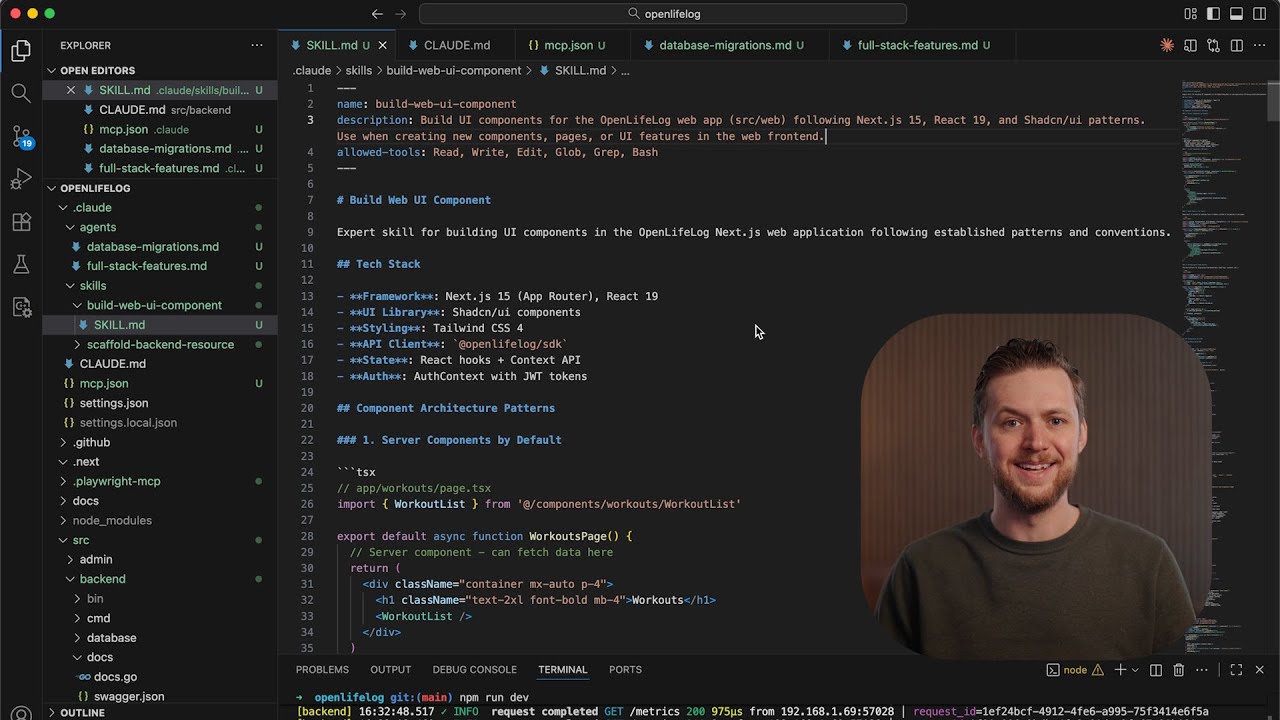
Agent Skills are organized folders that package expertise that Claude can automatically invoke when relevant to the task at hand.
Join the Claude Developer Discord - https://anthropic.com/discord
Learn more about Agent Skills - https://www.claude.com/blog/skills
00:06 Introducing Agent Skills
00:30 How Agent Skills work
01:08 Agent Skills vs C...
An example is remotion-skills (remotion is a react library that enables videos to create with react components)
Remotion skills effectively teaches AI agents like Claude code how to use the library together with best practices
Hence effectively turning prompts to motion graphics videos
With Claude code writing the code to make that possible
The same thing was done for manim
Effectively turning prompts to math animations making 3blue1brown videos easier to create
I was thinking we good do the same thing with tensorflow or pytorch
So we write an Agent Skill to effectively teach coding agents like Claude Code or OpenCode how to train models the right way
Using the best practices and stuff
I hope you get the picture I'm trying to paint
jaunty helm
autumn osprey
I hope you get the picture I'm trying to paint
quickly skimming through that video, I'm not sure if "skills.md" is anything more complicated than a good rag system
so if that's the case, just put what you imagine are "torch/tf best practices" + some code examples in a skills.md
give it a description that would trigger when you write in said libraries
you're done (at least I think
autumn osprey
Yeahh you're right but someone better than me should do it someone who has experience with the libraries and it's ins and outs should do so
autumn osprey
jaunty helm
quickly skimming through that video, I'm not sure if "skills.md" is anything mor...
It's nothing complicated but if done properly I think you will be able train neural nets from scratch and not much writing much yourself code with this
It's the same thing with remotion
People who aren't as good can now do basic stuff with videos remotion and those who are experienced are super charged now
So yeahh
I'd appreciate it if someone did that

Discover and install skills for AI agents.
This is another example that totally leveled up frontend Web design from the generic ai slop we all know
It's simple but it actually teaches AI how to do things the right way
Was wondering if someone could do the same for deep learning frameworks like pytorch
rich river
    def HandlerTask(self):
        for model_name in self._models:
            model = YOLO(model_name)
            input_files = self._gather_input_files()
            if len(input_files) == 0:
                raise FileNotFoundError(
                    f"No images or videos found under {self._source}. "
                    f"Ensure files exist (recursively searched)."
                )
            workers = 0
            imgsz = 960
            use_half = self._device_to_use != 'cpu'
            try:
                result_generator = model.predict(
                    source=input_files,
                    iou=self._iou,
                    agnostic_nms=self._agnostic_nms,
                    conf=self._conf,
                    device=self._device_to_use,
                    save=self._save,
                    stream=self._stream,
                    workers=workers,
                    # imgsz=imgsz,
                    # half=use_half,
                    verbose=True
                )
input_files is a list of filenames. I was originally passing a directory name but I want it to visit the files recurrently in the folder so I made a list of filenames.
but my program stops working every time, I wonder if it is because the list is too long and I'd better use directory/path name?
 odd meteor
lapis flax
alright i'm not getting the paper done lol. sucks to finally believe in yourself...
odd meteor
lapis flax
alright i'm not getting the paper done lol. sucks to finally believe in yourself...
😄 This reminds me of last year when I missed NeurIPS submission deadline. I had submitted the abstract, then 24 hours to main paper submission deadline, in the middle of that crazy rush hour, my compute credit finished. I didn't recover on time to beat the deadline. We live to fight another day.
There are some other top tier conferences you can submit your work to this year. You should consider submitting your work in other venues. You can even submit the work in the next ICML (but why wait till then if there are other venues you can submit to this year?)
lapis flax
I did still end up submitting the paper just not with the extra numerical example based on the neural net I was trying to build. I’m hoping that they accept me (with feedback) and by the time I’ve received that feedback I’ll have cleaned up the issues with my code and made it run nicely. We’ll see @odd meteor
 prime linden
Friend of mine made this plugin based on experimenting with code reviewing with Claude Code. Basically he saw greater success running successive passes (not parallel) for agent reviews, and pinned it down to (his words):
"- Stochastic sampling. Each run samples a different path through the reasoning space. One might focus on error handling, another on boundary conditions.
- Context anchoring. Once a reviewer commits to a line of analysis early in a pass, that reasoning occupies context and steers what it looks for next.
- Bugs mask bugs. When auto-fix resolves a "Must Fix" issue between passes, the next reviewer sees different code.
- Finite output budget. Each reviewer agent has a limited token budget for its response."
He's looking for people to test it out and provide feedback or contribute, if anyone has time here's the gh: https://github.com/HartBrook/lookagain
GitHub
Sequential code review with fresh agent contexts. Each pass runs in an independent subagent, ensuring unbiased analysis that catches issues other passes might miss. - HartBrook/lookagain
 dusky acorn
anyone have any resources on neural networks they found really useful?
we are being taught this semester about neurons perceptrons etc
we have moved onto some sort of logic gate math and the teacher wasnt able to explain it very well so i feel a bit lost
looking to self study so im not behind
 surreal tundra
hai guys morning, anybody knows free hosting for cloud computing such else?
spring field
surreal tundra
hai guys morning, anybody knows free hosting for cloud computing such else?
Google Collab has some free quotas
Personally I'd suggest Paperspace, it's paid though (has a free tier), but it's pretty nice, last I checked, you could pay like 8 bucks a month or so and oftentimes get some free hours on some gpu
but long-term it's cheaper to get your own hardware
 light stone
Hey, i want Api keys to create an Ai assistant, can anyone tell me which best free API i could get for thinking, listening and speaking?
 grim jewel
Hi, I’m Jash Kevadiya, an AI Automation & Generative AI Developer with hands-on experience in building intelligent systems using Machine Learning, Deep Learning, and Large Language Models. I specialize in designing end-to-end AI solutions from data pipelines and model development to automation workflows and real-world deployment. I enjoy solving complex problems and turning AI ideas into scalable, production-ready systems.
I am struggling to find my first project as a freelancer. need an experienced freelancer to guide me.
 ocean jungle
Hi, I am trying to get pytorch installed on my machine for cuda 13.0 and python 3.9.25 in a conda environment. I have tried the below but am getting a could not find version error
pip install torch==2.9.0 torchvision==0.24.0 torchaudio==2.9.0 --index-url https://download.pytorch.org/whl/cu130
 warm fossil
ocean jungle
Hi, I am trying to get pytorch installed on my machine for cuda 13.0 and python ...
warm fossil
ocean jungle
Hi, I am trying to get pytorch installed on my machine for cuda 13.0 and python ...
either go for older pytorch versions that support Python 3.9
or go to a higher version of python like 3.10
or higher
 final cobalt
Hello AI people
I have a complex, open ended problem
I'm training an MtG AI player. Here are my assets:
I have a functional rules engine, and a complete graph based world model. This world model is completely accurate and encodes relationships of arbitrary distance. I can easily implement a spider or walker to do traversal. GNNs or an RNNs which walks the graph could be applied here.
I have access to human-played game logs which, presumably, could be translated to resimulations of those games for observation. I can have a flagship LLM play against itself and have the AI observe. And, once the AI is halfway competent, I have self play.
And I have a clear goal. Given the state of the game world, multiple objectives, and a set of possible actions, how do I select the best possible action(s) when they're presented?
How would you approach this problem?
agile cobalt
"completely accurate complete graph based world model"?
are you sure about that?
iirc MtG is pretty ridiculously complex, I don't mean that like chess with a ridiculously large number of possible game states, I mean it's literally Turing Complete
ebon sapphire
Just knew about this moltbook ai reddit website aaaaand… will there be any chance that I could get myself a clanker gf?
 final cobalt
It is indeed very, very complex
I'm at 125 classes of node, and counting - probably closer to 250 once I'm finished
But, it is finitely complex
final cobalt
agile cobalt
"completely accurate complete graph based world model"?
are you sure about that?...
This is why I'm modelling my world graph as a LISP
 prime sierra
i need help 😭
how can i extract the values of the results from the dictionaries??

i try to use as little Ai as i can until they optimize them to use less water n such
 vast hollow
prime sierra
i need help 😭
how can i extract the values of the results from the dictionaries...
vast hollow
prime sierra
i need help 😭
how can i extract the values of the results from the dictionaries...
To get the value of an index you can do it by using:
Value = person1.values()
The output will be (['Mary','2','3','3'])
prime sierra
vast hollow
To get the value of an index you can do it by using:
Value = person1.values()
T...
i only want the results, not the name included
vast hollow
prime sierra
i only want the results, not the name included
values1 = [v for k, v in person1.items() if k != 'name']
k it will look for the keys name, and if the k is not equal with the 'name' it will take the v which is the value of the key
person1.items() is the key value pairs
jaunty helm
prime sierra
i need help 😭
how can i extract the values of the results from the dictionaries...
just person1['result1'] and etc?
 cinder wave
guys in your opinion what projects would you like to see in the resume of a fresher data analyst?
 plucky trellis
Hey everyone, I recently spent some time training a decoder only character level transformer. I had trained it with some README files that I found on the "stack" dataset.
```
Epoch: 45/50 | Train Loss: 0.8878 | Val Loss: 0.9439
Validation Loss has not improved. Patience:2/5
Epoch: 46/50 | Train Loss: 0.8867 | Val Loss: 0.9394
Val Loss has improved at 46. Model Saved!
Epoch: 47/50 | Train Loss: 0.8887 | Val Loss: 0.9380
Val Loss has improved at 47. Model Saved!
Epoch: 48/50 | Train Loss: 0.8829 | Val Loss: 0.9335
Val Loss has improved at 48. Model Saved!
Epoch: 49/50 | Train Loss: 0.8815 | Val Loss: 0.9322
Val Loss has improved at 49. Model Saved!
Epoch: 50/50 | Train Loss: 0.8746 | Val Loss: 0.9327
Validation Loss has not improved. Patience:1/5
However, when I tried to use it as an autocomplete tool, I got some gibberish text that resembled base64 strings or french text. I believe that this is due to a dirty dataset (My dataset must contain only english ascii letters and punctuation. Atleast 60% of the file must be english letters and whitespace combined.)
I'd like to know any techniques used to effectively clean my dataset while streaming. The entire dataset is around 160 GB and I am using 68 MB (First 10000 files that fit the criteria). Any help is appreciated.
BlockSize = 512
MaxEpochs = 50
LearningRate = 3e-4
Evaluations every epoch, I run 200 iterations and return the normalised losses.
NumEmbed = 384
NumHead = 6
NumLayer = 6
Thank you. pale kernel
vast hollow
values1 = [v for k, v in person1.items() if k != 'name']
pale kernel
vast hollow
values1 = [v for k, v in person1.items() if k != 'name']
This makes sense
Tysm i will try after i get home 🙏
 acoustic grove
pale kernel
Tysm i will try after i get home 🙏
acoustic grove
pale kernel
Tysm i will try after i get home 🙏
No you're not lol
 tacit latch
prime sierra
i need help 😭
how can i extract the values of the results from the dictionaries...
tacit latch
prime sierra
i need help 😭
how can i extract the values of the results from the dictionaries...
I like this theme, what's the name of it?
prime sierra
tacit latch
I like this theme, what's the name of it?
 prime sierra
acoustic grove
No you're not lol
prime sierra
acoustic grove
No you're not lol
that was my main account i just realised
dusky acorn
Guys my lecturers are giving two different responses
The activation function of a proceptron
Is it either 1 or 0 as the final output or 1 or -1
Or is it different depending on the model or something
serene scaffold
dusky acorn
Guys my lecturers are giving two different responses
The activation function of...
Depends on the model and the situation
Usually an activation function gives a value between two values (like between 0 and 1). Not exactly one or the other.
Oh you're talking about perceptrons
I forgot
iron basalt
dusky acorn
Guys my lecturers are giving two different responses
The activation function of...
The original perceptron or the one used in pedagogy (made up)?
dusky acorn
iron basalt
The original perceptron or the one used in pedagogy (made up)?
well ive never heard of pedagogy
we are having an introduction to neural networks but one of my lecturers seems a little lost and has confusd me a bit lol
iron basalt
dusky acorn
well ive never heard of pedagogy
we are having an introduction to neural networ...
Ok, so in school they teach a simplified variant of the actual perceptron which they then call "the perceptron". That version taught in schools can use either 0, 1 or -1, 1, and the second option is preferred due to being balanced around 0.
The original paper is talking about activation in terms of high or low (physical circuit). Binary 0 and 1 is when you threshold that and consider above some amount to be 1, and below to be 0, but you can interpret that as -1 or 1 depending on how you have it setup up and what it does later with that value.

("all-or-nothing" -> binary, digital)
Short answer, go with -1, 1. It makes the math easier.
They are equivalent (in learning power / model design).
dusky acorn
iron basalt
Short answer, go with -1, 1. It makes the math easier.
interesting okay and if i were to model a perceptron in python would i go for 1 -1
iron basalt
dusky acorn
interesting okay and if i were to model a perceptron in python would i go for 1 ...
Yes. This simplified variant. Modern textbooks prefer -1, 1.
dusky acorn
they also never explained why bias is used so i think tommorow im going to open 2 hours to dig deepe
dusky acorn
iron basalt
Yes. This simplified variant. Modern textbooks prefer -1, 1.
thank you
iron basalt
dusky acorn
they also never explained why bias is used so i think tommorow im going to open ...
You know y=mx+b? Think about what the b does.
iron basalt
dusky acorn
they also never explained why bias is used so i think tommorow im going to open ...

Desmos
(Two inputs, xor problem (-1, 1))
dusky acorn
iron basalt
https://www.desmos.com/calculator/38vyyl4mtr
yes we used this exact formula last lesson
ahh so the bias allows you to change the orientation of the curve to disclude or include data points
iron basalt
dusky acorn
yes we used this exact formula last lesson
ahh so the bias allows you to change ...
Offset along the normal.
In the line equation: Ax + By + C = 0.
A and B hold the normal vector, and C is the offset along that.
For example normal vector pointing straight up, <0, 1>, has A=0,B=1, so you just have y = some constant, so you have a horizontal line, and can move it up and down via the constant's value.
iron basalt
dusky acorn
yes we used this exact formula last lesson
ahh so the bias allows you to change ...
If you are familiar with more linear algebra, it turns the transform from linear to affine (adds a translation term).
 naive river
iron basalt
Ok, so in school they teach a simplified variant of the actual perceptron which ...
naive river
iron basalt
Ok, so in school they teach a simplified variant of the actual perceptron which ...
the version I learned was just real valued stuff with a sigmoid applied, is that the classical one?
(and doing analysis and stuff like proof of convergence for some of these old-school models)
iron basalt
naive river
the version I learned was just real valued stuff with a sigmoid applied, is that...
No, the classical one is much more complex and has multiple variations. For example it has feeback connections.
It's also not fully connected.
It's misinformation that a perceptron is that simple form.
lime grove
iron basalt
If you are familiar with more linear algebra, it turns the transform from linear...
you add translations to rotations? this sounds a lot like some kind of group theory
iron basalt
lime grove
you add translations to rotations? this sounds a lot like some kind of group th...
In mathematics, the affine group or general affine group of any affine space is the group of all invertible affine transformations from the space into itself. In the case of a Euclidean space (where the associated field of scalars is the real numbers), the affine group consists of those functions from the space to itself such that the image of ...
lime grove
iron basalt
https://en.wikipedia.org/wiki/Affine_group
I am exactly there right now. "Planar Affine group over the reals"
this is basically crystallography
iron basalt

In Euclidean geometry, an affine transformation or affinity (from the Latin, affinis, "connected with") is a geometric transformation that preserves lines and parallelism, but not necessarily Euclidean distances and angles.
More generally, an affine transformation is an automorphism of an affine space (Euclidean spaces are specific affine spaces...
(Every game engine ever is built on this too)
(They use augmented matrix form (homogenous coordinates))
lime grove
sure, just use quaternions instead of euler matrices for the rotation problem
iron basalt
Yeah.
Although there is a small growing push towards geometric algebra (rotors instead of quaternions).
lime grove
by the way there are exactly 219 space groups in crystallography, if you ignore something known as chiralities
coincidence? I don't think so
(there are 219 affine transformations in 3D)
iron basalt
naive river
the version I learned was just real valued stuff with a sigmoid applied, is that...


Competitive learning is a form of unsupervised learning in artificial neural networks, in which nodes compete for the right to respond to a subset of the input data. A variant of Hebbian learning, competitive learning works by increasing the specialization of each node in the network. It is well suited to finding clusters within data.
Models an...
(They are much more powerful than a simple sigmoid node (and multi-layer))
tacit latch
prime sierra
Ty bro
prime sierra
tacit latch
Ty bro
i got you
 jolly ginkgo
Explore and run machine learning code with Kaggle Notebooks | Using data from Spaceship Titanic
Guys am I ready for learning deep learning?
dusky acorn
naive river
(and doing analysis and stuff like proof of convergence for some of these old-sc...
We just learnt more on it today
So 0,1 was a step function which isn't used in computing because if the value is 0 the computer has no idea what to do
Sigmoid function 1,-1 is better and more widely used but there is also other ones like relu which is used in deep learning
Ig the step function was just a pre cursor to the topic
serene scaffold
 sand nest
Im struggling
sand nest
Im struggling
try being as specific as you can so that people can start helping you without having to interview you.
sand nest
serene scaffold
try being as specific as you can so that people can start helping you without ha...
Chill king
serene scaffold
sand nest
Chill king
I'm very chill. I'm giving you instructions so that people can actually help you.
sand nest
Thank you king
serene scaffold
yw twin
 fiery dust
hey guys, wanna learn few ML models, where can I do so?
 late vector
When I implement my green screen for a MP4 file, do I need to threshold the video frame? This is what I wrote:
# Convert frame to HSV
hsvFrame = cv2.cvtColor(frame, cv2.COLOR_BGR2HSV)
# Threshold the image
retVal, threshImg = cv2.threshold(hsvFrame, threshold, 255, cv2.THRESH_BINARY)
print("Threshold return value: ", retVal)
The threshold return value is 30.
late vector
fiery dust
hey guys, wanna learn few ML models, where can I do so?
I am learning about ML models and CNNs at OpenCV University. They have paid courses and free bootcamps. To clarify, what ML models are you looking into?
fiery dust
late vector
I am learning about ML models and CNNs at OpenCV University. They have paid cour...
specifically at:
Dummy / Baseline models (constant, random, majority class)
Logistic Regression
Linear Regression (and regularized variants: Ridge, Lasso, Elastic Net)
Random Forest
Gradient Boosting (XGBoost / LightGBM)
Isolation Forest
One-Class SVM
Hidden Markov Models
late vector
fiery dust
specifically at:
Dummy / Baseline models (constant, random, majority class)
Logi...
There is linear regression for Tensorflow.
late vector
fiery dust
afaik, tf and ptorch is for NNs
Thanks for letting me know.
fiery dust
afaik
 tawdry heart
Any smart pytorch users around
OptimizedModule(
  (_orig_mod): Model(
    (token_emb): Embedding(65, 32)
    (pos_emb): Embedding(125580, 32)
    (transformer): TransformerEncoderLayer(
      (self_attn): MultiheadAttention(
        (out_proj): NonDynamicallyQuantizableLinear(in_features=32, out_features=32, bias=True)
      )
      (linear1): Linear(in_features=32, out_features=256, bias=True)
      (dropout): Dropout(p=0, inplace=False)
      (linear2): Linear(in_features=256, out_features=32, bias=True)
      (norm1): LayerNorm((32,), eps=1e-05, elementwise_affine=True)
      (norm2): LayerNorm((32,), eps=1e-05, elementwise_affine=True)
      (dropout1): Dropout(p=0, inplace=False)
      (dropout2): Dropout(p=0, inplace=False)
    )
    (l1): Linear(in_features=32, out_features=32, bias=True)
    (l2): Linear(in_features=32, out_features=3, bias=True)
  )
)
My model keeps exploding and outputting nans (even on first batch with gradient clipping)
I've never seen this sort of thing from pytorch and it's the frist time I ever touch transformers
Ah! I had forgot to give it a mask of what inputs were padding.
Still gives nans but seemingly less frequently now?
tawdry heart
Same nonsense with a simpler 1D CNN
waxen kindle
Add some normalization
thick basin
hey, Gyes Iam learing PyTorch from a while but i'am now compining it with matplotlib and iam scared😂 🫠
def plot_predictions(train_data=x_train,
train_labels=y_train,
test_data=x_test,
test_labels=y_test,
predictions=None):
'''
Plots traning data, test data and compare predictions
'''
plt.figure(fig_size=(10,7))
Plot traning data in blue
plt.scatter(train_data, train_labels, c='b', s=4, label='Traning data')
is it that hard or because iam starting to learn it?
 young granite
thick basin
hey, Gyes Iam learing PyTorch from a while but i'am now compining it with matplo...
young granite
thick basin
hey, Gyes Iam learing PyTorch from a while but i'am now compining it with matplo...
first of the indentation is wrong -> will result in error. What do you try to achieve a simple scatter plot can be done as such:
import matplotlib.pyplot as plt

plt.figure()

plt.scatter(train_x, train_y, label="Train")
plt.scatter(actual_x, actual_y, label="Actual")

plt.xlabel("X values")
plt.ylabel("Y values")
plt.title("Train vs Actual Scatter Plot")
plt.legend()

plt.show()
by the way u are hardcoding parameters its simpler to use the obj and assign new items/traces to it.
and if im allowed to make the comment before u dive into pytorch u should grasp the fundamentals of python first, as this isnt a complex task at all.
late vector
thick basin
is it that hard or because iam starting to learn it?
Matplotlib is easy in my opinion. I used it a lot for school.
In addition, I used Seaborn too.
 clear glade
thick basin
hey, Gyes Iam learing PyTorch from a while but i'am now compining it with matplo...
clear glade
thick basin
hey, Gyes Iam learing PyTorch from a while but i'am now compining it with matplo...
Another really easy one is plotly
untold frost
young granite
first of the indentation is wrong -> will result in error. What do you try to ac...
how can i show my code like this massage?
serene scaffold
untold frost
how can i show my code like this massage?
!code
arctic wedgeBOT
untold frost
thank you
would anyone be interested in seeing my code of my first regression model and commenting on it?
rich moth
Has anyone built any kind of AI agent or used openclaw to check out moltbook?
 barren wadi
Hello
How do you guys manage discreet variables in XGBoost?
Heard that it wasnt very good in handling that.
 main notch
Hey can anyone guide me to learn ML from scratch?
 lilac hollow
main notch
Hey can anyone guide me to learn ML from scratch?
lilac hollow
main notch
Hey can anyone guide me to learn ML from scratch?
just my 2 cents and take it for what it's worth:
- Gemini
Just ask tell it exactly what you're trying to learn and how you like to learn etc...you'd be surprised.
Not perfect solution of course
main notch
lilac hollow
just my 2 cents and take it for what it's worth:
1. Gemini
Just ask tell it exac...
Thanks mate!
 cursive totem
barren wadi
Heard that it wasnt very good in handling that.
cursive totem
barren wadi
Heard that it wasnt very good in handling that.
You can correct me if im wrong, i didnt look much in classic ml theory.
As i remember its vica versa, it can handle it. Gradient boostings are just a bunch of continuous decision trees. And these trees at each step literally like: take
takes splits for full batch (full training set, as you wish) and looks which split was most informative by using cross entropy (minimizing suprise) or gini (idk just maybe faster cross entropy). So it can work with any kind of data if it is numerical and can just ignore missing values so the data will be splitted using other feature
cursive totem
tawdry heart
```
OptimizedModule(
(_orig_mod): Model(
(token_emb): Embedding(65, 32)
...
Didn't work with ttansformers but maybe you will see something useful from what i will say, although it can be completely useless: big learning rate; exploding exponents (that's why cross entropy with numerical stability exists), activations (in rnns as i know batch is squished with tanh), maybe batch/layer norms will help, maybe just look if you did connect everything in right way, just add printing out some values exceeding threshold after each layer and see if there is anything strange. Maybe you used log somewhere where it wasn't supposed to be, cuz on backprop 1/x will scale gradients very much. Maybe something didnt connect so by chain rule you took some nan values and kept them through layers
 untold kindle
Hey i'm making a roadmap for myself to learn AI, is kaggle a good source to learn machine learning and deep learning?
 fallen thicket
Guys uhm, I need help coding an ai gf from scratch for a challenge lmfao.
tawdry heart
untold kindle
Hey i'm making a roadmap for myself to learn AI, is kaggle a good source to lear...
Fantastic resource
FastAI is a really high level wrapper for pytorch
What I did was I learned FastAI then switched to PyTorch after
Since the overall stucture is identical
 somber ferry
hello everyone! can i post my data engineering doubts here?
 grizzled anvil
HI guys, i have a question, i have taken a ML course in uni and i want to build a CV model to label mushrooms. I have a decent data set already and im just wondering which LLM is the best one to give me a hand with coding? Ive heard both claude code and gemini are fairly good
serene scaffold
grizzled anvil
HI guys, i have a question, i have taken a ML course in uni and i want to build ...
either of those are fine, but the more you use an LLM to help you with this, the less you will learn.
bronze wyvern
Helloo, I want some ideas/advice, I'm currently working on my undergrad final year project and my supervisor told me to include an AI things in my project where I can train the model.
So basically what I'm building is an "Animal welfare" app where users can create post and chat. A basic app for now but it seems it's too basic. My supervisor told me to train a model that would compare animal images in case of missing animals.
But I told him that I don't think it's possible using AI models, I know their is another technique used, don't remember the name where we will compare the arrays of images then find how similar they are.
In this context, I wanted some ideas. Do you people know what can I implement in the AI aspect and what additional feature might be interesting for an animal welfare app pls.
grizzled anvil
serene scaffold
either of those are fine, but the more you use an LLM to help you with this, the...
That is very fair, i just need something to bounce ideas off of for some robtics/CV related projects i have and idk which one is the most competent. I dont want to pay for more than one subcription
 peak laurel
i just turned 13, how do i start ml
i have background in linear algebra and basic calc
any advice
 unkempt apex
start with traditional ml
serene scaffold
peak laurel
i just turned 13, how do i start ml
start with basics so that you learn fundamental concepts, and slowly work your way up to cutting edge ML. it will be a long time before you're ready to learn about how, for example, LLMs work.
a good place to start is learning how to train a classifer model on some CSV data.
 stone raven
Hi everyone, so i was trying to make a simple perceptron just to try and understand them properly and used the AND logic gate set, how can i discover if what i wrote is done properly or just working because of the set size without having to make a new one with a bigger set?
main fox
LLMs to assist with building a project can be good, assuming you mostly know what you're doing already and can spot where errors might occur. You should definitely not use it as a crutch, especially if your main goal is learning. It might make decisions you don't understand, can't justify, and are wrong. But if you already know what pieces you need, and mostly just want syntax, LLMs can be pretty helpful providing snippets.
bronze wyvern
bronze wyvern
Helloo, I want some ideas/advice, I'm currently working on my undergrad final ye...
anyone got an idea pls
waxen kindle
bronze wyvern
anyone got an idea pls
Your supervisor wants you to use a CNN
Call that AI if you want
bronze wyvern
yep it's a CNN, in my head, I was just going to compare 2 arrays, I don't really know if a CNN can help because my training data would be animal in general ,no?
waxen kindle
If you just use some kind of KNN on images, you'll end up getting very bad results AND it will be veeeery long
Look on the internet what kind of model can be used for image recognition
But it's a whole project on it's own, really
bronze wyvern
yeah I see, will try to have a general look see what it can bring, ty !
waxen kindle
If you are allowed to, I recommand finding a model on kaggle or huggingface and possiblty fine-tuning it, bc I don't expect you to get some meaningful results on this task if it's not the core of the work
As I said, it's a whole project on its own
You would need a lot (but like, a real lot) of data for training
And all the cleaning and labelling, that's not something I would start from scratch
arctic wedgeBOT
Resources
The Resources page on our website contains a list of hand-selected learning resources that we regularly recommend to both beginners and experts.
bronze wyvern
waxen kindle
If you are allowed to, I recommand finding a model on kaggle or huggingface and ...
yeah will do that, I have no restrictions on that
 late lichen
does exploding parameters normal on ML??
waxen kindle
Yes
 long whale
Hey!
Now coder here
I’m really confused about data science and AI
I mean they teach it in school but it sounds like fancy jargon to me half the time 😬
Anyone here who can help?
waxen kindle
What do you mean "fancy jargon" ?
It's a bunch of algorithm and techniques related to using and implementing them (as are any field within computer sciences)
Basically
What do you need help with ?
long whale
Any courses online that can help me get started
Pythons pretty cool but is that a part of data science? Are coding languages a part of data science?
 severe warren
Same I had just started @long whale
waxen kindle
Python is a tool you use to do data science
Usually yes, people use python
(But other languages can be fine too)
long whale
Like C and C+? Java?
serene scaffold
long whale
Like C and C+? Java?
those languages aren't really used for data science.
the most common alternative is R.
 turbid field
for vehicle classification model development using roboflow, is this balance or imbalance data? is it too bad or not, sorry i am new
 unkempt apex
turbid field
for vehicle classification model development using roboflow, is this balance or ...
unkempt apex
turbid field
for vehicle classification model development using roboflow, is this balance or ...
for CV tasks you should not care about balance/imbalance of data
just make sure you have variety of data for each class
so lets say if your tasks is object detection you need to make sure your dataset contains all possible / near possible variety for that class
you can also add image modification techniques such as inverse
turbid field
unkempt apex
for CV tasks you should not care about balance/imbalance of data
just make sure ...
ohhhhh
turbid field
unkempt apex
so lets say if your tasks is object detection you need to make sure your dataset...
so i will be using albumentation? or just use what yolo have?
unkempt apex
turbid field
so i will be using albumentation? or just use what yolo have?
Just try a model on dataset first and see if it's getting train or not
turbid field
unkempt apex
Just try a model on dataset first and see if it's getting train or not
thanks, but may i ask where is the best to train my datasets it contains 17k images. locally i have 3060ti 8gb vram or should i try google collab, vast ai, or runpod
unkempt apex
turbid field
thanks, but may i ask where is the best to train my datasets it contains 17k ima...
I never tried on 3060ti, was only using Collab free tier for yolo models
But I would say give it a try locally
turbid field
unkempt apex
I never tried on 3060ti, was only using Collab free tier for yolo models
how do you deal with the time limit?
u using the t4?
turbid field
ohhhhh okay okay thanks
 steady canopy
Is there like, a free ETL course anywhere?
glass temple
can someone share any resources and tips on how to grid search effectively? I'm tuning a couple of models, and the list of hyperparameters is too large to search through all at once.
I'm thinking of running different parameters that are close, together, but couldn't the different sets of parameters have different optimal values when working together than what I'll get from running grid search on separate sets of hyperparameters?
waxen kindle
yep, hp search is very time consuming. You basically have to parallelize the computations. Optuna is a good library for that for example
 manic sentinel
glass temple
can someone share any resources and tips on how to grid search effectively? I'm ...
manic sentinel
glass temple
can someone share any resources and tips on how to grid search effectively? I'm ...
Refer official docs that's all you need.
manic sentinel
glass temple
can someone share any resources and tips on how to grid search effectively? I'm ...
Use Optuna bro.
manic sentinel
manic sentinel
Use Optuna bro.
It's better than anything.
glass temple
waxen kindle
yep, hp search is very time consuming. You basically have to parallelize the com...
thing is, I'm running into memory issues when I'm trying to parallelize the tree models. and unfortunately, I'm limited in the libraries I can use and Optuna is not one of them...
glass temple
manic sentinel
Use Optuna bro.
is there any native sklearn/python alternative to Optuna? I'd love to use it, but sadly that's outside the scope of my project
turbid field
we have a thesis for vehicle classification and license plate detection (2 models) i will be buying the raspberry pi 5 with the hailo ai hat 26 tops, my question is should i buy 8gb or 16gb ram raspberry pi 5?
turbid field
^ ocr for license plate recognition and website with database is included
waxen kindle
turbid field
we have a thesis for vehicle classification and license plate detection (2 model...
run the algorithm on a computer and see how much memory it needs ?
turbid field
waxen kindle
run the algorithm on a computer and see how much memory it needs ?
we havent have the model yet
jaunty helm
glass temple
is there any native sklearn/python alternative to Optuna? I'd love to use it, bu...
simple random search has been found to be more time efficient than grid search
it's directly in sklearn, so you can try that
 heavy crow
Do you guys know of any datasets of "real" 3D models? So not fantasy assets but things like chairs, tables, shelves, etc.
 past meteor
glass temple
is there any native sklearn/python alternative to Optuna? I'd love to use it, bu...
past meteor
glass temple
is there any native sklearn/python alternative to Optuna? I'd love to use it, bu...
I agree with purplys, do a random search instead of grid search. If you're willing to use other dependencies have a look at bayesian optimization or similar
They shine when you can't parallelize because the algos are inherently sequential
 ember jetty
hlo
unkempt apex
turbid field
we have a thesis for vehicle classification and license plate detection (2 model...
16 if you can
glass temple
jaunty helm
simple random search has been found to be more time efficient than grid search
i...
I see, I'll look into that. thanks!
glass temple
past meteor
I agree with purplys, do a random search instead of grid search. If you're willi...
I'll use random search for now. Bayesian optimization is a bit outside my scope, both in terms of knowledge about it, and from a technical standpoint. I'll still look into it after I'm done with my current project, it definitely seems it'll save me problems with regular ml models. thanks for the recommendations!
turbid field
unkempt apex
16 if you can
damn i just bought the 8gb
it is paired with 26 tops hailo hat so i didnt think 16gb ram is needed
unkempt apex
yea its okay!
turbid field
will it struggle with 8gb ram?
unkempt apex
I dont think so, I mean 16 is pretty standard nowadays thats why
but for raspberry pi its okay
turbid field
yaaaa i dont have any experience how efficient are rams in rpi, since i haven’t own one
but my pc is now struggling with 16gb ram lmao
 midnight ermine
In case anybody's curious:
https://joss.theoj.org/papers/10.21105/joss.09631

Journal of Open Source Software
Mishchyriak, Y., (2026). PureML: a transparent NumPy-only deep learning framework for teaching and prototyping. Journal of Open Source Software, 11(117), 9631, https://doi.org/10.21105/joss.09631
tawdry heart
That's wild
spring field
turbid field
we have a thesis for vehicle classification and license plate detection (2 model...
no one has ever complained about having too much ram
especially (and literally) in this economy
what's the price diff though
turbid field
spring field
what's the price diff though
100 dollars is the price difference between 8gb and 16gb in our country
100-110 dollars
spring field
turbid field
100 dollars is the price difference between 8gb and 16gb in our country
well, I'd then either have to know the full price or need to know the price diff in percent because yk, 1000 vs 1100 is a bit different than 110 vs 210
turbid field
spring field
well, I'd then either have to know the full price or need to know the price diff...
137 for 8gb 225 for 16gb
almost 2 rpi for 16gb
spring field
oh, what the heck
 coral rover
Hhyy
 narrow gorge
Does anyone have any idea where I can find easy to understand tutorial for learning R? I kinda need it
bronze wyvern
Hi, quick question, what's the difference between bias in data vs imbalance data? I though these are synonymous to each other but biasness doesn't mean imbalance data?
turbid field
bronze wyvern
Hi, quick question, what's the difference between bias in data vs imbalance data...
i think bias data happen when there is an imbalance in data, it happens in high ratio imbalances like 10:1?
turbid field
spring field
oh, what the heck
yep too expensive
bronze wyvern
turbid field
i think bias data happen when there is an imbalance in data, it happens in high ...
I think it overlaps with data imbalance but I believe there is more to data biasness
for e.g when values are capped within certain ranges for e.g, it's some kind of biasness
turbid field
yep
anyways another question for rpi5 with 8l hailo hat what is the best yolo model? 8? 11? 26? and also small or nano
bronze wyvern
turbid field
anyways another question for rpi5 with 8l hailo hat what is the best yolo model?...
26 is the latest (I believe), haven't try it yet, the 11 one, I used it recently, seems to work well.
small or nano depends on the size of your dataset.
turbid field
bronze wyvern
26 is the latest (I believe), haven't try it yet, the 11 one, I used it recently...
hmmmmmmmmmmmmmmmmmmmmmmmmmm
how do u determine the size of the datasets?
i will be using two models btw one for vehicle classification detection and license plate detection
bronze wyvern
check out yolo's docs, it gives you insight when/where to use nano or when to switch to another size like small or medium
how many images do you have in your dataset?
turbid field
the vehicle classif has 17k
the license plate also has 15k
but i will transfer learning it with 3k images for the license plate i mean
bronze wyvern
yeah, I see, recently I work with approximately 20k images for my object detection model, the small model did a decent job, maybe you can try with it and switch if needed
turbid field
bronze wyvern
yeah, I see, recently I work with approximately 20k images for my object detecti...
what was the fps?
also how did u train it locally? or cloud like colab?
bronze wyvern
euh don't remember but since it's on a pi, I would export it using the openvino format which allows it to work better/more fluidly on a pi
bronze wyvern
turbid field
also how did u train it locally? or cloud like colab?
colab sadly :c
turbid field
bronze wyvern
colab sadly :c
u on free tier? how long did it take
sorry too many question i am so curious
bronze wyvern
yeah, too much time sadly and I couldn't exceed 80 epochs I think
turbid field
cuz im planning to train it locally using my 3060ti
bronze wyvern
you can give it a try, can be better than colab
 jovial urchin
Hi guys I need some help
turbid field
bronze wyvern
you can give it a try, can be better than colab
yaaa but i might just rent a gpu in runpod if i need it faster
wait forgot the name
its pod somthing
jovial urchin
turbid field
yaaa but i might just rent a gpu in runpod if i need it faster
Hi I have a question what are you talking about ?
turbid field
jovial urchin
Hi I have a question what are you talking about ?
computer vision and training
jovial urchin
turbid field
computer vision and training
Are you a student ? Sorry I usually get curious
jovial urchin
turbid field
im doing it for our thesis
Do you know networking ?
turbid field
not really
jovial urchin
turbid field
not really
Im trying to getting better computer for cyber security can you help me ? About hardware and software in computer
turbid field
oh sorry i dont really know anything about cyber sec
jovial urchin
turbid field
oh sorry i dont really know anything about cyber sec
No no I mean just computer , in the first place of everything in tech I should learn better the computer
bronze wyvern
jovial urchin
Im trying to getting better computer for cyber security can you help me ? About ...
there is a networks channel, maybe you will have better chance if you ask there
jovial urchin
bronze wyvern
there is a networks channel, maybe you will have better chance if you ask there
Thanks I will this give a try and by the way I'm looking for some friend in tech , you know it's hart to be nerd at school😂
turbid field
jovial urchin
No no I mean just computer , in the first place of everything in tech I should l...
maybe cisco?
jovial urchin
turbid field
maybe cisco?
Yep , and by the way i will be happy to make friends that they are more like me if you would like
waxen kindle
!rule 9
waxen kindle
<@&831776746206265384> recruitment
pearl wedge
!rule 7
arctic wedgeBOT
7. Keep discussions relevant to the channel topic. Each channel's description tells you the topic.
bronze wyvern
Hi, quick question, when performing cosine similarity of two embeddings, should they have the same number of dimensions/length?
I want to look for the vector similarity of 2 images. But the number of embeddings/size of image etc should this be a constant?
bronze wyvern
yeah I see, for this to work, both should have the same size/length
agile cobalt
bronze wyvern
yeah I see, for this to work, both should have the same size/length
you cannot compare embeddings generated by different models even if they have the same size though, unless these models are explicitly trained to work with each other
bronze wyvern
I need some advice. I read about image similarity and I have a better overview of the different method available to perform it. I'm building a web app that will allow users to compare missing animals vs animals found so that we know to what extend these 2 match.
What would be some required techniques to achieve this pls. I know there is CLIP but this is used more when we have a prompt and based on that prompt we would look for images, it's not really a similarity search, no?
I also read about siamese neural network. I vibe coded something with AI just to see how it works; it seems to work at start but when I use photos of different colors, say 2 different colors of cats, I get high similarity score which I don't really want.
agile cobalt
bronze wyvern
I need some advice. I read about image similarity and I have a better overview o...
maybe check if Meta's SAM (Segment Anything) works for your use case
if not, you might need to use a general purpose vision language model (chatgpt/gemini) or fine-tune a model specific for whatever you're trying to do
bronze wyvern
will give it a look
jaunty helm
bronze wyvern
I need some advice. I read about image similarity and I have a better overview o...
CLIP
what makes CLIP special is it projects both text and images into the same embedding space
so while yes, the fact you can compare similarity between text and image is one of its highlights, you can also compare 2 images
besides OpenCLIP, there are also other models that could work similarly, like dino v2/v3, google's siglip v1/v2, etc
by itself I don't think CLIPs are good at what you're describing, but I think you can train a classifier on top of it. I've not done that myself nor have I really looked deep into it, so I'm not sure how well that would turn out
bronze wyvern
yep noted, by the way things ike OpenCLIP, are these free models or we should paye for that?
jaunty helm
bronze wyvern
yep noted, by the way things ike OpenCLIP, are these free models or we should pa...
the ones I mentioned all have open weights you can freely download from huggingface
bronze wyvern
noted, ty
 icy stratus
hello world !
i'm working on a mini project, funny ai girl offline.
i'm using llama3.2:3b for the brain. i'm working on a feature that make the ai learn about you. but it did't work properly.
can anyone offer help.
for more information here you are the github repo: https://github.com/AhmedGharsallah/funny_ai_offline

GitHub
Contribute to AhmedGharsallah/funny_ai_offline development by creating an account on GitHub.
agile cobalt
llama3.2:3b
that model is very old and small, I would recommend trying something newer and/or larger
rich moth
We're up and running! But its a local, AI that learns from every conversation, consolidates knowledge while
idle, and can autonomously research the web and execute tasks . Its running great on a qwen 3 vl 30b a3b instruct model right now on Q4 K M. But all you need is 24 gigs of vram. Ideally thought I want to test it on a 80b with full context 262k.


It just pointed out a problem for me.
rich moth
Anyone else feel like propriety AI software is dead in the water? Why stuff a model with billions of parameters that change on a long enough time line? 80b seems ideal or somewhere in that realm with advance software capabilities and the tools to research and verify on its own accord.
rich moth
bronze wyvern
I need some advice. I read about image similarity and I have a better overview o...
You work at Ring or what? I saw the Superbowl commercial, lol. Thats the problem , you're just searching similarity.
Sounds like a great idea, but full of potential false postives.
Now you got a system that spreads false hope. Dogs weather easily and mange when outdoors for a few days.
People looked for missing animals in the 90's. This is 2026. Ring had a good idea though use their network to track them for their orgins I imagine.
You're missing the infastructure and the huge company ring already looking into this
rich moth
It can query its own memories and prompts.
 turbid field
another question for rpi5 what is the best remote access vnc or rpi connect? if vnc what would be the best one
jovial urchin
turbid field
another question for rpi5 what is the best remote access vnc or rpi connect? if ...
Hello I sent you a friend request, I have some questions could you help me ?
waxen kindle
Why are you doing this ? Why don't you just ask here ?
jovial urchin
waxen kindle
Why are you doing this ? Why don't you just ask here ?
Bro I talked about this above
waxen kindle
Yep, and as you can see the person you talked to was not really open to just get dmed randomly
Talk here first, then maybe send friends requests
In real life, you don't bump into people and say "can we be friend?"before talking, right ?
jovial urchin
waxen kindle
In real life, you don't bump into people and say "can we be friend?"before talki...
Yep your right
Sorry about that
 past bramble
we could perhaps have a better architecture than neural networks, or do we already have it?
rather than having a bunch of layers we could think of processing it some other way
 tidal bough
If you're thinking of dense layers - transformers are such a better architecture
past bramble
don't they still perform the same way, layer after layer?
what if layers could talk to other layers regardless of the order
non-linear operations
tidal bough
all NN architectures have nonlinearities
there are a few architectures that purport to be better than transformers but they didn't catch on. In particular I saw at least one adding connections between layers
past bramble
yup but linearity in their order of processing data, as in they go from left to right step by step
past bramble
tidal bough
If you're thinking of dense layers - transformers *are* such a better architectu...
if I'm not wrong transformers are neural networks with attention layers?
tidal bough
sure
past bramble
alright just clearing up for myself
tidal bough
past bramble
yup but linearity in their order of processing data, as in they go from left to ...
depending on what you mean by that, attention layers are already parallel. Like, processing N tokens of prompt does not require N sequential steps; if you have enough parallel compute you can process an arbitrary-length prompt in a fixed amount of time. This is a key difference from RNNs, and the reason why transformer training is so fast
past bramble
my thought was that (an example: ) instead of simply forward propagation, we introduced a logic so that it can backward propogate a few times in the hidden layers (decided by an arbitrary function that determines if it does so) before finally reaching the outputs
so it could maybe cause correction or improvise the data while it happens
glass temple
I'm trying to use a naive bayes model for a multi class imbalanced text + other features classification, but I'm having some problems with the scoring. I'm assuming that I'm not processing the data correctly, so I'd appreciate it if someone could guide me in the right direction.
I'm also, severely limited in the libraries I can use, so a general solution that can be implemented with native scikit learn/pandas would be helpful. I did some digging online, and almost everyone uses deep learning libraries to parse the data before passing it to the model. :(
main fox
Any resources on packaging ML models into an app?
I've been noticing a gap with modern data science education and actually putting models into production. A lot of the popular resources just show you how to joblib dump and load elsewhere, but this is hand waving a lot of complexity.
serene scaffold
main fox
Any resources on packaging ML models into an app?
I've been noticing a gap with ...
most of the models that people use these days are prohibitively expensive to distribute as part of the software, so they just get interacted with over the web.
main fox
serene scaffold
most of the models that people use these days are prohibitively expensive to dis...
I can see that being the case for LLMs (LLMOps I guess).
What about project structure, robust data/ML pipelines, handling async requests, Docker, etc.
I'm wondering if there might be some good resources for this side of things.
Even if not by distributing as a software but maybe general ML API design.
rich moth
This gave me the chills lol
 tawdry heart
Team
DefaultCPUAllocator: can't allocate memory: you tried to allocate 571894495956 bytes
nn.Linear(L * L, L)
expands to
nn.Linear(27342441, 5229)
rich river
    def __call__(self, source=None, model=None, stream: bool = False, *args, **kwargs):
        """Perform inference on an image or stream.

        Args:
            source (str | Path | list[str] | list[Path] | list[np.ndarray] | np.ndarray | torch.Tensor, optional):
                Source for inference.
            model (str | Path | torch.nn.Module, optional): Model for inference.
            stream (bool): Whether to stream the inference results. If True, returns a generator.
            *args (Any): Additional arguments for the inference method.
            **kwargs (Any): Additional keyword arguments for the inference method.

        Returns:
            (list[ultralytics.engine.results.Results] | generator): Results objects or generator of Results objects.
        """
        self.stream = stream
        if stream:
            return self.stream_inference(source, model, *args, **kwargs)
        else:
            return list(self.stream_inference(source, model, *args, **kwargs))  # merge list of Results into one

GitHub
Ultralytics YOLO 🚀. Contribute to ultralytics/ultralytics development by creating an account on GitHub.
can anyone explain how and where is __call__ called? why model.predict would call this function?
jaunty helm
glass temple
I'm trying to use a naive bayes model for a multi class imbalanced text + other ...
problems with the scoring
wdym specifically?
if you dont include details ppl wont be able to help
 timber zephyr
Hey guys to all the people passionate about ml and ai, I have started a study group where passionate people who are studying ai and ml can chat, discuss, and create small projects together! I am very open to suggestions and I believe we can learn a TON together, if any of you are interested then just dm me 🙂
glass temple
jaunty helm
> problems with the scoring
wdym specifically?
if you dont include details ppl w...
According to the paper I've read, naive bayes scored around 0.79 macro f1. However, I only know the rough set of hyper parameters used, and the kind of preprocessing applied on the dataset.
With my best guessimate, my model's scores are ~0.68.
The paper also applied 2 advanced preprocessing steps that I can't replicate with traditional sklearn: lemmatization and tokenization. Everywhere I read, it seems that the documents have to be heavily processed to get a good result with naive bayes.
waxen kindle
rich river
```python
def __call__(self, source=None, model=None, stream: bool = False, ...
__call__ is called when you call the object, like
x = Myclass(...)
x(...)
Will work if __call__ is defined. Otherwise it won't. In this case, you will find the same arguments in the definiton of call that you have to give to the x()
 hard widget
Does anyone have a project idea or an active project in progress?
If you need technical support or a developer, feel free to reach out.
main fox
main fox
Any resources on packaging ML models into an app?
I've been noticing a gap with ...

opaque condor
Does anyone know the data set for reading lips
I've been trying to figure out where it is
grand minnow
opaque condor
Does anyone know the data set for reading lips
Why not make one?
main fox
opaque condor
Does anyone know the data set for reading lips
Could probably use any closed captioned video footage to start
opaque condor
I wouldn't but I would need a large data set one time I'm I'm down to make my own data set but with how people move their mouths and if the audio is corrupted or envelope quality and I can't understand it then how can I reliably make an AI I don't understand what people are moving out
timber zephyr
Hey guys to all the people passionate about ml and ai, I have started a study group where passionate people who are studying ai and ml can chat, discuss, and create small projects together! I am very open to suggestions and I believe we can learn a TON together, if any of you are intrested then just dm me , we just need 5-7 more passionate active people who are studying ml and ai 🙂
past bramble
is it possible to train a good text to image generator model just with kaggle's GPU? I don't wanna waste time trying to do something that isn't possible
 earnest widget
past bramble
is it possible to train a good text to image generator model just with kaggle's ...
earnest widget
past bramble
is it possible to train a good text to image generator model just with kaggle's ...
By good you mean the accuracy of the model should be 95% accurate in all test cases? Like that level good?
past bramble
earnest widget
By good you mean the accuracy of the model should be 95% accurate in all test ca...
in the sense the images it creates are at least containing proper objects defined in the text if not the best resoultion
earnest widget
past bramble
in the sense the images it creates are at least containing proper objects define...
I think it shouldn't be a problem since there are good models you can fine tune based on but I think in terms of resources, Colab should have higher limits. I have heard Kaggle has stricter limits.
And colab offers TPUs
past bramble
earnest widget
I think it shouldn't be a problem since there are good models you can fine tune ...
i want to train them from scratch for learning purposes
what datasets are available for this?
earnest widget
past bramble
i want to train them from scratch for learning purposes
If you train from scratch, then you would need to at least rent a cloud instance to train on since you would need a lot of data and training time.
https://huggingface.co/datasets/jackyhate/text-to-image-2M
https://github.com/poloclub/diffusiondb
past bramble
earnest widget
If you train from scratch, then you would need to at least rent a cloud instance...
would that be the minimum requirements or could I use collab or kaggle for a small scale model?
 odd shell
Does Kaggle have any decent data? I've only used it for 2 months initially when I started out. I think for any reasonable data you just want to find some neat API that you can pump into your warehouse
waxen kindle
It depends what kind of data you are looking for
Small datasets for practicing and prototyping, yes
Whole big datasets that answer real world use cases, maybe not
jaunty helm
glass temple
The paper also applied 2 advanced preprocessing steps that I can't replicate wit...
I mean, I'm not sure what I'm supposed to say other than the obvious?
you (likely) get worse results than that paper you're referencing cause you're not doing the crucial processing steps
if you're stuck with only pandas and sklearn, yeah they don't provide an easy way to do those things to my knowledge
glass temple
I was afraid you'd say so. I'll look into other methods to tweak the performance of my linear models a bit then.
 empty dragon
Hello I am a First year Bachelor's in CS student and. I have learned Python and Pandas and did some basic EDA on Titanic and Netflix dataset which makes me think this field is interesting to work in. So I have a question to ask does Data science require heavy math knowledge I am currently learning Statistics from Khan Academy. I'm weak in Math right now but if I keep practicing question and exercises will I be able get it done till my graduation or should i also keep learning Web development side-by-side like I'm doing currently
wooden sail
empty dragon
Hello I am a First year Bachelor's in CS student and. I have learned Python and ...
statistics and linear algebra will be your bread and butter, yeah
main fox
empty dragon
Hello I am a First year Bachelor's in CS student and. I have learned Python and ...
Mostly depends on the company. I'd say there are math concepts that are important to understand, mostly to understand how data behaves, justifying things like data transformations, and diagnosing model behaviors. But me personally, I'm almost never doing complex math directly.
 uneven storm
hey guys what is the man diferent between machine learning and deep learning
serene scaffold
uneven storm
hey guys what is the man diferent between machine learning and deep learning
Deep learning is a subset of machine learning. It's just when you have a neutral network with a lot of layers.
Machine learning doesn't even have to be a neural network
uneven storm
soo AI is teaching some thing so solve a problem by machine learning or deep learning in machine learning they are sypervised learning and unsupervised learning but the deep learning use neural network to learn its own by using mathematical formuals is that correct
serene scaffold
Uhh you're throwing a lot of terms in there
Remember that anything that is deep learning is also machine learning. So there's no point saying "machine learning or deep learning"
That would be like saying "I want fruit or apples"
 eternal crane
tidal bough
eternal crane
tidal bough
I'd probably explain "deep learning" by showing this graph and article: https://epoch.ai/blog/compute-trends

somewhere around 2010, new model architectures were developed that could absorb way more compute and data and show way better results. That resulted in an exponential increase of the amount of compute spent on training, and it was a significant enough change that people invented a term for it.
see also the attached paper. here's how it describes the advent of deep learning:

 proven knoll
I have a question regarding imbalanced datasets. If the minority class has a low recall rate, what methods can be used to improve its recall performance?
Even though I try to use SMOTE, the recall rate only increase 1%
jaunty helm
proven knoll
I have a question regarding imbalanced datasets. If the minority class has a low...
I generally wouldn't expect smote to do much in most cases
have you tried tuning the decision threshold to trade precision for recall?
lime grove
proven knoll
I have a question regarding imbalanced datasets. If the minority class has a low...
Try SMOTEENN as well. I went from 0.00 recall on the minority class (support=249) to 0.90 recall w/ support = 4687. f1-scores were also balanced, 0.83 & 0.87.
I am running into a different problem, probably also related to imbalance. Using statistical tests:
- t-test for independence (
scp.stats.ttest_ind), - Mann-Whitney U (
scp.stats.mannwhitneyu), - Baumgartner-Weiss-Schindler (
scp.stats.bws_test)
The first two give seemingly reasonable outcomes, with variations in the resulting p-values. But bws-test is always exactly 0.0001, without any extra decimal places, across 18 different sets. Can't figure out wtf is going on
lime grove
proven knoll
I have a question regarding imbalanced datasets. If the minority class has a low...
smoteenn = SMOTEENN(
    random_state=42,
    sampling_strategy='minority'
)
df_work_res, df_trgt_res = smoteenn.fit_resample(df_work, df_trgt)
# ----------------------------------
# same logistic regression as before
class_lr = LogisticRegressionCV(
    cv=5,
    random_state=42,
    max_iter=1000
)
class_lr.fit(df_work_res, df_trgt_res.values.flatten())
y_pred = class_lr.predict(df_work_res)
print(classification_report(df_trgt_res,y_pred))
so you simply preprocess both the X and the y dataframes with SMOTEENN, and then proceed with the usual LogisticRegression procedures.
BTW, df_work in my data set has 39 features & over 5000 rows.
proven knoll
jaunty helm
I generally wouldn't expect smote to do much in most cases
have you tried tuning...
I did, but after adjusting the threshold, my precision slightly decreased from 93% to 80%, and another class accuracy also dropped.
proven knoll
lime grove
Try SMOTEENN as well. I went from 0.00 recall on the minority class (support=249...
I appreciate it. I’ll try it this morning.
turbid field
anyone got ai hat for rpi5? how do i convert onnx to hef i am damn losing my mind
tawdry heart
wooden sail
statistics and linear algebra will be your bread and butter, yeah
On a scale of matmul logic to designing a rocket from scratch how hard is it to learn this w/o school
opaque condor
Can I use a scraper for gathering data that I need if I can't find a data set
tawdry heart
opaque condor
Can I use a scraper for gathering data that I need if I can't find a data set
What are you asking
Like sure ig?
lime grove
lime grove
I am running into a different problem, probably also related to imbalance. Using...
WTF, google?
 agile cobalt
lime grove
WTF, google?
agile cobalt
lime grove
WTF, google?
autoregressive large language models just 'glitch' like that sometimes, repeating something over and over and over and over and over again until it reaches some limit or breaks in a different way
(hard to tell exactly why as they're black boxes, but either they saw something weird in the training data or the current input just something messed up with their probability distribution)
 half pulsar
Hii
Thought I'd join since I love Python and I work on a lot of projects and thought maybe I can find people to share my work with
turbid field
turbid field
anyone got ai hat for rpi5? how do i convert onnx to hef i am damn losing my min...
holy moly this is too hard
jaunty helm
proven knoll
I did, but after adjusting the threshold, my precision slightly decreased from 9...
which is expected and that's what tuning decision thresholds do
you balance the precision recall until you hit a sweet spot
what if you must improve everything at once? get more quality data, usually; some parameter tuning could also help
proven knoll
jaunty helm
which is expected and that's what tuning decision thresholds do
Oh, I get it.
ocean hinge
Hello, I trained my model to detect the information on the driver license. But the text its detecting is wrong. How can I improve this. I am using yolo v8 for object detection.
I tried google vision but my manager wants a ml explicitily trained using a dataset.
limber ibex
Woud you say, it's worth it to learn Optuna or/and Shap? Or would you recommend me to learn it?
serene scaffold
limber ibex
Woud you say, it's worth it to learn Optuna or/and Shap? Or would you recommend ...
I haven't even heard of those
limber ibex
serene scaffold
I haven't even heard of those
So rather not?
wooden sail
i haven't used it myself, but my colleagues use optuna
nothing you can't do manually, but it can help you set up and parallelize hyperparameter search
limber ibex
Ok, I'll have a look at it. And what do you think about Shap? And in general what do you think about a VotingClassifier, is it worth using it? Do you use them or rather not?
wooden sail
i have no idea about that
limber ibex
No problem
 keen wind
does anyone have any experience with the microsoft/fedml repo, i've been reading into it for a few days now, and im currently having trouble running the fedavg distributed bash script
lime grove
Interesting article on geometric relationships between target variables, prediction outcomes, and the Hat Matrix
https://functor.network/user/3370/entry/1645
e.g. y_pred = H_hat * y_target in ordinary least squares
The predicted y are a projection of the observed target feature to the span of the feature vectors in whatever dimensionality your problem has. This projection is the Hat matrix / operator

note that beta are the fitted coefficients of the linear regression problem. Cool way to view this.
main fox
limber ibex
No problem
Optuna is for searching hyper parameters, and you can even search for optimal values in certain feature engineering transformations. I think it's worth learning. It definitely beats gridsearch and randomized search, so you'd spend less time training models. By shap I assume you also mean the shap library for interpretation. It has tools for both global and local interpretation. It might be a nice to know, especially for justifying predictions made, but I wouldn't say it's crucial.
And a VotingClassifier is a way to ensemble different classifiers. You rarely see this outside of kaggle competitions that stack 20+ models to squeeze out high scores on the leaderboard. I wouldn't say this is worth learning.
tawdry heart
turbid field
holy moly this is too hard
Going to take a wild shot in the dark
Load to PyTorch then save in whatever format
I have absolutely no idea if this would work but that's my intuition
turbid field
tawdry heart
Going to take a wild shot in the dark
i was damn loosing my mind
ncnn onnx and pt are compatible with rpi5
however since it has no tops it ouputs 5 fps for cv
i have hailo hat installed in the pi 26 tops
u need hef format for it (not compatible for pt ncnn and onnx)
too damn hard to convert lack of documentation and really hard to understand
 mossy blaze
I am sharing with you a summary document on my approach to hybrid neuro-symbolic AI. https://transfert.free.fr/NwecLiq
Free Transfert
Service d'envoi et de partage de fichiers, simple, gratuit et sécurisé destiné aussi bien aux particuliers qu'aux entreprises.
spring field
guys, don't make charts like this one (https://viz.wtf/post/673472354894086144/sticking-your-neck-out)
 molten latch
hey guys im trying to work on a cv project with Sentinel Bands in tif file format and i want to know if there is any open source models that works well with them
 thorny solar
Hi guy's i'm glad to be amongst the best developers, i will like to seek your opinion on handson python project to do after completing python fundamental course, planning to take a AI Engineering course after this.
lime grove
a nice project would be an AI agent from end to end.
there are templates you can follow
thorny solar
lime grove
a nice project would be an AI agent from end to end.
I will really appreciate it, thank you!
 quasi rampart
does anyone know of a prebuilt mcp server i can use to connect a llm to my project?
serene scaffold
quasi rampart
does anyone know of a prebuilt mcp server i can use to connect a llm to my proje...
 tired wedge
How proficient at python do i need to be to pursue data science
agile cobalt
tired wedge
How proficient at python do i need to be to pursue data science
not that much
what you really need to be proficient at is the theory - math, linear algebra, statistics
lime grove
tired wedge
How proficient at python do i need to be to pursue data science
Places like Meta will test your Python skills at a relatively high level. So, it depends on who is interviewing you.
But like @agile cobalt said, it's more than just Python. Statistics, linear algebra, some system design, domain knowledge. It's far more than import pandas as pd, followed by some plotting.
lime grove
of that set of skills, I think that Linear Algebra is the one that most people neglect.
OTOH, that neglecting also happens on the employer side of things. So not sure exactly how necessary it is to be an expert. I mean that, yes, for actual Data Science linear algebra is absolutely important. But everyone is neglecting it, so the question is open as to how deeply it would be tested during the interviewing.
Like, ask yourself this: could you represent a quadratic in matrix form, and from there prove why matrix diagonalization is equivalent to a stepwise conjugate gradient approach to finding a minimum. And from there describe why the diagonalization, while rigorous, is numerically unfavorable? Stuff like that.
it's also good to think of Data Science as Machine Learning + Statistics. So if you are going to be good at the ML side, you need to understand optimization theory.
tawdry heart
RuntimeError: [enforce fail at alloc_cpu.cpp:124] err == 0. DefaultCPUAllocator: can't allocate memory: you tried to allocate 1715683487868 bytes. Error code 12 (Cannot allocate memory)
PyTorch consuming my entire computer bro
1.7 TB of ram 🥀
 supple escarp
How would someone use Python in lets say, clinical research, where statistics and graphs, etc. are utilized
(I'm new to python but is interested in how I can learn and utilize it for research based applications)
serene scaffold
supple escarp
How would someone use Python in lets say, clinical research, where statistics an...
You can use python to manipulate data and generate data visualizations
It's hard to be more specific without knowing what kind of data you're working with and what you want to find out about it
supple escarp
Ah gotcha, thanks!
Hm, what do you think is the best way to learn python for the purpose I mentioned above?
main fox
supple escarp
Hm, what do you think is the best way to learn python for the purpose I mentione...
There's a book called Biostatistics with Python by Darko Medin. Check out the table of contents to get an idea of things Python could help with. Python has a large community that builds tools around many domains, so you'll find code written and maintained by people that others often leverage for their own purposes.
supple escarp
main fox
There's a book called Biostatistics with Python by Darko Medin. Check out the ta...
I see
Thanks for the response!
I’ll look into it
Another question, do you think I can achieve functional literacy with python for data analysis, etc. within 5-6 months?
main fox
I would say yes
If you are completely new to programming, it will have its challenges. There are many things not covered by any singular resource you pick up, so you'll have to get used to looking up answers by yourself.
lime grove
can we please stop referring to plots as "graphs"? A graph is a concept that is important in actual data science, and is central to Networks
main fox
Names can mean different things, nothing new
Google "graph" and see what pops up first
 low kernel
What do I need to do to get an internship as a data scientist
spring field
low kernel
What do I need to do to get an internship as a data scientist
Well, for most internships, you probably need to be enrolled in a relevant university program
Mmm, this guy's cooking stuff, le GPT in 200 LoC: https://x.com/karpathy/status/2021694437152157847
https://gist.github.com/karpathy/8627fe009c40f57531cb18360106ce95
 abstract wasp
Hi as an mle do u guys think it’s important to know? I hear about it all the time, tjat it’s good for model registry and like keeping track of the models and such. I started a course some days ago and just wanted to know if it’s actually relevant in practice
serene scaffold
abstract wasp
Hi as an mle do u guys think it’s important to know? I hear about it all the tim...
that it's important to know what?
 royal sapphire
serene scaffold
that it's important to know what?
royal sapphire
serene scaffold
that it's important to know what?
probably mlflow, it's pretty much the standard for model tracking
serene scaffold
you're probably right
abstract wasp
serene scaffold
that it's important to know what?
Ml flow
serene scaffold
I ran the mlflow server for one of my projects last year. we ended up sticking with a version that's kinda old now because there kept being bugs in newer versions
abstract wasp
Sorry I didn’t see I didn’t type it lmao I don’t have my glasses on rn 😂
serene scaffold
I think it was 3.2 that we used. at the time, it had pretty strong support for model training, but weak support for testing agentic pipelines.
royal sapphire
serene scaffold
I think it was 3.2 that we used. at the time, it had pretty strong support for m...
hmm yeah, it's industry standard, focus on the model registry for production deployment stuff
serene scaffold
but if there's ever going to be a standard platform for tracking model development, it's going to be MLflow, in whatever form it evolves into.
abstract wasp
serene scaffold
but if there's ever going to be a standard platform for tracking model developme...
Ok tyyy for the advice!! :)
 analog thistle
Guys, if i needed machine that can answer me by gathering data online. Wich library is the best?
 slim storm
I have an idea for a little side project in python, but i dont know how to implement it, so i wanted to ask for help here.
In short, I want to create an AI that hallucinates faces.
First, I need a (ideally pretrained) ML model that can analyze an image and output a probability from 0.0 to 1.0 denoting how confident it is that this image is a face.
Then, I want to take the image vector, and somehow compute the closest image vector (using Euclidean distance if possible? or some other distance idk) for which the classifier does recognise a face. I'm thinking the easiest approach is to manually set a threshold. i.e. p > 0.8 means it recognises a face.
Then, output that vector as an image to a new file. The output should look something like a messed-up hallucinated face in an image where there isn't one.
So my two questions would be:
- What facial recognition models output a confidence/probability instead of a binary class?
- How do I go about finding the closest vector? Im assuming the model needs to grant me access to its gradient?
Thanks in advance
waxen kindle
I feel like you are describing a k-nearest neighbor
 mild dirge
slim storm
I have an idea for a little side project in python, but i dont know how to imple...
mild dirge
slim storm
I have an idea for a little side project in python, but i dont know how to imple...
Look into "Variational auto-encoder "
lime grove
So, I did an LSTM-based time series forecasting of electric load profiles for a city, and the back test looks like this

the behavior near the peaks is, I think, reasonable for a neural network. Peak forecasting is a problem that usually depends on several techniques applied at the same time (e.g. something like ARIMA at close ranges, etc)
But the behavior in the troughs is puzzling. The NN cannot predict the shape of anything below a certain baseline
any thoughts / ideas / etc.?
main fox
lime grove
any thoughts / ideas / etc.?
What is your loss function? Compare MSE and MAE. Also, did you normalize the input values?
lime grove
I'll test the normalization.
main fox
lime grove
I'll test the normalization.
I mention the loss function because the behavior looks like the model predicts a low average when uncertain about the values in that range, might be biased towards minimizing error in peaks
lime grove
it is predicting those shoulder-like features, but always at the same-ish level
similar pathology, it seems
 tiny stream
Im working on a web site that turns a prompt into a 3D model, I do this by using a smaller bot that will read throught the prompt fugure out what the user wants made then to save money and power it will search a data base full of templates instead of generating a model every single time. If you know how to optimize this any more please let me know, last I checked I made a thing with in 300-400 milliseconds.
main fox
Sounds good to me
tiny stream
main fox
Sounds good to me
me?
main fox
Ye
tiny stream
main fox
Ye
ok, thanks!
main fox
tiny stream
ok, thanks!
Are you trying to reduce time / cost past a specific value?
tiny stream
main fox
Are you trying to reduce time / cost past a specific value?
Im just trying to get the best results with in the least amount of time
I dont wanna be too picky, I would rather have it look good than be fast but there is also a balance between fast and good quality I wanna meet
main fox
Depends on what tradeoff you're willing to make. E.g. you could generate an embedding of the description of the template, and embeddings of the user prompt, then use a similarity metric between the prompt and template embeddings, cutting out the llm entirely
tiny stream
main fox
Depends on what tradeoff you're willing to make. E.g. you could generate an embe...
Thank makes a lot more sence, but the ai isn’t used much like this its the script finds key word breaking down what the user wants then It formats it into “blueprints” telling the ai how to make the model
 vale field
Hey guys, quick question, anyone know any good websites for small scale project ideas? i wanted to find specific data engineering projects (involving modelling and simulation) but I can't really find anything interesting. I don't know where to look.
tiny stream
vale field
Hey guys, quick question, anyone know any good websites for small scale project ...
pythonanywhere may be a good one
untold frost
could anyone recommend me some videos for multiple variable linear regression?
untold frost
thx
 tardy agate
Hello Thank you for taking a look at my Problem
Cleaning up easyOCR data
Goal
Cleaning up data read from easyOCR determenistically,
so that a locally running LLM(maybe Olama or Phi-3 Mini) is able to extract valuable information from the leftover data.
Problem
The data is from receipts. So of course it has alot of numbers and lines don't always perfectly line up.
The easyOCR data does extract most information but it's jumbled and has formatting issues.
for example often 0's turn into o's.
I want to clean up the data deterministically before feeding it to the LLM as they're small models and not that powerful.
I'd be grateful for any type of feedback.
But these are my main questions.
- should I use a larger model and interact with it via API instead of running a local model
- is there a better library(text recognition) to use for this endeavour
- how can I clean up the given data
- Is this project even feasible
- Should I try processing the image before feeding it to easyOCR
Things I've tried but maybe didn't implement well
- Flattening all text
- Then splitting spaes
- Then matching for a number via regex and replacing o with 0
    # only normalize if token contains digits or number-like chars
    if not re.search(r'\d', t):
        return token

    # common OCR mistakes
    t = t.replace('o', '0')
    t = t.replace('O', '0')

    # remove invalid characters except digits and separators
    t = re.sub(r'[^0-9,.\-%]', '', t)
- trying to parse text into types like - and failed miserably
- money
- text
- percent value
- some more
A picture and a sample of the data extracted from that are in the next message
['max wallner', 'bahnhofstraße', 'kunden-nr _', '20076', '3100 st. pölten', 'ihre bestellung', 'vom', '28-10-20', 'ihre', 'uid-nummer', 'atu14009106', 'wien', 'rechnung nr.', 'a 1595', '06-11-20', 'wir lieferten ihnen mit lkw am', 'movember 20', 'zahlbar und klagbar in wien', 'preis', 'betrag', 'einheit', 'produkt', 'stk,', 'oled-fernseher, smart tv 40', '720,00', '440,00', 'stk.', 'oled-fernscher , smart tv 46', '050,00', '1.050,00', 'stk .', 'oled-fernseher, smart tv 52', '1.890,00', '3,780,00', 'stk.', 'playstation ps4', '215,00', '1.290,00', '7,560,00', '30 % wiederverkauferrabatt', '2.268,00', '5,292,00', '10 % sonderrabatt', '529,20', '4,762,80', '20 % ust', '952,56', '5,715,36', 'menge']
 opaque condor
Does anyone know how long it takes to make an image or audio dataset?
Image:
Q&A:
Q0: how big is the data set?
A0: basic image detection
Which is usually a thousand images for to learn detection.
Q1: what type of images am I looking for?
A1: Humans,bikes,cars,trees,animals.
Q2: why don't I just use CV2?
A2: those are pre-trained models.
Q3: how many folders am I going to use?
A3: 5 for the dataset !
Q4: why did I put this into an answer question format?
A4: so it's easier to explain.
Q5: why didn't I start this when I was 12?
A5: I didn't know I could do it along with programming at the time.
jaunty helm
tardy agate
Hello Thank you for taking a look at my Problem
## Cleaning up easyOCR data
#...
have you tried one of the modern OCR models based on VLMs? say lightonocr-2 1b, paddleocr-vl-1.5 1b, deepseek ocr, glm ocr, etc
depending on your setup it might be more attractive to run one of these, despite an increase to compute compared to easyocr probably, than running a decent-ish ocr and trying to have large models fix it
also on a tangent; Ollama is not a model, but a program/library to run models
the phi series also has v4 now
a good chunk of them have demo spaces you can try online, say here for lightonocr-2-1b
tardy agate
jaunty helm
have you tried one of the modern OCR models based on VLMs? say lightonocr-2 1b, ...
Thank you.
No I havent looked into modern OCR models.
I'm at school rn but I'll get to it asap
 final kiln
wat
I looked up all the words
you built like a knowledge graph type thing that uses AI
tardy agate
jaunty helm
have you tried one of the modern OCR models based on VLMs? say lightonocr-2 1b, ...
Wow I tried lightonocr-2-1b and it pretty much got all of the text spot on.
This is going to make everything so much easier.
Thank you so much
 cold plover
hello guys, quick question about gradient descent and stochastic gradient descent. as far as I understand, gradient descent find the optimum function/fit by considering the entire data set right? for example for linear regression using sum of squared residuals as the loss function.
what i fail to understand is how stochastic gradient descent is similarly accurate whilst being more efficient? I see that it takes one random sample at a time but how does that produce a best fit for the entire data set?
serene scaffold
cold plover
what i fail to understand is how stochastic gradient descent is similarly accura...
it's not "efficient". and it's not even guaranteed to be accurate if the problem surface isn't convex (which it pretty much never is)
I guess my answer isn't helpful.
cold plover
serene scaffold
it's not "efficient". and it's not even guaranteed to be accurate if the problem...
ah, the statquest video made it seem that it was efficient in the sense of it takes fewer sample steps? like for example 23k genes and 1 million data points would be 23 billion instances it has to calculate but taking one sample/batch at a time reduces that number?
serene scaffold
suppose you take a step down the gradient for every training instance
or you take several instances into account before you take a step
wouldn't taking fewer, more informed steps be more efficient?
cold plover
it would.