#data-science-and-ml
1 messages · Page 140 of 1
 torn talon
but when i try any X beyond 12, things get really weird.
am i doing something very wrong, that the most simple third degree polynomial is not being correctly found using regression?
 raw tree
may simply not have enough data points ?
wikipedia says that you may have issues is your dataset is too small
but the perfect fit is weird ngl
torn talon
the testing im doing is this:
raw tree
did you look at the extracted coeffs ?
torn talon
    model = Model("data/perfect_fit_heat_capacity.csv", "data/perfect_fit_resistivity.csv")
    trained_x_test = PolynomialFeatures(degree=3, include_bias=False).fit_transform([[1],[2],[3],[4],[5]])
    trained_y_test = [1, 8, 27, 64, 125]
    assert model.heatCapacityModel.score(trained_x_test, trained_y_test) == 1

    untrained_x_test = PolynomialFeatures(degree=3, include_bias=False).fit_transform([[0], [13],[1000]])
    untrained_y_test = [0, 2197, 100000]
    assert model.heatCapacityModel.score(untrained_x_test, untrained_y_test) == 1
the first assert succeeds
the second assert fails comically, with the first x mapping to like -1million y
raw tree
raw tree
did you look at the extracted coeffs ?
havent done polynomial regression before, but might be worth a try
torn talon
these are the coefs:
material_test.py .Coef: [ 5.26907445e-14 -4.39378140e-15 1.00000000e+00]
raw tree
seems like overfitting again
try bumping up to 150 samples or so
raw tree
torn talon
these are the coefs:
material_test.py .Coef: [ 5.26907445e-14 -4.39378140e-15 ...
overfitting it is
torn talon
unfortunately, i only have like 20 samples
but i know that im mapping a third degree polynomial
raw tree
hmmm
torn talon
my samples are based on some published material science articles
and they only have like 20 data points
raw tree
try going oldschool if you are absolutly sure that it is in fact a cubic
https://math.stackexchange.com/questions/2655178/finding-the-equation-of-a-cubic-when-given-4-points

Mathematics Stack Exchange
I am asked to find the equation of a cubic function that passes through the origin. It also passes through the points $(1, 3), (2, 6),$ and $(-1, 10)$.
I have walked through many answers for simi...
torn talon
ok im not like positive it will always be
the function is the heat specifity of a metal wrt temperature
raw tree
ah
torn talon
and for one specific metal it is
raw tree
lemme try plotting your coeffs
torn talon
but i dont think it is for all metals
raw tree
torn talon
but i dont think it is for all metals
your code has gone awry somewhere

wait, shouldn't your cubic have one more coeff ?
torn talon
material_test.py .coef: [ 5.26907445e-14 -4.39378140e-15 1.00000000e+00]
how tf is this giving a 1.0 fit for [[1],[2],[3],[4],[5]]
im just doing: print("coef: ", model.heatCapacityModel.coef_)
oh wait lol a score of 1.0 is the worst possible
a score of 0.0 is the best
sorry im pretty new to python data science. ok well i fucked up this very simple linear regression
raw tree
lol, its fine
I'm banging my head against trasformers myself
raw tree
torn talon
a score of 0.0 is the best
give it a few more tries !
none of us are born clever : D
torn talon
hrm, python is doing something weird when converting my y values to floats
this is my csv:
temp,specifity
1,1
2,8
3,27
4,64
5,125
6,216
7,343
8,512
9,729
10,1000
11,1331
12,1728
im just printing out the parsed values from the results of genfromtxt:
temps:  [ 1  2  3  4  5  6  7  8  9 10 11 12]
specificity:  [1.000e+00 8.000e+00 2.700e+01 6.400e+01 1.250e+02 2.160e+02 3.430e+02
 5.120e+02 7.290e+02 1.000e+03 1.331e+03 1.728e+03]
looks right to me ?
also, why floats ?
torn talon
because actual metal heat capacity is reported as floats in kelvin
raw tree
consider just multiplying your inital data by 1k or so to get inits
called a kernel trick iirc
you can just divide your predicted values by 1k too to get the right values
floats can be painful to debug with their inaccuracy
torn talon
ok ill try it. but yeah the input vectors to my polynomial regression look right

ok wtf
this is the perfect fit

    #use model to make predictions on response variable
    y_predicted = poly_reg_model.predict(poly_features)

    #create scatterplot of x vs. y
    plt.scatter(temps, heatCapacity)

    #add line to show fitted polynomial regression model
    plt.plot(temps, y_predicted, color='purple')

    plt.show()
seems like best lol
torn talon
but this doesnt look at all like the graph you plotted
raw tree
got absolutely no clue ¯_(ツ)_/¯
torn talon
print(poly_reg_model.intercept_, poly_reg_model.coef_)
1.7053025658242404e-13 [-4.84333615e-14 1.28108132e-16 1.00000000e+00]
that wasnt what you sent before either
torn talon
im bouta lose my mind lmao
alright well thanks for helping rubber duck, if i get this working ill come back
raw tree
plot a few more out of dostribution man
torn talon
ah good idea
raw tree
torn talon
alright well thanks for helping rubber duck, if i get this working ill come back
ye !
stares into my unchanging f1 scores
like wtf
this is from a total of ~25 epoaches or so (restarted from checkpoints a few times)
oversampling time ig


 tacit basin
Looking at doc's for instructor. But can't find a way to use custom model or hosting API. Is it possible?
https://python.useinstructor.com/

A lightweight library for structured outputs with LLMs.
 agile cobalt
tacit basin
Looking at doc's for instructor. But can't find a way to use custom model or hos...
agile cobalt
tacit basin
Looking at doc's for instructor. But can't find a way to use custom model or hos...

A lightweight library for structured outputs with LLMs.
idk if it supports passing a custom client, but some of the clients it supports allow for you to use a custom hosting API (like how that example uses OpenAI's library for interacting with a model hosted under localhost)
tacit basin
agile cobalt
idk if it supports passing a custom client, but some of the clients it supports ...
Thanks yeah. Where I work they use their own wrapper for openai API. Which complicates things. Can't use lang chain, instructor without customizing it ...
torn talon
anyone here familiar with the RK45 api in scipy?
torn talon
what is the shape of this curve called? and what type of sklearn regression model best fits it?

ive tried linear polynomials of various degrees and none fit it very well
agile cobalt
looks kinda sigmoid to me? or maybe log
torn talon
worth noting, this is unrelated to any coursework, im a 32 year old trying to relearn practical diffeq
 worldly wagon
Just curious has anyone seen documentation on forward/back buttons in plotly animations opposed to pause and play?
Or has anyone implemented it
Just curious I may post a thread on this later or if i succeed on implementation I'll share
agile cobalt
you can try applying a non-linear transformation before trying to fit a linear model to it
torn talon
isnt that what i did by performing a linear regression with varying polynomial degrees?
oh wait youre saying map the values in the scatter plot to logs of themselves, then regress on that?
torn talon
im dumb, if the x axis is multiples of e^-7 the x axis is not logarithmic right. so this relationship is actually linear?

 fallow plume
torn talon
im dumb, if the x axis is multiples of e^-7 the x axis is not logarithmic right....
fallow plume
torn talon
im dumb, if the x axis is multiples of e^-7 the x axis is not logarithmic right....
Yes, that'd be linear... same as: y = (1e-7)ax+b
fallow plume
Perhaps its labeled wrong?
torn talon
nah
i probs made a mistake with my runge kutta formulation or something
i hate math
@fallow plume are you familiar with matplotlib? in particular 3d plots?
fallow plume
a little y?
torn talon
    magnet = Magnet(material, validated_config)
    accumulator = []
    for current in validated_config.current_densities_to_plot_A_per_m2:
        (times, temps) = magnet.computeTemperatureEvolution(current)
        accumulator.append([[current]*len(times), times, temps])
this results in an accumulator with N entries
where the entries represent time vs temperature time series data of my model of a metal at different currents
they are definitely not the same length
i cant figure out what matplotlib plot to use
fallow plume
torn talon
nah doesnt work
 half lintel
Man, I've been using pandas for a couple weeks, still cant figure out some basic stuff....
 serene scaffold
half lintel
Man, I've been using pandas for a couple weeks, still cant figure out some basic...
serene scaffold
half lintel
Man, I've been using pandas for a couple weeks, still cant figure out some basic...
Pandas works pretty differently from the rest of python. Avoid loops and the apply method, and keep a tab open for the docs. Eventually you'll get it.
half lintel
Things like...
I've got a super-big dataset, and I want to just update "things that match whatever" with a lambda.
I can use
df = df.loc[whatever, 'colname'] = df[whatever].apply(mylambda, axis=1)
But can't see how to chain something like that...
serene scaffold
half lintel
Things like...
I've got a super-big dataset, and I want to just update "things ...
If you use apply, you're not reading the docs to figure out how you're "supposed" to do it
Apply is only there as a fallback if there's no way to do it with existing methods.
 split dune
who need free recaptcha slover api key
half lintel
So have a nice
result_df = (
   something
   .groupby(..).agg(...)
   .rename()
   .whatever()
)

# then
result_df= # like above
There are also cases where you just can't chain whatever you're trying to do
half lintel
I couldn't figure how to chain "update some of the rows with a lambda"
because df is pretty large, and running the lambda for every one is super slow.
serene scaffold
Right, because you're only supposed to use lambdas as a last resort.
Always assume that there's a solution that doesn't involve loops or apply (including lambdas), and only give in to using either when you're sure the docs don't have a solution.
half lintel
How else to do:
if record.type == 'something' then record.id = f'xxxx{record.a} : yyyy{record.b} : zzzz{record.c}'
I have no loops. And try and use ... uh the arrayish things when I can
serene scaffold
The replace method might help, but I can't do a deep dive right now
half lintel
is this considered ok?
df.loc[df.SOMETHING.str.startswith('xxx-'), 'status'] = 'this is an xxx'
Yes, though I don't recommend ever looking up columns with the dot operator
half lintel
it's the same as df['SOMETHING']
serene scaffold
Right. I recommend you always do that and never use the dot operator.
half lintel
hmmmm.
serene scaffold
It's an unholy mixing of namespacing that pandas shouldn't support.
half lintel
Is there any way to chain a "select and update" .loc like that?
serene scaffold
Not that immediately comes to mind
half lintel
ok thanks
serene scaffold
Could you parameterize it with a loop?
Note that it wouldn't be a loop over the dataframe, which is what you want to avoid
serene scaffold
# not parameterized
thing['a'] = b + c
thing['d'] = e + f
thing['g'] = h + i

# parameterized
for letter, x, y in [
    ('a', b, c),
    ('d', e, f),
    ('g', h, i),
]:
    thing[letter] = x + y
so you only have df.loc[df['col'].str.startswith('xxx-'), 'status'] = 'this is an xxx' once, but with loop variables for all the parts that change.
anyway, I'm going to log off now
good luck
half lintel
thanks 🙂
Any recommendations on a good book for learning pandas? Or is the website the best?
serene scaffold
The kaggle pandas tutorial
agile cobalt
the official User Guide is very good imo
 proper crag
Geeksforgeeks or their official docs
 worldly dawn
 whole nacelle
send 50 messages to be verified?
whole nacelle
send 50 messages to be verified?
Note that if you spam, you will get moderated
whole nacelle
Yeah I am not spamming I want to talk about a problem im facing with azure functions
I'm sorry if that's spam
 hardy shuttle
Hi there, I have a question around date / time data for ML training. If this is something that might interest you / know the answer to, here is a link to my help post 🙂
https://discord.com/channels/267624335836053506/1271445530307727446
hardy shuttle
Does anyone have any good resource to understand SVM time series? and how to use it
torn talon
if youre using python to perform numerical analysis of very large decimal numbers, what operators do you use for things like exponeniation, and what primitives do you use to represent the numbers?
 buoyant vine
probably just the decimal lib

Python documentation
Source code: Lib/decimal.py The decimal module provides support for fast correctly rounded decimal floating-point arithmetic. It offers several advantages over the float datatype: Decimal “is based...
agile cobalt
yeah, if you need of perfect accuracy decimal ; if you need of speed and don't mind trading off accuracy you could use numpy's int64 or float64
 seems like
 polars supports Decimals, might be faster without trading off precision, but doesn't supports pow (it does supports * so you can do pl.col("X") * pl.col("X") for ** 2 and alike, but if you try to .sqrt() for example it just casts to float64)
edit; disclaimer: still considered "unstable" and there are some nasty sounding issues related to Decimals open in their github
 wooden sail
past a certain point you'd wanna consider using sage or mathematica
 scarlet owl
Hi, I want to do Machine learning to get started. Can anyone suggest me any?
 iron basalt
torn talon
if youre using python to perform numerical analysis of very large decimal number...
iron basalt
torn talon
if youre using python to perform numerical analysis of very large decimal number...
You can use sympy: https://docs.sympy.org/latest/modules/evalf.html
iron basalt
There is also gmpy2, which is faster.
 unkempt apex

Learn how to install and deploy LLaMA 3 into production with this step-by-step guide. From hardware requirements to deployment and scaling, we cover everything you need to know for a smooth implementation.
20GB of VRAM required ..
serene scaffold
unkempt apex
20GB of VRAM required ..
that's relatively low for post-ChatGPT LLMs.
the highest-performing models require the highest-end hardware.
unkempt apex
serene scaffold
that's relatively low for post-ChatGPT LLMs.
the highest-performing models requi...
what is 50 tokens generated in 1 second?
each token is similiar to word ( according to inference )
so 50 words in 1 sec?
agile cobalt
Gemma 2 has a 2B parameters model
that article is from before Llama 3 405B and Gemma 2 models were released I think?
 ocean pawn
agile cobalt
Gemma 2 has a 2B parameters model
that article is from before Llama 3 405B and ...
ocean pawn
agile cobalt
Gemma 2 has a 2B parameters model
that article is from before Llama 3 405B and ...
Gemma have 7B _I think _
Huh 27B since when
agile cobalt
ocean pawn
Gemma have 7B _I think _
unkempt apex
agile cobalt
Gemma 2 has a 2B parameters model
that article is from before Llama 3 405B and ...
yeah, it was suggested by reddit post! for 7B model
ocean pawn
agile cobalt
2B, 9B and 27B <https://huggingface.co/collections/google/gemma-2-release-667d66...
Yup I saw it, interesting
Realistically, what's the difference between Gemini and Gemma
Except the size of the model itself of course
Is the architecture similar, I wonder
unkempt apex
ocean pawn
Realistically, what's the difference between Gemini and Gemma
people used to hate gemini so they release gemma to distract!😂
ocean pawn
unkempt apex
people used to hate gemini so they release gemma to distract!😂
I mean, Gemini is proprietary and Gemma is open source (ish?)
serene scaffold
unkempt apex
what is 50 tokens generated in 1 second?
"token" is basically MLspeak for "word". a token is the primary unit of language that models deal with.
agile cobalt
ocean pawn
Is the architecture similar, I wonder
should be extremely similar if not the same, perhaps excluding multi-modal changes though
ocean pawn
serene scaffold
"token" is basically MLspeak for "word". a token is the primary unit of language...
Isn't technically, a token is part of a word?
Like wordpices
unkempt apex
ocean pawn
I mean, Gemini is proprietary and Gemma is open source (ish?)
yeah sort of !
agile cobalt
ocean pawn
Isn't technically, a token is _part_ of a word?
a token size could be anywhere from a single letter to an entire sentence, and there are some special tokens that don't correspond to text but rather special instructions
most of the time it should be part of a word though
serene scaffold
ocean pawn
Isn't technically, a token is _part_ of a word?
"wordpiece" is another ML term that isn't from linguistics. but a wordpiece is smaller than a token.
the reason "token" and "word" are separate is that "words" are a linguistic concept, and token boundaries for ML purposes might not be what linguistics consider to be word boundaries.
unkempt apex
agile cobalt
a token size could be anywhere from a single letter to an entire sentence, and t...
from single letter to whole sentence (combinations of letters) then how can we define token size?
ocean pawn
agile cobalt
a token size could be anywhere from a single letter to an entire sentence, and t...
Oh, I see, is the definition of a token manually defined by human?
ocean pawn
serene scaffold
"wordpiece" is another ML term that isn't from linguistics. but a wordpiece is s...
No I mean Google's WordPices tokenizer
It separates some word into parts from what I know
serene scaffold
ocean pawn
No I mean Google's WordPices tokenizer
I know what wordpieces are. that's what I'm talking about.
ocean pawn
serene scaffold
I know what wordpieces are. that's what I'm talking about.
Sorry then, I misunderstood, but don't wordpices turn sentences into tokens, each token can be a word, but it can also be part of a word?
unkempt apex
ocean pawn
Sorry then, I misunderstood, but don't wordpices turn sentences into tokens, eac...
and this is how we invent recurssion! lol
agile cobalt
ocean pawn
Oh, I see, is the definition of a token manually defined by human?
iirc most models are trained on a vocabulary created by another program - I forgot the details about how that's generated but Stel should know?
You can manually define/overwrite some tokens though, that's somewhat frequently used for fine tuning (e.g. fine tuning Stable Diffusion to recognize a person, or a LLM to perform a new task)
ocean pawn
agile cobalt
iirc most models are trained on a vocabulary created by another program - I forg...
Oh I see
serene scaffold
ocean pawn
Sorry then, I misunderstood, but don't wordpices turn sentences into tokens, eac...
no, the wordpiece tokenizer turns a string into a sequence of wordpieces.
ocean pawn
serene scaffold
no, the wordpiece tokenizer turns a string into a sequence of wordpieces.
Sorry I might've mixed it up with sentence piece, is it also like wordpices?
serene scaffold
ocean pawn
Sorry I might've mixed it up with sentence piece, is it also like wordpices?
wordpieces are basically "subtokens".
note that "wordpiece" and "wordpiece tokenizer" are separate things.
ocean pawn
Thanks for the explanation, but I am still a bit confused
I'll have some more look into it

Doesn't wordpices break sentences down to smaller part
Then the word get tokenized or something?
Is this correct?
serene scaffold
ocean pawn
Doesn't wordpices break sentences down to smaller part
it sounds like you think "a wordpiece" is a thing that does something
a "wordpiece tokenizer" is a thing that does something.
"wordpiece tokenization" is the process of splitting a unit of text (such as a word or sentence) into wordpieces.
ocean pawn
Oh, I see what you meant
serene scaffold
wordpieces and tokens are both units of text; wordpieces are smaller than tokens.
ocean pawn
serene scaffold
wordpieces and tokens are both units of text; wordpieces are smaller than tokens...
May I ask why wordpices are smaller than token?
serene scaffold
ocean pawn
May I ask why wordpices are smaller than token?
that's just how wordpiece is defined. originally, "token" referred to the smallest units of text used in ML.
ocean pawn
serene scaffold
that's just how wordpiece is defined. originally, "token" referred to the smalle...
Oh
I thought number of token was the size of the input to the algorithm?
Is that an incorrect assumption?
If tokenizer turn test->1 try>2 ing->3 then testing would be 1,3 so 2 token, this is my understanding is it correct?
serene scaffold
ocean pawn
I thought number of token was the size of the input to the algorithm?
depends on the model and what you are doing. neural networks are inherently numeric, so the input to a network is often an array/tensor of integers, where each integer represents a token from the input
or it might be that the integer represents a subtoken from the input.
ocean pawn
serene scaffold
or it might be that the integer represents a subtoken from the input.
Oh, I automatically assume each float/integer in a array is a token, but they can also be a sub token?
Sorry for the stupid question
Thanks for having the patience to answer said question
serene scaffold
ocean pawn
Oh, I automatically assume each float/integer in a array is a token, but they ca...
They could be sub tokens.
It depends on the model architecture
ocean pawn
serene scaffold
It depends on the model architecture
I see, thanks!
serene scaffold
ocean pawn
Oh, I automatically assume each float/integer in a array is a token, but they ca...
Generally speaking, tokens correspond to "words" in pure linguistics, and sub tokens/word pieces correspond to morphemes. https://en.m.wikipedia.org/wiki/Morpheme
A morpheme is the smallest meaningful constituent of a linguistic expression. The field of linguistic study dedicated to morphemes is called morphology.
In English, morphemes are often but not necessarily words. Morphemes that stand alone are considered roots (such as the morpheme cat); other morphemes, called affixes, are found only in combinat...
ocean pawn
serene scaffold
Generally speaking, tokens correspond to "words" in pure linguistics, and sub to...
Oh I see
So to check my understanding: a word is a token, wordpices which is part of a word is subtoken
Is that correct?
So word pieces tokenizer break word such as "unbreakable" into un, break, able
Each of them is a subtoken?
serene scaffold
Yes!
ocean pawn
Is that correct? Thanks!
ocean pawn
serene scaffold
Yes!
Thanks!
unkempt apex
yeah nice
ocean pawn
Thanks for explaining this to me! And thanks for the tolerating stupid question!
unkempt apex
so you put that model onto your website right?
that chatbot which tells about you?
yeah but it needs whole GPU clusters
then what is your monthly cost?
how? only ec2 is free right?
which one are you using?
1 year for free tier right?
so it is not completely free>
okay so that means I can play with llama on free tier? for completely free no additional plugins stuff require?
uhh ohh
heh, why total is 0.00?
100 dollars? for credit
okay
 regal bronze
Hey guys I got a question:
Before choosing the model, you have to prepare the data. How do you select columns are important for the model?
I have like 79 columns
 spare forum
regal bronze
Hey guys I got a question:
Before choosing the model, you have to prepare the d...
spare forum
regal bronze
Hey guys I got a question:
Before choosing the model, you have to prepare the d...
that's kinda the hardest task, you have to explore and there is no general answer, you can for example drop column that have too much missing values, low variance (and it's obvious if the column have the same value every time) , maybe sometime the column have low data quality, then there is stats, you look associations between you target and the columns with stats, correlations, anova... depends,
sometimes theres is more practical aspects like how easy is it to have this variable or "does it makes sense to make a model with this variable"
some test: correlation,anova, chi2
also make some visuals
some associations might be non linear and you have to do log transform to a variable etc... the tools goes on
pca
 jaunty helm
regal bronze
Hey guys I got a question:
Before choosing the model, you have to prepare the d...
jaunty helm
regal bronze
Hey guys I got a question:
Before choosing the model, you have to prepare the d...
best way is domain knowledge, but this is also the hardest obv
take ideas from stats as mentioned by gabigabgob, e.g. mutual information, (k)pca
use other models to assist, e.g. lasso, trees
regal bronze
jaunty helm
best way is domain knowledge, but this is also the hardest obv
take ideas from s...
Pca is a tool?
 verbal oar
is RNN foundation for LLM?
I mean do I need to care about gru, lstm before transformers etc?
my focus is on nlp and text
 spring field
verbal oar
is RNN foundation for LLM?
spring field
verbal oar
is RNN foundation for LLM?
no, but it was a predecessor to transformers in the field of nlp
spring field
verbal oar
I mean do I need to care about gru, lstm before transformers etc?
I mean, wouldn't be a bad thing to know about them anyway
 remote stream
Guys i am getting an error while using transfer learning
Only instances of `keras.Layer` can be added to a Sequential model. Received: <tensorflow_hub.keras_layer.KerasLayer object at 0x00000280F44756D0> (of type <class 'tensorflow_hub.keras_layer.KerasLayer'>)
proper crag
encoder = OneHotEncoder(sparse_output=False)
one_hot_encoding = encoder.fit_transform(data[['Old/New']])
encoded = pd.DataFrame(one_hot_encoding, columns=encoder.get_feature_names_out(['Old/New']))


combined_encoded = pd.concat([data.drop(['Property', 'Type', 'Old/New'], axis=1), encoded_df, encoded_df_two, encoded], axis=1) # Combine with the original data, dropping the original 'Property' & 'Type' column

        #Table visualization
#pd.set_option('display.max_rows', 40)
pd.set_option('display.max_columns', None)
pd.set_option('display.max_colwidth', None)

#sorted_data = data.sort_values(by=['Revenue'], ascending=True)

print(combined_encoded)```
why is it returned in float instead of interger?
 lapis sequoia
remote stream
```Only instances of `keras.Layer` can be added to a Sequential model. Received:...
lapis sequoia
remote stream
```Only instances of `keras.Layer` can be added to a Sequential model. Received:...

GitHub
Issue type Bug Have you reproduced the bug with TensorFlow Nightly? No Source source TensorFlow version v2.15.0-rc1-8-g6887368d6d4 2.15.0 Custom code No OS platform and distribution Kaggle Mobile d...
remote stream
ho
proper crag
also does the fact that its returned in float instead of interger, does it would efct the model prediction performance?
verbal oar
ok I read it I need lstm and/or transformers for llm
so its base
ok I now read your response, ok so good to know
 lyric furnace
guys, can anyone suggest me a tutorial or book or a doc related to machine learning. it should cover the basic ML, THE problem is that IDK high school maths cause i am only 13. idk calculus and other maths stuff, I am just learning. so please suggest.
lapis sequoia
start by coding, then move to simple frameworks like fast ai @lyric furnace
then you'll already have an idea if you wanna do the math part.
proper crag
lyric furnace
guys, can anyone suggest me a tutorial or book or a doc related to machine learn...
learn the language you wan to learn first while learn linear algebra
proper crag
to do ML youre dealing with data you hv to do data cleansing which involving data manipulation
lyric furnace
pandas ?
proper crag
understand how the system execute the code
lyric furnace
ive learn that a bit
@proper crag sorry but I am a beginner IDK much about the programming world
proper crag
tbh , at 1st im like you didn know where to go but just learn python as much as you can
while learn the math
lyric furnace
proper crag
tbh , at 1st im like you didn know where to go but just learn python as much as ...
thx bro
i've learned a bit in khan acardemy
[[1,1,0]
[0,1,0]]
Ive remeber somethign like above
 serene grail
Keep learning Python, keep learning math, both of those will serve you well
proper crag
since you're here...i wan to ask something
lyric furnace
ahh'
proper crag
proper crag
```py
encoder = OneHotEncoder(sparse_output=False)
one_hot_encoding = encoder.fi...
@final kiln
proper crag

i ve encoded them
but why its in float?...does wether its in float or interger would efect the model performance ? @final kiln
lapis sequoia
it can do both
lyric furnace
@final kiln Thx alot bro, you helped me alot, thx !!!
proper crag
encoder = OneHotEncoder(sparse_output=False)
one_hot_encoding = encoder.fit_transform(data[['Old/New']])
encoded = pd.DataFrame(one_hot_encoding, columns=encoder.get_feature_names_out(['Old/New']))


combined_encoded = pd.concat([data.drop(['Property', 'Type', 'Old/New'], axis=1), encoded_df, encoded_df_two, encoded], axis=1) # Combine with the original data, dropping the original 'Property' & 'Type' column

        #Table visualization
#pd.set_option('display.max_rows', 40)
pd.set_option('display.max_columns', None)
pd.set_option('display.max_colwidth', None)

#sorted_data = data.sort_values(by=['Revenue'], ascending=True)

print(combined_encoded)``` this is the code[1,2][2,3] => [1,3]
[2,3][3,1] => [2,1]
im using SK Learn
wooden sail
in finite dimensions at least
proper crag
Old/New....i've encoded them and its give the result in float
wooden sail
in infinite dims, the operation of taking the dual is not an involution
so it's not enough to just say something like "i'll just treat the dual space as a vector space and let the original vector space be its dual"
spare forum
regal bronze
think it will just be guessing one by one each column
Also it's cool to use a tree model with relatively low depth and visualize the decisions and check the used variables
proper crag
in linear algebra
lapis sequoia
wow ray tune seems powerful
proper crag
what make almost feel stuggl is scalar
i mean like how to satsify vextor x from the given 2 vectors
and diffenrental calculus
lapis sequoia
it's quite neat that kaggle gives you 2 gpus
 pine heron
Hello, everyone, this is my project, it allows you to easily train agents.

GitHub
Machine learning library, Distributed training, Deep learning, Reinforcement learning, Models, TensorFlow, PyTorch - NoteDance/Note
ocean pawn
Is there any reason why pytorch is more popular than tensorflow/keras?
It looks like keras is easier to use
||Any why is JAX not that used? It's suppose to preform better than both of those 3? Right?||
I see, but it looks like keras abstract away the training loop with fit too, so even less code needed?
It might be, that makes sense
I know
Fair enough
Intresting
pred = model(X)
loss = loss_fn(pred, y)
# Backpropagation
loss.backward()
optimizer.step()
optimizer.zero_grad()
I don't understand, loss.backward calculate the gradient, but how do optimizer.step updates the parameter of the model?
I've only tried jax before, and it's functional, so this is weird
loss_fn = nn.CrossEntropyLoss()
optimizer = torch.optim.SGD(model.parameters(), lr=1e-3)
Right, python is pass by reference, forgot that for a second
lapis sequoia
keras still allows custom loops
ocean pawn
Oh I see
I see, I was expecting something like w = w - learning_rate * w_grad, but it seemes like pytorch don't do reassignment(?) often
lapis sequoia
i think the main reason why torch is more popular is that it's easier to run
i.e has more hardware support, and less bugs of that sort
not bc of the api
ocean pawn
lapis sequoia
i.e has more hardware support, and less bugs of that sort
That makes more sense, the API is really similar
lapis sequoia
you can see people stuck installing tf for months
ocean pawn
lapis sequoia
you can see people stuck installing tf for months
Yeah I've seen them in help channel
I understand, but I was surprised at the fact that in pytorch when you use optimized.step() it automatically updated the parameters
I thought it'll return a new parameter, then I'll update my model with the new parameters
Either way, if it works it works
lapis sequoia
in tf weights are variables, and they can be mutated
ocean pawn
Understandable, there's many layer with lots of neuron
That's the formular for regression
I was expecting something similar
ocean pawn
lapis sequoia
they may be a class with some implemented behaviour
I suppose you can create your own class for optimizer? (Not that I can do that)
lapis sequoia
i meant the weights themselves
lapis sequoia
but yeah you can create or just extend it rather, since it's a large pile of inherited stuff
ocean pawn
Thanks everyone @final kiln @lapis sequoia (apologies for pinging)
I guess I'll play with pytorch (and Jax) and see
lapis sequoia
some of the current rationale is to map after batch i think this makes it faster, im unsure whether prefetch/cache order matters here.
one tricky thing with training using iterators is that you may run out of data, so sometimes it requires .repeat(n)
proper crag
how do you handle outlier?
data_quantile_1 = data['Revenue'].quantile(0.75) #31050500.0
data_quantile2 = data['Revenue'].quantile(0.25)   #9021375
data_min = data['Revenue'].min()   #2336000
data_max = data['Revenue'].max() #100083000```the comment is the output of the method
like you all see, its have outlier
 fallow coyote
would it be better to just use matplotlib or should i use it in combination with seaborn for ease of mind? Ive used matplotlib by itself and it pissed me off
 left tartan
fallow coyote
would it be better to just use matplotlib or should i use it in combination with...
left tartan
fallow coyote
would it be better to just use matplotlib or should i use it in combination with...
I prefer plotly. I think it's a matter of preference
fallow coyote
isnt matplotlib, from what ive read up, more extensive compared to other modules of its type?
Ill probably move onto other sorts of graphing modules but for now, I want to stick with whats most commonly used and has the most features
spare forum
They are both widely used
proper crag
proper crag
how do you handle outlier?
what i supposed to do ?
i wan to implemet the data for Logistic Regression
spare forum
Matplotlib is mainly better for scientific graphic and simple/sober graphics, with plotly its easier to do sexier graphics
spare forum
proper crag
how do you handle outlier?
Is that the target?
proper crag
spare forum
Is that the target?
i have encoded all the object type ..okay im actual beigner ..i didn know anything regrding feature engineering
spare forum
It's easier to see what's going on with a boxplot tbh
proper crag
spare forum
Is that the target?
okay what is this target you're talking about?
pls bare with me
im complete beginer in ML
however, ihave all the object type/string data encoded
 spare forum
Em, if you want to do a ML model that means you want to determine a target variable with other variables, is revenue what you want to determine
(might be a good idea to read about basics)
proper crag
spare forum
Em, if you want to do a ML model that means you want to determine a target varia...
so i heard about feature engineering and like outlier could efct the model performance
so, what i need to do regarding that step
then i would read anything i need just right this process which i need to get through bfore start to code my model
spare forum
I think you have check for really the 101 of ML on really easy data, you should know what is the target and what the "explicative column" means, I think that would be a slightly better start
proper crag
proper crag
so i heard about feature engineering and like outlier could efct the model perfo...
bcuz the data have outlier
im using logistic regression model is bcuz i wan to predict the pattern which then i could classify what might could be the peoples factors influencing market competitiveness and consumer interest using
proper crag
spare forum
Is that the target?
yeah, its the target...the revenue have outlier and is the target since i can undesrtand the revenue column as the output of the input ...thats what tartget mean right?
ocean pawn
class CNN(eqx.Module):
    layers: list

    def __init__(self, key):
        key1, key2, key3, key4 = jax.random.split(key, 4)
        # Standard CNN setup: convolutional layer, followed by flattening,
        # with a small MLP on top.
        self.layers = [
            eqx.nn.Conv2d(1, 3, kernel_size=4, key=key1),
            eqx.nn.MaxPool2d(kernel_size=2),
            jax.nn.relu,
            jnp.ravel,
            eqx.nn.Linear(1728, 512, key=key2),
            jax.nn.sigmoid,
            eqx.nn.Linear(512, 64, key=key3),
            jax.nn.relu,
            eqx.nn.Linear(64, 10, key=key4),
            jax.nn.log_softmax,
        ]

    def __call__(self, x: Float[Array, "1 28 28"]) -> Float[Array, "10"]:
        for layer in self.layers:
            x = layer(x)
        return x
Do anyone know why it's eqx.nn.Linear(1728, 512, key=key2), 512 is more or less abitory, but do anyone know how they figure out the size of the activation when it's ravel(ed)? (where do 1728 come from?)
 whole pendant
hey whats a good book for math for data science
quick i need to order
with explanations and stuff
nd solved examples
 unkempt wigeon
may i ask a question?
 odd meteor
whole pendant
hey whats a good book for math for data science
odd meteor
whole pendant
hey whats a good book for math for data science
-
The book by Ian Goodfellow
https://www.deeplearningbook.org/ -
Statistical Learning
https://www.statlearning.com/ -
Mathematics for ML book
Mathematics for Machine Learning
https://mml-book.github.io
- Check pinned post for more
An Introduction to Statistical Learning
Mathematics for Machine Learning
Companion webpage to the book “Mathematics for Machine Learning”. Copyright 2020 by Marc Peter Deisenroth, A. Aldo Faisal, and Cheng Soon Ong. Published by Cambridge University Press.
whole pendant
odd meteor
1. The book by Ian Goodfellow
https://www.deeplearningbook.org/
2. Statistical ...
thankyou
odd meteor
ocean pawn
```py
class CNN(eqx.Module):
layers: list
def __init__(self, key):
...
It's gotten from the image you're working with.
To build intuition, imagine you're working with a grayscale image with 14 x 14 pixels (14x14-dimensional image. That is, you have a matrix of pixels with the shape 14 rows by 14 columns )
Now, when we shrink (flatten) this image (matrix of pixels) to a row vector, you'll get a 196-dimensional row vector (14 x 14 pixels = 196 pixels)
This is what they calculated on the image you're working with to arrive at 1728, which was then passed to the 1st hidden layer.
odd meteor
ocean pawn
```py
class CNN(eqx.Module):
layers: list
def __init__(self, key):
...
The activation function doesn't have a size, I think you mean, the configuration of the hidden layers (number_of_input_features, num_of_output_features)
ocean pawn
odd meteor
It's gotten from the image you're working with.
To build intuition, imagine yo...
But why is it 1728?
ocean pawn
odd meteor
The activation function doesn't have a size, I think you mean, the configuration...
Oh, my apologies
ocean pawn
odd meteor
It's gotten from the image you're working with.
To build intuition, imagine yo...
11818 is the image, the "channel" (?) is 1 because it's grayscale
But I don't see where 1728 is derived from
What am I missing?
Thanks!
unkempt wigeon
may i ask a question?
ocean pawn
unkempt wigeon
may i ask a question?
Don't ask to ask, just ask
unkempt wigeon
how could i create a neral network?
lapis sequoia
can anyone help me with python?
 severe hare
unkempt wigeon
how could i create a neral network?
severe hare
unkempt wigeon
how could i create a neral network?
Gotta pick what kind first- (Convolutional Neural Network, Generative, Recurrant NN)
 odd meteor
ocean pawn
But why is it 1728?
odd meteor
ocean pawn
But why is it 1728?
Once you've gotten the dimension of the image you're working with, you can compute that value.
number of channel x image height x image width.
In my cooked up explanation, we assumed we're working with a grayscale image with 14 x 14 dimension.
1 (channel) x 14 (height) x 14 (width) = 196
 trim saddle
unkempt wigeon
how could i create a neral network?
trim saddle
unkempt wigeon
how could i create a neral network?
https://www.youtube.com/watch?v=VMj-3S1tku0&list=PLAqhIrjkxbuWI23v9cThsA9GvCAUhRvKZ
this is one of the best tutorials to learn
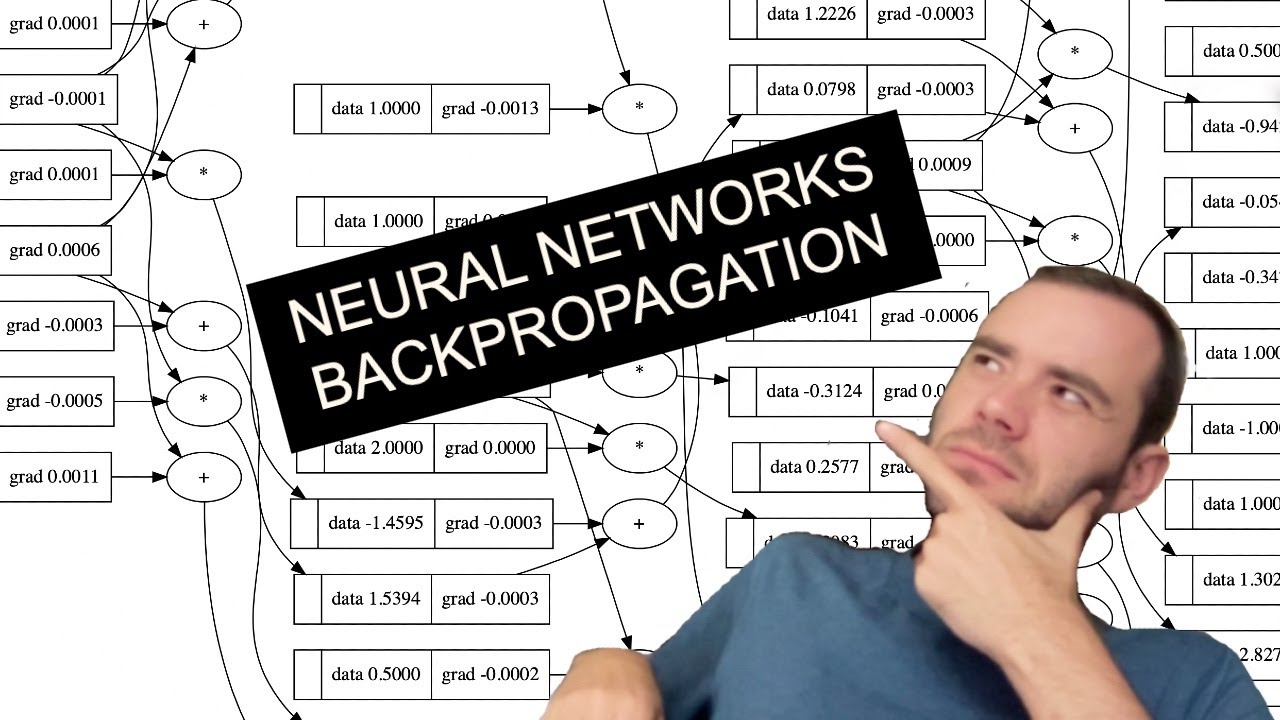
This is the most step-by-step spelled-out explanation of backpropagation and training of neural networks. It only assumes basic knowledge of Python and a vague recollection of calculus from high school.
Links:
- micrograd on github: https://github.com/karpathy/micrograd
- jupyter notebooks I built in this video: https://github.com/karpathy/nn-z...
ocean pawn
odd meteor
Once you've gotten the dimension of the image you're working with, you can compu...
I understand 196 but why 1728
odd meteor
ocean pawn
I understand 196 but why 1728
What is the dimension of your image data?
Check the shape
ocean pawn
odd meteor
What is the dimension of your image data?
It's a MINST data set
Let me check
*MNIST
28*28*1
784
 sturdy field

DeepLearning.AI - Learning Platform
Enroll in 'AI Python for Beginners' by DeepLearning.AI and learn Python programming with AI assistance. Gain skills writing, testing, and debugging code efficiently, and create real-world AI applications.
odd meteor
ocean pawn
*MNIST
Yeah MNIST is 28x28, it should be 784 not 1728. Or am I missing something 👀
ocean pawn
odd meteor
Yeah MNIST is 28x28, it should be 784 not 1728. Or am I missing something 👀
It's convolutional, and there's down sampling (?) with MaxPool2d maybe?
unkempt wigeon
severe hare
Gotta pick what kind first- (Convolutional Neural Network, Generative, Recurrant...
what can learn to find people in a photo or from a live feed??
my apoliges
severe hare
unkempt wigeon
what can learn to find people in a photo or from a live feed??
Called Facial Recognition. Just a piece of Computer Vision. Learn Computer Vision and you will get to it after a couple of chapters of applied study
severe hare
ocean pawn
It's convolutional, and there's down sampling (?) with MaxPool2d maybe?
My intuition is that it's your MLP outputs, but I'm kindof doing a few things at once
odd meteor
ocean pawn
It's convolutional, and there's down sampling (?) with MaxPool2d maybe?
Oh I see... 1728 is the result of flattening the output of the final feature map after the convolution and max pooling layers, leading to a total of 1728 elements which was then passed to the 1st hidden layer in the MLP.
 shut shoal
I want to make sure I'm getting RL down correctly so I'm going to give a general description of RL and if I'm missing something or it's incorrect would you guys correct me. Thank you in advance.
RL uses an agent to take some action in an environment based upon that state that it's in. The agent will either receive a positive reward or negative reward and the agent wants to obtain the highest reward possible.

The foundational model of RL is called the Markov Decision Process which contains states, actions, rewards, the transition probabilities between states, and the policy.

RL can be broken up into two categories, model-based and model-free. Model-based uses the environment to take predictions (policy iteration and value iteration or non-linear dynamics) based upon the environment. Model-free uses 'trail-and-error' to compute a gradient and if you know the gradient you can use some mathematical formula, otherwise, you'll use gradient-free methods mostly and they're broken up into either value-based or policy-based methods.

Value-based methods take value functions and iterate through it (value iteration) and it uses a bellman function to help determine the optimal policy (policy iteration). Policy-based methods just takes the next best action with just one step.
I've been getting confused on the value-based and policy-based methods the most. I'm not sure at all if my definiton is correct on those.
 past meteor
shut shoal
I want to make sure I'm getting RL down correctly so I'm going to give a general...
past meteor
shut shoal
I want to make sure I'm getting RL down correctly so I'm going to give a general...
There's some slight mistakes but you're largely on the right track
For instance, model based vs model free isn't the only way you can categorize RL algorithms. There are many.
For model based algorithms you can be more specific, they specifically try to make a world model and use that model, by means of unrolling to find the best actions
severe hare
Supervised RL models actively influence their own data distribution.
past meteor
The model-free part can be more specific too. I'd definitely talk about the distinction between monte Carlo and temporal difference learning.
If I remember correctly value and policy based was basically if you're learning Q values or V.
Finally, I'd definitely spend some time talking about on policy and off policy.
severe hare
^ I'm just saying it matters for an RL model if it's supervised or unsupervised.
past meteor
Unsupervised ones were the algorithms that mostly seek novelty yeah?
That use some kind of novelty signal as the reward in lieu of actual rewards
Or wdym exactly @severe hare
shut shoal
past meteor
There's some slight mistakes but you're largely on the right track
Gotcha. Is there anything wrong with my value-based and policy-based def at the bottom?
past meteor
shut shoal
Gotcha. Is there anything wrong with my value-based and policy-based def at the ...
Yes, it's not as complicated as you present it
shut shoal
past meteor
The model-free part can be more specific too. I'd definitely talk about the dist...
I should learn MC and TD before learning about value-based and policy-based methods?
past meteor
Value based simply learns the value of each state, V(S). You can easily derive the behaviour policy from that. Take the action that leads to the highest V(S+1). Policy based learns Q(S, A), it learns the value of a state action pair. It's also trivial to find the behaviour policy from this
severe hare
past meteor
Or wdym exactly <@813877367939530782>


The Berkeley Artificial Intelligence Research Blog
The BAIR Blog
past meteor
severe hare
Yup, I read a lot about this in the context of offline RL
severe hare
past meteor
That use some kind of novelty signal as the reward in lieu of actual rewards
Yes it won't use intrinsic rewards; that's correct
past meteor
But it's been a while and I'm rusty
severe hare
past meteor
But it's been a while and I'm rusty
Your knowledge is good.
severe hare
shut shoal
I should learn MC and TD before learning about value-based and policy-based meth...
I've really never done Temporal Difference; maybe I should try that. MCs and Bayesians yeah
You really want experience with both MCs' ; because there is two
shut shoal
past meteor
Value based simply learns the value of each state, V(S). You can easily derive t...
So the only real difference between those two is that one calculates it alongside the action while the other one doesnt. Otherwise it'll still get the max reward.
past meteor
shut shoal
So the only real difference between those two is that one calculates it alongsid...
I actually made a mistake here sorry, it's been a while
shut shoal
severe hare
I've really never done Temporal Difference; maybe I should try that. MCs and Bay...
Both MCs?
past meteor
Policy based is stuff like policy gradient, it doesn't learn Q or V at all.
shut shoal
Oh so it basically looks at the gradient and determines its next move like that?
past meteor
Policy-based vs. Value-based In Policy-based methods we explicitly build a representation of a policy (mapping π:s→a) and keep it in memory during learning.
In Value-based we don't store any explicit policy, only a value function. The policy is here implicit and can be derived directly from the value function (pick the action with the best value).
past meteor
shut shoal
Oh so it basically looks at the gradient and determines its next move like that?
Think about it more abstractly, forget about gradients for a second
severe hare
shut shoal
Both MCs?
Monte Carlos, and Markov Chains which also can be paired together,
past meteor
You have a function π: s -› a, basically something that maps a state to an action
Policy based methods are able to update this function directly
severe hare
Just to keep it confusing; there is such a thing as the Markov Chain Monte Carlo: that combines them
https://en.wikipedia.org/wiki/Markov_chain_Monte_Carlo
In statistics, Markov chain Monte Carlo (MCMC) is a class of algorithms used to draw samples from a probability distribution. Given a probability distribution, one can construct a Markov chain whose elements' distribution approximates it – that is, the Markov chain's equilibrium distribution matches the target distribution. The more steps that a...
past meteor
The others update Q or V and simply derive π: s -› a from that
Make sense? @shut shoal
shut shoal
OHHH
Basically policy-based only looks at the current state to compute an action while value-based looks at values to get some action based on a state.
past meteor
Well, maybe π: s -› a takes into account future states, we don't know that
All we know is that it doesn't need to estimate the value of states or state action pairs
shut shoal
Oh gotcha
Also from what I'm understanding, the value-based functions determine the values (Q or V) by using the Bellman equation.
past meteor
Yup, and to be sure just look at it this way: the value of a state is the immediate reward and the discounted future states
And you can expand the latter term etc.
shut shoal
This makes much more sense. Thank you @past meteor @severe hare
severe hare
I think of it that, the computer wants to be 'led to' a solution for the value of Q, even if your model never reaches it
severe hare
shut shoal
This makes much more sense. Thank you <@260493929047130113> <@813877367939530782...
Glad to help
past meteor
Same
Try implementing as many of these algorithms as possible. The basic ones rarely exceed 25 loc and in my experience those small experiments teach you a lot
 faint quail

GitHub
I custom library I made for training neural networks from scratch, using numpy and scipy - TheonlyIcebear/Neural-Net-Framework
serene scaffold
faint quail
Thoughts?
https://github.com/TheonlyIcebear/Neural-Net-Framework
Can you tell us more? Why would one use this instead of pytorch?
I guess the answer is "no one, this is just a demonstration of concept"
faint quail
serene scaffold
Can you tell us more? Why would one use this instead of pytorch?
simple answer dont

its probably way slower and doesnt have many features like pytorch
from utils.layers import *
from utils.schedulers import *
from utils.network import Network
from utils.optimizers import Adam
from utils.functions import Activations, Loss
import matplotlib.pyplot as plt
import numpy as np, pickle, time

if __name__ == "__main__":
    model = [
        Input(2),
        Dense(3),
        Activation("lrelu"),
        Dense(2),
        Activation("softmax"),
    ]

    print(model)

    network = Network(model, loss_function="cross_entropy", optimizer=Adam(momentum = 0.9, beta_constant = 0.99))
    network.compile()

    training_percent = 1
    batch_size = 4

    save_file = 'model-training-data.json'

    xdata = [[i % 2, i // 2] for i in range(4)]
    ydata = [[(i % 2) ^ (i // 2), 1 - ((i % 2) ^ (i // 2))] for i in range(4)]

    costs = []
    plt.ion()

    start_time = time.perf_counter()

    for idx, cost in enumerate(network.fit(xdata, ydata, learning_rate=0.01, batch_size = batch_size, epochs = 1000, threads=4)):
        if idx % 10:
            save_data = network.save()

            # network = Network()
            # network.load(save_data)

        end_time = time.perf_counter()

        print(end_time - start_time, "time")

        costs.append(cost)

        print(cost)

        plt.plot(np.arange(len(costs)) * (batch_size / (len(xdata) * training_percent)), costs, label='training')

        plt.legend()
        plt.draw()
        plt.pause(0.1)
        plt.clf()

        start_time = time.perf_counter()
heres an xor solver using it
proper crag
do i need to identify outliers by distributing data points from the minimum to the maximum value, and whether to use the actual data points themselves or to use the frequency (count) of those points for the y-axis in my visualization or analysis ?
im srry if i'm perhaps ovethink that its bcomes so complex when it isnt
i wan to use SVR for my dataset
and this is how my dataset looks like
 unkempt wigeon
is it possible to make an iterative language model ?
half lintel
If I have a dataframe with a columns (say): A,B,C,status
And I want to group-by A,B,C with a new column saying "number of times status=X" and "total number of items"
Feels like something .groupby().agg() <=== not sure what to put here
serene scaffold
unkempt wigeon
is it possible to make an iterative language model ?
What would it mean for it to be iterative
faint quail
do you mean like recurrent? like it plugs the output of the model back into the model
 craggy patio
Hey so I am currently trying to use a transformer to predict the next human generated "random" number from 1-100 inclusive. I'll drop some info about it and see if anyone has any suggestions on how to potentially improve it.
Transformer:
lr: 1e-3
L2: 1e-6
dropout: 0.2
feed forward size: 32
Embed size: 32
Attention heads: 7
num classes: 100
num features 43
features:
number itself
number mod 2
number mod 3
number mod 5
number mod 10
number of divisors
Digit sum
ranking in occurance
each digit as it's own feature (2 digits. We treat 100 as 99 which ik isnt the best but is better than having an optional feature)
x3 (We do encode the previous number and the number even before that with all the same features into this number as well)
Plus an additional difference feature for the numbers preceeding it (2 features)
And also an additional quotient feature for the numbers preceeding (2 more features)
All of these values are normalized correctly I ensured as well
Lmk if there is anything I can do better
 hollow night
Hi everyone! Hope you all are doing great today.
I am a beginner in Python and graduated high school this year. I am having a lot of difficulities in my Python learning journey.My elder brother, who is in his last year of college and is a web developer, guided me to explore the field of machine learning and recommended the Machine Learning Specialization course by Andrew Ng (Stanford University) on Coursera. Since it consists of many difficult concepts like linear regression, Gradient Descent, Supervised learning, e.t.c. I found the course quite tough and challenging and couldn't understand much. I have asked this server for guidance many times, but they usually respond as if I were an advanced programmer
Can You please guide me step by step. What and from where should I learn.
I have also started exploring Python libraries like Numpy and pandas.
 warped shale
hollow night
Hi everyone! Hope you all are doing great today.
I am a beginner in Python and ...
warped shale
hollow night
Hi everyone! Hope you all are doing great today.
I am a beginner in Python and ...
If you are alrdy good with python, like as in understanding simple concepts well enough, you should revise some of the mathematical concepts u have learnt in highschool like linear algebra, probability and statistics and familiarising urself with concepts like differentiation and integration. You should also get comfortable with data handling, for example understanding numpy and pandas. Datasets are a core part so i would say you should experiment with them (kaggle is one of my fav platforms for datasets), practice loading and cleaning them, experiment with augmentation. Aftr all these you should start with the basic concepts of ml, use sckit learn at first then move on to pytorch or tensorflow, start experimenting with mnist datasets. And like your brother said, Andrew Ng's course is a great source for understanding all the fundamental concepts.
Start with simple networks like cnns and rnns then move on to more advanced topics like rl, GANs, hybrids or NLP. Start a github repo(for documanting ur progress), join communities like stackoverflow and r/Machinelearning, and most important of all participate in competitions (competitions are held in sites like kaggle, they can range from small to large)
////
Btw someone help me with this: My training of a multiclass img model is done, validation is done too got an f1 of 85(20- test, 80 - train). However I want to test the model on another dataset, I was thinking of using the 2017, 2018 or the ham dataset but later I found out that the isic2019 is an extension that also contains all the imgs of all those sets. So which dataset should I use for another test?
I cant find one on Google and I have been searching for too long
For context: the isic2019 is an imbalanced dataset with 25k images for dermatology (also known as skin related issues). The model is an ensemble hybrid rf
warped shale
hollow night
Hi everyone! Hope you all are doing great today.
I am a beginner in Python and ...
Btw forgot to mention, please learn how to handle imbalance, its really important. I regret not learning it before: accuracy can be significantly impacted by imbalance
hollow night
So should I quit Andrew Ng course for now or should continue with these other stuffs
warped shale
Well, if you believe your still not ready for it, yeah sure
But that course is really good, so I recommend u follow it
After you are more confident ofc
ocean pawn
odd meteor
Oh I see... 1728 is the result of flattening the output of the final feature map...
But I want to know how it's calculated, I've tried different calculations but I can never get that specific value
 toxic mortar
 lapis sequoia
ocean pawn
```py
class CNN(eqx.Module):
layers: list
def __init__(self, key):
...
lapis sequoia
ocean pawn
```py
class CNN(eqx.Module):
layers: list
def __init__(self, key):
...
24*24*3
lapis sequoia
In this case (W-K) + 1 gives you the result; (width and kernel size.)
first it's 28-4 + 1 = 25
then its 25 -2 +1=24
then goes 24*24*3
lapis sequoia
may help: https://cs231n.github.io/convolutional-networks/
feel free to ask
Course materials and notes for Stanford class CS231n: Convolutional Neural Networks for Visual Recognition.
toxic mortar
What do you mean?
proper crag
how to find outlier in a dataset ?
im asking this bcuz i wan to find outlier
in my dataset which i got from kaggle
do i need to identify outliers by distributing data points from the minimum to the maximum value, and whether to use the actual data points themselves or to use the frequency (count) of those points for the y-axis in my visualization or analysis ?
im srry if i'm perhaps ovethink that its bcomes so complex when it isnt
toxic mortar
does this also applies when you train a model across epochs?
proper crag
im not asking in technical perspective, rather in perspective of analysis of how it might efect the model performance...i alr have target column and 2 features
toxic mortar
I mean the memory accumulation, cause I see that you mean the jupyter saves the variables in the memory
Until you explicitly free them
toxic mortar
proper crag
do i need to identify outliers by distributing data points from the minimum to t...
Depending on the concrete dataset
One common approach is to do dimensionality reduction and try to plot it within 2d/3d
Yeah, I get what you mean. But would you call that pitfall or just a feature 😄
proper crag
proper crag
im not asking in technical perspective, rather in perspective of analysis of how...
the features is originally a categorical column but i already encoded them
toxic mortar
But this is school example for gc
You lose reference to it - > gc should be activated
ok that means it is unfixable
well knowing that why would you use car for floating on water, when by default it is not intended for that use-case?
okay you can use for EDA
but create a script for training, no
right
people are spoiled
proper crag
118 rows x 7 columns is considered small?
 this is a bold quote
 rigid timber
I trained an ML model of my own that classifies brain tumor with about 92% accuracy. I unfortunately am not sure how I can integrate the .h5 file of the trained model in a simple web application or desktop application where I can upload an image and the model classifies the tumor based on the scan image. Please give me a step by step guide on how I can do that
proper crag
what is the best solution to handle with outlier
when the target column which hv outlier?
spare forum
How extreme are the outliers, how much outliers, are you using a robust model, does it make sense to have such outlier in the context?
rigid timber
spare forum
Streamlit is kinda easy
how so
spare forum
Is a library to do basic python data app
left tartan
There's some best practices around managing notebooks, and ensuring reproducibility. Such as only committing stripped notebooks, using something like papermill to populate notebooks for 'production' use, etc. Some devs local notebook is just a sandbox.
lapis sequoia
rigid timber
I trained an ML model of my own that classifies brain tumor with about 92% accur...
you can convert models with onnx and use them on the web, but i'd recommend models < 50Mb, if they run on the client.
proper crag
spare forum
How extreme are the outliers, how much outliers, are you using a robust model, d...
i decide to use SVR
rigid timber
lapis sequoia
you can convert models with onnx and use them on the web, but i'd recommend mode...
The model is 100mb, is there any workaround for that
 hollow dust
Yeah pretty terrible
lapis sequoia
rigid timber
The model is 100mb, is there any workaround for that
yes, quantisation
you may be able to do it when exporting (onnx export) or within the library you use for training/saving.
depends on many things, but it's possible.
for example, if you have float32 weights, you'll get to 50mb a bit less precision (normally you don't notice.) with float16, and 25mb with uint8s (that sometimes isn't as good, since the error increases substantially.) if you already have done that, then idk..XD
rigid timber
lapis sequoia
for example, if you have float32 weights, you'll get to 50mb a bit less precisio...
I think I used float64
Im relatively new to this so if you can tell me some resources where I can learn from that'd be pretty great
lapis sequoia
rigid timber
I think I used float64
search deep learning model quantisation
i think chatgpt can give you a decent introduction
you can check this but it's more complex https://newsletter.maartengrootendorst.com/p/a-visual-guide-to-quantization

Exploring memory-efficient techniques for LLMs
rigid timber
lapis sequoia
you can check this but it's more complex https://newsletter.maartengrootendorst....
Thanks
faint quail
lapis sequoia
for example, if you have float32 weights, you'll get to 50mb a bit less precisio...
yeah but numpy seems to shit itself when you have mixed float precision
and certain functions just fail like np.var with float32
ocean pawn
lapis sequoia
24\*24\*3
...
That's a simple solution I somehow haven't came up with
Thanks!
I though I have to do some trick as MaxPolling downsample the data
Oh and
When should sigmoid be used over relu in hidden layer?
ocean pawn
ocean pawn
That's a simple solution I somehow haven't came up with
24 (height) * 24 (width) * 3 (out channel of relU)
I though it would be 23 * 23 as conv2d have stride of 1
ocean pawn
Does the MNIST handwritten digit generalize badly?
(my own handwritten image)

Epoch 449 loss: 0.10526546835899353 accuracy: 0.9675506353378296
How can I improve this
spring field
ocean pawn
When should sigmoid be used over relu in hidden layer?
when you feel like it 🥴
generally you just look at what various papers implement and when or just experiment
spring field
ocean pawn
Does the MNIST handwritten digit generalize badly?
MNIST is a dataset... it doesn't do anything except exists as a dataset
your model OTOH can either generalize or overfit/(specialize?) (if those are opposites)
your model accuracy is about where one would expect it to be though
are the MNIST digits anti-aliased as well?
but yeah, I don't think your model is really capable of generalizing well because it's literally just a single convolutional layer with an MLP at the end (technically it's not an MLP, but oh well, I hate that term, no one ever uses MLPs anymore, but the term stuck, smh, anyway...)
half lintel
If I want to count the number of a particular value in a series, is there a better way than
def somefunc(blah: pd.Series):
    return (blah == 'running').sum()
Yes. Use value counts
half lintel
unless that's precalculated and cached, feels like that's doing a bunch of work I wouldn't care about? (for the other values?)
serene scaffold
half lintel
unless that's precalculated and cached, feels like that's doing a bunch of work ...
It's not precalculated, but both involve essentially the same amount of work.
half lintel
and are you suggesting: blah.value_counts().get('running', 0)
serene scaffold
I would probably keep the value count series as a variable
half lintel
As it happens, i'm using this in an agg() from a groupby. Would that suggest a better way?
    df2 = df.groupby(['ACCOUNT_NAME', 'REGION', 'TYPE', 'ID', 'Name']).agg(
        RunningHr=('STATE', lambda x: (x == 'running').sum()),
        NotRunningHr=('STATE', lambda x: (x != 'running').sum())
    )
Think I'm going to replace NotRunningHr with a total (count).
serene scaffold
That's fine. I'd use the eq and ne methods, though.
half lintel
OK, eq/ne is for style?
serene scaffold
Right, so you don't need parens for == and !=
half lintel
Yup I just removed those 🙂
Optimal?
    df2 = df.groupby(['ACCOUNT_NAME', 'REGION', 'TYPE', 'ID', 'Name']).agg(
        RunningHr=('STATE', lambda x: x.eq('running').sum()),
        TotalHr=('STATE', 'count')
    )
I'm probably over-obsessed with chaining stuff, rather than keeping lots of temporary variables.
serene scaffold
Sure
half lintel
Thank-you
serene scaffold
half lintel
I'm probably over-obsessed with chaining stuff, rather than keeping lots of temp...
Not creating references means fewer opportunities for memory to be waiting for garbage collection.
half lintel
I had a related question, and I think I've seen it somewhere, but don't know the words to search.
How can I add a "filter" to a series of chained calls?
Like if I have the code above, in a function called "summarise" how can I do:
result = pd.load_csv()...
.rename(this,that)
._CALL SUMMARISE
.other_thing()
Is there a "chain" or "call" thingy?
Ahh... "pipe" ?
serene scaffold
half lintel
I had a related question, and I think I've seen it somewhere, but don't know the...
Yeah, I think you have to use pipe so you can pretend that you have a variable for the dataframe at that stage
Pandas is weird
half lintel
What's a good way to update all values in a column (in a dataframe) with a lambda? I want to remove a substring (which is in another column)
The IDE suggested
all_resources['ACCOUNT_NAME'] = all_resources.agg(lambda x: x['ACCOUNT_NAME'].replace('-' + x['REGION'], ''), axis=1)
But I dont understand why it used agg() and not .... .assign() or .apply() ?
 serene scaffold
half lintel
What's a good way to update all values in a column (in a dataframe) with a lambd...
serene scaffold
half lintel
What's a good way to update all values in a column (in a dataframe) with a lambd...
"what's a good way to do x in pandas with a lambda" is self contradictory
A lambda is almost always the wrong way to do anything in pandas
Looks like you should make a new string column with str.replace that applies the desired string transformation.
half lintel
yessir, how can I do that with not-lambda 🙂
can I use str.replace on a vectory thing? when the text to be replaced is actually another column?
half lintel
Thoughts on how to create "pretty reports" using pandas? Presumably need some kind of templating engine....
 small wedge
I used matplotlib and just wrote out graphs to a pdf for presenting pandas data at my job
although in hindsight making a blank graph and a custom method to position text as I wrote it was a waste of time
shut shoal
This is then passed to the policy function to calculate the next possible action.
^^
||
This last sentence is a guess. Is this a correct guess?
Does this sound right?
wooden sail
spring field
MNIST is a dataset... it doesn't do anything except exists as a dataset
your mod...
just for completeness, this isn't quite right. if you have a fixed architecture and use different data sets to train it, the data sets will determine how well the model learns and whether it generalizes well too
it's fairly difficult to tell whether the data or the model is responsible without extensive testing, which is why one would do a lot of cross validation and play with removing some layers and reevaluating
hollow night
warped shale
But that course is really good, so I recommend u follow it
I forgot to say thanks.
By the way, I took some classes from Andrew Ng's course yesterday and decided to pause the course for a while to focus on more practical work
I will consider taking your help on my journey with Python. I hope you don't mind.
😊
lapis sequoia
ocean pawn
When should sigmoid be used over relu in hidden layer?
ReLU tends to perform better for various reasons, including that it's got no vanishing gradient problem. (probably especially true for leaky relu though.)
it's also simpler to compute the gradient.
here is a standard argument https://stats.stackexchange.com/questions/126238/what-are-the-advantages-of-relu-over-sigmoid-function-in-deep-neural-networks

Cross Validated
The state of the art of non-linearity is to use rectified linear units (ReLU) instead of sigmoid function in deep neural network. What are the advantages?
I know that training a network when ReLU is
nice, yes, also silu (idk what it is.) and leaky relu, which has got a small (adjustable) negative slope
im experimenting with hyperparameter tuning libraries and it's a neat way to test those,
 blissful locust
I really need some help in this kaggle competition I am taking part in so please hop on the voice chat 0 if you know a thing or two about about kaggle or ai in general. (it is my first competition)
lapis sequoia
random blogpost conclusion...
So which one should you use?
It depends on your application and what works best for your network. In general, ELU or GELU may be better choices than ReLU if you’re worried about dead neurons, while SILU may be a good choice if you’re using batch normalization.
Also GELU seems to be the SOTA for transformer models and SiLU is use mostly in computer vision models.
(E: exponential, G: gaussian, S: sigmoid)

/*! elementor - v3.21.0 - 30-04-2024 */ .elementor-widget-text-editor.elementor-drop-cap-view-stacked .elementor-drop-cap{background-color:#69727d;color:#fff}.elementor-widget-text-editor.elementor-drop-cap-view-framed .elementor-drop-cap{color:#69727d;border:3px solid;background-color:transparent}.eleme...
yeah
serene grail
The main reason these functions are used is that they're easy (fast) to compute right? The derivative is very straightforward
lapis sequoia
they need a couple of attributes: must be non linear, simpler is better indeed (but not too simple), have (or 'produce') non exploding or vanishing gradient...
its fun
idk tbh
interesting!
serene grail
lol yeah I guess
lapis sequoia
i may compare on mnist those for fun
serene grail
the point of these functions is to introduce non-linearity, so less linear -> easier to fit to real world (non-linear) data?
lapis sequoia
oh that's dan, he seems smart, one of the authors
dan hendrycks is one of the ones passing (or helping to write or smth) the bill to regulate ai i think
is on the 'imminent extinction' side iirc
fn is that one right?
 wooden sail
the siren part is pretty cool
lapis sequoia
erf is a gaussian like fn i think
wooden sail
erf is the integral of a gaussian
wooden sail
you usually get it as the CDF of the gaussian, i.e. the probability of a gaussian distributed event happening. it's called error function because it describes the probability of making errors when transmitting signals under gaussian noise
lapis sequoia
looks like a sigmoid :-(
wooden sail
a lot of stuff looks like a sigmoid
lapis sequoia
no wait, but in the paper that's \Phi(x)*x I think
so it's like a probability times a weight in a way
We perform an empirical evaluation of the GELU nonlinearity against the ReLU and ELU activations and find performance improvements across all considered computer vision, natural language processing, and speech tasks.
same paper, ig that's not a proof, but interesting.
blissful locust
I am facing an issue in the ML models I have created. Please dm me if you know a thing or two about AI and ML
lapis sequoia
i only partially agree with that; the paper you included says:
But as networks became deeper, training with sigmoid activations proved less effective than the non-smooth, less-probabilistic ReLU (Nair &
Hinton, 2010) which makes hard gating decisions based upon an input’s sign.
sigmoids are non linear
the introduction is very neat
wooden sail
there's this one talk from ICASSP 2020 or 2021 that i never found again, but discussed that if you learn the activation function, piecewise polynomials (like relu) are in some sense the optimal choice
lapis sequoia
but there is leaky relu as well
the discussion also is very nice
Across several experiments, the GELU outperformed previous nonlinearities, but it bears semblance to the ReLU and ELU in other respects. For example, as σ → 0 and if µ = 0, the GELU becomes
a ReLU. More, the ReLU and GELU are equal asymptotically. In fact, the GELU can be viewed
as a way to smooth a ReLU.
wooden sail
yeah, there's a handful of smoothing approximations to the relu. the problem is that it isn't differentiable at 0, only subdifferentiable. as a result, different ML libraries and implementations of autodif make different, arbitrary choices of what to do for the derivative at 0
lapis sequoia
i see
the x in their formula turns to relu ig x*Phi(x)
idk what u and sigma are here (i mean the role in the network); the weights?
wooden sail
mean and variance of a gaussian distribution. it's not really a pdf here though, so it's better to say they're the "shape parameters" of a "bell curve"
lapis sequoia
they are tunable though, i guess?
wooden sail
sure
proper crag
How does log(n) can centralized skewed graph?
lapis sequoia
wooden sail
sure
it could also be the u and sigma of a batchnorm on x i think
so not tunable
actually (this may be incorrect) but i think x is just the output of a linear transformation; but that's assumed to be normally distributed
(formula just for discussion.)
 wooden sail
there are good arguments to be made for x being normal distributed if you got it from a large enough matrix, sure
the original paper discusses it only very loosely though
lapis sequoia
i was wondering how they use that function since it does not have an actual expression
but they use tanh in replacement apparently
oops, they do say this though:
We could use the CDF of N (µ, σ2) and have µ and σ be learnable hyperparameters, but throughout this work we simply let µ = 0 and σ = 1.
which im assuming means the data comes from batchnorm
wooden sail
it really depends on what interpretation you want to give to the activation function
even though they called it a cdf, by leaving it fixed it pretty much detaches the function from the data, so it's not really a cdf
just a function that looks like a relu but is everywhere differentiable
lapis sequoia
it's a bit like x*sigmoid conceptually (in my mind at least.)
wooden sail
it's exactly that, because sigmoid is an umbrella world describing any roughly s-shaped function
like the logistic function, which is what people usually mean, or the hyperbolic and inverse tangents, or the error function
those are all sigmoids
you can
lapis sequoia
i wonder whether x*logistic would work well
wooden sail
yes
in my work we do this all the time, since the activation functions should mimic some other algorithm
so you chuck the hyperparams into the training
lapis sequoia
lapis sequoia
i wonder whether `x*logistic` would work well
just realised that's exactly silu
 wooden sail
yep
past meteor
How does it differ from a skip connection
lapis sequoia
so they propose a whole family of activation functions, that's quite beautiful
past meteor
Seems pretty similar
 lapis sequoia
yeah all sigmoid-type actually
lapis sequoia
past meteor
How does it differ from a skip connection
is that like or same as dropout?
past meteor
Different. You multiply theta(w, x) * x
wooden sail
i'm not sure what exactly you mean by "having it depend on previous outputs"
through composition and the usage of iterative optimization methods, all of the parameters depend on the initial guess, all of the previous parameters in the network, and all of the previous guesses of the optimal parameters
all gradient based optimization methods are recurrent
lapis sequoia
you can do arbitrary graphs, does that relate?
i.e 1 activation takes 2 prev layers as input
oh, skip connection as in resnets
i didn't know the name
i think i more or less suggested the same as @past meteor if i understood correctly
skip connections are one way to make that prev-output dependency using graphs, but you may have asked smth else
so this may be wrong but in my mind all the paths forward have a gradient backwards
then i thought that'd give a state in the sense you wrote (using just +complex graphs), but ig it does not
is the last representing y what you want, or what i meant?
does this match the description?

XD sorry
my current activation default stack sigmoid < ReLU < ELU < x * sigmoid (includes GeLU, SiLU,..)
according to some papers it's not for large networks

arXiv.org
We study the connection between the highly non-convex loss function of a simple model of the fully-connected feed-forward neural network and the Hamiltonian of the spherical spin-glass model under the assumptions of: i) variable independence, ii) redundancy in network parametrization, and iii) uniformity. These assumptions enable us to explain t...
there is also the regularisation parts, chatgpt returns a neat summary with what is a regularizer in deep learning networks?
idk whether regs matter that much either. actually dropout and batchnorm are regularisers
they say somewhere that large neural networks get to similar local minima disregarding of initialisation (since it's random and all get to the min.)
not to the same parameters, but to minima of similar quality (error.)
btw one of the authors is lecunn, worth reading him
lol, i take it
ill take a look
that's my read of this part at least:
However, several researchers experimenting with larger
networks and SGD had noticed that, while multilayer
nets do have many local minima, the result of multiple experiments consistently give very similar performance. This suggests that, while local minima are
numerous, they are relatively easy to find, and they
are all more or less equivalent in terms of performance
on the test set
(it could be they all tuned the init, im assuming they didn't to some extent)
proper crag
is kernel in kernel method is the OSes kernel?
lapis sequoia
yeah but their "experiments" for example say...
We performed an analogous experiment on a scaled-down version of MNIST, where
each image was downsampled to size 10 × 10. Specifically, we trained 1000 networks with one hidden layer
and n1 ∈ {25, 50, 100, 250, 500} hidden units (in the
paper we also refer to the number of hidden units as
nhidden), each one starting from a random set of parameters sampled uniformly within the unit cube. All
networks were trained for 200 epochs using SGD with
learning rate decay.
(it certainly does matter for small networks though.)
maybe i should add the remaining bit:
(...)
We obtained less than 2.5% drop in accuracy, which
demonstrates the heavy over-parametrization of neural
networks as discussed in Section 3.
yeah seems possible, this says smth similar https://ai.stackexchange.com/questions/40495/what-is-the-impact-of-the-initialization-of-weights-in-the-performance-of-a-neur

Artificial Intelligence Stack Exchange
In my own experience, weight initialization matters for model convergence.
Theoretically, can different weight initialization methods eventually converge to the same optimal solution? Are their we...
i was likely stretching that original model too far, it's not even meant to explain inits.
 bronze trout
Hello, I hope this is the correct channel for the question I have. I would like to to create an animated bubble chart, similar to https://cryptobubbles.net/ . Is there a package or framework in python I can use or is this only possible with D3.js ?

Crypto Bubbles
Explore the dynamic world of cryptocurrencies with Crypto Bubbles, an interactive visualization tool presenting the cryptocurrency market in a customizable bubble chart. Dive into the latest market trends and gain valuable insights effortlessly. Crypto Bubbles serves as an independent data aggregator, offering a comprehensive view of the crypto ...
lapis sequoia
bc it reduces to a gaussian process
they want to prove that neural nets reduce to a gaussian process; using a recent advance that the spin-model is equal to a gaussian process
i may be wrong, it's in the limit of my understanding
uhmm i think they assume a random input vector, but would need to re-read
also it's about the training, and the finding of the weights; actually the gaussian process is the loss there.
yes, that's quite interesting
it's structured data (not just noise), but can be modelled statistically and hence has randomness (i assume.)
i spent quite some time understanding that equation, i can't do it algebraically though
both are a feed forward, second one is a different way of writing it
wooden sail
since the sigmas are relus here, it's the same as multiplying specific paths by 1 or 0
lapis sequoia
you can think of a single weight and how it moves in the network
it ends up multiplied by every other weight, in the following layers
so write that down for all weights added up, and it's just another description.
XD
well, a large enough network is a universal approximator
wooden sail
the only thing they require for those first 2 equations is that the activation is a relu, as far as i can see
no
you'd have to analyze other architectures separately to show whether the result applies to them
general results of that kind are in general not tight and don't provide as much insight though
e.g. there are papers explaining the conditions under which special architectures will always reduce the training loss to 0, but you can't really make that conclusion for general networks since it would be a general statement about nonconvex opt that has eluded researchers for several years
the universal approx theorem is pretty much the starting point
which means you don't have even that for general architectures
that's a steep slope to fight against if you want to show any general results
that was kinda my point
you start with a general nonconvex, possibly nondifferentiable function you want to optimize, and have almost nothing to go off of
you'll find that theoretical guarantees of any kind are made only for special families of functions
and those are the special families of functions
if you go broader, you have pretty much nothing
nonconvex opt is a PITA
 indigo wing
https://github.com/samratsb/QueryDB
Hey I want to further my project to be able to talk with documents and dockerize it and upload it to cloud, what do I do?
GitHub
RAG with chromadb embedding and huggingface model. Contribute to samratsb/QueryDB development by creating an account on GitHub.
Anyone interested, please contribute
lapis sequoia
does seem like nice project to experiment with activations, since they are easy to implement;
that paper by hendrycks is not too hard imho
has anyone used duckdb for logging metrics where there are a lot of metrics and they get logged ultra quickly
or has anyone used duckdb at all just wanted to know what people use it for and how fast it is in real tasks
lapis sequoia
buoyant vine
And define 'ultra quickly'
so quickly that after I debugged the logging takes 40 seconds
not that quickly actually but there are so many metrics that it each logging event is very small amount of time from previous one
indigo wing
can someone contribute to my project, I have created a semantic search. it adds querys, and does a semantic search
I want to use it to do more, I feel like this is not enough
lapis sequoia
buoyant vine
Why duckdb for that application?
I just read that it is fast but I can't find any benchmarks and dont know if it is worth trying to implement
but also I want to learn it anyway
left tartan
lapis sequoia
or has anyone used duckdb at all just wanted to know what people use it for and ...
I use duckdb all the time. It's a great analytical engine. Not what you'd use for logging tho: you might use it for log analysis tho.
lapis sequoia
this is my current logging, just dicts
{
"metric1":{
  1: 100,
  4: 200,
  7: 300,
  },
"metric2":{
  2: 15,
  3: 25,
  },
}
and I thought it could be faster if I have a table for iterations, and table of metrics, and table of metric per iteration
left tartan
Why not one table?
lapis sequoia
left tartan
Why not one table?
idk, I'm not sure what would be faster, I would need to benchmark all of it
left tartan
lapis sequoia
idk, I'm not sure what would be faster, I would need to benchmark all of it
Faster at what?
lapis sequoia
left tartan
Faster at what?
faster at saving the metrics per some iterations
left tartan
Fastest is to stream a csv to a text file.
Appending to a single table will also be fast.
So will writing to a log store or time series db
The 'trick' to speed is to aggregate (buffer) writes... one big write is faster than many small
lapis sequoia
I'll do more benchmarking
some metrics are logged every second iteration some like every 128 iteration which is why maybe multiple tables will be faster
left tartan
lapis sequoia
some metrics are logged every second iteration some like every 128 iteration whi...
What difference would that make to the tables?
How many metrics and how many iterations per second are we talking?
lapis sequoia
indigo wing
can someone contribute to my project, I have created a semantic search. it adds ...
that's a cute request, i've no knowledge about that, but keep trying :-)
Dan Hendrycks on Reddit, interesting story about SiLU
 indigo wing
lapis sequoia
that's a cute request, i've no knowledge about that, but keep trying :-)
indigo wing
lapis sequoia
that's a cute request, i've no knowledge about that, but keep trying :-)

lapis sequoia
this video seems promising, terence tao about the potential of ai in mathematics (for automatic proofs etc.) https://www.youtube.com/watch?v=_sTDSO74D8Q

Terry Tao is one of the world's leading mathematicians and winner of many awards including the Fields Medal. He is Professor of Mathematics at the University of California, Los Angeles (UCLA). Following his talk, Terry is in conversation with fellow mathematician Po-Shen Loh.
The Oxford Mathematics Public Lectures are generously supported by XT...
indigo wing
I need to do so much on this project, can someone help me please
add KNN, similarity check, eval downstream tasks, model fine tuning, making it work on pdfs (I am currently creating chunks from .md files and finally I want to use this project to further it and make it into a complete RAG, that is, make it ans from what it is not trained on, using what it is trained on
And I have no idea how to implement this all, including dockerizing, what tech to use etc. I am suffering.
lapis sequoia
maybe up to 100 per second, and about 100 metrics, but only to are logged per iteration, other ones are once per few iterations
buoyant vine
I mean for logs analytics if this is for a service click house or quickwit are better solutions
But I guess your scale is probably a bit small for those systems to really be super useful
unkempt wigeon
may i ask a question
 arctic wedgeBOT
llama%2Fmodel.py lines 218 to 219
def forward(self, x):
return self.w2(F.silu(self.w1(x)) * self.w3(x))```can a rrecurent networks learn if you give it data?
 fiery bane
yes
unkempt wigeon
no teaching requierd?
fiery bane
well, you need backprop I guess
lapis sequoia
interesting !
fiery bane
unkempt wigeon
backprop?

Backpropagation, short for "backward propagation of errors," is an algorithm for supervised learning of artificial neural networks using gradient descent. Given an artificial neural network and an error function, the method calculates the gradient of the error function with respect to the neural network's weights. It is a generalization of the d...
fiery bane
you can shut down the machine that is running the neural network.
unkempt wigeon
well i want to make a code just encase sone takes a copie of the network and train it to be dangerous or if it becomes dangerous on it's own i can reset it or shut it of in esence a time out
my apologizes
fiery bane
unkempt wigeon
well i want to make a code just encase sone takes a copie of the network and tra...
great idea. good luck!
unkempt wigeon
but could the network break the shut down code?
fiery bane
unkempt wigeon
but could the network break the shut down code?
that would depends on the network, and the shut down code
unkempt wigeon
a code decrypting neural network and image identifyer
so
what do what do you think
toxic mortar
I want to integrate a model to some existing system. What should I pay attention to other then current infrastructure to ensure that my model wrapper complements their style
raw tree
Hey guys, quick question
The last time I finetuned a ml model (xlm-roberta), my model basically learned to always predict the majority class - like ALWAYS, regardless of the input
Even if I used oversampling, the same issue occurred (it predicted the majority class in that epoch) : /
Do you guys have any ideas on what went wrong and how to solve it ?
serene scaffold
raw tree
Hey guys, quick question
The last time I finetuned a ml model (xlm-roberta), my ...
these questions are hard to answer. you probably need to adjust the hyperparameters
 limpid zenith
raw tree
Hey guys, quick question
The last time I finetuned a ml model (xlm-roberta), my ...
limpid zenith
raw tree
Hey guys, quick question
The last time I finetuned a ml model (xlm-roberta), my ...
did you use dynamic loss weighting like focal loss?
verbal oar
hmm I wonder should I choose NLP with LLM or 3d deep learning path?
goal is to help people rather than do projects
or 3d deep learning is rather research?
 brave yew
hey guys has anyone here worked with the zero-shot-classification pipeline from transformers library? is it supposed to take so long to process a small string even when it is accelerated by a gpu? and yes i asked help on #1035199133436354600 but it was locked before anyone could answer
raw tree
limpid zenith
did you use dynamic loss weighting like focal loss?
Dunno what that means, but what I did was simple cross entropy
Would love to know what you are talking about
raw tree
brave yew
hey guys has anyone here worked with the zero-shot-classification pipeline from ...
It should warn you of you have a GPU that it detects and is not using
verbal oar
focal loss is related to focal length?
raw tree
Prob not lol
limpid zenith
raw tree
Dunno what that means, but what I did was simple cross entropy
Would love to kno...
yes you can do focal loss for cross entropy ..it's a special formula that counts the numebr of classes and dynamically adjusts the weights of the observed batch
raw tree
brave yew
hey guys has anyone here worked with the zero-shot-classification pipeline from ...
How many parameters ?
brave yew
raw tree
How many parameters ?
from transformers import pipeline

# Use a model specifically fine-tuned for zero-shot classification
classifier = pipeline('zero-shot-classification', model='facebook/bart-large-mnli', device=0)

res = classifier(
    "I am kinda sad today",
    candidate_labels=["happy", "sad"],
)

print(res)
this is all, and it doesn't show a output on pycharm
limpid zenith

Medium
Focal loss is said to perform better than Cross-Entropy loss in many cases. But why Cross-Entropy loss fails, and how Focal loss addresses…
raw tree
limpid zenith
https://towardsdatascience.com/focal-loss-a-better-alternative-for-cross-entropy...
ill give it another try with this, thanks a lot
limpid zenith
np 🙂
raw tree
I'll send the colab link next time lol
raw tree
brave yew
```py
from transformers import pipeline
# Use a model specifically fine-tuned f...
Like no output whatsoever ?
brave yew
wait could my internet speed be the bottleneck? because now that i think about it, how would it access teh model without locally caching it
brave yew
raw tree
Like no output whatsoever ?
nope it just runs and runs and i get no output
raw tree
brave yew
wait could my internet speed be the bottleneck? because now that i think about i...
Should show you a progreebar lol
verbal oar
so like loop forever?
raw tree
brave yew
nope it just runs and runs and i get no output
Add prints to know where it is stuck lol
brave yew
raw tree
Add prints to know where it is stuck lol
where do i add prints in a 10 line code 😭
raw tree
brave yew
where do i add prints in a 10 line code 😭
The nine in between : P
limpid zenith
brave yew
hey guys has anyone here worked with the zero-shot-classification pipeline from ...
did you move the tensors to gpu?
raw tree
limpid zenith
did you move the tensors to gpu?
Huggingface takes care of that for you
brave yew
limpid zenith
did you move the tensors to gpu?
if you mean adding the device = 0 parameter then yes i did
brave yew
brave yew
```py
from transformers import pipeline
# Use a model specifically fine-tuned f...
this the script
raw tree
brave yew
if you mean adding the device = 0 parameter then yes i did
Try removing that parameter
And actually try the prints lol
limpid zenith
ahhh didn't see that
raw tree
Again, how many parameters does that model have
Like if it's in the high billions, it'll take time
And what gpu
 raw tree
brave yew
raw tree
brave yew
Ah, I think I get it
The pycharm term seems to not support progress bars lol
The model is dl'ing
Use Windows terminal or kitty depending on your os
brave yew
should i try running in the terminal?
brave yew
raw tree
Use Windows terminal or kitty depending on your os
alright
limpid zenith
brave yew
should i try running in the terminal?
in pycharm u can enable emulate the terminal btw
brave yew
limpid zenith
in pycharm u can enable emulate the terminal btw
yeah i think it works now

lmao it was at 99% all this time
raw tree
That too works lol
raw tree
brave yew
lmao it was at 99% all this time
It'll time out
Read the error then
limpid zenith
you can make it run with terminal like this instead of going to terminal
 brave yew
limpid zenith
you can make it run with terminal like this instead of going to terminal
brave yew
limpid zenith
you can make it run with terminal like this instead of going to terminal
okay i will set it up, thanks!
lapis sequoia
they've got a neat site https://www.vincentsitzmann.com/siren/
Implicit Neural Representations with Periodic Activation Functions
brave yew
bro wtf! my device crashed while processing the stuff so i had to do a force restart and now it doesn't show that i have a gpu
serene scaffold
brave yew
bro wtf! my device crashed while processing the stuff so i had to do a force res...
in what environment?
brave yew
serene scaffold
in what environment?
i was working in a conda env, but not even my task manager recognizes my gpu
serene scaffold
brave yew
i was working in a conda env, but not even my task manager recognizes my gpu
so it's on your computer, and not something like google colab?
you can try rebooting, I guess.
lapis sequoia
there are some interesting criticisms of siren here as well https://www.reddit.com/r/MachineLearning/comments/hd6tu1/d_paper_explained_siren_implicit_neural/

Reddit
Explore this post and more from the MachineLearning community
proper crag
How to know if feature is linear?
bronze trout
Thank you. So there is nothing on Python side that can be used instead?
Great thank you! 🙏
brave yew
serene scaffold
so it's on your computer, and not something like google colab?
you can try reboo...
my gpu shows up again after restarting but the code has stopped working for some reason, even though it had worked earlier
serene scaffold
brave yew
my gpu shows up again after restarting but the code has stopped working for some...
how do you know that it "stops working"? what does that mean in this context?
brave yew
Oh right, let me share it, one sec
lapis sequoia
https://arxiv.org/pdf/1710.05941 "Searching for activation functions"
brave yew
serene scaffold
how do you know that it "stops working"? what does that mean in this context?
can i just share the repo?
serene scaffold
brave yew
can i just share the repo?
you can, but that won't tell us how you know that it "doesn't work".
was there an error message?
brave yew
serene scaffold
you can, but that won't tell us how you know that it "doesn't work".
right so essentially, it a review summarizer which scrapes reviews of product parses it and extracts reviews and then sends it over a zero shot classification pipline to classify the reviews by their degree of positivity or negativity, so the code returns an error while it creates an object for the class which does the classficaiton work
serene scaffold
the code returns an error
If you need help in relation to an error message, always show the whole error message
brave yew
from driver_init import SeleniumDriver
from review_scraper import ReviewScraper, parse_reviews
from review_classifier import ReviewClassifier


def main():
    url = "https://www.amazon.in/Number-Backpack-Compartment-Charging-Organizer/dp/B09VTDMRY7?pd_rd_w=giCzt&content-id=amzn1.sym.ec5c60c1-ae3d-4950-9707-1e49240719bc&pf_rd_p=ec5c60c1-ae3d-4950-9707-1e49240719bc&pf_rd_r=Y3MSH92QWBEKYCN9ATGK&pd_rd_wg=ZzwV4&pd_rd_r=8e0c7a40-a11e-4573-9b38-15ab13f59a8c&pd_rd_i=B09VTDMRY7&ref_=pd_hp_d_btf_unk_B09VTDMRY7"

    # Creating object of the class SeleniumDriver
    selenium_driver = SeleniumDriver()
    # Setting up the webdriver
    driver = selenium_driver.get_driver()

    try:
        # Creating object of the class ReviewScraper
        review_scraper = ReviewScraper(driver)
        page_sources = review_scraper.navigate_to_reviews(url)

        # Check if we have the required page sources
        if len(page_sources) >= 2:
            # Parse reviews
            positive_reviews = parse_reviews(page_sources[0])
            negative_reviews = parse_reviews(page_sources[1])

            # Combine positive and negative reviews
            reviews = ([review for review in positive_reviews] +
                       [review for review in negative_reviews])

            print("Reviews:")
            for i, review in enumerate(reviews, start=1):
                print(f"Review {i}:")
                print(f"Review: {review['review']}")
                print(f"Date: {review['date']}")
                print("-" * 40)  # Separator line

            # Create and use the ReviewClassifier
            review_classifier = ReviewClassifier(reviews)
            review_classifier.classify_reviews()

        else:
            print("Not enough page sources available.")

    except Exception as e:
        print(f"An error occurred: {e}")

    finally:
        # Close the driver
        selenium_driver.close_driver()


if __name__ == "__main__":
    main()
the main file
serene scaffold
if your code "doesn't work", but you got an error message, you don't need to say that the code doesn't work. you only need to show the error message.
brave yew
print(f"An error occurred: {e}")
as far as i understand e should send error message, but it gives only '0'
serene scaffold
brave yew
print(f"An error occurred: {e}")
as far as i understand e should send error mes...
show your whole terminal output from when you start the program to the end of the error message
!paste
arctic wedgeBOT
Pasting large amounts of code
If your code is too long to fit in a codeblock in Discord, you can paste your code here:
https://paste.pythondiscord.com/
After pasting your code, save it by clicking the Paste! button in the bottom left, or by pressing CTRL + S. After doing that, you will be navigated to the new paste's page. Copy the URL and post it here so others can see it.
brave yew
alright
brave yew
serene scaffold
show your whole terminal output from when you start the program to the end of th...
this is it
 serene scaffold
brave yew
this is it
serene scaffold
brave yew
this is it
okay. make it so that none of the code is in try-except, so that when an exception is raised, you get the exception.
brave yew
serene scaffold
okay. make it so that none of the code is in try-except, so that when an excepti...
okay give me a sec
arctic wedgeBOT
:incoming_envelope: :ok_hand: applied timeout to @flat plaza until <t:1723481327:f> (10 minutes) (reason: duplicates spam - sent 4 duplicate messages).
The <@&831776746206265384> have been alerted for review.
brave yew
serene scaffold
okay. make it so that none of the code is in try-except, so that when an excepti...
i hope that i used that right
serene scaffold
brave yew
https://paste.pythondiscord.com/SPEA
"sequence": sequences[0],
~~~~~~~~~^^^
KeyError: 0
do you see what this error message is telling you?
brave yew
serene scaffold
"sequence": sequences[0],
~~~~~~~~~^^^
KeyError: 0
do you see w...
not quite... i don't understand what is under the pipelines that well
serene scaffold
brave yew
not quite... i don't understand what is under the pipelines that well
do you know what keys are in Python?
brave yew
yes
serene scaffold
so if you got a key error from doing sequences[0], then what type of object is sequences?
brave yew
a list?
serene scaffold
you are mixing up indices and keys.
brave yew
am i sending a list of dictionaries instead of a list of string to the classifier?
serene scaffold
sequences is apparently a dict.
for which 0 is not one of its keys
what types are the keys and values of sequences? I do not know.
brave yew
serene scaffold
what types are the keys and values of `sequences`? I do not know.
i do not have a dictionary named sequences, in my code
serene scaffold
the code where the error occurs is C:\Users\Rikhil Nellimarla\.conda\envs\NLP_env\Lib\site-packages\transformers\pipelines\zero_shot_classification.py
brave yew
serene scaffold
the code where the error occurs is `C:\Users\Rikhil Nellimarla\.conda\envs\NLP_e...
brave yew
serene scaffold
the code where the error occurs is `C:\Users\Rikhil Nellimarla\.conda\envs\NLP_e...
yes... but that is inside a package tho
i wouldn't edit the python files inside an imported package
lapis sequoia
just went on a rabbit hole reading about sirens, if i understand correctly those can't model the probability distribution of a dataset of signals, just overfit a single signal sample.
still, it is extremely cool!
brave yew
i think i got it! i
        positive_reviews = parse_reviews(page_sources[0])
        negative_reviews = parse_reviews(page_sources[1])

        # Combine positive and negative reviews
        reviews = ([review for review in positive_reviews] +
                   [review for review in negative_reviews])
here both positive and negative reviews are a list of dictionaries with the review of the product and the date, so when only isolating reviews i need to write
            reviews = ([review['review'] for review in positive_reviews] +
                       [review['review'] for review in negative_reviews])
instead so that i can take only string assigned to the key of reviews
@serene scaffold see
 serene scaffold
@brave yew sorry, I have like four coworkers asking me to do stuff
brave yew
serene scaffold
<@790243224999952404> sorry, I have like four coworkers asking me to do stuff
no its okay, i just wanted to say my issue got solved, thanks!
serene scaffold
brave yew
i think i got it! i
```py
positive_reviews = parse_reviews(page_source...
you can just do reviews = positive_reviews + negative_reviews and it's the same thing
brave yew
serene scaffold
you can just do `reviews = positive_reviews + negative_reviews` and it's the sam...
oh? but the positive reviews and negative reviews are lists of dictionaries
serene scaffold
sure, but if you're just concatenating two lists, you just + them. you don't need the list comp part.
[x for x in y] is pointless if y is already a list.
(note that for arrays, this would do elementwise addition, so don't use "list" and "array" interchangeably)
brave yew
serene scaffold
`[x for x in y]` is pointless if `y` is already a list.
oh okay, i will do it like that then, thanks
 runic parcel
from langchain_chroma import Chroma
from langchain_openai import OpenAIEmbeddings, ChatOpenAI
from langchain.chains import RetrievalQA
import os

openai_api_key = "sk-"

K_RESULTS = 3
SIMILARITY_THRESHOLD = 0.5
SYSTEM_PROMPT = "I have an AI informational website. " \
                "You should check the user's prompt and recommend the best tool as per it. " \
                "Reply with the tool names in a Python list."


def ask_question(query):
    embeddings = OpenAIEmbeddings(api_key=openai_api_key)
    vector_store = Chroma(persist_directory="./chroma_db", embedding_function=embeddings)

    llm = ChatOpenAI(api_key=openai_api_key, model_name="gpt-3.5-turbo",
                     messages=[
                         {"role": "system",
                          "content": "I have an AI informational website. You should check the user's prompt and recommend the best tool as per it. Reply with the tool names in a python list."},
                     ])

    retriever = vector_store.as_retriever(
        search_type="similarity_score_threshold",
        search_kwargs={"k": K_RESULTS, "score_threshold": SIMILARITY_THRESHOLD}

    )

    chain = RetrievalQA.from_chain_type(llm=llm, chain_type="stuff", retriever=retriever)
    response = chain.invoke({"query": query})

    if 'source_documents' in response:
        for doc in response['source_documents']:
            print(f"Source Document: {doc.metadata['source']}, Section: {doc.metadata.get('section', 'N/A')}\nContent: {doc.page_content}\n")

    return response.get("result", "No result found.")


if __name__ == "__main__":
    query = "i need to build a website and i need tts features"
    print(ask_question(query))
when i added the system message in the ChatOpenAI, my code wont run properly and gives me
Sure! Please provide me with the user's prompt so I can recommend the best tool accordingly.
instead i wanted to print the tool name
unkempt wigeon
how do i make a network library?
lapis sequoia
unkempt wigeon
how do i make a network library?
what type of network
lapis sequoia
unkempt wigeon
how do i make a network library?
what type of library?
lapis sequoia
unkempt wigeon
recurent image detection and traking
so what do you want to make
a library that does the image detection? Or library to train new models for image detection?
do you just need a model or more than that
unkempt wigeon
unkempt wigeon
a library to train new models
@lapis sequoia
toxic mortar
Is this the correct formula/terminology to calculate accuracy in a scenario where I have 10 categories and want to classify my input into one of them?
For example, referring to the 10k instances that were classified as abusive, where 95% are truly abusive and 5% were classified as abusive but are actually good instances , should I use the formula: TP / (TP + FP) to calculate accuracy? Or thats for like binary
spare forum
toxic mortar
Is this the correct formula/terminology to calculate accuracy in a scenario wher...
Accuracy works the same
You can do things like precision/recall per class or averaging them over all the class to get one metric
unkempt wigeon
#===[imports]===#
import sys
import numpy as np
import matplotlib
#===============#

#===[neuron network]===#
np.random.seed(0)

X = [[1, 2 ,3,2.5],
    [2.0,5.0,-1.0, 2.0],
    [-1.5, 2.7, 3.3, -0.8]]

class Layer_Dense:
    def __init__(self, n_inputs, n_neurons):
        self.weights = np.random.randn(n_inputs, n_neurons)
        self.biases = np.zeros((1, n_neurons))
        def forward(self, inputs):
            self.output = np.dot(inputs, self.weights) + self.biases

layer0 = Layer_Dense(4,5)
layer1 = Layer_Dense(5,2)

layer0.forward(X)
print(layer1.output)
is this ok?
 violet gull
unkempt wigeon
```py
#===[imports]===#
import sys
import numpy as np
import matplotlib
#=======...
violet gull
unkempt wigeon
```py
#===[imports]===#
import sys
import numpy as np
import matplotlib
#=======...
It should be matmul not dot in forward
Dot product returns a scalar
Also the end bit doesn’t make sense. layer1.output is going to be undefined
serene scaffold
violet gull
Dot product returns a scalar
this is only true for 1d arrays.
@unkempt wigeon
- There is no reason for importing
syshere. It's not clear if you plan to usematplotliblater. Xshould probably be an array.- You should name the class
LayerDenseorDenseLayer. Don't use Upper_Snake_Case in python. - you made the
def forwardblock part of thedef __init__block. - The
forwardmethod should return the output, not assign it to self. - You don't do anything to make the output of layer0 go into layer1.
unkempt wigeon

Neural Networks from Scratch book: https://nnfs.io
NNFSiX Github: https://github.com/Sentdex/NNfSiX
Playlist for this series: https://www.youtube.com/playlist?list=PLQVvvaa0QuDcjD5BAw2DxE6OF2tius3V3
Neural Networks IN Scratch (the programming language): https://youtu.be/eJ1HdTZAcn4
Python 3 basics: https://pythonprogramming.net/introduction-...
lapis sequoia
unkempt wigeon
https://youtu.be/TEWy9vZcxW4?feature=shared&t=1236
His forward function is not inside of __init__ and also making X(data) into a numpy array will make operations faster and easier because you will be able to leverage the functions associated with the np.ndarray type
lapis sequoia
unkempt wigeon
how could i make X into an array?
yes
unkempt wigeon
asarry()?
lapis sequoia
import numpy as np

np.random.seed(0)

X = np.array([[1, 2, 3, 2.5],
              [2.0, 5.0, -1.0, 2.0],
              [-1.5, 2.7, 3.3, -0.8]], dtype=np.float32)


class LayerDense:
    def __init__(self, n_inputs, n_neurons):
        self.weights = np.random.randn(n_inputs, n_neurons)
        self.biases = np.zeros((1, n_neurons))

    def forward(self, inputs):
        self.output = np.dot(inputs, self.weights) + self.biases


layer0 = LayerDense(4, 5)
layer1 = LayerDense(5, 2)

layer0.forward(X)
# print(layer0.output)
layer1.forward(layer0.output)
print(layer1.output)
@unkempt wigeon
the exact code showed in the video
idk If I would structure my nn like this but that just me
unkempt wigeon
does array have indexing or something else
lapis sequoia
unkempt wigeon
does array have indexing or something else
yes
a np.array works
like a list just has certain operations that are faster
unkempt wigeon
asarray()
unkempt wigeon
GeeksforGeeks
A Computer Science portal for geeks. It contains well written, well thought and well explained computer science and programming articles, quizzes and practice/competitive programming/company interview Questions.
lapis sequoia
!d numpy.asarray
arctic wedgeBOT
numpy.asarray(a, dtype=None, order=None, *, device=None, copy=None, like=None)```
Convert the input to an array.I see
unkempt wigeon
[0.1 0.2 0.3 0.4]
lapis sequoia

Stack Overflow
What is the difference between NumPy's np.array and np.asarray? When should I use one rather than the other? They seem to generate identical output.
lapis sequoia
unkempt wigeon
[0.1 0.2 0.3 0.4]
?
unkempt wigeon
#===[imports]===#
import numpy as np
#===============#

X = [0.1, 0.2, 0.3, 0.4]

converted_data0=np.asarray(X)

print(converted_data0)
@lapis sequoia
serene scaffold
unkempt wigeon
https://www.geeksforgeeks.org/convert-python-list-to-numpy-arrays/
I would avoid geeksforgeeks entirely. They have bad quality control.
unkempt wigeon
that was a artical i found im sorry
how could i get the dat from the array?
@serene scaffold
lapis sequoia
unkempt wigeon
```py
#===[imports]===#
import numpy as np
#===============#
X = [0.1, 0.2, 0.3...
use
import numpy as np
lis = np.array([1,2,3,4])
wdym?
lis is the same as converted_data0
in your example
unkempt wigeon
take what is in the array and make it where I can add all of the numbers in the array
lapis sequoia
unkempt wigeon
take what is in the array and make it where I can add all of the numbers in the...
!e
import numpy as np
print(sum(np.array([1,2,3,4])))
arctic wedgeBOT
lapis sequoia
!e
import numpy as np
print(sum(np.array([1,2,3,4])))
:white_check_mark: Your 3.12 eval job has completed with return code 0.
10
 smoky basalt
violet gull
unkempt wigeon
https://youtu.be/TEWy9vZcxW4?feature=shared&t=1236
smoky basalt
violet gull
unkempt wigeon
https://youtu.be/TEWy9vZcxW4?feature=shared&t=1236
just a warning: this creator stopped making tutorials the moment before he got to the actual complicated stuff needing of tutorials