#zyun.
1 messages · Page 1 of 1 (latest)
 karmic steppeBOT
Please be patient
Our volunteers look into many questions every day; sometimes it takes them a little while to answer.
Pro tip: you can rename the thread title with `.tr <thread name>`
Make it descriptive, including relevant context, but also to the point. This way you improve your chances of getting a more relevant and specific answer.
 odd kraken
Okay so I'm going to assume you're going for Metropolitan French (i.e. the French of France)
In general, the top-hat vowels – called the circumflex – don't have a specific sound. « pâte » and « patrie » are pronounced the same.
The real difference is with the vowel E's three forms: bare (de), acute (télécharger), and grave (père)
For the bare: https://www.lawlessfrench.com/pronunciation/e/
For the acute: https://www.lawlessfrench.com/pronunciation/acute-accent/
For the grave: https://www.lawlessfrench.com/pronunciation/grave-accent/
The letter e has several different pronunciations in French.
In French, E is the only letter that can be modified with l'accent aigu, the acute accent. It changes the vowel's pronunciation to [e].
Only three French vowels can take the grave accent: à, è, and ù, and the purpose of the accent depends on the letter in question. - Lawless French
For a more general article on vowels, read this:
https://www.lawlessfrench.com/pronunciation/vowels/
In English, the vowels are "a, e, i, o, u, and sometimes y." But a vowel is not so much a letter as the sound represented by one or more letters.
 rustic herald
Thank you so much
rustic herald
odd kraken
The real difference is with the vowel E's three forms: bare (d**e**), acute (t**...
When do you use the C with a squiggly line underneath?
odd kraken
rustic herald
When do you use the C with a squiggly line underneath?
The cédille is a writing thing
Okay so in French, the consonant C represents two sounds: a soft S sound in front of front vowels like <i, e> like « cinéma, célébration » and a hard K sound in front of back vowels like <a, ou, u*, o> like « canicule, courber, cuve, coalition »
*<u> technically represents a front vowel /y/ but it doesn't trigger a soft S sound due to historical reasons
However, there are cases where you want a soft S sound in front of a back vowel so in that case you would write the C cédille (Ç, ç)
Take the city of « Besançon ». Because the « çon » part uses a soft S /sɔ̃/, you write it with the C cédille. If you had written in with a normal C like « con », we would've pronounced it with the hard K sound /kon/ which is wrong.
This usage of softening the C also works in historical spelling. For example, the letters <ais> have evolved in Middle French to become the <è> sound in Modern French. When we look at the imperfect conjugation for -cer verbs like « commencer, balancer », we have « je commençais / je balançais ». Here, even though we would pronounce <ais> like an <è>, it's not written as a front vowel but a back vowel so we put the C cédille there
rustic herald
I see so the Cedille is used primarly to make the word sound like an S
@odd kraken The problem I have with the vowels and the cedille is when to use them
odd kraken
rustic herald
<@695647039362433086> The problem I have with the vowels and the cedille is when...
Basically, if you have a soft S sound but you either have to:
a) Pronounce a back vowel
b) Pronounce a front vowel written as a back vowel
You use the cédille
rustic herald
odd kraken
Basically, if you have a soft S sound but you either have to:
a) Pronounce a bac...
ohh so like in the word because we dont use cedille cause the C in because is said without an S sound but for words like balancer where the C sounds like an S we use the cedille?
odd kraken
Right because <ais> is written as a back vowel (ais) even though the sound is soft
rustic herald
odd kraken
Right because <ais> is written as a back vowel (**a**is) even though the sound i...
I'm sorry this is the first time I've heard of back and front vowels
odd kraken
rustic herald
I'm sorry this is the first time I've heard of back and front vowels
It just means position
Say the letter A then the letter I
In French
rustic herald
okay
odd kraken
Notice your tongue moving?
rustic herald
no
rustic herald
hahaha wait I don't feel it moving
rustic herald
odd kraken
Or O and É
for this its my lips
odd kraken
Or not you can put something on your tongue
A finger or whatever
And just feel where your tongue is when you say A
Feel it where it is when you say I
rustic herald
yea I guess I feel it
odd kraken
The tongue with the A sound should feel back and down
rustic herald
I feel my jaw moving more though
odd kraken
The I should be front and up
rustic herald
odd kraken
The I should be **front** and up
yupp
odd kraken
rustic herald
I feel my jaw moving more though
Your jaw moves because your tongue is
odd kraken
rustic herald
yupp
Right that’s what it means
When you pronounce OU, A, O, your tongue is back
When you pronounce I and É, the tongue is forward
Thus back vowel and front vowel
rustic herald
Ahhhh I seee
Another question, when do you use nous nous appelons and vous vous appelenz
odd kraken
rustic herald
Another question, when do you use nous nous appelons and vous vous appelenz
You have two questions here
Are you asking when to use nous vs vous
Or are you asking why it has nous nous and not just nous
rustic herald
actually it was the former but I want to know both if that's alright
odd kraken
rustic herald
actually it was the former but I want to know both if that's alright
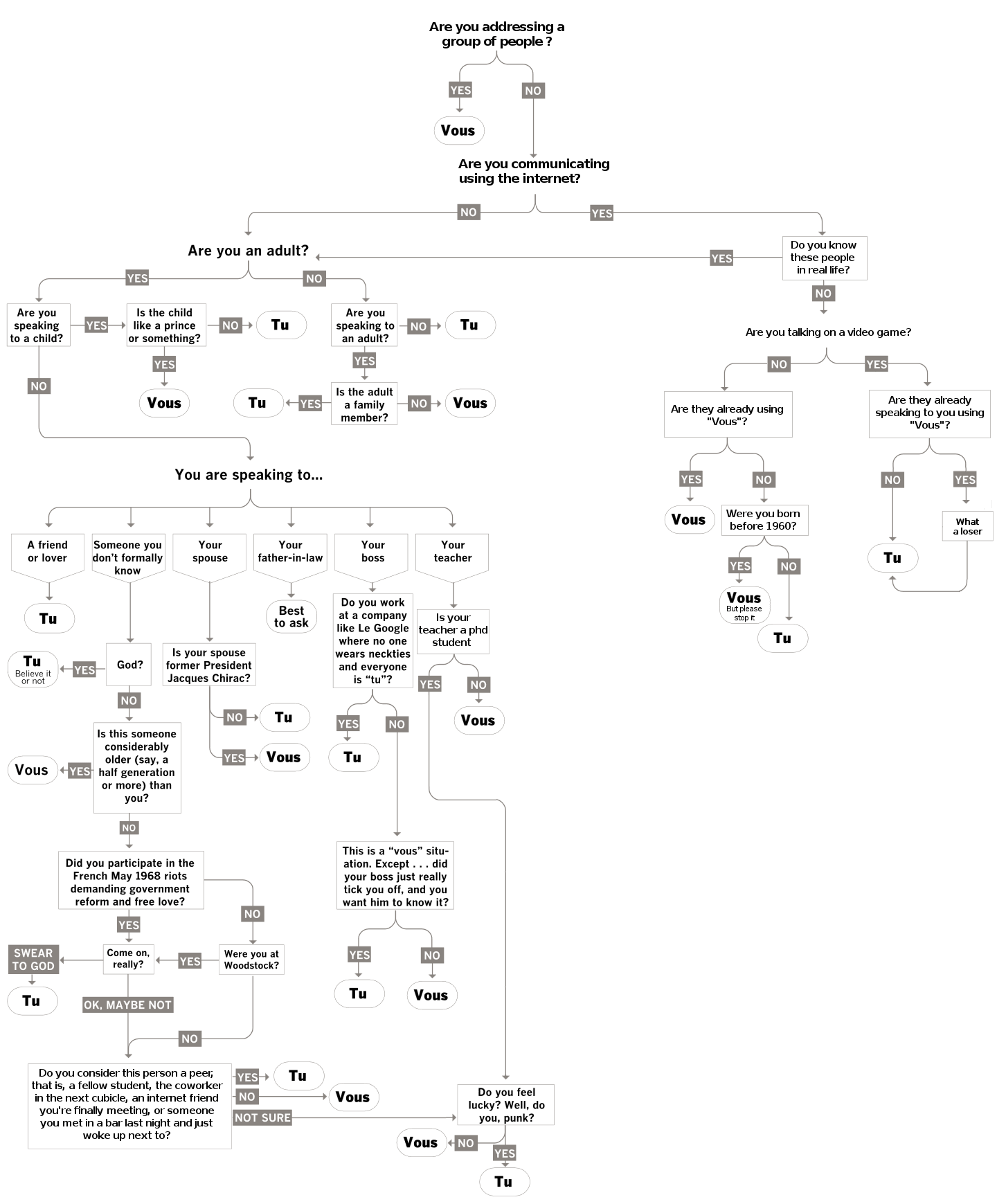
Well, « nous » is the plural first person. First person here means the person who is speaking so imagine you and your friend talking. That's « nous ». Now, in modern French, « nous » has all but discarded in favour of « on » but the principle remains.
« vous » can either be the plural second person or the formal singular second person. Second person here means the person who is listening to the speaker, the other person in the conversation. For the plural, imagine you and your friend listening to me talking. For the singular formal, imagine your professor or your teacher or someone who is more socially superior than you in place of you or your friend
;tu
karmic steppeBOT
 odd kraken
That's a bit humorous but it explains it well enough
Now, about why we have this doubling thing. French has something called pronominal verbs:
https://www.lawlessfrench.com/grammar/pronominal-verbs/
The grammatical term "pronominal" means "relating to a pronoun." You know that conjugated verbs (almost) always need a subject pronoun, but pronominal verbs need a reflexive pronoun as well. - Lawless French
You can read that article for full but the gist of it is that pronominal verbs are verbs whose objects are the same as their subjects. For example: « je me parle (I talk to myself), je m'appelle (I call myself) »
The thing is that certain pronominal verbs gain a more figurative meaning. For example, « s'appeler » (the s' there stands for « se », the reflexive pronoun) literally means 'to call oneself' but it has gained a figurative meaning of 'my name is…'
Je m'appelle Bertie.
–> literal translation: I call myself Bertie
—> actual meaning: My name is Bertie
Tu t'appelles Bertie.
–> literal translation: You call yourself Bertie
—> actual meaning: Your name is Bertie
Il s'appelle Bertie.
–> literal translation: He calls himself Bertie
—> actual meaning: His name is Bertie
Nous nous appelons Bertie et Thomas.
–> literal translation: We call ourselves Bertie and Thomas
—> actual meaning: Our names are Bertie and Thomas
Vous vous appelez Bertie. [formal singular]
–> literal translation: You call yourself Bertie
—> actual meaning: Your name is Bertie
Vous vous appelez Bertie et Thomas. [plural second person]
–> literal translation: You people/guys/all call yourselves Bertie and Thomas
—> actual meaning: Your names are Bertie and Thomas
Ils s'appellent Bertie et Thomas.
–> literal translation: They call themselves Bertie and Thomas
—> actual meaning: Their names are Bertie and Thomas
rustic herald
odd kraken
Well, « nous » is the plural first person. First person here means the person wh...
okay so far what I understood is that nous nous is used as a "we" like nous nous appelons is used as we are called? And for vous vous appelenz is for a formal way of saying "you are called".
odd kraken
The reflexive pronoun « s'/se » changes according to the subject since, again, the object refers to the same person as the subject
odd kraken
rustic herald
okay so far what I understood is that nous nous is used as a "we" like nous nous...
Essentially
odd kraken
odd kraken
The reflexive pronoun « s'/se » changes according to the subject since, again, t...
So if the subject is « je », the reflexive pronoun will find the object pronoun corresponding to « je » which is « me »
odd kraken
odd kraken
Now, about why we have this doubling thing. French has something called pronomin...
Again, read this link
It'll explain it better than me
and faster because I'm actually going to sleep rn
rustic herald
Me too hahah I about to sleep
thank you so much!! Will this chat be deleted? I hope not cause I will use these for class.
rustic herald
odd kraken
and faster because I'm actually going to sleep rn
Thank you so much again!
odd kraken
rustic herald
thank you so much!! Will this chat be deleted? I hope not cause I will use these...
Nope
But inactivity will make it unlisted so just save it somewhere
Take screenshots or what have you
rustic herald
Okay! Can I message you here again if I have questions?
odd kraken
rustic herald
Okay! Can I message you here again if I have questions?
It’s better to ask again in the original channel and have another thread because I may not be present
Others can find the new thread and help you there