#basic greetings
1 messages · Page 1 of 1 (latest)
 wet helmBOT
Please be patient
Our volunteers look into many questions every day; sometimes it takes them a little while to answer.
Pro tip: you can rename the thread title with `.tr <thread name>`
Make it descriptive, including relevant context, but also to the point. This way you improve your chances of getting a more relevant and specific answer.
basic greetings
 cloud frigate
- Comment tu t'appelles <== this is what I’ve always known
- Comment t'appelles-tu <== labeled as “informal”
- Comment vous vous appelez <== labeled as “formal”
I don’t understand the difference. Cursory research says 2 is formal and grammatically correct, while 1 is actually grammatically incorrect but used in day to day. Is 1 like how some things in English are accepted in every day life even if it’s incorrect?
Why “vous vous”? Won’t a literal translation be “how you you called”?
 worthy solar
Well « tu te » is also 'you you'
This construction is what is called a pronominal verb. Pronominal verbs are a class of verbs whose objects relate back to their subjects. For example, « je t'appelle » would be 'I call you' but « je m'appelle » would be 'I call myself'. Some pronominal verbs can have specific meanings that differ from their non-pronominal version. For example, « appeler » means to call but « s'appeler » means 'to be called'.
The « s' » in « s'appeler » is the reflexive pronoun « se » contracted. It's called 'reflexive' because it changes in accordance to the subject. When it meets « je » it turns to « me », « tu » it turns to « te », etc.
The grammatical term "pronominal" means "relating to a pronoun." You know that conjugated verbs (almost) always need a subject pronoun, but pronominal verbs need a reflexive pronoun as well. - Lawless French
« Comment tu t'appelles ? » is understood literally as 'How do you call yourself?' but figuratively as 'What is your name?'
So that's the pronominal part out of the way
As for the formality of questions, you have two bits of information here that I'm going to untangle
First off, we have the « tu/vous » distinction. In general, you can think of « tu » as the pronoun you use for close friends and family; « vous » for senior people.
;tu
wet helmBOT
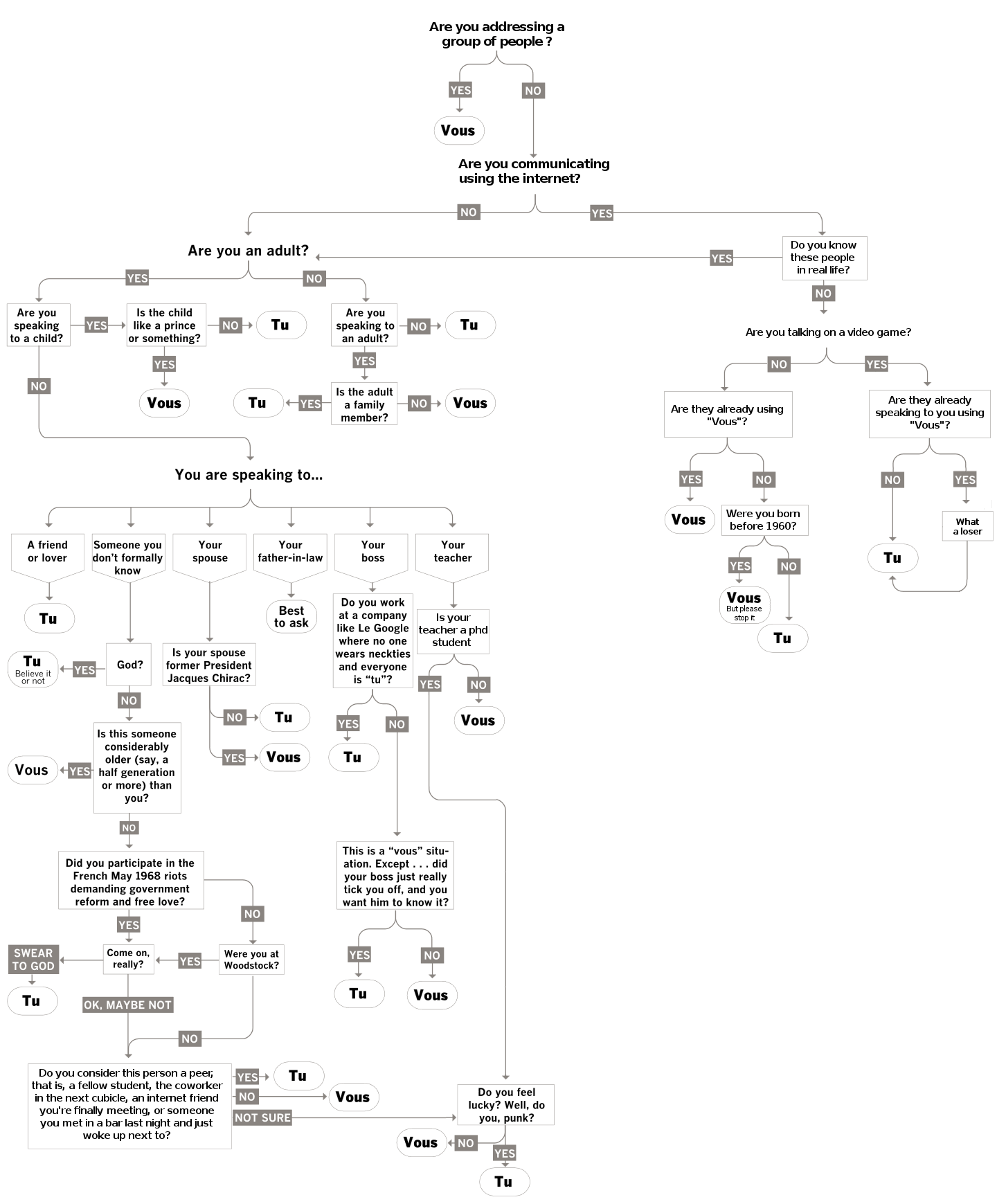
 worthy solar
This is a fairly humorous interpretation but it's accurate
Second, we have the question form itself.
French has three ways of asking a question.
(1) Inversion – the formal way
Inversion has you put the subject in front of the verb. We call it that because it inverts/flips the usual positioning of subject-verb into verb-subject.
Comment + tu fais cette chose => Comment fais-tu cette chose ?
However, inversion has a couple of wrinkles.
First, in a lot of cases, you can only invert with pronouns; you cannot invert nouns. Thus, if you do have a noun, you have to insert that noun in pronoun form and then flip that pronoun instead. Say we have this sentence:
« Le professeur vient (The professor is coming) »
Say you want to ask a time-related question so you use « quand (when) ». But uh-oh, we have a noun here as subject (le professeur) so what do we do? Well, « le professeur » is in third-person, masculine, and singular. So, we look at the list of subject pronouns and we find the third-person masculine singular pronoun which is « il ». We put that in:
« Le professeur [il] vient + quand »
And now we can invert:
« Quand le professeur vient-il ? (When is the professor coming?) »
Second, in third-person singular conjugations, there are cases where the verb ends in a vowel. In this case, we cannot have the final vowel and the beginning vowel of the pronoun meeting, so we put in a linking T. If we get that first example back and change « vient (comes) » to « arrive (arrives) », we get this:
« Quand le professeur arrive-t-il ? (When is the professor arriving?) »
We can't have « arrive-il » because two vowels meeting equals bad. Inversion being a pain in the arse is why we relegate this method mostly to written and/or formal speech, and why we have the other two methods.
Subject pronouns indicate who or what is performing the action of a verb. Each of the six six grammatical persons has at least one subject pronoun.
(2) Est-ce que – the neutral way
This is by far the most common way of asking a question. How does it work? It's simple: Just add « est-ce que » before the subject. Let's use our previous two examples:
« Quand + le professeur vient »
« Quand + le professeur arrive »
Just add « est-ce que » where we have that plus (+) sign.
« Quand est-ce que le professeur vient ? »
« Quand est-ce que le professeur arrive ? »
That's it. Easy peasy. This is neutral because it can be used either informally, formally, written or spoken, and everyone accepts it. But formal and neutral implies an informal way, which brings us to…
(3) Intonation – the informal way
This is the easiest way of asking a question. Just add the question word at the end and speak with a rising tone. That being said, intonation does have a tendency to forbid the question mark from moving. Let's use our previous two examples:
« Quand + le professeur vient »
« Quand + le professeur arrive »
Here, the question word (quand) cannot move to the front, so we just tack it on the end.
« Le professeur vient quand ? »
« Le professeur arrive quand ? »
Because it needs that rising intonation, we see this in oral conversation. Do note that some question words can be placed either way. « pourquoi, comment, combien » can be placed in either position.
With that covered, time to correct your question a bit.
(1) Comment tu t'appelles
Uses tu and intonation = Rather informal
(2) Comment t'appelles-tu
Uses tu and inversion = A bit neutral
(3) Comment vous vous appelez
Uses vous and intonation = A bit neutral, edging towards formal
Because of how 'rare' inversion is, the difference between tu and vous matters more (in my opinion)
cloud frigate
Merci beaucoup. This is a lot of useful info. I won't pretend I understood everything here already but I'm saving all of this.
I just have one small question:
two vowels meeting equals bad
Is this because it's non-sensical in French, or more of a purist kind of view? Like outdated English rules such as "don't end sentences with a preposition", or how some are vehemently for/against Oxford commas?
worthy solar
cloud frigate
I just have one small question:
> two vowels meeting equals bad
Is this because...
That's simply just how the language works
Well
it's a bit more complicated than that
but understanding that would unlock French more
For example, it's why we say « Parce qu'on peut le faire » instead of « Parce que on peut le faire »
Or why we say « mon école » instead of « ma école »
Or why we say « l'eau » and not « la eau »
cloud frigate
so "le école" is never a thing, it's always "l'école"?
worthy solar
It's a generality that may be inaccurate once you get into the higher levels of French but it's something that you can get by
worthy solar
cloud frigate
so "le école" is never a thing, it's always "l'école"?
exactly
cloud frigate
well not "never"... more like you just sound weird to modern ears?
worthy solar
Not even that
Elision – the technical term for it – has been a French thing since like the Middle Ages
you wouldn't just sound weird to modern people
you would sound weird even to medieval people
cloud frigate
Merci, thank you so much for all of these! It's so helpful to learn the more intricate details.