#popsicle_404
1 messages · Page 1 of 1 (latest)
 loud ledgeBOT
Please be patient
Our volunteers look into many questions every day; sometimes it takes them a little while to answer.
Pro tip: you can rename the thread title with `.tr <thread name>`
Make it descriptive, including relevant context, but also to the point. This way you improve your chances of getting a more relevant and specific answer.
 hidden sail
jai aidee pour le mot "que" et son utilisation
 nova heath

Kwiziq French
Learn how to use Que = Whom/which/that (French Relative Pronouns) and get fluent faster with Kwiziq French. Access a personalised study list, thousands of test questions, grammar lessons and reading, writing and listening exercises. Find your fluent French!
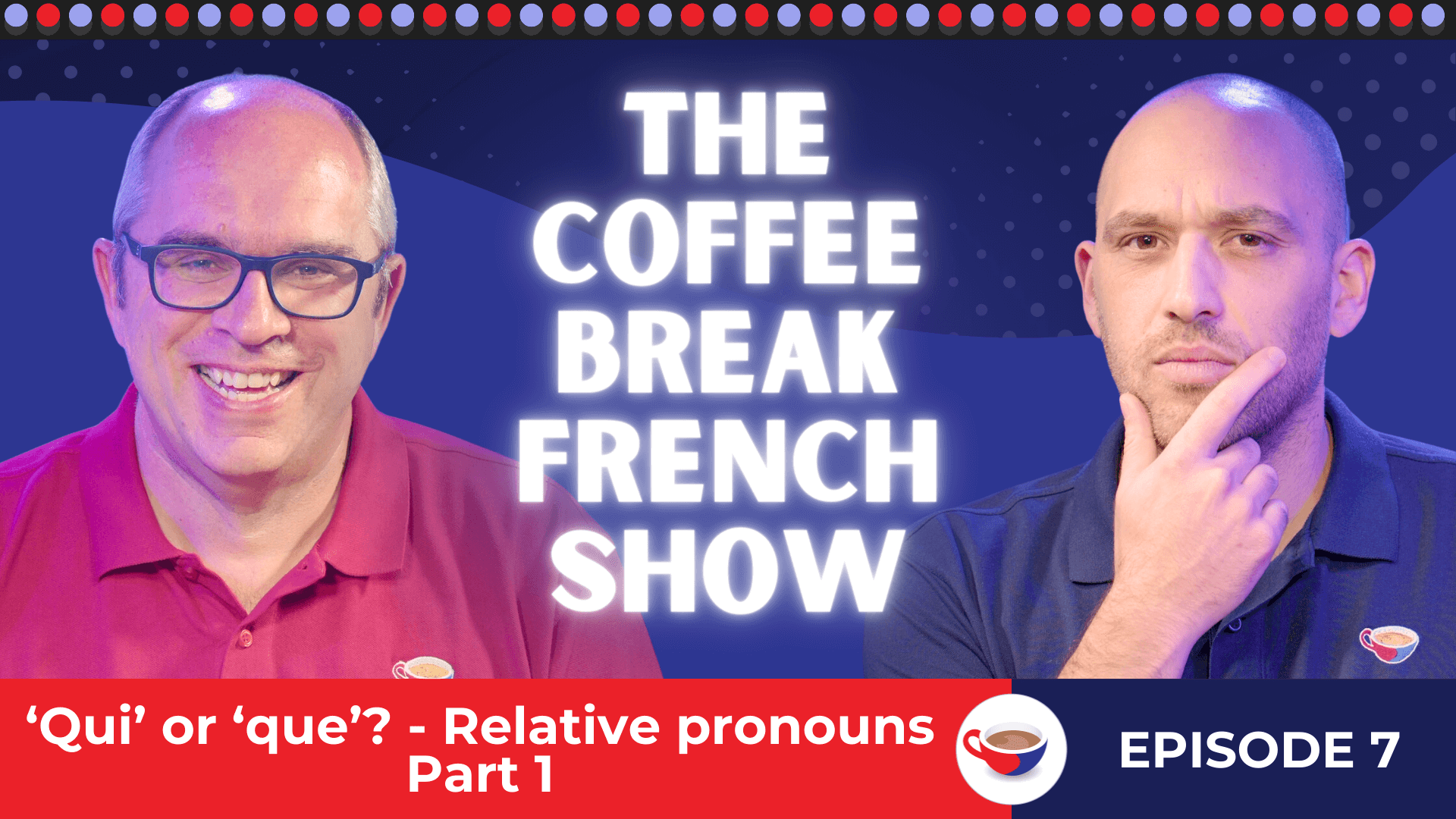
In this episode of The Coffee Break French Show we discuss the relative pronouns ‘qui’ and ‘que’ and how to choose between them when speaking French
hidden sail
idk its still a lil confusing when i watch the video but ill check these out tres bien merci!!!
*some
nova heath
hidden sail
idk its still a lil confusing when i watch the video but ill check these out tre...
It's roughly equivalent to 'that' in English:
I think that ...
The idea that ...
hidden sail
nova heath
It's roughly equivalent to 'that' in English:
> I think that ...
> The idea that...
why is que right after manteau

if its supposed to replace manteau
😭
irs like saying the coat coat i bought is white
nova heath
hidden sail
why is que right after manteau
The coat that I bought ...
hidden sail
i mean below it saws that que replaces le manteau
hidden sail
nova heath
The coat __that__ I bought ...
so im a lil confused srry
 nova heath
It's a poor description, since it cannot replace what still shows up.
It references the coat.
hidden sail
ohh oki ty
nova heath
The coat that I bought. What is 'that'? Answer: the coat.
nova heath
Pretty much.
hidden sail
do u lnow any major exceotion?
nova heath
But it's not every 'that'.
nova heath
That thing over there
Different 'that'.
Or to use both:
The colour that that car has ...
Que = that.
hidden sail
 oki
oki
nova heath
Cette = that.
 nova heath
If 'that' can also be 'this/the', then it's not 'que'.
hidden sail
nova heath
If 'that' can also be 'this/the', then it's not 'que'.
its ce cette ces?
ohh
i thoguht qui is who lmao
nova heath
hidden sail
its ce cette ces?
Or even 'ça'.
hidden sail
mb
nova heath
Is it that? Yeah, it's that.
C'est ça ? Oui, c'est ça.
hidden sail
je veux que l'orange ou orange
nova heath
If you happen to have learnt German at all, then 'que' is 'dass'. 🤔
hidden sail

nova heath
Not sure if that helps you, though.
nova heath
hidden sail
je veux que l'orange ou orange
'Que' can also mean 'only'.
nova heath
It's a fun word.
hidden sail
suelement?
nova heath
Or rather, 'ne ... que' is 'only'.
nova heath
The 'que' replaces the 'pas'.
nova heath
'Ne ... pas que' would be 'not only'.
 brittle shard
Much like an adjective that qualifies a noun, a relative clause qualifies a noun. And a relative pronoun connects those two parts and confers the grammatical role of the antecedent in regards to the relative clause.
Que marks the noun as the object of a relative clause (le vélo que j'ai acheté) while qui marks the noun as the subject of the relative clause (le vélo qui est beau).
nova heath
I'm afraid that makes no sense, nor do I understand what it's supposed to say.
hidden sail
brittle shard
Much like an adjective that qualifies a noun, a relative clause qualifies a noun...
ty!
hmm je veux acheter ne lorange/orange que?
nova heath
hidden sail
i want to only buy that orange
Je ne veux acheter que cette orange.
hidden sail
ohh
nova heath
Ne ... pas or ne ... que go around the verb.
hidden sail
why cette not le or ...
nova heath
Because 'cette' (feminine) is for 'this orange' and 'la' (or 'l'orange') would be 'the orange'.
I want to buy the orange.
Je veux acheter l'orange.
I want to buy this orange.
Je veux acheter cette orange.

 nova heath
No problem.
 green pine
hidden sail
so im a lil confused srry
green pine
hidden sail
so im a lil confused srry
Okay so let me explain the logic here a bit
When we have a complex sentence like this, « le manteau que j'ai acheté est blanc », this is actually two separate sentences merged into one. A 'complex' sentence is basically multiple sentences merged into one, hence 'complex'.
The original sentences are:
(1) Le manteau est blanc
(2) J'ai acheté le manteau
When we're forming complex sentences, that merger happens by way of a shared noun, the thing that exists in both sentences. In the sentence above, that's « le manteau ». Great! Now, when we're making a complex sentence, we have to determine the main/principal clause and the secondary/subordinate clause. The idea is that the principal clause forms the backbone of our complex sentence and we're essentially inserting the subordinate clause into the principal clause. We don't do anything to the principal clause; our focus is on the subordinate clause and just the subordinate clause.
In the original complex sentence, (1) forms the principal clause and (2) forms the subordinate, so let's see how that works. Again, we don't care about the principal clause (1) so we're just looking at the subordinate. What is the noun shared between the two clauses? « le manteau ». Here, we use something called relative pronouns because they're used, well, to refer to something that's already said. In French, the relative pronouns are based off of subject/object so that's what we're doing now.
Let's look at (2). What is « le manteau » doing there, what is its role? Here, we can see that it's after the verb, which means it's an object. Is there a preposition (à, de, sans, pour, etc) before the noun? No, so it's a direct object, which means we just put « que ». Our sentence is almost complete; all we have to do is move « que » to the start of the subordinate clause. We're moving that because relative pronouns sit right next to the shared noun. Thus, we have our original sentence: « Le manteau que j'ai acheté est blanc. »
A step-by-step method would be something like this:
(a) Le manteau est blanc + j'ai acheté le manteau
(b) Le manteau [j'ai acheté le manteau] est blanc
(c) Le manteau que j'ai acheté est blanc
The site's explanation on « que » replacing the direct object « le manteau » is for the subordinate clause
I've noticed that you've got « Anglais » in your bio so I'm assuming you speak English. English functions the same way with the key difference being the relative pronouns being based off of animacy/inanimacy (alive/dead)
a) L'ordinateur que je viens d'acheter est un Mac [L'ordinateur est un Mac + je viens d'acheter l'ordinateur]
b) La porte qui grince appartient à Luke [La porte appartient à Luke + la porte grince]
Both of these would be translated in English with the relative pronoun 'that' because both are referring to dead things:
–> a) The computer that I've just bought is a Mac [The computer is a Mac + I've just bought the computer]
–> b) The door that creaks belongs to Luke [The door belongs to Luke + the door creaks]
c) La fille que tu aimes est ma voisine [La fille est ma voisine + tu aimes la fille]
d) L'homme qui parlait avec toi est le professeur [L'homme est le professeur + l'homme parlait avec toi]
Both of these would be translated in English with the relative pronoun 'who' because both are referring to living things:
–> c) The girl who you love is my neighbour [The girl is my neighbour + you love the girl]
–> d) The man who was talking with you is the teacher [The man is the teacher + the man was talking with you]
This is why we can't always equate « que = that » because French and English relative pronouns operate on fundamentally different logics. It's going to be a lot more apparent once you move on to the indirect object pronouns so you should try and understand the subject/direct object difference because it's important you get that difference.
Note:
que replaces direct objects
qui replaces subjects
I've highlighted the roles in the French sentences