#kallht
1 messages · Page 1 of 1 (latest)
 halcyon hollyBOT
Please be patient
Our volunteers look into many questions every day; sometimes it takes them a little while to answer.
Pro tip: you can rename the thread title with `.tr <thread name>`
Make it descriptive, including relevant context, but also to the point. This way you improve your chances of getting a more relevant and specific answer.
 delicate sparrow
Separate the « lui » as an indirect object pronoun and « lui » as the singular masculine tonic pronoun
« Je vais lui donner la lettre ce soir. »
I am going to give this letter to him/her this evening.’
« Lui, c’est un soldat. »
‘That guy there, he’s a soldier.’
 runic plinth
"Lui, c'est un soldat"
So how would that be if we were walking about a woman?
delicate sparrow
You got the right instinct though
delicate sparrow
runic plinth
"Lui, c'est un soldat"
So how would that be if we were walking about a woman?
Elle, c’est une soldate
runic plinth
Dang okay, thanks!
delicate sparrow
You’ve got the right idea though
As an indirect object pronoun, you also have « leur (to them) » and as tonic pronouns you have « elle, eux, elles »
Here’s a general rule of thumb: If there is a verb, it’s going to be an indirect object pronoun.
« Lui, il veut partir. »
Because « lui » is not bound by a verb – notice the comma between it and the rest of the sentence – it’s a tonic pronoun.
« James veut lui donner des cadeaux. »
Because « lui » is constrained by the verb « donner », it’s an indirect object pronoun.
runic plinth
If you could translate those "lui"-sentences to English it would become even clearer. And if you could tell me if my "cheat rule" (i. e. replace elle/lui with eux or leur) works, then I'm all good. I have no trouble translating "him" into French, it's only "her" that's a problem for me, since it can be translated into "elle" and "lui"
delicate sparrow
Lui, il veut partir: He wants to leave / That guy there, he wants to leave
James veut lui donner des cadeaux: James wants to give some gifts to him/her
an example with your rule
Elle, elle veut partir: She wants to leave / That girl there, she wants to leave
James veut leur donner des cadeaux: James wants to give some gifts to them
delicate sparrow
runic plinth
If you could translate those "lui"-sentences to English it would become even cle...
That ambiguity of « lui » being either 'to him/her' actually causes something interesting
As you might know or gleam from my examples, French can repeat nouns to show emphasis. In English, we can just accentuate one noun over the rest of the sentence to emphasise it:
She loves him [subject emphasis] / She loves him [object emphasis]
In French, because there is no strong stress, we either do this by repeating the noun:
Elle, elle l'aime. [subject emphasis] / Elle l'aime, lui [object emphasis]
or by using the emphatic c'est structure:
C'est elle qui l'aime [subject emphasis] / C'est lui **qu'elle aime [object emphasis]
For the indirect object pronoun, we emphasise by repeating the whole thing:
« Elle leur donne des cadeaux —> Elle leur donne des cadeaux, à eux »
that gives a superficially-bizarre-yet-grammatically-logical sentence of:
« Lui, il aime lui donner des cadeaux, à elle. [He loves to give some gifts to her] »
 hollow cairn
à elle*
delicate sparrow
Oh yeah thanks
runic plinth
Lui, il aime lui donner des cadeaux, à elle
Haha, that's crazy man:D
Thx though
hollow cairn
runic plinth
If you could translate those "lui"-sentences to English it would become even cle...
i think the thing you should take away from this (besides bertie's fantastic explanation) is that it's counterproductive for translation from english to be your model of learning french
you have to learn how french works with french not with english
runic plinth
My question was though, if I can simply replace "elle" with "eux" and "lui" with "leur" if I'm unsure about how to translate "her" into French...
Sentences like "Lui, il veut partir" makes sense, and are mostly not that difficult to me. Sentences where we say "he" and "him" are not my problem.
Where I struggle is when it comes to knowing when to use "elle" or "lui" for "her". I think I found a rule that could work for me, since I more or less always know when to say "eux" or "leur". If you could confirm that I'm correct there I'd really appreciate it
Sentences like these are hard to me:
I'm talking to her
I'm thinking about her
I'm giving it to her
Show it to her
etc etc.
When the object is a man, you'd simply use "lui" in all of these sentences, but not with "her". That is my issue
delicate sparrow
runic plinth
Sentences like these are hard to me:
I'm talking to her
I'm thinking about her
I...
Well with ‘to her’, they’d all use « lui »
runic plinth
No, you say "je pense à elle"
delicate sparrow
runic plinth
No, you say "je pense à elle"
For penser, you can’t replace the indirect object into a pronoun
« Tu parles à elle » can be reworked into « Tu lui parles » but « tu penses à elle » cannot be reworked into « tu lui penses »
runic plinth
Exactly, that's why it's confusing.
You also say, for example "J'ai le même âge qu'elle" and "faites comme elle" and "Je ne les ai pas vus, ni lui ni elle"
In those sentences, you can't use "lui" to express "her"
hollow cairn
in french there are four different forms of the personal pronouns
the nominative (the subject of a sentence), the accusative (the direct object), the dative (the indirect object), and the tonic pronoun
for most of the pronouns they share a form, so for instance "je" is nominative, "me" is accusative and dative and "moi" is tonic
lui is both masculine and feminine as the dative pronoun but as the tonic pronoun it's strictly masculine while elle is the feminine tonic pronoun
as a simple rule the tonic pronoun is used whenever a pronoun is "out of position" when it's not acting as the subject of a sentence or is not immediately before the verb
parler takes the dative pronoun in the same as dire
"je lui ai dit..." = I told him/her....
"Je lui ai parlé" = I spoke to him/her
penser doesn't take dative, it takes no object
but you can use the preposition à with penser, just like about works with think in english
saying "je lui pense" is exactly like saying "I think him" in english, it makes no sense
runic plinth
I know "je lui pense" is incorrect.
I just want a rule to know when to use "elle" and when to use "lui" to say her. I don't know what you mean with "out of position"... How is "elle" out of position in the sentences I used?
hollow cairn
because it's neither the subject of a verb nor its object
comme elle, avec elle, a elle
same with moi
comme moi, avec moi, a moi
you would never say avec me or avec je
likewise the tonic pronoun can be used to repeat information emphasis which bertie gave examples of above
"moi, je sais nager"
elle is the same in the tonic and nominative, so you end up just saying elle twice, but it's the same principle
runic plinth
Yes, and once again, I already know how to use the tonic pronouns to emphasize the subject.
"because it's neither the subject of a verb nor its object"
That's not true in a sentence like "je pense à elle" though
delicate sparrow
runic plinth
Yes, and once again, I already know how to use the tonic pronouns to emphasize t...
It is
« à elle » is an indirect object
runic plinth
Exacly, it is an object
delicate sparrow
hollow cairn
penser doesn't take dative, it takes no object
It does take an object
An indirect one sure
hollow cairn
well, i guess it depends what you mean by an indirect object
but not in the same as parler takes an indirect object with the dative case
delicate sparrow
An indirect object, at least as French is concerned, is any object preceded by a preposition
I’ll go back to this later I’m eating lunch
hollow cairn
the à for penser works the same way as the de for rêver
on what basis would we say that's an indirect object? what do we call it when a verb takes an object in the dative as opposed to a prepositional argument?
delicate sparrow
hollow cairn
on what basis would we say that's an indirect object? what do we call it when a ...
So for « penser à qqch, parler à qqch », if there is an object after that preposition, then that becomes an indirect object. That's the general rule. The reason why « penser » can't have its indirect object replaced by an indirect object pronoun while « parler » can, well the theory is that « lui/leur » only works for animate nouns and « parler » only works for animate nouns (normally) whereas « penser » can be both. At heart, it's an exception and the animate/inanimate theory is just a theory.
Anyway, in terms of a prepositional argument, I think it depends on the verb itself and whether or not the preposition is an inherent argument. For example, « chercher » normally takes a direct object (je cherche qqch) but if it's followed by an infinitive, the preposition « à » appears (je cherche à faire qqch) even though it's not the original argument. Contrast that to « avoir besoin de » where it's the inherent argument to start with (j'ai besoin de qqch, j'ai besoin de faire qqch). For « chercher », we can't say « j'y cherche » for « je cherche à faire qqch » because the inherent argument isn't « je cherche à qqch » whereas « j'ai besoin de faire qqch » can be replaced with « j'en ai besoin ».
hollow cairn
delicate sparrow
So for « penser à qqch, parler à qqch », if there is an object after that prepos...
that's pretty easily solved with chercher
chercher only needs the preposition to add à verb
nothing mysterious about it
delicate sparrow
Yeah, you just say « je le cherche » because the fundamental argument is « chercher qqch »
hollow cairn
the idea of the only animate, doesn't make any more sense and if in fact makes less sense then the way i proposed to understand it
delicate sparrow
hollow cairn
the idea of the only animate, doesn't make any more sense and if in fact makes l...
Your argument would mean that anything after « penser » couldn't be replaced
Okay let me backtrack a bit
hollow cairn
um no
my argument is only that penser à works the same and should be described the same as rêver de in contrast with parler
delicate sparrow
Thing is that you can totally say « j'en rêve »
hollow cairn
yeah, and you can say "j'y pense"
with neither does it work for people
nothing strange there
delicate sparrow
Right, it's still an object, that's my argument
if it wasn't an object, we wouldn't be able to replace it
hollow cairn
in a certain sense yes, definitely
in terms of teaching it and understanding the grammar? we need to have a way to distinguish between verbs which take no object like penser and verbs which can take an indirect object like parler
delicate sparrow
That's the issue, « penser » does take an object otherwise « j'y pense » wouldn't be possible
hollow cairn
a certain kind of object
but not the dative object
indirect object is obviously a very broad term but in terms of teaching someone, it's best to use it as synonymous with the dative
delicate sparrow
That will trip up everyone learning « y, en »
hollow cairn
why?
only if you learn "y" can only replace the indirect objects and not the objects of à
i mean penser is an intransitive verb
in normal parlence that means it doesn't take an object
delicate sparrow
When we're teaching « y, en », we're explicitly teaching students that « y » replaces indirect objects under « à » and « en » replaces indirect objects under « de » as long as they're both inanimate. If we introduce a difference between animate/inanimate, it clicks a lot better
hollow cairn
yes, it can take an object with a preposition, but that's precisely the point
delicate sparrow
But that preposition appears because of the verb, it just doesn't appear like magic
hollow cairn
right but your explanation is that a verb which can use a preposition with an inanimate object cannot use the dative pronoun with a person, instead of saying some verbs are transitive some are intransitive
delicate sparrow
It just doesn't make sense to teach that « penser » doesn't have an object because it clearly does
even dictionaries say it has an object
hollow cairn
penser is intransitive which means it requires a preposition to introduce an object
an object of a preposition
but not a dative or accusative object
delicate sparrow
transitive means that it takes an object, be it direct or indirect
hollow cairn
calling it an indirect object while technically correct is just confusing
hollow cairn
delicate sparrow
transitive means that it takes an object, be it direct or indirect
oh man i was just waiting for you to say that


Définition de I. PENSER : Concevoir, juger, raisonner.
penser is only transitive in the philosophical sense "penser le néant" par exemple
 delicate sparrow
TRANSITIF INDIRECT
 hollow cairn
word reference the final word in all discussions of french
 delicate sparrow
whatever
I'm just going to disregard the Académie and go back to the issue at hand because clearly we're going nowhere
delicate sparrow
runic plinth
Exacly, it *is* an object
It's an indirect object, yes, but it cannot be replaced by the indirect object pronoun for reasons (French exceptions, it is what it is). In these situations, you can only replace the noun by its tonic pronoun.
As fquel demonstrated with other prepositions:
« On parlait avec Jeanne —> On parlait avec elle »
« Il a besoin de sa maman —> Il a besoin d'elle »
For the difference between « lui » the tonic and « lui » the indirect pronoun, fquel's already explained that and his argument's great
 white dawn
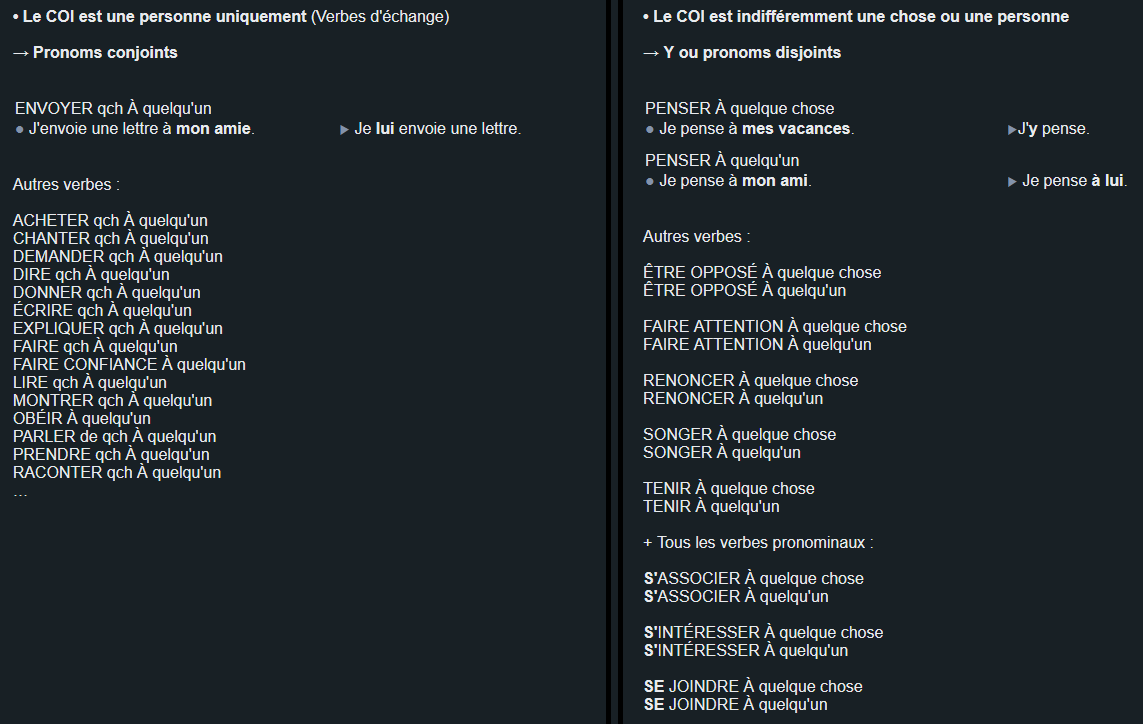
Je lui parle => indirect object, pronom conjoint
Je pense à elle => indirect object, pronom disjoint
Pronoms conjoints typically are used on verbs which primarily refer to animate objects (not simply because the object used happens to be animate) while pronoms disjoints are typically used on verbs which most commonly refer to inanimate objects OR refer to animate and inanimate objects with similar frequency. It's not a clear, hard-cut rule, and simply depends on the verb, but can be a good place to start
delicate sparrow
white dawn
Je lui parle => indirect object, pronom conjoint
Je pense à elle => indirect obj...
So you’d agree that it’d be an indirect object in « penser » but that it couldn’t be replaced by the indirect object pronoun?
white dawn
delicate sparrow
So you’d agree that it’d be an indirect object in « penser » but that it couldn’...
Yes
delicate sparrow
white dawn
Yes
Would you say it’s ‘transitive’?
It seems like there’s a difference between how English defines it and how French does it – at least the Trésor de la langue française
white dawn
Penser right? it can be both
indirect complements count tho yes

Un verbe intransitif n'a pas de complément; un verbe transitif demande un complément direct ou indirect, ou encore deux compléments. Voyez des exemples dans l'article.
delicate sparrow
white dawn
Penser right? it can be both
Specifically the ones with an indirect object like « je pense à Jeanne, il pense de notre vie »
white dawn
yes
hollow cairn
i'll refrain from repeating that you're both wrong on this account, but really it's an insubstantial squabble about word choice
i apologize if i took it too seriously earlier @delicate sparrow
my real point of departure from you is really whether it makes sense to distinguish the verbs by whether they apply to animate or inanimate things
the term indirect object can include complements with prepositions in a strict linguistic sense
there's no disagreement there
but since we often use the term indirect object to refer specifically to the dative case
i guess my point is that it's not strictle a dative to say "je pense à elle"
in the same way it is to say "je lui parle"
and this can be seen by the fact that this truer dative which can be replaced by the pronoun lui always uses the preposition à
while the use of à with penser is as arbitrary as de with rêver and each complement is simply replaced by the pronoun specifically referring to this kind of prepositional complement y and en respectively
the important point being that y and en cannot replace animate nouns, not that the verbs require y and en because they can refer to inanimate nouns
hollow cairn
hollow cairn
my real point of departure from you is really whether it makes sense to distingu...
in this way i believe me and albatros are in agreement
white dawn
I've lost you I think
Both the OQLF and l'Académie française talk about "transitif indirect" where the verb has an indirect object, though
The animate vs inanimate thing is a tendency thing, not a hard rule, and it's possible other things come into play - it's just the most reliable difference that anyone has managed to find, as far as I've seen. Presumably using pronoms disjoints to reinforce clarity of the object when it's less clear that the object may be animate
transitive indirect can also be considered intransitive in that direct objects are typically more important when discussing transitivity, maybe that's where the confusion is coming from?

from l'académie
OQLF ignores that idea though
 delicate sparrow
hollow cairn
i'll refrain from repeating that you're both wrong on this account, but really i...
delicate sparrow
hollow cairn
i'll refrain from repeating that you're both wrong on this account, but really i...
It’s not insubstantial, there is a genuine difference in grammar. English grammarians describe transitivity as having a direct object so ‘I think about you’ wouldn’t be considered transitive because the object is preceded by a preposition. French grammarians seem to define ‘transitivity’ as having an object, be it direct or indirect. Knowing this difference makes sure that, in future when I say that a verb is transitive, there is no ambiguity there.
hollow cairn
whatever you want to call it (transitivity is a pretty good name for it), there's a distinction between verbs which take the dative pronoun e.g. parler and those that don't e.g. penser
that distinction should be made not simply on the basis of animacy
delicate sparrow
hollow cairn
my real point of departure from you is really whether it makes sense to distingu...
Thing is, this also applies to a structure that baffled me for a while: lui/leur dessus / là-dessus. When you have a verb whose object is preceded by the preposition « sur », you can replace the object differently depending on whether or not the object is animate.
For example, if we have a sentence like « je tire sur ce mec », we can replace the object with « je lui tire dessus ». Setting aside the preposition turning into an adverb, this behaviour changes when the object is inanimate. If we have « je me renseigne sur ce problème », we can replace the object with a full adverb without a pronoun : « je me renseigne là-dessus ». Why this pattern? There’s no explanation that covers it other than this animate/inanimate difference.
white dawn
@left temple maybe u can weigh in on this
hollow cairn
i think clearly lui can only be used for people and y and en can never be used for people
white dawn
afaik dative isn't really something that applies to French but considering im not familiar with it regardless I'm not going to be of much help
white dawn
white dawn
I've lost you I think
Both the OQLF and l'Académie française talk about "transit...
starting here should give you most of the info I think
or at the larger bit of what fquel wrote immediately before
 left temple
I've never heard of animacy distinctions in transitivity. Not saying it's not a thing but it's def new to me
hollow cairn
you can say "je lui parle" but only "je pense a lui". the question is whether the only difference is that one can only parle with people so to speak but can pense à whatever, or whether it makes more sense to classify the verbs not based on the animacy of their predicates but based on whether they're "transitive" or not
transitivity is clearly more ambiguously used in french grammar than in english
left temple
the main reason why we learn about transitif direct afaik is to be able to make the agreements with the participe passé
white dawn
for me it's just a matter of pronoms conjoints vs pronoms disjoints, which tend to be related to how common it is for the verb to refer to animate or inanimate objects (pronoms conjoints mainly being used for verbs that mostly have animate objects, pronoms disjoints generally for everything else) not a transitivity thing or lack thereof
left temple
^ this is not knowledge we have as natives lol
delicate sparrow
Oh hey Eowyn, had a bus to catch
white dawn
you'll occasionally hear natives saying it's something about how.. "real" it seems? I think?
there was another theory that I always heard from natives
but it didnt seem to hold much water


 hollow cairn
white dawn
for me it's just a matter of pronoms conjoints vs pronoms disjoints, which tend ...
hollow cairn
white dawn
for me it's just a matter of pronoms conjoints vs pronoms disjoints, which tend ...
yeah this is basically my position
i was just calling the distinction transitive vs intransitive
delicate sparrow
Which is where my disagreement comes in. For me, the distinction is primarily because of animacy/inanimacy because we have a (relatively) clean split between the two because they’re both indirect objects regardless.
I do think that the heart of the question is about the definition of transitivity because the entire thing was sparked by fquel saying that « penser » isn’t transitive which, according to l’Académie, is correct. I argued that it is transitive because it takes an object and that the reason why « parler » can be replaced by an indirect object pronoun whereas « penser » can’t was because objects of the former tend to be animate whereas objects of the latter can either be animate/inanimate (which comes back to the conjoint/disjoint difference) which, according to the TLF, is correct.
hollow cairn
we agree that lui must replace a person and not a thing
the question is whether there is a verb which takes lui but can also take an indirect object that is inanimate with à
i believe there is at least one example

although i can't find an actual example in a sentence, if word reference is right that one can say "donner un coup à quelque chose", then we would have our example disproving your thesis
actually what am i saying, donner just works alone as the counter example
@delicate sparrow
white dawn
Donner as a verb is typically done to animate objects, hence taking a pronom conjoint
I'm not sure what it's disproving
delicate sparrow
hollow cairn
although i can't find an actual example in a sentence, if word reference is righ...
Well yeah it’s listing out the arguments
delicate sparrow
donner à qqch ?
white dawn
What about it
hollow cairn
l'academia francaise gives this as an example "Donner son manteau au vestiaire" but there are plenty of contexts
hollow cairn
white dawn
What about it
bertie's contention is that only verbs which can only be predicated with an animate noun can use the pronoun lui
white dawn
He said "tend to be animate" like I did
hollow cairn
donner gives a counter example since you can obviously use lui with people and it can still take an inanimate noun as an indirect object
hollow cairn
white dawn
He said "tend to be animate" like I did
i don't think so, because then what would we be arguing about
white dawn
I quoted for a reason
hollow cairn
where
white dawn
delicate sparrow
Which is where my disagreement comes in. For me, the distinction is primarily be...
At the end here
white dawn
I think fquel interpreted what you said as pronoms conjoints only being for verbs that can only be used with animate indirect objects
Which I'm not sure there are any verbs like that anyways
hollow cairn
that's definitely how bertie phrased it at the beginning
i mean what's the point of distinguishing them like that if it's just a very soft rule? these verbs work different because they tend to be used for animate nouns. no it's not because of a distinction in the way the verb takes compliments itself, it's just because it tends to take animate nouns
delicate sparrow
In the beginning I did say that it was just a theory
hollow cairn
yeah, i'm aware
delicate sparrow
delicate sparrow
So for « penser à qqch, parler à qqch », if there is an object after that prepos...
.
hollow cairn
yeah, i think the example of donner is a good counterexample to the above
white dawn
It's a soft rule probably in part because people don't usually pay much attention to it or bother to study it
But can be useful to help learners understand roughly why it happens and get a better instinct for it
delicate sparrow
The issue is that we don’t know why « lui penser » doesn’t work and there have been theories made on that very subject. I explained the most plausible theory but given that it was just that, a theory, I didn’t put much stock into it. I concluded by saying that at the end of the day it was just an exception. I emphasised the animate/inanimate element because it would be essential to the adverbial pronouns which take the exact same argument but with an inanimate object.
hollow cairn
ok, my point is that we're confusing "je parle à Jean" as being the same type of compliment as "je pense à Jean" because they look identical
but really what's going on is that the dative lui (i have no better term for it) expands out with à
while penser is using the pronoun à in exactly the same way as rêver
i mean we're not confused why you can't say "je lui rêve"
it's just that that the expanded out lui (if you pardon my terminology) looks the same as the verb taking a compliment with the preposition à
it's only a conundrum if you start from the premise that you say "je pense a Jean" and "je parle a Jean"
as being the same
white dawn
Yeah this is where I'm entirely lost
delicate sparrow
I wanted to expand further into that because there is no animate equivalent to « de » like « Je m’occupe de ma mère » becoming « Je m’occupe d’elle » because we can use the tonic pronoun to replace objects under prepositions like « avec, contre » but then we got derailed by transitivity
hollow cairn
right, but my point is that the "expanded out" (not sure how to phrase it) lui just always takes the preposition à
but it's not the same as the verb using the preposition à to introduce an indirect object (in your language)
just like how in english we can say "I gave him it" or "I gave it to him"
but when one says "I sent him to France", you can't say "I sent France him" without making France animate so to speak
ok it's not a 1-to-1 but the same principle explains at least it's awkwardness in english if not it's ungrammaticality to say "I sent France him"
the principle being that making the dative explicit (yes i know we don't typically call it that in english grammar) specifically takes à or to but it's not the same à or to which other verbs take as a complement
delicate sparrow
Right but that's English grammar where a change in position changes the type of object that follows. English grammar is a bit of a mess because of that change (dative shift IIRC) just doesn't happen in French so I don't know why it would be an example.
I said that « parler à Jean » and « penser à Jean » are the same because they are both indirects; the TLF says it, l'Internaute says it, Le Robert says it, OQLF says it, etcetera. If we go simply by it being a difference of the dative (i.e. you have a recipient) versus just a verb with the preposition à that isn't dative, there are still questions like « ressembler à qqch ». This wouldn't be a dative as there is no recipient yet we can still say « je lui ressemble ». From a learner's perspective, moreover, this distinction between dative vs basic preposition à is not particularly useful because there are verbs that can take « lui » even though they're not dative (je téléphone à lui –> je lui téléphone). It's a lot better to just go, 'These are all indirect objects and these ones are weird because they are' since that's what language resources do.
hollow cairn
you're getting way to caught up on the use of the word dative
but i literally just don't have the vocabulary to describe this
for you to be satisfied
probably because every time someone tries to point this out, everyone else gets caught up on the meaning of the term dative...
whatever you want to call it, it seems clear to me that "penser à" works the same as rêver de" while "parler à" works differently
that's it, that's the distinction i'm trying to make
clearly "ressembler à" works like "parler à"
ok dative is not the right term, transitive is not the right term, there is no right term for this that i'm aware of
but i've explained the distinction i'm making in a dozen different ways and as far as i can see it holds up quite well
delicate sparrow
hollow cairn
whatever you want to call it, it seems clear to me that "penser à" works the sam...
Well yes, that's my argument as well, it's just that I chalked it up to the nature of the object as well as the verb whereas you chalked it up to whatever the term is
Though for « rêver », there is no animate equivalent to « de » so I tend to keep it with the same preposition
hollow cairn
right, but ressembler and donner both show that the nature of the object has really only a weak connection
hollow cairn
delicate sparrow
Though for « rêver », there is no animate equivalent to « de » so I tend to keep...
right, but my whole point is that you're making the wrong distinction
yes, lui verbs, if you'll allow me to call it this for now, tend to be used with people which makes sense as lui can only be used with people but it's not a particularly hard rule
left temple
"J'aime beaucoup cette pierre, je lui ai donné un nom"
hollow cairn
even better
left temple
That's not a person though
Wasn't that your argument
Or was your argument that it's not a hard rule?
I'm struggling to keep up
delicate sparrow
That was mine
to say that « lui » would be used for people
Like sure, yeah, that's personification, TLF lists that
hollow cairn
left temple
Wasn't that your argument
nooo
it wasn't my argument lmaoo
my argument is forget animacy
delicate sparrow
 hollow cairn
although i agree with bertie here that you're anthropomorphizing the rock here
just like in english you might say "i give him a name, rockie the rock"
left temple
I'm about to go to sleep but might be a good idea to summarise your guys' point maybe
hollow cairn
i've done that like 5 times, honestly i'm pretty satisfied with the whole thing
left temple
Fair enough, I didn't follow much
delicate sparrow
left temple
I'm struggling to keep up
My argument is that the reason why we can't say « je lui pense » for « je pense à lui » but that we can say « je lui parle » for « je parle à lui » is because « penser » is an exception to indirect objects being replaced by an indirect pronoun phenomenon. A theory has been put forth about the different coming down to whether or not the indirect object is strictly animate or can be both (conjoint/disjoint as Albatros said in his first message). It's not a hard rule, it's just the plausible theory.
fquel's argument is that the reason why we can't say « je lui pense » for « je pense à lui » but that we can say « je lui parle » for « je parle à lui » is because the two verbs, though superficially similar (Preposition à + object), they fundamentally describe different things where « parler » uses the indirect object as a dative and « penser » uses in a sort of complement that isn't a dative.
I think we've moved on from transitivity as a 'French says X, English says Y' situation
Do correct me if I've misrepresented your argument, fquel
hollow cairn
yes that's basically my argument
left temple
I thought you guys were disagreeing. But yeah "penser à" introduces a kind of topical whereas "parler à" introduces a dative
delicate sparrow
left temple
I thought you guys were disagreeing. But yeah "penser à" introduces a kind of to...
Aight
white dawn
left temple
I thought you guys were disagreeing. But yeah "penser à" introduces a kind of to...
What's the difference
left temple
the topical is pretty broad/vague but basically the "à" in "penser à" is equivalent to “about”
the dative implies a recipient
left temple
keeping in mind that each language treats declensions differently
in German for example there are a lot of verbs that trigger the dative, whereby they imply a recipient, but wouldn't in English
http://deutsch.ie/german-grammar/german-verbs/german-verbs-dative-verbs/
Deutsch.ie
Brush up on your German dative verbs with our themed vocabulary lists and memory games! Learn new German nouns, verbs & adjectives quickly and easily.
a good example is “to follow”, which is a dative verb in German
“to follow (to) someone”
ah yeah “to help” is the other big one I was thinking about
German speakers learning French will tend to say "je lui aide" because that's how they do it natively
interestingly it does make a lot of sense that “to help” would imply a recipient, at the extreme you could argue that French isn't as logical as German about it
white dawn
Interesting