#the_dark_moon208
1 messages · Page 1 of 1 (latest)
 knotty kestrelBOT
Please be patient
Our volunteers look into many questions every day; sometimes it takes them a little while to answer.
Pro tip: you can rename the thread title with `.tr <thread name>`
Make it descriptive, including relevant context, but also to the point. This way you improve your chances of getting a more relevant and specific answer.
 acoustic glacier

 slim latch
That will depend on
- Quantity: are you talking to a group of people (plural)?
- Formality: are you using formal/polite address with an individual?
acoustic glacier
It's a bit humorous but it works
 raw gull
Thanks a lot
acoustic glacier
Do note that « votre/vos » and « ton/ta/tes » depend on the noun you're modifying, not the person that owns said noun
you can think of it as a sort of flowchart
Who owns this noun?
(1) One speaker [singular first-person] => mon, ma, mes
–> Is the noun singular or plural?
––> Singular => mon/ma
–––> What is its gender? Masculine = mon (*) | Feminine ma
––> Plural => mes
(2) One listener (friend) [singular/informal second-person] => ton, ta, tes
–> Is the noun singular or plural?
––> Singular => ton/ta
–––> What is its gender? Masculine = ton (*) | Feminine ta
––> Plural => tes
(3) Someone not involved in the conversation [singular third-person] => son, sa, ses
–> Is the noun singular or plural?
––> Singular => son/sa
–––> What is its gender? Masculine = son (*) | Feminine sa
––> Plural => ses
(4) Multiple speakers [plural first-person] => notre/nos
–> Is the noun singular or plural?
––> Singular => notre
––> Plural => nos
(5) Multiple listeners/one senior listener (boss) [plural/formal singular second-person] => votre/vos
–> Is the noun singular or plural?
––> Singular => votre
––> Plural => vos
(6) Multiple people not involved in the conversation [plural third-person] => leur/leurs
–> Is the noun singular or plural?
––> Singular => leur
––> Plural => leurs
(*) Singular feminine words/adjectives that start with a vowel tend to use the singular masculine to avoid hiatus or a gap between two vocal sounds. Compare: « son école / sa grande école » and « ma maison / mon ancienne maison ». The noun doesn't change, just the possessive.
 grave frigate
;tu
knotty kestrelBOT
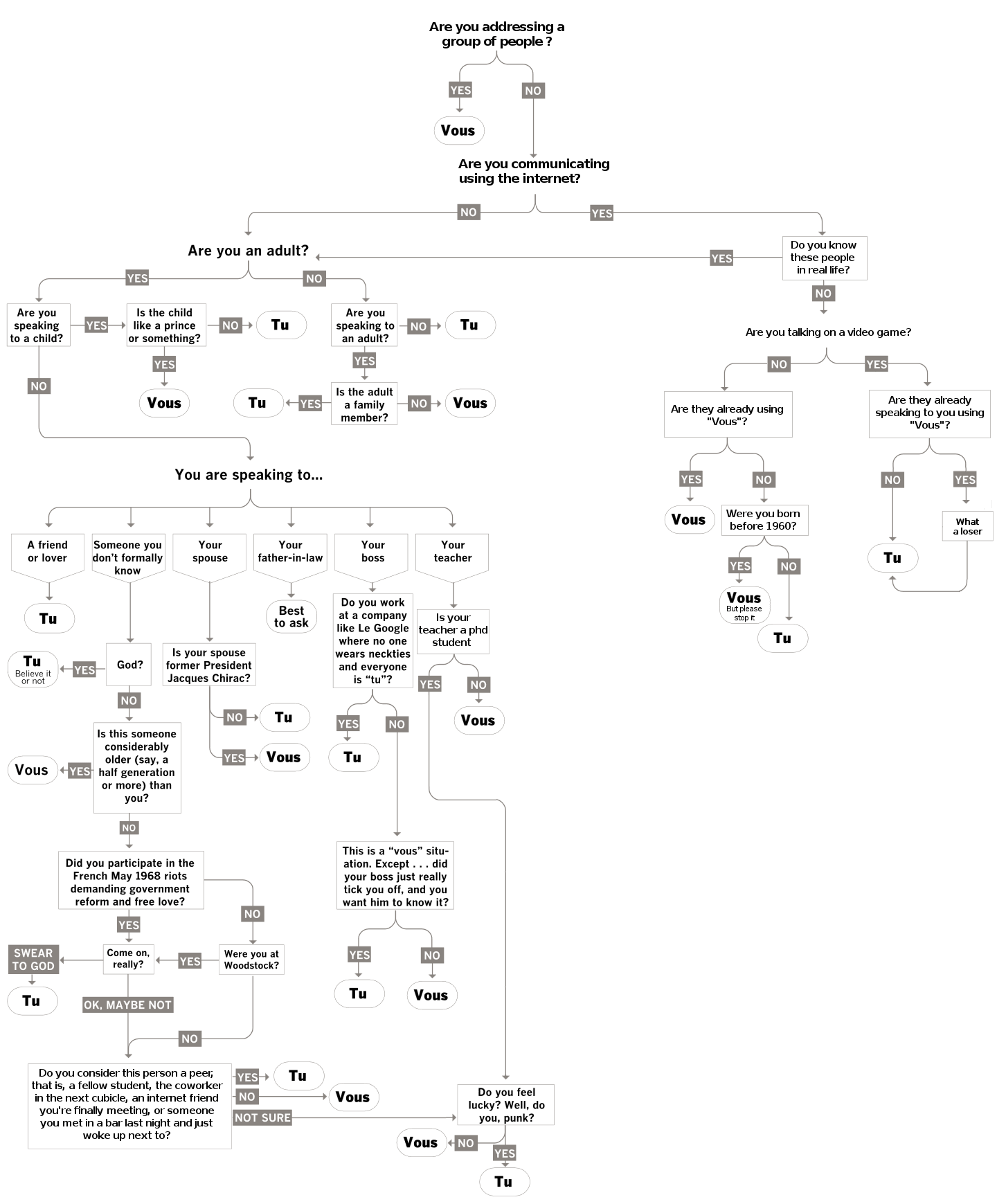 acoustic glacier
ah so that was the excerpt command
I forgot so I ended up uploading the whole thing from Reddit lol
grave frigate
I like the longer version
acoustic glacier
grave frigate
I like the longer version
that is the longer version
acoustic glacier
grave frigate
?
The one I sent in the beginning is the longer version
acoustic glacier
no it isn't
slim latch
This is the only difference; the first starts where my screenshot ends instead of in the section above.
 grave frigate
Ye
acoustic glacier
the shorter one just starts at the 'Are you an adult part'
oh wow I just noticed that
grave frigate
Yes like I said urs is longer than the original but doesn't include talking to a group
People often forget abt that part when they get too wrapped up in the singular differences

 acoustic glacier
 mental night
???? Didn’t get this
mental night
???? Didn’t get this
when you're talking to someone in a game (the internet in general) you use just « tu »
mental night
So if you say vous then you are a loser
acoustic glacier
the internet's meant to be a place where everyone of any age or whatever can come together so adding distance like using « vous » does gives off weird vibes
mental night
Does French have modern pronouns like xir etc
acoustic glacier
neopronouns?
mental night
Yeah
acoustic glacier
yes though they're way less used
« iel, iels, ielleux »
basically mashing « il » and « elle » together
acoustic glacier
yes
it's still a third person pronoun
the difference is when you introduce adjectives
since adjectives have to agree in gender
« Il est grand »
« Elle est grande »
What would you do with « iel » ? You put both: « Iel est grand.e »
acoustic glacier
same thing in the plurals
« Ils sont grands »
« Elles sont grandes »
« Iels sont grand.e.s »
mental night
Old French people surely are gonna cry about this 😂
acoustic glacier
Do note that non-binary people are more fluid on this in speech because « iel » just might sound like « elle »
and there's no way to pronounce « grand.e.s » so in oral, NBs often opt for the masculine or the feminine
mental night
acoustic glacier
and there's no way to pronounce « grand.e.s » so in oral, NBs often opt for the ...
Is there any verbs where the conjugation is different between il and Elle
grave frigate
Conjugation doesn't vary by gender
acoustic glacier
if you're doing past participles, they may differ if the auxiliary is « être » because past participles are adjectives
but that's not really conjugation
the part we're referring to by saying 'conjugation' just affects the auxiliary verb
grave frigate
The auxiliary can either be avoir or être
mental night
Il as regardé not il es regardé
grave frigate
The past participle can be any verb
mental night
Sorry I meant auxiliary also
acoustic glacier
mental night
Sorry I meant auxiliary also
For the majority of verbs, avoir is the auxiliary
that's why we try to ease people in
être is the auxiliary for a handful of verbs (arriver, venir, mourir – MRS VANDERTRAMP) and the pronominals (s'appeler, se souvenir, etc)
Since all pronominals take « être », the real challenge is in those handful of vandertramp verbs
grave frigate
Pronominals are a bit funky cuz they use être but under the hood they're rly avoir