#icanonlydosomuch
1 messages · Page 1 of 1 (latest)
 ancient warrenBOT
Please be patient
Our volunteers look into many questions every day; sometimes it takes them a little while to answer.
Pro tip: you can rename the thread title with `.tr <thread name>`
Make it descriptive, including relevant context, but also to the point. This way you improve your chances of getting a more relevant and specific answer.
 finite cape
When a verb has an object introduced by a preposition (usually à), said object is indirect.
J'ai écrit une lettre à Pierre.
Here, the bolded part represents an indirect object.
You can replace it with the corresponding indirect pronoun.
Je lui ai écrit une lettre.
 solemn cedar
Assuming you're a native English speaker this can be particularly confusing since we use the same object pronouns for direct and indirect sometimes
I wrote him a letter (I wrote a letter to him)
I hit him
Je lui ai écrit une lettre
Je l'ai frappé
 stray relic
finite cape
When a verb has an object introduced by a preposition (usually à), said object i...
stray relic
finite cape
When a verb has an object introduced by a preposition (usually à), said object i...
so je would be the direct object in this sentence, why does the indirect object appear right after the direct object, and would that always be the case?
 iron idol
stray relic
so je would be the direct object in this sentence, why does the indirect object ...
iron idol
stray relic
so je would be the direct object in this sentence, why does the indirect object ...
« je » is the subject not the object
stray relic
oops yes
iron idol
stray relic
so je would be the direct object in this sentence, why does the indirect object ...
There's an order to it
« écrire qqch à qqn »
stray relic
so would the indirect pronoun always come after the subject?
iron idol
stray relic
so would the indirect pronoun always come after the subject?
Object pronouns, be they direct or indirect, come before the verb they modify
stray relic
mmmmmmmm ok that makes more sense
iron idol
Tu lui parles (You're talking to him)
Tu veux lui parler (You want to talk to him)
Tu le vois (You see him)
Tu peux le voir (You can see him)
stray relic
sooooo instead of saying "je parle avec il" i can say "je lui parle"?
iron idol
As you can see, the object pronouns come before the verb they modify. For the indirect that's « parler », for the direct that's « voir »
iron idol
stray relic
sooooo instead of saying "je parle avec il" i can say "je lui parle"?
No, « lui/leur » only works with « à + qqn » and « pour + qqn » in some cases
qqn = quelqu'un (someone)
Also, it's « je parle avec lui »
« il » is the subject pronoun
« lui » can be a bit confusing at the start since it can either be the indirect object pronoun (to him/to her) or the masculine singular tonic pronoun (him in the sense of 'Him, that guy there')
but the positioning helps
« lui » as an indirect object pronoun will always be placed before the verb while « lui » as a tonic will not be
stray relic
bertiebear do u know spanish? i am a native spanish speaker and english is my 2nd language, if i have a tough time understanding in english i try to conceptualize it in spanish it makes it easier for me
stray relic
iron idol
« écrire qqch à qqn »
can you explain a little bit on qqn? also, qqn = someone, what does qqch mean?
 hasty pendant
stray relic
can you explain a little bit on qqn? also, qqn = someone, what does qqch mean?
hasty pendant
stray relic
can you explain a little bit on qqn? also, qqn = someone, what does qqch mean?
qqn = quelqu'un = someone
qqch = quelque chose = something
iron idol
stray relic
bertiebear do u know spanish? i am a native spanish speaker and english is my 2n...
unfortunately no
iron idol
stray relic
the equivalent of them?
to them
'them' on its own can mean different things
stray relic
ex: je leur envoie des textos
stray relic
ok one last one, what about te and t'
iron idol
stray relic
ok one last one, what about te and t'
t' is just te but before a vowel or a mute H
Je te vois / Je t'ai vu (te + ai vu)
iron idol
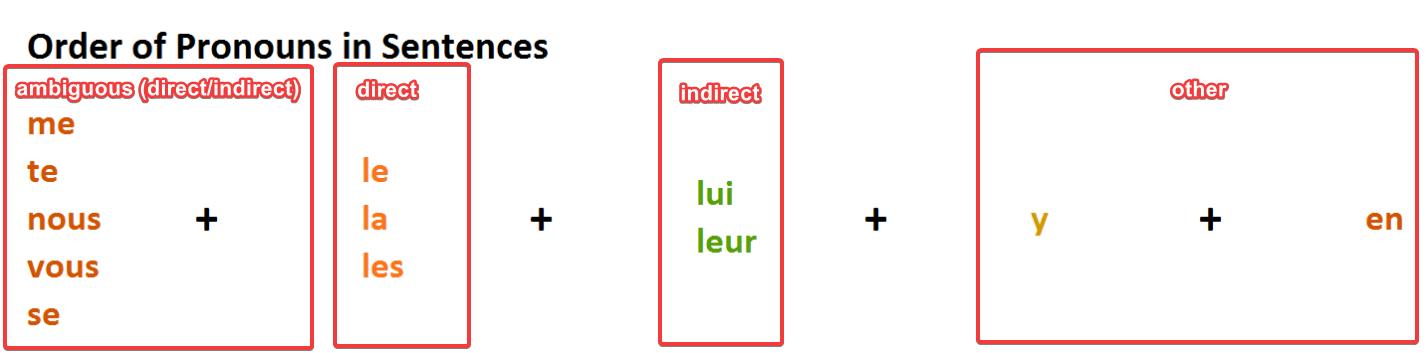
That being said, the first and second persons are 'ambiguous' in the sense that their direct and indirect forms are the same
stray relic
if there is one
iron idol
« Je te parle »
« Je te vois »
Both use the same pronoun but it's indirect in the first one and direct in the second
iron idol
stray relic
whats the te equivalent
singular you
stray relic
so je te parle would be i talk to you
iron idol
mmhm
iron idol
no problem