#dottelm
1 messages · Page 1 of 1 (latest)
 alpine bobcatBOT
Please be patient
Our volunteers look into many questions every day; sometimes it takes them a little while to answer.
Pro tip: you can rename the thread title with `.tr <thread name>`
Make it descriptive, including relevant context, but also to the point. This way you improve your chances of getting a more relevant and specific answer.
 oblique coyote
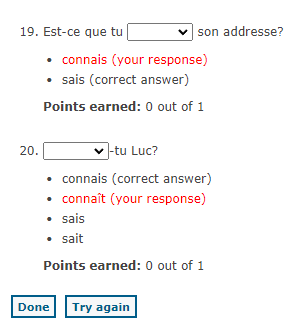
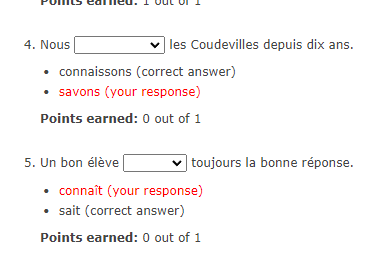
https://imgur.com/3sGphKd i understand 4 now, and 5 kinda just seems like a general knowledge statement so i think i get that one now too
 frigid echo
I don't think it matters if it's a direct object or not.
I'm not sure the ones about address and phone number are the best questions...I'll let a native weigh in. I would have thought connais or sais would work for son addresse and son numéro de téléphone. It's possible sais is more formally correct or something.
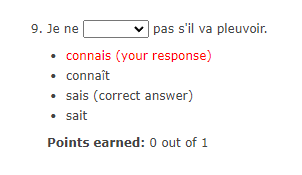
Definitely connais-tu luc is necessary. And the ones about knowing people, or knowing a location, those should all be connaitre. And the knowledge of when it will rain, or always having knowledge of the correct response would be savoir.
I see how the lawless french article comparing connaitre and savoir seems to imply savoir isn't used with direct objects or something...it talks a lot about the uses when there is a dependent clause or a verb...
 feral sparrow
we usually use connaître with nouns, and savoir with verbs but obviously there are exceptions. I've never heard of a rule where we have to take into account whether or not its a direct object.
personally, I agree with you on the address and phone number questions. I would say « je connais mon numéro de téléphone » and « je connais ton adresse ».
savoir is a simple knowledge of something
je sais que 2 + 2 = 4
est-ce que tu sais quelle heure il est?
il sait ce que t'as fait
je sais lire en allemand
ils ne savent pas se retenir
etc.
connaître is a more in-depth working knowledge of something — a place, a person, an event, a system, a rule — anything that can be deep, have moving parts or otherwise not be a simple fact.
je connais ma sœur, elle le fera pas!
ne t’inquiètes pas, je connais bien cette route
ne me demande pas, je ne connais pas ces impacts économiques
j'aimerais connaître cette règle
etc.
you can (loosely) translate savoir as to know and connaître as to be familiar with.
therefore you can savoir something withing connaître it, for example
je sais qu'il y a un raccourci ici mais je ne le connais pas
meaning you know there is a shortcut here but you're not familiar with it, that is to say that you don't know if it's... short, long, steep, rocky, where it starts or ends, if it's safe, etc.
you know of it, but you're not familiar with it
feral sparrow
our pleasure!
 oblique coyote
merci
oblique coyote
as far as i understand, sais is 'to know' and connatire 'is familiar with' . somehow thinking too hard about it doesnt make it make more sense though
sais is for stuff like 'i know how to' and facts and stuff. verbs
connais is more for nouns, people, abstract things?
if i think about it too much it all starts to feel like that all could be considered relative or some crap
feral sparrow
oblique coyote
as far as i understand, sais is 'to know' and connatire 'is familiar with' . so...
thats right. simple fact → savoir, deeper understanding → connaître
also, little side note, but when we use savoir with a verb, in english we have to say « know how »
I know how to cook
je sais (comment) cuisiner
but in french, we often drop the comment from the sentence. its not wrong to add it, but we often dont
je sais lire en allemand
je sais multiplier sans calculatrice
je sais le faire
etc.
feral sparrow
oblique coyote
connais is more for nouns, people, abstract things?
yes things that can be deep — there are many things you can know about a person — their height, age, personality, behavoiour, etc. so we use connaître
same with rules — how to use them, when to use them, where to use them, etc — it is not a simple fact, so we use connaître
you'll get it more as time goes on and you hear it being used in everyday conversation, but honnestly, i think you already have the hang of it
oblique coyote
not every nook and cranny but ill get there
feral sparrow
🫡 good work soldier!

 feral sparrow
oblique coyote
https://media.discordapp.net/attachments/474602906260078602/1096523517803114556/...
feral sparrow
oblique coyote
https://media.discordapp.net/attachments/474602906260078602/1096523517803114556/...
let us know if you need any help 🙂
oblique coyote
for sure. thank you soldier