Howdy, I've been learning more about paint properties from an artist perspective as opposed to a mini painter perspective. Something I've been mulling about is saturation of color and how it plays out in contrast paint. From my understanding, contrast paint pull in paint into recessed areas. From eyeballing models, this seems to increase the saturation of the recessed areas as well as usually making them darker. However, from my reading it seems that areas in shadow tend to be about the same saturation level as midtones and highlights (with a white light source etc.) Is my understanding of what contrast paint is doing right? Is this something that you just accept as a property of the approach when you use it?
#Contrast Paint - Does it add saturation to shadows?
28 messages · Page 1 of 1 (latest)
 lunar heath
 leaden ermine
I understand the same thing for contrast paints as you
you have to just accept them for that when you use them. Trying to correct that would be tough
as for the ideal that you try and do when you do layers, depending on painting style, if you go for more realistic, both ends of the lighting spectrum (high lights and deep shadows) are expected to be desaturated.
that doesn't mean zero color necessarily, but indeed the original contrast paints set having very saturated tones has always felt weird to me. Maybe that's another reason I really like Black Templar over the other pots?
I tried desaturating them and I didn't like the result (in part because it's hard to have a good mix for desaturation, in part because when the shadows are desaturated, so are the mid tones with contrast paints. 🤷♂️ )
they're still very efficient for tabletop readiness
 halcyon trout
Isn't that why transparent paints look better over a zenithal prime or a "white drybrush over black"? Keeping dark paint in the recesses helps you to fight the oversaturated shadows.
 kindred escarp
Artistically speaking, it depends on what style you are aiming for. If you want realism in your minis: avoid contrast paints. They are made to be an easy one coat color for tabletop miniatures. As any other medium you can incorporate them into your own method knowing their properties to get the results you want with them. That said, they will perform somewhat better like Marbull said, on top of a zenithal underpaint or grisaille. Not all shadows will be in recessed areas anyways, so you can always correct that before (grisaille) or after using the correct saturation. Whatever works for you 😅
lunar heath
leaden ermine
they're still very efficient for tabletop readiness
yeah, that's certainly true. I like how effective they are, just trying to decide what approaches might be equivalently quick but more accurate 🤔 like, if I use transparent paint over a zennithal that should give a similar effect of the contrast in that I quickly get color but without the pooling to recessed areas. I'll have to just give that a try and see if it works appropriately. Could just do with the airbrush too I suppose
leaden ermine
lunar heath
yeah, that's certainly true. I like how effective they are, just trying to decid...
A transparent paint won't have the same effect as contrast because it doesn't use the same medium. Pigments don't get so forced together in a normal medium as they do in contrast paints (in part because the surface tension is much less). The result is that a transparent paint in usual medium will have its pigments more uniformly spread, instead of being able to focus in the recessed.
A wash will be closer but still different. I don't know how to describe it. I guess the best is for you to try and see for yourself these behaviours.
In general, more realistic has meant more time to spend per mini .
If limited time is your path and you want to do a bit more than contrast paints, I would probably do like @kindred escarp said and upgrade some specific areas after contrast paints applied. I would therefore not focus on m'a le ING the shadows desaturated (unfortunately) but more on making specific details pop, expanding or reducing some shadows that are not recesses, etc. All of which are good learning too.
kindred escarp
https://youtu.be/Mt0oaltZ2IU good example of use of contrast paints

High Quality Speed Painting™ with Renaissance techniques, acrylics and a brush!
You can find the REAL TIME footage of my videos on Patreon ►https://www.patreon.com/notjustmecha
To SUPPORT the Channel ►
Add something cool to your collection asking for a commission or
!!! PATREON: https://www.patreon.com/notjustmecha !!!
EBAY: https://...
halcyon trout
Other good examples of transparent paint over grisaille:
https://youtu.be/5GoX6tgxFG4
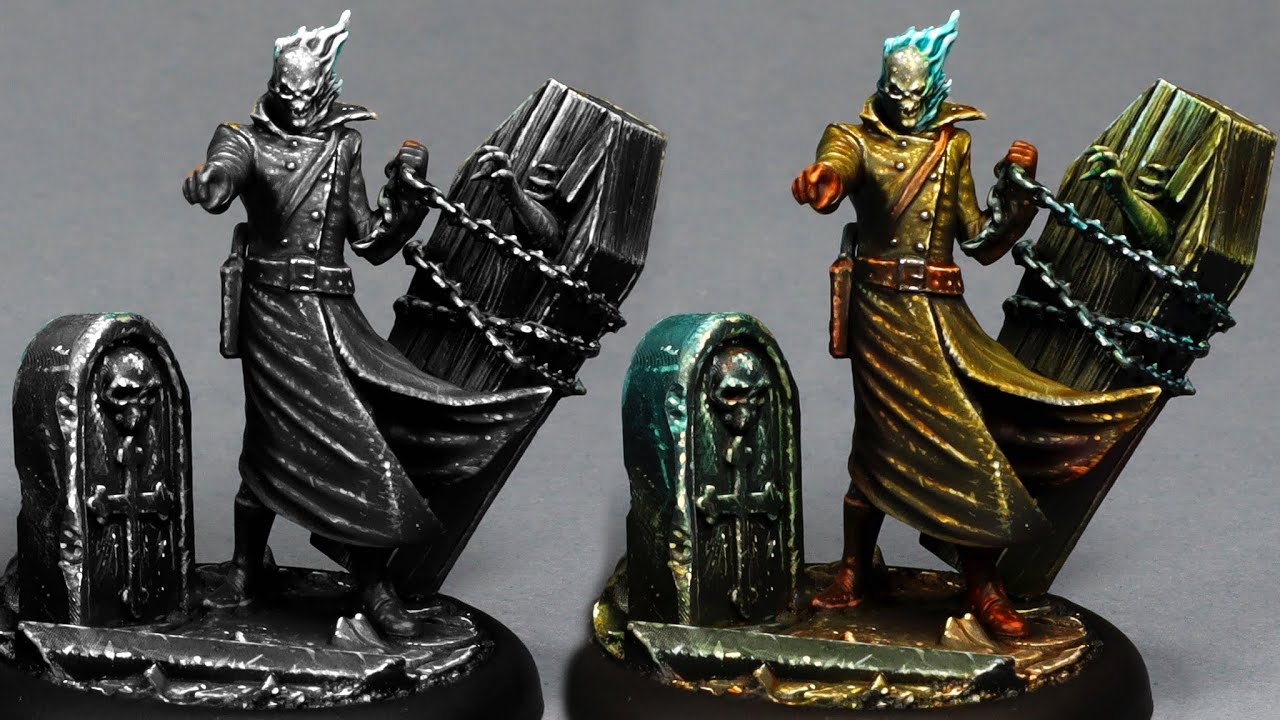
Ready for homework? In this video we talk about textures and painting "en grisaille" and how to combine this classic technique with Contrast paints!
REAL TIME footage on Patreon! ► https://www.patreon.com/notjustmecha
To SUPPORT the Channel ►
Add something cool to your collection asking for a commission or
!!! PATREON: https://www.patreon...

In this video, I'll show you how to save time and get smoother blends by using color glazes, and as a bonus I take you step by step through my process of painting squigs!
Supplies I use in this tutorial:
Vallejo Glaze Medium
Vallejo Model Color Pale Sand
Vallejo Model Color Orange Red
Vallejo Model Color Clear Orange
Vallejo Model Color Vermil...
Dana does not use contrast paint in this one and maybe it is closer to what you mentioned.
 open patio
Marco, as per the videos linked, used contrast paints very interestingly. After some kind of zenithal or value sketch, he'll sometimes go over areas with contrast paints to get some colour and tonal values into the models.
The pooling helps to keep the revealed surfaces lighter, while adding more into the recesses and shadows.
Don't think of a model as "base, layer highlights" but consider a wider variety of values to search for.
Contrast paints are certainly not a '1 coat gimmick for table top' but are instead convenient high pigment paints with a low surface tension. You can make similar mixes yourself with inks, flow improver, and maybe some medium.
Here's a great video of marcos, showing how you can use a wide variety of tools, and techniques, to build up different effects and illusions, to create some stunning work.
Contrast paints are just another "tool for the artists toolbox"

Advance theory put into advance practice on a display/competition model!
You can find EXTRA CONTENT and the REAL TIME footage of my videos on Patreon! ► https://www.patreon.com/notjustmecha
The Model:
Major Tom sculpted by Raffaele Picca for FeR Miniatures
https://ferminiatures.com/shop/forged-monkey/major-tom/
To SUPPORT the Channel ►
Add ...
An introduction to lighting and values

This time we talk about light and contrasts (yep plural!) and we'll see 5 ways to improve the look of your models + a juicy final trick!
Support the Channel with Patreon! ► https://www.patreon.com/notjustmecha
To SUPPORT the Channel ►
Add something cool to your collection asking for a commission or
!!! PATREON: https://www.patreon.com/...
 copper moth
just to add a bit..
Contrast paints add occlusion shadows, zenithal highlight adds self shadowing (and sometimes cast shadows). That's partly why they complement each other so well.
Also, the contrast paints have some things in common but they don't all work the same. Some of them seem to be formulated in such a way that they have some extra heavier pigments that settle only in the recesses, often to darken them, you can usually see it sediment on the bottom if you haven't shaken the pot in a bit.
Thirdly, I just don't agree that they have the same saturation everywhere. They have the most saturation in the midtones, they are darker (and thus of lower saturation) in the recesses and very low saturation on the high points, due to the amount of (usually white?) primer that shines through. In fact, one of the things that makes one-coat contrast coats not look so good is due to the amount of desaturation in the highlights, that's why the contrast paint + highlight strategy that Juan Hidalgo champions is so powerful as it allows him to make the highlights brighter and retain more saturation by picking his highlight colors well (also by applying them in a zenithal fashion)
There are some exceptions to the saturation bit, the really thin ones like Aethermic blue,, Magos Purple, Volupus Pink, etc, those actually have the most saturation in the shadows but almost no saturation anywhere else since they're so thin. But for the run of the mill high saturation ones that there are the most of, this holds true.
It would be so helpful if they'd tag the various contrast paints to what category they belonged to so people could predict how they will look coming out of the pot.
Also, if you want to desaturate the shadows more and you're using a high saturation contrast paint, just apply another layer just in the shadows, you can do it with a wash, the same contrast paint, an ink or even wet blend them with a darker contrast paint.
open patio
copper moth
Also, if you want to desaturate the shadows more and you're using a high saturat...
Yeah, they're really useful, if you know which one works well for whatever you're trying. Some of them even mix ok, others just turn to grey. Can't forget they're also really expensive.
lunar heath
halcyon trout
Dana does not use contrast paint in this one and maybe it is closer to what you ...
yeah, that's pretty much exactly what I am talking about except less layers. Dana does quite a build up of colors
damn ya'll, these are really great resources and thoughts, I wish I had a more informed perspective to contribute but I have found this very thought provoking and useful