#German History
17 messages · Page 1 of 1 (latest)
 frigid oxide
 placid obsidian
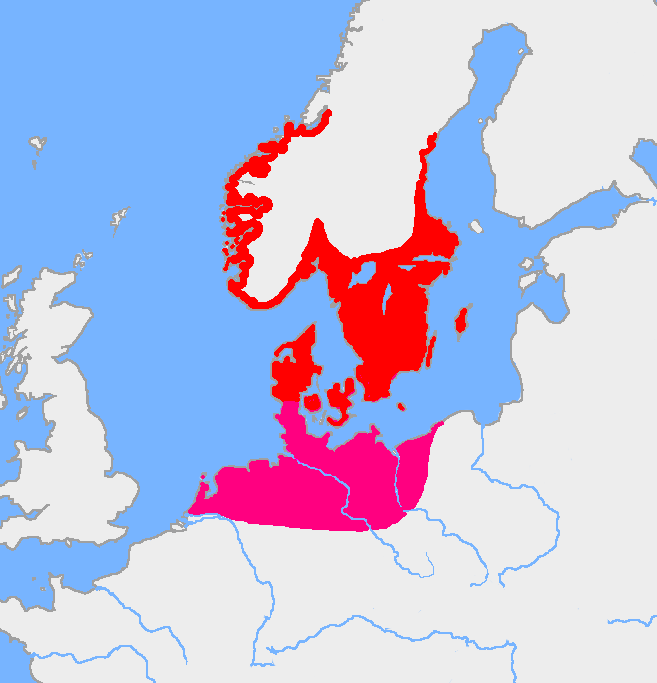
Proto-Germanic (abbreviated PGmc; also called Common Germanic) is the reconstructed proto-language of the Germanic branch of the Indo-European languages.
Proto-Germanic eventually developed from pre-Proto-Germanic into three Germanic branches during the fifth century BC to fifth century AD: West Germanic, East Germanic and North Germanic, which ...

 frigid oxide
placid obsidian
frigid oxide
placid obsidian
So, German came from a specific line of germanic?
placid obsidian
frigid oxide
So, German came from a specific line of germanic?
Yes.
frigid oxide
placid obsidian
Yes.
Do you know why some languages went extinct?
placid obsidian
I don't know specifically, but one common way they go extinct is that the language exists in a region with other languages and those languages take over. People stop teaching their kids to speak it.
 cerulean grove
There can be multiple factors for a language disappearing:
i) Not teaching your children because another language might offer them a better chance at life.
ii) Oppression by a government trying to "unify" the ruled over territory.
iii) Disappearance of the (distinct) ethnic/culture group that spoke the language by plague and war or by killing off the intellectual and ruling class of said group.
iv) Disappearance of the (distinct) ethnic/culture group after successful wars, when the group of victors intermingles/intermarries with the group of losers. Apparently languages are mostly taught by mothers, so if an invading force is mostly comprised of men and small compared to the existing population, that can make the tongue of the invader disappear within a few generations.
I'm not a language expert, so my attributions may not reflect the current scientific understanding of the matter.
But I would expect Gaulish having died out due to (i), Cornish due to a combination of (i) and (ii), and Gothic (in the Mediterranean regions like Spain and Italy) due to (iv) mostly - for other regions I have no idea, but suspect (iii), mostly.
Another language that disappeared mostly because of (iii) would be Illyric (which wasn't a Germanic language). Also ancient Greek, due to (ii) and (iii).
(i) is a reason why a lot of dialects disappear.
Also the list of Germanic languages is not complete. Burgundian - for example - is missing.
frigid oxide
Do you mean like German tends to sound towards a french accent, and then otherwise french sounds like a German accent? 🤔
 crystal ledge
True for French German. I'd be curious to hear German French ^^
frigid oxide
All languages take long to learn, especially if you didn't start as early as possible.
frigid oxide
Okay, is it just me or do like people who speak German in conversations, don't talk as fast, or is there some factor of english words being partially derived from German?
cerulean grove
frigid oxide
Okay, is it just me or do like people who speak German in conversations, don't t...
I don't understand what you mean with the first part of your sentence.
For how English is derived, the most prominent ingredients are - first - an early Germanic variant which was brought in by the Angles and Saxons (who migrated there after the Romans had left the island to it's own devices) and which was later renewed with a different variant by the Vikings (England used to belong to a Danish/Scandinavian kingdom for a while), and - second - an early form of French, which was brought in by the Normans (who used to be Vikings but had settled in northern France for over a century, adopting the language). For several hundred years, the language of the common people was mostly derived from Germanic/Scandinavian which the nobility almost exclusively spoke French (and, of course, the clergy spoke/wrote in Latin).
That's why there are a lot of doubled words in the English language - one with French roots considered high-class and one with Germanic roots considered low class.
Roughly the same happened in the German language, by the way - although the time periods are different and there is much more direct Latin (rather than French, which is itself derived partially from Latin) in the mix. The discussion about "Denglisch" (German sprinkled with English words and phrases) as a distorted version of German in the last few decades is rather similar to a phase in the 17th century, when Latin and French started to enter the German language en-masse. See this poem from 1642, which is (after a short introduction) basically an ABC of such new words, some of which have since disappeared, some are now considered "standard" German: https://de.wikisource.org/wiki/Ein_schön_new_Lied_genannt_Der_Teutsche_Michel
 crude moth
frigid oxide
Okay, is it just me or do like people who speak German in conversations, don't t...
crude moth
frigid oxide
Okay, is it just me or do like people who speak German in conversations, don't t...
Different languages, similar encoding efficiency: Comparable information rates across the human communicative niche
https://www.science.org/doi/10.1126/sciadv.aaw2594
Syllables per second (SR)
Information density (ID)
Information rate (IR)
Excerpt from the abstract:
_We show here, using quantitative methods on a large cross-linguistic corpus of 17 languages, that the coupling between language-level (information per syllable) and speaker-level (speech rate) properties results in languages encoding similar information rates (~39 bits/s) _
Excerpt from the discussion;
The most notable result is that languages are much closer in terms of IR than in SR. Despite the across-language dispersion observed for ID and SR, their regulatory interaction seems to give rise to a universal attractor. This result is far from trivial, especially considering that the substantial freedom speakers have to depart from their average SR without any apparent effort.
AAAS

Fig. 1 SR and IR.
The distribution of SR (in syllables per second) (left) and IR (in bits per second) (right) within the languages in our database (colored areas; colors represent the language families) and across them (black areas at the top) using a Gaussian kernel density estimate. The black vertical lines spanning the whole plot represent the means (solid lines) ± 1 SD (dashed lines). The short black vertical lines represent the actual data points.
crude moth

Babbel Magazine
Does it seem like that Spanish is faster than English? It's not all in your head. New research has shed light on the truth of language speed.