#questions-2
1 messages · Page 136 of 1
 sacred jackal
Like why in some sentences we have to reverse subject and the verb (like in question)
Like for exemple (jetzt muss ich eine pizza nehemen )
(Im so bad in german btw xD)
 fervent kernel
 steel patrol
But maybe proper "gym bros" have different lingo, I don't know.
steel patrol
But maybe proper "gym bros" have different lingo, I don't know.
What would be the best place to learn "Fachsprache" but from Gym Bros?
steel patrol
sacred jackal
Like for exemple (jetzt muss ich eine pizza nehemen )
Cause German sentence structure 🌈 🌈 🔥
fervent kernel
sacred jackal
Like for exemple (jetzt muss ich eine pizza nehemen )
I mean, it Puts a different emphasis on a different part of the sentence
steel patrol
fervent kernel
What would be the best place to learn "Fachsprache" but from Gym Bros?
Not sure, maybe just try searching for some informative and/or instructional fitness videos on YouTube?
fervent kernel
sacred jackal
Like for exemple (jetzt muss ich eine pizza nehemen )
Your example implies that JEZT because of Something that Happens, you are required to Take a pizza
steel patrol
In German,I mean.
 pure walrus
What is a difference between "drohen" and "bedrohen"?
sacred jackal
fervent kernel
Your example implies that JEZT because of Something that Happens, you are requi...
Thank you so much for clarifying.
 near folio
pure walrus
What is a difference between "drohen" and "bedrohen"?
near folio
pure walrus
What is a difference between "drohen" and "bedrohen"?

German Language Stack Exchange
Example: Die Ukraine droht Russland nicht, aber die ukrainische Revolution bedroht Putin.
pure walrus
near folio
https://german.stackexchange.com/a/12093
Thank you. I just saw that in my example passive is used.
 drifting mulch
Another few questions
Ich dusche ___ am Morgen.
Is it mich, mir, ich, sich and why?
steel patrol
drifting mulch
Another few questions
Ich dusche ___ am Morgen.
Is it mich, mir, ich, sich and ...
What would your guess be?:)
 half arch
It'd be mich
But I'm not really good with theoretical grammar
So I can't really explain it
steel patrol
drifting mulch
I’m leaning towards mir or mich
To my knowledge it would just be "ich dusche jeden Morgen," but it you must use one of the two then it would definitely be the Accusative case (since you're performing the task/action on yourself).
drifting mulch
Ok I found this chart and mich seems to fit the criteria
half arch
steel patrol
To my knowledge it would just be "ich dusche jeden Morgen," but it you must use ...
You're right, but "Ich dusche mich." works too
steel patrol
half arch
You're right, but "Ich dusche mich." works too
Schön! But, just to clarify, is "mich" in "ich dusche ... " optional then?
steel patrol
Wonderful
 empty flume
Guten Abend, Ich möchte eine Bewerbungs Email schicken, nur ich weiß nicht ob das stimmt oder überhaupt höfflich ist: Im Anhang sende ich Ihnen die benötigten Unterlagen, um mich initiativ für ein Praktikum in Ihrem Unternehmen als Praktikant zu bewerben.
Könnte sich jemand zeit nehmmen, um es anzuschauen
 swift bough
Eigentlich klingt das meiner Meinung nach grammatikalisch ganz perfekt und außerdem ziemlich förmlich, aber man würde statt „in“ „bei“ verwenden
Also ich denke, dass es so richtiger wäre
Weil es normalerweise heißt „sich bei jdm/etw um eine Stelle bewerben“
half arch
empty flume
Guten Abend, Ich möchte eine Bewerbungs Email schicken, nur ich weiß nicht ob da...
Ohne "als Praktikant", da dies bereits mit "für ein Praktikum" vermittelt wird.
swift bough
Ach ja, das stimmt auch noch
empty flume
Vielen Dank
 pallid gyro
"I must have read that a thousand times and I still don't get it."; wie würde man eine solche Übertreibung wie 'a thousand times' auf Deutsch ausdrücken?
Ich habe das X gelesen, aber ich verstehe immer noch nicht.
 night dagger
pallid gyro
"I must have read that a thousand times and I still don't get it."; wie würde m...
night dagger
pallid gyro
"I must have read that a thousand times and I still don't get it."; wie würde m...
tausendmal
pallid gyro
night dagger
tausendmal
Danke! es wirkt wie eine Übertreibung, und nicht buchstäblich, richtig?
night dagger
pallid gyro
Danke! es wirkt wie eine Übertreibung, und nicht buchstäblich, richtig?
ja
pallid gyro
great, thanks a lot!!
night dagger
man kann es bildlich verwenden auf alle Fälle
pallid gyro
noted!
 celest pollen
Jetzt gehe ich die Müll rausbringen✅ ❌
 fleet bridge
“Nennt sie ihren Namen?” What does this mean?
celest pollen
fleet bridge
“Nennt sie ihren Namen?” What does this mean?
I think "Tell her name"
||but im a stupid a1 guy||
fleet bridge
Is that a question sentence though?

 tender panther
fervent kernel
fleet bridge
“Nennt sie ihren Namen?” What does this mean?
tender panther
fervent kernel
fleet bridge
“Nennt sie ihren Namen?” What does this mean?
Tbh the sentence sounds weird for me
Maybe, nennt sie bei ihrem Namen
(?)
And no, it's imperative
 icy flax
@fleet bridge, @fervent kernel,
does she say her name?
||I dont think it is very idiomatic but that is what I read||
 regal rover
does someone have a resource from where i can learn a few german grammar vocabs
like weiblich, mänlich, Präsens...
icy flax
regal rover
does someone have a resource from where i can learn a few german grammar vocabs
I dont think "weiblich" and "männlich" are particularly included in grammar vocab. "Maskulin, Feminin und Neutrum" are the ways the genders are usually called.
I'd suggest you to open DWDS in a tab and in other open wikipedia in german, where then you'd search for Grammatik. Also, you could search for "deutsch lingolia" and check their articles on many topics in the left column. All gonna be in German and with DWDS you can get the meanings.
 woven nova
What should i start with as an absolute beginner
 narrow pier
Hi i have a question der ausflug means trip, but the youtube (konstanze k) she says that you can talk about seeing a sightsee, playing footbal, are those really considered a trip?
 willow marlin
woven nova
What should i start with as an absolute beginner
willow marlin
woven nova
What should i start with as an absolute beginner
learn the pronouns and numbers I'd say. Then learn the most common words. Choose a topicc you want to learn about to get you excited about learning
 mellow nova
woven nova
What should i start with as an absolute beginner
mellow nova
woven nova
What should i start with as an absolute beginner
faq beginner
 stoic mauveBOT
How to get started
The simplest way to learn German is to find topics you don’t understand yet and search for explanations of them. This list provides you with a guide for which topics to learn if you are completely new to German. Type the topic into Google (or YouTube) and start learning!
Introduction
1: Alphabet (especially ä, ü, ö and ß)
2: Basic greetings (hello, goodbye, etc.)
Part 1 - Simple Sentence
1: Noun gender & plurals
2: Nominative case (What are cases?)
3: Nominative pronouns (I, you, he, she, etc.)
4: Verbs in present tense
5: Definite/indefinite articles
6: Accusative case (for nouns)
7: Accusative pronouns
8: Word order of simple sentences
9: How to ask questions
See Part 2 on the next page.
Tips
- Always learn the gender of a noun when you learn a new noun
- Learn to use a translation dictionary (e.g. dict.cc, leo.org)
- Use
>faq resourcesto see our list of German learning resources - For listening and pronunciation practice, try watching movies or videos (incl. YouTube)
- You can listen to pronunciation for words on websites like dict.cc, forvo.com, and others
- Practice writing sentences every day (and asking people to correct them)
- Ask as many questions as possible
- Don’t be scared to make mistakes!!!! If you don’t let yourself make mistakes, you will never be able to learn German
Page 1/2
 austere lily
- verbringen (to spend time)
Is it as easy as: "Ich verbringe mit meiner Freunden" (I spend time with my friends)?
mellow nova
just Zeit
austere lily
How would I say something like "That would be expensive in Toronto"
Es wäre in Toronto teuer?
Es würde in Toronto teuer sein?
 fair hawk
you can say both
austere lily
Do they mean the exact same thing?
fair hawk
yes
 mortal hound
what does "Donaudampfschiffahrtsgesellschaftskapitänskugelschreiber" mean ?
 hollow ether
mortal hound
what does "Donaudampfschiffahrtsgesellschaftskapitänskugelschreiber" mean ?
hollow ether
mortal hound
what does "Donaudampfschiffahrtsgesellschaftskapitänskugelschreiber" mean ?
Danube Steamship Company Captains' pen
mortal hound
just why lol?
hollow ether
Why not
mortal hound
it's useless loll
 placid torrent
"Abbau von Handelshemmnissen; Prinzip der Zollbindung als Grundprinzip des
GATT" und "Prinzip der Liberalisierung durch gemeinsame Verhandlungsrunden" gehört das zusammen?
 worthy sky
can someone tell me when Ereignis and Veranstaltung can and can't be used interchangeably?
I looked up a forum where it had only a heated discussion and I ended up not really understanding
swift bough
I mean, they aren’t really the same concept tbh
They have completely different implications, but sure, both can be translated as „event“.
 final marlin
swift bough
I mean, they aren’t really the same concept tbh
They have completely different i...
final marlin
swift bough
I mean, they aren’t really the same concept tbh
They have completely different i...
Explain!!! Bitte

swift bough
A Veranstaltung is something which is planned. It is something which could be an Ereignis, but also maybe not, an Ereignis comes down to your own interpretation of it. A Veranstaltung refers to an organized event. Ereignis can mean event, yes, but it’s kinda like a cross between event and „occurrence“ or „happening“, sometimes even „incident“.
An Ereignis can be planned but only if it was a Veranstaltung first to begin with
It can also be something which was unplanned
A Veranstaltung is always planned on the contrary
For example at universities in Germany there is this thing called a Lernveranstaltung
Which is like a „learning session“, it is planned in advance.
Now, it could also be an Ereignis, but not everyone would say that it is one, it depends on what happens there. Of course it is inherently a „happening“ or „incident“ or „occurrence“ as well, but you wouldn’t necessarily call it that unless something happened there that possessed you to do so.
As you can see it’s a little bit hard to explain
Well now that I think about it, an Ereignis can also be planned as well. For example the birth of a child (which could also be unplanned and still be an Ereignis). This would only be Ereignis and not Veranstaltung.
But I guess the difference is also that Veranstaltung always has a specific date on which it is to occur, Ereignis does not always necessarily end up like that, regardless of if it is planned.
Like you can’t necessarily predict the exact day a baby is born, people are born early and late all of the time
 worthy sky
.... so a Veranstaltung can be a Ereignis but not vice versa.
perhaps occurance fits Ereignis more than Event
swift bough
If you read the definitions of each word and some of the example sentences here, it’s actually really helpful, and you can clearly see a difference in meaning (assuming you can understand a monolingual dictionary). https://www.duden.de/rechtschreibung/Ereignis
Duden
Definition, Rechtschreibung, Synonyme und Grammatik von 'Ereignis' auf Duden online nachschlagen. Wörterbuch der deutschen Sprache.
Duden
Definition, Rechtschreibung, Synonyme und Grammatik von 'Veranstaltung' auf Duden online nachschlagen. Wörterbuch der deutschen Sprache.
steel patrol
swift bough
But I guess the difference is also that Veranstaltung always has a specific date...
So "Ereignis" is used in the same fashion that "in the event of a fire ... [do this, that, and the other]" in English is? Since nobody plans for fires to break out (hopefully).
swift bough
steel patrol
So "Ereignis" is used in the same fashion that "in the event of a fire ... [do t...
Well, for that specific sentence, you would rather say „im Falle“, not Ereignis
steel patrol
I remember that for the longest time I'd think it was the weirdest thing for people to say, and would always make me crack up. 😂
Ah,ok
swift bough
But after it’s over and you just Are talking about it, then yes, you could call it that I suppose
steel patrol
Achso, schön!
steel patrol
swift bough
Or you could use „falls“
„Falls ein Brand vorkommt,“
Yeah, I meant to just compare it to the general usage of the word, rather than get a direct transition for that particular sentence, but like I said the other day, every little tidbit of an explanation is useful. :)
swift bough
It’s funny because I feel like no matter how precise I try to explain some of these things, someone always finds a way to put a hole in it or something
It’s hard to explain some things so that you have no way for misunderstandings
But even just talking about the fire, it’s not that it would be wrong to call it an Ereignis, but that almost doesn’t feel like the most appropriate word for it either, I guess it also depends how bad the fire was
Like I would probably choose a word like Katastrophe
Instead
steel patrol
I don't think there's ever any intention (by me or others) to go looking for things to "put a hole in", we just wanna make sure that we understand a concept as best as we can.
swift bough
Well follow up questions are good
I just am slowly realizing how hard it is to explain some things that are very nuance-like and not grammar related
Grammar is easy to explain
Nuances are trickier
I can’t even explain it always but
It helps that I have had real life experiences with the language
And I have heard for example words like Veranstaltung and Ereignis used by native speakers in context, whose differences registered in my brain at some point but I never really thought about it very much
Like for example the most common time I heard Veranstaltung was at my University in Germany. People always used this word to refer to organized events, usually organized clubs or meetings on our campus, so that’s where I learned that.
Or, obviously, also „events“
steel patrol
Such experiences are extremely useful for sure, and I know what you mean when you say that in many ways grammar is easier to explain than a (sometimes miniscule) nuance between two words, but please keep in mind that a lot of us in this server have not had a chance to have this crucial exposure to the language, and therefore we're just trying to navigate our way through it by ourselves, using online resources, and talking to helpful people who are willing to kindly take their time to explain these things. But, I mean, nobody's forcing you to do it and nothing's ever meant personally, so...
swift bough
I mean yes I know that, why do you seem passive-aggressive all of a sudden? 
When I said putting holes in my explanations, that wasn’t an attack on anyone, it was just me saying it’s hard to explain it so that follow-up questions don’t even occur. Which isn’t a bad thing, just an observation.
steel patrol
I'm very much trying to be the opposite of that, I actually kinda sensed that tone from you, which is why I tried to make my messages sound extra nice.
steel patrol
swift bough
When I said putting holes in my explanations, that wasn’t an attack on anyone, i...
Ok, I see.
swift bough
No I wasn’t trying to be passive-aggressive at all
Sorry if it came across like that
steel patrol
swift bough
No I wasn’t trying to be passive-aggressive at all
Fantastic! Then everything's good, yeah? 😄
steel patrol
That's also true.
swift bough
If you ever have follow-up questions, I highly encourage them and will gladly answer them to the best of my ability
steel patrol
Thank you. 🤗
swift bough
I guess I sort of meant with my statement that I wish that I myself were better at explaining
 nimble viper
" Ich bin der Meinung, das Reisen nach Deutschland wäre bestimmt eine gute Idee. " < Anything wrong with saying it like this?
 frigid temple
nimble viper
" Ich bin der Meinung, das Reisen nach Deutschland wäre bestimmt eine gute Idee....
frigid temple
nimble viper
" Ich bin der Meinung, das Reisen nach Deutschland wäre bestimmt eine gute Idee....
Yes you should say "Ich bin der Meinung, das Reisen nach Deutschland bestimmt eine gute Idee wäre."
nimble viper
frigid temple
Yes you should say "Ich bin der Meinung, das Reisen nach Deutschland bestimmt ei...
Why?
frigid temple
nimble viper
Why?
Bc the sentence after the comma is a Nebensatz which means that the Verb/Prädikat ist an letzter Stelle. Bc Ich bin der Meinung ist der Hauptsatz
nimble viper
Does one assume some kind of additional 'dass' ?
I'm not familiar with this hauptsatz nebensatz talk.
Are you saying that a comma indicates some coordinating conjunction even if none is there?
Because you don't say, "Ich glaube, das gut ist"
frigid temple
Hauptsatz Main Clause and Nebensatz subordinate clause
frigid temple
nimble viper
Because you don't say, "Ich glaube, das gut ist"
Yeah there you would say "ich glaube das ist gut."
frigid temple
nimble viper
I don't understand wherein the difference lies
I am not sure but i think that in the "ich bin der meinung, dass Satz it has to be dass with two s and in the sentence" ich glaube das ist gut" bezieht sich das auf was die Person gut findet. Also leitet es kein Nebensatz ein
nimble viper
So this is a matter of "Ich bin der Meinung," being necessarily followed by a dass
How about I just say " Ich denke das Reisen nach Deutschland wäre bestimmt eine gute Idee."
frigid temple
nimble viper
So this is a matter of "Ich bin der Meinung," being necessarily followed by a da...
Yes
nimble viper
Okay, I get you 🙂
frigid temple
nimble viper
How about I just say " Ich denke das Reisen nach Deutschland wäre bestimmt eine ...
Ich denke, dass Reisen nach Deutschland bestimmt eine gute Idee wäre.
nimble viper
Don't you need the das to introduce Reisen?
frigid temple
Maybe idk tbh i am still making mistakes with the das even though i am german
nimble viper
Perhaps the dass in itself implies a "das das"
I'll go with what you've said as I think I can get away with it and generally it'd be better to coordinate the clause
 shrewd portal
question because im trying to learn modal particles now
would "es wird wohl gut" make sense for something along the lines of like "itll probably be fine" ?
 coarse pagoda
nimble viper
Don't you need the das to introduce Reisen?
coarse pagoda
nimble viper
Don't you need the das to introduce Reisen?
you would probably say "Ich denke, dass das Reisen nach Deutschland bestimmt eine gute Idee wäre."
 humble gale
Hello, I am currently learning German. What do you mean, are you going to school today?
placid torrent
humble gale
Hello, I am currently learning German. What do you mean, are you going to school...
"Gehst du heute zur Schule?"
fervent kernel
how do I say 'Don't do this at home' in german?
fervent kernel
fervent kernel
how do I say 'Don't do this at home' in german?
'Tue (Sg.)/Tut (Pl.) dies nicht Zuhause'
 cunning pecan
Folglich wird viel Zeit verschwenden und haben die Arbeiter oder und die Arbeiter haben?
 wise pendant
shrewd portal
question because im trying to learn modal particles now
wise pendant
shrewd portal
question because im trying to learn modal particles now
These are filler words, also called
Modalpartikel:
wohl - Vermutung
- Da hast du wohl recht. => I guess you're right.
ja - Bekannte Tatsache
- Wie du ja weißt, ist zu viel Zucker ungesund für dich. => As you already know, too much sugar is bad for you.
doch - Widerspruch
- Ich habe doch die ganz Zeit gewusst, dass ich Recht habe. => I always knew I was right.
mal/eben/ mal eben - Erhöhte Höflichkeit [in Fragen]
- Kannst du da mal eben für mich nachfragen? => Could you please inquire that for me?
mal - Ergreifung einer Gelegenheit [in Aussagen]
- Ich gehe mal die Hausaufgaben machen. => I'm gonna do my homework. (There is nothing else to do)
nämlich - Grund / Erklärung
- Die kaufen uns nämlich alles weg! => Because they are buying it all from us.
eigentlich - Unsichere Tatsache (Es wird ein "aber" danach erwartet) [in Aussagen]
- Sprachen lernen ist eigentlich ganz einfach. => It's actually quite easy to learn languages
eigentlich - Allgemeine höfliche Verstärkung (Signalisiert Interesse) [in Fragen]
- Was hast du eigentlich gestern gemacht? => Tell me what did you do yesterday?
eben/halt/eben halt - Sichere Tatsache
- Die Welt ist eben/halt unfair. => The world is unfair, you know.
denn - Scheinbar unbekannte Sache [nur in Fragen]
(Der Sprecher ist verwundert, das es nicht bekannt war)
- Willst du das denn gar nicht essen? => Don't you want to eat?
(Part 2 follows ...)
denn - Generelle Verstärkung der Frage // Hartnäckiges Hinterfragen [nur in Fragen]
- Was willst du denn machen? => What are you going to do?
eh - Erwartung das etwas auf jeden Fall/ohne Frage passiert/so ist
- Das hab ich eh nie verstanden. => I never understood that anyways.
ja/aber - Überraschung
- Das freut mich aber, dass du wieder gesund bist. => I'm glad to hear, you are back up again.
bloß/ja/nur - Warnung (Es wird ein "sonst" erwartet.) [in Aussagen]
- Hör bloß damit auf! Lass das ja sein! => Stop that!
bloß/nur - Vorahnung von etwas Schlechtem [in Fragen]
- Was hat er bloß/nur getan? => What did he do (to deserve that)?
ruhig/schon - Ermunterung
- Kopf hoch, das wird schon wieder! => Chin high, it's gonna get better.
vielleicht - Verärgerung (selten)
- Das ist vielleicht eine Zumutung. => That's an imposition!
shrewd portal
ahhhh this is way better than the list i was using before, thank you!
so like, es soll wohl genügen is it should probably suffice
yeah ok this is way clearer tyvm
wise pendant
shrewd portal
yeah ok this is way clearer tyvm
You're welcome 😁

 placid path
No, it's right ^^
 cobalt charm
but an der Universität?
 ancient pulsar
Can you tell me why you are here?
Can you tell me why you want it?
Your condition doesn't explain why we went there
When I translate these sentences I get warum for why, can I use weshalb instead (probably yes), and how normal would that sound?
mellow nova
warum weshalb and wieso all mean the same thing in modern german
they had small differences but no one cares anymore
idk if it's common to say weshalb though
celest pollen
Sobald ich dein Film gesehen habe, weiß ich alle über Subordinating Conjunctions
✅ ❌
__If no correct immediately __
half arch
celest pollen
Sobald ich dein Film gesehen habe, weiß ich alle über Subordinating Conjunctions...
*alles
wise pendant
celest pollen
Sobald ich dein Film gesehen habe, weiß ich alle über Subordinating Conjunctions...
*deinen
wise pendant
celest pollen
Sobald ich dein Film gesehen habe, weiß ich alle über Subordinating Conjunctions...
(aren't they called this in German? why use english there?)
*Nebensatz einleitende Konjunktionen
 radiant pilot
ancient pulsar
wait, we can use wieso as well?
radiant pilot
ancient pulsar
wait, we can use wieso as well?

Learn about the four German forms for English "why": wieso, weshalb, warum, and weswegen. Basically, these four forms are synonyms but there is a slight difference between warum/wieso and weshalb/weswegen.
 whole karma
What does "Personenkraftwagen" PKW in short mean ?
whole karma
Thanks
 whole portal
radiant pilot
https://blogs.transparent.com/german/wieso-weshalb-warum-%E2%80%93-why/#:~:text=...
whole portal
radiant pilot
https://blogs.transparent.com/german/wieso-weshalb-warum-%E2%80%93-why/#:~:text=...
Tbh I see exaclty 0 difference between the 4
Warum is probably most common tho
Yea I checked, the order is
- Warum
- Wieso
...
... - Weshalb
- Weswegen
mellow nova
this is what google says
 whole portal
What does the graph describe tho
mellow nova
popularity found in books/news/searches etc
 fleet bridge
Why it use darüber
mellow nova
as opposed to
fleet bridge
Isn't darüber used for something that not move?
fleet bridge
So, I need to consider noun after preposition to see if it move or not to decide to use da- or not right?
mellow nova
i have no idea where you got this 'if it moves' thing
animate means being alive
did your teacher say 'if it moves'? 
fleet bridge
I have no teacher
That's why I am confused
In my country, courses with teacher is a scam
 upper ember
Lebendig bezieht zich auf etwas, das ein Leben hat. Dafür benutzt man die echten Pronomen. Für den Rest benutzt man die sogenannten Pronominaladverbien, wie im von dir geteilten Bild gezeigt.
Ist "getrauen," das dem Wörterbuch nach "wagen" bedeutet, ein gehobenes Wort? Wird im Wörterbuch nicht angezeigt.
 trim trellis
Hello can anyone confirm if this sentence is grammatically correct
Ich möchte eines Tages in Deutschland leben
I feel like it’s a lil off
 acoustic breach
trim trellis
Ich möchte eines Tages in Deutschland leben
acoustic breach
trim trellis
Ich möchte eines Tages in Deutschland leben
It seems correct
trim trellis
Klar, danke :)
whole portal
mellow nova
this is what google says
Okay I actually checked myself now lol
For me it's actually
- Wieso (48,5 %)
- Weshalb (26,5 %)
- Warum (24,6 %)
- Weswegen (0,4 %)
 thorn zodiac
What does ‚jz‘ mean?
I keep seeing it used and I’m guessing it’s a shortened version of jetzt but idk
Ex: Was willst du denn jz“
 sly ferry
it’s a shortened version of jetzt
 final marlin
whole portal
Okay I actually checked myself now lol
For me it's actually
1. Wieso (48,5 %)
2...
final marlin
whole portal
Okay I actually checked myself now lol
For me it's actually
1. Wieso (48,5 %)
2...
So viel Freizeit ,du hast.
whole portal
I just used the discord search function
final marlin
Discord hat einen Funktion wie das?
final marlin
Aber wie hast du die bestimmt Prozent für jeden bekommen?
wise pendant
Ich scheine Warum am meisten zu benutzen und die anderen Formen im Grunde gar nicht bis sehr selten
narrow pier
hi ausflug means trip, but how does it also include playing footbal, or hanging out like what are some examples of ausflug please?
 stable junco
You usually don't use ausflug in combination with those activities. Ausflug implies that the trip was previously planned, involves a longer journey etc
narrow pier
its for an email it says welche ausflüge sie mit marianne machen wollen , and a girl on youtube said you can say whatever you want, like taking marianne to a sightsee, playing foot ball, usw
narrow pier
stable junco
You usually don't use ausflug in combination with those activities. Ausflug impl...
so ausflug can be any activity on a journey
stable junco
narrow pier
so ausflug can be any activity on a journey
Ausflug is the act of journeying/ making a trip to somewhere. Say you want to see Big Ben in London. You make a trip there
"Wir machen einen Ausflug zum Big Ben"
icy flax
kann man "betrinken" im Sinne von "jdn betrunken machen" benutzen, selbst wenn der Agent nicht lebendig ist?
Ja, selbstverständlich warst du gestern nicht betrunken. Glühwein kann niemanden betrinken.
 stable junco
Betrinken ist immer nur für sich selbst. Wenn jemand das selbst tut.
In dem Fall würde ich sagen "Ja, selbstverständlich warst du gestern nicht betrunken. Glühwein macht nicht betrunken"
narrow pier
stable junco
Ausflug is the act of journeying/ making a trip to somewhere. Say you want to se...
thanks jojo
icy flax
stable junco
Betrinken ist immer nur für sich selbst. Wenn jemand das selbst tut.
In dem Fall...
ja, so waren all die Beispiele in DWDS. Danke für beide die Bestätigung und die Empfehlung, JoJo!
whole portal
final marlin
Aber wie hast du die bestimmt Prozent für jeden bekommen?
Mathe?
icy flax
car + liability + security = thing u gotta pay for the car
whole portal
Kraftfahrzeug = motorized Vehicle
Haftpflichtversicherung = liability insurance
thorn zodiac
"Ich stehe auf ältere"
I saw this and put this into the translator because I didnt understand it and it says "I like older" // "Im into older"
I dont understand why its constructed like this? is it a phrase or is this expression just formed like that?
mellow nova
auf etw stehen is to be into something
auf etw (DATIVE) stehen is to stand on something
and it's Ältere
Ich stehe auf Ältere => I'm into older people
Ich stehe auf Älteren=> I'm standing on old people
does that help @thorn zodiac
thorn zodiac
mellow nova
auf etw stehen is to be into something
ah I see, I completely forgot about this meaning, I thought it was dative and stand on only, makes sense thanks
cobalt charm
was meinen Sie mit "blabla" is this correct? what u mean by ...
mellow nova
yes that's the construction
cobalt charm
das riecht nach einer blume
das riecht wie eine blume
i think first is correct, what about 2nd?
placid path
I would say: "Das riecht wie nach einer Blume" xD
You use "nach" without an article like: "Es riecht nach Essen/Fleisch/Lakritz/Blumen".
But between your two sentences, the second one is more correct.
cobalt charm
placid path
I would say: "Das riecht wie nach einer Blume" xD
You use "nach" without an arti...
we always use it without article?no exception?
i mean nach
celest pollen
Ich möchte mehr in Deutsch sprechen, weill ich wegen das schneller deutsch lernen kann
✅ ❌
placid path
cobalt charm
we always use it without article?no exception?
Tbh, I dunno the grammar rule for that, it's for me just like it is 😅 But when I think about it, I cannot find any exception. But someone else knows it maybe better
placid path
celest pollen
Ich möchte mehr in Deutsch sprechen, weill ich wegen das schneller deutsch lerne...
"Ich möchte mehr auf Deutsch sprechen, weil ich dadurch schneller Deutsch/die Sprache lernen kann"
mellow nova
nach is more abstract
mellow nova
Es sieht aus nach Regen => it looks like it's going to rain
placid path
 south crow
I think they mean "nach" in this context
south crow
I think they mean "nach" in this context
Yeah, if you use it with the verb "riechen" of course
If it's a preposition for time or place, then it can be
 hardy zinc
It complains about a typo, but didn't I correctly replaced A: with Ae?

 wintry geode
hardy zinc
wintry geode
hardy zinc
Okay, so the complaint isn't fair, right?
 frigid mist
hardy zinc
Okay, so the complaint isn't fair, right?
frigid mist
hardy zinc
Okay, so the complaint isn't fair, right?
It isn’t
hardy zinc
fervent kernel
It is fair because you mostly use ä
I just didn't find a good way to type umlautes...
Maybe I will eventually
fervent kernel
hardy zinc
I just didn't find a good way to type umlautes...
oh because of your keyboard?
hardy zinc
Well it's not German if that's what you're asking
 tropic thistle
Doesn't hitting the buttons visible in the screenshot under the textbox place the correct letter?
fervent kernel
tropic thistle
Doesn't hitting the buttons visible in the screenshot under the textbox place th...
it probably takes too much effort when you just want to get through your lessons
hardy zinc
yeah ^
south crow
Yeah I don't know if Duolingo accepts it
placid path
In Switzerland they don't use ß so if you're not using it, that isn't a drama. But Umlaute are really important in German language
south crow
Just wanted to check this, since it seems like I lost this point on a technicality

 proven sphinx
south crow
Just wanted to check this, since it seems like I lost this point on a technicali...
proven sphinx
south crow
Just wanted to check this, since it seems like I lost this point on a technicali...
It's not really a technicality. "die Suppe" implies a specific kind of soup, but it wouldn't really make sense here.
It's literally "Today, we're eating the soup."
south crow
The other options didn't look good to me
I suppose I was thinking in my head of Soup as an uncountable noun
proven sphinx
south crow
The other options didn't look good to me
Well, only "eine" and "die" are grammatically correct, but "die" just doesn't make much sense logically here.
south crow
"We're having soup" seems the more logical way to express it
proven sphinx
south crow
I suppose I was thinking in my head of Soup as an uncountable noun
It can be, yeah.
Heute essen wir Suppe.
But you didn't have that choice here.
south crow
Yeah obviously
It wasn't immediately obvious to me that Supper meant type of soup in this case
Not really natural in English, but I suppose it sounds fine in German?
proven sphinx
south crow
Not really natural in English, but I suppose it sounds fine in German?
"Heute essen wir eine Suppe" is perfectly correct in German, yes.
south crow
Good stuff
"Today we're having a soup" in English sounds like there was a selection of soups amongst other things and you chose to have an unspecified soup from that list
As opposed to another dish
Just a bit of an odd way to phrase it context-less
proven sphinx
south crow
Just a bit of an odd way to phrase it context-less
German is much more prone to using an article than English in many cases.
south crow
I've definitely noticed, especially the definite
proven sphinx
south crow
I've definitely noticed, especially the definite
That's especially the case for abstract nouns. Compare "love is blind" to "Die Liebe is blind" or "Hope dies last" to "Die Hoffnung stirbt zuletzt".
south crow
I know, don't worry
Oh yes
I've read a little literature on this, but I was wondering what a native speaker thought
With a generic subject, does it sound more or less natural to hear it with the definite article?
Like
Postboten sind immer sp t
t
vs.
Die Postboten sind immer spt
 ancient viper
south crow
Postboten sind immer sp<:letter_a_umlaut:952762780333797376>t
vs.
Die Postboten ...
ancient viper
south crow
Postboten sind immer sp<:letter_a_umlaut:952762780333797376>t
vs.
Die Postboten ...
if it's generic, i'd say the first one. if you're referring to a specific selection of postboten then the second one imo
south crow
Okay good stuff
I read a paper that said in German it can be seen that the second is used generically occasionally

 nocturne gull
south crow
Postboten sind immer sp<:letter_a_umlaut:952762780333797376>t
vs.
Die Postboten ...
nocturne gull
south crow
Postboten sind immer sp<:letter_a_umlaut:952762780333797376>t
vs.
Die Postboten ...
You can use "ae" instead of ä. Ue is then ü and oe is ö.
south crow
Don't worry, I know
nocturne gull
Ah ok. 👍🏻
shrewd portal
Es ist kein Zeichen dass man etwas falsch gemacht hat, sondern etwas dass man darauf stolz sein soll.
is that correct? I feel as if I'm missing a word or particle or something but I can't quite figure out what
whole portal
Es ist kein Zeichen**,** dass man etwas falsch gemacht hat, sondern etwas**, worauf man** stolz sein sollte.
icy flax
whole portal
Es ist kein Zeichen**,** dass man etwas falsch gemacht hat, sondern etwas**, wor...
why not "auf was" since it should be relative to "etwas"? Weren't worauf for questions?
whole portal
This is the one time I actually know the scientific word.
Pronominaladverbien
Or maybe linguistic term is the better choice of words.
"auf was" is bad style
replace it with worauf
The list of these is very long
an was     | woran
auf was    | worauf
aus was    | woraus
bei was    | wobei
durch was  | wodurch
für was    | wofür
gegen was  | wogegen
hinter was | wohinter
in was     | worin
mit was    | womit
nach was   | wonach
neben was  | woneben
über was   | worüber
um was     | worum
unter was  | worunter
von was    | wovon
vor was    | wovor
zu was     | wozu
Do you also say "womit" for:
"Ich habe eine Gitarre, mit der ich jede Nacht in den Park spielen gehe"?
whole portal
Just use it in all these was cases
shrewd portal
whole portal
Es ist kein Zeichen**,** dass man etwas falsch gemacht hat, sondern etwas**, wor...
ahhhhhhh worauf gotcha, tyty
but I got a good other bit correct let's go
shrewd portal
whole portal
Es ist kein Zeichen**,** dass man etwas falsch gemacht hat, sondern etwas**, wor...
ok question if you don't mind because I've been thinking about it
why is it worauf?
whole portal
Well your whole last Nebensatz is not fitting for the situation
"something to be proud of" wäre das Englische Äquivalent
mellow nova
etwas takes 'was' as a relative pronoun
so etwas, "auf was" .. but like yoshi said, you use 'worauf' not 'auf was'
just bc that's how it is
(also dass is never a relative pronoun like you tried to use it as)
shrewd portal
wait did I use it as a relative pronoun?
oh I was thinking of it as just
something that
whole portal
Dein Satz heißt so viel wie "something [there's a cut here] , that one should be proud of."
whole portal
So I guess you tried to glue together those two but that's bot how german grammar works
mellow nova
there are many ways to translate the word 'that'
shrewd portal
aye aye, apologies
icy flax
shrewd portal
why is it worauf?
I discussed this w them haha
all relative clauses would receive "auf der/die/das" but since you are not "calling back" the thing by an relative pronoun but by "was", you must "worauf"
shrewd portal
ahh
icy flax
blunt passing
whole portal
Er sagt, dass man darauf stolz sein soll.
He says that one should be proud of it.
shrewd portal
my problem is like
I thought of "das man darauf stolz sein soll" or something already but was worried it was
whole portal
Basically you can't use a dass without a comma is what I'm saying, it only introduces Nebensätze
shrewd portal
clunky or missing something or could be shortened
yeah idk why I used dass thinking on it now lol
whole portal
mellow nova
there are many ways to translate the word 'that'
Well this might be the gist of it, not everything can be directly translated
shrewd portal
mhmm
mellow nova
it is directly translated though, relative pronouns are all 'that' in english, they correspond to the noun in german
'was' is the relative pronoun that translates to 'that'
whole portal
Well it's not always the same word is what I mean
mellow nova
ya
whole portal
Sorry should have specified
shrewd portal
so just to make sure I understand
it's worauf because it's auf was which just becomes that
whole portal
Yes
shrewd portal
ty
oh and it's was according to the same logic as like
"Da ist das Ort, wo er gestorben ist." or something
whole portal
No one is gonna rip your head off if you say auf was (okay I might), natives also like making that error and some grammatical circumstances make it difficult to actually use these but it's definitely a thing that makes you sound a lot better
shrewd portal
I'm planning to take uni courses abroad soon so I should be privy to this stuff, no worries
better to know it anyways
swift bough
whole portal
No one is gonna rip your head off if you say auf was (okay I might), natives als...
Making the error makes you sound better?
whole portal
shrewd portal
"Da ist das Ort, wo er gestorben ist." or something
I'm bad with all these linguistic terms lol but I see 2 possible sentences here?
Das ist der Ort, ...
Da ist der Ort, ...
swift bough
Sorry didn’t read the whole convo
whole portal
I was referring to the correct way in the bigger picture of the conversation ofc ^^"
Which I specified like 50 messages above so yea xd
swift bough
It‘s grammatically a bit better to say „in dem“ instead of „wo“ but you will nonetheless hear people speak like that
whole portal
Here it's an dem tho
swift bough
whole portal
Oh well actually depends
Well yeah I didn’t have any context so
swift bough
A small village can be a place though can it not
whole portal
Yes but the word Ort can just mean a place, any place
Or maybe location is the better term
swift bough
Yeah I know it’s context dependent but I was just trying to make sure it’s clear
whole portal
Like you could say
72.600013,-34.817324 ist der Ort, an dem er gestorben ist.
swift bough
Right
It becomes in for cities and towns because that’s the usual preposition used for that ie in der Stadt, im Dorf, etc
whole portal
Yea
We found another word with 2 meanings for the same spelling and everything I guess
swift bough
In Bavaria they say aufm Dorf though, I wonder if that means they would ever say aufm Ort
whole portal
That would mean something different 
swift bough
and what is that
whole portal
stiller Ort or stilles Örtchen means Toilet
shrewd portal
I love learning language
thank u both btw
wait now I'm having another question like
whole portal
They wouldn't say that tho, but if I had to interpret what they mean I'd think they mean they were taking a shit
swift bough
But given the context, you could probably interpret it differently since the usual preposition for them is auf?(at least for Dorf)
shrewd portal
when do you use an article to refer back to something compared to one of the question words
because they seem like
wait
actually an dem
whole portal
welcher vs der?
whole portal
Uh tbh idk myself I think you can choose whichever one you like
I think those were called Relativpronomen
swift bough
whole portal
I ***think*** those were called Relativpronomen
Yes they are
whole portal
But german is my worst subject so eh
swift bough
But using welcher instead of der is weird isn’t it
 real thistle
whole portal
But german is my worst subject so eh
real thistle
whole portal
But german is my worst subject so eh
same here
whole portal
I had 4/15 points in an exam last year
real thistle
i joined as im in german 2 and feel so behind
whole portal
That's like 35 %
real thistle
in the national german exam i kind of failed
whole portal
(The scale isn't exactly metric)
swift bough
shrewd portal
lol you seem to be doing a fine job
Not like he has to try that hard being native :>
shrewd portal
Er ist der Mann, mit dem ich vorher gesprochen habe.
like, it's only dem that could be used there, right?
see my point exactly
swift bough
shrewd portal
Er ist der Mann, mit dem ich vorher gesprochen habe.
like, it's only dem that c...
Yes
real thistle
yes
shrewd portal
like now I'm trying to interrogate why my sentence earlier was worauf (auf was) instead of darauf or auf das
ik this is minutia but
confusing
shrewd portal
ohhh right
mellow nova
not das, not der, not den, not dem, not die
shrewd portal
you did say that shoot my bad
whole portal
My exam after grade 10 that granted me a basic school degree looked like this:
Maths: 1 (95 %)
English: 2 (80-95 %)
German: 4 (40-60 %)
mellow nova
scroll to the bottom (or preferably read the whole thing)
whole portal
Also I definitely messed up my test about literature today
But seriously how the fuck is Wilhelm Busch Realist
Tbh I haven't read anything besides max & moritz but I'm getting carried away
shrewd portal
mellow nova
https://www.dartmouth.edu/~deutsch/Grammatik/WordOrder/relatives.html
I am learning!
I feel like I understand this way better now
thank u all
mellow nova
read every single thing on that dartmouth website
probably the single best english based german resource in existence
besides maybe hammer
whole portal
swift bough
Not like he has to try that hard being native :>
To be fair my style, spelling, grammar etc. is completely on point but I just hate doing interpretations and really anything that requires you to write a bunch
shrewd portal
I should make an effort to do it more often
overconfidence is a slow and insidious killer
and I made the mistake of thinking I knew Enough
swift bough
whole portal
To be fair my style, spelling, grammar etc. is completely on point but I just ha...
School is like 90% just putting in effort. If you put in effort, it’s really hard to fail.
For me it was anyway
whole portal
And the years when we talked about Relativpronomen and that shit I was busy playing fortnite with the bros I guess
whole portal
Fuck putting in effort
I only have issues in like history, german and ethics class
And even those I'm not gonna fail
swift bough
whole portal
Fuck putting in effort
You obviously put in more effort in math and English
whole portal
Tbh no clue how you can really fail school
mellow nova
whole portal
And the years when we talked about Relativpronomen and that shit I was busy play...
this made me feel old
swift bough
whole portal
Tbh no clue how you can really fail school
By not putting in effort
whole portal
swift bough
You obviously put in more effort in math and English
Wdym I didn't do shit
whole portal
mellow nova
this made me feel old
Well when I realise how long ago that was I also feel kinda old so yea
whole portal
swift bough
You had to have done *something* to earn your grades…
Well sure, be present in school and pay attention
whole portal
But I don't learn or do homework or sth like that
We don't get homework anymore anyways
swift bough
whole portal
But I don't learn or do homework or sth like that
Here where I grew up, if you don’t do your homework, you will fail and not graduate
This is why I said you just have to turn your shit in
You don’t even have to do it that well
Just as long as you do it
whole portal
You just have to put in enough effort to reach your goals and save the rest of your energy for the fun, that's what my aunt said
I do turn my shit in, what else should I do, it's a test
swift bough
But that shit also includes homework which you said you didn’t do xD
whole portal
Graded homework?
swift bough
In school ALL of my homework was graded
whole portal
Bruh tf
whole portal
Do your teachers have nothing better to do
swift bough
Yeah and some of it is unpaid
mellow nova
most of it is unpaid since they make salary
swift bough
This is one reason why I decided against being a teacher
mellow nova
a full time chikfila employee in my state makes like 6k more per year than a teacher
xd
whole portal
I'll probably get away in german and history with like 7 points and then the rest is like 12 on average and really it doesn't even really matter because the subject I wanna study doesn't require a certain grade (altho even if it did I'd pass easily)
swift bough
mellow nova
a full time chikfila employee in my state makes like 6k more per year than a tea...
Have you seen you can get paid 20 bucks an hour to work overnight at Walmart lmao
whole portal
mellow nova
a full time chikfila employee in my state makes like 6k more per year than a tea...
That reminds me of something
mellow nova
doesn't surprise me
whole portal
dude my sister got a job at the fucking customer service in berlin and she was paid the same amount as my mom in poland with 20 years of expierience and a phd in medicine
💀
mellow nova
at least that's because of severely different economies 😩 still sad though
whole portal
Yea
mellow nova
well not sad that the berlin person is being paid fairly but sad for poland
whole portal
Yea ofc
hardy zinc
Hi ; I've seen "Gibt es noch [...]" used as "are there more ...", right? Is it some kind of idiom?
So "gebt es" is close to "are there"/"there are"?
E. g. "In unserem Haus gibt es viele gut Menschen" is "In our house there are many good people"?
Is "Entschuldiging, gibt es eine Toilette in diesem Wohnung?" correct?
placid path
hardy zinc
E. g. "In unserem Haus gibt es viele gut Menschen" is "In our house there are ma...
"[...] viele gute Menschen"
hardy zinc
placid path
"[...] viele gute Menschen"
Thanks
 shut briar
I don't get why there is ||vor|| here.
 icy flax
shut briar
I don't get why there is ||vor|| here.
icy flax
shut briar
I don't get why there is ||vor|| here.
I would read it as a "for 320". The normal prepositions would be "gegen" and "für".
wise pendant
shut briar
I don't get why there is ||vor|| here.
Seems very badly machine translated
narrow pier
Okay , es sind eben kinder means they are just children but es means it and its singular so how es sind = they are
Is this used like can you use it in tests
 boreal night
hardy zinc
Is "Entschuldiging, gibt es eine Toilette in diesem Wohnung?" correct?
boreal night
hardy zinc
Is "Entschuldiging, gibt es eine Toilette in diesem Wohnung?" correct?
Es muss heißen: "Entschuldigung, gibt es eine Toilette in dieser Wohnung?" (1. im Deutschen gibt es ursprünglich nur die Endung "-ung", "-ing" ist eher Englisch; 2. Wohnung ist weiblich)
radiant pilot
can someone actually tell me what does "Nichts wie weg" actually mean?
Learn the translation for ‘nichts\x20wie\x20weg’ in LEO’s English ⇔ German dictionary. With noun/verb tables for the different cases and tenses ✓ links to audio pronunciation and relevant forum discussions ✓ free vocabulary trainer ✓
i found that, but it doesn't actually make sense in the context it was used in
wise pendant
radiant pilot
can someone actually tell me what does "Nichts wie weg" actually mean?
it could mean something being completely gone or when said alone: "Let's get out of here"
radiant pilot
thank you!
radiant pilot
is it necessary to use "doch, nur, bloß" with K2 to express regret about sthg, or is K2 sufficient?
 radiant pilot
just by the way you write in arabic, i can tell you're from the middle east, lol
 noble yacht
narrow pier
Hi guys how is the zur Prüfung and zum Jubiläum used
noble yacht
narrow pier
Hi guys how is the zur Prüfung and zum Jubiläum used
Wir gratulieren zur Prüfung. / Wir gratulieren zum Jubiläum ^^
shut briar
icy flax
I would read it as a "for 320". The normal prepositions would be "gegen" and "fü...
I noticed the number kept decreasing as my coins went up. So that can't be it
shut briar
wise pendant
Seems very badly machine translated
That makes sense, they wouldn't hire someone for every language
narrow pier
radiant pilot
just by the way you write in arabic, i can tell you're from the middle east, lol
I am kurdish but in iraq, but still don't know what you mean cause i don't speak that much arabic
narrow pier
noble yacht
Wir gratulieren zur Prüfung. / Wir gratulieren zum Jubiläum ^^
Oh thanks so that means we congratulate you on the test
Ok
And on the anniversary
fervent kernel
narrow pier
I am kurdish but in iraq, but still don't know what you mean cause i don't speak...
So you never leave the kurdish region?
narrow pier
Well I am kurd
We should have our own country but all the world says fuq you

What is the meaning of that sein pleasee??
I am very confused
🙂
shrewd portal
is there a good German equivalent for "would it kill you to...?"
in English it means something along the lines of
being annoyed that someone hasn't done a minor thing
under the expectation that it could have and should have been done
stable junco
"Es würde dich nicht umbringen, wenn du..."
Which is quite the literal translation but the negative form
Or "Du würdest schon nicht sterben, wenn du..." ( You won't die if you )
There are many possiblities
shrewd portal
ahhhhh so it is pretty close gotcha
looking it up on google gave me would it kill you but like, in the literal sense of asking about mortality with no way to check of it was idiomatic or emphatic or what have you
so thank you very much
boreal night
Man kann es auch wirklich direkt übersetzen: "Würde es dich umbringen, wenn du..."
shrewd portal
ah, war bloß nicht sicher ob es Sinn ergeben würde
whole portal
There's also "Es wird dich schon nicht umbringen" which is along the lines of "it's not gonna kill you"
whole portal
shrewd portal
being annoyed that someone hasn't done a minor thing
But I don't think there's anything close to that that has to do with killing
You could use something like "Ist es so schwer für dich, ..."
boreal night
shrewd portal
under the expectation that it could have and should have been done
If you are disappointed to the extent of rage (because it has already been some days), I would rather say "would it kill you", too.
shrewd portal
gotcha
point being it's similar enough to English that I can say something in the ballpark and be understood
icy flax
@whole portal @boreal night
Seid ihr noch da? Wie wahrscheinlich ist es, dass ihr zwoo statt zwei beim Handy sagt? || Einmal sagten mir Leute, zwoo wird bei Angaben von Telefonnumern ausgesprochen, um von drei einen deutlicheren Unterschied zu machen.||
boreal night
icy flax
<@332241481785933824> <@817886725355470869>
Seid ihr noch da? Wie wahrscheinlic...
Das mit der Unterscheidung ist richtig. Beim Buchstabieren nimmt man die Buchstabier-Alphabete und bei den Zahlen kann man 2 von 3 besser unterscheiden, wenn man zwoo sagt.
Das machen aber eher ältere Leute, ich in mir nicht sicher, wie verbreitet das in jüngeren Generationen ist. Das kommt meines Wissens aus der alten (kaiserlichen) Amtssprache.
fleet bridge
If I want to put nicht into these 2 sentences
“Wir sind in der Stadt gewesen”
“Er hat es gemocht”
Where should I put it in?
mellow nova
faq negation
stoic mauveBOT
Negation
Negations or negative sentences in German are formed with either kein or nicht.
You use kein if you want to negate nouns with an indefinite article or without an article, for example:
(1) Ich besitze kein Auto. (I don't own a car.)
(2) Ich habe keinen Hunger. (I'm not hungry.)
‼ kein is always placed right before the noun you want to negate. Also note that you need to decline kein.
If you want to negate anything else you use nicht, for example:
(3) Ich schlafe nicht. (I don't sleep.) [verb]
(4) Ich habe gestern nicht geduscht. (I didn't shower yesterday.) [verb]
(5) Ich gehe nicht gerne schwimmen. (I don't like to go swimming.) [adverb]
(6) Es ist nicht heiß. (It's not hot.) [adjective]
(7) Ich habe nicht dich, sondern ihn gerufen. (I didn't call you, but him.) [pronoun]
(8) Das ist nicht Peters Fahrrad, sondern meins. (This isn't Peters bicycle, but mine.) [proper noun]
(9) Der Zug kommt nicht um 18 Uhr an. (The train doesn't arrive at 6pm.) [preposition]
(10) Ich habe nicht das Essen bezahlt, sondern die Getränke. (I didn't pay for the food, but for the drinks.) [definite article]
‼ Note that nicht almost always comes before the word it negates, unless you want to negate a verb.
If that's the case, it depends on the tense of the verb and on whether there is an auxiliary verb or not. nicht is placed right after the verb if the verb is in present or past tense. For compound tenses or when the sentence has an auxiliary it is placed before the verb.
🌟 Confused by the terminology? See >ex Grammar terms
mellow nova
read this then try
icy flax
Dieser Freund aus Ukraine ist aus einer Stadt die gerade umstellt umgekesselt wird
Ich schaffe nicht diese Fettgeschriebenen zu verstehen
mellow nova
maybe they mean eingekesselt
icy flax
mellow nova
maybe they mean eingekesselt
Delli du genie! Danke dir, Alter!
mellow nova

narrow pier
Hi leute , whats the differences between these pairs (Ansagen - Durchsagen) ,,,. ( Der Raum , das Zimmer
 long whale
narrow pier
Hi leute , whats the differences between these pairs (Ansagen - Durchsagen) ,,,....
long whale
narrow pier
Hi leute , whats the differences between these pairs (Ansagen - Durchsagen) ,,,....
1st: pretty much synonymous, except ansagen/die Ansage can be used for any kind of announcing, while durchsagen/die Durchsage is only for announcements/announcing via speakers. das Zimmer is specifically for living/sleeping in (i.e. neither kitchen, nor bathroom, nor storage room). der Raum basically means "space enclosed by walls", i.e. can be used for any kind of room, whatever its purpose. :)
narrow pier
that was very specific thank you, and german is fascinating
and what about verkehrsmeldungen, is this an announcment who traffic officers do, or is it done through speakers
final marlin
long whale
1st: pretty much synonymous, except ansagen/die Ansage can be used for any kind ...
Hallo. Du bist zurück. Ich vermisse dich sehr.

long whale
final marlin
Hallo. Du bist zurück. Ich vermisse dich sehr.
Thank you. But since you aren't missing me anymore, now that I'm back, you'd need to put that in Perfekt. ;)
 prisma vigil
Hallo, darf ich fragen ob dieser satz verständlich und natürlich ist? : Wenn es bis Freitag keine Antwort gibt, denke ich, es erklärt sich, dass du es mehr willst.
long whale
prisma vigil
Hallo, darf ich fragen ob dieser satz verständlich und natürlich ist? : Wenn es ...
No. What were you trying to say?
prisma vigil
Eine person im privaten Vertragverhältnis..?
i asked answer but she didnt. And wanted to say if there is no answer then i think we dont work together.
long whale
How about "Bitte antworte mir bis Freitag. Sonst verstehe ich es so, dass du es nicht mehr willst." (Don't drop the negation, the sentence doesn't make sense without it.)
prisma vigil
Oh thank you i wanted to wirte in original sentence like "Keine zusammenarbeit"
final marlin
long whale
No. What were you trying to say?
Thank you for asking this. I thought I am the only one not able to understand.
 mystic oxide
Was bedeutet " Teilzeitarbeit" ???
 next jasper
doing a part time job (noun)
wise pendant
mystic oxide
Was bedeutet " Teilzeitarbeit" ???
Part time work/job
Next time consider using Translation Services or a dictionary. Pons, Dict.cc, Deepl, Leo, Duden, Dwds just to name a few
next jasper
mystic oxide
Was bedeutet " Teilzeitarbeit" ???
If you work for example monday to friday from 8 to 12, that counts as “Teilzeitarbeit”
radiant pilot
"Wer seine künstlerische Begabung zum Beruf machen will, ist an einer der rund 50 staatlich anerkannten Filmhochschulen in Deutschland genau richtig"
can someone point out to me the subject in the second part of the sentence?
please
is it "an einer der rund 50 staatlich anerkannten Filmhochschulen in Deutschland"?
 delicate tiger
"Wer seine künstlerische Begabung zum Beruf machen will"
delicate tiger
replace the whole construction with "Peter" or any other name and it still works
radiant pilot
Peter ist an einer der rund 50 staatlich anerkannten Filmhochschulen in Deutschland genau richtig
right?
wise pendant
He was just plainly giving you your answer right there. Just saying
radiant pilot

wise pendant
It's the same as
"The one who does this" being the subject of this following sentence:
"The one who does this is nice."
radiant pilot
im kinda stupid, sorry
wise pendant
Wer in that case can be translated with "the one who"
wise pendant
Yw
hardy zinc
What's the diff between "Keiner" and "Niemand"?
E. g. "Niemand kann mir helfen" but "Keiner trinkt", but can I interchange them?
whole portal
Niemand hat mir auf den Kopf gespuckt und Keiner hat's gesehen.
There's just no difference tbh
 ornate shuttle
Die unternehmensleitung informiert: die Gesundheit und Zufriedenheit von unseren Mitarbeitern stehen an erster Stelle
Was bedeutet stehen hier??
hardy zinc
Thanks ; wb these two:
Diese Opas sind noch gar nicht alt
vs
Diese Opas sind ueberhaupt nicht alt
?
swift bough
ornate shuttle
Die unternehmensleitung informiert: die Gesundheit und Zufriedenheit von unseren...
„an erster Stelle stehen“ = to rank first, to be the first priority
 hollow robin
Benutzt man "liegen in" in der Alltagssprache?
z.b. "Ich verstehe nicht, worin der Unterschied liegt."
long whale
hollow robin
Benutzt man "liegen in" in der Alltagssprache?
Yes.
 queen oyster
When do u use sei and seinen for imperative?
swift bough
queen oyster
When do u use sei and seinen for imperative?
only sei is a verb. seinen is a declined pronoun.
because sein can mean both "to be" and "his"
(as well as "its")
so for imperative you use sei
hardy zinc
hardy zinc
Thanks ; wb these two:
```
Diese Opas sind noch gar nicht alt
```
vs
```
Diese O...
^ 😅
Also, warum sagen wir
Morgen fahren wir nach München
aber nicht
Morgen wir fahren nach München
?
 potent cloud
hardy zinc
Also, warum sagen wir
```
Morgen fahren wir nach München
```
aber nicht
```
Morg...
potent cloud
hardy zinc
Also, warum sagen wir
```
Morgen fahren wir nach München
```
aber nicht
```
Morg...
In a statement in german, the main verb(fahren) has to be in the 2nd position of the sentence.
hardy zinc
Oh I see
potent cloud
hardy zinc
Oh I see
in questions for example you can see it in the first (z.B Fahren wir morgen nach München?)
acoustic breach
hardy zinc
Also, warum sagen wir
```
Morgen fahren wir nach München
```
aber nicht
```
Morg...
Btw, "also (german)" means "so (english)" , like deshalb, deswegen
It doesnt mean the "also (english)"
swift bough
but I think it still works perfectly fine the way that they used it
even if they mistook it for the english word
prisma vigil
hi there, can i say like that when i see a doctor? Der Auslöser (meines Rückenschmerzes) war Wassertragen...?
long whale
prisma vigil
hi there, can i say like that when i see a doctor? Der Auslöser (meines Rückensc...
Sure. It's perfectly understandable. :)
prisma vigil
long whale
Sure. It's perfectly understandable. :)
thanks😄
hardy zinc
acoustic breach
It doesnt mean the "also (english)"
oh -_-
 inland sphinx
Anyone here have experience doing the driving exam in Germany? I'm trying to figure out a situation. Why is it that car C can't go when car A goes? https://routetogermany.github.io/img/signs/other-images/right before left 2.svg
 unique dune
rechts vor links
if there r no signs indicating that u have the right of way u have to let the car to the right pass
meaning car C has to let car B pass and car B has to let car A pass
inland sphinx
Even though C can safely pass with A?
 inland sphinx
My logic is that if B has to wait for A, they might as well have to wait for C. There's no difference for B.
unique dune
but thats not how traffic works
they have to adhere to the rules no matter if they could logically do something else
inland sphinx
ok, fair enough
unique dune
i could also run a red light if theres no one near but it would still be illegal
 ruby ferry
how would you translate 'Wir sind da, aber sowas von' ? I am struggling to make it sound natural in english (it is for a graded translation task for context)
 rough furnace
Did I answer the questions right?
 whole portal
ruby ferry
how would you translate 'Wir sind da, aber sowas von' ? I am struggling to make ...
whole portal
ruby ferry
how would you translate 'Wir sind da, aber sowas von' ? I am struggling to make ...
"We're here, absolutely." maybe?
ruby ferry
whole portal
"We're here, absolutely." maybe?
i think that makes sense with the context - its a quote from a speech Luisa Neubauer gave at a climate strike haha, thank you
fervent kernel
ruby ferry
how would you translate 'Wir sind da, aber sowas von' ? I am struggling to make ...
we're there, you can say that again
we're there, damn right
we're there, you bet
we're there, absolutely/totally
celest pollen
Ich mag lieber Strandurlaub, weill ich **__kann **( i know this is mistake, but idk. On what i can this change) am Strand mit Bierchen gelegen habe
❌ ✅
whole portal
, weil ich mit einem Bierchen am Strand liegen kann.
celest pollen
never mind ist prasens tense
I thought my satze its a past
rough furnace
Thank you for the feedback bro 👍
 primal spire
Wenn ich "Das Unternehmen wird von uns ___ geführt" schreibe und wir 4 Leute sind, schreibe ich dann Vier oder Vieren? (An der Stelle mit den Unterstrichen)
long whale
2nd :)
fervent kernel
I forgor what is ich in Deutsche
primal spire
long whale
2nd :)
Danke
 young salmon
fervent kernel
I forgor what is ich in Deutsche
young salmon
fervent kernel
I forgor what is ich in Deutsche
ich means "i"
fervent kernel
Oh ok danke
 median heron
I'm no authority on what belongs where, but if you send it, I'll send feedback.
near folio
#corrections wäre dafür gut geeignet
 agile stream
hallo, kant jemand mir helfen ? ich habe nicht verstanden was der man sagt (where i put ** )
Der Navigator: Nach 600 Meter bitte rechts abbiegen.
Der Mann : 600 Meter? Ah das ist *** von der Brücke.
Die Frau : Jetzt schon nach rechts? meinst du ? Nein, das ist falsch!
Der Mann : Was? Warum denn ?
Navigator: Nach 400 Meter bitte rechts abbiegen
Die Frau :Hier auf meinem plan, steht das ganz anders.
Der Mann : Ganz anders ? *****
Navigator: nach 200 bitte rechts abbiegen
Die Frau :Nein, das kann einfach nicht sein, hier geht es noch ein oder zwei Kilometer geradeaus weiter
Der Mann : Ja, was jetzt?
Navigator: Jetzt, bitte rechts abbiegen
Die Frau :Nein ! nein ! nicht abbiegen, fahr geradeaus weiter
Der Mann : Und wenden plan falsch ist ? horst du ? was machen wir dann ?
Navigator: Bitte wenden Sie !
Die Frau :So! schloss ! mein plan ist nicht falsch !
wise pendant
agile stream
hallo, kant jemand mir helfen ? ich habe nicht verstanden was der man sagt (wher...
"Ach, das ist da unten vor der Brücke"
"Ganz anders? Ja, wie denn? Was steht denn da?"
"Und wenn dein Plan falsch ist?"
"So Schluss! Mein Plan ist nicht falsch"
agile stream
Vielen dank ^^
wise pendant
Der Rest war richtig! Du müsstest nur auf öäü und Großschreibung achten
fervent kernel
es tut mir leid - tut mir leid = i am sorry
in ordnung - ordnung - alles klar - schon gut = all right
What are the differences ?
young salmon
fervent kernel
es tut mir leid - tut mir leid = i am sorry
in ordnung - ordnung - alles klar -...
es tut mir leid = bound to something tut mir leid = general and not bound to anything
young salmon
fervent kernel
es tut mir leid - tut mir leid = i am sorry
in ordnung - ordnung - alles klar -...
in ordnung = okay, ordnung = order, alles klar = alright / everything good , schon gut = it's okay
hope this helps
fervent kernel
danke schön
young salmon
bitte schön 
 drowsy citrus
is the verb verbunden go with ist ??? I thoght it was hat verbunden !! can someone explain for me pls ?
 acoustic breach
drowsy citrus
is the verb `verbunden` go with `ist` ??? I thoght it was `hat verbunden` !! can...
acoustic breach
drowsy citrus
is the verb `verbunden` go with `ist` ??? I thoght it was `hat verbunden` !! can...
The verbunden here is an Adjektiv
(can all be seen as a zustandpassive thing but it's a B2 topic. Just take it as an Adjektiv)
 versed wasp
what is the difference ??
1- das glaubst du ihr?
2- glaubst du ihr?
ornate shuttle
1)Ich wäre gern Arzt
2)Wäre ich bloß Arzt gewesen, dann wäre mein leben besser
3)Ich würde gern ein Auto besitzen
4)Hätte ich nur ihm das ausgerichtet.
5)Ich hätte gern ein Auto.
Sind die alle Sätze korrekt??
DANKE IM VORAUS
whole portal
You forgot the . on 3 of them
long whale
versed wasp
what is the difference ??
1- das glaubst du ihr?
2- glaubst du ihr?
2 is more of a general question, perhaps about a whole story, while 1 refers to some specific fact. :)
long whale
ornate shuttle
1)Ich wäre gern Arzt
2)Wäre ich bloß Arzt gewesen, dann wäre mein leben besse...
Yes, they're correct, grammar-wise. But unless your life is pretty much over, you'd say "Wäre ich nur Arzt geworden" (If only I'd become a doctor) :)
placid path
ornate shuttle
1)Ich wäre gern Arzt
2)Wäre ich bloß Arzt gewesen, dann wäre mein leben besse...
- What Susana says. Also "leben" has to be capitalized so: Leben
- You forgot the point.
- Sentence position is kinda weird. I would say: "Hätte ich ihm das nur ausgerichtet."
fervent kernel
in germany we say
night dagger
manche haben kein Gewissen und versuchen nicht einmal es zu verbergen
fervent kernel
"versuchen es nicht einmal zu verbergen" oder "versuchen nicht einmal es zu verbergen"?
wo gehört das "es" hin?
oder würde beides passen?
night dagger
beides passt
fervent kernel
aso, danke
 rough forge
hi guys do schwierig also mean tricky ?
night dagger
rough forge
hi guys do schwierig also mean tricky ?
de.pons.com :)
rough forge
night dagger
de.pons.com :)
I see cuz I saw the subtitles tricky translated into schwierig
rough forge
night dagger
de.pons.com :)
thanks
ornate shuttle
Ich lerne Deutsch, Seit ich nach Deutschland gekommen bin.
Ich lerne Deutsch, seitdem ich nach Deutschland gekommen bin.
Ich bin seit zwei Jahren nach Deutschland gekommen.Seitdem lerne ich Deutsch.
Ich bin seit 2 Jahren nach Deutschland gekommen.Seither lerne ich Deutsch.
Seitdem ich nach Deutschland gekommen bin, lerne ich Deutsch
Ich bin seit 2 Jahren nach Deutschland gekommen. Ich lerne seither/seitdem Deutsch.
Sind die alle Sätze korrekt????
long whale
ornate shuttle
Ich lerne Deutsch, Seit ich nach Deutschland gekommen bin.
Ich lerne Deutsch, ...
Ich bin vor zwei Jahren nach D. gekommen. Except for this, which you got wrong twice, everything's correct, yes. :)
*Sind die alle [diese] Sätze korrekt?
ornate shuttle
recht herzlichen Dank (^^)
@long whale
thorn zodiac
"Ich möchte wirklich in diesem Beruf tätig sein"
Could someone explain what "tätig" would roughly translate to? The translator says employed, active, busy etc. but idk which one is more accurate in this case
 fallow ledge
thorn zodiac
"Ich möchte wirklich in diesem Beruf tätig sein"
Could someone explain what "t...
fallow ledge
thorn zodiac
"Ich möchte wirklich in diesem Beruf tätig sein"
Could someone explain what "t...
Active is probably best
thorn zodiac
fallow ledge
Active is probably best
danke
fallow ledge
You can remember it as a block, in einem Beruf tätig sein, means to work in that profession
Tätig is related to tun, so its has to do with doing stuff
versed wasp
what is the difference between dazugehören and gehören ??
long whale
versed wasp
what is the difference between dazugehören and gehören ??
"dazugehören" means to belong to a group of people or a set (of china, cutlery, etc.), to be part of something. "gehören" is just to belong in the sense of "to own". :)
 frank comet
Can anyone check if this is correct?
Ich hoffe, dass du ist gut in deustchland. Ich bin in australien Schule zu machen. In australien, schule ist gut fur alle personen weil viele Wege in schule hat. Ich finde menschen kann wählen deine Karriereoption. In australien, Ich habe deustch lerne weil ich finde eine andere sprache ist gut fur mich. Ich finde deusch ist nicht schwerlich als Japansich weil meine schule kann deustch oderr japansich sprache zu lernen. In meine deustch klasse, ich lerne fruendschaft mit andere. Freundschaft ist sehr gut weil ich viele gute fruend hat. In meine Klasse, alle personen ist gut mit alle. Wir lernen fruendschaft kann zwischen tieren und personen. Eine gute fruend muss gehen in beide Richtungen und ihr unterstützen Sie in guten und schlechten Zeiten .Man eine Konflikt hat, es ist mühelos wenn gute fruende hat. Ich brauche fruendschaft ist wichtig fur mich weil wenn ich probleme hat, ich kann sprichst mit dich. Meine fruende hilf mir mit meinen hausafgaben und ich helfe dir wenn sie hat eine problem. Freunde sind jemand, dem ich mich anvertrauen und ihnen meine Geheimnisse anvertrauen kann. Eine gute fruend sind nett, hilfreich, lustig und Sie vertrauen können. Freundschaft mit andere land ist sehr gut weil wenn Sie treffen sich, es lohnt sich mehr . Ich denke, dass deine fruend kann famile werden. Freunde fur lang zeit, ich finde du ist sehr wichtig fast meine Familie.
 charred harbor
Your capitalisation is a bit strange to me because some nouns you're capitalising and others you aren't
There's also quite a few Umlaute missing
frank comet
Thanks
 hushed spade
Quite a few spelling mistakes as well
charred harbor
Yeah like
deustchland
frank comet
hushed spade
Quite a few spelling mistakes as well
can you please give examples?
charred harbor
fruendschaft
hushed spade
oderr, fruend, deustch...
charred harbor
hausafgaben
frank comet
how do i spell deustchland?
hushed spade
Deutschland
charred harbor
The s comes after the t
long whale
You could write the text in English and then run it through deepl.com - your mistakes will show up when you compare them. :)
frank comet
charred harbor
> fruendschaft
is this the right way?
charred harbor
No
hushed spade
-> Freundschaft
frank comet
charred harbor
There's also quite a few Umlaute missing
which words please
charred harbor
frank comet
which words please
ist gut fur mich
The fur should be für
frank comet
Thanks
frank comet
long whale
You could write the text in English and then run it through deepl.com - your mis...
german to english works?
frank comet
charred harbor
> ist gut fur mich
The fur should be für
sorry to bother you but is there more?
Overall, how does it look for you?
long whale
frank comet
german to english works?
Well, you could try that, too. 🤔 You might be a bit surprised, though, at least at some of the things...
long whale
frank comet
Overall, how does it look for you?
Frankly? As if you'd taken an English text and simply changed the words to German. Unfortunately, that's not the way language learning works. :)
hushed spade
frank comet
sorry to bother you but is there more?
Just translate it to English, and then back again
frank comet
long whale
Frankly? As if you'd taken an English text and simply changed the words to Germa...
I didnt i wrote the whole thing out
frank comet
hushed spade
Just translate it to English, and then back again
ok
charred harbor
Meine fruende hilf mir mit meinen hausafgaben und ich helfe dir wenn sie hat eine problem
Meine Freunde helfen mir bei meinen Hausaufgaben und ich (helfe) ihnen, wenn sie Probleme/ein Problem haben.
hushed spade
frank comet
ok
It won't be perfect ofc, but it should get rid of most/all grammar/spelling mistakes
frank comet
charred harbor
> Meine fruende hilf mir mit meinen hausafgaben und ich helfe dir wenn sie hat e...
is ihnen better than du?
charred harbor
You mean "dir"?
frank comet
yes sorry
charred harbor
Ihnen means "they", which refers to all of your Freunde collectively
Dir means "you", and it refers to only one person
long whale
Your original sentence would translate back to something like "My freinds helps me with my homwork and I help you when she has an problem" :)
hushed spade
frank comet
is ihnen better than du?
It's not a matter of which is better, it's a matter of which is correct... "du" would be grammatically wrong
 long whale
I tried to put in the grammar/spelling mistakes, see? :)
charred harbor
OHHHH haha
Sorry, I'm silly
Nice
Yeah, you wouldn't say "eine Problem" because it's das Problem
frank comet
Freunde fur lang zeit, finde ich sie ist sehr wichtig fast meine Familie.
for this one, why finde ich not ich finde?
long whale
I warmly recommend simplifying your sentence. :)
hushed spade
Maybe "Gute Freunde finde ich fast so wichtig wie meine Familie" would fit better
frank comet
hushed spade
Maybe "Gute Freunde finde ich fast so wichtig wie meine Familie" would fit bette...
why finde ich?
not ich finde
hushed spade
Ich finde gute Freunde fast genauso wichtig wie meine Familie
works as well
I can't tell you exactly how the grammar behind it works
my grammar is very weak, sry
hushed spade
frank comet
genauso meaning?
In this case "equally"
charred harbor
frank comet
Ich hoffe, dass du ist gut in deustchland. Ich bin in australien Schule zu mache...
My honest advice... this seems like a pretty complex text, and given the spelling and grammatical errors it seems like overdoing it. I think it would be better to not write passages this long until you get more confident with spelling, grammar and German sentence structure. If you approach your learning like that you can slowly build up your sentence library of things you can say correctly.
What I mean is it's probably better to start in the shallow end and get confident in learning how to swim, as opposed to just jumping into the deep end like this and hoping you don't drown.
hushed spade
hushed spade
In this case "equally"
or "just as"
frank comet
charred harbor
My honest advice... this seems like a pretty complex text, and given the spellin...
it is a task for my german high school class
frank comet
hushed spade
or "just as"
thanks
ornate shuttle
Im Jahr 2018 habe ich mein Studium abgeschlossen. Vorher/davor habe ich das Abitur gemacht. Nachher habe ich zwei Jahre als Kellner gearbeitet.
Bevor ich in die Schule gehe, frühstücke ich gut.
Nachdem ich nach Deutschland gekommen war, besuchte ich einen Deutschkurs.
Sind alle diese Sätze korrekt???
hushed spade
ornate shuttle
Im Jahr 2018 habe ich mein Studium abgeschlossen. ***Vorher***/***davor*** habe ...
Davor, Danach, bin
(bevor) ist richtig
Den letzten Satz würde ich aber ein wenig umformulieren; Nachdem ich nach Deutschland gekommen bin, habe ich einen Deutschkurs besucht
ornate shuttle
hushed spade
Den letzten Satz würde ich aber ein wenig umformulieren; Nachdem ich nach Deutsc...
Dankeschön. :-)
hushed spade
ornate shuttle
Dankeschön. :-)
Kein Problem, immer wieder gern. Btw es wird "Danke schön" geschrieben
ornate shuttle
hushed spade
Davor, Danach, bin
Hier meinen Sie, dass ich kann Danach anstatt von Nachher stellen????
hushed spade
ornate shuttle
Hier meinen Sie, dass ich kann **Danach** anstatt von **Nachher** stellen????
Genau
ornate shuttle
👍👍👍 Danke schön ;)
 fair violet
ornate shuttle
Hier meinen Sie, dass ich kann **Danach** anstatt von **Nachher** stellen????
fair violet
ornate shuttle
Hier meinen Sie, dass ich kann **Danach** anstatt von **Nachher** stellen????
"Danach" is more used in the context of "after that", while "nachher" is "later", as in "Nachher werde ich ins Kino gehen." (Later I will go to the cinema.)
So yeah, danach is better in this sentence ^^
upper ember
frank comet
why finde ich?
Die berühmte V2-Regel... 🙈
upper ember
ornate shuttle
Hier meinen Sie, dass ich kann **Danach** anstatt von **Nachher** stellen????
...dass ich danach statt nachher stellen kann? 😊
upper ember
fair violet
"Danach" is more used in the context of "after that", while "nachher" is "later"...
Ich glaube, du meinst: danach = thereafter, nachher = afterwards 😬
 undone verge
thereafter 😂
fair violet
Ich meine was ich gesagt habe ^^ ich wollte betonen, dass "nachher" nicht immer in dem gleichen Kontext wie "danach" benutzt werden kann.
Danach: etwas passiert, und danach passiert etwas anderes. Ich ging zur Schule und danach nach Hause.
Nachher: später passiert etwas, aber es folgt nicht auf ein anderes Ereignis. Nachher gehe ich zum Strand.
Danach gehe ich zum Strand klingt komisch wenn vorher kein anderes Ereignis genannt wurde.
Ich ging zur Schule und nachher nach Hause klingt auch nicht richtig, weil sich das "nachher" nicht auf "ich ging zur Schule" bezieht, sondern einfach nur sagt "ich gehe später nach Hause." Und da der Satz in der Vergangenheit ist, passt das da nicht wirklich rein
Ist manchmal schwer die richtigen englischen Übersetzungen zu finden, weil die in anderen Kontexten auch anders benutzt werden können, aber das wollte ich nur damit ausdrücken
wise pendant
Btw: danach comes from Old High German daranāh. If there would still be a living english cognate it would be therenigh (close to it)
 toxic iron
Wisst jemand ob es gibt irgendwo Artikeln mit begleitende Audios (jemand liest die Artikeln oder Text-to-Speech)
Entweder Nachrichten oder irgendwas anderes
Ah super danke!
icy flax
Hi! Hab 4 Fragen an euch :3
- Wie ist die Sprache in diesem Text, findet ihr es alt/neu, gehoben/einfach?
- Diese zwei Wörter kommen mir als Modalpartikeln vor, und ich verstehe ihre Funktion hier nicht ganz. Könntet ihr ihre Bedeutung erklären?
- Wäre es zu komisch einfach "ihre" zu schreiben?
- Beide in Büchern und Liedern finde ich "wüsste". Gehört es der Alltagssprache?
Seit fast 15 Jahren setzte sich die alte Berthe **nun schon (2) ** jeden Tag vor ihre Tür. Die Bewohner von Bescos wunderte dies nicht, denn alte Menschen träumen nun einmal von der Vergangenheit und ihrer Jugend, blicken versunken auf eine Welt, die nicht mehr die ihre (3) ist, und suchen nach einem Vorwand, um mit ihren Nachbarn ins Gespräch zu kommen.
Berthe Hatte jedoch einen Grund, dort zu sitzen. Ihr Warten fand an jenem Morgen ein Ende, als sie den Fremden den steilen Hang heraufkommen und sich langsam zum einzigen Hotel des Ortes begeben sah. Er war nicht wie sie ihn sich immer vorgestellt hatte. Seine Kleider waren schäbig, sein Haar etwas länger, als man er für gewöhnlich trug, und er war unrasiert. Sein Begleiter aber fehlte nicht: der Dämon.Mein Mann hat recht<, sagte sich Berthe. >Hätte ich nicht hier gesessen, **wüßte (4) ** niemand etwas davon.<
Sie schätzte ihn auf etwa vierzig oder fünfzig Jahre, war sich allerdings nicht ganz sicher. >Ein junger Mann<, befand sie, wie alte Leute es mit Menschen tun, die jünger sind als sie selber, und fragte sich, wie lange er wohl bleiben werde: allem Anschein nach bloß kurz, denn er hatte nur einen kleinen Rucksack dabei. Wahrscheinlich würde er nicht mehr als eine Nacht bleiben und dann zu einem Ziel weiterwandern, das sie nicht kannte und das sie auch nicht interessierte.
whole portal
- No
- now already
- yea kinda but idk how to explain, ihre would make it sound like she actually owned the world, die ihre is more like it belongs to her
- Rechtschreibreform 1996
icy flax
whole portal
1. No
2. now already
3. yea kinda but idk how to explain, ihre would make it sou...
Since we changed to English, I will also reply in English (:
- No = modern and simple?
- I still dont get it. I know their meaning individually, but in the text it sounds weird, especially when translating word-by-word ||since 15 years Berthe sit now already every day fore her door||. That's why I asked for the mood "nun schon" brings. I don't think there is a matching 1:1 translation.
- got it!
- oh, yeah, I do not mean the Eszett but the "wüsste" instead of "würde wissen". I know this form is usual in some regions, but some find it weird. Do you use "wüsste" when talking?
whole portal
It means that she's been sitting there every day for almost 15 years already at this point
Since we changed to English, I will also reply in English (:
force of habit sorry

And that's a common thing to say
"Ich wüsste jetzt nicht, wieso es das nicht sein sollte." ;)
icy flax
Thank you, @whole portal !!
narrow pier
can kreis mean circle and sphere`?
long whale
narrow pier
can kreis mean circle and sphere`?
A circle is 2-dimensional, while a sphere is 3-dimensional, right? -> no
narrow pier
you are right
aber das war was hat geshrieben in leo
and I think netflix is very bad at tranlating
(Warum er sich,
Scheiße noch mal, erhängt hat) doesn't this statement mean dass das man hat sich erhängt wiederholen
like he hanged himself again
long whale
narrow pier
like he hanged himself again
What, because of the "nochmal"? That's just part of the cursing.
mellow nova
whatever you're talking about
narrow pier
it was basketball spielen so i think that why das was used
noble yacht
Please don't post the same question across multiple channels ^^
 novel jackal
And I thought I was sneaky
novel jackal
noble yacht
Please don't post the same question across multiple channels ^^
I am entirely certain that it will not get answered in the other channel because people already wrote below it about something unrelated
noble yacht
novel jackal
I am entirely certain that it will not get answered in the other channel because...
Hm yeah, maybe wait until the channel is completely full and post it then again-
I can't help you btw because I don't know this word in english-
novel jackal
noble yacht
Hm yeah, maybe wait until the channel is completely full and post it then again-...
Yeah, fair point. But I wasn't gonna spam it or something, I just wanted to post it in both chanells in case people who knew only looked in one or the other
noble yacht
novel jackal
Yeah, fair point. But I wasn't gonna spam it or something, I just wanted to post...
Sure, it hasn't looked like this too-
Maybe post it again later if there won't be a response (hopefully it won't be like this ^^)
ornate shuttle
Kann ich das Verb *** beitragen*** in diesem Zusammenhang verwenden????
Der Sport trägt zu einer besseren Gesundheit bei
proven sphinx
ornate shuttle
Kann ich das Verb *** beitragen*** in diesem Zusammenhang verwenden????
Der Spo...
Yeah, it works.
fervent kernel
Whats the best way to ironically Saxy that something hard to accomplish was very easy
Along the Linea of "i didn't even Break a sweat"
And could i very informally Sax "der Scheiß war easy" Like after winning a 1vs4 round
hardy zinc
Ist das korrekt "Kauf eine Hunde!" ("Buy this dog!") zu sagen?
hardy zinc
Danke, und, say, "Lern Deutsch" would be imperative for "Learn German" right?
radiant pilot
genau
hardy zinc
gut, verstehe
whole portal
hardy zinc
Ist das korrekt "Kauf eine Hunde!" ("Buy this dog!") zu sagen?
Kauf(e) diesen Hund!
hardy zinc
whole portal
Kauf(e) diesen Hund!
Wann brauche ich "e"?
whole portal
Nie
hardy zinc
._.
whole portal
kauf/kauf' ist trotzdem kurz für kaufe
hardy zinc
Ah... verstehe
radiant pilot
the same for Lernen, if i remember correctly
whole portal
Jap
radiant pilot
it's either Lern or Lerne
hardy zinc
Aber kann man "Kaufe diesen Hund" sagen?
whole portal
Ja
hardy zinc
Interessant
radiant pilot
and both iterations suggest the imperative, so don't worry
hardy zinc
Welch sagen Deutsche oft mehr? (not sure if I phrased that question correctly XD)
long whale
hardy zinc
Welch sagen Deutsche oft mehr? (not sure if I phrased that question correctly XD...
*Was sagen Deutsche öfter/häufiger?
whole portal
"handele"
becomes handle
But I think that's more reserved for (informal) speech
"handel" is also a possibility I think
hardy zinc
long whale
*Was sagen Deutsche öfter/häufiger?
haha didn't reach comparative adjectives yet, but now I have an idea how they're formed XD
whole portal
Yea Duden lists handel, handele, handle!
hardy zinc
whole portal
"handel" is also a possibility I think
i see
whole portal
Could be a regional thing maybe that one is more used in the north and one in the south or so but I don't know 🤷♀️
hardy zinc
wait let me guess, ...
kalt -> kälter
gut -> güter
klug -> klüger?
hardy zinc
Ah fair, I see
whole portal
Yea also that but I wanted to at least use the french I had in school once 🥲
hardy zinc
XD
radiant pilot
 hardy zinc
Sprichst du French Französisch?
radiant pilot
Französisch
hardy zinc
Lol
hardy zinc
Sounds more like a Star Wars character
 sinful maple
hallo ihr guys
 slim yew
yes but not obvious
long whale
Yes, it turns into a short "ja" in front of "-zehnt/en" :)
 onyx rain
Hi,
Why is
"Ich muss früher meine Eltern abholen" wrong?
But it's okay to say
"Ich muss später euren Freund vom Bahnhof abholen"
In both the sentences we are putting manner of time after verb ?
onyx rain
Hm not at all, it is from the current point of time, say we decided on some X time, now the flight got preponed and I am picking them up earlier.
Both sentences denoting future actions.
My main question is on the position of "früher" and "später"
long whale
onyx rain
Hm not at all, it is from the current point of time, say we decided on some X ti...
Mm, then, it's technically correct. However, since we use "früher" to mean "in the past", you'd rather say something like "Ich muss meine Eltern früher/eher abholen als ich dachte" :)
onyx rain
 long whale
Yeah, you can't really change the position of "früher/eher".
onyx rain
long whale
Yeah, you can't really change the position of "früher/eher".
But it's okay to do it with "später"
Are both correct?
Ich muss euren Freund später vom Bahnhof abholen
Ich muss später euren Freund vom Bahnhof abholen
long whale
It might be because the verb is what "früher" refers to. I mean, there wouldn't be a choice of position for "earlier" in the English sentence, either, I think.
long whale
onyx rain
But it's okay to do it with "später"
Are both correct?
Ich muss euren Freund sp...
Ah, but there's the same difference as in English between "I have to pick him up later" and "Later, I have to pick him up", I'd say.
onyx rain
long whale
Ah, but there's the same difference as in English between "I have to pick him up...
Starts to make sense.
Danke!
ornate shuttle
Kann ich das verb Einfallen in diesem Zusammenhang verwenden??
Heute hat eine tolle Idee in meinem Kopf eingefallen, dass warum wir einen Ausflug in die Berge nicht machen.
long whale
ornate shuttle
Kann ich das verb **Einfallen** in diesem Zusammenhang verwenden??
Heute hat ei...
Context is... kind of okay, grammar is not.
What's the auxiliary for "einfallen"? And it's "jemandem" einfallen.
ornate shuttle
Okaay ich wusste das nicht
Heute habe ich eine Tolle Idde gebracht. Ist dieser Satz korrekt?
long whale
ornate shuttle
Heute habe ich eine Tolle Idde gebracht. Ist dieser Satz korrekt?
*... eine tolle Idee gehabt
And instead of your original sentence, you could say "Heute ist mir eingefallen, dass warum wir einen Ausflug in die Berge nicht machen könnten :)
ornate shuttle
long whale
And instead of your original sentence, you could say "Heute ist **mir** eingefal...
Danke, du bist ja immer hilfsbereit!
undone verge
hast du eine Frage?
final marlin
Sprech
 bright stream
Ich muss Melanie eine E-Mail schreiben, aber ich habe nicht verstanden, was ich schreiben soll
 undone verge
hast du DeepL probiert? Oder gibt's ein spezifisches Wort bzw. eine Phrase, die du nicht verstehst?
bright stream
muss ich ihm erklären, wie sie nach BERN gehen soll oder was?
undone verge
entweder schreibst du, dass du schon mal in Bern warst (in diesem Fall, solltest du die Textbausteine unter 'A' benutzen, um deinen Brief zu verfassen) oder dass du noch nie da warst (in diesem Fall die Redemittel unter 'B').
bright stream
Vielen Dank 🥰
ornate shuttle
Hallo,
Welche Form ist mehr benutzt.
Passiv in Präteritum
Oder passiv in Peefekt ??
undone verge
depends on the person. Spoken you'll hear both.
bright stream
hallo
Liebe Melanie,
Vielen Dank für deine E-Mail. Ich war schon einmal in Bern und es gefällt mir sehr gut. Die Leute sind freundlich und das Essen ist gut wie Ragusa (Schokolade mit Haselnüssen) Mandelbärli (Bär mit Mandeln) du kannst auch einen guten Whisky trinken, den Swiss Mountain Single Malt.
ich habe viele Sehenswürdigkeiten besichtigt, die spätgotische Kathedrale ist sehr schön und groß, der Bärenpark war besonders schön, aber den Schützenbrunnen habe ich nicht gesehen.
wenn du im Moment keine Zeit hast, kannst du vielleicht im September nach Bern kommen und wir machen eine gemeinsame Tour.
Liebe Grüße
Lena
ist es gut geschrieben ????
prisma vigil
Hallo möchte einer Freundin schreiben, "hast du eine Gurke zuhause zufällig? Nur wenn ja bitte bring sie mit. Aber kein problem auch ohne!" (Ich bin bei Wortstellung nicht sicher: nur wenn ja oder wenn nur ja/ kein problem ohne auch oder auch ohne oder auch kein prob..??@_@)
proven sphinx
prisma vigil
Hallo möchte einer Freundin schreiben, "hast du eine Gurke zuhause zufällig? Nur...
It sounds a bit weird.
"Hast du zufällig eine Gurke zu Hause? Wenn ja, bringe sie bitte mit. Wenn du aber keine hast, dann ist das auch kein Problem!"
It would sound better like this.
bright stream
Raven hallo
können Sie mir den Text korrigieren
Liebe Melanie,
Vielen Dank für deine E-Mail. Ich war schon einmal in Bern und es gefällt mir sehr gut. Die Leute sind freundlich und das Essen ist gut wie Ragusa (Schokolade mit Haselnüssen) Mandelbärli (Bär mit Mandeln) du kannst auch einen guten Whisky trinken, den Swiss Mountain Single Malt.
ich habe viele Sehenswürdigkeiten besichtigt, die spätgotische Kathedrale ist sehr schön und groß, der Bärenpark war besonders schön, aber den Schützenbrunnen habe ich nicht gesehen.
wenn du im Moment keine Zeit hast, kannst du vielleicht im September nach Bern kommen und wir machen eine gemeinsame Tour.
Liebe Grüße
Lena
proven sphinx
bright stream
Liebe Melanie,
Vielen Dank für deine E-Mail. Ich war schon einmal in Bern und e...
The sentence with "Die Leute sind..." is a bit hard to read. Maybe you can insert a few commas or even separate it into at least two sentences.
fervent kernel
how can i join in channels
prisma vigil
proven sphinx
It sounds a bit weird.
"Hast du zufällig eine Gurke zu Hause? Wenn ja, bringe s...
Vielen lieben Dank!
ornate shuttle
Wenn ich nur mehr gelernt hätte, hätte ich die Prüfung bestanden
Hätte ich bloß mehr gelernt, könnte ich die Prüfung bestehen.
Hätte ich nur mehr gelernt, würde ich die Prüfung bestehen.
sind alle diese Sätze korrekt?
proven sphinx
ornate shuttle
Wenn ich **nur** mehr gelernt hätte, hätte ich die Prüfung bestanden
Hätte ich...
Ja, sie sind alle korrekt.
 fluid grove
ok i cant really find it just tell me how can i joina voice room
stoic mauveBOT
@fluid grove, please read the Roles section in #getting-started for info on how to join VC and more.
ornate shuttle
proven sphinx
Ja, sie sind alle korrekt.
Sind der zweite und dritte Satz gleich von Bedeutung?
fluid grove
ich spiele deutsch gerne
bright stream
proven sphinx
Ja, sie sind alle korrekt.
vielen danke Raven🥰

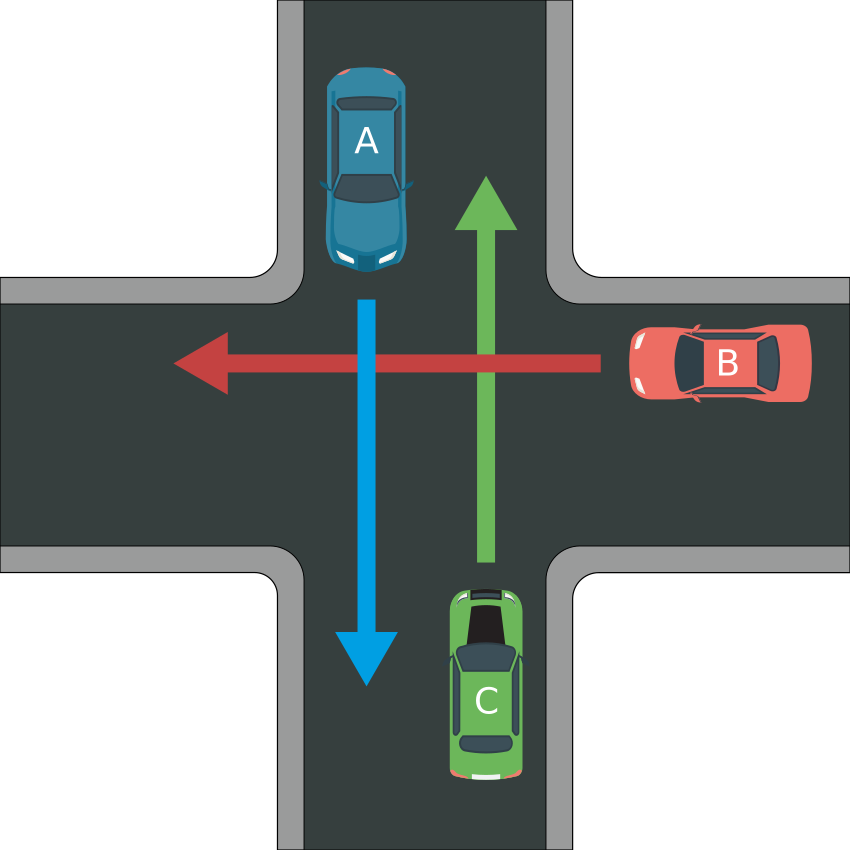 proven sphinx
 median loom
That is very hard to read. Why did you write this in blue?
bright stream
proven sphinx
The sentence with "Die Leute sind..." is a bit hard to read. Maybe you can inser...
ok danke
median loom
proven sphinx
That is very hard to read. Why did you write this in blue?
sorry was it's the colour I use the most on homework or more
proven sphinx
median loom
sorry was it's the colour I use the most on homework or more
I'd suggest using dark blue rather than light blue, though. Your teacher would definitely appreciate it as well.
Just use a normal pen.
median loom
proven sphinx
I'd suggest using dark blue rather than light blue, though. Your teacher would d...
ok
 vast violet
median loom
vast violet
median loom
"Bevor ich in die Schule gehe" - warum hast du das geschrieben? du musst etwas weiteres danach schreiben, oder den ganzen Satz weglassen. Es ist auch, "Bevor ich zur Schule gehe"
*Ich mag alle Arten von Musik wie Jazz, Pop usw....
im meine Zimmer❌
in meinem Zimmer✅
*und im Bus oder im (?) sitze, mit Kopfhörern.
*höre ich um zu brainstormen
Meine ganze Familie ((das Verb fehlt hier))...
*weil ich nicht sehr gut singen kann
Meine favourite❌
Mein Lieblingsmusiker/Meine Lieblingsmusikgruppe✅ ist /heißt ....
median loom
vast violet
"Bevor ich in die Schule gehe" - warum hast du das geschrieben? du musst etwas w...
he von zeit zu zeit is good
vast violet
median loom
he von zeit zu zeit is good
hmm so scheint es zu sein, ich habe es entfernt, danke