#questions-2
1 messages · Page 98 of 1
 tender panther
Sure, one moment
 inner silo
tender panther
Sure, one moment
inner silo
tender panther
Sure, one moment
I meant the one talking strange
One of these sentences
tender panther
English: "Master Mario! Have you heard the latest news?"
German: "Meister Mario! Hat er die aktuellen Nachrichten vernommen?"
 scenic drift
i can only assume it's doing a "narration" style then
 strong bridge
I'd just disregard it tbh I mean
that's just weird
I'd assume narration if it wasn't a question
 long whale
This was customary about 200 years ago.
inner silo
but its strange
tender panther
Toadsworth must be ancient then
long whale
It's called "erzen", and it's often used in films and books about the past. Supposed to give "colour", sort of. 🤷
inner silo
so I was right
scenic drift
damn, TIL. thanks susana.
strong bridge
Very interesting
inner silo
long whale
This was customary about 200 years ago.
what was spoken back then again, mittelhochdeutsch?
tender panther
If Mario was a girl would erzen still be a thing, or would you use feminine sie?
inner silo
Probably sie
long whale
"Susana, hat Sie schon Kaffee getrunken?" - "Nein."
scenic drift
wikipedia has a short entry about it that i'm finding useful: https://de.wikipedia.org/wiki/Pronominale_Anredeform#Anrede_mit_Er_bzw._Sie
Als pronominale Anrede bezeichnet man die Anrede von Personen mit einem Pronomen, z. B. du, ihr, Sie. Die Wahl des jeweils angemessenen Pronomens wird durch gesellschaftliche Normen bestimmt, die dem stetigen Wandel von Gesellschaft und Sprache ausgesetzt sind. In vielen Sprachen wird die zweite oder dritte Person Singular oder Plural des Perso...
long whale
tender panther
English: "Master Mario! Have you heard the latest news?"
German: "Meister Mario!...
It ought to be capitalized, btw: "Meister Mario! Hat Er die aktuellen Nachrichten..."
(at least as far as I can remember)
tender panther
yeah that was throwing me off, I've heard of erzen believe it or not but I assumed it would be capitalized if so
long whale
Yeah, some nitwit not thinking, or thinking it wasn't important. 🤷
 brazen dawn
Hey, can someone help me with a test that i have on Monday next week? It would really help me out if someone helped me because my current grade for german is a 4,0 on avarage that's basically an F
inner silo
what do you need help with?
scenic drift
faq homework
 stoic mauveBOT
How to ask a question
If you want something corrected, you can put it in a Google Doc and share a link with permission level »can suggest« in #writing .
Don't ask us to translate something for you outright: that takes professional time and effort and we're not here for that. You can try your luck with deepl.com.
For single words, use dict.cc or another dictionary, it'll be quicker.
If you want to know if/how a word can be used, provide some context to help us understand the situation.
Don't ask us to do your homework or exams for you! Show us your best attempt at something and try to pinpoint what exactly you don't understand.
 vagrant tulip
Guys is this sentence correct: Anna soll mir ihr Bruder zu Kino gehen.
scenic drift
vagrant tulip
Guys is this sentence correct: Anna soll mir ihr Bruder zu Kino gehen.
- mit ihrem Bruder
i think also "zum" or "ins" Kino but i'm not sure which suits better
inner silo
Nobody:
Mikey correcting sentences:
I am speed
vagrant tulip
inner silo
Nobody:
Mikey correcting sentences:
***I am speed***
XD
scenic drift
vagrant tulip
Anna soll mir ihren Bruder ins Kino gehen.
that's not the correction i made 
inner silo
hahaha
vagrant tulip
fam i am brainlagging
inner silo
understandable
inner silo
vagrant tulip
fam i am brainlagging
german is like so strange
 patent niche
german is so beautifully accurate
 slim yew
i dont see der Mann
scenic drift
"Der Schweizer" is a swiss man. "the swiss" alone doesn't work in english/
slim yew
i thogut the swiss meams the entire population of switzerland
slim yew
if it means the entire population it must use "haben" ?
patent niche
You´re welcome 😘
 finite sparrow
brazen dawn
Hey, can someone help me with a test that i have on Monday next week? It would r...
finite sparrow
brazen dawn
Hey, can someone help me with a test that i have on Monday next week? It would r...
why dont you study your lesson?
 summer crystal
Vielen Dank!
 onyx rain
Hallo in diese Satz, warum ist "ich" und "meine" zusammen?
Können sie bitte in Englisch eklären?
 heavy stratus
Meine is the verb. Like saying 'I mean'
patent niche
ich meine trasnlates to I think or i mean
patent niche
it is the same word
onyx rain
Sorry and vielen dank!
patent niche
but the meaning is different here
onyx rain
I get it now, thank you
 dim fjord
Hallo, ich würde gern wissen, was der Unterschied zwischen raten und erraten ist? und können sie Beispielsatz geben ?
patent niche
raten wie give advice aber auch raten wie guess
erraten wie you guessed correctly
Ich kann dir nur raten, nicht von der Brücke zu springen. (give advice)
Ich weiß nicht was los ist, aber wenn ich raten müsste, würde ich sagen, du willst von der Brücke Springen. (guess)
Ich habe erraten was du vor hast. (guessed correctly)
 fervent kernel
könnte man auch "erraten" durch "richtig raten" ersetzen?
patent niche
man kann anstatt erraten auch richtig raten oder richtig geraten sagen. Je nach kontext.
fervent kernel
cool, danke
patent niche
 dim fjord
patent niche
raten wie give advice aber auch raten wie guess
dim fjord
patent niche
raten wie give advice aber auch raten wie guess
I got it. Thank you
slim yew
i remember messing up heiße (hot with adj. ending) and heiße (name)
 hollow frigate
Hallo zusammen
inner silo
Hallo!
 dim quiver
Hey, can someone help me break down the grammar of a short text that's in german? It's 250 words
Here's the text https://docs.google.com/document/d/1DPWNs__83xsdSNVkipauHzWN8anN_DSgsvweKq6yFWk/edit?usp=sharing

Google Docs
Jugendsprache ist etwas, das jede Generation und Jugendkultur hat. Es kann je nach Region und Subkultur sehr unterschiedlich sein und beinhaltet die Vereinigung der Sprache mit Ihrer eigenen Kultur und Überzeugung. Die Jugendsprache ändert sich ständig, und was letztes Jahr cool war, könnte diese...
If it's too long, just one paragraph would help me understand a lot
fervent kernel
wdym by breakdown the grammar?
dim quiver
Like explain the thought process behind
It's the last paragraph i find the most confusing
and maybe the last half of the third
fervent kernel
thats a bit vague.. like what exactly dont you get?
did you write the text yourself?
Dies gilt nicht nur für Abkürzungen, sondern auch für alltägliche Wörter, die mündlich verwendet werden, selbst in Ländern, in denen nicht unbedingt Englisch gesprochen wird.
is it this line? cauuse its a long-ass sentence before the fullstop
dim quiver
Yes, especially that one
fervent kernel
-Dies gilt (nicht) nur für Abkürzungen.
-Dies gilt (auch) für alltägliche Wörter.
-die Abkürzungen und alltägliche Wörter werden mündlich verwendet.
-Diese Abkürzungen und alltägliche Wörter werden in vielen Ländern verwendet. Auch in den Ländern, wo Englisch nicht die Hauptsprache ist.
you can kinda break them down into these 4-5 sentences
and then its just a matter of writing it more efficiently using pronouns and conjunctions
-Dies gilt (nicht) nur für Abkürzungen.
-Dies gilt (auch) für alltägliche Wörter.
-->
Dies gilt nicht nur für Abkürzungen, sondern auch für alltägliche Wörter
"nicht nur .. sondern auch" is a fixed phrase you can use to join 2 sentences into one
long whale
nicht nur... sondern auch ;) @fervent kernel
fervent kernel
yes thanks i missed that :P
die mündlich verwendet werden
the 'die' here is a relative pronoun refering to both the Abkürzungen as well as the Wörter
dim quiver
why is it die sozialen medien and not sozial medien or something like that
long whale
"sozial" is an adjective, therefore, it needs to be declined. Please note that you cannot put 2 nouns next to each other in German, they'd need to be joined (compound noun) or hyphenated. :)
@dim quiver
dim quiver
what does declined mean?
long whale
The ending needs to change according to gender, case and singular/plural. If you haven't learnt about the German case system yet, don't worry about it. :)
@dim quiver
dim quiver
i have, it's nominative right?
long whale
"die sozialen Medien" is either Nominativ plural or Akkusativ plural, yes.
long whale
BTW, this is where capitalization comes in handy - it shows you that "Medien" is a noun (capitalized), while "sozial/en" is an adjective.
fervent kernel
do you have another table for "bestimmte Artikel" ?
long whale
dim quiver
there's nothing for that
No, there can't be, because in plural, there is no indefinite article in German.
dim quiver
dim quiver
So i don't really understand how to know what to end sozial with
stoic mauveBOT
FAQ not found. I found the following similar entries: Adjektivdeklination, N-Deklination.
dim quiver
faq Adjektivdeklination
stoic mauveBOT
Adjective Declension
A Brief Guide to Memorizing German Noun and Adjective Declension by Basementality
https://docs.google.com/document/d/1jWl5-kkqF3FQLDzrz8XLBJj7hvPFQK7MT5SYEDGK65E/edit
long whale
Yup, typo. There you go. :)
 shell pecan
Tausend PS, doch ich fliege blind. Was bedeutet PS?
long whale
shell pecan
Tausend PS, doch ich fliege blind. Was bedeutet PS?
Abbreviation for "Pferdestärken" (horse power) - it's how a car's engine power used to be measured.
dim quiver
Das Internet und die sozialen Medien haben auch in der Sprache der Jugend eine ganz neue Seite eingeführt, nämlich Abkürzungen.
How does the case system work with this sentece?
i would think "Das Internet und die sozialen Medien" is subject / nominative
haben is verb
shell pecan
That's right so far.
dim quiver
and then i just put the rest as direct object / accusative
except for the last part
eingufuhrt namlich abkurzungen
shell pecan
it's not that simple, but grammatically probably looks the same
dim quiver
i put that as verb again
shell pecan
in is a preposition. "in" triggers the dative case here. so we have die Sprache -> der Sprache.
Then, der Jugend.
dim quiver
shell pecan
in is a preposition. "in" triggers the dative case here. so we have die Sprache ...
Oh okay, that's actually what was causing me trouble
shell pecan
Jugand is normally die
dim quiver
yeah
shell pecan
it becomes der because of its relation to "sprache"
die->der here essentially makes it "of the"
dim quiver
so it's like "the language of the teenagers"?
shell pecan
(Das Internet und die sozialen Medien) Nominativ - haben auch in <der Sprache> Dativ because of "in" {der Jugend} "of the Youth" eine ganz neue Seite eingeführt, nämlich Abkürzungen.
that's sort of how it mentally reads
but also, as far as being practical, you don't need to be too concerned about knowing the rules of the cases
dim quiver
And because those two are connected, jugend i der instead of die
shell pecan
right
dim quiver
that kind of reminds me of predicative i think it's called, is the thought process kind of similar?
 proven sphinx
Predicative means using the word "to be" and such.
dim quiver
yeah
dim quiver
so object becomes nominative
shell pecan
Ah.
hm. That's unfamiliar to me
I basically just got that stuff through muscle memory
proven sphinx
Er ist ein guter Schüler.
Er = subject
ist = predicate/verb
ein guter Schüler = predicative object/Gleichsetzungsnominativ
shell pecan
ok. Yeah. I was thinking of adjective endings when I first saw predicative.
shell pecan
Das Internet und die sozialen Medien haben auch in der Sprache der Jugend eine ganz neue Seite eingeführt, nämlich Abkürzungen.
That's accusative, direct object yes
Someone more skilled than me should look at those adjective endings, because I would be inclined to say eine ganze neue Seite
proven sphinx
It depends on whether you intend for "ganz" to be used adverbially or attributively.
eine ganz neue Seite = a completely new page
eine ganze neue seite = an entire/whole new page
Like, the latter means you use the whole page.
The former just means that it's a different page.
heavy stratus
Ist es wahr, dass die Herkunft der deutschen Kultur in Wälder zu finden werden ist?
heavy stratus
 near folio
und das `werden` sollte sich da nicht befinden
near folio
und das `werden` sollte sich da nicht befinden
Ich habe gelesen, dass Wälder ein sehr wichtiges Teil der deutschen kulturellen Identität sind - immer zeigt in Literatur, Kunst, Volkgeschichten, sogar 'ein Teil der deutschen Seele'. Also ich stellte die Frage, die du früher gesehen hast
near folio
heavy stratus
Ich habe gelesen, dass Wälder ein sehr wichtiges Teil der deutschen kulturellen ...
könnte gut sein, da einmal das größte Teil Europas mit Wald bedeckt war
heavy stratus
Doch nicht mehr weil Bauernhöfe 😢
long whale
heavy stratus
Ist es wahr, dass die Herkunft der deutschen Kultur in Wälder zu finden werden i...
When you put it like that, it sounds a little... weird, to be honest.
long whale
heavy stratus
Ich habe gelesen, dass Wälder ein sehr wichtiges Teil der deutschen kulturellen ...
Well, yes, they are. We do like our forests.
*ein sehr wichtiger Teil
(das Teil ist usually only used for spare parts, of engines, for example. And colloquially for "thing". Otherwise, use "der Teil". :) )
 swift bough
You can think of "der Teil" as something you can break off of something literally, like half of a cookie or a slice of cake, or a key that is broken in half (where there would be 2 individual Teile), or a part of something that makes up something larger, such as a department in a company or someone who is part of a group, kinda like you metaphorically "broke" it away from the entire company @heavy stratus
and das Teil is a complete thing on the contrary (thus why it works for "spare parts" like Susana said)
 latent summit
Halloo :D ich bin neuer hier ^^freut mich, euch kennenzulernen
heavy stratus
long whale
When you put it like that, it sounds a little... weird, to be honest.
Wieso? Klingt es seltsam, weil was du darunter geschrieben hast (danke für die Korrektur btw)?
heavy stratus
swift bough
You can think of "der Teil" as something you can break off of something literall...
Gotcha - I guess you could break off part of a forest by cutting trees down, but that's reaching haha
long whale
Well, if you say "Is it true that German culture originates in forests", it sounds as if the forests had kind of developed German culture on their own, doesn't it?@heavy stratus
And - as everywhere in Europe - culture developed precisely where there were no forests (anymore), in monasteries and towns, so...
heavy stratus
long whale
Well, if you say "Is it true that German culture originates in forests", it soun...
Es höre mich eher an, wie Waldmenschen die Kultur entwickeln haben, oder Menschen, die neben Wälder in Denkweise sind - nicht wie die Wälder selbst die Kultur entwickeln. Klingt das sinnlos?
long whale
No. It's rather ungrammatical, but I see what you mean.
The thing is, yes, I suppose we are indeed famous for our attachment to forests, but it's quite inexplicable, since, as Pferd has already pointed out, all of Europe used to be pretty much covered by forests. 🤷
heavy stratus
long whale
The thing is, yes, I suppose we are indeed famous for our attachment to forests,...
Wenn das die Wahrheit ist, dann muss es nicht auch wahr sein, dass Deutsche Kultur zuerst in Wälder entwickelt ist, weil als du und 🐴 sagen, in vergangenen Jahren Europa Wälder war?
long whale
But the same would be true for French, Italian, Spanish, English, Polish and Greek culture, was my point. :)
heavy stratus
Hm, naja so es sieht aus - dann ich weiß es nicht. In jedem Fall ich danke dir für deine Antwort, die interessiere mich
 sick tartan
Yo yo, what's a good equivalent word of rich in German? (e.g. a rich culture)
Not $$$
long whale
"reich" works just fine, both literally - $$$ - and figuratively. :) @sick tartan
sick tartan
dankschön xx!!
swift bough
heavy stratus
Gotcha - I guess you could break off part of a forest by cutting trees down, but...
in that context, der Teil actually would work though, that's possible
"Dieser Teil des Waldes wurde abgeholzt."
So sounds like you understood
heavy stratus
swift bough
So sounds like you understood
In diesem Fall bin ich zufrieden :)
shell pecan
Does the saying "sounds good" literally translate to german?
Kann ich einfach "klingt gut" zuwerfen?
swift bough
shell pecan
Kann ich einfach "klingt gut" zuwerfen?
ja
eigentlich schon
kannst auch "hört sich gut an" sagen
 valid mulch
ja beides funktioniert
 flint ingot
also wie würde ich sagen das 200000 zuschauer im stadion geben könnten? ich weiß nicht wie ich das sagen soll
inner silo
flint ingot
also wie würde ich sagen das 200000 zuschauer im stadion geben könnten? ich weiß...
So a german translation to: There might me 2000000 spectators in the stadium?
inner silo
ohhh
Okay
that would be different
Das Stadion hat genug Sitze für 2000000 Zuschauer
flint ingot
could i replace genug with genügend to make it sound more formal?
inner silo
you could replace it, but it wouln't make it more formal
flint ingot
oh
inner silo
You could exchange Sitze for Sitzplätze
fervent kernel
@rancid thicket is bis "zum" 7. März richtig dort? Da bin ich mir nicht sicher
Wird bis 7. März verlängert
lautete der Satz
patent niche
"zum" passt da gut rein ja
patent niche
ja so würde es auch gehen. Mit klingt es etwas runder
onyx rain
Hi I wanted to say "What do you look like?"
here is my attempt "Was schaust du gerne gleich?"
 rancid thicket
fervent kernel
<@434359988576845825> is bis "zum" 7. März richtig dort? Da bin ich mir nicht si...
rancid thicket
fervent kernel
<@434359988576845825> is bis "zum" 7. März richtig dort? Da bin ich mir nicht si...
beides ist richtig aber ohne zum ist förmlicher
onyx rain
It translated super weirdly..
scenic drift
onyx rain
Hi I wanted to say "What do you look like?"
here is my attempt "Was schaust du g...
did you use some sort of machine translation for this?
onyx rain
no no I did it...
scenic drift
or a dictionary?
onyx rain
from my limited vocab (sorry I guess its that bad)
scenic drift
no worries :)
"Wie siehst du aus?" is how you'd ask that.
"gerne" means "like" in the sense of "what do you like doing" not "what do you look like"
fervent kernel
word for word translations don't always work unfortunately
onyx rain
scenic drift
"Wie siehst du aus?" is how you'd ask that.
I don't fully get this one "How do you see from?"
long whale
"aussehen" = to look, to appear :)
scenic drift
ah, susana got there first
onyx rain
oops, danke!
scenic drift
(it's a separable verb - in separable verbs, the preposition "detaches" and moves to another part of the sentence)
fervent kernel
rancid thicket
beides ist richtig aber ohne zum ist förmlicher
Hä dachte immer das mit zum wäre förmlich
Und ohne wäre eher umgangssprachlich
ich sehe fast nie ein Datum ohne 'zum' nach 'bis
Aber dafür lese ich auch kaum die Neuigkeiten (auf Deutsch)
long whale
I'd agree - leaving out "zum" sounds at best as if you couldn't be bothered. 🤷 As a side note: dafür andererseits; Neuigkeiten Nachrichten ;) @fervent kernel
fervent kernel
Danke. Ich muss jetzt wirklich die Nachrichten lesen um meinen Wortschatz zu erweitern
😅
 sudden cloud
Heute war sie seit Langem wieder an dem Haus vorbeigegangen. Fünfzehn Jahre war das alles her.
What does this mean in english
fervent kernel
hab' ich nachgeholt!
was kann das eventuell für Bedeutung haben? Der Kontext dahinter ist, ich habe einem eine Email geschrieben. Es geht darum, dass er offenbar vergessen hat, was online zur Verfügung zu stellen. Heißt es :
(1) dass er das Datei hochgeladen hat, und ich habe mich geirrt, oder
(2) dass er das Datei beinahe hochlad, und ich muss eben etwa geduld haben
 ember mason
Also nachholen heißt, etwas später (in diesem Fall weil die Person es vergessen hat) erledigen. Also hat sie's jetzt hochgeladen.
fervent kernel
ah, babsii ! danke 
long whale
sudden cloud
Heute war sie seit Langem wieder an dem Haus vorbeigegangen. Fünfzehn Jahre war ...
Why don't you put it through deepl? And then, if there are things you don't understand, you could ask more specific questions. ;)
long whale
"das alles" = all of that; all this (if it isn't clear at that point in the story what it refers to, then you'll be told about it later on). "her" is rather like "ago": Es/Das ist 10 Jahre her = It was 10 years ago @sudden cloud
sudden cloud
oh, I see
fervent kernel
welcher ist richtig? zwei drittel dutzend entspricht 8 Stücken oder zwei drittel dutzend entsprechen 8 Stücken.
 random hound
Zwei Drittel Duzend entsprechen acht Stücken.
 frank forge
When formally saying "I will come in July, but cannot specify a day." what should we use for "day"?
"Ich komme in Juli, aber ich kann keinen Tag /Datum angeben."
fervent kernel
proven sphinx
Wer sagt das schon?
Dunkin donuts Mitarbeiter? 
ember mason
proven sphinx
Zwei Drittel Dutzend?
 proven sphinx
Ja, genau! 😂
 delicate tiger
proven sphinx
Zwei Drittel Dutzend?
delicate tiger
proven sphinx
Zwei Drittel Dutzend?
besser: ein Gros, ein Dutzend Dutzend (144)
proven sphinx
Man schreibt es als "dutzend", verdammt nochmal.
"duzend" ist jemand, der "du" sagt.
summer crystal
Ist das richtig? "Dass ich traurig bin, weißt du sicher!"
long whale
summer crystal
Ist das richtig? "Dass ich traurig bin, weißt du sicher!"
Yes, it's correct. :)
summer crystal
Okay!
 brittle basin
Hallo zusammen! So I heard one can't use Modalpartikeln in a formal situation. But what about "doch" (Not as a Modalpartikel), would it be ok to use doch to answer a negative sentence in a formal situation? 🤔
Thanks!
 winter hamlet
Hallo
How else would you answer a negated question if not with doch @brittle basin ?
It's not a modal particle if you use it in response to a negative sentence
it's the regular use of 'doch'
use as a Modalparticle would have a completely different meaning
brittle basin
Hmm... I don't know lol, it was just a random thought, since I heard you can't use Modalpartikeln in a formal situation. So I made this link between those roles of it. Thanks for answering!
I see
Thank you again!
winter hamlet
'doch' as a Modalpartikel is a bit like inferring a question was asked when this wasn't really the case
in a formal setting this would be a little rude to do
They all infer some perspective to be true you can't really know ..so it's always a bit presumptive
rancid thicket
Example:
A: Bibi ist die beste Sängerin! (Bibi is the best singer)
B: Nein! (No)
A: Doch! (Yes as a response to "no")
fervent kernel
Person a is a brainwashed 12 y old girl

 granite spade
What's the best way to say "catch up with somebody (over a coffee)"
like with a friend, a casual meeting
bei einem Kaffee nachholen?
sich beim Kaffee über Neustes aufholen?
fervent kernel
Ich würde ganz einfach "jemanden beim Kaffee treffen" sagen
 rich lance
Hello, just wondering if is there any study group for (spanish or english)—> german??? I’m thinking in sitting down 30mins a day to learn/practice german, at least. However I’d like to learn with someone else, if possible.
I’m not a teacher, but I can teach spanish in exchange. (English too, but I’m not that confident with this one though)
fervent kernel
 plush prawn
Hast du B1 connectors list ? Für sprechen and schreiben ✍️
plush prawn
Hast du B1 connectors list ? Für sprechen and schreiben ✍️
What?
Do you mean conjunctions?
fervent kernel
plush prawn
Not exactly
maybe somethin like this?
https://www.thoughtco.com/about-german-writing-1445259
https://mydailygerman.com/german-essay-phrases/
 torpid salmon
Are there any usage of "zum ..." in Zeiträume? I can't seem to find examples about it.
fervent kernel
torpid salmon
Are there any usage of "zum ..." in Zeiträume? I can't seem to find examples abo...
zum is normally used along with ''bis'' for a date
like bis zum 1. März
and also like "zum Anfang des Jahres" , "zum Ende des Monats"
.. by the beginning of the year / end of the month
heavy stratus
Das ist ein Mann
fervent kernel
Alles klar, danke
 plain umbra
@fervent kernel Sein always takes nominative.
 runic meadow
Wie sag man "Drunk" auf Deutsch
swift bough
ja
swift bough
runic meadow
also wann ich sage "ich bin betrunken" ist das richtig?
wenn*
swift bough
wann = what exact time / day / month / yeah
wenn = if / when / whenever
@runic meadow
zum Beispiel
Wann gehst du zur Schule?
swift bough
if you wanna say "what's the time" you say "Wie viel Uhr ist es?"
or what time is it
swift bough
runic meadow
ich spricht nur Deutsch
spreche*
swift bough
runic meadow
besser Deutsch diese weg
hmm...was willst du sagen, also auf Englisch?
runic meadow
i will speak only in german. Learning better german this way
swift bough
Ich werde nur auf Deutsch sprechen. So lerne ich Deutsch besser.
runic meadow
Ich werede nur auf Deutsch sprechen. So lerne ich Deutsch besser.
Achso!! danke herr bundesverkehrsministerium
oder Frau
swift bough
Du kannst aber auch einfach sagen, "Ich spreche nur Deutsch"
du kannst also das Werden weglassen
Ich spreche nur Deutsch und so lerne ich besser Deutsch.
it's actually a bit better with Deutsch at the very end, I just noticed
runic meadow
hmmm achso!
Mein Deutsch ist besser wenn ich bin betronken
wie sag man "shy" auf Detusch
swift bough
eben, so fühlt es sich manchmal an
Aber ich denke, es wird nicht besser, sondern du sprichst mehr und traust dich mehr.
swift bough
shy = schüchtern
runic meadow
icht spreche mehr jaa
ich*
ich bin nicht schüchtern wenn ich bin betronken
achso
ich lerne viel Deutsch heute!!
swift bough
wenn ich betrunken bin*
swift bough
wenn man "wenn" benutzt, geht das Verb ans Ende
swift bough
runic meadow
ich muss merken das
das merke ich mir*
sagt man ^^
und danke das ist lieb von dir xD
runic meadow
ooo
ich lerne Deutsch 4 jahre aber es ist nicht genug
ich muss mehr Deutsch sprehce
fervent kernel
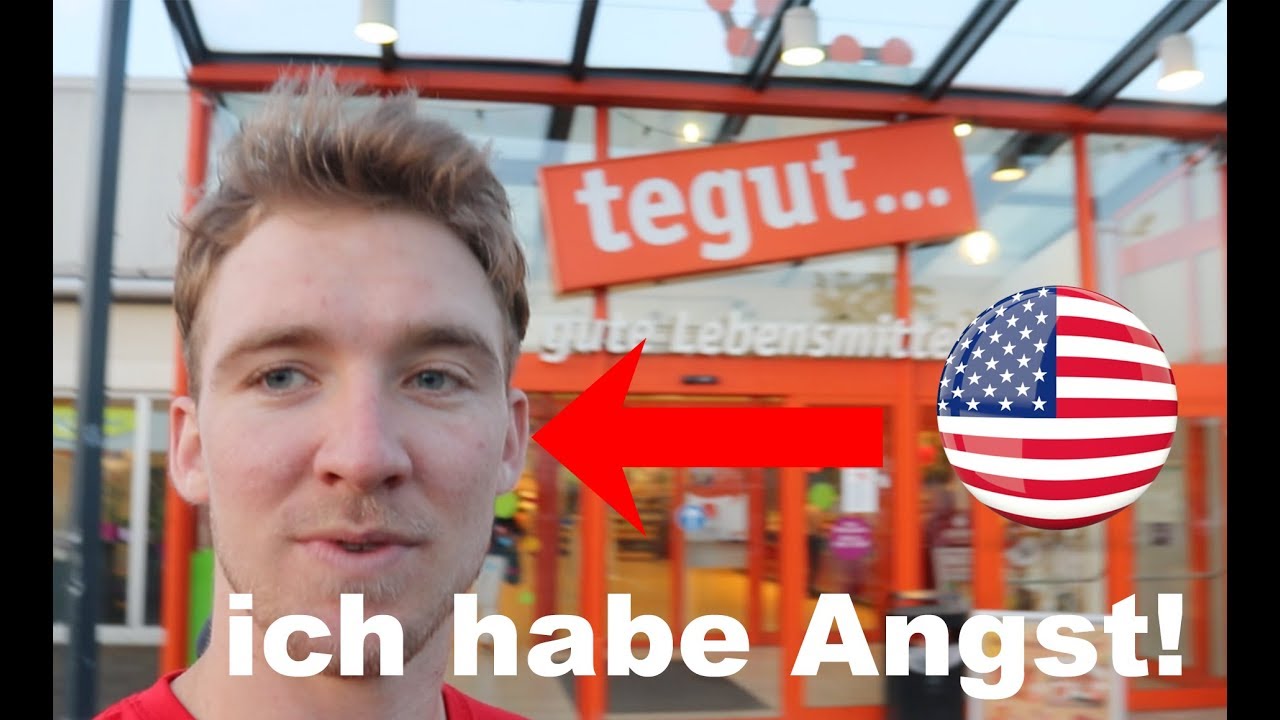
American speaks German at German Grocery Store! Conner Sullivan tries to learn german by speaking german at TEGUT. He fails but gets better!
I finally Went to BERLIN!! Dope City! Check out the Video Here! 👉 https://goo.gl/1Y8nv8
GET a T-SHIRT HERE!! https://goo.gl/AcNQ8w
American Speaking German at EDEKA: https://www.youtube.com/watch?v=z8AIWl...
can someone tell me what the german guy tells him?
I can't quite hear what he says
fervent kernel
fervent kernel
can someone tell me what the german guy tells him?
Pizza finden Sie da bei (den) Kühlschränken , rechts
thanks 🙂
@fervent kernel does he say den?
at first it sounded like Bahn to me, is he saying bei den really fast?
scenic drift
it sounds almost closer to "beim" to me ("beim Kühlschrank")
fervent kernel
oh yeah, that makes more sense
but if that were the case it sounds like he says something between Kühlschrank ... rechts
what Duitse said seems to fit more considering that 🤔
and it sounds like the plural of Kühlschrank
scenic drift
yeah, it does sound like he's saying the plural
language is funky in the real world like that 😉
fervent kernel
fervent kernel
<@456226577798135808> does he say den?
Now that I hear it again it does sound like "beim Kühlschrank" as Mikey said and the sound in between that and rechts is probably just a äääh , like he he was thinking about what to say
He does repeat the same line again a few seconds later and I think that makes it clear
I assumed that sound he made was for the plural of Kühlschrank lol
scenic drift
"Im Frühjahr war ich oft so erschöpft, dass ich schlief wie ein Baby"
why not "dass ich wie ein Baby schlief"?
i'm wondering if it's just a typo / something not caught during proofreading 😅
long whale
scenic drift
"Im Frühjahr war ich oft so erschöpft, dass ich schlief wie ein Baby"
why not "...
Mm... Often happens with comparisons. I'm not 100% sure whether a strict examiner from Goethe might not consider it an error, but normal native speakers wouldn't. 🤷
scenic drift
interesting. it's not the first time i've seen this.
is there a grammatical rule (even if informal)?
onyx rain
what part of grammar is it, when we use Die or Der alone in the beginning of a sentence or clause, Bespiele in diese Satz
long whale
It's a demonstrative or a relative pronoun, as far as I know. :) @onyx rain
onyx rain
I can't search it on Leo, coz it shows the meaning for English die (relating to death)
I will google it like that, danke
heavy stratus
long whale
Mm... Often happens with comparisons. I'm not 100% sure whether a strict examine...
The real question is, what would Goethe himself think of that?
granite spade
scenic drift
"Im Frühjahr war ich oft so erschöpft, dass ich schlief wie ein Baby"
why not "...
Pretty much what Susana said. Technically speaking, if you want to investigate it more, it is called Ausklammerung and refers to elements in a sentence that are placed outside the verbal bracket (die Satzklammer), of which comparisons often are. It's colloquial but increasingly found in writing I think, especially if the additional info is long

Deutsche Grammatik 2.0
Die Satzklammer Das Verb bildet zwischen der Position 2 und der Endposition des Satzes die so genannte Satzklammer. Das bedeutet, dass das erste Verb bzw. der
scenic drift
granite spade
Pretty much what Susana said. Technically speaking, if you want to investigate i...
exactly what i was looking for, thank you 🥰
ok, awesome! i've definitely seen this phenomenon before and not been sure why it was like that
granite spade
Bitte 😀
heavy stratus
Einige Politiker und Politikerinnen der USA sagen, dass Donald Trump die Angreifer angestachelt hat
When wanting to specify that multiple members of a group have a viewpoint, is it normal to be like 'Polizist und Polizistinnen glauben, dass...' etc? It seems a tad unnecessary, or is this just a stylistic thing for German that you just have to do
proven sphinx
You mean stating both the masculine and feminine forms or what?
It's something that's only become common in more recent years.
heavy stratus
proven sphinx
It's something that's only become common in more recent years.
Ah alright, I was reading and I just thought you could've just said 'Politiker' and I would've assumed that included female politicians. Was this the result of some sort of movement?
proven sphinx
Well, it's kind of the opposite of what's happening with English.
English often emphasizes gender-neutral forms, but German is a gendered language, so the masculine forms are starting to be seen as referring exclusively to men.
heavy stratus
Like, would it be a big deal to say Schauspieler instead of Schauspieler und Schauspielerinnen?
Or this it just more of a political thing that the average German doesn't pay attention to?
scenic drift
i've seen Schauspieler*innen used a lot...
heavy stratus
scenic drift
i've seen Schauspieler*innen used a lot...
I guess that makes the sentence feel less clunky, at least to me
scenic drift
i imagine it's not as formal though.
also sometimes (rarely) "Schauspielerinnen and Schauspieler"
heavy stratus
scenic drift
also sometimes (rarely) "Schauspielerinnen and Schauspieler"
Is it not normal for the feminine version to be first or something?
scenic drift
heavy stratus
Is it not normal for the feminine version to be first or something?
the 'default' is male first i think
heavy stratus
Ich würde mich das denn erinnern, wenn ich Deutsch schriebe. Danke Mikey
 cunning geyser
Hello, can someone help me? I need to translate a sentence: We do not know our way in this city/We are not familiar with this city. I need to use the verb "sich aus/kennen" I created "Wir uns kennen in dieser Stadt nicht aus." But I think it's terribly wrong and I don't know what to do. If someone could check it I'd be grateful.
delicate tiger
cunning geyser
Hello, can someone help me? I need to translate a sentence: We do not know our w...
almost, verb to second position
cunning geyser
Thank you so much!
 oak brook
heavy stratus
Like, would it be a big deal to say Schauspieler instead of Schauspieler und Sch...
oak brook
heavy stratus
Like, would it be a big deal to say Schauspieler instead of Schauspieler und Sch...
Well you dove into a relatively large continuous political debate of the recent years here and there will be quite a few of different opinions depending on where the person is on the political spectrum xD i can assure you tho if youre not a native nobody will be angry about what you decide to use here
heavy stratus
oak brook
Well you dove into a relatively large continuous political debate of the recent ...
Okay, thanks for the heads up Max! I think using the masculine version in reffering to both to men and women is just more efficient so I'll go with that one
fervent kernel
Hi. Anyone interested in speaking through WhatsApp vocal messages ? In German only OR we can speak German if you're native then French if you want to learn it 🙂 (I'm native)
I need practice
(don't know if it's the right channel, sorry)
fervent kernel
Person A: meint ihr, man schafft es, für die Klausur vorbereitet zu sein, wenn man jetzt anfängt zu lernen? ohne an den Vorlesungen teilgenommen zu haben?
Person B: klar, wieso denn nicht?
C: naja ist das Fach inhaltlich nicht schwer?
D: Also ich würde da mindestens 7 Wochen für einplanen
E: Was für 7 Wochen... so viele sind wir doch gar nicht?!
F: Also wir sind mindestens 3, aber ob es für 4 reicht weiß ich nicht
kann mir jemand hierbei helfen? ich möchte wissen, wovon Person E und F reden. Reden die von der Anzahl an Wochen oder sonst was? oder vielleicht ist das irgendwie ein Witz, den ich gar nicht verstehen kann? da bin ich verwirrt wegen ihrer Verwendung von "wir sind ..". Es gibt noch 7 Wochen vor der Klausur, falls das wichtig wäre..
 sly ferry
Doesn't make much sense to me either tbh
fervent kernel
mehr kontext gibt es leider nicht
 lyric void
Lol no clue
fervent kernel
dann muss es wohl ein dummer Witz oder Insider sein
 dense current
fervent kernel
Hi. Anyone interested in speaking through WhatsApp vocal messages ? In German on...
dense current
fervent kernel
Hi. Anyone interested in speaking through WhatsApp vocal messages ? In German on...
Hi I'm new here, I want to practice my German but firstly I have to say that I'm very terrible at it. Since, I have German exam in this May, I think I can improve myself by texting and voice messages.
 wheat drift
How do I structure my sentence, would the verb or adjective go before the noun?
scenic drift
can you give an example of a sentence? 😅
plain umbra
Yes. Sentences can have multiple verbs, nouns and adjectives and they can be in various orders.
The key point beginners learn for sentence order in German is verb placement. The most important thing to start off with is getting your verbs in the right place.
For a basic sentence, the conjugated verb goes in the second position, any extra verbs go at the end of the clause.
Ich esse Brot.
Heute lerne ich Deutsch.
Am Sonntag gehe ich an den Strand.
Hope that helps. @wheat drift
wheat drift
@plain umbra Oh, I was just checking because I thought the verb went before the subject, in your example being I. I was right. Thanks for the confirmation
plain umbra
@wheat drift It doesn't always.
wheat drift
What determines it
scenic drift
the verb's after the subject in "Ich esse Brot" for example
plain umbra
Like I said the verb goes second.
wheat drift
But in Today, I learn German. The verb was before the subject
I just realized the first one
plain umbra
If you start your sentence with something besides the subject, the verb has to come next, so the subject has to come third.
scenic drift
think about the location of the verb not in relation to the subject but in the place of the rest of the sentence
plain umbra
In English you can just stick something else on the front without changing the rest of the sentence. But in German, you can't just do that.
plain umbra
Np.
near folio
Kann ich den Satz:
He walks in circles around the castle.
so übersetzen:
Er geht im Kreis um das Schloss herum.
oder gibt es eine natürlichere Übersetzung?
delicate tiger
solange es nicht ein wirklich kreisförmiger Weg ist, würde ich es weglassen
near folio
also, ohne im Kreis?
 lean canyon
Hi everyone! I'm back, and yeah, with another question that makes me want to rip my head haha!
So i tried to translate a sentence which is, "Everyone has their own dog, everyone has their own movement, everyone has their own car." I did so to check the changes on "their" and "own" regarding the gender of the noun. Then it got me confused! So here is the result of the translation in Deutsch:
- Jeder hat seinen eigenen Hund (M.)
- Jeder hat seine eigene Bewegung (F)
- Jeder hat sein eigenes Auto (N.)
I tried to check with my notes, and it doesn't seem that all the nouns here are in the Akk case. Am I right? Because on the first sentence, which involves Der Hund, it uses "seinen" instead of "sein." Could anyone get me straight on this please? 🙁
And I'd be glad if someone also wants to explain about the changes on the word "eigene" too. I couldn't even match them on my Adj. endings list on my book 😭
VIELEN DANK!
plain umbra
@lean canyon It seems fine to me. But if you can't find them in your adjective ending list, I think there is something wrong with the book.
Because on the first sentence, which involves Der Hund, it uses "seinen" instead of "sein."
If it were nominative, it would use sein. It's accusative here, so it uses seinen.
lean canyon
plain umbra
> Because on the first sentence, which involves Der Hund, it uses "seinen" inste...
Thanks for the link! This is the website where I get my list, a bit strange, they both differ on the indefinite article. Would you mind to check this site so I can be sure that this site has listed the wrong adj endings? https://www.learn-german-smarter.com/learn-german-adjective-endings/

Learn German Smarter
Learn German adjective endings with mnemonics
plain umbra
@lean canyon Where does it differ?
The plural line is weird in your link, because they used the "no article" for the plural line in their "ein" diagram.
But that's simply because you cannot use "ein" with plural. You can use other ein-words and then the adjective would have -en ending for all cases.
lean canyon
plain umbra
The plural line is weird in your link, because they used the "no article" for th...
I even just realized after you write this 😆 you're right! Thanks for the explanation!
long whale
near folio
Kann ich den Satz:
`He walks in circles around the castle.`
so übersetzen:
`Er g...
If you're still interested, it would also sound good if you wrote (!) "Er umrundet [mehrmals/immer wieder/wieder und wieder] das Schloss". I agree that "Er geht [immer wieder/ständig] um das Schloss herum" would be most natural in speaking, but obviously, it wouldn't get the "circles" across without "ständig" or "mehrmals" or "immer wieder". :)
near folio
long whale
If you're still interested, it would also sound good if you wrote (!) "Er umrund...
ah, danke dir. Ich bin auch auf umherwandern gestoßen, wie hört sich das an? Beispiel: Er wandert im Innenhof des Schlosses im Kreis umher.
long whale
I may be overthinking this right now, but I don't think I'd say this. "umherwandern" means "to wander about [aimlessly]", doesn't it? While "im Kreis" does give a specific direction, doesn't it? @near folio
Unless he's kind of spiralling about the court, of course? 🤔
near folio
genau, das macht er
long whale
lightbulb ;)
near folio
also: he wanders aimlessly in circles
long whale
Yes, well, then, you've nailed it. :)
near folio
hat umrunden diese Konnotation von Ziellosigkeit nicht?
long whale
Uh - I don't think so, no. It would mean he'd be walking along the inner or outer walls.
At more or less of a distance, but kind of following their contours. Like... if you tour around a mountain, keeping to the valleys surrounding it, without climbing it, then, when you come back to your starting point, you'd say "Ich habe den Berg einmal umrundet" - is my understanding of "umrunden", at least.
near folio
ah okay gut, dann ist seine Bedeutung genau wie es sich anhört
 cerulean idol
 pale path
Wie war dein Wochenende
scenic drift
heavy stratus
Like, would it be a big deal to say Schauspieler instead of Schauspieler und Sch...
following up on this discussion. i saw an advertisement that i think you may find interesting.
gimme a moment to dig it up
a good example of "general neutral" job advertisements in real life 
 bold sapphire
scenic drift
bold sapphire
scenic drift
you can also say Pfleger*in (m/w/d)
fervent kernel
scenic drift
a good example of "general neutral" job advertisements in real life <:loleyes:48...
to add to that, i have also seen them just write the male forms, and then at the end mention something about the position being available to all genders, but just the one form written for "stylistic" reasons
i dont remember the exact word they used
bold sapphire
Fachkraft?
fervent kernel
no i mean the word they used to say "stylistic reasons"
cause i feel like in english it sounds a bit wrong
they used the male forms of the job in the Stellenausschreibung
bold sapphire
hmm
fervent kernel
but i dont see that anymore on their site. think they replaced it with (m/w/d) after the job title
bold sapphire
yes, (m/w/d) is very common nowadays
heavy stratus
scenic drift
a good example of "general neutral" job advertisements in real life <:loleyes:48...
Very interesting, I didn't expect this from official advertisements. German is truly full of surprises
heavy stratus
scenic drift
This looks strange, it would be helpful if they had like a Pflegerfachmensch but the perils of grammatical gender, I guess 😄
heavy stratus
Idk how I would solve that tbf. It looks weird having Pflegerfachmann with a picture of a woman but Pflegerfachfrau next to a man looks a bit odd
Then again isn't 'Hauptmann' a thing? I don't think I've heard 'Hauptfrau' and women can be a Hauptmann also
bold sapphire
heavy stratus
This looks strange, it would be helpful if they had like a *Pflegerfachmensch* b...
*Pflegefachkraft
 icy flax
@bold sapphire, now this seems familiar. I find it not-ok the way it "unpersonalizes" people though.
They aint no more employees, now they are "caring power"
 fervent veldt
How to say that "something is the same"?
"Dasselbe" or "die gleiche", and what is the difference?
sly ferry
 lost parcel
Was ist genau der unterschied zwischen „Abbrechen“ und „Aufheben“ ?
 arctic cosmos
"Kann ein Mensch, der über sich selber sagt, dass er ein guter Mensch wäre, wirklich so gut sein?"
Warum benutzen wir (wäre) statt (ist)?
fervent kernel
arctic cosmos
"Kann ein Mensch, der über sich selber sagt, dass er ein guter Mensch wäre, wirk...
das ist Konjunktiv 2. es drückt Wünsche, Vorstellungen sowie Unmögliches aus
in deinem Satz muss man sich diesen Menschen vorstellen
ich glaube so könntest du das verstehen 🤔
oak brook
lost parcel
Was ist genau der unterschied zwischen „Abbrechen“ und „Aufheben“ ?
They are completely different words in which context do you want to use them/ what do you wanna say?
lost parcel
oak brook
They are completely different words in which context do you want to use them/ wh...
I want to say "cancel" , what do they mean exactly ?
oak brook
Then its abbrechen
Aufheben could have multiple meanings, most common would be to pick smth up, it can also mean to keep smth like „ich hebe mir die schokolade für später auf/ im keeping the chocolate for later“, and a more rarely used variant would be „der präsident hebt das gesetz auf/ something like : the president is ending the law“
But then again do you have the whole sentence cancel could be translated in different ways
lost parcel
sehr klare Erklärung xD , vielen dankkk
lost parcel
oak brook
But then again do you have the whole sentence cancel could be translated in diff...
Ich dachte dass "cancel" war , weil ich "stummschalten aufheben" gesehen habe , dann hab ich mir gedacht , das ist wahrscheinlich "cancel" , obwohl ich nicht sicher war
oak brook
Ah lol yeah that is a case where you would use the third variant of aufheben
fervent kernel
das ist mehr wie "remove" als "cancel" glaub ich
i think its ok to think of aufheben as 'remove' most of the time
arctic cosmos
fervent kernel
in deinem Satz muss man sich diesen Menschen vorstellen
aber findest du nicht,dass (ist) in diesem kontext besser als (wäre) ist?
fervent kernel
nein, eigentlich grammatikalisch gesehen wäre 'wäre' richtiger
ob 'ist' falsch wäre, weiß ich nicht
long whale
arctic cosmos
"Kann ein Mensch, der über sich selber sagt, dass er ein guter Mensch wäre, wirk...
All 3 are possible here: "ist", "sei" and "wäre". "sei" would be correct, grammar-wise, since it's reported speech. However, it isn't used much outside of official communication (news, court reports, etc.). Many Germans have this vague idea that reported speech is something to do with Konjunktiv, so, they often end up saying "wäre" instead of "sei". However, outside of official communication, using Indikativ for reported speech sounds just fine. Therefore, I'd go with "ist", since it's definitely less awkward than "wäre", although not as formally correct as "sei" would be. :)
Oh, and as a side note: according to grammar books, the use of Konjunktiv II indicates the person who's reporting is doubting the truth of what's been said, so, that might be a reason for using "wäre". :)
fervent kernel
long whale
All 3 are possible here: "ist", "sei" and "wäre". "sei" would be correct, gramma...
thanks for that explanation. i still always get the sei / wäre thing wrong 😩
arctic cosmos
Danke schön für diese detaillierte erklärung💙
fervent kernel
long whale
Here, have a 🧁
danke schön <3
proven sphinx
long whale
You and roughly 98% of all native speakers. ;)
The other 2% are probably Swiss German speakers, since the Konjunktiv I is still very much in use in these dialects. LOL.
heavy stratus
proven sphinx
The other 2% are probably Swiss German speakers, since the Konjunktiv I is still...
Keine Österreicher 😔
heavy stratus
Kann man "lass uns kühl sein' sagen, wenn jemand sehr gereizt ist, um ihn zu entspannt?
 night dagger
heavy stratus
Kann man "lass uns kühl sein' sagen, wenn jemand sehr gereizt ist, um ihn zu ent...
night dagger
heavy stratus
Kann man "lass uns kühl sein' sagen, wenn jemand sehr gereizt ist, um ihn zu ent...
Ich würde das stattdessen sagen:
"Du solltest dich beruhigen".
"Lenk dich ein wenig ab."
"Entspann dich."
heavy stratus
night dagger
Ich würde das stattdessen sagen:
"Du solltest dich beruhigen".
"Lenk dich ein w...
Vielen dank! Ich merkte, dass ich keine Redewendungen hatte, die helfen, wenn jemand gereizt ist - bis jetzt
icy flax
heavy stratus
Kann man "lass uns kühl sein' sagen, wenn jemand sehr gereizt ist, um ihn zu ent...
Or, if you talking with a Professor or a Polizist:"Chill mal, Dicker!"
-jks
long whale
Another possibility: "Immer mit der Ruhe"
 dawn jackal
haben + zu + inf ist alternative zum müssen
so kann besipelweise ich sagen : ich muss lernen oder ich habe zu lerne
 shell bronze
dawn jackal
haben + zu + inf ist alternative zum müssen
so kann besipelweise ich sagen : ich...
shell bronze
dawn jackal
haben + zu + inf ist alternative zum müssen
so kann besipelweise ich sagen : ich...
"Ich habe zu lernen" klingt sehr komisch für mich
swift bough
Man würde eigentlich bloß sagen „ich muss lernen“
 fallow ledge
dawn jackal
haben + zu + inf ist alternative zum müssen
so kann besipelweise ich sagen : ich...
fallow ledge
dawn jackal
haben + zu + inf ist alternative zum müssen
so kann besipelweise ich sagen : ich...
Haben + zu + inf mag ein möglicher Ersatz zu(?) „müssen“ sein, aber es kommt sehr amtlich und oft zwingend rüber.
Es wird oft so verstanden, als müsste man etwas unbedingt machen. Wie z.B.
Alle Bürger haben das Gesetz zu befolgen.
Demnach klingt „ich habe zu lernen“ so als hätte jemand es dir befohlen.
long whale
Umm... Mmm... Other native speakers may disagree, but... the way I see it, very strict parents may say things like "Du hast zu tun, was ich dir sage", "Du hast dein Zimmer aufzuräumen", which is rather like "You're bloody well going to do what I tell you/clean up your room", but saying "Ich hab' noch zu tun", "Ich hab noch einiges zu lernen" is quite normal for "I've still got stuff to do/things to learn". @fallow ledge
fallow ledge
Nice 👍for those first ones, its still like someone told you to do it
Ive heard „ich habe noch zu tun“ but not the variation with lernen, thats nice to know
fervent veldt
How to say that something is "famous for" something?
Like a city is famous for cheese
 pale moat
'Die Stadt ist bekannt für ihren Käse' i believe
long whale
"berühmt" works, too. :)
icy flax
long whale
Umm... Mmm... Other native speakers may disagree, but... the way I see it, very ...
Oo, das erinnert mich dran, jemand hat mal hier gesagt, einige Sätze sollten "um" haben, haben aber nicht.
Hier ham wir ein Beispiel :)
"Du hast dein Zimmer, um aufzuräumen" bedeutet dasselbe als beim "du hast dein Zimmer aufzuräumen", oder liege ich eig falsch dran?
 tough rock
icy flax
Oo, das erinnert mich dran, jemand hat mal hier gesagt, einige Sätze sollten "um...
tough rock
icy flax
Oo, das erinnert mich dran, jemand hat mal hier gesagt, einige Sätze sollten "um...
Du hast dein Zimmer um aufzuräumen = you have your room in order to be cleaning it
Du hast dein Zimmer aufzuräumen = you have to clean up your room
swift bough
The first sentence makes no sense in English unless you literally bought a room just to clean it 
(And who does that?)
 hollow ether

 cerulean lion
Technically not a German language question, more of a historical one, but:
What was the official name in German for the "Minister/Ministry of Post" from 13 February - 20 June 1919, under the Scheidemann Cabinet (German: Kabinett Scheidemann)?
I can't seem to find much.
scenic drift
cerulean lion
Technically not a German *language* question, more of a historical one, but:
Wh...
wikipedia is suggesting Reichspostministerium, is that what you're looking for? https://de.wikipedia.org/wiki/Reichspostministerium
onyx rain
Oft times the word order with "aber" is not "aber + verb + subject", it is "aber + subject + verb"
I can't seem to find the pattern when, I understand that the verb is the "second idea" of the sentence (and not just position)
Can someone throw light on this? Or this too is flexible..
scenic drift
can you give an example?
word order with aber is fairly flexible because it can be used as both a conjunction and an adverb
example as a conjunction: "Ich mag keine Orangen, aber ich mag Äpfel. "
as a conjunction (ish) but with adverbial word order: "Ich bin dafür, er aber lehnt es ab"
as an adverb: "Du bist aber groß geworden"
onyx rain
Sie wissen sehr viel, Anna, aber Sie wissen noch nicht alles
scenic drift
that's aber behaving as a conjunction
the clause is "Sie wissen noch nicht alles" and the verb is the second item in that clause
(it's a coordinating conjunction, so word order doesn't change)
onyx rain
I see, I understand it a bit better now, thank you.
onyx rain
scenic drift
example as a conjunction: "Ich mag keine Orangen, aber ich mag Äpfel. "
as a con...
um..I can't help but notice you moved the subject even before aber was it supposed to be aber lehnt er es as or we did that to remove the ambiguity? ( I vaguely recall reading that somewhere)
scenic drift
it's supposed to be "er aber lehnt es ab", that's why i chose it as an example :)
(these are examples from the wiktionary page for "aber")
you can think of it as "he, however, rejects it" or "he, on the other hand, rejects it"
onyx rain
yes I read it along similar line "he, but, rejects it" (I think I got it, thanks)
swift bough
Don’t try to translate word for word btw
scenic drift
onyx rain
um..I can't help but notice you moved the subject even before `aber` was it supp...
also, note that you'd want "aber er lehnt es ab" (not "aber lehnt er es ab")
swift bough
It’s easier to understand the function of something than to try and literally translate
onyx rain
In this sentence 'aber' is used as a conjunction is it not?
Ich komme aus der Schwierz aber wohne ich in Berlin
onyx rain
that's very strange, that was the example more or less used to explain the word order
swift bough
You could say:
„Ich komme aus der Schweiz, wohne aber in Berlin“
onyx rain
there was a "now" (noch) in the sentence too
swift bough
onyx rain
In this sentence 'aber' is used as a conjunction is it not?
Ich komme aus der Sc...
Well actually, the sentence isn’t wrong...if you put a question mark at the end of it
onyx rain
would that make a difference
swift bough
Yeah
onyx rain
the meaning was "I come from Place X but now I live in Place Y"
swift bough
Because of the word order that is used with „aber“ as a conjunction
If you habe „wohne ich“, it’s like a question
But it couldn’t be a statement
Ok
Then it had to be „aber ich wohne...“
onyx rain
Ich komme aus der Schwierz aber wohne ich in Berlin - this is wrong
Ich komme aus der Schwierz aber noch wohne ich in Berlin - but this is right?
swift bough
Aber wohnst du in Berlin?
Aber du wohnst in Berlin!
These are two different things
onyx rain
I know we put verb + subject for questions, don't know when we put verb + subject for not a question
swift bough
onyx rain
Ich komme aus der Schwierz aber wohne ich in Berlin - this is wrong
Ich komme au...
No
Ich komme aus der Schweiz, wohne aber noch in Berlin.
Ich komme aus der Schweiz, aber ich wohne noch in Berlin.
swift bough
onyx rain
I know we put verb + subject for questions, don't know when we put verb + subjec...
In particular for „aber“, you generally put the subject first for statements, and in second position for questions
Not necessarily always but as a general rule
Like if I said „Aber du wohnst doch in Berlin, oder? (Since „oder“ changes a statement into a question, word order doesn’t change)
Just for example
onyx rain
I see I was listening to this https://radiolingua.com/2013/02/lesson-04-coffee-break-german/
swift bough
It’s kinda like the only part of that sentence that’s a question is „oder“
onyx rain
its at 9:45
swift bough
Ok let me listen
scenic drift
"Ich komme aus Deutschland, aber jetzt wohne ich in Österreich"
the word order has changed because of the "jetzt"
scenic drift
thinking about "verb placement", it's because jetzt takes first position so the verb goes in second position
"Jetzt wohne ich in Österreich" and "Ich wohne jetzt in Österreich" are both fine ways to say the same thing
swift bough
scenic drift
"Jetzt wohne ich in Österreich" and "Ich wohne jetzt in Österreich" are both fin...
Also both work directly after „aber“
scenic drift
genau
onyx rain
oh it was too specific, sorry for all the trouble, I just took it as general rule that with aber we move the verb at the second postion
icy flax
tough rock
Du hast dein Zimmer um aufzuräumen = you have your room in order to be cleaning ...
Interesting. In my language the first one would be "you (still) have your room to clean up". Does not mean tho you acquired a room solely to clean it. I'd like a native to confirm whether they are not the same in this "have to/must to"-meaning we're talkin about here. Idk either whether you might've meant that they're intrinsically different or what. (Ping me pls!)
tough rock
icy flax
Interesting. In my language the first one would be "you (still) have your room t...
Hi, I actually wrote this this morning and I just noticed that it should be „um es [das Zimmer] aufzuräumen.
I also don’t quite understand when you say that not every sentence can be used with „um“. Here though, I‘d say that it has a similar meaning to „damit“.
long whale
No, what you've been told was all good. :) @icy flax
"Du hast dein Zimmer, um aufzuräumen" = you've got your room in order to busy yourself cleaning up (sole reason for having a room = to practice cleaning up)
"Du hast dein Zimmer, um es aufzuräumen": sole reason for having a room = to clean it up
tough rock
Ich habe noch nie "Du hast dein Zimmer, um aufzuräumen" gehört! Es klingt für mich auch irgendwie... ungrammatikalisch. Ich kann es aber gerade nicht erklären.
icy flax
tough rock
Hi, I actually wrote this this morning and I just noticed that it should be „um ...
Not that it cannot, but that it need not.
I guess it was another Native, not Susana, who told us, peopled do ommit the "um" in some sentences, where there should in fact be one.
icy flax
tough rock
Ich habe noch nie "Du hast dein Zimmer, um aufzuräumen" gehört! Es klingt für mi...
Space, ich nehme an, dass du Englisch-Muttersprachler bist, sagt man einfach nicht "u still habe your room to clean up b4 going out w ur friends, young one!"?
tough rock
hmmm, interessant. Aber wie gesagt, ich habe das noch nie in meinem Leben gehört. Leider kann ich mich momentan nicht mehr darüber informieren, weil ich in der Prüfungsphase stecke.
tough rock
icy flax
Space, ich nehme an, dass du Englisch-Muttersprachler bist, sagt man einfach nic...
idk I am a German native
icy flax
Well... Maybe Nate will wake up soon and give his thoughts in this journey 😹
tough rock
I am intrigued, tbh. I just can't explain it and it drives me a little insane 😂
fervent kernel
Anzahl an etwas.
is etwas in akkusativ or dativ?
tough rock
Wenn ich mich nicht irre, Dativ
icy flax
tough rock
I am intrigued, tbh. I just can't explain it and it drives me **a little** insan...
Space, gleichfalls bei einem complexeren Satz?
"Junge, du hast halt noch dein ganzes Zimmer da oben, um aufzuräumen, bevor du wirklich frei zum Spielen bist."
tough rock
icy flax
Space, gleichfalls bei einem complexeren Satz?
"Junge, du hast halt noch dein g...
hmmm, ich würde definitiv "Junge, du hast halt noch dein ganzes Zimmer da oben aufzuräumen, bevor du ..." bevorzugen, aber vielleicht ist das auch nur eine stilistische Sache. Dieses "um aufzuräumen" passt für mich ganz und gar nicht. Aber ich würde gerne mal von anderen Muttersprachlern hören. Vielleicht ist es auch einfach nur für mich "komisch"
 carmine cairn
"um aufzuräumen" klingt für mich auch komisch
tough rock
Also es klingt nur in diesem Kontext extrem seltsam.
Um aufzuräumen, braucht man einen Staubsauger ist für mich akzeptabel oder halt Man braucht eine Staubsauger, um aufzuräumen
carmine cairn
ja, in anderem Kontext passt es schon. Susana hat ja weiter oben auch schon andere Bedeutungen erwähnt bei denen es passen würde
 trail harness
Wo ist Österreich? Ist es groß oder klein im Vergleich zu Deutschland?
scenic drift
trail harness
Wo ist Österreich? Ist es groß oder klein im Vergleich zu Deutschland?
Ich bin sicher, dass es im Internet Karten gibt? 😉
trail harness
Oof
slim yew
isnt "village" in german simply "dorf" ?
scenic drift
slim yew
isnt "village" in german simply "dorf" ?
yes, but it's in the genitive here (you can tell because its article is "des"). the genitive declension of "Dorf" is "Dorfes" or "Dorfs" :)
slim yew
my brain is broken at this point
scenic drift
yeah, different nouns have different declinations
Automat is one of the ones that gets -en in every case other than the nominative
Dorf is "Dorf" in all cases other than the genitive :)
slim yew
:)
scenic drift
(or rarely "Dorfe" in the dative)
night dagger
FWIW i've been told by multiple people to focus on getting good command over the first 3 cases (nom, dat, akk) before worrying too much about genitiv. it's good to know that genitiv exists, and how it works, but dativ can often replace it.
fervent kernel
tough rock
Wenn ich mich nicht irre, Dativ
thanks. finde leider nichts dazu online
scenic drift
night dagger
FWIW i've been told by multiple people to focus on getting good command over the...
interesting. i found the genitive much easier to use than the dative.
(+ learn)
night dagger
🤷 multiple people have told me that, including two professional german teachers. however, it could be a matter of opinion.
slim yew
there are no apostrophes in german so we use genitive
im just not familiar with it
heavy stratus
I've heard that the genitive can be replaced with the dative, but idk how that's possible. How else would one be able to say stuff like 'of the' without it? 🧐
scenic drift
heavy stratus
I've heard that the genitive can be replaced with the dative, but idk how that's...
"von"? :P
heavy stratus
Isn't das Auto des Mannes genitive?
bold sapphire
des Mannes sein Auto
scenic drift
heavy stratus
Isn't das Auto des Mannes genitive?
yeah, and the "von dem" is the dative alternative
heavy stratus
Oooh I see the comparison liebe was making
night dagger
bold sapphire
des Mannes sein Auto
this looks like a combination of genitiv and dativ lol
bold sapphire
night dagger
this looks like a combination of genitiv and dativ lol
There are multiple ways to say that something belongs to someone, that is one (very complicated and unusual) way
bold sapphire
night dagger
how would you describe it, grammatically?
I'm bad with linguistic terms lol
night dagger
would "dem Mann sein Auto" be correct as well?
bold sapphire
that's another possibility
night dagger
that's just using genitiv tho, right?
dim fjord
Hallo, Können sie mir helfen, um diese Redemittel (?) zu lernen?
1.die Gedanken treiben lassen
2.sich von der Muse küssen lassen
Wenn Sie erklären mit der Beispielsätze, wird besser für mich .
long whale
heavy stratus
Wie schade. Ich will den Genitiv nicht sterben 😔
= I don't want to die the genitive ;)
long whale
night dagger
would "dem Mann sein Auto" be correct as well?
No. In Standard German, definitely not. It is often used in certain dialects, though. :)
heavy stratus
long whale
= I don't want to die the genitive ;)
Haha. Ich meine, ich will den Genitiv nicht zu sterben
long whale
night dagger
das Auto von dem Mann
This is probably the form most often used in spoken German, yes. However, every time you need to indicate possession more than once, as for example in "my father's car's tyres/my father's car tyres", using von + Dativ gets quite awkward: die Reifen vom Auto von meinem Vater is such a mouthful, compared to die Reifen vom Auto meines Vaters. ;)
long whale
heavy stratus
Haha. Ich meine, ich will den Genitiv nicht zu sterben
Uh - what you mean is Ich will nicht, dass der Genitiv stirbt (no, no other way to say this in German, since main clause and subordinate clause have different subjects) ;)
scenic drift
long whale
Uh - what you mean is *Ich will nicht, dass der Genitiv stirbt* (no, no other wa...
would "Ich will den Tod [or das Sterben?] des Genitivs nicht" work?
heavy stratus
scenic drift
would "Ich will den Tod [or das Sterben?] des Genitivs nicht" work?
I like the cheeky use of the genitive there
scenic drift
precisely hehe
heavy stratus
long whale
Uh - what you mean is *Ich will nicht, dass der Genitiv stirbt* (no, no other wa...
Thanks. I'll do my best not to forget that next time I construct sentences
long whale
scenic drift
would "Ich will den Tod [or das Sterben?] des Genitivs nicht" work?
Kind of. Sounds quite awkward, though. 🤔
scenic drift
mostly i wanted to shoe-horn the genitive in there hehe
long whale
To make it less awkward, you'd have to rephrase it as "Ich wünsche dem Genitiv nicht den Tod" - but that would slightly change the meaning, I'd say (I don't wish death on the genitive?)... 🤔
heavy stratus
Doesn't that remove the genitive?
long whale
Yeah. I wasn't the one intent on using it. ;)
night dagger
ein typisches Beispiel lol
 regal chasm
ist passiert
 whole sonnet
Hat oder ist passiert
regal chasm
oder hat passiert
regal chasm
dort ist ein Unglück passiert
 oak thicket
Es ist passiert , weil er versucht hat uns zu helfen.
long whale
Er hatte die Brücke schon passiert, als das Unglück geschah
He had already passed the bridge when the accident happened
ist passiert = happened
hat passiert = passed (through)
oak thicket
long whale
hat passiert = passed (through)
Danke schön
whole sonnet
oak thicket
Danke schön
Deshalb ich ein Muttersprachler bin
icy flax
Besser das "habe um zu infinitiv" zu vermeiden dann. Danke, @carmine cairn und @tough rock
night dagger
heavy stratus
Vielen dank! Ich merkte, dass ich keine Redewendungen hatte, die helfen, wenn je...
i asked a native last night and they said "alles wird gut sein" and "es wird alles gut sein" would also be included in that 🙂
slim yew
genitive alternate = von + "the" ?
night dagger
slim yew
genitive alternate = von + "the" ?
"von" is a dative preposition, it technically translates to "from"
slim yew
ok
night dagger
i think misread that question, but yeah the dativ alternative to genitiv would be "von article noun"
like this example:
das Auto von dem Mann
das Auto des Mannes
the car from/of the man
dict.cc | Übersetzungen für 'von' im Englisch-Deutsch-Wörterbuch, mit echten Sprachaufnahmen, Illustrationen, Beugungsformen, ...
heavy stratus
night dagger
i asked a native last night and they said "alles wird gut sein" and "es wird all...
Danke für die weitere Vorschläge
night dagger
kein Thema
delicate tiger
night dagger
like this example:
das Auto von dem Mann
das Auto des Mannes
other version: dem Mann sein Auto (dialect, good to recognise, don't use in Standard)
winter hamlet
using Dativ instead of Genetiv is ghetto
night dagger
winter hamlet
using Dativ instead of Genetiv is ghetto
making statements like that is classist? lol
 forest scarab
why do i have to use "Welchen" for the second question
night dagger
i think it has something to do with gern and magst
ok yeah so
"ich mag den Wein"
"Welchen Wein magst du?"
so those are akkusativ
and "Der Wein ist gut"
"Welcher Wein ist gut"?
those are nomativ
winter hamlet
night dagger
making statements like that is classist? lol
genitive is harder, thus if you can't speak properly you'll want to help yourself with 'alternate' constructions instead
night dagger
winter hamlet
genitive is harder, thus if you can't speak properly you'll want to help yoursel...
no worries, just saying that "ghetto" is probably not the best way to describe that. 🙂
proven sphinx
winter hamlet
using Dativ instead of Genetiv is ghetto
It's just dialectal. Some dialects don't have the genitive at all.
winter hamlet
which?
proven sphinx
e.g. Swiss German: "Das isch em Peter siis Auto" (wörtlich: "Das ist dem Peter sein Auto.")
proven sphinx
winter hamlet
which?
Most Southern German dialects, including Austrian and Swiss German dialects.
winter hamlet
well, they wouldn't pass B2 then
proven sphinx
winter hamlet
well, they wouldn't pass B2 then
Are you trying to be offensive? Everyone who can speak a dialect can also speak Standard German.
Dutch also tends to use these kinds of constructions, but that doesn't mean that Dutch is somehow inferior to German. LOL.
winter hamlet
No, it's a different language.
proven sphinx
Well, most dialects are basically a different language as well. It's just that they haven't been standardized.
Like, Luxembourgish is basically a German dialect, but it's considered a language because Luxembourg made it an official language. Kek.
In any case, yes, don't use those constructions in Standard German.
winter hamlet
Iirc the line between language and dialect is: Dialects have a different vocabulary but use identical grammar.
But of course using dativ is valid
proven sphinx
winter hamlet
Iirc the line between language and dialect is: Dialects have a different vocabul...
I'm a linguist, and I can tell you that the only real difference between a dialect and a language is politics. As the saying goes: a language is a dialect with an army and a navy.
Where you want to draw the line is completely arbitrary.
winter hamlet
mhm, categorization of terminology is normative.. something being decided upon, doesn't mean there can't be a common standard
proven sphinx
Generally, a dialect is not standardized. There is no codified standard for how to write it, for example.
That is indeed the case for e.g. Swiss German.
winter hamlet
in fact i believe most scholary sciences spend an exorbitant amount of time drilling their terminology into students, as opposed to teaching them any content driven information
heavy stratus
I'm not convinced dialectical differences boil down to politics
proven sphinx
Tell that to "Serbian, Croatian and Bosnian", which are by all means the same language, but the speakers consider them different languages simply due to politics.
Same with Indonesian and Malay.
winter hamlet
it's simple enough to test if two groups share identical grammar rules or not tho
proven sphinx
winter hamlet
it's simple enough to test if two groups share identical grammar rules or not th...
Dude, that's not how it works at all. Where do you even get that from?
winter hamlet
from some language scientist who tried to categorize all the languages all over the world and explained how it is possible to differentiate between language and dialect
heavy stratus
proven sphinx
Tell that to "Serbian, Croatian and Bosnian", which are by all means the same la...
Can you expand on this? Do you mean they're the same syntactically and in vocabulary, but political differences make speakers think they're different?
proven sphinx
heavy stratus
Can you expand on this? Do you mean they're the same syntactically and in vocabu...
The difference lies in maybe a few words here and there, but the grammar is identical and like more than 95% of the words are the same as well.
@winter hamlet
delicate tiger
proven sphinx
e.g. Swiss German: "Das isch em Peter siis Auto" (wörtlich: "Das ist dem Peter s...
I think that is used all along the Rhine
heavy stratus
proven sphinx
<@!282075345719656449>
At the moment, I see one thing and fail to see another. I see a thesis without justification (the idea that distinctions between the terms 'language' and 'dialect' are arbitrary). I also don't see how the only valid difference between a language and a dialect is politics. Then again I do bear in mind I only asked you to clarify your position, so thanks for the excerpt
proven sphinx
heavy stratus
At the moment, I see one thing and fail to see another. I see a thesis without j...
Science is not as clear as school textbooks like to make it appear. The thing is that linguists disagree on the exact definition of a dialect vs a language. In fact, most linguists just don't see it as a useful distinction.
There are simply no universal criteria for distinguishing a language from a dialect.
It's funny how non-linguists seem to insist on there being a clear and obvious difference between a dialect and a language, but that difference only really exists in non-scientific contexts.
swift bough
I think there's at least a difference if you look at 2 languages from completely different language families
Chinese is not a dialect of English
proven sphinx
swift bough
I think there's at least a difference if you look at 2 languages from completely...
Well, then yeah, they are obviously two different languages. But the distinctions become unclear the more closely related the two languages you're comparing are.
swift bough
Yeah, true
heavy stratus
I haven't insisted anything, for the record. I'm pointing out two things. I haven't seen anything to suggest that distinctions between language and dialect are arbitrary. The other thing, which is more interesting, is that the only real distinction is political. All I have is your assertion about the thoughts of people in Croatia etc :/
swift bough
It reminds me of the same thing every single time because I find it so interesting - Bavarian is linguistically more different than Standard German than Norwegian and Danish I think it was
proven sphinx
heavy stratus
I haven't insisted anything, for the record. I'm pointing out two things. I have...
Linguistic distance, mutual intelligibility, linguistic authorities and political factors. Those may all play a role on whether someone considers something a dialect or not. But the thing is that they're not universally accepted.
Like, Swiss German has a low linguistic distance from Standard German, it's somewhat mutually intelligible with Standard German, it looks towards Standard German as a linguistic authority (e.g. dictionaries) and it's not politically recognized as a different language.
So that means that it may be a dialect, but then again all it would take is for Switzerland to recognize Swiss German as an official language, and then suddenly it would be a language.
heavy stratus
swift bough
It reminds me of the same thing every single time because I find it so interesti...
That's lowkey inspiring since I want to learn Norwegian after my German is good enough (so in like 4 years)
swift bough
When I read or listen to Swiss German, I would agree, it's somewhat intelligible. What is really difficult isn't usually the accent or different pronunciation, it's the different vocabulary and slang
proven sphinx
Well, that isn't actually the case for Swiss German at all.
Vocabulary is like 95% the same. Grammar is mostly the same (just without Präteritum or genitive).
It's the pronunciation that makes it hard for many Germans to understand Swiss German.
swift bough
With my very limited exposure to it that's how it felt lmao
I guess I have seen it written more than heard it too
proven sphinx
Like, it's not trivial for a German to recognize "Huus" as "Haus" or "Ziit" as "Zeit", especially if they're from the North.
swift bough
Well, it probably gets easier if they understood the context, right?
heavy stratus
proven sphinx
Linguistic distance, mutual intelligibility, linguistic authorities and politica...
The essence of your point was that the only real distinction is political, which is the interesting/fun part that I want to get to. Is this universally accepted? If not, does that not make the political distinction arbitrary under your framework?
proven sphinx
heavy stratus
The essence of your point was that the only *real* distinction is political, whi...
No, that's not universally accepted. In fact, linguists consider Serbian, Croatian and Bosnian to be just one language: Serbo-Croatian. But politically, they're different languages.
swift bough
So if you speak Serbian, you are automatically multilingual, politically
proven sphinx
They can understand like 100% of Croatian or Bosnian, no joke.
proven sphinx
Basically, they say Croatian and Serbian are different languages because like one or two words are pronounced slightly differently. LOL.
The speakers themselves, I mean. Or at least the lawmakers.
swift bough
They must take great pride in their own couple of pronunciation differences
proven sphinx
Yeah, that's pretty much how it goes...
swift bough
Well, I take pride in my accent as well, even if I don't think it's anything special.
proven sphinx
The written language used can also influence that perception. Hindi and Urdu are written with a different alphabet, but they're really just one and the same language.
swift bough
You know what I forgot to do that just randomly occurred to me is I forgot to listen to your pronunciations of worden and wurden on my PC
And I can do it rn
proven sphinx
Oh, that was a while ago, wasn't it? LOL.
swift bough
Yeah but my brain decided to remind me of it I guess
proven sphinx
You still can't tell the difference between the two?
pale moat
I remember that lol
swift bough
Well I don't know.
At the time I was listening to it on my phone in a sort of loud parking lot, without headphones
So that's why I wanted to listen to it at home
proven sphinx
Do you have it saved or should I re-record it?
swift bough
I think I found it actually
proven sphinx
All right.
swift bough
The only difference I hear is how your voice went a bit higher as you pronounced wurden, and with worden it was the opposite. Otherwise I can't hear any difference
proven sphinx
Interesting.
heavy stratus
proven sphinx
No, that's not universally accepted. In fact, linguists consider Serbian, Croati...
If it's not universally accepted, then doesn't it hold just as much water as the other distinctions you mentioned (like mutual intelligibility etc), making it not a real distinction but another arbitrary one?
swift bough
Good thing the words aren't interchangeable, so you always know what someone is saying anyway
proven sphinx
heavy stratus
If it's not universally accepted, then doesn't it hold just as much water as the...
Uh, yes?
proven sphinx
swift bough
Good thing the words aren't interchangeable, so you always know what someone is ...
It's weird that you can distinguish a ton of other sounds but not those two in particular.
swift bough
They sound the exact same to me
proven sphinx
swift bough
They sound the exact same to me
Simply, the "ur" is closer to an "oo" whereas the "or" is close to an "oh".
heavy stratus
proven sphinx
I'm a linguist, and I can tell you that the only _real_ difference between a dia...
Would you still agree with this statement then? Also, this probably should've left questions lol, now that I think of it
proven sphinx
Yeah, I'd agree.
swift bough
oo like in too?
proven sphinx
Yeah.
icy flax
proven sphinx
It's funny how non-linguists seem to insist on there being a clear and obvious d...
Just to add to that that Linguists too. In fact, I can name three of them. One (Professor in Brazil) studies the riograndensser dialect in south Brazil for over 20 years. Another is also a Professor in linguistics, she taught in Brazil, Portugal and Germany. Now she is in Singapure. The third might not have finished her doctors yet.
swift bough
I don't know how you pronounce "too" but I don't here that sound coming from "ur"
hear*
proven sphinx
swift bough
I don't know how you pronounce "too" but I don't here that sound coming from "ur...
Well, maybe it's closer to the "hook" vowel, especially in casual speech.
swift bough
that sounds more accurate
proven sphinx
It's exactly the same as the pronunciation of "poor" in some dialects.
So those that don't say it like "pore".
Can you hear the difference between "Uhr" and "Ohr", then?
swift bough
That's funny....I think with poor / pore there is a small difference as well in pronunciation but it's more to do with what seems to be the case imo with wurden / worden, where it seems like you move your voice up or down depending on the word
swift bough
proven sphinx
Can you hear the difference between "Uhr" and "Ohr", then?
Yeah that one is easy
For some reason
proven sphinx
Hmm, I'll try to say it without changing my tone then...
Vocaroo is a quick and easy way to share voice messages over the interwebs.
heavy stratus
Okay Raben, letzte Träumerei aus mir - ich verspreche! When one concedes that the political distinction holds just as much water as linguistic distance, mutual intelligibility etc but also claims that a political distinction is the only real distinction, it appears like cognitive dissonance to me. If the factors are equal in their level of distinguishing a language from a dialect (i.e. they hold just as much water as each other), then they must logically all be real distinctions. Of course, if you were saying 'I agree' to the fact that this discussion should've left questions, then yea ignore that :p
proven sphinx
heavy stratus
Okay Raben, letzte Träumerei aus mir - ich verspreche! When one concedes that th...
Yeah, yeah, I was wrong. Now let's leave it at that.
Let's pretend I never said that a political distinction was the only real distinction. 😛
@swift bough https://voca.ro/1f5D3nrES8MP
A bit more slowly.
swift bough
Ok I can hear it now Raven
proven sphinx
lolwut
swift bough
Yeah
heavy stratus
Also gut. eine interessante Diskussion aber. Sie macht spaß
swift bough
I promise you I'm not even trolling
proven sphinx
You can hear it in my second recording as well?
swift bough
Yeah I can
proven sphinx
That's very interesting indeed. LOL.
swift bough
Imo the difference is still really small
proven sphinx
Yeah, I guess it is.
swift bough
But I can hear it
proven sphinx
swift bough
But I can hear it
Vocaroo is a quick and easy way to share voice messages over the interwebs.
Exactly same sound.
For "Uhr" and "Ohr".
swift bough
I think I've only ever heard the words when people were using them in actual sentences, it never occurred to me that they actually sound different because I never heard them next to each other
proven sphinx
You can tell the difference between "offen" and "Ofen"?
Or "Hölle" and "Höhle"?
Vocaroo is a quick and easy way to share voice messages over the interwebs.
swift bough
I listened to them on dict.cc to make sure and those ones are more obvious sounding to me
proven sphinx
Any other sounds you have trouble distinguishing?
swift bough
also in your recording it is obvious
I don't know, I may have to think about it for a sec
pale path
@proven sphinx kannst du mir paar fragen zu rechtschreibung beantworten? z.b.:
Der Junge ist der L/letzte. L groß oder klein?
proven sphinx
Normalerweise, wenn es "der/die/das" davor hat, dann schreibt man es groß.
Dasselbe gilt auch für "etwas/nichts/alles"
pale path
ok, dann denke ich mal groß. dann hier die restlichen fragen:
Das Drei-zu-Eins/Drei zu Eins ließ die Zuschauer jubeln.
Ein Ritter flieht als L/letzer.
Schon mal was von N/nachdenken gehört?
Nein heißt N/nein.
near folio
du hast eine angenehme Stimme, Herr Raben
proven sphinx
near folio
du hast eine angenehme Stimme, Herr Raben
Danke. Das haben mir eigentlich schon recht viele hier gesagt. LOL.
proven sphinx
pale path
ok, dann denke ich mal groß. dann hier die restlichen fragen:
Das Drei-zu-Eins/D...
Immer die erste Option.
Es sollte aber "Letzter" sein.
pale path
ah, danke, das hilft mir. wie nennt man eigentlich die regel, dass bei "Schon mal was von N/nachdenken gehört?" Nachdenken groß geschrieben wird?
proven sphinx
pale path
ah, danke, das hilft mir. wie nennt man eigentlich die regel, dass bei "Schon ma...
Nominalisiertes Verb
pale path
ah danke 😄
hm, noch eine frage: wie heißt die regel, dass bei "Nein heißt Nein." das zweite nein groß geschrieben wird? oder ist das nur eine konvention?
near folio
proven sphinx
Danke. Das haben mir eigentlich schon recht viele hier gesagt. LOL.
du könntest mal ein bisschen Kohle mit deiner Stimme verdienen, indem du Bücher vorliest oder Schlaflieder für Babys oder so singst!!
proven sphinx
LOL. Danke, das werde ich mir merken. 😂
proven sphinx
pale path
hm, noch eine frage: wie heißt die regel, dass bei "Nein heißt Nein." das zweit...
Ich glaube nicht, dass es eine gute Regel dafür gibt. Das wird einfach bei "Ja" und "Nein" so gemacht, denn "Nein heißt Nein" ist eigentlich kurz für "Ein Nein heißt ein Nein".
pale path
ah danke, immer wieder interessant ^^
proven sphinx
pale path
ah danke, immer wieder interessant ^^
Vor allem bei Wahlen, da dann Ja und Nein natürlich für Ja-Stimme oder Nein-Stimme stehen.
pale path
aber da hängt das doch hauptsächlich von "Stimme" ab, oder? also mit fester regel
icy flax
proven sphinx
<@!720658038062841937> https://voca.ro/1f5D3nrES8MP
Raben, du sprichst Portugiesich auch, oder?
Sagst "wûrden" und "wórden"? Das ist was ich höre.
 ripe snow
i wrote « wir kennen nicht den Rhein » but it marked it as wrong, from which it wrote that the good answer was « wir kennen den Rhein nicht »
and so i was wondering why is it wrong to put « nicht » right after « kennen » ?
pale moat
ripe snow
i wrote « wir kennen nicht den Rhein » but it marked it as wrong, from which it ...
im pretty sure it isnt wrong per se to do what you did, but generally if the object has a definite article it goes before and if it is indirect it goes after
plain umbra
When you write something like "Wir kennen nicht den Rhein" it makes it sound like something else is coming after it. Like usually if you use this nicht placement, it's for the sentence of form:
"Wir kennen nicht den Rhein, sondern die Donau."
@ripe snow
proven sphinx
icy flax
Raben, du sprichst Portugiesich auch, oder?
Sagst "wûrden" und "wórden"? Das is...
Ja, mehr oder weniger.
ripe snow
@plain umbra @pale moat thanks to both of you 😄
scenic drift
Is the use of "gesagt zu bekommen" common in the sense of "to be told"? Why not eg "damit mir gesagt wird"?
 long whale
scenic drift
Is the use of "gesagt zu bekommen" common in the sense of "to be told"? Why not ...
long whale
scenic drift
Is the use of "gesagt zu bekommen" common in the sense of "to be told"? Why not ...
Uh... yes. The "regular" passive (as in: damit mir gesagt wird) is used a lot less frequently in German than in English. In written German, the active form is stylistically preferable (or so I was told by each and every one of my teachers at school). Passive with werden/wurden is most often used by government agencies (Behördendeutsch). In spoken German, we preferably use some sort of Ersatzpassiv like the one in your picture. :)
scenic drift
long whale
Uh... yes. The "regular" passive (as in: damit mir gesagt wird) is used a *lot* ...
gotcha. thanks for explaining, i wasn't aware there was a stylistic preference. guess i need more exposure to the passive
 mighty dust
scenic drift
gotcha. thanks for explaining, i wasn't aware there was a stylistic preference. ...
mighty dust
scenic drift
gotcha. thanks for explaining, i wasn't aware there was a stylistic preference. ...
You're a level C in German?? Damn 
scenic drift
mighty dust
You're a level C in German?? Damn <:thonkguns:800018116599218227>
are those sarcastic finger guns because i didn't know that, or a compliment for being C level? 😉
mighty dust
 I don't think they're sarcastic, it's more of a "damn that's so cool" kinda thing

 grizzled ridge
scenic drift
i'll get to C2 one day!
grizzled ridge
scenic drift
i'll get to C2 one day!
Let’s merge our essences into a C2 beast
fervent kernel
grizzled ridge
Let’s merge our essences into a C2 beast
if you add me into it you'll finally reach your Ziel 👀
grizzled ridge
fervent kernel
if you add me into it you'll finally reach your Ziel 👀
We’d become a D1 beast
icy flax
Noch Raum für einen Zuspätkommender? Bald sind wir in der Lage, die Nativ-Grenze zu übertreten.
(überzutreten?)
 bright sorrel
is there any particular reason why the article for Mädchen is das, even though das is for neutral nouns?
scenic drift
bright sorrel
is there any particular reason why the article for *Mädchen* is das, even though...
because Mädchen ends in -chen, which is an ending that means it's a neuter noun
the gender of a noun isn't necessarily the gender of the thing it's referring to
bright sorrel
ok, got it
tough rock
scenic drift
the gender of a noun isn't necessarily the gender of the thing it's referring to
lol imagine if it were... der Tisch, die Flasche, die Tür... interesting shapes they'd have
 slim yew
i cant read cursive help
 scenic drift
slim yew
i cant read cursive help
scenic drift
slim yew
i cant read cursive help
i'll have a go:
Hausaufgabe für Donnerstag
1 Diktatberichtigung
2 Gedicht lernen
3 Lesen der Kurzgeschichte ?
- Biographie des Autors
- Zeit und Ortsbestimmung
- Inhaltsangabe
- Charakterisierung der ?
- Versuch einer Interpretation
- Transfer auf die Gegenwart(?)
slim yew
i wonder is this a lot of homework
scenic drift
where is this from? :P
slim yew
 scenic drift
that lets me add "Kurzgeschichte von" and "Charakterisierung der Haupt?"
still missing what the story is and whose Charakterisierung they want
delicate tiger
3 Lesen der Kurzgeschichte von B...
- Charakterisierung der Hauptf[igur]
scenic drift
yeah Hauptfigur would be my guess there too
slim yew
https://youtu.be/lSyyhkKSoMY its from here

at the end u will see the teacher giving them homework
delicate tiger
vagrant tulip
Hey did i choose the correct Präpositions in all the cases?
❌ : in sein Zimmer, vor einen Monat, an die Stirn, mit der Aufräumen, mit dem Aufsätzen, in einer Mappe, unter den Teppich [you need to check the two-way-prepositions, missing the last one]
slim yew
i hate this kind of questions
vagrant tulip
delicate tiger
❌ : in sein Zimmer, vor einen Monat, an die Stirn, mit der Aufräumen, mit dem Au...
wait did i get all those u wrote incorrect?
delicate tiger
yes
scenic drift
vagrant tulip
what is two way prepositions?
it's a preposition that takes either the dative or the accusative case
vagrant tulip
ye i got the thing when it moves to a direct goal its akkusativ
and etc.
ik thx
wrong
delicate tiger
https://wortwuchs.net/grammatik/wechselpraeposition/ a link I found by quick googling
vagrant tulip
wow nice
vagrant tulip
delicate tiger
❌ : in sein Zimmer, vor einen Monat, an die Stirn, mit der Aufräumen, mit dem Au...
how is mit dem Aufsätzen und mit der Aufräumen wrong?
u sure
delicate tiger
"die Aufsätze" is plural, "das Aufräumen"
scenic drift
vagrant tulip
how is mit dem Aufsätzen und mit der Aufräumen wrong?
what's the gender of Aufsätzen and Aufräumen ?
vagrant tulip
Mask
scenic drift
they're plural