#questions-2
1 messages · Page 91 of 1
 summer crystal
I'm looking for a Thesaurus kind of dictionary, but in German. A dictionary that when you input a word, it show all synonyms and related words
 wise pendant
https://synonyme.woxikon.de/ @summer crystal
Synonyme in Deutschlands bestem Synonym-Wörterbuch finden ▶ 717496 Synonyme online ✓ Ähnliche Bedeutungen & sinnverwandte Wörter ✓ Wie sagt man noch? Jetzt passende Synonyme finden!
 fervent kernel
Super
 broken coral
Aufgemacht=to put up ?
@dawn musk Nein. Das ist eher „öffnen“.
@broken coral wdym by put up in that context?
@fervent kernel up on a shelf
fervent kernel
@broken coral ich muss die Spielzeuge im Regal aufstellen
 long whale
"ins Regal stellen", "ins Regal räumen"
"im Regal aufstellen" is fine, but it's something you'd do as a shop assistant, or as a collector, to show the things you're putting on the shelf. :)
fervent kernel
would you have a better, more common example for using aufstellen in that context then?
long whale
Well, "aufstellen" is specifically "to put in an upright position" or sometimes "to erect", so it works for Schilder (sign posts), Gerüste (scaffolding), buildings like storage units (Lagerhalle), but also for statues: "Der König ließ im Park mehrere römische Statuen aufstellen" (The king had several Roman statues erected in the park) or the dummies you put in shop windows: "Der Dekorateur stellte mehrere Schaufensterpuppen auf". It wouldn't work for books you just put on a shelf, that would simply be "Bücher ins Regal stellen". :) @fervent kernel
fervent kernel
Thank u
 icy flax
@long whale, even though that we very well could put the books on a vertical or a horizontal position?
 dry lava
Kann ich sagen "Ich treibe Sex"?
icy flax
@long whale, you know, sometimes I doubt on myself. I think I would find strange ppl saying "du musst das Buch auf der Regal aufstellen/hinlegen". But it if were to be said by a German I would smile and do the action nevertheless.
I usually omit these prefixes, except when I am totally 10/10 sure they mean exactly what I want.
From a Ausländer perspective, they do not make so much sense as Germans might think they do. I think it would be completely sound to say that a book on the vertical is "aufgestellt" for instance. Your whole explanation about the Schilder, the Gerüste and the Lagerhalle leads me to think it should also work similar to books, but then (surprise) it does not.
Can I understand much? Can I express myself without difficulties? Yeah, but I still am never 10/10 sure about the prefixes, or whether the things I say are markedly "natural". Most of the time I get a "that would never b said irl", which makes me think I speak Robot-German haha
Get it, @long whale ? :)
 onyx rain
A beginner here, I just read that to say "You are right" in German it translates to "Sie haben recht", I was wondering why it isn't "Sie sind recht"?
Wouldn't "Sie haben recht" translate to "You have right" ?
Thanks
 glossy marsh
In English, when you say You are correct you mean their idea. In German, when you say You are correct (Sie sind richtig), you mean their person.
onyx rain
could you explain a bit more what is meant by their person?
I understand the correctness point of the idea
long whale
Another example would be "I'm well/good" which translates to "Mir geht es gut", while "Ich bin gut" translates to "I am a good person" (or colloquially "I'm so good [at this], I'm practically a genius"). English and German, while similar, are still different languages. Therefore, literal translations often make no sense, or mean something entirely different. 🤷 @onyx rain
 rapid heart
Can someone help me understand this sentence please? Ja, wenn wir Sie dann anrufen können.
 pallid ravine
Can someone help me understand this sentence please? Ja, wenn wir Sie dann anrufen können.
@rapid heart "Yes, when we can call you" I think, 99% sure
rapid heart
@pallid ravine thanks a lot! I'm just trying to understand it now 😃 👍 😃 👍
I guess the word dann here's different from these others
That was messing up my mind kkkk
Many thanks guys!
pallid ravine
Sometimes, all the words don't have to be translated ^^
rapid heart
Yeah I see that a lot kkkkk
pallid ravine
To my mind, "dann" in your sentence is like a final "then" in English
rapid heart
To my mind, "dann" in your sentence is like a final "then" in English
@pallid ravine
I'll definitely keep that in mind 😃 👍
pallid ravine
But I can be wrong, I'm a native French speaker after all ^^
Be also aware of "ja", like "es macht ja nichts", it's just to sound familiar ;)
rapid heart
@pallid ravine that's really cool! Thanks man
 heavy stratus
Also, ich war ein Theaterstück lesen und jetzt habe ich eine Frage über deutsche Kultur: hat Deutschland noch etwas Grafen?
long whale
Also, ich
warhabe ein Theaterstück gelesen und jetzt habe ich eine Frage über deutsche Kultur:hatgibt es in Deutschland nochetwasGrafen?
@heavy stratus As far as I know, titles aren't recognized by law, but since lots of people love titles, the families which used to have them, mostly still use them. And while lots of counts and princes and whatnot lost their fortunes during the wars, some still own palaces, castles and enormous tracts of land. One of the prime examples would be the Thurn und Taxis family: https://en.wikipedia.org/wiki/Thurn_und_Taxis
 whole tusk
I'm looking for a Thesaurus kind of dictionary, but in German. A dictionary that when you input a word, it show all synonyms and related words
@summer crystal auch reverso
 autumn sapphire
Thesaurus.de iirc is also a thing
glossy marsh
 supple musk
Also, ich war ein Theaterstück lesen und jetzt habe ich eine Frage über deutsche Kultur: hat Deutschland noch etwas Grafen?
@heavy stratus No, Germany abolished nobility after the first World War.
heavy stratus
@long whale Interesting information, thank you (and for the correction)
supple musk
Former titles became part of the surname in some cases
heavy stratus
Oh with the Weimar Republic I'm guessing, that makes sense - thanks @supple musk
supple musk
Yup. The only "entitlement" remaining is that, if e.g. your surname has a "Freiherr" or "Prinz" in it and you have a daugther, she may use the gender-corrected version so "Frau Freifrau von Foobar" and not "Frau Freiherr von Foobar"
or like "Frau Prinzessin... " and not "Frau Prinz... " 😄
 hoary drift
ich kein verstehen
i dont understand?
 plain umbra
@hoary drift Ich verstehe nicht.
plain umbra
It's a normal mistake for a beginner to make, don't worry.
I recommend to start by just learning how to do verb conjugation.
Without complicating stuff by adding negation and stuff like that.
fervent kernel
gopl-meser, lefl, gloz;
epl-zaft biz in der noz.
mit a shtroy un mit a shlup;
fefer, mern, knobl, zup.
Any idea on these words?
Maybe they're an onomatopoeia 🤔
 delicate tiger
shtroy -> Streu (Prise/engl. pinch) [not sure at all]
shlup -> Schluck (engl. gulp)?
 proven sphinx
Yiddish may be pretty close to German, but a few words have different meanings that can throw you off at times.
fervent kernel
gibt es einen Unterschied zwischen die Adjektive dreckig und schmutzig? wenn es keinen Unterschied gibt, dann welches Wort wird öfter in der Rede verwendet?
delicate tiger
nicht wirklich, schmutzig ist etwas gehobener
 swift bough
übrigens @fervent kernel
zwischen den Adjektiven
glossy marsh
@fervent kernel It means to drive someone over.
fervent kernel
@glossy marsh thanks
 deft acorn
@fervent kernel They look Yiddish to me
gopl-meser, lefl, gloz;
epl-zaft biz in der noz.
mit a shtroy un mit a shlup;
fefer, mern, knobl, zup.
@fervent kernel
Fork, knife, spoon, glass
apple juice up to the nose
with a straw and with a shlump(?)
pepper, carrot(s), garlic(?), soup
🥵
Reimt sich besser auf Yiddisch 
 dawn jackal
"Der Mordfall konnte erst nach Monaten aufgeklärt werden" Wie kann ich das mit sich lassen umschreiben ?
delicate tiger
"Der Mordfall ließ sich erst nach Monaten aufklären"
dawn jackal
Danke sehr !
fervent kernel
Was ist der Unterschied zwischen ‘wem’ und ‘wen’?
icy flax
Kasus, basically. Wem is Dativ and wen is Akkusativ.
Wem muss ich es geben? (To whom must I give it?)
Wen möchtest du zu deinem Team denn? (Who do you want to your team then?)
I dont remember whether whom is also for the direct object in English. The second translation may b a bit off 
plain umbra
In English, you can really use "who" for everything. But the who/whom distinction is simply: who = subject, whom = object. @icy flax
 icy cove
Warum in der letzten drei Sätzen keine Passiv?.…........ Please @ ping me whenever you are answering.
plain umbra
@icy cove Why should there be passive?
icy cove
@plain umbra Yeah we can't make passive in these sentences but it is possible to make passiv with Bis/ Bevor/ Während or not?
plain umbra
Sorry, I don't understand the question.
icy cove
In the last three sentences passive isn't used. I am learning Nominalisierung and Verbalisierung. Can i make my own sentences and use passiv with words like Bis Bevor and Während
plain umbra
I don't see why not.
icy cove
and in these sentences why passive isn't used
 thorn pelican
-rotates neck 90 degrees to read image-
@icy cove there's no particular reason why it isn't used. just the selection of example sentences weren't written in passive
thorn pelican
it depends solely on the construction of the sentence
Does the subject play an object role in relation to the verb? put it in passive
if it doesn't, leave it in nominative
icy cove
but how could the nomen part be made passive?
thorn pelican
Meine Entdeckung von Eisen
Ich habe Eisen entdeckt
Eisen wurde entdeckt
icy cove
Wenn ...nicht Satz und Ohne Satz .....
thorn pelican
it's up to what makes the most sense in the context of the sentence
icy cove
In nominalform how could you identify that nomen part is akkusativ oder passiv?
thorn pelican
Look at the verb and the relationship between the noun and the verb
icy cove
genetiv
thorn pelican
not in terms of cases
think about what the verb means with the noun
E.g. look at number 5 with beginnen
with beginnen a noun like that can be the active object of a sentence so put it in active
etwas beginnt
icy cove
can you please join Study Group 1 for a while?
thorn pelican
I can see what I can do
icy cove
Danke🙏
thorn pelican
gern geschehen
 velvet otter
I need to write about a "hobby fair" in german class, how would i say "hobby fair" in a way that would make the most sense and be most natural?
thorn pelican
depends what on earth a hobby fair is
velvet otter
HAHAH good point
Thats probably why my dictionary doesnt really like the term,
But essentially where people gather to show off their hobbies? like a hobby show and tell i would guess
thorn pelican
iiiii have a feeling that's a very specific americanism or something of the like
if any natives have a clue what it is though it's their guess to translate it
my guess is Hobbyschau
or Hobbymesse
velvet otter
Hobbymesse was what google translator was saying but....
google translator
Ill just go for it and hope for the best, thanks for the help!
supple musk
@velvet otter it's correct 😉
 clear marsh
Hello! Would you do me a favour?
I'd like to know if the sentence below is correct
Ich muss lernen für Teste am Semesterend
fervent kernel
@clear marsh um almost yeah but it sounds kinda weird, try "Ich muss für meine tests am Semesterende lernen"
long whale
Hobbymesse was what google translator was saying but....
@velvet otter From what you're saying, I'd rather call it "Hobby-Ausstellung". I mean it's correct, translating "Messe" as "fair", but a "Messe" is usually for selling stuff, not just for showing. 🤷
clear marsh
@fervent kernel your advice really helped me a lot, thank you!
fervent kernel
yw
 red holly
icy flax
red holly
icy flax
Guys, lightbulb, how do you guys call it? Glühbirne is originally only for incandenscent lamps, how do you call a fluorescent one, and LED, my Sprachgefühl tells me to go "LED Lampe" and keep the Glühbirne for the one that glühen, loads of heat going thro; that is
 desert fern
Hello! I was using duolingo and I encountered a sentence that has left me puzzled. It said: "Die Planung hierzu läuft.". So I kept wondering, is it idiomatic or something used while speaking and not necessarily when writing? Because my main response was to put the verb in the second position but they count the adverb as part of the noun in the first position.
I hope I made myself understood and I hope somebody might be able to shine some light!
plain umbra
@desert fern You can think of "die Planung hierzu" as one thing, like a noun-phrase kinda thing.
desert fern
So it can only work with the combination of " (.. a noun) hierzu läuft"?
 jaunty prism
läuft is not necessary
hierzu is an adverb and it is modifying the noun "die Planung" forming with it a noun phrase "die Planung hierzu" (?)
 pale moat
it's like using dazu basically i think
jaunty prism
"hierzu" is like "for this purpose"
"die Planung hierzu" - the planning for this purpose
desert fern
I see. It's just that intuitively I wrote: "Die Planung läuft hierzu". But I guess its just one of those things that one has to learn by heart, haha. Thank you all for the responses! I am very grateful.
pale moat
is that the entire sentence?
because it could be part of a nebensatz and that's why the verb is at the end
desert fern
This was the sentence basically.
pale moat
oh now im seeing what base said lol yeah sorry thats probably right then
jaunty prism
~~i think whether you put the adverb next to the noun or the verb, the sentences would have a very similar meaning, but there is still some nuance in if the adverb is modifying the noun or the verb
like in english if you said "I calmly walk towards the tree." vs "I walk calmly towards the tree."
in the first example you are personally calm and in the second example the way in which you are walking is calm, though the resulting meaning is basically to the same effect~~
plain umbra
@jaunty prism No, it's not something like that.
Like I said, it's literally that "die Planung hierzu" is like one thing.
pale moat
yeah cuz if it was like that the verb would be in the 3rd place and thats not good
plain umbra
Like hierzu describes which Planung it is.
jaunty prism
oh thats a good point gay
plain umbra
Just like if you had an adjective: die wichtige Planung. The wichtig describes which Planung it is, and it's all together one thing, one noun phrase.
Same for: die Planung hierzu.
You can use many adverbs like this.
Like let's look at a bit of a simpler example.
The tree. The tree outside.
Der Baum draußen ist hoch.
Der Baum ist hoch.
Welcher Baum? Der Baum draußen.
jaunty prism
yeah I might have made it sound like you always have a choice where to put the adverb but that's obviously not correct. in some situations it only makes sense in one place
plain umbra
I think you're still missing the point though.
like in english if you said "I calmly walk towards the tree." vs "I walk calmly towards the tree."
Like in this example, both of these adverbs are modifying the verb.
jaunty prism
does "die Planung läuft hierzu" not make sense as a sentence? i know it wouldn't be the proper translation for the given english phrase
Like in this example, both of these adverbs are modifying the verb.
really?
plain umbra
Yes.
Whereas "The tree outside is tall" is a totally different concept. In this example, the adverb "outside" is part of the subject. It's not a part of the sentence as a whole.
Just like "Die Planung hierzu".
The hierzu isn't just some adverb as part of the sentence. It's simply a part of the subject "die Planung hierzu".
Just like in "die wichtige Planung", the wichtig is just a part of the noun phrase. You can't move it around the sentence because it's not really a part of the sentence.
A normal adverb is part of the sentence. Like, as in, an independent part that has its own role.
jaunty prism
Just like in "die wichtige Planung", the wichtig is just a part of the noun phrase. You can't move it around the sentence because it's not really a part of the sentence.
@plain umbra yeah i see that now. I had given a false example
i feel like "the tree outside" is some sort of shortening for the sentence "the tree is outside" the same way that "the red tree" is the same as "the tree is red"
plain umbra
Yes, those are alternative ways you can express the same idea.
But that's irrelevant to your question.
Or maybe it is relevant in some more abstract way, but it doesn't really address what you were asking about.
jaunty prism
i've forgotten my question at this point tbh
plain umbra
Your question was why in "Die Planung hierzu läuft", the verb is not in the second position.
The answer is: it is.
First position: Die Planung hierzu
Second position: läuft
jaunty prism
oh yeah that was understood
even when I was falsely suggesting hierzu is an adverb i still considered it all as position 1
plain umbra
Hierzu is an adverb.
jaunty prism
well the way that it's interacting with the noun
plain umbra
It's interacting as an adverb, as part of a noun phrase.
Perhaps if you wish to know more about it, searching info on noun phrases would help. I recommend to start with English ones (since it will be more intuitive) and then move onto understanding German ones from there.
This kind of adverb which attaches to a noun phrase is specifically called an adnominal adverbial.
Not sure if that would help to find info on it, but maybe.
jaunty prism
Ok sounds good. It's more clear now, I was mistaken for bringing up the calmly example, that must be a different topic
plain umbra
Yeah, it is a different topic.
fervent kernel
Mir können ihm nicht mehr vertragen, weil er krächzt ale mal.
Does this work in German?
Trying to adapt from here.
fervent kernel
vertragen->ertragen?
@delicate tiger I've found both 😰
Is only one of them actually used?
The Yiddish here is "fartrogn".
delicate tiger
mean different things, sich vertragen -> to get along; ertragen -> to tolerate
fervent kernel
Ohhhh I understand now.
Thanks Directing 💕
I'll use "ertragen" then.
Funny how just one letter can completely reverse the meaning 😏 😄 😄
delicate tiger
vertragen needs the reflexive "sich", it's not just one letter
 violet canopy
Hallo Leute
Können Sie mir bitte sagen, warum hier "den" anstelle von "der" verwendet wird?
vom Trubel **der **vielen touristen
Denn schließlich soll die "Genitivform" hier verwendet werden, oder?
Quelle: "Man ohne Gesicht - B1 lernkrimi"
thorn pelican
vom [Trubel der Innenstadt] und [den vielen Touristen] maybe?
so vom Trubel und von den Touristen
violet canopy
@thorn pelican
@sharp acorn
Das hat mir total entgangen.
vielen Dank
thorn pelican
the number of letters should match up. e.g. Turnschuhe for 2.
 thorny coyote
thank you is that all?
thorn pelican
3 needs another word added on to the front
thorny coyote
what word?
thorn pelican
the word for trash
glossy marsh
Not for trash, for a container.
What gender is Container?
thorny coyote
container is maskulin
yes but i dont know the other word
that can fit the brackets
thorn pelican
Müllcontainer
thorny coyote
so ein großes Müllcontainer?
thorn pelican
s is the neuter ending
thorny coyote
neuter?
thorn pelican
yeah there are three genders in german. masculine, feminine, and neuter
also if the last one is a carpet of sorts maYbe Badvorleger
that matches the number of spaces
thorn pelican
actually nvm for badvorleger as that's masculine and they give you a feminine article
for Müllcontainer the masculine ending is -er
fervent kernel
Hi
In Yiddish we can say "Gotsforchtiken" for "God-fearing", as in "pious".
Could that work in German?
Gottsfürchticken?
 lapis igloo
Hey how would you translate laufen? I thought it meant to run, my teacher is saying it means to walk
She has a habit of being wrong so I wasn't sure
thorn pelican
it means both. depends on which part of germany you're in
lapis igloo
Okay thank you
So my german teacher isn't yet to the point where she's blatantly mistranslating things but honestly she's getting close
fervent kernel
it's mainly used to say "to walk" ( at least where I come from shrugging)
it can also mean "to run"
but we also have another word for "to run" called "rennen".
@lapis igloo
lapis igloo
Thank you!
fervent kernel
Np
thorn pelican
funnily enough if you google laufen geschwindigkeit it gives you running speeds
fervent kernel
strange
thorn pelican
fervent kernel
interessant
 digital zodiac
Is this right? Ich muss langweilen bekommen heilen.
fervent kernel
It certainly isn't right but I cant give you a right sentence because Idk what you want to say^^.
would you mind telling me what you want to say in english?
 prime belfry
I saw this sentence on duolingo “Ich sage dem Kind, dass ich schlafe” how is this dative? Wouldn’t ‘Kind’ be akkusativ since he is being told something?
 sage quiver
the thing you're telling the kid (dass ich schlafe) is akkusativ, dem Kind is in dativ as they're indirectly being told it I think
fervent kernel
yes it's what's being said that's accusative
 fast whale
hello i have a question, i was trying to say " i have a house built " and the translation was > ich lasse ( mir ) ein Haus bauen.. my question is > why is lassen used here? is it like an expression ? i kinda of get it that you have to be allowed to build a house but i'm not sure this is the case here?
fervent kernel
lassen can also mean to get something done by someone else
like .. ich muss mein Fahrrad reparieren lassen / ich lasse mein Fahrrad reparieren
i need to get my bike repaired (by someone else)
but that translation is wrong btw. that translated sentence means "i'm having a house built for me (by someone else)"
ich habe (mir) ein Haus bauen lassen would be a better translation
fast whale
my initial translation was > ich habe ein haus gebaut
long whale
I saw this sentence on duolingo “Ich sage dem Kind, dass ich schlafe” how is this dative? Wouldn’t ‘Kind’ be akkusativ since he is being told something?
@prime belfry Because the construction required - Rektion - is "jemandem (Dativ) etwas sagen". :)
fast whale
but it didn't make sense
fervent kernel
that would mean 'i built a house'
fast whale
ye
thanks for the clarification
i couldn't find the meaning of lassen inititally online
fervent kernel
np, hopefully u understand it a bit better
just note that when lassen is used in that context, the perfect tense with haben is lassen, and not gelassen
like i typed out in the sentence earlier
fast whale
ye i noticed, thank you so much for your help
jaunty prism
it's kind of interesting that in English to get that same effect of "Haus bauen lassen", you could say " i had a house built (for me)"
glossy marsh
*effect.
fast whale
does " Ein Haus war gebaut worden " give the same meaning ? @jaunty prism
glossy marsh
A house had been built.
fast whale
it's confusing me in a sense that i can't explain..
I had a house built for me feels like passive
jaunty prism
That was a random sentence, idk what's going on in it
fervent kernel
I had a house built is like someone did it for you but a house's been built means the house got built by an unknown person
glossy marsh
Yep. ^
plain umbra
@fast whale Using lassen (as in your original sentence) is considered an alternative to passive. As in, it's often used to say something with a passive meaning, although it's not passive voice itself.
 small niche
when using the imperative voice, does one use the accusative case? "verlasse dich von hier"
glossy marsh
Verlasse diesen Ort.
Gehe weg von hier.
Entferne dich von hier.
fervent kernel
what do u call an opening of a pipe?
Rohröffnung?
or Öffnung des Rohres
is öffnung the right noun for it?
fervent kernel
okay thanks
glossy marsh
Pipe opening vs the opening of the pipe.
fervent kernel
Wie kann ich den Bot benutzen?
glossy marsh
>help in #botchannel.
 glass cape
could someone help me with the verb ermoeglichen
i want to say "it has enabled the economies of the world to..." and i have written "es ermöglichte die Wirtschaften der Welt"
however a german friend of mine has said that "die" should be a "den" and i'm not sure why, could someone pls explain?
glossy marsh
Because Wirtschaften is plural.
 wind shale
Uns fehlt es an nichts. - does that an really need to be there it confuses me
fervent kernel
yes
autumn sapphire
I don't quite know how to define this but when German needs to refer to an abstract quantity of sorts it uses "an" where other languages like English would use nothing.
Eine Menge an x, for example
plain umbra
@autumn sapphire What do you mean? Wouldn't English use "of"?
autumn sapphire
I think the example i had in mind when i started writing was different but it slipped before i got to write it down
But yours is a good point that different situations are different in English (neblak's sentence wouldn't require a preposition in English) but in German it seems to be more consistent maybe, if the pattern is the same, as i think
plain umbra
To give an English example (just for the sake of making a preposition not seem so odd), you have:
It lacks nothing.
It lacks for nothing.
I think the difference is like this, maybe?
Etwas fehlt mir.
Es fehlt mir an etwas.
Is that correct?
And I haven't really looked into it deeply, but I think that it's perhaps common that when you use this "es" construction with a dative verb, it uses "an"? If you wanted to look into a reason for it, that might be a good place to look.
long whale
I'm not entirely sure about the difference between "It lacks nothing" and "It lacks for nothing" - is it the same as in German? Because I'd say "X fehlt" = "There is no X", while "es fehlt an X" = "There isn't enough of X" @plain umbra
In theory, that is, because we'd say "Es fehlt Salz" even when we mean "There isn't enough salt". But on the whole, I mean.
fervent kernel
Willst Dau, Hannes, noh Bresilje ziehe,
Wo Deich Schlange unn die Affe kriehe?
Ach, dann stehrbt gewiß Dei Liesekett!
Can you guys help me "translate" it to Standard German? I have no idea for a lot of words here, like "Dau", "Deich", "kriehen".
"Stehrbt" I guess is related to sterben
"Liesekett" I don't know either 😬
thorn pelican
for the first line
Willst du, Hannes, nach Brasilia ziehen
long whale
Brasilien, probably.
Wo dich Schlangen und die Affen kriegen?
Ach, dann stirbt gewiss dein Lieschen!
Do you want to go to Brazil, Hannes?
Where the snakes and apes will get you?
Oh, then, surely, your Lizzie's gonna die!
fervent kernel
Thank you both very much ❤️
Is saying "Dau" for "Du" common nowadays in any dialect in Germany?
long whale
Not to my knowledge, no. (But then, I probably haven't heard all of the German dialects there are. 🤷)
It's a bit weird, anyway, because "Deich" for "dich" also sounds strange. And "kriehe" might well be "kriechen" (to crawl). However, since both "Dou" and "Deich" got a capital "D", I conclude it's "dich" and "kriegen". 🤷
@fervent kernel
fervent kernel
Thanks Susana
I've found this in a poem from Hunsrück, 1840.
It's not that easy to read 👀
Here is the full poem.
thorn pelican
here found a translation of the whole thing
http://www.hundemer-platt.de/Sprich4.html
Hunsrücker Platt
thorn pelican
the dialect is from the hunsrück region
plain umbra
@long whale It's not meant to be a translation. Just an example of how a preposition can intuitively fit into such a sentence despite how it might initially seem unnecessary.
 thorny forum
I don't know if it will be ''useful'' this question (at least, for me, it is) or is it a smart question to do (Sorry if it not). Can a German say to me which phrases can I use when I'm playing an FPS games?, for example: '' There's one soldier over there, I need munition etc ''.
(By the way, I use DeepL Translator (Better than Google translator (IMO)). And yes, indeed. I could use it instead making this question, but sometimes I'm not totally sure if this phrases is correct or not).
fervent kernel
Ask questions for yourself, and not for others. Don't worry about it being useful to other people
Unfortunately I can't help out with this one though
thorny forum
Don't worry, I will wait for a German to answer me.
Ask questions for yourself, and not for others. Don't worry about it being useful to other people
@fervent kernel , Well. This question is for me, not others.
glass cape
could someone explain the difference between saying "des Gebrauchs" and "des Gebrauches" in the genitive
is one incorrect, or if not when would you use each
fervent kernel
afaik it's just des Gebrauchs
icy flax
I've found this in a poem from Hunsrück, 1840.
@fervent kernel, bro, my dad speaks a version of the 20 century of that dialect. I will ask him whether that makes sense to him and whether he and his friends write that way in the countryside. Pretty cool!
glass cape
afaik it's just des Gebrauchs
@fervent kernel oh right
i have a german friend who told me that -es is more formal but i'd never heard of that before
 pure compass
maybe they meant genitive is more formal in general?
some words take -es and some -s in the genitive form, depending on the word, not the formality @glass cape
fervent kernel
Mostly single syllable words take the -es ending
fervent kernel
kontrolliert man für etwas? Oder gibt's eine andere Präposition dafür?
zB wenn man nach Fehlern sucht. Kontrolliert man für Fehler?
long whale
No. At most, you could say "etwas (Akk) auf Fehler [hin] kontrollieren" :) @fervent kernel
Usually, I'd say "Ich habe alles noch mal kontrolliert/durchgesehen und [dabei] folgende Fehler gefunden: ..."
fervent kernel
Hmmmmmmm
Well I want to write something in my report, specifically about using Ultraschall to look for Fehler
Do you have any suggestions of how I could write it?
long whale
Well, then it would probably be something like: XY wird mit/per Ultraschall auf Fehler untersucht
fervent kernel
Thank u thats perfect
 fallow ledge
Yup sounds okay, as long as your talking about many pairs of glasses
fallow ledge
One pair of glasses is like pants, it has to be singular in german, although its a plural in english:
Deine Brille ist schön, deine Hose sieht schön aus
Yeah Brillen is the plural form
Of die Brille 👓
fallow ledge
Its a seperable prefix, some verbs have them. They have a few grammar rules, but effectivley they get separated and put at the end of the sentence
Lets use ankommen, to arrive as an example
Ich komme morgen in Hamburg an.
Im arriving in Hamburg tomorrow
icy flax
There is also some fixed expressions, not verb related, but they are rare -> Ich arbeite von zuhause aus
fallow ledge
It think thats a lil different voodoo
 wheat zealot
so in previous case, the original verb was ausschon 😄
fallow ledge
Von ... aus is a phrase
Aussehen yes
It means to look
In the sense of an appearance
wheat zealot
cool
icy flax
fallow ledge
Heute siehst du wirklich schön aus ❤️
deine Augen ❤️
fallow ledge
😍
glossy marsh
fallow ledge
Yup sounds okay, as long as your talking about many pairs of glasses
*you're. ;)
glossy marsh
fallow ledge
You look really beautiful today
You look really beautiful every day.
 cunning pecan
glossy marsh
cunning pecan
glossy marsh
The person who invented the comma was Aldus Manutius.
RFRRR.
Number 11 is ambiguous and could be R.
fervent kernel
Can you guys understand what it says here?
Mein lieber guter Mann ????? du nur fein das ??? gucken sein.
Thank you very much ❤️
fervent kernel
"Morgenstunn hat Gold im Munn"
Can you guys recognize this word?
Isn't it Morgenstund hat Gold im Mund?
 sly ferry
Probably yeah
fervent kernel
Mitsammen, beisammen, zusammen
Any difference?
By the way, thank you guys. I'm learning a lot here :)
icy flax
Ooh, there is this link on interner, w8 a bit https://german.stackexchange.com/questions/11880/gemeinsam-vs-beisammen-vs-zusammen-vs-miteinander
Zusammen is together as one, I think
Beisammen is like side by side, like bf-gf
"Laurentia, liebe Laurentia mein, wann wollen wir wieder beisammen sein?"
 hoary prawn
what does board (dining) mean exactly? is it different from a plate?
 left star
No, it means how many times a hotel or idk gives you food per day
Half-Board is only breakfast and supper
and full board includes lunch
Also, sagt man großsten oder großesten?
pure compass
@hoary prawn board is another word for meals in english
fervent kernel
left star
Also, sagt man großsten oder großesten?
am größten
groß, größer und am größten
left star
Danke, aber z.B. dict.cc sagt
Ich verstehe dass die zweite Moeglichkeit ist veraltet?
pure compass
veraltet bedeutet altmodisch
left star
Ja, nicht mehr benutzt
fervent kernel
Mit veraltet ist aber «größesten» gemeint
fervent kernel
fervent kernel
groß, größer und am größten
Das hier ist die korrekte Steigerung
Komparativ: größer
Superlativ: am größten
left star
Danke sehr!
heavy stratus
I'm curious about "Karl hat sein ganzes Gelt ausgegeben". I understand the meaning to be "Karl has spent all his money", but I'm unsure exactly how to pinpoint 'ganzes' - his "entire money", his "whole money"?
 topaz pewter
Arent they same
heavy stratus
A dictionary would say so yeah, but the second would sound strange
fervent kernel
Genau wo, im Bundesland Rio Grande do Sul, tut ma' das Riograndenser Hunsrückische Platt im tächliche Lewe verzähle?
Ei, im Munizip Venâncio Aires, dicherlich. Unn nuer Derheem, unn unner [unser?] Verwandschaft, awer ooch uff der Stross, in der Bank, uff der Prass, unn so weiter.
Can you guys please help me with these words?
delicate tiger
tächliche -> täglich (alltäglich); dicherlich -> sicherlich[typo?]; nuer -> nur; unner -> unter
pure compass
@heavy stratus "ganz" can mean whole but also (the) entire or all (of)
heavy stratus
@pure compass danke für korrigieren mich
 split stirrup
Yes?
fervent kernel
Alright
So learning the genders are actually as easy as pie
Just learn the article (die, der, das) with the noun, as well as the plural ending.
For example:
Die Frau, -en
Der Mann, -Männer.
Der Junge, -n
Und so weiter
But the ones you sent actually make sense, cause they're people
and you could guess them anyways
Just learn the nouns with the article
 light crane
^
plain umbra
@fervent kernel What do you mean by "irregular" there?
fervent kernel
Its not
light crane
@split stirrup what are you using to learn german
split stirrup
Duolingo, lmfao
fervent kernel
Oh God
split stirrup
Yeah
fervent kernel
You made your first mistake.
light crane
lmao
split stirrup
Well where should I go to learn it better then?
fervent kernel
While Duolingo can be a good tool to pick up some vocab, it's horrible at teaching grammar.
plain umbra
Using Duolingo as a beginner is fine. It's just not something you should stick with for too long.
There are many approaches you can take to learning German. There's not just one "best" way.
The way I recommend is to be quite independent and don't rely on specific resources.
If you type >faq beginner in #botchannel any time, you can see a list of beginner advice and a recommended list of topics to learn as a beginner.
You can easily just go by that list.
faq beginner
 stoic mauveBOT
How to get started
The simplest way to learn German is to find topics you don’t understand yet and search for explanations of them. This list provides you with a guide for which topics to learn if you are completely new to German. Type the topic into Google (or YouTube) and start learning!
Introduction
1: Alphabet (especially ä, ü, ö and ß)
2: Basic greetings (hello, goodbye, etc.)
Part 1 - Simple Sentence
1: Noun gender & plurals
2: Nominative case (What are cases?)
3: Nominative pronouns (I, you, he, she, etc.)
4: Verbs in present tense
5: Definite/indefinite articles
6: Accusative case (for nouns)
7: Accusative pronouns
8: Word order of simple sentences
9: How to ask questions
See Part 2 on the next page.
Tips
- Always learn the gender of a noun when you learn a new noun
- Learn to use a translation dictionary (e.g. dict.cc, leo.org)
- Use
>faq resourcesto see our list of German learning resources - For listening and pronunciation practice, try watching movies or videos (incl. YouTube)
- You can listen to pronunciation for words on websites like dict.cc, forvo.com, and others
- Practice writing sentences every day (and asking people to correct them)
- Ask as many questions as possible
- Don’t be scared to make mistakes!!!! If you don’t let yourself make mistakes, you will never be able to learn German
Page 1/2
plain umbra
Here it is, for example.
You can see that the first topic to learn is noun gender and plurals.
fervent kernel
Be careful with Leo
It gives a list of like 20 words
You'll never know which one is the right one.
plain umbra
fervent kernel
It gives a list of like 20 words
Most dictionaries do, because most words have a lot of translations.
plain umbra
That's because learning to use a dictionary is a skill a learner needs to practice.
fervent kernel
True.
I was recommended to use a dictionary with meanings
Cause I've come to the point now, where I can understand the meanings and it would give me more nuance for what the word actually means
For example, I used the words verwenden and benutzen as complete synonyms
Cause that's what a translation dictionary says - they're synonyms
Well... I thought they were indeed complete synonyms.
So did I
Except I always use benutzen, I always forget verwenden unless I'm reading it.
plain umbra
We're talking about advice for a total beginner here though, not in depth advice about which dictionary to use.
plain umbra
@split stirrup Did you still want the question answered? Or do you feel like you understand it now?
split stirrup
I guess I understand, I will start watching youtube videos with it as well, since they are more useful apparently.
plain umbra
According to whom?
split stirrup
My brain.
plain umbra
Ah I see. Well, if that's what you prefer, that's fine.
plain umbra
There's no reason you can't use both. I'm a big fan of using multiple resources at once.
split stirrup
Oh okay, I will use both!
stoic mauveBOT
nicos
Nicos Weg is a free online program aimed at helping people learn German. It includes video, audio, text, grammar explanations, notes, vocabulary, and exercises. It also includes very useful cultural and bureaucratic information, such as how to open a bank account, while teaching you the relevant grammar and vocabulary.
It’s fairly popular and well-recommended, but keep in mind that you can’t learn a language with only one resource, even if it’s a good one!
You can find the courses here: https://learngerman.dw.com/en/overview/
You can also see various other courses for learners by dw.com here: https://www.dw.com/en/learn-german/s-2469/
plain umbra
This one is a lot more popular than Duolingo.
But my question was moreso about grammatical gender. Did you still want to talk about that more?
 upbeat zinc
Klingt wie eine Sekte
plain umbra
upbeat zinc
Klingt wie eine Sekte
What does?
glossy marsh
Sekt. /s
fervent kernel
When is “zum” used?
glossy marsh
"Zum" is the abbreviated form of "zu dem".
pale moat
zum Weinen
fervent kernel
Zum Frühstück
fervent kernel
So tears?
pale moat
so it's bringing you 'to the crying'
the 'the' wouldnt be there in english but it is in german
fervent kernel
I still don't understand
pale moat
im bad at explaining things
fervent kernel
It's fine ..
pale moat
but basically the verb is acting like a noun
fervent kernel
I called in the reinforcements...
glossy marsh
When verbs turn into nouns, it's usually "the act of <verb>".
pale moat
and you're talking about something bringing you to crying
glossy marsh
Here, it is bringing you to the act of crying.
With "crying" being the verb but "act of crying" being a noun.
plain umbra
@fervent kernel Usually when you use zu with a gerund like this, it essentially means "for the purpose of".
dry lava
Even if = Sogar / Selbst / Auch wenn? Gibt's einen Unterschied?
Even if the weather is good tomorrow, I still won't go outside
light crane
Wie soll man das 'r' auf Deutsch aussprechen?
delicate tiger
such dir eine Variante aus, fast jede Variante wird irgendwo im deutschen Sprachraum verwendet. Es verändert nie die Bedeutung. Was wirklich wichtig ist, ist alle Vokale genau zu treffen, da das die Bedeutung verändern kann und einen schwer verständlich machen kann.
pure compass
@dry lava there's no real difference I can think of
dry lava
Danke!
swift bough
Ich fände es komisch im erwähnten Satz „sogar“ zu verwenden aber vielleicht geht das nur mir so
delicate tiger
"Machen sie sich mal frei" sagt der Arzt, wenn er dich untersuchen will; teilweise ausziehen
pure compass
ich höre auch/selbst wenn am häufigsten
 steep sandal
Can somebody write word ordentlich or unordentlich in a sentence ?
I have a difficulty understanding it since I have never seen it in one
swift bough
pure compass
ich höre *auch/selbst wenn* am häufigsten
Ich auch, vielleicht deswegen fände ich da „sogar“ komisch, auch wenn es vermutlich korrekt ist.
 foggy mist
it is an adverb or adjective
Ich muss meinen Schreibtisch aufräumen, der ist total unordentlich.
Die Dachdecker haben ihre Arbeit nicht ordentlich gemacht und jetzt gibt es ein Leck.
swift bough
in den beiden Sätzen wird sowohl „unordentlich“ als auch „ordentlich“ als Adjektiv verwendet.
steep sandal
foggy mist
it is an adverb or adjective
Ich muss meinen Schreibtisch aufräumen, der ist to...
so it is not a verb ?
fervent kernel
It's not a verb
steep sandal
in quizlet we have it as tidy
swift bough
Ach so, hab die andere Nachricht ned gesehen 
fervent kernel
Not the verb tidy
foggy mist
etwas ordentlich machen - this is an adverb
steep sandal
aah, thank you
swift bough
foggy mist
etwas ordentlich machen - this is an adverb
Das Ordentlich könnte da auch ein Adjektiv sein
foggy mist
und welches Nomen würde es dort beschreiben?
foggy mist
machen ist ein Verb, darum ist ein Wort, was beschreibt, wie dieses ausgeführt wird ein Adverb
Falls es noch Verwirrung gibt, hier noch ein Beispiel mit beiden Wortarten
sie haben ordentliche Arbeit geleistet.
Sie haben ordentlich gearbeitet.
swift bough
Ich wollte damit hauptsächlich sagen, dass es als beides funktionieren kann, nicht das es im Satz sehr viel Sinn ergibt.
foggy mist
while "ordentlich" means tidy the adjective and "unordentlich" means untidy, messy
the adverb ordentlich can also mean oderly as in properly, correctly
swift bough
Ach ja, genau. Hab vergessen, dass es auch so was bedeuten kann
Das stimmt
Das habe ich aber nur 1-2 Mal so gehört
 slate elk
Can you guys form a sentence with the adverb ''insgesamt''?
i dont quite understand the use of it
glossy marsh
Mit den Stadtstaaten gibt es insgesamt 16 Bundesländer.
fallow ledge
You can use it with an amount:
- Ihr Kauf macht insgesamt 80€.
- Ich brauche insgesamt 2 Sekunde, um diesen Computer zu hacken.
- in meiner Klasse gab es insgesamt 20 Memschen
glossy marsh
Insgesamt means a total of.
fallow ledge
And you can use it to describe an overall impression of something:
- ich fand das Buch insgesamt ganz interessant
glossy marsh
Mit ihren künstlerischen Fähigkeiten gibt es insgesamt unendlich viele Gründe, weshalb Bluhu eine so tolle Person ist. 
swift bough
Ich pumpe im Fitnessstudio Eisen insgesamt 4 bis 5 mal in der Woche
fervent kernel
nein 4-5 Mal die Woche ist doch normal 🤔
 stoic flax
Wie lange? Stunde? 10 minuten? 3h?
swift bough
Normalerweise so 75 Minuten
stoic flax
Hm. Machst du nur das oder machst du auch sportliche vereinssachen oder so wie schwimmen oder boxen oder fußball, oder oder oder
swift bough
Aldo ich achte nicht so drauf dass ich in exakt 75 Minuten aufhöre, aber das Training endet für mich normalerweise in der Zeitspanne
In der Highschool habe ich 4 Jahre American Football gespielt
Und vorher auch etwas
Aber im Moment? Ne
stoic flax
Mkay
slate elk
danke für eure Antworten
swift bough
stoic flax
Mkay
okeh
slate elk
übrigens
es ist für mich sehr schwierig geworden zu ins Gym gehen
keine zeit wegen der Schule
ich gehe normalerweise viermal pro woche aber jetzt muss ich dreimal pro woche gehen
 deft patio
ich habe eine frage. wie benutzen man dativ?
fervent kernel
faq dative
stoic mauveBOT
When do I use the dative case?
The dative case has a great number of usages, many of which are idiomatic, but is mainly used:
- to mark the indirect object of many transitive verbs (the indirect objectis that which receives the result of an action)
Ich habe dir ein Bier gekauft.
Sie gibt dem Mann das Buch.
Er zeigte ihm seinen Führerschein.
- to mark the object of some transitive verbs:
Dir fehlen die richtigen Materialien.
Es fällt mir bestimmt gleich wieder ein.
Das gefällt ihr gar nicht.
- after some prepositions:
Ich komme aus den USA.
Komm mit mir.
Ich lerne seit vielen Jahren Deutsch.
The following prepositions are always followed by the dative case:
aus, außer, bei, gegenüber, mit, nach, seit, von, zu
- after two-way prepositions when they do not indicate movement:
Das Bild hängt jetzt an der Wand.
Er joggt im Wald. (he is jogging in the woods)
Sie steht vor mir.
- to show possession, mainly of clothing or body parts:
Ich habe mir in die Finger geschnitten.
Er hat ihr die Nase gebrochen.
Die Mütze fiel mir vom Kopf.
- with many adjectives:
Ich war mir nicht sicher.
Ist dir kalt? (See >ex impersonal verbs for why there is no subject here.)
Er ist seinem Bruder sehr ähnlich.
Page 2/2
fervent kernel
@deft patio
deft patio
aha, danke
 granite olive
"ich bin durchaus nicht gut im Deutsch, aber mein Lernprozess lauft gut"
ist die Satzstuktur okay?
topaz pewter
Well idk about the structure but im Deutsch sounds totally incorrect to me
granite olive
hmm the whole sentence sounds wrong to me tbh
plain umbra
im Deutschen
plain umbra
I don't want to correct the sentence as a whole, as I don't know the most native way to express this.
granite olive
i dont think i will ever understand where this "-en" thing comes in
swift bough
in* Deutsch
granite olive
plain umbra
I don't want to correct the sentence as a whole, as I don't know the most native...
i mean, natives prolly dont have to express this emotion
plain umbra
It's an adjective ending.
If you use an adjective as a noun (it's something people do fairly often in German), it keeps the endings it would normally get.
granite olive
should it be gut lauft?
plain umbra
Umlauts are essential.
topaz pewter
laeuft
plain umbra
You can write ä as ae.
swift bough
Ich bin nicht gut in Deutsch, aber mein Lernprozess läuft gut.
(vergiss nicht den Umlaut)
granite olive
is it true that u umlaut can be pronounced by making an 'o' with your lips but saying 'e'?
plain umbra
@swift bough Shouldn't "in Deutsch" and "im Deutschen" both be valid? I would have thought the latter is more common too, but I'm not totally sure.
topaz pewter
Isn't it pronounced as the Turkish ü
granite olive
what maes you think i know turkish
topaz pewter
nothing lol
granite olive
i dont even know my momtongue properly
plain umbra
Pronunciation is hard to describe by text.
topaz pewter
check out youtube
granite olive
swift bough
Ich bin nicht gut in Deutsch, aber mein Lernprozess l**ä**uft gut.
(vergiss ni...
so the rest is mostly fine?
swift bough
Ich bin schlecht / gut....
in Deutsch = at German
in Mathematik = at Math
in Chemie = at chemistry
Hier geht es um das Fach
„im Deutschen“ bezieht sich eher auf die Sprache selbst (in the German Language...) @plain umbra
plain umbra
But if it helps, if you know English, one common way to describe the ü pronunciation is that it's like the word "few" (fyoo) but just the "oo" part.
granite olive
ah makes sense
topaz pewter
Australian accent
granite olive
so... 'im'=in and 'in'=at?
swift bough
granite olive
i meant to say 'not very' or smth
„nicht sehr“
Ich bin nicht sehr gut in Deutsch
granite olive
ok
topaz pewter
im = in dem
granite olive
O:
swift bough
faq prepositions
stoic mauveBOT
FAQ not found. I found the following similar entry: Prepositions of Place Part 1.
granite olive
its a short form?
swift bough
eh
topaz pewter
You'll figure it out when you learn the dative case
plain umbra
@swift bough Ah, I see.
topaz pewter
yeah a short form of in dem
granite olive
how do i learn the dative case
im lazy i have only been doing duolingo for the past month lol
plain umbra
If you are lazy, don't learn dative case yet.
Make sure you know nominative and accusative first.
swift bough
Könntest du ihm auch bitte mal erklären, dass man Präpositionen nicht sehr leicht übersetzen kann? Man kann nicht sagen, die Präposition „auf“ bedeutet im Englischen nur ein Ding @plain umbra
plain umbra
Sure.
@granite olive You also can't just simply translate prepositions one-to-one between languages. It doesn't really work like that.
Prepositions can have a lot of different translations.
plain umbra
Yes, he was asking me to explain it in English since he is trying to speak only German.
granite olive
thank u too base imma go study now
swift bough
: D kein Problem
plain umbra
Have fun.
swift bough
Lol
granite olive
damn i will try speaking only german when i get better
swift bough
Ich bin aus den USA xD
granite olive
wow nice
steep sandal
When you use während, do you put a verb at the end of the each sentence, like if you have two sentences split with comma and only one of them has während in it ?
like this - Während Stefan hat die Fernsehe ferngesehen, sie späht aus die Ecke.
or like this - Während Stefan hat die Fernsehe ferngesehen, sie aus die Ecke späht.
(mention me pls)
icy flax
@steep sandal, während can work as "while+Sentence" (sending the verb to the end) or "while+Nouns" (being then a block in the sentece).
You are talking about the first.
Während Stefan ferngesehen hat, hat sie...
... aus die Ecke gespäht (?)
... die Ecke ausgespäht (?)
Im not sure which one you mean.
At any rate, the logic behind it is that the first sentence is a part of the main sentence "The girl peering from the corner" and is taking the position 1. Therefore, you have to place the verb in position two (that's y the very next word after the comma is 'hat').
Does it make sense?
steep sandal
icy flax
At any rate, the logic behind it is that the first sentence is a part of the mai...
I am not sure what do you mean
@icy flax
icy flax
- Während Stefan ferngesehen hat,... (während+sentence builds what ppl call a Nebensatz. It cannot exist alone, it requires a Hauptsatz).
- sie hat aus die Ecke gespäht. (this is a Hauptsatz).
to combine them (1+2), you move the "sie" to the third position after the verb, making:
Während Stefan ferngesehen hat, hat sie aus der Ecke gespäht.
While Stefan watched television, she peered out of the corner.
Just a correction to the example you brought: the first and second sentence must be also the same tense. You wouldn't say "While Stefan watched television, she peers out of the corner", would you?
steep sandal
yeah, thanks for the help !
 gloomy quest
Die Nebensätze mit "als", should i use als when my Hauptsatz is in the past?
proven sphinx
Als ich jung war, spielte ich gerne Verstecken.
Yeah, it has to be with "als" if you're talking about something you did in the past.
gloomy quest
okay
1 more question. I like to watch the sports show = Ich schaue mich gern die Sportsendung an
oder, Ich schaue mir ...?
topaz pewter
Doesnt schaue work itself
schaue mich an means look at me so i don think its mich
but i dont think mir is a neccesity either
gloomy quest
sich anschaun is the verb
reflexive verb or something.
but i was thinking about it like,
Ich wasche mich = i wash myself.
but if i say, I wash my hands, i could say:
Ich wasche mir die Hände
gloomy quest
oy i think it's
Ich sehe/schaue mir gerne die Sportsendung an
 weary gulch
It's Ich schaue mir gern die Sportsendung an.
swift bough
@icy flax übrigens, „aus“ verlangt immer den Dativ (aus der Ecke) 🙂
topaz pewter
Hm thanks hangman
gloomy quest
hangman, when do u say gern and when gerne?
topaz pewter
doesnt matter
gloomy quest
o
topaz pewter
%100
weary gulch
yeah it's the same, gern is just a shorter version
gloomy quest
okayy
icy flax
swift bough
<@471476935289995264> übrigens, „aus“ verlangt immer den Dativ (aus der Ecke) 🙂
omfg! cannot believe I typed "aus die Ecke" haha. That's humiliating.
icy flax
steep sandal
yeah, thanks for the help !
maaaan, sorry, I have made a typo up there. It is "aus der Ecke". Btw, where did you get the example from?
steep sandal
I made it up for my homework, we had few words that we had to use, like die Ecke
so I came up with that sentence :D
swift bough
@icy flax alles gut, ich verkacke natürlich auch ab und zu xD
icy flax
steep sandal
so I came up with that sentence :D
thought it could b a story and seemed rather interesting
steep sandal
hmm, that's possible, could help me train my german, will think about it..
icy flax
Oh.. With "God" I mean Cosmos. It is a different one. They accept it.
fervent kernel
Hier im Munizipium St. P. das Missões, Nordwest Rio Grande do Sul, sprecht ma' Riograndenser Hunsrückisch schon von Pionier-Zeite hear
Hey guys, can you help me with this word?
I think it's "her"
makes sense in the context
Thanks 😍
What about this word Die Lamp hengd iwich de Dische
Can you recognize it too?
Do you have more lines to it?
More context could help
I don't much more than that, unfortunately
It's a preposition, though
I took it from a regional dictionary
Die Lamp hengd iwich de Dische
Haus is iwichem Fluss
Die Katz is iwich die Dische gesprung
Meer hon Puffmilje gess iwich Tëlevisong aam gucke
Idk.. I thought it was irgendwie at first
or ewig
Can't figure out which proposition would fit there
Maybe zwischen?
It's more like "above" or "beyond"
From what the dictionary tells me
But I have no idea 😢
delicate tiger
"über", I get b->vv/w, the other changes seen weird
fervent kernel
delicate tiger
"über", I get b->vv/w, the other changes seen weird
Is there any preposition that is a synonym to über?
It looks like this dialect already uses "iber" 😢
No, wait, looks like it doesn't
It could indeed be über 😮
What is gess?
oops, sorry
it's the past participle of essen
Mehr als fünf Millionen gegessen über television am gucken?
@fervent kernel nope x)
Meer hon Puffmilje gess iwich Tëlevisong aam gucke - Mir haben ??? [corn?] gegessen iwich?? television am gucken
Looks like "milje" comes from "milho" (a Portuguese word)
Meaning "corn"
No idea on the "Puff" part
It's apparently "popcorn"
I read that as Fünfmillion lol
delicate tiger
"iwich" in this case used as "beim/während"
fervent kernel
@delicate tiger Do people in your region use "mir hon" too?
As a conjugation
Or do you use "mir haben"
delicate tiger
"mer ham" (wir haben)
fervent kernel
Heit morgn war ich an de Hospital kan fa mey pluut mëse (because I got myself cut?). Un newe(neben) drum wo ein Mann beim Docter. Der orem Mensch wo eklich, aber denkt ma an was ekliches. Er hat mir wait ap kewun. Ich hon ales gehert* was die gesproch hon. Da soot (sogt?) er fa de Dokter, er teet was schpeere.
Can you guys help me with this word too?
icy flax
delicate tiger
"mer ham" (wir haben)
Biste aus Köln?? :O
fervent kernel
icy flax
Biste aus Köln?? :O
Rhineland, I think.
icy flax
Cool! :O
 tulip nova
when talking about "menschen", do you use the wir or ihr conjugation
icy flax
People do this people do that
Menschen machen* dieses; Menschen machen jenes
icy flax
tulip nova
so, menschen existieren?
Yes! Keep the M always big bc it is a Noun.
tulip nova
icy flax
Yes! Keep the M always big bc it is a Noun.
followup question, do people always capitalize or is it like english where you dont capitalize if youre being informal
icy flax
Fuck, idk for sure. Well, most of the times Ive seen capitalized. I am in this server where everyone is german and they keep it
But they dont give a fuck for commas there
Punctuation is very much ignored, and so are some redundant parts of the sentence
tulip nova
ok epic thanks
tulip nova
is the difference between "kein" and "keine" just the gender of the thing you don't have anything of?
foggy mist
yep
 tender panther
both gender and plurality
foggy mist
kein - masculine / neuter in Nominative case and neuter in Accusative case
keine - feminine nouns in Nominative and Accusative case and also plural nouns in Nominative case and Accusative case
fervent kernel
tulip nova
followup question, do people always capitalize or is it like english where you d...
if in a casual chat like here capitalization is not so much of a thing.. I sometimes do it and sometimes don't..
if it's more formal though it should be kept.. like writing uni related e-mails or such..
I'd say same with punctuation although it won't show too much if you're not exactly doing very formal or offical stuff.. I'd probably recommend to still try and use it though 🙃
but that's just my perspective.. may differ for others.. hope it helps anyways
tulip nova
ok thx
 wide kayak
Is there a convinient way to say "kinda" or "sorta"?
I'm kinda hungry atm
pale moat
i have heard 'irgendwie', or 'iwie' for short used for that
 zealous depot
I have a question:
I learned about N-Deklination. I got the gist of it, It says some masculine nouns ending with at,ent,ant,ad has this property
But is there a way to recognise these words
Is there a list of words which uses it and how can i remember these words?
thorn pelican
there are lists out there on the internet, otherwise you simply remember then one by one by practice
zealous depot
ohh But all the words which start with at,ent does not have this property right , So how do we find it is there a way or is it just to know it ?
thorn pelican
to just know it
learn each word individually
just like learning which verbs are strong verbs
icy flax
einfach zum Spaß machte ich gerade diesen Test: https://www.goethe.de/en/spr/kup/tsd.html. Bei einer Aufgabe war ich mir sicher, es sollte "öffnet" sein. Allerdings, richtig muss dann "eröffnet" sein. Ich frage mich aber warum?! Kann jemand es mir erklären? Ich dachte mir das "er- öffnet" soviel wie "inaugurate" bedeutete. Ist das Trick, einfach "eröffnen" benutzen immer wenn die zu öffnende Sache abstrakt ist?
Internet (????) neue Alternativen und Möglichkeiten.
(a) öffnen
(b) eröffnen
Und noch dazu, sind Alternativen und Möglichkeiten etwas echt abstrakt?
sly ferry
eröffnen kann auch to introduce/open up bedeuten in so einem fall
icy flax
oh.. "introduces"
sly ferry
yup
icy flax
Welches Wort für Transcript of Records* wird von euch in der Schule und welches in der Uni lieber verwendet? *alle Noten, die ihr bekommen habt
(1) Notenabschrift, (2) Abschrift der Aufzeichnungen, (3) Zensurenspiegel, (4) Notenspiegel, (5) Studienergebnisse, ... (6) eig noch anderes?
weary gulch
1+2 nö
3+4 ist gebräuchlich, aber das bezieht sich dann auf den Notendurchschnitt einer Klasse oder von einem selbst und ist kein ToR
5 könnte man sagen, ist aber sehr allgemein und bezieht sich nicht auf ein ToR
In der Schule: Zeugnis
Uni: ToR^^
@icy flax
fervent kernel
Die Leit tun all schaffe, tun draus schaffe unn viele von die Kolonie komme in die Stadt
unn tun in die Stadt schaffe, misse‘se die Kinner in die Creche (Schul) tun, unn das macht, dass
die Familie nimme viel contato hot mit die Kinder unn dann tun die das verlenne. […]
Heit gehn die Kinner schon in die Schul mit sechs Monat, vier Johr, drei Johr, unn dann
verlenne die das schnell
You guys recognize this word?
müsse sie? sich?
sly ferry
could be müssen sie yeah but I'm not entirely sure
fervent kernel
Thanks Syro
What about this one?
Was macht ma on Reentooche, wenn Meu kommt?
It apparently means "guest"
delicate tiger
"müssen sie"
delicate tiger
other one seems not German, maybe port.?
fervent kernel
In Portuguese that would be just "my", "mine", so I don't know 😕
fervent kernel
Friher, wenn enne en Schappe mache geloss hot, dann horr’er die Zenn geroppt
unn musst noch so zweu bis drei Monat woote, bis der Gaume geheelt woo. Wie
der Franz seine neie Schappe hot krieht, do hot der Ninne [var. Nenne] dann
gemennt:
– Mein Gott, der Franz hot jetz Zenn! Der is scheener gebb.
Any idea on these words?
😕
maybe woote = warten?
woo = war?
icy flax
fervent kernel
In Portuguese that would be just "my", "mine", so I don't know 😕
in bad-level-portuguese, we mess up L with U bc we literally pronounce Ls as Us at the end of words. So, it could be "honey" ~ mel as well
 jaunty basin
Hey guys, would be super grateful if you can help me with this one:
Fährst du eigentlich dieses Jahr wieder nach Deutschland? Ja, in vier Monaten fahre ich nach Düsseldorf. Und was machst du dort? Ich mache seit/für zwei Wochen einen Deutschkurs.
In Lösungen it says that correct answer is seit, but I don't understand why, as they're talking about future, so correct answer would be** für**? Got really confused here.
glossy marsh
Ich mache is present tense.
The course began before the holidays.
für
I will be doing a German course for two weeks.
seit
I started a German course two weeks ago and will continue it.
I prefer the former, honestly.
It makes more sense to me.
tulip nova
"ich bin Traurig" oder "ich habe Traurig". is it like hunger where you have or like english where you are the emotion
 willow socket
I am a little bit confused about the seit/für distinction in this case. Because when I read it, it seems to be implied that the person is doing (ich mache...) in four months (implied by the previous conversation) a german course in düsseldorf. In that case would it be possible to say ich mache für 2 Wochen...? Or would you have to write it in the future tense to use für?
fervent kernel
Ich mache den Kurs für 2 Wochen .. implies the future as far as I know
It's the same as I'll do the course for two weeks
Nach 4 Monaten mache ich einen Kurs für 2 Wochen @willow socket
willow socket
Thanks!
weary gulch
you are the emotion in that case :D
Du bist traurig @tulip nova
tulip nova
thanks
jaunty basin
glossy marsh
`Ich mache` is present tense.
Thanks!
 shell anchor
von wo kommst du
woher kommst du synonymous?
 ivory plaza
Yeah, it's actually a bit more eloquent. ^^
heavy stratus
How would it feel if someone kept switching between du and Sie mid conversation? 🧐
delicate tiger
Annoyed, irritated (much less if the other person speaks bad German)
topaz pewter
Great that's what i am aiming for
heavy stratus
@delicate tiger thanks, the thought had just crossed my mind 😄
It would be a little funny, I'd imagine
long whale
Mm. Imagine somebody switched from your first name to "Mr. Rhino" mid-conversation. That would feel pretty weird, wouldn't it? @heavy stratus
heavy stratus
It would feel weird when you put it like that @long whale 😄 though, I would be amused
fervent kernel
Is treffen always with sich ? Like do we say "ich treffe mich mit meine Freundin gern" ?
proven sphinx
Ich treffe mich gern mit meiner Freundin.
mit + dative
And "gern" before the prepositional object.
fervent kernel
Nice, thanks !
plain umbra
fervent kernel
Is `treffen` always with `sich` ? Like do we say "ich treffe mich mit meine Freu...
No, not always. It is when you plan to meet up with someone, but I think other usages are not reflexive.
glossy marsh
Correct. ^
Treffen can also mean to meet (make/come to) a decision:
Ich treffe eine Entscheidung.
You can omit the sich when meeting up with others, too:
Ich treffe meine Eltern am Bahnhof.
I am meeting my parents at the train station.
fervent kernel
I looked the Leo.cc entry of treffen and indeed there are lots of definitions! I meant as in hanging out with friends
Mmm so how do I know if I have to use sich then ?
Since Ich treffe mir gern mit meiner Freundin and Ich treffe meine Eltern am Bahnhof are both correct ?
plain umbra
I think (correct me if I'm wrong) that you would use sich when talking about the general idea of hanging out with them, and treffen by itself for the initial meeting/seeing them.
That's why you use treffen without sich when you randomly bump into someone on the street or things like that.
fervent kernel
Oohhh I see
heavy stratus
Tut mir leid für andere Frage, aber in dem Satz "Konrad, glaubst du, wir dürfen heute zu Oma und Opa nach Millsdorf gehen", warum ist 'nach' dort? Warum nicht 'zu' zweimal sagen?
Ich weiß nicht den Unterschied für 'zu' und 'nach', they both seem to mean 'to'
glossy marsh
Nach wird benutzt, wenn es keinen Artikel gibt:
Der/Die/Das Millsdorf ist falsch.
sly ferry
Zu einer Person, nach einem Ort
glossy marsh
^
heavy stratus
Dankeschön! @glossy marsh @sly ferry
fervent kernel
Gibt es einen Unterschied zwischen "über" und "oben"?
delicate tiger
über: relativ zu etwas anderem; oben: allgemeine Richtung
thorn pelican
über ist eine Präposition und oben ist ein Adverb
fervent kernel
Danke !! ❤️
"Schau dir bitte #282831147942281216 an, um anzufangen."
Gibt es einen Weg de Pronom "an" zum Anfang der Satz bringen?
sly ferry
~~Anschauen von #282831147942281216 wird erbittet, um anzufangen  ~~
~~
thorn pelican
aber dann ist es kein Verb mehr
sly ferry
that's why it's crossed out and there's a at the end
thorn pelican
don't forget that tone doesn't carry well through text
fervent kernel
Thank you guys
"Mein Freund, dessen Eltern auf dem Land wohnen, hat mich
eingeladen"
Can we replace this "dessen" for something else?
I find its conjugation so hard.
stoic flax
wessen
fervent kernel
For example, we can replace der, die, das etc for "wo"
plain umbra
Btw conjugation is for verbs. It's declension for pronouns.
fervent kernel
"Mein Freund, von wem die Eltern auf dem Land wohnen, hat mich
eingeladen"
Does this work too?
stoic flax
Hm... it sounds... eh....
„Mein Freund, der Eltern hat, die auf dem Land wohnen, hat mich eingeladen“ lol
plain umbra
Mein Freund, die Eltern von wem auf dem Land wohnen, ... - maybe something like this? Not sure if it works.
stoic flax
von wem auf dem Land... ? Thats a thing? Lol
plain umbra
Maybe, but it's the grammatically correct version of what they tried above.
stoic flax
Ok
plain umbra
I have no idea how it sounds to a native speaker.
stoic flax
Well not taht good lol b
 quartz cedar
Hallo
Ich freue mich darauf mich persönlich vorzustellen.
Stimmt das?
I'm applying for an internship, and I'm questioning about the last sentence. If someone answers it, please ping
stoic flax
quartz cedar
Ich freue mich darauf mich persönlich vorzustellen.
This is grammatically correct yes. Though you could put a comma between „darauf“ and „mich“ 🙂
quartz cedar
Ohh okay thank you :D
 timid bane
''Tina gehen ins bett züruck um zu sie Findet ihr iPhone nicht''
Is that correct grammar and stuff
fervent kernel
Is there any difference between "erwählen" and "wählen" ? 😩
long whale
plain umbra
Mein Freund, die Eltern von wem auf dem Land wohnen, ... - maybe something like ...
Uh, no. That definitely wouldn't work. There's no good/correct way around "dessen", I'm afraid. (Unless you like Alpha's version of "Mein Freund, der Eltern hat, die...") :)
plain umbra
Okay, thanks.
long whale
fervent kernel
Is there any difference between "erwählen" and "wählen" ? 😩
Yes. "erwählen" is very, very rarely used, unless you're talking about "the chosen one" = der Erwählte. ;)
fervent kernel
"Susana ist die Auserwählte, die Retterin der deutschen Grammatik"
dry lava
Can I say "Alles wird vergehen" to mean "Everything's gonna be okay"?
"Alles wird vergehen, mach dir keine Sorgen"
 winter hamlet
Well technically it translates more to 'everything is gonna perish'... but if what is going to perish is a bad thing then yeah
then its gonna be ok
fervent kernel
Man kann eine Prüfung leicht bestehen, indem man gut vorbereitet.
macht das Sinn?
winter hamlet
*indem man 'sich' gut vorbereitet
heavy stratus
I found 'am Himmel sind an diesem Tag keine Wolken' really interesting, are clouds 'on' the sky to Germans and not 'in' the sky? 🧐 🤨
sly ferry
Yup
heavy stratus
Very strange indeed
 queen ginkgo
Can someone help me with a substantiv question?
glossy marsh
We see the sky as a canvas.
queen ginkgo
Im absolutely dumbfounded right now
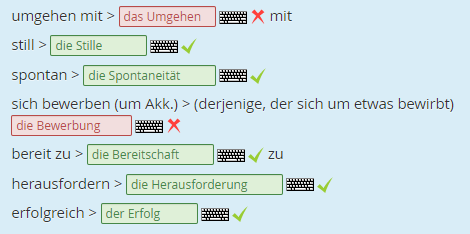
i've realised my error on the first one,
but the second one im too sleepless for
heavy stratus
@glossy marsh I'm curious, is smoke said to be 'on' the air as well or?
glossy marsh
No, in the air.
We say that clouds are "am/im Himmel".
With am, it means the sky is cloudy.
With im, it means that the location of clouds is in the sky.
heavy stratus
Ah okay, im Himmel doesn't raise any eyebrows, am Himmel makes the sky sound like a surface (a bit like a table) where you could put something on it and it would just float... suspended on the sky lol. Thanks for the explanation, I guess the author was just trying to communicate the sky is not cloudy
queen ginkgo
can anyone help?
glossy marsh
The person applying is the applicant, not the application.
heavy stratus
Der Bewerber, I think
icy flax
dry lava
Can I say "Alles wird vergehen" to mean "Everything's gonna be okay"?
Waffen, ver- has different meanings. The general one is "tresspassing a limit", which is overly abstract. A very common meaning is "things going wrong through the action". Vergehen has this meaning. Like they said, you are saying that things went (ok!) but went bad in some sense.
fallow ledge
„Die zeit vergeht“, bedeutet nur „time is passing“, was eine eher neutrale Stimmung hat
Ver- ist aber unglaublich knifflig
Indem die Wörter mit diesem Präfix unter sich viele unterschiedlichen Bedeutungen besitzen, die leider für jedes einzelne Wort gelernt werden sollen.
Abgesehen davon ist eine gute doch ziemlich vage Verallgemeinerung für diese Wortgruppe, wie Vodoo schon erwähnte, eine Überschreitungen von Grenzen.
glossy marsh
Alles wird vergehen.
Everything will pass (end).
dry lava
Danke euch
 molten viper
So können wir unser Mißverständnis vielleicht aufs schnellste wieder geradebiegen.
gibt es Rechtschreibfehler?
''aufs schnellste'' richtig?
icy flax
molten viper
So können wir unser Mißverständnis vielleicht aufs schnellste wieder geradebiege...
die Website ,,rechtschreibpruefung24.de'' weißt darauf hin, du solltest "Missverständnis" schreiben. Ich frage mich auch, warum das "schnellste" nicht großgeschrieben empfohlen wurde, da es um Nominalisierung geht, also "aufs Schnellste".
molten viper
meine Rechtschreibprüfung
es gibt ein Brief
Danke
''Mißverständnis'' wurde geschrieben.Sollte ich es als ''ss'' korrigieren?
außerdem ''dass'' oder ''daß''
Manche Sätze wurden als ''daß'' geschrieben
icy flax
Missverständnis mit ,,ss''.
dass = aktuelle Schreibweise
daß = veraltete Schreibweise
molten viper
vielen Dank
 vital goblet
@icy flax i really wonder what u will say
its so interesting
u start typing about 10 years ago
icy flax
Leute, ein kleines Review. Korrigiert mich wenn was nicht stimmt.
Beim Satz 1 geht es um eine gegenwärtige Empfehlung. Das ,,sollen'' im Satz 2 steht im Präteritum; im Satz 3, im Konjunktiv II. Allerdings bedeuten 2 und 3 hundertprozentig dasselbe. Nummer 4 hat nur eine Interpretation: etwa 50% Wahrscheinlichkeit, dass du es gemacht hast.
(1) Du sollst es machen. -> Empfehlung in der Gegenwart.
(2) Du solltest es machen. -> Empfehlung in der Vergangenheit.
(3) Du hättest es machen sollen. -> auch Empfehlung in der Vergangenheit.
(4) Du solltest es gemacht haben. -> Subjektive Bedeutung des Modalverbs.
icy flax
vital goblet
<@!471476935289995264> i really wonder what u will say
I like to keep things straightforward and clear 🙂
long whale
Um... There's a fundamental misunderstanding there. 1 means "You're supposed to do this [because some person of authority has said so - parents, teacher, boss]"
2 - Empfehlung in der Gegenwart
3 - Empfehlung für die Vergangenheit
4 - You were supposed to have done this - yesterday, for example.
@icy flax
icy flax
@long whale ! Nummer 4 existiert mega gar nicht. Ich meinte *gemacht haben.
 weak mist
Can someone send an article or just explain themselves about "noch" and where to use it? 
fervent kernel
Now that you say it, I do use noch sehr often
But that's because my language has an equivalent
weak mist
I don't think mine does :/
fervent kernel
What's your native language @weak mist