#questions-2
1 messages · Page 83 of 1
 unkempt spoke
But you just conjugate the verbs with the endings listed there then?
Aside of sein i mean
 fallow ledge
Somewhat
A lot of the k1 forms looks like the indicative
It sometimes gets replaced with Konjunktiv 2
Er sagt: „ich habe den Täter gesehen!“
Er sagt, er habe den Täter gesehen
 tardy carbon
specifically
K1 is very regular
but it’s often identical to the indicative
in those cases you’re supposed to replace it with K2
e.g. er ginge instead of er gehe
and if that’s still ambiguous you use würde
as far as I know, with the exception of sein, all K1 forms are just infinitive stem + K1 endings
fallow ledge
Nicely put ^^
unkempt spoke
So this is for reporting what people say then textually...Ok I see
And KII is for possibilities?
Oh wait I remembee now
The modal verbs with umlaut
I just think I saw it with modal verbs only, and not with the verb itself
So ginge confused me for a moment
 long whale
Um... You could just say "Ich räume mein Zimmer (Akk.) auf". The meaning might be slightly different though. "in meinem Zimmer" (I might just be sorting out my desk, for example, not the whole room) vs. "mein Zimmer" (would refer to the whole room). @dry lava
unkempt spoke
About earlier
I just wanna clarify. I'm doing this exercise about it
Basically I take the root of the word (the infinitive without the -en), right? And then use the endings cited in the yellow square, right?
And sein have an exception so I use sei
But i wanna ask
Why in number 3 i have to use würden schaffen?
And why in 4 is könne and not könnte?
In 6 i did have to use könnten
tardy carbon
because
- Konjunktiv I and Präsens are both schaffen → go to K2
- Konjunktiv II and Präteritum are both schafften → use würde-form
unkempt spoke
Ahhh so if it's the same i use K2 with würden always?
tardy carbon
yea, if the present ones are the same see if the past ones are distinct, if also the same use würde
so like e.g. with haben you’d have for K1: sie haben = sie haben but then for K2 it’s sie hatten vs sie hätten so you can use that
it’s a weird rule and I’m not sure how consistently people use it
 buoyant coral
would a better translation be "People check in their suitcases from here?
 thorn pelican
nope
regardless of the german sentence i wouldn't use 'from' in the english sentence
also note that some liberties have to be taken with translations as some concepts don't cross over word for word between languages. e.g. you simply use abgeben - to provide or to hand in - for luggage at an airport in german.
 plain umbra
Abgeben is also used for things like handing in homework, documents, etc.
buoyant coral
what is the purpose of "ab" here?
plain umbra
That's just what the verb is: abgeben.
unkempt spoke
@tardy carbon late reply but I think I'm understanding
So for K1 is present, and check if the new form is rhe same, and for K2 is preteritum and chrck if it's the same
Alright! Thank you
 fervent kernel
hello, i've got a question
i just read about the adjektive declination for ein paar..
so, for example my sentence is : i talked with a few friends
is it : ich habe mich mit** ein paaren** Freunden unterhaltet
i was rather uncertain, cause i've never come upon the declinated version of ein paar..
is the sentence right?
 sly ferry
Nope, mit ein paar Freunden
fervent kernel
but according to the list here, https://www.tlu.ee/~kirs/GRAMMATIK - Deklination der Substantive (Nomen) und Adjektive.pdf
 glossy marsh
Just to point out:
paaren
Means to mate.
fervent kernel
ah i get it now, ich habe mit** ein paar lustigen** freunden unterhaltet. it is adjective declination .. 😅
 autumn sapphire
declension*
buoyant coral
did he actually say "I don't give a fuck"? 😂
tardy carbon
yep
buoyant coral
haha!
autumn sapphire
i knew an old man who said scheißegal literally between every sentence
unkempt spoke
How do you use fiel ein
Is that "occured to someone"?
Like in "Ihm fiel nichts ein" or "es fiel mir ein"
Not sure if there's a rule for it or different conjugations
autumn sapphire
it's just einfallen but in präteritum tense
 dry lava
Kann ich einfach "Ich komme mit dir" statt "Ich komme mit dir mit" sagen?
thorn pelican
natürlich
dry lava
Ist es das Gleiche mit "mitbringen"?
"Ich bringe mit mir eine Tee Tasse mit"
"Ich bringe eine Tee Tasse mit"
"Ich bringe mit mir eine Tee Tasse"
Sind sie alle richtig?
tardy carbon
first of all, either it’s Teetasse (which is an empty cup the proper size for tea) or Tasse Tee (which is an actual cup of tea)
dry lava
Thanks. And second of all?
tardy carbon
the first one sounds very awkward. the second one means that you’re bringing the cup to some destination. the third that you’re carrying it around (or, poetically, that you bring it as a gift)
dry lava
Dank, Alter 
fervent kernel
Hey, I have a question.
When you use "aber" in the middle of a sentence, does it have the same meaning as "though" in english? Like this:
Ich habe es aber nicht
 humble saffron
it can also be used as "nevertheless" or "regardless"
not entirely sure what "Ich habe es aber nicht" implies, but i think it's something along the lines of
Yes but, I don't have it
or
Nevertheless I don't have it / I haven't done it, etc
not sure tho
fervent kernel
But "Aber ich habe es nicht" und "Ich habe es aber nicht" mean both the same?
 sand vine
Hey, I have a question.
When you use "aber" in the middle of a sentence, does it have the same meaning as "though" in english? Like this:
@fervent kernel essentially yes
it could function as 'however' too: Das ist aber ein heikles Thema, zur Besprechung zu bringen = this is however a touchy topic to bring up
fervent kernel
So when you use "aber" in the beginning of the sentence ("Aber ich habe es nicht") it functions as "but".
But when you use "aber" in the middle of the sentence ("Ich habe es aber nicht") it functions as "however" or "though"?
sand vine
Well if you ignore direct translations, don't they mean the same thing?
I would neverthless say that the second variant has a slightly stronger emphasis on the contrast
fervent kernel
Okeyy, thank you!
long whale
it could function as 'however' too: Das ist aber ein heikles Thema, zur Besprechung zu bringen = this is however a touchy topic to bring up
@sand vine In case you're interested, this kind of construction doesn't work in German. :) You'd need to rephrase it, for example as "Es ist eine heikle Sache, dieses Thema zur Sprache zu bringen". Plus, "Besprechung" means "meeting". :)
long whale
No, I meant "it's a difficult topic to bring up" can't be translated as Das ist aber ein heikles Thema, zur Besprechung zu bringen
@sand vine
sand vine
ahhhh i get what you're saying
thanks for the correction
just to be sure, ein heikles Thema as a standalone works right
long whale
You could say "Ich möchte k/ein heikles Thema zur Sprache bringen", that's perfectly fine. But you couldn't start with "Das ist..." and then end the way you did. 🤷
sand vine
got it👍
long whale
just to be sure, ein heikles Thema as a standalone works right
@sand vine Of course. :)
 topaz ridge
Was ist der Unterschied zwischen wirklich, tatsächlich und echt?
 dense ice
Was ist der Unterschied zwischen wirklich, tatsächlich und echt?
@topaz ridge
Du bist echt/wirklich nett. (You're really nice.)
Du bist tatsächlich nett. (You're actually nice) (Sounds like you did not expect the person to be nice at all)
In an other context it would be different but that's really complicated.But "tatsächlich" could be best translated with "in fact" when "echt" and "wirklich" are more like "really"
If you'd ask something like "really?" there's no real difference between those two words. Both are commonly used like that. But I guess "echt" is more like "real" and "wirklich" more like "really".
If you'd ask "Is this piercing real?" for example, you'd say "Ist das Piercing echt?"
you can't say "Das Piercing ist wirklich." In this case you have to use "echt". But you can use " wirklich" to emphazise an adjective. For example you could say (to respond that question "Ist das Piercing echt?") " Ja, es ist wirklich echt."
fervent kernel
Hi guys, I'm reading a small conversation and this person presents herself saying " und ich bin die Anke " why did she put an article in front of her name?
thorn pelican
Some southern dialects put an article in front of peoples name. It's a dialect/regional thing and not standard german
fervent kernel
Some southern dialects put an article in front of peoples name. It's a dialect/regional thing and not standard german
@thorn pelican
Thanks
 brittle basin
Servus Leute! When using a compound word (Kompositum I think?), will the word gender be the same as the first noun or the same as the last one? "der Geburtstag" do words like this always follow this logic? Thanks!
plain umbra
@brittle basin Last word, yes. And there are only a couple of exceptions that exist in the whole language.
The one most people know is:
das Wort, die Antwort
I think there is at least one more, but it's extremely rare, so you can trust it as a rule.
brittle basin
oh, thanks!
plain umbra
And btw, the reason it's die Antwort is because it used to be das Antwort but changed over time to match die Frage.
So die Frage and die Antwort are both the same gender. (Just mentioning that because I think it's a useful fact for remembering the genders)
brittle basin
sehr interessant! :v Thanks again!
autumn sapphire
@plain umbra interesting. Source?
plain umbra
@autumn sapphire Of which part?
autumn sapphire
That Antwort changed gender because of Frage
plain umbra
@autumn sapphire I guess I wouldn't say necessarily that it changed because of Frage. It most likely at least changed parallel to Frage. In wiktionary it's described as The gender change from neuter to feminine is due to semantic association with Frage (“question”)., but I think perhaps it really just comes from one of the typical grammatical construction of nouns from verbs. For example, fragen -> die Frage, antworten -> die Antwort, although (I'm pretty sure) originally it was ant- + das Wort = das Antwort.
But I don't have a super reliable source or something. Just wiktionary, dwds, etc. have some basic info about it.
thorn pelican
Verb stems take masculine when turned into nouns
verb stems plus e are feminine. infinitives are neuter and ge- ones are a combination of neuter and masculine
plain umbra
@thorn pelican I can't remember all the details off the top of my head but you essentially have multiple categories for nouns from verbs:
from the infinitive (gerund) -> neuter
from the Präteritum -> masculine
from the stem + -e, -t, or -st -> (often) feminine
thorn pelican
i know. by stem i meant exclusively the stem. no additional letters
antwort is just the stem so if following that rule would be masculine
plain umbra
Yeah, but that's most likely what's meant by Antwort specifically being described as following the pattern of similar feminine nouns derived from verbs.
Like it was originally neuter based on das Wort but changed due to association with nouns that are formed by a different rule, such as die Frage.
thorn pelican
it cpuld alsp be the other way around in which the verb was derived from the noun. 🤔
plain umbra
Yes, that's what happened in the middle though.
First: ant + Wort -> das Antwort
Second: Antwort -> antworten
Third: das Antwort -> die Antwort
(At least that's what I got from reading about it)
Although of course this all happened before modern German was a thing so it was like old German or something along those lines.
 rancid gate
how to say :
**i used to like her but not anymore **
glossy marsh
Ich mochte sie aber jetzt nicht mehr.
dry lava
Etwas ist hin = Etwas ist kaputt?
 summer crystal
Why in German it is:
"In Berlin ist es heute windig"
instead of
"In Berlin es ist heute windig"?
dry lava
because a verb always takes the second position
dense ice
It is a rule for the structure of the sentence
There must be verb in second position but it has exceptions too
German has so many exceptions
summer crystal
Danke ihr zwei!
dense ice
Etwas ist hin = Etwas ist kaputt?
@dry lava
It is a colloquially usage. I dont know how common is this but i dont think so
fervent kernel
Hi wanna ask what word do you use for "excited for"?
fallow ledge
in the sense of "im keen for", i would say; ich freue mich darauf
fallow ledge
in a couple of sentences:
ich freue mich auf den Kuchen (im looking forward to the cake)
ich freue mich darauf, diesen Film zu schauen (im looking forward to seeing this movie)
fervent kernel
sich freuen ueber means im happy about right?
fallow ledge
yeah
fervent kernel
so sich freuen auf means looking forward to?
fallow ledge
thats probably its closest translation
fervent kernel
aight vielen dank
 soft moss
I'm still very confused at telling the difference between dative and accusative
I know nominative is always your primary subject
and genetive is posessive
 mellow viper
Difference in usage or difference in formation?
 ivory kestrel
the accusative case is comparable to the direct object in english, and the dative case the indirect object in english, i.e. I give the ball (dir.) to the man (indir.)
however the usage between them aren't completely the same
@soft moss
it would probably be good to get an overview of both with the >faq [accusative/dative] command
 sharp acorn
@soft moss i have an example for you that might help you recognise the conceptual difference of akkusative and dative
this example expresses the difference between objects and indirect objects:
I am buying you.
- you are the object here. So I am buying you. I am purchasing the right to own you as a slave. This is human trafficking and it is bad and illegal. :O
I am buying you chocolates.
-chocolates is the object here. So I am buying chocolates. Not people. You here, are the indirect object, so you're receiving the object, the chocolates. So the verbs action is only indirectly affecting you, I am not buying you, rather I am buying an object for you or to you.
Now it is a nice thing! 🍫
accusative - what are you verbing? /who are you verbing?
dative - what are you verbing that thing for? /to whom?
ivory kestrel
nice
 wild gazelle
@soft moss Just be careful, that there are some special verbs that take the dative as the direct object, e.g. helfen, folgen. I am not sure why, most likely there was some logical reason in Old High German.
autumn sapphire
@autumn sapphire I guess I wouldn't say necessarily that it changed because of Frage. It most likely at least changed parallel to Frage. In wiktionary it's described as
The gender change from neuter to feminine is due to semantic association with Frage (“question”)., but I think perhaps it really just comes from one of the typical grammatical construction of nouns from verbs. For example, fragen -> die Frage, antworten -> die Antwort, although (I'm pretty sure) originally it was ant- + das Wort = das Antwort.
@plain umbra i mean, the word for answer was feminine in proto-germanic already 👀 so i kinda (x) doubt this
tardy carbon
which word for answer? @autumn sapphire
autumn sapphire
eh answ - something - ô (no o with macron on this keyboard). Hold on i'll look it up
tardy carbon
cursory search on wiktionary gives me *andawurdiją (from which German Antwort) and *andaswarō (from which English answer)
the latter is feminine, but formed with a different noun (swarō, from which German Schwur and English swear)
autumn sapphire
this one
oh andawurdiją is neuter, right
in middle dutch it became antworde which according to wiktionary could be neuter or feminine so there does appear to have been a change (but it was before german)
plain umbra
Yeah, and like I said, although I described it in terms of modern German, it technically was something from before that. It's just easier to describe it in terms of the current forms, for the sake of clarity.
autumn sapphire
still, would be nice if the people who put claims on wiktionary cited any source at all, especially since in
the intermediate steps are all missing pages
tardy carbon
wiktionary is horrible for reliable etymologies
it’s a good place to see whawt sounds plausible
but I’d definitely take it with a tablespoon of salt
autumn sapphire
kinda sad how to research good etymology we still need to rely on paper resources
dry lava
"Ich sah zu Petra hinüber"
It's like in the image? (The green lines show my view)
I'm on the right
glossy marsh
Yes.
dry lava
Thanks
dry lava
Diese Regel besteht = This rule exists?
dry lava
ah
so the main difference between BESTEHEN and EXISTIEREN is the first one implies "to continue to exist", whereas the second one means "to exist"?
glossy marsh
Yes.
dry lava
Dank!
glossy marsh
*Habe Dank or
*Danke
tardy carbon
“Habe Dank”‽
dry lava
wut
tardy carbon
that sounds like you’re a poet from the 17th century to my ears
glossy marsh
^^
 tardy carbon
immer gern
glossy marsh
Alternatives are nice to have. :P
tardy carbon
if they’re actually valid, sure

 neat loom
Hello,
Are the German Harry Potter books suited for beginners? And are there any good audio variants? Sorry if it has been asked before
thorn pelican
define 'beginner'? like what level of beginner?
you can listen to it / try and read it for practice at any level, but at about B1 it starts becomming more manageable / enjoyable
plain umbra
Most normal novels will be B1 minimum (and most will actually be B2+, but some will be okay for B1 as well).
Most of the books for Level A are books written specifically for learners.
However, you can try to read a book at any time. Worst case is you give up, but there's no harm in trying tbh. 😄
neat loom
You are right, i will probably purchase them off amazon, thanks
dry lava
"Verlangen" wird nur wie "demand" benutzt? Kann ich es auch wie "require" verwenden?
Zum Beispiel:
"Es ist verlangt (es verlangt), dass du zwei Augen hast" - "It's required (it requires) that you have two eyes"
long whale
Mm... "Es wird verlangt, dass..." Yes, that would be "It's required that..."
@dry lava
dry lava
Ok, danke!
And
"Ich verlange von dir, dass du mir das gibst"
"I demand you give me that"
Richtig?
 light marsh
'Sie lebt gern in Berlin. Die Stadt ist oft hektisch und anstrengend.
(obwohl)"
answer: *Obwohl die Stadt oft hektisch und anstrengend ist, lebt sie gern in Berlin. *
?
AND
answer 1: Sie lebt gern in Berlin, obwohl die Stadt oft hektisch und anstrengend ist.
 bronze garnet
Both good!
light marsh
Thanks 🙂
 autumn grail
What is the equivalent of " tit for tat" in German?
plain umbra
dict.cc | Übersetzungen für 'tit for tat' im Englisch-Deutsch-Wörterbuch, mit echten Sprachaufnahmen, Illustrationen, Beugungsformen, ...
dense ice
I read a phrase like this: "du kannst was lernen so fängt man einen fisch"
Shouldn't be it: Du kannst (etwas) lernen, wie man einen Fisch fängt
I didnt get the "du kannst was lernen" part
fallow ledge
You can shorten etwas to just was
And for the so fängt man einen Fisch, i feel like its demonstrating something, where so its like: like this! This is how you catch a fish
Or in gerneral referring to an event that just happened or the sentence before
I think took the sentence too literally. Hmmm
 icy flax
I aggre w u, @dense ice. It seems a period was just ommited. Where diid you take that passage from?
I read it as "(Komm!) Du kannst was lernen. So fängt man einen Fisch!"
dense ice
I aggre w u, @dense ice. It seems a period was just ommited. Where diid you take that passage from?
I read it as "(Komm!) Du kannst was lernen. So fängt man einen Fisch!"
@icy flax
Avatar: der Herr der Elemente 01x01
 swift bough
What is the equivalent of " tit for tat" in German?
Bruh what does that even mean in English
 forest tusk
i wonder the same thing lmao
plain umbra
Same as "an eye for an eye".
forest tusk
interesting
icy flax
@swift bough , in dict.cc for "tit 4 tat":
Auge um Auge, Zahn um Zahn.
Wie du mir, so ich dir.
Wurst wider wurst.
glossy marsh
The first two I've heard. ^

 cerulean whale
An eye for an eye is an expression I think
It's a principle where you return the exact harm to someone who did it to you
icy flax
I hate Netflix... I heard now "Was ist denn endlich gefahr?" and the Untertitel war "Was ist denn los?". I wanted to know the actual sentence
plain umbra
@swift bough No, "an eye for an eye" is a common expression.
thorn pelican
an eye for an eye and the whole world goes blind
swift bough
New to me
 formal nexus
isnt that idiom out of the bible
long whale
I hate Netflix... I heard now "Was ist denn endlich gefahr?" and the Untertitel war "Was ist denn los?". I wanted to know the actual sentence
@icy flax The actual sentence probably was "Was ist denn in dich gefahren?" (What's gotten into you?) :)
icy flax
danke Susanaaa!!
cerulean whale
If I am speaking to a guy I don't know in this server, do I address them formally or informally? So if it's 'you', would it be Sie or du?
Or does it depend, like if they are older or younger
thorn pelican
on the internet in chats like this it's always du
cerulean whale
But in real life, it would be Sie?
long whale
Depends a little. On how old you are and on how old the other person is. "Sie" is kind of a marker of respect for strangers and people considerably older than you. If you're 16 and meeting somebody who's more or less the same age, you wouldn't address them formally. If you're talking to a teacher, or a friend's parents, or a shop assistant, or a random stranger you ask for directions, you'd always address them as "Sie" (and this wouldn't change, no matter how well you know them, unless they tell you otherwise). Does that help? @cerulean whale
cerulean whale
Ich verstehe, danke für ihre Hilfe
cerulean whale
Are there any rule of thumbs in knowing when a vowel should have an umlaut on top of it?
Like:
Ich trage
Du trägst
 crisp socket
Most of the time, if the word has one syllable it changes
kalt kaelter
jung jünger
etc
autumn sapphire
- when the part of speech changes (but not for all words)
- when you form superlatives like Nolan showed
- in the second and third persons singular of strong verbs
and it depends on the root vowel and shape. There are patterns but they date back to protogermanic and they're not worth learning. You'll get the hang of it eventually, don't think about it too much. The brain is good at picking up patterns by itself even if you don't rationalise them consciously
cerulean whale
Are there any nice and easy online etymology dictionary for German words for level A students like myself?
It helps me remember vocabulary
autumn sapphire
hmm dwds often offers etymology
i'm not aware of anything that specifically tackles it though if not in paper form
germans are boomers
tardy carbon
I’m not aware of an english-language etymological dictionary of German. you may find one on Germanic languages in general though
wild gazelle
@cerulean whale Wiktionary has a section on etymology in English for German entries.
Also, most strong verbs have a umlaut in the second and third person present.
tardy carbon
yea but you can’t really trust wiktionary imo, they barely ever source anything
and I’ve definitely come across some rather questionable things there in the past
wild gazelle
I know, but it is OK for personal research to help connect cognates and patterns. I would not recommend it for serious academic research.
autumn sapphire
frankly i would avoid it even in that case if you're not prepared to look for confirmation of what you find
because this is exactly how disinformation works
you think the thing you read is good enough and eventually you repeat that information as true after you've convinced yourself, even though there aren't enough reasons to believe it in the first place
wild gazelle
fair enough
cerulean whale
Okay, so I should have both the Wiktionary and a German etymology dictionary open at the same time, and if the wiktionary contradicts information in its German counterpart, I don't trust it
wild gazelle
Yes, if you wish.
cerulean whale
Ich verstehe. Danke für die Auskunft!
thorn pelican
German doesn't differentiate between present continuous and present tense
e.g. there is no difference between i eat and i am eating in german.
in this case es regnet both means it rains, and it is raining
cerulean whale
So if it's happening in the moment, I don't have to put the 'ist' in this kind of sentence structures?
thorn pelican
you can't put 'ist' in there at all
you can use an adverb like 'gerade' to make it very clear that you're talking about rightt now, though
cerulean whale
How about this sentence:
Der Mann ist traurig, weil seine Frau gestorben ist.
There is an 'ist' at the end of the sentence
thorn pelican
because that's the past tense
The man is sad because his wife died
you build the perfect tense (the tense used to express the past when speaking) using either haben or sein debending on the verb, and the participle 2 form of the verb
cerulean whale
I see, I see. Danke für ihre Hilfe!
thorn pelican
gern geschehen
 heavy stratus
Is there an equivalent for 'of' in German?
Eine Tasse Kaffee
Das Ende der Tag
Would 'der Sohn Ivar' --> 'the son of Ivar'?
 celest frost
no, but you can leave out letters (usually vocals) in other words.
"a good ol' cup of coffee" -> "Ne gute alte Tasse Kaffee"
"Das Ende des Tag(e)s"
No, that'd be "the son Ivar"
thorn pelican
eh technically von
but except for a few situations using von for possesion is not standard german
heavy stratus
Der Sohn von Ivar?
celest frost
possession: "Ivar's son" -> "Ivars Sohn" (Genitiv, uncommon in casual conversation)
"Der Sohn von Ivar" (Dativ, common in casual convos)
"Ivar ist sein Vater" (Possessivpronomen)
all of the above are possessive
heavy stratus
Very helpful, thank you :)
celest frost
gern
heavy stratus
So does 'von' in people's names mean something like 'descendant of'... similar to Irish surnames names starting with an O'?
celest frost
in names it's a designator of noble heritage
if you were to refer to them by their last name, you'd say "Guten Tag, Herr von Ivar."
celest frost
so treat it as if it were an inseparable of the person's name
I don't know anyone with a noble name, personally
so it's really uncommon
heavy stratus
Right I see, danke! Maybe you walked past a 'von' one day without realising aha
celest frost
I didn't anticipate you asking about the nobility use case, so my earlier answer might have mislead you
heavy stratus
A monocle, walking cane and tail suit is how I picture a 'von' now
celest frost
i certainly do remember some people, but that's business clients and none of them are my friends, so I don't know how I would refer to them if they were
icy flax
@heavy stratus , here in Brazil, I've heard once that the ones with "Silva" last name come from a rich family that happened to have slaves back in the days. The "da Silva" would have its origins also in the context of the "Silva" except that they were slaves from "Herr Silva". For that reason, they are "da Silva". Maybe this logic could also be applied to other languages too.
long whale
@icy flax Not to German. ;)
Roughly, in medieval times, lots of peasants were owned by some knight, but they weren't known by his name, they were usually known by their occupation (hence the many German Müllers (Millers) and Meiers/Mayers/Meyers), or some physical trait, or whatever came to mind to distinguish them from the many other people with the same first name. The knight, however, did own a place, usually some castle, and that's where he got his last name from: Herr (master) von (of) [insert name of castle]. :)
@icy flax
heavy stratus
@icy flax I've not come across that before, interesting take
@long whale were the peasants 'owned' by knights? I figured rather the knight was the 'feudal lord' in charge of the land upon which they worked and lived rather than owning the actual peasant
long whale
heavy stratus
I wish my German was good enough to read that :D my text book only just taught me how to use the accusative in some instances less than a week ago haha
long whale
The corresponding English article is called "Serfdom". :)
heavy stratus
Danke!
long whale
"Leibeigenschaft" is, to all intents and purposes, a form of slavery. "Leibeigene" could not move away from where they were farming, they were not allowed to marry without their master's consent, they had to do what they were told, i.e. serve their master, who was at the same time their judge, and as far as I know, they were sold together with the land they lived and worked on. I'd call that "being owned", wouldn't you? @heavy stratus
heavy stratus
@long whale I agree that's called being owned, I was not aware of Leibeigenschaft. I'm assuming this was a feature of the Holy Roman Empire?
long whale
Hmm... This was a very common feature in most of Europe (Italy and France, for example), as far as I know. I do know it existed in Russia, too, until the Russian Revolution. 🤷
heavy stratus
ich verstehe. Just found out owned serfs were a thing in England too, I wasn't aware lords had that extent of control over some of their individual subjects - this sort detail never came up in my old history exams so I wasn't aware :) vielen dank
 fathom valve
buoyant coral
fathom valve
buoyant coral
Sonntags trifft sich die Familie von Andrea zum Mittagessen = Sundays the family of Andrea meets to the lunch?
buoyant coral
Organisationsform, bei der die Bundesländer ein Mindestmaß an Eigenständigkeit besitzen. (could someone breakdown this sentence for me?)
swift bough
meets for lunch @buoyant coral
buoyant coral
why not "für"?
swift bough
Organisationsform, bei der die Bundesländer ein Mindestmaß an Eigenständigkeit besitzen.
Form of organization in which the federal States exhibit a minimum amount of independence
buoyant coral
bei der = in which?
swift bough
Well, because you can’t always translate prepositions literally.
buoyant coral
ah ok
swift bough
Each preposition means something different than any similar English preposition
Mostly very slight differences
I actually sadly don’t really remember why it’s „zu“ in this case rather than „für“, but it would sound odd to my ears
buoyant coral
Each preposition means something different than any similar English preposition
@swift bough so you mean they can mean sth other than what they directly mean?
I actually sadly don’t really remember why it’s „zu“ in this case rather than „für“, but it would sound odd to my ears
@swift bough thats ok
swift bough
so you mean they can mean sth other than what they directly mean?
Yeah exactly. There’s plenty of cases where „für“ and „for“ will work as direct translations, but just not always.
buoyant coral
i understand thx
swift bough
Like for example, „Ich fliege nach Amerika“, „I‘m flying to Amerika“
buoyant coral
danke
swift bough
Lmao that wasn’t even using für but the idea is applicable to all prepositions so
Because at a first glance, „zu“ would be closest to „to“
buoyant coral
ok
swift bough
Well ok so
sand vine
@swift bough thats ok
@buoyant coral für seems to be more for possession while zu more for purpose
buoyant coral
ah i see danke ZF
sand vine
Hence meet for lunch would be like meeting for the purpise of lunch
Hence zum Mittagessen
buoyant coral
danke
swift bough
Regarding your question about why the „an“ is there - you basically just have to memorize which prepositions get used in each specific context. It’s the same thing with my „Ich fliege nach Amerika“ example
swift bough
Hmm yeah I agree with that @sand vine
Like in Germany if you go shopping you commonly see on the packaging of items „zum Öffnen“
For example
zum Öffnen really means the same thing as „um zu öffnen“, and as it turns out, „zum“ and „um zu“ have very similar lettering, making it easy to understand and remember, however, the two constructions aren’t actually directly related. What I mean by that is um + zu doesn’t equal „zum“, „zu + der/das“ is where zum comes from
But one of them usually just sounds better than another depending on the sentence
buoyant coral
i see
what is the purpose of "an" in my sentence. how does it affect things?
i know it's a preposition but does it like "strengthen" or "put more emphasis" on things?
swift bough
I just notice that I forgot to translate an entire word 
It’s actually this
„Form of organization in which the federal States exhibit a minimum amount of independence“
buoyant coral
ok thx
swift bough
It functions as „of“
The „an“
Another example where the common translation „von“ doesn’t work
It isn’t really logical to memorize what every preposition can possibly translate to, that will just end up being too confusing.
It’s better to instead memorize one context at a time in which you can use each one
buoyant coral
Ok I understand thank you 🙂
buoyant coral
vielen vielen dank!!
long whale
"besitzen" = possess, have
Do you see "exhibit" as a fitting synonym there? 🤔
@buoyant coral @swift bough
swift bough
Possess and exhibit in this context are very much interchangeable in English @long whale
long whale
Oh, okay, then. Thanks. :)
swift bough
nppp
dry lava
Es ist** allgemein/überhaupt** falsch
Gibt es hier einen Unterschied zwischen **diesen **Wörter?
swift bough
„Es ist überhaupt falsch“ klingt sehr komisch meiner Meinung nach, „es ist allgemein falsch“ wäre theoretisch richtig
Ich habe sowas noch nie gesehen/gehört
Noch auf das erste bezogen
dry lava
Und wenn man "überhaupt" benutzen soll?
Wie hier? "Ich mag das überhaupt nicht"
swift bough
Ja sowas sagt man sehr häufig
dry lava
Ist das die Analogie von "at all"?>
dry lava
Ok, danke
long whale
What is "dir" for in this sentence?
@vivid leaf The verb is "sich (Dat.) etwas ansehen" = to look at something 🤷 While you could say "er sah das Bild an [ohne es zu sehen]" it would mean he was directing his eyes towards the picture (without actually seeing it). In your sentence "Sieh dir das an", the "dir" could not be left out without making the sentence so entirely unidiomatic as to render it meaningless. :)
 vivid leaf
Ok thanks
fervent kernel
hallo, ich würde gern eine frage im bezug auf die Nutzung des Wortes ''sei'' stellen...
sei geduldig.. sei stolz auf dich.. das ist klar, sei + adjektiv.
sei ein gehorsames mädchen.. sei + nomen
aber
sei nicht so spät auf die arbeit zu gehen.. stimmt das auch?
oder sei nicht so früh bei mir vorbeizukommen..
 wise pendant
Sei nicht so spät auf der Arbeit <- das hier ginge, aber nicht mit einem anderen Hauptverb dazu
fervent kernel
also nach dem wort 'sei' muss es kein mehr verb gibt.
oder sei nicht so früh bei mir vorbeizukommen.. und dieser satz? wie kann ich ihn richtig ausdrücken ?
sei nicht so früh bei mir?
wise pendant
ja
fervent kernel
okay, danke Andre!
wise pendant
"Sei" scheint mir einfach nur die Befehlsform von "sein" zu sein
fervent kernel
ich habe das wort auf englisch als ''please .. be'' übersetzt
wise pendant
Ja, das Wort "sei" ist einigermaßen höflich
fervent kernel
wenn ich mit meinen freunden rede, passt dieser besser? -> komm nicht so früh bei mir vorbei
wise pendant
Du musst mit deinen Freunden nicht unhöflich reden. 😅
Aber ja, "Komm nicht so früh bei mir vorbei" geht auch (diese Version ist auch recht neutral, aber ein wenig unhöflicher)
fervent kernel
😂 nee,, ich meine , welcher ist formeller und informeller ..
wise pendant
Ich würde sagen in formellen Situationen hört sich ein Satz mit "Seien Sie ... " schon höflich genug an.
In informellen Situationen kann man an sich auch die Form mit "sei" verwenden. Das ist dann ein kleines bisschen höflicher, als die Form ohne, die natürlich auch ok ist.
fervent kernel
okay, verstehe! also lieber diese Form komm nicht so früh bei mir vorbei wenn ich mich mit meinen freunden unterhalte.. nicht wahr?
wise pendant
Ja, aber die Form mit "sei" ist auch ok.
fervent kernel
mhm danke noch einmal ! ich merke mir das 😊
 delicate tiger
 warm karma
ah Sporen! nicht Spuren. Vielen Dank.👍
talking about comparing a cars top speed, “auch bei 250km/h ist hier Schluss” is that a correct interpretation?
 pine copper
Hello! I'm new to german, I saw a phrase where I expected a personal pronoun and instead there's an article
"Die spinnen, diese Amerikaner"
Why is that and what's it called (so that I can learn it by myself)?
fervent kernel
the meaning is something like : they are crazy, these americans..
fervent kernel
die is more of a 'derogatory' form
plain umbra
It's common to use die/der/das/etc. instead of the personal pronoun when referencing something where you're really emphasizing it in some way, or pointing it out. You use it a lot with objects. It can be used with people, but like Gran said, it is often used to be rude when used for people.
Like maybe you point to an object that's masculine (like a table) and say "Den mag ich nicht." or so on.
pine copper
Thanks! Is it just nuance though or also grammatically different? I'm thinking for example of "I don't like it" vs "I don't like that"
plain umbra
The meaning is the same. It's just about what sounds good for that context, basically.
In theory, they're interchangeable.
I would recommend just to learn it by example.
Like by more German immersion.
It's just one of those things.
pine copper
👍
bronze garnet
if it helps at all, using "sie" would be perfectly correct in that sentence but I would always use "die" here
pine copper
Ok... So it's really a question of tone👍
plain umbra
Ja.
swift bough
Hey, bin auf etwas gestoßen beim Lesen. Ich wollte fragen, ob die Verwendung von dem „festlegen“ am Ende folgendes Satzes schon etwas veraltet worden ist, denn ich hätte selber eher „ausdrücken“ verwendet, oder heißt es was anderes?
„Und ich musste feststellen, dass mir selten etwas so schwergefallen ist, wie mich hier unmissverständlich festzulegen.“
Für mich ist das Verb „festlegen“ sowieso schon etwas undeutlich, bezüglich der ganzen Weisen in denen es verwendet werden kann. Ich musste es im wirklichen Leben bisher nur verwenden zum Termin Festlegen.
long whale
No. If anything, it's the first "festlegen" I have problems with. Are you sure it's not a typo? IMO, it ought to be "feststellen". The one at the end of the sentence looks fine, although it's a bit hard to say without further context. But "sich unmissverständlich/endgültig [auf etwas] festlegen" is quite a common turn of phrase, meaning something like "to definitely decide on something". :) @swift bough
swift bough
Oh no you’re right the first one is „Feststellen“ @long whale
the reason I thought that „ausdrücken“ could make sense, is that the book has to do with a mother who is giving life advice to her children
To express all of her advice to them I guess
long whale
I guess the whole sentence would be something like "And I found that rarely had anything been as hard for me as to take a really firm stand [without any possibility of being misunderstood] on this [issue]" 🤷
@swift bough
I guess if she's giving advice, she needed to decide first of all where she herself stood, concerning some issue?
swift bough
This sentence is just from the „introduction“ of the book
It’s „why I am writing this book“
long whale
That sounds as if I've guessed the context more or less correctly?
swift bough
Well based on the context of the rest of the book, I would’ve translated it as „And I just had to notice how rarely something had ever been so hard for me, such as trying to unambiguously express myself/my thoughts“
She did mention, it was damn hard for her to put her thoughts into words
Somewhere close to after or before that
Also this now made me wonder, are Feststellen and Merken synonymous? Would it sound weird to use Merken instead in that sentence?
long whale
In this particular sentence, "merken" would have worked just as well, yes. But on the whole - no. "merken" (which also has other, quite different meanings, but you know that, right?) is like "to notice" in the sense of "to feel", "to intuit", while "feststellen" is "to find out", for example by trial and error. @swift bough
swift bough
Uh yeah I know a few other ones. It can mean „to bookmark sth“ but also „sich merken“ which basically means „to keep sth in mind“
Dunno if there’s more
But those are the main other ones for sure, other than „to notice“
long whale
Yes, correct, those are the important ones. :)
 light ivy
Any free practice worksheets available?
For free?
Could someone perhaps direct me to them?
 sage tendon
light ivy
sage tendon
light ivy
I have not. Thanks
 stoic mauveBOT
resources
wild gazelle
In which class is the strong verb gären? It seems to me that it should belong in class-4 alongside erwägen, bewegen, etc.
tardy carbon
what is the definition of class 4?
I don’t know the enumeration scheme
wiktionary lists it as class 3, for what it’s worth, but it also exists as a weak verb and I personally use it mixed (gären / gegoren / gärte)
wild gazelle
It has four sub-classes or patterns. It is a bit of complex one. But the relevant sub-class of class-4 I am referring to is:
3rd present indicative: ä/e
simple past: o
past participle: o
I saw the entry in Wiktionary too.
tardy carbon
as I understand, wiktionary is following this enumeration scheme
wild gazelle
That table does not seem to have all the patterns. For example, class-4 has more patterns than that.
tardy carbon
I’m not sure how useful it is to bother with listing the classes tbh
I’ve not seen many learners bother with them, people just memorize the principal parts or cram the commonly used ones a bunch until they’re stuck in memory
wild gazelle
That is how I learn strong verbs' conjugation. It helps me systemise a pattern (if there is any) in my mind.
tardy carbon
the thing is there’s usually like… three verbs in a given pattern
at least it feels that way
wild gazelle
I am wondering if there is a more reliable German dictionary with the class.
tardy carbon
most dictionaries list the principal parts
wild gazelle
I mean the enumeration.
tardy carbon
from which you can derive all the information
including the class, if you so desire
wild gazelle
I know, but I do like learning the enumeration along side it.
tardy carbon
idk of any, really the only people who use this enumeration scheme are historical linguists
wild gazelle
It is habit that I got from learning Old English which has a similar enumeration to German.
Oh well, I will just list it as class-4 since it relates the most to it.
tardy carbon
it falls into the category
Class 4 with long vowels and substitution with o in preterite (eː-o:-o:) : gären, scheren, schwären, wägen, weben, bewegen.
except that the e shifted to ɛ
wild gazelle
I thought so.
tardy carbon
for some speakers
wild gazelle
Where is that quote from?
tardy carbon
https://en.wikipedia.org/wiki/Germanic_strong_verb#Classes_1_to_6 under class 4 for german
In the Germanic languages, a strong verb is a verb that marks its past tense by means of changes to the stem vowel (ablaut). The majority of the remaining verbs form the past tense by means of a dental suffix (e.g. -ed in English), and are known as weak verbs.
In modern Englis...
below the table
eː vs ɛː is a bit of a mess
some speakers merge them, some employ spelling pronunciation
wild gazelle
Yes, I read that article. I just wanted to confirm with a native or at least find a dictionary that has the enumeration.
tardy carbon
it’s not entirely clear where which vowel was actually the original one
I mean it is gären/gor/gegoren yes
but I tend to say gärte if anything
actually I’m not sure if I say gegoren either, I might just always use the weak verb
self-analyses are hard
wild gazelle
Is there a distinction in meaning like erschrecken? One is transitive and the other is intransitive.
tardy carbon
supposedly the weak one is preferred for metaphorical uses and the strong one for actual fermentation
but idk how consistently that is done
they’re both intransitive
long whale
but idk how consistently that is done
I'd (tentatively) say it's done pretty consistently in Standard German. To the point where it wouldn't make any sense to use the form with the vowel change in a sentence like "Im Volkgorgärte es".
tardy carbon
what about the opposite? “der Apfelsaft gärte”
long whale
Or, heaven forbid, in "Der Zorn hatte schon lange in ihm gegoren gegärt". With fermented drinks, on the other hand, I'd expect to see "gor"/"gegoren", "vergoren". 🤷
 past rivet
May I use "an jemanden denken" to mean "to commemorate"? Because that's how "gedenken"s first meaning is given on DWDS but I thought they were somewhat different things.
dense ice
"denken an" means literally "to think about"
ZB: Denkst du an den Termin heute abend? - Do you think about the appointment tonight?
jds./etw. gedenken
or
das Andenken jds./etw. feiern
is more usable i guess
fallow ledge
This version of einer sache gedenken is listed as a Synonym to erinnern an
So i feel like its, lest we forget, let us remember those who fell, sort of idea of to remember and to think about
@past rivet
@dense ice im not sure if feiern is the right word here, its usually associated with a big party (or leaving work like Feierabend), unless you wanted to celebrate das Andenken with like a big funeral party.
Im not sure what a good replacement would be: ehren vielleicht?
long whale
You're mistaken. "feiern" is not just "to party". @past rivet We also say "Trauerfeier" (funeral service).
long whale
Several examples here: https://www.dwds.de/wb/Trauerfeier @fallow ledge (scroll down to Verwendungsbeispiele - no idea why they felt the need to include an example from 1934, it's not as if the word were obsolete 👀)
fallow ledge
Haha i mean for feiern
I was looking at the dwds page and the Synonymsgruppe was a lot of fun
long whale
Something like (making this up) "Der Gedenkgottesdienst (memorial service) wird im Dom gefeiert" you mean?
fallow ledge
yeah i see, thank you!
long whale
I was looking at the dwds page and the Synonymsgruppe was a lot of fun
@fallow ledge I see. Yes. Several in there I'd never heard. "bürsteln" giggles
wild gazelle
Are both word-orders correct?
Sie legt aufs Bett die Kleider
Sie legt die Kleider aufs Bett
long whale
Um... The 1st would only be okay in a poem or song. It would sound quite, quite funny, otherwise.
@wild gazelle
wild gazelle
OK, I thought that the indirect object would normally come before the direct object, unless that does apply here.
Or are they both considered direct objects since they are both accusative?
long whale
That's only for people, as far as I know: Sie gibt ihrem Bruder ein Buch. (She gives a book to her brother)
@wild gazelle
Oops.
Neither.
Only 1 direct object (Kleider), no indirect object.
The "auf's Bett" is a prepositional thingummy. Präpositionalergänzung (or something, sorry, can't be bothered to look it up, it's late). :)
wild gazelle
OK, thanks, is that for all clauses that have two accusatives, where one is a direct object and the other indicates movement? I cannot think of another example.
long whale
Hmm, yes, I'd say so.
Er bringt seine Freundin nach Hause (He's taking his girlfriend home)
I could come up with others if you needed them...?
wild gazelle
Is Hause not dative?
long whale
Correct.
wild gazelle
What about (this is off the time of my head, it may be very wrong):
Er fährt das Auto in die Stadt
wild gazelle
And in die Stadt or in die Garage are Präpositionalergänzung as you said.
long whale
Let me check if that's the correct word...
long whale
Just a quick note: "Er fährt das Auto in die Stadt" would mean "He's taking the car into town" (as in: his sister needs it there). If you wanted to say "He's going into town by car/He's driving into town", you'd say "Er fährt mit dem Auto in die Stadt".
And I think the reason is that the place/location usually comes last.
wild gazelle
OK
long whale
In a German sentence, I mean.
And Präpositionalergänzung is not the right word. That's for verbs requiring a certain prepositon.
As in "to stop somebody from doing something" = jemanden an etwas hindern
summer crystal
Hallo! I came across this phrase and I can't make sense out it... what would be the literal, word by word translation?
Es wird am Wochenende warm und sonnig werden.
plain umbra
Why don't you try it yourself first?
However, there's not much benefit to a "word by word translation" here.
summer crystal
I'm having trouble with the "wird" at the beggining, and searching for its meaning didn't help much :/
plain umbra
This is how you form future tense in German.
 woeful jay
It will be warm and sunny at the weekend.
plain umbra
Ich werde essen. = I will eat.
Du wirst trinken. = You will drink.
Es wird werden. = It will become.
Werden by itself means "to become" but when you use "werden" + another verb, it's future tense.
summer crystal
Right, but there are two "wills", wird and werden, and I think this bugged me
Werden by itself means "to become" but when you use "werden" + another verb, it's future tense.
Oh! now I get it!
So the word by word translation would be "It will in the weekend warm and sunny become", right?
plain umbra
Sure, it could be translated like that.
summer crystal
Super, danke schön!
buoyant coral
Not being able to have an answer for something
Nicht in der Lage sein, auf etwas eine Antwort zu haben
I just wanna know what is the reason for "auf" being here?
 rain python
eine Antwort auf etwas = an answer for something.
there are lot of verbs that go with certain prepositions. for example:
kummern um : take care of
sich freuen ueber : happy/pleased about
fragen nach : ask for
buoyant coral
ach so! vielen vielen dank @rain python
rain python
most of the time prepositions don't translate to other language
i'm having a hard time with this too
buoyant coral
damn
formal nexus
yeah prepositional verbs and phrases are common in both english and german and in both if you use the wrong preposition you might get misunderstood, especially for verbs that can take different ones, cos the preposition changes the words meaning (like pick up vs pick on in english)
past rivet
Thank you Susana, BlueBottletop and Mathemagician
 oblique jay
For Hast du Geschwister, it means Do you have a sibling right?
Then wouldn't thre answer be Ja, ich habe zwei Geschwister.

thorn pelican
Geschwister is basically always plural. So, Do you have siblings?
oblique jay
Ohhh I see
thorn pelican
and the answer is most likely i have an x and a y
oblique jay
Ja, ich habe ein Bruder und eine Schwester?
oblique jay
okay thanks 
celest frost
I don't think we even have a word for "sibling"
"Geschwisterteil" maybe
anyway, what sun said
oblique jay
Wats Geschwister then?
Alsoo for the first question
I mean I have 2 sisters
So do I make it Wie heisBt deine Schwestern?

tardy carbon
Geschwister is both singular and plural
tardy carbon
singular das Geschwister, plural die Geschwister
thorn pelican
das Geschwister is specifically a swiss thing though
oblique jay
They're not Halbschwester (half sister) nor my step sister nor my twin sister
and the sie would become ihr? Or Sie also works i guess
tardy carbon
with Eltern I agree (tho some people are trying to make das Elter a thing, people are mostly just ridiculing that)
oblique jay
im sorry but all of dis is not helpful to my question rn
tardy carbon
anyway I’m sorry relerx but I’m a bit lost, what exactly is your question?
 tardy carbon
(please don’t substitute ß with B, use ss if you must)
tardy carbon
if you wanna ask “How are your sisters called” yes that’s correct
oblique jay
But the question doesn't allow me to do that cuz there's no option
so do I just name one of my sisters
I think I should ask my teacher about this tbh
tardy carbon
I assume you’re supposed to answer from the perspective of Thomas in the picture there
oblique jay
yep
tardy carbon
I mean it looks like you’re just supposed to make some dialogues or sth
are there no instructions?
tardy carbon
it means “create dialogues”
oblique jay
this is the whole question ^
tardy carbon
plural
oblique jay
tardy carbon
probably
oblique jay
Lemme ask him again
tardy carbon
are you in class right now
(if so why would you turn to discord first and not to your teacher)
tardy carbon
I assume you’re supposed to just write out a dialogue like this or sth
if this is written homework
oblique jay
ya
I thought I had to follow the template word to word so that's what I did for the first thing
maybe I have to do that? and make my own template for question 2?
idk
Gonna wait for the response from my teacher
Ok so I can change the question as required but I should follow the template
I have another question not related to this
Mein Brüder Hobbys sind computer spielen und gern gehen ins Kino
Susan told me to change this to: Mein Brüder Hobbys sind spielen gern Computerspiele und gehen gern ins Kino.
why does it matter if gern is behind spielen or after?
long whale
Correction: I told you to change the ending on "Mein", and there was no "sind" in my corrected sentence! "gern" needs to come after the verb it refers to. 🤷 @oblique jay
oblique jay
Oh shit I included the sind accidently
"gern" needs to come after the verb it refers to Is there a reason why? or like its just the things way work?
(also I din't mean to be rude from my message, I was just curious)
long whale
No, don't worry. But word order is usually... just the way it is. I mean, you wouldn't say "I like computer games playing", would you? Although there is no real reason why this should sound odd, is there? :)
oblique jay
Fair enough tbh both of them sound good to me but I will be careful with this
 loud nimbus
,,dargestellt werden" is ,,they are portrayed" (passive present) and ,,dargestellt wurden" is ,,they were portrayed" (in the past) ?
 vital dome
What separates the word 'Above' from 'across'?
please correct me if I'm wrong, but don't they both translate to über?
tardy carbon
you’re thinking of it the wrong way. über die Strasse may translate to sth like “across the street” but the actual information in that sentence is “movement over the street”
like you have to walk over the street to get to the other side
note that über, like many other prepositions, uses a different case depending on whether it’s describing movement or a state
tardy carbon
there’s auf der anderen Seite “on the other side” as an alternative
there’s also jenseits but that’s more fancy and mostly used for metaphors (e.g. “das Jenseits” is a commonly used term to describe the afterlife)
vital dome
this is helping me a lot, I'll probably need to write this down so I dont forget
give me a second
vital dome
Alright
tardy carbon
but I figured I might as well mention it
vital dome
Thank you so much for the help, but I gotta go to sleep now
I had that question on my mind and it was confusing me so I had to get an answer
Danke und Gute Nacht
light ivy
If I wanted to say “While she was in the kitchen” or “As she was in the kitchen” would “Während” be the right word?
?
And perhaps an example of it’s usage in an example sentence
 winter hamlet
Während is the correct word...
winter hamlet
German doesn't have an own time for this sort of thing so it's not the most common way to speak although you'll find it in books and such, I guess
Vater las im Wohnzimmer ein Buch, während Mutter in der Küche das Abendessen vorbereitete.
You can switch the first part with the second
light ivy
Thanks
winter hamlet
although you then have to put 'las' before 'Vater'
ie: Während Mutter in der Küche das Abendessen vorbereitete, las Vater im Wohnzimmer ein Buch.
plain umbra
Can also be "als".
winter hamlet
Ah yes, that sounds less snobby
 upper rivet
Hallo! I've found sometimes ich's and I'm having some hard time finding its meaning. Also, I'm assuming it is a contraction of ich + X, but what's X?
tardy carbon
es
’s is usually shortened es (the other cases it appears are: a plural s that would look awkward on its own or a mistake made by someone who thinks english looks cool)
heavy stratus
Is this vocabulary tip unique to 'kann' or does this happen with other second verbs? Also are drink markets a common thing in Germany, I personally didn't know they existed?
tardy carbon
there is always exactly one verb part in second position
if your predicate (verb complex) is made up of multiple words, all but the conjugated bit go to the end
as for Getränkemarkt, never heard of that Word but I do know of a chain called Drinks of the World that sells imported beers n stuff
heavy stratus
as for Getränkemarkt, never heard of that Word but I do know of a chain called Drinks of the World that sells imported beers n stuff
@tardy carbon
Ich sehe, danke
if your predicate (verb complex) is made up of multiple words, all but the conjugated bit go to the end
@tardy carbon
By verb complex do you been a sentence with multiple verbs that goes in an order like (subject, conjugated verb, filler, infinitive verbs)? Not familiar with predicates, thought that was a mathematics/logic thing 🤷♀️
tardy carbon
by verb complex I mean like… auxiliary verbs + the main verb
plus things like infinitives, particles, separable prefixes
just basically multiple words that together make up the “whole” verb
predicate is just another term for it
but it’s actually a bit ambiguous in meaning, some people take it to mean “everything but the subject”
or verb + object
heavy stratus
Right okay, is this an accurate understanding: if there is more than one verb, the main verb (conjugated one) goes in second position and then the rest of the verbs go at the end of the sentence?
tardy carbon
yes
this is accurate for main clauses which are neither yes/no questions nor commands
heavy stratus
Danke schön Ssascha!
long whale
Is this vocabulary tip unique to 'kann' or does this happen with other second verbs? Also are drink markets a common thing in Germany, I personally didn't know they existed?
@heavy stratus Never seen the point of "drink markets", to be honest, but yes, they're quite common in Germany. They sell all kinds of beer, juice, mineral water, wine, etc. 🤷
heavy stratus
It's an odd concept to say the least, I wonder if there's food there or if it's strictly Getränke. It would be funny if it's the latter haha
'I'm hungry"
"Too bad this is a drinks market, now get out"
long whale
No, they don't really sell food, except peanuts and things - the kind of snacks you'd have with beer. :) @heavy stratus
heavy stratus
Verstehe, danke :p
sharp acorn
So the point of Getränkemärkte, for the enduser, is that they often have a much wider selection, and especially of alcohol, than German supermarkets do. Sometimes you just need that special uncommon drink flavor, or a very specific regional wine, that the supermarket around the corner doesn't offer...
Getränkemärkte also offer deliveries to other resale buisinesses, such as bistros, restaurants and bakeries, which supermarkets do not.
heavy stratus
Sounds quite sensible when you put it like that, I like the idea of Getränkemärkte now
thorn pelican
Also some alcohols can be quite expensive - the kind of monetary loss your average supermarket isn't equipped to deal with
glossy marsh
What's more, some allow you to order and pick up your own drink of choice.
heavy stratus
Well, I'm now an educated scholar of drinks markets - to think I didn't know they were a thing less than a day ago. Vielen dank Leute :p
 vapid venture
Yes, that would work
 rich coral
Thanks
thorn pelican
an asterix a native pointed out to me is when someone says a negative statment and you agree with it you have to add a 'nicht' in there, unlike in english.
E.g. if someone says 'i don't like cats' 'ich mag Katzen nicht'.
In english you can say 'me too'. But in german you can't say 'ich auch' but instead 'ich auch nicht'.
tardy carbon
tbf I’m pretty sure I learned in school that “proper english” would have you say me neither, not me too
glossy marsh
an asterix a native pointed out to me is when someone says a negative statment and you agree with it you have to add a 'nicht' in there, unlike in english.
E.g. if someone says 'i don't like cats' 'ich mag Katze nicht'.
In english you can say 'me too'. But in german you can't say 'ich auch' but instead 'ich auch nicht'.
@thorn pelican *Katzen.

tbf I’m pretty sure I learned in school that “proper english” would have you say me neither, not me too
@tardy carbon *Neither do I (like them).
tardy carbon
not that proper
glossy marsh
Make up your mind. :P
thorn pelican
'me too' is certainly prevailent enough for negatives in english for it to be normal
tardy carbon
not gonna disagree with that
sand vine
'Me too' would certainly confuse me
fallow ledge
@glossy marsh nor do i
 digital vector
''Schnecke, die kein Haus hat''
what is ''die'' supposed to translate to?
tardy carbon
it’s a relative pronoun, you’d translate it as “that” or “which”
“snail/slug that has no house (shell)”
digital vector
when are you supposed to know what type of ''das'' you're supposed to use
and I thought conjunctions for that are only dass
tardy carbon
it’s not a conjunction
glossy marsh
Depends on the subject/object.
tardy carbon
provided you know the gender and case of everything involved, yes
 proven sphinx
In a sentence like: "Das Haus, das ich gesehen habe.", the second "das" is actually a relative pronoun.
proven sphinx
Yep.
tardy carbon
basically, the idea behind relative pronouns is this:
you take two sentences in which the same noun appears. e.g.
(1) Das ist ein Hund.
(2) Ich habe den Hund gesehen.
and you want to put them together into a single sentence.
proven sphinx
It depends on the noun's gender.
tardy carbon
you can replace “den Hund” with the relative pronoun den, which must be moved to the beginning of the relative clause, giving you this:
Das ist ein Hund, den ich gesehen habe.
the relative clause usually follows the noun directly
proven sphinx
Eh, sounds a bit weird with "ein" instead of "der", but I think it's still correct.
tardy carbon
it needs to be definite in the relative clause
but I don’t think it needs to be in the matrix clause
proven sphinx
"The matrix clause" is a pretty fancy way of saying "main clause".
tardy carbon
it’s more specific
just like you could call relative clauses “subordinate clause”
but you don’t cause that loses the information of what kind of subordinate clause it is
digital vector
Noted.
proven sphinx
I've never heard that term before. I do understand it because, you know, "matrix" is Latin for "womb" and hence the origin of something.
But yeah, in any case, the easiest way to create relative clauses is to literally combine two sentences into one, as Sascha showed above.
Another example:
- Das ist der Mann.
- Ich habe ihm (dem) ein Geschenk gegeben.
Combine those two and you get: "Das ist der Mann, dem ich ein Geschenk gegeben habe."
fervent kernel
I want to know what "gerade" means in this context hat der Krieg unter dem offenbaren Walten Gottes gerade dazu geholfen
Here is full context Die weltgeſchichtliche Bedeutung des jüngſten Krieges iſt vor Allem in dem Zuſammenhange deſſelben mit der Entwickelung der nationalen Einheit Deutſchlands beſchloſſen : in Verblendung herauf beſchworen , um dieſe Entwickelung im Reime zu erſticken , hat der Arieg unter dem offenbaren Walten Gottes gerade dazu geholfen , daß die innerlich vorbereitete Einheit des deutſchen Volksbewußtſeins mit wunderbarer Kraft alle Hüllen durchbrach und vermöge dieſer ge waltigen Bethätigung zu unwiderruflicher Vollendung gelangte
wise pendant
A synonym would be "erst recht", if I read correctly
But where did you get such quite frankly ancient german from
dry lava
How much time did you spend there
Wie viele Zeit hast du dort verbracht?
delicate tiger
*viel
wise pendant
^
dry lava
Verbringen wird nur mit Zeit verwendet?
wise pendant
ja ungefähr, also auch zB "Er verbringt sein ganzes Leben damit"
dry lava
danke!
fervent kernel
@wise pendant Gerade means erst recht in that sentance
 weak mist
How do i know when to use, jemanden, jemandem etc. instead of jemand?
proven sphinx
It depends on the case.
Ich suche jemanden, der mir helfen kann.
Ich habe jemandem geholfen.
Jemand hat mir geholfen.
long whale
Gerade means erst recht in that sentance
@fervent kernel I agree. The writer claims the war (WWI) was supposed to stop/hinder Germany from uniting, but actually, it was just this war, which - with god's help - led to this unification. 🤷
fervent kernel
@long whale The book is about der deutsch-französische Kreig
long whale
Oh, right. There was supposed to be a question mark in the brackets. 🤷 Thanks. Anyway, I wasn't sure why you'd repeated André's answer - I thought perhaps you wanted someone to elaborate. :)
fervent kernel
Yeah i do, i dont exactly know how gerade means erst recht there
long whale
And my somewhat abbreviated translation didn't help?
fervent kernel
Basically, how do I know if gerade means like the "just" and the "exact" verstion
long whale
Uh, from context?
fervent kernel

proven sphinx
Context is basically always the answer to everything.
long whale
I mean, this is some historical analysis, isn't it? So, how could the writer say "it just happened", when this unification happened in the immediate aftermath of 1870/71?
unkempt spoke
Small question
What is.....rausgebracht?
The sentence is "Ich habe meine erste CD rausgebracht"
is it "released"?
As in...rausbringen?
glossy marsh
Yes.
unkempt spoke
thank you!
delicate tiger
more formal would be "veröffentlichen"
plain umbra
I mean why do you believe they should both be feminine?
plain umbra
Grammatical gender is a separate thing from human gender.
 odd oar
ah
plain umbra
For example, a table is der Tisch. It is masculine despite being an object.
odd oar
personally i think all gendered stuff that isn’t a living thing is kinda silly in languages but i’m a native english speaker so that’s probably why
plain umbra
It is really common that a word which refers to a human of a specific gender will have the same gender as the human, but there is no rule which would require that to be true.
odd oar
that makes more sense
plain umbra
In the case of Mädchen specifically, the reason why it's neuter is because it has the suffix -chen.
All words formed with the suffix -chen are neuter.
odd oar
ahhh thank you
plain umbra
No problem.
@odd oar But I highly advise you to separate your idea of person gender from grammatical gender. If you find the use of the word "gender" to be confusing or misleading, you can also try thinking of them by the term "noun classes".
Since it's a more generic word, it might help you conceptualize it more accurately. In the sense that it's a grammatical concept and not a reflection of human gender.
odd oar
i’m gonna screenshot that so i can remember
plain umbra
Np.
autumn sapphire
personally i think all gendered stuff that isn’t a living thing is kinda silly in languages but i’m a native english speaker so that’s probably why
that's because gender in grammar is simply a way to categorise words. We don't really need a way to know what you have in your pants from adjectives and articles, that's not what gender's for. It's unfortunate that they have been named "genders" when they have nothing to do with being male or female.
thorn pelican
there are for example some interesting applications of gender in australian languages. e.g. some have a gender for safe to eat things which is really useful for passing down that kind of knowledge
autumn sapphire
ah yeah i had heard about that
what do you do if you find an unknown mushroom in the wild
fallow ledge
Ask the elder?
I feel like the naming would be more specific, for specific types of mushrooms
formal nexus
genders dont necessarily have to even be described as masculine/feminine etc. more generally genders are a type of noun class
thorn pelican
that's exactly what the last several messages have explained
fallow ledge
Hmm im not sure how a general mushroom would be classified though, i dont know any specifics
Sun do you happen to know how the random mushroom would be classified?
thorn pelican
iirc the earliest known noun classes were animate vs inanimate and things expanded from there. but that's a very euro-centric theory
formal nexus
the only australian language im aware of that has edible food as a noun class (dyirbal) specifically only refers to edible fruits and veg, so a mushroom would probably go in the misc. noun class they have
tho there's probably other languages with a more general edible food class
thorn pelican
i mean most people count mushrooms as a vegetable
autumn sapphire
i was about to ask which category would humans belong to... :>
i mean most people count mushrooms as a vegetable
@thorn pelican well they're certainly not animals
fallow ledge
This region is in queensland, im not sure how often youll have edible shrooms there
thorn pelican
and i doubt a hunter-gatherer culture would have the rigorous organism categories you get from being able to examine the cells under a microscope
fallow ledge
As a fun side note, many of Australian edible mushrooms are introduced spiecies or snuck in from europe
autumn sapphire
somehow it doesn't surprise me that stuff in straya is deadly by default
tardy carbon
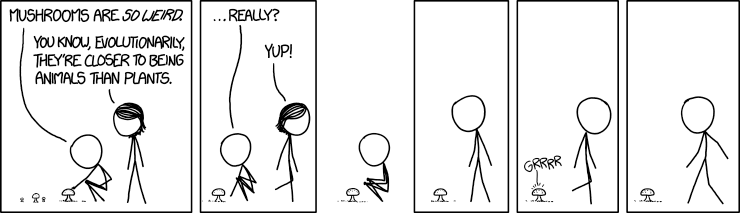
well they're certainly not animals
I mean they’re more closely related to animals than to plants
iirc the earliest known noun classes were animate vs inanimate and things expanded from there. but that's a very euro-centric theory
the indo-european system originates from roughly such a distinction, but feminines in particular derive from a formation of collective nouns
but noun class systems exist independently in many unrelated language families
animacy distinctions are extremely common, world-wide
gender-based distinctions are also found in other language families - afro-asiatic for example has this common feature:
A two-gender system in the singular, with the feminine marked by the sound /t/.
(afro-asiatic is the family to which hebrew and arabic belong, as well as e.g. ancient egyptian)
Tamil apparently also has a male/female distinction in its noun classes, but wikipedia is not being helpful in actually explaining how the system works there, there are more classes
okay it seems that there’s a major split in animacy (called “rationality”) and then animate is further split into masculine vs feminine in the singular only
autumn sapphire
I mean they’re more closely related to animals than to plants
@tardy carbon
 dry lava
Sie ist sympathisch = She is pretty?
Kann ich "sympathisch" verwenden, wenn etwas mich anzieht?
 tribal flame
Again, I have the transcript, but the above is really hard to figure out what's being said. Can a native confirm what's being said in German? and what tips (if any) on how to decrypt what's being said?
plain umbra
A lot of this kind of recognition comes from not simply hearing the sounds but actually having pre-knowledge of what you expect someone to say.
So it's kinda hard to give tips aside from "consume tons and tons of German until you can predict what someone would say there".
thorn pelican
@tribal flame mind dming me the transcrpt of that section? i'm curious now
plain umbra
I'm not a native speaker but I just want to give my transcription to kinda get a sense of how the process works here:
Wenn wir dann eine Achterbahn nehmen, ...
Of course the first part is relatively easy to hear, but the "Achterbahn" is tricky if you don't know what an Achterbahn is. I recognized the word (despite not knowing it) from knowing the Bahn part and thus assuming Achterbahn is some kind of vehicle. Nehmen fits into that knowledge too.
.. muss ich mich ... geben.
Again, these words are somewhat easy (although not sure on the last one) because I know them already, but the missing word, I would have no idea since I don't already know what vocab might fit there.
plain umbra
I just add this because it gives you a good impression of what I described, about how your previous knowledge is the primary driver of understanding speech. Tbh, even clear speech.
 humble remnant
^^
plain umbra
Ah yeah. So here if you know the phrase sich übergeben, you can more easily pick out this is what would be said. I didn't know it but I assume mom did?
tribal flame
I mean I still can't hear uebergeben
humble remnant
he speaks VERY fast so like
tribal flame
where's the ue in ueber?
plain umbra
The "vielleicht" is the one that really makes it hard.
tribal flame
It's like attached to the ass of vllt?
plain umbra
He pronounces it almost like "flecht".
humble remnant
^^ it blends in with übergeben
also
prime example of what base said
i know what an Achterbahn is
so vocab related to achterbahn is easier for me to pick out bc i have that in mind
the first syllable über is pronounced so fast it's practically swallowed
tribal flame
Oh, like knowing what an Achterbahn helps limit what possibilities there are
humble remnant
yes
tribal flame
Makes sense
humble remnant
do you know what it is?
tribal flame
No
tribal flame
Well, I mean I know it now
humble remnant
oh
tribal flame
I didn't know it from just listening and then the transcript was like 👀
humble remnant
wiggery luv
but yeah. Achterbahn was easy to pick out bc the speaker emphasized it
tbh the first time i listened i still didn't quite hear the über myself
but what i DID here was "muss ich mich" which means reflexive
tribal flame
vllt is also very hard to discern
humble remnant
and "geben"
and prior knowledge helped me click the rest into place without really "hearing it" per se
which is a skill that is very good to develop in foreign languages
tribal flame
makes sense, that's easier when you know the vocab for sure
humble remnant
bc you're always at least putting in a little bit more effort to keep up so filling in blanks of meaning like that is useful so you don't fall behind
do you know the translation of the whole sentence now?
tribal flame
Oh yeah, the audio has both the transcription and the translation
tribal flame
But I go through it many times
humble remnant
right
tribal flame
sometimes the transcription is wrong though
humble remnant
picking out Achterbahn and piecing together sich übergeben is what kinda gets you the whole meaning
plain umbra
Yeah exactly. And for me right now, this kind of skill is my biggest weakness in German as well.
tribal flame
Thanks for the help mom
plain umbra
Like the "filling the gaps" aspect of listening. It's very difficult and takes a long time to learn.
humble remnant
it's a hard skill to develop mine is still far from perfect base don't worry 😔
plain umbra
🤗 ❤️
light marsh
What's a predicate noun? I've read they require the nominative case albeit I fail to understand what is it.
humble remnant
predicate is whatever comes after a linking verb
usually "to be"
so when you say "I am a boy"
subject - I
linking verb - am
predicate - boy
predicates can either be nouns or adjectives
plain umbra
In the context of German, it's basically just the correct grammatical term for "objects" of "nominative verbs".
light marsh
Alright thanks.
proven sphinx
In that case in "Ich bin ein Junge", "ich" would be the subject and "ein Junge" would be the predicative, also called "Gleichsetzungsnominativ" in German.
Literally: "nominative of equalization".
Because "Ich bin ein Junge" basically means "Ich = Junge".
buoyant coral
Wann muss man Nomen mit ihrem Artikel benutzen?
long whale
*Wann :) Basically, the rules are the same in English as in German. 🤷 With some exceptions, like "Er will Arzt werden" (no article in German) vs. "He wants to become a doctor" and "He can drive a car" vs. "Er kann Auto fahren".
Wenn muss man Nomen mit ihrem Artikel benutzen?
@buoyant coral
thorn pelican
It depends on what you want to express. E.g. Er darf Auto fahren. Expresses that he is allowed to drive cars in general. But something like Er darf das Auto fahren. can mean that he's allowed to drive a specific car (sentence or situational context will usually make it clear which car specifically).
Also something i'd like to point out is nature is one of those few instances I know of that german prefers an article where english doesn't. E.g. German prefers die Natur where english would just use nature without an article.
long whale
so for modal verbs you take out the "ein"?
@buoyant coral Nothing to do with modal verbs: "Mit dem Auto kann ich nicht fahren!" (I can't drive that car!) What I was trying to point out was that German sees "Auto" as part of the verb in this kind of general statement (a bit like Tennis spielen/to play tennis). :)
buoyant coral
@long whale do you agree with what sun said above? her 1st paragraph
long whale
Yes, of course. :) @buoyant coral
wild gazelle
For the Wortstellung of adverbs, is the general order TeKaMoLo (Temporal, Kausal, Modal, Lokal)?
This website disputes that: https://coerll.utexas.edu/gg/gr/con_06.html
Grimm Grammar is an online German grammar reference from the University of Texas at Austin. Page description: Word order (also called syntax) in German is usually driven by the placement of the verb. The verb in German can be in the second position (most common), initial posi...
tardy carbon
don’t their examples actually contradict that claim anyway?
all three example sentences with the place unemphasized have the place at the end
wild gazelle
The examples above?
tardy carbon
the examples right below the image you posted on the same page
wild gazelle
Oh, yes, that confused me more.
tardy carbon
those all have place at the end
wild gazelle
So, is 'time - place - manner' wrong (or at least no the general rule)?
wild gazelle
So, TeKaMoLo?
tardy carbon
well, yes, that’s the same but more specific ^^ and I honestly have no clue what causal and modal actually mean
I mean I can guess
if that order was wrong it wouldn’t be consistently taught in German language courses ^^
wild gazelle
Causal: reason
Modal: Manner/way
That is what they mean in English at least.
tardy carbon
I’m failing to think of a causal adverb tbh
causal stuff is mostly in the form of um…zu clauses
which go at the end
wild gazelle
darum, deswegen, deshalb, etc.?
although they are normally first and act as adverbial conjunctions.
if I am not mistaken
tardy carbon
yea those usuallly come at least before other adverbials
from what I can tell
they can come immediately after the verb in sentences like Ich gehe darum morgen nach Hause
but I’d consider this at least weird: ?Morgen gehe ich darum nach Hause
(and with darum ich it’s straight up wrong to my ears)
wild gazelle
OK, just another question:
Apart from obvious concrete rules like how the finite verb is second, etc., is it still OK to experiment and deviate from the general rules of main clauses? E.g. accusative noun before dative noun, manner before time, etc. I read that the order of objects and adverbs can be rearranged in various ways to emphasise certain things. Or is it just safer to stay with the general rules of word-order?
thorn pelican
see page 874 of duden Die Grammatik for a detailed layout of the typical adverb order of the mittelfeld of a german sentence
wild gazelle
OK, I will have to parse that tomorrow. I am not that good at reading yet.
thorn pelican
@tardy carbon from page 573 (margin reference 846) they go through the 4 different adverb classes if you're interested in reading up on kausal and modal
tardy carbon
the one kind of deviation you can always do is choosing which element to front
anything can go first
with the default choices being W-words (mandatorily in front), temporal adverbs and subjects
other than that a lot of changes to the word order will sound rather weird
you can still play with them a little bit but it’s probably very hard to judge which changes will still sound fine and which will make it sound extremely bad
wild gazelle
I see, thanks, this was a question that I had in my mind ever since learning Wortstellung.
It seems a shame to me that you have a case-system which would normally allow rearrangement of the subject, direct object, etc., but it is (Edit: generally) not allowed. That is just my opinion.
Languages can be weird.
tardy carbon
it explicitly allows for rearrangement enough that anything can be topicalized
like the sentence Den Hund habe ich gesehen would have to be translated to English as sth like “That dog, I saw it” or “It’s that dog that I saw”
to retain the contrastive nuance
wild gazelle
I guess so, but I meant more total rearrangement, like the subject last in the middle field.
tardy carbon
I mean would that add anything?
like, what do you gain from full rearrangement?
sure it could probably be used to encode something
wild gazelle
Oh no, I was just saying that you have a case-system where that would be feasible (e.g. Esperanto), but word-order is still important (at least for sounding normal).
tardy carbon
yea and my counterpoint is, there’s no advantage to completely free word order
word order is a tool
having a default word order of sorts means deviations from it can mark nuances
if you just said “everything works and there’s no difference in meaning” then you lose a useful tool
wild gazelle
OK, thanks for help anyway
 little pebble
What's the difference between die and das
wild gazelle
Die: feminine (Edit: also plural)
Das: neuter
thorn pelican
the grammatical gender (noun class) of a word