#questions-2
1 messages · Page 13 of 1
 flint nimbus
 fervent kernel
it’s no use, even Louise sounds masculine in Slovak
 tranquil flower
https://en.m.wikipedia.org/wiki/Louie_(given_name)#:~:text=In the United States%2C Louis,%2F)%20is%20far%20more%20common.&text=The%20name%20is%20unisex%3B%20it,as%20a%20diminutive%20of%20Louise.
Louie is a moderately common given name, related to the more common name Louis. It originated in the United Kingdom (where Louis is pronounced ) as a more regularly-spelled version without a silent ⟨s⟩. In 2011, it was the 74th most common forename for births in England and Wales, with Louis only slightly more common at 68th. In the United Stat...
flint nimbus
ok, if Louise sounds masculine to you better not i suppose. But it's not necessarily a masculine name
tranquil flower
What about this one?
fervent kernel
that also sounds masculine in Slovak
 verbal girder
fervent kernel
it’s no use, even Louise sounds masculine in Slovak
verbal girder
fervent kernel
it’s no use, even Louise sounds masculine in Slovak
but you need a name that's neutral only somewhere in the world ?
fervent kernel
yes
flint nimbus
the point isn't just technicality but also that it should work for her as well
is it the same with Kim?
tranquil flower
I was thinking about this one too
flint nimbus
right, so what you want is a name that sounds feminine but is technically masculine or neutral by the given standard?
fervent kernel
i think so, it’s not really used here so older people would be a little confused
fervent kernel
flint nimbus
right, so what you want is a name that sounds feminine but is technically mascul...
precisely!
flint nimbus
good luck with Luzi then, Luisa!
fervent kernel
call me Luisa please but thank u!
flint nimbus
aw all right, changed
fervent kernel
it’s totally okay!! it’s just for the documents so I won’t get in any unpleasant situations
 gusty silo
(i'll not read the full context, but was the implication at some point that Luzi is (potentially) a masculine name in german?)
(ah i've found where this starts, okay)
flint nimbus
Luisa is going to need to argue that it passes for a masculine name somewhere on earth
fervent kernel
gusty silo
(i'll not read the full context, but was the implication at some point that Luzi...
yes yes!
gusty silo
(Luca as a feminine name in german would be unusual to me. i only know men called Luca/Luka)
gusty silo
i would not assume so
fervent kernel
well I know for certain that they accept names from babynames.com
the authorities consider that site to be official
but only for English names
 undone verge
What about Luce? that is both masculine and feminine
fervent kernel
that sounds masculine in Slovak 😦
gusty silo
fervent kernel
yes yes!
Like Susana said, i'd think of ‹Luzi› as a women's name only (except for, i guess, the devil, but even in the one common saying that's allegedly referencing that, i know it in the feminine form only)
fervent kernel
do you all think that the local authority will approve the name Luzi if I give them the names site firstname.de as evidence?
gusty silo
the authorities in slovakia that is?
verbal girder
fervent kernel
do you all think that the local authority will approve the name Luzi if I give t...
bro how could we possibly know
fervent kernel
gusty silo
the authorities in slovakia that is?
the administrative office of the region I’m from
undone verge
I'm confused by the Aufgabe. Are you looking for names that are gender neutral specifically in slovakian? Or names that somewhere in the world are assigned to both genders?
fervent kernel
the latter! but I only wanted to know whether Luzi sounds masculine in German or not
I’ve already got the answer I needed! it’s okay
undone verge
ah okay. then topic closed I guess: no
flint nimbus
i think i might've started learning some phrases that are a bit needlessly advanced for my level, might suspend them from my Anki tbqh.
Just out of curiosity:
Thomas? Was will der schon machen?
is the der in der schon matched with the gender of Thomas?
 long whale
flint nimbus
i think i might've started learning some phrases that are a bit needlessly advan...
long whale
flint nimbus
i think i might've started learning some phrases that are a bit needlessly advan...
Yes. And you need to be a bit careful with using der (or die) for people - it may sound a bit rude/derogative. (depending on situation, context, etc.)
flint nimbus
the use of "der schon" here also seems so narrow
i got this from my deep dive into the word schon
 reef moss
flint nimbus
the use of "der schon" here also seems so narrow
reef moss
flint nimbus
the use of "der schon" here also seems so narrow
What do you mean by narrow?
flint nimbus
not applicable to many different situations, not the kind of thing one can build upon for many other uses, for example the way learning what the word essen means is
long whale
flint nimbus
not applicable to many different situations, not the kind of thing one can build...
Mm... however, it's very frequently used in that very meaning in daily spoken German.
reef moss
Well, schon is a modal particle in this instance, it sees lots of use
long whale
It's the verbal equivalent of going "Pffff"
flint nimbus
lol
 plain umbra
flint nimbus
the use of "der schon" here also seems so narrow
plain umbra
flint nimbus
the use of "der schon" here also seems so narrow
I think you're confusing something here. Der and schon are two separate things in the sentence, not one thing.
plain umbra
Yes.
flint nimbus
this is an annoying practice, i wish german would knock it off lol
plain umbra
You could say "Was will der machen?" and it's the same basic meaning.
flint nimbus
or Was will er schon machen?
reef moss
flint nimbus
so der is synonymous with er here?
Demostrative pronoun vs. (regular) pronoun
gusty silo
as usual it's best left untranslated into english i think, but if we did, i'd try to approximate it (again, knowing that it's likely too literal and may not have the desired effect) as the 'even' in "what's he even going to do?"
plain umbra
flint nimbus
or Was will er schon machen?
Yes.
Keeping in mind these different phrasings may come across more or less naturally, with different tone/emotion, etc.
flint nimbus
reef moss
Demostrative pronoun vs. (regular) pronoun
afaik demonstrative pronoun is strictly das?
plain umbra
But in terms of the basic grammar, they are all the same.
reef moss
flint nimbus
afaik demonstrative pronoun is strictly das?
No
There are many demonstrative pronouns, some of which can also be demonstrative articles
It depends on their function
gusty silo
it's only (or maybe in one or two other circumstances but i can't think of specifics) restricted to the neuter form in introducing someone or something
flint nimbus
but er isn't a demonstrative pronoun, right? and it doesn't make sense in context since the speaker seems well aware of who this "Thomas" is
gusty silo
er is a "regular" personal pronoun
it just replaces another noun of the masculine gender
reef moss
The various demonstrativa are: dieser, diesen, dieses, diesem, diese, jener, jenen, jenes, jenem, jene ( you see the pattern here. It also applies to) welch-, der-/die-/dasselbe, ebendies-, der, die, das and I think that's it???
Am I forgetting any?
gusty silo
der, dieser and jener can also work as true pronouns (i.e. standing on their own, rather then modifying a noun), generally with a certain demonstrative/deictic (i.e. pointing-at-something) element, but der/die/das can also be used in colloquial speech without the "pointing at something" character. (all in addition to how these words may work as articles or article-like demonstratives that modify another noun directly)
reef moss
Diesen Mann habe ich gesehen: Demonstrative article
Dieser war auch zum Besuch bei mir: Demonstrative pronoun
gusty silo
flint nimbus
but er isn't a demonstrative pronoun, right? and it doesn't make sense in contex...
for clarity: "Was will er schon machen" would be perfectly ordinary as well
fervent kernel
can someone please tell me if is there anything wrong or is there something i could replace ty . "Es tut mir leid, dass um gerade nicht treffen können. Ich arbeite zurzeit sehr viel wahre aber am nächsten Wochenende bin ich frei und wir können in dieser Zeit treffen. Ist das ok fur dich?"
 prisma vapor
fervent kernel
can someone please tell me if is there anything wrong or is there something i co...
prisma vapor
fervent kernel
can someone please tell me if is there anything wrong or is there something i co...
„Es tut mir leid, dass wir uns gerade nicht treffen können. Ich arbeite zur Zeit sehr viel, aber nächstes Wochenende habe ich frei und wir können uns in dieser Zeit treffen….“ hoffe konnte dir helfen 😉
fervent kernel
prisma vapor
„Es tut mir leid, dass wir uns gerade nicht treffen können. Ich arbeite zur Zeit...
Vielen Dank 
 gilded nacelle
Was ist die unterschied zwischen "ich bin frei" und 'ich habe frei"?
gusty silo
one is freedom, the other is spare time
undone verge
ich bin frei is more like being not in prison. Ich habe frei is more like 'I have a free moment'
gusty silo
(verstehen, not vorstehen)
gilded nacelle
gusty silo
(verstehen, not vorstehen)
Danke
undone verge
(you are at work) 'hey, willst du nach der Arbeit mit mir einen Kaffee trinken?'
'ja, wann hast du frei?' (when are you getting off?)
gusty silo
or "Von Montag bis Samstag bin ich beschäftigt, aber sonntags/Sonntag [either works] habe ich frei"
Monday to Saturday i'm busy (school, work, other obligations) but i'm free on Sunday(s)
(sonntags/Sonntag correspond to Sundays/Sunday, but that's contextual. sonntags is an adverb and implies this is true for sundays in general, Sonntag may be taken to mean only a specific Sunday is referred to here)
 woven wind
Farbbelegen? what does it mean?

 daring fern
paint layer
 delicate tiger
"Farbbelägen" (von Belag)
woven wind
i get it now, thanks
flint nimbus
i read that i should use aus rather than von in places i would use in rather than zu. But also
Ich komme von der Bank.
Should i assume both aus and von work there? Do they necessarily have different emphasis?
It feels to me personally that in can mean a travel which ends inside a building, but aus has more emphasis on the getting out of the building, so it's not exactly corresponding. Is that right?
long whale
flint nimbus
i read that i should use aus rather than von in places i would use in rather tha...
Mm... yes, I feel "von" is talking more about the function than the building. Not sure why you mention the bank, specifically: Ich gehe zur Bank is fine, probably more common, even, than Ich gehe in die Bank.
And I think, on the whole, this is correct. I'd say "Ich komme aus dem Kino", not "vom Kino"
delicate tiger
(that may be a regional thing, I have no problem with "Ich komme (grade) von der Bank (zurück)")
flint nimbus
long whale
Mm... yes, I feel "von" is talking more about the function than the building. No...
someone gave the distinction that for in it's in particular things that you can enter, and zu is for things you're particular about not entering
bank is just the example at hand, but it's a building one enters
long whale
flint nimbus
someone gave the distinction that for in it's in particular things that you can ...
Yes, "zu" is usually for people and events, but specifically, "zur Bank" and "zur Post" are fine - but then, those can also be regional things.
flint nimbus
what about aus bank, would that be very particularly about exiting the bank, or could it mean like getting out from the bank and going home? because that would be the mirror case of how one uses in sometimes, right? like ich gehe in die Bank. Couldn't this sentence still mean i'm starting from home, drive, park, and eventually enter the bank?
long whale
Neither aus Bank nor in Bank work without the def. article. ;) As I said before, I feel "von" refers more to the function, I see "aus" as referring more to the building -> Ich komme gerade von der Bank (and will now tell you about the state of our finances) vs. Ich habe ihn getroffen, als er gerade aus der Bank kam (I ran into him as he was leaving the bank, i.e. the building). But that may be a matter of personal opinion.
@flint nimbus
flint nimbus
long whale
Neither ~~aus Bank~~ nor ~~in Bank~~ work without the def. article. ;) As I said...
makes sense, since von is strictly talking about bigger-scale kinds of movement, whereas aus can also talk about more detailed things (literally the action of getting out of the building)
ok so both in and zu can be described "going to the bank". Aus and von don't seem to mirror these perfectly. Probably because the most interesting thing with in happens at the end of it, so the rest of the travel still needs to happen, while the most interesting thing when getting out of the bank happens right in the beginning, so the rest of the travel becomes a bit odd to still refer to as "aus"?
long whale
That is definitely an interesting way of looking at it. 😄
flint nimbus
i've been suggested this sentence
Was willst du vom weihnachtsmann?
it seems to be missing a haben. Does it? (i think the original sentence i was given was with von dem, but this contraction should be correct, right?)
long whale
flint nimbus
i've been suggested this sentence
> Was willst du vom weihnachtsmann?
it seems t...
The contraction is correct, yes. You could put in "haben", but you don't have to.
 whole portal
Haben can often be omitted in such situations in informal speech
Altho it's often seen as more of a common mistake especially for kids
Same with "Kann ich X?"
flint nimbus
ok, thanks
whole portal
Altho then again wollen without haben has its own meaning
So that sentence could also mean something like "What do you expect from [him]?"
flint nimbus
it's funny how some resources are very hard line casual conversation without being clear of what they're omitting as part of that
whole portal
Well I think the task was going more for the second meaning I guess
And you only learn natural language from seeing natural language so it makes more sense to include that, you don't want to sound too synthetic after all
flint nimbus
the implied meaning should be what do you expect to receive from him
whole portal
Yeah basically
flint nimbus
maybe, i'm not sure. I think it's probably easy to adapt quickly to informal speech once in the action so to speak. Informal speech is also less universal in the whole language region typically. It's probably good to know both!
whole portal
Well still it's not like they won't understand you and I think even a bavarian can tell the difference between a northener speaking naturally and synthetic german
flint nimbus
i'm sure they'll understand the formal speech as well 😛
whole portal
Yes of course
But before that, they'll explain to you that it's the Christkind and not the Weihnachtsmann :p
long whale
whole portal
But before that, they'll explain to you that it's the Christkind and not the Wei...
Eh - the Christkind comes to heathenish Protestants. The Weihnachtsmann comes to Catholics - accompanied by Knecht Ruprecht. ;)
 flint nimbus
i'm doing a lot of german studying every day so i hope ya'll don't mind peppering the chat with questions 😄 basically i write stuff down when i study and then i bring it here afterwards. Though i think i'm going to start doing that a bit more strongly. I frequently bring questions in the middle of study sessions, but i think it makes more sense to collect like five of them and ask all at the same time and come back a bit later
long whale
(I know, having grown up as a Protestant among Catholics - in Bavaria.)
flint nimbus
speaking of german's spread in europe, i read about the germanic-romance language border the other day. Quite interesting!
long whale
A... cross between Weihnachtsmann and Christkind? 👀
flint nimbus
it was mostly about french vs german, but not only
whole portal
long whale
A... cross between Weihnachtsmann and Christkind? 👀
air too thin

this is still worse
 modern orchid
Welcher Mensch sagt der Butter
long whale
flint nimbus
it was mostly about french vs german, but not only
Well, lots of historical/political/wartime shifting of borders, hence lots of bilingual people on both sides of the French-German border. Or is that not what you meant?
flint nimbus
yes, kind of. The war and stuff was part of what i read about
though it's been weirdly stable for hundreds of years with seemingly quite small changes along it
long whale
Language-wise stable, you mean? Yes, fortunately no supposedly "ethnic cleansing" in that respect, at least.
flint nimbus
despite not lining up perfectly with countries and their "official" languages
long whale
Well, the hundreds of years are pretty irrelevant, since up until about 100 years ago, in Europe (and several other parts of the world, like Turkey and Russia) French used to be what English is today. ;)
flint nimbus
both french and german lost influence in the past 100 years yeah
but both languages still major languages in europe behind english
how often do ya'll say
Wollen wir uns nicht duzen?
it seems very awkward to say!
Also, it's literally "Don't we want to 'du' each other", right?
long whale
What seems awkward about it?
flint nimbus
🤷
it seems "wollen wir uns..." is often used to make suggestions like "let's..."
is that right?
long whale
flint nimbus
it seems "wollen wir uns..." is often used to make suggestions like "let's..."
i...
Yes, the sentence requires a high level of equality (age- and status-wise).
Which is why it doesn't come up all that often (at least not to me). For a long time, the principle of "We're both young, and you're a friend of a friend, so, of course, we'll go with "du" at once" applied. And now, as I'm past that age, I find I'm mostly quite comfortable with formal address. ;)
 kindred anchor
Hi, I have a grammatical question:
Wir stellen ihr ein paar Fragen (her)
Does the verb stellen here function as a dative?
flint nimbus
has someone ever declined your offer to duzen them?
long whale
kindred anchor
Hi, I have a grammatical question:
Wir stellen ihr ein paar Fragen (her)
Does ...
It's "jemandem eine Frage stellen", specifically.
long whale
flint nimbus
has someone ever declined your offer to duzen them?
No. Although I would frequently like to have declined when it was offered to me. Only... it's a bit awkward-bordering-on-insulting. 🤷
kindred anchor
Agh, yeah thank you! it's the same case in English 🙂
 stiff girder
Perfect
 sullen gale
Nice, glad I could help
 glacial patrol
I have a fill-in-the-blank question that says
"Der Großvater Frank treibt Sport nicht ... oft ... seine Frau Gertie."
Does this sound right?
Frank treibt Sport nicht so oft als seine Frau Gertie."
I got the question wrong LOL
Apparently it's "nicht so oft wie seine Frau Gertie"
I'm getting used to going from using "als" all the time to "so ... wie"
woven wind
genommen werden = to be hired ?? / and what exactly does "Die Familie wird meist von einer Agentur vermittelt" mean? does it mean that the agency is responsible to send Au pair to these families?
 woven wind
"von Kanada habe ich in der Zeit so gut wie nichts mitbekommen" --> i didn't get much in canada (like it could be language, culture, ..) ??? / "Ich bin froh, dass ich in Kanada durchgehalten bin" --> I'm glad that i didn't give up and continued (like my journey there) ??
gusty silo
woven wind
"von Kanada habe ich in der Zeit so gut wie nichts **mitbekommen**" --> i didn't...
'etwas[some information] (von etwas[whom the information is about]) mitbekommen' means to notice something, hear of something, to learn (in the sense of "come to know that something is the case", not "acquire new skills")
gusty silo
woven wind
genommen werden = to be hired ?? / and what exactly does "Die Familie wird meist...
genommen werden means to be hired here, yep
and yeah vermitteln means that the Agentur finds people who want to be au pairs and families who want to take an au pair and then figures out who to send where. it's like 'to mediate' in english, the idea is that the Agentur is the middle man between the two sides
gusty silo
it takes a dative, so "ich glaube dir". but yes, "dir" versus "Ihnen" depends on formality
 rigid coral
ohh, tyvm <3
gusty silo
np!
 brave harbor
whole portal
https://www.atlas-alltagssprache.de/wp-content/uploads/2012/05/f5_15a.jpg
brave harbor
whole portal
https://www.atlas-alltagssprache.de/wp-content/uploads/2012/05/f5_15a.jpg
ah yes, we southerners also say 'Der Semmel' and other wild things- imma go ahead and say sorry on the behalf of all of us
 rare jetty
Not all though. In Baden-Württemberg people say "Das Weckle". Semmel is a Bavarian and Austrian thing and well, Switzerland is just a different breed
 winged maple
What does duzen mean? I've searched it up on Google but couldn't find it
winged maple
flint nimbus
how often do ya'll say
> Wollen wir uns nicht duzen?
it seems very awkward to s...
.
rare jetty
When you say "du" (informal you-form) to someone, its "duzen". When you say "Sie" (formal you-form) its called "siezen"
winged maple
Danke
So what does the whole sentence mean? I'm a bit of confused
Wollen wir uns nich duzen?
prisma vapor
winged maple
So what does the whole sentence mean? I'm a bit of confused
*Wollen wir uns ni...
„Don't we want to call each other by first name?“
woven wind
**nachdenklicher **Film --> ist das ein Film, der jdn dazu bringt, nachzudenken?
brave harbor
i would say no? someone can be nachdenklich, busy with their thoughts, but a movie cant be that?
Ein Film kann jemanden nachdenklich stimmen / machen / zum nachdenken anregen
gusty silo
yeah it's certainly a weird formulation, but it is how i would interpret it if i heard it
alternatively i guess it could mean that the movie is fairly slow-paced and takes its time presenting its ideas?
brave harbor
to me this is a pretty human concept and i would never link it directly with a movie like this, and if i read it without explaination it would make me nachdenklich fr
gusty silo
lol
woven wind
"Dynamik und Spannung kommen allerdings erst allmählich** ab der Mitte** der Filmhandlung auf und auch da ohne die vermutete tragische oder besondere Wendung." --> ab der Mitte ??
gusty silo
was genau ist das Problem?
ab X heißt 'nach dem Punkt X'
im Kontext eben: die erste Hälfte des Films war öde/langweilig, in der zweiten Hälfte wird er erst spannend
 unkempt dust
what does this setence mean "Komme ich hier zum Bahnhof?"
gusty silo
what do you think it means, can you try? which words can you identify, what roles are they in?
verbal girder
am i comming Here to the Station?
unkempt dust
yes, or like that
gusty silo
the way this is interpreted in german is ultimately "is this the way to the train station?"
basically "am i getting to the train station here[=this way]?"
unkempt dust
is it common to hear that instead of using weg?
gusty silo
quite
i don't know for sure if it's more common then "Bin ich hier (richtig) auf dem Weg zum Bahnhof" or "Ist das hier der Weg zum Bahnhof", but i would prefer it over those and i would not be surprised if it were indeed more common. it is definitely a very usual and idiomatic way of saying this
unkempt dust
gusty silo
i don't know for sure if it's more common then "Bin ich hier (richtig) auf dem W...
Vielen Dank!
gusty silo
nichts zu danken
flint nimbus
some questions:
- With Limonade, is it always meant carbonated drinks, sodas that is probably not cola, but might be?
- in Ich habe einen Salat gegessen - is the accusative clause of Salat based on it coming after habe, or it having a relationship to gegessen?
- Wir müssen heute bis 21 Uhr arbeiten. - Could wir and heute swap places or would that make the sentence have weird emphasis on wir?
- in nach sentences like Emmas Mama fliegt nach Amerika, could zu work as a replacement for nach? In which cases are nach uniquely suitable?
- Are möchte and will (haben) interchangeable? Like in Sie möchte pilotin werden or Ich möchte ein Bier, bitte.
- Was gibt es denn? - i didn't really understand this! Is it a common phrase? Based on context it seemed to mean something like What is there on offering then
fervent kernel
flint nimbus
some questions:
1. With Limonade, is it always meant carbonated drinks, sodas th...
nothing makes the sentence weird as long as you have the verb in the second place
hope this helps you a little bit
flint nimbus
fervent kernel
nothing makes the sentence weird as long as you have the verb in the second plac...
no offense but i'd prefer not-troll answers
fervent kernel
flint nimbus
no offense but i'd prefer not-troll answers
what is "troll" about that?
trying to help is "troll"?
gusty silo
- the prototypical Limonade is a fizzy lemon-flavoured drink, but it can be a fizzy drink with different taste. Cola proper is never a subset of Limonade practically speaking. maybe someone else who's more familiar with the contrast to other languages' use of the word (or similar words) can give a better answer
- because of gegessen. the relation of case between the object and the lexical verb stays the same even when an auxiliary is present
- yeah it's fine. "Heute müssen wir bis 21 Uhr arbeiten" contrasts it with other days, where you don't have to work until then (but i guess so does the other phrasing too, so this likely isn't a very helpful answer in that regard).
- "zu Amerika" means nothing in this sentence, no.
- yeah quite interchangeable. möchte sounds more polite when it counts.
- "what's on offer?" is indeed a possible meaning of that sentence in context. but it's definitely not the only or perhaps main one (i mean, to germans they all sound like the same usage more or less, but for the purposes of translating they end up very differently so). the sentence itself is indeed very common and can be used in a number of contexts
fervent kernel
flint nimbus
no offense but i'd prefer not-troll answers
your name and pfp is worse than troll tbh
flint nimbus
gusty silo
1. the prototypical Limonade is a fizzy lemon-flavoured drink, but it can be a f...
thank you! I realize now that it's gonna be too much to ask follow up questions to several of these 😄 but i found what you said about the word order interesting. I read an article talking about how german is strictly "head last", that is, the more important something is, the later it comes, save for the V2, for which the real position is at the end. But here it seems you feel that heute is more important when it's first in the sentence rather than pos 3. I think expectation based on head-last perspective would rather be that it would be the wir that got more relevant from the swap!
Also interesting about zu Amerika not meaning anything! That's surprising to me!
Also funny that many european languages seem to do the asking for things in subjunctive is polite thing!
gusty silo
no feel free to ask follow up questions, don't worry
random thing i feel obligated to say: german as head last is, if head last is meant in the linguistic sense, strictly false
flint nimbus
those were the important ones. The 6 answer i didn't get at all though 😛
long whale
nach + [country or city name], except when the country has a definite article (die Schweiz -> in die Schweiz)
flint nimbus
gusty silo
random thing i feel obligated to say: german as head last is, if head last is me...
the argument made i think is that there are other forces as well, and there's also V2 which puts a verb that "should" be at the end at pos 2, but that otherwise it works pretty nicely
gusty silo
for what it's worth, zu can occur in places like these in not-standard german. but then that's not what we're here to teach and it doesn't apply to my own flavour of non-standard german so i can't even speak about it confidently
flint nimbus
right, that's good. I'm not going to correct natives when they say zu, but it's good to know what the "proper" thing is 🙂
gusty silo
But here it seems you feel that heute is more important when it's first in the sentence rather than pos 3.
if i'm not misinterpreting my feelings (possible, i guess, but they match the received wisdom in more linguistics-y circles), then the position before the verb is generally indeed the place of emphasis in german, yes
it's just that, since usually the subject is relatively consistent high~ish importance conversationally, putting that in that position is "the default". but you can rather freely put the actual conversationally relevant piece of information there if that is not the subject
flint nimbus
i'm not questioning your intuitions or anything of the like! If anything i'm using what you're saying to question how well this way of analyzing works
long whale
"Was gibt es [denn]?" might mean "What's there for lunch/dinner/whatever?" or less specifically "What's on offer?" (at a restaurant, or when someone's offering you just something to eat). It can also be used to say "What is it?", as in... I'm sitting there, reading, and you come up to me and say "Can I ask you something?", I might respond by saying "Was gibt es [denn]?" i.e. What is it you wanted to ask me?@flint nimbus
gusty silo
yeah it's a very general question about what the deal with a contextually obvious thing is
flint nimbus
so was gibt es is like asking for the follow up
gusty silo
yes
Was gibt es (denn) [zu kaufen] (what is there [to buy]) in the shop scenario, if you want to think about it like that
flint nimbus
is the expression extremely idiomatic or am i missing something obvious?
long whale
flint nimbus
so was gibt es is like asking for the follow up
It's also what I'd ask if I saw you just hovering somewhere, obviously wanting to say something. ;)
flint nimbus
long whale
It's also what I'd ask if I saw you just hovering somewhere, obviously wanting t...
a follow up to their presence, perhaps 😄
gusty silo
if there's a commotion somewhere, i suppose you might also ask "Was gibt's?" to ask what the people are doing or why they're doing it or what they want
long whale
flint nimbus
is the expression extremely idiomatic or am i missing something obvious?
Mm... es gibt = there exists (often translates to "there is/there are", which can be a bit misleading). Just think of it as the colloquial "What gives?", maybe? ;)
flint nimbus
so if i say
ich habe noch es nicht gemacht
but change it to
noch habe ich es nicht gemacht
am i emphasizing the "yet/still" in a rather extreme way?
wait
long whale
flint nimbus
so if i say
> ich habe noch es nicht gemacht
but change it to
> noch habe ich es...
Ich habe es noch nicht gemacht vs. Noch habe ich es nicht gemacht - yes.
flint nimbus
i inserted another ich
gusty silo
also, if you don't think the preceding examples already sorta cover that, "was gibt's?" works for asking someone if there are any news or whatever. could be asking about some thing you are aware of, can just be the "how are you?"-question when seeing an someone you know
long whale
flint nimbus
i inserted another ich
Nice, but word order in the 1st is still wrong.
Remember what I said yesterday, about "noch nicht" = not yet, being fixed?
flint nimbus
how would one say something like "it is still not the case that..." (that is, making the sentence a side sentence)
long whale
Es ist immer noch nicht so, dass...
flint nimbus
long whale
Remember what I said yesterday, about "noch nicht" = not yet, being fixed?
yes, but even in one of the examples you wrote, they weren't next to each other
long whale
flint nimbus
yes, but even in one of the examples you wrote, they weren't next to each other
Yeah, in the one where you put huge emphasis on "noch"...
flint nimbus
so i assumed them being fixed was more of a more large scale word order thing
right
ok
woven wind
is this good? better to use Mission, right? or ?
 long whale
woven wind
is this good? better to use Mission, right? or ?
long whale
woven wind
is this good? better to use Mission, right? or ?
No.
flint nimbus
i'm gonna look through what's already been written some more now
long whale
"Mission" sounds religious, as in "missionary"@woven wind
long whale
woven wind
so assignment is ok ?
Oh, you mean "mission" in English? Yes, that would probably work.
woven wind
exactly
flint nimbus
ok! interesting about both the word order thing (i'll keep it in mind for now) and the was gibt es/es gibt expressions
 raw tundra
Why does German sounds So angry?
long whale
raw tundra
Why does German sounds So angry?
Please don't post the same question in more than one channel.
fervent kernel
raw tundra
Why does German sounds So angry?
It doesn’t sound angry to me. Languages don’t sound angry, people do.
Plus, old recordings of angry speeches in German were not even everyday speech. People would use “Stage German” which exaggerated the r sounds and such due to the poor quality of microphones then.
undone verge
Although it is an understandably unpleasant stereotype, I have to admit that sometimes german can sound angry depending on what you think is normal (and angry) based on your background and upbringing. If you're not used to hearing a lot of casual spoken german, it can sound angry because the intonation is different than you're used to, but just take your 'gut feeling' with a grain of salt. They're probably not actually angry (most of the time)
 timid vector
a lot of it for English speakers has to do with the way that the phonemes present in german often appear (at least similar sounds) when you're angrily slurring your words in english
flint nimbus
do both of these work?
Mir geht es gut
Es geht mir gut
woven wind
What does Fabriketage mean? Is it "factory floor" or "Atelierwohnug/Künstlerwohnung" ??
delicate tiger
vermutlich sowas https://de.wikipedia.org/wiki/Loftwohnung
long whale
woven wind
What does Fabriketage mean? Is it "factory floor" or "Atelierwohnug/Künstlerwohn...
Depending on context, it either means one floor of a factory, or a factory floor which has been converted to a living space - and yes, perhaps one for an artist.
sullen gale
guh
Could anyone explain why “Sie hier?” Is after the verb at the end? is that how it works for question phrases?
 sullen gale
Ahhh I see, I was under the impression “how many” was its own section, that makes sense
Thank you
sullen gale
Oh wait no. My brain saw the “n” in Wochen and immediately thought “it’s a verb”
whoops!
fervent kernel
"Johannes ist am Freitag spazieren gewesen." = "Johannes ist am Freitag spaziert."?
 junior flame
"Eines Tages startet Franz eine Intrige, durch die er seinen
Bruder enterbt und ihn glauben lässt, sein Vater hätte ihn verstoßen."
Why has k2 been used here?
long whale
fervent kernel
"Johannes ist am Freitag spazieren gewesen." = "Johannes ist am Freitag spaziert...
No. "spazieren sein" is what's called Absentiv: Wo ist Tom? - Er ist spazieren, i.e. he's not here, where you expected him to be, he's going for a walk. ;)
long whale
junior flame
"Eines Tages startet Franz eine Intrige, durch die er seinen
Bruder enterbt und ...
Because his father had not, in fact, disowned him. The writer could have used K1 (the writer may have felt this was too formal), or, in speaking, they could have used Indikativ and a dass-clause: und ihn glauben lässt, dass sein Vater ihn verstoßen hat (rather less elegant).
fervent kernel
long whale
No. "spazieren sein" is what's called *Absentiv*: Wo ist Tom? - Er ist spazier**...
Wo ist Tom? why not: er spaziert
junior flame
long whale
Because his father had not, in fact, disowned him. The writer could have used K1...
Thanks a lot 
long whale
fervent kernel
Wo ist Tom? why not: er spaziert
It might be possible on a technical level. But to us, the verb is "spazieren gehen". Same as "essen gehen" (= to have a meal at a restaurant) -> Wo ist Tom? Er ist essen (i.e. he is not here, he's away from home/work, having a meal at a restaurant).
That's what Absentiv means: somebody not being where you'd expect them to be, to be away, doing something elsewhere.
fervent kernel
long whale
That's what *Absentiv* means: somebody not being where you'd expect them to be, ...
following the first inquiry, "Ich bin am Wochenende tanzen gewesen" = "Ich bin am Wochenende getanzt."?
long whale
fervent kernel
following the first inquiry, "Ich bin am Wochenende tanzen gewesen" = "Ich bin a...
a) They don't mean the same thing, b) We'd usually say "habe getanzt"
fervent kernel
long whale
a) They don't mean the same thing, b) We'd usually say "habe getanzt"
I thought both mean: I was dancing at the weekend or I danced at the weekend
long whale
No. As I said: Ich war tanzen = I was out on the town, dancing vs. I danced (i.e. I might have spent the weekend dancing in my own living room)
fervent kernel
achso
"Ich bin am Wochenende tanzen gewesen" implies that I was out in town, whereas "Ich bin am Wochenende getanzt." could happen in my very room?
long whale
fervent kernel
"Ich bin am Wochenende tanzen gewesen" implies that I was out in town, whereas "...
Yes. Except we'd say "habe getanzt"
fervent kernel
long whale
Yes. Except we'd say "**habe** getanzt"
Entschuldigung, aber hier es sagt "bin getanzt" (von 56:00 bis 58:00 Minuten) https://youtu.be/erbHJMv47RI

Mach entweder live mit, oder im Nachhinein. Hausaufgaben gibt es jetzt immer hier: https://mein-deutschkurs.com/ - Sogar mit gratis Korrekturen!
Wenn du hier mitmachst, nimm auch immer ein Stück Papier und einen Stift, um dir Neues aufzuschreiben.
Bitte unterstütze mein Projekt:
https://patreon.com/JoPhi
Privater Unterricht und/oder Werbung ...
long whale
fervent kernel
Entschuldigung, aber hier es sagt "bin getanzt" (von 56:00 bis 58:00 Minuten) ht...
Yeah. He's using Absentiv without explaining what it is, and that it's a different concept. Also, I didn't say "Ich bin getanzt" was wrong. I just said "We usually say: Ich habe getanzt". 🤷
 rare jetty
Es ist noch Zeit dafür
 nimble viper
long whale
Yeah. He's using Absentiv without explaining what it is, and that it's a differe...
nimble viper
long whale
Yeah. He's using Absentiv without explaining what it is, and that it's a differe...
Ist oder hat man aus der Reihe getanzt?
long whale
nimble viper
Ist oder hat man aus der Reihe getanzt?
"ist" (with directional movement of some sort, use "sein")
nimble viper
Cool dachte nur es könnte eine Ausnahme sein
raw tundra
faq beginner
 stoic mauveBOT
How to get started
The simplest way to learn German is to find topics you don’t understand yet and search for explanations of them. This list provides you with a guide for which topics to learn if you are completely new to German. Type the topic into Google (or YouTube) and start learning!
Introduction
1: Alphabet (especially ä, ü, ö and ß)
2: Basic greetings (hello, goodbye, etc.)
Part 1 - Simple Sentence
1: Noun gender & plurals
2: Nominative case (What are cases?)
3: Nominative pronouns (I, you, he, she, etc.)
4: Verbs in present tense
5: Definite/indefinite articles
6: Accusative case (for nouns)
7: Accusative pronouns
8: Word order of simple sentences
9: How to ask questions
See Part 2 on the next page.
Tips
- Always learn the gender of a noun when you learn a new noun
- Learn to use a translation dictionary (e.g. dict.cc, leo.org)
- Use
>faq resourcesto see our list of German learning resources - For listening and pronunciation practice, try watching movies or videos (incl. YouTube)
- You can listen to pronunciation for words on websites like dict.cc, forvo.com, and others
- Practice writing sentences every day (and asking people to correct them)
- Ask as many questions as possible
- Don’t be scared to make mistakes!!!! If you don’t let yourself make mistakes, you will never be able to learn German
Page 1/2
woven wind
what could we translate "nochmal einiges" here ?

and what does "Arbeitsaufenthalt" mean ? does it mean a place to live in given by the employer?
long whale
woven wind
what could we translate "nochmal einiges" here ?
"einiges" could be translated as "quite a bit". - No. Like... "I was in Madrid last week." - "Oh, were you there on holiday?" - "Nein, es war ein Arbeitsaufenthalt" (I was there for work)
woven wind
long whale
"einiges" could be translated as "quite a bit". - No. Like... "I was in Madrid l...
ahann
i get it
and about "draufzahlen" , is it like the extra money you pay, like sth is 30 euro but somehow the kaufmann wants you to pay 35, and you should pay 5 euro extra at the end
long whale
woven wind
and about "draufzahlen" , is it like the extra money you pay, like sth is 30 eur...
❔
tranquil flower
Is "Ich küsse deine Augen" widely and frequently used among Germans?Jugendsprache? Or is it more limited to people of Arabic/Turkish heritage?
woven wind
long whale
❔
sent by mistake
tranquil flower
tranquil flower
Is "Ich küsse deine Augen" widely and frequently used among Germans?Jugendsprach...

Bedeutung Im türkischen “Gözlerinden öperim.” Mit „Ich küsse deine Augen“ oder „Ich küsse dein Auge“ wird Dankbarkeit oder Anerkennung auf eine andere Weise ausgedrückt. Ob anstelle von “Vielen Dank” oder “Danke, dass du das für mich gemacht hast”, der Kuss auf die Augen symbolisiert in der heutigen Zeit Dankbarkeit. Woher der Ausdruck stammt, i...
long whale
tranquil flower
Is "Ich küsse deine Augen" widely and frequently used among Germans?Jugendsprach...
Probably the latter.
tranquil flower
long whale
Probably the latter.
But does almost everyone understand it?
long whale
tranquil flower
But does almost everyone understand it?
I wouldn't. I mean, if I heard/Iread it, I'd assume it was an expression of romantic love, not of gratefulness. 🤷
tranquil flower
long whale
I wouldn't. I mean, if I heard/Iread it, I'd assume it was an expression of roma...
Got it! Thanks  😅
😅
woven wind
woven wind
and about "draufzahlen" , is it like the extra money you pay, like sth is 30 eur...
@long whale
long whale
woven wind
<@612557923192799249>
It's usually used as a synonym for "Geld verlieren", "ein schlechtes Geschäft machen". As in: 1 Hemd kostet 10 Euro. Wenn du 5 Hemden für 60 Euro kaufst, hast du 10 Euro draufgezahlt.
woven wind
long whale
It's usually used as a synonym for "Geld verlieren", "ein schlechtes Geschäft ma...
clear
woven wind
ich sehe die Arbeitseinsätze von jungen Menschen aus den wohlhabendern Ländern in Hilfsprojekten der sogenannten Dritten Welt eher kritisch. Natürlich dient es der Horizonterweiterung. Aber verändert man dadurch wirklich etwas vielleicht? nimmt man auch jungen Einheimischen einen Arbeitsplatz weg.
---> Das Arbeiten im Ausland kann den jungen Leuten vor ort auch schaden ---> is it the local young people there ?
woven wind
woven wind
ich sehe die Arbeitseinsätze von jungen Menschen aus den wohlhabendern Ländern i...
and why is Dritt not dritt ??
long whale
woven wind
and why is Dritt not dritt ??
die Dritte Welt = the third world (fixed expression)
vor Ort - yes, there
woven wind
wenn du gern Hilfe bei der Planung von Work and Travel hast, kannst du dich an Agenturen wenden. --> Hilfe haben ? i didnt find sth like that on internet, what does it mean?
whole portal
It should be hättest
woven wind
Agenturdienst --> Das ist ein Dienst, die Agentur(en) anbieten/leisten ??
whole portal
And gern haben (not gernhaben) basically means wollen
whole portal
woven wind
Agenturdienst --> Das ist ein Dienst, die Agentur(en) anbieten/leisten ??
What do you think
woven wind
whole portal
What do you think
i don't know that is the only thing came to mind
there is no definition on internet
whole portal
Are you asking for what ak Agenturdienst is or which word would be appropriate now
woven wind
whole portal
And gern haben (not gernhaben) basically means wollen
so it mean wenn du Hilfe willst ... right ?
woven wind
whole portal
Are you asking for what ak Agenturdienst is or which word would be appropriate n...
I'm asking what it means ..
thanks a lot @whole portal
woven wind
aha
woven wind
achh
i see
and a question, how do we say "anyway", while talking .. like talking and at some point you don't want to continue and you say anyway ..
 gentle hound
This can be said in many ways, some examples are "was solls", "Sei's drum" or "egal"
woven wind
i see, thanks.
gilded nacelle
Warum wir sagen: zb. "mein jacke ist weg" und "mein weg nach Amerika" weg ist gleich aber nicht die gleiche bedeutung
gusty silo
weg ist nicht gleich
long whale
gilded nacelle
Warum wir sagen: zb. "mein jacke ist weg" und "mein weg nach Amerika" weg ist gl...
der Weg = the path; weg (adverb) = gone
gusty silo
weg ist ein Adverb, Weg ein Nomen. beide unterscheiden sich zudem in der Länge des Vokales (weg kurz, Weg lang)
 fading pasture

 wise ravine
ok falls ich eine adjectiv kennte, was wuerde passieren, wenn ich die Substantiv unrichtig bilde? zB geduldig -> die Geduldigkeit (LOL ich weiss aber dass die richtige form "die Geduld" sein wuerde)
in Bezug auf "wahrnehmung"
ich weiss dass man das noch einfach verstehen kann
timid vector
wise ravine
ok falls ich eine adjectiv kennte, was wuerde passieren, wenn ich die Substantiv...
Probably the same thing as if you said "popularship" instead of popularity
 terse skiff
Im reading the following sentence to help practice, and I'm confused about a grammar choice:
Man hat sehr richtig bemerkt, dass die beim magnetischen Schlafe sich bisweilen einstellende Ekstase an jenes "Sein ausser dem Leibe" erinnert, von welchem öfters in der Bibel, sowie noch in andern alten Urkunden, die Rede ist.
Why is "die Rede ist" its own clause at the end? I'm a bit confused about why it's constructed like that. I know what it says, I'd just like to understand the rules as to why
nimble viper
terse skiff
Im reading the following sentence to help practice, and I'm confused about a gra...
von welchem - acts as a subordinating conjunction
the respective öfters… and sowie… items act as adverbs
terse skiff
nimble viper
von welchem - acts as a subordinating conjunction
Thank you, that's very helpful, clears it right up. I was confused by the comma use, I think. I'm not as familiar with that as I'd like
kindred anchor
How can I tell whether a word that describes a noun is an adverb or an adjective, since both modify the noun in German.
Thanks in advance!
 long whale
kindred anchor
How can I tell whether a word that describes a noun is an adverb or an adjective...
long whale
kindred anchor
How can I tell whether a word that describes a noun is an adverb or an adjective...
I'd say this explanation was written for native speakers. 🤔 Native speakers know whether to decline an adjective in front of a noun (in which case they - mostly - know it is in fact an adjective). As a non-native speaker, I guess you'll have to check a dictionary to see which one it is.
kindred anchor
Alright that's gonna be tough. For example, the word weg is an adverb, it does not tell anything about the place, time, reason... but it rather sounds like... An adjective! In English at least.
long whale
kindred anchor
Alright that's gonna be tough. For example, the word _weg_ is an adverb, it does...
Yes. And if you ask a native speaker, they'll quickly run a mental check: can I put it in front of a countable noun? No? Gotcha! It's an adverb (this applies to "weg", btw) Yes? Will it change if I put it in front of a countable noun? No? Gotcha, it's an adverb. Yes, it will change? Gotcha! It's an adjective.
kindred anchor
Oh! That's how it works! Thank you so much!
 steel patrol
Are "ich habe festgestellt, dass..." and "ich bin zum Schluss gekommen, dass..." basically interchangeable?
 vague loom
Hello i was wondering what does "hingehen" mean in
"Ich will dah nicht hingehen"
Why can't i just say gehen instead
stoic mauveBOT
FAQ not found. Try >explain all.
steel patrol
Ok
steel patrol
vague loom
Hello i was wondering what does "hingehen" mean in
"Ich will dah nicht hingehen...
"hin" emphasises that you're going to/away to a certain place. "Hin" means movement away from the speaker, and "her" movement towards the speaker.
vague loom
steel patrol
"hin" emphasises that you're going *to/away to* a certain place. "Hin" means mov...
Got it thanks
Quick question tho @steel patrol
When i say something like
Ich will ein Deutschkurs machen
Does this means i want to attend one
Or i want to actually make one like give the course to people
steel patrol
(To my knowledge) this just means that you want to attend one / take classes. But do double-check the gender of "Kurs".
vague loom
steel patrol
(To my knowledge) this just means that you want to attend one / take classes. Bu...
Awesome thanks
Einen*
steel patrol
Yup!
long whale
steel patrol
Are "ich habe festgestellt, dass..." and "ich bin zum Schluss gekommen, dass..."...
Well... would you say "I find..." and "I've come to the conclusion..." mean the same? As a side note: I'd preferably say "ich bin zu dem Schluss gekommen, dass..."
long whale
vague loom
Hello i was wondering what does "hingehen" mean in
"Ich will dah nicht hingehen...
The answer to "Why can't I just say gehen instead" is basically that German has a very large bee in its bonnet about direction. Best accept and move on. ;)
Yes, exactly. Your question had me going... ehh... mm... 🤷 @steel patrol
steel patrol
long whale
Well... would you say "I find..." and "I've come to the conclusion..." mean the ...
I thought "ich habe festgestellt" could also be understood to mean "I realised / I came to the realisation"? But maybe I made an interpretation out of something I shouldn't have, and really it's more literal that that...
And does it really make a difference if it's "zum" or "zu dem"? (That's a lot of questions, sorry...)
steel patrol
long whale
Yes, exactly. Your question had me going... ehh... mm... 🤷 <@806852143767093258...
I see, ehmm, I'm slightly panicking now 😂
long whale
steel patrol
I thought "ich habe festgestellt" could also be understood to mean "I realised /...
Okay, I have no problem accepting that "I've realized" might be the better translation. But doesn't the question remain the same? As in "I've realized I've kept growing fatter and fatter over the last few years" seems fine to me. While "I've come to the conclusion" would seem a bit weird to me.
In this instance, using the contraction does seem a bit odd to me, yes. Maybe it's just me, but I feel I always see "bin ich zu dem Schluss gelangt, dass" (also vs. Ich komme nun zum Schluss meiner Rede = end of speech is in sight) 🤷
steel patrol
Ahh, German and all its little nuances again... 😅 But alright then, I see how it does make a genuine difference, thank you very much!
tranquil flower
tranquil flower
Is "Ich küsse deine Augen" widely and frequently used among Germans?Jugendsprach...
@earnest arch 
 😅
😅
 earnest arch
tranquil flower
<@366602364888809473> <:hmmnote:952693277495279678> <:im_angy:96297787998405428...
earnest arch
tranquil flower
<@366602364888809473> <:hmmnote:952693277495279678> <:im_angy:96297787998405428...
I don't know 
earnest arch
Achso! 😁
woven wind
"Einige suchen vor allem Schüler für die Besetzung von Ausbildungsplätzen, andere wenden sich an Hochschulabsolventen für Direckteinstiege oder Trainee-Stellen, wiederum andere an Arbeitssuchende mit Berufserfahrung. Eine Berufsmesse kann **sich **aber auch **an **bestimmte Berufsgruppen wie Handwerker oder Ingenieure richten." -> Trainee-Stelle = Ausbildungsplatz ?? / sich an jdn/etw richten = sich an jdn/etw wenden ??/ what does wiederum andere mean
woven wind
"nach den momentanen Vorlieben" --> according to current preferences ? would it be an appropriate translation ?
long whale
woven wind
"Einige suchen vor allem Schüler für die Besetzung von Ausbildungsplätzen, ander...
 brave sedge
hello, had one quesiton, wie sagt man "rip" auf Deutsch?
gusty silo
the actual equivalent of the phrase "rest in peace" is "Ruhe in Frieden"
verbal girder
is that what you write on tombstones
 rugged hazel
verbal girder
is that what you write on tombstones
rugged hazel
verbal girder
is that what you write on tombstones
Mostly nothing or at least some christian phrase is inscribed on headstones. Is rest in peace even used in English-speaking countries? I would imagine it to be the same there
brave sedge
gusty silo
the actual equivalent of the phrase "rest in peace" is "Ruhe in Frieden"
ahh, so like in normal day to day convos, i sometimes use rip, like:
person: oh my this is such a bad day
me: rip
so would Ruhe in Frieden work for this if im speaking in german, or is there something entirely different to be used, or should it not be used at all?
gusty silo
m, i expected that you might because of something like this: not usual, i guess among young people informally you could as well use 'RIP' itself
brave sedge
gusty silo
m, i expected that you might because of something like this: not usual, i guess ...
ah i see, thank you so much
woven wind
**dann **hier bedeutet in diesem Fall, oder? und womit kann man "nachholen" hier übersetzen? to catch up?

 trail temple
is "en" at the end of a word is the same as "to" before a word in english?
gusty silo
trail temple
is "en" at the end of a word is the same as "to" before a word in english?
Sort of!
The usage where they correspond is called an 'infinitive', that's a form of a verb that refers to an action without any other context (no matter who does it or when it happens or if it's completed).
The infinitive in English is marked with the preposition 'to' in front, but not every word preceded by 'to' is an infinitive.
In German the infinitive ends in -en and can in specific circumstances be marked with a 'zu' in front as well (but not always), but not every German word ending in -en is an infinitive either.
The infinitive with 'to' is the citation form (the normal one you use to reference the word, for example in a dictionary entry) for verbs in English and the infinitive (without 'zu'!) is the one in German
trail temple
gusty silo
Sort of!
The usage where they correspond is called an 'infinitive', that's a for...
thanks
 pale blade
gusty silo
the actual equivalent of the phrase "rest in peace" is "Ruhe in Frieden"
pale blade
gusty silo
the actual equivalent of the phrase "rest in peace" is "Ruhe in Frieden"
Danke Mann xd
flint nimbus
Wir spielen Schach bei unseren Kindern.
why is it Kindern? Isn't Kinder already the plural form?
flint nimbus
are there other ways in which the noun itself is changed in this way? (ignoring genetive for now) i thought the noun only changed between plural and singular, and that the other grammatical information were in the articles before the nouns
woven wind
"bearbeitung der Gläser" --> any idea on the meaning of this phrase? (in the context of Augenoptiker) --> does it possibly mean to adjust the Gläser to accord with the eyes of the patient or sth?
timid vector
flint nimbus
are there other ways in which the noun itself is changed in this way? (ignoring ...
faq weak nouns
stoic mauveBOT
Weak Nouns
Weak nouns are called this way because they receive the same endings as adjectives inflected with weak endings. They take an additional ending -n in every case except nominative singular. This is also known as N-Declension and affects almost exclusively masculine nouns.
Nominativ: der Junge, die Junge__n__
Genitiv: des Junge__n__, der Junge__n__
Dativ: dem Junge__n__, den Junge__n__
Akkusativ: den Junge__n__, die Junge__n__
Some nouns end with a suffix -en to make the pronunciation easier:
der Mensch, den Mensch__en__
‼ Das Herz is the only non-masculine (neuter) noun with N-Declension❣
So how do we recognize these nouns? We can divide them into 3 big groups:
- nouns of Greek and Latin origin,
- nouns ending with
-e(most of these refer to people or animals), - other random German nouns (Mensch, Herr, Student, Nachbar, Prinz etc.)
Another way to divide the groups could be:
- nouns denoting male beings in general (der Bauer, der Knabe, der Herr, der Junge, der Kunde etc.)
- nouns indicating nationality or religious affiliation (der Chinese, der Russe, der Türke, der Jude, der Katholik, der Protestant)
- nouns designating male beings and ending in the foreign suffixes (
-ant,-arch,-ast,-ege,-ent,-ist,-oge,-om,-oph,-ot: der Kollege, der Student, der Psychologe, der Polizist, der Philosoph)
‼ der Käse and words ending with -ee aren’t weak nouns.
Genitive of Weak Nouns
You might have noticed from the examples above that weak nouns don’t have the additional -s in genitive like other masculine nouns.
Some exceptions are das Herz and nouns of group 3 that don’t refer to people nor animals (Name, Wille, Glaube, Buchstabe etc.), which take both the -n and -s endings.
Example: der Name, des Name__ns__.
timid vector
that, plural dative -n, and genitive masculine/neuter -(e)s
woven wind
is this translation good?
 flint nimbus
timid vector
>faq weak nouns
flint nimbus
timid vector
>faq weak nouns
whelp... well that's good to know 😄 kind of makes me go but why though...
is there a list or something of words that are common to use with preteritum in speech in german? Is schicken one of them?
also, about
Diesen Winter
are all seasons accusative by default?
rugged hazel
flint nimbus
is there a list or something of words that are common to use with preteritum in ...
Schicken is not one of them
rugged hazel
flint nimbus
also, about
> Diesen Winter
are all seasons accusative by default?
Depends on how you use it
You could also say "In diesem Winter" where 'in' requires Winter to be Dativ
flint nimbus
rugged hazel
Depends on how you use it
You could also say "In diesem Winter" where 'in' requi...
ah, i meant more like in cases where one might otherwise expect nominative
fervent kernel
Wie kann man diesen Satz kürzer machen? Ich möchte von dem Satz das Wort "Ding" loswerden
"Kannst du mir das Foto von dem Ding senden, über das du gesprochen hast?"
Diese sind meine Versuchungen:
"Kannst du mir das Foto davon senden, was über du gesprochen hast?"
"Kannst du mir das Foto davon senden, worüber du gesprochen hast?"
"Kannst du mir das Foto davon senden, über das du gesprochen hast?"
fervent kernel
fervent kernel
Wie kann man diesen Satz kürzer machen? Ich möchte von dem Satz das Wort "Ding" ...
The second one is close to correct.
"Kannst du mir ein Foto davon senden, worüber du gesprochen hast?" would be a nice solution, a unspecific article is used though.
(not one specific photo, just whatever photo of what was talked about)
Unless you mean one specific photo ofc, then the second one would be flawless.
rugged hazel
fervent kernel
Wie kann man diesen Satz kürzer machen? Ich möchte von dem Satz das Wort "Ding" ...
Du möchstest den Nebensatz behalten, richtig?
Dann ist das doch ok
fervent kernel
fervent kernel
(not one specific photo, just whatever photo of what was talked about)
Eigentlich erklärt der Relativsatz das Ding, nicht das Foto. Also suche ich nach der Version, die damit geht
@rugged hazel
Das Problem ist wie man "davon" mit einem Relativsatz beschreiben kann
flint nimbus
rugged hazel
I don't get your question
why are you acting as if it only makes sense to ask a question one already knows the answer to?
rugged hazel
flint nimbus
why are you acting as if it only makes sense to ask a question one already knows...
What?
flint nimbus
would it be weird to say bis bald to someone you're going to see the same day or the next? One source i have says it needs to be at least 4 days for it to make sense to say it
fervent kernel
flint nimbus
would it be weird to say *bis bald* to someone you're going to see the same day...
Bis später would be more appropriate.. but there is not set rule really
bis bald would implicate it is going to be a longer time until u see each other again simply
flint nimbus
ok, thanks! 🙂
it's weird with those kinds of things that are kind of based on feel, when you're just inhereting other people's feel 😄
fervent kernel
flint nimbus
it's weird with those kinds of things that are kind of based on feel, when you'r...
Yeah definitely 😄 It's like, when 'bis morgen' may not apply or you simply don't know when you meet again. but generally it'd be like 'bis später' for short amounts of time 'bis morgen' is obv and everything else you can pretty safely use 'bis bald' 🙂
as 'until then' basically
flint nimbus
then there's gleich, nachhin, übermorgen... 😖 😄
fervent kernel
Oh yeah but that really is flexin then.. generally you can get away pretty much anywhere with these three tho
Thought that might help a bit😅
'bis gleich' would literally mean 5-30 minutes or sth
flint nimbus
rugged hazel
What?
if you didn't mean it like that then ok, but anyway, you answered the question! It is not always accusative. I think i have some old notes that i took before i understood the cases and their effect
rugged hazel
flint nimbus
if you didn't mean it like that then ok, but anyway, you answered the question! ...
I wrote "i dont get your question" because i did not understand what exactly you asked for, and found your question to be very vague. There is no need to be offended over that
flint nimbus
yourdailygerman says something like: sofort is the immediate future up until like 5 min, the 5 min-2h is gleich, then 2h-5h-ish is später and nachhin, where nachher implies a bit more assumed accuracy, and then morgen for tomorrow, übermorgen for the day after, then in ein paar Tagen, and bald for 4-30 days
obviously with the understanding that this is very loose
fervent kernel
Yeah very.. instead of 'übermorgen', 'bis bald' would be fine too e.g., so you can go by that generally, but it's nowhere near a proper rule and noone will question that either tbh
Even regionally, in northern germany 'moin' und 'tschüss' is used for basically everything regardless of time or timespan, in the South theres stuff like 'servus' which can both be used as opening and closing etc.
flint nimbus
i'm struggling with the logic of nachher as a word i've got to admit. Her usually means "towards me", right? but nachher means like beyond a certain point in time, right? it's the wrong direction?
fervent kernel
Nachher = späterer Zeitpunkt
or
Nachher/Hinterher = following an object, chasing sth.
There are really nice pics/cheat sheets for "neben, vor, unter, hinter" etc👀
flint nimbus
cool, they're actually some of the few prepositions i've yet to get to
except hinter i've started with a bit
fervent kernel
yeah, "hinter = behind" simply e.g.
"Simply" as description for prepositions, lmao
^^
flint nimbus
so how does it make sense that nachher is beyond a point in time, when her should mean "towards us"?
fervent kernel
It doesn't tbh.. it is derivative to "nach etwas her" implicating that after an event which you might not know when or whether it occurs, whatever this preposition is describing is following up to.
flint nimbus
i'll be back later
fervent kernel
flint nimbus
i'll be back later
And this then is either applied to spatial recognition or time recognition here.. but it can be confusing af if you start to question it. 😄 Alr, that was all i can say on that anyways Hope I helped more than I confused you😅
nimble viper
Hört sich nicht komisch an wenn ich sagen würde, ich versuche mich nicht davon überzeugt werden zu lassen?
nimble viper
whole portal
Ich versuche, mich davon nicht überzeugen zu lassen.
also kein überzeugt werden?
whole portal
Also sofern du nicht explizit was in die Richtung ausdrücken möchtest ist das Passiv hier unnötig.
whole portal
Aber selbst dann wäre es eher "Ich versuche, davon nicht überzeugt zu werden."
nimble viper
whole portal
Aber selbst dann wäre es eher "Ich versuche, davon nicht überzeugt zu werden."
Wäre sowas eher in Bezug auf mehrere Personen zu sehen?
whole portal
Obwohl man dann wohl auch das Versuchen im Futur schreiben müsste ...
nimble viper
zB kann ich sagen, Ich versuche ihn davon nicht überzeugt werden zu lassen?
Oder immer noch nicht
whole portal
Hm
nimble viper
so "Er sagt mir er wolle jeden Tag einfach aufgeben, aber trotzdem versuche ich ihn davon nicht überzeugt werden zu lassen" ?
whole portal
Also unabhängig von der Grammatik ergibt "Ich versuche, ihn vom Gegenteil zu überzeugen." ja mehr Sinn aber prinzipiell geht das so
nimble viper
ihn vom Gegenteil - ja mehr direkt
flint nimbus
fervent kernel
It doesn't tbh.. it is derivative to "nach etwas her" implicating that after an ...
ok let's break this down word for word, there's something i'm not getting here but i think it'll work out in the end if we go through it a bit. So there are three words baked into one, nach, her, and etwas (implied). Great. So:
nach: in most cases it means roughly "to" or "towards", that is, to travel to somewhere/thing. It also frequently has the sense of "after", or "beyond", especially regarding time. Wiktionary says it is connected to "nah", in other words, near. Already this is a bit confusing word, but at least it has something to do with direction, moving away from us, either towards something else or beyond that as well.
etwas: some, something
her: hitherto, towards us
now i just can't understand how these three words come together. I could make something up that sounds vaguely plausible, but with the risk that it's not really how it's supposed to be.
Are there instances where nachher does something that simply nach is not sufficient for?
long whale
flint nimbus
ok let's break this down word for word, there's something i'm not getting here b...
The thing is "her" is not only used for "towards the speaker" (although that is its most common meaning). There's also the "her" in "Es ist zwei Jahre her" (It's been 2 years)
flint nimbus
long whale
The thing is "her" is not only used for "towards the speaker" (although that is ...
sure, that seems similar to the use of her in woher. So how does that help us to understand nachher?
 wise pendant
It can be roughly thought of as:
nach - after
nachher - afterwards; in a while
long whale
flint nimbus
sure, that seems similar to the use of her in woher. So how does that help us to...
I don't think so... you can see "woher" as "where from [towards me, the speaker]". But in "Es ist zwei Jahre her", it means 2 years have passed [since whatever event we're talking about] And it feels to me as if "nachher" is rather like "after [some unspecific time has passed]"
wise pendant
flint nimbus
so how does it make sense that nach*her* is beyond a point in time, when her sho...
Btw tbh "nachher" should just be thought of as a fixed word combination rather than trying to understand why it is the way it is.
flint nimbus
long whale
I don't think so... you can see "woher" as "where from [towards me, the speaker]...
ok, so usually her means towards "us" in some sense, but in nachher, in this way of viewing it, we're almost kind of viewing it from the perspective of the event in the future that we're talking about?
long whale
flint nimbus
ok, so usually her means towards "us" in some sense, but in nachher, in this way...
I guess you could see it that way, yes.
I mean, very common "bits" of a language tend to take on kind of illogical seeming meanings (even though you might be able to see the logic emerging if you were able to follow the history of its usage). -> I tend to agree with Andre here: accept as is and move on. ;)
wise pendant
flint nimbus
ok, so usually her means towards "us" in some sense, but in nachher, in this way...
The meaning of that word probably changed over time as well. Things in a language can often be weird and nonsensical if you try to find consistent logic in everything as some things did make sense in the past but the rules changed again and again.
Leaving weird remnants behind.
All across the board
 urban oxide
Welcher Satz stimmt?
Ich weiß nicht, ob er kommt oder nicht
oder
Ich weiß nicht, ob er oder nicht kommt
Meine Lehrerin sagt dass nur das Letztere stimmt aber das klingt mir nicht natürlich
Steht das Verb immer am Ende mit "ob"?
Das "oder nicht" hier ist wie ein eigener Satz, oder?
 prisma lily
urban oxide
Welcher Satz stimmt?
> Ich weiß nicht, ob er __kommt__ oder nicht
oder
> Ich we...
prisma lily
urban oxide
Welcher Satz stimmt?
> Ich weiß nicht, ob er __kommt__ oder nicht
oder
> Ich we...
dass das Verb am Ende mit "ob" steht, stimmt, aber nur der erste Satz ist sinnvoll. der zweite ist schlichtweg falsch.
wenn du den ersten Satz genau hinsiehst: ich weiß nicht, ob er kommt oder (ob er) nicht (kommt). hier steht das Verb auch am Ende, wie es sein soll
urban oxide
Ach so
prisma lily
urban oxide
Das "oder nicht" hier ist wie ein eigener Satz, oder?
quasi so.
urban oxide
Verstanden, danke!
 charred pumice
'Der' should be 'der' right?

 opal cove
Könnt jemand den letzten Satz für mich bitte übersetzen?
"Später entdeckte ich neue Winkel; über andere habe ich
zugelernt. Jedoch kein Mädchen, kein Erlebnis und kein
Buch konnte mir über diesen Neues sagen. Als darum drei-
ßig Jahr danach ein Landeskundiger..."
"Als darum" hab ich noch nie gesehn und ich weiß nicht, wie ich es verstehen sollte. Falls du mehr Kontext brauchst, kann ich den Rest posten
long whale
opal cove
Könnt jemand den letzten Satz für mich bitte übersetzen?
"Später entdeckte ich ...
Als darum... = So, when...
 brave gust
How do I use "meinen"? what is the difference between "meinen" and "mein"?
gusty silo
there are multiple different things that are ‹meinen›, which are you talking about
gusty silo
are you familiar with grammatical cases yet?
gusty silo
then i would look those up, because 'meinen' is a form of 'mein-' in certain forms
what form 'mein-' takes mirrors the form the noun it applies to needs, for what it's worth
so say we have "mein Hund" and we put it in a sentence where it has a specific role, like "Ich streichle ___ ___" (i pet ___ ___)
do you want to try filling that in?
gusty silo
✅ ding ding ding, full points
gusty silo
If that's encouragement thanks, if that's a guess then no i'm not :P
 rigid nexus
Question SOLVED! Do you guys know where to find meanings of these prefix's? Or you guys too rely on Google translator/ Deepl just like me.
 verbal girder
wow where did you get that list
rigid nexus
verbal girder
wow where did you get that list
One of the things that is the most surprising (and exasperating) when you start learning German is the idea of a separable verb.
verbal girder
Dartmouth gives you the meaning no?
rigid nexus
Ya I just found it. My bad I didn't inform that I found answer of question I asked.
fervent kernel
Ich habe eine Frage. Wann soll man diese Wörter "schlecht" und "schlimm" benutzen?
undone verge
schlimm is more bad
there's a better way of describing it, one moment

German Language Stack Exchange
Can someone shed some light on when to use "schlimm" and when to use "schlecht"?
I've found an explanation here that tries to clarify the issue, but in my opinion does a fairly poor job. Every exa...
long whale
fervent kernel
Ich habe eine Frage. Wann soll man diese Wörter "schlecht" und "schlimm" benutze...
It's fairly simple: when something can be either good or bad (weather, food, hotel, friends, etc.), you use "schlecht". When something is inherently bad (road accidents, illnesses, storms, floods), you use "schlimm" to say they're really bad. ;) @undone verge
fervent kernel
long whale
It's fairly simple: when something can be either good or bad (weather, food, hot...
Danke schön 😊
 dusty scaffold
Hallo Lena, schön, dich wiederzusehen.
Hallo Maria, danke für die Einladung.
Wie geht es Ihnen? Hatten Sie starke Schmerzen?
Ja, leider hatte ich sehr viele Schmerzen. Vor allem in meinem Kopf und Nacken.
Es tut mir leid, das zu hören. Wann gehst du wieder in die Reha?
Ich bin am Samstag da, hast du Lust zu kommen?
Sehr gerne. Wo ist es?
Es ist in der Turnhalle im Erdgeschoss.
Okay, dann komme ich am Samstag.
is this correct?
rugged hazel
rigid nexus
```Question SOLVED!``` Do you guys know where to find meanings of these prefix's...
They are particles, not prefixes (it even says so in the picture)
urban oxide
Wenn man ein Adverb von Zeit ohne Präpositionen verwendet, ist das Adverb immer im Akkusativ, richtig?
z.B. "Wir waren letzten Monat im Deutschland"
"Jeden Morgen stehe ich um 6 Uhr auf" usw


Warum ist es dann "letzter" hier?
long whale
urban oxide
They're both wrong. Should be "Letzten Monat"
Also, if it's a vague point in time, like "one day/evening/morning/night", it's Genitiv: eines Tages/Abends/Morgens/Nachts (just so you know). ;)
long whale
urban oxide
Ach so..
By the way, those sentences are really wrong in other ways as well. So, whatever source they're from, better avoid it in future.
(If they're from a dictionary under the heading "examples from the internet", you have to be wary, even though the dictionary itself may be very good (linguee, pons).
urban oxide
Thanks for the heads up, I will be careful :)
fervent kernel
long whale
Also, if it's a vague point in time, like "one day/evening/morning/night", it's ...
Ich brauchte das! Danke
Dieser Server ist sehr hilfreich
 granite spade
Can someone help me find the noun “Fähren” in a dictionary? It comes from a poem by Stefan George (Der Freund der Fluren) and refers to the land itself, not to a Fähre in the sense of a boat/ferry
I’m having trouble finding a definition of this old word, even the Grimm Wörterbuch doesn’t seem to have it
delicate tiger
context? There is also "Fähe" (female fox)
granite spade
[41] Kurz vor dem frührot sieht man in den fähren
Ihn schreiten · in der hand die blanke hippe
Und wägend greifen in die vollen ähren
Die gelben körner prüfend mit der lippe.

Literatur im Volltext: Stefan George: Der Teppich des Lebens und die Lieder von Traum und Tod. Gesamt-Ausgabe
der Werke, Band 5, Berlin 1932, S. 41-42.: Der Freund der Fluren
One scholar says this fähren means ‘die Furchen im Acker’
I just can’t find this word in any online dictionary
long whale
granite spade
One scholar says this fähren means ‘die Furchen im Acker’
Yes, I was going to suggest that - seems the most logical considering the context.
long whale
granite spade
Does it belong to some dialect?
Hey, the guy was a poet. You could ask the same question - or did you? - about wölken which to my knowledge is not a valid plural of "die Wolke", or "pfähl" which, again to my knowledge, is not a valid singular form of "der Pfahl".
granite spade
long whale
Hey, the guy was a poet. You could ask the same question - or did you? - about *...
He uses „wolken“ and „pfahl“ in that poem though? The only words which really stuck out to me as totally impenetrable were „fähren“ and „die gemarken“
long whale
granite spade
He uses „wolken“ and „pfahl“ in that poem though? The only words which really st...
I see. So, this is not an orthographically correct version: https://www.gedichte-lyrik-online.de/der-freund-der-fluren.html - ?
long whale
granite spade
He uses „wolken“ and „pfahl“ in that poem though? The only words which really st...
Mm, I mean, with "gemarken"it is easier to see where it comes from (die Gemarkung), but has Georges form ever existed?
granite spade
long whale
I see. So, this is not an orthographically correct version: https://www.gedichte...
No, no idea where that one comes from. The edition I’m citing (which the Zeno one also matches) is the critical edition of his works
Die Gemarke apparently is Frühneuhochdeutsch
This dictionary has nothing for that pesky fähren though…
long whale
Well... there you go, then. He was either using some dictionary which contained errors - or he was just making use of poetic license.
junior flame
"eine Herausforderung bewältigen", can this phrase be used to say that I was given a challenge and I completed it?
 jovial pagoda
Yes it basically means to overcome a challenge
kindred anchor
Hallo again,
I have encountered some kind of relative pronouns that are new to me such as wer, was, welche-er-es... (I have never used them before) but I need to know whether there is a difference between these pronouns and the regular ones: der, die, and *das *
stiff girder
help
stoic mauveBOT
Semantle commands
:small_blue_diamond: **📒 semantle**
No description provided.
Page 12/20 (20 entries)
rigid nexus
rugged hazel
They are particles, not prefixes (it even says so in the picture)
Right  I was learning trennbare verben and in that video they explained like.. Aufstehen, auf = präfix and stehen = normal verb. So keeping that in mind I wrote Präfix 😅 Anyway I'll call it separable particles.
earnest arch
rigid nexus
Right <:belgianpeepy:983098265929142312> I was learning trennbare verben and in ...
Prefixes are not separable, that's the difference. And to answer your question: you can google it, their meaning depends on the context/the verb sometimes. But they do always express an idea.
rigid nexus
earnest arch
Prefixes are not separable, that's the difference. And to answer your question: ...
Vielen Dank! 
long whale
earnest arch
Prefixes are not separable, that's the difference. And to answer your question: ...
👀 You mean this is all... wrong? https://www.dartmouth.edu/~deutsch/Grammatik/Wortbildung/Separables.html
earnest arch
long whale
👀 You mean this is all... wrong? https://www.dartmouth.edu/~deutsch/Grammatik/W...
Mh 🤔 I'll admit I only checked one source because I was curious.
 tropic edge
Im writing a german job application.
Im confused whether to use werde or würde
For example which is correct:
Ich bin mir sicher, dass ich ein wertvolle Kandidat würde
Or
Ich bin mir sicher, dass ich ein wertvolle Kandidat werde
?
Please help 🙏
long whale
tropic edge
Im writing a german job application.
Im confused whether to use werde or würde
...
Please don't post the same question in more than 1 channel. ;)
tropic edge
long whale
Please don't post the same question in more than 1 channel. ;)
Sorry im just desperately trying to get this finished to submit within one hour. Not taken! 🙂
rugged hazel
tropic edge
Im writing a german job application.
Im confused whether to use werde or würde
...
würde is konjunktiv of werden in present tense
werde is indikativ of werden in future tense
nimble viper
rugged hazel
würde is konjunktiv of werden in present tense
werde is indikativ of werden in f...
Würde man aber abgesehen von diesem von dir erwähnten Fakt nicht vor allem in dem oben Beispiel “dass ich ein wertvoller Kandidat wäre” sagen?
rugged hazel
Geht auch
nimble viper
Wenn ja warum wurde das dem riianling nicht verdeutlicht
rugged hazel
Weil er nur nach würde und werde gefragt hat
nimble viper
Äh, ergibt dann Sinn, vermute ich
long whale
nimble viper
Wenn ja warum wurde das dem riianling nicht verdeutlicht
I told him - in the other channel. ;)
 timber apex
Hallo alle zusammen! Ich habe eine kleine Frage.
Wie kann ich diesen Satz bilden? ---> Ich warte, dass der Unterricht beginnt. / Ich warte darauf der Unterricht beginnt. / Ich warte darauf, dass der Unterricht beginnt. --- Sind alle drei Sätze grammatikalisch richtig?
whole portal
Nein
- ist grammatikalisch richtig aber inhaltlich fragwürdig (geht aber in der Alltagssprache), 2. ist falsch, 3. ist richtig.
timber apex
Danke für Ihre Antwort!
 radiant silo
Ein herzliches Hallo in die Runde!
Ich möchte wissen, welche Position Adverb "unbedingt" belegt?
flint nimbus
how come Gefallen is masculine, shouldn't nouns derived from infinitives be neuter?
long whale
flint nimbus
how come Gefallen is masculine, shouldn't nouns derived from infinitives be neut...
It is. When it means "the [act of] liking". "der Gefallen" = favour
steel patrol
When it comes to whining/whinging (about having to get on with a difficult task or just about the result of a bad day, for example), what's the best verb to use? The most suggested word seems to be "jammern", but I don't think it quite fits; perhaps "nörgeln", or?
 viral jolt
steel patrol
When it comes to whining/whinging (about having to get on with a difficult task ...
viral jolt
steel patrol
When it comes to whining/whinging (about having to get on with a difficult task ...
meckern should work, is close to nagging.
steel patrol
viral jolt
meckern should work, is close to nagging.
Nagging is different though, isn't it? I'm not even sure I'd considering a synonym. But thanks for the suggestion.
junior flame
The phrase "in den Mittelpunkt rücken" means "to gain the centre satge", so how would we translate this sentence: "Nur weiße Frauen würden die Diskriminierung in den Mittelpunkt rücken"
 autumn marsh
junior flame
The phrase "in den Mittelpunkt rücken" means "to gain the centre satge", so how ...
autumn marsh
junior flame
The phrase "in den Mittelpunkt rücken" means "to gain the centre satge", so how ...
only white women would make discrimination the main topic
flint nimbus
i've put aside two places where the word bei is being used, and i don't quite understand how or why. I hope someone can help me out!
My understanding of bei is that it's supposed to mean at/by something, in particular a stationary place, like a building, but not necessarily an area, like for example a country. Something where it makes sense in english to "stand next to", to get a sense of the kind of thing bei should typically be applied to. So:
Viel glück bei der Suche, Herr Gonzáles.
Here i don't understand why bei is used. It seems to be used roughly as "with"? Could other prepositions be used in the same place?
Zum beispiel... (for example...)
I don't quite get why or how bei is used here.
I also wonder about this
Mach's gut!
is this a common phrase? I've translated it for myself as "be well", but is that a good translation? Should it be something more like "do well/succeed"?
i assume the 's is short for es. I still don't quite understand how the expression works tbqh
whole portal
be well is a decent translation
Mach es gut does indeed literally mean "do it well" but it rather means "do your life well/succeed"
I guess the best english equivalent would be farewell
And think of the search as an event you can attend at
This is generally the case for nouned verbs
steel patrol
whole portal
I guess the best english equivalent would be farewell
"Take care" is likely what you'd hear when saying bye to someone
whole portal
Well of course you can use all possible synonyms to say good bye at the end of the day
whole portal
flint nimbus
i've put aside two places where the word bei is being used, and i don't quite un...
Also wdym with Beispiel, bei is just part of the word here
steel patrol
Yes, it's just that in terms of formality (or rather informality) and general meaning they seem about the same, that's why I mentioned it
farewell is quite strong and more on the permanent side
steel patrol
good to know!
flint nimbus
whole portal
And think of the search as an event you can attend at
still wouldn't something like in be better than bei then?
whole portal
No
Prepositions are quite random and the way they are used is pretty dependent on the language
There isn't anything inherent about a search that you can be in or at it
mit could be used with Suche but bei sounds a lot better
flint nimbus
ok thanks
woven wind
"Ab Frühling wieder draußen, am liebsten auf der Tennisanlage Sonnenfeld.** Di oder Do** ab 17 Uhr oder am Wochenende. Bitte meldet euch." --> what does "** Di oder Do**" mean ?? any idea?
whole portal
Di = Dienstag ("Tue")
Do = Donnerstag ("Thu")
Generally speaking, it's
Mo - Montag
Di - Dienstag
Mi - Mittwoch
Do - Donnerstag
Fr - Freitag
Sa - Samstag/Sonnabend
So - Sonntag
fervent kernel
Spricht ihr in dieser Gruppe Deutsch oder Englisch?
wise pendant
fervent kernel
Spricht ihr in dieser Gruppe Deutsch oder Englisch?
Beide sind ok
woven wind
whole portal
Mo - Montag
Di - Dienstag
Mi - Mittwoch
Do - Donnerstag
Fr - Freitag
Sa - Samsta...
ah okkk, now i get it, thankss
fervent kernel
Aber ich brauche eine Gruppe,in der man nur Deutsch spricht
wise pendant
fervent kernel
Aber ich brauche eine Gruppe,in der man nur Deutsch spricht
#german-only
 snow herald
I spoke with my friend today and used a sentence: Das war nicht ein guter Film. And she smiled at me and told me that it is easy to see that I am a foreigner. Is her sentence: Das war kein guter Film that more appropriate to German?
woven wind
do we use **ausüben **with Sportarten? like in the following sentence : "Welche der Sportarten werden hier ausgeübt? Unterstreichen Sie" --> shouldn't it be üben/geübt ??
 glad oyster
woven wind
do we use **ausüben **with **Sportarten**? like in the following sentence : "Wel...
glad oyster
woven wind
do we use **ausüben **with **Sportarten**? like in the following sentence : "Wel...
The word "ausüben" can be used with "Sportarten" but it does not convey the same meaning as "üben" or "geübt". "Ausüben" means to practice or perform a certain activity or profession, whereas "üben" means to practice or train in order to become skilled in something.
terse skiff
Is there a difference between warum, weiso, weswegen, etc?
whole portal
Well first off, your options are
Warum
Wieso
Weshalb
Weswegen
All 4 mean "why" and can be used completely interchangebly in that regard
Depending on the person, different ones are used more commonly but generally, wieso, weshalb and warum are common while weswegen is a lot rarer, still in use tho.
On top of that, weshalb and weswegen can also be used as ", which is why"
Der Mond war aus Käse, weshalb/weswegen die Maus ihn aß.
Also "wozu" can also mean why but it's asking for an intention rather than a reason so if those two aren't the same they're different.
"to what end" is the translation I guess
(@terse skiff)
 charred harbor
whole portal
Der Mond war aus Käse, weshalb/weswegen die Maus ihn aß.
charred harbor
whole portal
Der Mond war aus Käse, weshalb/weswegen die Maus ihn aß.
Der Mond ist aus Käse und wer etwas anderes behauptet, lügt 
whole portal
Die Maus hat ihn ja aufgegessen.
Sie weiß Bescheid, die Maus, die kleine süße Maus
Wie kommt der Saft in die Tüte und wie kommt er wieder raus?
Warum hat der Käse Löcher und der Käsekuchen nicht
Und warum brennt auch nachts im Kühlschrank das Licht?
Wie kommt die Wurst in die Pelle und wo kommt die Pelle her
Und warum mag die kleine Maus den Elefanten so sehr?
Die Antwort bekommst du, direkt zu dir nach Haus
Mach die Glotze an, denn hier kommt die Maus!
charred harbor
Is that famous? I don't know that song
whole portal
Can't read the words "die Maus" without getting this banger stuck in my head 😔
Oh you're missing out

Hier kommt die Maus, der Elefat und die Ente. ^^
whole portal
Also to this day I have no clue how he can pronounce "watschelt lustig" so clearly yet so fast
But then again he's a singer and TV moderator and everything so he's probably trained his pronounciation a lot
fervent kernel
„Ich finde nicht, daß du ein besonders feines Benehmen Damen gegenüber hast“,
Why is the gegenüber after Damen?
 thorn pelican
fervent kernel
„Ich finde nicht, daß du ein besonders feines Benehmen Damen gegenüber hast“,
Wh...
thorn pelican
fervent kernel
„Ich finde nicht, daß du ein besonders feines Benehmen Damen gegenüber hast“,
Wh...
gegenüber can be used in german as a postposition
https://deutsian.tumblr.com/post/153727949562/11-german-postpositions

Like English, German has very few “true” postpositions.The amount is disputed, but around three-five in current use is a good estimate. There are, however, more adpositions that can be used as either pre- or postpositions.
Remember, postpositions follow the noun they’re referring to. Beneath are the words’ meanings as postpositions, not as pr...
fervent kernel
Die Konzerne müssen ihre Preise nun drei Jahre lang einfrieren.
Isn't this just the adjective lang?
thorn pelican
fervent kernel
> Die Konzerne müssen ihre Preise nun drei Jahre lang einfrieren.
Isn't this jus...
nope
adjectives don't come directly after the noun they modify like that
fervent kernel
as in "three years long"
fervent kernel
thorn pelican
it translates to 'for'
wdym
thorn pelican
long in your english example is an adverb
fervent kernel
can u write it being translated into for
thorn pelican
The companies must freeze their prices for free years.
fervent kernel
also
what does nun do?
fervent kernel
why isnt it nur then
unkempt dust
Doesn't nun translate to now?
unkempt dust
or more like currently?
fervent kernel
so what does the nun do
thorn pelican
The companies must now freeze their prices for three years
fervent kernel
ok danke
thorn pelican
lang in this context is a postposition because it's derived from entlang (a postposition) and behoven to the same syntatic and grammatical rules and functions as other postpositions.
words often are used as multiple types of words with changes in their meaning between each word type
e.g. ab as a preposition can mean from whereas ab as an adverb can mean away
nimble viper
Was bedeutet sprayen
umg.
Ich glaub das Verb hat was mit Marihuana zu tun, bin mir aber nicht sicher
delicate tiger
nimble viper
delicate tiger
<https://www.duden.de/rechtschreibung/sprayen>
Ah bei diesem Gespräch ging es um was illegales, Graffiti sprayen ist mir irgendwie nicht eingefallen, weil Ott davor besprochen wurde
Graffiti ist nehme ich jetzt an das was mit sprayen gemeint war
 lilac cave
Is there a real difference in saying "mir geht es gut" and "mir geht gut"
Or is one of them grammatically incorrect
unkempt dust
I think if you remove the "es" you have to say "Mir geht's gut"
unkempt dust
lilac cave
Is there a real difference in saying "mir geht es gut" and "mir geht gut"
i don't think you can remove both
lilac cave
Okay thanks
viral jolt
correct, it's either mir geht's gut or mit geht es gut
glad oyster
viral jolt
correct, it's either mir geht's gut or mit geht es gut
Thats the same
fervent kernel
Brauch ich ein Komma in diesem Beispiel?
"Ich freue mich darauf, von Ihnen zu hören"
glad oyster
Ja
reef moss
fervent kernel
Brauch ich ein Komma in diesem Beispiel?
"Ich freue mich darauf, von Ihnen zu h...
Anything that is more complicated than a mere infinitive (ex. just zu hören) should have a comma, if that makes sense
flint nimbus
Der Löwe fürchtet sich vor allem
is allem taking a dative neuter form? Why, when there is no noun that it affects?
undone verge
flint nimbus
> Der Löwe fürchtet sich vor allem
is allem taking a dative neuter form? Why, wh...
'alles' (everything) declined to dative is 'allem'
alle (everyone) declined to dative is 'allen'
follows the pattern of nominalisation
flint nimbus
undone verge
'alles' (everything) declined to dative is 'allem'
ok i see, seems a bit beyond me atm! I'll return to it later. Thanks
Thomas macht vor dem Meeting Yoga
is this the most natural word order? The original sentence had a much longer word instead of Yoga, and idk if that's what pushed it to the back, because it would seem natural to me if Yoga was drawn to macht that's what macht is talking about. However, since (does) Yoga is the most important part of that sentence, it also makes sense that it's all the way in the back. Does this way of thinking make sense?
rugged hazel
flint nimbus
> Thomas macht vor dem Meeting Yoga
is this the most natural word order? The ori...
Out of context it's equally natural
flint nimbus
oh sorry i realized i didn't present the alternative word order i was thinking of:
Thomas macht Yoga vor dem Meeting
so it's about same-same between the two alternatives then? Is it for the reasons i mentioned?
flint nimbus
Schnell, ich*, euch*
are these 3 different sounds? (front, middle back, respectively)
whole portal
flint nimbus
***Sch**nell, i**ch**, eu**ch***
are these 3 different sounds? (front, middle ba...
ich and euch are the same, Schnell is obviously something else
flint nimbus
whole portal
ich and euch are the same, Schnell is obviously something else
oh, i think i made a mistake with euch! Let's see then 🤔 auch, then?
flint nimbus
ok good, thanks!
is the dt spelling only in older texts? Like nietzsche's Gott ist todt?
whole portal
Well uh
No?
I guess there just used to be more things spelled with it?
Like Stadt still is
flint nimbus
oh, right
Ist alles in Ordnung?
is the alles here strictly speaking incorrect? I suppose strictly speaking Ordnung should take the dative here, so aller?
 opal narwhal
flint nimbus
> Ist alles in Ordnung?
is the alles here strictly speaking incorrect? I suppose...
opal narwhal
flint nimbus
> Ist alles in Ordnung?
is the alles here strictly speaking incorrect? I suppose...
It's correct. "Alles" is the subject of the sentence, so it's in the nominative. No reason to have the dative here.
flint nimbus
and it doesn't agree on gender either, it's just Alles?
whole portal
agree?
opal narwhal
It's a neuter pronoun.
whole portal
Huh?
flint nimbus
i was thinking alles would agree with the gender of Ordnung, but i guess not
opal narwhal
It's a pronoun, it doesn't go with "Ordnung".
whole portal
Ich verstehe den Gedankengang gerade nicht wirklich, alles ist ein indefinitpronomen im nominativ, "Ordnung" hat keinen Einfluss darauf
opal narwhal
Genau, aber das hat er anscheinend nicht verstanden. Wahrscheinlich dachte er, es sei ein Adjektiv, das mit "Ordnung" geht.
opal narwhal
Was meinst du mit "Nominativobjekt"?
whole portal
Ich wollte nur verdeutlichen dass es im Nominativ steht auch wenn es ja eigentlich kein Objekt ist, daher auch die Anführungszeichen
Aber ist wahrscheinlich klarer ohne
fervent kernel
Kann man das Verb "betragen" für Personen oder Nummern benutzen? z.B.
"Das beträgt total 10 Personen"
"Mit diesem beträgt es 5 Stühle"
Oder kann man das Verb für nur Preise benutzen?
Ich habe noch eine Frage. Kann man das Verb "aufnehmen" als "to record" und "to contact someone" benutzen?
undone verge
fervent kernel
Kann man das Verb "betragen" für Personen oder Nummern benutzen? z.B.
"Das beträ...
man kann 'Kontakt aufnehmen'
undone verge
fervent kernel
Kann man das Verb "betragen" für Personen oder Nummern benutzen? z.B.
"Das beträ...
'Das beträgt insgesamt 10 Leute' klingt für mich okay
fervent kernel
undone verge
man kann 'Kontakt aufnehmen'
Kann man "Nehmen Sie bitte Kontakt mit ihm auf" sagen?
undone verge
ja so ist es richtig 😄
fervent kernel
Danke schön
 slate palm
Hallo
Ich musste mir eine Fortsetzung der Geschichte einfallen lassen.

Also habe ich dies getan, aber ist das, was Sie überprüfen können, ob es richtig ist, bitte
Aber eine Hexe erscheint und verwandelt die Prinzessin in einen Frosch .Und der andere Frosch wird ein Prinz .
Der Frosch weint und bittet die Hexe, sie wieder in eine Prinzessin zu verwandeln, aber es nützt nichts, weil die Hexe verschwindet.
Dann erklärt der Prinz ihm, dass er dasselbe durchgemacht hatte. Er hatte seine Schlüssel im Brunnen verloren.
Und ein Frosch wollte Hilfe, wenn er mit ihr spielte und schlief. Aber der Prinz willigte nicht ein. Und er zerschmetterte den Frosch, der eigentlich eine Prinzessin war.
und so die gleiche Hexe kam und hatte ihn in einen Frosch verwandeln.Und er sagte dem Frosch, dass er 10 Jahre gewartet hatte, in der Hoffnung, dass die Prinzessin kommen, um ihm zu helfen, aber es war nutzlos.Die Prinzessin verwandelte sich in einen Frosch weinte .Und sie fragte den Prinzen, ob er ihr Begleiter sein dürfe, denn sie könne nicht allein leben.
Der Prinz weigerte sich und ging .
Der Frosch weinte jeden Tag in der Hoffnung, dass der Prinz zurückkommt.
Eines Tages kehrte der Prinz zum Frosch zurück. Und er war bereit , sein Gefährte zu werden .Der Frosch überglücklich sprang auf den Prinzen und gab ihm einen Kuss.
Dann verwandelte sie sich in eine Prinzessin .Der Prinz und die Prinzessin lebten glücklich und bekamen Kinder.
glad oyster
Aber eine Hexe erscheint und verwandelt die Prinzessin in einen Frosch. Und der andere Frosch wird zu einem Prinzen. Der Frosch weint und bittet die Hexe, sie zurück in eine Prinzessin zu verwandeln, aber es nützt nichts, weil die Hexe verschwindet.
Dann erklärt der Prinz ihm, dass er dasselbe erlebt hatte. Er hatte seine Schlüssel im Brunnen verloren. Ein Frosch bat ihn um Hilfe, wenn er mit ihr spielte und schlief. Aber der Prinz willigte nicht ein und zerschmetterte den Frosch, der eigentlich eine Prinzessin war.
Und so kam die gleiche Hexe und verwandelte ihn in einen Frosch. Der Prinz sagte dem Frosch, dass er 10 Jahre gewartet hatte, in der Hoffnung, dass die Prinzessin kommen würde, um ihm zu helfen, aber es war nutzlos. Die Prinzessin weinte, als sie sich in einen Frosch verwandelte.
Sie fragte den Prinzen, ob er ihr Begleiter sein dürfe, denn sie könne nicht allein leben. Der Prinz weigerte sich und ging weg. Der Frosch weinte jeden Tag in der Hoffnung, dass der Prinz zurückkehren würde.
Eines Tages kehrte der Prinz zum Frosch zurück und war bereit, sein Gefährte zu werden. Der Frosch sprang überglücklich auf den Prinzen und gab ihm einen Kuss. Dann verwandelte sie sich in eine Prinzessin. Der Prinz und die Prinzessin lebten glücklich und bekamen Kinder.
slate palm
glad oyster
Aber eine Hexe erscheint und verwandelt die Prinzessin in einen Frosch. Und der ...
Vielen Danke, aber können Sie mir helfen, eine Moral zu finden, weil ich keine Ahnung habe,
@glad oyster
glad oyster
Das musst du selber schaffen. 😉
slate palm
Ja ich habe eine Idee auf Französisch, aber ich weiß nicht, wie ich es auf Deutsch sagen soll.
slate palm
glad oyster
Das musst du selber schaffen. 😉
Aber finden Sie meine Geschichte ist gut ?
@glad oyster
glad oyster
slate palm
Aber finden Sie meine Geschichte ist gut ?
Ja
slate palm
Ok danke
Ich habe eine Moral gefunden.
@glad oyster
"Behandle andere Lebewesen so, wie du selbst behandelt werden möchtest"
Das ist gut ?
verbal girder
isn't it Ist das gut?
flint nimbus
you can also make statements into questions and indicate it with a question mark or speech inflection, compare english "It's all good? We're all clear?"
fervent kernel
Welches Verb statt "machen" kann ich benutzen, um diesen Satz mehr formeller zu machen?
"Ich würde gerne mit Ihnen das Gespräch machen."
unkempt dust
"Was nehmen Sie sich immer wieder vor und schaffen es nicht?"
Does this sentence mean what do you try to do but don't accomplish?
 woven vine
unkempt dust
"Was nehmen Sie sich immer wieder vor und schaffen es nicht?"
Does this sentence...
woven vine
unkempt dust
"Was nehmen Sie sich immer wieder vor und schaffen es nicht?"
Does this sentence...
yes it does
flint nimbus
Kaffe mit viel Milch, aber wenig Zucker.
why viel and wenig? I would've expected vieler, and wenigem?
are viel and wenig "locked" and won't be conjugated? Why if so?
whole portal
Milch und Zucker sind nicht zählbar.
Es ist ähnlich zu much und many, viel wird nur dann dekliniert, wenn es "many" bedeutet.
viel Milch, viele Züge
 nova egret
viel is an irregular adjectiv.
viel -> mehr -> am meisten
many -> more -> the most
in this example its
coffee with a lot of milk, but little sugar
unkempt dust
What is the difference between saying Herzkrankheiten and Herzkrankungen? they are both translated to heart diseases
nova egret
unkempt dust
What is the difference between saying Herzkrankheiten and Herzkrankungen? they a...
its basically the same i'ld say. Though Herzkrankungen isn't a word, the correct one is Herzerkrankungen.
Krankheiten and Erkrankungen are synonyms.
unkempt dust
nova egret
its basically the same i'ld say. Though *Herzkrankungen* isn't a word, the corre...
Vielen Dank
 worn ibex
hey what context is the word "servus?" I saw it listed as a greeting on the Grenzenlos Deutsch website. I've never seen this word or heard it in any of the basics of German type videos I have seen. Do people commonly use this word?
verbal girder
it's a regional greeting
worn ibex
oh I see. can I ask where its from or is it kind of broad?
opal narwhal
worn ibex
oh I see. can I ask where its from or is it kind of broad?
It comes from Latin "servus", which means "slave". It's like you say "I am your slave", meaning "I am here to serve you", as a polite form of greeting. For more informations: https://de.wikipedia.org/wiki/Servus
verbal girder
worn ibex
oh I see. can I ask where its from or is it kind of broad?
i dont know for sure but maybe austria and southern germany
worn ibex
opal narwhal
It comes from Latin "servus", which means "slave". It's like you say "I am your ...
oh super interesting. I thought it sounded kind if like "serve." that's pretty cool
well thank you two for the information. I appreciate it!
opal narwhal
You are welcome
whole portal
Please note that "Servus" is an informal greeting nowadays tho
Unless you're Christian Tramitz you probably won't use it everywhere
fervent kernel
Yeah, the only place I’ve seen it used is by a YouTuber from München.
Sort of like I’ve heard Grüß Gott is only common in southern Deutschland as a greeting.
fervent kernel
Hello, I have a question how do I know where I should place the verb in a sentence when speaking German? Is the verb always after the noun or subject? I was wondering if saying something like "Wie kann ich deutsch fließend sprechen" would be correct grammer. Sorry if I explained my question badly, I am just confused with how to construct clauses.
This is my first year being serious about studying german and its so hard for me to even grasp some of the basics 🥲
woven vine
fervent kernel
Hello, I have a question how do I know where I should place the verb in a senten...
In most cases the verb in the main clause is the second word, it can be in rare cases the first or the last one. In sublauses the verb usually/nearly every time is the last word.
fervent kernel
woven vine
In most cases the verb in the main clause is the second word, it can be in rare ...
Thank you! So, was the sentence structure I listed correct in that case, or should it be "Wie kann ich sprechen fließend deutsch."
woven vine
fervent kernel
Thank you! So, was the sentence structure I listed correct in that case, or shou...
No "Wie kann ich deutsch fließend sprechen" is absolutely correct. "Wie kann ich sprechen fließend deutsch." would be very wrong.
fervent kernel
woven vine
No "Wie kann ich deutsch fließend sprechen" is absolutely correct. "Wie kann ich...
Okay, thank you very much! This helped clear up a lot of confusion!
woven vine
fervent kernel
Okay, thank you very much! This helped clear up a lot of confusion!
you're welcome
 timid vector
no it's because it's an infinitive clause
you can't "zukommen lassen sein"
sure and beste is an adjective
doesn't answer the question tho
not at all
could be literally any verb and it would still need the zu
has nothing to do with lassen
wise ravine
kann mann soft copies der dokumenten zu den auslanderbehoerde bringen?
wuerde sehr nervig sein um alles mussen zu druecken
 frosty holly
Is getting 4/4/4/4 in testdaf easier than clearing C2 in Goethe exam?
viral jolt
frosty holly
Is getting 4/4/4/4 in testdaf easier than clearing C2 in Goethe exam?
surely the former
Goethe C2 involves a lot of intuition for the language and some exercises are, after a certain point, guessing games. 16 TDN in TestDaF in comparison can be approached in a much more objective manner.
frosty holly
@viral jolt Thanks a lot. My friend convinced me it's the opposite somehow
undone verge
wise ravine
kann mann soft copies der dokumenten zu den auslanderbehoerde bringen?
#1033125270217048246 but for the record, no. You should bring physical copies (notarised when necessary) to the ausländerbehörde
flint nimbus
Du sollst nicht mit dem Fremden gehen.
Why is not nicht in front of gehen? Is this really the most natural place for nicht?
viral jolt
flint nimbus
> Du sollst nicht mit dem Fremden gehen.
Why is not nicht in front of gehen? Is ...
ja
faq nicht
stoic mauveBOT
Negation
Negations or negative sentences in German are formed with either kein or nicht.
You use kein if you want to negate nouns with an indefinite article or without an article, for example:
(1) Ich besitze kein Auto. (I don't own a car.)
(2) Ich habe keinen Hunger. (I'm not hungry.)
‼ kein is always placed right before the noun you want to negate. Also note that you need to decline kein.
If you want to negate anything else you use nicht, for example:
(3) Ich schlafe nicht. (I don't sleep.) [verb]
(4) Ich habe gestern nicht geduscht. (I didn't shower yesterday.) [verb]
(5) Ich gehe nicht gerne schwimmen. (I don't like to go swimming.) [adverb]
(6) Es ist nicht heiß. (It's not hot.) [adjective]
(7) Ich habe nicht dich, sondern ihn gerufen. (I didn't call you, but him.) [pronoun]
(8) Das ist nicht Peters Fahrrad, sondern meins. (This isn't Peters bicycle, but mine.) [proper noun]
(9) Der Zug kommt nicht um 18 Uhr an. (The train doesn't arrive at 6pm.) [preposition]
(10) Ich habe nicht das Essen bezahlt, sondern die Getränke. (I didn't pay for the food, but for the drinks.) [definite article]
‼ Note that nicht almost always comes before the word it negates, unless you want to negate a verb.
If that's the case, it depends on the tense of the verb and on whether there is an auxiliary verb or not. nicht is placed right after the verb if the verb is in present or past tense. For compound tenses or when the sentence has an auxiliary it is placed before the verb.
🌟 Confused by the terminology? See >ex Grammar terms
viral jolt
the position of "nicht" is a topic in itself. in addition to the bot command, consider looking it up in a grammar book/blogs
flint nimbus
i have, and yes, it's a topic, more specifically, the topic of my question
it's not obvious to me why mit dem Fremden is what i want to negate rather than gehen
viral jolt
flint nimbus
it's not obvious to me why mit dem Fremden is what i want to negate rather than ...
you usually put it before a preposition if it exists in the sentence. that's one of the "nicht" rules.. thought you didn't know them, which is why i suggested looking it up
flint nimbus
ok, that's a good rule of thumb to keep in mind!
what i read might've been a bit special tbf, it was on yourdailygerman
he has a bit of a different take on nicht altogether
his idea is basically that we should tranform the sentence to side sentences so that the conjugated verb ends up in the back, and then view nicht as negating everything that comes after it. And when nicht is last, it's because the conjugated verb's side sentence position would be behind it, so it's not last, but rather it's negating the conjugated verb which has been moved to its v2 position
anyway, might be an interesting view, but i think i need the more common rules of thumbs as well, so thank you for that 🙂
viral jolt
flint nimbus
his idea is basically that we should tranform the sentence to side sentences so ...
joa that's a cool way of approaching it.. but there are Ausnahmen such as this
 vital iris
whole portal
Bro can you stop
vital iris
whole portal
Bro can you stop
?
rigid nexus
There are few questions related to Wie ist das Wetter?
- Es ist schönes Wetter.
- Es ist schlechtes Wetter.
Why is there "es" at the end of schönes & schlechtes? Can't we just write "schlecht" oder "schön"?
charred harbor
rigid nexus
There are few questions related to `Wie ist das Wetter?`
1. Es ist schönes Wett...
Schlecht or schön, you mean?
No. Attributive adjectives have to decline to match the noun in German.
rigid nexus
so it was because of das wetter?
charred harbor
Mhm!
rigid nexus
Oh my!! hahaha
charred harbor
That and the fact that it’s coming before the verb.
Like you’d say “Der Mann ist gut” for example. You don’t add anything to “gut” because it’s after a verb
rigid nexus
Vielen Dank!
 soft mica
Are there any rules as to which German definite article to use for a fictional/made-up/fake noun?
whole portal
rigid nexus
There are few questions related to `Wie ist das Wetter?`
1. Es ist schönes Wett...
Es ist Schlechtwetter. :p
 sharp ravine
Moin Leute Koni hier,
Bevor wir anfangen, möchte ich euch für eure Gebete und all die lieben Worte danken.
Ich hatte heute eine schriftliche Prüfung, die war nicht einfach, doch ich hatte das Gefühl, dass der heilige Geist mit mir war.
Nochmal vielen lieben Dank für eure Unterstützung, ich weiß es wirklich zu schätzen.
 flint nimbus
i don't get the rules about when to conjugate adjectives. Why is it
Mein vorname ist...
and not
Meiner...
And why then, is it
Wir spiele Schach bei unseren Kindern.
rather than
Wir spiele Schach bei unser Kindern.
I have also seen an adjective take -er because of masculine noun. I just don't understand what the rules are
thorn pelican
flint nimbus
i don't get the rules about when to conjugate adjectives. Why is it
> Mein vorna...
before we dig into that, how much do you know about the four german cases?
flint nimbus
thorn pelican
before we dig into that, how much do you know about the four german cases?
enough to understand the answer. I haven't looked much into genetive, but neither of these situations are genetive
 pliant pelican
flint nimbus
i don't get the rules about when to conjugate adjectives. Why is it
> Mein vorna...
pliant pelican
flint nimbus
i don't get the rules about when to conjugate adjectives. Why is it
> Mein vorna...
it is because adjektive deklination + some pronomens such as von and bei
thorn pelican

 thorn pelican
pliant pelican
it is because adjektive deklination + some pronomens such as von and bei
thorn pelican
pliant pelican
it is because adjektive deklination + some pronomens such as von and bei
psst von and bei are prepositions not pronouns
pliant pelican
thorn pelican
psst von and bei are prepositions not pronouns
ı reall dont know what the name of the kind but ı think it is clear
thorn pelican
flint nimbus
i don't get the rules about when to conjugate adjectives. Why is it
> Mein vorna...
see the images above for the endings your posessesive pronouns get (it's the same pattern for the rest of your posessive personal pronouns)
for adjectives see this page here
https://www.internationalschooltutors.de/German/case/casetables.html
Vocabulary and grammar quizzes for learners of German, including English language explanations of German case grammar.
fervent kernel
Wie kann man das Wort "werden" imperative machen? z.B.
"Get rid off that thing" - "Werd das Ding los"?
verbal girder
what case is Wochenende here
Ich war letztes Wochenende in Paris
undone verge
it should be letztes Wochenende
verbal girder
my bad
undone verge
and it is accusative
verbal girder
kinda wierd for me because it doesnt seem to take the action
undone verge
temporal information like this is often in accusative, less often in genitive
Ich esse jeden Tag einen Apfel.
Eines Tages werde ich nach Amerika fliegen.
they are not objects of the verb
verbal girder
undone verge
they are not objects of the verb
true, thanks
fervent kernel
fervent kernel
Wie kann man das Wort "werden" imperative machen? z.B.
"Get rid off that thing" ...
werde*
flint nimbus
thorn pelican
see the images above for the endings your posessesive pronouns get (it's the sam...
ok, i see, i think i was probably just a bit confused. I'll look out for whether i can find things that don't make sense to me. Looks like a nice table! I like especially that it includes other words that act like der and ein
steel patrol
When talking about countable quantities, how common is the word "etliche"? I'm looking at my textbook and it's there, squeezed in between "mehrere" and "viele", but I can't think of a time when I've seen/heard a native actually use it (or even anyone, really...)
(And "lauter" as well? That's apparently even more than "viele", but I could make the same comment about that)
whole portal
I find it a bit difficult to actually compare those
lauter is probably a bit more common but still isn't uncommon by any means
steel patrol
whole portal
lauter is probably a bit more common but still isn't uncommon by any means
So people, for the most part, just don't really use them?
Or am I not getting this right, I'm not sure
whole portal
no, the opposite
steel patrol
whole portal
no, the opposite
Oh, I see. I guess I just haven't really noticed people using them then. Thanks ✌️
flint nimbus
Duden has a frequency meter. Idk how accurate it is though, especially for speech
flint nimbus
i think so too, it says something like it's a simple instance counter for a big database of texts. But idk exactly what kinds of texts those are
nimble viper
yoshi bist du hier in der Nähe?
whole portal
Bin ich
nimble viper
Frage an Muttersprachler; Ich bin auf dieses Wort "doll" gestoßen und wollte wissen, wo genau ich das benutzen kann, Bspw. hab ich "ganz doll lieb" gesehen (hdgdl), aber mW habe ich noch nie das Wort sonstwo gefunden. Es gilt als umg. laut Google doch müsste* das nicht heißen, ich hätte das Wort vielmals herumgeworfen gesehen?
whole portal
(soll müsste das nicht)
Weiß nicht, ist halt wirklich sehr umgangssprachlich
Es ist halt etwas plump
Aber dennoch solltest du es gerade im privat Gesprochenen häufig beobachten können.
nimble viper
Habe ich auch vermutet
whole portal
Musst nur ganz doll dran glauben.
nimble viper
whole portal
Musst nur ganz doll dran glauben.
ganz doll gleicht quasi "wirklich" da?
whole portal
Ja oder halt stark
Aber auch hier
Man würde wahrscheinlich eher "ganz fest" als "ganz doll" sagen
nimble viper
ganz fest kann ich eher nachvollziehen denn wir sagen sowas auch auf Englisch
whole portal
Hm?
nimble viper
Wir sagen auch Believe in it firmly
whole portal
Ah
nimble viper
Vielen Dank für alles, was du mir diesbezüglich gezeigt hast, ich vermute ich warte dann nur auf den perfekten Moment doll zu sagen.
whole portal
Ganz doll? .-.
nimble viper
Sieht man doll nicht allein?
whole portal
Selten
nimble viper
Okay, danke 🙂 zweimal
 charred jetty
Which verb do you guys use "i got a Netflix account" in German? Bekommen, erlangen, erhalten, haben, empfangen
timid vector
charred jetty
Which verb do you guys use "i got a Netflix account" in German? Bekommen, erlang...
what do you mean got
to own? to create? to receive (as a gift?)?
 burnt zodiac
Is "tschuss" shorter for "bye"?
 rotund quartz
charred jetty
Which verb do you guys use "i got a Netflix account" in German? Bekommen, erlang...
rotund quartz
charred jetty
Which verb do you guys use "i got a Netflix account" in German? Bekommen, erlang...
Ich besitze einen Netflix Konto
rugged hazel
rotund quartz
Ich besitze einen Netflix Konto
Netflix-Konto
Don't forget the hyphen!
rugged hazel
charred jetty
Which verb do you guys use "i got a Netflix account" in German? Bekommen, erlang...
Haben and besitzen is fine
charred jetty
Danke schön
fervent kernel
What verb would translate to make when saying make an appointment let's say at the doctor? Would "Ich habe den Termin heute gemacht" work?
 quartz charm
What digga meaning in germany? Is it bad word?
verbal girder
i guess it depends where in germany
 vocal plover
quartz charm
What digga meaning in germany? Is it bad word?
vocal plover
quartz charm
What digga meaning in germany? Is it bad word?
Digga is simply word you use when addressing a friend, like “mate”, “dude” or “bro”.
plain umbra
@fervent kernel Don't post screenshots with slurs please.
quartz charm
aah okay so it’s just slang
fervent kernel
plain umbra
<@456226577798135808> Don't post screenshots with slurs please.
mb
rotund quartz
rugged hazel
Netflix-Konto
Don't forget the hyphen!
Korrektur genommen Sensei 😅
delicate tiger
fervent kernel
What verb would translate to make when saying make an appointment let's say at t...
"einen Termin machen/vereinbaren"
flint nimbus
Als wir jung waren, spielten wir im wald.
Is this a natural way of talking?
For example, would "... haben wir im wald spielen" be more natural? Also this contruction with the side sentence up in front looks a bit like story telling to me, but what do i know
Tauschen? Das geht bie uns nicht!
would it also make sense to put nicht before bie instead? It feels more natural to me
rugged hazel
flint nimbus
> Tauschen? Das geht bie uns nicht!
would it also make sense to put nicht before...
It's "bei", and yes "nicht" can be in front of "bei uns" too
At least colloquially! I am not sure about standard german right now
rugged hazel
flint nimbus
> Als wir jung waren, spielten wir im wald.
Is this a natural way of talking?
Fo...
Perfekt is more natural, watch out, it's haben + participle2, so "haben ... gespielt"
flint nimbus
oh right, thanks!
rugged hazel
And "Als wir jung waren" is an Adverbialsatz, and it's fine to use it even in speech this way and not unnatural
(Be sure not to mistake the "als" for a junction here, it has both uses!)
flint nimbus
ok good, thank you!
rugged hazel
flint nimbus
ok good, thank you!
Yes,
Das geht nicht bei uns!
Is completely fine, since "nicht" follows the V2-Verb and is still in the middle field
 grave carbon
burnt zodiac
Is "tschuss" shorter for "bye"?
grave carbon
burnt zodiac
Is "tschuss" shorter for "bye"?
Yes
charred jetty
Hallo Leute
 spring chasm
Hi! 🙂
 rocky sorrel
burnt zodiac
Is "tschuss" shorter for "bye"?
rocky sorrel
burnt zodiac
Is "tschuss" shorter for "bye"?
Yep, "tschüss" is a casual way to say goodbye but only get's used in certain regions of Germany. You could translate it with "bye". There is also a "Verniedlichung", e.g a more "cuter" version of it called "Tschüssi". But you can't go far wrong with "Tschüss" anyway.
 lament merlin
When i refer to a dog a say "der Hund" but if i know if the dog is female do i stick with "der" or do i start using "die"
nimble viper
Wird "außer" aber als Konjunktion gebraucht, kann das folgende Wortgebilde im gleichen Kasus wie das Bezugswort stehen. In Ihren Beispielen sind also Dativ und Akkusativ richtig. Ich lade alle ein außer (Konjunktion) dich / außer (Präposition) dir.
Jetzt zum Beispiel:
,,Du hast nix verpasst, außer die Sache mit Jake.”
Das hat also ein Muttersprachler gesagt. Dank der Informationen oben weiß ich warum die Sache in akk und nicht dative steht. Doch meine Frage ist, käme es als komisch rüber, wenn ich da persönlich den Dativ nach außer benutzen würde?
verbal girder
lament merlin
When i refer to a dog a say "der Hund" but if i know if the dog is female do i s...
take it from a A level, it stays Der Hund
nimble viper
lament merlin
When i refer to a dog a say "der Hund" but if i know if the dog is female do i s...
stick with der. You can say die Hündin or der weibliche Hund
verbal girder
and when you refer to a personal pronoun (a Name) I guess you can refer to the person(or dog) as Die
lament merlin
so does this mean that all nouns have their own genders and i just have to memorize them all
whole portal
lament merlin
so does this mean that all nouns have their own genders and i just have to memor...
It's a basic property of the word like the pronounciation or spelling, yes
whole portal
nimble viper
stick with der. You can say die Hündin or der weibliche Hund
Altho there is movement to change this (as it makes everyone who isn't male look like an afterthought), generally you use the masculine form when the gender is not relevant
There are a few noteworthy exceptions to this tho and most of those happen to be animals
Die Katze, die Giraffe, die Grille
 upper roost
are any general rules to help with telling which nouns are feminine or masculine?
i'm having the most trouble remembering which is which
verbal girder
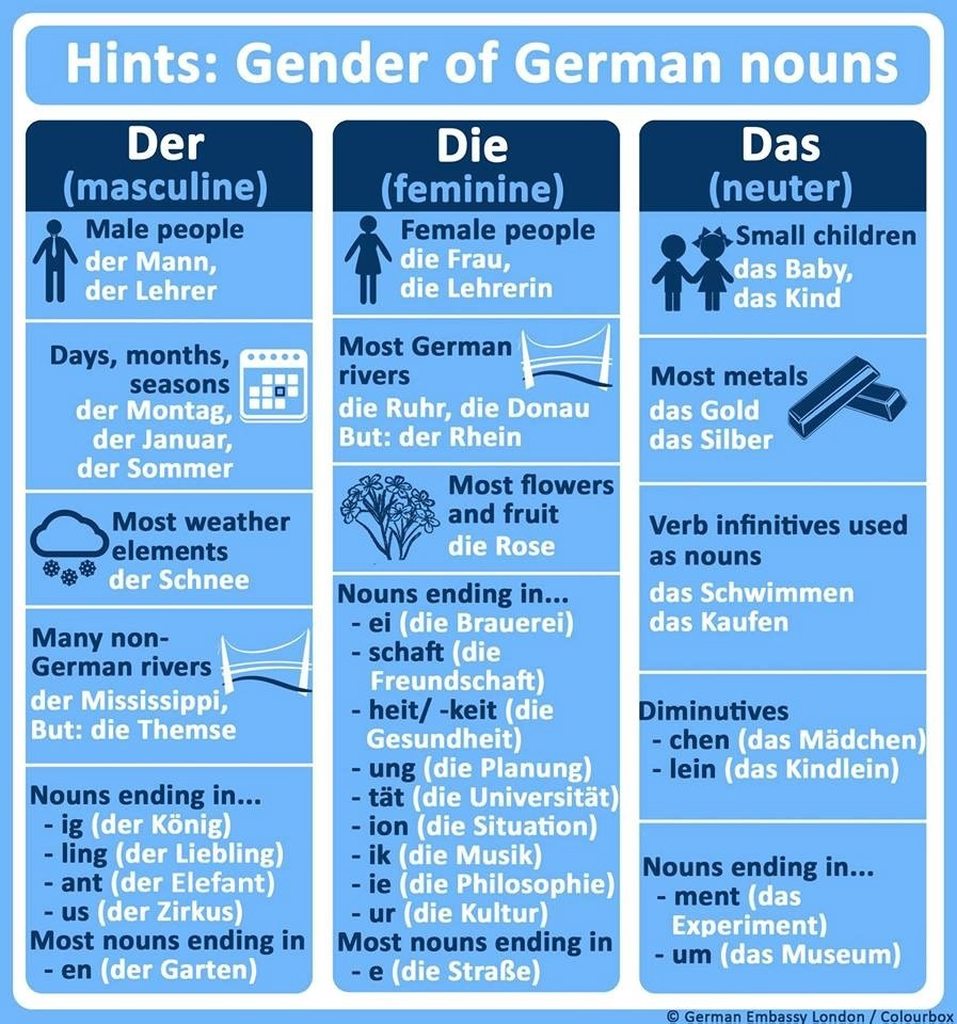 upper roost
verbal girder
https://imgur.com/RMQ5r4M
upper roost
verbal girder
https://imgur.com/RMQ5r4M
thank you!! that helps a LOT
pliant pelican
Hallo, Ich suche Vokabel list für Niveau B1 und B2, weil ich Schwierigkeiten über Vokabel lernen habe. Verfügst jemand über eine website oder pdf dass ich erreichen kann.
granite spade
'gemäß irgendwelchen Gesetzes' or irgendwelches?
 floral marlin
„Gemäß irgendeines Gesetzes“ oder viel öfter „Gemäß irgendeinem Gesetz“, hätte ich angenommen, aber mal sehen, was die Muttersprachler sagen 👀
undone verge
no, that's not true.
at least not colloquially, where irgendwelch- will be used pretty often with all sorts of genders, singular and plural
whole portal
Zum Beispiel?
undone verge
'Sie hat mich angerufen, weil sie irgendwelches Problem mit dem Gerät hatte.' (probably somewhat annoyed discussing event)
ofc my brain does a hard shut down when trying to think of examples, aber bild ich mir das ein? In meinem Kopf benutze ich 'irgendwelche-' auch singular, aber natürlich fallen mir gerade nur Sachen ein, die auch mit dem Plural benutzt werden können. (Sie hat mir irgendwelches Formular gegeben // Sie hat mir irgendwelche Formulare gegeben)?
whole portal
Sie hat mich angerufen, weil sie irgendwelches Problem mit dem Gerät hatte.
irgendein
Vielleicht ist das regional verschieden aber bis auf unzählbare Wörter (hast du irgendwelchen Käse) fällt mir nicht viel ein.
undone verge
I just asked my partner, and they agree with you. But also confirmed my suspicion that people around me do say stuff like that (zB ich habe irgendwelchen Typ gesehen) even though it's wrong
so my bad, I guess I picked up a bad habit without realising it and/or hang around a lot of foreigners who make mistakes like me 😄
flint nimbus
Ich glaube Ihnen
so glaube takes dative... but does it take only dative, or accusative and dative?
verbal girder
dative (according to this list of dative verbs i have: http://germanforenglishspeakers.com/reference/dative-verbs/)
As a reminder, these are verbs that can take a dative object even without an accusative object or a dative preposition. (See V.13 for more.) The best way to remember them is a short phrase with a dative pronoun or … Continue reading →
floral marlin
Accusative and dative. Basically if you believe a person, you are believing to them: Ich glaube Ihnen.
But when you believe something, it’s accusative: „Ob du es glaubst oder nicht“.
So when you believe something someone says, the person is dative but the thing they say is the direct object in the accusative: „Ich glaube Ihnen Ihre Geschichte“
flint nimbus
that seems like a very limited use of the accusative
 nova sparrow
undone verge
'Sie hat mich angerufen, weil sie irgendwelches Problem mit dem Gerät hatte.' (p...
nova sparrow
undone verge
'Sie hat mich angerufen, weil sie irgendwelches Problem mit dem Gerät hatte.' (p...
to me
irgendein Problem
irgendwelche Probleme
irgendein Formular
irgendwelche Formulare
sounds better
nova sparrow
whole portal
Vielleicht ist das regional verschieden aber bis auf unzählbare Wörter (hast du ...
selbst beim Käse: hast du irgendeinen Käse mMn
floral marlin
flint nimbus
that seems like a very limited use of the accusative
I'm not sure what you mean? But tbh I don't see it much differently from normal verbs. „Ich gebe dir deinen Bleistift“ has one indirect object in the dative and one direct object in the accusative. Same with glauben. If you think about it, when you believe someone, it's not really them you believe, but their claims.
 sick lark
my thing says
"write phrases that correspond to the english cues"
its the as good as
not as old as
better than
and idk if it wants me to write a whole new sentance and give my own example or if it wants me to just write it in german
hlep pls
 tacit isle
sick lark
and idk if it wants me to write a whole new sentance and give my own example or ...
tacit isle
sick lark
and idk if it wants me to write a whole new sentance and give my own example or ...
My understanding is that you only have to write exactly what it says, no examples.
sick lark
yea i thought so
tacit isle
The wording on the question is strange though... a little unclear
sick lark
ik
tacit isle
Since it says 'write phrases' instead of 'write sentences' I do not think you need a whole sentence
sick lark
mhm
flint nimbus
Thomas ist ein guter Zuhörer.
why on earth's name is it guter?
flint nimbus
floral marlin
I'm not sure what you mean? But tbh I don't see it *much* differently from norma...
idk, just seems like any time it's used would be kind of redundant and with very limited options like "what she says" "his story"
 prisma kindle
flint nimbus
> Thomas ist ein guter Zuhörer.
why on earth's name is it guter?
prisma kindle
flint nimbus
> Thomas ist ein guter Zuhörer.
why on earth's name is it guter?
Because Zuhörer is male and Thomas is good at listening
flint nimbus
oh right nvm
i got it
i might've even asked it before
ok new question then 🙂
Ich möchte gerne mal München besuchten.
why is it gerne, and what does mal do in this sentence? Are they necessary to convey I'd love to go to München?
whole portal
flint nimbus
ok new question then 🙂
> Ich möchte gerne mal München besuchten.
why is it gern...
mal means something like one time here
The best English approximation would probably be "I'd like to visit München some time."
flint nimbus
i got the impression from something i read that schon mal would mean "several times already", while just schon would mean "already". I guess that's backwards then...
i'm also confused about the ending -e in gerne. I don't understand why it's -e
whole portal
"Ich möchte schon gerne mal München besuchten." means something like "Actually, I'd really like to visit München some time."
whole portal
flint nimbus
i got the impression from something i read that schon mal would mean "several ti...
Why not
flint nimbus
whole portal
Why not
why not gern?
whole portal
Because they decided to use gerne
Didn't I tell you that already or was that somebody else


 delicate tiger
all nouns are
nimble viper
whole portal
"Ich möchte schon gerne mal München besuchten." means something like "Actually, ...
Yeah I would do “I would like to visit München some time” where schon predicates the stress on the word would. However this would be confusing for @flint nimbus as your insertion of schon into the example is a different usage to the more familiar “schon (ein)mal” which fyi Clouds when seen together means “(once) before”.
As they are separated / not seen together in your sentence though, you understand mal as something like “once”, usually in english as HP said “some time”
urban oxide
Hallo, ich habe ein paar Fragen über Präpositionen:
Wilhelm ist auf dem Schiff zur See gefahren.
- Warum ist es "zur" hier? Sagt man nicht "auf See"? Kann ich "auf die See fahren" sagen?
Die Haltestelle liegt in der Ecke.
- Und warum ist es "in der Ecke" und nicht "um die Ecke"?
urban oxide
Bitte klingen Sie mir wenn Sie antworten
undone verge
urban oxide
Hallo, ich habe ein paar Fragen über Präpositionen:
> Wilhelm ist auf dem Schif...
none of those can be right, since See is masculine
urban oxide
I think this sentence uses the "See" in the second sense
 undone verge
I also don't see why it would be 'in der Ecke' unless the Haltestelle is somehow situated in a corner
undone verge
urban oxide
I think this sentence uses the "See" in the second sense
yes, you're right