#botchannel
1 messages · Page 136 of 1
 dawn panther
 lean flickerBOT
How to get started - Part 2
Please make sure to read Part 1 before starting Part 2!
Part 2 – Beyond a Simple Sentence
1: Conjunctions (coordinating and subordinating)
2: Subordinate clause word order
3: Dative case
4: Dative verbs
5: Verbs with two objects (e.g. geben)
6: Prepositions (accusative, dative, and two-way)
7: Spoken past tense (Perfekt)
8: Written past tense (Präteritum)
9: Genitive case
10: Relative clauses
11: Adjective declension
Tips
- Make sure to practice writing and reading simple texts
- Some of these concepts are confusing to start with, so it’s a good idea to ask for help in #questions when you’re unsure
- You should use a declension chart to help with declension to start with, because you won’t be able to memorize it straight away
- After you feel confident with creating sentences, you can start learning the adjective declension properly by using the command >faq adjective declension and reading the guide provided
Page 2/2
 astral silo
sub translation
lean flickerBOT
:x: Use the >group joinall command to join all available groups.
astral silo
group joinall
lean flickerBOT
:x: Use the >group joinall command to join all available groups.
astral silo
group joinall
lean flickerBOT
:white_check_mark: Added you to 9 available groups: Coding, Food, Science, Gaming, Ouija, Advancedreading, Reading, Art, Activities.
astral silo
unsub all
lean flickerBOT
:x: Use the >group joinall command to join all available groups.
astral silo
unsub advancereading
lean flickerBOT
:x: Group advancereading not found.
Try >groups to see a list of all groups or >group joinall to join all available groups.
astral silo
unsub Advancereading
lean flickerBOT
:x: Group Advancereading not found.
Try >groups to see a list of all groups or >group joinall to join all available groups.
astral silo
groups
lean flickerBOT
These groups are currently accessible
Activities
Lessons! Subscribe for pings!
Grammar
Lessons! Subscribe for pings!
Advancedreading
Like Reading but only B2+ level content.
Reading
Lessons! Subscribe for pings!
Writing
Join to get weekly and monthly prompts!
Translation
Offers weekly sentences to translate.
Pronunciation
Offers weekly texts to practise pronunciation.
Food
A group for food talks.
Science
STEM-related topics.
Ouija
A Ouija-style game just for fun.
Gaming
All gaming-related topics.
Coding
For all the coding nerds.
Art
A group for sharing self-made art.
Type >sub to join a group or >group joinall to join all available groups .
astral silo
group leaveall
lean flickerBOT
:white_check_mark: Removed you from 13 groups: Coding, Food, Science, Gaming, Ouija, Pronunciation, Grammar, Writing, Translation, Advancedreading, Reading, Art, Activities
lean flickerBOT
:x: Group translator not found.
Try >groups to see a list of all groups or >group joinall to join all available groups.
 limber jay
faq babbel
lean flickerBOT
FAQ not found. Try >explain all.
Note: This entry has been added to our FAQ idea pool.
 ionic marsh
sub pronunciation
 wet ridge
faq cefr
lean flickerBOT
cefr
If you see something like A1, B2 or C1, these represent the proficiency of a speaker in a language they're not native in, and are called CEFR levels. They are valid for any language, not only German!
Roughly speaking, A levels are beginners and C levels are experts. Remember that CEFR level are self-assessed and indicative!
You can see more specific names and descriptions on the Wikipedia page:
https://en.wikipedia.org/wiki/Common_European_Framework_of_Reference_for_Languages
🗨 How do I know what level I am?
If the table on Wikipedia is too generic for you, you can try using this one here:
https://rm.coe.int/168045bb52
Just check each column one at a time: if you can do all it describes, move to the next column. Your level is the highest where you can do the most things.
Alternatively, you can use this questionnaire to estimate your level more accurately:
https://www.laits.utexas.edu/fi/sites/laits.utexas.edu.fi/files/Self Assessment Checklist European.pdf
wet ridge
cefr B
 knotty frost
 real atlas
 snow compass
cat
lean flickerBOT
 snow compass
@quiet falcon
 tight jacinth
faq beginner
lean flickerBOT
How to get started
The simplest way to learn German is to find topics you don’t understand yet and search for explanations of them. This list provides you with a guide for which topics to learn if you are completely new to German. Type the topic into Google (or YouTube) and start learning!
Introduction
1: Alphabet (especially ä, ü, ö and ß)
2: Basic greetings (hello, goodbye, etc.)
Part 1 - Simple Sentence
1: Noun gender & plurals
2: Nominative case (What are cases?)
3: Nominative pronouns (I, you, he, she, etc.)
4: Verbs in present tense
5: Definite/indefinite articles
6: Accusative case (for nouns)
7: Accusative pronouns
8: Word order of simple sentences
9: How to ask questions
See Part 2 on the next page.
Tips
- Always learn the gender of a noun when you learn a new noun
- Learn to use a translation dictionary (e.g. dict.cc, leo.org)
- Use
>faq resourcesto see our list of German learning resources - For listening and pronunciation practice, try watching movies or videos (incl. YouTube)
- You can listen to pronunciation for words on websites like dict.cc, forvo.com, and others
- Practice writing sentences every day (and asking people to correct them)
- Ask as many questions as possible
- Don’t be scared to make mistakes!!!! If you don’t let yourself make mistakes, you will never be able to learn German
Page 1/2
 mortal zealot
 karmic peak
 upbeat compass
Happens
lean flickerBOT
nicos
Nicos Weg is a free online program aimed at helping people learn German. It includes video, audio, text, grammar explanations, notes, vocabulary, and exercises. It also includes very useful cultural and bureaucratic information, such as how to open a bank account, while teaching you the relevant grammar and vocabulary.
It’s fairly popular and well-recommended, but keep in mind that you can’t learn a language with only one resource, even if it’s a good one!
You can find the courses here: https://learngerman.dw.com/en/overview/
You can also see various other courses for learners by dw.com here: https://www.dw.com/en/learn-german/s-2469/
upbeat compass
Ehehe :D
lean flickerBOT
FAQ not found. I found the following similar entries: beginner, beginner 2.
 tight silo
faq beginner
lean flickerBOT
How to get started
The simplest way to learn German is to find topics you don’t understand yet and search for explanations of them. This list provides you with a guide for which topics to learn if you are completely new to German. Type the topic into Google (or YouTube) and start learning!
Introduction
1: Alphabet (especially ä, ü, ö and ß)
2: Basic greetings (hello, goodbye, etc.)
Part 1 - Simple Sentence
1: Noun gender & plurals
2: Nominative case (What are cases?)
3: Nominative pronouns (I, you, he, she, etc.)
4: Verbs in present tense
5: Definite/indefinite articles
6: Accusative case (for nouns)
7: Accusative pronouns
8: Word order of simple sentences
9: How to ask questions
See Part 2 on the next page.
Tips
- Always learn the gender of a noun when you learn a new noun
- Learn to use a translation dictionary (e.g. dict.cc, leo.org)
- Use
>faq resourcesto see our list of German learning resources - For listening and pronunciation practice, try watching movies or videos (incl. YouTube)
- You can listen to pronunciation for words on websites like dict.cc, forvo.com, and others
- Practice writing sentences every day (and asking people to correct them)
- Ask as many questions as possible
- Don’t be scared to make mistakes!!!! If you don’t let yourself make mistakes, you will never be able to learn German
Page 1/2
 rancid kraken
lean flickerBOT
rancid kraken
lean flickerBOT
FAQ not found. Try >explain all.
Note: This entry has been added to our FAQ idea pool.
lean flickerBOT
cefr
If you see something like A1, B2 or C1, these represent the proficiency of a speaker in a language they're not native in, and are called CEFR levels. They are valid for any language, not only German!
Roughly speaking, A levels are beginners and C levels are experts. Remember that CEFR level are self-assessed and indicative!
You can see more specific names and descriptions on the Wikipedia page:
https://en.wikipedia.org/wiki/Common_European_Framework_of_Reference_for_Languages
🗨 How do I know what level I am?
If the table on Wikipedia is too generic for you, you can try using this one here:
https://rm.coe.int/168045bb52
Just check each column one at a time: if you can do all it describes, move to the next column. Your level is the highest where you can do the most things.
Alternatively, you can use this questionnaire to estimate your level more accurately:
https://www.laits.utexas.edu/fi/sites/laits.utexas.edu.fi/files/Self Assessment Checklist European.pdf
 vernal gulch
faq zustandspassiv
lean flickerBOT
zustandspassiv
Stative Passive (Zustandspassiv)
The passive voice with werden (Vorgangspassiv) refers to the process of an action; it indicates that an action is taking place. The resulting state of this action can be indicated with a different version of the passive voice called the Stative Passive (Zustandspassiv). This form uses sein instead of werden as its auxiliary verb. For example:
Das Fenster ist zerbrochen. (The window is broken)
Transitive verbs that are valid in the Vorgangspassiv can typically be used in the Zustandspassiv and vice versa. The Zustandspassiv, however, tends to prefer verbs that have a clear end state, such as: zerstören, öffnen, schließen.
Vorgangspassiv vs Zustandspassiv
The difference between the two passive voice forms is best illustrated with an example:
Der Tresor war verschlossen, aber wir haben nicht gesehen, wie er verschlossen wurde.
The safe was locked but we did not see how it was locked.
In the first clause, the state of the safe is being discussed. The process of locking the safe was completed and the safe reached a condition of being locked. The last clause concentrates on the process of locking the safe, namely how it was done. The safe has somehow reached a state of being locked, but this process was not observed.
As the Vorgangspassiv discusses a process, it often relates to the English progressive aspect, but this is never true for the Zustandspassiv. For example, the English sentence:
The product is being packed.
Can be translated as:
Die Ware wird verpackt.
But cannot be translated as:
Die Ware ist verpackt.
This loses the implication of a process, which the English progressive aspect and Vorgangspassiv possess. Instead, this sentence indicates that this process is complete and the product is now packed. Thus, it would be an acceptable translation for:
The product has been packed.
 hollow cape
faq gender
lean flickerBOT
gender
German nouns are sorted in three different genders: masculine, neuter and feminine. These have nothing to do with sex or social gender.
The first thing genders will influence are articles like der, das, die. Each word has its own and you better get it right: some words that look identical can have different meanings depending on the gender they're used with. For example:
die Band = the (musical) band,
der Band = the (book) volume,
das Band = the tape.
Some words, mainly trademarks and loanwords, have multiple acceptable genders while having no change in meaning:
der Jogurt = das Jogurt
das Virus = der Virus
These may vary by region or colloquiality.
💢 But WHY, German, WHY ⁉
Gender is actually quite useful! Since sentence structure is less rigid than in English, grammatical case helps you tell the various elements apart (with some practice), and that works through genders: each gender has its own forms, which makes everything a little less ambiguous. Besides, as you've seen with Band above, it allows us to make up words with different meanings that look the same but are not ambiguous, and if that's not magic, I don't know what is. ✨
🙀 But how am I supposed to tell them apart? 🙀
Check out >explain gender patterns. 😉
hollow cape
faq gender pattern
lean flickerBOT
FAQ not found. I found the following similar entries: gender, Gender patterns.
hollow cape
faq gender patterns
lean flickerBOT
gender patterns
Unfortunately, many German words don't have immediately clear clues that reveal it, but thankfully, many common words do follow patterns that reveal their gender.
In general, you are advised to learn the article together with the word (and its plural!).
Plural forms always use die and follow plural declension rules, which are the same for all genders (yay 🎉).
Type >explain grammatical gender for an explanation on grammatical gender.
Here's a list of patterns to recognise word gender.
Note that exceptions may apply.
💙 Masculine words (der):
- profession/role names (der Verkäufer, der Lehrer)
- many elements of time (der Tag, der Monat, der Winter)
- cardinal directions (der Norden, der Süden)
- words ending in:
---igder König, der Teig
---lingder Neuling, der Schwächling
---antder Praktikant, der Elefant
---ismusder Faschismus, der Sozialismus
💚 Neuter words (das):
- nominalised verbs (das Leben, das Lesen)
- metals (das Gold, das Kupfer)
- babies and cubs (das Baby, das Lamm)
- diminutives in
-chen/-lein(das Hündchen) - words ending in:
---mentdas Experiment, das Sakrament
---ma(usually of Greek origin) das Komma, das Thema
❤️ Feminine words (die):
- many words ending in
-e(die Nase, die Kiste) - words ending in:
---in(feminine professions/roles): die Verkäuferin, die Lehrerin
---eidie Fischerei, die Bäckerei
---schaftdie Mannschaft, die Gemeinschaft
---heit/-keitdie Freiheit, die Gerechtigkeit
---ungdie Bedeutung, die Achtung
---iondie Aktion, die Religion
---ikdie Logistik, die Logik
---anzwords of classical origin: die Allianz, die Toleranz
---urdie Natur, die Kultur
---tätdie Professionalität, die Kriminalität
 proud obsidian
faq ß
lean flickerBOT
ß
The ß, called Eszett or scharfes S, is a letter of the Standard German alphabet.
🗨 How to type it?
If you're on a US keyboard, you can use the US International layout and type ß with [right alt] + s. There is also an altcode (press [alt], type the numbers and release [alt]):
ß = alt+225
🗨 What about capital ẞ?
Capital ẞ is only used in typography and all caps words (and not even always). It never occurs as the first letter of a word, so you will never really need to be able to write it. ;)
🗨 How to read it?
It is always read as an unvoiced [s], like in the English word ma__ss__.
🗨 When to ß and when to ss?
The pronunciation is the same, but they're used in different positions.
ẞ is used after long vowels, which are vowels pronounced for slightly longer than otherwise (Fuß, Straße); compare the English m__i__nd and m__i__tten: same letter, different length, thus different pronunciation.
ẞ is also used after diphthongs, which are groups of vowels pronounced together (gießen, Preußen).
ss is used after short vowels (Schloss, Abfluss). This also occurs for ck vs k and similar: double consonant means short (even in English, see mitten above!)
ss is also found after diphthongs and long vowels if the two Ses belong to separate parts; this can happen in prefixes (aussteigen) and compound words (Moossee).
🗨 I've seen something that doesn't follow these rules! ‼
Not to worry! The above rules apply for Standard German and you can follow them religiously. If you find exceptions, these are the possible reasons:
- The writer or text follows old rules, where all instances of
ssin the same word becameßregardless of the vowel. - The writer or text comes from Switzerland, where ß is seldom used, if at all.
proud obsidian
@old slate
 old slate
Oh, thanks.
 tender trellis
cefr A
 keen garden
cefr B
 livid scarabBOT
:heavy_check_mark: I replaced your old CEFR role with Level B.
 queen swallow
tender trellis
queen swallow
tender trellis
faq beginner
lean flickerBOT
How to get started - Part 2
Please make sure to read Part 1 before starting Part 2!
Part 2 – Beyond a Simple Sentence
1: Conjunctions (coordinating and subordinating)
2: Subordinate clause word order
3: Dative case
4: Dative verbs
5: Verbs with two objects (e.g. geben)
6: Prepositions (accusative, dative, and two-way)
7: Spoken past tense (Perfekt)
8: Written past tense (Präteritum)
9: Genitive case
10: Relative clauses
11: Adjective declension
Tips
- Make sure to practice writing and reading simple texts
- Some of these concepts are confusing to start with, so it’s a good idea to ask for help in #questions when you’re unsure
- You should use a declension chart to help with declension to start with, because you won’t be able to memorize it straight away
- After you feel confident with creating sentences, you can start learning the adjective declension properly by using the command >faq adjective declension and reading the guide provided
Page 2/2
 atomic musk
cefr b
 molten hull
 plucky cloud
faq cefr
lean flickerBOT
cefr
If you see something like A1, B2 or C1, these represent the proficiency of a speaker in a language they're not native in, and are called CEFR levels. They are valid for any language, not only German!
Roughly speaking, A levels are beginners and C levels are experts. Remember that CEFR level are self-assessed and indicative!
You can see more specific names and descriptions on the Wikipedia page:
https://en.wikipedia.org/wiki/Common_European_Framework_of_Reference_for_Languages
🗨 How do I know what level I am?
If the table on Wikipedia is too generic for you, you can try using this one here:
https://rm.coe.int/168045bb52
Just check each column one at a time: if you can do all it describes, move to the next column. Your level is the highest where you can do the most things.
Alternatively, you can use this questionnaire to estimate your level more accurately:
https://www.laits.utexas.edu/fi/sites/laits.utexas.edu.fi/files/Self Assessment Checklist European.pdf
 kindred wyvern
gr gegessen
livid scarabBOT
❌ Bad argument: Role "gegessen" not found.
kindred wyvern
gr food
livid scarabBOT
:x: Sorry, this role is not assignable.
Roles you can give yourself
- Level A
- Level B
- Level C
Use >groups for a list of group roles.
kindred wyvern
sub food
lean flickerBOT
cefr
If you see something like A1, B2 or C1, these represent the proficiency of a speaker in a language they're not native in, and are called CEFR levels. They are valid for any language, not only German!
Roughly speaking, A levels are beginners and C levels are experts. Remember that CEFR level are self-assessed and indicative!
You can see more specific names and descriptions on the Wikipedia page:
https://en.wikipedia.org/wiki/Common_European_Framework_of_Reference_for_Languages
🗨 How do I know what level I am?
If the table on Wikipedia is too generic for you, you can try using this one here:
https://rm.coe.int/168045bb52
Just check each column one at a time: if you can do all it describes, move to the next column. Your level is the highest where you can do the most things.
Alternatively, you can use this questionnaire to estimate your level more accurately:
https://www.laits.utexas.edu/fi/sites/laits.utexas.edu.fi/files/Self Assessment Checklist European.pdf
 median scarab
cefr a
lean flickerBOT
How to get started - Part 2
Please make sure to read Part 1 before starting Part 2!
Part 2 – Beyond a Simple Sentence
1: Conjunctions (coordinating and subordinating)
2: Subordinate clause word order
3: Dative case
4: Dative verbs
5: Verbs with two objects (e.g. geben)
6: Prepositions (accusative, dative, and two-way)
7: Spoken past tense (Perfekt)
8: Written past tense (Präteritum)
9: Genitive case
10: Relative clauses
11: Adjective declension
Tips
- Make sure to practice writing and reading simple texts
- Some of these concepts are confusing to start with, so it’s a good idea to ask for help in #questions when you’re unsure
- You should use a declension chart to help with declension to start with, because you won’t be able to memorize it straight away
- After you feel confident with creating sentences, you can start learning the adjective declension properly by using the command >faq adjective declension and reading the guide provided
Page 2/2
tender trellis
faq resources
lean flickerBOT
resources
median scarab
sub all
lean flickerBOT
:x: Use the >group joinall command to join all available groups.
lean flickerBOT
:white_check_mark: Added you to 13 available groups: Coding, Food, Science, Gaming, Ouija, Pronunciation, Grammar, Writing, Translation, Advancedreading, Reading, Art, Activities.
lean flickerBOT
:x: Use the >group joinall command to join all available groups.
 tawny prawn
group joinall
lean flickerBOT
:white_check_mark: Added you to 13 available groups: Coding, Food, Science, Gaming, Ouija, Pronunciation, Grammar, Writing, Translation, Advancedreading, Reading, Art, Activities.
 torn turret
faq beginner
 slate arch
lean flickerBOT
slate arch
lean flickerBOT
How to get started - Part 2
Please make sure to read Part 1 before starting Part 2!
Part 2 – Beyond a Simple Sentence
1: Conjunctions (coordinating and subordinating)
2: Subordinate clause word order
3: Dative case
4: Dative verbs
5: Verbs with two objects (e.g. geben)
6: Prepositions (accusative, dative, and two-way)
7: Spoken past tense (Perfekt)
8: Written past tense (Präteritum)
9: Genitive case
10: Relative clauses
11: Adjective declension
Tips
- Make sure to practice writing and reading simple texts
- Some of these concepts are confusing to start with, so it’s a good idea to ask for help in #questions when you’re unsure
- You should use a declension chart to help with declension to start with, because you won’t be able to memorize it straight away
- After you feel confident with creating sentences, you can start learning the adjective declension properly by using the command >faq adjective declension and reading the guide provided
Page 2/2
 wanton venture
help
livid scarabBOT
Page 11/11 (29 commands)
WordTrainer Commands
A cog that lets you train your vocabulary.
word
A command that helps you train and expand your vocabulary.
Use ">help command" for more info on a command.
wanton venture
verb arbeiten
livid scarabBOT
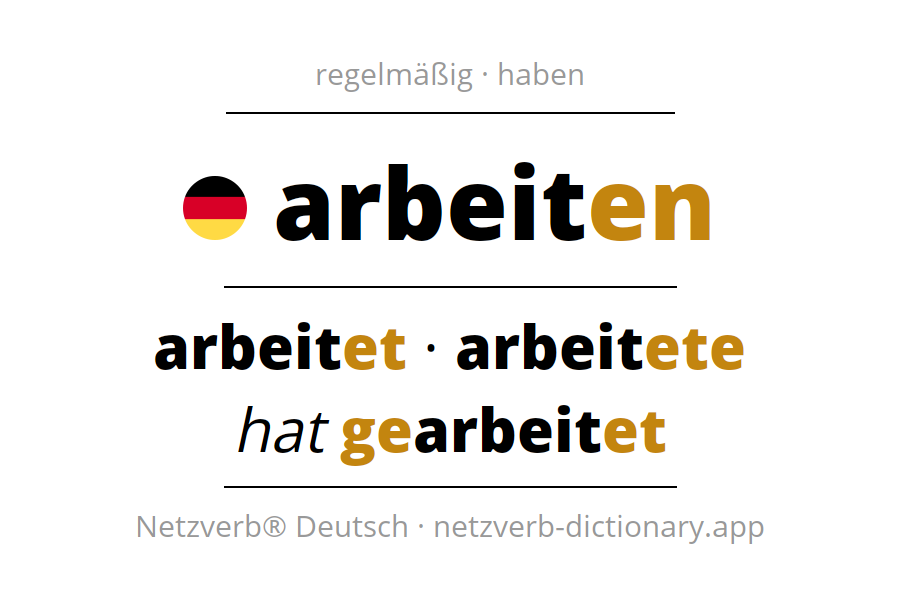
Konjugation Verb arbeiten: im Präsens, Präteritum, Konjunktiv, Perfekt, ... viele Beispiele, Grammatik, Regeln erklärt, Übersetzung, Übungen, Bedeutung und kostenlose Downloads.
wanton venture
word
 pulsar saffron
faq cefr
lean flickerBOT
cefr
If you see something like A1, B2 or C1, these represent the proficiency of a speaker in a language they're not native in, and are called CEFR levels. They are valid for any language, not only German!
Roughly speaking, A levels are beginners and C levels are experts. Remember that CEFR level are self-assessed and indicative!
You can see more specific names and descriptions on the Wikipedia page:
https://en.wikipedia.org/wiki/Common_European_Framework_of_Reference_for_Languages
🗨 How do I know what level I am?
If the table on Wikipedia is too generic for you, you can try using this one here:
https://rm.coe.int/168045bb52
Just check each column one at a time: if you can do all it describes, move to the next column. Your level is the highest where you can do the most things.
Alternatively, you can use this questionnaire to estimate your level more accurately:
https://www.laits.utexas.edu/fi/sites/laits.utexas.edu.fi/files/Self Assessment Checklist European.pdf
pulsar saffron
cefr A
 sharp silo
 split dome
sub gaming
 sly glacier
faq beginner
lean flickerBOT
How to get started
The simplest way to learn German is to find topics you don’t understand yet and search for explanations of them. This list provides you with a guide for which topics to learn if you are completely new to German. Type the topic into Google (or YouTube) and start learning!
Introduction
1: Alphabet (especially ä, ü, ö and ß)
2: Basic greetings (hello, goodbye, etc.)
Part 1 - Simple Sentence
1: Noun gender & plurals
2: Nominative case (What are cases?)
3: Nominative pronouns (I, you, he, she, etc.)
4: Verbs in present tense
5: Definite/indefinite articles
6: Accusative case (for nouns)
7: Accusative pronouns
8: Word order of simple sentences
9: How to ask questions
See Part 2 on the next page.
Tips
- Always learn the gender of a noun when you learn a new noun
- Learn to use a translation dictionary (e.g. dict.cc, leo.org)
- Use
>faq resourcesto see our list of German learning resources - For listening and pronunciation practice, try watching movies or videos (incl. YouTube)
- You can listen to pronunciation for words on websites like dict.cc, forvo.com, and others
- Practice writing sentences every day (and asking people to correct them)
- Ask as many questions as possible
- Don’t be scared to make mistakes!!!! If you don’t let yourself make mistakes, you will never be able to learn German
Page 1/2
vernal gulch
faq vorgangspassiv
lean flickerBOT
vorgangspassiv
Vorgangspassiv
The Vorgangspassiv is formed with werden as the finite/conjugated verb and the past participle of the main verb (or action verb) in the active voice sentence.
For example, when we translate The man eats the apple., we get:
Der Mann isst den Apfel.
When this sentence is converted into its passive voice equivalent, several things happen:
- The finite verb becomes the equivalent conjugation for werden.
isst-->wird - The main verb is then converted into its past participle and placed at the end of the clause, when possible.
isst-->gegessen - The accusative object becomes the (nominative) subject.
den Apfel-->Der Apfel - The subject is indicated with the preposition
vonor simply left out altogether.Der Mann-->(vom Mann)
Putting this together, we create the passive voice sentence:
Der Apfel wird (vom Mann) gegessen.
‼ Only the accusative object of a verb can become the subject in a passive sentence. This means verbs that govern a dative, genitive, or prepositional object can never become the subject. Instead, the object remains as it was.
For example, the verb helfen governs a dative object. An example with it in an active sentence would be:
Der Mann hat dem Kollegen geholfen.
When converted to the passive voice, dem Kollegen does not change case:
Dem Kollegen wurde (vom Mann) geholfen.
This applies equally to verbs that govern genitive and prepositonal objects:
Der Toten wurde gedacht.
Über das Thema wird kaum gesprochen.
Tenses & Moods
Present: Der Apfel wird gegessen.
Simple Past: Der Apfel wurde gegessen.
Future: Der Apfel wird gegessen werden.
Present Perfect: Der Apfel ist gegessen worden.
Past Perfect: Der Apfel war gegessen worden.
Future Perfect: Der Apfel wird gegessen worden sein.
See Also:
https://bit.ly/2Quvo8q (Pferd's blog)
 solid matrix
lookup ge en rich
livid scarabBOT
❌ ge is not a supported language. Use dict info.
 main raptor
faq homework
lean flickerBOT
homework
If you want something corrected, you can put it in a Google Doc and share a link with permission level »can suggest« in #writing .
Don't ask us to translate something for you outright: that takes professional time and effort and we're not here for that. You can try your luck with deepl.com.
For single words, use dict.cc or another dictionary, it'll be quicker.
If you want to know if/how a word can be used, provide some context to help us understand the situation.
Don't ask us to do your homework or exams for you! Show us your best attempt at something and try to pinpoint what exactly you don't understand.
 normal vortex
sub Reading
median scarab
faq beginner
lean flickerBOT
How to get started - Part 2
Please make sure to read Part 1 before starting Part 2!
Part 2 – Beyond a Simple Sentence
1: Conjunctions (coordinating and subordinating)
2: Subordinate clause word order
3: Dative case
4: Dative verbs
5: Verbs with two objects (e.g. geben)
6: Prepositions (accusative, dative, and two-way)
7: Spoken past tense (Perfekt)
8: Written past tense (Präteritum)
9: Genitive case
10: Relative clauses
11: Adjective declension
Tips
- Make sure to practice writing and reading simple texts
- Some of these concepts are confusing to start with, so it’s a good idea to ask for help in #questions when you’re unsure
- You should use a declension chart to help with declension to start with, because you won’t be able to memorize it straight away
- After you feel confident with creating sentences, you can start learning the adjective declension properly by using the command >faq adjective declension and reading the guide provided
Page 2/2
median scarab
faq help
lean flickerBOT
FAQ not found. Try >explain all.
Note: This entry has been added to our FAQ idea pool.
median scarab
explain all
lean flickerBOT
See a listed FAQ with >faq [name]
- Accusative [Akkusativ]
- Adjective Declension [adjective endings, Adjektivdeklination]
- Beide vs. Beides [Beides vs. Beide, Beides, Beide]
- Best way to learn German [learn fast, learn German fast, learn efficiently, best way to learn, fastest way to learn, most efficient way to learn]
- CEFR levels [lvl, CEFR]
- Cases [case, grammatical case]
- DACH
- Dative [Dativ]
- Duolingo [duo]
- Eszett [Scharfes S, ẞ, ß]
- FAQ
- Formal and informal speech [duzen vs. siezen, Sie, Du vs. Sie]
- Gender patterns
- Genitive [Genitiv]
- German letters [german keyboard, keyboard]
- Grammar terms [Glossary, Grammatical terms]
- Grammatical gender [genders, der-die-das, gender]
- How to ask a question [Translation, Homework]
- How to get started [Starting out, beginner]
- IPA [Pronunciation, Sound transcription, International Phonetic Alphabet]
Page 1/3 (49 entries)
median scarab
faq learn fast
lean flickerBOT
Best way to learn German
Should I study all these skills every day?
If you want to study them all every day, you can, but some people may find it easier to focus on particular skills on particular days. For example, on Monday you might choose to do a lot of writing practice, and then on Tuesday you might plan some conversation practice with some speaking partners.
If you try to cover too many different things in one day, then you might be jumping around all over the place and not able to focus on each individual task. It’s also a really good idea to have a different schedule or set of tasks each day to keep things from getting boring. So setting a special schedule or set of tasks for each day of the week - like the Monday writing day, or every Friday you do some grammar exercises followed by watching TV shows, or any other combination you like – is a really good way to go.
How much time should I dedicate to studying?
Everyone has a different schedule and everyone learns at a different pace. It is recommended to study every day, preferably for 30 minutes or more, but taking 1-2 days off is okay. More important is how many hours you study in a week.
A casual pace will be roughly around 5-8 hours a week, a steady pace would be around 10-14 hours a week, and a fast pace (around the same pace as a university subject) will be 15-20 hours a week.
Anything less than 5 hours and you may find it hard to keep improving steadily (but feel free to try it and see how it works for you), while studying one subject for over 25 hours a week may quickly lead to burnout.
How you choose to spread those hours out over the week is not that important; for example, if you have a lot of time on the weekend but not during the week, it’s fine to do short study sessions on weekdays and then dedicate a bunch of time on Saturday and Sunday.
Page 2/2
median scarab
faq resources
lean flickerBOT
resources
 tall acorn
cefr A
 runic socket
sub coding
solid matrix
groups
lean flickerBOT
These groups are currently accessible
Activities
Lessons! Subscribe for pings!
Grammar
Lessons! Subscribe for pings!
Advancedreading
Like Reading but only B2+ level content.
Reading
Lessons! Subscribe for pings!
Writing
Join to get weekly and monthly prompts!
Translation
Offers weekly sentences to translate.
Pronunciation
Offers weekly texts to practise pronunciation.
Food
A group for food talks.
Science
STEM-related topics.
Ouija
A Ouija-style game just for fun.
Gaming
All gaming-related topics.
Coding
For all the coding nerds.
Art
A group for sharing self-made art.
Type >sub to join a group or >group joinall to join all available groups .
solid matrix
faq beginner
lean flickerBOT
How to get started - Part 2
Please make sure to read Part 1 before starting Part 2!
Part 2 – Beyond a Simple Sentence
1: Conjunctions (coordinating and subordinating)
2: Subordinate clause word order
3: Dative case
4: Dative verbs
5: Verbs with two objects (e.g. geben)
6: Prepositions (accusative, dative, and two-way)
7: Spoken past tense (Perfekt)
8: Written past tense (Präteritum)
9: Genitive case
10: Relative clauses
11: Adjective declension
Tips
- Make sure to practice writing and reading simple texts
- Some of these concepts are confusing to start with, so it’s a good idea to ask for help in #questions when you’re unsure
- You should use a declension chart to help with declension to start with, because you won’t be able to memorize it straight away
- After you feel confident with creating sentences, you can start learning the adjective declension properly by using the command >faq adjective declension and reading the guide provided
Page 2/2

 upbeat compass
faq eesources
lean flickerBOT
FAQ not found. I found the following similar entry: Resources.
 chilly path
help
livid scarabBOT
Page 6/11 (29 commands)
German Commands
Commands used by the German learning server.
cefr [role]
Assigns a role to you from a list of available roles.
removecefr <role>
Removes a previously assigned role.
verb <verb>
Get the conjugation for a verb you provided.
Use ">help command" for more info on a command.
 mighty cedar
sub Coding
chilly path
sub Reading
 granite heart
cefr b
livid scarabBOT
:heavy_check_mark: I replaced your old CEFR role with Level B.
upbeat compass
faq how to learn German
lean flickerBOT
FAQ not found. I found the following similar entries: Best way to learn German, learn German fast.
upbeat compass
faq best way to learn German
lean flickerBOT
Best way to learn German
There isn’t only one “best” way to learn German, especially since different methods work better for different people. However, this FAQ will outline the main aspects of learning efficiently, which you can cater to your needs.
If you’re a beginner, type >faq beginner in #botchannel to see our beginner guide.
Cover all skills
There are many combinations of activities you can use to study and practice a language. How do you know which combinations are suitable? The key is to make sure you cover each of the main skills with at least one activity. Some activities only train one skills, while some train multiple – either is fine, as long as all the 6 skills are covered somewhere in your studies.
The skills
• Reading
• Writing
• Listening
• Speaking
• Grammar
• Vocabulary
Which resources should I use?
It doesn’t really matter which resources you use, as long as you can follow along, and the information is correct and reliable. If you have any doubts about whether a resource is correct, feel free to ask. You do not need to find just one resource and stick to it – in fact, to learn best, it’s recommended that you use a large variety of resources and switch between them when needed.
Type >faq resources in #botchannel to see our list of resources.
On the next page
• Should I study all these skills every day?
• How much time should I dedicate to studying?
Page 1/2
tender trellis
faq resources
lean flickerBOT
How to get started - Part 2
Please make sure to read Part 1 before starting Part 2!
Part 2 – Beyond a Simple Sentence
1: Conjunctions (coordinating and subordinating)
2: Subordinate clause word order
3: Dative case
4: Dative verbs
5: Verbs with two objects (e.g. geben)
6: Prepositions (accusative, dative, and two-way)
7: Spoken past tense (Perfekt)
8: Written past tense (Präteritum)
9: Genitive case
10: Relative clauses
11: Adjective declension
Tips
- Make sure to practice writing and reading simple texts
- Some of these concepts are confusing to start with, so it’s a good idea to ask for help in #questions when you’re unsure
- You should use a declension chart to help with declension to start with, because you won’t be able to memorize it straight away
- After you feel confident with creating sentences, you can start learning the adjective declension properly by using the command >faq adjective declension and reading the guide provided
Page 2/2
 torpid gyro
sub Grammar
 scenic frost
faq
lean flickerBOT
:x: The required argument name is missing.
scenic frost
help
livid scarabBOT
Page 1/11 (29 commands)
Banning Commands
isbanned <user>
Returns whether a user is banned or not.
Use ">help command" for more info on a command.
torpid gyro
faq
lean flickerBOT
:x: The required argument name is missing.
 analog aurora
cefr a
 snow slate
sub art
solid matrix
faq learn german fast
lean flickerBOT
Best way to learn German
Should I study all these skills every day?
If you want to study them all every day, you can, but some people may find it easier to focus on particular skills on particular days. For example, on Monday you might choose to do a lot of writing practice, and then on Tuesday you might plan some conversation practice with some speaking partners.
If you try to cover too many different things in one day, then you might be jumping around all over the place and not able to focus on each individual task. It’s also a really good idea to have a different schedule or set of tasks each day to keep things from getting boring. So setting a special schedule or set of tasks for each day of the week - like the Monday writing day, or every Friday you do some grammar exercises followed by watching TV shows, or any other combination you like – is a really good way to go.
How much time should I dedicate to studying?
Everyone has a different schedule and everyone learns at a different pace. It is recommended to study every day, preferably for 30 minutes or more, but taking 1-2 days off is okay. More important is how many hours you study in a week.
A casual pace will be roughly around 5-8 hours a week, a steady pace would be around 10-14 hours a week, and a fast pace (around the same pace as a university subject) will be 15-20 hours a week.
Anything less than 5 hours and you may find it hard to keep improving steadily (but feel free to try it and see how it works for you), while studying one subject for over 25 hours a week may quickly lead to burnout.
How you choose to spread those hours out over the week is not that important; for example, if you have a lot of time on the weekend but not during the week, it’s fine to do short study sessions on weekdays and then dedicate a bunch of time on Saturday and Sunday.
Page 2/2
solid matrix
faq resources
lean flickerBOT
resources
split dome
sub reading
 hidden niche
groups
lean flickerBOT
These groups are currently accessible
Activities
Lessons! Subscribe for pings!
Grammar
Lessons! Subscribe for pings!
Advancedreading
Like Reading but only B2+ level content.
Reading
Lessons! Subscribe for pings!
Writing
Join to get weekly and monthly prompts!
Translation
Offers weekly sentences to translate.
Pronunciation
Offers weekly texts to practise pronunciation.
Food
A group for food talks.
Science
STEM-related topics.
Ouija
A Ouija-style game just for fun.
Gaming
All gaming-related topics.
Coding
For all the coding nerds.
Art
A group for sharing self-made art.
Type >sub to join a group or >group joinall to join all available groups .
hidden niche
cefr A
tight silo
faq cefr
lean flickerBOT
cefr
If you see something like A1, B2 or C1, these represent the proficiency of a speaker in a language they're not native in, and are called CEFR levels. They are valid for any language, not only German!
Roughly speaking, A levels are beginners and C levels are experts. Remember that CEFR level are self-assessed and indicative!
You can see more specific names and descriptions on the Wikipedia page:
https://en.wikipedia.org/wiki/Common_European_Framework_of_Reference_for_Languages
🗨 How do I know what level I am?
If the table on Wikipedia is too generic for you, you can try using this one here:
https://rm.coe.int/168045bb52
Just check each column one at a time: if you can do all it describes, move to the next column. Your level is the highest where you can do the most things.
Alternatively, you can use this questionnaire to estimate your level more accurately:
https://www.laits.utexas.edu/fi/sites/laits.utexas.edu.fi/files/Self Assessment Checklist European.pdf
snow slate
cefr c
 modern robin
help
livid scarabBOT
Page 6/11 (29 commands)
German Commands
Commands used by the German learning server.
cefr [role]
Assigns a role to you from a list of available roles.
removecefr <role>
Removes a previously assigned role.
verb <verb>
Get the conjugation for a verb you provided.
Use ">help command" for more info on a command.
modern robin
help cefr
livid scarabBOT
[cefr|getcefr|gr] [role]
Assigns a role to you from a list of available roles.
If you abuse this command, you will get blacklisted.
Use ">help command" for more info on a command.
tender trellis
faq beginner
lean flickerBOT
How to get started
The simplest way to learn German is to find topics you don’t understand yet and search for explanations of them. This list provides you with a guide for which topics to learn if you are completely new to German. Type the topic into Google (or YouTube) and start learning!
Introduction
1: Alphabet (especially ä, ü, ö and ß)
2: Basic greetings (hello, goodbye, etc.)
Part 1 - Simple Sentence
1: Noun gender & plurals
2: Nominative case (What are cases?)
3: Nominative pronouns (I, you, he, she, etc.)
4: Verbs in present tense
5: Definite/indefinite articles
6: Accusative case (for nouns)
7: Accusative pronouns
8: Word order of simple sentences
9: How to ask questions
See Part 2 on the next page.
Tips
- Always learn the gender of a noun when you learn a new noun
- Learn to use a translation dictionary (e.g. dict.cc, leo.org)
- Use
>faq resourcesto see our list of German learning resources - For listening and pronunciation practice, try watching movies or videos (incl. YouTube)
- You can listen to pronunciation for words on websites like dict.cc, forvo.com, and others
- Practice writing sentences every day (and asking people to correct them)
- Ask as many questions as possible
- Don’t be scared to make mistakes!!!! If you don’t let yourself make mistakes, you will never be able to learn German
Page 1/2
lean flickerBOT
These groups are currently accessible
Activities
Lessons! Subscribe for pings!
Grammar
Lessons! Subscribe for pings!
Advancedreading
Like Reading but only B2+ level content.
Reading
Lessons! Subscribe for pings!
Writing
Join to get weekly and monthly prompts!
Translation
Offers weekly sentences to translate.
Pronunciation
Offers weekly texts to practise pronunciation.
Food
A group for food talks.
Science
STEM-related topics.
Ouija
A Ouija-style game just for fun.
Gaming
All gaming-related topics.
Coding
For all the coding nerds.
Art
A group for sharing self-made art.
Type >sub to join a group or >group joinall to join all available groups .
tender trellis
faq learn german fast
lean flickerBOT
Best way to learn German
There isn’t only one “best” way to learn German, especially since different methods work better for different people. However, this FAQ will outline the main aspects of learning efficiently, which you can cater to your needs.
If you’re a beginner, type >faq beginner in #botchannel to see our beginner guide.
Cover all skills
There are many combinations of activities you can use to study and practice a language. How do you know which combinations are suitable? The key is to make sure you cover each of the main skills with at least one activity. Some activities only train one skills, while some train multiple – either is fine, as long as all the 6 skills are covered somewhere in your studies.
The skills
• Reading
• Writing
• Listening
• Speaking
• Grammar
• Vocabulary
Which resources should I use?
It doesn’t really matter which resources you use, as long as you can follow along, and the information is correct and reliable. If you have any doubts about whether a resource is correct, feel free to ask. You do not need to find just one resource and stick to it – in fact, to learn best, it’s recommended that you use a large variety of resources and switch between them when needed.
Type >faq resources in #botchannel to see our list of resources.
On the next page
• Should I study all these skills every day?
• How much time should I dedicate to studying?
Page 1/2
 lapis yacht
cefr b
livid scarabBOT
:heavy_check_mark: I replaced your old CEFR role with Level B.
lapis yacht
nice
plucky cloud
sub Reading
 woeful ocean
faq cefr
lean flickerBOT
cefr
If you see something like A1, B2 or C1, these represent the proficiency of a speaker in a language they're not native in, and are called CEFR levels. They are valid for any language, not only German!
Roughly speaking, A levels are beginners and C levels are experts. Remember that CEFR level are self-assessed and indicative!
You can see more specific names and descriptions on the Wikipedia page:
https://en.wikipedia.org/wiki/Common_European_Framework_of_Reference_for_Languages
🗨 How do I know what level I am?
If the table on Wikipedia is too generic for you, you can try using this one here:
https://rm.coe.int/168045bb52
Just check each column one at a time: if you can do all it describes, move to the next column. Your level is the highest where you can do the most things.
Alternatively, you can use this questionnaire to estimate your level more accurately:
https://www.laits.utexas.edu/fi/sites/laits.utexas.edu.fi/files/Self Assessment Checklist European.pdf
 loud jetty
cefr b
livid scarabBOT
:heavy_check_mark: I replaced your old CEFR role with Level B.
 jagged blade
MOM GET YOUR OLD ROLE BACK PLS
 zinc cipher
solid matrix
zinc cipher
solid matrix
faq keyboard
lean flickerBOT
keyboard
Being able to type German letters is quite important!
- Schon = already. Schön = beautiful.
- Mutter = mother. Mütter = mothers.
How to? There are several options.
🔸 US International layout: if you're using a US keyboard or a keyboard based on it, the transition is very easy! Everything stays as you know it, except for some symbol keys like ~, ` or ", which can be pressed to add accents. For example " + a = ä. You can also do RightAlt + s = ß.
To use US International on Windows, look for the Region & Language options and switch your selected keyboard layout to US International.
🔸 Use a program like AutoHotkey to automatically type the symbols you need when you type certain shortcuts: https://www.autohotkey.com/
🔸 Alternatively, you can memorise the altcodes for German characters. Learning them is easier than you might think! Simply hold Alt and type the numbers on your numpad:
ä = 132; Ä = 142
ö = 148; Ö = 153
ü = 129; Ü = 154
ß = 225
🔸 If all else fails, you can use ASCII conventions for the characters: add an e to other vowels, and write ss or sz for ß. For example:
ae = ä
oe = ö
ue = ü
ss = ß
But this is discouraged since it's harder to read and... looks ugly. It is only done in situations where alternatives are impossible (fonts with no unicode etc).
lessons
Lessons
The lessons held on the server don’t have a consistent schedule, because we allow lesson hosts to choose their own times and days. Lessons are held in the Lessons voice channel along with the #lessons text channel. Everyone is welcome to listen to the lessons even if they don’t wish to participate.
You can subscribe to a specific group to get pings whenever a session is announced. The current lesson groups are:
- Reading: Read and translate German texts together.
- AdvancedReading: Like Reading but aimed at B2+ speakers.
- Grammar: Lesson about a specific grammar topic.
- Activities: Speaking practice, learning games, or things that don’t fit in the other categories.
Subscribe by typing >sub Reading (for example) in #botchannel.
Lesson Hosting
Lesson hosting is a voluntary role and we welcome any members who are interested to host their own sessions. If you’re interested in running a session, feel free to DM one of the moderators to discuss the process.
Even if you feel inexperienced or have no idea what to run a session about, we’re always happy to provide guidance and teach people how they can hold learning sessions.
 candid totem
lean flickerBOT
candid totem
lean flickerBOT
resources
tender trellis
cefr A
 ionic frigate
cefr A
livid scarabBOT
:heavy_check_mark: I replaced your old CEFR role with Level A.
proud obsidian
info 336224267517558795
lean flickerBOT

Information about Lillie.txt#5052
Name
@spring acorn
ID
336224267517558795
Joined
16/06/2020 22:34 (29 minutes and 32 seconds ago)
Account created
16/07/2017 19:15 (2 years, 11 months and 3 hours ago)
lean flickerBOT
:x: Group lessons not found.
Try >groups to see a list of all groups or >group joinall to join all available groups.
 knotty wing
lean flickerBOT
knotty wing
lean flickerBOT
:x: Group advanced reading not found.
Try >groups to see a list of all groups or >group joinall to join all available groups.
 storm sigil
sub advancedreading
 proper ibex
Ah
upbeat compass

lean flickerBOT
You don't have any long-term reminders.
 worldly berry
faq beginner
lean flickerBOT
How to get started
The simplest way to learn German is to find topics you don’t understand yet and search for explanations of them. This list provides you with a guide for which topics to learn if you are completely new to German. Type the topic into Google (or YouTube) and start learning!
Introduction
1: Alphabet (especially ä, ü, ö and ß)
2: Basic greetings (hello, goodbye, etc.)
Part 1 - Simple Sentence
1: Noun gender & plurals
2: Nominative case (What are cases?)
3: Nominative pronouns (I, you, he, she, etc.)
4: Verbs in present tense
5: Definite/indefinite articles
6: Accusative case (for nouns)
7: Accusative pronouns
8: Word order of simple sentences
9: How to ask questions
See Part 2 on the next page.
Tips
- Always learn the gender of a noun when you learn a new noun
- Learn to use a translation dictionary (e.g. dict.cc, leo.org)
- Use
>faq resourcesto see our list of German learning resources - For listening and pronunciation practice, try watching movies or videos (incl. YouTube)
- You can listen to pronunciation for words on websites like dict.cc, forvo.com, and others
- Practice writing sentences every day (and asking people to correct them)
- Ask as many questions as possible
- Don’t be scared to make mistakes!!!! If you don’t let yourself make mistakes, you will never be able to learn German
Page 1/2
worldly berry
cefr A
 teal gyro
cefr A
vernal gulch
faq all
lean flickerBOT
See a listed FAQ with >faq [name]
- Negation [kein, nicht]
- Nominative [Nominativ]
- Omission of movement verbs
- Passive [Passiv]
- Past Tense
- Prepositions of Place Part 1 [Nach-In-Auf-Zu]
- Proposals [suggestions]
- Resources [resource list]
- Stative Passive [Zustandspassiv]
- Structure of Konjunktiv II [KII 2]
- Study Vocabulary [unterrichten, lernen, beibringen]
- Swiss German [gsw]
- Switzerland [Schweiz, CH]
- Usage of Konjunktiv II [KII 1]
- Usage of zu [um zu]
- Vorgangspassiv
- Weak Nouns [N-Declension, N-Deklination]
- Word Order for Nouns & Pronouns
- Word Order for Verbs
- beginner 2
Page 2/3 (49 entries)
vernal gulch
faq Structure of Konjunktiv II [KII 2]
lean flickerBOT
FAQ not found. I found the following similar entries: Structure of Konjunktiv II, Usage of Konjunktiv II.
vernal gulch
faq Structure of Konjunktiv II
lean flickerBOT
Structure of Konjunktiv II
Structure of Konjunktiv II
In the first part, we explained the usage of Konjunktiv II. (see >explain Usage of Konjunktiv II)
Now let’s see how it’s built!
We can create KII through Präteritum - slap an Umlaut on the verb and add the suffixes of Konjunktiv I (or basically suffixes of Präteritum without the -t-).
(5) Ich äße gern mehr, aber ich bin schon satt. = “I would love to eat more but I’m already full.”
(6) Wäre ich nicht arm, ginge ich ab und zu außer Haus essen = “If I wasn’t poor, I would eat out now and then.”
(7) Ich probierte diese Speisen gern, wenn sie nicht ein Vermögen kosten. = “I’d love to try these dishes if they didn’t cost a fortune.”
⁉️ Wait, what?! Isn’t the verb in example (7) in Präteritum?!
Well, yeah, building KII through Präteritum works well with strong verbs, but it doesn’t show in weak verbs because the forms are the same in both Konjunktiv II and Präteritum.
So how do we distinguish between these two?
For weak verb, the würden-structure is used. Würden (= werden in KII) acts as an auxiliary verb with infinitive. The meaning doesn’t change, it’s just clearer what we want to say.
So if we rewrite (7):
(8) Ich würde diese Speisen gern probieren, wenn sie nicht ein Vermögen kosten.
As you can see, würden stays at the second position and the infinitive goes to the end of a clause.
vernal gulch
explain Usage of Konjunktiv II
lean flickerBOT
Usage of Konjunktiv II
Konjunktiv II: Usage
Konjunktiv II is a grammatical mood that expresses irreality - it describes something that isn't guaranteed to happen.
(1) Wenn ich Millionen Dollar hätte, würde ich alle Speisen der ganzen Welt probieren. = “If I had million dollars, I would try all dishes around the world.”
(2) Wäre ich Mod, würde ich alle bannen. = “If I were a Mod, I would ban everybody.”
Konjunktiv II is also used as a form of politeness.
(3) Könnten Sie mir bitte helfen? = “Could you help me, please?”
And it also replaces Konjunktiv I (see >explain Konjunktiv I) when the conjugation of Konjunktiv I is ambiguous. For example, when it matches Präsens:
(4) Sie sagte, ich brauche sie. ➡️ Sie sagte, ich würde sie brauchen.
Now that we have explained the usage of Konjunktiv II, let’s see how it’s built!
Type >explain Structure of Konjunktiv II to read the second part.
vernal gulch
explain Konjunktiv I
lean flickerBOT
FAQ not found. I found the following similar entries: Structure of Konjunktiv II, Usage of Konjunktiv II.
 scenic lintel
tex 🙂 ^
livid scarabBOT
Latex rendering failed: Package ucs Error: Unknown Unicode character 128578 = U+1F642,
 solid matrix
faq resources
lean flickerBOT
resources
livid scarabBOT
Roles you can give yourself
- Level A
- Level B
- Level C
Use >groups for a list of group roles.
:heavy_check_mark: I replaced your old CEFR role with Level C.
 sage kayak
cefr A
 lusty spear
lean flickerBOT
lusty spear
lean flickerBOT
These groups are currently accessible
Activities
Lessons! Subscribe for pings!
Grammar
Lessons! Subscribe for pings!
Advancedreading
Like Reading but only B2+ level content.
Reading
Lessons! Subscribe for pings!
Writing
Join to get weekly and monthly prompts!
Translation
Offers weekly sentences to translate.
Pronunciation
Offers weekly texts to practise pronunciation.
Food
A group for food talks.
Science
STEM-related topics.
Ouija
A Ouija-style game just for fun.
Gaming
All gaming-related topics.
Coding
For all the coding nerds.
Art
A group for sharing self-made art.
Type >sub to join a group or >group joinall to join all available groups .
 lime plume
help
 hoary imp
help
livid scarabBOT
Page 4/11 (29 commands)
Generic Commands
Generic commands used by basically every bot.
charinfo <characters>
Show information about a number of characters.
danke
Gerne.
dog
Responds with a random dog image.
freedisappointment <member> <message>
Bully your fellow users with this wonderful meme command.
friendshipendedwith <old_friend> <new_friend>
Bully your fellow users even more with this wonderful meme command.
help [command]
Shows help about the bot, a command, or a category
memename
Shuffles the consonants in the given member's nickname.
oldcat
Responds with a random cat image.
ping
Pong.
Use ">help command" for more info on a command.
lean flickerBOT
FAQ not found. I found the following similar entries: beginner, beginner 2.
hoary imp
faq beginner
lean flickerBOT
How to get started
The simplest way to learn German is to find topics you don’t understand yet and search for explanations of them. This list provides you with a guide for which topics to learn if you are completely new to German. Type the topic into Google (or YouTube) and start learning!
Introduction
1: Alphabet (especially ä, ü, ö and ß)
2: Basic greetings (hello, goodbye, etc.)
Part 1 - Simple Sentence
1: Noun gender & plurals
2: Nominative case (What are cases?)
3: Nominative pronouns (I, you, he, she, etc.)
4: Verbs in present tense
5: Definite/indefinite articles
6: Accusative case (for nouns)
7: Accusative pronouns
8: Word order of simple sentences
9: How to ask questions
See Part 2 on the next page.
Tips
- Always learn the gender of a noun when you learn a new noun
- Learn to use a translation dictionary (e.g. dict.cc, leo.org)
- Use
>faq resourcesto see our list of German learning resources - For listening and pronunciation practice, try watching movies or videos (incl. YouTube)
- You can listen to pronunciation for words on websites like dict.cc, forvo.com, and others
- Practice writing sentences every day (and asking people to correct them)
- Ask as many questions as possible
- Don’t be scared to make mistakes!!!! If you don’t let yourself make mistakes, you will never be able to learn German
Page 1/2
lean flickerBOT
cefr
If you see something like A1, B2 or C1, these represent the proficiency of a speaker in a language they're not native in, and are called CEFR levels. They are valid for any language, not only German!
Roughly speaking, A levels are beginners and C levels are experts. Remember that CEFR level are self-assessed and indicative!
You can see more specific names and descriptions on the Wikipedia page:
https://en.wikipedia.org/wiki/Common_European_Framework_of_Reference_for_Languages
🗨 How do I know what level I am?
If the table on Wikipedia is too generic for you, you can try using this one here:
https://rm.coe.int/168045bb52
Just check each column one at a time: if you can do all it describes, move to the next column. Your level is the highest where you can do the most things.
Alternatively, you can use this questionnaire to estimate your level more accurately:
https://www.laits.utexas.edu/fi/sites/laits.utexas.edu.fi/files/Self Assessment Checklist European.pdf
 smoky rock
cefr B
 keen crown
sub gaming
solid matrix
faq resources
lean flickerBOT
resources
livid scarabBOT
❌ Bad argument: Role "B2" not found.
 earnest idol
cefr B 2
livid scarabBOT
❌ Bad argument: Role "B 2" not found.
earnest idol
Lol
solid matrix
lookup gm en mal
livid scarabBOT
❌ gm is not a supported language. Use dict info.
solid matrix
dict info
livid scarabBOT
These languages are supported
- en (
english) - de (
german) - fr (
french) - sv (
swedish) - es (
spanish) - bg (
bulgarian) - ro (
romanian) - it (
italian) - pt (
portuguese) - ru (
russian)
Confused? React with ℹ for more info.
Page 1/3 (25 entries)
solid matrix
lookup de en mal
livid scarabBOT
Translations for mal
- medieval
- times
- once
- sometime
- by
- mediaeval
- multiplied by
- sometimes
- mal-nourished
- time
Page 1/2 (20 entries)
solid matrix
lookup de en man
livid scarabBOT
Translations for man
- one
- you
- Man!
- they
- Man!
- people
- we
- just
- considering
- Man!
Confused? React with ℹ for more info.
Page 1/2 (20 entries)
solid matrix
help star
livid scarabBOT
Page 1/1 (4 commands)
star <message>
Stars a message via message ID.
To star a message you should right click on the on a message and then
click "Copy ID". You must have Developer Mode enabled to get that
functionality.
A message needs to be present in the starboard in order for this command to work.
It is recommended that you react to a message with ⭐ instead.
You can only star a message once.
star random [member]
Shows a random starred message.
star show <message>
Shows a starred message via its ID.
star stats [member]
Shows statistics on the starboard usage of the server or a member.
star who <message>
Show who starred a message.
Use ">help command" for more info on a command.
tender trellis
faq begginer
lean flickerBOT
FAQ not found. I found the following similar entries: beginner, beginner 2.
lean flickerBOT
How to get started
The simplest way to learn German is to find topics you don’t understand yet and search for explanations of them. This list provides you with a guide for which topics to learn if you are completely new to German. Type the topic into Google (or YouTube) and start learning!
Introduction
1: Alphabet (especially ä, ü, ö and ß)
2: Basic greetings (hello, goodbye, etc.)
Part 1 - Simple Sentence
1: Noun gender & plurals
2: Nominative case (What are cases?)
3: Nominative pronouns (I, you, he, she, etc.)
4: Verbs in present tense
5: Definite/indefinite articles
6: Accusative case (for nouns)
7: Accusative pronouns
8: Word order of simple sentences
9: How to ask questions
See Part 2 on the next page.
Tips
- Always learn the gender of a noun when you learn a new noun
- Learn to use a translation dictionary (e.g. dict.cc, leo.org)
- Use
>faq resourcesto see our list of German learning resources - For listening and pronunciation practice, try watching movies or videos (incl. YouTube)
- You can listen to pronunciation for words on websites like dict.cc, forvo.com, and others
- Practice writing sentences every day (and asking people to correct them)
- Ask as many questions as possible
- Don’t be scared to make mistakes!!!! If you don’t let yourself make mistakes, you will never be able to learn German
Page 1/2
solid matrix
lookup de en man
livid scarabBOT
Translations for man
- one
- you
- Man!
- they
- Man!
- people
- we
- just
- considering
- Man!
Confused? React with ℹ for more info.
Page 1/2 (20 entries)
solid matrix
lookup de en mal
livid scarabBOT
Translations for mal
- medieval
- times
- once
- sometime
- by
- mediaeval
- multiplied by
- sometimes
- mal-nourished
- time
Confused? React with ℹ for more info.
Page 1/2 (20 entries)
upbeat compass
Yeess
 surreal badge

 last isle
ach slotty bitty
solid matrix
Er ist dumm
kindred wyvern
sub coding
last isle
times und one time ist richtig , once auch, "sometime" auch
also mal kann halt wirklich viel bedeuten und wird dementsprechend anders übersetzt
und schau, "man" hat er auch richtig übersetzt one /you
hat halt nicht erwähnt, dass "one" dabei als Pronomen zu verstehen ist, also "one is , one has, one does"
solid matrix
es ist schwer für mich
ich habe mag Ihnen fragen
Ich brauchte Beispiele
Ich habe es auch nicht voll vertraut
last isle
es ist vielleicht besser, je nach Situation eine passende Übersetzung zu finden
dict.cc kannst du voll vertrauen, ist ein starkes Werkzeug
livid scarabBOT
Translations for schauen
- to look
- to see
- to behold
- Look!
- to peer
- to pay attention to sth.
- to look through sth.
- to watch TV
- to watch football
- to take care of sb./sth.
Confused? React with ℹ for more info.
Page 1/2 (20 entries)
 primal valley
cefr A
solid matrix
lookup en de everyone
livid scarabBOT
Translations for everyone
- jeder
- jedermann
- jede
- jedermanns
- fast jeder
- Tut das nicht jeder?
- alle anderen
- Alle einmal herhören!
- Alle mal herhören!
- Morgen allerseits!
Confused? React with ℹ for more info.
Page 1/2 (20 entries)
solid matrix
lookup de en spitze
livid scarabBOT
Translations for spitze
- great
- marvelous
- marvellous
- awesome
- super
- ripper
- mean
- ace
- on point
- top-notch
Confused? React with ℹ for more info.
Page 1/2 (20 entries)
livid scarabBOT
Translations for verlegen
- embarrassed
- sheepishly
- abashed
- shy
- awkward
- bashful
- confused
- perplexed
- sheepish
- awkwardly
Confused? React with ℹ for more info.
Page 1/2 (20 entries)
solid matrix
lookup de en dabei
livid scarabBOT
Translations for dabei
- thereby
- withal
- at that
- as well
- at it
- at the same time
- near by
- and yet
- in the process
- in doing so
Confused? React with ℹ for more info.
Page 1/2 (20 entries)
tender trellis
cefr A
sub art
sub coding
sub grammar
sub activities
sub writing
sub reading
solid matrix
sub grammer
lean flickerBOT
:x: Group grammer not found.
Try >groups to see a list of all groups or >group joinall to join all available groups.
solid matrix
group joinall
lean flickerBOT
You're already a member of all the accessible groups.
 glossy tinsel
faq beginner
tender trellis
group joinall
lean flickerBOT
:white_check_mark: Added you to 13 available groups: Coding, Food, Science, Gaming, Ouija, Pronunciation, Grammar, Writing, Translation, Advancedreading, Reading, Art, Activities.
 scarlet heath
cefr A
 pulsar sandal
cefr A
jagged blade
groups
lean flickerBOT
These groups are currently accessible
Activities
Lessons! Subscribe for pings!
Grammar
Lessons! Subscribe for pings!
Advancedreading
Like Reading but only B2+ level content.
Reading
Lessons! Subscribe for pings!
Writing
Join to get weekly and monthly prompts!
Translation
Offers weekly sentences to translate.
Pronunciation
Offers weekly texts to practise pronunciation.
Food
A group for food talks.
Science
STEM-related topics.
Ouija
A Ouija-style game just for fun.
Gaming
All gaming-related topics.
Coding
For all the coding nerds.
Art
A group for sharing self-made art.
Type >sub to join a group or >group joinall to join all available groups .
jagged blade
@tender trellis
 signal heron
ye just type >sub gaming
tender trellis
sub gaming
 lucid rampart
cefr C
tender trellis
Ty
lucid rampart
Im Level c now
tender trellis

signal heron
congrats
livid scarabBOT
:heavy_check_mark: I replaced your old CEFR role with Level B.
signal heron
oof
lean flickerBOT
:x: Use the >group joinall command to join all available groups.
lucid rampart
group joinall
lean flickerBOT
:white_check_mark: Added you to 13 available groups: Coding, Food, Science, Gaming, Ouija, Pronunciation, Grammar, Writing, Translation, Advancedreading, Reading, Art, Activities.
tender trellis
faq lessons
lean flickerBOT
lessons
Lessons
The lessons held on the server don’t have a consistent schedule, because we allow lesson hosts to choose their own times and days. Lessons are held in the Lessons voice channel along with the #lessons text channel. Everyone is welcome to listen to the lessons even if they don’t wish to participate.
You can subscribe to a specific group to get pings whenever a session is announced. The current lesson groups are:
- Reading: Read and translate German texts together.
- AdvancedReading: Like Reading but aimed at B2+ speakers.
- Grammar: Lesson about a specific grammar topic.
- Activities: Speaking practice, learning games, or things that don’t fit in the other categories.
Subscribe by typing >sub Reading (for example) in #botchannel.
Lesson Hosting
Lesson hosting is a voluntary role and we welcome any members who are interested to host their own sessions. If you’re interested in running a session, feel free to DM one of the moderators to discuss the process.
Even if you feel inexperienced or have no idea what to run a session about, we’re always happy to provide guidance and teach people how they can hold learning sessions.
tender trellis
joinall
lean flickerBOT
:white_check_mark: Added you to 12 available groups: Coding, Food, Science, Ouija, Pronunciation, Grammar, Writing, Translation, Advancedreading, Reading, Art, Activities.
torpid gyro
!p you can be king again
solid matrix
faq beginner
lean flickerBOT
How to get started - Part 2
Please make sure to read Part 1 before starting Part 2!
Part 2 – Beyond a Simple Sentence
1: Conjunctions (coordinating and subordinating)
2: Subordinate clause word order
3: Dative case
4: Dative verbs
5: Verbs with two objects (e.g. geben)
6: Prepositions (accusative, dative, and two-way)
7: Spoken past tense (Perfekt)
8: Written past tense (Präteritum)
9: Genitive case
10: Relative clauses
11: Adjective declension
Tips
- Make sure to practice writing and reading simple texts
- Some of these concepts are confusing to start with, so it’s a good idea to ask for help in #questions when you’re unsure
- You should use a declension chart to help with declension to start with, because you won’t be able to memorize it straight away
- After you feel confident with creating sentences, you can start learning the adjective declension properly by using the command >faq adjective declension and reading the guide provided
Page 2/2
lean flickerBOT
:x: Group lessons not found.
Try >groups to see a list of all groups or >group joinall to join all available groups.
 lunar oasis
groups
lean flickerBOT
These groups are currently accessible
Activities
Lessons! Subscribe for pings!
Grammar
Lessons! Subscribe for pings!
Advancedreading
Like Reading but only B2+ level content.
Reading
Lessons! Subscribe for pings!
Writing
Join to get weekly and monthly prompts!
Translation
Offers weekly sentences to translate.
Pronunciation
Offers weekly texts to practise pronunciation.
Food
A group for food talks.
Science
STEM-related topics.
Ouija
A Ouija-style game just for fun.
Gaming
All gaming-related topics.
Coding
For all the coding nerds.
Art
A group for sharing self-made art.
Type >sub to join a group or >group joinall to join all available groups .
 dreamy sphinx
cefr B
 past orbit
cefr B
 humble tide
cefr B
signal heron
help ouija
livid scarabBOT
ouija
Commands for ouija chains.
Reacting with a blue litter box challenges a chain post.
The current threshold for the deletion of a single post is 3.
Message edits are supported.
Entries are serious by default and can be denoted as casual with
[Casual] or [C] at the beginning of a prompt.
Bear in mind that the bot removes invalid entries from its database
should it encounter one.
Use ">help command" for more info on a command.
solid matrix
faq resources
lean flickerBOT
resources
solid matrix
faq beginner
lean flickerBOT
How to get started - Part 2
Please make sure to read Part 1 before starting Part 2!
Part 2 – Beyond a Simple Sentence
1: Conjunctions (coordinating and subordinating)
2: Subordinate clause word order
3: Dative case
4: Dative verbs
5: Verbs with two objects (e.g. geben)
6: Prepositions (accusative, dative, and two-way)
7: Spoken past tense (Perfekt)
8: Written past tense (Präteritum)
9: Genitive case
10: Relative clauses
11: Adjective declension
Tips
- Make sure to practice writing and reading simple texts
- Some of these concepts are confusing to start with, so it’s a good idea to ask for help in #questions when you’re unsure
- You should use a declension chart to help with declension to start with, because you won’t be able to memorize it straight away
- After you feel confident with creating sentences, you can start learning the adjective declension properly by using the command >faq adjective declension and reading the guide provided
Page 2/2
solid matrix
faq adjective declension
lean flickerBOT
adjective declension
A Brief Guide to Memorizing German Noun and Adjective Declension by Basementality
https://docs.google.com/document/d/1jWl5-kkqF3FQLDzrz8XLBJj7hvPFQK7MT5SYEDGK65E/edit
 stuck night
cefr B
vernal gulch
faq auxiliary verbs
lean flickerBOT
FAQ not found. Try >explain all.
Note: This entry has been added to our FAQ idea pool.
vernal gulch
faq auxiliary verb
lean flickerBOT
FAQ not found. Try >explain all.
Note: This entry has been added to our FAQ idea pool.
vernal gulch
faq auxiliary
lean flickerBOT
FAQ not found. Try >explain all.
Note: This entry has been added to our FAQ idea pool.
vernal gulch
explain all
lean flickerBOT
See a listed FAQ with >faq [name]
- Accusative [Akkusativ]
- Adjective Declension [adjective endings, Adjektivdeklination]
- Beide vs. Beides [Beides vs. Beide, Beides, Beide]
- Best way to learn German [learn fast, learn German fast, learn efficiently, best way to learn, fastest way to learn, most efficient way to learn]
- CEFR levels [lvl, CEFR]
- Cases [case, grammatical case]
- DACH
- Dative [Dativ]
- Duolingo [duo]
- Eszett [Scharfes S, ẞ, ß]
- FAQ
- Formal and informal speech [duzen vs. siezen, Sie, Du vs. Sie]
- Gender patterns
- Genitive [Genitiv]
- German letters [german keyboard, keyboard]
- Grammar terms [Glossary, Grammatical terms]
- Grammatical gender [genders, der-die-das, gender]
- How to ask a question [Translation, Homework]
- How to get started [Starting out, beginner]
- IPA [Pronunciation, Sound transcription, International Phonetic Alphabet]
Page 1/3 (49 entries)
solid matrix
faq Genitive
lean flickerBOT
Genitive
Genitive
The genitive case (der Genitiv) is one of the four cases of the German language. A case affects how a noun or noun phrase is inflected, and indicates the role of the noun or noun phrase in a clause.
🗨 How do I decline in the genitive case?
Nouns and adjective declension is completely different compared to the nominative case. Pronoun declension does exist but it is virtually never used. See >explain adjective declension for a full explanation.
🗨 When do I use the genitive case?
The genitive case is mainly used:
- to link nouns, especially when showing possession
Dies ist der größte Bahnhof der Welt.
Die Hälfte des Kuchens gehört mir.
Es gibt noch einen Strahl der Hoffnung.
For proper names, the order is reversed and an 's' is attached to the proper name as long as it does not end with an 's' sound.
Deutschlands längster Fluss ist der Rhein.
- to mark the object of very few transitive verbs
Empfindliche Haut bedarf besonderer Pflege.
Heute gedenkt die Nation des Jahrestages der Verfassung.
Wir harren einer Antwort.
- after some prepositions
The following prepositions are commonly followed by the genitive case in written German, but usually with the dative case in spoken German:
(an)statt, trotz, während, wegen
Prepositions denoting position are usually followed by the genitive case:
außerhalb, innerhalb, oberhalb, unterhalb, jenseits
A great number of prepositions that are only used in formal German, such as:
angesichts, bezüglich, einschließlich, fernab, infolge, namens, seitens, zugunsten
- by adverbials of indefinite time
Eines Tages werde ich Deutsch beherrschen.
Sonntags sind wir meist unterwegs.
Eines Nachts hörte ihr Vater sie weinen.
Note the declension in the last sentence. Although it is die Nacht, it assumes a similar form as the rest.
vernal gulch
explain all
lean flickerBOT
See a listed FAQ with >faq [name]
- Negation [kein, nicht]
- Nominative [Nominativ]
- Omission of movement verbs
- Passive [Passiv]
- Past Tense
- Prepositions of Place Part 1 [Nach-In-Auf-Zu]
- Proposals [suggestions]
- Resources [resource list]
- Stative Passive [Zustandspassiv]
- Structure of Konjunktiv II [KII 2]
- Study Vocabulary [unterrichten, lernen, beibringen]
- Swiss German [gsw]
- Switzerland [Schweiz, CH]
- Usage of Konjunktiv II [KII 1]
- Usage of zu [um zu]
- Vorgangspassiv
- Weak Nouns [N-Declension, N-Deklination]
- Word Order for Nouns & Pronouns
- Word Order for Verbs
- beginner 2
Page 2/3 (49 entries)
vernal gulch
faq Past Tense
lean flickerBOT
Past Tense
German has two basic past tenses: Perfekt and Präteritum.
What’s the difference? Which one should I use?
To put it simply: Perfekt is used for spoken and casual German, and Präteritum is used for formal writing such as novels. For anything in between or if you’re unsure, it’s best to simply ask a native speaker. But most of the time, you will be using Perfekt, so it’s recommended that you learn that first!
However, even when you are using the Perfekt tense, a few verbs are often still used in Präteritum. This varies by region! Some native speakers use 100% Perfekt tense when they speak, but most people use at least a few words with Präteritum in their speech.
The main verbs commonly used in Präteritum form even when using Perfekt are:
• haben (e.g. ich hatte instead of ich habe gehabt)
• sein (e.g. ich war instead of ich bin gewesen)
• modal verbs
• wissen, denken (e.g. ich wusste, ich dachte)
The following are sometimes also used in Präteritum form but not as pervasively:
• bleiben, brauchen, finden, geben, gehen, laufen, liegen, rufen, sehen, sitzen, stehen, tun
Page 1/2
 lethal rock
 heady bloom
unsub reading
lean flickerBOT
:x: Group advanced reading not found.
Try >groups to see a list of all groups or >group joinall to join all available groups.
lean flickerBOT
These groups are currently accessible
Activities
Lessons! Subscribe for pings!
Grammar
Lessons! Subscribe for pings!
Advancedreading
Like Reading but only B2+ level content.
Reading
Lessons! Subscribe for pings!
Writing
Join to get weekly and monthly prompts!
Translation
Offers weekly sentences to translate.
Pronunciation
Offers weekly texts to practise pronunciation.
Food
A group for food talks.
Science
STEM-related topics.
Ouija
A Ouija-style game just for fun.
Gaming
All gaming-related topics.
Coding
For all the coding nerds.
Art
A group for sharing self-made art.
Type >sub to join a group or >group joinall to join all available groups .
 craggy hemlock
sub advance reading
lean flickerBOT
:x: Group advance reading not found.
Try >groups to see a list of all groups or >group joinall to join all available groups.
craggy hemlock
sub advancereading
lean flickerBOT
:x: Group advancereading not found.
Try >groups to see a list of all groups or >group joinall to join all available groups.
craggy hemlock
sub advancedreading
sub writing
sub activities
sub translation
sub pronunciation
sub grammar
upbeat compass
cefr B
livid scarabBOT
:x: You can't assign CEFR roles if you're a native.
solid matrix
faq beginner
lean flickerBOT
How to get started - Part 2
Please make sure to read Part 1 before starting Part 2!
Part 2 – Beyond a Simple Sentence
1: Conjunctions (coordinating and subordinating)
2: Subordinate clause word order
3: Dative case
4: Dative verbs
5: Verbs with two objects (e.g. geben)
6: Prepositions (accusative, dative, and two-way)
7: Spoken past tense (Perfekt)
8: Written past tense (Präteritum)
9: Genitive case
10: Relative clauses
11: Adjective declension
Tips
- Make sure to practice writing and reading simple texts
- Some of these concepts are confusing to start with, so it’s a good idea to ask for help in #questions when you’re unsure
- You should use a declension chart to help with declension to start with, because you won’t be able to memorize it straight away
- After you feel confident with creating sentences, you can start learning the adjective declension properly by using the command >faq adjective declension and reading the guide provided
Page 2/2
solid matrix
faq genitive case
lean flickerBOT
FAQ not found. I found the following similar entries: Genitiv, Genitive.
solid matrix
faq Genitiv
lean flickerBOT
Genitiv
Genitive
The genitive case (der Genitiv) is one of the four cases of the German language. A case affects how a noun or noun phrase is inflected, and indicates the role of the noun or noun phrase in a clause.
🗨 How do I decline in the genitive case?
Nouns and adjective declension is completely different compared to the nominative case. Pronoun declension does exist but it is virtually never used. See >explain adjective declension for a full explanation.
🗨 When do I use the genitive case?
The genitive case is mainly used:
- to link nouns, especially when showing possession
Dies ist der größte Bahnhof der Welt.
Die Hälfte des Kuchens gehört mir.
Es gibt noch einen Strahl der Hoffnung.
For proper names, the order is reversed and an 's' is attached to the proper name as long as it does not end with an 's' sound.
Deutschlands längster Fluss ist der Rhein.
- to mark the object of very few transitive verbs
Empfindliche Haut bedarf besonderer Pflege.
Heute gedenkt die Nation des Jahrestages der Verfassung.
Wir harren einer Antwort.
- after some prepositions
The following prepositions are commonly followed by the genitive case in written German, but usually with the dative case in spoken German:
(an)statt, trotz, während, wegen
Prepositions denoting position are usually followed by the genitive case:
außerhalb, innerhalb, oberhalb, unterhalb, jenseits
A great number of prepositions that are only used in formal German, such as:
angesichts, bezüglich, einschließlich, fernab, infolge, namens, seitens, zugunsten
- by adverbials of indefinite time
Eines Tages werde ich Deutsch beherrschen.
Sonntags sind wir meist unterwegs.
Eines Nachts hörte ihr Vater sie weinen.
Note the declension in the last sentence. Although it is die Nacht, it assumes a similar form as the rest.
 cursive orchid
rr GLaD Member
livid scarabBOT
❌ Bad argument: Role "GLaD Member" not found.
cursive orchid
cefr B
 signal saffron
sub advancedreading
 simple glacier
help play gangnam style
livid scarabBOT
Command "play" has no subcommands.
simple glacier
help play
livid scarabBOT
play <query>
Add a song to the queue.
This uses YTDL to auto search for a song. A URL may also be provided.
Playing nationalistic or racist songs will instantly get you blacklisted
without prior warning.
simple glacier
play gangnam style
livid scarabBOT
No channel to join. Please either specify a valid channel or join one.
tender trellis
sub gaming
lean flickerBOT
:x: Use the >group joinall command to join all available groups.
 kind forge
group joinall
lean flickerBOT
:white_check_mark: Added you to 12 available groups: Coding, Food, Science, Ouija, Pronunciation, Grammar, Writing, Translation, Advancedreading, Reading, Art, Activities.
 ancient cairn
cefr
livid scarabBOT
Roles you can give yourself
- Level A
- Level B
- Level C
Use >groups for a list of group roles.
livid scarabBOT
Roles you can give yourself
- Level A
- Level B
- Level C
Use >groups for a list of group roles.
 pine pewter
cefr A
solid matrix
faq cefr
lean flickerBOT
cefr
If you see something like A1, B2 or C1, these represent the proficiency of a speaker in a language they're not native in, and are called CEFR levels. They are valid for any language, not only German!
Roughly speaking, A levels are beginners and C levels are experts. Remember that CEFR level are self-assessed and indicative!
You can see more specific names and descriptions on the Wikipedia page:
https://en.wikipedia.org/wiki/Common_European_Framework_of_Reference_for_Languages
🗨 How do I know what level I am?
If the table on Wikipedia is too generic for you, you can try using this one here:
https://rm.coe.int/168045bb52
Just check each column one at a time: if you can do all it describes, move to the next column. Your level is the highest where you can do the most things.
Alternatively, you can use this questionnaire to estimate your level more accurately:
https://www.laits.utexas.edu/fi/sites/laits.utexas.edu.fi/files/Self Assessment Checklist European.pdf
solid matrix
faq resources
lean flickerBOT
resources
 devout cobalt
 lean sluice
lean flickerBOT
lean sluice
lean flickerBOT
lessons
Lessons
The lessons held on the server don’t have a consistent schedule, because we allow lesson hosts to choose their own times and days. Lessons are held in the Lessons voice channel along with the #lessons text channel. Everyone is welcome to listen to the lessons even if they don’t wish to participate.
You can subscribe to a specific group to get pings whenever a session is announced. The current lesson groups are:
- Reading: Read and translate German texts together.
- AdvancedReading: Like Reading but aimed at B2+ speakers.
- Grammar: Lesson about a specific grammar topic.
- Activities: Speaking practice, learning games, or things that don’t fit in the other categories.
Subscribe by typing >sub Reading (for example) in #botchannel.
Lesson Hosting
Lesson hosting is a voluntary role and we welcome any members who are interested to host their own sessions. If you’re interested in running a session, feel free to DM one of the moderators to discuss the process.
Even if you feel inexperienced or have no idea what to run a session about, we’re always happy to provide guidance and teach people how they can hold learning sessions.
 winged gate
help
livid scarabBOT
Page 6/12 (34 commands)
German Commands
Commands used by the German learning server.
cefr [role]
Assigns a role to you from a list of available roles.
removecefr <role>
Removes a previously assigned role.
verb <verb>
Get the conjugation for a verb you provided.
Use ">help command" for more info on a command.
winged gate
cefr
livid scarabBOT
Roles you can give yourself
- Level A
- Level B
- Level C
Use >groups for a list of group roles.
winged gate
cefr LevelA
livid scarabBOT
❌ Bad argument: Role "LevelA" not found.
lean flickerBOT
These groups are currently accessible
Activities
Lessons! Subscribe for pings!
Grammar
Lessons! Subscribe for pings!
Advancedreading
Like Reading but only B2+ level content.
Reading
Lessons! Subscribe for pings!
Writing
Join to get weekly and monthly prompts!
Translation
Offers weekly sentences to translate.
Pronunciation
Offers weekly texts to practise pronunciation.
Food
A group for food talks.
Science
STEM-related topics.
Ouija
A Ouija-style game just for fun.
Gaming
All gaming-related topics.
Coding
For all the coding nerds.
Art
A group for sharing self-made art.
Type >sub to join a group or >group joinall to join all available groups .
 winged laurel
cefr faq
livid scarabBOT
❌ Bad argument: Role "faq" not found.
winged laurel
faq cefr
lean flickerBOT
cefr
If you see something like A1, B2 or C1, these represent the proficiency of a speaker in a language they're not native in, and are called CEFR levels. They are valid for any language, not only German!
Roughly speaking, A levels are beginners and C levels are experts. Remember that CEFR level are self-assessed and indicative!
You can see more specific names and descriptions on the Wikipedia page:
https://en.wikipedia.org/wiki/Common_European_Framework_of_Reference_for_Languages
🗨 How do I know what level I am?
If the table on Wikipedia is too generic for you, you can try using this one here:
https://rm.coe.int/168045bb52
Just check each column one at a time: if you can do all it describes, move to the next column. Your level is the highest where you can do the most things.
Alternatively, you can use this questionnaire to estimate your level more accurately:
https://www.laits.utexas.edu/fi/sites/laits.utexas.edu.fi/files/Self Assessment Checklist European.pdf
analog aurora
faq beginner
lean flickerBOT
How to get started - Part 2
Please make sure to read Part 1 before starting Part 2!
Part 2 – Beyond a Simple Sentence
1: Conjunctions (coordinating and subordinating)
2: Subordinate clause word order
3: Dative case
4: Dative verbs
5: Verbs with two objects (e.g. geben)
6: Prepositions (accusative, dative, and two-way)
7: Spoken past tense (Perfekt)
8: Written past tense (Präteritum)
9: Genitive case
10: Relative clauses
11: Adjective declension
Tips
- Make sure to practice writing and reading simple texts
- Some of these concepts are confusing to start with, so it’s a good idea to ask for help in #questions when you’re unsure
- You should use a declension chart to help with declension to start with, because you won’t be able to memorize it straight away
- After you feel confident with creating sentences, you can start learning the adjective declension properly by using the command >faq adjective declension and reading the guide provided
Page 2/2
 toxic wasp
<fag beginner
plucky cloud
faq lessons
lean flickerBOT
lessons
Lessons
The lessons held on the server don’t have a consistent schedule, because we allow lesson hosts to choose their own times and days. Lessons are held in the Lessons voice channel along with the #lessons text channel. Everyone is welcome to listen to the lessons even if they don’t wish to participate.
You can subscribe to a specific group to get pings whenever a session is announced. The current lesson groups are:
- Reading: Read and translate German texts together.
- AdvancedReading: Like Reading but aimed at B2+ speakers.
- Grammar: Lesson about a specific grammar topic.
- Activities: Speaking practice, learning games, or things that don’t fit in the other categories.
Subscribe by typing >sub Reading (for example) in #botchannel.
Lesson Hosting
Lesson hosting is a voluntary role and we welcome any members who are interested to host their own sessions. If you’re interested in running a session, feel free to DM one of the moderators to discuss the process.
Even if you feel inexperienced or have no idea what to run a session about, we’re always happy to provide guidance and teach people how they can hold learning sessions.
 elder widget
 wise ginkgo
 jolly lintel
rr Level B
livid scarabBOT
:x: You do not have this role.
jolly lintel
rr
livid scarabBOT
❌ Bad argument: role is a required argument that is missing.
jolly lintel
cefr Level B
 tame nexus
sub science
 terse dirge
 glass depot
 abstract bolt
cefr A
 high imp
help
livid scarabBOT
Page 12/12 (34 commands)
WordTrainer Commands
A cog that lets you train your vocabulary.
word
A command that helps you train and expand your vocabulary.
Use ">help command" for more info on a command.
high imp
cefr Native
livid scarabBOT
❌ Bad argument: Role "Native" not found.
high imp
cri
tender trellis
faq beginner
lean flickerBOT
How to get started
The simplest way to learn German is to find topics you don’t understand yet and search for explanations of them. This list provides you with a guide for which topics to learn if you are completely new to German. Type the topic into Google (or YouTube) and start learning!
Introduction
1: Alphabet (especially ä, ü, ö and ß)
2: Basic greetings (hello, goodbye, etc.)
Part 1 - Simple Sentence
1: Noun gender & plurals
2: Nominative case (What are cases?)
3: Nominative pronouns (I, you, he, she, etc.)
4: Verbs in present tense
5: Definite/indefinite articles
6: Accusative case (for nouns)
7: Accusative pronouns
8: Word order of simple sentences
9: How to ask questions
See Part 2 on the next page.
Tips
- Always learn the gender of a noun when you learn a new noun
- Learn to use a translation dictionary (e.g. dict.cc, leo.org)
- Use
>faq resourcesto see our list of German learning resources - For listening and pronunciation practice, try watching movies or videos (incl. YouTube)
- You can listen to pronunciation for words on websites like dict.cc, forvo.com, and others
- Practice writing sentences every day (and asking people to correct them)
- Ask as many questions as possible
- Don’t be scared to make mistakes!!!! If you don’t let yourself make mistakes, you will never be able to learn German
Page 1/2
 twilit drift
help
livid scarabBOT
Page 7/12 (34 commands)
Latex Commands
Provides the latex rendering command.
latex <latex>
Renders the specified LaTeX text.
Use ">help command" for more info on a command.
twilit drift
cefr
livid scarabBOT
Roles you can give yourself
- Level A
- Level B
- Level C
Use >groups for a list of group roles.
twilit drift
oldinfo The__Duck#4540
livid scarabBOT
Information about The__Duck#4540
ID
332593984872513536
Joined
06/11/2018 20:26 (1 year, 7 months and 1 week ago)
Created
06/07/2017 18:49 (2 years, 11 months and 1 week ago)
Roles
@everyone, Reading, GLaD Member, Level A
 twilit drift
stats The__Duck#4540
livid scarabBOT
 The__Duck#4540
Command Stats
5 commands used.
Most Used Commands
🥇: help (2 uses)
🥈: cefr (1 use)
🥉: oldinfo (1 use)
🏅: stats (1 use)
Most Used Commands Today
🥇: cefr (1 use)
🥈: oldinfo (1 use)
First command used
·
twilit drift
groups
lean flickerBOT
These groups are currently accessible
Activities
Lessons! Subscribe for pings!
Grammar
Lessons! Subscribe for pings!
Advancedreading
Like Reading but only B2+ level content.
Reading
Lessons! Subscribe for pings!
Writing
Join to get weekly and monthly prompts!
Translation
Offers weekly sentences to translate.
Pronunciation
Offers weekly texts to practise pronunciation.
Food
A group for food talks.
Science
STEM-related topics.
Ouija
A Ouija-style game just for fun.
Gaming
All gaming-related topics.
Coding
For all the coding nerds.
Art
A group for sharing self-made art.
Type >sub to join a group or >group joinall to join all available groups .
livid scarabBOT
Information about The__Duck#4540
ID
332593984872513536
Joined
06/11/2018 20:26 (1 year, 7 months and 1 week ago)
Created
06/07/2017 18:49 (2 years, 11 months and 1 week ago)
Roles
@everyone, GLaD Member, Level A
twilit drift
thanks
livid scarabBOT
You're welcome, The__Duck.
twilit drift
ping
livid scarabBOT
:ping_pong: Pong! | 182.05ms
 obsidian imp
cefr B
 gusty cobalt
ping
livid scarabBOT
:ping_pong: Pong! | 178.08ms
 neon python
cefr Level C
solid matrix
faq resources
lean flickerBOT
resources
upbeat compass
latex は
livid scarabBOT
Latex rendering failed: Package ucs Error: Unknown Unicode character 12399 = U+306F,
solid matrix
faq beginner
lean flickerBOT
How to get started
The simplest way to learn German is to find topics you don’t understand yet and search for explanations of them. This list provides you with a guide for which topics to learn if you are completely new to German. Type the topic into Google (or YouTube) and start learning!
Introduction
1: Alphabet (especially ä, ü, ö and ß)
2: Basic greetings (hello, goodbye, etc.)
Part 1 - Simple Sentence
1: Noun gender & plurals
2: Nominative case (What are cases?)
3: Nominative pronouns (I, you, he, she, etc.)
4: Verbs in present tense
5: Definite/indefinite articles
6: Accusative case (for nouns)
7: Accusative pronouns
8: Word order of simple sentences
9: How to ask questions
See Part 2 on the next page.
Tips
- Always learn the gender of a noun when you learn a new noun
- Learn to use a translation dictionary (e.g. dict.cc, leo.org)
- Use
>faq resourcesto see our list of German learning resources - For listening and pronunciation practice, try watching movies or videos (incl. YouTube)
- You can listen to pronunciation for words on websites like dict.cc, forvo.com, and others
- Practice writing sentences every day (and asking people to correct them)
- Ask as many questions as possible
- Don’t be scared to make mistakes!!!! If you don’t let yourself make mistakes, you will never be able to learn German
Page 1/2
hoary imp
faq beginner
lean flickerBOT
How to get started
The simplest way to learn German is to find topics you don’t understand yet and search for explanations of them. This list provides you with a guide for which topics to learn if you are completely new to German. Type the topic into Google (or YouTube) and start learning!
Introduction
1: Alphabet (especially ä, ü, ö and ß)
2: Basic greetings (hello, goodbye, etc.)
Part 1 - Simple Sentence
1: Noun gender & plurals
2: Nominative case (What are cases?)
3: Nominative pronouns (I, you, he, she, etc.)
4: Verbs in present tense
5: Definite/indefinite articles
6: Accusative case (for nouns)
7: Accusative pronouns
8: Word order of simple sentences
9: How to ask questions
See Part 2 on the next page.
Tips
- Always learn the gender of a noun when you learn a new noun
- Learn to use a translation dictionary (e.g. dict.cc, leo.org)
- Use
>faq resourcesto see our list of German learning resources - For listening and pronunciation practice, try watching movies or videos (incl. YouTube)
- You can listen to pronunciation for words on websites like dict.cc, forvo.com, and others
- Practice writing sentences every day (and asking people to correct them)
- Ask as many questions as possible
- Don’t be scared to make mistakes!!!! If you don’t let yourself make mistakes, you will never be able to learn German
Page 1/2
 tiny jackal
 placid yarrow
livid scarabBOT
placid yarrow
livid scarabBOT
Page 12/12 (34 commands)
WordTrainer Commands
A cog that lets you train your vocabulary.
word
A command that helps you train and expand your vocabulary.
Use ">help command" for more info on a command.
 past fractal
sub all
lean flickerBOT
:x: Use the >group joinall command to join all available groups.
past fractal
group joinall
lean flickerBOT
:white_check_mark: Added you to 13 available groups: Coding, Food, Science, Gaming, Ouija, Pronunciation, Grammar, Writing, Translation, Advancedreading, Reading, Art, Activities.
 scarlet venture
unsub Reading
 rancid ridge
hoary imp
rancid ridge
hoary imp
faq lessons
lean flickerBOT
lessons
Lessons
The lessons held on the server don’t have a consistent schedule, because we allow lesson hosts to choose their own times and days. Lessons are held in the Lessons voice channel along with the #lessons text channel. Everyone is welcome to listen to the lessons even if they don’t wish to participate.
You can subscribe to a specific group to get pings whenever a session is announced. The current lesson groups are:
- Reading: Read and translate German texts together.
- AdvancedReading: Like Reading but aimed at B2+ speakers.
- Grammar: Lesson about a specific grammar topic.
- Activities: Speaking practice, learning games, or things that don’t fit in the other categories.
Subscribe by typing >sub Reading (for example) in #botchannel.
Lesson Hosting
Lesson hosting is a voluntary role and we welcome any members who are interested to host their own sessions. If you’re interested in running a session, feel free to DM one of the moderators to discuss the process.
Even if you feel inexperienced or have no idea what to run a session about, we’re always happy to provide guidance and teach people how they can hold learning sessions.
 gentle gale
cefr level B
lean flickerBOT
:x: Group lesson not found.
Try >groups to see a list of all groups or >group joinall to join all available groups.
snow compass
sub coding
lean flickerBOT
These groups are currently accessible
Activities
Lessons! Subscribe for pings!
Grammar
Lessons! Subscribe for pings!
Advancedreading
Like Reading but only B2+ level content.
Reading
Lessons! Subscribe for pings!
Writing
Join to get weekly and monthly prompts!
Translation
Offers weekly sentences to translate.
Pronunciation
Offers weekly texts to practise pronunciation.
Food
A group for food talks.
Science
STEM-related topics.
Ouija
A Ouija-style game just for fun.
Gaming
All gaming-related topics.
Coding
For all the coding nerds.
Art
A group for sharing self-made art.
Type >sub to join a group or >group joinall to join all available groups .
humble tide
sub Translation
 dusk sigil
rr
livid scarabBOT
❌ Bad argument: role is a required argument that is missing.
dusk sigil
cefr Level A
 proud cove
faq beginner
lean flickerBOT
How to get started
The simplest way to learn German is to find topics you don’t understand yet and search for explanations of them. This list provides you with a guide for which topics to learn if you are completely new to German. Type the topic into Google (or YouTube) and start learning!
Introduction
1: Alphabet (especially ä, ü, ö and ß)
2: Basic greetings (hello, goodbye, etc.)
Part 1 - Simple Sentence
1: Noun gender & plurals
2: Nominative case (What are cases?)
3: Nominative pronouns (I, you, he, she, etc.)
4: Verbs in present tense
5: Definite/indefinite articles
6: Accusative case (for nouns)
7: Accusative pronouns
8: Word order of simple sentences
9: How to ask questions
See Part 2 on the next page.
Tips
- Always learn the gender of a noun when you learn a new noun
- Learn to use a translation dictionary (e.g. dict.cc, leo.org)
- Use
>faq resourcesto see our list of German learning resources - For listening and pronunciation practice, try watching movies or videos (incl. YouTube)
- You can listen to pronunciation for words on websites like dict.cc, forvo.com, and others
- Practice writing sentences every day (and asking people to correct them)
- Ask as many questions as possible
- Don’t be scared to make mistakes!!!! If you don’t let yourself make mistakes, you will never be able to learn German
Page 1/2
proud cove
faq beginner
lean flickerBOT
How to get started - Part 2
Please make sure to read Part 1 before starting Part 2!
Part 2 – Beyond a Simple Sentence
1: Conjunctions (coordinating and subordinating)
2: Subordinate clause word order
3: Dative case
4: Dative verbs
5: Verbs with two objects (e.g. geben)
6: Prepositions (accusative, dative, and two-way)
7: Spoken past tense (Perfekt)
8: Written past tense (Präteritum)
9: Genitive case
10: Relative clauses
11: Adjective declension
Tips
- Make sure to practice writing and reading simple texts
- Some of these concepts are confusing to start with, so it’s a good idea to ask for help in #questions when you’re unsure
- You should use a declension chart to help with declension to start with, because you won’t be able to memorize it straight away
- After you feel confident with creating sentences, you can start learning the adjective declension properly by using the command >faq adjective declension and reading the guide provided
Page 2/2
lean flickerBOT
:x: Group advancereading not found.
Try >groups to see a list of all groups or >group joinall to join all available groups.
tender trellis
groups
lean flickerBOT
These groups are currently accessible
Activities
Lessons! Subscribe for pings!
Grammar
Lessons! Subscribe for pings!
Advancedreading
Like Reading but only B2+ level content.
Reading
Lessons! Subscribe for pings!
Writing
Join to get weekly and monthly prompts!
Translation
Offers weekly sentences to translate.
Pronunciation
Offers weekly texts to practise pronunciation.
Food
A group for food talks.
Science
STEM-related topics.
Ouija
A Ouija-style game just for fun.
Gaming
All gaming-related topics.
Coding
For all the coding nerds.
Art
A group for sharing self-made art.
Type >sub to join a group or >group joinall to join all available groups .
tender trellis
sub reading
cefr a
sub writing
sub art
sub science
sub food
sub pronunciation
 small sigil
faq cefr
lean flickerBOT
cefr
If you see something like A1, B2 or C1, these represent the proficiency of a speaker in a language they're not native in, and are called CEFR levels. They are valid for any language, not only German!
Roughly speaking, A levels are beginners and C levels are experts. Remember that CEFR level are self-assessed and indicative!
You can see more specific names and descriptions on the Wikipedia page:
https://en.wikipedia.org/wiki/Common_European_Framework_of_Reference_for_Languages
🗨 How do I know what level I am?
If the table on Wikipedia is too generic for you, you can try using this one here:
https://rm.coe.int/168045bb52
Just check each column one at a time: if you can do all it describes, move to the next column. Your level is the highest where you can do the most things.
Alternatively, you can use this questionnaire to estimate your level more accurately:
https://www.laits.utexas.edu/fi/sites/laits.utexas.edu.fi/files/Self Assessment Checklist European.pdf
 jovial oracle
lean flickerBOT
jovial oracle
lean flickerBOT
How to get started
The simplest way to learn German is to find topics you don’t understand yet and search for explanations of them. This list provides you with a guide for which topics to learn if you are completely new to German. Type the topic into Google (or YouTube) and start learning!
Introduction
1: Alphabet (especially ä, ü, ö and ß)
2: Basic greetings (hello, goodbye, etc.)
Part 1 - Simple Sentence
1: Noun gender & plurals
2: Nominative case (What are cases?)
3: Nominative pronouns (I, you, he, she, etc.)
4: Verbs in present tense
5: Definite/indefinite articles
6: Accusative case (for nouns)
7: Accusative pronouns
8: Word order of simple sentences
9: How to ask questions
See Part 2 on the next page.
Tips
- Always learn the gender of a noun when you learn a new noun
- Learn to use a translation dictionary (e.g. dict.cc, leo.org)
- Use
>faq resourcesto see our list of German learning resources - For listening and pronunciation practice, try watching movies or videos (incl. YouTube)
- You can listen to pronunciation for words on websites like dict.cc, forvo.com, and others
- Practice writing sentences every day (and asking people to correct them)
- Ask as many questions as possible
- Don’t be scared to make mistakes!!!! If you don’t let yourself make mistakes, you will never be able to learn German
Page 1/2
torpid gyro
help play
livid scarabBOT
play <query>
Add a song to the queue.
This uses YTDL to auto search for a song. A URL may also be provided.
Playing nationalistic or racist songs will instantly get you blacklisted
without prior warning.
livid scarabBOT
play <query>
Add a song to the queue.
This uses YTDL to auto search for a song. A URL may also be provided.
Playing nationalistic or racist songs will instantly get you blacklisted
without prior warning.
upbeat compass
What do you not understand eh?
 ruby gale
>play my horse is amazing
upbeat compass
Awesome example lmao
tender trellis

10 Hours of Nothing
Freshly squeezed nothingness. You're welcome.
Also plz sub :)
SpriteNick
Twitter? - https://twitter.com/SpritePix
Tumblr? - http://spritepix.tumblr.com/
Well, I guess you guys will be wondering why I created this video. It took me at least a full 24 hours ...
livid scarabBOT
No channel to join. Please either specify a valid channel or join one.
tender trellis
10 Hours of Nothing
Freshly squeezed nothingness. You're welcome.
Also plz sub :)
SpriteNick
Twitter? - https://twitter.com/SpritePix
Tumblr? - http://spritepix.tumblr.com/
Well, I guess you guys will be wondering why I created this video. It took me at least a full 24 hours ...
livid scarabBOT
The bot can't join the AFK channel.
tender trellis
shouldn't we have a channel for it?
i think of all the vc's as being intended for learning
solid matrix
faq resources
lean flickerBOT
resources
tender trellis
i forgot about casual
torpid gyro
play oxigen twice
livid scarabBOT
:x: At least two members are needed before I start playing music.
tender trellis
try providing the link
tender trellis
😂
torpid gyro
Tx anyway
upbeat compass
I mean you can listen to music alone on youtube or something like that you know
But sure
You're welcome
tender trellis
10 Hours of Nothing
Freshly squeezed nothingness. You're welcome.
Also plz sub :)
SpriteNick
Twitter? - https://twitter.com/SpritePix
Tumblr? - http://spritepix.tumblr.com/
Well, I guess you guys will be wondering why I created this video. It took me at least a full 24 hours ...
livid scarabBOT
:x: At least two members are needed before I start playing music.
tender trellis
i forgot about that
tender trellis
my attention span is worrying
torpid gyro
I ll forgive your atrention span
lime plume

“CHROMATICA”
THE SIXTH ALBUM BY LADY GAGA
OUT NOW
http://smarturl.it/Chromatica
“RAIN ON ME”
THE NEW SINGLE & VIDEO FROM LADY GAGA WITH ARIANA GRANDE
OUT NOW
http://smarturl.it/RainOnMeChromatica
WATCH THE VIDEO: https://youtu.be/AoAm4om0wTs
SHOP THE OFFICIAL CHROMATICA COL...

Provided to YouTube by Soundrop
Say So (Japanese Version) · Rainych
Say So
℗ 2020 Rainych
Released on: 2020-03-31
Composer Lyricist: Amala Zandile Dlamini
Composer Lyricist: Yeti Beats
Composer Lyricist: Lydia Asrat
Composer Lyricist: Lukasz Gottwald
Auto-generated b...

✦ Selphius' Cover von「Say So」von Doja Cat auf DEUTSCH!
✦ Ihr wollt mich unterstützen? ► https://www.patreon.com/Selphy
✦ "Say So" streamen & downloaden ► https://selphius.lnk.to/SaySo
▬▬▬▬▬▬▬▬▬▬▬▬▬▬▬▬▬▬▬▬▬▬▬▬▬
♪ ♫ LOSSLESS & ACAPELLA ♫ ♪
Patreon ► https://www.patreon.com/Sel...
tender trellis
sub grammar
 cinder shale
cefr faq
livid scarabBOT
❌ Bad argument: Role "faq" not found.
cinder shale
faq cefr
lean flickerBOT
cefr
If you see something like A1, B2 or C1, these represent the proficiency of a speaker in a language they're not native in, and are called CEFR levels. They are valid for any language, not only German!
Roughly speaking, A levels are beginners and C levels are experts. Remember that CEFR level are self-assessed and indicative!
You can see more specific names and descriptions on the Wikipedia page:
https://en.wikipedia.org/wiki/Common_European_Framework_of_Reference_for_Languages
🗨 How do I know what level I am?
If the table on Wikipedia is too generic for you, you can try using this one here:
https://rm.coe.int/168045bb52
Just check each column one at a time: if you can do all it describes, move to the next column. Your level is the highest where you can do the most things.
Alternatively, you can use this questionnaire to estimate your level more accurately:
https://www.laits.utexas.edu/fi/sites/laits.utexas.edu.fi/files/Self Assessment Checklist European.pdf
lean flickerBOT
These groups are currently accessible
Activities
Lessons! Subscribe for pings!
Grammar
Lessons! Subscribe for pings!
Advancedreading
Like Reading but only B2+ level content.
Reading
Lessons! Subscribe for pings!
Writing
Join to get weekly and monthly prompts!
Translation
Offers weekly sentences to translate.
Pronunciation
Offers weekly texts to practise pronunciation.
Food
A group for food talks.
Science
STEM-related topics.
Ouija
A Ouija-style game just for fun.
Gaming
All gaming-related topics.
Coding
For all the coding nerds.
Art
A group for sharing self-made art.
Type >sub to join a group or >group joinall to join all available groups .
cinder shale
sub reading
sub science
sub food
sub gaming
sub pronunciation
sub activities
sub art
tender trellis
faq beginner
 regal tundra
 placid sparrow
faq cefr
lean flickerBOT
cefr
If you see something like A1, B2 or C1, these represent the proficiency of a speaker in a language they're not native in, and are called CEFR levels. They are valid for any language, not only German!
Roughly speaking, A levels are beginners and C levels are experts. Remember that CEFR level are self-assessed and indicative!
You can see more specific names and descriptions on the Wikipedia page:
https://en.wikipedia.org/wiki/Common_European_Framework_of_Reference_for_Languages
🗨 How do I know what level I am?
If the table on Wikipedia is too generic for you, you can try using this one here:
https://rm.coe.int/168045bb52
Just check each column one at a time: if you can do all it describes, move to the next column. Your level is the highest where you can do the most things.
Alternatively, you can use this questionnaire to estimate your level more accurately:
https://www.laits.utexas.edu/fi/sites/laits.utexas.edu.fi/files/Self Assessment Checklist European.pdf
placid sparrow
cefr B1
livid scarabBOT
❌ Bad argument: Role "B1" not found.
lean flickerBOT
:x: The required argument groupName is missing.
lean flickerBOT
:x: Group transltion not found.
Try >groups to see a list of all groups or >group joinall to join all available groups.
placid sparrow
sub translation
 spark sand

Todesbossa · Käptn Peng, Die Tentakel von Delphi
Das nullte Kapitel
℗ Kreismusik
Released on: 2017-05-19
Composer: Boris Nielsen
Author: Käptn Peng
Composer: Moritz Bossmann
Composer: Peter Bartz
Composer: Shaban
Music Publisher: Wintrup Musikverlage
Auto-generated by You...

Ein Lied aus dem Album "Das Nullte Kapitel"
konsumquatsch:
Kreismusik: http://bit.ly/2jQvXKU
JPC: http://bit.ly/2lpWYof
Amazon: http://amzn.to/2lLndIv
iTunes: http://apple.co/2lpXWRv

Tango im Treibsand · Käptn Peng, Die Tentakel von Delphi
Das nullte Kapitel
℗ Kreismusik
Released on: 2017-05-19
Composer: Boris Nielsen
Author: Käptn Peng
Composer: Moritz Bossmann
Composer: Peter Bartz
Composer: Shaban
Music Publisher: Wintrup Musikverlage
Auto-generate...

Music video by OK KID performing Gute Menschen. (C) 2015 Four Music Productions GmbH
#OKKID #GuteMenschen #Vevo #Pop

Neues Album "ZWEI" erscheint am 08.04.16 Jetzt vorbestellen:
Limitierte Box: http://sny.ms/OKKIDzwei_Box
Vinyl: http://sny.ms/OKKIDzwei_Vinyl
CD: http://sny.ms/OKKIDzwei_CD
iTunes: http://sny.ms/OKKIDzwei_MP3
2016 wieder auf Tour: www.okkidshop.de oder eventim: http://bit.ly/...
 cosmic galleon
cefr A
 knotty perch
faq beginner
lean flickerBOT
How to get started
The simplest way to learn German is to find topics you don’t understand yet and search for explanations of them. This list provides you with a guide for which topics to learn if you are completely new to German. Type the topic into Google (or YouTube) and start learning!
Introduction
1: Alphabet (especially ä, ü, ö and ß)
2: Basic greetings (hello, goodbye, etc.)
Part 1 - Simple Sentence
1: Noun gender & plurals
2: Nominative case (What are cases?)
3: Nominative pronouns (I, you, he, she, etc.)
4: Verbs in present tense
5: Definite/indefinite articles
6: Accusative case (for nouns)
7: Accusative pronouns
8: Word order of simple sentences
9: How to ask questions
See Part 2 on the next page.
Tips
- Always learn the gender of a noun when you learn a new noun
- Learn to use a translation dictionary (e.g. dict.cc, leo.org)
- Use
>faq resourcesto see our list of German learning resources - For listening and pronunciation practice, try watching movies or videos (incl. YouTube)
- You can listen to pronunciation for words on websites like dict.cc, forvo.com, and others
- Practice writing sentences every day (and asking people to correct them)
- Ask as many questions as possible
- Don’t be scared to make mistakes!!!! If you don’t let yourself make mistakes, you will never be able to learn German
Page 1/2
tender trellis
play
livid scarabBOT
❌ Bad argument: query is a required argument that is missing.
tender trellis
help play
livid scarabBOT
play <query>
Add a song to the queue.
This uses YTDL to auto search for a song. A URL may also be provided.
Playing nationalistic or racist songs will instantly get you blacklisted
without prior warning.
tender trellis
play mamamoo starry night
livid scarabBOT
:x: At least two members are needed before I start playing music.
jagged blade
Pls be kind to slotty bitty :c
tender trellis
But he uses my weakness to bully me :(( he's a calculative bastärd
jagged blade
Nawww:c
tender trellis
Er erlaubte mir nicht die Musik anzuhören, dabei sagte er "hoho du hast keine Freunde"
jagged blade
Nawww sad
livid scarabBOT
:x: At least two members are needed before I start playing music.
lean flickerBOT
These groups are currently accessible
Activities
Lessons! Subscribe for pings!
Grammar
Lessons! Subscribe for pings!
Advancedreading
Like Reading but only B2+ level content.
Reading
Lessons! Subscribe for pings!
Writing
Join to get weekly and monthly prompts!
Translation
Offers weekly sentences to translate.
Pronunciation
Offers weekly texts to practise pronunciation.
Food
A group for food talks.
Science
STEM-related topics.
Ouija
A Ouija-style game just for fun.
Gaming
All gaming-related topics.
Coding
For all the coding nerds.
Art
A group for sharing self-made art.
Type >sub to join a group or >group joinall to join all available groups .
 jagged idol
group joinall
lean flickerBOT
:white_check_mark: Added you to 13 available groups: Coding, Food, Science, Gaming, Ouija, Pronunciation, Grammar, Writing, Translation, Advancedreading, Reading, Art, Activities.
placid sparrow
groups
lean flickerBOT
These groups are currently accessible
Activities
Lessons! Subscribe for pings!
Grammar
Lessons! Subscribe for pings!
Advancedreading
Like Reading but only B2+ level content.
Reading
Lessons! Subscribe for pings!
Writing
Join to get weekly and monthly prompts!
Translation
Offers weekly sentences to translate.
Pronunciation
Offers weekly texts to practise pronunciation.
Food
A group for food talks.
Science
STEM-related topics.
Ouija
A Ouija-style game just for fun.
Gaming
All gaming-related topics.
Coding
For all the coding nerds.
Art
A group for sharing self-made art.
Type >sub to join a group or >group joinall to join all available groups .
solid matrix
faq resources
lean flickerBOT
resources
spark sand

"E08 Schwimmen" jetzt streamen und unserer Playlist 'Woodkids' folgen:
http://hyperurl.co/OKKID_E08Schwimmen
Das 3. OK KID-Album "SENSATION" jetzt bestellen: https://okkid.lnk.to/sensation
Live 2019: Tickets http://www.eventim.de/ok-kid
24.10. Linz (A) - Posthof
25.10. Graz ...
Music video by OK KID performing Gute Menschen. (C) 2015 Four Music Productions GmbH
#OKKID #GuteMenschen #Vevo #Pop
Todesbossa · Käptn Peng, Die Tentakel von Delphi
Das nullte Kapitel
℗ Kreismusik
Released on: 2017-05-19
Composer: Boris Nielsen
Author: Käptn Peng
Composer: Moritz Bossmann
Composer: Peter Bartz
Composer: Shaban
Music Publisher: Wintrup Musikverlage
Auto-generated by You...
Tango im Treibsand · Käptn Peng, Die Tentakel von Delphi
Das nullte Kapitel
℗ Kreismusik
Released on: 2017-05-19
Composer: Boris Nielsen
Author: Käptn Peng
Composer: Moritz Bossmann
Composer: Peter Bartz
Composer: Shaban
Music Publisher: Wintrup Musikverlage
Auto-generate...

“Drüben bei Penny” - Von Wegen Lisbeth vom Album “Grande”
Das Live Album - Von Wegen Lisbeth - Live in der Columbiahalle:
https://vwl.lnk.to/LiveInDerColumbiahalleAlbum
Den Song gibts hier: https://smg.lnk.to/VonWegenLisbeth_Grande
Unseren Kanal hier abonnieren: https://bit...

Provided to YouTube by Believe SAS
Sockosophie · Käptn Peng, Die Tentakel von Delphi
Expedition ins O
℗ Kreismusik
Released on: 2013-04-12
Author: Boris Nielsen
Composer: Boris Nielsen
Music Publisher: Copyright Control
Author: Hannes Gwisdek
Composer: Hannes Gwisdek
Auth...
skip
livid scarabBOT
Derrest#3583 has skipped the song.
 hollow path
 turbid dawn
group joinall
lean flickerBOT
:white_check_mark: Added you to 13 available groups: Coding, Food, Science, Gaming, Ouija, Pronunciation, Grammar, Writing, Translation, Advancedreading, Reading, Art, Activities.
 haughty island
faq beginner
lean flickerBOT
How to get started
The simplest way to learn German is to find topics you don’t understand yet and search for explanations of them. This list provides you with a guide for which topics to learn if you are completely new to German. Type the topic into Google (or YouTube) and start learning!
Introduction
1: Alphabet (especially ä, ü, ö and ß)
2: Basic greetings (hello, goodbye, etc.)
Part 1 - Simple Sentence
1: Noun gender & plurals
2: Nominative case (What are cases?)
3: Nominative pronouns (I, you, he, she, etc.)
4: Verbs in present tense
5: Definite/indefinite articles
6: Accusative case (for nouns)
7: Accusative pronouns
8: Word order of simple sentences
9: How to ask questions
See Part 2 on the next page.
Tips
- Always learn the gender of a noun when you learn a new noun
- Learn to use a translation dictionary (e.g. dict.cc, leo.org)
- Use
>faq resourcesto see our list of German learning resources - For listening and pronunciation practice, try watching movies or videos (incl. YouTube)
- You can listen to pronunciation for words on websites like dict.cc, forvo.com, and others
- Practice writing sentences every day (and asking people to correct them)
- Ask as many questions as possible
- Don’t be scared to make mistakes!!!! If you don’t let yourself make mistakes, you will never be able to learn German
Page 1/2
 supple trench
cefr B
 cloud socket
 next moss

Chill House Queen, Nora Van Elken - Sumatra 👑
✓ Spotify: https://www.chillyourmind.com/spotify ✓ Apple Music: http://bit.ly/cymapple
✓ YouTube Playlist: http://bit.ly/chillyourminduploads ✓ Instagram: http://bit.ly/cyminstagram
✓ Turn on the '🔔' to get no...

Best Music Mix 2020 ♫ Gaming Music x Nocopyrightsounds ♫ Best EDM, Trap, Bass, DnB, Dubstep, House
⚡Stream On Spotify: https://lnk.to/7evenID/spotify
▬▬▬▬▬▬▬▬▬▬▬▬▬▬▬▬▬▬▬▬▬▬▬▬▬▬▬
▶️Tracklist:
00:00 Besomorph & Arcando & Neoni - Army [NCS Release]
http://ncs.io/Army
03:17 Eleme...
proud obsidian
weeb music playing weebs out 😤 @lime plume @next moss 
next moss
@proud obsidian listen to that first one Nora Van Elken - Sumatra
its good, no weeb music
 tender trellis
play Kraftklub kein Liebeslied
p dat adam nextlevshit
play dat adam nextlevshit
livid scarabBOT
:x: At least two members are needed before I start playing music.
jagged blade
Pls be Kind to Slotty bitty ):
tender trellis
Then sloty bitty should do his job well^^
jagged blade
He already is doing his job well 😤
tender trellis
That disqualifies him for me
❌ At least two members are needed before I start playing music.
I prefer rythm or Groovy
But only my View of the point
I Wish you a great (whatever there Is) 😁
👋
livid scarabBOT
Page 8/12 (34 commands)
Music Commands
current
Return information about the current song.
play <query>
Add a song to the queue.
skip
Skip the current song.
tts <language> <text>
Tries to pronounce a member name or a string
upnext
Show the queue.
Use ">help command" for more info on a command.
 tulip needle
cefr A
 raven holly
faq resources
lean flickerBOT
resources
 boreal arch
cefr A
 regal laurel
cefr A
lean flickerBOT
How to get started
The simplest way to learn German is to find topics you don’t understand yet and search for explanations of them. This list provides you with a guide for which topics to learn if you are completely new to German. Type the topic into Google (or YouTube) and start learning!
Introduction
1: Alphabet (especially ä, ü, ö and ß)
2: Basic greetings (hello, goodbye, etc.)
Part 1 - Simple Sentence
1: Noun gender & plurals
2: Nominative case (What are cases?)
3: Nominative pronouns (I, you, he, she, etc.)
4: Verbs in present tense
5: Definite/indefinite articles
6: Accusative case (for nouns)
7: Accusative pronouns
8: Word order of simple sentences
9: How to ask questions
See Part 2 on the next page.
Tips
- Always learn the gender of a noun when you learn a new noun
- Learn to use a translation dictionary (e.g. dict.cc, leo.org)
- Use
>faq resourcesto see our list of German learning resources - For listening and pronunciation practice, try watching movies or videos (incl. YouTube)
- You can listen to pronunciation for words on websites like dict.cc, forvo.com, and others
- Practice writing sentences every day (and asking people to correct them)
- Ask as many questions as possible
- Don’t be scared to make mistakes!!!! If you don’t let yourself make mistakes, you will never be able to learn German
Page 1/2
 modern ridge
faq resources
lean flickerBOT
resources
vernal gulch
faq konjunktiv II
lean flickerBOT
FAQ not found. I found the following similar entries: Structure of Konjunktiv II, Usage of Konjunktiv II.
vernal gulch
faq Structure of Konjunktiv II
lean flickerBOT
Structure of Konjunktiv II
Structure of Konjunktiv II
In the first part, we explained the usage of Konjunktiv II. (see >explain Usage of Konjunktiv II)
Now let’s see how it’s built!
We can create KII through Präteritum - slap an Umlaut on the verb and add the suffixes of Konjunktiv I (or basically suffixes of Präteritum without the -t-).
(5) Ich äße gern mehr, aber ich bin schon satt. = “I would love to eat more but I’m already full.”
(6) Wäre ich nicht arm, ginge ich ab und zu außer Haus essen = “If I wasn’t poor, I would eat out now and then.”
(7) Ich probierte diese Speisen gern, wenn sie nicht ein Vermögen kosten. = “I’d love to try these dishes if they didn’t cost a fortune.”
⁉️ Wait, what?! Isn’t the verb in example (7) in Präteritum?!
Well, yeah, building KII through Präteritum works well with strong verbs, but it doesn’t show in weak verbs because the forms are the same in both Konjunktiv II and Präteritum.
So how do we distinguish between these two?
For weak verb, the würden-structure is used. Würden (= werden in KII) acts as an auxiliary verb with infinitive. The meaning doesn’t change, it’s just clearer what we want to say.
So if we rewrite (7):
(8) Ich würde diese Speisen gern probieren, wenn sie nicht ein Vermögen kosten.
As you can see, würden stays at the second position and the infinitive goes to the end of a clause.
vernal gulch
explain Usage of Konjunktiv II
lean flickerBOT
Usage of Konjunktiv II
Konjunktiv II: Usage
Konjunktiv II is a grammatical mood that expresses irreality - it describes something that isn't guaranteed to happen.
(1) Wenn ich Millionen Dollar hätte, würde ich alle Speisen der ganzen Welt probieren. = “If I had million dollars, I would try all dishes around the world.”
(2) Wäre ich Mod, würde ich alle bannen. = “If I were a Mod, I would ban everybody.”
Konjunktiv II is also used as a form of politeness.
(3) Könnten Sie mir bitte helfen? = “Could you help me, please?”
And it also replaces Konjunktiv I (see >explain Konjunktiv I) when the conjugation of Konjunktiv I is ambiguous. For example, when it matches Präsens:
(4) Sie sagte, ich brauche sie. ➡️ Sie sagte, ich würde sie brauchen.
Now that we have explained the usage of Konjunktiv II, let’s see how it’s built!
Type >explain Structure of Konjunktiv II to read the second part.
 visual dagger
median scarab
visual dagger
median scarab
faq help
lean flickerBOT
FAQ not found. Try >explain all.
Note: This entry has been added to our FAQ idea pool.
median scarab
explain all
lean flickerBOT
See a listed FAQ with >faq [name]
- Accusative [Akkusativ]
- Adjective Declension [adjective endings, Adjektivdeklination]
- Beide vs. Beides [Beides vs. Beide, Beides, Beide]
- Best way to learn German [learn fast, learn German fast, learn efficiently, best way to learn, fastest way to learn, most efficient way to learn]
- CEFR levels [lvl, CEFR]
- Cases [case, grammatical case]
- DACH
- Dative [Dativ]
- Duolingo [duo]
- Eszett [Scharfes S, ẞ, ß]
- FAQ
- Formal and informal speech [duzen vs. siezen, Sie, Du vs. Sie]
- Gender patterns
- Genitive [Genitiv]
- German letters [german keyboard, keyboard]
- Grammar terms [Glossary, Grammatical terms]
- Grammatical gender [genders, der-die-das, gender]
- How to ask a question [Translation, Homework]
- How to get started [Starting out, beginner]
- IPA [Pronunciation, Sound transcription, International Phonetic Alphabet]
Page 1/3 (49 entries)
median scarab
help
livid scarabBOT
Page 12/12 (34 commands)
WordTrainer Commands
A cog that lets you train your vocabulary.
word
A command that helps you train and expand your vocabulary.
Use ">help command" for more info on a command.
lean flickerBOT
:x: Group cefr C not found.
Try >groups to see a list of all groups or >group joinall to join all available groups.
 trim sleet
unsub C
lean flickerBOT
:x: Group C not found.
Try >groups to see a list of all groups or >group joinall to join all available groups.
trim sleet
removecefr C
solid matrix
faq resourcez
lean flickerBOT
FAQ not found. I found the following similar entries: resource list, Resources.
solid matrix
faq resources
lean flickerBOT
resources
 tropic grail
cefr B
 shy snow
livid scarabBOT
shy snow
livid scarabBOT
:x: Cannot remove this role. Are you sure this isn't a group role?
 bronze pebble
faq beginner
lean flickerBOT
How to get started - Part 2
Please make sure to read Part 1 before starting Part 2!
Part 2 – Beyond a Simple Sentence
1: Conjunctions (coordinating and subordinating)
2: Subordinate clause word order
3: Dative case
4: Dative verbs
5: Verbs with two objects (e.g. geben)
6: Prepositions (accusative, dative, and two-way)
7: Spoken past tense (Perfekt)
8: Written past tense (Präteritum)
9: Genitive case
10: Relative clauses
11: Adjective declension
Tips
- Make sure to practice writing and reading simple texts
- Some of these concepts are confusing to start with, so it’s a good idea to ask for help in #questions when you’re unsure
- You should use a declension chart to help with declension to start with, because you won’t be able to memorize it straight away
- After you feel confident with creating sentences, you can start learning the adjective declension properly by using the command >faq adjective declension and reading the guide provided
Page 2/2
bronze pebble
faq cfr
lean flickerBOT
FAQ not found. Try >explain all.
Note: This entry has been added to our FAQ idea pool.
bronze pebble
faq cefr
lean flickerBOT
cefr
If you see something like A1, B2 or C1, these represent the proficiency of a speaker in a language they're not native in, and are called CEFR levels. They are valid for any language, not only German!
Roughly speaking, A levels are beginners and C levels are experts. Remember that CEFR level are self-assessed and indicative!
You can see more specific names and descriptions on the Wikipedia page:
https://en.wikipedia.org/wiki/Common_European_Framework_of_Reference_for_Languages
🗨 How do I know what level I am?
If the table on Wikipedia is too generic for you, you can try using this one here:
https://rm.coe.int/168045bb52
Just check each column one at a time: if you can do all it describes, move to the next column. Your level is the highest where you can do the most things.
Alternatively, you can use this questionnaire to estimate your level more accurately:
https://www.laits.utexas.edu/fi/sites/laits.utexas.edu.fi/files/Self Assessment Checklist European.pdf
bronze pebble
cefr a
 icy wyvern
cefr A
tender trellis
cefr d
livid scarabBOT
❌ Bad argument: Role "d" not found.
tender trellis
😡
 old oar
 harsh star
faq beginner
lean flickerBOT
How to get started
The simplest way to learn German is to find topics you don’t understand yet and search for explanations of them. This list provides you with a guide for which topics to learn if you are completely new to German. Type the topic into Google (or YouTube) and start learning!
Introduction
1: Alphabet (especially ä, ü, ö and ß)
2: Basic greetings (hello, goodbye, etc.)
Part 1 - Simple Sentence
1: Noun gender & plurals
2: Nominative case (What are cases?)
3: Nominative pronouns (I, you, he, she, etc.)
4: Verbs in present tense
5: Definite/indefinite articles
6: Accusative case (for nouns)
7: Accusative pronouns
8: Word order of simple sentences
9: How to ask questions
See Part 2 on the next page.
Tips
- Always learn the gender of a noun when you learn a new noun
- Learn to use a translation dictionary (e.g. dict.cc, leo.org)
- Use
>faq resourcesto see our list of German learning resources - For listening and pronunciation practice, try watching movies or videos (incl. YouTube)
- You can listen to pronunciation for words on websites like dict.cc, forvo.com, and others
- Practice writing sentences every day (and asking people to correct them)
- Ask as many questions as possible
- Don’t be scared to make mistakes!!!! If you don’t let yourself make mistakes, you will never be able to learn German
Page 1/2
small sigil

Check out our new video for "Twin Size Mattress", from our new album TALON OF THE HAWK, out now!
Purchase Talon of the Hawk below -
iTunes: http://goo.gl/hIUtq
Amazon: http://goo.gl/eY6jm
Bar/None: http://goo.gl/SlrrE
www.thefrontbottoms.com
www.facebook.com/thefrontbottoms
...
livid scarabBOT
Now Playing: The Front Bottoms "Twin Size Mattress" Official Music Video [0:04:33] requested by sunset#2020
 thin iris
play wii tennis theme
 tidal pier
hoary imp
tidal pier
hoary imp
faq beginner
lean flickerBOT
How to get started
The simplest way to learn German is to find topics you don’t understand yet and search for explanations of them. This list provides you with a guide for which topics to learn if you are completely new to German. Type the topic into Google (or YouTube) and start learning!
Introduction
1: Alphabet (especially ä, ü, ö and ß)
2: Basic greetings (hello, goodbye, etc.)
Part 1 - Simple Sentence
1: Noun gender & plurals
2: Nominative case (What are cases?)
3: Nominative pronouns (I, you, he, she, etc.)
4: Verbs in present tense
5: Definite/indefinite articles
6: Accusative case (for nouns)
7: Accusative pronouns
8: Word order of simple sentences
9: How to ask questions
See Part 2 on the next page.
Tips
- Always learn the gender of a noun when you learn a new noun
- Learn to use a translation dictionary (e.g. dict.cc, leo.org)
- Use
>faq resourcesto see our list of German learning resources - For listening and pronunciation practice, try watching movies or videos (incl. YouTube)
- You can listen to pronunciation for words on websites like dict.cc, forvo.com, and others
- Practice writing sentences every day (and asking people to correct them)
- Ask as many questions as possible
- Don’t be scared to make mistakes!!!! If you don’t let yourself make mistakes, you will never be able to learn German
Page 1/2
 broken shore
cefr A
tender trellis
cefr A
tropic grail
cefr d
livid scarabBOT
❌ Bad argument: Role "d" not found.
lean flickerBOT
These groups are currently accessible
Activities
Lessons! Subscribe for pings!
Grammar
Lessons! Subscribe for pings!
Advancedreading
Like Reading but only B2+ level content.
Reading
Lessons! Subscribe for pings!
Writing
Join to get weekly and monthly prompts!
Translation
Offers weekly sentences to translate.
Pronunciation
Offers weekly texts to practise pronunciation.
Food
A group for food talks.
Science
STEM-related topics.
Ouija
A Ouija-style game just for fun.
Gaming
All gaming-related topics.
Coding
For all the coding nerds.
Art
A group for sharing self-made art.
Type >sub to join a group or >group joinall to join all available groups .
harsh star
sub Coding
lean flickerBOT
:x: Group writting not found.
Try >groups to see a list of all groups or >group joinall to join all available groups.
 bleak oak
faq beginner
lean flickerBOT
How to get started - Part 2
Please make sure to read Part 1 before starting Part 2!
Part 2 – Beyond a Simple Sentence
1: Conjunctions (coordinating and subordinating)
2: Subordinate clause word order
3: Dative case
4: Dative verbs
5: Verbs with two objects (e.g. geben)
6: Prepositions (accusative, dative, and two-way)
7: Spoken past tense (Perfekt)
8: Written past tense (Präteritum)
9: Genitive case
10: Relative clauses
11: Adjective declension
Tips
- Make sure to practice writing and reading simple texts
- Some of these concepts are confusing to start with, so it’s a good idea to ask for help in #questions when you’re unsure
- You should use a declension chart to help with declension to start with, because you won’t be able to memorize it straight away
- After you feel confident with creating sentences, you can start learning the adjective declension properly by using the command >faq adjective declension and reading the guide provided
Page 2/2
 dull matrix
sub reading
tender trellis
sub grammar
tropic grail
sub reading
sub advancedreading
sub grammar
sub pronunciation
sub activities
sub writing
sub translation
tender trellis
faq cerf
lean flickerBOT
FAQ not found. Try >explain all.
Note: This entry has been added to our FAQ idea pool.
tender trellis
faq cefr
lean flickerBOT
cefr
If you see something like A1, B2 or C1, these represent the proficiency of a speaker in a language they're not native in, and are called CEFR levels. They are valid for any language, not only German!
Roughly speaking, A levels are beginners and C levels are experts. Remember that CEFR level are self-assessed and indicative!
You can see more specific names and descriptions on the Wikipedia page:
https://en.wikipedia.org/wiki/Common_European_Framework_of_Reference_for_Languages
🗨 How do I know what level I am?
If the table on Wikipedia is too generic for you, you can try using this one here:
https://rm.coe.int/168045bb52
Just check each column one at a time: if you can do all it describes, move to the next column. Your level is the highest where you can do the most things.
Alternatively, you can use this questionnaire to estimate your level more accurately:
https://www.laits.utexas.edu/fi/sites/laits.utexas.edu.fi/files/Self Assessment Checklist European.pdf
tender trellis
cefr A2/B1
livid scarabBOT
❌ Bad argument: Role "A2/B1" not found.
tender trellis
cefr B1
livid scarabBOT
❌ Bad argument: Role "B1" not found.
tender trellis
cefr B
 hearty mantle
cefr B
 charred cipher
cefr B
solid matrix
faq resources
lean flickerBOT
resources
 flint cypress
cefr B
harsh star
cefr B1
livid scarabBOT
❌ Bad argument: Role "B1" not found.
heady bloom
unsub grammar
livid scarabBOT
No command called "group" found.
 amber ocean
faq Group
lean flickerBOT
FAQ not found. Try >explain all.
Note: This entry has been added to our FAQ idea pool.
amber ocean
explain all
lean flickerBOT
See a listed FAQ with >faq [name]
- Accusative [Akkusativ]
- Adjective Declension [adjective endings, Adjektivdeklination]
- Beide vs. Beides [Beides vs. Beide, Beides, Beide]
- Best way to learn German [learn fast, learn German fast, learn efficiently, best way to learn, fastest way to learn, most efficient way to learn]
- CEFR levels [lvl, CEFR]
- Cases [case, grammatical case]
- DACH
- Dative [Dativ]
- Duolingo [duo]
- Eszett [Scharfes S, ẞ, ß]
- FAQ
- Formal and informal speech [duzen vs. siezen, Sie, Du vs. Sie]
- Gender patterns
- Genitive [Genitiv]
- German letters [german keyboard, keyboard]
- Grammar terms [Glossary, Grammatical terms]
- Grammatical gender [genders, der-die-das, gender]
- How to ask a question [Translation, Homework]
- How to get started [Starting out, beginner]
- IPA [Pronunciation, Sound transcription, International Phonetic Alphabet]
Page 1/3 (49 entries)
amber ocean
group joinall
lean flickerBOT
You're already a member of all the accessible groups.
lean flickerBOT
These groups are currently accessible
Activities
Lessons! Subscribe for pings!
Grammar
Lessons! Subscribe for pings!
Advancedreading
Like Reading but only B2+ level content.
Reading
Lessons! Subscribe for pings!
Writing
Join to get weekly and monthly prompts!
Translation
Offers weekly sentences to translate.
Pronunciation
Offers weekly texts to practise pronunciation.
Food
A group for food talks.
Science
STEM-related topics.
Ouija
A Ouija-style game just for fun.
Gaming
All gaming-related topics.
Coding
For all the coding nerds.
Art
A group for sharing self-made art.
Type >sub to join a group or >group joinall to join all available groups .
 frank pollen
faq cefr
lean flickerBOT
cefr
If you see something like A1, B2 or C1, these represent the proficiency of a speaker in a language they're not native in, and are called CEFR levels. They are valid for any language, not only German!
Roughly speaking, A levels are beginners and C levels are experts. Remember that CEFR level are self-assessed and indicative!
You can see more specific names and descriptions on the Wikipedia page:
https://en.wikipedia.org/wiki/Common_European_Framework_of_Reference_for_Languages
🗨 How do I know what level I am?
If the table on Wikipedia is too generic for you, you can try using this one here:
https://rm.coe.int/168045bb52
Just check each column one at a time: if you can do all it describes, move to the next column. Your level is the highest where you can do the most things.
Alternatively, you can use this questionnaire to estimate your level more accurately:
https://www.laits.utexas.edu/fi/sites/laits.utexas.edu.fi/files/Self Assessment Checklist European.pdf
upbeat compass
faq prepositions
lean flickerBOT
FAQ not found. I found the following similar entry: Prepositions of Place Part 1.
upbeat compass
faq Prepositions of Place Part 1.
lean flickerBOT
FAQ not found. I found the following similar entry: Prepositions of Place Part 1.
upbeat compass
faq Prepositions of Place Part 1
lean flickerBOT
Prepositions of Place Part 1
Generally you use the preposition nach when talking about going to countries, cities or directions, for example:
(1) Ich fahre nach Berlin. (I’m going to Berlin.)
(2) Ich gehe nach Westen. (I’m going west.)
(3) Ich fahre nach Deutschland. (I'm going to Germany.)
‼ Note that nach does not work with countries or regions that take an article. In this case you need to replace it with in, for example: Ich fahre in die Schweiz. (I’m going to Switzerland.)
In addition to that you will need to use auf for specific islands, for example: Ich fliege auf die Balearen. (I fly to the Balearic Islands.)
Here you can find a map with countries that take an article: http://i.imgur.com/QRFA2WI.png
🌟 nach is also idiomatically used in nach Hause gehen (to go home)
The preposition zu is used when talking about going to people, or places with a proper name, for example:
(4) Ich gehe zu ihm. (I go to him.)
(5) Ich gehe zum [zu dem] Arzt. (I go to the doctor.)
(6) Ich gehe zu Aldi. (I go to Aldi.)
You use in if you will end up inside a place or location, for example:
(7) Ich gehe in die Kirche. (I go to church.)
(8) Ich gehe ins [in das] Kino. (I go to the cinema.)
You use auf if you will end up on something, or for going to formal events, for example:
(9) Ich klettere auf den Berg. (I climb up the mountain.)
(10) Ich gehe auf die Toilette. (I go to the toilet.)
(11) Ich gehe auf eine Party. (I go to a party.)
🌟 When in doubt, use zu, since you can often replace in and auf with zu, for example:
(12) Ich gehe zur Kirche. (I go to the church.) [but not necessarily inside]
(13) Ich gehe zu einer Party. (I go to a party.)
‼ However, note that you cannot replace zu with in if it would be absurd to speak of going inside:
(14) Ich fahre in die Kirche. (I drive into the church.)
 past python
cefr A
livid scarabBOT
:heavy_check_mark: I replaced your old CEFR role with Level A.
frank pollen
cefr A
 spring rose
faq beginner
lean flickerBOT
How to get started
The simplest way to learn German is to find topics you don’t understand yet and search for explanations of them. This list provides you with a guide for which topics to learn if you are completely new to German. Type the topic into Google (or YouTube) and start learning!
Introduction
1: Alphabet (especially ä, ü, ö and ß)
2: Basic greetings (hello, goodbye, etc.)
Part 1 - Simple Sentence
1: Noun gender & plurals
2: Nominative case (What are cases?)
3: Nominative pronouns (I, you, he, she, etc.)
4: Verbs in present tense
5: Definite/indefinite articles
6: Accusative case (for nouns)
7: Accusative pronouns
8: Word order of simple sentences
9: How to ask questions
See Part 2 on the next page.
Tips
- Always learn the gender of a noun when you learn a new noun
- Learn to use a translation dictionary (e.g. dict.cc, leo.org)
- Use
>faq resourcesto see our list of German learning resources - For listening and pronunciation practice, try watching movies or videos (incl. YouTube)
- You can listen to pronunciation for words on websites like dict.cc, forvo.com, and others
- Practice writing sentences every day (and asking people to correct them)
- Ask as many questions as possible
- Don’t be scared to make mistakes!!!! If you don’t let yourself make mistakes, you will never be able to learn German
Page 1/2
 viral pier
faq cefr
lean flickerBOT
cefr
If you see something like A1, B2 or C1, these represent the proficiency of a speaker in a language they're not native in, and are called CEFR levels. They are valid for any language, not only German!
Roughly speaking, A levels are beginners and C levels are experts. Remember that CEFR level are self-assessed and indicative!
You can see more specific names and descriptions on the Wikipedia page:
https://en.wikipedia.org/wiki/Common_European_Framework_of_Reference_for_Languages
🗨 How do I know what level I am?
If the table on Wikipedia is too generic for you, you can try using this one here:
https://rm.coe.int/168045bb52
Just check each column one at a time: if you can do all it describes, move to the next column. Your level is the highest where you can do the most things.
Alternatively, you can use this questionnaire to estimate your level more accurately:
https://www.laits.utexas.edu/fi/sites/laits.utexas.edu.fi/files/Self Assessment Checklist European.pdf
spring rose
faq cefr
lean flickerBOT
cefr
If you see something like A1, B2 or C1, these represent the proficiency of a speaker in a language they're not native in, and are called CEFR levels. They are valid for any language, not only German!
Roughly speaking, A levels are beginners and C levels are experts. Remember that CEFR level are self-assessed and indicative!
You can see more specific names and descriptions on the Wikipedia page:
https://en.wikipedia.org/wiki/Common_European_Framework_of_Reference_for_Languages
🗨 How do I know what level I am?
If the table on Wikipedia is too generic for you, you can try using this one here:
https://rm.coe.int/168045bb52
Just check each column one at a time: if you can do all it describes, move to the next column. Your level is the highest where you can do the most things.
Alternatively, you can use this questionnaire to estimate your level more accurately:
https://www.laits.utexas.edu/fi/sites/laits.utexas.edu.fi/files/Self Assessment Checklist European.pdf
 indigo olive
 tender trellis
faq vocabulary
lean flickerBOT
FAQ not found. I found the following similar entry: Study Vocabulary.