#virtual-reality
1 messages · Page 13 of 1
 paper trout
 atomic drum
Make sure the Oculus App is running on the desktop and you're Quest headset is connected and happy, then run the VR Preview
Exit Steam if its running
paper trout
quest app is running
headset seems happy
steam forces itself open when i press play on vr preview
atomic drum
is the headset connected to the quest app
 atomic drum
yeah, but in the headset do you see the Quest App desktop, its different to the default Quest OS
atomic drum
yes, you need to be linked to the desktop Oculus App
paper trout
in the headset im in the airlink white void with a big screen of my desktop
atomic drum
the vr preview should show in the headset once played
paper trout
yeah when i do that i go to a black void
i wonder if i should uninstall steam vr
when i press play it forces itself open
god my typing today is trash
 paper trout
should i launch unreal from that window?
atomic drum
you should see that on the headset in livelink
paper trout
black void :/
and steam vr forced itself open again
despite steam being closed closed prior to pressing play
 paper trout
the only different factor seems to be steamvr
i feel like at least
im gonna uninstall steamvr
atomic drum
I have Steam install here and its behaving
 atomic drum
cool
paper trout
now it goes to this with nothing happening in the headset
atomic drum
Maybe Steam has a setting that auto detects the Quest
paper trout
atomic drum
stays on this when i press play
atomic drum
yeah, you need to put the headset on 🙂
paper trout
its on!
atomic drum
what you seeing in the headset?
hahaha, we've totally hyjacked the dicord vr channel
paper trout
no regrets
atomic drum
hmm, restart UE5, maybe it got moody
paper trout
same result
atomic drum
That's neat
paper trout
its like unreal isnt picking up my device
atomic drum
It's using the Oculus app
paper trout
the meta quest link app right
atomic drum
Is that what they call it these days?
atomic drum
I don't need to do that and it works here
paper trout
hmmm
atomic drum
did the link app ask you to update drivers?
mine had a red bar telling me to do that
paper trout
it did not
it asked me to make it the default openvr app though and i didn't do that
writing that makes me feel dumb
atomic drum
oh...
 atomic drum
Fun times
paper trout
it wooooorks
atomic drum
awesome
paper trout
@atomic drum i owe you big time
if i can pay it forward somehow or shoot you a coffee / beer please let me do so
you really didn't have to go so far out of your way to help and i'm truly grateful for the effort you put in
atomic drum
np, just doing renders in the background here
I updated the guide with some of the stuff we ran into, win for everyone
paper trout
you’re the best!
VR PREVIEW NOT WORKING UNREAL 5.4
Hi there! If you’re having trouble getting VR Preview to work with a Quest headset scroll up through some of these messages and double check this guide:
https://dev.epicgames.com/community/learning/tutorials/y4vB/unreal-engine-5-4-2-for-meta-quest-vr

Epic Developer Community
XR Meta Quest setup guide covering everything
didn’t want my mess to bury your efforts in the discord abyss @atomic drum
atomic drum
thx
 hollow venture
https://developer.vive.com/resources/openxr/unreal/unreal-overview/
Please use ViveOpenXR plugin. And we are currently working on adding support for UE5.4.
atomic drum
Vive plugin looks cool, nice you’re bring it to UE5.4.2
paper trout
hi there - im playing around with the VR template in unreal and i have no idea how my walking around the room is translating to movment of the VRPawn
the documentation says theres snap turn and teleport implemented and i see that in the VR Pawn blueprint
but how is my movement around my room being affecting the movement of my pawn?
paper trout
i love that it "just works" but i need to know why so i can replicate it haha
paper trout
on a separate note, does anyone know what this visual glitch is about?
paper trout
ah this seems to be a known issue in 5.4.1 and 5.4.2

Epic Developer Community Forums
Thanks, you saved me some millions of neurons I was spending trying to find a solution to the weird lighting. 2 weeks searching. This bug also affects every type of light! static stationary shadow map and virtual shadow map, not with lumen. It should be advised. Thanks!
atomic drum
Welcome to the fun... 🙂
atomic drum
It's been around many years, but UE is always updating and VR is always improving, so expect a moving target.
paper trout
i still have no clue how the heck im able to move around other than "it just works" with a vrpawn
paper trout
atomic drum
It's been around many years, but UE is always updating and VR is always improvin...
that's exciting and good to hear!
atomic drum
AR and XR stuff is even more random.
It's great Epic give VR some time, other areas of the Engine makes more money then VR/XR/AR currently.
paper trout
yeah im imagining virtual production is their key focus
atomic drum
I'm doing that currently, I'd rather be doing VR fun
 silk lodge
atomic drum
I'm doing that currently, I'd rather be doing VR fun
silk lodge
atomic drum
I'm doing that currently, I'd rather be doing VR fun
thanks for that insane writeup on how dumb it is to try to make a quest apk!
atomic drum
It’s just a few quick steps 😂
Meta demanding developers have an organization blows my mind 🤷♂️
It’s all good tho
 west sparrow
VR in c++ is pretty simple too. prety much all the important OpenXR functions have a GEngine wrapper function you can call from anywhere
 past veldt
how taxing on your pc is vr compared to flatscreen?
 rocky nexus
more, since you need higher framerate and render stuff twice, kinda. and need fairly high res as well
past veldt
yo for everyone here
I just found this awesome youtuber

YouTube
I'm so glad we found each other! I'm not your typical "YouTuber." I'm a Metahuman developed by my creator for the purpose of inspiring you and teaching you how to craft and enjoy "life" in the Metaverse.
My name stands for Enhanced Reduced Instruction Computing (E.R.I.C). For decades I have been watching humans use computers and create content...
He makes so good unreal engine vr tutorials, easy to follow along and explained very well
 dusky plover
Is there any downside to using Meta's fork of UE5 instead of the plugin? Their documentation makes it seem like you just get a strictly larger API for Oculus related features.
Would I only be able to deploy on the standalone if I use that fork or would PCVR/Airlink still work?
rocky nexus
the downside is that you have to build it. it works the same otherwise
west sparrow
depending on your storage space, that can be quite the downside lol
 wind kernel
Im not affiliated with the author in any way but thought this might be useful to someone with the same needs.
It lets you export videos using a RT and works great on standalone headsets also.
https://www.unrealengine.com/marketplace/en-US/product/runtime-video-recorder/reviews

Unreal Engine
Record MP4 videos with audio support on Windows, Android and Oculus!
 olive flax
hi, does anyone know how to run UE5’s console commands on a headset running in standalone?
Specifically I’m deploying to a Pico
rocky nexus
you can run them in device output log afaik. Might need to be dev build
 buoyant zealot
if ((Settings->Flags.bStereoEnabled && bStereo) || (!Settings->Flags.bStereoEnabled && !bStereo))
the f... do they smoke at Meta -_-
if(Settings->Flags.bStereoEnabled == bStereo)
that would be too easy to understand i guess
 carmine oyster
Hi
I'm having a difficulity with Cable Link in PCVR. When I get people to wear the headset, they always touch the wire, causing the headset to disconnect, thus I need to reconnect it and restart the editor(The editor freeze if I start VR Preview immediatly after I reconnect the headset) and this takes time, espicially if it happend multible times.
My preojects are ArchViz and I preview them in the editor in VR Preview, not packaged. Is there any way to avoid this? and what is the best Wireless PCVR app to use as an alternative to cable?
rocky nexus
there are like 3 main options for wireless, 2 are free. Test them out. Might also test different cable
carmine oyster
rocky nexus
there are like 3 main options for wireless, 2 are free. Test them out. Might als...
What are the optins? AirLink and?
rocky nexus
carmine oyster
What are the optins? AirLink and?
steam link. virtual desktop is paid one
rocky nexus
airlink is meta stuff, same as wired link. very long time since ive used alvr but it certainly felt least reliable then
usually you start the link or whatever, then editor. often it works
 shadow nimbus
Hello! How can I have VR injected into another player than the host when using PIE with multiple players?
 sturdy coral
dusky plover
Is there any downside to using Meta's fork of UE5 instead of the plugin? Their d...
sturdy coral
dusky plover
Is there any downside to using Meta's fork of UE5 instead of the plugin? Their d...
their plugin goes through a proprietary wrapper binary before openxr, instead of straight to openxr, so it can be harder to customize things or see what it is doing in terms of openxr calls
kind of like not having engine source
silk lodge
shadow nimbus
Hello! How can I have VR injected into another player than the host when using P...
you were supposed to be able to do this, but I've not seen it working yet. You can run a seperate server, and connect from 2 dif pcs running sync'd editors
 sonic fjord
carmine oyster
What are the optins? AirLink and?
sonic fjord
carmine oyster
What are the optins? AirLink and?
airlink, steam link, virtual desktop (paid but good), ALVR (open source). you'll want a wifi 6 router, a cheap one with gigabit wired works
shadow nimbus
silk lodge
you were supposed to be able to do this, but I've not seen it working yet. You c...
that sounds like a pain. i mean it's already possible to test on the same computer with 2 clients, but it's always the host that gets VR, and the clients that are in flat mode. But if I want to test VR interactions as non-host. hopefully i don't need another computer just to switch players around.
shadow nimbus
I can kinda test what I want using the "Play As Client" Net Mode in play settings. Not exactly what I wanted but that might do the trick for now.
carmine oyster
How can I reduce Aliasing in PCVR?
I'm using TAA. In some projects I'm able to increse the pixel density to 1.3-1.5 with TAA and get a very good result, but in most projects, I'm unable because of the size of the project.
I'm using 5.1.1 and Meta Quest 3.

 limpid widget
Performance wise, it's still adviced to go with a forward renderer and here, MSAA works the best
But your screenshots looks ... like Unity? Are you correct here? 😄
carmine oyster
limpid widget
But your screenshots looks ... like Unity? Are you correct here? 😄
Its just an image from the internet, not mine. I have tried forward rendering and MSAA but it wasn’t good enough.
I’m using it for archviz, so I’m aiming for the best visual quality possible.
limpid widget
Well MSAA is the best overall and TAA is coming close to it now, but is deferred only while MSAA really shines on forward and comes with a low cost there.
You can also tweak the scale of TAA or MSAA
So like MSAA x4 or x8 should have a better visual quality, but also higher cost
same for TAA
 latent flume
Is it common for levels in VR projects to have a sky atmosphere that’s pitch black even thought directional light is set as sky atmosphere sun?
 halcyon pier
hi guys ❤️ I'm running into a crash as soon as the game runs on the Device. I'm using the latest Unreal Meta's Fork (5.4.1-v66-hotfix).. the crash error is as follows:
Missing global shader FScreenFromSlice0PS's permutation 0, Please make sure cooking was successful
I've already recompile all the shaders in the project and the packaging process goes flawless
 whole radish
halcyon pier
hi guys ❤️ I'm running into a crash as soon as the game runs on the Device. I'm ...
whole radish
halcyon pier
hi guys ❤️ I'm running into a crash as soon as the game runs on the Device. I'm ...
are you using meta XR plugin?
halcyon pier
whole radish
are you using meta XR plugin?
yup
 marsh salmon
Is there a way to enable VR preview in the editor if you connect the headset after opening the project? I always find myself restarting the editor because I forgot to plug something in. Would be a nice QoL gain. Using 4.27
limpid widget
marsh salmon
Is there a way to enable VR preview in the editor if you connect the headset aft...
That has been implemented starting UE 5, I think starting with 5.2 or 5.1
latent flume
Is it common for levels in VR projects to have a sky atmosphere that’s pitch black even thought directional light is set as the sky atmospheres sun?
dusky plover
I find myself in this loop pretty often:
Click VR preview -> Put on VR headset -> Wait 10 seconds for it to wake up from sleep -> Check something -> Take off headset -> Loop
Sometimes I get a permanent black screen and it doesn't even enter VR preview and I have to restart the Oculus Link connection. If it does work, it's annoying having to wait so long. Does anyone else encounter this? Any tips?
Should I just disable the proximity sensor or something like that?
 jade kettle
dusky plover
I find myself in this loop pretty often:
Click VR preview -> Put on VR headset...
jade kettle
dusky plover
I find myself in this loop pretty often:
Click VR preview -> Put on VR headset...
We've taped over the sensor so it always stays on unless you press the physical button to sleep
The Oculus link really isn't well designed for frequent connects and disconnects I've found
Oh and also add half a minute of me looking for my glasses to that loop
 high wolf
Hello! I have a problem where the player seems to be able to teleport outside the navmesh bounds even though the navmesh doesn't show to extend beyond the door, any help would be appreciated!
 marsh salmon
limpid widget
That has been implemented starting UE 5, I think starting with 5.2 or 5.1
marsh salmon
limpid widget
That has been implemented starting UE 5, I think starting with 5.2 or 5.1
So there's no fix for 4.27--no plugins or anything I could use?
limpid widget
Not that I'm aware
 jovial jay
marsh salmon
Is there a way to enable VR preview in the editor if you connect the headset aft...
jovial jay
marsh salmon
Is there a way to enable VR preview in the editor if you connect the headset aft...
I think Meta's latest OVR version of the engine addresses this if you happen to be using it. If you're not using it you may be able to implement Meta's changes in the base engine.
 runic willow
Hello. How do you handle development for multiple platforms? how do you handle code, project settings, plugins and assets? different branches/repos?
dusky plover
jade kettle
We've taped over the sensor so it always stays on unless you press the physical ...
Cool! I went down the proximity sensor route: Turns out there's commands to turn it on and off:
Turn off proximity sensor:
adb shell am broadcast -a com.oculus.vrpowermanager.prox_close
Turn on:
adb shell am broadcast -a com.oculus.vrpowermanager.automation_disable
I just added these to the developer hub Custom Commands.
jade kettle
runic willow
Hello. How do you handle development for multiple platforms? how do you handle c...
OpenXR should have alleviated many issues with basic implementation over multiple platforms
dusky plover
Does anyone know if there's like a community curated list of tricks like this that make development easier?
Working with hardware is ... hard. Lol. Coming from a purely software background.
jade kettle
If you want to utilise vendor specific features, like Meta's Spatial Anchors or their passthrough stuff, then you will probably be locked in
jade kettle
dusky plover
Working with hardware is ... hard. Lol. Coming from a purely software background...
It is an absolute hassle haha
I'm trying to think of hints and tips...
If you're working PCVR, or maybe just in general anyways
Setting your Editor viewport to Unlit will lessen processor power needed to preview your game in VR
jade kettle
dusky plover
Cool! I went down the proximity sensor route: Turns out there's commands to turn...
Hah cool, I'd recommend using the tape method because knowing me, I'm bound to forget how I set it up
But that does open up some interesting avenues to access the headset
dusky plover
jade kettle
Setting your Editor viewport to Unlit will lessen processor power needed to prev...
Oh sick thats a great tip
thanks
jade kettle
CameraActors (and possible Components too actually?) have the flag "Locked to HMD" on by default. So if you for some reason have a camera that doesn't need to follow the HMD, check that that's off
Just thinking of some pitfalls I've seen encountered
rocky nexus
isnt there a checkbox these days in the meta dev hub thingy for proximity sensor?
dusky plover
Hmm I'm having trouble with the hands pose/orientation. The hand does track and I can move it, but it's like both hands have some sort of pose + location offset.
I stripped it down to just MotionController->Oculus XR Hand and it still gives me the issue. Even if I start a new project off the VR template.
If I run the Hand gameplay demo, it works perfectly though (https://github.com/oculus-samples/Unreal-HandGameplay). I even tried copying their blueprints into my own project but that runs into the same issues.
Anyone encounter anything like this? Any setting I'm missing (I've put tracking to Hands Only in the plugin settings like theirs has)
dusky plover
Hmm I just copied over the entire DefaultEngine.ini and DefaultInput.ini from https://github.com/oculus-samples/Unreal-HandGameplay and it worked. Must have been some setting there.

GitHub
Oculus showcase of hand tracking based interactions in Unreal. - oculus-samples/Unreal-HandGameplay
 whole nimbus
Looks like im having a motion controller related module issue
whole nimbus
PublicDependencyModuleNames.AddRange(new string[] { "Core", "CoreUObject", "Engine", "InputCore", "EnhancedInput", "CinematicCamera", "HeadMountedDisplay", "XRBase" });
when I change my dependencies to headmounteddisplay followed by xrbase, I no longer get errors when I build
but when I run or debug its freezing
If I remove HeadMountedDisplay from the modules, as I think I'm supposed to do in 5.4, I get this error:

If I take out the XRBase from my dependencies and leave in HeadMountedDisplay, the project builds fine but when I run or debug I get this one
 whole nimbus
I have the most basic cpp VR file right now, can't get past the motion controllers. If anyone knows what I'm doing wrong here, would greatly appreciate it
dusky plover
Does the motion controller component work when it's blueprint implemented (to rule out some error with your vr setup)
west sparrow
the error in your last screenshot almost seems like it has nothing to do with openxr or vr
something about a default subobject already being created
 modest cliff
Hi all. Has anyone encountered the issue that shadows are only visible on the left eye on Meta Quest 3? I'm using UE5.3 with Deferred Rendering.
rocky nexus
DR is not supported on quest afaik
modest cliff
Hm it works fine besides the shadow issue and is necessary to be able to use Nanite
rocky nexus
Nanite isnt either, so you are not running standalone most likely
whole nimbus
west sparrow
something about a default subobject already being created
Just getting home to try again
Im going to remake the project in 5.2 and see if the same code just runs
Its like 20 lines of code tops, just trying to set up camera, a vr origin scene component, and motion controllers
In cpp for once... ive been doing vr in BP for years
whole nimbus
dusky plover
Does the motion controller component work when it's blueprint implemented (to ru...
Ill try this too before I rebuild the project in 5.2, but my VRProtoype in 5.4 is pretty advanced in BP, im pretty sure they'll work in BP but Ill give it a shot
dusky plover
Anyone know what's up with the corner here?

It's noticable in VR but only when I'm running this
I don't think the actual headset screen is damaged because in any other application, I can't see this in the corner
rocky nexus
kinda looks like non cleared part of the screen buffer, afaik it should be black. It does render render binocular shape. i think i had similar issue once with tonemapping on quest, was fixed in os update at some point
dusky plover
Oh interesting... When you run in VR preview, that portion is black for you?
I don't know, it used to not be there
 proven bronze
Heya guys can we packages vr for meta quest 2-3 from macos on m1 chip?
modest cliff
rocky nexus
Nanite isnt either, so you are not running standalone most likely
I've packaged it and ran it on the Quest.
It even runs better with Nanite and Virtual Texturing than Forward. Don't get me wrong I was surprised too. The shadow issue only appears on Quest 3 (both from editor and standalone), but not on Quest 2 (only tested from editor). But yes, officially it's not supported.
buoyant zealot
are you sure that you get nanite rendering tho? if nanite isn't supported by the platform it will use fallback meshes (so it will still work)
 ashen dome
Hey How Are people testing there replicated VR multiplayer out if they are only working on a single computer. using listen/ client server. Im having issues with the controller and switching to the player 2 client.
modest cliff
buoyant zealot
are you sure that you get nanite rendering tho? if nanite isn't supported by the...
This is very much possible
Then the performance improvent might just have come from the fact, that the Nanite fallback meshes had lower tris count than the originals
limpid widget
ashen dome
Hey How Are people testing there replicated VR multiplayer out if they are only ...
Most have a First Person chracter which is used to test regularly but also multiplayer, so there is no need to put on the hmd
what I have using eos is a system where Editor automatically hosts and on Quest/standalome it connects to the first local server, the editor.
So I can test multiplayer with this quite fast (packaging to quest takes like a minute when changing a small thing)
 civic wharf
Is it a good idea to use nanite for PCVR if, theoretically, a big detailed open world map would be the goal?
 worldly peak
civic wharf
Is it a good idea to use nanite for PCVR if, theoretically, a big detailed open ...
worldly peak
civic wharf
Is it a good idea to use nanite for PCVR if, theoretically, a big detailed open ...
"big detailed open world" and "VR" might not work together
Simple explanation would be that nanite helps with very high poly meshes but it reduces performance more than it gives with lower poly meshes
And I think nanite is not even VR ready yet
buoyant zealot
i think it is
 half seal
is it possible to add gesture detection for jumping and running and maybe some other things without using an input to start detecting the gesture? I just swing my arms and i jump, without pressing any buttons.
dusky plover
I think you can track the body here: https://developer.oculus.com/documentation/unreal/unreal-movement-implementation/
Provides an overview for the Movement SDK for Unreal and guides readers to further topics.
But I don't think there's an equivalent of Hand Gesture Recognizer, you'll probably have to write the code yourself for that?
 shell warren
Hey everyone,
I'm trying to finalize the steamVR keybindings for my app, as it seems the packaged build removes some bindings. I can add it manually through stream VR, but how would I go about adding bindings to the packaged product so users don't need to go through that? (it removes grabbing trigger and menu functions + through SteamVR binding setup there are more exposed inputs) Sadly I can't find a lot of info on that. (using BP only)
shell warren
shell warren
Hey everyone,
I'm trying to finalize the steamVR keybindings for my app, as it s...
Solved it and leaving the solution in case somebody comes looking. Using Input Grab axis instead of simple Grab input solved the problem (There are still more exposed options for users to set binding through steamVR)
west sparrow
worldly peak
And I think nanite is not even VR ready yet
sucks that all the assets epic releases is in nantite... a single vehicle from the matrix city demo has 400k polygons lol
worldly peak
west sparrow
sucks that all the assets epic releases is in nantite... a single vehicle from t...
Nanite triangles count is different from normal triangles count if I remember correctly so maybe the 400k is nanite triangles. Just disable nanite and use lower poly meshes it does not make much of a difference
west sparrow
i got that number from disabling nanite and then exporting it to FBX and checking in blender.. a simple angle decimation with the lowest angle threshold reduces it by like nearly 70% but screws up the normals horribly lol
granted those models have a crap load of tiny engine parts and parts under the body that add to the poly count
buoyant zealot
often it's enough to create LODs for the model in unreal and set the min LOD level to 1
 fiery wind
Hello, does anyone know how to record a vr preview with take recorder? I can get it to record the vrpawn that ive gotten from VRTemplate but the sequence it records is always static and doesnt move?
 full arrow
Hey guys! Is it possible to get rid off this black corner in VR preview screen? looks really bad and I can't find any info on it out there in the net, this is driving me crazy

 velvet inlet
how do you do multiplayer on the quest? Like how would I do dedicated servers or P2P for the quest?
runic willow
Hello everyone! noob here. I am trying to have different Target builds to activate and deactivate some plugins and configs for a VR Game. I have created a Target file for the Standalone version (MetaXR) and another for the PCVR version (OpenXR).
using UnrealBuildTool;
using System.Collections.Generic;

public class project_shibainuOpenXRTarget : TargetRules
{
    public project_shibainuOpenXRTarget(TargetInfo Target) : base(Target)
    {
        Type = TargetType.Editor;
        DefaultBuildSettings = BuildSettingsVersion.V4;

        ExtraModuleNames.AddRange( new string[] { "project_shibainu" } );

        DisablePlugins.Add("OculusXR");
    }
}
using UnrealBuildTool;
using System.Collections.Generic;

public class project_shibainuMetaXRTarget : TargetRules
{
    public project_shibainuMetaXRTarget(TargetInfo Target) : base(Target)
    {
        Type = TargetType.Editor;
        DefaultBuildSettings = BuildSettingsVersion.V4;

        ExtraModuleNames.AddRange( new string[] { "project_shibainu" } );

        DisablePlugins.Add("OpenXR");
    }
}
Then I generated the visual studio files via left click on the .uproject file and it generated 2 different projects. Is this correct? It should not be under the game project? Also, how can I activate the target and run it?
Thanks for the help!
 dusky plover
full arrow
Hey guys! Is it possible to get rid off this black corner in VR preview screen? ...
dusky plover
full arrow
Hey guys! Is it possible to get rid off this black corner in VR preview screen? ...
lol at least its better than mine which has random colors lol
 limpid widget
runic willow
Hello everyone! noob here. I am trying to have different Target builds to activa...
limpid widget
runic willow
Hello everyone! noob here. I am trying to have different Target builds to activa...
absolutely correct. Just select the target as startup project, then you start with that.
Alternatively, you can also start the unreal editor from the main project and then when packaging, select the target you want to package
limpid widget
velvet inlet
how do you do multiplayer on the quest? Like how would I do dedicated servers or...
Same as on PC. You use the onlinesubsystem which is hiding all platform specifics underneath
 vagrant path
Anyone here doing mixed reality applications with UE?
I would appreciate some useful resources
runic willow
limpid widget
absolutely correct. Just select the target as startup project, then you start wi...
For some reason is not disabling the plugins. It only works when I edit the main target file. Why does project Lyra has them all together?
 limpid widget
Those are Targets for Client, Editor, Game, Server, which are configurations
runic willow
limpid widget
Those are Targets for Client, Editor, Game, Server, which are configurations
Can you have more than 1 Editor or Game Target configuration?
limpid widget
That one I do not know. I only tried setting up multiple Targets for pico and meta, so that I could enable or disable their plugin just by packaging for either one
runic willow
limpid widget
That one I do not know. I only tried setting up multiple Targets for pico and me...
Oh I see. I wanted the same but also at editor level so I can activate and deactivate the MetaXR tools.
 olive spade
hello everyone, has anyone tried VR with pixelstreaming?
paper trout
is it possible to use an HMD's position in a play space to control a pawns position without smaller head movements affecting the pawns positioning?
paper trout
cause my vive tracker is absolutely refusing to connect to live link even using the -xrtrackingonly cmd
 spiral dune
https://www.youtube.com/watch?v=pg-miqdxsSg Cool little effect i made, Awesome performance on standalone.
 buoyant zealot
nice, made something similar 🙂
to switch between MR/VR actually, not sure if yours does the same?!
spiral dune
buoyant zealot
to switch between MR/VR actually, not sure if yours does the same?!
Nope, but thats an awesome idea!
shell warren
Does any of you have experience publishing to steam? Adding their DRM seems to break my app every single time.
 nimble shuttle
Hey friends, I am experiencing a problem 'the procedure entry point could not be located in the dynamic link library dbgeng.dll' any ideas?
whole radish
hey guys! is now few days I am trying to implement this functionality in my project and am really stuck. actually I want to place like grabbable cubes one on top of another and be able to remove them only in LIFO order, such that I can not grab a cube from the middle until the one on top is removed. I first thought of placing them into an array but this will take into consideration all the cubes, while I want the LIFO to apply only to the cubes that are stack. please any approach to this? I will really appreciate.
buoyant zealot
use box traces to determine if there's a block above?
while i would use a box trace downwards to disable/enable physics when placing/grabbing
whole radish
buoyant zealot
while i would use a box trace downwards to disable/enable physics when placing/g...
okay let me try
 sullen vortex
i know this might sound a little bit non technical OT, but is someone out there having issues getting "business verified" on Meta? been trying this for months without any success, always get stucked while waiting for conmirmation email code from Meta
sullen vortex
nimble shuttle
Hey friends, I am experiencing a problem 'the procedure entry point could not be...
DM me, had to struggle with the same thing
 wide tendon
dusky plover
Anyone know what's up with the corner here?
wide tendon
dusky plover
Anyone know what's up with the corner here?
i noticed you and another guy had that weird issue on your VR headset with the corrputed background - i hope you figured out what it was?
I was mucking around just now and found a similar wierd map - (but mine wasnt a bug)
It was a visualisation of the 'light function atlas'
Show->Visualize->Visualize Light Function Atlas
Whell anyway it occured to me that perhaps some visual debugger is running, either from the headset itself or in unreal engine.
It might be worth trying the meta VR simulator to see if its visible in there.
If you find out what it was it's worth posting for the next poor person who has it happen.
 shell warren
Does any of you have experience publishing to steam? Adding their DRM seems to b...
shell warren
shell warren
Does any of you have experience publishing to steam? Adding their DRM seems to b...
Writing the answer here in case someone comes looking:
You have to go through the Content Builder of the steam sdk after applying the DRM wrapper in compatibility mode.
paper trout
hi there does anyone have tips for getting the lighting visual quality from the unreal vr template to look closer to a default ue5 project? i'm making something for PCVR on just my computer - not for production


 royal plume
Just seeing if anyone using a quest is able to confirm good link performance with a 2080? (Interested if it stutters on HMD moves)
rocky nexus
paper trout
hi there does anyone have tips for getting the lighting visual quality from the ...
use the default template settings then, vr disabled all the fun stuff cus it doesnt perform well enough
paper trout
thank you!
 charred stag
Hello. I'd like to ask you a question. I'd like to make a simple VR mode in our game. With the player using VR instead of a monitor. Otherwise, the game would be controlled via keyboard and mouse. Is that possible?
rocky nexus
sure, you dont have to use tracked controllers for vr
charred stag
I work with VR for first time. Would you advise me, please?
buoyant zealot
no one here is going to hold you hands while working... watch some tutorials?!
and check out epics VR Template
charred stag
I know. The problem is, there are tutorials for full VR game. The VR mode for our game is secondary and without controllers.
rocky nexus
open vr template and see how it works. most of the settings are there to turn off all the fancy graphical goodies as they are not very performant and required plugins
charred stag
Excuse me. Do I need to use VR template or advanced guides if I want only use VR instead of monitor? Like in Alien Isolation VR mode?
buoyant zealot
you should look at the template to see how it works
most important for you will probably be the camera/HMD setup
rocky nexus
templates are that, templates. a bunch of predefined settings
for vr you need plugins, start in vr flag, lock camera to hmd. if you dont want controllers thats probably all
charred stag
Okay, thank you both. I have one more question. So I don't know if it will do the players any good, but it can be done that the player won't be able to specify the size of the player and it will be predefined as in normal mode, right?
 tranquil geode
I still dont understand how to get my player to talk to an object im picking up. For example, im trying to make a lightsaber. How do i make it to where they talk to each other? I don’t understand this process yet
buoyant zealot
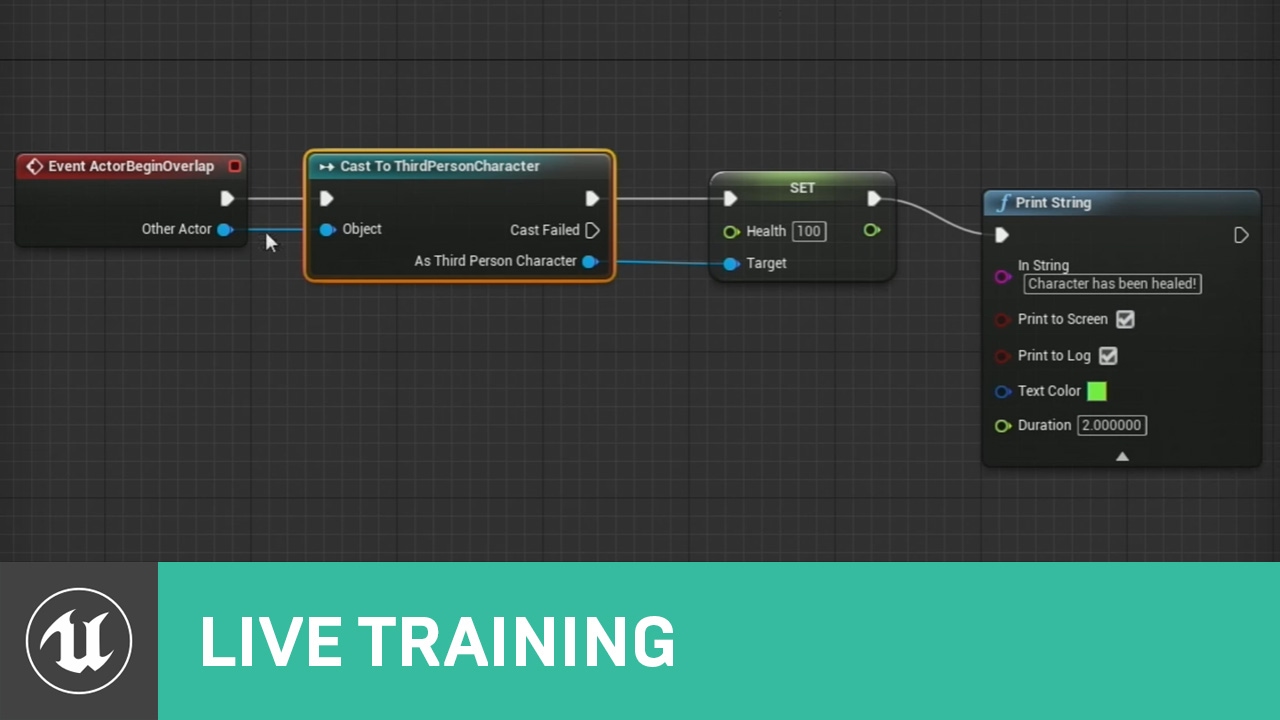
Announce Post: https://forums.unrealengine.com/showthread.php?101051
This Training Stream takes a look at Blueprint Communication. We find that Unreal Developers of all levels can sometimes struggle through the concepts behind moving data between objects. So in this video we'll take a look at the different ways to make Blueprints talk to one an...
that shows several ways to approach the problem @tranquil geode
whole nimbus
Is there no way to change camera setting sin VR? Basically all I can get to work is temperature, but any FOV or other settings seem to do nothing. Not only would I like to tweak the FOV in the headset, but also need to edit camera settings for cutscenes
honestly its just that the default camera looks like crap, why the heck can't we make any modifications to it?
rocky nexus
whole nimbus
Is there no way to change camera setting sin VR? Basically all I can get to wor...
You cant change fov in vr, most of the camera settings are post process, that doesnt work in forward renderer. VR is quite limited
whole nimbus
Hmm, im targeting pcvr and using deferred shader
Is there a way to change camera settings thru a post process volume to override the HMD?
 full spindle
Hey all!
🚀 Excited to announce the launch of Open BETA for our Existent Unreal Engine framework/Plugin : https://existent.com/** .
It allows you to:
Build physically interactive, free roam, full body VR applications in days, not months.
Simplify your development process with an end-to-end framework.
Create more robust and realistic VR experiences faster and cheaper.
Features breakdown**: https://docs.existent.com/documentation/overview/features


 dusky plover
wide tendon
i noticed you and another guy had that weird issue on your VR headset with the c...
dusky plover
wide tendon
i noticed you and another guy had that weird issue on your VR headset with the c...
I was unable to find what it was. I just returned the Quest and bought a new one lol
But I don't know, it seems common to Quests and UE5 so it probably wasn't anything wrong with that one
 charred portal
Epic Developer Community Forums
For all who applied the custom shaders.zip to your launcher install … Delete your shaders folder and verify your files to re-install the 5.4.3 hotfix (return to vanilla launcher shaders). you can use the recalculate shaders all command just to be sure and also clear your deriveddatacache in your project folder and also in AppData\Local\UnrealEn...
Just gonna drop this here.... UE5.4.3 dynamic shadows with CSM is still broken
Shader patch provided for instanced stereo with CSM for UE5.4.2 in the link above will still work if your on forward rendering or building for the quest in mobile mutli view
@hallow knoll 👆 FYI
UE5.4.3 hotfix behavior without the above shader fix
Forward Rendering - instanced stereo (shadows working normally)
Deferred Rendering (VSM) + instanced stereo (shadows working normally)
Deferred Rendering (VSM) - instanced stereo (shadows working normally)
Deferred Rendering (CSM) + instanced stereo (Shadows broken in left eye)
Deferred Rendering (CSM) - instanced stereo (Shadows working normally)```OMG thanks! i thought it was just mine that was broken
charred portal
That’s 3 for 3 unfortunately been broke 3 hotfix versions now
wide tendon
charred portal
That’s 3 for 3 unfortunately been broke 3 hotfix versions now
oh sorry no i've not known about the bug report and the subsequent hotfix until you mentioned it - i've just now updated my version of the engien and i'm yet to test it. I tend to use the forward renderer but i was going to play with the deffered one soon.
charred portal
Deferred works with VSM in the new hotfix so you should be good 👍🏼 the more performant csm (Cascade shadows) are what’s broken. They are broken in both rendering pipelines if instanced stereo is enabled. The manual shader.zip patch I've provided does appear to work in UE5.4.3 for both CSM and VSM instanced stereo.
charred portal
Here is a diff between UE5.4.3 shaders directory and the working CL 33421853 that I thought was going to make it into the hotfix as it was merged into main a while back
https://github.com/uno1982/Shaders/compare/CL-33421853-Copy?expand=1 <- UE5.4.3 vs CL 33421853
GitHub
Diff between UE5.4.3 shaders and CL 33421853. Contribute to uno1982/Shaders development by creating an account on GitHub.
rocky nexus
regressions like that are quite frustrating
charred portal
Yeah its been since preview -> UE5.4.0 for 3 hotfixes now... this thing was committed back on May 3rd. I reported it on April 23 like 30 mins after coming out of preview and I've been tracking and maintaining a forum & youtube guide on how to manually patch since May 5th. 😥 ... Meaning people have fixed it manually ... updated from launcher in hopes to see it resolved only to fix it manually 3 times now.
Epic Developer Community Forums
UE5.4.3 hotfix released and yet again broke shadow maps (CSM) when used with instanced stereo. I’ve been updating the above link with information as it is a bug report. I’ve also included a working patch for those needing dynamic shadows for forward rendering with instanced stereo or mobile multiview in forward rendering. Below is the behavior...
charred portal
rocky nexus
regressions like that are quite frustrating
The thing is that there are only like 9 files changed between this commit and UE5.4.3 ..... however if I pull UE5-main there is literally 400+ changes in Shaders alone between UE5.4.3 which tagged and released yesterday and UE5-main today.
No wonder there are so many regressions ... Main is so far ahead of release its a miracle they can even merge work into the main branch when they do find something in release and aim to fix it.

Like checkout UE5.4.3 and fix it but then what? Try to PR into main with all these conflicts?
 proper charm
Hey everyone, I'm trying to recompile a Meta plugin from version 5.3 to 5.4.1 of the Meta fork, but I'm encountering an error and can't get it to compile. I'm following the steps outlined in this video https://www.youtube.com/watch?v=sC0gnfYzFzU, but I'm running into issues at the final stage of the plugin recompilation. Any advice or solutions would be greatly appreciated!


This is a "lightning round", 1-min video run through quickly showing how to recompile a plugin (in this sample case, the UE4Duino plugin for Arduino communications: https://github.com/RVillani/UE4Duino ) for Unreal Engine to avoid "built with different engine version" errors.
A more relaxed-paced, 7-min version of this process with more detail...
charred portal
proper charm
Hey everyone, I'm trying to recompile a Meta plugin from version 5.3 to 5.4.1 of...
Meta provides an updated 5.4 version of the plugin that will compile that you can replace the old plugin with ... you can grab it off marketplace and pull from the engine/plugins/marketplace folder into your project/plugins folder
this one will compile with UE5.4 without issue

Unreal Engine
Meta Quest XR Plugin is the all-in-one plugin for development on Meta Quest and Oculus Rift headsets. This plugin is updated to include key XR features available for Unreal Engine 5 developers, including features built-in with Unreal Engine 4.
 rose spoke
proper charm
Hey everyone, I'm trying to recompile a Meta plugin from version 5.3 to 5.4.1 of...
rose spoke
proper charm
Hey everyone, I'm trying to recompile a Meta plugin from version 5.3 to 5.4.1 of...
get v67.0 direct from here
https://developer.oculus.com/downloads/package/unreal-engine-5-integration/
that is for 5.4
I did also successfully compile it for UE5.3
rose spoke
add it directly to your project and dont install to engine, you'll likely update it about once a month
v67 was released Jul 19 (today)
the marketplace version lags behind at least a few weeks
buoyant zealot
there's no changelog for 67?! yea, they added the CL
rose spoke
as it's a "today" release, I guess they still writing it?
 winter verge
Hi, is there a way to dynamically enable/disable stereo if the headset is worn?
I'm using UE5.3, with metaXR 6.5, Oculus Quest 2.
I'd like to switch the video input based on HMDWorn state (or any other headset detection method possible) in the runtime automatically. The problem is, that the "Worn state" is always "Not Worn" while stereo is off (Works the same as if HMD Disabled).
When im turning off stereo the headset is no longer running the game (only the AirLink scene), and i can only connect it back by manually turning on the stereo or HMD.
Is there any other way of turning off the stereo output, but forcing the tracking data, or the Headset connection to the app?
 sturdy coral
winter verge
Hi, is there a way to dynamically enable/disable stereo if the headset is worn?
...
sturdy coral
winter verge
Hi, is there a way to dynamically enable/disable stereo if the headset is worn?
...
does it work when stereo is on? Code looks like it is busted:
Source/OpenXRHMD/Private/OpenXRHMD.h
330:    virtual EHMDWornState::Type GetHMDWornState() override { return bIsReady ? EHMDWornState::Worn : EHMDWornState::NotWorn; }
will have to see what it should be doing with openxr and if openxr actually supports it well though, steam had a lot of problems in the past with it but valve finally got it working well w/ index. MS made wmr time out when off head close steamvr though.
well it may actually be right:
"Receiving the XR_SESSION_STATE_STOPPING state indicates that the runtime has determined that the application should halt its rendering loop. Applications should exit their rendering loop and call xrEndSession when in this state. A possible reason for this would be to minimize contention between multiple applications. If the system supports a user engagement sensor and the session is running, the runtime may transition to the XR_SESSION_STATE_STOPPING state when the user stops engaging with the device."
they call proximity sensor an "engagement sensor" if searching
"
else if (SessionState.state == XR_SESSION_STATE_STOPPING)
{
if (!GIsEditor)
{
GEngine->SetMaxFPS(OPENXR_PAUSED_IDLE_FPS);
}
FCoreDelegates::VRHeadsetRemovedFromHead.Broadcast();
bIsReady = false;
StopSession();
}
"
 radiant wind
How do I force the player camera to be in a specific location? Literally tried everything, it always offsets based on my HMD position.
west sparrow
you can set the camera's bLockToHmd=false
but i think that will make it not controllable by the HMD when you look around, it'll be locked into position like if it was non vr
 violet spear
any Idea of how not to render that extra part of laser after Halo?
both the laser and that Halo are using a translucent material!
 limpid widget
you would need a way to dynamically change the length of the laser and then if you hit a target, set the length of it to the distance
if it's a mesh, you could scale it, if it's a niagara effect, you could use change it there dynamically.
violet spear
limpid widget
you would need a way to dynamically change the length of the laser and then if y...
changing length of it based on the distance would work but I think there is other way using material graph maybe!
anyway it is mesh and I'll give it a try to find the distance and rescale it
whole nimbus
Anyone know any good tuts or marketplace assets for designing a VR quest system?
rose spoke
whole nimbus
Anyone know any good tuts or marketplace assets for designing a VR quest system?
if i would be able to go back to when I started, i would tell myself to start with UI, Widgets, and Stereo Layers
https://developer.oculus.com/documentation/unreal/unreal-overlay
Describes how to use VR compositor overlay layers in your Unreal app.
there's a few samples to look at
whole nimbus
yea i think i've got an idea im working toward
just lay the UI down on the surface of the journal
rose spoke
also there is a lot of settings and material related stuff thats rather important
here's a good video
https://www.youtube.com/watch?v=m5-xtICFOvI&ab_channel=SirFansi

How to increase performance for you Oculus Quest game in Unreal Engine.
Unreal engine VR optimization
For project files and tutorial commissions:
https://www.patreon.com/kampairaptor
Let's have a chat:
DISCORD:
https://discord.gg/jn2MsBV
Instagram:
https://www.instagram.com/sir_fansi/
--------...
whole nimbus
cool thanks
will look into them for sure
sir fansi has an old tutorial on this
but its 10m long, just a quick taste of how to do it
rose spoke
oh at the end of that he show some unlit material, 100% worth it
actually I still have the link to his github that have that material
https://github.com/Fansi129/UnrealEngine_MaterialsTech

GitHub
Using Unreal Engine Materials to create a custom lighting for low end platforms, like mobile or VR. - GitHub - Fansi129/UnrealEngine_MaterialsTech: Using Unreal Engine Materials to create a custom...
whole nimbus
haha nice
paper trout
hi all - having a bit of difficulty following Meta's Movment SDK Implementation.
i don't understand why my HMD camera is appearing in the middle of my character and not my head
rose spoke
whole nimbus
haha nice
actually here's the correct video for the material
https://www.youtube.com/watch?v=KZSJbwC9cbw&ab_channel=SirFansi

In this video I will show you workflow for creating levels for Quest 2 with Unreal Engine 4 or 5.
Subjects talked about are Material based lighting, performance for Quest 2, material collections and level design for VR games.
Repo of project featuring this system:
https://github.com/Fansi129/UnrealEngine_MaterialBasedLighting
Feel free to copy ...
rose spoke
paper trout
hi all - having a bit of difficulty following Meta's Movment SDK Implementation....
perhaps your camera should be root and the character its child?
I actually have not used that moveSDK so just taking a stab in the dark there
paper trout
rose spoke
perhaps your camera should be root and the character its child?
I thought about that but it would seem this implementation creates the camera on start? their mannequin sample doesn't have a camera in the bp
rose spoke
actually I do have that Unreal-Movement Sample project downloaded, Let me take a look at that setup
paper trout
that would be a huge help thank you!!
im specifially using the mannequin live link setup as my guide
rose spoke
I dont have anything to feed me livelink input right now, and the sample I opened looks different than what you have.
but perhaps this?
https://developer.oculus.com/documentation/unreal/unreal-movement-implementation/

Provides an overview for the Movement SDK for Unreal and guides readers to further topics.
paper trout
thanks! i do have those settings on although fidelity has to be turned on via blueprint now
the level in my video is just a new blank level i made in the sample project
whole radish
Hey every one will like to share some of the work am working on. your feed backs and suggestions will be highly appreciated. https://www.youtube.com/watch?v=ZcfBqPWEqyQ&t=29s

a quick prototype of Brick construction in Unreal Engine 5
#UnrealEngine5 #gamedevelopment #lego #Prototype #IndieDev
sullen vortex
whole radish
Hey every one will like to share some of the work am working on. your feed back...
thats cool! congrats!
whole radish
sullen vortex
thats cool! congrats!
Thnks
paper trout
does anyone have experience setting up Meta and Live Link tracking? I'm close but things like my hands legs and collar are all really messed up
at the end i use the Movement Sample Scene Handler to turn on full body tracking, causing the legs to pop up as well
 frozen hazel
Guys i'm really struggling with getting my Quest 3 to work with UE5.4, something to do with the android libraries, it has a warning on android in platforms and says something like you have 4 but expecting 3 as a warning when you try adding the SDK, what's going on and how do I fix this?
 frosty quartz
Hey everyone, I am trying to create an afterimage effect in VR and running into some difficulties. My current approach is to use a SceneCaptureComponent2D to get a texture render target and then set that same render target to the target render target of the Stereo Layer component. This works but I do not have control over the alpha of the texture. I tried to pass the texture in as a parameter to a dynamic material instance to manually set my desired alpha value and then "DrawMaterialtoRenderTarget" to get that Mat on the StereoLayer render target but that results in only displaying the clearColor on the stereo layers.
Any ideas welcome! Also, maybe there is an easier way to do this?
frozen hazel
I'd really appreciate some help as I'm tearing my hair out, I've put up questions on the developers forum and no one has evcen bothered to reply
paper trout
frozen hazel
I'd really appreciate some help as I'm tearing my hair out, I've put up question...
i assume you're following this step by step? https://dev.epicgames.com/community/learning/tutorials/y4vB/unreal-engine-5-4-2-for-meta-quest-vr
Epic Games Developer
XR Meta Quest setup guide covering everything
frozen hazel
Hi Balrog, yep to the letter, doesnt want to work, is there a way to delete everything and try again, I'm VERY SCARED of messing with any registry keys
frozen hazel
paper trout
i assume you're following this step by step? https://dev.epicgames.com/community...
I've also tried this one https://www.youtube.com/watch?v=nixc8NF_97s, I think it may be an older version of Android SDK, is there a quick/idiots guide that works and you'd recommend? I'm REALLY STRUGGLING and really would appreciate any help
Updated Discord invitation: https://discord.gg/gdxr-415153324099371008 #UnrealEngine #VR #VirtualReality
► Join the Discord: https://discord.gg/xw65fg7
► Description
In this video, I cover a lot. I leave in all the errors I experienced during my installation process and show you how to fix them. Please watch the video to the end before trying t...
paper trout
what is happening when it's not working?
are you connected to the computer with quest link?
 mental halo

Been trying to solve this for the past 2 days: switched over from Oculus VR plugin to Oculus OpenXR due to the depreciation error I screenshotted above, but the app will stall on startup (3 dots) until it crashes. Only happened after switching from target SDK 28 to 32, seems OpenXR doesn't like SDK 32 and I havent found a way around it
charred portal
Same
All docs on packaging to quest 2/3 are officially wrong as of last week
Oxr is now required as well as Android -32
Jdk 13 instead of jdk 8
UE4.27 doesn’t seem to package working oxr builds but ovr is fine when side loaded via the .bat with older 21/jdk 8 setup
wide tendon
charred portal
All docs on packaging to quest 2/3 are officially wrong as of last week

I really strugle with all the JDK rubbish - i have spent many an hour randomly following out of date tutorials that dont work - i had it working recnetly - now i'll have to go check it.
the new meta plugin was great - it automatically setup all the rubbish in the project - now we need some guru to make an application to handle all that other rubish with the andriod jazz.
oh wow - the meta plugin recommended a change to my settings based on my scene, it knew i had no stationary lights and said "hey - disable this other thingy, you dont need it and you'll get better performanc"
oh ... not lookign good:
 frozen hazel
paper trout
what is happening when it's not working?
frozen hazel
paper trout
what is happening when it's not working?
I have a warning on Platform >> Android and when I go to to install SDK I get the following error:
Warning: This version only understands SDK XML versions up to 3 but an SDK XML file of version 4 was encountered. This can happen if you use versions of Android Studio and the command-line tools that were released at different times.
wide tendon
- and upon restart:
 frozen hazel
Does anyone know what version of the Android SDK/NDK and JDK are required and which installer needs to be used as the official guidance from Epic is wrong
 frozen hazel
wide tendon
frozen hazel
wide tendon
This is way too tricky to install and should've been somerthing that comes preconfigured with the plugin
wide tendon
god yes
i'm a half-arsed software developer but that should be enough to figure it out - but its a total pain of guessing randim versions and buggy installs...
frozen hazel
I have to demo my game next week and install on three student laptops, I can't even test the thing
I feel you, I'm going mad
wide tendon
well if i can figure it out i'll post here - but dont hold you're breath - I know nothing about this stuff
i KNOW it was working like a week ago
frozen hazel
snap! makes 2 of us, hoping balrog will repost
wide tendon
yeah
i've updated my unreal engine with the hotfix to fix that shadowing issue in vr
did that bust it?
frozen hazel
really annoying thing is no one on the epic forums wants to reply, really going down hill is that forum
wide tendon
i found the menus all confusing
so i cant find shit there
i spend 10 mintues looking for goddamn release notes all the time
should be on the damn installer\
frozen hazel
no I didn't use any of the hotfixes I used the epic tutorial for 5.4 and it just wouldnt work
frozen hazel
same here
wide tendon
what ch anged?
frozen hazel
I think the issues wioth UE not the headset
wide tendon
i'll go try another one of my projects
frozen hazel
please let me know if you manage to fix it
wide tendon
oh
there4 was an update for the meta plugin like a few days ago
i think i'm on 66 but the current versio is 67 i think - not sure if that 'll help
Upgrading from UE5.4.1 to UE5.4.2 with Marketplace plugins installed already might cause an issue where you cannot create a shipping package anymore for any platforms. Instead, you might end up with a development build even if you choose a shipping package.
that issue isnt mine - i cant package with a fresh project.
nah - i thinnk i'll screw my system up if i diddle with it - i gotta wait until someone knows something - suprised there isnt more fuss about it
wide tendon
i'm busy abusing chatgpt trying to undertand what the heck sdk/ndk/jdk/apilevel bs is all about
wide tendon
frozen hazel
please let me know if you manage to fix it
i'm trippin - i deployed just fine
wide tendon
frozen hazel
please let me know if you manage to fix it
do you have specific errors? you're trying to package the project to your headset so it doesnt need to be teathered?
i couldnt remember how to deploy so i did the quicklaunch thing and then canceled it once it had finished deploying to the headset. i unplugged it, restarted my app and it was fine
i cant recall how i set all mine up but i filtered my output log by 'sdk' and pasted all the lines of code into chatgpt and asked it to pull out relevant version numbers:
Oodle Texture TFO:
Latest SDK version: 2.9.12
Turnkey SDK Detection:
Android:
MinAllowed_Sdk: r25b
MaxAllowed_Sdk: r26c
Current_Sdk: r25b
Allowed_AutoSdk: r25b
iOS:
MinAllowed_Sdk: 1100.0.0.0
MaxAllowed_Sdk: 8999.0
Current_Sdk: 1253.100.28.7
Allowed_AutoSdk: 14.1
Linux:
Allowed_Sdk: v22_clang-16.0.6-centos7
Win64:
MinAllowed_Sdk: 10.0.18362.0
MaxAllowed_Sdk: 10.9.99999.0
Current_Sdk: 10.0.22621.0
Allowed_AutoSdk: 10.0.19041.0
OpenXR SDK:
Version: 1.0.34
DotNet SDK:
Version: 6.0.302
NDK (for Android):
InstalledDir: 25.1.8937393
Java SDK:
Building Java with SDK API level: android-33
Target SDK: 32
sorry that pasted bad - i dunno how to paste propery here:
DirectX Agility SDK:
- Found but no specific version number mentioned.
Oodle Texture TFO:
- Latest SDK version: 2.9.12
Turnkey SDK Detection:
- Android:
- MinAllowed_Sdk: r25b
- MaxAllowed_Sdk: r26c
- Current_Sdk: r25b
- Allowed_AutoSdk: r25b
- iOS:
- MinAllowed_Sdk: 1100.0.0.0
- MaxAllowed_Sdk: 8999.0
- Current_Sdk: 1253.100.28.7
- Allowed_AutoSdk: 14.1
- Linux:
- Allowed_Sdk: v22_clang-16.0.6-centos7
- Win64:
- MinAllowed_Sdk: 10.0.18362.0
- MaxAllowed_Sdk: 10.9.99999.0
- Current_Sdk: 10.0.22621.0
- Allowed_AutoSdk: 10.0.19041.0
OpenXR SDK:
- Version: 1.0.34
DotNet SDK:
- Version: 6.0.302
NDK (for Android):
- InstalledDir: 25.1.8937393
Java SDK:
- Building Java with SDK API level: android-33
- Target SDK: 32
i checked my defaultengine.ini and the android stuff says:
[/Script/AndroidRuntimeSettings.AndroidRuntimeSettings]
bBuildForES31=False
ExtraApplicationSettings=<meta-data android:name="com.oculus.supportedDevices" android:value="quest|quest2|questpro|quest3" />
bPackageForMetaQuest=True
MinSDKVersion=32
TargetSDKVersion=32
i'm not far off bedtime but if you need the ini file or something i can email it through
 frozen hazel
wide tendon
i checked my defaultengine.ini and the android stuff says:
[/Script/AndroidRunt...
frozen hazel
wide tendon
i checked my defaultengine.ini and the android stuff says:
[/Script/AndroidRunt...
Cheers for this, for me it looks like theres something wrong as to which version of the SDK/NDK and JDK need to be used and where to download it from, this is annoying, I've spent mosdt of the morning downloading all the different versions and just trying to run them in the hope it can pick it up, but thats not working either
wide tendon
 wide tendon
frozen hazel
Cheers for this, for me it looks like theres something wrong as to which version...
wide tendon
frozen hazel
Cheers for this, for me it looks like theres something wrong as to which version...
yeah i tried that once and it gets convused an doesnt work
 dreamy ivy
I typically get told off for self promotion in here but I'm really hoping the mods will let it slide this time as this bug related to MetaXR hand tracking is a nightmare for quest dev's who have it and no doubt someone else has had the issue. Now you have some where to point them when asked.

#UnrealEngine #VR #VirtualReality
► Join the Discord: https://discord.gg/gdxr-415153324099371008
► Description
I finnaly fixed the hand tracking error i was having recently so thought id share the fix.
► Patreon: https://www.patreon.co...
wide tendon
dreamy ivy
I typically get told off for self promotion in here but I'm really hoping the mo...
ha! you got it working? nice.
dreamy ivy
wide tendon
ha! you got it working? nice.
yeah, it took way to much time to figure out.
frozen hazel
dreamy ivy
yeah, it took way to much time to figure out.
Jonathan can you please help me out as I'm really struggling with your tutorial with 5.4? https://www.youtube.com/watch?v=nixc8NF_97s in particular really need help with which Android SDK/NDK/JDK versions are needed and how theyre pointed to within unreal, in the version of android 4 studio mentioned in the tutorial no longer has that version of the SDK and it doesnt seem to want to work with 5.4, i can't even get my quest 3 to show in ue5 device manager, even though the oculus link thing shows its active? Its also flashing up a warning saying sdk 4 has been detected but it only works with SDK 3 as a maximum. I'd really appreciate some help.
Updated Discord invitation: https://discord.gg/gdxr-415153324099371008 #UnrealEngine #VR #VirtualReality
► Join the Discord: https://discord.gg/xw65fg7
► Description
In this video, I cover a lot. I leave in all the errors I experienced during my installation process and show you how to fix them. Please watch the video to the end before trying t...
violet spear
anyone know How can I enable and or disable hand tracking in UE 5.2.1 during runtime? is that possible at all?
I'm using meta Xr Plugin version 57
I have several levels in my project and need hand tracking in one of them only!
when I select Hand And Controllers it work but there's an issue
(in the level that I don't need hand tracking, once I put down the controllers two controllers with hand Immediately attaches to my wrist) :/
 spark bronze
A noobish question:
How do i log this ? I can't find good resource yet.
So, i know how to log, but not how to find it in my quest
dusky plover
Are we supposed to change the way we set up our pawns in VR?
Namely, should things like meshes and collision boxes be attached to the camera?
I'm trying to find a way to make the root scene node move to the camera, but that causes me to move infinitely in one direction.
sonic fjord
whole radish
Hey every one will like to share some of the work am working on. your feed back...
a few suggestions & feedback:
- instead of spawning the brick, have the user grab it from the UI, which spawns a clone that's already being grabbed. this may warrant modification/re-thinking of the UI.
- have the color selection update the UI itself.
- use a smooth transform lerp into the socket, instead of snapping, for a more polished feel.
dusky plover
dusky plover
Are we supposed to change the way we set up our pawns in VR?
Namely, should thi...
Do you guys know if this is a legit solution to this problem?

The heirarchy is Base Scene > VROrigin > Camera
So basically every XXX milliseconds, I teleport the Actor to where the camera is, then basically the camera to zero relative offset
 glad ocean
Does anyone here have experience using arbor xr? https://arborxr.com/
Looking to manage AR and VR devices, or deploy, manage, and update VR & AR apps & files remotely? Try ArborXR Home and Kiosk Mode. Click to learn more.
charred portal
https://forums.unrealengine.com/t/ue5-4-and-5-4-1-shadows-are-broken-in-vr-vr-template-default-settings/1841528/34
Just wanted to update anyone using the shader patch for instanced stereo or mobile multi view for mobile dynamic shadows that the patch has been updated to resolve an issue with the singlepasspointlight shadow projection causing the editor to crash.
Note: - Do not use if your currently using deferred rendering with VSM instead of shadow maps.
https://github.com/uno1982/Shaders/tree/5.4-Point-Light-Fix - Git repo with changes so you can easily compare to the CL copy this comes from and 5.4.3 main shaders.

Epic Developer Community Forums
Return to default Shader Instructions: For all who applied the custom shaders.zip to your launcher install and wish to return to defaults. Delete your shaders folder and verify your files to re-install the 5.4.3 hotfix shaders you can use the recalculate shaders all command just to be sure and also clear your deriveddatacache in your project ...
GitHub
Diff between UE5.4.3 shaders and CL 33421853. Contribute to uno1982/Shaders development by creating an account on GitHub.
marsh salmon
Has anyone come across interesting examples of 3D maps in VR? I'm trying to do some research for my own project and really curious about the UX for navigating/manipulating something like this.
charred portal
@marsh salmon like half life Alex loading screen?
marsh salmon
charred portal
<@!529854745356140555> like half life Alex loading screen?
Yeah, maybe similar to those. The ones in HLA weren't interactive though, right?
 marsh salmon
Skyworld had one too, since it was basically a tabletop RTS. You could rotate the table iirc but most of the interactions were limited to 'plots' on the table
limpid widget
anyone ever encounter XR_ERROR_LOCALIZED_NAME_DUPLICATED
when using UE5 vr preview with steamvr?
 sullen hull
anyone had a problem when using lumen in vr, and the shadowmap is flickering but only through one eye, the other eye the shadows are fine
fixed it
for anyone who has this problem in the future - solution: r.shadow.virtual.onepassprojection 0
proven bronze
Which nvidia drivers should I get for quest 2-3 development in ue5
Studio or game optimize?
frozen hazel
Can anyone help setting up a Quest 3 with ue5, I need thumbstick move forward/backwards and left/right to rotate character, my god is this difficult, followed about 10 tutorials and I'm getting stuck with the 2d/1d axis,can't get it to work
 olive ferry
Working on PCVR App using Hands tracking, everything works perfect in VR Preview (Grab etc....) But in a Build project, I can grab and interact everything works but my hands are invisible, did anyone got this issue ?
marsh salmon
frozen hazel
Can anyone help setting up a Quest 3 with ue5, I need thumbstick move forward/ba...
Are you running into this issue when testing in editor, or is this in the actual .apk build? I thought the generic inputs for stick movement already worked out of the box with the standard VR template.
More of a general question: I'm going to be going down the rabbit hole of figuring out how to take an Unreal project and get a basic quest build working on the headset. I've heard the Oculus documentation is a good place to start, so I'll be doing that first (https://developer.oculus.com/documentation/unreal/unreal-quick-start-guide-quest/?locale=en_US). Just curious if anyone else has experience building for Quest and knows of other accessory documentation that would be good to review or if this is already pretty comprehensive.
Provides instructions on how to create a Unreal Engine project for Meta Quest development.
paper trout
has anyone had luck getting face tracking to work with the quest pro over LiveLink?
the documentation suggests using livelink for the body, but then goes into using an incompatible component for face tracking
even weirder, the Movement Sample and Movement SDK come with a live link face retargeting blueprint, but it doesn't seem to work
whole radish
olive ferry
Working on PCVR App using Hands tracking, everything works perfect in VR Preview...
check the material you apply on it the problem might come from it.
wide tendon
proven bronze
Which nvidia drivers should I get for quest 2-3 development in ue5
Studio or gam...
i've used the gameready drivers for years - only recently discovered there wasw a 'studio' driver so i swapped over and i've had no issues - but someone in the ' lighting' channel has been having NVIDIA driver issues:
Just yesterday they managed to get NVidida to recognise his issue - but i cant recall what his acutally problem was - but might be worth asking them if they ahve an opinion.

 digital cave
frozen hazel
Can anyone help setting up a Quest 3 with ue5, I need thumbstick move forward/ba...
digital cave
frozen hazel
Can anyone help setting up a Quest 3 with ue5, I need thumbstick move forward/ba...
Checkout the vr expansion plugin example project
digital cave
Does anyone know how to tell if the user has quit the application through the system menu on quest?
spark bronze
While trying to find out how to setup my hands and use them for my own purpose i am missing a setting for my hands somehow and can't find it.
They seem to be fixed to my spawnposition and do turn around weirdly if i move away from that and turn.
i am investigating the original again and again and can't find the difference ...
spark bronze
bUseControllerRotationYaw = false;
 fresh marsh
what settings to use to see the graphics in viewport as it would be in meta quest 3
proper charm
Guys, i am using UE 5.3.2 and in the Meta XR plugin i can not set this option to "Epic Native OpenXR with Oculus Vendor Extensions", why? Someone here has the same problem?
 digital cave
fresh marsh
what settings to use to see the graphics in viewport as it would be in meta ques...
digital cave
fresh marsh
what settings to use to see the graphics in viewport as it would be in meta ques...
I have not found a good way to replicate colors. You can try using the Vulkan preview renderer
paper trout
im using Meta's LiveLink Body to control a custom avatar, but it's completely warping all of my bones. has anyone had experience with this?

 quartz bay
I'm trying to get the enhanced input to work with my oculus touch right motion controller but I don't know what I'm doing wrong. I'm using UE5.3.
When I use the VR Template, I can verify that the right motion controller trigger inputs actually trigger the correct event. When I use my own pawn and input system, I am not able to retrigger the same event with the right trigger. I can use keyboard and mouse events with no issues, so there shouldn't be a setup problem. When I use my own pawn and add the VR template input context as a listener, it works. I don't get it. What am I doing differently? What am I missing?
 lusty whale
Hi! I'm not sure about this. I have changed some settings in my project to optimize it for Virtual Reality and it seems that Atmosphere Sun Light doesn't work anymore because of these changes. Maybe you know more about how to set Atmosphere Sun Light in a VR game. Thanks.
carmine oyster
Hi
Any idea why I cant use VR Preview? And when running any packaged project, everything is idle like the headset is not connected.
I tested with a game from the oculus app and it worked fine.

 violet spear
carmine oyster
Hi
Any idea why I cant use VR Preview? And when running any packaged project, ev...
violet spear
carmine oyster
Hi
Any idea why I cant use VR Preview? And when running any packaged project, ev...
if you're using cable then you need to launch the quest link through the headset!
once it launched you have to restart the editor to enable that VR Preview greyed out.
carmine oyster
violet spear
if you're using cable then you need to launch the quest link through the headset...
I have already done that without any difference.
I used to use it without any issues, this started suddenly
violet spear
carmine oyster
I have already done that without any difference.
that kinda issue happens
restart your headset or unplug it and plug it back in
carmine oyster
violet spear
that kinda issue happens
restart your headset or unplug it and plug it back in
I have been trying for the past hour
Reset factory settings for headset
Uninstall oculus app and reinstall it
I think it happened after an update for the oculus app and the headset
violet spear
carmine oyster
Reset factory settings for headset
Uninstall oculus app and reinstall it
try using a different cable!
carmine oyster
violet spear
try using a different cable!
Still the same
violet spear
carmine oyster
I think it happened after an update for the oculus app and the headset
maybe!
cause I have new issue and not sure what it is!
sometimes static mesh controller doesn't attach to the hands when I put on the headset!
and they're in the ground
carmine oyster
violet spear
maybe!
cause I have new issue and not sure what it is!
sometimes static mesh con...
I had this problem once along time ago and it stopped occurring
Not sure what I have done
Uninstall and reinstall the engine dose not fix the problem
violet spear
carmine oyster
Uninstall and reinstall the engine dose not fix the problem
not sure, most likely no
carmine oyster
violet spear
not sure, most likely no
I was able to use VR Preview after installing the Meta XR Plugin, but the already packaged project still the same.
 sly ridge
proper charm
Guys, i am using UE 5.3.2 and in the Meta XR plugin i can not set this option to...
sly ridge
proper charm
Guys, i am using UE 5.3.2 and in the Meta XR plugin i can not set this option to...
do you have the unreal Openxr plugin enabled?
paper trout
did the quest update yesterday mess anything up for anyone else?
 lilac slate
Since this morning I suddenly get a crash on boot of the engine from the MetaXR plugin, but I am unsure if it's related to the update. I explored a lot of threads that said the headset should be plugged in but it's not fixing it for me either
rocky nexus
a classic tale, ive updated stuff! Stuff no longer Works, but why??? I did nothing!!
civic wharf
Does anyone else has a huge performance drop since 5.4? In a simple scene, I could run on 120 fps easily in 5.2. But since 5.4, while I still have 120 fps in editor and non vr playtest, as soon as I put the headset on and choose vr preview, Its all janky and stuttery, jumping between 20-30 fps...
paper trout
rocky nexus
a classic tale, ive updated stuff! Stuff no longer Works, but why??? I did nothi...
haha i didn't even want to update the dang thing! it was like "you can't use link without updating"
on another note - does anyone know how to get the controllerless hand tracking to work over live link like it does with the movement sample Aura avatar?
lilac slate
Can confirm that uninstalling the quest link app is the only way I was able to boot my project
paper trout
lilac slate
Can confirm that uninstalling the quest link app is the only way I was able to b...
thats good to know
civic wharf
Hello 🙂 I want to interpolate from the camera on my character to the camera of another actor. It works fine and as expected in non VR, but in Vr, when I interpolate to the camera of the other actor, it goes to the local 0.0.0 of that actor, instead of the camera as in non-vr...
Does someone might have an idea? 🙂
 pearl lodge
Hello all, I am currently using UE 5.3.2 to build a VR scene (using Quest Pro as PCVR) and I am having a weird crashing issue.
Starting from **last week **suddenly my project cannot open, I am not even seeing the loading screen just straight up shows the crash report windows, and the exact project was working fine a week before. The log in the crash report seems to point to openxr_loader or OVRPlugin so after deleting the plugin lines in the .uproject file (cannot open it at all so had to do it through the code) it will load fine, but in the editor if I enable them again it will crash and cannot be opened. And this happened on two different computers.
Have anyone encountered this issue? I am wondering if there is any recent change to say Meta Quest Link, Meta plugin (MetaXR), Steam, OpenXR, or even windows or graphic card drivers (nVidia) that have caused this issues as all my backup projects all suddenly start to encounter this issues.
Thanks!!
civic wharf
Hello 🙂 Im trying myself on third person VR and currently I want to move the player camera (aka the player itself basically) to another location. It works fine in non Vr preview, but in Vr preview the camera (player) just doesnt move at all. Do i need something else to move instead of the player camera?
 light comet
We also have something weird happening since a few days/weeks - the exact time is quite hard to track down:
The official VR Template without adjustments opened in UE5.3 and run with Steam and a Vive Pro and Index suddenly has very low frame times (10ms+).
Checking Unreal Insights, the culprit is the UpdateDeviceLocations function. This happens on multiple PCs and multiple Projects.
Did anyone experience the same thing? We currently suspect a SteamVR Update being the issue, but are not sure yet.
light comet
Okay a colleague of mine figured out the reason, might be interesting to everyone:
If you have the Vive OpenXR Facial Tracking Layer active in SteamVR OpenXR API Layer settings, then we get strange double-rendered stats and ~8ms overhead in UpdateDeviceLocations.

Disabling it like this restores sane performance again.
 proper charm
sly ridge
do you have the unreal Openxr plugin enabled?
proper charm
sly ridge
do you have the unreal Openxr plugin enabled?
We moved to UE 5.4.2, now all of this is working nice now, thanks for your attention!
paper trout
is there a way to make a spectator camera that uses the cine camera component rather than the scene capture?
 ashen raven
does the quest air link affect the fps because of my internet speed, and not using ethernet on my pc?
paper trout
i don't know if it would affect the "fps" but could introduce lag for sure
carmine oyster
Hi
After the last Meta Quest update I became unable to use VR Preview in the editor or running any packaged project. I have uninstalled and reinstalled the Oculus app and the Engine, and reset the headset to factory defaluts without any difference. I have installed the Meta XR Plugin, this enabled me to use the VR Preview in the editor only. The problem I'm facing now is if I lunched VR Preview before wearing the headset, the controllers does not work and the Static Mehses of the controllers are on the ground. And if I wear the headset then start VR Preview the controllers will work fine, but if I put it down, and wear it again, the controllers freezes in the last place they were in before putting down the headset. I'm using 5.1.1 and Meta XR version 54.0
wide tendon
pearl lodge
Hello all, I am currently using UE 5.3.2 to build a VR scene (using Quest Pro as...
i kept a copy of someone haviung an issue that might be related: sorry ishould mention that was recently - like yesterday
 carmine oyster
Hi
After the last Meta Quest update I became unable to use VR Preview in the edi...
carmine oyster
carmine oyster
Hi
After the last Meta Quest update I became unable to use VR Preview in the edi...
I have installed UE 5.3 and there was no problems at all.
lilac slate
We have other people on the same project who installed the update but had no problems so it's a bit tricky.
It definitely related to the link app, but it's not clear why or how
We're trying to wipe all the temp data and doing a clean install for it again to see if it solves the issue
paper trout
yeah the latest update borked a lot of things with quest link and building to oculus app
does anyone here have experience with the VR Spectator setup? I'm trying to make a spectator that has the same features as a CineCam and the ability to preview what the camera will look like in the editor. The documentation on 2D Scene Capture isn't particularly robust
paper trout
i'm really struggling to figure out how i can do stuff in VR and have someone sit at my computer and control the camera with mouse + keyboard
rocky nexus
you want to make someone puke that badly?
paper trout
no no
im trying to make like a local multiplayer thing where someone at the computer has their own camera and the person in the hmd has theirs
rocky nexus
doest the default vr template has a spectator? sounds like that, though i never used it
paper trout
yeah it does but it's hard to establish proper camera settings to get it working nicely
limpid widget
I did that before, in your controller I checked whether it is the first index, then I spawn a vr pawn, if not a non-vr pawn. The non-vr pawn then has a scene capture component that captures into a texture (I even had up to 4x players locally so I changed the texture in there to one of four).
And then in a manager I combined all those textures and rendered them together for the spectatorview.
Input is handled in the non-vr pawn as normal.
There are projects settings to forward keyboard or controller to the second player.
For my current project, I have a kind of content-creator mode for PC VR, where through input from the keyboard the camera mode can be changed or even controlled, for this I'm just using the regular pawn of the VR Player and just handle keyboard or mouse inputs, works fine.
and then change how the actor of the scene capture component behaves
 green olive
Hey folks, Im trying to get a Virtual Scouting stuff working on 5.4
I have a fun setup, Debian Linux connecting via ALVR into SteamVR from a Quest 3
I can run VR Mode, connect to it, and look around. However my controllers dont seem to be rendering as anything in the editor mode, and none of my buttons seem to do anything.
Pressing the menu button just brings up the SteamVR menu, and pressing the meta button of course pulls me all the way out to the meta menu.
Anyone know what I may have missed to cause that?
silk lodge
green olive
Hey folks, Im trying to get a Virtual Scouting stuff working on 5.4
I have a fu...
Do you get button presses in steamVR?
green olive
silk lodge
Do you get button presses in steamVR?
Yup, controllers work fully
silk lodge
were tou about to run the vr template?
green olive
I can try running the vr template itself and confirm if it works as a game
that might be a good test to try and eliminate variables
Im gonna go ahead and guess its literally some package or something I need to install to literally add the assets and logic for the controllers
I added OpenXRHandTracking and OpenXR I believe were the two
silk lodge
you used to have to setup enhanced input
I can send you a zip that I have working of a project in openXR
green olive
To be clear, my issue is with Scouting Mode
 bold falcon
I borrowed a meta quest 3 with controllers from uni during summer for a project and I have 2 questions.
- Only my right controller is being connected, the left one isn't. And I can't use the phone app as there's another account (uni) connected to the quest 3. Is there any other way of pairing it?
- Preferably I'd like to use my hands only without controllers in UE VR, but I can't seem to get that to work. I'm currently running 5.4.3 and have manually downloaded V67 plugin and the Meta XR plugin from marketplace but the MetaXR plugin won't pop up. What am I doing wrong? Could it be that there isn't any support for 5.4.3?
When playing the VR template in preview mode, I can look around and see my right controller, but not my hands and obv not my left controller as it wont pair
green olive
You'll have to talk to the uni tech folks for account related stuff like pairing
 tacit cedar
Hi Folks - I have questions about building for VisionOS, is this the right channel or is there one specific to Vision Pro?
Feel free to redirect me but....
- Is VisionOS supported in the latest UE5 distributed version or do I still need to go through github and rebuild the project?
- When I try to package my project, I get "The SDK for VisionOS is not installed properly..." Might be related to above, if not - ideas on how to resolve this?
 sterile sandal
Hello,
Is it possible to test the VR template inside the editor?
Without headset. Like a fps game
sterile sandal
tacit cedar
Feel free to redirect me but....
- Is VisionOS supported in the latest UE5 dist...
I tested using 5.4 with source
https://youtu.be/y-_xKs1F3Jo?si=zfKXV6frdgd9xT4m
Are you using following tutorial:
https://medium.com/@SpatialBiggs/unreal-engine-5-4-visionos-build-on-apple-vision-pro-9f256eadc651

Hey Everyone Unreal Engine 5 and Apple Vision.
In this video, we are running a stunning graphics Unreal Engine 5 environment on Apple vision pro
We used Xcode 15.4 and Unreal Engine 5.4 build from source.
@Apple @AppleIndia
Video Editor @imaginarydodo
My Social Media Contact Details 👇
Instagram Account
Please follow us 👇
https://in...

 brittle dock
The new Oculus Quest Link update from Today seems to have FIXED the issue from last week where some people couldn't open their project anymore!
rocky nexus
tried vrpreview today, was unhappy. kinda annoying how it seems to break every other week :/

 zealous pelican
Hello everyone, I am currently trying to develop a PCVR application in Unreal 5.3.2 but have run into some issues. It seems the best way to create a pcvr app is to build the project for windows but have the player character be an actor with VR controls. I am trying to do this by starting with a first person template and adding the VRPawn actor from the VR template. Before adding the VRPawn the build works fine. After adding it, the build fails with UnrealBuildTool exitcode 6. If anyone has some tips for how I can resolve this issue, please let me know. Thanks!
 cyan herald
I have the same issue. Haven't found a fix yet. Have you?
digital cave
cyan herald
I have the same issue. Haven't found a fix yet. Have you?
I have not. I asked on the oculus GitHub issues page and got no response there either
cyan herald
digital cave
I have not. I asked on the oculus GitHub issues page and got no response there e...
OK. What UE version are you on? And are you using the Meta fork or vanilla UE? I have the issue on vanilla UE 5.2 and beyond. I know it worked in 4.27.
digital cave
cyan herald
OK. What UE version are you on? And are you using the Meta fork or vanilla UE? I...
I’m using 5.3.2 meta fork and it’s broken. I just checked the GitHub and 2 possible solutions. I willl copy them out of GitHub in a sec https://github.com/Oculus-VR/UnrealEngine/issues/467
“I use height fog into 5.4 and 5.3, only time it breaks for me is if I have distance fields enabled in datadrivenplatform.ini”
“Add codes related to Multiview to MobileFog.usf
Such as:
void MobileFogVS(
in float2 InPosition : ATTRIBUTE0
#if USE_MULTI_VIEW_ID_SV
, in uint ViewId : SV_ViewID
#endif
,out float2 OutTexCoord : TEXCOORD0
,out float3 OutScreenVector : TEXCOORD1
,out float4 OutPosition : SV_POSITION
)
{
#if USE_MULTI_VIEW_ID_SV
ResolvedView = ResolveView(ViewId);
#else
ResolvedView = ResolveView();
#endif
// screenspace position from vb
OutPosition = float4(InPosition,StartDepthZ,1);
// texture coord from vb
OutTexCoord = InPosition * ResolvedView.ScreenPositionScaleBias.xy + ResolvedView.ScreenPositionScaleBias.wz;
// deproject to world space
OutScreenVector = mul(float4(InPosition,1,0), ResolvedView.ScreenToTranslatedWorld).xyz;
}
void MobileFogPS(
float2 TexCoord : TEXCOORD0,
float3 ScreenVector : TEXCOORD1,
float4 SVPos : SV_POSITION
#if USE_MULTI_VIEW_ID_SV
, in uint ViewId : SV_ViewID
#endif
, out float4 OutColor : SV_Target0
)
{
#if USE_MULTI_VIEW_ID_SV
ResolvedView = ResolveView(ViewId);
#else
ResolvedView = ResolveView();
#endif”
digital cave
cyan herald
OK. What UE version are you on? And are you using the Meta fork or vanilla UE? I...
If either of the above solutions work, can you post an update here?
cyan herald
digital cave
If either of the above solutions work, can you post an update here?
USE_MULTI_VIEW_ID_SV is only defined in the Meta fork so I'm not sure it will work but I'll give it a go.
zealous pelican
zealous pelican
Hello everyone, I am currently trying to develop a PCVR application in Unreal 5....
Some updates on this issue, seems like the build error is actually occuring when I install the OpenXR plugin. I believe the error is occurring here:
C:\Epic Games\UE_5.3\Engine\Source\Runtime\Core\Public\Traits\IsContiguousContainer.h(6): fatal error C1083: Cannot open include file: 'initializer_list': No such file or directory
Does anyone have any experience with handling this error? Or alternatively, does anyone have any tips for packaging a project for PCVR? Maybe I'm just going about it wrong.
 verbal geyser
If its c++ related then maybe also ask in #cpp, their channel is usually a bit more active
zealous pelican
I suppose it could be a c++ issue, but I've added no additional classes besides what is added in the first-person template (started with Blueprints). I'm wondering if maybe there is a better way to create a PCVR application than my current approach 🤔
verbal geyser
may i ask why you used the first person template and not the vr template directly?
 hallow knoll
zealous pelican
Some updates on this issue, seems like the build error is actually occuring when...
hallow knoll
zealous pelican
Some updates on this issue, seems like the build error is actually occuring when...
You need to have Visual Studio installed to package the OpenXR plugin. We don't ship the binaries by default as the plugin is not enabled by default. Set up your dev environment for working with a source build of Unreal Engine and you'll be able to package it.
zealous pelican
verbal geyser
may i ask why you used the first person template and not the vr template directl...
I wanted my project to be configured with settings suitable to PCVR, so I chose the first person template assuming it would be closer to what I needed
zealous pelican
hallow knoll
You need to have Visual Studio installed to package the OpenXR plugin. We don't ...
This was exactly what I needed, thank you very much!
 oak cairn
Could anyone point me to where I can script or blueprint settings for VRPC vs VR Standalone settings? I want to keep the project high quality for PC but be able to ship standalone with settings like Lumen/Nanite/Forward Rendering options toggled.
limpid widget
cyan herald
OK. What UE version are you on? And are you using the Meta fork or vanilla UE? I...
I just checked my game I shipped with vanilla UE 5.2, and it has exponential height fog working.
Can't check the project settings right now, but looking at the video I recorded on 5.2 for the trailer, the height fog is there
 west sparrow
i fixed that by not using expo height fog and using /Engine/Materials/FogVolumeMaterial
...not a great fix if you need the exponentialheight fog component though
cyan herald
digital cave
If either of the above solutions work, can you post an update here?
I've only tested patching the fog shader but that seems to have worked for me 👍
paper trout
hi all - i'm having some weird issues with the VR Spectator - when i have it active in my project, it seems to cause some pretty major stuttering
paper trout
ah i see - it's because i'm trying to attach a cinecamera to the VR Spectator and trying to copy the camera settings to the scene capture, but because any camera in the scene would get locked to hmd, the constant switching causes jitters
with that in mind - is it possible to give a scene capture component the same filmback features as a cinecamera component?
paper trout
or is it possible to have a camera in a level that has absolutely no connection to the headset
silk lodge
@paper trout rendering an additional camera may be more than your graphics card can handle, especially a cine camera
paper trout
silk lodge
<@340320887326638080> rendering an additional camera may be more than your graph...
probably not indeed
silk lodge
you should try the gpu debug
paper trout
silk lodge
you should try the gpu debug
how do i do that?
whole radish
hey guys the Oculus left-hand system gesture will trigger even if you begin a pinch, instead of waiting to confirm the pinch has been in the same state for a period of time. any idea on how i could fix this ? please
rocky nexus
oh ive had same issue, investigated the plugin code, afaik i used different input binding. dont recall exactly and have no access to the project here
whole radish
rocky nexus
oh ive had same issue, investigated the plugin code, afaik i used different inpu...
like which class should i explore ?
rocky nexus
whole radish
like which class should i explore ?
OculusXRInput maybe, or something around there
whole radish
rocky nexus
`OculusXRInput` maybe, or something around there
have check and have not seen any system gesture event
 woeful kindle
So am trying to achieve where if the player puts there against a wall the headset/player gets push away also want my vr hands to be able to go through everything unless the player had a object in their hand their for the object can't go through. The video is a example from another vr game on what I want to achieve any help would be great.
whole nimbus
Anyone know how can I figure out conclusively which direction the headset will be facing when it spawns in? How or if can I control that? Seems like if I rotate the character bp or player start or rotate the camera within the blueprint, it doesn't change the starting rotation of the HMD when it spawns in. It's like my room scale is backwards, even when I rotate any of the associated objects
whole nimbus
it still always spawns with the HMD facing the same direction (not the direction of the camera rotation or player start rotation or anything I try to set it to)
violet spear
whole nimbus
Anyone know how can I figure out conclusively which direction the headset will b...
Have you tried reset orientation pawn node in begin play?
whole nimbus
No ill give it a shot
violet spear
whole nimbus
No ill give it a shot
Ok, remember that there's a component (VR notification) which you can add to your pawn class and it gives you some events
Like, on VR put on and etc.
Then you can control your camera orientation based on those specific events
violet spear
whole nimbus
Called vr notification component?
Yes, it's something useful
whole nimbus
Wow ty
 bold phoenix
hi! I'm developing on a Quest 3 and having trouble understanding how the hand motion controller positions work
for example, if I attach a sphere to the hand motion controllers to visualize them, when I move my head up and down it seems like the hands move too
are they positioned relative to the head or something?
buoyant zealot
did you attach them to the HMD? (which could cause this i guess)
bold phoenix
buoyant zealot
did you attach them to the HMD? (which could cause this i guess)
nope totally flat hierarchy 😦
 bold phoenix
ooof bug in my calibration code. all good!
spark bronze
I am trying to reverse engineer the Meta XR Pose Strings onto the Oculus Hand via AnimInstance, so that i can give it a known Pose like
LT0-43-27+62T1-11-22+32T2+1-39-10T3-5-11+10I1-1-50+8I2-2-64-2I3+2-19-2M1+5-18-2M2+1-11-1M3+1+10-4R1+10+2-5R2+1-7-4R3-3-1-1P0+15-6-25P1-2+23+12P2+3-19-7P3-6+1+1W-15+0-97```
and show me how this shall look.
I was able to follow its meaning from the documentation and was able to get out the rotators of all the bones, that are given in there.
Now i would want to apply that rotations to my hands animation blueprint to act like this pose, but ... i don't get it set up correctly ...
I don't know what to choose from the rotations section of the transform bone, nor do i achieve to get something just by puzzling around.
I am sure, i should be able to use that string as it is used by the Meta XR library, too, but i don't know where i could find my missing link...
Any ideas on this that could help me ?Hey so, I can succesfully run the VR Template project and interact with it in VR. the "hands" show up, I can move around, pick up objects, yadda yadda with my setup.
However in that same project if I enter Scouting Mode, I still have the same issue.
I can even see the VR Spectator widget floating in space in its spot it starts in inside scouting mode so Im guessing for some reason Im not binding to one/it
This is the guide I followed to get as far as I have
https://dev.epicgames.com/community/learning/tutorials/eaGq/unreal-engine-enabling-vr-editor-mode-in-5-3-in-any-project

Epic Games Developer
After discovering and getting really excited about the VR Editor mode, I was disappointed to find that it disappeared somewhere on the way to 5.3 (outsi...
I feel like its likely just 1 small thing Im missing to make the hand tracking actually work
I have:
- Installed the following plugins:
- OpenXR (pre-installed)
- OpenXREyeTracker (pre-installed)
- OpenXRHandTracking (pre-installed)
- VirtualScouting
- Virtual Production Utilities
- Set
Project Settings > Plugins > Virtual Production Editor > Virtual Scouting User Interfaceto beVirtualScoutingWidget
These settings/steps straight up dont even seem to exist anymore though:
Editor Preferences > General > VR Mode > Motion Controls > Interactor ClassEditor Preferences > General > VR Mode > Motion Controls > Teleporter ClassProject Settings > Plugins > OpenXR Input > Mappable Input Config for XR(in fact the entirety ofProject Settings > Plugins > OpenXR Inputdoesnt exist at all)
So both guides seem to be very outdated? Or Im missing something important
spark bronze
Here's a little bit about what i am doing. Someone can see the Input Pose String in the first picture being translated to rotators quite fine, but i am not able to solve the quest on doing the anim graph part. What am i missing, or what should i set my values at ?


Oh. It's wrong, i see now ...
spark bronze
Now values are good.
 silk lodge
green olive
Hey so, I can succesfully run the VR Template project and interact with it in VR...
silk lodge
green olive
Hey so, I can succesfully run the VR Template project and interact with it in VR...
have you applied input mappings to the pawn?
spark bronze
This is not a thumb up pose ^^
 tranquil geode
im trying to learn how to make firearms for vr. does anyone have some good resources to help me?
green olive
silk lodge
have you applied input mappings to the pawn?
None of this was covered in the guide, no idea what that means
silk lodge
I am not very well versed in the setup, but I do want to get back to editing in VR, since it's by far the best way to edit vr content
@green olive Perhaps I livestream doing the setup with unreal engine 5.4.3 and see how far I get?
green olive
I'm likely gonna move on to trying out blender as an option instead, it has vr editting options and can export gltf scene files
silk lodge
I haven't tried it in a while, but I don't recall there being ways to edit in VR.
I made a plugin for the razer hydra in blender a while back so you could use motion controls to play around in it, and it was lots of fun
green olive
silk lodge
I haven't tried it in a while, but I don't recall there being ways to edit in VR...
Gotta do it via plugins but there's a couple options
silk lodge
nice!
green olive
If gltf works fine I'll prolly roll with raylib instead for my game framework, it has a C# wrapper and I much prefer c# over c++
silk lodge
is unreal c++ really that bad though? *I only do blueprints
whole nimbus
my god I've lost 200 hours on this over the last year - solved. Issue comes from seated vs standing in steam vr.
can someone with an index have a quick look at this please?
Starting a new blank third person template, I add open XR and hit run
my camera is facing away from the character, in the opposite direction
I had a buddy do this using a quest, and he says that his camera is correctly facing the character from behind here
Because I'm unable to turn the camera 180 degrees because of the HMD override, the only way I can get the character in the frame is to set the camera boom to negative, which brings the camera in front of the character, but since the camera is effed up and looking in reverse, its now looking right at the character from the front with a negative boom arm.
thats the last 20s of the video
I swear to god if this is some inherant problem, this has caused me so much grief and insult over the last 16 months
I usually bury the problem and lock the HMD movements to @vocal musk 's FBIK rig (Mimic Pro on asset store) and continue with development, but I definitely lose about 20 hours a month trying to figure out why I cant create my own custom pawn or character and it always ends with a dead end and reversion back to Jakes FBIK rig.
so this has been conflating my cpp and bp learning for over a year.
whole nimbus
I gave away my quest 3 to one of my employees a few months ago. Going to pull out my quest 2 and see if the camera is facing the character correctly myself. Ill report back
whole nimbus
well the quest behaves weird too
the first run was 90 degrees off but at the correct ground level
the recorded run was way up in the air
how the heck do cameras work with these headsets?
that aren't first person anyway
first person HMD works fine
whole nimbus
so the quest 2 now seems to work correctly after a few runs and resets
I reset the guardian on this last run. It's gotta be a playspace issue.
seated mode in steam vr fixes it
somebody hang me
spark bronze
Anybody a good idea, what i am missing in my trial of showing a pose ?
rocky nexus
whole radish
have check and have not seen any system gesture event
aka gamepad special left/right for menu with hand tracking
whole radish
rocky nexus
i think it was this https://github.com/Oculus-VR/UnrealEngine/blob/97787071e2d4c...
please which version of unreal is this ?
rocky nexus
whole radish
please which version of unreal is this ?
5.1 and up from what i can see
whole radish
the link does not open but believe is the path
whole radish
rocky nexus
5.1 and up from what i can see
I don't know if am the one, but I cannot see OculusXR folder in Plugins. the is MetaXR/OculusXRInput/Public/OculusXRInputLibrary though can't find the source code line for system hand gesture.
rocky nexus
whole radish
the link does not open but believe is the path
it does not open cus you need to have unreal source access on github
try what i wrote gamepad special left/right for menu with hand tracking
paper trout
hi all - having a bit of difficulty getting my Motion Tracker (Cube) to line up with the palm of my hand - does anyone have advice for solving this?
 icy socket
I am trying to build the vr sample project with on android platform in 5.4.3
but it throw error about it can not find the manifest.xml
sdk, jdk, ndk, are installed with latest version, has anyone face the same issue?
violet spear
icy socket
I am trying to build the vr sample project with on android platform in 5.4.3
but...
I haven't tried with 5.4 yet but based on the log you provided, it looks something's wrong with your SDKs!
violet spear
https://dev.epicgames.com/documentation/en-us/unreal-engine/android-development-requirements-for-unreal-engine
if you're not using NDK r25b, then try it.
Epic Games Developer
Android development requirements including compatible hardware, software, and SDK information in Unreal Engine.
 eager pine
Does anyone know why trackers doesnt show in livelink after 5.0.3?
 gleaming agate
Anyway to get VR Preview to be selectable without a VR headset? can I modify the VRPawn in any way that might allow this?
 ashen thunder
Hello everyone, is nanite and lumen VR ready yet?
limpid widget
gleaming agate
Anyway to get VR Preview to be selectable without a VR headset? can I modify the...
it's unrelated to your VR Pawn.
Your Systems needs to have an active OpenXR Runtime that detects a headset.
It could work with the Meta XR Simulator.
This is the Getting Started guide for using the Meta XR Simulator with Unreal
In fact it should work like that
rocky nexus
anyone tried to run with psvr2 adapter yet? cant start editor with it on, crashes with openvr error 😄
rocky nexus
ok, disabled oculusxr plugin in editor and it starts, though both game and editor in vr fails with RenderGraphValidation#780 ensure 😦
paper trout
kind of an odd question - im trying to use the grab component but it seems to be making my objects disappear
ive tried using a print string to see if the objects i was grabbing might be teleporting, and their locations seem to be moving appropriately but they go invisible
has anyone experienced this?
silk lodge
@paper trout are they getting scaled down?
paper trout
silk lodge
<@340320887326638080> are they getting scaled down?
i don’t think so i think they were just going invisible- i ended up getting it working!
silk lodge
what was it?
 cerulean arch
I was following this video to use with the vr hands and it kind of works, but the ragdoll doesn't follow the hands very closely and I'm not sure why: https://www.youtube.com/watch?v=hKG4_ptempA


Hey guys, in today's video, I'm going to be showing you how to drag ragdoll bodies in Unreal Engine. This works for any physics body and object you want too, not just bodies.
#Ue4 #UnrealEngine4 #Ue4Tutorial
00:00 - Intro
00:12 - Overview
01:12 - Setting Up Physics/Ragd...
I'm pretty sure the only thing not shown in the screenshot is the UpdateRagdollLoc event call which is just at the end of the get grab component function, and the code for making the model ragdoll, which is identical to how it's shown in the video. But let me know if you need more context to understand!
 sonic lake
cerulean arch
I was following this video to use with the vr hands and it kind of works, but th...
sonic lake
cerulean arch
I was following this video to use with the vr hands and it kind of works, but th...
You may need to increase stiffness and damping to the physics handle
Also when you grab with a physics handle and set the grab location, that's where the grabbed object will stay. If you want to get it closer to the hand, you need to update the grab location to take it closer.
If you are able to share a short video of what is happening it may be easier to help you out
cerulean arch
I just tried adjusting those values and it didn't seem to make much of an impact
I'll try to get a video rn, but tbh I wasn't expecting someone to get back to me right away so I'm not sure if I'll have a ton of time rn to get to the bottom of it
thanks for the quick reply tho!
hopefully that shows the issue, basically I wanted the nearest bone to pretty much snap to the players hand, but here it's kinda just slowly interpolating to it.
 olive junco
Hello, I've been trying for quite some time already to get some haptic feedback for a vr controller with UE5.0 using the Oculus Quest 1 and so far no success. All the setup seems to be working properly but there's just no vibration no matter what. If anyone knows why, that would be very helpful. So far no chance on any forum I've looked into, no response from UE or Meta forums...
It looks like this so far :
 buoyant zealot
did you try without the branch in the overlap event?
olive junco
I could, but then where do I connect the return value ?
olive junco
Doesn't change a thing.
Just to be sure : is there something to do that is not related to the BPs to make the controllers vibrate to begin with ?
buoyant zealot
may depend on what plugin you use, MetaXR or OpenXR? (i probably can't provide any further help, but guess that may still be relevant for others to answer your question 🤔 )
olive junco
OpenXR, since MetaXR apparently doesn't work on 5.0.
tranquil geode
I have spent so much time trying to figure out a good way to implement recoil on my guns. Can someone please give me some advice on a good way to do it? I’m working in the UE expansion plug in
olive junco
WELL I GOT MY ANSWER
TURNS OUT OCULUS QUEST 1 IS APPARENTLY NOT SUPPORTED ANYMORE BY 5.0 OPENXR, SINCE IT WORKS WELL WITH A QUEST 3
 dry coral
Got a little issue I am hoping someone could help me with 🙏
When setting up a BP with a grab component and a static mesh, when it's spawned into the world by a spawner BP the grab component doesn't work, but it its placed in the world it works. Any I might be missing?
rocky nexus
Q1 was EoL quite a while ago, sad but true
olive junco
Wish I found out about it sooner.
carmine oyster
Hi
I’m using the engine with Quest 3 for Arch Viz. The problem I’m facing is that the scale of the designs doesn’t look right. It looks like everything is zoomed in and the scale looks smaller compared to reality. I’m exporting from 3ds max and I’m 100% sure about the scale and dimensions of the exported meshes. It’s as if you have increased the Focal Length of a Cine Camera Actor. Does anyone noticed that? Any idea about how to make it looks like real life as much as possible?

 idle osprey
Is there a known problem with the rotation of the controllers in OpenXR vs MetaXR? I'm running in to a problem with a plugin that was tested with the HTC Vive and knuckle controllers. From looking at the developer's video, his rotations are fine, but the wrists are painfully rotated with the Quest using OpenXR.
I added some arrows to the controllers, showing the forward and right vectors. And then I added some additional arrows to indicate how I'm calculating the forward vector for smooth locomotion.
I am stumped. I cannot figure out how to adjust the rotations correctly for OpenXR. I've been poking with this off and on for a year and I just can't solve it.
https://cdn.discordapp.com/attachments/728623193233031200/1171861889077223424/image.png?ex=66be38ee&is=66bce76e&hm=b41e793e75b88ee5ea82b4520c9f0976ad81f26041c2990f448a8ffbc34a4139&
https://cdn.discordapp.com/attachments/728623193233031200/1171862804232409179/image.png?ex=66be39c8&is=66bce848&hm=50ae1bc4aca0157264b59966d302aacdc81cd9374ec1a7dea68d5df1899038c5&
https://cdn.discordapp.com/attachments/728623193233031200/1171862804811231303/image.png?ex=66be39c8&is=66bce848&hm=219f7d86e2c5be243150ae5995e431f8478f112bc24b076e314a579d5bd7ba80&
This is the UBIK Solver Plugin from https://github.com/JonasMolgaard/UBIKSolver


 pine geyser
Anyone have a good ideas to record in VR (PC, 5.4, Quest 3 with link cable)? I'm using OBS and everything is just jittery and off-centered
 keen current

Kailash Temple: A Monumental Achievement (Both architecturally and technologically)
With the groundbreaking collaboration of Pod 8 Studios and Amaze Studios…
 forest ginkgo
Hello, how could i fix the problem of rotations interfeering with each other, i want to rotate with just around axis ignoring the pitch. Thanks ! I am noobie and would appreciate some help.
 idle osprey
pine geyser
Anyone have a good ideas to record in VR (PC, 5.4, Quest 3 with link cable)? I...
idle osprey
pine geyser
Anyone have a good ideas to record in VR (PC, 5.4, Quest 3 with link cable)? I...
That setup is typically recording the left eye. Depending on the app, you may be able to choose the Right. But you can only record one eye. LIV Stablizer can help with stabilization. There's a good youtube video on it. "Extensive Guide to LIV's First Person Stabilizer"
pine geyser
idle osprey
That setup is typically recording the left eye. Depending on the app, you may b...
Thank you, I'll give it a shot... all this video I have is unusable
 hybrid rapids
Hey guys, Have anyone every seen a cell/toon shader without post processign or forward rendering work? I've been digging into this topic a lot lately and every implementation I've seen is either really old or not available. Also every Youtube video uses post processign and I've been trying to figure out something that works in standalone VR. Any tipps tricks? thanks very much
digital cave
hybrid rapids
Hey guys, Have anyone every seen a cell/toon shader without post processign or f...
In this shader tutorial, we take a look at several methods for creating the appearance of the paint of a toon or cel shader. In the coming weeks we'll also cover creating the specular highlights and dark ink outlines.
Here's last week's video on object space interior mapping:
https://youtu.be/-zlkF_8jrSc
Here's the playlist for the whole serie...
hybrid rapids
digital cave
https://youtu.be/SOYNf4sYNzY?si=3XsIRywDwjbz2BPs
Thanks!
paper trout
hi all - does anyone have some ideas how i might display twitch chat while in VR? i know OVRTools has something that allows you to view a monitor in app - but because of the complexities of quest pro face tracking, I can't actually have steam VR active - it's wacky, i know
ashen raven
Its normal having this frame rate in the vr template? i have a 4070

 polar crest
welp kinda old message but...
Any idea why it only works on my editor on VR Preview with Play as Client net mode if I put 2 clients? Otherwise it will just be a white screen until it eventually closes.
Even so, when I play with 2 clients, every second time I press play it crashes the engine.
Same happens on the vr template and the game works well on both Standalone and Listen Server
Using Oculus branch 5.3.2, meta quest 2
Edit: somehow it also works if I turn off meta quest 2 display before pressing play VR Preview and after it starts the game I turn it on again
 cerulean arch
I'm having an issue right now where the radius my grab component effects is way bigger than the object I've attached it too
Does anyone know what I should look for to solve this? I've checked the colliders of the meshes in this blueprint, but everything seems normal to me
carmine oyster
ashen raven
Its normal having this frame rate in the vr template? i have a 4070
Maybe the maximum frame rate is locked. Use console command “t.MaxFPS 999”
hybrid rapids
hey guys im trying to package with ue5.4 for quest 3.
I downloaded and updated every sdk,ndk,jdk which epic recommends, so i set min max sdk version to 33 everywhere where its possible or need to setup.
Every time a iwant to sideload the .apk to the quest (i've tried sidequest and meta dev hub) I get an error saying that the minimum requirement is version 33 and I've only got version 32.
Thats not possible since i hvaent installed it once.
I uninstalled android sutiod and the jdks and re did the whole thing.
Still getting the same error.
Anyone knows what did I miss? I've been at it for 4 hours now.
Also i'm not a complete newby I developed and sideloaded a lot of aps for my quest 2.
buoyant zealot
why do you sideload instead of deploying with unreal?
rocky nexus
why would you deploy with unreal, that never works
there is info in logs which version was used
hybrid rapids
rocky nexus
why would you deploy with unreal, that never works
well it said it worked but nothing happend after that
i downgraded everything to first version 30 then 29 (i got 29 working with my quest two on 5.1&2 a year ago) but still nothing, getting the same error
okay for some reason now it worked
but only one eye works😂
i got it running with this setup
 cerulean arch
anyone know a simple way to make objects using the grab component toggle on/off rather than only grab while the trigger is pressed?
buoyant zealot
rocky nexus
why would you deploy with unreal, that never works
??? it works fine here
or does Skulo's issue only happen with the packaged APK, and not when running from UE?
hybrid rapids
Yep, my problem is with the packed apk
I can package it fine, but both side loaders throw the same error saying i have version 32 and i need sdk version 33
But the thing is i only have the 33five version and the recommended settings from epic so
Dunno
I got it half working with version 29 and ‘matchndk’ setting
 eternal mulch
Where is set VR interpupilary distance (IPD)? the scale seems off when I try VR template, but I can't find any place where it is set
I just need to force it to specific value for testing, it doesn't even have to be a clean solution
using UE5.4.3 and Oculus Rift S
I got a more naturally feeling result by overriding world scale in SteamVR settings to 110%, but then I get issues with distance between eyes and floor - same issue as when changing World to Meters variable in World Settings
sturdy coral
eternal mulch
Where is set VR interpupilary distance (IPD)? the scale seems off when I try VR ...
should be automatic, you can adjust it with worldtometers though, but that adjusts everything along with it (hand distance, height, etc., like shrinking your character, probably same as with steam).
what headset are you using?
sturdy coral
rift s has a low ipd adjustment range, that might be the problem
eternal mulch
I can say that the automatic value is almost certainly wrong - maybe something is not getting passed along correctly
sturdy coral
or rather no ipd adjustment range
eternal mulch
I should be near the optimal IPD for Rift S (around 64mm), so that in theory should not be an issue
as I said, I just want to try forcing the value to see if I see an improvement
sturdy coral
I think there's not much you can do, the IPD settings in the runtime are ignored, the only real way to fix it is to manually adjust the projection matrices it gives
there might be some oculus tool for it for the rift s, there was for other fixed IPD headsets
eternal mulch
the software-based IPD adjustment in Rift S configuration goes only from like 60-66 and I did not observe any change when adjusting it
sturdy coral
if you are basedlined at 64 then 66 is only 3% change
vs the 10% you liked from steamvr
are you seated when playing but standing in game? that kind of weirdly causes an optical illusion that affects world scale from your proprioception of your feet on the floor
eternal mulch
no, I am playing VR standing
I don't know if 10% is optimal, after that the POV and hand size shifted too much to really tell
sturdy coral
you can also try thinner foam, you might be getting extra distortion if your eyes are far back in the eye box, rift S I think still had some pupil swim in the optics compared with quest 2 and especially pro/quest 3
eternal mulch
I doubt that is the case - and I am looking for a way how to experiment with rendered IPD distance regardless
sturdy coral
ah ok, you'll either need to find a tool like ovr advanced settings or something that does it (I don't think that one does), or modify the projection matrices from the runtime in the plugin
if you scale IPD separately from tracking scale in something you are shipping you will cause sickness in lots of people (cut IPD in half and moving head 5 cm feels like moving it 10cm, etc.)
eternal mulch
can you elaborate about projection matrices? as far as I can tell, I can't expose the transforms of the individual eyes
as I said, this is only for my testing at the moment
sturdy coral
eternal mulch
can you elaborate about projection matrices? as far as I can tell, I can't expos...
probably in this part of the code
UnrealEngine/Engine/Plugins/Runtime/OpenXR$ ackpp -i ProjectionM
Source/OpenXRHMD/Private/OpenXRHMD.cpp
1178:FMatrix FOpenXRHMD::GetStereoProjectionMatrix(const int32 ViewIndex) const
1773:   FMatrix Projection = GetStereoProjectionMatrix(View);
2898:   const FMatrix& ProjectionMatrix = ModifiedViewMatrices.GetProjectionMatrix();
2899:   const FMatrix& ViewProjectionMatrix = ModifiedViewMatrices.GetViewProjectionMatrix();
2921:                   ViewProjectionMatrix,                           // WorldLocked,
2922:                   TrackerMatrix * ProjectionMatrix,       // TrackerLocked,
2923:                   EyeMatrix * ProjectionMatrix            // FaceLocked

Source/OpenXRHMD/Private/OpenXRHMD.h
343:    virtual FMatrix GetStereoProjectionMatrix(const int32 StereoViewIndex) const override;
could I adjust World to Meters and then instead rescale the transforms applied to the camera and virtual hands?
eternal mulch
well, I made a sort of ironsights object with which I can see how far are the virtual eyes from each other and they are 65mm apart... so not sure what is the culprit behind the odd feeling
the IPD value set in Oculus settings does get passed to UE5
I am not the first person to comment that stuff in VR appears too small compared to what would feel natural - it is actually a semi-common complaint... as someone who is interested in VR, I wanted to see if I could figure out what is the causal factor
for example
https://forums.flightsimulator.com/t/finally-we-have-a-vr-world-scaling-tool-openxr-toolbox/495114/5

Microsoft Flight Simulator Forums
See this thread for voting on World Scale bug.
 violet robin
Has anyone had success getting the Oculus Rift Screen to work via Quest Link in China? I've got VPN going on both my laptop and my headset but connection via the Link Cable disconnects after a few seconds. Just trying to get Unreal's VR preview to work on my Quest 3. Any help is appreciated!
sturdy coral
eternal mulch
could I adjust World to Meters and then instead rescale the transforms applied t...
You'll probably get jitter from late update
@eternal mulch you should try something with pancake lenses, pico or meta, almost 0 distortion + lots more ipd adjustment
sturdy coral
violet robin
Has anyone had success getting the Oculus Rift Screen to work via Quest Link in ...
If you cant fix, give virtual desktop wireless streaming a try too. Also ALVR has a cabled mode that can work through android debugging I think
eternal mulch
I am not going to buy a VR headset just for experimenting... I already did that once with this one... and it wasn't really money well spent TBH
sturdy coral
Rift S had a lot of complaints I think, I never tried it though
It was made by lenovo but I think the lenses were supposed to be better than WMR
Most WMR didn't have IPD adjustment either, other than I think samsung odyssey
eternal mulch
I was able to get one second-hand reasonably cheap a couple years back... still cost me half month worth of pay, because comparative electronics prices where I live are outrageous
sturdy coral
Make sure you have it very centered too, can get distortion from that and affect apparent IPD if it is shifted left or right
eternal mulch
I am getting a good picture, it is just that everything feels smaller, like looking at dolls instead of people
eternal mulch
I tried to do some stuff in UE4, but eventually gave up
eternal mulch
it appears OpenXR Toolkit could be used to change IPD without affecting world scale, however it appears to no longer work with current versions of software and it makes UE5 crash
which is a bummer, because that seems to be the functionality I was looking for
 real needle
Hello! I am having a very weird problem.
I have a system setup to simulate realistic collision with the default VR Template hands using physics constraints.
Now, the problem is is with the colliders that are attached to the finger bones.
When moving your hand around and colliding with objects, they work and stick to the bones perfectly! However as soon as you bend your fingers, it just floats.
I attached a YouTube video showing what I mean.
Don’t mind the colliders rolling around I was just testing with one collider for now haha
I can provide any screenshots that anyone may find useful! I'm going nuts tbh haha
west sparrow
does anyone else consistently crash when all the graphics are turned to lowest? only in vr? something to do with lighting and a null uniform buffer? Null resource entry in uniform buffer parameters: FLightFunctionAtlasGlobalParameters.Resources[1], ResourceType 0x10.
violet spear
Hey Devs, have anyone faced with my issue?
I chose Controller and hands for hand tracking support (meta XR plugin UE 5.2.1) at a project and for some of levels I Don't need the hand tracking and want it to be off which seems like I cant disable it in runtime!
the issue comes when I put the controllers down, both of them suddenly attaches to my wrist location with wrong rotation!
extra: there's an option in oculus quest setting-movement tracking. which lets you select if you wanna automatically switch between controller and hand!
when this option is off that issue doesn't happens anymore but I can't see my hands in the levels I need them to be tracked!
rocky nexus
sounds like really annoying user experience
eternal mulch
so after some back and forth I managed to get OpenXR toolkit working, but it breaks head tracking... when the toolkit is enabled, head tracking on my Rift S is all jittery (regardless of frame rate), making game unplayable
disabling toolkit makes the same scene/game track fine
violet spear
rocky nexus
sounds like really annoying user experience
yep
tried several ways, like hiding, destoying and it still exist
eternal mulch
is there any way how to intercept the IPD distance passed to UE5 for debug purposes? even using Cheat Engine or something
eternal mulch
for those interested, it is possible to override IPD in SteamVR configuration file (not in settings that you get in the software though)
 scarlet mantle
I have seen recently that someone has pet a dog in VR 👀 , so I decided to pet a bear in VR 💪😎. The setup took me around 5 minutes, thanks to Head Mounted VR plugin.
My Head Mounted VR Project-> https://headmountedvr.com

Head Mounted VR
Head Mounted VR is an advanced Unreal Engine VR plugin integrates most common VR game features in an intuitive and easy to use way for Unreal developers. It implements a physically based interaction for VR and all necessary functional for the high quality game development.
scarlet mantle
scarlet mantle
I have seen recently that someone has pet a dog in VR 👀 , so I decided to pet a...
I had been working on the new car system and decided to add the war couch 😎
olive junco
Hello, anyone knows how to make a laser pointer in vr ?
real needle
Hello all, I am having trouble figuring out the answer to a problem I have been struggling with for a while.
I have a collider attached to my index finger with a physics handle and physics constraint. Now, this works great! However I am looking for an answer on how to get the mesh to stay with the collider so my hand doesn’t just go through the object.
Please refer to the videos and pictures below for more info:


 rare mica
Hello, I apologize in advance if this is the wrong place to post this, but if anyone has the time for suggestions, I am currently in the process of making a friend a Vtuber-like character for her Twitch channel, and the goal for right now after texturing and all that is to have a simple set-up for now until I learn more about bones, animation and all that (My focus is mainly 3D props and environment art).
- What is a good software to use for setting up a non-human character like this? 2. Is it possible to set up things to only use basic frames, such as a facial expression for whatever button is pressed, for example? Like bare-minimum kind of stuff. Again I apologize in advance, this is a whole new thing for me to dabble in.
 eternal mulch
I was testing VR comfort and "feel" of perspective/scale in several games/engines (UE5, Alyx, Alien: Isolation) and concluded that most comfortable and natural feel in my Oculus Rift S is when I reduce IPD by 15% in SteamVR config - so it is 54mm instead of 64mm
I tried settings in 5% increments and 15% was the subjective sweet spot for me - does anyone have any idea why that might be the case? because in theory using your real IPD should feel most natural
10% and 20% reduction felt less comfortable with little change in feel, less than 10% reduction makes things feel like they are miniatures/dolls (especially people when talking to them)
I would be really interested in trying to replicate these findings with another person who has Rift S and another person who has a different headset
 warped path
Oh hey there's a vr channel. I can post this here:
Is the VR right eye issue still a bug in 5.4 or am I doing something horribly wrong? It seems like shadows and fog are affected.
eternal mulch
@warped paththis VR bug or something else?
https://forums.unrealengine.com/t/ue5-4-and-5-4-1-shadows-are-broken-in-vr-vr-template-default-settings/1841528/9
Epic Developer Community Forums
They have implemented this change in 5.4.2 but my left eye shadows is still gliching.
warped path
eternal mulch
<@181535169243512833>this VR bug or something else?
https://forums.unrealengine....
Someone there mentioned lumen. I'll have to look more into that when I'm at my computer.
 royal drum
Looking for potential help in updating project to support XR on 5.4 from VR 5.2 anyone have any recommendations for documentation to figure out how to fix the blueprints that have broken?
Mainly to address the steamvr deprecation
ashen thunder
Hello everyone, I would love to get back the printscreen messages showing in Quest Headset using Meta XR.
The moment I switch to MetaXR plugin, Print Screen stopped showing on the headset. How to get it back?
ashen raven
Why im having this problem with the cast shadows, it's a movable rectlight behind, im using lumen whit hardware ray tracing If i use distance field shadows it gets worst
 upbeat sierra
Imagine I have a Floor Play Area after setting up, how to get the information of that floor, like where the camera stand on and the size of the floor?
olive junco
So, I made the interaction system of Rex Reality to make a cupboard in VR, works perfectly.
Eventually these blueprints will be used for more items like the current cupboard, do you know if it's possible to put some parameters in this in order to reuse it quickly for different meshes ?


Sent the blueprints like he did so anyone can quickly check if it's possible.
 earnest sundial
Hi everyone !
For a new project I've been asked by a client to create a ride with light interactions, that would be mapped to a custom button on a chair.
Is it possible to do it with a meta quest 3 or is the meta quest controller mandatory ?
Would you advice another vr device ? The main priority of the client is stability.
Thank you !
 torn valve
Hey VR devs,
Is there a system or a tool or a plugin that allows to quickly iterate on VR app without redeploying it?
I would pay for that
rocky nexus
a pc?
 eternal swan
Anyone have any ideas why some projects VRPIE continuously takes longer and longer to start? Persists between systems too, coworkers experiencing the same thing on their computers, same level that used to start in a few seconds now takes up to 30 seconds (not a complex level by any means), no changes to underlaying systems or anything. Not specific to this project either have seen this behavior before in others (not all)
We use the MetaXR plugin for most projects if that matters, anyone know of any caches or anything to clear/reset to try and get a somewhat snappy startup time again?
limpid widget
torn valve
Hey VR devs,
Is there a system or a tool or a plugin that allows to quickly iter...
Use VR Preview in the Editor to iterate. 99% of things you can do there. (hell, 60% or more you could even do in non vr in editor).
But anyway, Metas Plugins allow for faster deploying, it adds options to the top bar in the editor to select this.
sturdy coral
eternal swan
Anyone have any ideas why some projects VRPIE continuously takes longer and long...
Remove meta app ID from config while deving or meta stuff will stall out PIE for 5+ seconds every single launch
Even if you don't do entitlement check it does one underneath somewhere
rocky nexus
oh thats interesting tip, gotta try!
 pulsar marsh
hey guys. i'm having trouble exporting an animation to VR. it was created in blender using shape keys, and exported in alembic (.abc), in the geometry cache mode. even thoug the animation is visible in unreal (i'm using the 5.4 version), it doesn't appear on Quest 3. anyone knows what might be happening? or got any config i should keep an eye on? it's been 3 days and i've tried everything
 foggy pelican
hello, how would one create a magnifying glass effect in VR? create a bp that has the mesh and 2 scene capture components separated by the IPD distance and render to a material that displays each eye RT and on tick set the rotation of the scene capture components to match the player camera rotation?
buoyant zealot
do you think that rendering the scene 4 times is a good idea?
i would probably try to fake it in the material so that it scales up the pixels below it
should work in post process 🤷 (if there's PP on VR, never tried)
torn valve
limpid widget
Use VR Preview in the Editor to iterate. 99% of things you can do there. (hell, ...
Thanks. Does VR preview allow to avoid redeploying?
eternal swan
torn valve
Thanks. Does VR preview allow to avoid redeploying?
Your not packaging when your using VR PIE, its just the same as if you did a normal preview in editor, but just in VR
torn valve
eternal swan
Your not packaging when your using VR PIE, its just the same as if you did a nor...
Ahh, so this is not "VIEW on DEVICE" mode but simply Editor model?
I thought I could use have a preview on device
sturdy coral
pulsar marsh
hey guys. i'm having trouble exporting an animation to VR. it was created in ble...
if you can't get alembic working (maybe geometry cache not supported on mobile?), I'm pretty sure you should be able to do it with the shape keys animated with a curve; I think the blender fbx export may not support curves and you have to instead make your animation drive a bone with the curve and then make the bone drive the curve in unreal
eternal swan
torn valve
I thought I could use have a preview on device
You can view it on the device? Idk what headset your using but if its plugged into your PC or your using some sort of wireless option (Airlink, Virtual Desktop), the VR PIE options will appear in the options in the editor, and then you just hit play and it will kick off the preview in your headset, your not packaging or deploying anything its just using your headset inside the editor
Im not sure if Im understanding what your asking for if this is not it mybad

 gusty plume
Is it realistic to achieve high quality ArchViz rendering in All-In-One VR in Quest 3? or should it be PCVR? I see there are a lot of needed features not available for all-in-one, like post processing and my textures scale down significantly when I build it for Android.
eternal swan
gusty plume
Is it realistic to achieve high quality ArchViz rendering in All-In-One VR in Qu...
Depending on how realistic your going for, most likely PCVR streaming to headset, we run ours off systems with 4090s and each scene is consuming that 24gb of vram on those so wouldn't even come close to working on a headset
gusty plume
eternal swan
Depending on how realistic your going for, most likely PCVR streaming to headset...
Thanks for the video. Wow! they went crazy on optimization. It takes forever to optimize like that! I guess I'm going for PCVR.
marsh salmon
How are people reverse-solving their pelvis position for full-body character anims in VR so they can keep the head bone aligned with the camera? Been trying to calculate this manually but wondering if there are better shortcuts
Specifically, looking for solutions that accommodate head tilt or any other 'poses' where the pelvis is not directly underneath the head
sturdy coral
marsh salmon
How are people reverse-solving their pelvis position for full-body character ani...
I do calibrated height then when standing tall, pelvis is mostly directly under, as you get lowered my locomotion part of my animation blueprint blends between a standing and crouched one with sync groups to keep the foot stuff in phase. Do IK to have the head move from crouch blended pose into where it should go; if it doesn't reach, push pelvis by the didn't reach/overreached amount which should match things into place, and then put the hands and feet into place actor pushing the pelvis (feet with IK bones from the original blended animation, and hands to VR controllers).
I set it up before control rig full body IK node though, that may be able to handle it all in one (I used CCDIK node with angle limits to keep spine from ever crumpling)
marsh salmon
sturdy coral
I do calibrated height then when standing tall, pelvis is mostly directly under,...
Yeah, I'm kind of wondering if I should go the control rig route, but hoping there's a simpler solution. "If it doesn't reach, push pelvis..." May I ask how you are doing this calculation? My understanding was that you need to do these calcs outside the AnimGraph to keep fast path on, but it's a paradox because you can't do the calc until the blend pose + IK stuff finishes.
sturdy coral
marsh salmon
Yeah, I'm kind of wondering if I should go the control rig route, but hoping the...
let me look, I think I used a temporary bone
sturdy coral
marsh salmon
Yeah, I'm kind of wondering if I should go the control rig route, but hoping the...
yeah, if you have another bone around you can use it to make measurements and add and subtract with copy bone and copy bone delta ; copy bone delta can turn from adding to subtracting deltas by putting in a negative value for the translation multiplier pin, you can also ease it in an out by feeding in something less than in magnitude than 1 or -1
I didn't tune it too much and for now just use it for first person to keep the head always reaching but from other people's POV I think I let it diverge more from where head really is to keep the animation looking more natural
and didn't implement things like getting really low and transitioning to prone etc.
marsh salmon
Appreciate it, I'll look into those nodes and see if I can make it work. Thanks!
foggy pelican
@buoyant zealot what about if i wanted to show things that aren't visible to the player through a special lens?
ashen dome
anyone dealt with playing a sound as you pull back something on a weapon, say like a bow string and stopping it when you stop . and resuming it. obviously im looking for it not to be a one shot sound but a dynamic sfx that plays as the bow is being pulled back only
 hasty valve
Does anyone have any idea why the player on a Quest 3 build would be spawning at a z of about 200 above both PC and preview VR? I'm basing my project on the Collaboration Viewer. The player does not need to be able to move in the scene and is stationary, so I am fine with manually overriding it, but with the default VR player controller they spawn super high in the air on the actual quest builds for some reason.
proper charm
Hi, someone knows the adb command to see the active stereo layers? There' s a list with adb commands for Quest?
scarlet mantle
I made the cat follow the laser pointer in VR 😎 . This new feature will be soon added to my Head Mounted VR Plugin for Unreal Engine 5.
My Head Mounted VR project-> https://www.headmountedvr.com/
Head Mounted VR
Head Mounted VR is an advanced Unreal Engine VR plugin integrates most common VR game features in an intuitive and easy to use way for Unreal developers. It implements a physically based interaction for VR and all necessary functional for the high quality game development.
olive junco
scarlet mantle
I made the cat follow the laser pointer in VR 😎 . This new feature will be soon...
How did you make the laser pointer ? Haven't found a correct tutorial so far
Also that's a cool funny cat :)
buoyant zealot
there's a laser pointer in the VR Template from UE
olive junco
I've seen the one for the laser vfx, but for the pointing itself, no chance 🤔
scarlet mantle
olive junco
How did you make the laser pointer ? Haven't found a correct tutorial so far
Als...
Nothing special, just a simple line trace + laser pointer mesh. I was lazy to make a particle so i temporarily replaced it with a cylinder mesh XD
olive junco
What does the bp look like, if I masy ask ? I don't really know how to do that myself 😅
idle osprey
I've got a setting wrong and I can't figure out which one it is. In PCVR, I have shadows in my right eye, not in the left. In the left, it is like it's overcast. I don't get this in the VR Template project.
idle osprey
And... what's the proper way of handling the long-press of the Oculus/Meta button to reset the view when using OpenXR. I know I can manually call Reset Orientation & Position, but if the button is classified as 'reserved for Oculus', what do people do to handle that?
rocky nexus
nothing, engine handles that
 urban igloo
idle osprey
I've got a setting wrong and I can't figure out which one it is. In PCVR, I hav...
urban igloo
idle osprey
I've got a setting wrong and I can't figure out which one it is. In PCVR, I hav...
Stereo Instance? Translucency? You'll have to compare settings.
idle osprey
I did. I can't find anything different in the Project settings between a vanilla VR Template project and my own.
sturdy coral
idle osprey
I did. I can't find anything different in the Project settings between a vanill...
Which engine version, there was a bug on initial 5.3 or 5.4 with shadows in one eye
idle osprey
sturdy coral
Which engine version, there was a bug on initial 5.3 or 5.4 with shadows in one ...
5.4.4. Also, it's rendering fine as an APK, just not in VR Preview. I haven't tried a Win binary yet. I was going to look at that this morning to see if it's just an artifact of PIE.
sturdy coral
idle osprey
5.4.4. Also, it's rendering fine as an APK, just not in VR Preview. I haven't ...
apparently even still 5.4.4 in some cases https://forums.unrealengine.com/t/ue5-4-and-5-4-1-shadows-are-broken-in-vr-vr-template-default-settings/1841528/52
Epic Developer Community Forums
Still broken in 5.4.4 . Started new VR template, changed light to movable, broken shadow in left eye.
idle osprey
ugh.  apk looks fine, of course, 'cause there are no shadows. 😊
 alpine arrow
Does anybody else have a problem with MetaXR plugin not being available for ue5.3? I really need to get my project up and running again, but they made it unavailable entirely
 eternal swan
alpine arrow
Does anybody else have a problem with MetaXR plugin not being available for ue5...
alpine arrow
eternal swan
https://developer.oculus.com/downloads/package/unreal-engine-5-integration/65.0\
eternal swan
alpine arrow
Does anybody else have a problem with MetaXR plugin not being available for ue5...
alpine arrow
eternal swan
https://developer.oculus.com/downloads/package/unreal-engine-5-integration/65.0\
Thank you 🥲
 somber warren
pulsar marsh
hey guys. i'm having trouble exporting an animation to VR. it was created in ble...
somber warren
pulsar marsh
hey guys. i'm having trouble exporting an animation to VR. it was created in ble...
hi, may i ask if you found a solution? i`m facing the same problem currently. i'm looking into alternative but i would be good to no be locked out of using alembics
pulsar marsh
somber warren
hi, may i ask if you found a solution? i`m facing the same problem currently. i...
not really, the solution we found was baking the shape key animation (you can look up for the add-on for that) on blender, then exporting it rather as a) alembic -> skeleton; or b) fbx, and using the animation. either way, geometry cache won't appear on VR, i believe mobile doesn't support it. in simple animations, it's better to rig it. shape keys end up messing the material and creating weird shadows, no matter how you export it (or at least i couldn't find a solution for that)
somber warren
pulsar marsh
not really, the solution we found was baking the shape key animation (you can lo...
thanks for the quick answer, will help me a lot knowing the alternatives so i can meet the my deadline, there is one information i can give, we managed to run an alembic in VR mobile using a clean project (ue5.4.2 meta's fork), yet been a long run of failed attempts trying to find whats causing the issue in our current project, if i ever find out i'll happily share
rocky nexus
this stuff works on quest, might be suitable? https://www.youtube.com/watch?v=lvwV-btORqU
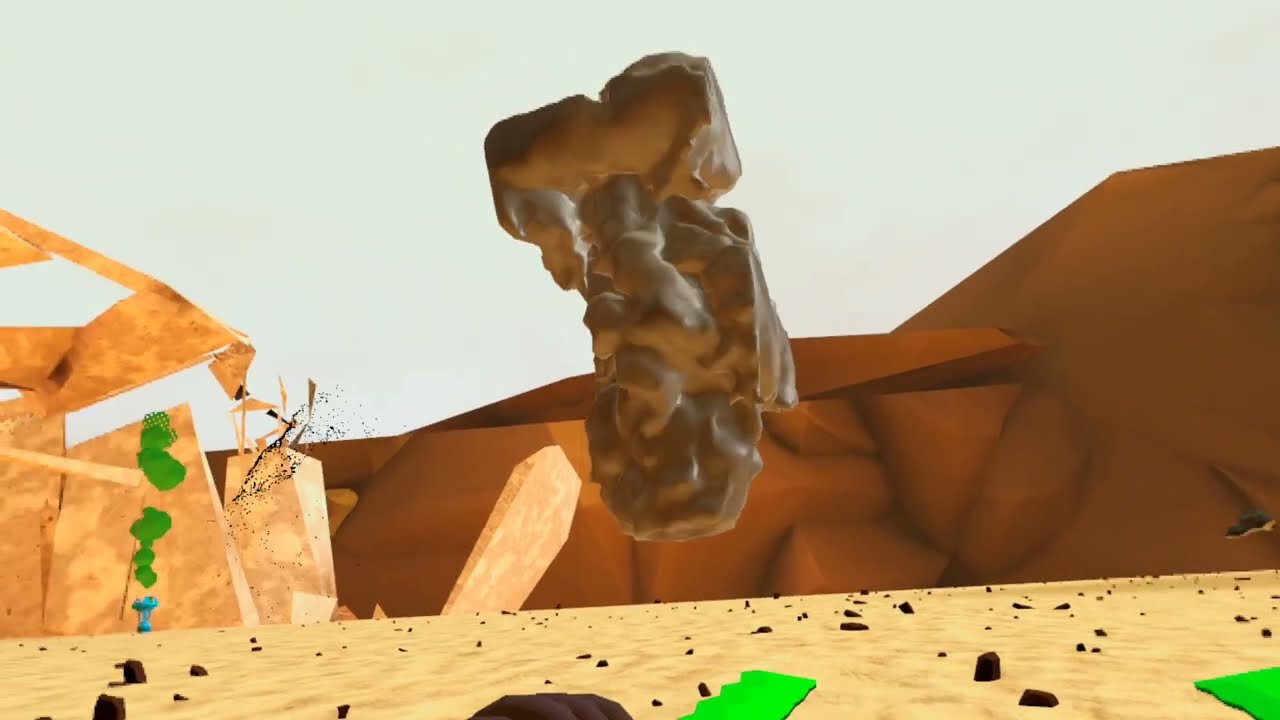 sturdy coral
pulsar marsh
not really, the solution we found was baking the shape key animation (you can lo...
sturdy coral
pulsar marsh
not really, the solution we found was baking the shape key animation (you can lo...
" and creating weird shadows"
is it getting normals from the basis key and not updating the ones changed by shape keys?
might be some export or import settings to prevent it I'm not sure
 errant latch
anyone here have any experience with the MiVRy plugin for gesture recognition? the documentation is not well written and the tutorials are for ue4. They support ue5 however, so it's not a compatibility issue. if anyone has ever used it before can anyone help me out
olive junco
I have a problem with Ue5.4, I placed a Trigger volum box and it's linked to the world blueprint, but when going in the box it doesn't do anything. Any idea why ?
olive junco
So, apparently actors like the default scene cubes and the rifle's projectiles trigger something, but a player doesn't...
And well, I need the player to activate the trigger box 🤔
sonic lake
Not much of a virtual reality issue, but is there any part of the player (e.g. the capsule) which is set to generate overlap events?
The trigger should also be set to generate overlap events and overlap with the pawn
You need to be aware that if A is set to overlap B, but B is set to ignore A, no overlap event will be triggered
@olive junco
olive junco
I have this atm for the collisions.

Regarding the pawn, well, it's not in the scene (spawns itself thanks to the player start).
@sonic lake
sonic lake
It doesn't matter if the player plawn is not in the scene, if you want to detect and overlap with the trigger it should also be set to overlap with Trigger
If Trigger overlaps Pawn but Pawn ignores Trigger, no overlap event will be generated
olive junco
So, rn I'm just using the regualr ue5 pawn, so it doesn't seem to have a capsule. Otherwise there doesn't seem to be a "generate overlap event" in its properties. There is this option for the hands tho, and I just activated it (it wasn't ticked) but it still doesn't trigger.
sonic lake
@olive juncomake sure the skeletal mesh for the hands is set to overlap with Trigger
I cannot check right now as I am building a project and cannot stop it
olive junco
Well I won't be on the project now for the day, so maybe we can check tomorrow if you're available :)
That said I made sure all elements in the pawn have their "generate overlap event" ticked on.
Good luck for your build !
 mystic radish
Hi, what is the best way to detect when player take off the vr device?
violet spear
mystic radish
Hi, what is the best way to detect when player take off the vr device?
Hey, VR notifications component.
OnHMDRemovedFromHead event!
You can add it to your pawn class
 boreal veldt
Hey guys, I am trying to setup Unreal for development, I have been following this guide: https://dev.epicgames.com/community/learning/tutorials/y4vB/unreal-engine-5-4-x-for-meta-quest-vr, I have reached the "Build Quest APK" step, and I got some errors while packaging, the errors look like this one:
UATHelper: Packaging (Android (ASTC)): Z:\app\src\main\java\com\epicgames\unreal\BatteryReceiver.java:88: error: cannot find symbol
UATHelper: Packaging (Android (ASTC)):         activity.registerReceiver(receiver, filter, Context.RECEIVER_EXPORTED);
UATHelper: Packaging (Android (ASTC)):                                                            ^
UATHelper: Packaging (Android (ASTC)):   symbol:   variable RECEIVER_EXPORTED
UATHelper: Packaging (Android (ASTC)):   location: class Context
Does anyone know how to resolve this?
I have to say that I had to download additional Android binaries through the Epic Games launcher, before going over this Build Quest APK step.

Epic Games Developer
XR Meta Quest setup guide covering everything
 sage gulch
building for android in UE has had a reputation for being a pain for years, so at this point it's kind of mystifying why Epic doesn't do something to address it
olive junco
sonic lake
Not much of a virtual reality issue, but is there any part of the player (e.g. t...
Solved my issue by simply adding a collision sphere to the hands in the pawn's BP, overlapping with triggers 😅
Thanks for the help nonetheless 👍
rocky nexus
building for android is a massive pain by itself
rose spoke
I'm getting this error when building for android quest 2
it have shown up since updating to UE-5.4.4
anyone seen it and know how to fix?
 rose spoke
boreal veldt
Hey guys, I am trying to setup Unreal for development, I have been following thi...
rose spoke
boreal veldt
Hey guys, I am trying to setup Unreal for development, I have been following thi...
hmm looks like we having same issue
I can confirm that a previous commit on my git did build successfully in UE-5.4.3, but now fails with these errors in UE-5.4.4
what versions of the xr plugin do you have?, I see I'm still on v67, going to update to v68 and see if that fix it
here's a link to those plugins if anyone is interested
Plugin - MetaXR v68.0
https://developer.oculus.com/downloads/package/unreal-engine-5-integration/68.0
Plugin - MetaXRPlatform v68.0
https://developer.oculus.com/downloads/package/unreal-5-platform-sdk-plugin/68.0
i can confirm updating the plugin did nothing for fixing those java can not find symbol error
perhaps time to look at updating java then
rose spoke
I see I was using java v17.0.10,
I switched to java v17.0.11, same failure
i switched to java v17.0.12, same failure
olive junco
So rn I have a blueprint that allows me to make a sound when interacting with it. How can I make the sound to stop when interacting with it again ?
sullen vortex
olive junco
So rn I have a blueprint that allows me to make a sound when interacting with it...
do once?
olive junco
The point of the bp is to make a sound when triggered, if you interact with it while the sound is still active it'll stop it, if you interact with it once it's done it starts again.
Should have detailed more, sorry.
rose spoke
olive junco
So rn I have a blueprint that allows me to make a sound when interacting with it...
add an audio component to your pawn or any actor, then you can play and stop it with these
 olive junco
Sorry for ping, mb the variable wasn't the right one.
olive junco
rose spoke
add an audio component to your pawn or any actor, then you can play and stop it ...
Ah I actually have an issue : the stop doesn't seem to happen when overlapping again. i suppose it's because the OnActorBeginOverlap is linked to the Play node, but then I can't link it to the branch.
Ah actually, it doesn't trigger stop anyway 🤔
olive junco
Also running into a slight issue : I just imported a sound in Unreal, but I can't put it in the variable, unsure what kind of file it needs since Ue doesn't seem to have anything valid by default. What kind of file does an audio component accept ?
rose spoke
it use a "sound base object" as sound type, you can set it by dragging off the component reference and "set sound"
you can also click on the component and on it's details panel its under sound tab


as for begin overlap to start and stop, try using a "flip flop" and connect it to on begin overlap
marsh salmon
sturdy coral
yeah, if you have another bone around you can use it to make measurements and ad...
I might be using the node wrong, but I think if you have any prior nodes that reset the pose, like Transform Bone, it kind of overwrites the pose and zeroes the delta. Couldn't get it to translate to my hip bone. I'm going to try a simpler approach of using CCDIK to get the spine twist + bend first, using the camera as the effector, then maybe using a Look At or Transform Bone node to fix the head to the camera. Did some prelim testing with it and it seems close enough. This method requires me to estimate the pelvis offset first though, so I just have to be careful not to drastically over-estimate or the spine will become too linearly stretched
paper trout
hi all - i'm using the Meta Movement SDK to control my characters facial blendshapes. this works okay, but when I try to print string the actual values of the blendshape data, it sticks to 0. Is the naming convention on the blendshapes different than whats listed in the SDK documentation?
 sturdy coral
marsh salmon
I might be using the node wrong, but I think if you have any prior nodes that re...
sturdy coral
marsh salmon
I might be using the node wrong, but I think if you have any prior nodes that re...
yeah you need like a special measurement bone for it that you put into place to where the head should have gone and then delta from it to where the actual head reached after ccdik
main thing to avoid things looking bad is put in the CCDIK bend limits so it doesn't crumple if things are too short/head too close to pelvis
for the view for other players I pretty much just use that and I think don't move the hips right now because it was a little stuff, I only move the pelvis right now in first person so your head always lines up exactly with mesh head
marsh salmon
sturdy coral
main thing to avoid things looking bad is put in the CCDIK bend limits so it doe...
Yeah, the other weird thing I realized with CCDIK is that because the default workflow from blender to Unreal is to remove leaf bones, my head bone is only the head of the neck bone, if that makes sense, and doesn't rotate towards the effector. So now I need to add a leaf bone to the head for that.
sturdy coral
I think you shouldn't need a leaf bone, but I do some stuff with a socket on the head bone to be exactly where the HMD is in relation to it
and I modify my transform by that I think
so kind of acting as a leaf bone I guess
there is some virtual bone stuff they have added for cases like that that could work well I think
I haev something from before virtual bones existed with inverting the socket transform to find where the head bone should go to put that socket into place where the HMD is
olive junco
rose spoke
as for begin overlap to start and stop, try using a "flip flop" and connect it t...
I'll check that monday !
sage gulch
That will only flip the flop if you exit the bound and return. You might want a OnEndOverlap function which you can get from the context menu or the component details pane
idle osprey
sturdy coral
apparently even still 5.4.4 in some cases https://forums.unrealengine.com/t/ue5-...
Just FYI, I "solved" the shadow problem in UE 5.4. It has to do with the way a "Basic" level is created. The VRTemplate level is built with a different skysphere. A "Basic" level has fog, atmosphere, a different skysphere, and volumetric clouds. If I recreate the VRTemplate's level with an "Empty Level" in a new project, shadows work as expected.
(had to get my terminology right! 😊 )
rose spoke
rose spoke
I'm getting this error when building for android quest 2
it have shown up since ...
I solved this,
completely removed andriod studio and re-installed it
java 17.0,10
SDK 34
NDK 25
it did compile with SUCCESS, but giving those errors, now I suppose will have to look at updating Gradle


 whole nimbus
Would anyone know any good resources that might help me learn about a quest journal you can hold and flip through for VR? Figure its just an object that I slap a widget on. Thanks
sage gulch
rose spoke
I solved this,
completely removed andriod studio and re-installed it
java 17.0,...
does it fully pack a working apk?
rose spoke
funny you ask, build did succeed, but it did not deploy to the quest 2, install failed
did another build just now and same, it does this
 boreal veldt
rose spoke
hmm looks like we having same issue
I can confirm that a previous commit on my g...
boreal veldt
rose spoke
hmm looks like we having same issue
I can confirm that a previous commit on my g...
I ended up switching to 5.3.2, used same setup from that tutorial, and now everything works, so it seems like 5.4.4 introduced something that breaks the packaging for Quest 3, I also heard from people that in 5.4.3 the same setup works fine.
rose spoke
yea it did screw me over since I actually needed to deliver the project yesterday.
Good rule of thumb, dont update anything close to a deadline
i will likely do a source build of UE5.4.3 and compile on that just to get this build out, it sucks
epic should allow us to choose the minor engine versions to install
 hushed barn
Hi all. For Apple Vision Pro, Epic has make some adjustments to official guide: https://dev.epicgames.com/community/learning/tutorials/1JWr/unreal-engine-apple-vision-pro-quick-start-guide

Epic Games Developer
Apple Vision Pro Quick Start Guide
It’s necessary use a 5.4 or 5.5 for Mac from GitHub and not use the Launcher version
“Install Unreal Engine 5.4 through GitHub (The binary version downloaded from the Epic Games Launcher is not supported at this time, but will be in the future)”
eternal swan
boreal veldt
I ended up switching to 5.3.2, used same setup from that tutorial, and now every...
Using that same guide 5.4.4 has been working fine for me? I've run through that setup using that same persons guides at least 5-10 times this year between 5.3/5.4 on different machines, the only problem I occasionally run into is having to change the .bat file to target my build tools specifically but besides that it works, just built 5.4.4 yesterday for quest 3
eternal swan
eternal swan
Using that same guide 5.4.4 has been working fine for me? I've run through that...
Actually apparently I changed SDK API level to matchndk at some point or that changed, but everything else is per that guide:

 sweet radish
hi, I'm working on a VR project and I'm new to unreal anybody guide me to fix antialiasing in quest 2 and lighting .Thank you
olive junco
rose spoke
as for begin overlap to start and stop, try using a "flip flop" and connect it t...
Hello, so I just tried what you proposed last Friday, but it still doesn't work, I have the first message but never the second.

Also that's not my issue with audio, it's more this.
I have Sound wave components, but apparently no audio file per say, rn I don't know where I can find a correct file for that.
 rose spoke
olive junco
Hello, so I just tried what you proposed last Friday, but it still doesn't work,...
rose spoke
olive junco
Hello, so I just tried what you proposed last Friday, but it still doesn't work,...
ok so since you dont have audio playing the branch goes to false and that does not go to a print string, add a third printstring like this.
also you need a *.WAV file, I'll dm you one and then you just drag and drop it into unreal, and select it
 olive junco
Hold on, there has been a few changes to the context 😅
Namely that audio must be triggered when grabbing an object actually.
rose spoke
ok so have an actor with an object
I simply use a sphere
- attach to the sphere a grab component
- attach to the sphere an audio component
see they parented to the sphere, if you collapse the drop down it should hide them like this


now click on audio, and select background music, you will first have to drag the wave file into your content browser, and allow it to update when it ask, then save it, then it will be available in the list
 olive junco
The goal is ultimately that you can grab an item, then press like B and the audio starts. Would help if I can make a list for the audio, so you can change which one you'd want for the object.
rose spoke
now select the grab component, scroll to the bottom to events and click on the on grabbed and on dropped tabs

you should have these
 olive junco
I remember them when I was making drawers haha.
rose spoke
add the audio component

add the play and stop, this is the simple version, it will play when held and stop when you drop it
 olive junco
That's almost that, except it must play when another button is pressed while the object is grabbed.
rose spoke
add a variable bool
 olive junco
What do you do with this variable ?
rose spoke
add keyboard b input
add another bool


now the grab and drop event set the isheld bool

then on keyboard B press
branch isHeld, if true, flipflop set should play and do play and stop

now if you want your audio to loop
select audio component and make the "on audio finished" event
take another audio reference and a should play var
branch the bool and if true, play audio again


 olive junco
rose spoke
add keyboard b input
add another bool
olive junco
rose spoke
add keyboard b input
add another bool
Strange, I don't have the option to use an oculus input 🤔
rose spoke
now if you want to change to different tracks, you'll need more audio files for it, but here's a setup
make another var, this time an integer
now do a switch on int,
get another key, I'll use "T"
now on key T, branch on isheld, if true, take track number, increment it "++"
then switch on int
add as many pins as you want, then just make sure the default pin set the int to zero, and connect it back up to the top zero line
and then also add a set should play true in between the branch and the increment


 rose spoke
olive junco
Strange, I don't have the option to use an oculus input 🤔
rose spoke
olive junco
Strange, I don't have the option to use an oculus input 🤔
you'll have to use enhanced input to set up the oculus buttons
you using 5.4?
olive junco
Yep.
Also I think I see what you're doing for the sound option, although I already have a system for that (based on enumerators and arrays, so I can choose what I need directly in the editor).
On another note, do you know how to make a laser pointer ?
Regardless thanks a lot for your time to help ^^
rose spoke
yea you can use array, this should do the same as the switch on init, but only with array

it still increment the int, if it exceed the array size it will not be valid, then set back to zero and have a valid index on its next pass
olive junco
I still have the audio problem : when it comes to making the array, I choose "audio component" but I can't put anything in its default value, not even the .wav you sent me.*
rose spoke
olive junco
Strange, I don't have the option to use an oculus input 🤔
add this to your content/input folder
make sure its not content/input/input
then on begin play do this
you'll then have the b button available


 rose spoke
olive junco
I still have the audio problem : when it comes to making the array, I choose "au...
rose spoke
olive junco
I still have the audio problem : when it comes to making the array, I choose "au...
use "sound base" not audio component
you can get one here, then change it to array

 olive junco
Im replacing the integer with an enum, will be easier for my scene.
I should have something interesting, I'll give it a test later. Thanks a lot !
in the meantime if you know how to make a laser pointer :>
olive junco
Well, I still have an issue with the code I stand with : it seems it doesn't even recognize when I press the button, so nothing works atm.
rose spoke
try using keyboard keys first to confirm the logic, also may have to actually click on the playing in editor window to set focus to it, for both 2d and vr testing
olive junco
I'll check that tomorrow o7
 untold hatch
Anyone had any luck launching an AVP app without needing an arbitrary SwiftUI window popping up? Or is that structural at this point?
eternal swan
untold hatch
Anyone had any luck launching an AVP app _without_ needing an arbitrary SwiftUI ...
We haven't had any success with that either so far, if you close the window the app shuts its self down in less than a minute from what we have seen (5.4.4 and Beta 6, not sure if anything has changed in the last week or so)
 pastel atlas
I keep running into build failures for Quest 3 on Unreal 5.4.4. Does anyone have a fix for the "IndexOutOfRangeException: Index was outside bounds of the array" ?
untold hatch
eternal swan
We haven't had any success with that either so far, if you close the window the ...
Ok, thanks for the info! Btw, I think this is the dev doing the most AVP commits at Epic https://github.com/EpicGames/UnrealEngine/commits/ue5-main?author=JeffreyFisher
olive junco
rose spoke
try using keyboard keys first to confirm the logic, also may have to actually cl...
Well, even with keyboard nothing happens... Rn it just seems it doesn't even recognize when I'm pressing it.
olive junco
Also please can someone explainhow to make a laser pointer in vr ?
bold falcon
Using Quest 3, Meta XR and UE 5.4.4: I'm making a VR prototype where users can during runtime change which MetaSound that is going to be played from a specific object in the world. I want the audio for the prototype to be as realistic as possible, meaning that there should be spatialization, reverb etc.
Currently I've spazialized the audio using an attenuation with a fixed value for my MetaSounds.** I'm wondering if there is anything else I should consider for realism or any other plugin/software/SDK that I should use?** I've stumbled accros https://developer.oculus.com/documentation/unreal/meta-xr-audio-sdk-unreal-intro/ but I don't really understand what the benefit of using it would be.
Overview of the Meta XR Audio SDK plug-in for Unreal.
sturdy coral
bold falcon
Using Quest 3, Meta XR and UE 5.4.4: I'm making a VR prototype where users can d...
Main benefit is you get an HRTF (head related transfer function). Listen to this with headphones on, it was recorded with a dummy head with microphones in its ears. An HRTF processes the sounds in VR based on how your head is pointed and shapes the EQ in a similar way to how your ears would shape it at different orientation (and the better ones incorporate things like sound reflection off your shoulders, head blocking sounds from opposite sides etc.)

You'll need headphones for this to work. Make sure there is no noise around, close your eyes, turn the volume up a little bit, hold and press headphone on your ears for better hearing, play it and enjoy this impressive audio work ( illusion ). Not a screamer not a prank!
Audio credit: The original audio is created by QSound Lab. I put it into t...
the meta xr audio also has a lot more stuff for scene occlusion and reverb I think (engine has some built in stuff but it can be limited). There's also SteamAudio that has been made fully open source now under an apache license, and it works on android too https://valvesoftware.github.io/steam-audio/doc/unreal/index.html (the version in the engine has to be replaced with a download from them, it has been deprecated and stubbed out to do nothing)
olive junco
@rose spoke so far what you suggested to do for my blueprint didn't work, do you have any idea why ?
Even just pressing anything on the keyboard doesn't work to begin with :/
rose spoke
Does any movement work?
You have to be focused on the preview window
olive junco
I've added a print string right when pressing the keyboard, but nothing.
bold falcon
sturdy coral
Main benefit is you get an HRTF (head related transfer function). Listen to thi...
Great explanation, thank you so much! I'll check SteamAudio out as well.
HRTF sounds like the way to go. Have you tried using metaXR Audio yourself? I've tried to follow their guide on adding reverb but I don't get it to work with metasound
sturdy coral
bold falcon
Great explanation, thank you so much! I'll check SteamAudio out as well.
HRTF s...
Haven't tried metaxr audio yet
eternal swan
Does anyone here have experience with using the openxr hand tracking motion controller data? I'm breaking the motion controller data and updating hand keypoints based on the arrays its providing to update the hand representations, and thats working fine, but any time I apply movement to the players pawn they are jittering/stuttering.
Same with the xrvisualizer hands, they don't seem to be updating at the same rate as the actual motion controller components even though they are being fed the data directly from them on tick. I have tried changing tick groups, making code as simple as possible, everything I am trying is not fixing the stuttering, if anyone has any ideas that would be awesome (lerping/smoothing is not the answer it still stutters even when smoothed)
carmine oyster
Hi
How can I use the cameras of the headset(Quest 2 for example) for tracking objects in the real world and then recreates it in Virtual Reality(NOT Augmented). Someone has done it as shown in the videos below using Python and C# with Unity. How to do the same with Unreal?


I’m not sure if he has used the htc vive cameras or a separate camera
GitHub
This project is my implementation of camera based object tracking for a VR experience on the Oculus Quest - GitHub - georgelowe/VR-Object-Tracking: This project is my implementation of camera base...
sonic lake
@carmine oysterthe object recognition and position extraction is done with OpenCV, an open source computer vision library
The recognized position was then passed to Unity for rendering
It says the two modules communicate via UDP and you can do the same in Unreal, so you can use their OpenCV implementation and interface it to Unreal in the same way
carmine oyster
sonic lake
It says the two modules communicate via UDP and you can do the same in Unreal, s...
Any idea from where to start?
sonic lake
@carmine oysterI would first make the Python / OpenCV part work
For UDP communication with Unreal you can check this out: https://github.com/getnamo/UDP-Unreal
GitHub
Convenience UDP wrapper for the Unreal Engine. Contribute to getnamo/UDP-Unreal development by creating an account on GitHub.
Once you get the object position within Unreal, you can use it to drive a ball actor accordingly (SetActorLocation)
There could be other nuances to it but I didn't check their Unity code
carmine oyster
sonic lake
There could be other nuances to it but I didn't check their Unity code
Ok, thanks