#multiplayer
1 messages · Page 714 of 1
 ancient adder
 fossil spoke
I know this is old, but this works surprisingly well. Havent tested it in a fully packaged build, but works in Standalone on 4.27.
 empty axle
ancient adder
I cannot use widgets on server atleast for holding data?
empty axle
ancient adder
I cannot use widgets on server atleast for holding data?
widgets shouldn't hold data
 twin juniper
hello i have an issue when passing a variable from the server to the client and i dont know why if anyone could help me that would be great
in this picture u can see the call refresh is called from the server and passes the item array.

but when the client receives it the values are set to none why is that?
 twin juniper
but when the client receives it the values are set to none why is that?
twin juniper
twin juniper
but when the client receives it the values are set to none why is that?
and again this part works on single player or on the listen server
one sec
twin juniper
 thin stratus
UObjects?
thin stratus
UObjects?
i think so yea
 meager spade
If they are actors then your rpc is happening before they have been replicated, if they are uobjects then you need to do some additional networking stuff in c++ to make them replicate
twin juniper
 meager spade
Yes you can't replicate them without some C++ work
twin juniper
o thats great
this would then also apply for structs?
beacuse the reason i am doing it like this is when i acces a replecated struct from as client it is empty
meager spade
if the struct has those uobjects, it won't have anything
on the client side
but a normal struct should replicate fine
twin juniper
it is an array of structs but yea it also holds the same objects among other normal variables
could you point me in the direction on what i should implement in c++
thin stratus
Search for subobject replication
It's basically an actor that takes care of the UObjects
twin juniper
thanks mate
twin juniper
thanks so if i understand correctly i wanna change my object blueprint to c++ so i can add replecation?
meager spade
you create a C++ class, and parent your BP ones to it
twin juniper
thanks again
 atomic barn
Hi can a variable in c++ be blueprint accessible and be replicated?
 solar stirrup
UPROPERTY(Replicated, BlueprintReadWrite /** or BlueprintReadOnly */)
int32 MyVariable;
@atomic barn
atomic barn
solar stirrup
```cpp
UPROPERTY(Replicated, BlueprintReadWrite /** or BlueprintReadOnly */)
int...
thanks
 dreamy terrace
I'm trying to test a very bare bones setup of multiplayer by running in standalone mode: one as -server and another as -game from .bat files. It definitely works on a build from source version of 4.27 but definitely doesn't on a straight release.... does anyone know if you DEFINITELY need to build from source to have this type of network play work?
 chrome bay
You only need to build from source if you want to package a dedicated server
A listen server will work just fine
dreamy terrace
chrome bay
You only need to build from source if you want to package a dedicated server
thats what I thought but I cant figure out what I'm doing wrong. both are third person template vanilla projects and exact same .bat file setups. The from source version works fine. multpile clients can all boot in as a new player. On the release engine build all clients just take over the default pawn that was in the level.
chrome bay
I don't think the default templates have any real multiplayer functionality
You're saying one is running as -server and one as -game, but how is the second instance connecting to the server instance?
dreamy terrace
the pawn by default replicates, the running in standalone on our build version operates identical to the PIE multiplayer tests you can run in listen mode. the pawn runs around its inputs are replicated. the second -game instance has the ip pf the server it connects to. Basically following instructions from the book - Unreal Engine 4 VR projects by Kevin Mack / Robert Rudd.... give me 2 to screencap the bit.
 leaden atlas
How does replication work with level streaming?
I've got this replicated geometry cut actor thing
And it takes a chunk out of static meshes using booleans
But I'm not sure how it'll work if the static meshes are in different levels or if someone makes a cut in a level that' not loaded for other players
 marble gazelle
very likely that you need to take care of it^^
leaden atlas
Is there some sorta delegate like
Like on level load, i should perform the cuts if the static mesh actor is loaded?
dreamy terrace
@chrome bay

 marble gazelle
I guess you have some system that replicates the cuts, so yeah, at some point you need to sync the cuts with the loaded meshs
leaden atlas
yeah right now just the cut box dimensions and the cut static meshes are replicated
like as 2 vectors and a list of actors
marble gazelle
so what's the question 😄
marble gazelle
well if they are UPROPERTY I hope they get nulled^^
you will need to store their GUID or another identifier that the actor it self knows and can thus register again on reload
leaden atlas
also i got another question, is beginplay called before or after initial replication?
like on server, if set some variables on begin play, does that get initially replicated out?
or is it only stuff passed on construction with SpawnActor?
 meager fable
It seems like my EventDestroyed is not getting called on listen server when traveling, is this normal?
 chrome bay
But it depends if the actual match has begun play also
marble gazelle
does replication of an actor first starts after its begin play got called or could it be earlier?
chrome bay
Initially Replicated Properties will be read in before BeginPlay is called yeah
solar stirrup
I've had rep notifies get called before beginplay yeeeee
Generally just wait and have BeginPlay() call them again
 zealous wind
Hey all. I have some variables in an animation instance that aren't being replicated. Is the animation instance not normally used for replication?
 viscid narwhal
I'm using DemoNetDriver. On Server and on Client movement of the car looks ok, but on the replay car jerks like every 1/8 per sec. How to fix it?
leaden atlas
zealous wind
Hey all. I have some variables in an animation instance that aren't being replic...
nah it's not normally replicated
usually you stick the variables on your pawn, or compute them from pawn values
zealous wind
Turns out replicating it was a bit of a dumb idea
haha yeah, that's what I'm doing now
Thanks though
I was trying to avoid the pawn class getting unreasonably bloated
leaden atlas
You could stick it in a component
That's what I do for basically everything. I hate putting anything in character
chrome bay
Components have additional cost, so it's pointless to do that if it's a character property
 plucky prawn
am i allowed to send, from the client, the property reference and a value and have it be set on the server? or do i need an RPC for every single property that can be set? eg if i have 2 bools and a string, would i need 3 RPCs from client->server to set those?
chrome bay
You just pack them in the same RPC
plucky prawn
chrome bay
You just pack them in the same RPC
do you mean i can have a single RPC that would let me change all 3 properties?
chrome bay
sure why not? All you're doing is sending values to it
ServerSetSomething(bool b1, bool b2, const FString& TheString);```ah nah i meant the RPC would just take a property/value pair
so i would make 3 calls to change all 3 values if that makes sense
chrome bay
No that won't work
Unless you send some FName to identify the property and an array of bytes to directly set it to
But that's hugely inefficient and smells of design problems
plucky prawn
right
chrome bay
You're normally doing something very specific with an RPC
If you can set any property to any value, that's an open door for cheating
plucky prawn
so i guess if i have some UI that has a bunch of scalar values i can change on an actor i would need an RPC for each one
chrome bay
That's different
plucky prawn
oh
chrome bay
But ultimately, yes you need to send them somehow - either packed together, or with some ID to identify what you're changing.
Generally you never call RPC's directly from UI though
You don't want a slider to spam the server with 100 RPC's everytime it's dragged
plucky prawn
right
leaden atlas
chrome bay
Components have additional cost, so it's pointless to do that if it's a characte...
how much of an additional cost?
chrome bay
The component adds an additional header, since it has to be identified. It's not massive, but it's not nothing.
Either way putting properties into a component only makes sense if it's logical data for that component
If it's a property of the actor, that's where it belongs
leaden atlas
🤔
The overhead for component replication is relatively low. Each component within an Actor that replicates will add an additional NetGUID (4 bytes) 'header' and an approximately 1 byte 'footer' along with its properties. CPU wise, there should be minimal difference between replicating a property on an Actor vs replicating on a component.
 fervent musk
hey all, does steam multiplayer work in 5.0.1 atm ?
 bitter oriole
fervent musk
hey all, does steam multiplayer work in 5.0.1 atm ?
bitter oriole
fervent musk
hey all, does steam multiplayer work in 5.0.1 atm ?
Steam doesn't do multiplayer, but Steam online features haven't changed particularly in 5
fervent musk
bitter oriole
Steam doesn't do multiplayer, but Steam online features haven't changed particul...
hey. im asking this because i have a silly and ultra basic idea id like to play with some IRL friends with, so I figured it would be faster to get a multiplayer template and spend a day or two to put my idea into practice
so the first hit i got on the marketplace was "multiplayer fps basic pack" but it says this:
 bitter oriole
What's the bug report like?
fervent musk

Unreal Engine
Welcome to the Unreal Engine Issue and Bug Tracker. You can check the status of an issue and search for existing bugs. See latest bug fixes too.
i have zero experience in network replication, servers etc, i use unreal for archviz and as a hobby,this is why i figured a pack would be a fast way
bitter oriole
I don't have that particular issue myself
fervent musk
in 5 ?
bitter oriole

GameDev.tv
In Unreal 4.27, the following setting is necessary to use the Steam OSS to Host lobbies: SessionSettings.bUseLobbiesIfAvailable = true; Otherwise you get quoted error above. Edit: Oh hey it’s covered in the next lecture anyway.
(yes, in 5)
 umbral dragon
Is it possible to use AddStaticMeshComponent in multiplayer? I get this:
LogNetPackageMap: Warning: FNetGUIDCache::SupportsObject: StaticMeshComponent NODE_AddStaticMeshComponent-2 NOT Supported.
 winged badger
it is
if its added on server and replicated
or its added on client and server separately and has the exact same name
ancient adder
I have a bp inherited from this //Header UPROPERTY(Replicated, EditAnywhere, BlueprintReadWrite) bool ReplicateToEveryone = false; UPROPERTY(Replicated, EditAnywhere, BlueprintReadWrite) FName Name; //CPP void UInventoryComponent::GetLifetimeReplicatedProps(TArray<FLifetimeProperty>& OutLifetimeProps) const { Super::GetLifetimeReplicatedProps(OutLifetimeProps); if (ReplicateToEveryone) { DOREPLIFETIME(UInventoryComponent, Name); } else { DOREPLIFETIME_CONDITION(UInventoryComponent, Name, COND_OwnerOnly); } }
But when i set "ReplicateToEveryone" to true in my bp defaults the "Name" var still gets set to OwnerOnly
chrome bay
GetLifetimeReplicatedProps() is called on the class
You'll need to make a new Blueprint Class of that component, set the flag, then add that class to your actors
This would work at the actor level because the actor blueprint is a new actor class, but it's components are not new classes
ancient adder
chrome bay
You'll need to make a new Blueprint Class of that component, set the flag, then ...
Im not sure if i understand, im not getting the "new Blueprint Class of that component" part
Do you mean "Add component by class" in bp or "UInventoryComponent NewComp = NewObject..." in c++?
 crystal crag
If I wanted to handle rotating the character to face a target when a certain property is set, would one way to handle that be inside of the character movement component's GetDeltaRotation ?
I could do it inside of the actor tick, but I was thinking of lerping the rotation as the character is moving instead of just rotating the actor even when the character is not moving
well, I guess the second part of what I said at the end could be handled inside of the movement component too, so I guess ignore that part. The question really is, which method would be best to handle rotating the character towards a target in a multiplayer game?
leaden atlas
how do you keep a replicated reference to something that gets loaded/unloaded with level streaming?
the reference gets nulled out on level unload
 ember sinew
I have a "InventorySlot" struct with an FIntPoint index and a TObjectPtr<UMyItemClass>. The index replicates, but the object pointer won't. Is there something I'm missing? Or is that just not possible?
I know that UMyItemClass replicates fine normally - e.g. I have an AMyItemContainer with pointers to items, and those replicate on the network
crystal crag
Make sure that the UMyItemClass is marked as supporting replication and you also will need to override whatever component or actor you are using and manually call upon the pointer to be replicated
Unless you mean to replicate it outside of an actor or actor component. I haven't done that before.
ember sinew
I did all the stuff to make sure UMyItemClass replicates - like I said, I have actors with pointers to items (just like I'm trying to do with the struct) and everything works fine. The FInventorySlot struct is being replicated by an actor component. Other fields in the struct replicate fine, but the item pointer does not.
 fleet crown
Hello, why all of a sudden ServerMove stops getting called and I just get acks?

Client can see server move but Server can't see Client move after a while
 chrome quest
ember sinew
I have a "InventorySlot" struct with an `FIntPoint index` and a `TObjectPtr<UMyI...
chrome quest
ember sinew
I have a "InventorySlot" struct with an `FIntPoint index` and a `TObjectPtr<UMyI...
I'm curious as to why you use a TObjectPtr instead of the usual UPROPERTY and regular pointer (*) combo.
I'm sure you know this but UObjects have to be UPROPERTY(Replicated) to replicate.
I suggest you replace TObjectPtr with the bare *
winged badger
ember sinew
I did all the stuff to make sure `UMyItemClass` replicates - like I said, I have...
how did you come to a conclusion that your item class doesn't replicate?
as struct not having a valid pointer because it replicated first does not mean the object didn't replicate after
ember sinew
chrome quest
I'm curious as to why you use a TObjectPtr instead of the usual UPROPERTY and re...
TObjectPtr is a UE5 thing, they recommend it over raw pointers for properties/fields (but not function arguments/returns). Using a raw pointer didn't help.
chrome quest
ember sinew
`TObjectPtr` is a UE5 thing, they recommend it over raw pointers for properties/...
Ahhh, I see. I haven't switched yet.
winged badger
if you breakpoint AActor::OnSubobjectCreatedFromReplication on the actor responsible from replicating that UMyItemClass
does it hit?
ember sinew
winged badger
how did you come to a conclusion that your item class doesn't replicate?
The object field is null on the struct for clients but not the server. I know the rest of the struct is replicating because I added a MyRandomInteger field to the struct to test it; I can see that the structs replicate that number (and the FIntPoint index I mentioned earlier), but the object will always be null.
ember sinew
winged badger
if you breakpoint AActor::OnSubobjectCreatedFromReplication on the actor respons...
Ah, that is something I'm not familiar with. Lemme look into that.
winged badger
if it hits - it means your UMyItem didn't replicate by the time you got a replication callback, and if the same actor channel is responsible for both struct and items, you should put the Super call at the end of ReplicateSubobjects
if it doesn't hit you either have a problem in ReplicateSubobjects on the Actor responsible, or you didn't override IsSupportedForNetworking on the UMyItem
assuming here that UMyItem inherits from UObject, if it inherits from UActorComponent, then it was not set to replicate
ember sinew
Those are good points. Talking this out has made me realize a few things I could be missing.
For more detail, the "flow" of what's happening is:
- Player steps on a button
- I spawn a new
AItemDropthat players can pick up (spawning happens on server, drop actor gets replicated.) When it's spawned, it calls a server-only 'Setup' function with a linemyItemPtr = NewObject<UMyItemClass>(withmyItemPtrbeing a replicated property on that actor) - Client or server player walks up close to the drop
- We try to add the drop to inventory: we call the server-only
TryPickUp(item)function, which will create a newFInventorySlot, give it the reference to the item, then add it to a replicated array of slot structs.
I've tested and confirmed that when I create the item object initially (step 2), the item is being replicated. All clients & the server will see the new AItemDrop actor, and everyone's copy of the actor has a reference to the same UMyItemClass object (again, I tested with random int IDs, everyone's machine gets the same ID replicated.) However, when we get to step 4, all clients & the server will get an updated array with slots that are replicating correctly, except for the item reference.
...however, I also know that the server deletes the AItemDrop once it has completed the TryPickUp, so I'm wondering if the item pointer is getting destroyed in that step. I'm also realizing: I probably need to handle the ReplicateSubobjects when the item is added to inventory, since that means it's owned by another actor. I don't think I'm manually setting any outer/owner, either.
And yeah UMyItem does inherit from straight UObject, and I do have IsSupportedForNetworking and GetLifetimeReplicatedProps properly implemented on the object. But like you're saying, I may not be properly doing replication on the actor side. Gonna double check all that.
winged badger
bool UAttributeComponent::ReplicateSubobjects(class UActorChannel *Channel, class FOutBunch *Bunch, FReplicationFlags *RepFlags)
{
    bool WroteSomething = Super::ReplicateSubobjects(Channel, Bunch, RepFlags);

    for (USolsticeBuffBase* Buff : ReplicatedBuffs)
    {
        if (IsValid(Buff) && Buff->IsReplicated())
        {
            WroteSomething |= Channel->ReplicateSubobject(Buff, *Bunch, *RepFlags);
        }
    }
    return WroteSomething;
}```@ember sinew Do you by chance have a destroy function on the UObject that is called when the replicating owner is destroyed?
If you follow Jambax's tutorial on replicating Objects, there's a function like that that may cause your problem
winged badger
short example of ReplicateSubobjects that replicates an array of UObjects
looks the same if implemented on Actor level
 scenic jasper
I am using blueprints and cant find hosted sessions, my guess is i should set bShouldAdvertise to true?
but how do i do that while using blueprints..
or am i missing something else
ember sinew
chrome quest
<@254716873793470465> Do you by chance have a destroy function on the UObject th...
I actually found that tutorial before and it helped me clear up stuff I was doing wrong. Gonna give it another check and make sure I'm doing stuff right. As for the destroy: I don't have a destroy on the object itself. I didn't intend to delete the object, but it could be. I'll add the OnDestroyed or whatever to it and spit out a log, see if it's getting called.
winged badger
its a UObject, you don't call Destroy on those usually
you just let go of the pointer keeping it alive and GC handles the rest
chrome quest
winged badger
its a UObject, you don't call Destroy on those usually
Yeah, in the tutorial it's a custom function that markes the object as dirty or something so that GC can clean it up
winged badger
MarkReadyForDestroy() ?
chrome quest
winged badger
MarkReadyForDestroy() ?
Yeah this.
winged badger
never had a cause to use that
chrome quest
I had to remove it also cause I don't want it to get destroyed that way
It just tied the lifetime of the object to the replicating actor.
You can remove the function if you don't need it
 summer tide
If I put the server and multicast and replicated variables code in a common-component then inherit that component. Would that network replication work?
winged badger
as long as the Actor which that component belongs to is owned by the PlayerController, yes
otherwise, only multicast will work
summer tide
So setting a replicated variable using server RPC wont?
winged badger
you can do it in PlayerController, Pawn and PlayerState by default
summer tide
Not using a component
A common component being shared by two components. And two separate components are added to two separate characters.
winged badger
all Server and Client RPCs require that Actor whom they ultimately belong to is owned by the PlayerController
otherwise you'll just get a "No owning connection for..." warning in your Output log
ember sinew
chrome quest
<@254716873793470465> Do you by chance have a destroy function on the UObject th...
Ah, shoot, yeah, I forgot some key ingredients from that tutorial (especially the whole "make sure the item's outer is an actor" bit.) Welp, got some work to do. Thanks for recommending that 👍
summer tide
winged badger
otherwise you'll just get a "No owning connection for..." warning in your Output...
This should work then. A common component being shared by two components. And two separate components are added to two separate characters.
chrome quest
ember sinew
Ah, shoot, yeah, I forgot some key ingredients from that tutorial (especially th...
Oh.. this. Okay. Hope it fixes your problem.
winged badger
ember sinew
Ah, shoot, yeah, I forgot some key ingredients from that tutorial (especially th...
it doesn't have to be an Actor, but due to fantastic quirks of Unreal, after it replicates on client the Outer will be the Actor whose channel was used for replicating the subobject
 toxic lion
ember sinew
Ah, shoot, yeah, I forgot some key ingredients from that tutorial (especially th...
toxic lion
ember sinew
Ah, shoot, yeah, I forgot some key ingredients from that tutorial (especially th...
Just wanted to leave this out there in case it's handy. Article by Jambax
https://jambax.co.uk/replicating-uobjects/
ember sinew
toxic lion
Just wanted to leave this out there in case it's handy. Article by Jambax
<https...
Ha, that's like 80% copied from the other article, this is so important he wrote it twice 😛
 vivid sparrow
can I only ever call server RPCs on pawns/controllers (aka something the client owns?)
I originally was doing a NetMulticast RPC call in the gamestate (which is shared between server/clients) but it seems to make more sense to do it from the pawn, even though I moved my original code from the gamestate to the pawn and it made no difference, I understand the syntax though, as the client, you call a function only the server should have access to, then call that server function, which will then call the base function
I'm honestly not sure why this isn't working, when playing as the server I am calling the function and it successfully NetMulticasts, but when I play as a client it never multicasts, even when I ask the server to do it
I'm basically going Pawn->FunctionInGameState->ServerFunctionInGameState->FunctionInGameState
is my logic messed up??
chrome quest
vivid sparrow
can I only ever call server RPCs on pawns/controllers (aka something the client ...
Yes.
You can only call server functions from player controller or something that pc owns.
 crimson valve
GameState isn't owned by the pawn presumably?
 lost compass
Hi, does Replication Graph replace the default Network Relevancy System or are they supposed to be used in combination?
plucky prawn
i have this function in C++ which is clearly marked as Client but is being run on dedicated server. i know this because i create a widget inside which crashes because PlayerController::IsLocalController fails because the netmode is dedicated cpp UFUNCTION(Client, Reliable, BlueprintCallable, Category = Interaction, meta = (HideSelfPin = true, DefaultToSelf = true)) void ShowUI(class AMob* Player); does anyone know why this would be happening?
plucky prawn
the problem was that this function was on an actor that the player did not own. moving the core of this function to the player controller fixed it, although not being allowed to call an RPC on an actor that you dont own is annoying af and clogs up the player controller/player character
 fathom aspen
crimson valve
GameState isn't owned by the pawn presumably?
fathom aspen
crimson valve
GameState isn't owned by the pawn presumably?
It is spawned by the GameMode, so it is definitely not. It's server owned
fathom aspen
plucky prawn
the problem was that this function was on an actor that the player did not own. ...
You just said the reason. See the table for reference:
 plucky prawn
fathom aspen
You just said the reason. See the table for reference:
plucky prawn
fathom aspen
You just said the reason. See the table for reference:
i really need to get this printed out in a big poster and put it on my wall
 short void
I'm using Smooth Sync for my racing game - does anyone know how to fix the major discrepancy in the client locations? The actual position of the owning client severely outpaces the replicated position. It's almost as if the plugin is not using extrapolation. I've gone through all the settings and can't seem to figure it out.
 nova wasp
short void
I'm using Smooth Sync for my racing game - does anyone know how to fix the major...
nova wasp
short void
I'm using Smooth Sync for my racing game - does anyone know how to fix the major...
Why not ask them in their official discord?
winged badger
most movement components with prediction work like this:
1 - client applies its movement predictively and sends its FSavedMove to server
2 - server receives FSavedMove, applies it and sends the timestamped result back to client
3 - client receives the server result, then reapplies all moves that happened after the timestamp of last server update, and that is its position
which means client will always "be a little bit ahead" of where it is on the server, unless its standing still
short void
I guess the main problem I'm having is, people cannot race side-by-side because they don't know whether or not there actually is a car to their inside or outside. The desync gets too far out of hand at 200+ KPH, like 5 car lengths
short void
nova wasp
Why not ask them in their official discord?
Can you provide a link? I have looked all over and cannot find it
nova wasp
he found the link here for posterity https://discord.com/invite/6VpgNQg
ancient adder
How does ustruct repnotify works?, changing a value inside the struct does not call repnotify
thin stratus
In BPs?
I always felt like modifying variables in BP without involving the Set node of the variable doesn't cause RepNotifies
E.g. adding to an array
ancient adder
im working in c++, but its for both, do i have to keep a loop to check which value changed in the struct and apply it?
thin stratus
Hm in CPP it should be fine to just modify the structs property. Not sure
ancient adder
Yea setting the struct fires the repnotify but changing a value inside the struct doesnt
ancient adder
In blueprint it does call the repnotify when i change the values inside the struct
But not in c++
Well, it appears to be also working with c++ version, gotta check the code then
 lament garnet
when i send an rpc with a pointer parameter(for example a montage) what does the parameter looks like when sent over the network?
its the asset path?
chrome bay
crimson valve
GameState isn't owned by the pawn presumably?
No - owned by the GameMode
chrome bay
lament garnet
when i send an rpc with a pointer parameter(for example a montage) what does the...
If it's an asset, then at first yes - the full string path is sent until a GUID is acked for that object by each connection
lament garnet
alright so there is no point in manually sending it, ill just let ue handle the thing
chrome bay
yeah, you don't need to do anything - just send the asset pointer
Or if you have a fixed list of assets you are using and can index them somehow, that's a way to save cost
lament garnet
make sense, thank you
chrome bay
ancient adder
How does ustruct repnotify works?, changing a value inside the struct does not c...
Should work fine
C++ rep notifies work differently though (aka, properly)
BP "rep notifies" are just "when any change is made to this property regardless of who or where it came from"
And the difference between them is an endless source of frustration
 chrome bay
Probably not now.. I wonder how many BP projects would outright break if they did
Just a silly legacy decision we gotta live with 😢
 signal lance
short void
I guess the main problem I'm having is, people cannot race side-by-side because ...
signal lance
short void
I guess the main problem I'm having is, people cannot race side-by-side because ...
Only solution and what rocket league does is to predict other clients locally based on their last known input to place them in the same "timeline" as your locally controlled car
The higher the latency the worse it will look as the only information you have to predict them is their last state from the server and their last input
plucky prawn
If I have a door control panel ui that opens the door when I click a button in the widget, but I don't own the door, is the best/only way really to tell my local player controller to call a server RPC on itself to then call open on the door?
chrome bay
yes
plucky prawn
I'm trying to better understand the workflow for client side actions that are performed on the server for actors I do not own. The way I described seems like it would clutter the player controller with dozens of RPCs which only exist to call a function on another actor
chrome bay
Usually something like this is done through a generic interaction system
You don't make it specific for every possible actor, you design a system that can handle many interactions
plucky prawn
chrome bay
You don't make it specific for every possible actor, you design a system that ca...
Do you have any recommendations for marketplace assets or further reading for these kind of designs?
chrome bay
Would never recommend anything from marketplace tbh
But a simple approach would be just a single "Interact" RPC that takes an actor and a gameplay tag
E.g. "Door.Open"
And through an interface, call a function on the target actor
e.g. OnInteract(Player, InteractionType)
Usually quite game-specific
plucky prawn
Ooh I keep forgetting about gameplay tags
chrome bay
Ignore whatever Lyra did, it's awful
plucky prawn
How much would it cost me to have you implement this for me? Haha jk unless...
chrome bay
Well me personally I have no time 😄
But tbh generic systems like these are the most fun things to make IMO
signal lance
👆
plucky prawn
chrome bay
But tbh generic systems like these are the most fun things to make IMO
Sort of the same for me except I don't have the knowledge or experience to do it most of the time. Super rewarding when it works though. I might even specialize it in one day and not even worry about trying to make games
chrome bay
Yeah but then these are the times when you learn the most too 😄
Even if you reinvent it a couple of times, you learn a lot from the failures and mistakes
Throwing stuff in the bin is underrated
plucky prawn
Great advice actually. I really need to learn to not be scared of having to rewrite code. I have this thing about writing code once and have it be perfect so I never have to revisit it and it's absolute hell. It means I get bogged down with tiny implementation details and micro optimizations that cost me days or weeks of time
chrome bay
I still do that tbh 😄
Very hard not to get too excited and over engineer once you get into a flow
But the first thing is identifying the problem, you don't want to pollute the controller with misc code from all over the place which makes sense - now it's just thinking about how to solve it in a nice way
plucky prawn
chrome bay
But the first thing is identifying the problem, you don't want to pollute the co...
I'll keep this in mind. Thanks for the help 😘
dreamy terrace
Continuation from my yesterday boggle - I'm trying to find out if this works by default in anyone else's launcher release of UE4.27.2 - https://nerivec.github.io/old-ue4-wiki/pages/how-to-test-dedicated-server-games-via-commandline.html
The way I was testing is by making a default third person project and using that. In a particular 4.27.1 build from source one of my coworkers made it works flawlessly. each game clients joins and they run around seeing each other. In 4.27.2 launcher release, 5.0 launcher realease or a 4.27.2 build from source it doesn't work the same. On those versions we have to manually use the console and type open 127.0.0.1
I'm trying to figure out if there's some type of bug or is something magical changed in the engine .ini's of that build that is making it work
lament garnet
chrome bay
If it's an asset, then at first yes - the full string path is sent until a GUID ...
what if we are talking of uobjects instances?
for example if i create a new object that is maybe some hit informations when a character is hit and i send this damage object over rpc(i know it does not make sense, its just the first example that it comes to my mind)
should i pass only relevant data and rebuild the object on who receive the call or there is some magic happening behind the scenes?
chrome bay
You can't pass objects created with NewObject
The object has to be network addressable
So it has to be reachable some other way, e.g as a replicated subobject of another actor
lament garnet
oh
so in this case where the object is just a transient object, how would you do this?
chrome bay
You can't
It has to be networked somehow, and reachable anohter way
If/When Epic takes this PR, you'll be able to send any data struct via the same RPC
https://github.com/EpicGames/UnrealEngine/pull/9087
plucky prawn
i am currently trying to figure out how to send a wildcard through a blueprint function call to a blueprint event. decided to not use wildcards and just use an FString instead :( i dont like it but.. it will work for now
 eternal canyon
chrome bay
Very hard not to get too excited and over engineer once you get into a flow
eternal canyon
chrome bay
Very hard not to get too excited and over engineer once you get into a flow
It is very fun
chrome bay
meager spade
what ya mean on the interaction thing?
I'm just not a fan of it myself, I don't like how it's scanning and constantly granting/removing abilities etc.
bitter oriole
Thinking of that time where Destiny 2 DLC got out of GamePass and players lost abilities mid game in PVP
meager spade
I mean I use abilities for interaction but these are triggered from native code. But the interact ability is mainly for gameplay purposes and timed interactions
fathom aspen
chrome bay
No - owned by the GameMode
I keep seeing this in bunch of different places, though looking at the source code, the GameModeBase seems to spawn GameStateBase without specifying the Owner, so it's kinda left null there. How would I still conclude that it's owned by the GameModeBase?
chrome bay
fathom aspen
I keep seeing this in bunch of different places, though looking at the source co...
Ah in that case it's owned by nothing, I always assumed gamemode spawned it with itself as the owner
 quasi tide
Well, I don't think it needs to explicitly set the owner, because aren't null owners considered to be owned by whoever spawns it?
If this is true, because GM only exists on the server, it'd naturally be what owns the GS.
chrome bay
Nah it has to be set explicitly for sure, you can definitely have actors without owners
fathom aspen
quasi tide
If this is true, because GM only exists on the server, it'd naturally be what ow...
Hmm I do think you have to always specify the Owner explicitly, otherwise it's null owned. But null owned actors are like server owned, so it doesn't make much of a difference
chrome bay
But tbf it makes sense for it not to have any owner, GameMode wouldn't replicate to clients anyway
No point replicating a ref that will never resolve
fathom aspen
chrome bay
But tbf it makes sense for it not to have any owner, GameMode wouldn't replicate...
Ah right 👍
quasi tide
So I'm part right. I'll accept it.
solar stirrup
Is it a known bug that map actors destroyed via Initial Lifespan on the server still appear on clients that join after it was destroyed?
chrome bay
Hmm, as long as they are replicated it should work as expected I think
solar stirrup
Client that joined late on the left still has spawns that got destroyed (not visible in the client in the right)


LogNetPackageMap: Warning: UPackageMapClient::InternalLoadObject: Unable to resolve default guid from client: PathName: GER_ForwardSpawn2, ObjOuter: /Game/PostScriptum/Maps/Wolfheze/Offensive/Single/UEDPIE_0_Wolfheze_Offensive_Single_01.Wolfheze_Offensive_Single_01:PersistentLevel
big rip, whines about it when I call a Server RPC if I try to spawn on it 
guess i'll figure out why it doesn't get replicated destruction info created for it
.... it does?
 chrome bay
Relevancy issue maybe?
solar stirrup
Always Relevant
solar stirrup
Yea
chrome bay
There's a max range for actor destruction infos being replicated IIRC
But haven't got code atm so can't find it
solar stirrup
does it come with a warning in the output log?
chrome bay
I don't think so
It just doesn't send out destruction infos for actors that are far from the viewer, but yeah here that would be a problem
solar stirrup
gonna check all usages of DestroyedReplicatedStaticActors
 rose prawn
Hey people, is there somewhere I can access replicated control rotation? I currently have my own replicated control rotation variable. But if it's already exist in somewhere I might drop mine and use it. (Using cpp)
solar stirrup
Not seeing anything about visibility 
solar stirrup
Alright, don't get that destruction issue without the rep graph
odd
Ay got it: UReplicationGraph::SetActorDestructionInfoToIgnoreDistanceCulling()
Beats me in what case you'd want to cull destruction info for map actors
especially always relevant ones
ancient adder
I have a component that creates a basic inventory such as players inventory, storage and that kind of stuff
And on its begin play it populates a replicated with repnotify(ReplicatedUsing) structure thats called InventoryData
when the player logins the repnotify function fires and creates widgets with data from InventoryData struct
What im trying to do is put this component on an actor owned by no one and act as a storage to the player
so when the player interacts with the storage actor it opens a storage widget with data relevant to him
or even as a marketplace with online data that everyone can access
But i can't seem to make it work as a storage(didnt try marketplace yet), the data is always empty
Can't find a way to make the actor load data relevant to the player since he doesnt own the storage actor
So i was wondering is my approach possible? should i stick with adding the inventory components to the player controller or is there a better way?
 dark edge
ancient adder
I have a component that creates a basic inventory such as players inventory, sto...
dark edge
ancient adder
I have a component that creates a basic inventory such as players inventory, sto...
So it's like the stash in Diablo, shows different contents to different players?
ancient adder
I havent played diablo but yes, different contents to different players
dark edge
That data should live in PlayerState probably, replicated to Owner only. The stash just acts as a way to interact with it.
It's your items, you can only get at your items when interacting with the stash
it's not the stash's items
Set it up such that you can open the inventory any time you want with a keypress, then just hook into the interaction with the stash
Sort of like a shulker chest in Minecraft
ancient adder
I've thought about keeping all data thats relevant to the player inside controller and make the storage actor just a way to open the widget, but its kinda hard to make new inventories at runtime with this approach
dark edge
Is this inventory global or tied to the specific actor, just restricted per character?
ancient adder
i dont think i understand, you put the component in an actor and you have an inventory for that actor
dark edge
I mean, if I put items in chest A and go open Chest B, are my items there? Is it like the WoW Bank where it's accessable from many spots or just from the one actor?
dark edge
But another player can't see them right?
ancient adder
Yes, you only see what you put in it
dark edge
I'd just add OwningPlayer to an item slot and filter by that
ancient adder
But there is no data for the slot to have
dark edge
add it
ancient adder
hmm
dark edge
I mean it all depends. I was leaning towards adding a global inventory to the PlayerState but then you said that each actor has a separate inventory so that changes things up a bit
What's the context, is this for a stash or bank or auction house or what
ancient adder
dark edge
I'd just add OwningPlayer to an item slot and filter by that
I think i'll have to recreate the system to do it this way
dark edge
ancient adder
Im trying to make an inventory system that i can use for everything
I'm working on a crazy inventory system too, but it doesn't use components as anything but an ID really.
Not doing any of the context stuff though, everything is the same for everyone.
ancient adder
dark edge
I'm working on a crazy inventory system too, but it doesn't use components as an...
The reason im using a component is to easily add/move it to another project by just copy pasting
All the logic is contained in the component, you just call events/ interfaces or functions from the component
dark edge
A component is typically the approach, the wrench in the whole thing is the "ownership" mechanic.
ancient adder
Yea the ownership is what making it hard to me
dark edge
ancient adder
Yea the ownership is what making it hard to me
is ownership a thing in other contexts?
maybe that should be on the item level
ancient adder
Marketplace seems easy to do since i just make the data replicate to everyone but im not sure
ancient adder
dark edge
is ownership a thing in other contexts?
I dont understand, can u explain please?
ancient adder
just an item, a dropped item will be an actor that contains an item data
dark edge
Like is it MY sword because it has my name/id on it somewhere or is it just the sword in MY chest?
ancient adder
might make it owned
dark edge
Do you have item slots?
ancient adder
Yes, on client side they're widgets
dark edge
I mean in the data
ancient adder
on server they're just structures
dark edge
does a component just have an array of item structs?
ancient adder
yea
dark edge
or an array of slot structs with item structs in them
ancient adder
exactly
dark edge
which one?
ancient adder
Its a struct called inventoryData, which contains some data about the inventory like name, owner type and 2 other array of structs that hold the information for the slots
dark edge
ancient adder
Its a struct called inventoryData, which contains some data about the inventory ...
Maybe just let an InventoryComponent have multiple InventoryData
Usually it just has 1
but these special inventories have 1 per character
ancient adder
dark edge
Maybe just let an InventoryComponent have multiple InventoryData
Yes, but the problem is, its hard to add a new inventory and keep track of it at runtime
ancient adder
dark edge
but these special inventories have 1 per character
i dont think i understand
dark edge
Instead of one InventoryData, have an array of them
Most inventorycomponents will have 1 of them, but these special (subclassed probably) inventorycomponents would add more when interacted with by a player.
Or just have ownership on the slot level, and only show slots owned by Player or Nobody
ancient adder
dark edge
Instead of one InventoryData, have an array of them
I tried that, but had a hard time keeping track of the inventories like which index belongs to a specific actor
ancient adder
dark edge
Or just have ownership on the slot level, and only show slots owned by Player or...
Yea i'll prob have to recreate the system to use objects to have owners?
I did make it once operate with objects, but i dont think it made it any good to me
dark edge
You have 3 options that I can see. Add an Owner field to
- The InventoryData
- The Slot inside the InventoryData
- The Item inside the Slot
ancient adder
Which i did all of them, except for Slots inside the inventorydata, i instead used objects as slots
Anyway thank you so much for the information i really appreciate it, i'll look into doing slots with ownership if i couldnt make the current approach work
fathom aspen
solar stirrup
Ay got it: `UReplicationGraph::SetActorDestructionInfoToIgnoreDistanceCulling()`
I see a blog post in the horizon
 magic yoke
What happens when I replicate an array with object references in it? (in blueprints)
I don't see any options to mark objects as replicating
does the client only get a bunch of pointers, or does it replicate the objects as well
 willow prism
Hi!! I have a bot that looks at the player when it sees the player, is there a way for the rotation to be as similar as possible on the server and client. Currently it looks at me but if on the server it is looking at an angle of 90°, for example on the client it may be seeing at 80° or some other value close to those of the server, but never the same. How could I make it as close as possible to the server?
eternal canyon
magic yoke
does the client only get a bunch of pointers, or does it replicate the objects a...
they get a bunch of guids
which they will then match with the object on their side
tho if it doesnt exist it will just be null
magic yoke
if you missed my slight kerfuffle in blueprints
I'm basically trying to create a large tile system
and trying to figure out the best way to communicate to the client about the world tiles it's near
I don't see a way to replicate objects actually
probably missing something basic
dark edge
willow prism
Hi!! I have a bot that looks at the player when it sees the player, is there a w...
What does "look at" entail?
Is there a variable LookDirection? AimPosition? TargetActor?
dark edge
magic yoke
I'm basically trying to create a large tile system
What is a tile in your system? Like just 2d data?
willow prism
dark edge
What does "look at" entail?
the bot turns completely towards the player with a "Target actor"
magic yoke
dark edge
What is a tile in your system? Like just 2d data?
more or less. location, tile type, ownership
dark edge
Is the bot a Character?
magic yoke
it has relatively little information in it
dark edge
magic yoke
more or less. location, tile type, ownership
Why object and not struct?
magic yoke
not a good reason, found out making them out of actors raw was bad so I stepped down to object instead
willow prism
dark edge
Is the bot a Character?
yes
magic yoke
I think I could make them out of structs easily enough
the data does get updated, but tiles aren't created or destroyed after setup
only the data inside
struct would work better?
dark edge
magic yoke
I think I could make them out of structs easily enough
Structs are plain old data so replicate easily. How many tiles total?
dark edge
willow prism
yes
Then it's rotation should be replicated already. Is it yawing towards the player?
magic yoke
I'd prefer 100k/1m
if possible
the client would only need to know about a small subsection at a time
the chunky array would be server side
dark edge
Is it static or dynamic? Procedural generation?
dark edge
You could just start with replicating the seed + diffs
willow prism
dark edge
Then it's rotation should be replicated already. Is it yawing towards the player...
yes, but visually it is not exact, example in the server it seems that it sees the player's face but in the client it seems that it sees a shoulder
magic yoke
mmm, I think I misspoke
the tiles themselves are static, not all the info inside them is static
who owns the tile would change for example
 wet bridge
Anyone know if large scale maps using world partition work well with a listen server multiplayer setup?
I can't find much info on the topic but what I have seen has implied it might be computationally heavy for the host to have to load multiple regions in at once
dark edge
magic yoke
who owns the tile would change for example
That sounds like plain old data to me. Maybe fast array of structs
Or GetSurroundingTileInfo(MyLocation)
magic yoke
yeah, more or less
I think you put me on the right path :)
structs + client owned actors are definitely what I was looking for
 shrewd tinsel
hi guys
me health variable has a big delay on playerstate when replicating
how do i solve that?
chrome quest
shrewd tinsel
me health variable has a big delay on playerstate when replicating
Increase the net update frequency of the player state.
Be careful though as it increases bandwidth usage (not sure if that's the correct terminology)
chrome quest
shrewd tinsel
me health variable has a big delay on playerstate when replicating
Also, why do you have the health on the player state? Seems like something that should be on the character even if you're replicating.
Unless the health variable outlives the character class?
shrewd tinsel
thanks for the response
you are infact right, i probably should have that on the pawn
and thanks for the tip on net update frequency
i did played with that but i probably set it too low cuz it broke everything
maybe 0.4 second rate would be good?
chrome quest
I can't really say tbh. It depends on what other stuff are replicating in your game. The default should have been fine.
shrewd tinsel
imagine counter strike
you really want as fast update on the health bar as possible
so you have good feedback on the damage youve dealt
i dont really want to rpc that
alright thanks for help!
chrome quest
shrewd tinsel
alright thanks for help!
Np
 snow tiger
hi guys i have a question related to voice chat in dedicated server. i made according to the tutorial but the voice doesnt replicate to the other clients
anyone know what to do on this matter
crystal crag
If you wanted to smoothly rotate a player towards a target when "locked on", wouldn't it be best to just mess with AddControllerYawInput to have to naturally replicate to the server / other clients?
The only other way I can think of doing it is making the lock on action call a server RPC and then have the client and server call SetActorRotation
on tick
 distant turret
do you need to have savegame in unreal engine if you're using NoSql database?
 blissful saffron
Does anyone have a blog or write ups on some good practices for validation/anti-cheat for multiplayer?
 short arrow
blissful saffron
Does anyone have a blog or write ups on some good practices for validation/anti-...
short arrow
blissful saffron
Does anyone have a blog or write ups on some good practices for validation/anti-...
You want to make your own anti cheat detection system?
blissful saffron
Well, I want to integrate Easy AC but I know from reading their docs that the primary anti cheat is based on validating game state, inputs, etc. Or at least that's what I gather from reading it so far
 sinful tree
distant turret
do you need to have savegame in unreal engine if you're using NoSql database?
sinful tree
distant turret
do you need to have savegame in unreal engine if you're using NoSql database?
No
 undone plinth
Hi, I've got replicated actors attached to a replicated actor. In viewport and new editor window they work fine. However in standalone preview the children replicated actors do not spawn on the client but show on the server. Any body got any advice on this?
I am seeing this line in the server console which points to something - Server connection received: ActorChannelFailure [UChannel]
 pallid mesa
blissful saffron
Well, I want to integrate Easy AC but I know from reading their docs that the pr...
pallid mesa
blissful saffron
Well, I want to integrate Easy AC but I know from reading their docs that the pr...
hey well it depends on what you want to validate
ie: client authorative server validated can use server validation to ensure things are proper, ie: checking the shoot was a valid shoot
or if you have a vehicle you could be checking on the server that it isn't surpassing certain velocity and that it isn't teleporting
it is really gameplay centric
and every game has different needs
lament garnet
in single player ive used a tmap of gameplaytag, fstat to define my stats for actors. since replication is not supported, how would i implement something similar? TSet?
and having the tag inside the struct
chrome bay
TArray is the only container supported for replication
But why would you replicate that anyway is my Q?
Ah wait.. FStat is your own type?
Either way the answer is to just use a TArray of structs, which combine the tag and data
 tribal elk
You can also serialize the tmap to a tarray struct for replication purpose ( key-value sequence )
Ue5 GAS does this for replicating loose tags
chrome bay
Usually very special cases though, most of the time TArray<FSomeStruct> is preferable
lament garnet
mm thank you guys
tribal elk
Agree but also the stat definition could be an asset :)
And if they are dynamic the server should probably do the work anyway so no rep needed to setup the fstat
As you probably propagate it into components anyway ?
chrome bay
Even then I'd still make it an array
lament garnet
tribal elk
As you probably propagate it into components anyway ?
what do you mean by that?
twin juniper
@chrome bay would you happen to know how to send more than 64kb between server and client? Chunked tcp sockets? Would a custom uactorchannel work for this? I think I read something about custom uactorchannels but couldnt find much.
chrome bay
RPC it in batches maybe?
Replication system isn't really designed for large data sets
Little and often is it's preference
Custom sockets might be an option if you want to download a large stream of data early on
twin juniper
I did try that but if it was too fast in between it would fail
chrome bay
You can look at this
https://forums.unrealengine.com/t/replicating-large-arrays-and-data-sets/265029
But TL;DR it's not recommended to use the engines game-level replication for large data
tribal elk
lament garnet
what do you mean by that?
It sounded like your map is only used declaratively not really at runtime and other components ( like health / GAS ) replicate their health then
Sorry misunderstood probably
lament garnet
yep, thats how im doing it
twin juniper
chrome bay
But TL;DR it's not recommended to use the engines game-level replication for lar...
Itd have to be 2mb max worst case scenario initially only to a single player. From then on its just the updates
chrome bay
What's being replicated?
twin juniper
Uobjects
chrome bay
I mean what data
UObjects can't natively replicate without piggybacking off an Actor anyway
pallid mesa
any good resource in which I could consult average network bandwidth and other stats employed by famous multiplayer titles?
twin juniper
chrome bay
UObjects can't natively replicate without piggybacking off an Actor anyway
their item data, couple floats. Fname. A bool. Some references to actors. A tag container.
chrome bay
And you can't generate that data client-side from a seed?
twin juniper
I suppose I could. Just dont know how 😅
chrome bay
I mean you're sort of stuck because if that all needs to be replicated for some reason, you don't really have any choice but to use regular property replication
And just wait until the engine manages to get it all out to the clients
How many objects are there?
twin juniper
chrome bay
I mean you're sort of stuck because if that all needs to be replicated for some ...
its just the initial bunch. I've tested adding 2k of the objects to an array slowly and it did replicated fine. It wont change much. Just initially. Will the engine managed to get 1mb out to a single client?
chrome bay
If it's all in one array then it won't really work no
FastArraySerializer might work
If the array is that large you'll probably have to use it anyway
pallid mesa
What was the conclusion between the tarray and fastarray?
bigger arrays, or bigger members?
chrome bay
tbh I don't think there's any fixed answer
But there's definitely a cap for regular arrays at some point
TArray still works nicely if the array stays fairly constant in size and you care about order
Because you still get delta replication
pallid mesa
so what would be the problematic... the array size or the member size?
chrome bay
Both
chrome bay
Especially if you consider the initial non-delta packet that replicates the full contents
Whereas IIRC FastArraySerializer will sort of "chunk" them internally
pallid mesa
so if we don't consider that initial replication
if we have a longer members in a reasonable sized array
probably it's just comparable
chrome bay
I think so. FastArray does have larger packets in general I've found
But
It does have delta struct serialization on by default now
It does seem to work, but I'm still seeing larger overall packet sizes
Can't figure out where the extra bits are coming from atm
pallid mesa
yeah
I always struggle on what to use, really.
I end up using TArrays unless the array is very very very long
and later, when you profile you see and go like "shit i probably should have tried fast array" hah
chrome bay
I'm near enough in the same area. If the array is "reasonably" sized, like 10-40 elements or something, and it's size is fairly constant, I tend to find it cheaper
I did have a little test project.. wonder where that went
solar stirrup
gonna be using it to replicate map marker data soon
chrome bay
The other benefit of FastArray ofc is the per-element add/change/remove stuff. That's useful
chrome bay
Every marker in HLL is it's own actor 😄
solar stirrup
PS is either an actor or a component that registers on the map

refactor time soon™️
chrome bay
yeah, I've wanted to profile one vs the other for ages, just never got around to it
solar stirrup
issue with component is that it means the map marker won't show up for non relevant actors
even if it needs to
(╯°□°)╯︵ ┻━┻
pallid mesa
chrome bay
yeah, I've wanted to profile one vs the other for ages, just never got around to...
I was thinking about making this aswell
Actually I have drafted several use cases to profile
chrome bay
Oh I meant actors vs fast array in this case
TArray vs FastArray I did, for small data sets TArray seemed to be a winner
But also it's removals that get you
solar stirrup
Fast array is probably lighter since it won't have all the actor overhead
chrome bay
You remove something from the start of a TArray, suddenly every element ends up being sent
solar stirrup
yeaaa
pallid mesa
ah actors vs fastarrays
I see... Zlo seemed to find extreme benefits from one over the other
solar stirrup
I'll probs go fast array since i'm expecting 100 player markers + vehicles + objectives + spawns etc
pallid mesa
so much useful info in here, thank you guys <3
solar stirrup
and i'll split it into three actors, each relevant per team and one relevant for all
pallid mesa
i gtg now! have a good day!
chrome bay
yeah, if we did this again, I'd have one actor for each type of marker + data
per team
winged badger
chrome bay
Can't figure out where the extra bits are coming from atm
it does have some overhead in FFAstArraySerializerItem
chrome bay
Yeah I know about the RepID at least, so that explains at least 32 bits
There were a few extra I couldn't account for, but didn't dig in deep enough
I'll have to find the numbers again
winged badger
i kinda serialized some fastarrayitem structs to .json once
there was more then just repID there iirc
chrome bay
I think they've added some fixes for the delta stuff in 5.1 too, need to see if that makes a difference
winged badger
generally, never had a bandwidth problem, or even close to it, but had to do plenty of CPU optimizations
pallid mesa
pallid mesa
any good resource in which I could consult average network bandwidth and other s...
Speaking of which, any idea?
solar stirrup
Oh god
winged badger
to youngling such as you: dial up is an ancient tech that used a modem to do internet over the phone line 😄
pallid mesa
Zlo, you are not that old, come on man
xD
you are portraying yourself like an elder
solar stirrup
Ok boomer
winged badger
i am not, you are that young 😄
solar stirrup

pallid mesa
hahaha
lament garnet
"mum put down the phoneee, internet is down"
pallid mesa
I've lived that
But yeah, old games with real engineers run over crazy budgets
for both CPU and bandwidth
😄
I was also thinking about profiling Lyra as a starting point to see how much a UE5 multiplayer title would be as a baseline
maybe not very ideal, but we can get good and detailed numbers with insights there
twin juniper
chrome bay
You can look at this
<https://forums.unrealengine.com/t/replicating-large-arrays...
Setting net.MaxConstructedPartialBunchSizeBytes really high worked. I doubt that this is a good idea though. don't replicated properties just get sent changes in variables?
chrome bay
They do, but the initial state needs to be replicated too if it's different to the clients' initial values
Also have to consider join-in-progress, where massive deltas might be sent
twin juniper
chrome bay
Also have to consider join-in-progress, where massive deltas might be sent
Yeah. This is just during a main menu like tarkov for big inventory. Being replicated to one person. So no need to send all that data to everyone. Though what would ramifications be having net.MaxConstructedPartialBunchSizeBytes so high? I guess in such a situation its not as bad because main connection server is seperate from game server. But could be possibility in game an array might be large but not that large
 split siren
I am having hard time understanding the login process. I generate a url and token for player to join a server (127.0.0.1?token=secret). Server should verify the token by checking DB or asking a webserver (at least 100ms processing time)
FString AGameSession::ApproveLogin(const FString& Options) - This looked like a perfect method, but it is not async, which causes lag when checking if token is valid
bool ProcessAutoLogin(); Is async with OnAutoLoginComplete callback, but I don't have access to url options like with ApproveLogin (and it fetches the login data from commandline etc).
What is the right process to check if token is valid without locking the game thread?
chrome bay
You probably want to check it before they actually join at the game-level
solar stirrup
Beacon would be a good way
chrome bay
Yeah. Otherwise lots of wasted time to load a level only to get kicked back to the menu again
solar stirrup
Client sends server secret through Beacon -> Server checks asynchronously -> Caches result and tells it to the client who can join if it's valid -> Check cache in login
split siren
Thanks for the tip, I have never used beacons before. Just a sanity check, you are talking about this right? https://docs.unrealengine.com/4.27/en-US/InteractiveExperiences/Networking/OnlineBeacons/

Overview of the Online Beacon system
solar stirrup
Yep
split siren
Lovely, thank you very much
 arctic hazel
So anyone with a bit of clue how to solve this..
https://gyazo.com/608f19e772ebe9c58acb02233741b468
Trying to have a sprite turn degree around when mouse is at X position of its controller, and then update the rotate for everyone to see,
 ancient adder
How do i call this manually? UInventoryComponent::GetLifetimeReplicatedProps(TArray<FLifetimeProperty>& OutLifetimeProps) const
solar stirrup
Why would you want to call it manually?
ancient adder
I want the variables replicate condition change based on an exposed bool
chrome bay
It'll only work at the class level
ancient adder
Yes, thats what happens
chrome bay
You can't do conditional replication that way
GetLifetimeReplicatedProps() is called by the engine at a specific point, so you can't really "call it manually" so to speak
ancient adder
ahaa
chrome bay
you can turn props on/off with PreReplication
ancient adder
let me check real quick
chrome bay
actors do this for replicated movement for e.g, depending on whether attached or not
ancient adder
Is PreReplication called manually?
chrome bay
no
none of it is
PreReplication() is called before just before checking for property changes
ancient adder
Do you mean when you press play?
chrome bay
no
every time the actor is replicated
or considered for replication at least
GetLifetimeReplicatedProps() is called once when the actor channel is created, on it's class
What do you actually want to do here btw?
ancient adder
So GetLifetimeReplicatedProps() is called on base class, but im having trouble understanding PreRep
chrome bay
PreRep is called on the instance, just before that instance is considered for replication
BTW this is all in the comments of Actor.h
ancient adder
Im trying to change replicate condition based on bool inside my bp details panel
chrome bay
If it's on a component, you can't
You have to create a new BP class for that component, THEN change the bool, then add that blueprint component class to your actor
You can only change conditions at the class level, not the instance level
ancient adder
I now understand i cannot do it with GetLifetimeReplicatedProps()
ancient adder
chrome bay
PreRep is called on the *instance*, just before that instance is considered for ...
but this?
chrome bay
It will work with PreReplication yes
You'll need to replicate the property with a condition, you can use COND_Custom if you aren't using one already
 formal solar
I noticed that I can't update an animBP variable on server directly, I have to do it via rep notify, why is this?
chrome bay
AnimBP's don't replicate
ancient adder
Thats great, the only missing piece is how to use PreRep, imma look for a doc on that or something like that
chrome bay
Look at AActor::PreReplication
formal solar
So it's either multicast or repnotify?
chrome bay
E.g. DOREPLIFETIME_ACTIVE_OVERRIDE(AActor, ReplicatedMovement, IsReplicatingMovement());
chrome bay
formal solar
So it's either multicast or repnotify?
Unsure what exactly you mean but AnimBP's have zero network functionality. If you want to set a property in the anim BP, a replicated actor/component must do it
ancient adder
I mean i know those, but not how to setup the PreRep func
chrome bay
Just have a look at the actor
It's a virtual function you can override, nothing much to it
ancient adder
Whats the difference between RESET_REPLIFETIME_CONDITION and DOREPLIFETIME_ACTIVE_OVERRIDE?
wet bridge
Anyone know if large scale maps using world partition work well with a listen server multiplayer setup?
I can't find much info on the topic but what I have seen has implied it might be computationally heavy for the host to have to load multiple regions in at once
ancient adder
Why am i getting this argument truncation from ELifetimeCondition to const bool
with this DOREPLIFETIME_ACTIVE_OVERRIDE(UInventoryComponent, InventoryData, COND_OwnerOnly);
and this works fine DOREPLIFETIME_ACTIVE_OVERRIDE(UInventoryComponent, InventoryData, COND_None);
wait wat, it takes bool
So its for "when a property does and does not replicate"
lament garnet
mm.. so i was implementing the stat thing i asked before
im getting the stat from the array as a pointer and then edit it(it's a struct)
the actual struct does not change tho if it's replicated..the second i remove replicated property it work
what am i missing?
solar stirrup
show code
lament garnet
send code
you can hit me if you want
the answer is that i was missing the component replicate boolean
solar stirrup
arctic hazel
ok so
uhm
https://i.gyazo.com/d5e54f66d853b129f7bc29fda9636eaf.mp4 happends when using get mouse position to turn a actor around, After brench of mouse position Calls server > Calls multi > Sets actor rotation
(Mouse is not moved in this recording)

wait.. i gotta pass the actor's location thru server and over to the multi.. dont i? <.<
pallid mesa
what's "Shared" in net insights?
 potent cradle
Found this comment by Zlo. Does anyone know how to accomplish this?
My usecase here is object pooling. I'd like to not destroy actors when they go out of reprange, so they can stay in the pool on the client as well.
If I'm not mistaken, actors that are part of the level are not destroyed when they go beyond your rep range, but stay frozen in their last known position when they were in rep range.
How can I trick the engine to do this?
solar stirrup
potent cradle
How can I trick the engine to do this?
From a quick look in the engine, it looks like this is handled in DataChannel.cpp

looks like the net driver has a function for that

 solar stirrup
o7
potent cradle
Oh wait, I think bNetTemporary is something else. It replicates only once or something of the sort 🤔
solar stirrup
Yeah, wouldn't touch that
I'd probably just modify the net driver, or (haven't done that before so no idea if it's even possible), derive and override ShouldClientDestroyActor()
 mellow solstice
Hey, I have a client joining a listen server and both can see each other move correctly. After the host initiates a transition from the lobby to another gamemode and both pawns have spawned, he can see both players move correctly as well. However for client I can give input and control the vehicle on the host but I can't see myself move?
solar stirrup
How are you controlling the vehicle
mellow solstice
It's replicating vehicle input, I am a bit at loss why it stops working after going from lobby to the gamemode
I also get this warning but not sure if related "No game present to join for session (GameSession)", it almost seems like the client is connected to the host but in its own world
chrome bay
potent cradle
My usecase here is object pooling. I'd like to not destroy actors when they go o...
The problem with this is that you'll just have duplicate actors. When they come back into replication range, a new channel will be created and a new actor spawned
potent cradle
chrome bay
The problem with this is that you'll just have duplicate actors. When they come ...
Even if they are part of the level? Surely I've seen in the past where, if I had an actor that was part of the level, moved out of rep range, and came back, it picked right back off where it was?
chrome bay
If it's a map startup actor it has to be stably named
So they must be spawned independently on Server + Client with stable names, trick the engine into thinking it's a map startup actor, and the rest should work
But channels will still be created/destroyed
solar stirrup

potent cradle
hmmm, is this a silly approach?
chrome bay
And opening a channel sends all properties that differ from the serialized defaults
Because change history is lost with it
potent cradle
I imagine this is also something that you ran into with HLL no?
chrome bay
nah, we don't pool anything
 chrome bay
The bullets are data only, no actors or anything
chrome bay
yeee
solar stirrup
Damn
potent cradle
chrome bay
But channels will still be created/destroyed
Is this actually an issue?
chrome bay
since they're all projectiles, so actors would never have scaled
Maybe, closing/opening channels a lot isn't advisable I'd say.. it's cheaper than spawning new actors ofc
potent cradle
Gosh I'm starting to think it might be better to just serialise the whole pool to disk or something. It feels dirty but this whole set-up is starting to cause a lot of friction 🤔
solar stirrup
Place the pool on the map in editor
potent cradle
Yeah
 potent cradle
😆
solar stirrup
Tbh, could just make them non replicated
chrome bay
I ended up using dormancy for pooled actor-based projectiles, still hits a peak though
solar stirrup
And have the server just give instructions
potent cradle
chrome bay
So they must be spawned independently on Server + Client with stable names, tric...
To see if I get it:
- Spawn the whole pool on client and server, with exactly the same names.
- Trick engine into thinking it's a map startup actor (how though?)
- Rest automagically works
chrome bay
- yeees
- set bNetStartup = true
- in theory...
Whether it actually saves any real cost is anyones guess though
potent cradle
chrome bay
I ended up using dormancy for pooled actor-based projectiles, still hits a peak ...
I would love to hear a few more words about that. Wouldn't you run into the same issue where the actor needs to be spawned in client-side once it hits rep range?
solar stirrup
- engine makes you pay for messing with it
potent cradle
chrome bay
Whether it actually saves any real cost is anyones guess though
Well the spawning itself hitches a lot, which is why I wanted to pool to begin with 🤔
chrome bay
Trying to remember how I did it but I think the gist was:
1- Spawn a pool or replicated projectiles with the weapon, they should be dormant.
2- Remove from dormancy when "fired"
3- Return to dormant when "finished"
The downside is, dormancy has the same issue of sending all properties
So I had to trim down the # of replicated props per projectile to as minimal as possible
So still hits a ceiling
Got to about here:
https://www.youtube.com/watch?v=Y733GJnatpc
potent cradle
chrome bay
Trying to remember how I did it but I think the gist was:
1- Spawn a pool or rep...
But still, the actor has to be spawned client side each time it wakes up and enters rep range right? Which defeats the point of pooling?
chrome bay
Dormancy doesn't kill the actor
If you're talking about relevancy range then yeah, that's a problem still
potent cradle
Yeah 🤔
chrome bay
But I don't see any good way around that tbh.. maybe the net startup hack might work
Still gnarly though
potent cradle
- I spawn 10 actors for my pool on the server, at 0,0,0.
- Player is 5KM away from 0,0,0, so pool is out of rep range, and pool actors do not exist client-side.
- Player requests something from the pool on server.
- Server moves the pool actor, client has to spawn it separately and pooling falls flat on its face
Gnarly indeed
chrome bay
If scale is such a concern, not using actors at all is probably a more sane approach
more E N G I N E E R E D though
The other massive problem I had is
You join a game where a few vics/weapons have spawned
Client times out trying to spawn all the replicated projectiles, majority of which aren't even active
IDK, it gets complicated
potent cradle
Multiplayer 
ancient adder
Is it possible to replicate a property to a specific group of clients?
chrome bay
negative
Well that's not strictly true, you can do some stuff with custom net delta serializers but for the most part, nope
solar stirrup
I did take a look at doing something like that once
It wouldn't be too hard to create a custom condition and handle it
but there's likely better ways to do what you're trying to do
ancient adder
The closest thing i found is this AActor::IsNetRelevantFor
solar stirrup
You can replicate an actor to specific connections yes
Which would be the easy way to replicate properties to a selection of players
potent cradle
Does RepGraph handle changing dormancy at runtime, automagically, yet? 🤔
void UReplicationGraph::NotifyActorDormancyChange(AActor* Actor, ENetDormancy OldDormancyState)
Seems like!
🥳
 tribal trout
There is a GenericToolServer.exe that is being distributed by Epic with the NASA MarsXR Challenge and requests network permissions independently of the standard Epic/Swarm editor request for similar network permissions.
It's unsigned. They assert that it is included with the Editor -- "this is a default message whenever you want to connect to a server using unreal engine multiplayer".. However if I search for that tool with my 4.26 or 5.0 installs it isn't found.. but there are 3 copies of it within the Challenge installation.
any thoughts?
it requests at installation, not when you are already in the editor and trying to run a multiplayer game
 glossy kettle
ancient adder
Is it possible to replicate a property to a specific group of clients?
glossy kettle
ancient adder
Is it possible to replicate a property to a specific group of clients?
depends if u want to write custom udp shit or not
glossy kettle
tribal trout
There is a GenericToolServer.exe that is being distributed by Epic with the NASA...
post bins
tribal trout
where
lament garnet
so how do i deal with notifies that play from a replicated montage?
the server is firing it two times of course
 blazing jolt
Hey slackers. I am currently encountering an issue described perfectly at the given link. The players are spawning into the server and seeing the map through the player controller, then they possess the pawn and have their vision blacked out appropriately for the level to load. I was wondering if anyone knows a way to block out the player controllers camera on start up, to avoid that view of the map. Using the player camera manager or a UMG to cover the player controller has not worked for me. Both are not active when the controller starts up.
Link: https://forums.unrealengine.com/t/multiplayer-level-open-glitch/51792
Unreal Engine Forums
When my client joins the server (via open ) there is always a brief 1/2 second where the client seems to be rendering the view from the 0,0,0 position of the map. After the 1/2 second the player pawn spawns and the view is correct but that 1/2 second view is very annoying to me. How can I make this stop? You can see this easily enough with a ...
solar stirrup
Hey, replication graph question, getting a server crash due to this ensure in UReplicationGraph::ReplicateSingleActor():

Something I don't get, isn't an actor that's getting destroyed supposed to be removed from the rep graph and not replicated?
Are there any pitfalls I should be aware about?
solar stirrup
blazing jolt
Hey slackers. I am currently encountering an issue described perfectly at the gi...
Use a camera fade, fade back in when the pawn is acknowledged on the client
blazing jolt
solar stirrup
Use a camera fade, fade back in when the pawn is acknowledged on the client
Unfortunately that starts too late if I do it on beginplay so I still see the map, and it doesn't seem to work in the construction script
solar stirrup
Use a loading screen perhaps?
blazing jolt
solar stirrup
Use a loading screen perhaps?
Where do I attach the UMG? If the loading screen is a umg, that what I have seen in my brief research. Attaching it to the player controller before loading the level?
 elfin hinge
Ok, so.. I really dont know if this is the right place for this but I made a transforming mechanic, which now finally works if you do netmode client with 2 it works and matches, but if its netmode listen server the I assume host it is backwards. What is the possible problem or does it not matter?
 kindred widget
Don't know what transform mechanic is or does programatically. If it doesn't work the same for one player as another regardless if they're listenserver or a client, then it's not being RPCed and replicated properly.
elfin hinge
I have basically 5 characters and a human, the player can change to a character and human back and forth, I have "isHuman" and "isTransformed" both with repNotify. First one is where the custom events and the button press it located, the second is the multicast and the third is the graph inside isTransformed if this helps


 lament garnet
anyone can send me something regarding animation notifies when dealing with network? i cant find sheat
 latent heart
Animation notifies won't trigger on a client if the animation is playing on a server and vice versa.
They will only trigger locally.
latent heart
They're probably playing the same animations, yeah.
If you want network stuff to fire off when anim notifies happen, you have to add an extra level of code yourself to do it.
lament garnet
yes but im having trouble understanding what's happening in the first place to be honest
 cyan drift
Hello, I'm attaching my characters to other actor when they get close, but on the client the character is out of sync, keep moving forward. I searched and found that there's a bug report on this, but it's been 4 years ant still the same issue on UE5. Anyone know if there's some way to fix it?
lament garnet
at the moment the montage is multicasted and the notify runs two times when asked from the server
latent heart
How are you multicasting it?
lament garnet
from the server
latent heart
You should be good then.
lament garnet
why is the notify triggering 2 times on the server then?
the code is really small and all inside the notify just to make sure nothing else is breaking the thing
 timid breach
Hello everyone. I want to ask you it is possible to predict AI-characters movement?
I have game I connect my camera to an AI character https://youtu.be/RG3_IHL0Wwc
But my AI is always a bit lagging, network settings is default 😦
It is possible to fix it?
 gilded charm
Hello folks I hope you all are doing well. I am working on a multiplayer game for few months and now I am trying to create network system and there are two ways that you setup up your game on dedicated server but I wont use them because that's too expensive for me. And second that user can create its own listen server but that works locally and for all over network you need to port forward in your router.But there is no implementation or tutorial how to do it automatically without prompting user to do it. Can any one suggest me some ideas or advice.
Plus I use EOS online services but there are some issues for brand account only registered email can access EOS and not available for all users.
dark edge
gilded charm
Hello folks I hope you all are doing well. I am working on a multiplayer game fo...
Listen server can work with Steam or EOS or whatever.
lament garnet
ill try again, does anybody have any idea on why an anim notify state on a multicasted montage run twice on the server?
im going crazy
 peak sentinel
Subobjects can not manage their own relevancy, right?
They are strictly bound to actors
 compact talon
In a party game do I store information like player scores, cosmetics and items in the game instance on the host or the gamemode?
Or is there a better place? It doesn't need to persist through game instances. In fact I don't want it to persist through game instances, I want it to persist only within the session
twin juniper
peak sentinel
Subobjects can not manage their own relevancy, right?
no it uses the actors
sinful tree
compact talon
In a party game do I store information like player scores, cosmetics and items i...
Game Instance: Stored specifically on the running game instance. Not replicated. Not accessible to any other instances of a game (eg. A server cannot run a "Run On Client" RPC on a client's Game Instance, nor can a client run a "Run On Server" RPC on the server's Game Instance)
Game Mode: Only exists on the server of the game. Not replicated to clients. Store data specifically regarding the game that clients should not be able to access.
Game State: Replicated. A single instance is created for the level. This should be used to store data about the current game session. Eg. Team Scores, Round Time Remaining.
Player State: Replicated. An instance is created for each player controller that exists in the game. This can be used to store data that all clients may need to know about any particular player. Eg. Player Name,
Character/Pawn: Can be replicated. Should be used to store data specifically about that character that doesn't need to persist through respawning. Eg. Current & Max Hitpoints
Player Controller: Replicated, but only to the owning client, no other clients can access. Should be used to store data that pertains, or can be replicated to only the specific client.
So based on the needs of who needs to know about your values, you should choose the appropriate place that:
- Stores data that is relevant to the class used. (Eg. It doesn't make a lot of sense trying to use a Game State to store information about the cosmetics a single player has unlocked.)
- Allows for replication as needed. (Eg. Game instance is completely out of the question as it can't replicate. It also doesn't make any sense to use the Game Mode to store the information about the cosmetics a single player has unlocked as it cannot be replicated to anyone from there.)
- Persists appropriately without having to re-replicate the data. (Eg. A "Character" class doesn't make much sense as when the player dies and respawns, you shouldn't have to re-send their cosmetic data)
- Allows for replication to the required people. (Eg. It might make sense to use the PlayerState or the PlayerController for replicating the available cosmetics, depending on if all clients need to know if that client has unlocked those cosmetics or not. If everyone needs to know, PlayerState. If only the one client, PlayerController)
compact talon
Wow, that is very helpful thank you very much.
I didn't realise how they all differed from each other - especially the player controller.
I am stuck on scores though. You mention game state which I don't doubt is right, but as I use different levels for the different minigames there would be different game states. Would I need to pass the score from the previous game state into the next game state with the necessary changes?
sinful tree
You can store the score in the Game Instance at the end of a level and read it back into the gamestate at beginplay if others need to see it.
But then you gotta make sure that value in the game instance gets reset whenever an entirely new session is started.
compact talon
I see, so for transferring the information through minigames I should store it on the game instance for the host at the end of a minigame and read from that gameinstance when the level starts for other players to see. I could probably just reset it when the host starts/joins a new session
I think I also need to move my UI functionality onto the player controller (like main menu pause menu etc) because it doesnt make sense to be on the character
compact talon
sinful tree
Game Instance: Stored specifically on the running game instance. Not replicate...
The first part of this has me a bit confused.
If the game instance is the server, it can only use "Run on Server" RPC. If the game instance is a client, it can only use "Run on Client".
So if I had 2 custom events, one running on the server and one running on the client, the host would only have the server event run, and the client would only have the client event run?
Or does none of these work as "Run on Server" is client > server, and "Run on Client" is server > client
sinful tree
compact talon
The first part of this has me a bit confused.
If the game instance **is** the s...
Game Instance cannot replicate. You can't run any RPCs on it at all. It'll only ever be able to execute on the local instance of the game that is running
compact talon
I see, it still has the checkbox for "Replicate" with the dropdown so I was confused as to why it was there.
So if I want only the host to run something on the game instance I switch on has authority?
sinful tree
Yes and no. Authority doesn't check if you're running on the server always. Eg. If you're in the game instance already, everyone has authority of their own game instance. As long as you know you're running on the server using it, then yes.
Eg. Enemy takes damage and dies is usually calculated while running on the server under a "Has Authority > Authority" node, so calling game instance from there, you're probably running on the server already.
compact talon
Weird
Am I right in using the Game Instance for transferring information between my levels in a session?
It just seems to work so weirdly with multiplayer that maybe there is a better way to store per-session information server side
 hallow fiber
Does anybody know if there's something already some function already built into the properties system that you can call to determine if a replicated property has been synced to all clients? As in it has net serialized to all required clients yet?
twin juniper
how detrimental is bandwidth spike like this?
 ancient adder
What i understand is Unreliable RPC calls might not be sent depending on server load, but what about replicated variables? are the changes to replicated variables guaranteed to be sent/reach the client? what if i have an important information update like player items, should i use replicated variables or rpc?
twin juniper
ancient adder
What i understand is Unreliable RPC calls might not be sent depending on server ...
replicated or rep notify probably is better
ancient adder
Also if have a a system that run fine with replicated variables, is there any bad converting it to RPC? like no more replicated variables just RPCs
ancient adder
twin juniper
replicated or rep notify probably is better
Better than rpc?
thin stratus
RPCs and Replicated variables as well as RepNotifies are used for different reasons
You can't say they are better or worse in general
And you can't only use one of them for your game
ancient adder
ancient adder
Also if have a a system that run fine with replicated variables, is there any ba...
What about this? because i feel like i will have more control with RPCs
thin stratus
Replicated Variables should eventually reach the Client.
RepNotifies in addition allow you to execute code inside the OnRep_ function.
RPCs are for one time events and can be divided into Reliable and unreliable.
thin stratus
ancient adder
What about this? because i feel like i will have more control with RPCs
You should never use RPCs for State changes basically
One example would be an exploding barrel
The explosion VFX and Sounds (if the Client can't predict them) would be an Unreliable RPC, because they aren't important if they are dropped and they are only interesting to whoever is close to the barrel. Not to people that come in later or aren't even connected yet.
The visuals of the barrel, being it is destroyed and some fire is permanently burning in it after the explosion, is State. Represented by for example a boolean bDestroyed.
This is something you want everyone to see even people that come close to it an hour later or people that join later.
So here you use a RepNotify boolean where you change the mesh and turn on the VFX etc in the OnRep function
So again, RPCs and RepNotifies are for different usecases. You can't only use one and there is no better or worse despite simply using the wrong one.
ancient adder
thin stratus
You should never use RPCs for State changes basically
This part is killing me, whats the reason?
thin stratus
Because RPCs are only executed for the clients that are relevant at the time of sending it. So connected clients that are in range.
They won't fire again for someone who joins later or comes into relevancy range (e.g. a huge map where you don't care about the barrel that is 5km away)
ancient adder
Aha, what i meant is calling the rpc when the client requests the change
thin stratus
If you change the mesh of the barrel with it and someone comes into it's range later or joins later,the RPC won't fire for them again and the mesh would be wrong
ancient adder
like for example, an inventory system where a player drags and drops the item, client sends RPC with index and item to server, server checks if valid then sends another rpc to update inventory indices with items
thin stratus
RepNotifies will however call again whenever the variable replicates. So a new player will get the new bDestroyed value and the OnRep calls and the mesh will be correct for them
thin stratus
ancient adder
like for example, an inventory system where a player drags and drops the item, c...
We are talking server to clients here
A server RPC (sent by a client) is fine as it has no replicated variable equivalent
ancient adder
Sorry my question wasnt clear enough
thin stratus
The inventory example is a bit more tricky
Yes you would send a Reliable Server RPC to the server to tell it that you modified the inventory
ancient adder
thin stratus
The inventory example is a bit more tricky
But doable, but will it be any bad compared to replicated variables? like performance wise or bandwidth
ancient adder
thin stratus
Yes you would send a Reliable Server RPC to the server to tell it that you modif...
Yes exactly
thin stratus
The callback can then be a Client RPC, however a lot of users here would say use c++ with a Fast array bla (can't recall the name) for the inventory array because that has OnRep functionality per changed entry
Which is not a thing in BPs
So that more advanced array would basically tell you the changes while sticking to the idea that it's basically a state and should use a RepNotify
Only reason I'm saying this though is to make sure the whole state vs one time change is clear
You can use the client rpc to tell the client the update of the inventory
ancient adder
thin stratus
Only reason I'm saying this though is to make sure the whole state vs one time c...
But you can do that with RPC, if i undertand
thin stratus
It might even never break in that example
Yeah but it's a special case. You could for example not do this with an inventory that is for the whole server
E.g. a Chest
Cause the other players that join later would not get the update
ancient adder
The idea is i had inventory system built with Only RPCs, now i have one with mostly RepNotify Variables, With RPCs i had way more control, Im just wondering is there a donwside to only using RPC performance or bandwidth wise?
ancient adder
thin stratus
Yeah but it's a special case. You could for example not do this with an inventor...
Ahha, like for marketplace right?, that makes sense
thin stratus
Yeah or just a chest in the middle of the map like for Survival Games
ancient adder
Yes, but you can request the items from the server with RPC when u open the chest
thin stratus
I don't know about the performance diff between the two concepts to be honest. It rarely matters and there a lot of other things you tweak if bandwidth is an issue
thin stratus
ancient adder
Yes, but you can request the items from the server with RPC when u open the ches...
That introduces latency when the users interacts
Would be much nicer if the chest was in the correct state when opening for instant feedback
ancient adder
thin stratus
That introduces latency when the users interacts
Yea i agree
Or, you can call that RPC with Collision Box to make it nicer for instant feedback
Its like you have way more control with RPC, if i understand correctly
thin stratus
I mean sure. You could craft a system like that it might work fine for this usecase. My explanation is for general decision between the two concepts and while there might be some overlap between them, usually you find yourself using one over the other cause otherway round needs lots of workarounds
That depends what you mean with control
ancient adder
Reliable, unreliable, when to send the changes and things like that
thin stratus
Why is there a need for more control when all you want is the client to have the latest inventory array
The RPCs are still send whenever the engine can. You calling them doesn't guarantee timing
Could even be that a variable replicates before the RPC is sent
Or at the same time fwiw
ancient adder
thin stratus
Why is there a need for more control when all you want is the client to have the...
The reason is, there is a chest i want to show a group of clients Items A, and another Group of clients items B, if that makes sense
ancient adder
ancient adder
The reason is, there is a chest i want to show a group of clients Items A, and a...
I find it easier to do with RPC than diving deep into Replication
thin stratus
Sure
I can't argue against that cause it would need some more work to get this going with just replicated variables
I would probably still go for the more work approach
ancient adder
thin stratus
I can't argue against that cause it would need some more work to get this going ...
Yea thats the only downside i found about going only RPCs so far, extra work
thin stratus
But that's up to you. Can only give you the advice here
ancient adder
I really appreciate the information, and sorry for taking so much of your time, Thanks!
 real ridge
guys can u give me advice ? So, I have created a dedicated server where I can connect using IP 127.0.0.1. Then I have added an EOS subsystem to the project and to do this I have created in C ++ functions to create a session, find a session and join a session. I need the game to work so that my dedicated server will run all the time, where sessions will be created, so the session creation will still take place on the server side. I did this by calling the create function via blueprint using a custom event on the server side but it doesn't work. I don't know how to do it can you advise me? In short, I need a server that will run 24/7, I will connect to the game (to my server) and there will be sessions (games) created on the server where we will connect as players.
latent heart
You're going to have to be more descriptive than "doesn't work."
glossy kettle
ancient adder
Yea thats the only downside i found about going only RPCs so far, extra work
100% rpc is not the way
real ridge
latent heart
You're going to have to be more descriptive than "doesn't work."
its answer for me ?
latent heart
Yes.
real ridge
latent heart
Yes.
I was printing messages in LOGS (creating session ETC) And I was calling these functions on server side and when I was watching logs of a game and also log of server aftter clicking on CREATE SESSION inside game I got log message ( created) in my client game log not in server log
so i thought its running still localy not on the server side
latent heart
So how are you calling these functions "server side"?
real ridge
latent heart
So how are you calling these functions "server side"?
like this
 latent heart
You can only call server commands like that on client-side actors that are "client owned" - character, player controller, player state, etc.
latent heart
Call it via your player controller or player state or whatever
EOS -> Pc -> server -> EOS
real ridge
what but code is in game instance or how do you mean it maybe I am too dumb XD
latent heart
You can't use the game instance to do it
latent heart
latent heart
EOS -> Pc -> server -> EOS
-> means "call a function on"
real ridge
so Should I code this inside player controller ? but its right way ? I want make a multiplayer game where server will run 24/7 and games will be created there players will join sessions or leave
I wonder if some short pdf or book about development of that type game does exists ah
latent heart
I want make a multiplayer game where server will run 24/7 and games will be created there players will join sessions or leave
this make no difference to how server RPCs work.
real ridge
latent heart
> I want make a multiplayer game where server will run 24/7 and games will be cr...
i know but i dont actually know how its work exactly ah... but okay I will make these functions inside player controller and try it but problem is that instance is c++ class and I have it coded there and maybe I need make new player controller with c++
ancient adder
If i have an array of structs inside an array of structs how can i tell which value has changed OnRep? do i have to loop thro all of them?
in c++
 limber gyro
Does any know if the method "onMovementUpdated" in the character movement component is called every tick?
latent heart
Loop time, @ancient adder
pallid mesa
pallid mesa
what's "Shared" in net insights?
Anyone?
twin juniper
is there a certain way to take control of the server model??
when playing i can use the client model to move but when i switch back to the server screen im unable to move the other model
any ideas??
(btw its set to "play as listen server")
 devout berry
Can someone point me in the right direction on how to replicate animations when using this new "Blueprint Thread Safe Update Animation"?
I have a bunch of variables in my ABP that feed into the state machine. But I can't set those to be replicated due to the above, it results in compile errors.
 pulsar lotus
Kick client if you join from standalone if in viewport mode works correctly, how to fix it?
 devout berry
I don't get it. Nothing in the anim blueprint of the Lyra game is set to replicated but the animations all work fine over network obviously.
How did they achieve this?
solar stirrup
devout berry
I don't get it. Nothing in the anim blueprint of the Lyra game is set to replica...
Anim BPs don't replicate
You replicate values on the characters, and the Anim BP uses those values
devout berry
Yeah that's how I would normally do it.
But within that Blueprint Thread Safe Update Animation thing you have to access properties, which I cannot just modify or replicate on my character.
So how is that done?
 ember sinew
I have an InventoryComponent for each player, stored on their PlayerController. This mean that functions like "AddToInventory"/"RemoveFromInventory" should be Client functions, not Server functions, right? Right now I have them set up as server functions that are being called by other server functions (e.g. "DetectedItemPickup"), but it looks like they aren't getting called at all.
I'm also curious... are there any good guides on best practices for ownership? E.g. in this inventory system, new item objects are spawned and owned by the server, but when player's pick them up and have them in inventory/equipped I figured I should make that player the owner. Is this reasonable?
devout berry
Okay I tried the normal approach with regular animation blueprint update function and replicating the variables in the character class.
Almost got it, but it does not replicate from client to server.
Does anyone see a mistake?
 dark edge
real ridge
so Should I code this inside player controller ? but its right way ? I want make...
dark edge
real ridge
so Should I code this inside player controller ? but its right way ? I want make...
If you're this new, don't bother with EOS right now. Just develop the thing while testing dedicated server on a 2nd machine or PIE.
dark edge
devout berry
Okay I tried the normal approach with regular animation blueprint update functio...
Why are you doing it like that.
devout berry
@dark edge I don't know it better. Got a suggestion?
dark edge
The movement is predicted
Just set up animation to be driven by movement (idk if last input is predicted/replicated or not) and it'll work everywhere. Look at the default 3rd person template
Velocity and forward vector are already synced
devout berry
I'll study the template. But for the sake of learning: Since I will need to replicate variables eventually, what is wrong with my approach?
Taking animations out of the context. Just in the light of variable replication.
dark edge
Skip the multicast, the variables are replicated already
But also remember that they aren't gonna be smoothly updated per frame on clients, you'll want to do some clientside smoothing for stuff that changes rapidly.
Like say you're replicating a vector AimPoint
So client sends it to server (unreliable run on server event on tick)
Server sets replicated variable
It won't necessarily update as smoothly on remote clients as it did on the sending client (bandwidth, jitter, etc)
dark edge
With the multicast either multicast or replicate state, don't do both (they'll conflict)
With your code, a remote client is setting Velocity on the multicast AND when the server changes it and it replicates. So it'll be spazzing all over the place.
pallid mesa
FVector replication is now 200 bits?????? 😩
dark edge
Idk, maybe the switch to doubles?
pallid mesa
yes 😭 it seems like
pallid mesa
FVectorf and FVectord were the explicit types, right?
20 bits per component for the quantized ones
but yeah replication budget goes up by default
also I'm seeing this Shared a lot in the Net Insights profiler... and I don't know what they are referring to
I think I know what it is... but haven't dug in the sc to confirm it, if someone here knows I'd appreciate it
solar stirrup
solar stirrup
Hey, replication graph question, getting a server crash due to this ensure in `U...
bumpin because this is a little annoying, and I can't find a documented cause for it oof
devout berry
This event is not firing for me at all (took inspiration from the third person template).
Why?

 ornate pilot
Hey, wild question but I have a security system using scene capture components and it's viewable on a widget and works fine but if the camera is too far from the person looking through the camera nothing is replicated through the captured camera. Im pretty lost on how to handle.
fossil spoke
ornate pilot
Hey, wild question but I have a security system using scene capture components a...
You may need to set it to be AlwaysRelevant. It sounds like the Camera Actor is being culled by Network Relevancy.
ornate pilot
so interesting enough that didn't work but if I set another character to always relevant I was able to now them on the camera.
ornate pilot
if anyone is interested this seems to have fixed the issue. idk if its the best way to handle it but it works well enough.
 devout berry
@dark edge I did it now as per the third person template and none of my animations are replicating (and they are using the 3 vectors you see in the picture). I am lost

 distant timber
Destroying a replicated player (actor remains visible)
Hello,
I have a dedicated server and some clients. On the server, each client's AMyCharacter spawns an actor (MetaHuman blueprint) that it attaches to itself. The replication is set so that they appear and move correctly on all the clients.
The problem is when a client quits (OnLogout, the server calls DestroyActor on the controller), the MetaHuman stays present on the server and can be seen by remaining/new clients.
On the server, UWorld::DestroyActor is getting called for the AMyCharacter and the AMyCharacterController,
but their virtual destructors aren't getting called.
Do you know where I might be going wrong?
Thanks very much 🙂
arctic hazel
Question
If my host commits a "damage" twice,
should i not multi-cast line-traces, and the dmg apply of the line trace?
https://gyazo.com/dad40c4c7667c7f947708c903f23c159
https://gyazo.com/61561a9af9ab7879bec9b5b540823b2e
this one for e.x hits users twice


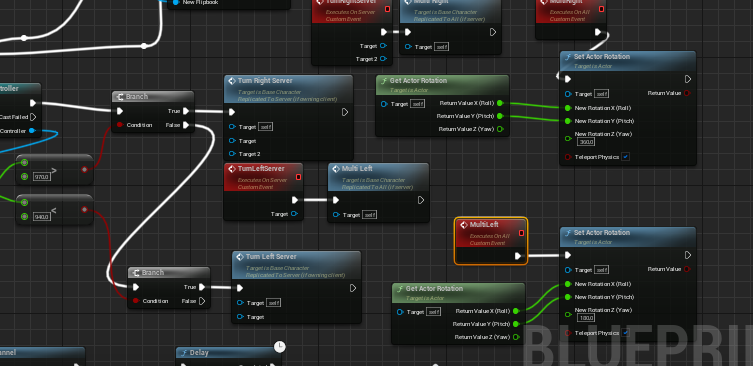
 spark ivy
Hi everyone, I’ve got multiplayer working on my VR game. I’m now trying to setup user profiles so each user can save settings and avatar changes etc. has anyone done this?
My multiplayer is hosted on a gcp server
 low helm
arctic hazel
Question
low helm
arctic hazel
Question
This setup seems to make no sense. You don’t want to do line traces or run other logic from a multicast
arctic hazel
hm? i tought ya always had to multi-cast visual effects
 charred crane
I have a replicated actor containing a 3d widget and a sphere collision. When a pawn overlaps with the sphere collision, I want the widget to be visible only to that pawn. I'm messing around with owner no see and only see, but I'm not sure if that's what i need to do. Any ideas?
crystal crag
From a really high level, can someone explain some of popular methods (even conceptually is fine) for making the player lock their rotation to a target? I've heard that PhysicsRotate is one way its been done. I've looked at that method and I am not quite sure what benefit it would give me over calling say SetActorRotation from the server on the player character's or controller's tick
I originally thought that I would use AddControllerYawInput and just handle it client-side, but I was told in the CPP thread that it was not a good idea to do that.
If you call set ActorRotation on the server, wouldn't it have a better chance to cause corrections?
(which you don't want of course)
so far, I've tried a few things. They all either don't work at all or get me close but have issues. Right now I just have a check in the character's tick to see if the target actor is valid. If so, then try to "lock on" to it.
Super::Tick(DeltaSeconds);

    if(IsLocallyControlled() && AttackComponent && AttackComponent->IsCameraLockedToTarget() && CameraManager)
    {
        const FVector CameraDirection = CameraManager->GetCameraRotation().Vector();
        const FVector CameraZeroedDirection = FVector(CameraDirection.X, CameraDirection.Y, 0);
        const FVector CameraLocation = CameraManager->GetCameraLocation();
        const FVector SourceLocation = GetActorLocation();
        const FVector SourceZeroedLocation = FVector(SourceLocation.X, SourceLocation.Y, 0);
        const FVector TargetLocation = IRaevinTargetable::Execute_GetWorldTargetPosition(GetAttackComponent()->GetLockedTarget());
        const FVector TargetZeroedLocation = FVector(TargetLocation.X, TargetLocation.Y, 0);
        const FVector SourceDirection = GetActorRotation().Vector();
        const FVector SourceZeroedDirection = FVector(SourceDirection.X, SourceDirection.Y, 0);
        const FVector TargetUnitDirection = (TargetZeroedLocation - SourceZeroedLocation).GetSafeNormal();
        const float LoopDotProduct = FVector::DotProduct(SourceZeroedDirection, TargetUnitDirection);
        const FRotator TargetRotation = UKismetMathLibrary::FindLookAtRotation(SourceZeroedLocation, TargetZeroedLocation);
        if(LoopDotProduct > 0.0 && LoopDotProduct < 0.98f)
        {
            if (LastRotationTick.IsZero())
            {
                /*LastRotationTick = CameraManager->GetCameraRotation();*/
                LastRotationTick = GetActorRotation();
                return;
            }
            const FRotator Tmp = FMath::RInterpTo(LastRotationTick, TargetRotation, DeltaSeconds, 0.5f);
            /*UE_LOG(LogTemp, Warning, TEXT("LoopDotProduct %f. Camera Direction: %f %f %f Target Unit Direction: %f %f %f RInterp Rotator Yaw: %f Target Rotation Yaw: %f"), LoopDotProduct, CameraDirection.X, CameraDirection.Y, CameraDirection.Z, TargetUnitDirection.X, TargetUnitDirection.Y, TargetUnitDirection.Z, Tmp.Yaw, TargetRotation.Yaw);*/
            const float turnAmount = (Tmp.Yaw / DeltaSeconds);

            AddControllerYawInput(turnAmount);
            /*SetActorRotation(Tmp);*/
            /*const AActor* LockedTarget = GetAttackComponent()->GetLockedTarget();
            const FRotator NewRot = UKismetMathLibrary::FindLookAtRotation(GetActorLocation(), LockedTarget->GetActorLocation());
            SetActorRotation(NewRot, ETeleportType::None);*/
        }

        /*const AActor* LockedTarget = GetAttackComponent()->GetLockedTarget();
        const FRotator NewRot = UKismetMathLibrary::FindLookAtRotation(GetActorLocation(), LockedTarget->GetActorLocation());
        SetActorRotation(NewRot, ETeleportType::None);*/
    }
    else
    {
        LastRotationTick = FRotator(0, 0, 0);
    }
Am I anywhere close to getting what I am looking for?
dark edge
crystal crag
From a really high level, can someone explain some of popular methods (even conc...
Use the same rotation method you use unlocked
Just when locked, instead of adding yaw and pitch from input, you're setting your rotation (or you can formulate it to still add yaw and pitch) based on some function (look at rotation)
There's really nothing fundamentally different between locked on and not, just now you can't change whatever direction is the locked one, and instead it's updated another way
crystal crag
by "updated the other way" do you mean the server is updating it instead of the client?
crystal crag
I think the issue is I need to rotate the camera / controller. Otherwise I would have to uncheck use controller yaw and I want both the camera and the character locked to the target
so trying to call SetActorRotation on the character class does nothing, because it is taking the rotation from the camera / controller
dark edge
Just update ControlRotation using lock on mechanics instead of mouse/stick input when locked on.
atomic barn
Hi is there any function which one can use to get the pawn controlled by the client ?
pallid mesa
from the client controller you can invoke GetPawn(), it is also in Blueprints
 proud galleon
How can I make an inventory save system on a dedicated server. For example, what should I do to delete everyone's inventory whenever I want. How exactly is it stored?
atomic barn
pallid mesa
from the client controller you can invoke `GetPawn()`, it is also in Blueprints
how do i cast to the client controller though?
pallid mesa
atomic barn
how do i cast to the client controller though?
were are you trying to get the pawn?
pallid mesa
do you plan to have split screen? or multiple players per local viewport?
atomic barn
actually i want to cast to the actor that is being controlled by the client player and check it equals another actor
pallid mesa
I mean use GetOwningPlayerPawn
atomic barn
pallid mesa
I mean use `GetOwningPlayerPawn`
thanks also if i want to create the widget, will it auto assign the player controller if i dont manually assign it via blueprints?
pallid mesa
what do you mean?
pallid mesa
proud galleon
How can I make an inventory save system on a dedicated server. For example, what...
There are many ways to approach inventories, if you use the search function of discord in this same channel you will see multiple breakthroughs... as for doing an action in every client... you'd author these from the server
atomic barn
I mean in blueprints like when u create a widget u assign ‘get player controller’ to the player controller pin, so if I don’t do that will it automatically assign itself the client player controller
proud galleon
pallid mesa
There are many ways to approach inventories, if you use the search function of d...
Thx
pallid mesa
atomic barn
I mean in blueprints like when u create a widget u assign ‘get player controller...
uh, actually I'm not sure, let me check rapidly the source code, don't do much UI these days
@atomic barn It feels like the widget won't be created unless you tell which owning controller will hold it
 atomic barn
pallid mesa
<@763697697722335263> It feels like the widget won't be created unless you tell ...
atomic barn
pallid mesa
<@763697697722335263> It feels like the widget won't be created unless you tell ...
Oh then how do I know which player controller I need to assign to it
chrome bay
The one which owns the HUD that creates the widget