#blueprint
1 messages · Page 398 of 1
 granite nacelle
 vocal shell
so it was working when you had it bound to a different button?
granite nacelle
i was using completed for turning it false
granite nacelle
vocal shell
so it was working when you had it bound to a different button?
yep
vocal shell
changing the button shouldn't affect how it works. im guessing you're deflecting the stick when you push the stick button and your dot product check is failing out
you need to debug that logic to figure it out, we cant tell you by just looking at it
granite nacelle
vocal shell
changing the button shouldn't affect how it works. im guessing you're deflecting...
i removed the dot product to see if it was the issue but it wasn't
vocal shell
where does the execution stop? put a breakpoint on the input node and follow it
 faint pasture
All that your sprinting input should do is signal your INTENT to sprint. Just set bWantsToSprint true and false
vocal shell
that too
faint pasture
your tick should use that as part of the calculation as to whether you are sprinting or not, setting whatever speed and whatever other variables
granite nacelle
vocal shell
where does the execution stop? put a breakpoint on the input node and follow it
i dont follow you
vocal shell
https://dev.epicgames.com/documentation/unreal-engine/blueprint-debugging-example-in-unreal-engine?lang=en-US you sould read it all, but jump to breakpoitns for the specifics

Epic Games Developer
Pause execution using Breakpoints to inspect graphs and the values of variables.
 torn blaze
Anyone here use Rama's Victory Plugin 4.27? I can't get "Get Sound Wave From File" to work. The file is an ogg, the resulting sound wave "is valid" and has the correct duration etc, but doesn't actually play
 torn blaze
Output log says "LPCM data failed to load" but idk if that's an export option in OGG or what
 narrow kite
Does anyone have a simple method to either bind variables to a UMG widget or disable the updating per frame? I know there are a few ways, but they seem rather complex and some include custom C++ code.
 dawn gazelle
narrow kite
Does anyone have a simple method to either bind variables to a UMG widget or dis...
dawn gazelle
narrow kite
Does anyone have a simple method to either bind variables to a UMG widget or dis...
-
Have event dispatchers available that your widgets can bind to, and be sure to call the relevant ones when you make changes to variables within an actor/actor component. Your UI will need a reference to the object that contains the dispatcher so it can bind to it.
-
Use something like the GameplayMessagingSystem that is present in the Lyra Example. This is a means of generically sending a message on a "channel" (a gameplay tag) and anything that wants to listen to that channel can then respond to the message as it needs. It can also use varying structures as payloads to pass along data. Your UI would just need to listen to the appropriate channel. This doesn't require C++ coding, and I think there are people who have packaged it in a plugin so you don't have to try and strip it out yourself from Lyra.
narrow kite
dawn gazelle
1) Have event dispatchers available that your widgets can bind to, and be sure t...
That is correct, but everything I have ever seen on this is missing key information or examples. This image illustrates a basic example. The actual core problem comes from using the UMG widget itself.
What needs to be understood at a more basic level is that all the rules change when doing this. Thus everything you may have normally done is out the window. Such as how to update variables or access them. It's kind of like how rules change from an Event Custom function to a created function. There are "hidden" changes that need to be learned.
In this case it is in fact referencing the text object inside the UMG widget. That's not how I manage any of the data in the entire game. That's where the real problem occurs. Understanding the "hidden changes/rules".
When you know the solution and how it works it may appear simple. This is a different manner of updating variables than saving, binding, calling, and general management. It does not follow the standard rules and seems wrong because it's applied differently.

 dawn gazelle
Your UI should be reading values from other game objects it cares about. The only variables that should exist in the UI are things that the UI itself needs to manage, but the game should be able to function entirely without the UI being present.
narrow kite
This is also another huge part of the problem. You can't type Set Text or drag and do set text There are many text block options including rich text block etc.

In that example when I dragged from the object I go the hover text by typing set text.
Regardless that should be working I'll do a simple randomizer to verify it.
dawn gazelle
The "Weapon Name" is a "Text" object type that pertains to your widget. That "Text" object has various exposed functions that allow you to set and the read the values it contains. So, when you're doing the "SetText (Text)" call, you're setting the variable within the "Weapon Name" "Text" object to that value (which could be displayed in your UI)
Taking "Weapon Name" and doing a "To Text (Object)" I believe would retrieve the actual object name and return the text of that string, which would probably be something like WeaponName_C0 or something weird like that.
narrow kite
Also note in many cases it will be expected to update the information, but not always. In those cases simply updating the object reference on even begin play or construct should work I presume.
The to text object is something that is auto populated on many of the selections.
It's automatically created in that case when referencing the hover.
If you drag off of Weapon Name, what do you type to get the correct node? Because it's not Set Text
If it's even possible without already knowing the answer and mnaually selecting it
There are roughly 100 options when typing set text. That's part of the issue. Especially if you don't already know what is correct.
dawn gazelle
The name of the node is at the top of the node itself. That said, even typing "Set Text" from a Text reference gives me this attached screenshot. The one to use is the one at the bottom SetText (Text).
 narrow kite
Looks like there is a bug regarding that. If you do the search while context sensative is highlighted and then uncheck it you will get that. You need to uncheck it and then do the search again. It won't update properly without that "refresh"
 dawn gazelle
What version of Unreal are you on?
narrow kite

5.7
Might be even buggier then that. I got the menu you displayed one time only.
It might be the other nodes interferecing or cashed data maybe?
 dawn gazelle
Expand the Context Sensitive Arrow at the top right. Can you screenshot what you ahve selected there?

 dawn gazelle
Interesting.
I have Pin Type Class on, and when I turn it off, I see kind of what you see.


Not sure why that would be disabled for you.
I'm on 5.2, but I don't think that would change this functionality.
narrow kite
Ummm now I every time I bring it up the pin type is checked ! lol
narrow kite
dawn gazelle
Interesting.
I'll do some testing and updating to reflect the changes and prevent the unnecessary spamming of updating variables when it's not needed. Thanks for your time.
dawn gazelle
Well, here's an example of an event dispatcher setup in an actor component. This example is assuming the health component would be attached to the player's pawn by the time the widget is created. This would make it so the bound event in the widget trigger whenever "ChangeHealth" is called on the Player Pawn's health component. This would eliminate the need for the UI to constantly ping the health component for the value.
The only trouble with this setup, is that by the time the widget is created the player may not be possessing a pawn, or if their pawn changes mid-game, then it would remain looking at the bound pawn's value. Takes a bit more setup to account for everything, but this is an example of how something like this can work.

 narrow kite
dawn gazelle
Well, here's an example of an event dispatcher setup in an actor component. Thi...
narrow kite
dawn gazelle
Well, here's an example of an event dispatcher setup in an actor component. Thi...
Realistically bindings should simply have an option to disable updating. The UMG's are a core component of creating inventory, HUD, menu's etc. While it's not apparent and hasn't shown to many signs of slow down, it feels like a massive hidden problem.
That is explained well in some videos regarding the matter, but what you really need is a randomization on every bound variable to really see how much spam is created.
The point being almost all menu's should have this revoked. Which means losing the true value of binding. A clean and easy way to design these systems. For health, stamina, etc the updates may be needed, but otherwise most values won't.
 crimson briar
dawn gazelle
Well, here's an example of an event dispatcher setup in an actor component. Thi...
crimson briar
dawn gazelle
Well, here's an example of an event dispatcher setup in an actor component. Thi...
You can also bind to the Pawn OnDestroyed or OnUnpossesed (I think it exists, but not sure, I used OnPossesed though so it should) if you need to clean up or change something.
Or shift the creation and bindings of the widget to something on the character, like a UI Manager Component and reconnect the widget when OnPossesed is triggered or some other event
narrow kite
I'm building out the menu, but it does appear to be working and correctly with the values and lack of upddating per frame.

The view button simply toggles the visibility of the right hand panel. That actually calls other user widgets for the data which is used by the items index. It's just a simple function that updates the data when called. Since the user widgets are linked they can reference each other.
This is needed due to the nesting of UMG widgets
 narrow kite
dawn gazelle
Well, here's an example of an event dispatcher setup in an actor component. Thi...
narrow kite
dawn gazelle
Well, here's an example of an event dispatcher setup in an actor component. Thi...
It's a lot of information to extract and I know it's the result I'm looking for. However, everything about it feels wrong. The association between bindings makes a clean and well established system. Instead I'm taking all the nodes from the bindings and creating them in an unlinked environment which is a lot less organized.
I could create multiple functions to organize the nodes a little better, but it's a complete downgrade vs the binding system. A much better solution would be an option to stop the frame updating or change it. That is an option on the UMG widgets, but it does not apply to bindings.
 dark drum
<@&213101288538374145>
dark drum
narrow kite
It's a lot of information to extract and I know it's the result I'm looking for....
As an FYI, the property bindings in UMG is a legacy feature. Epic would remove it if it didn't break older projects. There's actually an option in the project settings to disallow it altogether.
As for an approach to you issue, using custom uobjects for data can make things like this easier. For example, each item would be its own uobject and contains its data. The item entry widget would be passed the uobject and the widget would update itself accordingly, extracting the information from the uobject.
Having an event dispatcher on the item entry widget for when the view button is clicked also simplifies things. When clicked, it would call the 'OnItemEntryClicked' event dispatcher and pass through the uobject that was assigned to itself.
In the main widget that the item entries are placed, you can bulk bind to the on item entry clicked event and have all of them call the same function. In this function you would get the details widget and pass in the new uobject that was passed through. The details panel would then extract the relevant data it needs from the uobject and update itself accordingly.
narrow kite
dark drum
As an FYI, the property bindings in UMG is a legacy feature. Epic would remove i...
I get most of what you are saying, but it's nearly impossible to match the bindings. They are built into the menu, give drop options for the functions, but also include direct links to the function and separation for things like visibility, color, text.
The way I'm setting it up isn't necessary bad, it's just that everything would in a way be inferior to something that was specifically designed for the widget.
In the example I used it does only update the necessary information. Which in that specific case is all the information on the right hand panel. Including some calculations such as exp progress, and next requirement for level up. When you click view you are essentially viewing a different item so nearly all the data will change.
dark drum
narrow kite
I get most of what you are saying, but it's nearly impossible to match the bindi...
It sounds like you might need to rethink and rebuild how you assemble you're UI. The vast majority of information in the UI only needs to be updated when first displayed or when something changes. Blindly re-pulling and applying is a waste of resources.
UI should be responsive to game events or player input so these are your trigger points.
narrow kite
dark drum
It sounds like you might need to rethink and rebuild how you assemble you're UI....
That is how things are being constructed. Essentially removing the bindings. That menu is different in that it's actually a list view which works differently and already does that.
In that example though that's exactly how it works. When the player clicks view that triggers the update to view the item which they clicked on for more specific details. It's also used in other menu's as a better version of hover text.
So if you want details on what a stat does for example you can click on it and get the information on it from the "detail panel".
narrow kite
dark drum
It sounds like you might need to rethink and rebuild how you assemble you're UI....
The UMG widgets are also stacked together for better utilization. Such as the Header (Drop down menu so it can be inserted into multiple menu's). The main menu isn't actually updating in that example. The right hand "Details panel" is it's own Widget placed in the main menu. Thus it's just updating the right hand side by calling a function on that widget which pulls only the data for the change. Thank you for the input though. I believe it's all being done correctly.
The main issue was previously it used a lot of bindings. And while it looked fine behind the scenes it was spamming all the time.
narrow kite
I need to work on it and clean it up a bit more, but so far
 dark drum
Wrong channel, it should be posted here. #hire-a-freelancer
 tawdry goblet
Hi guys. I'm really struggling with something here - I've got a "bomb" which is a sphere collision which is set to overlap as it's large , on overlap I apply damage set collision , set simulate physics and then add impulse to overlap/hit components/bone name etc, but the characters just flop over from the damage I applied and do NOT get hit by the impulse I've added. Any help please.
 broken briar
what kind of modifiers did you do for this? I assume swizzle but i can't be sure (i might jsut be stupid i am tired rn)
 maiden wadi
broken briar
what kind of modifiers did you do for this? I assume swizzle but i can't be sure...
maiden wadi
broken briar
what kind of modifiers did you do for this? I assume swizzle but i can't be sure...
Swizzle and negate. Mine is set up for +Y forward by default. Which is actually right in Unreal. Negate and Swizzle settings are all default, and Triggers are Down.
 broken briar
epic
maiden wadi
So in this case my W swizzles to change my +Y to +X, etc etc.
broken briar
ye
you are awesome thanks so much
I'm just trying to set up my controls beforehand so i don't hve to go back through once everythign is done and add a bunch of inpout action events and stuff
maiden wadi
Until you need to rebind and you're going back through to add PlayerMappableKeySettings for the options menu. 😄 But yeah I hear ya.
broken briar
heh
yeah
that'll be a problem for later though lol
for now i just want to ahve the access there at all
just making sure i ahve this all setup right, this is it yea?

-# Probably would help if the IA wasn't a boolean type
lol
oh yeah it workin
just uh
not the way i needc it to lmao
anyway ig it's time to trial and error
 fossil patio
I think I'm experiencing an engine bug, but can't find any other reports of anyone running into this problem.
I have two events in my blueprint interface both passing the same reference to and from the same places the same way. one of these events returns the reference fine, but the other one always returns invalid. I have never experienced this before. I'm using Unreal 5.3.2.


 maiden wadi
fossil patio
I think I'm experiencing an engine bug, but can't find any other reports of anyo...
maiden wadi
fossil patio
I think I'm experiencing an engine bug, but can't find any other reports of anyo...
Child classes? My initial assumption is that WasHit is on a child, and isn't passing the data to the parent call?
fossil patio
maiden wadi
Child classes? My initial assumption is that WasHit is on a child, and isn't pas...
unfortunately not, this is the highest parent of this class
i've rebuilt the same set of variables inside of "test event" and it works exactly the way "washit" should, so the problem is technically solved, but i wanted to make sure there wasn't anything im overlooking before chalking this up to an engine bug
maiden wadi
Wild. 😄 I don't use interfaces. I'm curious if you see a valid object before the call? Like I'm assuming that your line on the bottom is the same thing and you're not somehow randomizing from a list or something. But I can't come up with anything that can cause that besides a child class messing with the virtual call chain.
fossil patio
maiden wadi
Wild. 😄 I don't use interfaces. I'm curious if you see a valid object before th...
yep. it's valid going in but invalid coming out
also nope, it's a reference to an animation notify state object
 violet plover
Anyone here has experience with Instanced Structs? I'm trying to create an entity database where every entity has a guid and an array of instanced structs. Then i would add structs for inventory, health, etc. This works well for the initial setup but it seems impossible to retrieve and update these values. For example, when i click save i need to get every interactable actor's transform and update the database. Is that even possible?
maiden wadi
I'm not sure if Blueprint has a by ref getter for instanced structs. You might be in the same boat as maps there where you need to make the copy, set data in it and just write the whole struct back.
violet plover
maiden wadi
I'm not sure if Blueprint has a by ref getter for instanced structs. You might b...
But how do you retrieve the data from an instanced struct? For example, let's say that i want to find an entity that has the Actor struct. I can loop the database and get the struct array from every entity, but how do i check if it has the struct that i want?
 maiden wadi
violet plover
But how do you retrieve the data from an instanced struct? For example, let's sa...
maiden wadi
violet plover
But how do you retrieve the data from an instanced struct? For example, let's sa...
You're kind of stuck doing it like this in BP. Get it(Only valid here if the output matches the struct), copy the value, modify the value, pass the modified value back to the same spot.

The map part also complicates that a little. What is your map of? Guid/Struct, or?
violet plover
maiden wadi
The map part also complicates that a little. What is your map of? Guid/Struct, o...
It's a guid
maiden wadi
violet plover
It's a guid
So more like this. For each key(guid) in the map, get the associated struct's value. Modify a copy. Add that to the map with the same GUID which acts like an overwrite.

Replace Transform here with whatever your struct was. If you have different structs per guid then you need that chaining NotValid thing I did above.
violet plover
maiden wadi
So more like this. For each key(guid) in the map, get the associated struct's va...
Wait, how do you get a make struct node? I managed to get a break node by creating a variable with the type of the struct
 maiden wadi
There should be a Make ST Actor node too. They're auto generated per USTRUCT
 marble tusk
violet plover
Wait, how do you get a make struct node? I managed to get a break node by creati...
marble tusk
violet plover
Wait, how do you get a make struct node? I managed to get a break node by creati...
Something I noticed in that screenshot that you might want to know about: The engine's built-in For Each Loop is just a regular blueprint macro, and inside it uses a Copy version of the GET node, so trying to set it by ref won't work off the Array Element pin of the For Each Loop
violet plover
I can't do a make of any struct in my project
violet plover
It's mine, just a simple struct
marble tusk
Now I want to experiment with Instanced Structs and passing by ref to see what's possible 
violet plover
Can you just right click in your blueprint and find a make struct node?
I can find Make Transform, but i can't do it with any of my structs
maiden wadi
I copied your structs here.

 violet plover
 maiden wadi
O.o That's odd. Engine restart maybe?
Either way. This is essentially what you're after for at least setting STActor's data.
 maiden wadi
Once you start adding more type it's just chaining the notvalids here.

Your STActor looks like this, yeah?

If so, see if restarting the engine fixes your Make search. Bit odd that's missing. O.o
violet plover
maiden wadi
Your STActor looks like this, yeah?
Yeah, just like that
Restarting didn't help
How did you get the Break STActor? Did you just right click in your blueprint?
I can get a break node, but only if i create a variable with the same type as the struct, and then drag from it
maiden wadi
Either that or drag off of the wildcard.
violet plover
Dragging it off from the wildcard doesn't work for me
Also, i noticed that mine says (by ref) when i drag it off from the make instanced struct node, while yours doesn't
maiden wadi
Shouldn't matter in this case. Right clicking on the graph should get you the same thing. 🤔
Two thoughts. Can you add a boolean to the STActor. Save it. And then remove it and save again?
violet plover
Done, nothing changed
maiden wadi
Your Class is Actor type, yeah? Not some other BP actor class?
In the STActor struct I mean
violet plover
Wait, i found the problem. My struct is named ST_Actor but it only shows up if type ST Actor, with a space instead of an underline
maiden wadi
How Unreal™
maiden wadi
Good luck. 😄 Funny enough I'm writing my own savegame stuff atm.
violet plover
My gameplay logic was working fine but i wasn't being able to save it properly, now i'm trying to find a way to store everything in a single place and use it for both gameplay and save logic
 modern cove
I'm a bit puzzled. Usually when my character steps onto the stairs, the Capsule position is where it should be, but sometimes, it shifts downward by the same amount as the difference between the Standing and Crouching Capsule Half-Heights, despite both the built in and my own addtional Crouching variables returning false.


I placed a few UnCrouch nodes at various key points but it still seems to happen sometimes. I noticed it works fine if he has to walk a short distance before stepping down on the stairs; usually when the capsule shift happens, it was when he was at just the right spot to start climbing down without walking to the Stair Top. It does involve pressing Down, which crouches when not near stairs, but still.
 livid flare
Hi guys I'm facing a weird freeze when the character collide with other actors, I can't identify the issue cause it doesn't seems to generate the crash log or anything inside the output. Any idea on how to debug this?
The issue only happens if I use physics on the character mesh
dark drum
livid flare
Hi guys I'm facing a weird freeze when the character collide with other actors, ...
Do you have any overlap or hit event on either the player or other actors?
livid flare
dark drum
Do you have any overlap or hit event on either the player or other actors?
I tried disabling all the logic inside the actors but it still hang
I also tried in a new empty level with just one actor and this time, during the overlap. the character is being teleported at 0 location and his body bones looks wrong
still can't find what happens
dark drum
livid flare
I tried disabling all the logic inside the actors but it still hang
I also tried...
You could try starting a profile before testing. It might show the function call it stalls on.
livid flare
dark drum
You could try starting a profile before testing. It might show the function call...
Oh I forgot I could trace, thanks! I'm gonna give a try
 quasi hearth
hey guys how do I check for when a variable changes? I'm working on a wall-run system and want to do some special thing when they chain multiple wall-runs together (like right wall, left wall, right wall, etc)
so far I have a variable that gets set to either 0 (floor), 1 (right) , 2 (left) , depending on the last surface they touched, and I want to execute some code when it changes from either 1 -> 2 or 2 -> 1, but NOT the other types of changes (0->1, 0->2, 1->0, 2->0)
 fiery swallow
quasi hearth
hey guys how do I check for when a variable changes? I'm working on a wall-run ...
fiery swallow
quasi hearth
hey guys how do I check for when a variable changes? I'm working on a wall-run ...
this is kind of a weird question because you would sort of know when a variable changes when you change it... If you want something to happen every time the variable is set then you could make a setter function. Basically call a function that sets the variable and then does whatever check you need it to do after
alternatively I have seen some people use the built in repnotify condition to automatically call a function whenever a variable has been set. It is traditionally used for multiplayer purposes but you could use it for single player too, it's just a little weird
quasi hearth
oh yeah I think i kinda get it , so like put the branch checking thing inside the part where the variable gets set?
fiery swallow
exactly
just make sure anytime the variable is going to be changed you call that function to change the variable
It's good practice to always do this. You don't really want to be setting variables all over the place all willy nilly
fiery swallow
quasi hearth
oh yeah I think i kinda get it , so like put the branch checking thing inside th...

you could replace that switch with a branch or whatever you need to check
 frosty heron
ideally enum or gameplay tag for state.
 vagrant cobalt
Question
I created a spline BP for our level designer, and he's telling me that he experienced a lot of lag with it, and I'm quite uncertain what the problem may be. Do you have any ideas on what I should do to fix it?
on my computer it runs smoothly with a little bit of drop of FPS and lag will only happen after the spline is way longer
https://youtu.be/rlBt7oBVQyk
This is the spline:
https://www.youtube.com/watch?v=l5W8KdQYI7k


Today we look at a simple setup to make a spline that creates a mesh that you can easily edit for your games. for this exactly we'll use a rail track but you can use this for roads, pipes, or anything you want really!
get the project files here : https://www.patreon.com/posts/mesh-on-spline-86182540
Join the discord for any help you need! : ht...
dark drum
quasi hearth
oh yeah I think i kinda get it , so like put the branch checking thing inside th...
I commonly use setter functions like this. I tend to use an event dispatcher so you can have multiple things listening and do their own thing. This prevents the setter function from getting bloated.
It'll also be a good idea to set the variable to private so it can't be changed from other blueprints without using the function.
 marble tusk
vagrant cobalt
Question
I created a spline BP for our level designer, and he's telling me that ...
marble tusk
vagrant cobalt
Question
I created a spline BP for our level designer, and he's telling me that ...
It has to do with the editor selecting the spline component in the details panel. I assume the lag is caused by the details panel having to update the spline point values being displayed since the lag doesn't happen when the spline component isn't what's selected in the details panel.
The fix is to use this command
Editor.ComponentVisualizer.AutoSelectComponent false
or add this in DefaultEngine.ini
Editor.ComponentVisualizer.AutoSelectComponent=false```The editor didn't auto select the component until a few engine versions ago which is why most tutorials don't have this issue
Note: the command only works for the current editor session, and will reset the next time you load up the editor. So you probably want to add it to the DefaultEngine.ini
vagrant cobalt
marble tusk
It has to do with the editor selecting the spline component in the details panel...
I tried the command but it's still lagging 🫠
marble tusk
vagrant cobalt
I tried the command but it's still lagging 🫠
Make sure the spline component isn't already selected in the details panel. After using the command you might have to select a different actor first, then go back to the actor with the spline
Basically, in the details panel component hierarchy you want it to not have the spline highlighted
vagrant cobalt
marble tusk
Make sure the spline component isn't already selected in the details panel. Afte...
I sent the command while the spine was not highlighted I pressed on other actor and back to the spine and it seems to still be lagging a lot
marble tusk
Then my only other guess is you're maybe adding way too many spline meshes
maiden wadi
It's worth noting that it's lagging even in that guy's video. What you really want to do is not run the construction script while moving the spline, only after. There's a checkbox for it in the actor settings.
Recreating the spline meshes literally every mouse movement is... yikes.
marble tusk
That would help too, unless you really need it to update during the drag
Since it's using the bounding box size you want to make sure the mesh you're using isn't too small or else it'll be adding a lot of spline meshes causing the lag
vagrant cobalt
@maiden wadi @marble tusk That's a great idea, thank you very much. By the way, I'm not familiar with a checkbox to stop construction script, and I just did a custom boolean but I would love to know where I would find it❤️
maiden wadi
vagrant cobalt
<@143471961723371520> <@108727481711738880> That's a great idea, thank you very ...
Uncheck this here.

The "On Drag" one.
Counts for moving the actor, or components within it like splines or their points. Only calls the cosntruction script again once you release the mouse.
 lost hemlock
Hi, I have a problem with my Saving/Loading system. 💾 🔃
It fails to work only on the Initialize of this widget. 🖱️

I have a pure function, and an un-pure function, but they're both the same thing.

The variable that fails to save is this one... ❌

When I declare the Locked to True, then the next time I initialize that will not be properly saved at all.
Oh, and this is how im saving it btw... 🔴 Current status here: Checked to True✅ ... 💾
But on the Initialize... ⌛ ❌ it will be forgotten. 🫤👎

 tropic shuttle
Hellu hellu, Ive come with a weird question. Ive purchased a simple combo pack to analyze the blueprints and learn from them. The combat is where light attacks stagger the enemy lightly and heavy attacks make the enemy fly up. Just curious, where would I find normally find such indicators, for example, if I wanted to switch that the light attack life the enemy and heavy attacks lightly stagger ? Ive found animation montage relations in the blueprint but they dont really go to any values or indicators
crimson briar
tropic shuttle
Hellu hellu, Ive come with a weird question. Ive purchased a simple combo pack t...
Usually you should start tracing from the inputs. Look for input actions related to attacks inside the player character, player controller, or any components that are attached to them and go from there
tropic shuttle
crimson briar
Usually you should start tracing from the inputs. Look for input actions related...
Its a bit interestingly made, ive kinda expected it to go from Enchanced input. but all light and heavy attacks and skills start from custom events

and then the animations are added as variables

from the character blueprint:
 crimson briar
Looks like it was made with the Gameplay Ability System. I myself don't know much about it, maybe someone else will chime in
tropic shuttle
crimson briar
Looks like it was made with the Gameplay Ability System. I myself don't know muc...
thats fine, thanks for it anyways !
narrow kite
Which node allows you to set the image location in a UMG widget? This is an image object

It was from texture, got it.
 jovial delta
I have attack and interact animations and the first time i trigger them they work fine, but if i start them again they freeze at the first frame


 languid hemlock
narrow kite
Which node allows you to set the image location in a UMG widget? This is an ima...
languid hemlock
narrow kite
Which node allows you to set the image location in a UMG widget? This is an ima...
Your widget must be inside of a canvas panel to make it move. Then you can call "Slot as Canvas Slot" and "Set Position" nodes
crimson briar
If it is stateful, make a repnotify variable on the player controller/character.
If it is a message of some kind, yeah, rpc
narrow kite
languid hemlock
Your widget must be inside of a canvas panel to make it move. Then you can call ...
It's a different issue. I'm assigning the value of the variables manually to avoid the binding updates.
maiden wadi
The short answer, you don't.
The longer answer, state doesn't belong on the GameMode. There's a GameState, PlayerState, and Pawns, and whatever else that can have their own state. If it's game wide, it goes on a GameState, if it's related to a player globally, it goes on their PlayerState, if it's a sort of transient gameplay value related to their pawn it goes on their pawn.
You UI then binds and listens to delegates or polls on tick to update the client's version of the state. The actor holding the state replicates it and broadcasts delegates when it changes.
dark drum
Where is the data stored initially?
frosty heron
Sounds like a repeat of anti pattern again.
You should just update the variable, and have HUD or anything that need to respond to it, listen to it.
The extra step is the rpc to client.
The noob way 🙂
Client can just update on OnRep.
Take it or shoot your own foot.
 lilac mountain
Hi! im trying to make a simple enemy spawner that spawns a cube that moves in a straight line then gets destroyed after a set amount of time but Im a little stumped on where to set up the logic and stuck on which way to make the enemies move. Currently I have an enemy spawner that spawns the enemy in a set range. Should I build the movement logic in the enemy BP itself? also is there away to add movement to something or should I set up an on tick event that updates the location every tick?
frosty heron
@peak trail you relaised the variable only get send when the value changes rite?
You r sending rpc anyway. Thats extra. Making it reliable will cost your reliable buffer, marking it not reliable will be unreliable.
frosty heron
lilac mountain
Hi! im trying to make a simple enemy spawner that spawns a cube that moves in a ...
I would suggest Behavior Tree / State trees but I never use state trees my self.
That and followed by EQS if the A.I need to be environmentally aware (which in most cases are).
lilac mountain
frosty heron
I would suggest Behavior Tree / State trees but I never use state trees my self....
Totally honest I dont know what those are yet im super new. im working on a game where shapes come at you and you have to hit them before they get behind you. theyre barely gonna be AI and more or less be a moving collison box
Whats the difference between setting an actors location and setting its relative location?
frosty heron
lilac mountain
Whats the difference between setting an actors location and setting its relative...
Relative location will offset from relative object (e.g parent).
Where set actor location is world coordinate.
lilac mountain
This is how I have it setup right now and my cube is floating diagonally left

 frosty heron
Where do you want to move it? If you want to alwags move the cube forward, use the forward vector.
@lilac mountain cant avoid vector math here. Dive in a little and you can make wonders.
lilac mountain
This is the gameplay screen, you can move lfet and right and click to shoot. im trying to get the cubes to come at the player
 frosty heron
If your cube is like projectile, i would just use the projectile movement comp.
lilac mountain
okok
frosty heron
Come at the player in what way? Like space invader? Again if it only shoot forward then use the forward vector.
lilac mountain
frosty heron
Come at the player in what way? Like space invader? Again if it only shoot forwa...
Yea exactly like that. Im trying to escape tutorial hell by just spam making mini games
frosty heron
lilac mountain
Yea exactly like that. Im trying to escape tutorial hell by just spam making min...
Look into projectile movement component.
Read the doc、there should be one.
Pjm comes with more flavours as such CCD.
Helps with fast moving projectile which would have been missed if you just lerp the actor.
Nu uh, no need physich for that.
lilac mountain
I used projectile movement for my shooting and that worked fine but the enemy actor just goes straight through the floor when its spawned
frosty heron
Optional
lilac mountain
lilac mountain
I used projectile movement for my shooting and that worked fine but the enemy ac...
sim phys is off too
Yes, yes. Overlapalldynamic
There shouldnt be any gravity changing its height tho
Ya it still goes through the floor
lilac mountain
I didnt have that setup
now they dont fall through the floor but I also cant resize my collider now
Ye the boxes clip through the ground now and I cant pick it up in the viewport
 lilac mountain
The projectile movement seems to be moving it downwards and I cant find anything to change its direction in the projectile movement component. When I added the pjm comp to my shooting projectile it went out straight just fine
those spheres are all projectiles that move fine

 hexed pelican
Does anyone have a project idea or an active project in progress?
If you need a developer, feel free to reach out.
lilac mountain
frosty heron
The collider must be the root.
Im pretty sure this allowed the cube to be affected by gravity now. Ive tried turning off all gravity physics and change the velocity in the pjm to be on the X<Y and Z and they all still fall straight to the ground
 lost wolf
hexed pelican
Does anyone have a project idea or an active project in progress?
If you need a ...
lost wolf
hexed pelican
Does anyone have a project idea or an active project in progress?
If you need a ...
i have a cool idea . gta but it's better
 summer sail
Hello guys, I have a question regarding Gameplay Tags.
Unless I'm mistaken a gameplay container carries all tags we set up in the game. So weapons would have tags for AI logic also.
Isn't that too wasteful? Wouldn't structs work best or at least do the same job in a more organized way?
People hype tags so much I feel I'm missing something.
Thanks in advance.
crimson briar
summer sail
Hello guys, I have a question regarding Gameplay Tags.
Unless I'm mistaken a gam...
GameplayTagContainer carries only the tags you put inside of it
Tags themselves are defined in a singular project file somewhere
The biggest advantage of tags is usability. You don't have to type manually each time you want to assign some property, you just choose a tag
summer sail
crimson briar
The biggest advantage of tags is usability. You don't have to type manually each...
Hummm understood, so a missing tag would be the boolean false version.
crimson briar
Uh... what missing tag
summer sail
For example Ai.Action.Attacking
dawn gazelle
A tag not present in the container can be considered that the container is "false" for that tag.
summer sail
if this tag is not in the container than its not attacking
I see. I thought it was a big list of booleans
dawn gazelle
In a way... it is XD
summer sail
Yeah right? Thank you guys!
summer sail
Anything agains me using structs instead? or Gameplay tags has secret optimization or something like that?
dawn gazelle
They're different tools for different things.
Structs are for containerizing data.
GameplayTags are useful for state/flagging things.
summer sail
I see, I`ll keep it in mind, thank you so much for your time guys.
 last peak
summer sail
Anything agains me using structs instead? or Gameplay tags has secret optimizati...
last peak
summer sail
Anything agains me using structs instead? or Gameplay tags has secret optimizati...
A tag is basically you writing a post it note and slapping it on something
Everything else can see this note and then decide what to do with it
summer sail
last peak
A tag is basically you writing a post it note and slapping it on something
Ever...
I think I'm getting it. Gameplay tags won't sent data around, its in the actor. A struct would actually have to be sent to the other entity
crimson briar
Tags are very useful for anything you could think of as "category". You can slap a tag onto something with Item.Consumable.Food.Cooked. And this simple line lets you know that it is an item, a food, and a cooked one. Each stage can be compared depending what you want.
Inventory might care only if the thing has Item tag. A UseComponent will check for Item.Consumable. Fridge will only accept Item.Consumable.Food. And you will get a bigger buff from eating an Item.Consumable.Food.Cooked rather than [...].Raw
It all depends on project needs though
dawn gazelle
summer sail
I think I'm getting it. Gameplay tags won't sent data around, its in the actor. ...
GameplayTags are a variable type.
Structures are also a variable type, but it holds different variable types within it in a package.
Neither of them have anything to do with sending data around.
last peak
I mean ....
If you send a struct your sending the data in the struct
if you want to pedantic even the tag is data
dawn gazelle
If you send a gamelpaytag you're sending the data in the gameplaytag variable <_<
But strictly they don't have anything specific about them relating to moving data around.
They can be moved around regardless.
summer sail
Yeah I couldve worded better
I'm trying to find a way to track an action between a state tree and a AI character BP
I want to avoid having code all over
so I wanted to handle everything inside the BP and just send a message to the State Tree task if its complete, ongoing or interrupted
and some tutorials recommended tags but i got confused on why do that, when structs or enums seem neater.
So I wanted to pick your guys brains.
last peak
summer sail
I'm trying to find a way to track an action between a state tree and a AI charac...
A component
You put a component on your actor, lets say you want to see if your character is jumping
You put a variable(bool) in your component "is jumping", in your character whenever it jumps you set that bool in the component to true.
In your anim bp get owner - get component by class(ai component) - get is jumping
You can also use a base class without component, you put is jumping directly in the character and set it there
In your anim bp get owner - cast to base class - get is jumping
narrow kite
I would bet this is possible, but how?
Each map had a unique String or Text which consists of only 0 and 1's.
A event ID checks that maps variable, but is assigned a specific digit.
So what's needed is to find the value of digit 16 for example.
last peak
narrow kite
I would bet this is possible, but how?
Each map had a unique String or Text whi...
You get the sixteenth element and read its value ?
dawn gazelle
GameplayTags are very much like named booleans, a GameplayTag variable can only contain one of those named booleans at a time, but utilizes a heirarchy, allowing you to have something like mentioned before:
Item.Consumable.Food --- If you had this stored in a GameplayTag variable, then you know that it contains an Item, that is Consumable, and is Food, therefore you can check for these kinds of things.
GameplayTagContainers can contain multiple GameplayTag values, essentially allowing you to store many states that are also hierarchal. So you could have Item.Consumable.Food and Item.HealthGranting within the same GameplayTagContainer and this lets you know that the item is food and grants health and use your logic with that as you need.
Enumerators are roughly the same thing as GameplayTags, but you're limited to 255 options within an Enumerator as they are stored as 1 byte values, and there is no hierarchy. It can only ever contain a single value. In order to get close to the same function as GameplayTagContainers, you'd have to use an array which is less efficient for looking up and more difficult to manage.
Structures contain multiple variables. So you could have it store a GameplayTag, a Boolean, an GameplayTagContainer and an Enumerator all at once. It doesn't really do much else other than this.
narrow kite
last peak
You get the sixteenth element and read its value ?
Correct.
last peak
narrow kite
Correct.
Well there you go
Structures are basically like a backpack for variables
narrow kite
last peak
Well there you go
Get substring, and subtract 1 index?
last peak
narrow kite
Get substring, and subtract 1 index?
You just get the sixteenth element
summer sail
dawn gazelle
GameplayTags are very much like named booleans, a GameplayTag variable can only ...
Oh I see. For items it really is powerful.
narrow kite
last peak
You just get the sixteenth element
I'm not sure what you mean? It's not an array. The array would be each map name. To condense the information all the events would be each position in the string. (Assuming it's a string)
Or how do you extract the 16th "element" from a string? Besides what was mentioned the sub string index.
summer sail
Appreciate all you guys insights. I'm still unsure how to deal with my problem but cons for gameplay tags is much clearer now.
I have all the info to make a decision now. Cheers
dawn gazelle
If all you're doing is trying to manage a 3-phase state, then an enumerator is probably the way to go. Easy to set up. You know that it can only ever be one of those 3 states, and no need to worry about anything else polluting a GameplayTag/GameplayTagContainer. If you want to contain all the potential states of an AI in one variable, then a GameplayTagContainer with appropriate GameplayTags can handle that.
narrow kite
last peak
Well there you go
Sounds like you mean just create a struct with Value 1, Value 2, Value 3 etc. Then find the corresponding struct value?
last peak
narrow kite
Sounds like you mean just create a struct with Value 1, Value 2, Value 3 etc. T...
No
You have a key and you have a value
You can search for the key at index 16
get its value
narrow kite
last peak
No
Thanks. It's probably unnecessary though. I think I will create a few Game Tag - Struct Arrays for it. Saved, Quests, Events etc. So additional information can be added (stage progress for example or unlocked). As well as simple booleans.
The value searching is one of the highest level consensning, but probably not needed today.
last peak
Lets say you have a map with
Test1 ---1
Test2 ---2
Test3 ---3
And a event id comes in
If event id is 3
you get value of Test3
narrow kite
last peak
Lets say you have a map with
Test1 ---1
Test2 ---2
Test3 ---3
And a eve...
That makes sense. I was thinking of it as
001 and pulling the 3rd digit.
Sorting it out. I think it will just be an array of structs. So for example a "mini quest" isn't really a quest in the traditional sense, but it works for this. The struct will allow for a unique ID, progress stage, Boolean.
In game: Pull lever, unlocks door, grants access to point A which after defeating x mob allows access to door B.
That should allow for customizing on the developer side also. Such as "pathway quest" description to help keep track.
Your answer was correct though for what I had originally asked, thanks.
last peak
narrow kite
Sorting it out. I think it will just be an array of structs. So for example a...
An array of bp structs?


Cya in a few days when it breaks 😄
fiery swallow
-# he's hardcore exaggerating but yeah it's way more reliable to make structs and enums in c++
fiery swallow
If its breaking that commonly for you that often then you might be doing something wrong boss
last peak
And then it wont even give proper error messages noooo it just spills out some gargle and you have to whip out a crytal ball to find where it broke
fiery swallow
Its always been a simple process for me. Anytime you make changes to a blueprint struct its best to recompile everything that uses that struct because sometimes the engine (for some reason) doesn't always catch it for you.
In the case that the engine doesn't catch it and prompt you to resave and recompile, then you'll get some pretty weird nonsense issues for sure. But in the last 7 years I think ive only experienced one genuine struct corruption and that was when I used a plugin
last peak
Yee.... untill your editor crashes, you boot it up again compile - editor crashes - you boot it up again - rename struct - ohh cant believe that fixed it - you hit paly 400000 errors during play, error messages dont tell you anything
Granted i havent used a bp struct in a while i started to just do them in c++ and be at peace with my life 😄
fiery swallow
In 7 years thats never happened to me. And ive worked on too many blueprint only games lol
last peak
Your very lucky then, its a common issue as i found out when i tried to find a solution for it
fiery swallow
From unreal engine 4.20 to 5.7 I've been coding in both blueprints and c++. upgrading project versions, downgrading project versions, shipping projects, diffing blueprints, ripping blueprints, and packaging gives and solving packaging errors. To say that it's luck that I haven't run into this struct problem of doom is a little silly especially when I have a project that has been live service for 5+ years and is filled with them

 graceful sage
fiery swallow
From unreal engine 4.20 to 5.7 I've been coding in both blueprints and c++. upgr...
graceful sage
fiery swallow
From unreal engine 4.20 to 5.7 I've been coding in both blueprints and c++. upgr...
I think it depends how you use them in the graph or something.
When you change them
fiery swallow
Yeah, for me I try my best not to make changes to blueprint structs depending on how big they are and how used they are around the project. Sometimes you have no choice but to edit them though, and in those cases. You simply just need to not rely on the engine and recompile everything that touches it manually
I'm all for pushing people to use c++ structs though, they're better in every way and almost makes this problem obsolete
it's takes 2 seconds to make c++ structs and it's not that hard to learn how to do it
graceful sage
Right. I only had it happen when I was new and wasn't aware of it. But following the method I mentioned stopped it from happening
Ofc c++ is better too
fiery swallow
It's a little bogus that we had to learn these do's and don'ts with blueprint structs though haha
I don't really understand why they don't put more effort into solving the quirks
everyone engine has a few quirks and issues that need to be learned to avoid though, it's unavoidable
 loud vessel
fiery swallow
Yeah, for me I try my best not to make changes to blueprint structs depending on...
loud vessel
fiery swallow
Yeah, for me I try my best not to make changes to blueprint structs depending on...
Hey Moxie.
What if I told you there's an easy 2 minutes way so you don't have to recompile them manually? 😉
fiery swallow
loud vessel
Hey Moxie.
What if I told you there's an easy 2 minutes way so you don't have to...
I'd think you're selling me pixy dust. Unless there's some cool utility widget stuff that I don't know about
utility widget's have some really good stuff that I wish they would talk about more
last peak
For just 199.99$ he will tell you
loud vessel
fiery swallow
I'd think you're selling me pixy dust. Unless there's some cool utility widget s...
Yup, it's one I made 😉
Check it out, and tell me if it actually works for you ❤️
https://www.youtube.com/watch?v=IqsSOiKnijE

We got "Fix unknown struct" before GTA6..... what a world.
My FREE Plugin: https://www.fab.com/listings/fa599c9d-6c92-4917-ae4e-7a506f5e97a5
"""Support""": https://discord.gg/aaQv8bhbFy
Forums Post: https://forums.unrealengine.com/t/unknown-structure-fixer-plugin-tool/2715731
(Make sure to check it out, it has all information you'll need.)
The...
It's free 😉
fiery swallow
last peak
For just 199.99$ he will tell you
unironically I was waiting for it too 💀
fiery swallow
loud vessel
Yup, it's one I made 😉
Check it out, and tell me if it actually works for you ❤...
wow free, I'll definitely give it a try that's awesome
I'll just first have to wait for one of my structs to break
loud vessel
And hey, if there's anything wrong with it, feel free to ping me here, or DM me directly. 
loud vessel
Mhmmm yup, though I'm not using any ""custom"" code.
It's all engine functions.
fiery swallow
not to say that your work isn't awesome yeah
I can see you are doing something quite interesting and clever
 ruby cobalt
can we crossfade between two material instances?
here's how I would do it. load MI as assets, fetch their parameters, store to struct.
drive a "main" MID with the struct.. crossfade between the values of 2 structs at once.
Is there a better way?
can you actually fetch the params from an MI?
I got a pretty dense material that I like to animate as if the parameters were synth parameters.. but turns out it takes forever to map everything.. it would be easier to just create a bunch of presets, one MI each
that's what makes me think I should crossfade MI
violet plover
I need to create subsystems for my game but i don't want to use cpp. Is it ok if i just create all my functions and variables at the game instance and organize everything or there would be some kind of consequence later on?
fiery swallow
violet plover
I need to create subsystems for my game but i don't want to use cpp. Is it ok if...
You can just create an actor that spawns on beginplay from the gamemode
You would usually do this for managers or beacons
If you really wanted to use gameinstance you could but thats not really what its for. The only consequence would be bloat eventually
violet plover
Yeah, i think i'm gonna use actors. They don't hold data, i just need to be able to cast to them anytime and everywhere
I tried with objects first but plugging world context everywhere looks really bad
 next hollow
I would suggest/ prefer a component.
No need to do any GAAOC, or some direct var.
(granted, not like those would make or break a game)
violet plover
But i need to run logic on entities that aren't actors
last peak
violet plover
But i need to run logic on entities that aren't actors
Wut?
how are you gonna do that ?
Are the entities objects atleast ?
violet plover
No, just structs identified by a guid. This is why i need subsystems/managers
last peak
is there a reason why you dont just turn em in uobjects ?
violet plover
The data is stored in a database, and the logic would run in a subsystem. So the uobject would be empty.
I'm trying something similar to a mass entity system
narrow kite
Is this a legitimate alternative to doing a while loop to search for an item?
 dark drum
narrow kite
Is this a legitimate alternative to doing a while loop to search for an item?
dark drum
narrow kite
Is this a legitimate alternative to doing a while loop to search for an item?
Nope.
narrow kite
dark drum
Nope.
Does it even work? Or is it just a poor way to code it?
It did work with a MAP (String - Int)
Well it wasn't a struct in that case so it wasn't breaking down that part, but it did function.
dark drum
narrow kite
Does it even work? Or is it just a poor way to code it?
The find would look for a struct with the exact values for all properties as you have listed on the node.
narrow kite
dark drum
The find would look for a struct with the exact values for all properties as you...
So you mean Event ID 0 for example would always result
marble tusk
You could use a MAP which has the Quest Name as the key and the struct as the value
dark drum
narrow kite
So you mean Event ID 0 for example would always result
Yep and the completed bool being false and the Map Id being empty.
narrow kite
marble tusk
You could use a MAP which has the Quest Name as the key and the struct as the va...
That was what was orignally created except it used just a int value instead of struct. That may be what I need though
The errors are only due to the changes in variable types. Otherwise it would like more like this
 dark drum
I find using custom uobjects for quest systems much nicer than structs.
Or even data assets with a custom uobject for runtime data.
You can use soft class references as the keys and makes it easier to identify what quest something is. Regardless of it's names.
narrow kite
dark drum
I find using custom uobjects for quest systems much nicer than structs.
Or even...
I keep looking up uobjects, but the examples don't seem to convince me.
The map text or string to struct should provide all the infomation needed. I'm not sure what else would even be missing. The struct would allow for special additions such as a boolean for complete status or any other variable type.
Also a compiling question. Changing the variable types can cause a lot of errors in blueprints. Most of them will be auto found. However, in this case everything froze up and I wasn't sure why. I think it's because the specific map I tried to switch to had blueprints with errors. When the map tried to load it then locked up everything. Because switching maps saves the player data including the map it couldn't play at all after that.
How would I do a more universal find for blueprint errors?
dark drum
narrow kite
I keep looking up uobjects, but the examples don't seem to convince me.
Wait till the scope changes and you need to refactor the whole system because you needed an additional property for a handful of quests. 😉
Also the quest manager would end up bloated handling the logic for Every type of quest. Using a custom uobject allows you to offload some of this logic specific to the quest. Normally of which is just binding to event listeners and notifying the quest manager when all tasks have been complete.
last peak
dark drum
I find using custom uobjects for quest systems much nicer than structs.
Or even...

But what about the overhead?
I DONT CARE ABOUT THE 10 KB OVERHEAD FFS
narrow kite
dark drum
Wait till the scope changes and you need to refactor the whole system because yo...
A lot of that data is being off loaded to instanced BP's. For example a Sliding Door BP. Each placement is it's own instance. The requirements for opening the door, display messages, etc are maintained on exposed variables for that instance.
 raw onyx
I just got basic implementation of my quest system working earlier this week. My quest manager is a Uobject. I use data assets as my design tool for my quests which is just a few structs that I fill values of. Those I put into a SETs. On begin play I do a for loop and copy those structs from the data assets in the SET into the relevant quest maps of quest name and strut and boom all my quests then have their default values in the system
dark drum
narrow kite
A lot of that data is being off loaded to instanced BP's. For example a Sliding...
The quest system shouldn't be a part of your game world. It should sit on top of it observing.
Ultimately, bar giving or taking away a quest, nothing should really know it exists.
narrow kite
dark drum
The quest system shouldn't be a part of your game world. It should sit on top of...
The "quests" I'm using are not traditional although it should work for all. Such as can you go through through portal? And what the requirements are. Those requirements and portal function exist on that instance. Where it ports to, and can you use it.
For saving purposes on permanent progress I simply need to save a minor amount of data which is what this is regarding.
raw onyx
My quest system doesn't have any references to any actors by design. I have my objects and interactables in the world get reference to the quest manager only if they are an objective object, and then just do the update function from it with revelant information, so it's all very self contained
last peak
Any reason why you should not just slap it in a component attached to the player ?
narrow kite
Also for more complex tracking, but still condensed into a single INT for example. Such as multiple switch/level positions resulting in various results. In which the BP instance would control the event. Such as the wall pathway is removed so you can down a path IF the levers are positioned in a specifc manner.
dark drum
last peak
Any reason why you should not just slap it in a component attached to the player...
Id go with player controller or player state. 🙃 Game state if you have shared quests? 😅
raw onyx
My quest manager gets constructed by the game instance since mine is single player, player state is a good option if multiplayer
dark drum
raw onyx
My quest manager gets constructed by the game instance since mine is single play...
My only concern with using the game instance would be with it persisting across levels. Have you run into any issues when you change levels?
raw onyx
dark drum
My only concern with using the game instance would be with it persisting across ...
I'm using instanced levels so that's not an issue
narrow kite
dark drum
The quest system shouldn't be a part of your game world. It should sit on top of...
I think I get what you are saying but in this case quest/event/tracking are kind of the same. I don't see much issue except for lookup putting the data on instances.
If I have 60 portals in the game it seems to make sense that each instance contains it's own data. Regarding use and where it goes. In the same manner a door may display a "hint" if you can't open it. It makes sense for that hint to be a simple text variable that is set on only that door.
dark drum
If it was a c++ project I'd probably just make a player subsystem for it.
I wish they'd add a way to make them in BP.
raw onyx
Don't get me wrong constructing a Uobject is pretty simple but then you also need to either implement interfaces or cast and possibly pass around the reference if needed. If it was subsystem wouldn't need that extra layer of logic to do
dark drum
narrow kite
I think I get what you are saying but in this case quest/event/tracking are kind...
I'm not saying it wouldn't work, just not a good way to handle it. Scalability wise it can become a pain quickly when the scope changes.
Portals should function without a quest system.
dark drum
raw onyx
Don't get me wrong constructing a Uobject is pretty simple but then you also nee...
I tend to use hierarchy. I've also split quests into tasks and listener objects for reusability.
narrow kite
dark drum
I'm not saying it wouldn't work, just not a good way to handle it. Scalability w...
"Quest system" may be confusing the issue. It's more about a simplistic relationship between control variables and game design. For example a portal may require you have to completed a quest, or player level, etc. It's a simple validation process rather than a "quest system". Even if the data was maintained in a struct named event or quest.
raw onyx
dark drum
I tend to use hierarchy. I've also split quests into tasks and listener objects ...
That's fair. I just have objects check their data asset if they are an objective item, if true then it gets the quest manager reference from function in my BFL
last peak
raw onyx
Don't get me wrong constructing a Uobject is pretty simple but then you also nee...
Whats wrong with casting to a single object? 😄
raw onyx
last peak
Whats wrong with casting to a single object? 😄
Well the cast is also doing is valid check aswell which in this case wouldn't be necessary
 dark drum
narrow kite
"Quest system" may be confusing the issue. It's more about a simplistic relatio...
dark drum
narrow kite
"Quest system" may be confusing the issue. It's more about a simplistic relatio...
Id just have an 'active' state in the portal. When the relevant quest is completed, it (the quest) sets it to true. The portal would never know about the quest, whatever it would be.
The quest quest could be for reaching X level, jumping 10 times or standing in a specific spot for X seconds, the portal shouldn't actually care.
dark drum
last peak
Whats wrong with casting to a single object? 😄
Cast, cast and cast away. If you have issues structure your stuff better. 😅
raw onyx
last peak
At that point.... just throw your machine away 😄
I'm sure many of us want to do that sometimes with Unreal Engine lol
last peak
Cast to Motivation
ERROR:Accessed None trying to read property: WillToLive
narrow kite
dark drum
Id just have an 'active' state in the portal. When the relevant quest is complet...
I wouldn't do this, but as an example. The 60 portals all have different level requirements. When you level up wouldn't an entire data table / loop / or some method be needed to validate every area you might have access to?
 tacit rampart
silly question but when I spawn the character hes always halfway in the ground, is there any way to move it all up? capsule component is root but I don't really want to copy everything over to a different bp ;-;
 narrow kite
tacit rampart
silly question but when I spawn the character hes always halfway in the ground, ...
narrow kite
tacit rampart
silly question but when I spawn the character hes always halfway in the ground, ...
Is it Shift + End or CTRL End to place on ground? Could be your placement of the object in the game.
raw onyx
I was literally about to ask where in the world the spawn location is
tacit rampart
it does work but any child actors don't for some reason?
child v parent lol

moreso worried when I try to spawn them in... I could add 90 to their spawn transforms but I'm worried if that would cause issues
narrow kite
tacit rampart
it does work but any child actors don't for some reason?
Drag up the right actor and press the END key should place it on the floor. A good spawner comes with a box placement. Which does multiple things including ensuring they are on the ground. Random location within box etc also.
last peak
Its weird that it even lets you spawn it in like that tbh ...
dark drum
narrow kite
I wouldn't do this, but as an example. The 60 portals all have different level ...
No, that would be the role of the relevant quest.
'Hey, the players have done these things, I should go set these portals to active.'
The portal then only worries about its active state.
tacit rampart
narrow kite
Drag up the right actor and press the END key should place it on the floor. A g...
oh I see ty, ctrl+end does work! If I'm spawning it with SpawnActor is there an equivalent? Or should I just add 90 to the transform
narrow kite
tacit rampart
oh I see ty, ctrl+end does work! If I'm spawning it with SpawnActor is there an ...
I got rid of the original code, but it was something like this. Just look up a spawner video for it. It's about placing the spawn at a location and determing the height to prevent that issue.
 tacit rampart
ooh smart thanks!
narrow kite
tacit rampart
ooh smart thanks!
Find the floor. It will draw a trace up to -3000 in that case until it collides with the floor. I use that for the z axis for skills that I want to display on the ground for example.
 tacit rampart
probably a good idea to have this anyways lol seems more accurate to double check
tysm!
narrow kite
Spawns a niagara effect on the ground, Modified +20 in this case since the effect doesn't belong exactly at 0.

The socket is just the x/y coordinates to match the player. That z location is the height.
dark drum
tacit rampart
moreso worried when I try to spawn them in... I could add 90 to their spawn tran...
Personally, whenever I spawn a character in, I tend to add the capsule half height + 1 to the z location. (Assuming it's on the floor) It can help prevent them falling through the floor.
narrow kite
dark drum
No, that would be the role of the relevant quest.
'Hey, the players have done t...
That's not accurate for that example. In the example the player level is dictating whether the player can use it or not. In all examples that data resides on the BP instance. The only thing being addressed is the validation.
In your example the validation would occur when the player levels up. Because in the example that is the requisite. Thus in order to toggle each access the level up process would need to chain through every possible enabling every level up.
It would then "enable the portal variable", but it would need to do that every time as that would be the only correlation.
While I'm suggesting when you go to use the portal it simply checks the player level vs the instances level requirement.
Another example is bashing a wall down. It would take the instance value requirement and check your Bash Mastery + (Str/12) to determine if you meet the requirements to successfully break down the wall. I know that's going outside the scope of "quest", but those are real examples.
narrow kite
dark drum
No, that would be the role of the relevant quest.
'Hey, the players have done t...
Also one last thing. What you made makes sense, but I'm sure the separation is really possible. The main issue is saving the data. Which means it needs to be maintained in some type of array/struct. Not an individual variable pertaining to that instance.
Thus it's not really possible to separate them. Regardless of where it's assigned the instance would need to validate the stored information. So it's going to some saved structure either way.
Meaning the entire structure would be the same and the only point would be trying to separate them via when they are updated/validated.
Actually they are tied together more then that. The "quest" may already be the updating location. For example an INT that tracks stages. In which case multiple events use that INT to determine outcomes. If the progress is 4+ then (x door opens).
In that case it's not about relating it to that event as "grant access". It's a simple INT value that could effect 12 locations, but only using 1 variable to do so. Which is also natural progression for a quest. If > 6 then (event is available to move to 7)
Also things like quest text changes depending on the INT value. While all of these things are tied to a single Quest/Event variable inside the struct. The NPC in this case also doesn't need any updating. It simply uses the same validation of the INT value to determine possibly multiple responses.
And maybe a data table or excel sheet if deemed necessary for tracking. Such as Value: 4 - Opens West door Value - 6 Changes NPC Yuri text. Or in the struct itself. If there is an easy way to read the info from the editor. I'm not sure structs would do that without making nodes to print the output.
last peak
narrow kite
Also one last thing. What you made makes sense, but I'm sure the separation is ...
If 1 portal activated - get quest component
As quest component - int++,
if int >= 3 && stage 3 - complete quest
dark drum
narrow kite
Also one last thing. What you made makes sense, but I'm sure the separation is ...
From what you've described it seems like you have multiple potential systems in play.
Quests and Stats jump to mind. These would save/load their own data and other actors can query the individual systems.
GetQuestManager -> QuestCompleted
GetStatsSystem -> GetCurrentLevel
As requirements get more complex, it can be better to bundle it into a single quest. It doesn't even need to be player facing. (Doesn't appear in any UI)
This can be nice because other systems can also utilize the same thing where the quest system becomes more of a global state validator.
narrow kite
last peak
If 1 portal activated - get quest component
As quest component - int++,
if int ...
In this case it's not really a "quest component". It's just store value. The instance can update the variable.
last peak
To me it seems like your overcomplicating things .... maybe i just dont understand what your trying to do ....
narrow kite
dark drum
From what you've described it seems like you have multiple potential systems in ...
It is essentially globally accessible because the main array exists on the player. Thus any event can pull the data it needs to validate, update, determine outcomes.
The stat vs quest doesn't really have to be separated in that manner. That feels almost 100% game design related. For example, to help show the player they can break through walls they will do so in a starter map. That doesn't save, it is put into an event array though.
It's more of old school hidden areas and metroid/zelda unlock content via progression. In that case it's only temporarily saved the instance knows whether to make the wall visible and collision.
However, some could rely on a quest which is more of a scramble. Talk to X NPC, kill x, get x item, Unlock X door, Talk to Y.
last peak
@narrow kite
Is this what you want to say in essence ?
I think the quest state should be saved centrally, for example as an integer or struct.
Then doors, NPCs, and events can check that value when needed.
For example:
Progress >= 4 opens the west door.
Progress >= 6 changes Yuri’s dialogue.
Progress >= 7 unlocks the next event.
So I’m not sure it makes sense to fully separate quest progress from world events, because they often depend on the same saved state.
narrow kite
I think the main thing to emphasize though is utilizing a single INT variable to control 40+ events while only saving 1 single value. And stemming everything off that. Instead of a mash of variables.
narrow kite
last peak
<@219514604475252736>
Is this what you want to say in essence ?
I think the que...
That is correct, but the game design itself can over ride or dictate things. For example a portal might be restricted by level, or part of a quest, or other factor. So in some cases it's a quest objective while another portal may not be quest related at all.
Also things like Progress >= 8 "Spawners will create these mobs"
Which don't exist otherwise, but again all ties back to the same INT
Also there are some distinctions. In the case of "breakable walls" it's not part of this system. It's a good example though.
- It establishes the player can break walls and should look for them
- It's fun to break into areas and see the effect
- It utilizes and helps the player understand the value of STR + the Vocation Bash
But in most cases that's just a fun little event to find a hidden grind area or shortcut
last peak
But why does the quest system need to know about specific actors is what i dont understand
Like cant the spawner not just have a set rquirement
It asks the quest system - are the requirements fullfilled? and if yes it spawns enemies
Seems more modular
narrow kite
last peak
Like cant the spawner not just have a set rquirement
It asks the quest system -...
That depends on the circumstance. For example a portal requirement may require a quest line. The spawns could change depending on quest progress. NPC text etc.
It's can in cases be used like an old school JRPG system in which you are locked out of areas intentionally until you follow the quest line
last peak
I agree with that, but I think that still fits the requirement based approach.
A portal can require a quest line, a spawner can change based on quest progress, and NPC dialogue can check quest stages.
My point is just that the quest system does not need direct references to those specific actors. It only needs to store and expose the quest state. The portal, spawner, or NPC can own their own requirements and query that state when needed.
So it can still support old-school JRPG-style progression locks, but without the quest system directly managing every world actor.
narrow kite
You could spawn gaurds that won't allow access until quest conditions are met. This would use the same systems as discussed.
narrow kite
last peak
I agree with that, but I think that still fits the requirement based approach.
...
That is what's being done. Patty's main point was trying to tie the data to the event. Which in many of these cases may not be feasible.
So the quest would "unlock" the portal for example. Which makes sense, but may not be needed.
Well one of the points. Patty will speak for himself I'm certain 🙂
dark drum
last peak
But why does the quest system need to know about specific actors is what i dont ...
It would depend on the quests but i'd argue that a quest system would need to know about a lot of actors. Some of the best quest systems I've made rely on event dispatchers which only work if the quest can get a ref. Of course there's ways to tag and get these actors without making a specific reference such as an actor manager type thing.
narrow kite
dark drum
It would depend on the quests but i'd argue that a quest system would need to kn...
I think there is a strong value in "instance cheating" to save data in a sense. Because they can hold unique information. Such as the text response, hints, multiple out comes, visibilty, etc.
That was part of the first order problem though. How to manage and track so much information in a small amount of variables.
With a simple label/text/string attached to an array of structs all the save data can be pulled.
last peak
dark drum
It would depend on the quests but i'd argue that a quest system would need to kn...
Im trying to wrap my head around a good architecture, both dont sound too bad, i have not done that amny quest systems so im unsure what the best way is
What would come to mind are more generic events in the quest system with a identifier "enemies killed input stage X"
For example
narrow kite
last peak
Im trying to wrap my head around a good architecture, both dont sound too bad, i...
That's why I wanted a struct instead of just a map value. So more specific data can be handled.
last peak
But event dispatcher might work just as well
narrow kite
Even dispatcher would still need to pull the data. There is also a major difference between saved or temp info.
Instance Blue Prints could handle most anything. Change lighting, spawn special mobs, change assets.
crimson briar
Uh. From what I followed in this discussion it all just seems to end up at "it depends". It is better to just do the thing and see if it works instead of theorizing for hours, I think
narrow kite
You could use old school cheats and load a different copy of a burned down town
narrow kite
crimson briar
Uh. From what I followed in this discussion it all just seems to end up at "it d...
Not quite. The "how" is essential for this. And also why (why/pro's cons)
If you just did a string variable for each quest that would result in major problems. Such as a massive list of variables, and how to save them.
dark drum
To me though, I don't think quests would normally generate much of their own data. In the event it does, its normally just an int or a float. For these, I just convert to a string and append together. The string then gets stored with the quest class during saving.
Like this.
 narrow kite
dark drum
Like this.
narrow kite
dark drum
Like this.
That's really not much different. It does include a few key aspects if they are used in a game though. Such a quest completion list or ongoing quests.
I could place an Objective text in the struct for that though. And Status (ongoing, complete, na) etc.
Since some of mine may be more of puzzles than traditional "accept quest". Such as randomly finding a door and being given a hint on how to open it. That instance will give you a clue, but could also update the status to ongoing.
I presume you blocked that off as 1-500
PattyM suggest Uobjects so much my spidey sense thinks he might have a sponsorship with them 😉
dark drum
narrow kite
Since some of mine may be more of puzzles than traditional "accept quest". Such...
For me I think id still handle it as a quest but one not visible to the player.
The door would have an overlap event that would add the quest. The quest would then keep track of what the player needs to do to unlock the door. Plus, you can have some sort of quest/task initializer event that can set the scene as it were. In the screenshots, I have one task enable a door so it can be interacted with then a listener that is informed when the repair has been made.
If the above would be a frequent type of quest, I could expose the tag used to get the relevant door so it can be subclassed.

 dark drum
narrow kite
PattyM suggest Uobjects so much my spidey sense thinks he might have a sponsorsh...
dark drum
narrow kite
PattyM suggest Uobjects so much my spidey sense thinks he might have a sponsorsh...
UObjects are awesome. 😄 Actors are uobjects, Actor Components are UObjects. Even the actions you can perform in BT's are uobjects. 😛
I wish there was a way to make them default to instanced (when required) without C++ though. :/
raw onyx
I will way it's interesting to how different people approach things, like with quest systems we've been talking about
narrow kite
dark drum
For me I think id still handle it as a quest but one not visible to the player.
...
That would only require minor modifications that probably needs to be done anyway for player convivence. The door already has a collision overlap box which pulls the data and responds.
A -- It opens
B -- It posts a hint
I can simply update the struct to accommodate quest tracking
dark drum
raw onyx
I will way it's interesting to how different people approach things, like with q...
It is interesting. The hardest part I find is understanding the reasoning. It's not always easy to get the vision in a 30 minutes conversation to know why some choose to do something a particular way.
I'm too indecisive at times so I try to make my stuff as flexible as possible in case I change my mind. 😅
last peak
narrow kite
PattyM suggest Uobjects so much my spidey sense thinks he might have a sponsorsh...
because they are awesome
The single best thing in the engine
Super easy to work with
Cheap
Wont break
Its like a Cow - chicken - sheep
dark drum
These are the main classes for my quest system, 3 of which are uobjects.
 narrow kite
last peak
because they are awesome
narrow kite
last peak
because they are awesome
That can be said about almost all the aspects at some level. A MAP, struct, data table, enum, array etc.
last peak
narrow kite
That can be said about almost all the aspects at some level. A MAP, struct, dat...
A struct is annoying to work with and prone to breaking
A map can only hold a key and a value
A uobject can do everything you want
dark drum
Data Assets are just single instance uobjects. (like static meshes, textures etc..) Its nice to have helper functions to get specific data.
narrow kite
last peak
A struct is annoying to work with and prone to breaking
Technically maybe, I break structs quite often 😉
 last peak
narrow kite
Technically maybe, I break structs quite often 😉
last peak
narrow kite
Technically maybe, I break structs quite often 😉
Get - variable you want
with a uobject
dark drum
narrow kite
Technically maybe, I break structs quite often 😉
This is the sort of stuff I try to avoid. It's bitten me too many times. 🥲
last peak
last peak
with a uobject
It wont get any more convinient than that
narrow kite
dark drum
This is the sort of stuff I try to avoid. It's bitten me too many times. 🥲
I have heard of a few issues, but honestly never encountered a problem with them.
dark drum
narrow kite
I have heard of a few issues, but honestly never encountered a problem with them...
Yea it doesn't happen very often but when it does it can be a nightmare.
dark drum
last peak
can just access member with ->
Plus you can add functions to C++ structs.
dark drum
last peak
in cpp i would probably use structs
If it needed to be exposed to BP i think I'd struggle to pick lol.
raw onyx
BP structs are fine but you just have to avoid doing certain things otherwise very good chance things will break eventually
last peak
u objects all the way, every day
i just don see any pro that a struct has over a uobject
besides the minimal overhead in the object
dark drum
One thing that I like about structs in C++ is you can have pointers to them. Unfortunately, you can't in BP. Its always a copy. 😕
raw onyx
C++ structs are better for sure there's no doubt about that
narrow kite
dark drum
One thing that I like about structs in C++ is you can have pointers to them. Unf...
Does this apply to that?
 crimson briar
Yeah, refs for structs are wonky. It seems like they exposed some operations but not others so it often breaks the link at some point anyway
dark drum
narrow kite
Does this apply to that?
Sort of but that's only for the specific index in the array. Once you try to store it in another variable it becomes a copy. You can use the (a ref) version and 'Set Member' to update the values in the struct in that specific index in the array.
crimson briar
Also I'm too in the club of never using BP structs after way too many issues with them
narrow kite
Maybe I got lucky so far, but this does update the value of the struct
 dark drum
narrow kite
Maybe I got lucky so far, but this does update the value of the struct
dark drum
narrow kite
Maybe I got lucky so far, but this does update the value of the struct
Yea, in C++ you could store a ref to the actual pointer and pass it around if you needed.
dark drum
crimson briar
Also I'm too in the club of never using BP structs after way too many issues wit...
I still use BP structs but try to keep them small and get very nervous if I ever need to remove/rename a property. Most of the time I'll just leave it. 😅
I was recently thinking about adding a little quest system to my current project. Mainly for collect type quests. I still need to decide how I want to handle it.
maiden wadi
Flowgraph.
crimson briar
dark drum
I still use BP structs but try to keep them small and get very nervous if I ever...
After you get used to it, it is just way too easy to add the struct as C++ class
 mental trellis
References in BP are a lie.
dark drum
crimson briar
After you get used to it, it is just way too easy to add the struct as C++ class
True, plus you can always create it in BP and look at the header preview.
 full badge
last peak
A uobject can do everything you want
full badge
last peak
A uobject can do everything you want
serializing is kinda pain tho
last peak
full badge
serializing is kinda pain tho
Ok, that the only really annoying thing with them
full badge
last peak
Ok, that the only really annoying thing with them
i just made a savegame object and use them as uobject but i think it will break gc
maiden wadi
full badge
serializing is kinda pain tho
How so?
full badge
with pure bp
maiden wadi
RIP
full badge
i hate it when 90% of serializing stuff isn't exposed to bp
full badge
full badge
i just made a savegame object and use them as uobject but i think it will break ...
im doing it like this, but i think bp constructed savegames won't get gc
 maiden wadi
Yeah. Specially since it's literally about 22 lines of code including the header, to save and restore an object. Or more accurately to write an object's properties to byte data, and then push byte data to an object. Doesn't necessarily need to be the same object, or even the same class to work.
full badge
maiden wadi
Yeah. Specially since it's literally about 22 lines of code including the header...
i wish i can do this but im mostly modding game and i can only use bp 😭
maiden wadi
full badge
im doing it like this, but i think bp constructed savegames won't get gc
They'll be collected if nothing references them. They're like any other UObject.
full badge
maiden wadi
They'll be collected if nothing references them. They're like any other UObject.
oh thanks, didn't know about that
dark drum
I once made an inventory system where the inventory was a SGO. Not a bad option if you only need something simple.
A weird idea I've had is to use data assets as global properties. You just need to be aware that changes persist when playing in the editor. (granted you still need to actually save the data asset)
 ivory vapor
Hello, I have a custom Stat component that handles health and death among other things that I added to the base enemy BP in my game, I have set some logic for the "On Death" event of the enemy base and I want to call it with more logic on one child of it, the issue is that the event didn't appear by itself so I had to copy paste it from enemy base but now I don't have the parent On Death like begin play have Parent begin play and if I try to find it it finds nothing. How can I call the logic from the event that is in the parent in the child's on death?
 dark drum
ivory vapor
Hello, I have a custom Stat component that handles health and death among other ...
dark drum
ivory vapor
Hello, I have a custom Stat component that handles health and death among other ...
Right click the on death node and add parent call. Having said that, if it's an event dispatcher, it should appear in the function list to override.
crimson briar
or add an empty event to the parent and call it in the ondeath. children would override this event - in case you need something done in the middle of parent event
dark drum
Athough, with it being an event dispatcher, you can technically add a new one to the child and it'll call both anyway. (treated as two bindings)
ivory vapor
add call to parent function is greyed
but I added it in the parent before adding it to the child
crimson briar
Recompile the parent then the child if you added it recently
Although, it being the event on a component... I never tried using call to parent outside of the thing the event belongs to
 red heath
Hello everyone,
I’m trying to create a crack system using HISM, but it’s not working properly. What could be the reason?
I also asked Claude, but I didn’t get useful results. How can I implement this correctly?
maiden wadi
red heath
Hello everyone,
I’m trying to create a crack system using HISM, but it’s not wo...
What is a crack system?
maiden wadi
red heath
Hello everyone,
I’m trying to create a crack system using HISM, but it’s not wo...
Ah. Your issue is that you're using decals. You don't want decals. You want to set per instance data on the HISM instance and let your materials overlay a crack.
red heath
yea
I'm trying to add a decal to break a player block, but I just can't seem to do it xd
I show all the codes until the end of the video.
maiden wadi
I mean, if you're dead set on using decals, it looks like your decals are too deep.
red heath
Adding things to HIM is very difficult and frustrating; there aren't even any resources available. Is there another good solution?
maiden wadi
Need a few to get my editor open. Messing with code atm.
red heath
I wait u
narrow kite
Testing it with MAP Game Play Tag - Struct

I presume that will tie the Struct data to ONLY a specific tag?
maiden wadi
red heath
Hello everyone,
I’m trying to create a crack system using HISM, but it’s not wo...
Do you have a way to get the HISM instance at the grid position?
red heath
maiden wadi
Do you have a way to get the HISM instance at the grid position?
If you're talking about the system I created, it takes a long time to do.
maiden wadi
I'm not sure what you mean?
HISM instances have an instance ID, an integer. Usually you'd map your XYZ IntPoint or whatever to one of these, so you can reference the HISM instance.
maiden wadi
narrow kite
I presume that will tie the Struct data to ONLY a specific tag?
Are you asking if the Find will get parent tags as well, or only that specific tag?
narrow kite
maiden wadi
Are you asking if the Find will get parent tags as well, or only that specific t...
That is makes a proper 1 : 1 ratio. Each Tag will contain it's own Struct data.
And I'm sorting out how to update the info in a struct (which should be tied to a specific game play tag)

Set member in a specific struct would be all that's needed in just a struct. However, because it's a map it needs to be asscociated to a specific tag. If it works the way I'm expecting.
maiden wadi
Find returns a copy. Alter the copy, Add the copy back to the map with the same key.
Bit brutish, but BP is not nice with map data handling.
red heath
maiden wadi
HISM instances have an instance ID, an integer. Usually you'd map your XYZ IntPo...
It's already heading in that direction, so I think you're giving irrelevant answers.
narrow kite
maiden wadi
Bit brutish, but BP is not nice with map data handling.
I think this would do?


That should find the struct using the specific game tag. Create it as a variable to reference. And then use the reference to update it?
maiden wadi
Not quite. You still have to add it back to the map. Right now you're essentially doing...
StructCopy.Progress = 2;```So to finish it you need to
MasterQuestArray.Add(QuestTag, StructCopy);
narrow kite
Sounds like you are saying it's more like this?
 maiden wadi
That should work, yeah.
narrow kite
When that's done without a MAP you don't need any of that. The set function by itself updates the struct.
The break seems like a ref not a copy

I could test it. If I can get things working. I blew up the project temporarly. Until I resolve some of the data changes. The game will just freeze.

I'll fix the grammar error while I'm at it
 bronze grotto
narrow kite
The break seems like a ref not a copy
bronze grotto
narrow kite
The break seems like a ref not a copy
reference to the struct that you are breaking, but the struct that you are breaking is the copy of the found or default constructed value from map
map find returns a copy
narrow kite
bronze grotto
reference to the struct that you are breaking, but the struct that you are break...
I have to fix a few things, but the level does activate and updates the information as needed. If you try pull the lever a second time you get a message that it's already activated. When you go to the door it opens after the lever.

I pulled out the lever to adjust the hit box
bronze grotto
completely out of the loop here dude, i just came to fix one misunderstanding
narrow kite
Just saying it works with the nodes above
That does point back to the specific map/game tag/struct though. Not just the membership update on the struct.
 unborn anchor
yo I need some help with a problem I am having, wondering if anyone would mind sitting in a call to check out my blueprints (a little too much to show in screenshots) . Been troubleshooting for 2 days and have no idea what I am doing wrong.
 frozen hedge
Depends what the issue is
unborn anchor
it has to do with status effects and applying them to enemies. I can apply frost seperate from the other effects to an enemy but when I apply frost to an enemy that already has another effect on them it hard crashes.
maiden wadi
Need a little GAS in your life.
unborn anchor
idk GAS just seems like too much for what I wanna do
mental trellis
GAS is kinda perfect for buffs and debuffs. It just doesn't have continuous effects, only discrete.
maiden wadi
Everyone says that. Then they need attributes. So you tell them to use GAS. They say they don't need all it's features. Then they need trackable removable buffs with states. So you tell them to use GAS. They say it's just too complicated and unncessary. Then they need a way to grant generic abilities to things without tying them to specific classes. You tell them to use GAS, and they're three years into their game and would love to change, but just can't consider putting in the effort to do it at this point.
unborn anchor
why are people so reliant on GAS tho
maiden wadi
Because it doesn't crash when you apply the freezing GE when something already has another GE..
mental trellis
GAS is pretty good at this stuff.
That's why.
If you don't want to rewrite GAS (because you will end up doing this) then just use GAS. It has most features people want.
unborn anchor
I just seems counter intuitive when I already have a "working" system but this crash makes no sense
maiden wadi
It's not a matter of reliance. It's a matter that it's a nice generic ability system with attribute, effects, abilities, and cues. It's already done for you and ready for you to just start using. It's a common framework that a lot of people already know so getting help with it's features and implementing things in it is easier.
mental trellis
Indeed. Tutorials be eerywhere.
last peak
unborn anchor
yo I need some help with a problem I am having, wondering if anyone would mind s...
Uhh free consulting
sounds awesome 😄
unborn anchor
welcome to the internet
narrow kite
unborn anchor
welcome to the internet
This thread is very good for answering a variety of complex issues. However, it's done with proper questions and images. So they can quickly be reviewed and addressed by those that wish to assist. Asking for personal help generally isn't fruitful here.
last peak
If it turns into actual work where you cant opt out whenever you want it gets annoying ^^
even just dming with someone becomes annoying fast
afterwards they use you as their personal help bot
 unborn anchor
last peak
even just dming with someone becomes annoying fast
unborn anchor
last peak
even just dming with someone becomes annoying fast
real easy to ignore those people, If someone I asked for help said they dont wanna help then thats that
faint pasture
unborn anchor
it has to do with status effects and applying them to enemies. I can apply frost...
just show the bit of code where it's crashing
unborn anchor
faint pasture
just show the bit of code where it's crashing
thing is im not sure what is freezing but it stops executing when it reaches the "Trying to freeze" Print String in BP_StatusEffectComponent


 faint pasture
 unborn anchor
noooo I hate when my execution lines are easy to follow and organize
faint pasture
unborn anchor
thing is im not sure what is freezing but it stops executing when it reaches the...
You really oughta rethink your approach here
Are your status effect actors polymorphic, are they all some subclass of BP_Debuff?
crimson briar
unborn anchor
thing is im not sure what is freezing but it stops executing when it reaches the...
Do you mean the string prints or not?
Also did you check it by adding breaks (except inside the loop, breaks don't work correctly in loop) on each consecutive node to see at which point exactly it stops?
unborn anchor
faint pasture
Are your status effect actors polymorphic, are they all some subclass of BP_Debu...
all status effects are child actors of status effect base
which is just a normal actor
Im close to just having an "does X status effect" bool for each effect on the weapons
crimson briar
unborn anchor
noooo I hate when my execution lines are easy to follow and organize
Arguably the base wires are easier to follow because curves are more predictable, you don't have to follow them to guess where they are going. But it is a personal preference I guess
faint pasture
unborn anchor
How many debuff types are you trying to have and how different are their actors, do they carry different particles effects and sounds and such or are they just containers for what could be a tiny bit of data?
unborn anchor
faint pasture
How many debuff types are you trying to have and how different are their actors,...
the stauts effects usually just contain the Niagara system they want to change the characters System to and some nodes for applying damage or in this case ice buildup
for example here is my burning effect that works

to be clear the ice effect DOES work it just crashes when applied to someone that already has effects
faint pasture
unborn anchor
the stauts effects usually just contain the Niagara system they want to change t...
Whenever you see the same code repeated with tiny changes that's a clue to do something different.
unborn anchor
but same thing doesnt happen when I apply fire and poison. They both work in that instance
unborn anchor
faint pasture
Whenever you see the same code repeated with tiny changes that's a clue to do so...
but its not the same code? each effect has different code for what it should do

here is my poison
faint pasture
unborn anchor
but its not the same code? each effect has different code for what it should do

exact same shape
lost wolf
last peak
Electronic nodes pisses him off
this is objectively wrong
faint pasture
just have the one loop, checking how many instances of STATUSCLASS it has, spawning STATUSCLASS
lost wolf
electric nodes are the most beautiful graphs in the industry
not saying blueprints are good to be clear
last peak
lost wolf
this is objectively wrong
How can personal preference be objectively wrong
faint pasture
lost wolf
electric nodes are the most beautiful graphs in the industry

Oh yeah that's gorgeous, let's just collide everything and make it impossible to follow at a glance
lost wolf
faint pasture
90 degrees manhattan style is dumb
unborn anchor
faint pasture
Oh yeah that's gorgeous, let's just collide everything and make it impossible to...
user error
lost wolf
45 degrees sharp corners is so much better then splines
i can't believe im saying this but curves are just fucking ugly in 2D
unborn anchor
faint pasture
just have the one loop, checking how many instances of STATUSCLASS it has, spawn...
I will try this and get back to you
lost wolf
last peak
your not a cake man
usually im all about curves this is the solitary exception
subway grid > spaghetti
faint pasture
You may not like it, but this is what peak BP looks like

It is stupid that exec nodes aren't all at the same height within a node, but I prefer top left corner to be on the grid
last peak
faint pasture
It is stupid that exec nodes aren't all at the same height within a node, but I ...
Hahhahaha
Its just a different kind of ocd
 last peak
THE LINE IS NOT STRAIGHT AND SO MUCH CRISSCROSSING

THE LINE NEEDS TO BE STRAIGHT
MAKE THE LINE STRAIGHT
faint pasture
Doesn't matter, everything for each execution is self contained. You can zoom in and see what every exec depends on without having to follow any spaghetti across the plate
they really messed up making data and execution both flow left to right
unborn anchor
faint pasture
this just looks messier to me idk
next hollow
faint pasture
You may not like it, but this is what peak BP looks like
Same shape. 😛
Fix it
 faint pasture
unborn anchor
this just looks messier to me idk
faint pasture
unborn anchor
this just looks messier to me idk
It's just a lot of code and very dense, here's the same thing once translated to C++
 last peak
 unborn anchor
faint pasture
It's just a lot of code and very dense, here's the same thing once translated to...
unborn anchor
faint pasture
It's just a lot of code and very dense, here's the same thing once translated to...
I really need to learn code...
next hollow
I hate seeing people use get blank with an index node.
last peak
faint pasture
It's just a lot of code and very dense, here's the same thing once translated to...
Ah ye... the pleasure of cpp which just looks like a block
My c code looks like art compared to cpp
faint pasture
last peak
Ah ye... the pleasure of cpp which just looks like a block
Does its job, top to bottom, and fast.
Here's 128 instances of the tire model in debug, don't remember the timings but it was well under 1ms for the sim
faint pasture
last peak
My c code looks like art compared to cpp
Let's see some.
last peak
void    load_images(t_g *game)
{
    int    width;
    int    height;

    game->wall_img = mlx_xpm_file_to_image(game->mlx,
            "./tiles/GroundTile01.xpm", &width, &height);
    game->floor_img = mlx_xpm_file_to_image(game->mlx,
            "./tiles/BackgroundBlue.xpm", &width, &height);
    game->collectible_img = mlx_xpm_file_to_image(game->mlx,
            "./tiles/Cheese.xpm", &width, &height);
    game->exit_img = mlx_xpm_file_to_image(game->mlx,
            "./tiles/ExitPortal.xpm", &width, &height);
    game->player_img = mlx_xpm_file_to_image(game->mlx,
            "./tiles/Player0.25.xpm", &width, &height);
    if (!game->wall_img || !game->floor_img || !game->collectible_img
        || !game->exit_img || !game->player_img)
    {
        ft_printf("Error: Failed to load one or more images.\n");
        exit(EXIT_FAILURE);
    }
}

void    init_mlx(t_g *game, int rows, int cols)
{
    game->mlx = mlx_init();
    if (!game->mlx)
    {
        ft_printf("Error: MiniLibX initialization failed.\n");
        exit(EXIT_FAILURE);
    }
    game->win = mlx_new_window(game->mlx, cols * 32, rows * 32, "so_long");
    if (!game->win)
    {
        ft_printf("Error: Window creation failed.\n");
        exit(EXIT_FAILURE);
    }
}

void    locate_player_and_collectibles(t_g *game)
{
    int    y;
    int    x;

    y = 0;
    while (y < game->rows)
    {
        x = 0;
        while (x < game->cols)
        {
            if (game->map[y][x] == 'P')
            {
                game->p_x = x;
                game->p_y = y;
            }
            else if (game->map[y][x] == 'C')
                game->collectibles++;
            x++;
        }
        y++;
    }
    if (game->p_x == -1 || game->p_y == -1)
    {
        ft_printf("Error: Player position not found in map.\n");
        exit(EXIT_FAILURE);
    }
}

..........................
Minilib x sucks hardcore
Ifanyone ever thinks about using mlx for anything .... just dont
faint pasture
That's just a bunch of small scopes really
most of my code looks like that
just the business end of physics devices can get real big
last peak
faint pasture
That's just a bunch of small scopes really
We had some insane restrictions
Functions cant be more than 25 lines
Cant declare and assign variables on the same line
jovial delta
I have this swinging arm overlay for my character, and while the animation plays the arm never goes back. I have the branch filter correct I belive yet the animation is not playing correctly
 faint pasture
last peak
```
void load_images(t_g *game)
{
int width;
int height;
g...
faint pasture
last peak
```
void load_images(t_g *game)
{
int width;
int height;
g...
here's a gearbox model. Has 3 connections, rotational input, output, and a signal to shift the thing. Looks more like the typical nested code.
 last peak
cant do that either

Line too long XD
Have you ever tried to write a function with max 25 lines without for loops without declaring and assigning on the same line and lines can only be like 40 letters wide
hahaha
That breaks your brain
faint pasture
last peak
Have you ever tried to write a function with max 25 lines without for loops with...
Yeah, in 1997, in BASIC
why max 25 lines?
last peak
faint pasture
why max 25 lines?
Their reasoning was, they want to teach us to write efficient code, they want that we really think how to do something
faint pasture
last peak
Their reasoning was, they want to teach us to write efficient code, they want th...
Tell them they are dumbasses
unborn anchor
faint pasture
So I did the thing, but tell me how CharacterBase (Set in EffectBase) can be invalid for one effect but valid for the others? (I dont like using delay nodes but had to to make the cast valid)


 last peak
Most of the time i was just fighting with this idiotic norm
maiden wadi
last peak
Their reasoning was, they want to teach us to write efficient code, they want th...
Clean code is not efficient code. Clean code is shit code.
last peak
The rules were more strict than at nasa hahaha
faint pasture
Code that's like a choose your own adventure book where you gotta chase symbols all over the place sucks. Just write the thing to do the job top to bottom, and break out functions if it makes sense.
maiden wadi
Clean code: Gee, I wonder how many virtuals and function call overheads we can make them suffer before they abandon this shit philosophy.
last peak
0 external libaries, if you want a external function you have to write it yourself
From scratch
crimson briar
unborn anchor
So I did the thing, but tell me how CharacterBase (Set in EffectBase) can be inv...
Hm, not sure if it was asked. Why is the effect an actor and not a component?
faint pasture
maiden wadi
Clean code: Gee, I wonder how many virtuals and function call overheads we can m...
Although to be fair nobody knew where speeds were going in the early 90s
unborn anchor
crimson briar
Hm, not sure if it was asked. Why is the effect an actor and not a component?
umm idk, the Component is the manager which spawns the effects on actors should I make the effects components?
faint pasture
unborn anchor
umm idk, the Component is the manager which spawns the effects on actors should ...
I wouldn't. But what you want is a way to modify an existing effect instead of just adding more actors.
As a dirty hack (since BP classes don't have static functions AFAIK), just spawn the thing, tell it to apply, and let that be the end of it. Let the effect see how many stacks are there and modify the existing (destroying self) if there's already one.
faint pasture
maiden wadi
Clean code: Gee, I wonder how many virtuals and function call overheads we can m...
Virtuals would be AWESOME if computers actually performed like they do on academic CS paper. But they don't 🙁
crimson briar
Yeah, what Adriel said. Attaching more and more actors can get a little heavy
unborn anchor
faint pasture
I wouldn't. But what you want is a way to modify an existing effect instead of ...
its not like the actors stay on forever they get deleted when the effect is complete
crimson briar
Especially that spawning an actor is also not a light operation
faint pasture
unborn anchor
its not like the actors stay on forever they get deleted when the effect is comp...
ballpark how many at once? 3, 10, 100?
unborn anchor
faint pasture
ballpark how many at once? 3, 10, 100?
well max that fire can go to is 24
ice and poison 1
well I have ice at 99 for debugging currently
faint pasture
thats a lot
faint pasture
Even then, you got particle effects clobbering each other, sound overlapping, etc.
unborn anchor
the particle effects only effect a single system on teh base player
instead of spawning more systems
faint pasture
oh in that case why have actors at all
have a map of SomeIdentifier -> int
and drive it all off that. A poisoned burning frozen guy might look like;
Poison : 3
Fire : 5
Freeze : 12
unborn anchor
so just dont spawn actors and handle all the logic in the status effect component?
I guess that makes sense
faint pasture
There are many many ways to do this
 faint pasture
wait i got a nice simple setup
since your visuals are off on their own anyway
have an actor for the actual timed logic etc, but don't spawn it right away.
the applicator looks for an actor of EFFECTCLASS and adds 1 to its stack count if it exists, spawning it if it doesn't. The stack count lives in the effectactor
so you'd most have 3 actors for your 3 status effects
each of which manages its own logic, timing, and stack count
ApplyDebuff(DebuffClass) -> does target have a DebuffClass on it? -> Y -> add 1 to its stack
-> N -> spawn and attach it or whatever
maiden wadi
TBF even in GAS you'd spawn an actor just for designer ability. Via cues. Make the effect stack, make it have an associated cue that spawns an actor that can get the stacksize and tune it's emitter parameters for the stacksize.
faint pasture
as a bonus visuals can go live in the effect again instead of having to have some polymorphic visualsmanager. A few actors is no problem, you just don't want gobs of them and especially not multiple of the same type.
unborn anchor
I fear I would just get into the same issue in the effect actors with setting their attached actor variable
faint pasture
unborn anchor
I fear I would just get into the same issue in the effect actors with setting th...
have an array ActiveEffects on WhateverEffectsCanBeAppliedTo
ApplyEffect(EffectClass) -> for each ActiveEffect in Target.ActiveEffects -> if ActiveEffect.Class == EffectClass -> ActiveEffect.AddAStack
-> SpawnEffect(EffectClass) -> add it to Target.ActiveEffects
You can have the management of Target.ActiveEffects happen on either side, doesn't really matter.
either applicator calls Target.RecieveEffect(EffectClass) which implements the above logic or the applicator can handle it all and target does nothing but sit there and take it
depends on if you want the logic to live in whatever is handing out effects or whatever is recieveing them
I'd say the receiver. Let any old thing just call Whatever.RecieveEffect
unborn anchor
faint pasture
as a bonus visuals can go live in the effect again instead of having to have som...
ok so unrelated to crash which I will test once I get the other effects up to date with new system but is this sorta what you were talking about?


(also that cast to node isnt good I know but I just did that for quick itteration)
this does work with the fire effect so far
forgot to include this

 faint pasture
unborn anchor
faint pasture
unborn anchor
dont get attached actors
foreach over Target.ActiveEffects
Are YourBaseCharacter the only things that will have these effects applied to them?
unborn anchor
faint pasture
Are YourBaseCharacter the only things that will have these effects applied to th...
Not at the PC rn but yeah base character mainly, I would have different implementation of some effects like freeze for enemybase (which is child of characterbase) so I can pause AI logic
quasi hearth
Is there a way to make Set Timer by Function Name only begin when a certain condition is met? (while only firing the IA-Event once, rather than constantly triggering)
I'm trying to make a slide where, for the first 1 second of sliding, theres no friction, then it turns back on after 1 second.
I want it to only start counting up the seconds if the player is on the ground, so if they begin sliding mid air, it doesnt take away from the 1 second of no-friction until they hit the ground
I already made a previous version that works exactly like this, but it was more primitively coded, using tons of branches and a manual timer w/ multiple variables, So i'm trying to redo it with Set Timer by [...], but idk if it can work like this
last peak
quasi hearth
Is there a way to make Set Timer by Function Name only begin when a certain cond...
?
You mean a branch infront or in the timer ?
if (not in air) - count
quasi hearth
I have the IA_Slide set up with a "Pressed" trigger in the file so it only executes once when you hold the button down
if I put a branch in front of this Set Timer I assume it'll just check the time on the set timer once & then do nothing since it would be false (since the timer did not start yet)
I mean like, can I make this Set Timer node wait until you touch the ground before it fires (while only executing the IA_Slide trigger once

or do i need to set it to constantly trigger
quasi hearth
quasi hearth
I have the IA_Slide set up with a "Pressed" trigger in the file so it only execu...
also I did already specify all of this in the original comment btw
last peak
"Is there a way to make Set Timer by Function Name only begin when a certain condition is met?"
Yes if you add a branch infront of it
quasi hearth
Ok I tried it and it did not work because the IA_Slide only fires once (like I said 3 times now) because it is specifically set up as a Pressed Trigger rather than constant (which I would like to keep it that way)
so when it checks the branch, only once, it returns false, and the timer does not start
last peak
......
Cant you just show your code ?
is this all you have ?

its hooked up to the trigger so it should fire nonstop
No idea how your begin slide looks like
Ah i see pressed trigger nvm
quasi hearth
these two are being used, except the "SlideTimer Start / End" variables aren't doing anything since they're still a holdover from my old version (havent deleted them yet)

 unborn anchor
faint pasture
dont get attached actors
unborn anchor
faint pasture
dont get attached actors
OK, new system and everything else seems to work fine again but when I try to add a freeze effect it is telling me the Character Base is not Valid. Which it IS valid for the other effects so I dont get why it could be invalid for this one. (I tried some solutions in freeze BP already with the cast nodes but that didnt really do anything) Getting CAST FAILED print string on freeze....
ok wait I figured it out, my CharacterBase var is not being set before freeze is executing. I will probably will just wait for effect execution until charbase is set in effect base by using functions instead of beginplay on the effects


 quasi hearth
Do I need to change it to be a constant trigger or is there like a "Wait for [condition]" nodethat would work with pressed-trigger
idk if ithe whole thing would break if I switched it to constant, but I think i'd probably have to rework it in some way if I did
last peak
Not directly ...
The setup is weird
If you want the timer to start specifically at the time when a condition is met you need a new event
Or a event dispatcher
And you call that event when the condition becomes true
So your movement comp would have to call the event
you can check on tick but thats dirty
you could also setup a check timer that checks ever 0.x seconds for the condition
after you pressed the input
quasi hearth
last peak
you could also setup a check timer that checks ever 0.x seconds for the conditio...
actually I just thought of this too, I think this might possibly work

ignore the custom time delay macro , its basically just normal delay but works when time is dilated
last peak
quasi hearth
actually I just thought of this too, I think this might possibly work
thats in essence a check timer
just with a delay
The only problem i see with it is that you cant clear the delay
quasi hearth
oh wait does my loop thing keep running when the key is released
quasi hearth
there pretty sure that fixed it, IsSliding gets cleared when you let go of key

(it is getting progressively more convoluted)
quasi hearth
i placed a print node right between the False and the Reroute and it doesnt print at all, but it still works somehow
quasi hearth
ok so it does loop forever but only if I start sliding while in the air
wait nvm not forever, only until you touch the ground
last peak
once the branch is true it stops

but if it doesnt become true it will run untill you press input another time
 quasi hearth
I find it funny that the whole point of me remaking this mechanic was to clean up the messy code from the old version, and then it immediately became messy again
life
 quasi hearth
italian chefs be like
maiden wadi
The mass amount of cross execution state there makes me want to detonate C-4 on that thing.
last peak
Haha and the 4 random comments in this piece of garbage 😄
quasi hearth
I think i have created the most useful function ever conceived

"Variables" aka the only one who survived from the previous version
last peak
quasi hearth
I think i have created the most useful function ever conceived
In cpp this would be clean ^^
a proper setter
 civic oar
Hey everyone, I have what seems to be a perfect ATV vehicle according to my tastes, EXCEPT: the sideways friction forces just get really oscillate-y and swervy at high speeds and I haven't figured out how to fix it yet without adding a whole undesired layer of complexity to the physics. Can someone help me figure out what is causing this swerviness at high speeds? I have a link to the sideways friction forces blueprint and a video of the effect itself.
https://blueprintue.com/blueprint/igsi87so/
https://drive.google.com/file/d/1WSNwgyBwuqpaoq51RxnwVNAS4M8xKnIU/view?usp=sharing

No description provided
Google Docs

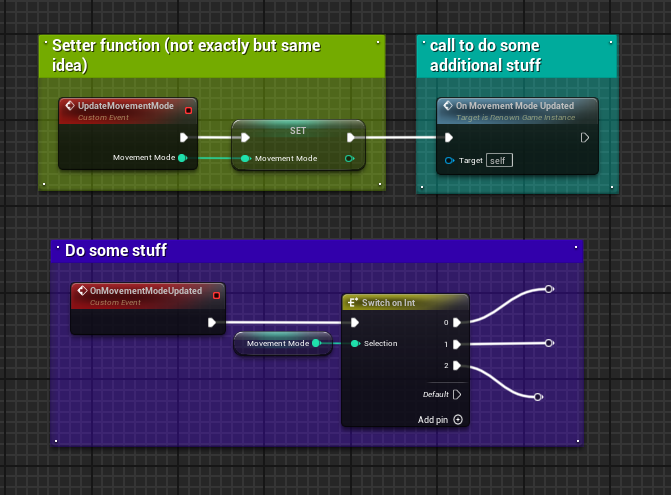
 little agate
last peak
The more important question is this right now
little agate
last peak
The more important question is this right now
wait, I think i saw this question somewhere previously 😂
last peak
Haha in the would you rather subreddit
 hazy steeple
Hello can someone please help me with an error I am facing?
Im facing a problem where when i pick up the gun the character doesn't switch to gun animations
Please dm me if u can

 faint pasture
civic oar
Hey everyone, I have what seems to be a perfect ATV vehicle according to my tast...
faint pasture
civic oar
Hey everyone, I have what seems to be a perfect ATV vehicle according to my tast...
my brother, all of these are already gettable parameters

This is an unreadable rat's nest but my hunch is that this is your problem

 spiral kite
I tried to use a physics constraint between the capsule and the mesh to stop ragdoll bodies from flying away and keep them consistent when I simulate physic in multiplayer, but it’s not working.

 timber wind
When communicating between actors, do you guys like to access components on other actors using these, or prefer to add interfaces on the actors and not access their components directly?
I thought I would always use interfaces on actors, so seeing these functions exist I questioned myself
 next hollow
If you need some generic/ specific use stuff, I do interfaces. (say like UI text info, that'd be slightly unique per actor)
But, if its something more global (such as like health/ stats)
I just access components directly.
maiden wadi
timber wind
When communicating between actors, do you guys like to access components on othe...
Neither. Library functions. Actual API. That's what your game should be using instead of direct getters or interfaces. If the library function uses them internally that's whatever, how the system works is up to the system, it's not the consumer's job(even in the same project) to figure out how to access your system past a generic API.
next hollow
That didn't answer there question, of when each should be used, or why.
Cuz, interfaces are functions only, and no default code.
So, if its something more unique to each class, or only a small amount of classes have it, interface makes sense.
While a component makes the most sense if a ton of different classes share similar, or exact same logic, and need vars, and such.
maiden wadi
Fair. I just took "communicating between actors" as like "What would I prefer to do from a line trace for some thing."
 surreal peak
timber wind
When communicating between actors, do you guys like to access components on othe...
surreal peak
timber wind
When communicating between actors, do you guys like to access components on othe...
Depends a bit. You can get far with the GetComponent(s) functions, but they have limits. If you are always sure that a given Actor either has the Component or doesn't have it, then GetComponentByClass works well. But as soon as you have a case where the Actor you deal with needs to retrieve the Component from another Actor, you run into problems.
E.g., let's assume you have some HealthComponent. You put this onto a given Actor. Now that Actor, however, spawns some other Actors runtime, which are sort-of owned by the inital Actor. Let's further assume you want to damage the initial Actor if any of the spawned ones are hit.
If you simply do GetComponentByClass<HealthComponent>(), you'll get a nullptr back and your system might think that the HitActor isn't damageable.
If you, however, use an interface, then the HitActor can implement that and ask its Owner for the HealthComponent instead. That way you always get the right HealthComponent.
Encountered a lot of cases in the past. Just can't come up with a good example atm :D
next hollow
surreal peak
E.g., let's assume you have some HealthComponent. You put this onto a given Acto...
I never thought about the issue of multiple actors sharing info. (But, I also can't think of any game that does this off the top of my head)
I've only ever seen a boss with multiple health bars (multiple heads, body, legs, etc for big bosses)
Technically the way I coded my stuff could support it, on some cases (most specifically damage)
surreal peak
next hollow
I never thought about the issue of multiple actors sharing info. (But, I also ca...
Well, you could for example have a building system, where the built Actor has the HealthComponent. That built Actor might spawn other Actors, that make up the building or add custom functionality that is reusable (e.g. a door). Damaging those extra Actors should damage the building as a whole. That would be another example for this.
next hollow
Oh, thats a valid case.
Just most games I play either have the entire thing be 1 actor.
Or, each actor does have a unique health, and destroying a core piece just destroys the rest, cuz its not held up anymore
surreal peak
next hollow
Oh, thats a valid case.
Just most games I play either have the entire thing be 1...
Yeah, obviously "depends" on the game. It just happens more often than not, and it's not necessarily limited to something like a HealthComponent of course. You might come across it, you may not. I recently had it that people were expecting the HitActor to have a specific Component, but the design of the system by now changed and allow such "owned Actors" to be hit instead.
maiden wadi
All the more reason for a solid API. 😄 Game code damaging the actors without a health component shouldn't need to change their callsite. Shouldn't care about the component or the interface. Then you can make whatever system changes you ever need to make the system work in whatever way you need without having to fix a billion callsites.
surreal peak
Lots of "should" (not literally). There is probably a world where there is no need for any should and the code is always perfect. I'm afraid it ain't this world though.
maiden wadi
But still worth repeating constantly in a channel like this frequented by the newer people to coding in Unreal who rely constantly on shit Youtube videos telling them just to interface their interfaces to an interface to avoid casting.
surreal peak
Sure, but I doubt they actually know what you mean with "solid API". It's not like they instantly translate that to a correct solution. Googling that will probably also not help much. Might be worth a blog post with examples :D
 tight pollen
hi everyone, The AI sometimes circles aimlessly around the point and can't reach the NavLink, I increased the radius to 111 and it still sometimes circles and can't reach it

someone can help?
 rancid quartz
Hello!! It's my first time using unreal engine and I wondered if someone could help me out? I want to implement a mechanic into my game where- if you click a button on the bottom right of the screen, it brings up a piece of paper and the player can type things on there, and there's check boxes that the player can check. Here are screenshots of the code :) I'm running into a problem though. When I open and then close the notes, and then try and click on the notes button again, nothing happens. Is anyone able to tell me how to fix this pls? Thank you sm!


 tight pollen
someone can help?
- I have nav mesh
- Destination is Cube (Actor Location)

alwyas is aborted
it doesn't even work with that

Always Fail
 surreal peak
tight pollen
it doesn't even work with that
surreal peak
tight pollen
it doesn't even work with that
I would try to disable the "Affects Navigation" setting of the cube mesh, cause it's currently cutting into your nav mesh
"Can ever Blabla Navigation"
Iirc
 pastel magnet
tight pollen
pastel magnet
tight pollen
You can do what the person above said or make them move like right next to it (but not inside of it)
spiral kite
I tried to use a physics constraint between the capsule and the mesh to stop ragdoll bodies from flying away and keep them consistent when I simulate physic in multiplayer, but it’s not working. What did I do wrong?

 warm hare
How would I go about making a playable arcade machine in my game? I have the widget with the mini game in it that works and I have the arcade cabinet I would like to use, but I am unsure about how to set it up in a BP so the player can interact and play a couple of mini games in it.
 near summit
yall whats wrong with my blueprint, everything is good but the drain for the player 2 is faster than player 1 or the host im lost
 faint pasture
near summit
yall whats wrong with my blueprint, everything is good but the drain for the pla...
faint pasture
near summit
yall whats wrong with my blueprint, everything is good but the drain for the pla...
because you shouldn't do it like that
Is Battery visible to the client or just a behind the scenes thing that determines when the light goes out?
It can be this simple:
Input -> run on server
run on server -> set bSwitchIsOn //not the same as bLightIsOn
Tick/Timer -> if has authority -> update Battery based on bSwitchIsOn -> set bLightIsOn based on Battery and bSwitchIsOn //bLightIsOn should be replicated and repnotify
OnRep_bLightIsOn -> actually turn the light component on and off.
half the code, and it'll work
near summit
faint pasture
Is Battery visible to the client or just a behind the scenes thing that determin...
no its behind the scenes the client cant see it
dark drum
near summit
yall whats wrong with my blueprint, everything is good but the drain for the pla...
You should only update the battery value on the server and have it replicated. Possibly with a rep notify so the client can update visuals.
Your current going from client -> server -> client -> server -> client.
The client should ask the server to turn on the flashlight, the server handles changing the values and replicates them. Client updates visuals when value changes are received.
maiden wadi
near summit
yall whats wrong with my blueprint, everything is good but the drain for the pla...
"Bruh. I just hotjoined your game, why's it so dark, turn on your flashlight."
near summit
lol i fixed it thanks yall
faint pasture
near summit
no its behind the scenes the client cant see it
Then what I posted will work just fine.
 prime stump
Should 'on-demand' widget classes generally be soft object references instead of hard ref's? I imagine any widget that needs to be on-screen all the time like a hud would be a hard ref but things like a pause menu, settings menus, in-game scoreboard ect.. are those types better off as soft ref's?
And just in general on soft ref's I imagine they add some latency when loading the thing, does that effect replication versus a hard ref?
 errant snow
prime stump
Should 'on-demand' widget classes generally be soft object references instead of...
errant snow
prime stump
Should 'on-demand' widget classes generally be soft object references instead of...
It can depend on a lot of factors. Like where the hard ref is, how big it is, etc.
For a pause menu, it probably makes sense for that to be a hard reference from something world specific (like the hud). As opposed to a hard reference from something that is global to the whole game. Perhaps the pause menu has soft references to expensive sub menus though.
If the scoreboard only comes up at the end, a soft reference makes sense.
And if latency is a concern, you can always try to load it pre-emptively close to when you need it instead of immediately when you need it.
For UI, I don't believe replication is an issue. Generally UI's are local and represent replicated info and aren't replicated themselves directly. But I don't know a whole lot about MP stuff.
faint pasture
prime stump
Should 'on-demand' widget classes generally be soft object references instead of...
your networking shouldn't know or care about UI
prime stump
faint pasture
your networking shouldn't know or care about UI
Yeah I know in the case of UI, but in general for other things like actors using soft references, does soft ref's typically impact replication in any way or do they work the same way as a hard ref would do?
mental trellis
How often are you replicating this?
And you should never be replicating soft references to widget calsses over the network, really.
prime stump
It isn't a scenario that I have actually ran into as of yet but I'm just wondering how they would work down the line for when I do eventually run into it lol
prime stump
mental trellis
And you should never be replicating soft references to widget calsses over the n...
Yeah although I'm not talking about replicating widgets specifically, I know they're local so don't need replicating themselves but I mean other things that are using soft refs
faint pasture
prime stump
Should 'on-demand' widget classes generally be soft object references instead of...
I can't imagine any widgets being big enough to care about with that. Unless you have a widget that hard refs every mesh in your game or something like a bestiary
If it's settings and stuff what is there to load? It's just text and numbers and hooks into classes that should exist already.
I'd rather burn like 500KB holding the scoreboard BP in memory than wait on it to load every time I open it.
prime stump
faint pasture
I'd rather burn like 500KB holding the scoreboard BP in memory than wait on it t...
Is the load time that long typically? I haven't really had to use soft ref's for anything as of yet so I'm not familiar with their typical load times which I imagine depends on how big the thing being loaded is.
The reason I am actually looking at soft ref's in the first place is in attempt to kill a dependency chain that appears in my pawn class that shows in the size map, the chain goes like this: pawn class has a reference to its player controller class > player controller creates pause menu widget > pause menu creates settings menu widget > settings menu creates video settings widget > settings saved by the player are saved in the game instance > game instance calls a server travel function on a pre lobby game mode.. all of this is currently loaded in all the time when some of it doesn't need to be, especially the pre lobby classes which have nothing to do with my pawn class at all so there is no reason they should be dependent in any way

So I was gonna make the pause menu a soft ref so that chain disappears until its in use however if the load times are too long or causes horrible hitching when loading soft refs then that might not be the best approach lol
That sound effect will be getting nuked anyway cause there's no reason it should be nearly 200 MiB but regardless of that there is still no reason the pawn needs to know about any of those pre lobby classes
frosty heron
Async Loading isnt instant, and you also have to deal with the async logic. Its just the pros and cons.
It can be really quick, or it may take some frames. The only way to find out is to implement it.
@prime stump
Then you can make design choice. Wether to load it on loading screen instead of on demand.
prime stump
frosty heron
Async Loading isnt instant, and you also have to deal with the async logic. Its ...
I noticed the player controller doesn't seem to let me use 'Async Load Asset', instead it wants me to use 'Load Asset Blocking' which when I hover over it says it loads the soft object ref immediately but might cause hitching, but what I'm really interested is getting rid of that dependency chain I've got there, but i'm unsure of what the best approach is to take
faint pasture
prime stump
Is the load time that long typically? I haven't really had to use soft ref's for...
why does game instance hard ref the level and assets?
prime stump
faint pasture
why does game instance hard ref the level and assets?
The game instance casts to GM_PreLobby when a game starts which calls a function on the game mode that does server travel from pre lobby to the actual map and the game mode has the references to those sound effects for some reason as well as the PS_PreLobby & PC_PreLobby classes right at the bottom of the size map
Which all then links back to my pawn class because its player controller creates a pause menu lol
errant snow
prime stump
I noticed the player controller doesn't seem to let me use 'Async Load Asset', i...
Are you trying to use it in a function instead of on the Event Graph? You can't use any latent async nodes in functions.
There's no reason the player controller should be unable to use 'Async Load Asset'
prime stump
errant snow
Are you trying to use it in a function instead of on the Event Graph? You can't ...
Ahh yeah I was in a function when I tried it, didn't try it in the event graph
So the question remains on what is the best approach to clean that dependency chain up, would interfaces maybe be better so instead the hard refs to game instance/game mode they can go through interfaces without having the dependency?
maiden wadi
Seems like you either needs Metasounds or FMOD. No real reason to have a sound hard reffed.
prime stump
maiden wadi
Seems like you either needs Metasounds or FMOD. No real reason to have a sound h...
That sound is being deleted from existence either way cause its huge lol but I'm more concerned about having pre lobby classes hard referenced to the pawn class when there's no reason they should be at all
maiden wadi
What tells the GameIntance to tell the GameMode to do the travel thing?
prime stump
maiden wadi
What tells the GameIntance to tell the GameMode to do the travel thing?
The pre lobby's game state class when a lobby timer counts down, or from a widget when the host of the session manually starts the game, but its being done through an interface
maiden wadi
But why through the GameInstance?
Both of those things have World context and can just get the GameMode itself.
errant snow
prime stump
So the question remains on what is the best approach to clean that dependency ch...
An interface or doing things in native would be a solution to remove the game instance reference.
Or you could move the functionality entirely out of your game instance because it's a little weird that your video settings require that reference.
frosty heron
Main GI referencing asset sounds soo cooked.
prime stump
maiden wadi
But why through the GameInstance?
I was under the assumption that the game instance is where session logic goes, but if i don't have to use that at all that might help
errant snow
The reference from the GI to the PreLobby game mode also seems suspicious. But it's hard to give concrete solutions without access to the project.
(no I don't want a copy of your project to look at 😉 )
prime stump
errant snow
An interface or doing things in native would be a solution to remove the game in...
Video settings references the game instance because thats where all the settings are saved and loaded, which i was also under the impression was the best place to do that
errant snow
Make a project child of UGameUserSettings. That's where that stuff should go.
maiden wadi
That's a kind of vague misconception. Session handling is handled inside of an OSS, AKA UOnlineSessionSubsystem. Which is a GameInstance Subsystem subclass. But there's no real reason to need the game instance for anything session related.
Unless you're BP only. In which case RIP, cause you're doing multiplayer with your hands tied behind your back, your legs chopped off and your eyes burned out.
prime stump
maiden wadi
Unless you're BP only. In which case RIP, cause you're doing multiplayer with yo...
Well.. I am BP only so 😂
 pastel apex
question how do I remove up a message listener handler from the gameplay message subsystem? (like stop the listener)
frosty heron
prime stump
Well.. I am BP only so 😂
its gonna be though managing those memory dependency as well with only bp.
upskill or face the limit.
p.s doesn't take a lot to make a native class.
open up new world too. You can create your own game instance subsystem, world subsystem and pretty much remove the limit of bp canvas.
dawn gazelle
pastel apex
question how do I remove up a message listener handler from the gameplay message...
If you have a node like this, use the Async Action reference and use the "Cancel" function.
 pastel apex
dawn gazelle
If you have a node like this, use the Async Action reference and use the "Cancel...
pastel apex
dawn gazelle
If you have a node like this, use the Async Action reference and use the "Cancel...
sanks
i did eventually figure that was the case but thanks anyway
 sudden hedge
fun fact: The developers on Ratchet and Clank: Up Your Arsenal had the issue of making a game for ps2. The ps2 hardware was limited so to tackle down performance one thing they did was to optimize their bullets.
Instead of making an actor bullet with collision that is shot out of a gun. They used 2d billboards that always face the player with something like a raytracing shot out of the billboard every frame, so as the bullet moves it shoots a raytrace to detect if there's anything in front of it, if nothing it moves forward again, if it hits something it explodes. This substitutes using an actor which in UE is a heavy object and collision is not necessary which further saves on performance

 wooden whale
hello does anyone have a idea why this happens? I am making a camera zoom slider but for some reason it doesn't work


 last peak
wooden whale
hello does anyone have a idea why this happens? I am making a camera zoom slider...
last peak
wooden whale
hello does anyone have a idea why this happens? I am making a camera zoom slider...
Make a print string right here

and print the value
wooden whale
It does get to 600 here but my camera arm length doesn't zoom out
last peak
It shouldnt go to 600......
wooden whale
I also tried setting the slider back to 1 but that didn't do it eather
crimson briar
Is there something behind the camera that the arm could collide with?
loud vessel
Why not try to use a lerp float instead?
The value from the "On Value Changed" should only output between 0.0~1.0
Then, use a lerp between your 300 and 600
(of 0 --> 300
if 1 --> 600)
Should be easier, and idk... maybe a bit more of a good practice?
last peak
Your clamp goes from 0 - 1 range
if it prints 600
everything higher than 0 will do the jump
then any further movement will do nothing
wooden whale
my camera is attached to a springarm which is then attached to my ball
crimson briar
Oh yeah, it seems you changed the range of the slidebar and it is not the default 0-1. So Blackhand is correct
wooden whale
I tried setting the slider value to 1 now because first I setted it too high but it still doesn't work :/
loud vessel
wooden whale
I tried setting the slider value to 1 now because first I setted it too high but...
Want to DM?
I can help, it shouldn't take long.
wooden whale
sure no problem
narrow kite
last peak
I'm confused to how that's an example of messy coding. It looks more organized than Ashes of Creation accounting.
crimson briar
Are you actually asking or just making a joke?
narrow kite
crimson briar
Are you actually asking or just making a joke?
It's just a joke. However, organizing and labelling projects correctly is worth the time. Sure you can avoid it, but it's not just for others or multi person projects.
last peak
Im not very deep in the Ashes of Creation game, are they that chaotic ?
mental trellis
It's dead.
last peak
i mean i personally find my red bull and cigarette fueled bp is pure art
....
Abstract art 😄
narrow kite
last peak
Im not very deep in the Ashes of Creation game, are they that chaotic ?
Luckily it poses no issue to Unreal or association to the engine though it was being done in Unreal 5. However, it was bad for the MMO industry and I would not be surprised if it leads to multiple criminal investigations.
narrow kite
Epic would never have bought them. Despite the "looking at it". Any business doing a large acquisition would have experts look into the accounting and feasibility. They wouldn't buy any of the garbage and would automatically be forced to not proceed upon seeing any information or it being witheld. It's in ligitigation, but the game isn't likely to ever go anywhere at this point for multiple reasons including it's reputation.
wooden whale
yo got my problem fixed looks like the do collision test on the springarm is the bitch of my problem haha
wooden whale
last peak
If epic did we might get some free assets soon 😄
yay I hope so
crimson briar
last peak
Any idea who took it over ?
There are lawsuits flying. In short, Steven and some other LLM people are fighting over it and it is a mess where the money came from and who did more bad things
last peak
Meh
So chances are near 0
I dont even know why im greedy for more assets lol
I collected terrabytes over the years
narrow kite
last peak
Meh
Riot is doing their MMO. The big question is which game engine they will use 😉 I'm guessing Godot!
last peak
Im really not interested in mmos
I dont think mmos are very good games
A relic of the past
Even tho many ppl seem to like them ..... i will never understand why
narrow kite
last peak
Im really not interested in mmos
I don't think it's MMO's. It's the market not producing games. They are just a shell for gambling.
last peak
I have never played a single really good mmo 10 / 10
Plenty of singleplayer rpgs or coop rpgs
But mmos are so forgettable
Bad combat mediocore story
narrow kite
last peak
I have never played a single really good mmo 10 / 10
The only way to get 10/10 is go back 20+ years and play them at the time. And only the much older games.
narrow kite
BDO moved the bar forward. For inputs, responsive combat, and graphics (at it's release). It's just that they don't care about the game, it to is just a shell for gambling.
Luckily Unreal's enhanced input system makes those inputs rather easy. It feels so much better than 1,2,3,4,5
dark drum
last peak
But mmos are so forgettable
Bad combat mediocore story
Yea, I know what you mean. I think the issue is down to all the compromises they have to make so it's actually playable (as an MMO). It ends up feeling bland as they all have to make the same compromises.
raw onyx
The only MMO I really got into was City of Heroes, played that for thousands of hours over the years
narrow kite
dark drum
Yea, I know what you mean. I think the issue is down to all the compromises the...
In relation to the prior conversation. I will work to divide "Events" vs "Quests". Even though some quests will use the same concepts such as unlocking portals and pathways. The main difference though is the Quest contains more data such as a Quest Log and thus the separation will make sense.
dark drum
narrow kite
In relation to the prior conversation. I will work to divide "Events" vs "Quest...
You could also do a unified approach. So you have an events object with a 'run event' function and when you setup a quest, you can define an event object that gets called when the quest is complete.
That way you could use the same event objects outside of quests as well. Just a thought
raw onyx
I've setup in my quest system that I can have things update on other quests when a quest is started, completed or failed. Took awhile to figure out how I wanted that to work
narrow kite
dark drum
You could also do a unified approach. So you have an events object with a 'run e...
The more important distinction seems to be saved vs temp. As long as the Quest is maintained in a quest variable it's fine. Through game play tags, structs etc, I can manage whatever data I want.
The harder part may be more of the design side as to what needs to be saved. For example a lever sequence that opens certain paths. Should the player have to redo it every time they enter the map? What is least annoying on the player side will be the real question.
And "farm" prevention. Which I could test some placement tool for if needed.
dark drum
narrow kite
The more important distinction seems to be saved vs temp. As long as the Quest ...
Normally I tend to make things have states. Open/closed for example, then you'd just save the state and reapply on load. You can have fancy transitions when switching states during gameplay.
narrow kite
You can output the player location (x,y,z). However, is there a simple way to do that on a static mesh for example?
I'll have to open the editor. When placed will the location of the object already show the current (xyz) in the editor?
dark drum
narrow kite
I'll have to open the editor. When placed will the location of the object alrea...
I'm not sure what you mean.
narrow kite
dark drum
I'm not sure what you mean.
I don't really place items often using the coordinates in the editor, but they are there. Just usally for scaling purposes. I'll have to dive into what the events would be first though. I was thinking of randomizing their locations. But needing a way to identify location positions for that. Then probably just spawning some events at random locations upon entering the map.
dark drum
narrow kite
I don't really place items often using the coordinates in the editor, but they a...
Ahh, for dynamically spawned actors you'll need some sort of manager. You'll need to save its class and transform. If the actors also have additional data that can change at runtime, those would need to be saved as well.
Id probably make a struct that has a class, transform and a string.
The extra data can then just be converted to a string. There are other ways to handle this but how you'd approach it can vary depending on what the actors are and what not.
narrow kite
dark drum
Ahh, for dynamically spawned actors you'll need some sort of manager. You'll nee...
I would think a Game Play Tag MAP with a vector array would probably work. Except for overlap prevention. The BP instance would be built with a spawn on begin or construct. That would place it in rand(1,10) locations essentially. Or could be controlled by difficult or grouping. Such as 1-5 6-10 or a type of coding. Such as 13+ is sever difficulty or rare etc.
 inland walrus
is anyone familiar with this error?
 crimson briar
My guess is you have an infinite loop going on
faint pasture
last peak
Even Wow was super mid for me
Vanilla wow was an insane experience.
faint pasture
last peak
But mmos are so forgettable
Bad combat mediocore story
Only EVE really captures what an MMO could be IMO.
spiral kite
I tried to use a physics constraint between the capsule and the mesh to stop ragdoll bodies from flying away and keep them consistent when I simulate physic in multiplayer, but it’s not working. What did I do wrong?
 dark drum
spiral kite
I tried to use a physics constraint between the capsule and the mesh to stop rag...
dark drum
spiral kite
I tried to use a physics constraint between the capsule and the mesh to stop rag...
As far as I'm aware, skeletal meshes ragdoll inside component space. The component transform would stay the same.
 grave spoke
Would anyone happen to be knowledgeable about dynamic material instances? I'm spawning in a pet and using it to create a randomized color palette using linear colors and vector params. Right now I'm trying to save the linear colors and then apply them onto a different actor with the same mesh for a minigame and it does not seem to be applying the meshes. Any help would be greatly appreciated.


