
#gameplay-ai
1 messages · Page 166 of 1
 celest python
Max Walk Speed is a CharacterMovementComponent property
You havent plugged anything to it
So it tries to find the property in the self (the class you are on) - which doesnt have any MaxWalkSpeed variable inside

 subtle birch
try using a print string in you ai bps. see if it outputs somethink @lyric flint maby see if the walk speed gets changed
 lyric flint
subtle birch
try using a print string in you ai bps. see if it outputs somethink <@4562265777...
lyric flint
subtle birch
try using a print string in you ai bps. see if it outputs somethink <@4562265777...
I seem to have it fixed it
but the print string shows up on screen flickering on and off for a split second so its hard to tell

 main heart
Try calibrating the last option in Print String node! 🙂
main heart
Did it work @lyric flint ?
 sullen crater
Guys, which way of writing AI is the most flexible and free in terms of features? AI in Blueprint, in Behavior Tree or in C++?
 misty wharf
C++ is most flexible but also likely to be most tedious
It's best to use a combination of all the ones you listed as they each have their own strong points
main heart
yeah best of both worlds
 fallow gust
Hey yall. I am writing a hybrid Behavior Tree/GOAP implementation for my AI. I have the first two parts down pat, but I am trying to decide on a recommendation for determining on how to have the AI compute what it's next goal should be dynamically. For instance, I am thinking of having a 3-dimensional vector weighted by 3 distinct factors, positive outcome weight, negative outcome weight, and effort to accomplish, then normalizing the vector. From there I plan on using Euclidean distance to determine the best next goal to pursue. Thoughts?
Then an iteration on that having a property that helps direct what to use as a more weighted selection, for example, pursue goals with higher positive outcomes, or pursue more goals with low effort to accomplish more sooner, or to avoid the most negative outcomes first.
lyric flint
main heart
Did it work <@456226577798135808> ?
hey dude
not sure what you mean
it is checked on for print to screen which should work
main heart
Yeah even now I forgot what I meant.
 tardy marten
Hey, would anyone have a really good tutorial on AI? I want to start building out basic AI but don't know where to start
 crystal sequoia
Hey, I'm making a space game with 2d movement and I want to use navmeshes. Is there any way to generate them, in the air/ not on a surface?
tardy marten
Nvm I looked in the pinned posts like a smart person.
 ocean wren
fallow gust
Then an iteration on that having a property that helps direct what to use as a m...
ocean wren
fallow gust
Then an iteration on that having a property that helps direct what to use as a m...
Sounds like you want a utility architecture for that.
fallow gust
ocean wren
Sounds like you want a utility architecture for that.
Tell me more
 mystic solar
Ahoi! I tried pathfinding in c++ and using a lot of different EQS options, but i still struggle to find the best position to approach an actor which could have any size as close as possible. As I always have to handover a distance to the center of the actor, I´m failing to get next to the desired actor. In the picture, you can see two actors of various sizes and the desired position of the characters.
 ocean wren
fallow gust
Tell me more
ocean wren
fallow gust
Tell me more
Check out stuff by Kevin Dill and Dave Mark amongst others. Plenty of GDC videos on it on YouTube.
I think Kevin had some chapters in GameAIPro on the same thing which should be available online now
Dual Utility reasoning I think he called it
Dave called it Dual Axis something
fallow gust
ocean wren
Check out stuff by Kevin Dill and Dave Mark amongst others. Plenty of GDC videos...
Thanks! That was a short read and simply explained. I may give that a shot since the addition of a category and weights meets what I described as a desired behavior.
 whole fable
ocean wren
Dave called it Dual Axis something
whole fable
ocean wren
Dave called it Dual Axis something
Infinite Axis
 dry island
Does anyone know why this might be happening on my behavior tree? Just trying to get the AI to walk back and forth. I basically just followed the documentation to get this to work, not sure why it's not executing
fallow gust
dry island
Does anyone know why this might be happening on my behavior tree? Just trying to...
Do you have a NavMesh Volume and is the location accessible? Seems like the MoveTo is returning a fail.
dry island
fallow gust
Do you have a NavMesh Volume and is the location accessible? Seems like the Move...
I do,
fallow gust
Looking at your blackboard variables during debug the location is invalid
dry island
weird
fallow gust
Your task before moveto must not be setting the right key
dry island
Hmm
fallow gust
Also make sure your patrol radius is greater than the acceptable range for the MoveTo
dry island
So here are my task blueprints. The key for Patrol is the same as on the blackboard...


Patrol radius is much higher than the range...
hmmm
fallow gust
Your walk speed is being set to 0
dry island
On stop
That's the behavior I want if the player is in range
The second one is the stop behavior
fallow gust
Ah, okay. There is actually a function(on controller or movement component I think) to cancel your movement path instead of setting speed to zero.
What does that radius function for finding a patrol point look like?
dry island
That's the first one
fallow gust
Can you show what your nab debug overlay looks like in the level editor?
Nav*
As well as the variable details for setting the patrol location? I feel there may be a typo in the FName for the blackboard key.
dry island
Not sure how to show the nav debug overlay specificly...

That's on the task...

That's the key... doesn't look to be a typo
wait i got the debug overlay
 fallow gust
What is the Value of the PatrolLocation variable?
fallow gust
Which function? In the definition of the behavior tree? Also, I should asked, is this UE4 latest?
fallow gust
Okay, if you are in your level viewport and press P you should see green showing where the nav mesh has calculated as navigation for AI. I am not seeing any of that green overlay. Also, you are setting it with the value of the patrol location variable, which you said is None. What if you change the default to”PatrolLocation”?
dry island
Oh I can show that, it's green
one sec
I'm not able to set the value to anything other than none...
 fallow gust
Where are you trying to set it?
dry island
I can't change the value in the inspector

sorry, I mean details panel. I'm a unity pleb
fallow gust
And in the behavior tree when you select the task node?
dry island
 fallow gust
Sorry, the task to find your patrol location
dry island
Yeah that's this. The Key is PatrolLocation
 fallow gust
In the behavior tree similar to wat u showed previously for the move to
 fallow gust
Okay, go to you task function, click the eye next to PatrolLocation and compile the blueprint then go back to that view
dry island
Ahhhhh
It's working
THANK YOU!!!
well it worked for a second haha
I think it's working now
fallow gust
Awesome!
dry island
Now I just have to figure out how to make him only move on the y and not the x
@fallow gust THANK YOU so much for your time
dry island
Ok so now I have the opposite problem. Been at this for an hour and a half!! Basically it won't switch back to the patrol node after stopping now... what could be wrong?

 patent hornet
aborts both includes lower priority
dry island
I tried self too and that didn't work either?
patent hornet
and your SeesPlayer key hasn't changed for the duration of that clip
patent hornet
nor did i see the red bar that appears when decorator blocks the execution
dry island
I think that it's not updating perception after it goes to the Can See player node
and I'm not sure why
Is there a way to manually trigger perception update?
oh wait
I think I see it
My lose sight raidus was at 3500!!!
Thanks @patent hornet lol
patent hornet
AIPerception is also capable of some things you're doing by hand out of the box
you can generally use GameplayDebugger to see more, pressing '
after it loses the sight, it "remembers" the last sighting for a bit of time, before it "forgets" the actor
with gameplay debugger active you get debug spheres for that, for each sense
dry island
Yeah, this was based on the documentation on Behavior Trees, I'm a n00b with AI
I should use that for sure. I will now
thanks!
 proud crescent
What are some good techniques for navigating very large but sparsely populated worlds?
Specific use case: Flying vehicle (constrained in 2D plane) in a world mostly consisting of large open spaces with occasional clusters of towers or impassable regions ("too windy"). I can basically assume it is okay to go in a straight line in the open parts (plan to just add some kind of dynamic avoidance on top of the pathfinding).
ocean wren
It depends on the movement of your vehicles.. can they slow down and hover and then land? or does it have to fly in and land?
because if the former, I'd do it as two different elements
i.e. a 2D collision avoidance (basically RVO like) and then for landing you can just project down to the navmesh
avoidance could be done with simple steering behaviours really
depends on how dense the towers are if you need pathing vs avoidance
I've done stuff like that using a 2D physics engine before, worked out nicely
Box2D is what I used
proud crescent
Thank you for your insight @ocean wren 🙂 They have a complicated landing behavior but I was thinking that I would use splines for that part once they got close enough and then simply pathfind to the start of the splines. I was thinking that using unreals nav-mesh would not work since there was no geometry in the air for the nav-mesh to "sample". Also was worried that it would take up large amounts of memory when the world is very large Or do you think this will be balanced out because it is mostly open areas? Finally Is it possible to procedurally exclude volumes of the world from the nav-mesh (the windy parts of the world). These are known in advance but it would be cumbersome to mark up all the excluded areas by hand. Sorry for all the questions!
ocean wren
You can use navmesh blocking volumes
But yeah, it'll sample all of your geometry for the navmesh unless you set it to not collide etc.
And yeah, UE4 at least doesn't deal with large worlds well at all, so not a good match
If its a new project, UE5 might be more capable in that sense
What I'd do personally, is use the octree built into UE and do a pathfind on that.. spline based pathing within an octree is what the Kythera guys implemented for their 3D pathing solution and it makes a lot of sense.
If you have the budget you can save yourself the time and just license theirs 🙂
proud crescent
I actually have the opposite problem 😅 since I want to generate the nav-mesh where there is no geometry and avoid anywhere there is geometry
normally it needs a floor from what I have seen on tutorials
ocean wren
yeah, you wouldn't use the navmesh system for the flying part at all
you'd use a local avoidance system, unless you've got a really dense set of incursions into your flying space
proud crescent
ah I see what you are saying now
ocean wren
i.e. if you were flying a drone through a forest might be a bit challenging
but helicopters around the occasional skyscraper I'd do local avoidance
so depends a lot on how your space is in the flying plane
proud crescent
the avoidance is fine I am just struggling with how to generate the flight path on the world scale (e.g. go around the windy areas and not get stuck in dead ends)
ocean wren
well, if you've having things like concave objects, then you'll have to do a 2D pathfinder
basically, do 2D collision primitives in your flying plane for colliders, subtract those from a 2D mesh, store the mesh in chunks, use a 2D heirarchical pathfinder on the chunks
HPA* is something you can look at
proud crescent
Thanks for the pointers will give it some thought 🙂
ocean wren
Not ideal Unreal Engine territory 🙂
 atomic delta
guys the hits arnt registering any help[2:04 PM]when i shoot it sometimes goes through the A.I.[2:05 PM]pls can i have help
misty wharf
You're going to have to be more specific than that
But if you're using line traces, check that your trace channel is correct, and the collision profile on your targets is blocking on that channel. If you have confirmed those are correctly set up, enable the debug line drawing option and confirm the trace is actually going to the correct location
 sudden citrus
What's the proven best way of making AI-usable doors? Navlinks or nav modifiers?
I used to think navlinks but someone pointed out to me last week that modifiers might be a better way and I can sort of see that.
misty wharf
As usual the best way really depends on how it needs to work and how your game works
sudden citrus
Probably open/close animations are harder to do with nav mods*
misty wharf
Nav modifier only really changes the navigation cost, it doesn't really make doors "work" in any other particular way
sudden citrus
The idea is that you have a nav modifier + a trigger to make the door open/close etc, and then it works the same for players and NPCs without extra work, and incurs less of a cost at search time (compared to smart links). Also probably harder to make access rules with nav mods... possible through a nav filter but you'd have to fill all the costs ahead of search instead just letting the link "interrogate" the agent
misty wharf
a navigation filter is something that affects how a valid path is generated based on navigation modifiers
sudden citrus
Yes, and say if you want to allow a character through certain doors (maybe they have a key or not) you'd modify the cost to be FLT_STUPID
misty wharf
in terms of doors, the uses for navigation modifiers would just be to give the door a higher cost compared to not using a door, ie. if you have two paths of the same length but one has a door, you could make the AI prefer taking the path without a door
sudden citrus
Of course yeah that's the basic thing. I did the whole navlink implementation for a prototype of a Hitman-like game so it needed more complexity
misty wharf
Right
Smart navlinks really offer the best flexibility in terms of how to do it both in terms of logic and modifiers/filters
sudden citrus
The only problem is you need to use them as a base class or rewrite NavLinkProxy into a component
tbh I feel like the whole nav system needs a pass, functionality is usually strewn across five classes
misty wharf
Why is that a problem?
sudden citrus
It's a problem if level designers already placed 70 doors around the level and go "oh yeah can the AI use them now" 😄
misty wharf
Well if you decide on a major change to how a feature works it's always going to require a bunch of work
but ideally in the doors case it should just be a matter of adding the smart link component into your door BP
 elder perch
How often foes the ai call its scripts, is it every tick?
misty wharf
"the ai"?
elder perch
The ai controller
misty wharf
if you run logic on tick then it will tick at its tick interval which defaults to every tick
elder perch
Is that the same for behaviour trees?
misty wharf
Yeah they should process on every tick
 dawn loom
I'm running into the max crowd aware path following agents limit (set at 50 by default) I upped it to 100 but we might need more is it safe to make it higher?
also I can make my AI disable it's path following when it's idle and out of the player vision but idk how to do that
ocean wren
You should look at what can be switched off for non visible agents, things like animation updates and the like
You might want to also throttle the tick rate for non visible etc
 ebon lagoon
how to move a pawn on a navmesh?
I have this navmesh which sets the player -> checks that the player is set -> move to actor

the pawn refuses to move.... probably because it lacks the movement component that the character class has
what can I do to fix it? (or implement it manually)
I have no qualms about implementing a custom task but I have no idea how to get the next point on the navmesh myself
 prime barn
ebon lagoon
what can I do to fix it? (or implement it manually)
prime barn
ebon lagoon
what can I do to fix it? (or implement it manually)
Hello, a few options here. First two basic questions:
- Do you have built navmesh in the level and both player and enemy are standing on it?
- Do you have Floating Pawn Movement component added to your Enemy BP?
ebon lagoon
yes and yes
my problem with the floating pawn movement component is that it moves but it is annoying to override.
by that I mean:
- controlling animations from C++ variables
- Making the actor turn to face my player (the default moveTo doesn't do that on floating component)
- makes my pawn walk slightly above ground (despite having his location constrained)
While a character component may solve the last two issues, it just seems overkill since my intended is logic is literally:
- move to player
- call and wait for the attack method montage to end
- wait a bit (like 0.2s)
- repeat step 1-3 until player or this AI pawn dies
and I would also struggle with controlling the animations from my animator instance
@prime barn
prime barn
ebon lagoon
While a character component may solve the last two issues, it just seems overkil...
Judging by your requirements, I'd advise switching to Character class with Character movement, unfortunately. Unless, of course, you want to write your own movement component. : ) I generally use Pawns only for a simple AI's that, for example, don't use Skeletal Meshes, like Drones, or simple floating Droids etc.
prime barn
ebon lagoon
my problem with the floating pawn movement component is that it moves but it is ...
And yes, rotating Pawn towards target needs to be handled manually, somewhere in Tick, preferably.
ebon lagoon
So things like a tower in LoL would qualify as pawn but a minion would qualify as a character? (since a minion needs movement and rotation among other things)
My game is nothing like LoL, just trying to understand what you mean xD
prime barn
ebon lagoon
So things like a tower in LoL would qualify as pawn but a minion would qualify a...
I would say that the rule of thumb should be: if it's a humanoid and requires Anim BP, than it should be Character.
ebon lagoon
I see
what about something like a tank in older red alert games?
they still move and rotate but I wouldn't call them characters/skeletal
do they qualify?
prime barn
I'd try to use Pawns for that.
Simple movement and rotation towards target should not be an issue.
ebon lagoon
thanks! 
prime barn
I have a public project that I use as my portfolio
https://lg7.itch.io/blueprint-rush (github link is there)

I use Pawns in it, they have Behavior Trees, tasks etc. They use Floating Pawn component. Perhaps you'll find something useful there.
 ocean wren
You really need to do AI in C++ for the most part if your project is anything but trivial. At least that's how it feels to me. Just because you have so much more flexibility. You can write new tools and extend classes and just generally control your codebase a lot better.
I don't mean the configuration part. I mean the tasks and senses and the like. Configuration in BT/BP etc is what its good at.
celest python
I really need to meet the guy who made Red Alert 3's AI
ebon lagoon
I know RA1's AI is open source
ebon lagoon
ocean wren
You really need to do AI in C++ for the most part if your project is anything bu...
my current AI is trivial but I can see your point
celest python
ebon lagoon
I know RA1's AI is open source
They changed everything with RA3
I wish I could see some goodies from the source
But I learned the guy who made RA3 AI working at Chrome OS' development now, also worked on flight simulation softwares after leaving EA
So no wonder he is some psycho mad big brain programmer
main heart
RA1 sounds more like a bollywood movie
Well what do you know https://en.wikipedia.org/wiki/Ra.One
ebon lagoon
Lol
ebon lagoon
Is there a good resource (free/paid) that delves deep into AI?
Most resources cover basic BT stuff but they don't go into things like multi-frame tasks and whatnot
by multi-frame tasks I mean like the MoveTo, it executes on multiple ticks/frames. I tried figuring out how it works in code but too complicated for me
misty wharf
Afaik not really
multi-frame is easy in blueprint based tasks, you simply don't call finish execute until you're done
iirc the C++ version works sort of like that, you return InProgress as the result for it which prevents it from finishing the task immediately, and then there's some other bits that you need to do to finish it
in BP's you can do something like this for example
 ebon lagoon
I have this code:
void ABaseCharacter::MeleeCommandReceived()
{
    if (!CanMelee||IsMidAction)
    {
        return;
    }
    CanMelee = false;
    IsMidAction = true;
    Animator->Montage_Play(MeleeStabAttackMontage, 1.0f);
}
//played at a certain point in the montage
void ABaseCharacter::MeleeAttackStart()
{
    IsMidAction = true;
    DaggerCollisionBox->SetCollisionProfileName(TEXT("Weapon"));
    DaggerCollisionBox->SetNotifyRigidBodyCollision(true);
}
//played towards the end of the montage
void ABaseCharacter::MeleeAttackEnd()
{
    DaggerCollisionBox->SetCollisionProfileName(TEXT("NoCollision"));
    DaggerCollisionBox->SetNotifyRigidBodyCollision(false);
    MeleeOverlappedActors.Empty();
    IsMidAction = false;
    GetWorldTimerManager().SetTimer(MeleeRateTimerHandle, this, &ABaseCharacter::ResetMeleeFlag, MeleeCoolDownSeconds, false);
}
The idea is it turns a collider on/off at certain points of the montage, and does damage if it overlaps.
It works as intended for the player character but I have no idea how to tweak it for the enemies. I currently have it in the base class since both types can melee.
I assume the task finish would have to be done when MeleeAttackEnd but I'm not sure how to handle it
misty wharf
give it a delegate that you bind to
in the screenshot above the attack end is a dynamic multicast delegate on the npc base class which just broadcasts whenever an attack finishes
the basic way my system works is very similar to what you pasted, so you'd just put the broadcast into your MeleeAttackEnd and I think it would probably do the trick
ebon lagoon
I'm trying to understand the screenshot you sent but I'm not sure about how the event is relating to the function
you are unbinding the event and returning Finish Execution
but isn't the delegate listener its own scope?
OnExecuteAI(...)
{
//get the character
//bind to the event
//melee command start
}

OnEventHappened(....)
{
// returns finish
}
the delegate gets broadcast whenever any kind of attack fires, so once we are done with the attack that was triggered by this specific BT task, we need to unbind from the delegate
otherwise if another attack triggers for some other reason, it would keep running the code
ebon lagoon
yeah but like if im thinking correctly the return is in a whole other function. I am not sure how to get it to the ExecuteAI one.
The only way I can think of is by using some sort of temp variable to interop between them
misty wharf
ah in C++ terms?
if you want to do it in C++, the easiest way is to make your task instanced
which allows you to use just regular properties in the task class to store state
otherwise you have to use the task memory feature which is probably partially why the moveto task looks so hard to follow :P
 last helm
Hi, I wrote an ai code in cpp but the problem is that the ais are also shooting at them selves. What can I check that it won't happen?
celest python
Is there any way to use different Context for EQS tests without creating different assets, like how we do for option configs?
 ocean wren
ebon lagoon
I have this code:
```
void ABaseCharacter::MeleeCommandReceived()
{
if (!Can...
ocean wren
ebon lagoon
I have this code:
```
void ABaseCharacter::MeleeCommandReceived()
{
if (!Can...
I'd make it triggerable via montage.. so that your animators can switch on/off attack collision tests.
misty wharf
celest python
Is there any way to use different Context for EQS tests without creating differe...
Nope
You could possibly modify the generator's properties in C++ before the query gets executed
But it's not really exposed in any kind of nice way in editor
celest python

ocean wren
You can just create different query contexts
celest python
Another reason to blame Epic for being bad at UX
ocean wren
Yarp
last helm
last helm
Hi, I wrote an ai code in cpp but the problem is that the ais are also shooting ...
?
misty wharf
It's a bit hard to say because "shooting" can mean many different things
But if you're doing line traces or projectiles, you need to set your collision channels so that whatever is not supposed to be hit is ignored
 terse star
The AI are shooting each other? Or the AI is hitting itself when it shoots?
last helm
each other
last helm
misty wharf
But if you're doing line traces or projectiles, you need to set your collision c...
I am working with the on see pawn and if its sensing something so he shoots it
misty wharf
Right, so check what was seen before you do other actions
last helm
misty wharf
Right, so check what was seen before you do other actions
strange thing that I tried that and it didn't care Its like it has its own mind
misty wharf
Yeah hard to say without seeing any of the code
If you cast the seen pawn to the player character and ignore everything else, it should probably work
ocean wren
Dammit I need a team of artists!
and some programmers 🙂
But mostly artists..
PCG is only going to get me so far.
 heady raptor
my Logs say
"SimpleMove failed for AIC_Unit_C_0: movement not allowed"
can i somehow get more information out of it to understand why the movement is not allowed?
i would wish i have more detailed logs 😦
ocean wren
You could stick a breakpoint in the code and see where it failed
The main benefit of Unreal Engine is that you have the source code
heady raptor
ocean wren
The main benefit of Unreal Engine is that you have the source code
ty for your help... I think I can work with that... did set a Breakpoint on the funktion in the blueprint, did jump to definition and now go down the rabbit hole in Rider
did not fix it yet but have a good feeling about it 🙂
ocean wren
Being able to debug is the only way to make progress.. its a skill you have to learn really.
Wondering if I should use a sampling based approach to spline proximity for my steamdeck game idea.. wondering if there's even an analytical approach I can use
I guess its a minimization function across both splines
 gritty peak
Hi i am trying to make a flying AI. I am using a character actor with an ai behavior tree. I got it to fly to my character but the ai is not rotating. I tried adding a sytem to change the meshes rotation based on find look at rotation between my player and the AI. However it seems to be stuck. am i missing something?
 opal crest
I'm working on some combat AI, and I have an EQS Query that's pretty good at choosing cover, but I'm trying to have it avoid choosing paths to that cover that have it pass near threats. i.e. if there's two equally good positions to aim for, but the path to one goes by a turret, and there's a safe path to second, I'd like it to choose the second. What are some ways to achieve this?
misty wharf
🤔
maybe you could try filtering out points that would require passing through the turrent's line of fire
ie. if you calculate a line from the querier to item, does this line intersect any turret's firing lines (ie. a line you calculate directly forward from a turret)
 dim lynx
how can i disable falling for AI?
i disabled gravity but this doesn't help
I want AI to stay in the air
misty wharf
if you're using character movement component, maybe try setting movement mode to flying
or try setting gravity scale in CMC to 0, as I think it might be doing its own gravity calculations
main heart
opal crest
I'm working on some combat AI, and I have an EQS Query that's pretty good at cho...
Point scoring is the way!
Endow them with appropriate weight, I mean!
crystal sequoia
Hey, is there a way to add navmesh pathfinding to a Player Controller?
main heart
crystal sequoia
Hey, is there a way to add navmesh pathfinding to a Player Controller?
Maybe tell more what you want to achieve. There are several things in-built, for instance, MoveToLocation() is there in AAIController. You can look up the source https://github.com/EpicGames/UnrealEngine/blob/d94b38ae3446da52224bedd2568c078f828b4039/Engine/Source/Runtime/AIModule/Private/AIController.cpp#L587 and reverse engineer your way 🙂
 tame cedar
Hey guys, I have an AI question, how to make a AI Group Logic to Spread among Multiple Targets, like the game Mount and Blade, one team's soldiers will evenly spread out to fight against the other team. I did a logic that each soldier always fight the closest enemy, the result is not good, any ideas how to do it? Thanks
main heart
Perhaps explain WHY the results are not good.
ocean wren
Typically for that kind of thing, you'd probably want to look at formations, from what I understand, you don't fight in those kinds of engagements as an individual, instead you fight as a formation, so I suspect most of the logic is at the formation level, with individual agents doing just the final close-quarters logic to attack nearest enemy. The formation manager would do the actual actions to direct it (things like encirclement etc)
Pretty sure I saw a presentation from Chris Jurney about a similar thing at GDC once. He did it for a Warhammer game I believe, or maybe a Company of Heroes game.
misty wharf
you can use get perception class if you have the perception event data
crystal sequoia
main heart
Maybe tell more what you want to achieve. There are several things in-built, for...
Thanks for the reply! So, basically I want to add pathfinding to my game's main character, but I didn't want to entirely switch out the player controller for an AI controller (which might end up being the right answer). You can't have two controllers for a pawn, correct?
ebon lagoon
I have this service that sets a player (Object/Actor) blackboard key
void UBTService_Player::TickNode(UBehaviorTreeComponent& OwnerComp, uint8* NodeMemory, float DeltaSeconds)
{
    Super::TickNode(OwnerComp, NodeMemory, DeltaSeconds);
    APawn* Player = UGameplayStatics::GetPlayerPawn(this, 0);
    if (!Player)
    {
        return;
    }
    OwnerComp.GetBlackboardComponent()->SetValueAsObject(GetSelectedBlackboardKey(), Player);
}
and this:

expected behavior:
- follow player
- when close enough -> melee
- wait a bit
behavior happening:
- go to player's initial location regardless of where the player actually is
- execute a melee even if on air
- wait a bit
- follow the player properlt
- do melee only when close
- wait and repeat 4-6
link to the issue happening: https://youtu.be/nGO7Wv6hFD4
ebon lagoon
the weird part is it seems to happen in simulate play but not in viewport play
misty wharf
Simulate is not same as PIE so it might behave differently I guess
Not sure how exactly simulate differs from actually playing in terms of how the logic runs
ebon lagoon

opal crest
misty wharf
ie. if you calculate a line from the querier to item, does this line intersect a...
Oh, that's interesting! Thank you. I am doing something similar for determining that the final space is safe, so I could generalize that if I could get the querier->item nav path, and determine the items that the nav path goes through.
Sounds pretty expensive though. I assume that the nav path grid generator is already paying most of this price, and I might be able to write a custom generator to expose the results in a useful way.
misty wharf
I don't know if it's actually that expensive
You could do it as a 2D line-line intersection check basically
or line-ray
so it's just a bunch of maths, it doesn't need any linetraces or anything like that
opal crest
Yeah, I can see how it's really cheap if the movement is in a straight line.
misty wharf
well even if it wasn't, the only thing that really should matter whether moving from current location to target location would cross the line of fire from a turret
I think it would cover most cases but maybe not all (eg. if it needs to go around some obstacle)
I think the going around obstacle case could be done via a separate check on a path generated between the points which would be a bit more expensive
opal crest
Yeah, that's where my head was going. I can definitely prototype getting the path from querier to item, and doing a series of line intersections and see how that works out.
But like you said, I may not need that often enough, and I can play with some simpler checks (it's likely that if a straight line passes through an attack volume, it's a bad path).
misty wharf
Yeah
I think there was an EQS test for navigation path, maybe you can look at how that works if you want to do the more specific test for it
Basically you can generate the path, then pull the individual points from the path and test those with the line intersection
opal crest
Yeah, I've written some custom EQS tests by reading engine code, so that's doable.
ocean wren
ebon lagoon
expected behavior:
1) follow player
2) when close enough -> melee
3) wait a bit
...
You should have seperate conditions for close enough vs following.. so have two different behaviours with the "follow player" lower priority then add a "close enough to melee" condition on a higher priority that does the attack and waits.
For BT's its important to understand what conditions partition the behaviour and what priority they are in relation to each other
For instance, doesn't make any sense to do a melee attack unless you're in range for melee attack, so that is a different behaviour to execute when that condition becomes true
ebon lagoon
but isn't that what the sequence node is supposed to do? @ocean wren
ocean wren
Well, clearly it isn't 🙂
ebon lagoon
it keeps executing "moveTo" until it actually comes into my acceptance range -> then and only then it should execute the melee
ocean wren
Thing is, your attack can attack nothing, because you haven't tied the attack to the range anywhere
ebon lagoon
yes, I want that so the player is able to dodge in time
ocean wren
So yeah, you might fix the moveto and it MIGHT work.. but you'll likely get more times where it attacks nothing
ebon lagoon
but the issue was that moveTo doesn't follow the proper target if I start in simulate
but if I use play in editor, it works normally
probably the simulate doesnt spawn my actor or something => thus messing it up
ocean wren
But in general, try and design your BT's so that you have conditions that split the behaviour and then make sure your priority is in the right order
Makes it easier if you want to add ranged attacks and the like
ebon lagoon
Currently I have no such plans and given the scope of this project (first non-tutorial game; so keeping the scope small), I'm gonna be done with it soon.
but just for future reference, how would I go about splitting the behavior?
ocean wren
Basically, make conditional decorators that read data from the blackboard and do or not do something
and have those conditions apply to higher priority behaviours
so that they only happen, when the conditions allow
Then just think, left to right, higher priority to lower.. how to sort out what is the highest priority
i.e. the most specific behaviour, tends to be the most priority
the least specific (like idling) tends to the lowest
 ruby reef
Does anyone have any good tutorials or starting points for implementing ai daily routines? I have guard ai that have patrol paths but I would like to implement shift changes and other evens based on time. I've already created a way to track time with a timespan but I'm stumped how to tackle this beyond where I'm at.
Eventually I would like to have many systems within the game trigger at certain times.
 alpine pecan
Evening all, I'm trying to learn how to AI perception properly rather than hacking around some of its most basic functionality for once...
I've got an AI controller doing its thing and listening for footsteps/watching for the player. What I want to do is use the last seen location of the player (which is definitely stored somewhere, as you can see it in the AI debug views) to drive some further behaviour of the AI once sight has been lost.
In blueprint, can I get the last known location straight out of the AI perception system itself or do I have to record it based on successful sight perceptions elsewhere?
Bonus question - the GetActorsPerception node spits out an array of perceptions but seemingly no way to differentiate between what sense they were (or weren't yet) generated by. Can I get that information somehow or do I have to find out to manually tag each stimuli and then ignore the untagged (not yet perceived) entries?
 misty wharf
get sense class should work on the perception info you get out from it
iirc last seen location would be if you store the position of the actor when you get an event from sight perception with successfully sensed as false
it may even remain in there if you use get actors perception but not sure
alpine pecan
That's what I was thinking and it does seem to be the case so the weird bit is that the array that you get from that Info pin seems not to care about what sense it comes from
unless the order of that array matches the order of the senses configured perhaps...
I'll need to test this more tomorrow
misty wharf
iirc it might, but you should be able to just do get sense class on the individual sense info to get the specific sense class it was from
alpine pecan
Ahhh
Yeah okay that makes a lot of sense, I wouldn't have seen that via breakpoint and snooping around in the array itself
I'll check in tomorrow once I've tested it more
Thanks!
 high tide
Hello everyone, Hope your all well
What do you guys think the best way to implement this would be?
https://www.youtube.com/watch?v=oTIo4xyng20&t=1s

Like a random in game event
main heart
There is a GDC talk on dialog. Quite famous though. Lemme see if I can fish that!

In this classic GDC 2012 session, programmer Elan Ruskin shows a simple, uniform mechanism made for the Left 4 Dead series for tracking thousands of facts and possibilities, allowing intelligent characters to remember history, cascade from special to general cases, and select the optimal dialog, script, behavior, or animation for every situation...
celest python
main heart
https://www.youtube.com/watch?v=tAbBID3N64A
I'm still struggling to implement this one to UE
They use some middleware (is that how its called?) thing to make lookups faster to search dialogues
It's very difficult to do that for UE
Since blackboard value access times also get multiplied exponentially you cant loop 10k conditions and select the best one like how they do
But I found a smarty-panty way of implementing it with a cheap way but I'm not sure it will work either
main heart
I am sure there must be something on market place.
but yeah default Engine functionality is I am ignorant about
celest python
Sadly something equal to what Valve does it what we are lacking around the marketplace
main heart
🙂
dawn loom
ebon lagoon
I have this service that sets a player (Object/Actor) blackboard key
```
void UB...
the way I would do it is put the melee attack as a higher priority in a selector but have one or multiple decorators to check if it can be executed, and have the MoveTo as second so that if it doesn't attack it moves (it checks again if it can attack once it's done moving)
ocean wren
high tide
Hello everyone, Hope your all well
What do you guys think the best way to implem...
You might want to check the new SmartObject system in UE5 codebase, it might have what you want. Its the kind of thing they used for a lot of the NPC+Environment interactions in Bioshock Infinite as example (there's a talk about that on YouTube).
alpine pecan
misty wharf
iirc it might, but you should be able to just do get sense class on the individu...
This worked a treat. I do still need to dig into GetActorsPerception very often to find the sense I care about and the data I'm interested in but it all seems to work fine for my purposes, thanks @misty wharf
misty wharf
Depending on what you're doing it might be worth just saving the bits you want into some variables so you can access them more easily
alpine pecan
I'm currently recording the last known location of the player's pawn into the AI's blackboard for use elsewhere
I guess I could just refer back to the specific entry in the array that I care about and check it directly
Next question though - In a behaviour tree is there a sensible way to have a sequence loop for a specific length of time but without cutting the loop short?
In my example, I have an AI that's suspicious of something so I want it to go to the location it sensed the suspicious thing at, pause, then do a loop of wandering to a nearby point, waiting, then repeating.
I'd like this to last maybe 10 seconds or so but not have the AI look like it had decided to wander to a new location and then decide that the 10 seconds was up and immediately change direction since that'll look a bit weird.
misty wharf
You could try using a loop with a decorator that checks for this, without making it abort
I don't remember for sure how it works but it might be possible to combine them like this
Ie. the loop keeps it looping for however many loops or infinitely, and the decorator can stop it whenever the loop completes
If it doesn't work with a combination of them like this, you could make a custom looping decorator which handles it the way you want, this can be done in C++ but not in BP's
alpine pecan
I may have just stumbled on a trick that may or may not work

Simple Parallel nodes apparently the ability to let their subtree finish after the main task has completed
misty wharf
Ah, that's a clever way of doing it then
I've never really used simple parallel much because it just seems so weird lol
alpine pecan
yeah i was avoiding it for the same reasons, this looks promising though
last helm
Does anyone know why I cant call AddDynamic for the OnMoveCompleted function?
misty wharf
Are you getting a compile error or?
Well, actually looking at it, I don't think OnMoveCompleted is a delegate
You can only AddDynamic on delegates, that's just a regular function
last helm
So is there another way to bind the function?
misty wharf
the function is virtual, you could override it in a custom AI controller
or you could try binding to ReceiveMoveCompleted
I think that might do the same thing but it's just exposed as a delegate
last helm
Thanks, I will try that
alpine pecan
alpine pecan
I may have just stumbled on a trick that may or may not work
Quick update, this works as desired - your loop always completes naturally and your timer (or other main task) only acts as a limit on when a new loop can start
misty wharf
Ah good to know, I think I might have one or two cases where I have a pattern like this but implemented in a more complicated way lol
ocean wren
So anyone got any guesses what this epic announcement is today?
ebon lagoon
forgot all about it, thanks for reminding me
misty wharf
I'm probably just gonna wait for a summary :D
ebon lagoon
they do summaries? o.o
ocean wren
I reckon they bought some other company
misty wharf
Well I mean just someone posting here what cool stuff was announced basically :P
ocean wren
Ooooh... how about this for a theory... they bought.... UNITY!
 misty wharf
they will announce the Tim Sweeney climbing trees NFT collection
ocean wren
To be fair, not likely, given they've got roughly equal valuations, but Epic's parent company has $$$ or had until recently
yeah, if its some NFT shit I'm out 🙂
ebon lagoon
nah I don't believe they are into the NFT fad tbh
ocean wren
god I hope not
ebon lagoon
I hope im right tho
ocean wren
Probably, I think Tim is a bit smarter than that
ebon lagoon
lets go to another channel?
misty wharf
I would like to see them announce they're telling Artstation to stop censoring ukrainian users posts
:P
ocean wren
Its probably some lame gears of war game or something dumb..
misty wharf
Jazz Jackrabbit
ebon lagoon
wasnt that owned by EA?
ocean wren
Yeah, makes sense.. but its published by Microsoft isn't it?
ebon lagoon
yeah
ocean wren
Hmm, ok then.. I guess its worth having look at the MassAI stuff now?
ebon lagoon
ocean wren
its going to be bad isn't it 🙂
Nope, i liked it
Main highlights:
Ue5 releases today, new photoscanning app, integration with quixel
ocean wren
Yeah, to be fair, wasn't bad
Makes things easier for me in terms of supporting my products.. at least I can just make them all for UE5 now 😉
 fallow hound
I hope there's a livestream w/ mieszko about the new Mass stuff
I enjoyed his old talks on AI
 worldly crown
I'm trying to make an enemy AI that tries to stay in shadow and avoid light. Do I need to use EQS or is there some way to do it in behaviour tree?
ocean wren
MassAI was Mikko I believe
Mikko Mononen, who now works at Epic
guy behind the recast+detour libraries used for navmesh generation
Ex CryTek and Unity guy
Should be able to play with it myself at the weekend, see whats up
fallow hound
ah good info, but i think he is involved wth Mass somehow https://twitter.com/MieszkoZ/status/1470483900770234380

@HoussineMehnik @WWeynants @MikkoMononen @devfipa @UnrealEngine That was just then we moved it over from its hiding place - we’ve been working on this tech for over a year and we still have backlog tasks and ideas for years! ;)
 Twitter
·
ocean wren
Twitter
·
ocean wren
Ah, nice.. guess it was a team effort, there's a bunch of new things in there.. like smartobjects and the like
and the new statemachine thingy
fallow hound
yeah i've been keeping an eye on it! I hope its in the city sample project just launched too
ocean wren
Should be
fallow hound
excellent
ocean wren
The code has been in the github version for a while
fallow hound
have you had a chance to mess around w/ it?
ocean wren
No, I just read through some of the code to have a look
Figured I'd wait for the matrix demo content
This is good though, means I can update my lectures and whatnot knowing that I only have to support UE5+ now
Although, it does mean that they'll have unrestricted access to quixel bridge.. I fear for our disk space in the labs 🙂
opal crest
Thanks zomg and cowboy, I got my combat AI avoiding taking dangerous paths thanks to your tips. I have some optimizing to do, but it works a treat.
Although I have a feeling the new announcement means I'll be poking around in some new source code today, lol.
opal crest
I'm currently doing it the 'slow but accurate' way. I created a UEnvQueryTest subclass that takes 2 Contexts, one for the mover, one for 'hostiles'. I use the navmesh to get the path to the Item, and subdivide the path every Distance Units. Then I trace a ray from each subdivision to each hostile, as soon as I get a hit on a hostile, I mark the path as unsafe.
I'm adding a filter for the subdivisions (could any hostile actually see this point, even if they could see through walls, is it a safe distance away) which should speed this up a fair bit.
celest python
ocean wren
Hmm, ok then.. I guess its worth having look at the MassAI stuff now?
Lack of improvements in AI module triggered me

 flint trail
wow, a lot of AI goodies in UE5... Looking forward new AI tutorials 😊
ocean wren
Just imagine the army of "influencers" making tutorials this very second
flint trail
I doubt that.. UE4 had few and far between AI tutorials
(quality AI tutorials)
and most of those were made by non-Epic people
 real arrow
yeah, I'm really interested to look at all the optimizations they made with mass ai
ocean wren
There's a ton of AI tutorials, just not many good ones 🙂
No doubt we'll see some new ones where people really don't understand it 🙂
Did you see they launched a new shootergame like demo? I already hate the animations and I've only seen it twice 🙂
 tardy siren
oh come on main purpose of lyra is to give a head start for project
dont expect top notch art
😂😂
ocean wren
Yeah, I'm just talking about the goddam shoulders always looking wonky 🙂
goddam mannekin defaults... ugh 🙂
tardy siren
i dont replace mannekin until my all mechanics of game is done
will game dev community accept me? 😂
ruby reef
This might be a dumb question but how does everyone handle their behaviour trees when they get too big
Can you have behaviour trees in behaviour trees?
misty wharf
If they use the same blackboard, you can use the run behavior and run behavior dynamic nodes to do that yes
 shell arrow
Has anyone ever done any Hierarchical Task Network (HTN) or Goal Orientated Action Planning (GOAP) in unreal before? Just looking for any general experience out there
celest python
Default HTN plugin is broken/incomplete
shell arrow
by default..... do you mean this one? https://maksmaisak.github.io/htn/#/
Description
celest python
No, this is a marketplace product
Epic has a default one, made by Miezsko
but broken
shell arrow
okay right I think we briefly looked at that. Thanks @celest python ! Heard of any other third parties or middleware that work well in unreal by chance? The plugin above seems alright but. just looking for other options or anyones xp with these types of systems in general
 swift bolt
How do you build navigation paths in UE5, because I tried going build -> Build Paths and Graphs and it still complains top left to build navigation paths
celest python
shell arrow
okay right I think we briefly looked at that. Thanks <@!748517221608980631> ! He...
I havent heard about GOAP plugins much, but I heard the one you linked has some quality
lyric flint
hey guys
does anyone know how to fix this issue my AI is running in place after I stun him with my flashlight

how can I enable the movement after animation is done
misty wharf
There is another play montage node which has a pin for when it finishes
Perhaps try that one
lyric flint
doesnt work
misty wharf
define "doesn't work"
misty wharf
Did you check whether the montage ends correctly?
lyric flint
its not that
the movement is disabled
need to find a way to enable it
but enable mouvement node doesnt exist for some reason
misty wharf
Yes, and like I said, use the other play montage node which has an execution pin that allows you to run additional logic when the montage finishes
DisableMovement seems to just set the Movement Mode of the CMC to None, so to re-enable it, try changing the movement mode back to Walk
It's definitely a bit weird they'd have a node to do that but not one to enable it :P You wouldn't know this is how it works unless you looked at the C++ code for it
opal crest
That does reverse "disablemovement" I've used it in my "unragdoll" blueprint utility.
lyric flint
misty wharf
DisableMovement seems to just set the Movement Mode of the CMC to None, so to re...
?
mouvement back to walk?
misty wharf
I think the node is called Set Movement Mode or something like that
on Character Movement Component
use it and set it to "walk"
 misty wharf
Like
I've said it twice already
Use the other play montage node
there's a different one which has a separate pin for when the montage finishes
lyric flint
misty wharf
there's a different one which has a separate pin for when the montage finishes

this one?
I dont have it on my bp
cant find it
can only get it in my AI bp
opal crest
Are you in a function? It has a timeline associated, I think, so you might need to be in Event Graph?
misty wharf
Maybe try setting a timer instead then
The return value from the montage play node should be the length of the montage, so you should be able to set a timer with that as its time value
then trigger the set movement mode stuff from that
lyric flint
opal crest
Are you in a function? It has a timeline associated, I think, so you might need...
yes i am in a function
misty wharf
Right that explains why the other node won't work since it's a latent node and you can't have those in functions
if you use a timer, you can use the create event node to link it to another function or event, as you can't use the regular event thing in functions
lyric flint
but its strangely fun
misty wharf
Yeah
anyway I think the timer should let you run the code at the end of the montage... I don't know for sure whether the set movement mode will fix it but at least with it you should be moving in the right direction
lyric flint
hey thanks for the help I actually cant try that right now cause my friend is gonna get on the projet soon ( via remote )
can I get back to you on this tommorow?
misty wharf
I'll probably be lurking here tomorrow if I get bored so I'll check then :D
ocean wren
shell arrow
Has anyone ever done any Hierarchical Task Network (HTN) or Goal Orientated Acti...
GOAP is way out of date by now. I'd recommend looking at more modern planning approaches. But in general, I'd advise looking at HTN before goap. Goap was planning back from the early 2000's and since then lots has changed. HTN was a bit more recent, but still quite old in terms of planning methods.
I'd also tend to use utility over both of them to be honest
celest python
@ocean wren first time seeing you this late, are you diving in the UE5 source? 😛
shell arrow
@ocean wren thank you for the response! that aligns with my very limited understanding but I may or may not have some designers pushing it. Could you recommend anything more modern to look at? I've only done ai a few times in my career and i'm not up to date by any means
ocean wren
Nah, just cant sleep thinking about a paper I'm writing
ocean wren
shell arrow
<@!152527068045770752> thank you for the response! that aligns with my very limi...
Hmm, I'd look at some of the GDC presentations on utility AI: https://www.youtube.com/watch?v=IvK0ZlNoxjw

In this 2016 GDC panel, programmers Kevin Dill, Christopher Dragert & Troy Humphreys provide a comprehensive exploration of modular AI, from the theoretical underpinnings up to code examples from shipped titles.
Register for GDC: http://ubm.io/2gk5KTU
Join the GDC mailing list: http://www.gdconf.com/subscribe
Follow GDC on Twitter: https://t...

In this 2018 GDC talk, ArenaNet's Mike Lewis discusses how designers can craft behaviors in as intuitive manner as possible using AI systems.
Join the GDC mailing list: http://www.gdconf.com/subscribe
Follow GDC on Twitter: https://twitter.com/Official_GDC
GDC talks cover a range of developmental topics including game design, programming, a...
And Tommy Tompson's discussion of utility: https://www.youtube.com/watch?v=p3Jbp2cZg3Q

Support AI and Games on Patreon to get your name in the credits, early-access and more:
http://www.patreon.com/ai_and_games
Sometimes the AI in a videogame has lots of perfectly valid actions it can take, but deciding which one can be quite difficult. Utility AI is one approach to help solve it, by calculating how useful that action is base...
Also recommend Dave Mark's book on Behavioural Mathematics
called Behavioural Mathematics for Game AI, which basically goes over his version of Utility architecture
The reason I prefer utility, is that I find that plans tend to not last very long in gameplay, so having long costly planning steps tends to be redundant.. I guess its game specific though
celest python
GOAP feels more "static" to me
Its difficult to make a GOAP driven AI react to dynamic events if you have a complex world
shell arrow
everyone I've talked to said GOAP was "garbage" more or less
celest python
Since also you can not alter action costs that easily as in utility
ocean wren
There are some good parts to GOAP type approaches.. expanding potential actions via search etc.. but still doesn't quite get around the "oh shit, someone just shot at me, what now?" problem
shell arrow
I've done emergent ai before but it has never turned out well on the design side. they always want "X to happen here when special case Y" and end up scripting it
ocean wren
Naah, goap isn't garbage.. I think its fine for certain types of AI and gameplay, I mean plenty of games have used it
shell arrow
yeah for combat stuff you need to be way more reactive
ocean wren
Basically, HTN, Goap, BT, Utility are all viable
ocean wren

In this 2015 GDC talk, AI Programmers Chris Conway, Peter Higley and Eric Jacopin revisit the Goal-Oriented Action Planning method of game AI programming to see how it's held up for the last 10 years, and how it influenced the AI of Middle Earth: Shadow of Mordor and Tomb Radier.
GDC talks cover a range of developmental topics including game de...
shell arrow
haha I know that video i think
ocean wren
I tend to look for what I think is more important, which is about how to present the decision making editing and debugging to designers
it doesn't really matter what the toolset is, as long as people can author quickly and debug quickly right?
Behaviour trees in general are good for that.. sadly poorly implemented in UE, so I wouldn't say UE was a good example of BT
shell arrow
yes absolutely. i've just found with emergent stuff designers hang themselves alot. however, I will always have an open mind
ocean wren
It depends on the game though really
ocean wren
things like how fast paced is it.. do decisions last for a long time (i.e. strategy games) or are the fleeting (fps)
shell arrow
for this it does make sense. but i wanted to see if there was a good HTN tool out there maybe someone has used. we found one. might have to try and figure out if we should use it or roll our own
celest python
Btw if you are not just researching but also trying to solve which tool is best for you, I think if you give the design goal and purpose of the AI it's easier to get a specific answer
ocean wren
Let me see.. pretty sure there was a talk about HTN at GDC too
shell arrow
@ocean wren thank you for those videos too I will watch them for sure
celest python
AC's usage of GOAP also a slideshow in GDC's website
ocean wren

www.aiandgames.com
www.patreon.com/ai_and_games
--
In previous videos, we have discussed the Goal Oriented Action Planning (GOAP) framework: a game AI method adopting classical STRIPS-based planning for the F.E.A.R. trilogy. In this video, we look at the evolution of planning in games, focussing on the Transformers: Cybertron series by High Mo...
shell arrow
@celest python fair enough. actually i've been lurking around here for a while but never said anything. this is my first question and yall have been so supportive
ocean wren
Tommy did a review of it, but I'm sure I've seen the presentation at some point too 🙂
celest python
shell arrow
<@!748517221608980631> fair enough. actually i've been lurking around here for a...
Np, just felt like you are looking for an exact solution and wanted to point that out 😄
There are many combinations of usage of tools (zoombapup even knows more about those things everything lol), maybe GOAP is not even your best choice
ocean wren
I tend to mix utility and behaviour trees a lot..
shell arrow
Yeah i've seen the cybertron video i think. I always feel with these types of video of course their going to sell the coolness of emergent ai. it's really sexy. but how was it to develope
so for our htn stuff we're doing ambient behaviors. characters walking around a city but doing really interesting things. time of day dependent. i think that's a general enough description to be safe to share
ocean wren
The cybertron guys definitely sounded happy with it.. I might have seen the presentation live 🙂 been a while since I went to GDC though so dunno if its just something I've watched
celest python
shell arrow
so for our htn stuff we're doing ambient behaviors. characters walking around a ...
Gives some vibes of what AC is exactly doing
shell arrow
true @celest python
celest python
Like at day times people fishing, but night times they do more relaxing things
shell arrow
yes but possibly even having a Skyrim like schedule. however i think that has to be severely limited
they go from their house to where they work etc
celest python
Is the world state changing based on the player progression? For example Helgen gets destroyed in Skyrim, so in a city like that no one would roam around etc.
ocean wren
I've always thought that if you're going to do the time of day thing, then really embrace it and build your AI around timelines
shell arrow
@eren there will definitely be some world states to respond to
ocean wren
where the behaviours are gated by time intervals and you use a design interface that fully gets on board with that
celest python
Then I think HTN is a good decision, but you gotta find a way to provide data about the world states I guess
ocean wren
To be fair, I mostly do tools dev with UE right now, so maybe thats the slate programmer in me talking 🙂
Making custom editors in Unreal Engine is a guilty pleasure
shell arrow
the time intervals are what i was thinking in that regard too. like "checkpoints" to just load them in close enough to where they're supposed to be
this is really helpful. it's in line with what we've been talking about and honestly I think you're the first people to actually back up the htn stuff
celest python
ocean wren
Making custom editors in Unreal Engine is a guilty pleasure
Guilty and painful
shell arrow
usually when i mention it people have had bad experiences with it or something
ocean wren
I think that honestly, any system has potential to work or to have bad experienced
shell arrow
this is true
ocean wren
I mean I know BT's work well, I've used it a lot in my own codebases.. but I constantly see people here suffering using UE's BT
either because they don't understand it conceptually, or because the usability of the implementation is trash.. in fact usually both 🙂
shell arrow
i feel like the people who use BTs in unreal, in my xp, speghetti them more than they do with bps
ocean wren
But BT's as an approach is REALLY understandable and usable, hence why it was so popular
shell arrow
you have to have some sort of paradigm or template to follow. it quickly becomes a mess if not thought out
ocean wren
yeah, I think the two parts are that 1) they don't know the mental model to apply and 2) the toolset isn't very good UX
shell arrow
yeah i agree
celest python
We need pure nodes, getters and inline graphs in BTs  also property binding like how FSM plugin in the marketplace does
ocean wren
I've been designing BT's for like 20 years though, so I can relate to their pain.
shell arrow
i've been wanting to look at the state tree interface
ocean wren
Yeah, I suspect that the state tree will quickly overtake the BT as popular tool of choice for novices
shell arrow
tie the state trees to child behavior trees? it's been on my mind
hybrid FSM behavior tree the unreal way maybe
ocean wren
A good BT system should have far better parallel node handling to be honest.. we don't really have that in UE's implementation and it hurts
celest python
shell arrow
hybrid FSM behavior tree the unreal way maybe
I have that in my project
It was a bit painful to do though
shell arrow
yeah i tried to do something similar (not with the state tree) and it was painful
celest python
FSM to BT works more smooth But its rarely desired compared to BT to FSM
ocean wren
State tree is HFSM, which you know, is another usable option. Valve used it for a while.
The problem with all of these approaches, is that boolean conditions are hard to design for
i.e. trying to think about all the different edge cases.. "I can do X, but only when Y and Z are in state V" is just fundamentally hard work 🙂
shell arrow
yeah it's always the edge cases
ocean wren
Perhaps the biggest challenge for game AI
ocean wren
is how to deal with what are not clear boolean conditions
shell arrow
at least in something discreate it's easier to hack it in at the end
ocean wren
yeah, I tended to use utility for some of the fuzziness in decisions, but I'd probably used RL/ML these days
But then, the challenge there is the explainability/debugging issue
shell arrow
ml is way beyond my scope. but i know there's a good hum about it in the industry for ai
shell arrow
i mean, what isn't over hyped? not being cynical, more that it might not be where they make it out to be now, but it'll get there
ocean wren
Honestly, I think these days, having hybrid systems is probably wise.. different architectures for different types of decisions..
shell arrow
i agree
ocean wren
Well, ML has the problem of over promising and under delivering a lot.. plus its wicked hard to explain 🙂
shell arrow
better than crypto
ocean wren
basically "numbers go up and down" 🙂
shell arrow
thank you all so much again. i'm going to pay more attention and hopefully actually contribute back 🙂
ocean wren
I'm currently writing a paper on a UE recommender system for automated cinematography for FGD2022
using graph neural networks
Which I find pretty interesting as an approach
will be applying the same method to behaviour tree recommender system in due course
So my bet is on ML/RL basically sidestepping the issue of being able to design things like BT's in the medium term.. having a ML model do it for us
shell arrow
oh wow! interesting
ocean wren
recommender systems being used out in the wild already.. for loads of websites, based on GNN's
I'm keen on getting some RL going with Unreal Engine too.. but thats a longer term project, probably for a masters student
Frightening how AI is just.. ignored in games though
considering the rest of the tech sector is all over it like a rash
celest python
Maybe because lack of professionals existence of ignorant people in the industry
ocean wren
I was in a meeting with the CEO of a large UK game dev about.. a year back? and I asked him about his thoughts on ML and he basically said that he wasn't interested in it and didn't think it would be useful 🙂
I mean FFS, the thing that's literally disrupting dozens of creative sector industries and this guy doesn't even think it has ANY value?
totally goddam clueless
celest python
My 2nd guess would be people dont know the value of it
ocean wren
Well, I guess in his defence, there aren't enough strong examples of it being valuable
i.e. there aren't clear "heres why you should care" moments
its the old Lotus 1-2-3 problem.. people don't know they need it, until everyone needs it 🙂
BUT
I would point to companies like Embark Studios... they really do "get it"
celest python
A valid way to convince them is proving how ML could save from budget
Otherwise from their perspective is its just a cool tech
ocean wren
Yeah, I'm working on PCG tools for UE that show the value of ML adoption for production tasks.. things like cinematography, behaviour generation, scene generation etc
celest python
I think demonstrations also important btw
ocean wren
I've got loads of ideas for works in this area.. but not enough hours in the day 🙂
Yeah, I'm just going to make plugins and sell them 😉
ML (and cloud usually) powered plugins
celest python
ocean wren
I've got loads of ideas for works in this area.. but not enough hours in the day...
An evil me would say that's why students exists
ocean wren
hahaha.. sadly this is kind of on the edge of students capability
a really good masters by research student could do it
and a good phd student too
main heart
lul
ocean wren
But those don't tend to get funding in the UK at least
main heart
What an explicit description
ocean wren
in fact, games and creative ML stuff tends to not get funding
main heart
yeah there is a branch where Miezko is working on ML
ocean wren
because its that weird mix of technology and creativity, so neither the technology research funders not the arts research funders like it 🙂
ocean wren
I'm hopeful that will maybe change now that Mieszko has Mikko helping out
main heart
Humans dont have that kind of patience
ocean wren
oh right, yeah, I get you.. yeah that ML thing isn't good 🙂
My stuff tends to learn from other media.. so films mostly
main heart
Lel I liked my own post
celest python
I would appreciate a ML that can do lighting for me, and maybe even can determine locations for fog sheets
main heart
That be the dream
celest python
Who needs lighting artists anyway
ocean wren
Lighting can definitely be done via ML
celest python
They try to learn tons of technical stuff to just make a night scene
That's why ML should exist
main heart
Well Susy should exist too
celest python
To replace technical stuff and leave the art and aesthetics to humans
main heart
but I digress
ocean wren
I've got a design in progress for an ML plugin that can co-create arbitrary scenes.. you basically give it a picture and it generates the scene from the image automatically
main heart
yeah
ocean wren
Because a visual scene can be learnt in the form of a graph.. and we can learn on graphs and generate them
main heart
what kind of graph
celest python
ocean wren
I've got a design in progress for an ML plugin that can co-create arbitrary scen...
Can ML also understand the level/map metadata and place objects to there? Like design the destruction of a city
main heart
you mean some relevant data in structured form
ocean wren
But the fun part, is that graphs can be transformed in lots of funky ways.. things like "generate me this indoor scene, but make the setting a victorian manor"
main heart
I knew it
celest python
celest python
Can ML also understand the level/map metadata and place objects to there? Like d...
Think like designers create a high level layout of the city in Houdini and creates metadata for ML, and ML creates the low level details
ocean wren
Eren: yeah, we can derive all sorts of features.. you can predict from a single image stuff like depth and object location/rotation
main heart
and now I am invisible
ocean wren
evolutionary?
ocean wren
Well, for instance, you might have attibutes of a wall as having a certain type of texture.. so if you wanted variations you could search for similar scenes with different wall texture properties
ocean wren
the node properties of a wall might have all sorts of node features.. we can learn a huge amount of different features and generate them etc
celest python
@ocean wren you are making me hyped for the future 😂
ocean wren
a big graph
main heart
gg
ocean wren
basically, its all stored as a graph of nodes and edges
let me find you a nice website.. one sec
celest python
So thats why you are teaching your students Houdini and PCG 
main heart
is that a hierarchical graph or non hierarchal graph
ocean wren
this one is great.. written by some peeps from google: https://distill.pub/2021/gnn-intro/
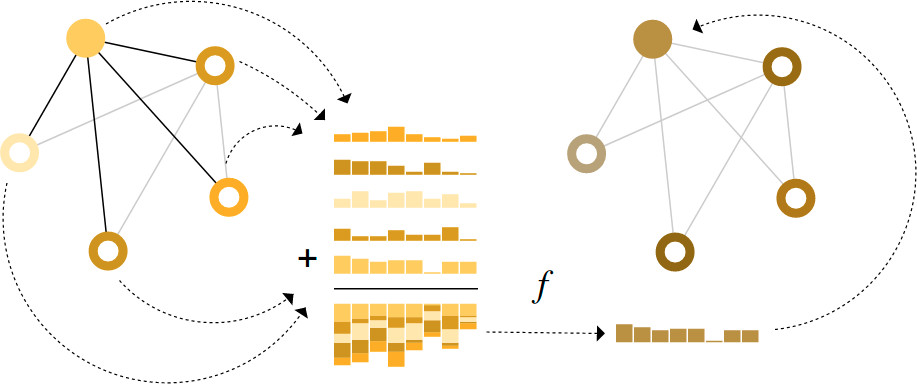
Distill
What components are needed for building learning algorithms that leverage the structure and properties of graphs?
main heart
me like
ocean wren
So basically.. you encode whatever the hell you like as graphs.. I encode movie scenes as spatio-temporal graphs for instance, extracting them into an abstract domain specific language called PROSE
ocean wren
and then we predict graph similarity say.. so my current paper is about a recommender system where you place objects in a scene and it predicts the cinematography as a graph completion step
ocean wren
i.e. I place character A and add edge attribute "angry at" and the ML model completes a set of graph proposals as recommendations.. one of those might be to add another character for the A character to be angry at, another might be a teacup being spilled
the idea of it being like.. I'm using the analogy of predictive text but for cinematography 🙂
main heart
wow you have basis to serialize the emotions?!
ocean wren
The thing of it is, that this stuff already is being used out there.. you go on google maps and try looking at a route.. it does this
Well, the emotion stuff is just an edge attribute.. edges are relationships in graph terms
so characters A and B might be nodes, with edge "hates" between A and B for instance
ocean wren
Yeah, edges can be directed or undirected, depending on how you want them
main heart
If I can revert the direction "hates" -> "love"
ocean wren
you can have bi-directional by just adding two directed edges
main heart
hehe
ocean wren
The point is, you just need a huge old set of graphs as example right? then learn those embeddings..
so I extract those graphs from movies
main heart
gg
ocean wren
and I learn on those
and then.. cinematography 🙂
course its never quite that simple 🙂
But this concept of recommender systems for videogame PCG is my current paper 🙂
main heart
 ocean wren
hahaha..
main heart
all the best with the paper
ocean wren
Thanks, I'll post it here if it gets accepted, we are required to now
i.e. making it public in our university repo
ocean wren
otherwise I'll submit a follow on to AIIDE and share that if it gets accepted
main heart
Sure if you can connect to "first principles", it should
ocean wren
Depends on who reviews it usually
main heart
yeah unfortunately it is out of my expertize
My sister on the other hand is AI scientist
ocean wren
I review for a bunch of different confs and journals and the quality of responses is kind of mixed.. I try and be positive and give constructive feedback.. but a lot of egotists in academia unfortunately
main heart
hehe, the flip side of academia
ocean wren
So you have a panel of reviewers, get a good panel and you're golden.. get an egotist and your screwed 🙂
 ocean wren
Some researchers did a study by submitting a bunch of papers to CVPR I think it was.. they submitted to two sets of reviewers the same papers.. the accepted papers only overlapped between the two review groups in like 30%, so they both accepted and rejected different things 🙂
celest python
ocean wren
I review for a bunch of different confs and journals and the quality of response...
In Turkey we are able to study 2 programs like both psychology and sociology, is that also a thing in England?
main heart
ocean wren
Some researchers did a study by submitting a bunch of papers to CVPR I think it ...
lul
ocean wren
Not really, I think there might be places you can do that.. but its rare in the UK
major/minor thing like the US?
celest python
I guess so, yeah
ocean wren
We tend to only study one thing
celest python
I was not aiming for England but if it would be possible, I'd try to study both aerospace and whatever if your area is in the future as minor
ocean wren
any particular part of aerospace?
main heart
I'd rather pull back the models
celest python
ocean wren
any particular part of aerospace?
If which part is most close to Aerospace Engineering directly
main heart
and try to ponder over the faliure of AI advancement
ocean wren
I tend to teach across games and computer science myself.. but my passion is games
main heart
My friend said, computer science has done no major advancement since Turing
ocean wren
hahaha.. yeah, that doesn't really work though does it
main heart
and I conform to that
ocean wren
transistors?
ocean wren
like you couldn't make modern CPU's without computer science
or.. things like weather simulations
or neural networks
main heart
what be another revolutionary paper since then
ocean wren
I mean, you couldn't have had the large hadron collider without computer science
main heart
yeah you could argue, but still I personally have theorem based mindset
LHC computations be like Chemistry
in front of Physics 🙂
celest python
ocean wren
We tend to only study one thing
What are "joint honors"?
I think its equal to what I'm looking for
main heart
so many exceptions
and no unified rule
no wonder they get pissed whilst learning chemistry
ocean wren
Well, there's still plenty of things we don't know..
particle wave duality is my favourite 🙂
ocean wren
the slit experiment etc
main heart
well Church-Turing tried to address that
ocean wren
I'd rather just build machines that go "ping" 🙂
main heart
algorithms dear Watson, algorithms
ocean wren
I'm more an empiricist than a theoretician
main heart
Let me demonstrate
ocean wren
although a unifying theory of aesthetics is interesting to me
main heart
there is an algorithm which boosts quadartic speedup in unstructured database searching
using the power of quantum mechanics
celest python
celest python
If which part is most close to Aerospace Engineering directly
Damn I realized your university doesnt have Aerospace
main heart
and it is redundant apparently
ocean wren
Yeah, which is weird given we're surrounded by airfields and the UK airforce 🙂
ocean wren
main heart
and it is redundant apparently
redundant?
ocean wren
I occasionally hear about quantum computing.. but I've never seen anything practical come from it
main heart
good
ocean wren
Hopefully at some point it goes from theoretical to practical.. then I'll pay attention
Certainly gets funding though
which pisses me off
ocean wren
The only thing we get funding for is goddam fruit picking robots 🙂
main heart
yeah, I remember in my undergrad I made hovercraft
but some jerks made usual line follower
and they won
the cant tolerate innovations
ocean wren
A few colleagues are making a play to get into some drone related cloud stuff
which is hot right now funding wise
 ocean wren
Drones kind of live in the same area as robots in terms of funding.. so its probably not a bad play if you want $$
ocean wren
Our spin is AI enabled drones via cloud 🙂
main heart
hmm
ocean wren
because edge based AI is also getting funding 🙂
main heart
go on
ocean wren
so basically, AI, drone, cloud all get funding 🙂 so smush them together into a proposal
main heart
well we have Hulk
ocean wren
I envision our drones being more like flying robots though
i.e. having a bit more AI than the usual flying thing
main heart
yeah air manoeuvre needs more care!
ocean wren
Well, these drones are for stuff like forestry and agriculture.. spotting disease and the like you know?
ocean wren
anyway.. got to get back to bed.. need some sleep 🙂
main heart
nn
ocean wren
talk to you all later
 night panther
Anybody in here know perception system
and how you set an actor as Hostile Actor
no real config in the Team Sense
Need similar actors to check if they are on the same team and exploring methods
night panther
nvm I found it ❤️
real arrow
aye, I also work in embedded ai
real arrow
I hope somebody eventually makes some tutorial for the mass AI system that's in CitySample, that would be really nice
main heart
hey prof
I think crowd AI is in UE's todo list?!
Not completely sure though
yeah search for the term in this channel an you may get glimpses
real arrow
oh, I thought they already implemented it
I saw a bunch of classes in the ue5 editor, but I'm not sure how much of that is functional as I have not tried anything yet
 wary ivy
so has anyone tried to get a crowd system going with the new mass stuff?
wary ivy
also what happens to the navmesh actor now? 🤔
it looks like mass stuff uses zonegraph instead
does the editor come with tools to automatically generate a zonegraph for any kind of terrain?
misty wharf
welcome to #gameplay-ai where nobody has any answers for your ue5 questions 
main heart
Yeah looking forward to more Insights!
I mean inside Unreal videos. With the good 'ol gang
wary ivy
misty wharf
welcome to <#221798778208780288> where nobody has any answers for your ue5 quest...
I was hoping that UE 5 release spurred some life here 😄
misty wharf
I think zoombapup is the only one I've seen talk about any of the new features here :P
wary ivy
 last helm
How can I bind ReceiveMoveCompleted to a function in cpp?
main heart
I believe Tom Looman has Udemy lecture on binding delegates

Udemy
Unleash the power of C++ and Blueprint to develop Multiplayer Games with AI in this Epic Games-approved course.
Lecture 78
Handle Damage
ocean wren
I'll probably take a look at the MassAI system in a livestream over the weekend
Once I've submitted this paper I should have time to take a look
 desert dagger
Is it somehow possible to convert navmesh bounds volume into Navigation data reference?

 lone stump
Nav bounds don't have nav data, they're just used to generate it. I don't think there's blueprint function to get it, but there are multiple ways in c++, look in NavigationSystem and search for GetNavData.
crystal sequoia
Hey, I'm using a floating pawn movement component but my pawn won't rotate to face the direction it's going - any suggestions?
shell arrow
wary ivy
also what happens to the navmesh actor now? 🤔
I don't think the nav mesh is going anywhere. the Zone Graph is just a cheaper spline network for simpler pathing you can use instead. that's my understanding
shell arrow
crystal sequoia
Hey, I'm using a floating pawn movement component but my pawn won't rotate to fa...
I think there's an OrientRotationToMovement flag on the movement component if i remember right
crystal sequoia
shell arrow
I think there's an OrientRotationToMovement flag on the movement component if i ...
Hmm, where would that be? Can't seem to find it in ue or the docs
shell arrow
so many settings it blends in really well

should note the comments on it though

that's not the only way to do such a thing
crystal sequoia
Thanks! It looks like this is for character movement? I'm using floating pawn movement at the moment
 acoustic apex
Is there any way to increase NavLink lenght limit?
shell arrow
@crystal sequoia oh my bad
I think you might just have to roll your own solution. Add some rotation towards the current velocity to make it smooth
wary ivy
shell arrow
I don't think the nav mesh is going anywhere. the Zone Graph is just a cheaper s...
it's just that all the mass docs talk about zone graph and how it uses the graph for nav
shell arrow
you probably want to use zone graph for crowd like actors or travelling over large distances to keep em cheap. I'll bet mass entities are tied into it but I would imagine ideally you could still generate and follow nav mesh paths. i could be wrong
i also think zone graph is good for defining streets and sidewalks which is a bit trickier with nav mesh. i haven't dug into it much but this is what i've gathered so far
wary ivy
yea but what if I have a environment like... a forest?
zone graph doesn't seem useful for that
 peak escarp
hey how do I open the ai debbuger ? when i press the " ' " key it works but I can't see the ai perception debug
misty wharf
press one of the numeric keys it lists
it should say 1 AI or whatever so you press 1 to turn that part on
celest python
ocean wren
I'll probably take a look at the MassAI system in a livestream over the weekend
Let us know, I'll be there
 harsh storm
Been tinkering with StateTree. Kind of neat. Still tryin' to figure out how some pieces work though. Overall, my impression is that it is quite similar to a BT.
Looks like it just high jacks the BT AI debugger too

Doesn't seem like it actually works though. Womp womp
misty wharf
🤔
harsh storm
The debugger
misty wharf
So it's another brain component then
harsh storm
Yeah
misty wharf
Only had the BT Brain in 4 so I was wondering if there was something else for it lol
harsh storm
And if you don't select this schema - it won't show up in the dropdown for the component.

 night panther
Anybody know how to set Team attitudes
for the team detection I have set generic team Ids
I dont even need to set it I just need to know what is considered hostile to eachother by default
I know 255 is neutral
 misty wharf
I don't think it's possible in BP's
night panther
thats what ive heard but these are available there must be away
misty wharf
Just because they're available doesn't really make it so sadly :)
you would need to implement IGenericTeamAgentInterface because that's what the perception system uses
night panther
yeah did that already
misty wharf
and/or set an FAttitudeSolverFunction into the team id system
iirc if you implement that interface and override GetTeamAttitudeTowards you can just use that to detect who's hostile
but setting the FAttitudeSolverFunction may make it simpler depending on how you're setting it up
night panther
im just not sure where I set the attitude solver. In the player controller cpp?
I dont see that override after I add the interface
misty wharf
It might work if you set the solver in your module's startup, if not setting it in a world subsystem definitely works
the override is not going to show up in BP's, the interface is C++ only so you'll need to override it there
night panther
I think ill just dicth the team interface from the perception and use tags
can just check for tags on sight perception
no?
misty wharf
Sure
The only downside of not using it is you can't filter out who you want to perceive
night panther
right which would help with performance
misty wharf
Yeah
since everything will attempt to perceive everything, instead of say just the player
which means quite a few more linetraces
harsh storm
So, the StateTree definitely crashes my engine quite often 🤣. Main thing I haven't really been able to figure out is to pass data around in tasks. Figured it out with Evaluators.
misty wharf
I guess they're not using it in Fortnite
harsh storm
Overall though - I still think using the BT will be quicker for newbies. There can be quite a lot of setup involved with StateTrees imo.
night panther
o its some new thing
harsh storm
And explaining the processing sequence for BT's is easier than ST's imo.
misty wharf
Yeah StateTree is a new UE5 thing
misty wharf
Yeah
night panther
how much you charge me to walk me through it
night panther
ok fair
misty wharf
let me see what I have it for in my project...
it's not complicated
void UBillysTeamSystem::Initialize(FSubsystemCollectionBase& Collection)
{
    Super::Initialize(Collection);

    FGenericTeamId::SetAttitudeSolver(&UBillysTeamSystem::GetAttitude);
}

ETeamAttitude::Type UBillysTeamSystem::GetAttitude(FGenericTeamId Of, FGenericTeamId To)
{
    if(Of.GetId() == static_cast<uint8>(EBillysTeamId::IrvingForce) || To.GetId() == static_cast<uint8>(EBillysTeamId::IrvingForce))
    {
        return ETeamAttitude::Hostile;
    }

    return ETeamAttitude::Neutral;
}
I have a GameInstanceSubsystem like this
this is the attitude solver function part
FGenericTeamId ABillysCharacterBase::GetGenericTeamId() const
{
    return static_cast<uint8>(EBillysTeamId::IrvingForce);
}