


1 messages · Page 1 of 1 (latest)
 compact eagle
Hello,
So i got a printer from a friend and had it sat in my garage for a few months, he came to help set it up and i did the first benchy print.
He cant remember anything about gow the printer works so he 'thinks' its a 0.4mm nozzle but it could be a 0.2mm.
Anyway benchy was printed at 0.4mm settings which might be why he has little problems but ny questions are:
How can i tell which nozzle is on without dismantling it as i dont have much confidence doing it.
is it obviously the correct nozzle as if it was the 0.2mm and not the 0.4mm it would be a horroble print?
what can anyone see thats wrong or settings i need to change to fix them or try to anyway.
Im using the elegoo software that came eith the printer, when i printed resin i used chitubox, should i switch back to chitu or do i need to use the elegoo slicer?
Thanks for any info, i realise this is abit vague.
 mint pythonBOT
This post has been inactive for over 1 hour and so has been closed. To reopen this post simply send another message.
 nova narwhal
compact eagle
Hello,
So i got a printer from a friend and had it sat in my garage for a few m...
You can use orcaslicer from softfever github for fdm usually as gold standard. It's free....but any slicer will print. (Just not flashprint. Don't use flashprint)
If your nozzle is 0.2mm and your printing on 0.4mm settings, the extruder will click and it will clog up very quickly \ wont complete a benchy.
Check the nozzle, but removing the silicon sock, then shine a torch on it. It's usually embossed in the side. Universal default is 0.4mm, so unless your friend remembers changing it, it should be that.
the one important thing on fdm is filament can get wet from humidity over time, so be sure to dry it occasionally before use. (Or store in airtight box if used infrequently)
mint pythonBOT
3DBenchy
The 3D Benchy is a commonly used model to calibrate both the visual and dimensional accuracy of a FFF(FDM) printer. Due to its near ubiquitous nature this is often regarded as the standard benchmark print making it a useful model to print when seeking help for troubleshooting a model or improving print quality.
Settings for FFF(FDM) Machines
Scale: 1:1 (unmodified in size, from bow to stern #3DBenchy.stl measures 60.00 mm).
Layer height: 0.2 mm
Infill: 10%
Print speed: up to 50 mm/s
Nozzle diameter: 0.4 mm
Resources
Single Material Downloads: STL | 3MF
Multi Material Downloads: github repo
3D Benchy Website
Infographics: Dimensions | Features | Combined
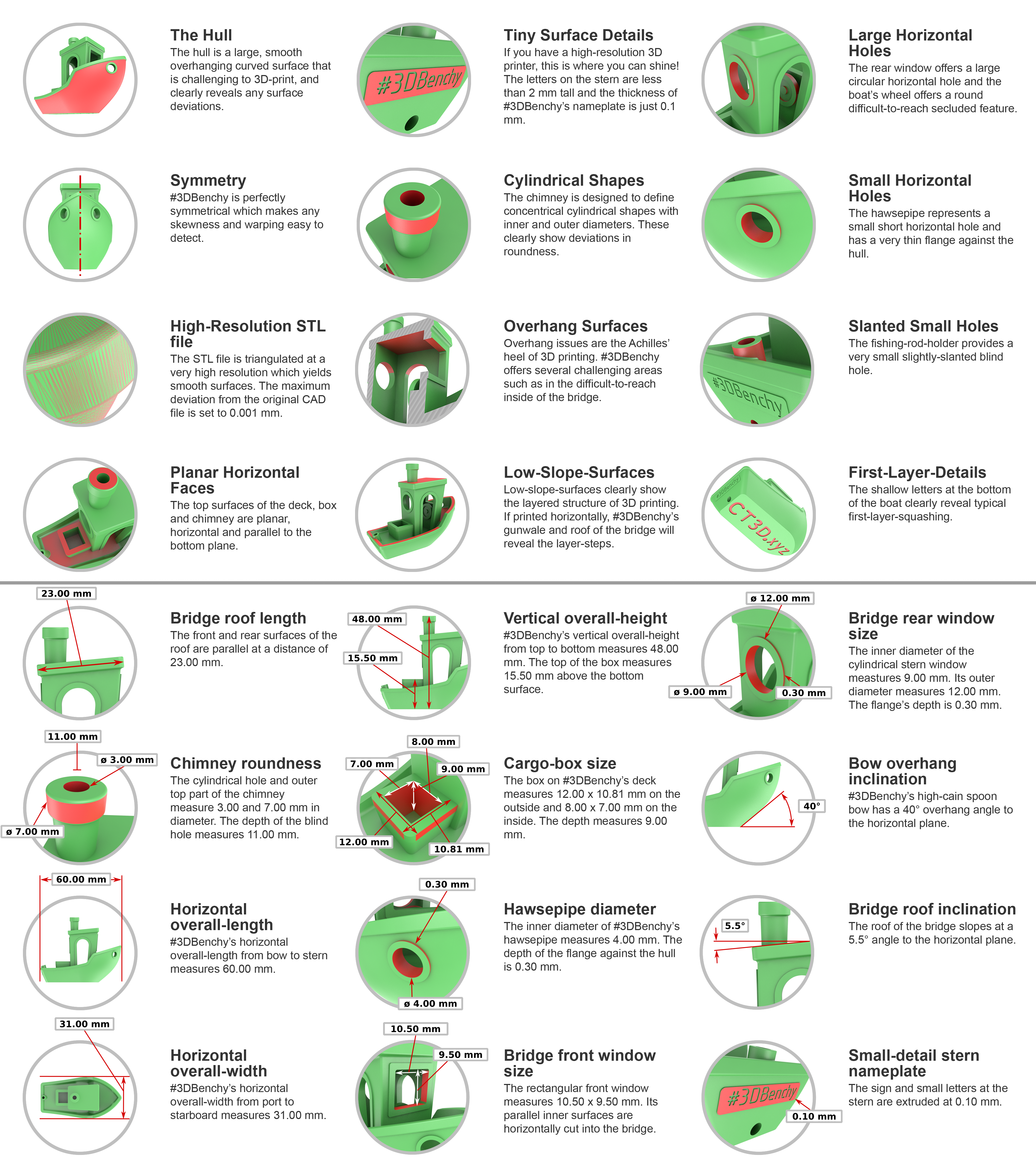 nova narwhal
Benchy looks pretty good 
If you want to improve it further, heres some stuff to check:
Imo thats it, looks good
I'll pull up the reference stuff in case it's needed.
mint pythonBOT

New filament is wet and you should always be working with dry filament. Instead of buying a separate dryer, just use your print bed. Bed drying is also quite effective for materials like TPU, ABS, PC, and Nylon since it can reach temps that most consumer dryers can’t. For more info, see the ?wetfilament command and watch this video. https://cdn.discordapp.com/attachments/667463307963138058/1447891119261221047/IMG_1185.mov?ex=6939452f&is=6937f3af&hm=5fc10c4c072d548d57e8afcd509285a7cdbdd507c56e92461896e6cd9d8e0aa9& https://cdn.discordapp.com/attachments/667463307963138058/1447891124940308551/Screenshot_2024-09-16_at_4.08.38_PM.png?ex=69394530&is=6937f3b0&hm=cad96b7020d51e6bf4bf2178d83552e5d5511ae8a4065a1c641ca495030c083a&
Ellis' Print tuning guide
Follow this guide for easy print tuning
Guide
nova narwhal
Look for pressure advance and flow \ extrusion multiplier in here ∆


