#Does anyone have a CURA PETG profile for the Anycubic Vyper?
1 messages · Page 1 of 1 (latest)
 trim glacier
 glass cloakBOT
trim glacier
Does anyone have a CURA PETG profile? I've spent months trying to tweak my setti...
AI Help
I'm sorry to hear about your frustrations in getting the desired results with your PETG prints in CURA. While I cannot provide specific profiles, you may benefit from looking into forums or groups dedicated to 3D printing where users often share their optimized settings for various materials. It's also recommended to check the manufacturer's recommendations for the specific brand of PETG you are using. Experimenting with temperatures, retraction settings, and print speeds may also help you achieve better results. Good luck!
WARNING: This response is AI generated and may contain errors.
 snow yoke
trim glacier
Does anyone have a CURA PETG profile? I've spent months trying to tweak my setti...
no but the tools to help you
glass cloakBOT
Calibration
Calibration and tuning can help with all aspects of print quality.
Extruder calibration should be done only once, and then again if you change any hardware on your extruder setup (new tube, gear drive, different motor, etc).
Flow calculation should be done for every filament, even different colours from the same brand.
A number of calibration and tuning guides exist online:
?calibration requested by: m.von.d#0
snow yoke
I would use the teaching tech guide with the Orca slicer built in tests
Main thing with PETG is that it needs to be dried and that you tune your retractions
trim glacier
Any Mods: all stock
• Firmware :stock
• Filament material and temps: various brands of petg w/ diff temps
• Slicer : Cura
• Any recent changes: nope
• What have you tried so far : temp, retraction, speed, cooling
snow yoke
What are your problems with PETG
trim glacier
layer seperation is a big one
glass cloakBOT
PTFE Temperatures
TL;DR: Do not heat PTFE above 230C for long periods of time, and never above 260C.
Polytetrafluoroethylene, a.k.a. PTFE, a.k.a. Teflon, is a polymer renowned for its extremely low coefficient of friction. It is used in many industrial and domestic applications, most famously in non-stick pans. Relevant to us, PTFE is used as Bowden tubing and heatbreak liners in 3D printers for ease of filament transport. This places the polymer in close contact with areas where high temperatures are routinely encountered.
PTFE will begin to pyrolyze at 220 degrees centigrade. It will begin off-gassing at significant amounts at 240. At 260, this process will have accelerated to the point where the structural integrity of your tubing will have been compromised. Most contemporary citations focus not on the physical decomposition of PTFE but on the health effects of byproducts used in its manufacture. However one major health risk is directly attributable to PTFE pyrolysis: Polymer fume fever.
Polymer fume fever, or colloquially "Teflon flu", is a condition caused by overexposure to fumes (over the course of 4-8 hours) caused by the decomposition of PTFE. The advanced respiratory metabolism of birds make them particularly sensitive to polymer fumes, which leaves them at high risk of death in environments where such fumes are prevalent. Further reading is linked below.
Further reading
?ptfetemps requested by: m.von.d#0
trim glacier
i been testing with new and dried filament as well. diff brands
oh yes the tube is upgraded to ptfe
only mod
snow yoke
trim glacier
oh yes the tube is upgraded to ptfe
"upgraded"
trim glacier
replaced lol
snow yoke
upgraded from what?
snow yoke
yeah if you print PETG to cold it does that
trim glacier
wdym
trim glacier
sorry im pretty new to this
snow yoke
no worries
trim glacier
ah i keep it in the garage
i have this tubing
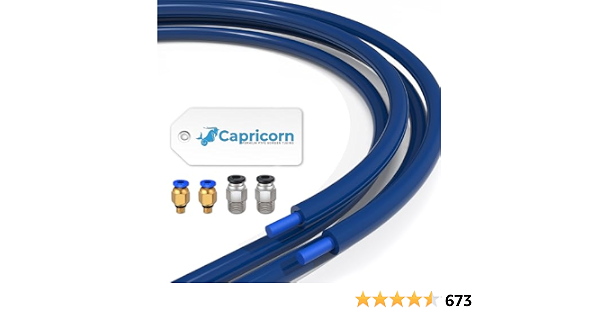
Creality Capricorn Bowden Tubing 1M, Bowden PTFE Tube for 1.75mm Filament with 2X PC4-M6 Extruder Fitting & 2X PC4-M10 Hotend Fitting for Ender 3 V2/3/3 V3 SE/5/K1 Max 3D Printer
snow yoke
trim glacier
ah i keep it in the garage
I mean .... then you accumulate a potent neurotxin in your garage
ah this
glass cloakBOT
Capricorn
Capricorn lists melting temps, not degradation temps when advertising their PTFE tubing.
Capricorn tubes have a unique selling point in that their quality control ensures accurate inner and outer diameters of extrusion. This is in contrast to generic manufacturers who may not have as stringent a requirement for manufacturing.
A 1.9mm ID (inner diameter) has been shown to help in reducing hysteresis when extruding flexible filaments in a Bowden setup but in other setups, i.e. filament with a higher variance in diameter, this can actually become detrimental. Use best judgement when deciding what form or brand of PTFE to use in your printer.
Capricorn tubing is relatively high quality for its price point, but there is insufficient independent evidence to show that it has more thermal resistance to pyrolysis than "generic" PTFE tubing. One difficulty in testing is that due to the colorants in the PTFE resin, the distinctive "browning" of degradation or pyrolysis is much harder to detect. Another point of concern is to do with Capricorn's line of translucent "TL" PTFE. Though the exact composition of their resin remains proprietary, the nature of PTFE and related fluoropolymers speculatively suggests the addition of PFA or FEP (which are optically transparent) into the mix. The issue with this is that both PFA and FEP have lower working temperatures than PTFE. PFA is rated to a similar ceiling of 260 C but has a higher thermal conductivity whereas FEP undergoes degradation at temperatures as low as 200 C. Unfortunately without further evidence, this must remain speculative.
?capricorn requested by: m.von.d#0
snow yoke
same same
trim glacier
snow yoke
I mean .... then you accumulate a potent neurotxin in your garage
by the window w it open, i rarely print anything as Im close to giving up lol
snow yoke
trim glacier
by the window w it open, i rarely print anything as Im close to giving up lol
open window introduces temperature gradients between your part and the plate, leading to warping and layer separation
printer should be used in a stable temperature
trim glacier
i have a cover over the printer though
snow yoke
trim glacier
i have a cover over the printer though
That should help. You still degrade the tube and that might lead to other issues.
As I said: Use the guide to systhematically tune the profile. If you change parameters left and right you will run in circles as these values influence each other. There is a certain order to things
trim glacier
is it best to start w default and redo?
snow yoke
trim glacier
is it best to start w default and redo?
yes
trim glacier
like a stock cura petg profile
snow yoke
yes, would be my course of action. First a full metal heatbreak upgrade though
I would use Orca slicer, much more options for calibraton and tuning. But use what you want and know.
trim glacier
interesting ive never heard of it
figured the basic adjustments was all thats needed
temp, flow, retraction, etc
snow yoke
trim glacier
temp, flow, retraction, etc
Yeah that should in theory be correct. But if you do them in the wrong order you won't have much luck