#Shear stress mitigation

1 messages · Page 1 of 1 (latest)

carmine kiln
#

This thing is a blinker canceller for a car. It fits around the steering column, between the steering wheel and a reasonably stout spring. The peg on the top engages with the wheel.
The barrel of this will be in compression. I'm not too worried about that, but I'll definitely use <20% infill for it.
My main concern with this is the peg. Because that engages with the back of the wheel, it will be under a lot of back-and-forth shearing forces. I currently plan to print it in the orientation shown, so the shearing forces will be in-plane with the print layers; the worst possible orientation for that kind of stress.
I don't know how much shear stress this will actually experience. If I'm being overly paranoid, I'd be glad to know.

What can I do to mitigate this weakness? This doesn't have to look good; if this works, it will (ideally) never be seen again.
Things I've thought of:

  • Increase infill to 100%. I don't know if that's a good idea, because it'll make the print quite a bit longer, and consume a fair bit more material. If it doesn't work, that's a bit of a raw deal.
  • Increase wall thinckness/line count. I don't know if that's
  • Mill it instead of 3D print it. I can probably work out how to operate the AliExpress toy CNC mill that I have. That will result in a much stronger part, if I can make it work, but I don't have it set up yet, nor do I have a suitable block of material to cut on it.
earnest wedgeBOT
#
AI Help

To mitigate the weakness in the peg due to shearing forces, you have some good options to explore:

  1. Increase Infill: While 100% infill would make the part stronger, as you mentioned, it would be more material-intensive. You could try a compromise, such as 50-75% infill, to reinforce the structure while balancing material usage.

  2. Increase Wall Thickness/Line Count: This can also help strengthen the part, especially in the area of the peg. Thicker walls or more perimeters can provide additional support against shearing forces.

  3. Alternate Printing Orientation: Consider printing the part in a different orientation that aligns the layers with the direction of the shearing forces. This can help improve the part's resistance to such stresses.

  4. Post-Processing: After printing, you could reinforce the peg further by using techniques such as inserting a metal pin or rod for additional strength.

Regarding milling the part, it could indeed result in a stronger compo...

west eagle
# carmine kiln This thing is a blinker canceller for a car. It fits around the steering column,...

You can print it on the side, with tree supports to hold the circle in place, elevate the part if you can,
Wall count like 6+, to make the print fully walls
Print slower so theres better layer adhesion
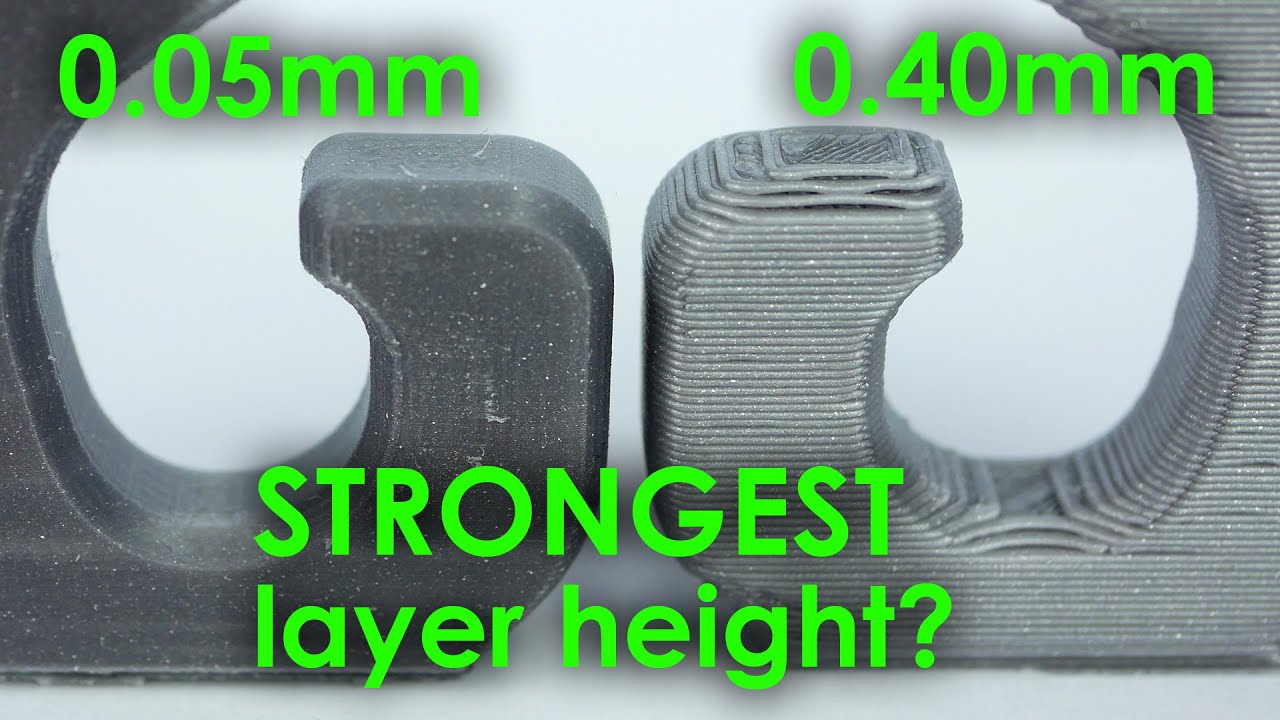
also you can reduce the layer height, like in this video https://www.youtube.com/watch?v=fbSQvJJjw2Q

Does thickness matter? Today we'll find out which layer height you should choose to get the strongest prints! I printed test specimens with layer heights from 0.05mm to 0.40mm and measured their strength.

Check out our CNC Kitchen products at https://cnckitchen.store/ or at resellers https://www.cnckitchen.com/reseller and on AMAZON (EU) https:...

▶ Play video
#

Yeah it'll take more filament but filament is kinda cheap, compared to a block of alu

carmine kiln
#

I don't think this mill will do metal lol.
It's one of those open-frame things made out of aluminium extrusion.

west eagle
#

You can do a simple test with just the nub printed, and then apply your own forces to see how it goes

carmine kiln
#

idk if I can put that much force on it by hand. It's fairly small

west eagle
#

but yeah since its small, filament is cheap, i think this print fully infilled would be no more than what 30 grams?

#

Unless i'm getting the size wrong ahahah

carmine kiln
#

11g, according to cura

west eagle
#

Yeah thats 1/100s of a spool so if its 20 dollars thats 0.2 cents or smtg, print times would be maybe like an hour max?

carmine kiln
#

1:45

west eagle
#

Yeah i'd say give it a go man, as long as its not a 12 hr print with no way of knowing its always worth it

carmine kiln
#

Or a bed-spanning print that's already failed three times...

west eagle
carmine kiln
#

It's all in the first one, maybe two layers, and I normally hang around for that

#

I think my bed is warped, but there;s no real way to fix that print.

west eagle
west eagle
carmine kiln
#

It's mostly just to catch the early fails. Most of them happen in layer 1 or 2

carmine kiln
west eagle
#

damnn yeah, welp all the best man

#

hope it works, it should seeing the orginal canceller is injection molded abs

carmine kiln
#

I'm not up for completely re-tuning a printer from scratch, even if the compile times are acceptable

carmine kiln
carmine kiln
#

?solved