#dev-general
1 messages · Page 481 of 1
 prisma wave
 old wyvern
hmm
prisma wave
@ could also be used for pattern matching if we're copying taking influence from haskell
 arctic juniper
https://github.com/haskell/haskell-language-server
hls is this, right?
prisma wave
old wyvern
how do you mean?
case x of ->
  r@Record(a _ _ ) -> putStrLn (show r ++ a)
yeah ~/.ghcup/env needs to be added
old wyvern
prisma wave
i think it offers to do that for you if you install it with the shell script, but not if you used the aur package
old wyvern
ah
arctic juniper
also ghc isn't in path
prisma wave
that will be in /env too
arctic juniper
and what do I put there
prisma wave
prisma wave
yeah `~/.ghcup/env` needs to be added
.
i presume you know how to add a directory to your path
old wyvern
export PATH="$HOME/.cabal/bin:$HOME/.ghcup/bin:$PATH"
arctic juniper
.ghcup/env doesn't exist
arctic juniper
ah, thanks
prisma wave
oh wait yeah
old wyvern
if you have stack as well
export PATH="$HOME/.local/bin:$PATH"
arctic juniper
I have neither yet
old wyvern
download both
prisma wave
my bad, it's env on my machine but it did weirdness
arctic juniper
well hold on
arctic juniper
it just told me to upgrade ghc, jesus christ
old wyvern
lol
prisma wave
hmm
does vsc work with 9.0.1 yugi?
kali was having some issues with it the other day
although that was on windows
old wyvern
prisma wave
does vsc work with 9.0.1 yugi?
It should
It gives a warning in the main file tho
but that should be fine
arctic juniper
downloaded, installing
prisma wave
excellent
arctic juniper
[ Warn  ] This is an old-style command for installing GHC. Use 'ghcup install ghc' instead.
[ Error ] Unable to find a download for the requested version/distro.```stack-static is an aur package
prisma wave
idk the exact reason but i think it's because it's kind of 3rd party
arctic juniper
okay got them installed
prisma wave
awesome
arctic juniper
lemme just add to path
prisma wave
might have done that for you if it's on the aur
prisma wave
you using VSC?
arctic juniper
nvim
old wyvern
stack new <Project_name>
arctic juniper
it made a bunch of stuff
prisma wave
yeah tbh, you might want to steer clear of the build tools for the absolute basics
prisma wave
kinda overkill if you just want a hello world
old wyvern
maybe just use ghci
prisma wave
yeah
arctic juniper
200mb fuuuuuu-
prisma wave
ghci is the jshell to java
old wyvern
lol
arctic juniper
after stack new or?
old wyvern
leave that project for now ig
prisma wave
or delete it, whatever. you can just use a single file for now
old wyvern
https://docs.haskellstack.org/en/stable/README/
Further instructions to use stack are here if you're interested
prisma wave
okay so anyway, in FP you often program at a REPL as it's usually more convenient for hacking together stuff
the official repl is ghci
arctic juniper
ah I see why it isn't in path
there's no ghci or ghc bin, there are bins with a version
ghci-9.0.1 is a command
prisma wave
ah that's an issue i was having a while ago
arctic juniper
there should be or I should alias?
arctic juniper
yep probably it
prisma wave
can you do ghcup tui and make sure you've set the versions you have installed
arctic juniper
okay ran ghcup set 9.0.1
old wyvern
alright, now it should work
arctic juniper
does
prisma wave
awesome
old wyvern
lit
prisma wave
okay so uh
arctic juniper
I have a shell thing now
arctic juniper
oh my god 9 + 9 works
prisma wave
incredible
old wyvern
sum [1..9]
arctic juniper
where are the parentheses
prisma wave
you don't write them
old wyvern
^
arctic juniper
sum [1..10000000] is slow
old wyvern
try sum [1,3..11]
prisma wave
in haskell (and other ML style languages) parentheses are to denote precedence, not for function application
old wyvern
arctic juniper
sum [1..10000000] is slow
well ofc xD
arctic juniper
arctic juniper
sum [1..10000000] is slow
my shell just crashed from doing this
arctic juniper
okay it works now
prisma wave
you can probably identify all the parts in that, [1..n] is a list between 1 and n, and sum is a function that... sums a list
arctic juniper
old wyvern
try `sum [1,3..11]`
36
prisma wave
simple
arctic juniper
yeah I see
 forest pecan
(10million * (10 million + 1) )/2
arctic juniper
does .. only work in the [] thingies?
prisma wave
yeah
old wyvern
those are lists
old wyvern
sum takes a list as input
arctic juniper
gauss shit
prisma wave
they're list literals, you can also do stuff like [1, 2, 4, 8]
arctic juniper
does .. have a step?
old wyvern
sum :: Num a => [a] -> a
is the type
prisma wave
forest pecan
(10million * (10 million + 1) )/2
it can't do that unfortunately, sum has to be generalised for any summable type
or maybe it does do that
forest pecan
F
old wyvern
arctic juniper
does .. have a step?
You can provide the step pattern in the list
prisma wave
idk
prisma wave
probably not
arctic juniper
old wyvern
```
sum :: Num a => [a] -> a
```
is the type
okay now you lost me
prisma wave
dw about that
old wyvern
arctic juniper
okay now you lost me
Thats its type signature
oh oops
fixed
sum :: Num a => [a] -> a
arctic juniper
is that a named return value?
old wyvern
no
prisma wave
in java terms that's <A extends Num> A sum (List<A>)
old wyvern
Thats a constraint
prisma wave
but dw too much about that for now
arctic juniper
ah
prisma wave
let's keep it simple
arctic juniper
so a is a type
old wyvern
No
arctic juniper
no?
prisma wave
num is a type constraint, kinda like an interface except more powerful
arctic juniper
right
prisma wave
in other words "a can be any type that implements the Num type"
anyway
so
we know how to use functions
time to make a function
double x = x * 2
try this
or that
old wyvern
^
prisma wave
lol
prisma wave
you get used to it
arctic juniper
works
prisma wave
and then naturally you can do double 3 etc
arctic juniper
yay
prisma wave
awesome
arctic juniper
uh so
old wyvern
now define another function
arctic juniper
double 3 + 5 does what
prisma wave
that won't compile i don't think
old wyvern
arctic juniper
double 3 + 5 does what
(double 3) + 5
prisma wave
yeah function calling has the highest precedence
prisma wave
although not often
prisma wave
yep
arctic juniper
converting?
forest pecan
how dare u
old wyvern
😌
old wyvern
arctic juniper
converting?
Its a cult here
arctic juniper
excuse me, I'm a catholic
prisma wave
also, cool bonus feature - when you're in ghci you can do :t x to find out the type of x
try :t double
arctic juniper
I am learning about your culture, not converting
forest pecan
lol
prisma wave
we'll see about that
arctic juniper
floats are fractionals?
old wyvern
Theres a distiction in haskell actually
prisma wave
yeah...
old wyvern
haskell has both fractional numbers and floating point numbers
prisma wave
decimal stuff is kinda messy sometimes
arctic juniper
pi is floating
arctic juniper
my 6.9 is fractional
arctic juniper
is fractional so you don't lose precision?
old wyvern
Depends on the type you operate on and the functions you use fefo
prisma wave
it's a bit confusing
anyway, you'll probably know this from rust and kotlin but in haskell, functions are values
arctic juniper
what's next
prisma wave
meaning they're no different to any other "variable"
you can pass functions to functions, functions can return functions, etc
arctic juniper
right
old wyvern
Fractional is just anything dividable generally I think
arctic juniper
is pi not divisible
old wyvern
It can be
prisma wave
confusing stuff
okay what next
Strings
they're pretty similar
exactly the same even
and of course you have Chars too
exactly the same syntax as any other language for those
prisma wave
in other words "'E' is of type Char"
 obtuse gale
old wyvern
Fractional is just anything dividable generally I think
obtuse gale
old wyvern
Fractional is just anything dividable generally I think
so like.. it's a fraction basically lol it can be represented as a ratio of two numbers
right?
obtuse gale
well numbers idk what you can do in haskell but hopefully you get what I'm trying to say
prisma wave
lol
arctic juniper
so what do I use when I want to deal with decimals?
prisma wave
generally i think you'd just let the compiler figure it out
arctic juniper
Rational?
prisma wave
i guess Floating is the "traditional" way, but im not sure what's conventional tbh
obtuse gale
prisma wave
generally i think you'd just let the compiler figure it out
classic native languages
old wyvern
obtuse gale
so like.. it's a fraction basically lol it can be represented as a ratio of two ...
Seems like it also consists of irrationals? not sure tbh
arctic juniper
so how would I make a multiline function?
old wyvern
do blocks
prisma wave
good question
old wyvern
But
prisma wave
this is where ghci gets a bit annoying
old wyvern
Warning
prisma wave
you can't do multiple line stuff very well
old wyvern
those are syntax sugar, anything not part of the final result either as a value or as a bind will NOT be evaluated
prisma wave
lol
okay you might wanna switch over to an actual editor now, and make a new file
we'll have a look at do blocks
 eternal flare
Minecraft on java 1.16 😶
 ocean quartz
Yasss
arctic juniper
initializing languageserver.haskell
prisma wave
👀
old wyvern
eternal flare
Minecraft on java 1.16 😶
 prisma wave
🥲
old wyvern
Ok mockito is just trolling now
Why does it say cglib is not on the classpath when its right damn there
🥲
prisma wave
classic
arctic juniper
Cannot find any haskell-language-server exe, looked for: haskell-language-server-9.0.1, haskell-language-server-9.0, haskell-language-server
f
arctic juniper
I don't have it installed for 9.0.1
prisma wave
did you do ghcup set hls?
 ocean quartz
🥲
old wyvern
ok screw this
prisma wave
ima keep typing while you try and figure it out - i could never get vim working but i also suck at vim so that might be why
arctic juniper
prisma wave
did you do `ghcup set hls`?
the problem is that hls doesn't support ver 9
prisma wave
ah
old wyvern
is there any other framework that can mock with proxies?
ocean quartz
old wyvern
ok screw this
Wouldn't happen unit testing Haskell!
arctic juniper
I guess I'll just go back to 8.10.4
prisma wave
that's similar to the problem kaliber was having a while ago
old wyvern
ocean quartz
Wouldn't happen unit testing Haskell!
ikr
prisma wave
yeah that's probably best
you're not gonna be missing much
okay so, in haskell every function is a single expression. there are no "blocks", just expressions.
however as you might expect this can get a bit annoying, so there's a syntax sugar called "do blocks" that replicate an imperative {} block
arctic juniper
okay it loaded in like a second
prisma wave
good enough
ocean quartz
old wyvern
is there any other framework that can mock with proxies?
Seems like Ktor uses Mockk for it
arctic juniper
okay yep works
prisma wave
okay so let's start with the main function actually, you've already seen putStrLn "hello world", but that only evaluated in the repl
arctic juniper
yes
prisma wave
like most languages we have a main function
prisma wave
yup
arctic juniper
yay I guessed it
arctic juniper
what if I want more lines?
old wyvern
ocean quartz
Seems like Ktor uses `Mockk` for it
Does that work outside kotlin? the 2 kks make me feel like its for kotlin
prisma wave
that's when do blocks come into play
arctic juniper
how do I close a do?
prisma wave
try this: ```hs
main = do
putStrLn "hello"
putStrLn "world"
Ah, probably not yeah 😦
old wyvern
welp
obtuse gale
old wyvern
Does that work outside kotlin? the 2 kks make me feel like its for kotlin
klassik kotlin adding K's everywhere 🌝
prisma wave
arctic juniper
but what's the point of do if I don't close it?
it's indentation based
arctic juniper
ah
old wyvern
🥲
ocean quartz
obtuse gale
klassik kotlin adding K's everywhere 🌝
Lmao yes, i actually hate that xD
prisma wave
you can technically use braces if you want, it's just not generally done
main = do {
  putStrLn "hello";
  putStrLn "world";
}
this is also valid
arctic juniper
  { haCharBuffer :: IORef (...something...)
  , haBuffers :: IORef (...something...)
  , haBufferMode :: BufferMode
}```commas before the line??w- what
old wyvern
Except thats not the convention 🥲
Prepare to be horrified
main = do
  { putStrLn "hello"
  ; putStrLn "world"
  ; }
the conventions for spacing and things are definitely a little different
old wyvern
yea
prisma wave
yes 🥲
arctic juniper

prisma wave
but im not sure it can be considered a convention if nobody actually writes it like that
ocean quartz
Who created that convention? i need to have a talk with them
old wyvern
They do use that I think
arctic juniper
thank fuck
old wyvern
ah
arctic juniper
not working
prisma wave
yup
prisma wave
indeed
old wyvern
Anything the derives Show provides a show function
obtuse gale
OH MY GOD
old wyvern
Which can "Stringify" it
obtuse gale
gradle 7 for fabric mods UJFDSUOJSDNBJLOS
arctic juniper
old wyvern
String!
is that ! a part of the type?
prisma wave
putStrLn :: String -> IO () this is the signature of putStrLn - it takes a String, and returns an IO () (which we'll get to in a minute)
arctic juniper
what the
prisma wave
show is roughly analogous to toString
arctic juniper
works
arctic juniper
I removed the parentheses, it doesn't work
old wyvern
to save yourself from parenthesis hell
We have custom operators
Haskell has one defined in the base class to apply an argument
prisma wave
arctic juniper
I removed the parentheses, it doesn't work
yeah, that's because of precedence. without the parentheses it would be interpreted as putStrLn(show, 3) in C-style function calling
old wyvern
This is for a single argument and so can only be used for the last argument
prisma wave
whereas what we want is putStrLn(show(3))
arctic juniper
shows a warning
old wyvern
It simply takes whats on its right, and applys its to the function on the left
arctic juniper
tells me to use print 1
prisma wave
indeed
prisma wave
that's kinda verbose so there's print which is a combination of putStrLn and show
old wyvern
brb
arctic juniper
how do multiple args work?
prisma wave
i dont think so, this is where it can get a bit confusing
actually maybe
try it
i don't think it will
arctic juniper
add(add(1, 2), add(3, 4))```add x y doesn't compile
prisma wave
you need the body
arctic juniper
I have it
arctic juniper
oh do I put the add outside of main?
yeah the thing doesn't compile
lemme try parentheses
prisma wave
yeah outside of main
you can nest functions, but that has a slightly different syntax
arctic juniper
print $ add (add 1 2) (add 3 4)
that should work
arctic juniper
it does
prisma wave
awesome
obtuse gale
what kind of chain rule is that lol
arctic juniper
weird and confusing
prisma wave
heh
okay
now for the real mind-blow
go into ghci, define add again and then check the type of add
arctic juniper
add :: Num a => a -> a -> a
loll
arctic juniper
looks very intimidating
prisma wave
it's actually quite simple
arctic juniper
I want to kill it
prisma wave
in haskell functions only have 1 parameter
arctic juniper
they what
prisma wave
if you have functions with multiple, that's just a function that returns a function
and so on
arctic juniper
I know what curry is
arctic juniper
currying is the process of applying curry to food?
prisma wave
close enough
anyway, what this funky parameter stuff means is that we don't need to provide all of the parameters to a function
so for example, we can do add 3
arctic juniper
oh
prisma wave
which in turn returns another function
arctic juniper
so that returns a function we can use later
prisma wave
exactly!
arctic juniper
similar to julia
prisma wave
oh does julia do that too?
arctic juniper
yeah some functions return a function if you don't supply all params
prisma wave
ah cool
yeah, super common pattern in FP
i was gonna explain where it might be useful but im guessing you already know
arctic juniper
julia> ==("69", "69")
true

julia> ==("69")
(::Base.Fix2{typeof(==), String}) (generic function with 1 method)
I have no clue where that could be useful
prisma wave
ah yeah exactly the same thing
okay
well
you're familiar with map and filter right?
prisma wave
hehe
arctic juniper
I see
prisma wave
yup
arctic juniper
filter(==("69"), arr)
prisma wave
exactly
arctic juniper
in julia
prisma wave
in haskell that would be filter (== "69") arr
arctic juniper
is equivalent to filter(x -> x == "69", arr)
prisma wave
so almost exactly the same
prisma wave
lol no problem
arctic juniper
it's getting late and I haven't showered in 3 days
prisma wave
🥶
fair enough
if you decide to carry this on feel free to ping me if you have any questions
arctic juniper
actually gonna go a bit later
arctic juniper
so you told me all about functions and all that fancy stuff
prisma wave
yup
arctic juniper
but what about if statements
prisma wave
no statements, only expressions
arctic juniper
right
prisma wave
the difference being that an if requires an else
arctic juniper
it what
prisma wave
so it can evaluate to some value
prisma wave
because everything in haskell is an expression
and the definition of an expression is something that evaluates to a value
arctic juniper
does haskell have no void type?
prisma wave
it does
arctic juniper
do functions with 0 params exist?
arctic juniper
eh?
prisma wave
because haskell does lazy evaluation
arctic juniper
ah
prisma wave
so you can do blah = print 3 and that won't actually print anything until you try and get the value of blah
prisma wave
it is a bit weird
prisma wave
arctic juniper
how do I define a var?
name = value
arctic juniper
in main
arctic juniper
    let test = print 69
```this doesn't work until I access testyeah
that line alone won't print anything
because it doesn't evaluate until it's forced to
arctic juniper
    let test = print 69
    test
test```this prints twiceit's like a weird ass macro
prisma wave
basically, to keep functions pure, stuff like print don't actually print anything, they just return a value that describes some IO.
so it's returning the same value every time, but the do block is executing the IO twice
print doesn't actually print anything, it returns a value that's sort of like a list of instructions on what IO to do in order to print that value
arctic juniper
why is it executing the value?
prisma wave
because the do block assumes you want to execute it
arctic juniper
oh is test like a 0 param function now?
prisma wave
kind of
this is quite a tricky concept
but it will make sense
it's probably best not to worry about that for now
for all intents and purposes, it's a 0 param function
prisma wave
lol
¯_(ツ)_/¯
basically, haskell wants every function to be pure, so it doesn't actually do any IO, it just describes the IO to do, and then the compiler bundles that up and does evil wizardry to perform that IO
the language stays pure, but it can still do IO
 cinder flare
might as well rename this channel to #intro-to-haskell
arctic juniper
Tomorrow at 00:00
cinder flare
im kinda diggin it though
just following along after
makes actually a bit of sense
hey do you know how to do infinite lists BM
prisma wave
yes
cinder flare
what's up with those
prisma wave
wdym
cinder flare
what are they used for
cinder flare
but super cool!
prisma wave
but usually number generating stuff
arctic juniper
how do you get all odd numbers
cinder flare
oh I see like a number generator is just an infinite list of all possible numbers generated?
prisma wave
yeah
if you wanted to generate a list of all primes, a naive but functional implementation would be filter isPrime [1..n]
cinder flare
arctic juniper
how do you get all odd numbers
2N+1
prisma wave
arctic juniper
how do you get all odd numbers
[1,3..]
cinder flare
lol
prisma wave
yup
prisma wave
sadly it's not that sophisticated
it can do arithmetic progressions
not much more than that
arctic juniper
is that valid haskell
prisma wave
probably valid julia lol
cinder flare
∈ means is an element of in set theory
prisma wave
you could do an infinite list of all fibonnacci numbers with some recursion magic
cinder flare
2n is just multiplying n by two lol
arctic juniper
but | is just binary or
cinder flare
| means such that
prisma wave
shame
cinder flare
you read that statement as: 2n -1 such that n is an element of all natural numbers
so basically every odd number
arctic juniper
main :: IO somethingwat
prisma wave
Ah you've discovered the IO monad
cinder flare
haha monads go brrr
prisma wave
Now we're cooking with gas
arctic juniper
I haven't discovered shit, I just googled how print works
cinder flare
gas
prisma wave
Lol
arctic juniper
btw, what's haskell used for?
prisma wave
Quite a lot
It's definitely traditionally used for academia
But Facebook uses it for spam detection, GitHub uses it for language parsing
cinder flare
yeah as I said it's really good at expressing set theory and category theory lol
type theory too
prisma wave
It's gaining more adoption
But yes the original use case was definitely just for nerdy professors to experiment with complicated mathematical ideas
Which sounds pretty fun tbh
arctic juniper
it's gaining more adoption? isn't it half a century old?
cinder flare
hey im a nerdy normal person, not a professor
cinder flare
arctic juniper
it's gaining more adoption? isn't it half a century old?
python was made in the 90's and it's still gaining more adoption
prisma wave
arctic juniper
it's gaining more adoption? isn't it half a century old?
Nah Haskell came out in 1991 iirc
Or around that time
93 maybe
cinder flare
yea a lot of langs came out early 90's
cinder flare
ML go brrrr
prisma wave
I mean lisp was like 1958 or something
arctic juniper
ml is what
prisma wave
Maybe 61
cinder flare
ML is the precursor to Haskell
arctic juniper
what does ml stand for
prisma wave
There were quite a few functional languages in the 70s and 80s, until they realised that there were too many languages to learn so they all sat down and made Haskell
That's not a joke
Pretty much what happened
prisma wave
ML was pretty influential afaik
That and Lisp were like
The big 2
Back in the day
arctic juniper
cinder flare
and Coq, nice
how do you read that
cinder flare
awe man what a time to be alive
prisma wave
Not that I'd know
cinder flare
arctic juniper
how do you read that
try spelling it out, with a ck instead of a q
arctic juniper
hmm
obtuse gale
u horny ass
cinder flare
oy
obtuse gale
lmao
cinder flare
is it cause I mentioned C++
arctic juniper
blyat
cinder flare
it summoned you out of your cave
obtuse gale
lol not because of that, no
prisma wave
Ofc
obtuse gale
prisma wave
There were quite a few functional languages in the 70s and 80s, until they reali...
I was laughing about this tbh
arctic juniper
monads?
cinder flare
woah have you guys heard of Cyclone
it's like C but they made it harder to fuck yourself
prisma wave
arctic juniper
monads?
Oh that's gonna take a while to explain
prisma wave
cinder flare
it's like C but they made it harder to fuck yourself
Pretty low bar
cinder flare
yeah
arctic juniper
I don't like when they make it hard to fuck yourself
cinder flare
bro go back to writing ASM then
arctic juniper
if I want to fuck myself I will do it and nobody will stop me
prisma wave
Damn right
arctic juniper
cinder flare
bro go back to writing ASM then
I actually did do some a few days ago
arctic juniper
nasm
 prisma wave
Okay I am gonna go to bed pretty shortly but I will try and briefly explain the IO monad (or at least the idea behind it)
arctic juniper
network assembly I think is what it stands for
cinder flare
Netwide Assembler apparently
arctic juniper
close enough
old wyvern
back
old wyvern
how far did you get vr?
cinder flare
in ASM? holy cow
arctic juniper
the literal equivalent in c did work
so I was left confused
it didn't error, it just returned
weird stuff
well not returned, ran the whole thing
without error
also debugging assembly is a pain in the ass
especially without libc
old wyvern
cinder flare
it's like C but they made it harder to fuck yourself
Seems like human anatomy
prisma wave
this is what I was talking about earlier where we have an abstraction that describes some IO to do. The main function says "this is a list of the IO I would like to do", and the compiler turns that into evil unsafe code.
This is expressed through the type IO a which basically represents some IO operation that returns an a
So print and putStrLn are IO () because they're an IO operation that returns no meaningful value (() is the void type, known as "unit")
old wyvern
cinder flare
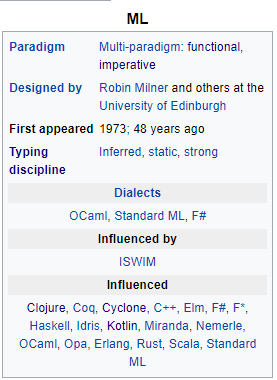
technically OCaml, Standard ML, and F# are all ML bois
Dont forget Elm 😌
cinder flare
yugi really going back through the message history and commenting
prisma wave
similarly we have other IO functions like getLine (gets a line from standard input), this returns an IO String
old wyvern
Yea
cinder flare
also Wikipedia does not list Elm as an ML boi
old wyvern
Elm is afaik
 old wyvern
 arctic juniper
hmm well it is kind of confusing
cinder flare
yeah influenced
old wyvern
Even haskell was "influenced by"
old wyvern
Its literally the same syntax as haskell
arctic juniper
can you print inside another function?
old wyvern
It only lacks custom monads
prisma wave
Yes, but that function has to return an IO value
old wyvern
Elm is actually pure
arctic juniper
oh
cinder flare
yeah ML isn't 100% pure
arctic juniper
what if I want to return another value?
cinder flare
it allows unsafe stuff
old wyvern
Ofc, Elm isnt a complete ML ripoff
I just meant it shares the same elements haskell does from ML
prisma wave
arctic juniper
what if I want to return another value?
Example?
old wyvern
or atleast most of it
arctic juniper
if I have a function that prints 69 and returns 420
cinder flare
nice
prisma wave
So something like ```hs
funny = do
print 69
return 420
This would have to return an IO Int
arctic juniper
IO Int?
cinder flare
combo types!!!!
prisma wave
Because it's an IO operation that eventually returns an Int (420)
cinder flare
what if I don't know how a Future works either 🥲
arctic juniper
wait can I run any function that doesn't return IO in main?
old wyvern
Haskell itself does not read or write anything, so it needs to compose IO Actions to create the sideeffects
prisma wave
Yes
arctic juniper
I can't run add
old wyvern
IO functions can only eb called in IO functions
Except a few cases wher eyou can lift em with transformers
but the general rule stands
prisma wave
arctic juniper
I can't run add
That is because you're not doing anything with the result I'm guessing
prisma wave
yugi you might be overcomplicating this a little
old wyvern
arctic juniper
prisma wave
That is because you're not doing anything with the result I'm guessing
yes
prisma wave
Yeah you have to bind it with a let binding, or not call it at all
arctic juniper
doesn't binding just not run it at all?
cinder flare
oh snap he's got a point
prisma wave
It will run it if you force it to evaluate
cinder flare
lazy evaluation biting oyu
arctic juniper
so say I got this
add x y = x + y

main = do
    let poo = add 69 420

print "ha"```this works fine
but add will never actually be called
old wyvern
Mhm
prisma wave
right
cinder flare
print poo
old wyvern
Everything is evaluted only when it needs to be
arctic juniper
and I can't just put poo on the next line, it won't work unless I print it
prisma wave
the thing is, because add is pure you won't actually know that it doesn't get called
there's no noticeable difference
arctic juniper
well yes, but I will know
prisma wave
Indeed
obtuse gale
sounds like a functor to me 🌚
arctic juniper
a what now
prisma wave

arctic juniper
do you call a functor or is there a fancier word?
prisma wave
is it really
cinder flare
this is why we stay in haskell land
old wyvern
arctic juniper
do you call a functor or is there a fancier word?
Well you could say "A mapping between 2 categories"
cinder flare
no weird C++ shit
old wyvern
But
Assuming you are sane
And havent started circlejerking
lets just go with function
prisma wave
old wyvern
And havent started circlejerking
I would never do that
prisma wave
anyway, Vr the reason you can't just do poo is because of what do blocks compile to
obtuse gale
cinder flare
no weird C++ shit
arctic juniper
what do do blocks compile to?
prisma wave
main = do
    print 3
    print 4
This gets translated to ```hs
main = print 3 >> print 4
?
prisma wave
Yeah
prisma wave
It basically takes 2 IO actions and turns them into 1
cinder flare
obtuse gale
_cough <http://learnyouahaskell.com/functors-applicative-functors-and-monoids>_
oh I didn't know you actually knew haskell lol i thought that was a C++ thing
prisma wave
it's like .thenRun with a CompletableFuture or something
arctic juniper
what happens to bindings?
prisma wave
they get inlined I believe
So your poo example becomes ```hs
main = print (add 69 420)
wouldn't that call the function multiple times?
arctic juniper
what now
obtuse gale
cinder flare
oh I didn't know you actually knew haskell lol i thought that was a C++ thing
yeah a functor is also a thing in C++, although I think it's different
and no I don't know haskell lol
cinder flare
ah nice
prisma wave
We generally don't worry about it, because the compiler can determine whether it's worth caching or not
this kinda what yugi was saying earlier, how you don't need to think about performance much
because the compiler is able to do a lot of the optimisations for you
arctic juniper
so can I think of bindings as kind of #define?
prisma wave
they usually act in a similar way yeah
But they might not, as far as I know that's an implementation detail
arctic juniper
so, what's a monad?
 gusty glen
arctic juniper
so, what's a monad?
gusty glen
arctic juniper
so, what's a monad?
functor + map, or just flatmap
prisma wave
😱
arctic juniper
uh
prisma wave
It is getting pretty late so I don't think I can explain that now
arctic juniper
you mean early
prisma wave
But an oversimplified explanation would be "an abstraction over a value"
obtuse gale
arctic juniper
so, what's a monad?
LMAO classic
prisma wave
Adios
obtuse gale
chao
gusty glen
I just call monad a thing that has flatmap, which is just lazy operations over the wrapped object, plus flattening the object later (if I'm not mistaken here)
prisma wave
arctic juniper
you free tomorrow?
Absolutely
The only thing stopping me from talking about Haskell 24/7 is school and "sleep"
Quite unfair imo
arctic juniper
okay I just realised I forgot to do something I should've done 3 hours ago
prisma wave
uh oh
arctic juniper
no, not 3, 5 hours ago
prisma wave
🥶
 distant sun
prisma wave
The only thing stopping me from talking about Haskell 24/7 is school and "sleep"
distant sun
prisma wave
The only thing stopping me from talking about Haskell 24/7 is school and "sleep"
A global mute will also stop you :)
prisma wave
WHAT
arctic juniper
why do I have to bring papers physically
I have a phone with a camera
I want to die
cya
gn
obtuse gale
arctic juniper
I want to die
same
ocean quartz
Oh boy
 steel heart
arguably newer versions are more optimized. then we have better switch expressions, records, sealed classes, the java std lib gets better and better also for every version
forest pecan
new gc
obtuse gale
List.of() 🙂
forest pecan
lol
distant sun
Basically everything
obtuse gale
forest pecan
new gc
CMS yeah boy
 dense dew
steel heart
arguably newer versions are more optimized. then we have better switch expressio...
dense dew
steel heart
arguably newer versions are more optimized. then we have better switch expressio...
ty
obtuse gale
yeah lol
ocean quartz
Yup, it had for some time, 1.5 added sealed interfaces though
Actually just used it for the first time today
 obtuse gale
Private Methods in Interfaces
I genuinely don't see the point in this though
ocean quartz
me neither
distant sun
Who cares about you two 🤷
cinder flare
wait holy shit I just realized how awesome Java 16 will be for plugins
this solves my oldest woe of everyone using JDK 8
distant sun
so you dont specify which classes can extend that but define them inside the sealed class itself? @ocean quartz
ocean quartz
You know what would be awesome
obtuse gale
cinder flare
this solves my oldest woe of everyone using JDK 8
huh?
ocean quartz
Valhalla 🥺
old wyvern
cinder flare
wait holy shit I just realized how awesome Java 16 will be for plugins
what specifically? or do you just mean the new features in general?
cinder flare
obtuse gale
huh?
what is there not to understand
i hate how everyone uses old java versions
and this fixes it
distant sun
tldr for valhalla?
old wyvern
Probably not
obtuse gale
cinder flare
what is there not to understand
oh I misread
ocean quartz
distant sun
so you dont specify which classes can extend that but define them inside the sea...
You can even define them outside, as long as they are in the same file
cinder flare
old wyvern
what specifically? or do you just mean the new features in general?
oh yeah i mean just everything
distant sun
Ah nice
old wyvern
ah ok
cinder flare
i am usually very sad that we don't get to use anything cool
but now we get like switch expressions and record classes or whatever
old wyvern
Yea happens when you dont use haskell
cinder flare
i gotta read up on new features babyyy
ocean quartz
distant sun
tldr for valhalla?
 obtuse gale
I came just by reading List<int>
old wyvern
c# being ahead of its time 😌
ocean quartz
For Kotlin it means full support for value classes and a few other features I don't remember much
distant sun
Ic
cinder flare
old wyvern
c# being ahead of its time 😌
no its just java being behind its time
cinder flare
nullpointerexception
old wyvern
ew
obtuse gale
cinder flare
i gotta read up on new features babyyy
I'm sure you've read this one before cuz I've shared it before but for a more detailed list of things that whatever Matt shared 🙄 https://advancedweb.hu/a-categorized-list-of-all-java-and-jvm-features-since-jdk-8-to-16/
cinder flare
yeah I skimmed it once but it just made me sad cause I thought I would never use them
obtuse gale
now read it joyfully 
old wyvern
Why not?
cinder flare
because this is the only reason people will upgrade java versions
have you seen the graph
70% or something of people are still on java 8
old wyvern
I assume you plan to make stuff outside of the minecraft community as well
cinder flare
not with java probably
old wyvern
ah I c
cinder flare
that's what Rust is for 😉
cinder flare
there's really not too much you can do with Java
obtuse gale
cinder flare
70% or something of people are still on java 8
Did you know that 33 percent of obese men have a low sperm count?
cinder flare
i don't see many projects besides Minecraft stuff written in java
old wyvern
cinder flare
there's really not too much you can do with Java
What is this "too much"?
obtuse gale
And one of them could be you
cinder flare
obtuse gale
And one of them could be you
bruh
old wyvern
There are lots of applications written in java
obtuse gale
lmaoo
cinder flare
such as?
old wyvern
Google it up my guy
cinder flare
wow great point proving
ocean quartz
The amount of web servers using Java is insane
cinder flare
moral of the story, I don't see a lot of stuff I'd like to work in written in java
old wyvern
A lot of people using spring
 quiet depot

