
#James Webb Space Telescope 🔭
1 messages · Page 1 of 1 (latest)
 modest dune
 brave coral
i dont think that there they found more galaxies earlier than understandable, right? just more disc galaxies than hubble observed
 old charm
not yet
but keep in mind that it almost instantly found a galaxy older than the oldest Hubble had ever found
modest dune
I look forward to the comparison between Hubble's original deep field and when JWST gets around to it early next year
brave coral
old charm
but keep in mind that it almost instantly found a galaxy older than the oldest H...
id hope so!
modest dune
considering the redshift levels it can handle, aye
 pseudo bramble
It's a discord post of a reddit post of a BBC News post of a scientific paper of the initial galaxy cluster lens deep field image.
The scientific paper https://arxiv.org/abs/2207.09428
TLDR early galaxies are more spiral morphologically than expected (although just read the abstract).
brave coral
do you know what z > 3 means? I read the abstract and am not an astro-whatever-ist so I wasnt familair with that
i assume its the redshift
but that's just a guess
pseudo bramble
First link from basic google search. It appears to be a measure of the redshift, likely based on specific hydrogen emission spectra fingerprints.
The abstract says they assessed the 3 < Z < 8 galaxies which is essentially the highly red shifted galaxies. It is pretty nice how scientific writing forces abstracts to be mostly readable.
 noble quarry
brave coral
do you know what *z > 3* means? I read the abstract and am not an astro-whatever...
noble quarry
brave coral
do you know what *z > 3* means? I read the abstract and am not an astro-whatever...
z is redshift, yes
 ornate marsh
brave coral
do you know what *z > 3* means? I read the abstract and am not an astro-whatever...
ornate marsh
brave coral
do you know what *z > 3* means? I read the abstract and am not an astro-whatever...
it's the relative change in wavelength of the light, so a z of 3 means that the wavelength of light is 3x longer than the emitted wavelength
brave coral
woah that's a lot longer!
pseudo bramble

Ars Technica
Remarkably normal-looking galaxies, remarkably close to the Big Bang.
Identifying signals that only appear as wavelengths are increased to identify possible oldest galaxies from the JWST deep field image already released.
brave coral
But the distance and age are exceptional—these billions of stars formed within a few hundred million years of the Big Bang. And, based on theoretical considerations, we wouldn't expect these early galaxies to be as common as they appear to be. The researchers estimate that if galaxies were visible at the rates we'd expect, they'd have had to search through an area 10 times larger to come up with them. If these numbers hold, our theoretical considerations about the formation of the first stars and galaxies will need significant revision.
That probably shouldn't surprise us; as the research team notes, we don't have strong constraints on how the earliest stars formed, which allows a lot of uncertainty here. But for now, we can't explain this; in different parts of the paper, the team writes, "It is still unclear what the physical reason for this might be," and "The physical mechanisms driving this departure are yet to be definitively established."
modest dune
I wonder when JWST will have results on the Hubble Tension AKA The Crisis in Cosmology https://www.youtube.com/watch?v=dsCjRjA4O7Y

PBS Member Stations rely on viewers like you. To support your local station, go to: http://to.pbs.org/DonateSPACE
↓ More info below ↓
https://www.patreon.com/pbsspacetime
I have good news and bad news. Bad news first: two years ago we reported on the Crisis in Cosmology. Since then, it’s only gotten worse. And actually, the good news is also t...

Ahh... KBC isn't the largest void, though it is close at 2nd place (re: potential cause/effect relationship with the local/recent hubble constant observations)- https://en.wikipedia.org/wiki/KBC_Void
old charm
chose my own colors for the cosmic cliffs, and some slight compositing
 ornate marsh
if the image is false color anyway, might as well use fun colors
old charm
exactly!
easy to break apart the RGB channels and swap them for whichever colors you want
 rain oracleBOT
Recent NASA JWST Blog Posts
modest dune
They do rotate the telescope to get the diffraction spikes away from things! https://youtu.be/NiyZfAgoRFk?t=1573
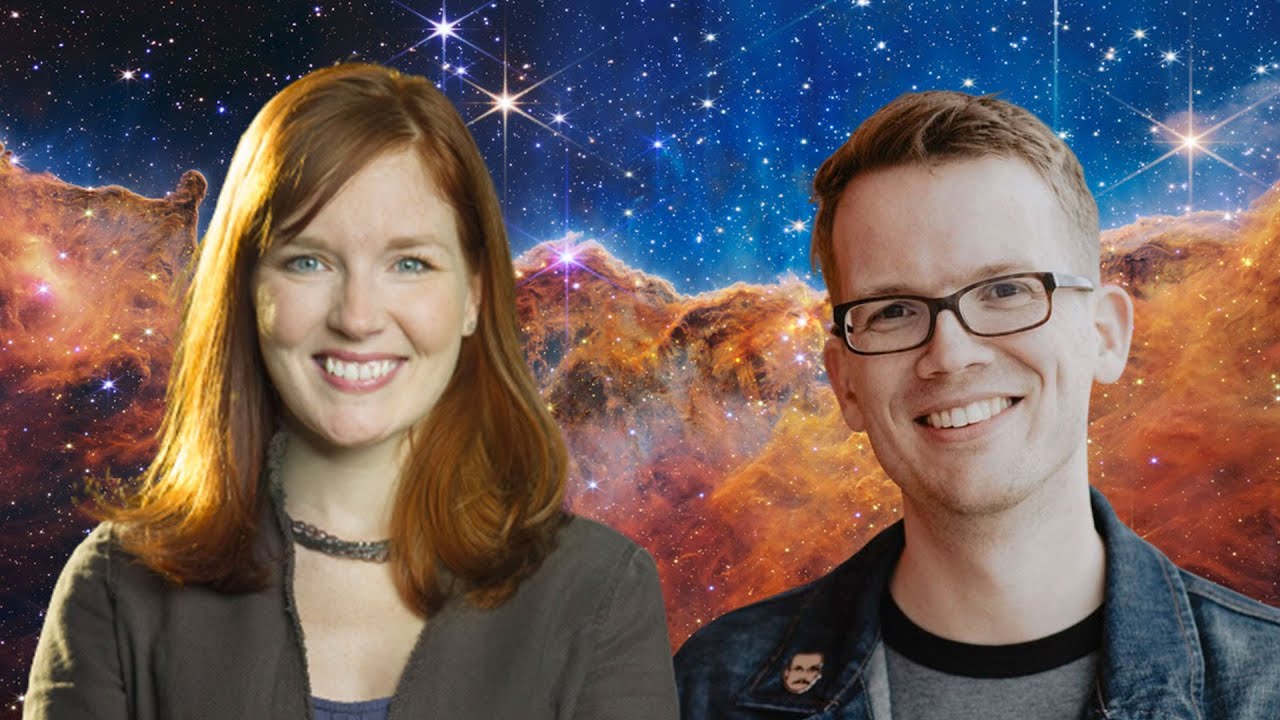
Dr. Straughn is an astrophysicist at NASA, and also she's often tapped to talk to the public about their work because of her wild depth and breadth of knowledge and her excitement and enthusiasm for this work.
I first talked to her over 10 years ago after I made a video about JWST and then, again, at the launch, and NOW FOR THE PICTURES!!!
modest dune
If there's anyone who's not already familiar with JWST in your life, this is really good as an intro with the full story including the initial image results as payoff https://www.youtube.com/watch?v=hF-7eKtzAHM

Discover how NASA engineers built and launched the most ambitious telescope of all time.
Official Website: https://www.pbs.org/nova/ | #NOVAPBS
How did NASA engineers build and launch the most ambitious telescope of all time? Follow the dramatic story of the James Webb Space Telescope—the most complex machine ever launched into space. If it wo...
 safe bronze
The uploader has not made this video available in your country

 grave carbon
RIP
old charm
grave carbon
RIP
?
grave carbon
Yeah
modest dune

Good telescope that I've used to learn the basics: https://amzn.to/35r1jAk
Get a Wonderful Person shirt: https://teespring.com/stores/whatdamath
Alternatively, PayPal donations can be sent here: http://paypal.me/whatdamath
Hello and welcome! My name is Anton and in this video, we will talk about even more incredible revelations from the James W...
rain oracleBOT
Recent NASA JWST Blog Posts
modest dune
 pseudo bramble

NASA
NASA’s James Webb Space Telescope has peered into the chaos of the Cartwheel Galaxy, revealing new details about star formation and the galaxy’s central black hole. Webb’s powerful infrared gaze produced this detailed image of the Cartwheel and two smaller companion galaxies against a backdrop of many other galaxies.
brave coral
what the heck thats crazy
old charm
modest dune
https://www.nasa.gov/sites/default/files/styles/full_width/public/thumbnails/ima...
Yoink
 normal portal
it should be from the parachute
modest dune
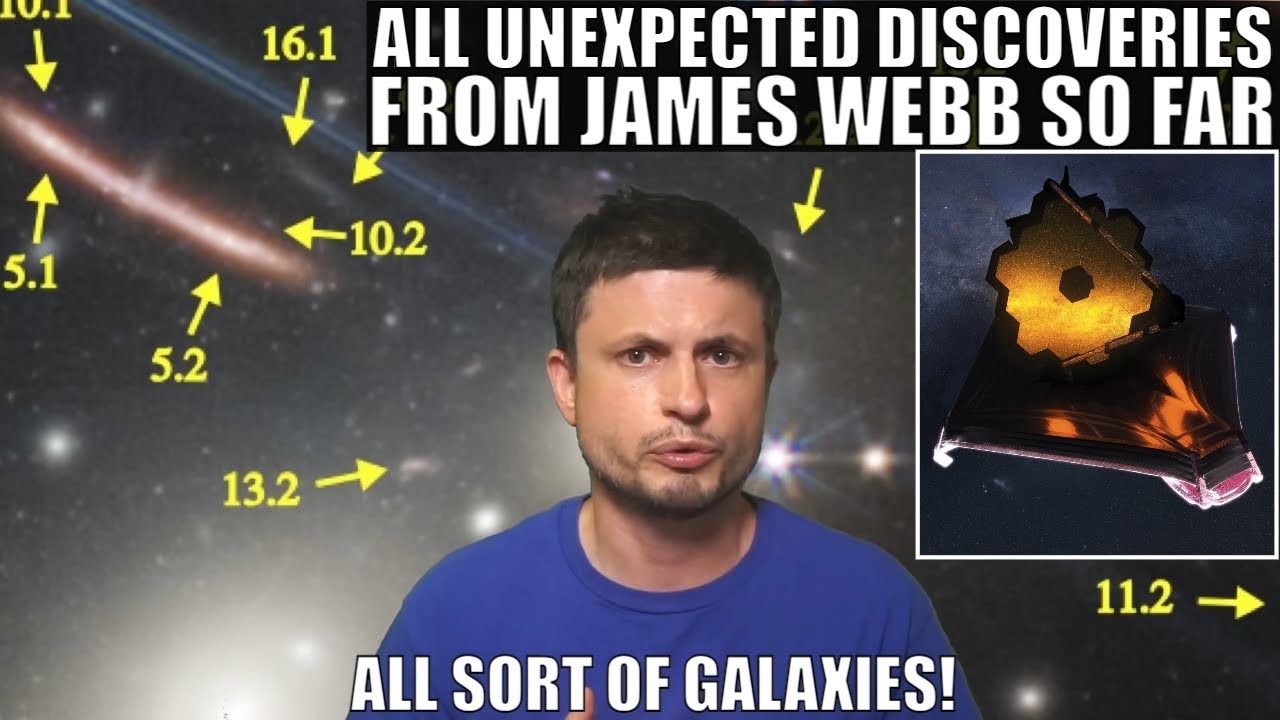
Get a Wonderful Person shirt: https://teespring.com/stores/whatdamath
Classic Mars design is on Amazon: https://amzn.to/3BWwIMz
Alternatively, PayPal donations can be sent here: http://paypal.me/whatdamath
Hello and welcome! My name is Anton and in this video, we will talk about some of the major discoveries from the James Webb that were made i...
pseudo bramble
Super weird seeing a mix of youtube optimized content (often called click bait), mixed with scientific paper content.
(I get why and don't mind people optimizing their videos for youtube; it's just interesting when it's applied to coverage of scientific content)
 pseudo comet
(for those who don't get why? https://www.youtube.com/watch?v=S2xHZPH5Sng )

The title and thumbnail play a huge role in a video's success or failure.
Check out http://kiwico.com/Veritasium50 for 50% off your first month of any subscription!
▀▀▀▀▀▀▀▀▀▀▀▀▀▀▀▀▀▀▀▀▀▀▀▀▀▀
Special thanks to Patreon supporters: Alvaro Naranjo, Burt Humburg, Blake Byers, Dumky, Mike Tung, Evgeny Skvortsov, Meekay, Ismail Öncü Usta, Paul Peijz...
old charm
modest dune
https://www.nasa.gov/sites/default/files/styles/full_width/public/thumbnails/ima...
Finally got around to color grading on that one
 modest dune
nice
 glad mist
JWST shows Big Bang didn’t happen?
https://mindmatters.ai/2022/08/james-webb-space-telescope-shows-big-bang-didnt-happen-wait/
modest dune
JWST shows lamda-cdm model might need a lot of revision ||and the observations still look consistent with my musing about inflation, dark matter, and baryogenesis being solved replaced by a huge number of antimatter-as-neutrinos causing time compression in halos around galaxies, pushing inward and outward at the same time and explaining why MOND results give better correlations with the visible mass--because the halos aren't inside the galaxies dominating gravitation with a smooth bubble, but outside||
pseudo bramble
From a quick read of the link, the raw info appears to be the count of early galaxies is higher to some extent than expected from current models.
Gives me click bait feel otherwise with the wordings chosen.
modest dune
Oh I just realized that the article makes it sound like the individual galaxies are smooth rather than their distribution
It's not just that there are more of them earlier than anticipated, they're also more evenly spread out than would be expected if they had only the time since "then" until "now" (old, distant universe vs. modern, local universe), I'm pretty sure
old charm
pseudo bramble
From a quick read of the link, the raw info appears to be the count of early gal...
to my understanding it's that there's a greater percentage of spiral galaxies out of the whole than expected, as it's thought there wasn't sufficient time for them to develop those spirals and complexity
 carmine olive
I think the argument is that, if you measure age by redshift
then there are galexies that formed very qucikly after the big bang that by our model the unriverse was not mature enough to form such galexies
or smth idk
old charm
The crux of the issue then is that measuring age by redshift is making an assumption about the expansion rate of the universe, which itself hinges upon the assumption that our standard candles are correct
all of which is underpinned by the assumption that the fundamental constants of the universe have remained constant
it's a house of cards
modest dune
I think one of the most telling things is that we are coincidentally at the point in the timeline of the lamda-cdm model where matter (including dark) density is equal to that of dark energy.
I don't think that's a coincidence. I think it's something that would always be observed to be the case throughout the entire history of the universe if the lamda-cdm model were used (meaning the timeline is broken and makes bad projections due to misattribution of the factors observed to be equivalent in density/intensity)
If the inflation of the universe and gravitational binding of matter were opposite sides of the same thing (gravity), it would mean that the expansion of the universe and contraction of bound matter (both forms of spacetime curvature) were always in balance
old charm
could be
cosmology as a whole is just fraught with so much fill in the blank guesswork compared to GR and QM at least. They can be distilled down to a handful of first principles and the rest of the theory follows easily, cosmology is… decidedly not that
modest dune
modest dune
If the inflation of the universe and gravitational binding of matter were opposi...
I should note that the force carriers would have only momentum, no influence on spacetime curvature, in this
hehe yeah
I wish I had math for this stuff rather than things like "Wouldn't it be elegant if the missing antimatter were just..still out there?"
pseudo bramble

A new James Webb image shows the Great Barred Spiral Galaxy in stunning detail!
Anyone have the link to the raw image, other links for this?

On August 17, 2022 NASA’s James Webb Space Telescope presented new amazing 4K UHD image of NGC 1365 galaxy inside. JWST made closer look inside the galaxy than any telescope yet. NGC 1365 influences star formation throughout the entire galaxy and conceals a supermassive black hole hidden behind multitudes of newly formed stars. NGC 1365's promin...
old charm
Holy crap that one is cool
 jade valve
cant seem to find it. i assume its not an official image or at least not made available to public yet
author of the post compilled it themselves. also iirc they make all of jwst findings/data available to public so maybe it was compiled off that?
for full resolution/size images i look here:
seems to be the most up to date official website
i think this confirms my hunch:
reddit
809 votes and 31 comments so far on Reddit
.

 jade valve
pseudo bramble
https://www.universetoday.com/157184/a-new-image-from-webb-shows-galaxy-ngc-1365...
jade valve
pseudo bramble
https://www.universetoday.com/157184/a-new-image-from-webb-shows-galaxy-ngc-1365...

Dusty, barred spiral galaxy NGC 1365. Interestingly, the dust bar isn't nearly as prominent as it is in visible light. In the center is a modest active galactic nucleus (AGN). The circumnuclear dust is also quite striking. This time, I was happy to receive the PHANGS team's reduction of the data. Makes it much easier because their mosaic was mu...
pseudo bramble
Some additional JWST images in that persons set of images there.
old charm
I might grab the data later and toy around with it myself if I can figure it out
 old charm
My workflow would be to toss it all into blender and go ham
Surely not the best tool but it’s the one I know
jade valve
theres also this:
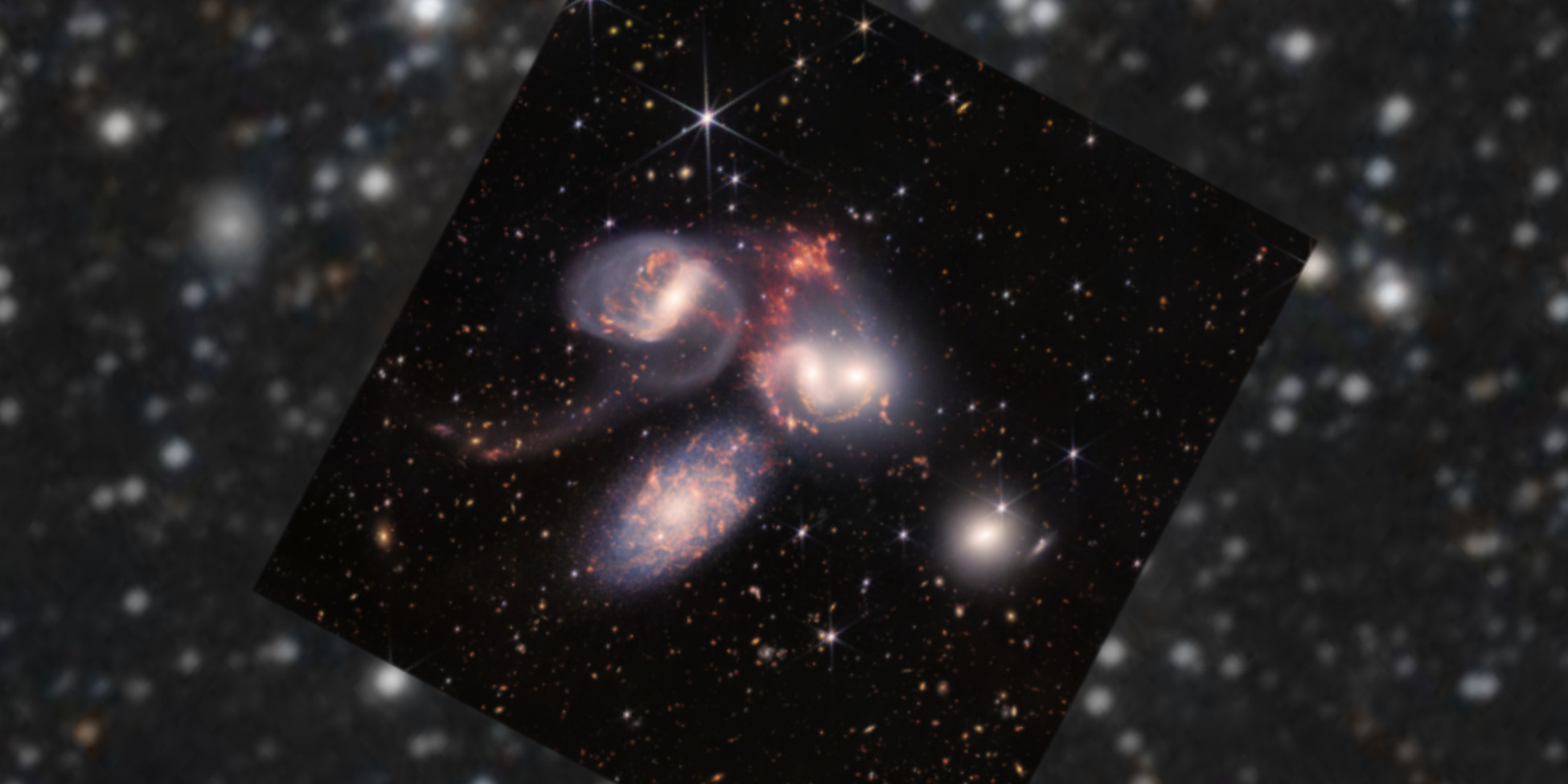
AAS WorldWide Telescope
Pan and zoom into the new images on a sky map using AAS WorldWide Telescope.
no idea what they use to render these images, would be fun to try it tho
rain oracleBOT
Recent NASA JWST Blog Posts
modest dune
Well that's a gorgeous level of detail on Jupiter
modest dune
I didn't mean for this to be a test of circularity, but...
 old charm
Sphericity?
noble quarry
modest dune
I didn't *mean* for this to be a test of circularity, but...
so oblate!
pseudo comet
gas go spinny
brave coral
evidence of superstructures under Jupiter's thin cloud later
jade valve
interesting
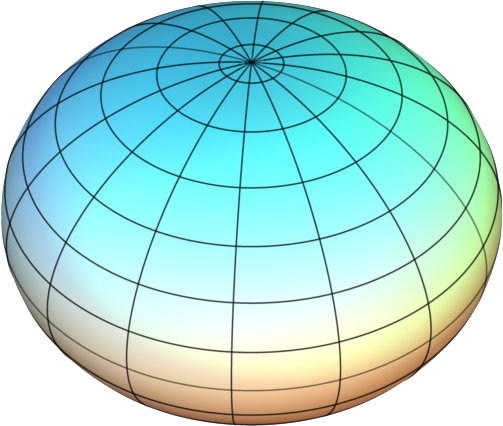
An oblate spheroid is a famous shape. It is the shape of the Earth and some other planets. It is like a sphere squashed from the top so the circumference around the poles is less than the circumference around the equator. Shapes of this type are called ellipsoids.
Oblate spheroids have rotational symmetry around an axis from pole to pole.Many pl...
modest dune
modest dune
I didn't *mean* for this to be a test of circularity, but...
@manic charm
 manic charm
oh thanks
jade valve
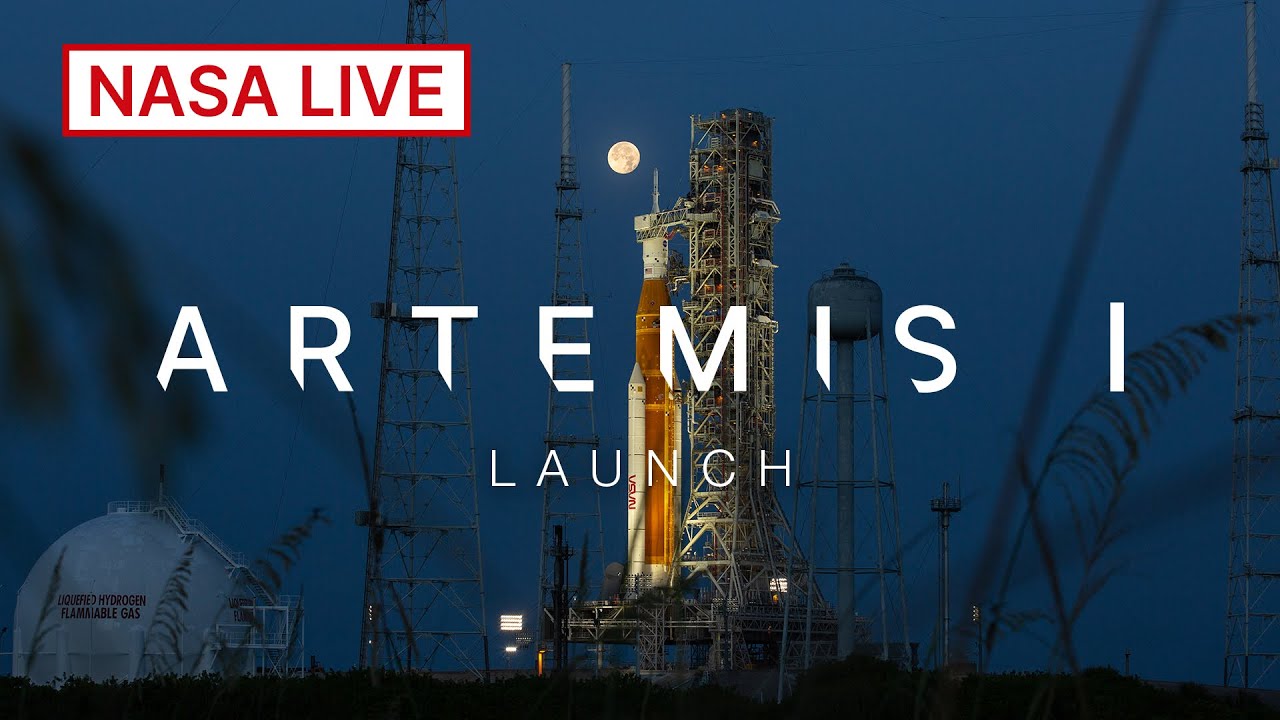
Watch live as our mega Moon rocket launches an uncrewed Orion spacecraft on a six-week mission around the Moon and back to Earth. During #Artemis I, Orion will lift off aboard the Space Launch System (SLS) rocket, and travel 280,000 miles (450,000 km) from Earth and 40,000 miles (64,000 km) beyond the far side of the Moon, carrying science and t...
 normal terrace
#1013456118506336326 btw 🙂
 last shadow
thanks
jade valve
normal terrace
<#1013456118506336326> btw 🙂
yeah
ill barely make it. would it be a couple hours earlier i wouldnt
noble quarry
... and scrubbed 😦
jade valve
yeah...
last shadow
all these don't work for me, Im setting up wallapers and would like to use them as wallpapers is there another website? ( asking anyone, no ping )

 rain oracleBOT
Recent NASA JWST Blog Posts
noble quarry
rain oracle
it's too bad that the article never mentioned the distance to the planet: ~385 ly
carmine olive


 last shadow
I need that! Did you buy it or make it?
carmine olive
I made it! cost me about 15 bucks

DIY HEXAGON ACRYLIC MIRROR WALL STRICKER 24 Pcs Hexagon Acrylic Mirror Wall Stickers can increase beauty of your room, your ideal choice to decorate bathroom, living room, TV backdrop, door, cabinet, children room, bedroom and so on. funny and durable and practical. please note it's not real mirr...
10 actually
pseudo comet
I don't want to rain on your parade, but some of those mirrors look slightly misaligned 
carmine olive
pseudo comet
I don't want to rain on your parade, but some of those mirrors look slightly mis...
unlike nasa, they are affixed to the wall via loops of tape
and not sub-10nm accuracy like the nasa adjusters
if you have any better ideas I've love to hear
pseudo comet
accept my observation for the lighthearted tease it was meant to be
carmine olive
hehe
it breaks up the image so it might actually be slightly better for room design reasons
to have them slightly disaligned
current better idea is to cnc either wood (and paint/stain it black) or lexan and have them slot perfectly in
pseudo comet
there's definitely a tradeoff to be considered. what you have is a really cool fixture, even disregarding the low cost you put into it
carmine olive
100%. The only thing I'm worried about rn is them falling off because they're on with tape loops
pseudo comet
even just a standard 'adhesive gum' may be an improvement?
brave coral
woah! i want it
carmine olive
It's pretty cheap!
I'm unsure how to not fuck up walls tho lol
I made this slick jig


help me fit them perfectly
it needed to be a decent bit longer but I could correct for slop manually
noble quarry
carmine olive
100%. The only thing I'm worried about rn is them falling off because they're on...
tape loops are surprisingly robust for low-mass stuff; blue (painting) tape is the way to go to give the lowest chance of wall damage after a few years (for tape, at least)
noble quarry
carmine olive
if you want to be very silly, print up a small poster of a Webb image and put it on the wall directly across from the array 😛
carmine olive
I love that idea
pseudo bramble

NASA
Nicknamed the Tarantula Nebula for the appearance of its dusty filaments in previous telescope images, the nebula has long been a favorite for astronomers studying star formation. In addition to young stars, Webb reveals distant background galaxies, as well as the detailed structure and composition of the nebula’s gas and dust.
 wispy sun
rain oracleBOT
wispy sun
rain oracleBOT
Recent NASA JWST Blog Posts
rain oracleBOT
Recent NASA JWST Blog Posts
rain oracleBOT
Recent NASA JWST Blog Posts
pseudo bramble

Ars Technica
"It has been three decades since we last saw these faint, dusty rings."
 bold bronze
holy shit its beautiful
noble quarry
pseudo bramble
https://arstechnica.com/science/2022/09/webb-telescope-captures-dazzling-views-o...
ring ring ring ring bananaphone Neptune
old charm
It’s neat to see the rings, but I’m whelmed by the planet itself
safe bronze
Same, lol. Scientists are probably having a field day with the data though :P
brave coral

NASA
After 10 months flying in space, NASA’s Double Asteroid Redirection Test (DART) – the world’s first planetary defense technology demonstration – successfully impacted its asteroid target on Monday, the agency’s first attempt to move an asteroid in space.
🆒
also google 'nasa DART' for an easter egg
noble quarry
brave coral
https://www.nasa.gov/press-release/nasa-s-dart-mission-hits-asteroid-in-first-ev...
a good asteroid redirection is when you move the asteroid; a great one is when you also get to reuse the spacecraft 😛
wispy sun
fun backronyms are my favorite thing in science
 stray kindle
brave coral
https://www.nasa.gov/press-release/nasa-s-dart-mission-hits-asteroid-in-first-ev...
stray kindle
brave coral
https://www.nasa.gov/press-release/nasa-s-dart-mission-hits-asteroid-in-first-ev...
Last night was pretty cool, got to see Jupyter and then got back home right at the time to see the intentional crashing stream. Also there was something immensely funny for me how there were a bunch of people celebrating 'lost signal'
old charm
stray kindle
Last night was pretty cool, got to see Jupyter and then got back home right at t...
Found the programmer
stray kindle
Damn, you got me, though not sure what exactly gave me away
stray kindle
Ah, thought the short i there is only in my native tongue
wispy sun
stray kindle
Last night was pretty cool, got to see Jupyter and then got back home right at t...
They hit a 525 foot rock 6.8 million miles away at 14000 mph
noble quarry
wispy sun
They hit a 525 foot rock 6.8 million miles away at 14000 mph
barely 0.5 km/s
rain oracleBOT
Recent NASA JWST Blog Posts
brave coral
NASA will share a new image or spectrum from the James Webb Space Telescope at least every other week on the mission’s blog. This week, check the blog on Wednesday, Oct. 5 at 10 a.m. EDT for a new image highlighting a galaxy pair.
so you dont have to read it
rain oracleBOT
Recent NASA JWST Blog Posts
 old charm
whelp, apparently blender can't handle the Tarantula Nebula photo at full resolution
it gives up
brave coral
safe bronze
https://stsci-opo.org/STScI-01GE08RNPH8RBMMGMC52JD3R93.png
woah!
old charm
pseudo bramble
https://www.nasa.gov/feature/goddard/2022/a-cosmic-tarantula-caught-by-nasa-s-we...
 last shadow
Nice addition to my background collection!
 old charm
better
 manic charm
old charm
it gives up
manic charm
old charm
it gives up
or your pc doesn't want to melt
rain oracleBOT
Recent NASA JWST Blog Posts
pseudo bramble
I guess that image above is like sunlight shining on a window showing how dusty it is. Fascinating
old charm
pseudo bramble
I guess that image above is like sunlight shining on a window showing how dusty ...
Kinda yeah
or sunbeams through a window showing how dusty it is inside the building
rain oracleBOT
Recent NASA JWST Blog Posts
modest dune
 brave coral
woah
the article is well worth reading
its not some sort of visual glitch causing the rings. the rings are shells of dust created periodically when the binary stars in the center of the image get their closest every 8 years.
noble quarry
starshells!
brave coral
alternative explanation: dyson shells
brave coral

NASA
NASA’s James Webb Space Telescope has captured a lush, highly detailed landscape – the iconic Pillars of Creation – where new stars are forming within dense clouds of gas and dust.
love this one!!!
and finally, my prediction has come (semi) true!
eagle nebula wasnt the first one, but we got it in the first 6 months! and it looks sooooo good!!!
im so happy!!!
modest dune
the video from the page is worth a look too https://www.youtube.com/watch?v=1__KBHIo_xs

This video tours areas of Webb’s near-infrared light view of the Pillars of Creation. This area is brimming with gas and dust – which are essential ingredients for star formation. Glowing, bright red wavy lines appear at the edges of some pillars, revealing where stars are ejecting material as they form. The bright red orbs are newly formed star...
bold bronze
So incredible
rain oracleBOT
Recent NASA JWST Blog Posts
rain oracleBOT
Recent NASA JWST Blog Posts
modest dune
splitting distant red dots into a pair of clouds has never been so exciting
 safe bronze
They missed some stars too :P
brave coral
worse, there's this thing where the 4 bright stars in the right middle used to be

i think it looks cool tho
oh interesting, they did it with an AI
i guess that explains the inconsistent results. still very cool!
brave coral

By Keith Bradsher
The Mengtian module was launched into orbit and docked with the Tiangong space station, the latest step in Beijing’s effort to surpass the United States in space exploration.
lets go

archive.ph
archived 31 Oct 2022 20:15:43 UTC
anti-paywall
rain oracleBOT
Recent NASA JWST Blog Posts
modest dune
I assume they create posts for the actual images too right?
maybe yay could filter out the later-this-week posts? :P
rain oracleBOT
Recent NASA JWST Blog Posts
brave coral
interesting
rain oracleBOT
Recent NASA JWST Blog Posts
modest dune
anyone else notice that file name? 😂 https://blogs.nasa.gov/webb/wp-content/uploads/sites/326/2022/11/MicrosoftTeams-image-28.png

The comparison of clarity and focus really is incredible, but the filename brings it slamming back to earth, immersion-wise :P
safe bronze
lol
 quaint plaza
modest dune
anyone else notice that file name? 😂 https://blogs.nasa.gov/webb/wp-content/upl...
quaint plaza
modest dune
anyone else notice that file name? 😂 https://blogs.nasa.gov/webb/wp-content/upl...
all the scientists will do is zoom the latter to look like the former and then ask for money to build a better one
modest dune
there's a limit to how far telescopes can even see due to redshift and the age/expansion of the universe though
JWST made a huge difference to how much of that coverage we have
carmine olive
we only get so many photons from each star
safe bronze
We need a bigger telescope though. Who knows what these tiny blue dots might be
 modest dune
they haven't even gotten to the deep field stuff yet though
as in the long-exposure plans with jwst are still pending
quaint plaza
safe bronze
We need a bigger telescope though. Who knows what these tiny blue dots might be
just a couple more zoom levels and we might get the :
 pseudo bramble
modest dune
there's a limit to how far telescopes can even see due to redshift and the age/e...
pseudo bramble
modest dune
there's a limit to how far telescopes can even see due to redshift and the age/e...
Can't the telescope used to detect a given "initial wavelength" of light just steadily shift to higher wavelengths due to red shift? Visible light from stars red shifted into infrared which is within JWST range.
modest dune
shifting how?
pseudo bramble
Idk maybe I'm just curious what you meant. Like just a re-word from you.
noble quarry
pseudo bramble
Can't the telescope used to detect a given "initial wavelength" of light just st...
one problem is, under current inflation theory, at some point early on, the universe expansion rate exceeded the speed of light, so it's unclear that we'd be able to see much from that epoch
modest dune
cosmological distances are often measured in terms of redshift (a z-value)
so yes the further away something is the more redshifted it is and the lower frequency range the instruments have to be to detect it
JWST has multiple sensors for different ranges
both in frequency and distance :P
pseudo bramble
Ah, gotcha gotcha. I was just over reading into what you said it seems.
My thought was that there isn't a limit to the ability of telescopes to detect red shifted light in aggregate because humans have telescopes that detect light within the different wavelength ranges. Within a specific telescope (ala Hubble) there definitely is limitations.
Presumably those heavy red shifted stars can also be detected by radio telescopes, etc. I assume there are other reasons like intensity of light at given wavelengths that makes IR especially useful for their imaging.
I read the recent JWST post just now so randomly musing.
modest dune
I'm not sure exactly if or how the CMB sets a noise floor for redshifted observations, come to think of it 🤔
pseudo bramble
https://www.forbes.com/sites/startswithabang/2016/09/26/ultra-deep-radio-telescope-catches-what-hubble-cant/?sh=2670d35a1b56 Very quick google and skim seems to have similar deep field images taken with radio telescopes. Makes sense.
Presumably it's just JWST and Hubble are especially good space based telescopes making their results particularly useful.
modest dune
quaint plaza
all the scientists will do is zoom the latter to look like the former and then a...
You do have a point here, I just wanted to emphasize that the diminishing returns would be high since JWST wasn't just about being bigger but also covering an entirely different frequency with sensors :P
brave coral
pseudo bramble
<https://www.forbes.com/sites/startswithabang/2016/09/26/ultra-deep-radio-telesc...
the images in that article are images from ALMA superimposed on the Hubble deep field. ALMA is a radio array and is a a different type of telescope than Hubble and James Web and doesnt take the same type of pictures
pseudo bramble
I guess black body emission (presumably this is a lot of the light emitted from stars) approximately matches this type of graph. So I assume the visible wavelengths have some of the highest luminance making them especially good for detection of stars. Possibly one reason JWST/Hubble are especially good at deep field images.
 brave coral
earth based telescopes are often much larger than Webb because you dont need to launch them into space. the Gran Telescopio Canarias is possibly the largest optical telescope on earth and it has a 10m mirror. Radio arrays argubly have much much larger "mirror" sizes, but they work different. Webb "only" has a 6.5m mirror. However, Web is able to get better data because it doesnt have to shoot though the atmosphere.
modest dune
especially since the atmosphere blocks the infrared ranges it's observing
brave coral
as the wavelength of light you want to capture increases, the size of the aperture you need increases linerally. you need larger telescopes to photograph stuff with higher redshift
pseudo bramble
Is the black body radiation chart actually the close representation of intensity of light vs frequency of light emitted from a star? I assume this is astronomy 101 type stuff, but I didn't take that course.
Black body radiation primarily with hydrogen (other gas) emission, absorption lines overlaid on it.
 pseudo bramble
If yes, then the combination of the following makes Hubble, JWST good:
- space telescopes are especially good at high signal to noise ratio which is good for long exposures (ala deep field)
- limitations of rocket launches prevent high quality space based radio, microwave telescopes
- visible, IR light has especially high luminance making it good for detecting stars
pseudo bramble
brave coral
its fun to note that the it peaks around visible light. coincidence?
Presumably you're saying eyes evolved to detect the highest intensity light source?
brave coral
no clue
pseudo bramble
Ah, idk what you meant by that then.
brave coral
but seems plausable
modest dune
pseudo bramble
If yes, then the combination of the following makes Hubble, JWST good:
1. space ...
not just luminance but also angular resolution
brave coral
i just thought it was fun to note, and wondered if it was a coincidence
modest dune
it takes way more collection area to resolve the source of a radio wave
pseudo bramble
Yep yep. The whole angular resolution based on size of the telescope. I gotcha. (insert all that other technical stuff I read about for JWST when it was especially in the news)
brave coral
also, if you look at the packaging for a light bulb, they have a marked temperature. the "temperature" of light bulbs is the same as the temperature of a blackbody that emits a similar spectrum
specifically, incandescent light bulbs were pretty much just really hot black bodies
noble quarry
pseudo bramble
Is the black body radiation chart actually the close representation of intensity...
stars are pretty good blackbodies, in general (neglecting absorption lines, of course)
(in space, of course; once you go through an atmosphere, it gets messy)
 thorn musk
neglecting absorption lines is kind-of cheating though
pseudo bramble
The solar radiation spectrum was already posted above which answered the question. Direct data good.
old charm
noble quarry
one problem is, under current inflation theory, at some point early on, the univ...
You have to specify a distance scale with “faster than the speed of light” or the statement is meaningless
Since it’s space expanding and it compounds, you can always get to “faster than the speed of light” just by going out farther (assuming it’s within your light cone to be observed)
old charm
brave coral
its fun to note that the it peaks around visible light. coincidence?
@pseudo bramble No, not a coincidence. Why would you evolve to see light that doesn’t exist to be seen, or doesn’t provide useful information? At most such a mutation would drift but not have any adaptive benefit so it wouldn’t be likely to spread
Also important here is that chemical compounds with conjugated systems (like the pigments in eyes) tend to fluoresce/absorb light in the UV/visible range
brave coral
well, if the star primary emitted radio waves, I wonder if they would be useful for vision because of their large wavelength. it might be that eyes would evolve to see lower wavelength light even if the star's primary wavelength was too long to be useful
thorn musk
if anything having light cones for light that isnt there is a negative trait
having them isnt free
old charm
Maybe, maybe not, depends on how much energy it is to retain. Light cone does not mean photoreceptor
thorn musk
any kind of receptor takes energy simply to build out of proteins
so either its in place of another, better-suited one or youve added a cost
brave coral
also, if eyes evolved underwater, the absorption of water might heavily affect the evolution of the eye
or, if eyes evolved to be filled with water
 old charm
brave coral
well, if the star primary emitted radio waves, I wonder if they would be useful ...
old charm
brave coral
well, if the star primary emitted radio waves, I wonder if they would be useful ...
Note that the pigment molecule size scales roughly with the wavelength of light it absorbs (true of any given confined system)
brave coral
water is mostly only penetrated by wavelengths close to visible light
so perhaps it is water rather than the sun that caused visible light to be what's picked up by eyes
old charm
Both
brave coral
old charm
Note that the pigment molecule size scales roughly with the wavelength of light ...
exactly!
old charm
brave coral
Got a graph title for this?
brave coral
so, if we lived in a star that "mostly" emitted radio waves, we might be seeing visible light anyways just because of water

The absorption of electromagnetic radiation by water depends on the state of the water.
The absorption in the gas phase occurs in three regions of the spectrum. Rotational transitions are responsible for absorption in the microwave and far-infrared, vibrational transitions in the mid-infrared and near-infrared. Vibrational bands have rotational ...
old charm
Is it water absorption or the combination of water absorption and insolation
Because the latter is what we really care about, not just what water absorbs alone
brave coral
Liquid water absorption spectrum across a wide wavelength range
is the caption
old charm
So it’s the former
brave coral
do you have one of the latter?
brave coral
all im saying is, im not convinced its not a coincidence
old charm
Note that the water one means that the color (relative strength of wavelengths) of perceived light changes with depth
Absorption is -per meter
old charm
brave coral
all im saying is, im not convinced its not a coincidence
What evidence would you have to see to confirm it isn’t a coincidence?
thorn musk
if water is required for life one could infer that any aliens that exist likely see similar colours to us :P
simply because of what water does or doesnt block
old charm
But if your star is red, then is there much point in seeing blue or even yellow light, even if water lets it through?
brave coral
i would say that the burden of proof is on the one trying to establish causality
i think ive established two alternate explanations and its not clear why we should favor any of the three without evidence
old charm
That wasn’t the question I asked though
thorn musk
a "red" star would still emit some green and blue, so the question is if that is more than the mostly-blocked alternatives
brave coral
old charm
But if your star is red, then is there much point in seeing blue or even yellow ...
the star is "mostly" red. like how the sun is "mostly" yellow, we still see other colors.
the question i have (i have no answer) is: is it necessarily the case that animals living around the a star will always perceive peak wavelength color the star emits? or are some wavelengths (visible(?)) somehow more useful than others and are more likely to be perceived regardless of the star?
noble quarry
brave coral
the question i have (i have no answer) is: is it necessarily the case that anima...
you mean, will animals have the peak of their visual sensitivity near the blackbody peak of the star?
looks like O and B type stars have their spectral peaks in the UV, but they'll still emit quite a bit in visible wavelengths
old charm
So there's two separate questions of "can perceive" and "peak of visual perception"
pseudo comet
brave coral
the question i have (i have no answer) is: is it necessarily the case that anima...
see: deep-sea hydrothermal vent ecosystems?
jade valve
no, its not a coincidence
i think its a mix of reasons
- the majority of the radiation put out by the sun is in the visible spectrum
- humans evolved the ability to detect the wavelengths of light that are the most informative for helping us survive and reproduce in our particular environment
- its high enough energy to not be drowned out by thermal radiation which is the case for infrared, and its largely transparent to small molecules so it penetrates air and water but not solid objects. and theres not much evolutionary advantage to seeing radio waves or xrays
im sure there are other reasons and more scientific explanations. but basically
visible light = useful for humans
pseudo bramble
Majority likely not the right word.
- Very reasonable and the most direct mechanism for why evolution would select for a given sensor.
I wonder how much variance in absolute quality of human made sensors exits due to tech advances for visible light cameras. Probably isn’t that big a contribution to Webb Hubble having good sensors.
safe bronze
Species evolving on a planet with an atmosphere that is not transparent to visible light would very likely see in different wavelengths - if at all
pseudo bramble
Like is Webb so good because we’ve spent so much drooping the detector advances.
jade valve
i think someone asked for this but theres a limit to how far the telescopes can see into the space
the oldest light
we actually reached that a while ago

the cosmic microwave background
when the universe was around 379k years old. thats when the first atoms formed. before that it was all plasma
and its physically impossible to see before that
the most distant (confirmed) astronomical object (forming galaxy) that we have captured is gn-z11 and the light is around 13,4 billion years old. around 400 million years after the big bang

by hubble
patiently waiting for what jwst finds
safe bronze
jade valve
The resolution definitely needs some work though
jade valve
safe bronze
The resolution definitely needs some work though

Cosmic microwave background seen by Planck
jade valve
safe bronze
The resolution definitely needs some work though
just a pic i pulled off google
safe bronze
As I say, the resolution needs some work
jade valve
i can highly recommend this channel:

YouTube
I make chilled out videos about all things space-related. Hope you like what you see, thanks for stopping by!
has videos where he goes into great detail about jwst, cmb, lambda-cdm model, early universe, andromeda (the reason we discovered that the universe is much bigger than milky way), dark matter, dark energy, etc etc
and his videos are actually watchable
hes working on a video about ''journey to the edge of the universe''
that should be interesting
safe bronze
It better not be another powers of 10 clone 
pseudo bramble
@jade valve You did see the JWST inital set of image releases and subsequent papers that already have found a/several galaxies older than the one you linked right?
jade valve
pseudo bramble
<@280661954908127232> You did see the JWST inital set of image releases and subs...
yeah but those are candidates. gn-z11 is confirmed

The world around us is made of atoms. Did you ever wonder where these atoms came from? How was the gold in our jewelry, the carbon in our bodies, and the iron in our cars made? In this lecture, we will trace the origin of a gold atom from the Big Bang to the present day, and beyond. You will learn how the elements were forged in the nuclear furn...
one of my favorites
we are star stuff
quaint plaza
modest dune
You do have a point here, I just wanted to emphasize that the diminishing return...
If I understand it correctly the move to infrared means that it can observe things that have a greater red shift and so look further back in time/distance. If that's the case I wonder why so much effort is spent on producing false colour images of objects when, presumably, you could identify the signature of a known "thing" and then shift the frequencies up the scale to reverse the effect of red-shift and get back the original true colours
¯_(ツ)_/¯
maybe that is already done
safe bronze
True colors are boring, it's just all various shades of white :P
pseudo comet
safe bronze
True colors are boring, it's just all various shades of white :P
 FFT (||fast fourier transform||) has entered the chat?
brave coral
that's not strictly true. there's colors
pseudo comet
consider each frequency as pure-alpha
safe bronze
brave coral
that's not strictly true. there's colors
And I may not be strictly serious:P
brave coral
oh ok
old charm
quaint plaza
If I understand it correctly the move to infrared means that it can observe thin...
That already happens yes
Everything JWST sees is some degree of red, anything beyond that is false color, and chances are the “red” in the image you can’t even actually see
NIRCam just barely squeaks into the green range
 quaint plaza
I was just thinking of de-red-shifting the image by the amount it's shifted... like, if you can find something you know should be at 5300K then you can shift your frequency data up so that the received frequency gets corrected
carmine olive
quaint plaza
I was just thinking of de-red-shifting the image by the amount it's shifted... l...
this only works when we're looking at visible light that's been redshifted into the jst range
quaint plaza
yea, that's what I meant, but I getcha, sometimes ... maybe most of the time they are shifting the invisible visible
carmine olive
yea I think so
modest dune
The purpose is to make the contrasts appreciable at anu rate; even if the colors are shifted "accurately" it still has exposure and aperture differences changing the intensity so we can see it
quaint plaza
gotcha
noble quarry
jade valve
and its physically impossible to see before that
this is why we need gravitational wave telescopes 🙂
brave coral
the CMB blows my mind and I cant really wrap my head around it
modest dune
why's that?
brave coral
i think the fact that the universe was so tiny back then but yet the CMB is in every direction
modest dune
it wasn't tiny at the re-ionization, that was well after inflation (assuming the inflationary model)
brave coral
like, its bigger than it was? if that makes sense
even though its not really any size anymore because its in the past
modest dune

Visit https://brilliant.org/ScienceAsylum/ to get started for free and get 20% off your annual subscription.
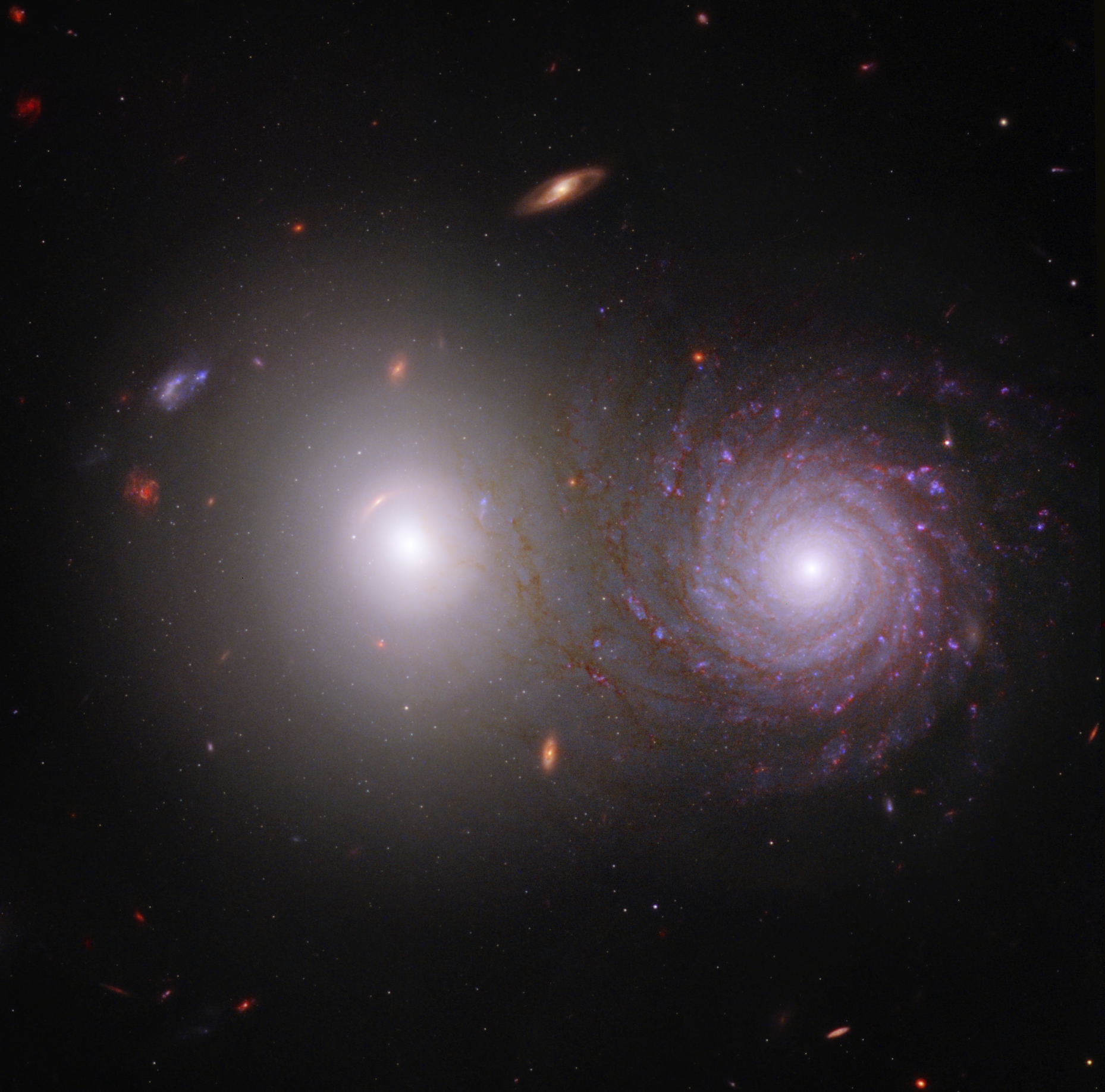
At about 9.6 billion light years, our intuition about angular diameter breaks down. Galaxies start getting larger the more distant they are. Let's find out why.
Nick Lucid - Host/Writer/Editor/Animator
Natalie Wells - Researcher
_______...
Very much related^
brave coral
like, okay. assume the CMB wasnt there. then every point in the universe would terminate on the first nanosecond after the universe was created, which would just be like a point
this video seems very relevant to this yes
modest dune
hehe
brave coral
and hey! the title is wrong because I'm talking about it
modest dune
I only learned about it recently
brave coral
yeah so the CMB is HUGE in that its literally on every point in the universe but its also very tiny
i cant realllly wrap my head around that
modest dune
try imagining spacetime inside out such that every possible destination of a photon emitted from a spot on a star is in some sense adjacent in terms of the quantum entanglement of outcomes
old charm
brave coral
like, okay. assume the CMB wasnt there. then every point in the universe would t...
Assumption being that the Big Bang is true of course 
brave coral
its like that black hole thing where once you get close enough to the black hole (but before you get inside it) you see it inverted all around you
modest dune
I don't doubt the big bang, but inflation as distinct from dark energy. . . :P
brave coral
IC, i feel like you shared a video about that with me? or maybe me with you?
it was like flying around in 3D with a black hole whose surface was painted to look like earth's surface
pseudo comet
tangential?
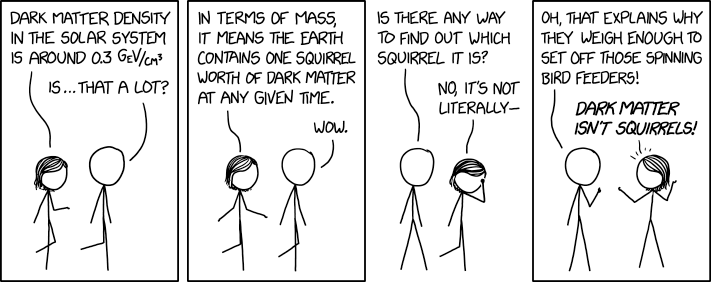
https://xkcd.com/2622/
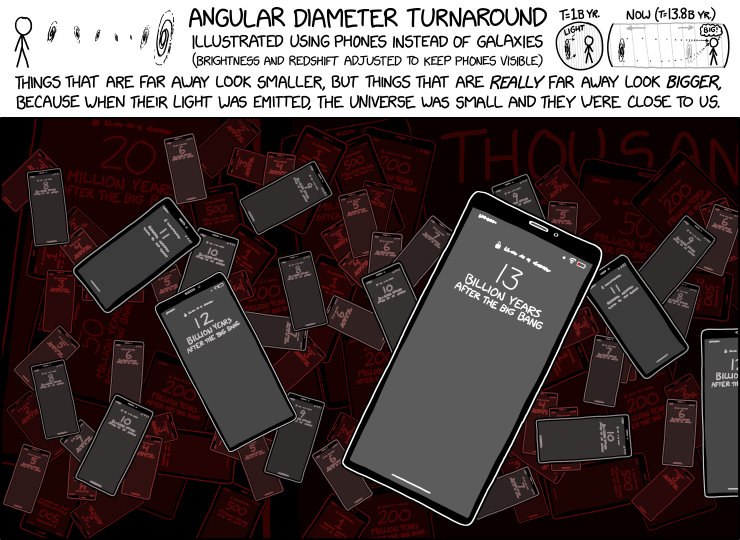
Thank you to Katie Mack for teaching me about this effect, and to Janelle Shane for describing redshifts as 'like galaxies sinking into a pool of dilute blood,' which is how I'll see them from now on.
brave coral
pseudo comet
tangential?
https://xkcd.com/2622/
very similar idea yes!
modest dune
brave coral
it was like flying around in 3D with a black hole whose surface was painted to l...
I don't remember that specifically. hrm
brave coral
maybe it wasnt you hehe i jsut feel like its something youd share
i cant find it darn
brave coral
pseudo comet
tangential?
https://xkcd.com/2622/
a few questions about this:
- shouldnt the 13 billion years thing be redshifted too? or no?
- why is it that the 13 million year thing is covering up something 9 billion years? shouldnt the 9 billion year thing be closer?
pseudo comet
13B years ago after is "kind of just happened" for illustrative purposes 🤷
brave coral
oh doh, I read them all as "13 billion years ago," but they actually say "13 billion years after the big bang"
pseudo comet
"ago" and "after big bang" have an inverse relationship, yeah
brave coral
yes
old charm
modest dune
I don't doubt the big bang, but inflation as distinct from dark energy. . . :P
Quite a lot of the current cosmological model relies on having a ton of assumptions and parameters trying to answer questions that are more philosophical than physical ones
brave coral
what questions?
old charm
Things like “why is the universe so smooth at large scales?” -> inventing inflation to explain it, instead of accepting that it could’ve just been that way
There’s a few others but I’d have to think on it when I have more time
and now inflation is more or less just accepted as fact while we don’t really have… that much in the way of evidence for it
brave coral
oh okay i see what you mean but i mean you need some assumptions to go off of unless you have a time machine
old charm
It’s just a convenient thing to make things nice and pretty and easy for human minds when there’s no indication that’s actually how things are. Most models are similar in that they’re generally created to explain behavior that’s observed, not to answer a question that’s based more on feeling than observation
old charm
brave coral
oh okay i see what you mean but i mean you need some assumptions to go off of un...
So assuming inflation gets us… where exactly?
pseudo comet
post hoc ergo propter hoc?
old charm
It explains a couple of things, but those things might not even need explaining
last shadow
can you define inflation?
old charm
pseudo comet
_post hoc ergo propter hoc_?
Not quite
modest dune
last shadow
can you define inflation?
In physical cosmology, the inflationary epoch was the period in the evolution of the early universe when, according to inflation theory, the universe underwent an extremely rapid exponential expansion. This rapid expansion increased the linear dimensions of the early universe by a factor of at least 1026 (and possibly a much larger factor), and ...
old charm
last shadow
can you define inflation?
The specific theorized era in the early universe (<1 second) that the universe is thought to have rapidly and exponentially (in the mathematical sense) grown in size
brave coral
it gets a theory that predicts situations we havent encountered yet
old charm
Not the general concept of the universe expanding
old charm
brave coral
it gets a theory that predicts situations we havent encountered yet
No, it’s a theory that explains situations we are assuming to exist
brave coral
no, it produces a theory that fits all known data so far and predicts unobserved historical data, and future data
if you had another theory that fit all data so far without inflation you could compare it to a theory with inflation. you could ask yourself why you'd prefer one over the other
pseudo comet
'unobserved historical data'
now there's an intriguing noun-phrase! 
modest dune
inflation as it stands creates discontinuities and weirdness with no explanation for the phase change into and out of the inflationary effect other than the conditions needed to massage the numbers for the assumed conditions
old charm
This paragraph epitomizes my issue with it:
The rapid expansion of space meant that any potential elementary particles (or other unwanted artifacts, such as topological defects) remaining from time before inflation were now distributed very thinly across the universe.
brave coral
typically the answer is something like "well this theory implies some things that feel fundamentally less likely than this other theory," like "the universe is not homogeneous"
old charm
There’s a huge built in assumption there that “potential elementary particles or unwanted artifacts” existed and needed to be distributed
And the whole model is a house of cards like that
modest dune
what I really want to know is how neutrinos separating out were factored in and if it's possible that we've overlooked that because of the difficulty (impossibility?) of detecting those now-low-energy relic neutrinos with current technology
brave coral
you cant just remove inflation and have a model that's consistent with observed data, you need to insert new assumptions
you can pick which assumptions seem most likely to you, but ultimately those assumptions can be proved wrong with new data
so the answeerto the question of "what does assuming inflation gets us?" is "a consistent theory"
old charm
then you start running into Occam’s Razor. If you have to event a process or phenomenon to explain something but are making the same number of assumptions, your process isn’t really doing much explaining
last shadow
Eventually with enough assumptions, you can rule out something. Reminds me of sodoku
old charm
modest dune
https://en.wikipedia.org/wiki/Inflationary_epoch
https://en.m.wikipedia.org/wiki/Inflation_(cosmology) better article
In physical cosmology, cosmic inflation, cosmological inflation, or just inflation, is a theory of exponential expansion of space in the early universe. The inflationary epoch lasted from 10−36 seconds after the conjectured Big Bang singularity to some time between 10−33 and 10−32 seconds after the singularity. Following the inflationary period,...
More information about the theory itself and what it’s trying to explain
pseudo comet
last shadow
Eventually with enough assumptions, you can rule out something. Reminds me of s...
"physics is just math constrained by precepts of reality"
brave coral
old charm
then you start running into Occam’s Razor. If you have to event a process or phe...
when picking which consistent theory you like most, one technique is to use the razor, yeh. its like considering theories that assume gravity and theories that dont. both might be entirely consistent with observed data. which is simpler? well, maybe to you, gravity is insane and the other theory makes more intuitive sense. that's awesome! if they both make sense to you, and both have the same amount of experimental support, then that's great.
old charm
Inflation resolves several problems in Big Bang cosmology that were discovered in the 1970s.[26] Inflation was first proposed by Alan Guth in 1979 while investigating the problem of why no magnetic monopoles are seen today; he found that a positive-energy false vacuum would, according to general relativity, generate an exponential expansion of space. It was very quickly realised that such an expansion would resolve many other long-standing problems. These problems arise from the observation that to look like it does today, the Universe would have to have started from very finely tuned, or "special" initial conditions at the Big Bang. Inflation attempts to resolve these problems by providing a dynamical mechanism that drives the Universe to this special state, thus making a universe like ours much more likely in the context of the Big Bang theory.
It’s the anthropological principle again
brave coral
but keep in mind that producing data that is inconsistent with inflation would produce you a nobel prize and world fame. its the experimentalist's holy grail.
old charm
But if you can’t conceivably falsify it then it’s also not a great model
modest dune
Can we pleaaaase get enough photons in one place to see if it creates a black hole or a miniature big bang with net-zero gravitation? (:
brave coral
old charm
But if you can’t conceivably falsify it then it’s also not a great model
you can conceivably falsify it, its just kind of hard to get the data. there exists a model that is true. its either
- inflationary
- not inflationary
- something not yet invested
when you are making predictions about things that you dont have hard observational data for right now, you need to pick a model. if you dont have any model, then you dont have a consistent view on how the universe works
modest dune
lol Kwirky
brave coral
if you wanted to say "i think inflation is BS" then I'm okay with that, you just need to be aware you are either
- abandoning having a model at all, which is bad
- accepting another model with its own set of assumptions (which you might not actually agree with!)
modest dune
I don't think it's wrong (bad) to say "The established models have too many flaws to accept any of them" without having a replacement worked out
at least with something this far removed from direct experience
pseudo comet
"Phlogiston theory doesn't explain all the observed nature of fire, so I guess we can conclude that fire is unknowable and unexplainable"
modest dune
"so I guess we have some unknowns to solve for"
brave coral
i think its different than that. it would be "phlogiston theory explains all of the observed nature of fire but I dont like it for aesthetic and philosophical reasons"
pseudo comet
another even less historically-congruent scenario: "both pholgiston and combustion/oxidation explain all observed phenomena regarding fire but operate via fundamentally different mechanisms"?
…or is my allegorical bent counterproductive?
modest dune
the metaphor breaks down because we can so easily test the I/O of the phenomenon of fire
brave coral
i think thats close
pseudo comet
modest dune
the metaphor breaks down because we can so easily test the I/O of the phenomenon...
actual history and empirical results notwithstanding, yeah
brave coral
or like when there was the dueling theories of light, aether and special relativity
pseudo comet
wait, there's an XKCD on this, too…
feh, probably buried in the what-ifs…
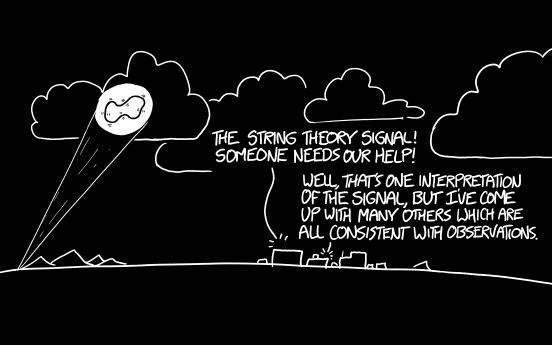
<image is projected high into the night-sky clouds>
"The Dark Matter signal! Someone needs our help!"
"That's one interpretation! I also have a dozen other interpretations that are consistent with all observations!"
modest dune
To detect dark matter, we just need to build a bird feeder that spins two squirrels around the rim in opposite directions at relativistic speeds and collides them together.

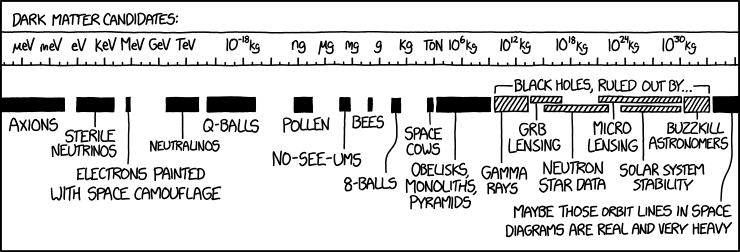
My theory is that dark matter is actually just a thin patina of grime covering the whole universe, and we don't notice it because we haven't thoroughly cleaned the place in eons.
pseudo comet
I found it
https://what-if.xkcd.com/imgs/a/140/help.png (from https://what-if.xkcd.com/140/)
 old charm
brave coral
i think its different than that. it would be "phlogiston theory explains all of ...
old charm
brave coral
i think its different than that. it would be "phlogiston theory explains all of ...
I think a better analogy would be paleontology and archaeology. Tons of things are assumed about things that we find, but we don’t really have any way to prove any of it without explicitly recorded information (which isn’t even entirely reliable). There’s occasionally a testable prediction that comes up now and then, but the vast majority of it isn’t and can’t be tested. It’s easy to come up with simple explanations for things, but when we try to apply the same simple methods to things we have in the modern day, you get stuff like this for a baboon

Cosmology is just the paleontology of the universe at large
noble quarry
as an experimentalist, my view is that the theorists have been allowed to run amok on far too little data for far too long, and it's high time we got some new data to start constraining/ruling out various hypothesis. which is of course why Webb is so exciting: real data!
rain oracleBOT
Recent NASA JWST Blog Posts
modest dune
how on earth can they tell which direction most of the rocks are coming from and orient accordingly?
that's crazy
pseudo comet
maybe it will be described in the "Cycle 2" report mentioned at the bottom of the article?
noble quarry
modest dune
how on earth can they tell which direction most of the rocks are coming from and...
well, first of all, it isn't on earth ... 😛
modest dune
called it.. silently, but..called it
wispy sun
however, even after this event our current optical performance is still twice as good as our requirements.
NASA being conservative as always :p
noble quarry
wispy sun
NASA being conservative as always :p
this is NASA at its best
modest dune

Scotty understands how to manage a client and deliver on time, while looking like you pulled off the impossible.
pseudo comet
different cultures, to be sure
modest dune
and consequences to the network for the "benefit" of the individual (and the people watching and cheering the miracles :P)
pseudo comet
of course, we were shown that the Enterprise ("no bloody A, B, C, or D") made it work… so arguably things worked out way better than it could have? yay, fiction!
brave coral
interesting backwards apostrophe
 brave coral
modest dune
how on earth can they tell which direction most of the rocks are coming from and...
brave coral
modest dune
how on earth can they tell which direction most of the rocks are coming from and...
This quote describes it
Micrometeoroids that strike the mirror head on have twice the relative velocity and four times the kinetic energy, so avoiding this direction when feasible will help extend the exquisite optical performance for decades
The direction they are avoiding is "forwards"
brave coral
wispy sun
> however, even after this event our current optical performance is still twice ...
I think the key wording here is "current," given that the performance will continue to degrade
modest dune
But forwards around the sun, the lagrange circling path, or the combination (if the second is even significant)?
brave coral
I think -- guessing here -- that it would be the combination!
old charm
modest dune
But forwards around the sun, the lagrange circling path, or the combination (if ...
Presumably pointing backwards along the orbit around the sun (not around L5)
 autumn sierra
They were proved mathematically long ago, but they're not stable (as the physicist put it). Guess it was named a Kugelblitz.
There's a book, "Geons, Black Holes, and the Quantum Foam" which was a good read from what i remember
autumn sierra
modest dune
Can we pleaaaase get enough photons in one place to see if it creates a black ho...
I told it to reply... ^
modest dune
autumn sierra
They were proved mathematically long ago, but they're not stable (as the physici...
Why would it be unstable if it existed? It's not like light is capable of escaping from the singularity, it's just a question of whether photons bend spacetime as theorized or if they might respond to but not affect spacetime curvature
old charm
modest dune
Why would it be unstable if it existed? It's not like light is capable of escapi...
https://www.youtube.com/watch?v=ulCdoCfw-bY
tangentially related, but have you seen this yet?

To support Kurzgesagt and learn more about Brilliant, go to https://www.brilliant.org/nutshell and sign up for free. The first 688 people that go to that link will get 20% off the annual Premium subscription.
OUR CHANNELS
▀▀▀▀▀▀▀▀▀▀▀▀▀▀▀▀▀▀▀▀▀▀▀▀▀▀
German Channel: https://kgs.link/youtubeDE
Spanish Channel: https://kgs.link/youtubeES
HOW C...
modest dune
a while ago but yeah
brave coral
I wanna guess how it works! you craft a black hole of appropriate size and send it towards the target. black holes decay faster the smaller they are. at first the black hole decays slowly, but you time it so the the black hole reaches the target at a point where the hawking radiation from the decay is enough to kill everyone.
conveniently, the black hole decays completely quickly afterwards, meaning you can send your occupying force to arrive quickly after the black hole bomb does its job.
modest dune
want a hint? ||It's about the rotation||
brave coral
no! it works completely differently! (than I guessed)
modest dune
was that from looking at the video or the hint? :P
brave coral
the video
modest dune
aw I was hoping you'd get a chance to take another guess with the hint
modest dune
speaking of ||rotation|| it was really cool to learn that stars ||slow their rotation as they emit stellar wind!|| https://www.youtube.com/watch?v=n5EHbLJ_eVY

Get a Wonderful Person Tee: https://teespring.com/stores/whatdamath
More cool designs are on Amazon: https://amzn.to/3wDGy2i
Alternatively, PayPal donations can be sent here: http://paypal.me/whatdamath
Hello and welcome! My name is Anton and in this video, we will talk about a discovery of how planets influence star's evolution and age
Links: ...
old charm
magnetic fields can be the source of a ton of friction
something something Mach Principle
noble quarry
old charm
magnetic fields can be the source of a ton of friction
don't forget magnetic reconnection
old charm
noble quarry
don't forget magnetic reconnection
Friction has to generate heat somehow :p
noble quarry
old charm
Friction has to generate heat somehow :p
indeed, the solar corona problem says hi!
quaint plaza
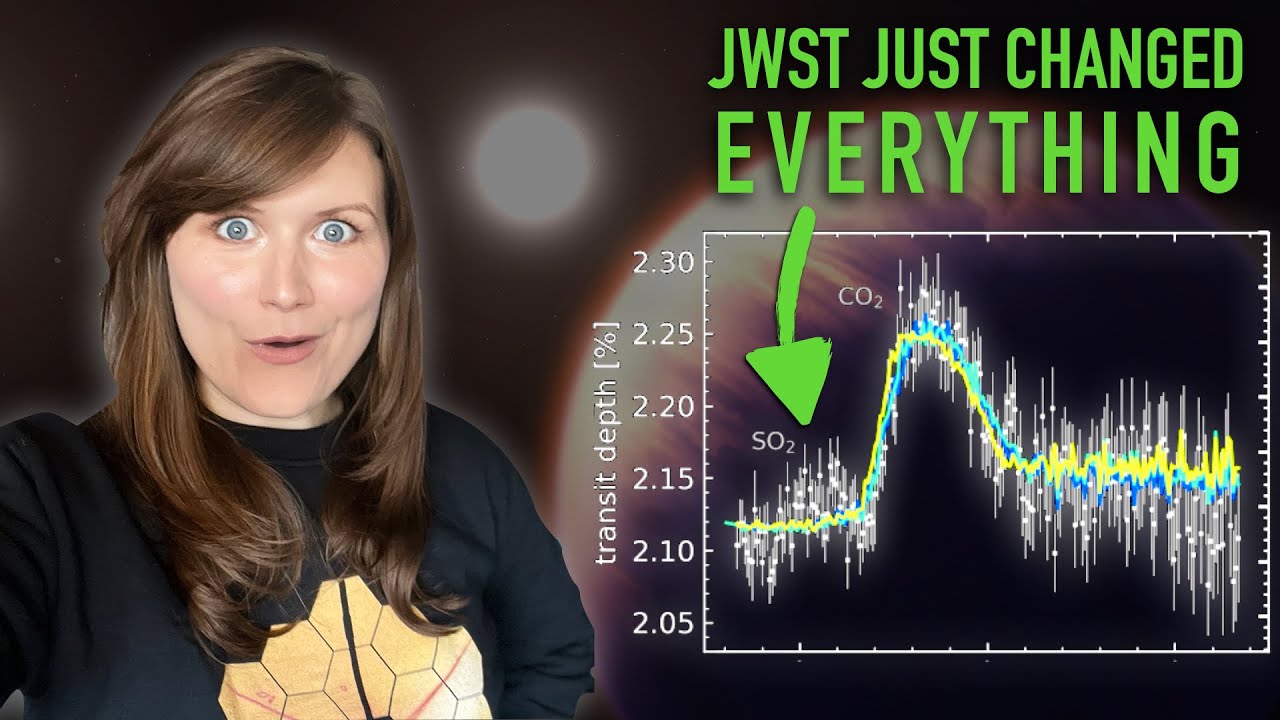
Try MEL Science with 50% off the first month with code DRBECKY at checkout! https://melscience.com/sBLX/
Wakeford et al. (2018; Hubble detection of H20 in WASp-39b atmosphere) - https://arxiv.org/pdf/1711.10529.pdf
Tsai et al. (2022; photochemistry in WASP-39b atmosphere) - https://arxiv.org/pdf/2211.10490.pdf
Alderson et al. (2022; NIRSpec ob...
wispy sun
 red sail
James Webb Space Telescope 🔭
wispy sun
bold bronze
Something I didn't know about until today, is that the orion capsule is "hogging" almost all of the deep space network's bandwidth, which means that JWST and other crafts are unable to operate at maximum capacity due to internal storages filling up and not enough bandwidth to send off data
bold bronze
Which is why NASA have been testing out laser communication
They are set to mount a laser module on the ISS to act as an intermediate between future deep space commuication systems using laser and the laser points on earth, in 2023
noble quarry
looks like we need bandwidth limits for comms in KSP2 😛
modest dune
"More cameras!"
"Too many cameras!"
pseudo bramble
Webb data of the Hubble ultra deep field location, good stuff.
brave coral
where?
modest dune
new banner get
safe bronze
Hehe
wispy sun
guess who's back
rain oracleBOT
Recent NASA JWST Blog Posts
rain oracleBOT
Recent NASA JWST Blog Posts
 carmine olive
that's crazy
modest dune
“This unique field is designed to be observable with Webb 365 days per year, so its time-domain legacy, area covered, and depth reached can only get better with time,” concluded Rogier.
nice
brave coral
a year long exposure 👀
modest dune
if we had another copy of the telescope. . .
brave coral
reaches for the blueprint tool
noble quarry
opens VAB menu, selects "JWST_final_mk4_final0"
modest dune
somehow I hadn't encountered this concept before, but it's a pretty good introduction and mentions the JWST looking for them so I'm putting it here https://www.youtube.com/watch?v=aeWyp2vXxqA

Try Rocket Money for free & unlock more features with Premium!
https://rocketmoney.com/Kurzgesagt
This video was sponsored by Rocket Money!
You've waited for a long time. Now it's finally here: our new ✨Limited Edition Pin✨.
You can pre-order it for 72 hours and then never again.
🚨https://shop-us.kurzgesagt.org/products/limited-edition-unive...
safe bronze
lol
I first encountered the concept very recently while reading up on supermassive black holes, lol
thorn musk
misread 6 hours ago as 6 years ago, "JWST was known about that long ago?"
brave coral
yes lol
6 years ago, it was supposed to be launched in 2018
JWST has very much been known about and planned and anticipated for a very long time
its went thru design review 14 year ago
NASA, ESA and CSA have collaborated on the telescope since 1996
noble quarry
brave coral
NASA, ESA and CSA have collaborated on the telescope since 1996
Hubble (1996): "Oh yay, they're going to build me a friend!"
Hubble (2006): "Soon, my friend will be here soon!"
Hubble (2016): "Any year now ..." 
Hubble (2021): 
wispy sun
Hubble's an old man creaking along
rain oracleBOT
Recent NASA JWST Blog Posts
rain oracleBOT
Recent NASA JWST Blog Posts
1. https://blogs.nasa.gov/webb/2023/04/21/mid-infrared-instrument-operations-update-2/
2. https://blogs.nasa.gov/webb/2023/04/12/webb-shows-areas-of-new-star-formation-and-galactic-evolution/
3. https://blogs.nasa.gov/webb/2023/03/24/how-webbs-coronagraphs-reveal-exoplanets-in-the-infrared/
4. https://blogs.nasa.gov/webb/2023/02/22/webb-observes-a-globular-cluster-sparkling-with-separate-stars/
5. https://blogs.nasa.gov/webb/2023/02/08/breaking-the-tracking-speed-limit-with-webb/
6. https://blogs.nasa.gov/webb/2023/01/31/webbs-niriss-returns-to-full-operations/
7. https://blogs.nasa.gov/webb/2023/01/25/webb-spies-chariklo-ring-system-with-high-precision-technique/
8. https://blogs.nasa.gov/webb/2023/01/24/near-infrared-imager-and-slitless-spectrograph-operations-update/
last shadow
your bot has awoken @wispy sun
wispy sun
yeh
I turned on the "server" for the first time in like... four months?
it's an old Chromebook(Acer CB3-532) running a slightly broken GalliumOS
about 15% of the right side of the internal display is actually usable :p
last shadow
so its on life support
wispy sun
yep
rain oracleBOT
Recent NASA JWST Blog Posts
bold bronze
Together, the submitted proposals requested more than 35,000 hours of telescope time, far exceeding the 5,000 hours of telescope time available to be allocated.
wispy sun
we need 7 JWSTs, clearly 🙂
pseudo comet
Rule Number One of Government Spending: Why build one, when you can build two for only twice the price?
 rain oracleBOT
Recent NASA JWST Blog Posts
brave coral
anyone know how to see the other images taken during this program?
pseudo bramble
https://webb.nasa.gov I believe this page has links to the released images.
Hamburger menu -> Webb Flickr albums.
brave coral
i can only find the one from the article there
pseudo bramble
Top right menu has links when I click it. “Web images and launches” -> Flickr
brave coral
right, I can only find the one fron the article on the flickr but more are alluded to

its also the only image here https://webbtelescope.org/images
pseudo bramble
Ah, you’re looking for extra photos of Saturn mentioned in the recent article?
I assume the ones you see are the only public images as the data is from “in progress” scientific papers reducing the released info.
brave coral
yeah exactly
i understand why you were confused, I assume you thought I meant other JWST images
but yeah I mean other images taken during this saturn observation
pseudo bramble
Gotcha gotcha. Afaik what you see is what you get at this point.
rain oracleBOT
Recent NASA JWST Blog Posts
pseudo bramble

NASA
NASA has released Webb’s image of a small star-forming region in the Rho Ophiuchi cloud complex on its first year anniversary of science operations.
Looks like quite a few new images from JWST are getting posted in a short time frame for the one year anniversary.
pseudo bramble


Got a chance to look at the JWST image in more detail. Wasn't sure exactly what I was looking at so googled around. Seems like the above diagrams are relevant. Am I understanding the JWST image appropriately as indicated by the following image? Green circle is the protoplanetary disk, red lines are the flow/jets.

Was trying to make sure that "dark" is the protoplanetary disk because the dust is thick enough to block the light. Always hard to know what is absorption vs emission vs scattering vs nothing.
noble quarry
mmm, plasma jets
brave coral
pseudo bramble

Makes more sense now what this image is showing. JWST image of a protostar released maybe 6 months ago.
 worldly harness


Space.com
When looking for answers in the cosmos, sometimes more questions appear.
noble quarry
worldly harness
"Riddle me this Batman Webb!"
rain oracleBOT
Recent NASA JWST Blog Posts
1. https://blogs.nasa.gov/webb/2023/09/12/webb-confirms-accuracy-of-universes-expansion-rate-measured-by-hubble-deepens-mystery-of-hubble-constant-tension/
2. https://blogs.nasa.gov/webb/2023/08/24/mid-infrared-instrument-operations-update-3/
3. https://blogs.nasa.gov/webb/2023/08/21/webb-reveals-intricate-details-in-the-remains-of-a-dying-star/
4. https://blogs.nasa.gov/webb/2023/08/15/talking-with-webb-using-the-deep-space-network/
pseudo bramble
The bot maintaining the legacy of JWST delays.
wispy sun
I need to move the bot to a VPS so that the server doesn’t keep on getting unplugged
noble quarry
wispy sun
I need to move the bot to a VPS so that the server doesn’t keep on getting unplu...
who keeps unplugging a server?
wispy sun
Roomba
noble quarry
maybe tape down the cord? lol
wispy sun
https://www.val.town/ seems like the perfect thing to use for this
rain oracleBOT
Recent NASA JWST Blog Posts
pseudo bramble
Good bot.
rain oracleBOT
Recent NASA JWST Blog Posts
pseudo bramble

It’s oh-so-easy to be absolutely mesmerized by these spiral galaxies. Follow their clearly defined arms, which are brimming with stars, to their centers, where there may be old star clusters and – sometimes – active supermassive black holes. Only NASA’s James Webb Space Telescope can deliver highly detailed scenes of nearby galaxies in a combina...
Quite cool spiral galaxy images by JWST.
 patent shard
rain oracleBOT
patent shard
rain oracleBOT
Recent NASA JWST Blog Posts
rain oracleBOT
Recent NASA JWST Blog Posts
rain oracleBOT
Recent NASA JWST Blog Posts
rain oracleBOT
Recent NASA JWST Blog Posts
pseudo bramble
Bot with the timely post, nice.
rain oracleBOT
Recent NASA JWST Blog Posts
bold bronze
Awesome
rain oracleBOT
Recent NASA JWST Blog Posts
wispy sun
During each observation the team measures Webb’s pointing stability or ‘jitter,’ which has remained six times better than design requirements.
rain oracleBOT
Recent NASA JWST Blog Posts
wispy sun
It still works??
noble quarry
the question now may be whether the webbhook will outlive NASA or not ...
glad mist
Isnt NASA how we went to space before SpaceX demonstrated they can do it cheaper? Granted, astronaut safety is a low priority. Also, all safety is out. But other than that
noble quarry
glad mist
Isnt NASA how we went to space before SpaceX demonstrated they can do it cheaper...
getting into more-offtopic, perhaps, but NASA getting tied up in cost-plus contracts with defense primes largely accounts for the expense of the human spaceflight portion of NASA
rain oracleBOT
Recent NASA JWST Blog Posts
rain oracleBOT
Recent NASA JWST Blog Posts
carmine olive
hypehpye
last shadow
joining this so i will (hopefully) get pinged when it starts
brave coral
SAME
last shadow
do @everyone's work here?
 calm flint
Do we need a launch cancellation bingo?
safe bronze
wispy sun
I would like to avoid pinging everyone
Yup, lol. Not sure if it pings everyone in the thread, or invites the entire server into the thread :P
modest dune
besides, we get notifications for every message in a thread still, no?
calm flint
Thankfully not.
last shadow
I get the unread notification
modest dune
ah I see the default changed yeah, makes sense
last shadow
12 hours to go 
safe bronze
Delay in 3... 2... 1...
brave coral
uh oh
 red sail
Hype!
last shadow
math is not my strong suit.. 5+5 = 10 hours till 5am and launch ( i hope )
modest dune
<t:1640434800:R> at <t:1640434800:T>
modest dune
modest dune
<t:1640434800:R> at <t:1640434800:T>
brave coral
hoe did you do that?
bold bronze
Discord supports unix timestamping
A good site to auto gen one for you: https://hammertime.djdavid98.art/en-GB
 brave coral
that site sells NFTS of the timestamp lol
modest dune
¯_(ツ)_/¯
bold bronze
Yeah.. just noticed that lol
brave coral
it has a really informative "what's an NFT" link. check it out!
bold bronze
Might be worth to support something that doesn't use sell "timestamp" NFTs
brave coral
oh wait
i mean the "sign in with etherium" link
that one is really informative ;)
lmaoooo
looking at the code the NFT thing is a joke
last shadow
u want to buy a piece of time? that is 1116 dollars..
According to this legitimate site https://www.celebritiesstatus.com/elon-musk-has-made-16-million-per-hour/ elon musks makes 4444 dollars a second so he could buy every single time NFT down to the second there is going into the future

Back in December, we reported on the fact that Elon Musk doesn't take a salary for his work at Tesla. Instead, he has a compensation plan that could
carmine olive
last shadow
u want to buy a piece of time? that is 1116 dollars..
According to this legitim...
some days he loses literally billsions of dollars
some days he makes it
brave coral
on average he's creating a lot of money for himself
last shadow
yeah so if he wants to he can own time with the very official nft's.. i never understood those
brave coral
6 months until we get the first pictures 
 cerulean thorn
yeah, Lagrange points aren't exactly close
not to mention all that complicated unfolding
brave coral
unfolds
last shadow
assuming it goes good..
what % will it succeed? I watched #offtopic message and it never said the %
 brave coral
ja, und?
cerulean thorn
it would be a suicide mission for an astronaut to go there
brave coral
uuuuund?
cerulean thorn
lol
brave coral
hehe
cerulean thorn
brave coral
6 months until we get the first pictures <a:YA_Hype:725688289537032232>
which will be grayscale :/
like security cameras at night
last shadow
will they all be like that??
cerulean thorn
yes
the telescope is supposed to be detecting infrared light, VERY faint infrared light
brave coral
cerulean thorn
like security cameras at night
wtf just blow it up on the landing pad smh
cerulean thorn
infrared is also the one that is most likely to pass through interstellar gasses
making stuff that is very faint and very far potentially visible
carmine olive
last shadow
will they all be like that??
more like
every "picture" is just a bitmap "picture" from 0 to 100% intensity
and each picture is taken at a specific wavelength
we can take multiple pictures at different wavelengths and then map each one to a wavelength in the visible light spectrum
this is what hubble did as well
brave coral
wait no wtf it can see visible light and different frequencies of infared
cerulean thorn
that thing is so sensitive that if it was pointed towards earth it could see a thief breaking into a store in complete darkness all the way from orbit... assuming only the thief was the heat source, and not the entire damn planet
no, JW is only infrared
hubble is visible light
brave coral
This means that Webb's instruments will work primarily in the infrared range of the electromagnetic spectrum, with some capability in the visible range (in particular in the red and up to the yellow part of the visible spectrum).
The James Webb Space Telescope (sometimes called Webb or JWST) is a large infrared telescope with a 6.5-meter primary mirror. Webb will be the premier observatory of the next decade, serving thousands of astronomers worldwide. It will study every phase in the history of our Universe, ranging from the first luminous glows after the Big Bang, to ...
cerulean thorn
the reason they are sending it so far is because the planet itself is too hot and the radiated heat even in orbit would be too much for the very sensitive instruments
brave coral
that +Arson's thing means the pics can be in color
actually only Arson's thing means color photographs are possible
brave coral
color photos yes
cerulean thorn
like really old ones, all yellow :P
brave coral
no, more than that
last shadow
better than nothing, and i feel like ur making it seem like its worse than it is
brave coral
in astrophotography, its common to take an only red picture, an only blue picture, and an only green picture and combine them in post
jwt can do that with 3 frequencies of the infared spectrum
cerulean thorn
but then it's false color... which is actually how most space pictures that we have ever seen are
brave coral
well it depends on your definition, right? the things JWT will take pictures of will be all reshifted to hell and back
cerulean thorn
anyway, not an issue, the most important thing is it should be able to detect the faint infrared radiation from exoplanets... that's huge, because direct imaging of exoplanets was not so successful so far
last shadow
So itll look like any space pictures we have currently
brave coral
so we will be receiving infra red, but it may have originally been emmited as red, blie, or green
astronomers can calculate the reshift and color correct it back to the original colors that were emmited
or they can be artistic and pick colors to make the photos pretty if they want
last shadow
great explanation :D that makes sense
cerulean thorn
there is not much red shift on nearby stuff, actually, there is pretty much none
yes, it will be able to look "far away", but that is not as interesting as looking close and actually seeing.. something
knowing where to send the first interstellar space probe will be HUGE
if only fusion would be solved....
brave coral
the point of JWT and the reason they chose infra red is so they can see distant redshifted galaxies!
cerulean thorn
and exoplanets
brave coral
hype
cerulean thorn
but yea, very nice to know that the universe is bigger than we think it is...
cerulean thorn
yea, planet around another star
last shadow
oh thats it lmao
cerulean thorn
a place to go once we figure out how the f to get there
brave coral
lmao
cerulean thorn
it could even potentially detect planet where E.T. lives :)
maybe not, but who knows :P
brave coral
that would be crazy hype. we'd need to notify spielburg at once
i've done some astrophotography. got some pictures of planets
last shadow
can u share them easily?
brave coral
let me see if i have any
just this old one i happened to have on google cloud

its a jupe
featuring: great red boi
brave coral
heh
even simple shots like these are edited. i took a few thousands frames, picked the best 100 or so, and use an astrophotography program to combine them into one
last shadow
so if u combine more hte better it looks?
brave coral
sometimes, its kind of hard to know beforehand
you gotta try a bunch and see what works
if the air quality is bad, a lot of frames will be bad and you'll need to throw out more frames
keeping more frames means that you'll keep more low quality frames
air quality is not what you normally think of, its sort of how turbulent the atmosphere is
the atmosphere acts like a lense and as it moves the focus changes, etc
last shadow
that makes sense but i wouldve never thought of that
im not experienced though my best photograph is a lego car
brave coral
if you've ever seen the wavy lines of hot air during a mirage, that's what it can look like
constantly wiggling around
thats why space telescopes are great, they dont need to dal with that bs
last shadow
yeah and why those imges look so great
brave coral
that pic's not too great, it was one of the first I took and it was in the city
light pollution hurts too
last shadow
light pollution would defnitely be a problem yeah
brave coral
very cold, very dark, very still air
cerulean thorn
air is nice to have, for breathing and stuff, not so great for taking pictures of things that are far away
last shadow
have u tried putting  modules on ur camera to try and get thru light pollution and atmosphere
cerulean thorn
I had heavy distortion with just 600mm lens... it's already bad
brave coral
hehe
cerulean thorn
for ground telescopes it's worse, if they don't have active compensation
brave coral
well there's the thing where they shine a test laser to the upper atmosphere
they expect the test laser produce an exact circle and they can adjust the image in real time to compensate for the atmosphere
modest dune
cerulean thorn
yes, it will be able to look "far away", but that is not as interesting as looki...
seeing distant galaxies that are more mature than we can explain for their apparent distance, if it happens, would say otherwise
brave coral
that laser thing is called adaptive optics
last shadow
6 hours
cerulean thorn
I got some more ☕ ... hope it will be enough
8 am here, and I was awake all night
last shadow
in adaptive optics?
brave coral
ye
in the JWT they're gonna have a period of time where they do calibrate the mirrors
last shadow
i just want to see space civilizations and see that the galaxy is just a stellaris game
brave coral
each of the ....24 ? .... mirrors can be adjusted individually
 last shadow
Yeah its great, SUPER precise as well
brave coral
they're gonna take a test picture of a star and use it to align all the mirrors
cerulean thorn
I think this is the most complicated thing humanity has sent in space beyond earth's close orbit, far more complex than the voyagers or the planetary probes
ornate marsh
really I'm just impressed they're getting this thing launched before HST gave up the ghost
carmine olive
brave coral
astronomers can calculate the reshift and color correct it back to the original ...
they could but it wouldn't look (as) good
brave coral
hubble is a beast, but keep in mind there was a serious flaw with the mirror post launch that needed a manual fix
NO chance for JWT
last shadow
ill go for humanity to save JWT
cerulean thorn
let's not think of that yet...
 cerulean thorn
tbh it would probably be cheaper to build another one than attempting to save it in any way
brave coral
me and the boys suiting up for our 1 way trip to JWT
last shadow
i like the left guys hair lmao
carmine olive
cerulean thorn
tbh it would probably be cheaper to build another one than attempting to save it...
would be way easier to launch one on a starship
cerulean thorn
yeah.... but that one is not flying yet so... we'll see
ornate marsh
brave coral
NO chance for JWT
I dunno, going out to L2 to repair it would be expanding the range of human space exploration
carmine olive
I believe it is significantly easier to finish a non-reusable starship and then build a james-webb equivalent than rebuild the james webb
ornate marsh
if space exploration was still a cool thing maybe it would be worth doing
carmine olive
I think that
nasa would rather set up a moon base
than send humans to L2 and back
for the PR
brave coral
i mean, same
ornate marsh
carmine olive
I think that
nasa would rather set up a moon base
than send humans to L2 and bac...
set up a moon base so you can send humans to L2
carmine olive
"send humans to space? we did that in the 70s"
cerulean thorn
moon has stuffz on it... $$$
moon base not pointless... it's actually very cheap to send stuff back from the moon, the hard part is sending things there, but once some industry is set up, a rail launcher is all that's needed, not even rockets
no atmosphere, no friction, point that thing towards earth, power up the magnets, done
last shadow
I wonder what the payoff time of setting up a moon base would be
like invest X billion when do you get X billion back, 10 years, 20 years?
last shadow
ROI?
modest dune
return on investment
last shadow
return on investment investment?
carmine olive
hehe
anyway basically
nasa doesn't need to be profitable to be good for the economy
cerulean thorn
it's very interesting and few people know that lots of things that we just take for granted today have been invented at nasa
for example, what everyone of us carry in their pockets now...
last shadow
wallets or phones
cerulean thorn
multiple things... the camera, the concept of a cpu, the phased array antenna
last shadow
they made the camera huh
ornate marsh
not to mention things like GPS
last shadow
or launching a person on the moon
cerulean thorn
yea... cmos sensor which is used by pretty much every digital camera in existence today
is nasa invention
carmine olive
james webb claims to have "invented ten new technologies during it's development that they knew would need to be invented during it's development"
last shadow
have they listed those?
carmine olive
s/james web/random article I read a while back/
cerulean thorn
probably theres a ton of academia papers about it
just not something that common folk know
last shadow
im gonna (try) to sleep and come back when its going to launch
brave coral
with luck i'll wake up to a successful JWT as a Christmas present

well, successful launch anyway
or should i set my alarm? decisions decisions
last shadow
brave coral
or should i set my alarm? decisions decisions
stay up ill be up
last shadow
cerulean thorn
did you play your base all night?
I played it till an hour or two again I migth get back on I cant sleep
I have like 20 thing si have to improve
cerulean thorn
4h 30m left
modest dune
Watch the launch of the James Webb Space Telescope—the most powerful space telescope ever made. This mission is scheduled to lift off at 7:20 a.m. EST (12:20 UTC), Dec. 25, 2021, aboard an Ariane 5 rocket from Europe’s Spaceport in French Guiana.
With revolutionary technology, Webb will observe a part of space and time never seen before, provid...
calm flint
30 minutes to the NASA show starts. Perfect window to get a snack & a good cup of coffee.
cerulean thorn
 cerulean thorn
so cringe
safe bronze
lol
 plucky merlin
Don't worry, the launch will go flawlessly, and JWST will deploy perfectly, and then it will live a long and healthy life past its projected lifetime giving us fantastic science for a long time to come
calm flint
~10 years, until fuel is depleted.
cerulean thorn
station keeping fuel
it might still be operational but slowly drift away from earth
plucky merlin
They will likely enter a longer period of limited operational capability when they get lower on fuel, so it can probably last even longer
cerulean thorn
pointing direction is controlled with reaction wheels, which only use electricity, and it won't have any shortage of that as long as electric system is working
calm flint
Someone mentioned 5 years of high activity, and a total length of 10 years.
 somber peak
High risk, high reward so🤞
calm flint
It's not just about being positioned, it is also about being cooled so that heat infra doesn't interfere with observed infra.
Though perhaps that's also solved by electricity alone.
plucky merlin
Official NASA stream rather than the unofficial one: https://www.youtube.com/watch?v=7nT7JGZMbtM
Watch the launch of the James Webb Space Telescope—the most powerful space telescope ever made. This mission is scheduled to lift off at 7:20 a.m. EST (12:20 UTC), Dec. 25, 2021, aboard an Ariane 5 rocket from Europe’s Spaceport in French Guiana.
With revolutionary technology, Webb will observe a part of space and time never seen before, provid...
cerulean thorn
super cringe
plucky merlin
Watch this one instead, it's such high-quality commentary and I didn't even realize it wasn't official for a while https://www.youtube.com/watch?v=5rARTOhbLDg
An Ariane 5 rocket is launching NASA's James Webb Space Telescope (JWST). JWST is the largest and most advanced space telescope ever built and will study every phase of cosmic history. Liftoff is scheduled for 7:20 a.m. Eastern (12:20 UTC) from the Guiana Space Centre in French Guiana.
Article: https://www.nasaspaceflight.com/2021/12/ariane-5-w...
cerulean thorn
ah yes, NSF, of course
safe bronze
plucky merlin
Official NASA stream rather than the unofficial one: https://www.youtube.com/...
Have you checked the pins yet?
plucky merlin
It's too important to leave pins up to chance
cerulean thorn
nasa is always so cringy with their children doing space science... c'mon, gimme a break
plucky merlin
Did she just say it's the Nerd Center of Space Launch?
carmine olive
imagine being the guy with responsibility for launch termination
also nasa spaceflight is like ~10 sec faster
somber peak
image being the guy who had to issue the termination, the politics aaaaaaaaaaaaaaaaaa
calm flint
Shouldn't be much of an issue. You just have a set of parameters, they're either acceptable, or not.
cerulean thorn
phew, didn't blow up on the pad
carmine olive
you're still a human pushing a button
plucky merlin
 somber peak
lesgoo
carmine olive
whered the rockt go
cerulean thorn
clouds ate it
carmine olive
what the hell is this 3d animation lmao
cerulean thorn
eh, it's not spacex...
carmine olive
fair
this is actually decent if they don't have a good camera shot on it
hypehypye!!!!!
fairing separation :o
cerulean thorn
wheeee
carmine olive
they got a camera shot of the fairing sep!
incredible
huh, they goin straight to L2
no earth orbit
calm flint
Tharr she blows!
plucky merlin

Interesting, its altitude is temporarily going down based on the trajectory they chose
cerulean thorn
it uses earth's own gravity to accelerate even more
somber peak
yeah
cerulean thorn
already beyond escape velocity
carmine olive
sep 🎉
cerulean thorn
wheeeeee
carmine olive
 cerulean thorn
👏
safe bronze
Shiny
cerulean thorn
yeah, the entire thing is designed to reflect as much sunlight as possible
carmine olive
hehe good point
cerulean thorn
 somber peak
delicious
cerulean thorn
'WhereIsWebb' shows the status of Webb on its journey to L2 orbit. The page constantly updates as Webb travels, deploys, and cools to operating temperature. The most recently completed deployment step for Webb is displayed along a timeline that also indicates the major deployment phases. Note that the timing, duration and/or order of deployme...
calm flint
So 1 month of travel, then an unknown time for calibration & tests.
somber peak
ye 30 days to l2
 eternal oar
Damn this SpaceEx update looks 🔥🔥🔥
plucky merlin
Nice JWST wallpaper for your phone's lock screen
 normal portal
brave coral
they're gonna take a test picture of a star and use it to align all the mirrors
normal portal
brave coral
they're gonna take a test picture of a star and use it to align all the mirrors
the sun? 😏
normal portal
and good luck with aligning the mirrors
carmine olive
"might"
plucky merlin
That's a really bright idea
glad mist
Is there an article discussing velocity changes over the next 30 days?
modest dune
it's already 2.4% of the distance to L2
normal portal
damn
safe bronze
Iirc there will be two burns, probably a course correction and an orbital insertion at L2
Other than that the constant gravitational deceleration
modest dune
although I guess it'll slow down a lot as it approaches the destination
safe bronze
It'll have to slow back down from 9 km/s to basically 0...
So the last bit will probably be pretty slow
glad mist
They said it covers roughly 25% of the distance in 3 days. Then the remaining distance over 27 days.
safe bronze
Yup, engine cutoff should be when it reaches its highest speed
normal portal
what if smol stone, w/ high speed, hit james?
calm flint
The satellite is wrapped in metal foil to deflect radiation.
Foil is basically paper & paper beats rock. So it's fine.
normal portal
aaah
good thinking of the designers
Get the CuriosityStream x Nebula bundle deal for just 11.59 until December 24th https://curiositystream.com/realengineering
New streaming platform: https://watchnebula.com/
Vlog channel: https://www.youtube.com/channel/UCMet4qY3027v8KjpaDtDx-g
Patreon:
https://www.patreon.com/user?u=2825050&ty=h
Facebook:
http://facebook.com/realengineering1...
plucky merlin
normal portal
https://www.youtube.com/watch?v=aICaAEXDJQQ
This is a great video btw, LOTS of novel engineering information about JWST that you won't see in any other videos, even Scott Manley's
plucky merlin

Ariane5/JWST: Meanwhile, NASA reports the telescope is powered up, communicating with flight controllers and is correctly oriented with respect to the sun; all six reaction wheels are powered up and working normally
 Twitter
·
cerulean thorn
Twitter
·
cerulean thorn
Reaction wheel amazing tech
Basically a kid on a swing
Pushing against nothing, just own inertia
 short loom
I'm just waiting for foone on Twitter to wake up and start posting.
eternal oar
Foone?
short loom
I think they worked on JWST a long time ago
last shadow
i watc hed it launch on my phone at 5am looked just like launching a factorio rocket
short loom
last shadow
i watc hed it launch on my phone at 5am looked just like launching a factorio ro...
"Capable of returning one megalitre of vanilla-flavoured science."
calm flint
Any groundbreaking launch should include one fish, for good luck.
brave coral
MERRY CHRISTMAS
wispy sun


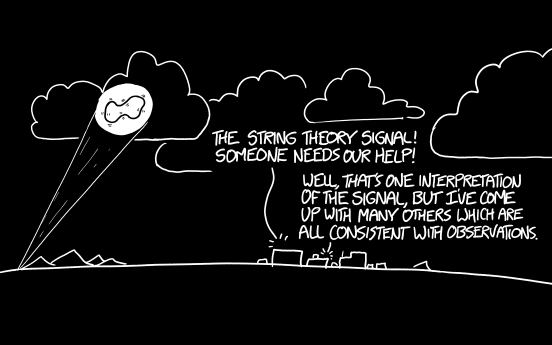 last shadow
itll take a month to get there right?
brave coral
yeah
carmine olive
it slows down as it goes away
like how throwing a ball upwards travales half the distance in 3/4ths of the time
plucky merlin
 cerulean thorn
next major space event.... B4S20 testing, hopefully