#Train timings
1 messages · Page 1 of 1 (latest)
 dapper python
So my brain is flipped for some reason and I need a rubberduck who can ask the right question that I can't, if you don't mind. I'm going to edge detect on the rear of the train b/c the front is actually braking distance and I want to ignore that

The greater network will consist of only merges. I can automate any timing detection, warm up circuits and such.

I guess it's reserved stuff? But my brain refuses to figure out which controls which
Or if they both do
I know the mergers are important, detecting when trains hit each merger. So probably it's just "trains already on, must reserve"?
 clear pivot
What exactly are mergers?
dapper python
The return lines are merges, rather than intersections.


The other part is controlling for speed, without having control lol
clear pivot
Could train limits/number of trains at station be used to determine if trains are entering a merge?
dapper python
Mmm, I could enable/disable waypoint but I'd rather not as it'd be global anyhow
I think I'm globally wiring as it is, I don't see a way around that. But I'm trying to get the control mechanisms down to what I actually need
Which, I suppose, is that once a train is already on the tracks, I don't put another train on in a way that it crashes, yeah?
clear pivot
dapper python
Which, I suppose, is that once a train is already on the tracks, I don't put ano...
I suppose direction is important 
 clear pivot
Right...
dapper python
These are where things get a little more complicated and I want to abstract though
I don't think the difference between the first station and the last station is enough that I should pay attention to it
I think I can group those up, and find minimum and maximum travel time, with a warmup circuit
That's what led me to think about the mergers though. That's where the thing actually happens, or doesn't
I should be able to release a copper train at the same time as an iron train

exact same time, and I don't need to process any further than the merge
clear pivot
dapper python
So my brain is flipped for some reason and I need a rubberduck who can ask the r...
how did you manage to circuit the gates?
to my knowledge, thats not a vanilla feature
dapper python
Wall
 clear pivot
need to experiment with this. That might be your alternative for signals
clear pivot
so if train goes past, then activate previous rail
dapper python
Okay so trains already on the tracks have to reserve. That means they know when they're going to hit the merger
That merger then has to block the other track
But only for the time frame when it'll be problematic
Speed is dealt with on "clearing the other side"
Which is the split
clear pivot
so if train leaves station, lock all other stations. free lock when merge completes
dapper python
So it could release if the new train can clear the next "block", IE distance to split, before the train already on the tracks clears
That's speed control, oh yeah
Wait it's ONLY clear time??
Time to clear block if slow train is in front. Time to hit merge if slow train will be behind
Shit this is accidentally almost LTN as well
Okay and min/max times are only needed for one of the calculations too, now we're getting somewhere
- Group sources and sinks for circuit, warmup tests extreme range of groups on many-to-many. There is only one relevant merge, this is still ostensibly a 2-track system.
- Once trains are on the tracks, they are on the tracks until they get off.
- Minimum time is the fastest the train can hit the merge. If the merging train will arrive behind the train on the tracks, you can send a train behind the reserved train.
- Maximum time is the slowest a train will clear to their split, given the grouping.
- Group timings are all relative and can be checked during warmup
So I need gates for time to hit merger, and time to hit split?
dapper python
dapper python
So my brain is flipped for some reason and I need a rubberduck who can ask the r...
Okay here's the problem with that information. I don't want to store so much. I can't store each of those splits
clear pivot
I dont think you need time, just conditionals
dapper python
Right, I'm just thinking about how to repeat this information down the tracks
The big thing is the science trains, right? I don't want the space science train to shut down my entire factory the whole time
When it takes off, it has time to next merger/split. I think either decision does similar things but has to be handled differently?
Full speed trains, between two mergers, will take the same amount of time. So I don't have to do it for blue, then purple, then yellow. They need to know their time to full speed once they're on, maybe
When space science passes through yellow, the yellow sci ore trains have the min-behind/max-ahead thing. Then when it passes through purple, same thing, this time yellow is also doing the same thing. There's a window I can't release trains
Yes, there it is. There is a window around each science train, where I can't release new trains
The mergers need to know when they're blocked. They send that info to the group
dapper python
So this is interesting. Gates stop detecting trains when the trains nose crosses. The only thing they actually detect is braking distance, which is also a speed detector
For a group of trains that are all the same size, the longer the braking distance(simple counter on gate signal) the faster it's going
dapper python
How far should I actually push this? I feel like I can save a lot of circuits by dumping a little bit of precision
dapper python
I need my FIFO too. This circuit is getting big. Rip
dapper python
Aight, it's not the most automatic, but I think I can determine the important timers and remove the circuits after @clear pivot
 dapper python
This gap is pretty reliably 8 ticks different
 dapper python
Yeah, from dead stop, this is 8 ticks farther. I would've thought that time got ticked on at the end. Maybe it does and it's still 8 ticks?

This pair I'm looking at is 937 versus 945 ticks. So I guess it's final speed, as max would be 11 tiles and I moved 10

 dapper python

https://cdn.discordapp.com/attachments/783049079584063588/1284903108564226196/image.png?ex=66e852c5&is=66e70145&hm=4b4913cd0f194c89031b2fd68037adf9be27356280304a1c1ce0c6f3505b8985& @clear pivot got it in the simplest form. No data storage. Detect if red or not

Ah dang, it's a little messy, because I have trains waiting. It's not complete
These trains have already departed.

The ones at the mines also have departed already and are no longer being circuit controlled at that point. I'm thinking to prevent departure but that is going back to global stuffs
I will have trains waiting at both ends so I have to address this. Any ideas?
clear pivot
honestly, would probably just be simpler to have many gates just circuited with each other
@dapper python

If you are going global network route, may as well implement the equivalent rail signal equivalent
dapper python
Actual red light lmao

You know it's not the worst
I don't think there will be damage
it's very slow damage
 clear pivot
What are the remaining problems @dapper python
dapper python
Fine tuning?
clear pivot
So just timings?0
dapper python
I think so
Yeah like this train is LONG gone

lmfao almost 800 ticks too much

Here we go, got it close on both sides now
dapper python
lmao so for the duration they push against the gates, they don't seem to be doing any damage. I think this is actually going to work out
 velvet sigil
so i was wondering, can you set signal colour on signals?
i know, dumb question that is probably already answered
dapper python
You can force closed
velvet sigil
but not force open?
dapper python
Correct, you wouldn't want that anyhow
velvet sigil
damn
no i was thinking about one of the messages
where you wished for way to detect trains
dapper python
Forcing open is invariably more than 1 train per block
Oh yeah, I should update. I have a neat red/green circuit
 pliant citrusBOT
Blueprint String
 dapper python
Uhhh shit ignore the guys on the right, those are unrelated

In action
omg it's not repeating like I wanted it to, my everything was off. I removed 3 combos and fixed the behavior to do what it's supposed to
dapper python
I don't know why I always seem to get what I want as far as trains, at night, but here we are lol
dapper python
@clear pivot So I have one last generic problem, and I guess it might not even be a problem? High speed merges at distance, and combining complex networks. Copper merges all the way over on the right, and it'll happen at full speed b/c it's like a KM away. I have further distances to consider later. I guess the problem I've yet to specifically identify is how to do the delays across multiple merges?

Oh I guess it's just "all farther trains" isn't it....
I have to measure some trains at some weird places then, and transmit some of the information a long ways. I might have a use for entrainglement!
That's neat too b/c I can have multiple places block the same input, I'm only transmitting one bit.
clear pivot
dapper python
I have to measure some trains at some weird places then, and transmit some of th...
Using trains to transmit information at super luminal speeds? 
dapper python
lmao yea
pliant citrusBOT
Blueprint String
 dapper python
@clear pivot Quantum Entrainglement makes it so damn simple, I'm only transmitting one bit, "red light," so it's actualyl a perfect use case

It's combinator free, no power needed

And completely generic. You can place them wherever and it'll block that specific spot.
dapper python
@clear pivot I'm realizing the only difference between a merge, and a crossing, is that a crossing actually has less competition time? It's only the train itself for the moment it's there, the acceleration time doesn't matter anymore, just presence. However, the distance at which the releases are being controlled is getting impractical to measure
I can put stuff wherever but it's a guess, I save and let time tick, diagnose crashes, adjust
clear pivot
dapper python
<@296405990771785732> I'm realizing the only difference between a merge, and a c...
Moot in 2.0 with elevated rails btw
dapper python
lol yeah in 2.0 crossings are irrelevant, only merges matter
clear pivot
Crossings will still be useful
Especially for high throughput scenarios as you@can make use of track above and below
dapper python
Tracks crossing will be useful, it's just that they have no impact on train flow anymore
Only merges have an impact on flow
ofc, crossings aren't strictly necessary
dapper python
@clear pivot Ahhh I finally understand why it's not syncing like I thought it should. Distance gets added twice, and both times are added onto the return side. When the limit goes to 1, the train goes on the entrance track, that's easy enough to sync. But the return trains do not have the same length of cycle. The inbound from start time being totally synchronized with a simple clock, means that it arrives at the station later based on distance, stays for the same time, and then spends more time coming back. So if inbound is sync'd on a simple clock, return is automatically going to desync itself
 dapper python
<@296405990771785732> Ahhh I finally understand why it's not syncing like I thou...
dapper python
dapper python
<@296405990771785732> Ahhh I finally understand why it's not syncing like I thou...
@pale merlin Btw this is where I'm stuck atm. The acceleration ramps mitigate the issue quite a bit, but don't solve it
The one in the video was like 1 second behind, so it's not going to have the same sync on the next train

 pale merlin
you have to know how long a train can take to clear it out of the track safely.
dapper python
Yeah, I have a python program that can calculate all my timers for me
pale merlin
basically the exit ones are different from entrance one.
dapper python
Yeah, and the problem is that it's not on the same cycle length
The farther ones get the distance added twice so the frequency changes
pale merlin
exactly, so each line will have a different length
how do you prevent trains from going to the wrong station?
dapper python
Flash limit 0/1
pale merlin
they are only ever designed to go from A / B if you use timing
dapper python
Yeah, each station has a specific time it turns on
They won't repath if they never slow down for a signal
Tbh they won't re-station unless there are open limits, and there never are
pale merlin
its basically a timing issue, for each train station A -> B you need to know the distance, and you can calculate the time.
 pale merlin
problem is does this system also keeps track of trains already moving?
dapper python
I got through red, green, and blue, with a naive scheduler and gates
pale merlin
well I mean does it keep track of when a train should be on the track from B -> A? so it wont launch a train that's already moving?
Wait let me rephrase that.
When B Launch 1 train, how do you know it won't launch a train which is too close to each others path?
dapper python
I must not understand something about what you're asking. It remembers nothing. There's a clock on a cycle, and schedule slots are every 130 ticks. I send a train every 5th schedule slot, so the limit combo is just "when schedule slot equals" and all of them are 5 slots apart

 dapper python
pale merlin
When B Launch 1 train, how do you know it won't launch a train which is too clos...
dapper python
pale merlin
When B Launch 1 train, how do you know it won't launch a train which is too clos...
haha that's the neat part. You schedule them
pale merlin
dapper python
haha that's the neat part. You schedule them
yeah but the schedule should take ahold from the limitation if its too close to each other the schedule does not work
dapper python
Right, 5*130 ticks apart
pale merlin
maybe should be higher, for return trains?
dapper python
That's what works in blue
There are certain cycles I have to hit
Some of the copper stations need a train every 25,960 ticks, because that's how fast it takes to consume a train's worth
Others are twice that
Others are on a 33,600 tick cycle
pale merlin
Noted, just going by return and train crashes.
dapper python
Yeah, that's the thing. If they sync up in one direction, they will not be on the same sync, on the other side
The simple schedule runs into problems when you involve long distances
pale merlin
dapper python
The simple schedule runs into problems when you involve long distances
you need to know travel time for each train. and travel time back + wait time
dapper python
pale merlin
you need to know travel time for each train. and travel time back + wait time
correct
 pale merlin
also the cycles for each should be in here as well.
dapper python
(Maximum interval because of train count, cycle time/100 ticks)
 pale merlin
The biggest issue I keep in my head is
Depot -> Diff station . Easy.. One to many rails.
But many to one, is too hard to do, you get trains leaving at any moment. they cannot leave without clearing a certain section
dapper python
Yeh, the funny part to me is why exactly it doesn't work any more, when it did before mostly
pale merlin
dapper python
Yeh, the funny part to me is why exactly it doesn't work any more, when it did b...
its all about timing
dapper python
I can sync either side no problem
pale merlin
well if you redesigned the rails you get issues, and have to readept the schedule
dapper python
I'm already resigned to depots, but yeah syncing one side is relatively easy
dapper python
pale merlin
well if you redesigned the rails you get issues, and have to readept the schedul...
lol true, this is a very static thing
pale merlin
dapper python
I'm already resigned to depots, but yeah syncing **one** side is relatively easy
yeah thats from Depot -> Stations. but Stations -> Depot is harder since you have to keep track at which station they are *based on schedule
dapper python
Right, which I don't think is something I'd like to use
I'm trying to avoid any and all extra steps I can
pale merlin
you just have to extend the schedule .
A -> B how long did it take.
Station -> How long unload + additional wait timer from other trains to prevent crashes
B -> A (Depot) how long ?
dapper python
I mean, I have the gate redlights
dapper python
pale merlin
you just have to extend the schedule .
A -> B how long did it take.
Station -> ...
So here's the thing, the build is long enough, that I could probably do math based on where things are in the cycle, and maybe that's the best way to do it. The clock is information on what trains are where. The problem is that any simple sync will desync on the other side
If I send a train at 100, 200, 300, 400, 500
Those trains will get back at 1100, 1220, 1340, 1460, 1580
Whatever sync, will be different
pale merlin
so the clock ingame desyncs?
dapper python
No, the distance is counted twice on the one side because of how the trains are called, by stations
They're called at 100,200,300 etc., but they arrive at 200, 310, 420
Stay for however long, then leave and also take extra time then
pale merlin
oh you mean based on depot #1 and depot #2? 🤔
pale merlin
dapper python
Stay for however long, then leave and also take extra time then
yes and that time should also be accounted, the waiting time inside the station.
dapper python
These trains are all called at the same interval, they arrive at a different interval

I am
It's this extra few tiles
It's not much, that's why i could ignore it in RGB
Once they're at speed it's like a quarter of a second extra coming, and going
pale merlin
yeah the finetuning is the hard part
dapper python
dapper python
I'm already resigned to depots, but yeah syncing **one** side is relatively easy
If I match the return side, this side desyncs
I can't adjust schedule based on distance either
I could greenlight at station with longer counters, I suppose
I just feel like there's some simple trick I'm missing with frequencies. I could adjust ALL of the unload timers
I could give them a little more track before they rejoin the main
pale merlin
im more thinking in the way of modulo distance, where distance equal to train + topspeed.
if its reached the train should be able to leave, and do its thing to leave without crashing
dapper python
There may be a way to detect conflicts based on comparing schedule positions. The higher these numbers, the farther the station
 pale merlin
yeah I was thinking like segmenting , and you already did that nice, like how many tiles does it need in order to not crash in other trains
dapper python
I'm fairly sure I'm close lol, I've put a fair bit of work into this
I think you may have given me the tool I need
each schedule signal is also distance
pale merlin
exactly, maybe
how many signals do fire?
as in your depot has how many triggers from going?
dapper python
I have tentatively found a way to keep all of them on the same cycle
There's something with having shared factors
if they're all base 10, for instance, if you send one at 1,11,21,31, and the modulo is also based on 10, say it's 500, then it won't ever sync up with one that's going at 3, 13, 23, 33, with base 400 cycle
pale merlin
I was going by another idea as well ,
groupings of trains to leave at once.
Like distance groups , one leave
mid group one train leaves
close distance group one train leaves.
And if they do not get to the station on time they have to wait till next group trigger.
Maybe thats what you mean with distance.
dapper python
So far, I've stuck to nearest-to-farthest, which accomplishes that grouping. But that's one thing that's on the table
They still can show up in the wrong order, too
My copper mines naturally timed with that iron mine, was soo nice
They're -1 but it doesn't matter, they're always -1
pale merlin
do you do any triggers on the unloading / smelting station? or once left from depot they are free running?
dapper python
The only control is limit 0/1 when the stop in question is scheduled to call a train
pale merlin
so the station calls a train? ?
dapper python
This conversation has been super useful to me, I'm really crunching the problem down. I have to adjust the schedules
lol yeah, each requester calls at their scheduled time
pale merlin
np 🙂 I understand 80 % of it.
dapper python
Hehe, I'm definitely into some deep, dark waters
I know I have the space on track for it though
pale merlin
dapper python
Hehe, I'm definitely into some deep, dark waters
factorio , each engineer has its own limits.
pale merlin
dapper python
I know I have the space on track for it though
thats not the requirements! 😉
dapper python
That's one of them! XD The track can handle it, I square!
There's so much extra room even with those trains that were on the fastest cycle
pale merlin
dapper python
There's so much extra room even with those trains that were on the fastest cycle
ideally you want multiple groupings of train leaving at once, to fill up those spaces
dapper python
I did really like the sync of simultaneous release and track spacing
pale merlin
dapper python
I did really like the sync of simultaneous release and track spacing
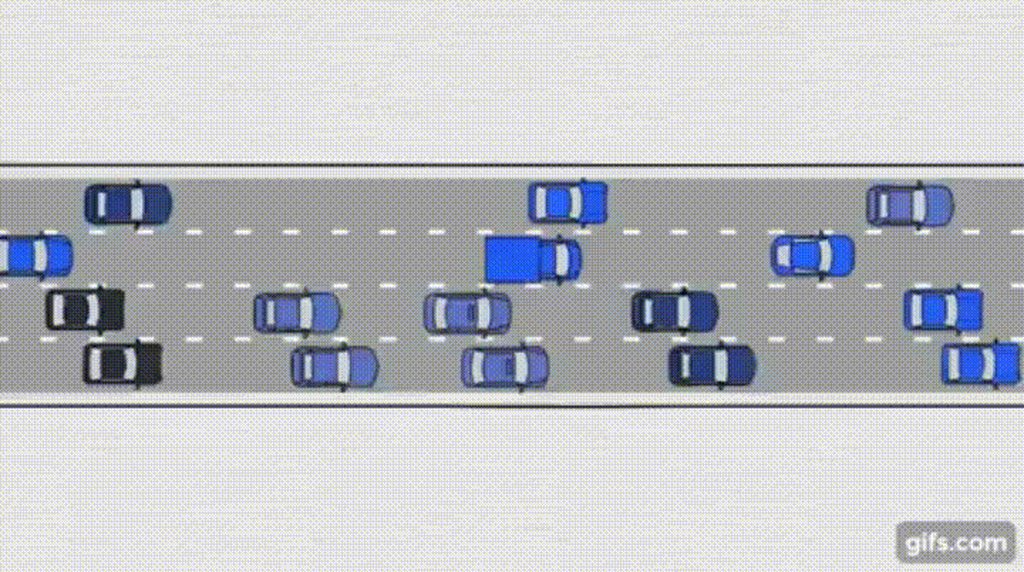
this is basically your problem with merging traffic ^^;;
https://i.imgur.com/CIhYAiv.gif
 dapper python
lol except there are zero brakes
pale merlin
yep
dapper python
But yeah that happens all the time on multi-track rail networks
pale merlin
in an ideal world, your track is reserved for you and all the timings are perfect and nobody has to wait on anything because parking is guaranteed
dapper python
Yeah that's the world my RGB builds live in
So interestingly, I can do "time passed and circuit condition"...if there's only a few troublesome merges, I might just be able to stop those
The circuit condition would be just an extra timer though, and UPS optimization is a huge part of this. So that's why time passed first, it's not supposed to be doing the circuity stuff
pale merlin
yeah I leave you to it 🙂
dapper python
Thanks so much for the help!
dapper python
Okay I found a cycle where some slots exist

Bah, they disappear when I extend the check to more depth of cycles.

Some still exist on that cycle at timing 5
That's (conflicts,slots) for various timings.
w/ base 10, slots exist on interval two, and slots exist on interval 5, so I'm more sure about the factors thing.
Yeah, this is what's happening

Factors will end up with the same position at the end of the long cycle
 dapper python
Whew, okay, I can find the empty spots on the track now.

(slot, crashes predicted on naive cycling)
dapper python
The minute a pattern starts to form, it disappears again.
 dapper python
Ah fuck and I just realized something I was doing that's critically wrong, about how I'm checking schedule slots. This is only for the first station, I didn't iterate stations. But I think I need to rethink this anyhow. There's a point where complexity starts spiraling and it isn't doing what it's supposed to, which is "fewer things in-game to avoid crashes."
I'm trying to stretch scheduling too far. It can be used as a part of this but trying to sync so many different schedule intervals isn't going to fly.
I can fit a quadratic to time/distance so at the least, I can do a little bit of distance calculation, but this approach is getting lost in the sauce. Scheduling can get 99% of the way there, pick the best schedule, then somehow stop conflicts. The gates are enough, I just wanted to remove them.
clear pivot
dapper python
The minute a pattern starts to form, it disappears again.
This is a program@you put together right?
dapper python
Yea
It's doing the simple cycling, with a base clock that I'm doing multiple modulos on. So it's detecting that slot 48 on the modulo 490 schedule, crashes with 6, 12, 30, 36, etc., from mod330
Most of them are 1 crash
Even w/ primes, which I guarantee will eventually sync, it takes a while and it's just the one

W/ a shared base they never sync
 clear pivot
Do you know if train schedules are done in parallel or on the same core?
dapper python
I'm not sure, but I think it doesn't matter for me? I've wholly mitigated pathfinding
And also station switching. When a station calls, it is assigned a train the next tick
clear pivot
If you are going with a timing approach, this methodology may be inherently flawed if its operating over a single core while the train scheduling isnt
dapper python
I must be misunderstanding something here. All of the work should be done ahead of time?
clear pivot
My understanding is this program is meant to help find optimal scheduling delays given an arbitrary number of trains
dapper python
The "Scheduler" is just a simple clock with a /130 to be 'schedule slot' signal. I send a train every 5 slots
 dapper python
clear pivot
My understanding is this program is meant to help find optimal scheduling delays...
dapper python
clear pivot
My understanding is this program is meant to help find optimal scheduling delays...
I don't have the cojones to try a generic solution until I figure it out once lol
I'm trying to do the program in a generic fashion wherever I can, given the option to do it generically, I do

Cost me nothing to put those in
clear pivot
Ok, so regarding actual factorio for a moment, do you know if train schedules are processed on the same core or in parallel?


 clear pivot
Yeah
dapper python
This is asleep until 72s
clear pivot
Ok, but if you have two trains with a similar delay, are they processed in parallel or after the other processes?
If thats the case the concern was that schedules executed on a different cores will not be subject to the same perfect timing
dapper python
The odds of that being tiny aside, I would assume single core
clear pivot
Then yeah your program should sync fine
dapper python
My window to work in is like +-100 ticks
Yeah I'm not concerned anyhow, if I'm +-1 tick I should be fine.
A huge motivator here is UPS efficiency, so "time spent" would be very nice to keep
The thing is that these simple schedules, "This station gets a train when S%490==48", it's very few collisions. That's very little work in the game.
I could add circuit conditions to the train, but that's defeating the purpose. I could track every train with my FIFO system and decide if it's safe to send a train or not, but that's 300-500 combos, again defeating the purpose at least a bit
I know what the problem is, it's distance adding an extra layer of variability. I even know how to access that layer in-game already, so long as I stick to "farther stations get higher schedule slots" I can pretty easily gauge distance.
There's no pattern to the conflicts though. I'd end up having to effectively store multiple combinations of at least 2 and maybe more input slot modulos.
L(1) when S%490==49 and S%330 in 7,13,31,37,157,187,192```That's very complicated in factorio. I don't want to pre-calculate to put that many things in. So I'm kinda stuck
clear pivot
different approach, why not use a station to synchronize timings? @dapper python
basically from what i recall from your particular problem, merging trains and them firing off causes issues. You could deliberately throttle that by having each train route to a special nearby station that doesnt release the train until the timing syncs
although i guess youd still be at the same problem of using walls to block things off
dapper python
Yeah that's a possibility. Actually it can be an acceleration loop
So when the train is released it's at full speed. But there's limits to that b/c you need a schedule that alternates AB enough times to cover all delays, so the train has to hit that on the way out
You can just spam clearing on the end, it's not really a problem, but 10 extra stops isn't ideal
Track timing with loops might be possible too but I don't see how
The problem isn't the entering train, the desync comes from the farther train
Waitaminit, the desync comes from the farther train?

This makes it worse?
dapper python
idk it's sorta working, I don't get it
lmao I could normalize the distances. More track for each station closer. Then every train goes the same distance.
dapper python
@clear pivot YUP just had to normalize the distance, single acceleration ramp.
dapper python
Hmm, airports? I haven't been to many but I suppose they're pretty tightly scheduled too aren't they
Ohh it's the baggage carousels
clear pivot
i didnt even consider those but i was thinking of the the runways
airplanes basically meander to a lane that allows to them to take off
dapper python
That too, yeah. I had done larger acceleration ramps but that wasn't working, I do still need at least one I think, but perhaps not more than one
I don't need to double back for map-build, either, so that it's one-directional will be fine on map
This is the general solution btw. I just had to look at the problem in the right way.
Left is problem, right is solution. The tracks need to head in the same direction, over a certain distance, so that distance always stays equal

I got away with it for RGB
Also dead speed merging trains at 600 tick intervals require effectively two slots to accel safely, so it's for sure one acceleration ramp
pale merlin
dapper python
<@296405990771785732> YUP just had to normalize the distance, single acceleratio...
if you want some chaotic fun 🥲 remove one train its fuel and watch the chaos unfold
dapper python
lmaoooo
pale merlin
dapper python
lmaoooo
good thing we got load game options 😛
dapper python
ikr? So many crashes I reset to save
dapper python
Okay I have one last problem to solve I think, which is a little awkwarrd considering how I did everything up till this point. The coal trains have to get snaked in at bad times, and each section on the right is associated with a section on the left, to stop the weird overlaps from happening. I'm not sure how to snake the coal trains in b/c they're interspersed.
Maybe I should just try it and see what happens
I'll get the 5th part of the packet in b/c I have to do it that way, probably.
pale merlin
dapper python
Okay I have one last problem to solve I think, which is a little awkwarrd consid...
same as the other trains ? what would coal trains make special? Just add them in as one of those trains who need to be in sequence and just belt it in ?
dapper python
pale merlin
same as the other trains <:engithink:800737127121551380> ? what would coal trai...
The locations of them. One of the things I did to simplify the scheduling was that the groups of drops, and groups of supplies, are positioned the same, they're all in the same order. Farthest right stack, goes to farthest right requesters. If this weren't the case I think I'd end up with trains overtaking?
Maybe not, now that I have basically an entire acceleration track for them.