#Transmutation Mapping and Chromatic Notation: Building an intuition for apotheosis
1073 messages · Page 2 of 2 (latest)
 cursive summit
So the mood vector is basically the weighted average of the ingredients in the recipe. If you have a recipe of two items with the same energy and count, the mood vector will be exactly in the middle of the two items in the essence space.
 mellow citrus
I’d love it it will show the item it will give using images 
 lone canyon
https://www.desmos.com/calculator/ef5snlibgv
made a representation of an item
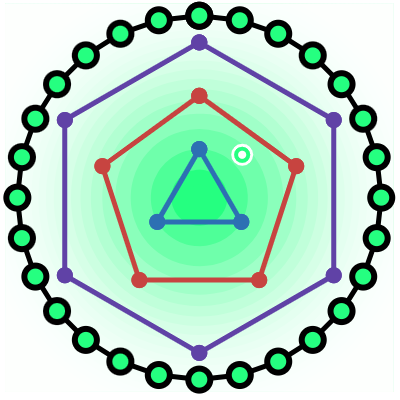
Desmos
mellow citrus
lone canyon
https://www.desmos.com/calculator/ef5snlibgv
made a representation of an item

lone canyon
note this does include rank because i made it before i learned it does nothing
 wind relic
ohhhh alpha channel right
cursive summit
The energy determines the weight an item has in that average; low energy relative to the other ingredients means the mood vector is further from it, high relative energy means the average is closer to it.
lone canyon
wind relic
ohhhh alpha channel right
afaik tho alpha is always 1
cursive summit
I actually haven't double checked if alpha is used at all, so that could be true and it could be 16.
lone canyon
cursive summit
The energy determines the weight an item has in that average; low energy relativ...
oh so mood vector is just the energy ratio(s)
wind relic
there is also the chance that I forgot the actual number of dimensions and my memory filled it in with 17 from ||the minimum distance you can get to Maria before she disappears||
lone canyon
cursive summit
I actually haven't double checked if alpha is used at all, so that could be true...
afaik it isnt, given hzs site doesnt give item alpha and he's prob the 2nd most knowledgable on the topic, short only of lucy themselves
cursive summit
lone canyon
oh so mood vector is just the energy ratio(s)
Kiiiiinda? The mood vector is a point in the essence space, but where it is is determined by the average location of the ingredients in essence space and weighted by their energy. The game then checks the distance from the mood vector to all the items, with that distance also being weighted by bias and tags, and then whichever item it's closest to is the output. The 'area/hypervolume of bias' is just the weighted area/hypervolume in which any point inside it is considered closest to the associated item.
lone canyon
are you calling the mood vector what i called my "perfect result"?
cursive summit
I think so, yes. In the game's code it's called the mood vector, which is why I call it that.
lone canyon
oh
weird
but for clarification-the mathematical result of apotheosis, which is what items are compared to to find cost of each one?
cursive summit
What do you mean by cost?
cursive summit
lone canyon
https://www.desmos.com/calculator/ef5snlibgv
made a representation of an item
This is really cool, would you be ok if I maybe built something using this later?
lone canyon
basically the distance across all dimensions (and that dimensions weight)
like how tags are a full -1, while essences are + [the difference between mood vector's and the item's] and color is that weird formula hzs was talking about with square roots
lone canyon
cursive summit
This is really cool, would you be ok if I maybe built something using this later...
i was thinking about making a second one which fuses into a third but each single point is a unique line of math with a variable (theres 40 something)
(oh yeah sure btw pop off queen)
lone canyon
lone canyon
basically the distance across all dimensions (and that dimensions weight)
like h...
ive mentioned it before, in my previous big explain cost is the actual sorting, its compressing a comparision of 2 16 ish dimensional points (mood vector and given potential product] into a single float
cursive summit
I... Think I understand? Are you calling the distance the cost? Like, the sorting is done by the distance from the mood vector to each of the items in the essence space, weighted by tags and bias. Are you calling that ranking by distance the ranking by cost?
lone canyon
product with the lowest cost wins (can and likely will be negative)
cursive summit
Ok, yes, you are calling the distance cost
lone canyon
cursive summit
I... Think I understand? Are you calling the distance the cost? Like, the sortin...
thats what hzs calls it when he explains it so its what i use 🤷♂️
but yeah its basically distance
except it can go negative
cursive summit
Why don't we use the terminology used in the code, what
lone canyon
i assumed cost was what it was called
cursive summit
lone canyon
except it can go negative
yeah, that's the reason why I didn't use add tags in my little 2D model
lone canyon
cursive summit
Why don't we use the terminology used in the code, what
thats a question for hzs
he IS online
cursive summit
I would love to talk to him about this, but I might have to wait until later/tomorrow because I'm actually supposed to be writing a magazine review article that's due tomorrow >.<;;
Procrastination, yippeeeee
 unique urchin
cursive summit
Why don't we use the terminology used in the code, what
unique urchin
cursive summit
Why don't we use the terminology used in the code, what
I'm just used to calling it cost because that is what it's usually called in the context of algorithms and optimization problems
cursive summit
Ohh, I see
unique urchin
Either that or it's called loss but calling it a "cost" just made more sense to me
I think the apotheosis algorithm ignores the A value. The color distance function only uses R, G, and B.
What I call cost is actually called distance in the code though, I just end up calling it cost whenever I'm not specifically trying to use the terminalogy in the code
like, to me, since it's the sum of multiple distances, tag match metrics, and penalties, it's not really a "distance"
but when talking about optimization problems it's pretty normal to call such a thing a "cost"
it just feels more natural to me
lone canyon
makes sense
cursive summit
another one
 lone canyon
good to see we’ve surpassed the actual tome
cursive summit
Hehe, I made it in the tome but just posted the png from the files here
rather than a screenshot
mellow citrus
Having a hard time mapping out, tooth block
lone canyon
chomp chomp
cursive summit
I mapped the letters. I don't know any recipes for the letter cube, but if I could I would try to include that in these, because the letter d is unfuseable.

 unique urchin
I don't think a recipe for letter cube exists, the properties are really unfavorable
cursive summit
That's really unfortunate. I swear I saw someone with some in a cache cube in a stream a while back, I wonder if they modded it in...
wind relic
unique urchin
I don't think a recipe for letter cube exists, the properties are really unfavor...
unfusable according to lucidpedia
unique urchin
wind relic
unfusable according to lucidpedia
It does have the fuseable tag in the game, it is just that there is no known recipe (and a recipe likely does not exist)
wind relic
ah
lone canyon
unique urchin
It does have the fuseable tag in the game, it is just that there is no known rec...

lone canyon
does he know
or is he a fake ball knower
unique urchin
I have a guess
cursive summit
I'm prototyping a new feature. I noticed that a lot of triplets have one of the members that produce more/less from the others (lower/higher relative energy), and so I've begun to add a chord line beside items that give more and a dot inside the triangle next to items that give less.
Currently the way I've been writing it have somewhat complex rules that result in minimal vagueness, but I'm considering if maybe I should simplify the rules at the cost of being a little more vague.


I'll see if I can write out the rules I've been trying out:
- If any two of the triplet have have no product mults, they are seen as the baseline, and the third is either marked as multiplicative or divisive.
- If the three are all unequal in relative energy/produce different amounts based on the combination of the others, the one that produces the most is marked as multiplicative, the one that produces the least is marked as divisive, and the third receives no marking.
- If the triplet already contained a junk pair with product multipliers, those take priority in the notation. Triplet mults aren't notated on those two. Instead, if the third produces more than both, it's marked as multiplicative, if it produces less than both it's marked as divisive.
I find that this helps me with understanding the relative energy each item in a family has.
cursive summit
-# with every addition this notation becomes less approachable auau I am making my way to the title of Grand Alchemist... Grand Apotheologist?
 fresh steppe
cursive summit
I'm prototyping a new feature. I noticed that a lot of triplets have one of the ...
fresh steppe
cursive summit
I'm prototyping a new feature. I noticed that a lot of triplets have one of the ...
Mmmm this is real good
cursive summit
Alright, there has been a big addition to the site: Elemental Mutations. It is currently under a new Advanced Notation section, in which the contents assume a knowledge of the info panel and item elements.
https://paletteheart.nekoweb.org/chroma_note.html#advanced
As well as that, here are a couple maps that utilize this feature.


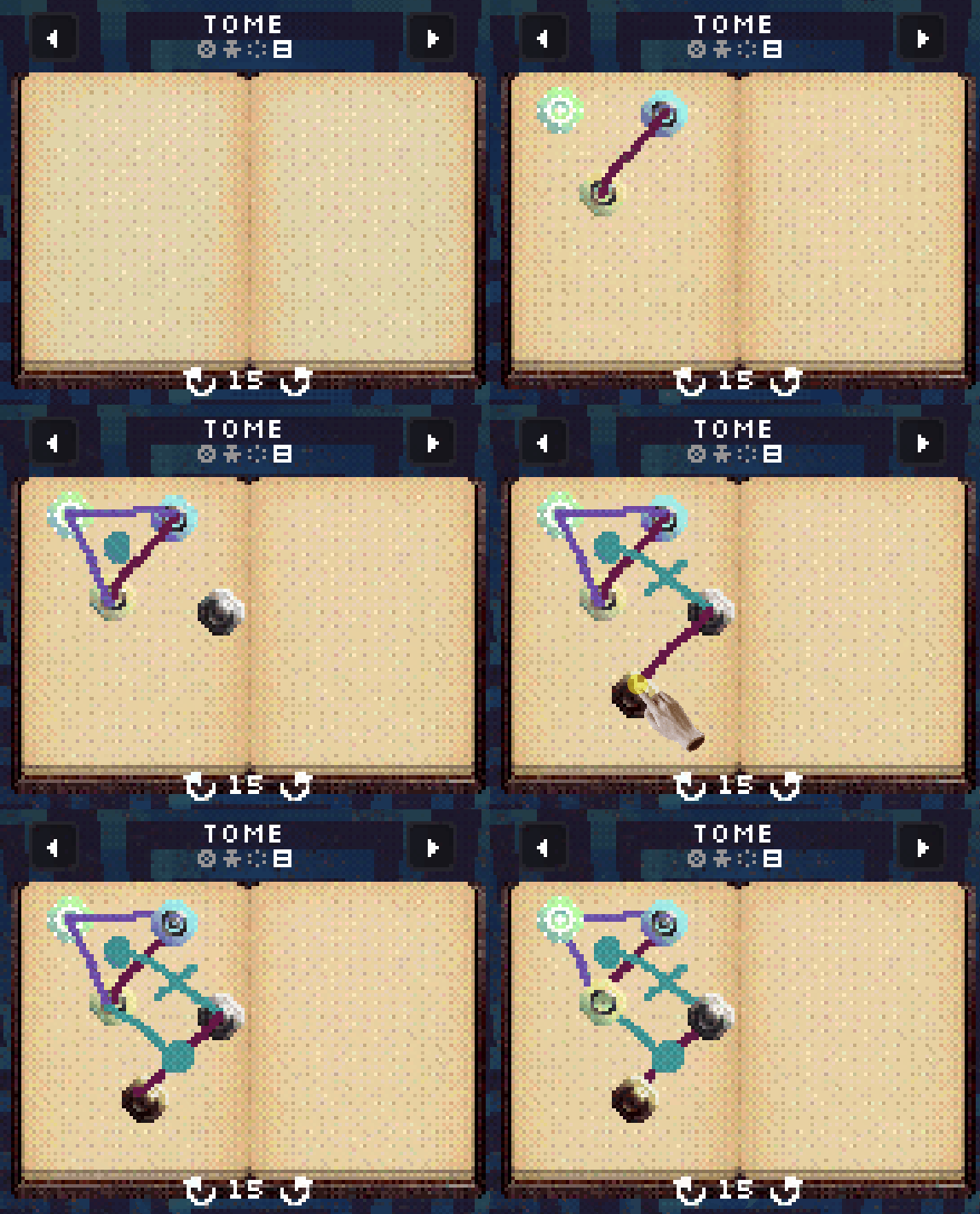
A guide and introduction to mapping lucid blocks apotheosis recipes with chromatic notation.
In those maps, it documents that the ball wand and foliage picker both may be made into a hate wand by raising their hate, and that a string may be made into a metal hook by raising its mercury.
I'm really happy with how it turned out, the table and vectors I made for it was an especially fun little touch to make.

I'm hoping tomorrow to get the new product multiplier marks for triplets into the guide.
cursive summit
Alright, the triplet multipliers have been added to the documentation. They're real useful for charting the energy difference between triplet members, as well as compressing notation.
https://paletteheart.nekoweb.org/chroma_note.html#mult-triplets

A guide and introduction to mapping lucid blocks apotheosis recipes with chromatic notation.
fresh steppe
cursive summit
Alright, the triplet multipliers have been added to the documentation. They're r...
Hell yeah
cursive summit
Lots of maps in the gallery have been updated with triplet multipliers, and the two maps I've made with elemental mutations have been added as well.