#czii-cryo-et-object-identification
1 messages · Page 1 of 1 (latest)
 gusty oxide
trying get copick working right now, if anyone has any advice, it would be greatly appreciated
 gleaming mesa
Hello!
 past notch
hello karamat & nimisha 😊
 pale vessel
Hello everyone im new here, and a bit confused about the dataset provided, do we need to first classify the particle type using object detection and then predict their x,y,z values?
@brittle quest
 brittle quest
pale vessel
<@315475486979522560>
brittle quest
pale vessel
<@315475486979522560>
I am a competition host for, and only know about, the #um-game-playing-strength-of-mcts-variants competition. I don't know anything about this one, sorry.
gusty oxide
not sure if you all had this problem but the overlay directory should look something like this

i spent a long while messing around with the directory, im doing this one my C: drive
i thought you had to remove the :///, but no keep it
/sample_overlay should contain /ExperimentalRuns and /Objects
 fervent sedge
@gusty oxide I just got on discord, did you get everything worked out with copick?
gusty oxide
hi
no i havent
i tried following the notebooks but those failed too
i pasted one into google colab and it didnt quite work right
i also tried installing all the libraries that were on the overview nb on a different project, then ran into a problem with the zarr import
 worthy sigil
If we wanna build a deep learning model for this chase. What is the name of theqnique for processing this data??
gleaming mesa
I haven't started working with copick yet. I want to know more about it. But I couldn't find any documents supporting the "copick" package.
If anyone finds it, please share it here.
Okay, found something related to copick on GitHub (fortunately 😊). Take a look:
https://github.com/copick/copick

GitHub
Definitions for a collaborative cryoET annotation tool. - copick/copick
You can search your issues here. @gusty oxide
 runic imp
Okay
 plush kiln
pale vessel
Hello everyone im new here, and a bit confused about the dataset provided, do we...
plush kiln
pale vessel
Hello everyone im new here, and a bit confused about the dataset provided, do we...
I think not. The particle coordinates allow you to calculate your model's accuracy
 timber ingot
I want to know what model benchmark.csv is obtained through?

 mossy breach
Idk if i should be posting here but I'm looking to join a team for cryo et object detection competition.
 real cobalt
Does anyone else has this problem with numcodecs, when trying to install it into a kaggle environment by importing it as a dataset beforehand and than trying to install it like that? It works with the normal use of pip. But since this competition is without internet usage, i am trying it this way to get dependencies in. The numcodecs package is needed by copick.

 swift quarry
Anyone else looking for a team?
 hardy hazel
i am trying to figure out why the coordinates are non decimal numbers. Is there something I am not understanding about voxels or does this have to do with 3 dimensional space coordinates?
 glacial sail
the image is attached to voxels, so integers. But the centromers can be decimals
Ah yes
definitely although depth is highly blurry is a 3D particles problem
But sure, to locate the nearest voxel to labels get nearest integers
So I guess you already know. But just to clarify, voxels are a grid over a continuous space. By using decimals you are saying that centromer is closer to one voxel than his neighbors by the portion of the decimals
Cause the metric used, decimals can be a difference
hardy hazel
I kinda see. My trigonometry for 3d isn’t so good. Trying to get an idea how I would visualize a python array in terms of non decimals
glacial sail
An array is a grid of values. His indexes are in fact integers pointing a position on the grid
Ex: the slice z=0, row y=0 and column x=0, first position
But between (0,0,0) and (0,0,1) for example there is non stored space
In more simple words, the images are volumes in Amstrongs. The arrays store intensities in voxels separated 10A. But your model can be more sensible than 10A locating centromers
 exotic hill
Hello, I have a question. The size of tomogram is (184,6630,630) but the position of proteins in json file sometimes more than these values position. How come? could you tell me how can I relate these two values together?
glacial sail
you need to scale coordinates by ~1/10 for 184x630x630 tomograms
glacial sail
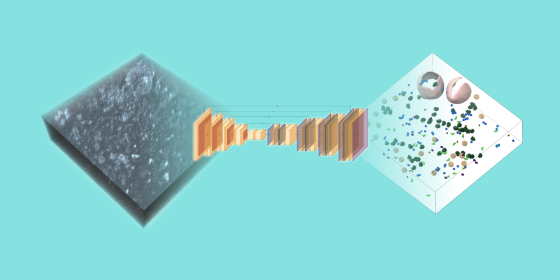
Find small biological structures in large 3D volumes
hardy hazel
glacial sail
In more simple words, the images are volumes in Amstrongs. The arrays store inte...
That last statement really helps thank you
hardy hazel
Also it looks like the array is in zxy format is that correct? Z axis first x second y last
glacial sail
zyx
 wary hill
Hello, anyone looking to work together ?
 grizzled kestrel
Has anyone been able to get decent recall results on all the classes? I can get decent recall on ribosome, virus, and thryoglobulin with a split dice / focal loss, using class weights of 1 - (class freq as %).
Using monai 3d unet
wary hill
grizzled kestrel
Has anyone been able to get decent recall results on all the classes? I can get ...
did you use image segmentation via co ordinates ?
hardy hazel
Does anyone else get a blurry or skewed image when plotting on the zx or zy plane. Am I doing something wrong?
grizzled kestrel
The imaging is taken in the xy dimension, so other views wont look like an exact picture
 crystal oxide
wary hill
Hello, anyone looking to work together ?
crystal oxide
wary hill
Hello, anyone looking to work together ?
i'm looking for someone to work with, already coded most of the stuff just need to optimize and refine now
using pytorch lightning btw
hmu if ur interested (ping me and we can talk in dms)
 hasty creek
hardy hazel
Does anyone else get a blurry or skewed image when plotting on the zx or zy plan...
hasty creek
hardy hazel
Does anyone else get a blurry or skewed image when plotting on the zx or zy plan...
The side views are really bad due to the “missing wedge”. When they take the image, it’s mostly in the xy plane but it’s tilted back and forth between -60 to 60 degrees. Since it’s missing some data from the tilt, the 3D reconstruction is smeared in the side views. I still don’t have my head wrapped around it but I found this gif helps (from the tomographic reconstruction Wikipedia page)
hardy hazel
That make so much sense! I was doing some rotation and observed that same phenomenon.
hardy hazel
hasty creek
The side views are really bad due to the “missing wedge”. When they take the im...
Thank you. I witnessed that directly
 untold hearth
Anyone interested in teaming up with me
 pliant vapor
I see most public notebooks use asciitree lib, what does it really do?
hardy hazel
pliant vapor
I see most public notebooks use asciitree lib, what does it really do?
Think of it like a directory layout
hardy hazel
pliant vapor
I see most public notebooks use asciitree lib, what does it really do?
They are probably doing it to look at nodes in a hierarchical design
pliant vapor
I added the F beta metric into the baseline notebook. Hope you will find it useful. https://www.kaggle.com/code/laodriverayu/more-than-baseline-unet-training-f-beta-metric

Explore and run machine learning code with Kaggle Notebooks | Using data from multiple data sources
hardy hazel
Is there any reason to have a team? I’d rather work alone
hardy hazel
Is there 7 more days to create a submission?
hardy hazel
How many people are actively working on this project? Not a lot of activety
hardy hazel
Is it possible to petition for an extension?
hardy hazel
I haven’t got a submission in. I was doing it a certain way. Need a little more time
glacial sail
I don't think it will be possible. At least you'll can submit out of time with no medal but knowledge