 Twitter
1 messages · Page 1 of 1 (latest)
 silk hornet
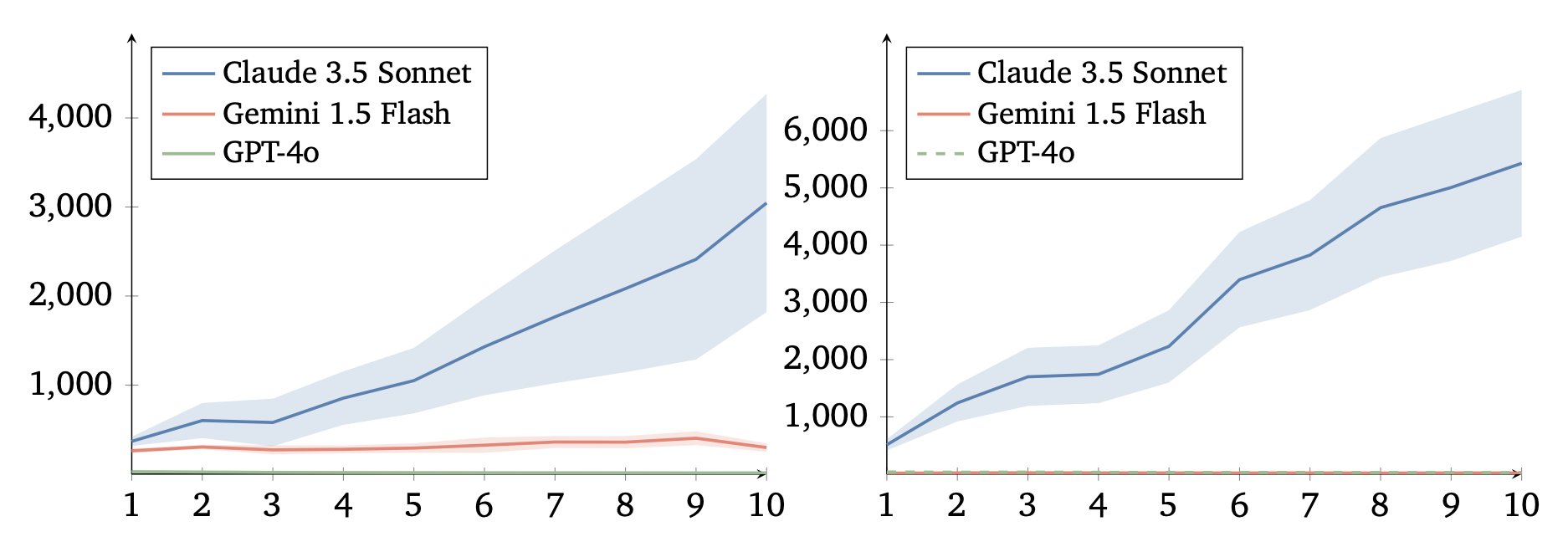
"Over generations, societies composed of Claude 3.5 Sonnet agents evolve high levels of cooperation, whereas GPT-4o agents tend to become more distrustful and give less"
https://x.com/Sauers_/status/1869153758787305880?t=NFqT9srCyIwXJVACGK-VKg&s=19
Over generations, societies composed of Claude 3.5 Sonnet agents evolve high levels of cooperation, whereas GPT-4o agents tend to become more distrustful and give less
Twitter
·
 golden saddle
Full paper
 glossy ingot
This is really interesting stuff. The term "machine culture" is going to become really important, especially in "multipolar" outcomes.
Self-cooperation seems really important to execute on any tasks at scale. Also important, but not tested, is how well the different models do in mixed populations. I'm very curious how robust Claude is when they're only 20% of the population
 long aurora
glossy ingot
This is really interesting stuff. The term "machine culture" is going to become ...
long aurora
glossy ingot
This is really interesting stuff. The term "machine culture" is going to become ...
Relevant: Axelrod's classic https://en.wikipedia.org/wiki/The_Evolution_of_Cooperation
(Spoiler: topology matters. - can co-operators cluster?)

The Evolution of Cooperation is a 1984 book written by political scientist Robert Axelrod that expands upon a paper of the same name written by Axelrod and evolutionary biologist W.D. Hamilton. The article's summary addresses the issue in terms of "cooperation in organisms, whether bacteria or primates".
The book details a theory on the emergenc...