


1 messages · Page 1 of 1 (latest)
 severe vessel
GitHub is where people build software. More than 150 million people use GitHub to discover, fork, and contribute to over 420 million projects.
 fathom swallow
@severe vessel @dapper warren Sir, I understand the task and believe I can contribute effectively to the relevant projects where this can be implemented.
I am a second-year B.Tech student at the Indian Institute of Information Technology (IIIT), Sonepat, and I have good working knowledge of Next.js and TypeScript.
One possible approach could be to add a button that opens a dialog-style interface, where we list all the required external APIs along with clear instructions on how users can obtain and configure them.
I would appreciate your feedback on this approach and would be happy to refine it further based on your suggestions.
 dapper warren
fathom swallow
<@369000194630746113> <@730649203264585830> Sir, I understand the task and bel...
dapper warren
fathom swallow
<@369000194630746113> <@730649203264585830> Sir, I understand the task and bel...
This is an org wide idea, so specific implementations will differ on a case to case basis depending on the different projects. However the core idea is similar to your suggestion
fathom swallow
Okay then I can work upon those with next js or mern as tech stack
dapper warren
Not necessarily, all our projects have different tech stacks
 fierce dragon
Multi-LLM provider support is necessary.
We should have options of providers like Anthropic and Openai along with the free tier APIs like gemini, openrouter and groq and more.
We can also have the option for local LLM support, like ollama and LMStudio.
Some people do have powerful GPUs and can use local LLMs on their systems
We can use tools like Litellm or Vercel AI SDK for this or build it by ourselves depending on the project.
 finite sky
@dapper warren hey , i want to clarify something , will the user set this api or the llm key in the env or in the frontend , ie before running or after running the project , can you please tell me about this i am little confused
Thanks!
dapper warren
finite sky
<@730649203264585830> hey , i want to clarify something , will the user set this...
Ideally in the frontend, so the layman user does not need to edit any code and recompile products
 noble sinew
@dapper warren I’m Sagar, a CS student from India preparing for GSoC 2026. I have experience with Python, ML projects, and some open-source contributions (including scikit-learn).
I’ve been going through the discussion on the CHOICE idea. From my understanding, the core tasks involve:
Would it be a good approach to design a common provider abstraction layer (e.g., an LLMProvider interface) so switching APIs does not affect core logic?
Also, which AOSSIE project would be the best starting point to implement BYOK + multi-provider support?
severe vessel
Would it be a good approach to design a common provider abstraction layer (e.g., an LLMProvider interface) so switching APIs does not affect core logic?
Yes.
Also, which AOSSIE project would be the best starting point to implement BYOK + multi-provider support?
Finding the projects that are in most need of this is part of the challenge.
noble sinew
okay @severe vessel , I’ll review the existing projects to better understand where such an abstraction would have the most impact. Thanks for the clarification.
finite sky
hi @severe vessel @kind moon
I’ve implemented a v1 of a library that addresses the “Redundancy and Choice for External Dependencies” requirement.
This version supports:
✅ Bring Your Own Key (BYOK) — users can configure and store their own API keys in local storage.
✅ Provider selection — users can choose between multiple API providers (e.g., different LLMs) from project settings.
✅ First-time configuration flow — users are guided to set up their API key when they use the project for the first time.
But the main issue is adaptability all the ai related projects have different architecture we need to change something in the projects codebase to use this feature , but the upcoming projects can add this , so for the already implemented codebases i really want your mentorship and guidance
Also the backend that is written in node and python is my primary vision coz maximum are written in these two but what about code written in go or c++ , or should i focus on node and python only for now
looking forward for you response
Thank you
severe vessel
finite sky
hi <@369000194630746113> <@1337858821653139527>
I’ve implemented a v1 of a lib...
Nice! But why are you using a backend? Couldn't this be a pure frontend component?
finite sky
Hi @severe vessel , great point — and you're right for the majority of cases.
For new projects or projects where the AI call is made directly from the browser (like a simple chat UI), a pure frontend component is absolutely sufficient. The user's key lives in localStorage, and the fetch goes directly to Groq or Gemini — no backend needed at all. That's the primary vision going forward.
The backend middleware exists specifically for existing AOSSIE projects that already have server-side agent logic — LangGraph graphs, multi-agent pipelines, tool calls, server-side memory — where the LLM is initialized in Python or Node, not in the browser. In those cases the key has to travel from localStorage → HTTP header → backend, because there's no way for a browser fetch to inject a key into a Python process directly.
So to clarify the two cases:
New or frontend-only projects → pure frontend component, zero backend change needed
Existing projects with server-side agents → frontend stores the key, sends it as a header, backend reads it and passes it to the LLM constructor — all other agent logic (graphs, prompts, tools) stays untouched
Going forward, should I prioritize the pure frontend path and treat the backend middleware as a secondary integration guide for existing projects? Also, for existing codebases — would you prefer I pick 1-2 specific AOSSIE projects and demonstrate the full integration end to end, rather than keeping it generic?
Tell me if i did not get anything or am i missing something here
Thanks
finite sky
@severe vessel @dapper warren hi ! , so we actually used the library in a working project , and just wanted to know your view on this
Also if all things are ok , i was thinking to open a pr for this which will change some architecture decisions of the project so please give me guidance on this
Thank you
finite sky
@severe vessel @dapper warren
Can you please check this
https://github.com/AOSSIE-Org/Perspective/pull/145
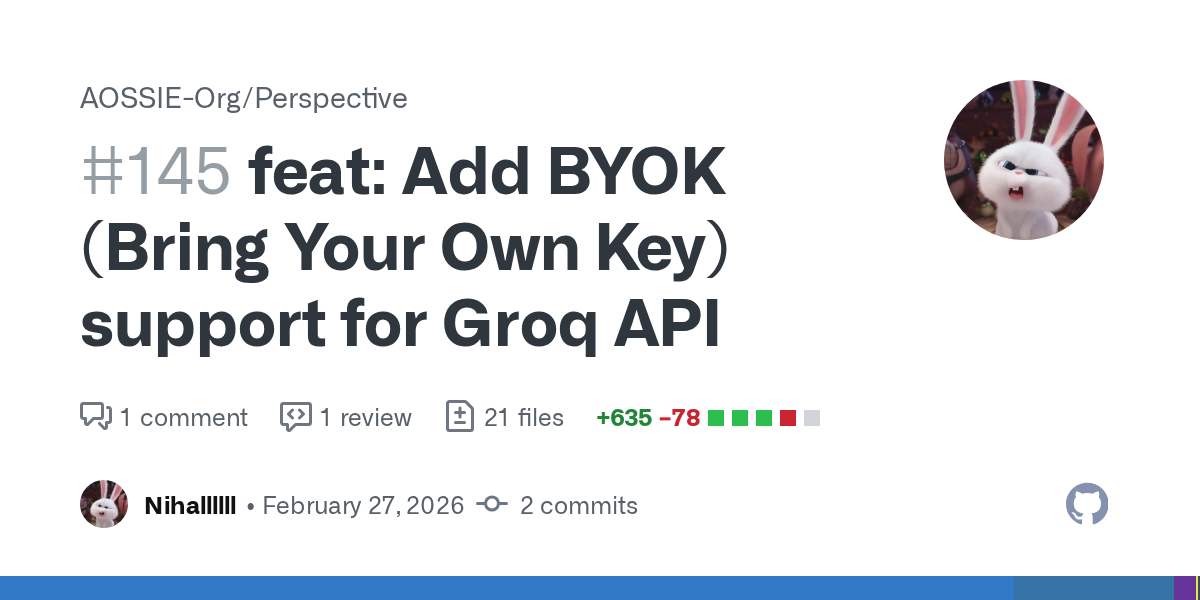
What this PR does
This PR removes the dependency on a server-side GROQ_API_KEY environment variable
and replaces it with a BYOK (Bring Your Own Key) pattern — users supply their own
Groq API key th...
i have added above in the perspective channel , but since it uses the choice feature so i thought to post it here also
Thanks
dapper warren
finite sky
<@369000194630746113> <@730649203264585830>
Can you please check this
https://...
I will take a look at it, but i need some time
finite sky
dapper warren
I will take a look at it, but i need some time
no worries 👍
 orchid shadowBOT
@finite sky You are now level 5! :confetti_ball:
severe vessel
finite sky
Hi <@369000194630746113> , great point — and you're right for the majority of ca...
Are you saying that, in the case of existing projects, we will go from "frontend + backend" to "frontend + backend + middleware backend"??
If so, we shouldn't do this.
Couldn't the BYOK frontend component have some sort of callback configuration that allows an existing project to configure the component in such a way that, when a key is inserted, the project's own backend is called via the callback?
finite sky
@severe vessel
Mental Model :
User types their Groq key into your app
↓
Library saves it in THEIR browser (localStorage) — never your server
↓
Every request from your frontend automatically carries the key as 3 headers
↓
Your backend reads those headers and uses the key to call the LLM
@severe vessel is this approach better ??
severe vessel
finite sky
<@369000194630746113> is this approach better ??
Yes.
finite sky
Hi @severe vessel , I have completed the BYOK library update and pushed the latest code to my GitHub.
What I changed:
Implemented the callback-driven BYOK flow (frontend returns headers, backend reads them).
Removed proxy-style architecture so it stays as frontend + project backend only.
Added/updated docs and usage examples.
Cleaned the repo so it now contains only the library code.
I have already pushed the code to my GitHub.
Could you please tell me where you would like me to open the PR (which repository and branch)?
Contribute to Nihallllll/Choice development by creating an account on GitHub.
finite sky
@dapper warren Hey! can you please tell me where i should make a pr for this
dapper warren
finite sky
<@730649203264585830> Hey! can you please tell me where i should make a pr for t...
I don't think we have a repo for this yet. I will talk to Bruno and create one shortly.
finite sky
dapper warren
I don't think we have a repo for this yet. I will talk to Bruno and create one s...
Thanks , also have you started to see the pr's of perspective ai project as you told me that you were busy on other projects earlier , just asking so that i can message in that channel
dapper warren
finite sky
Thanks , also have you started to see the pr's of perspective ai project as you ...
Haven't been able to get to it yet
severe vessel
@finite sky , I have created the repo here: https://github.com/AOSSIE-Org/BringYourOwnKey
Component to let users input their own API keys. Contribute to AOSSIE-Org/BringYourOwnKey development by creating an account on GitHub.
I have also invited you to a team that will give you access to write to this repo.
I had a quick look on the ReadMe. I suggest that you add screenshots of the widget to the readme.
finite sky
Hi @severe vessel , thanks a lot for the invite and for giving me write access to the repo. I’ve joined the team successfully.
I’ll update the README and add screenshots of the widget as you suggested so it’s clearer for others who want to use it.
Really appreciate the opportunity to contribute!
severe vessel
finite sky
Hi <@369000194630746113> , thanks a lot for the invite and for giving me write a...
Also, ensure the README follows AOSSIE's template.
finite sky
Hey @severe vessel , I've opened the PR with the library code and updated README.
Could you please review when you get time