#Mix I've Been Working On! Looking for constructive feedback.
1 messages · Page 1 of 1 (latest)
 split oracle
split oracle
split oracle
I'd like to say right off the start (just from an observation that I've been seeing from my past recent mixes), is that I often EQ the VOX's too bright.
Edit: I think something that may have caused this is that I solo the track then EQ a lot, and then I don't make the necessary changes to the vocals. Also, I got into the habit of ALWAYS boosting 3 - 4 kHz for vocals, but I should get into the habit of finding the range for presence depending on the vocals I'm working on. I'll keep this in mind for future mixes.
Edit 2: I'm relistening to the track the next day and it doesn't sound that bad. I would still do something to the top-end a bit, as I find the shaker element to be a bit too harsh to my ears. I probably was experiencing some crazy ear fatigue.
I need to tweak my VOX EQ approach
split oracle
And also, I find myself having to re-do my static mix several times throughout the mixing process. Though the hierarchy remains mostly the same (e.g., drum, bass, then vocal on top, then everything else), I find myself automating the levels or lowered the overall levels and adjusting as I go.
Not sure if this is something common that engineers do, but I would like to know if this is something you guys also do.
 split sky
Listening now...
Vocals are front and center, a little distorted pretty consistently. The "punchiness" of the drums seems to change a lot. The vocals are a lot louder than everything else, so the rest of the elements are masked. I'm not getting much of a sense of space, which is probably just because the vocals are mono and very loud.
I'm guessing that there's some dynamics processing on the master/main track which is reacting to the full mix, and it's attenuating the kick. Are you using an internal sidechain with a high-pass on the mastering compressor (assuming you are using one)?
split oracle
split sky
I'm guessing that there's some dynamics processing on the master/main track whic...
mm. I have a submaster before the master using a Vari-Mu compressor. It's a Fairchild emulation.
There are "variable" options where I believe I can set the minimum attack and release time. That's probably where the transients are being pooped.
And I get what you mean about the vocals. I had trouble getting them to sit right, when I lower them statically with a fader, they just get buried.
It happens to be in a range of 1-2 dB difference where the vocals stand out too much or get sucked up in some places, at least to my ears.
split sky
Mute tracks that clash with the vocals until you no longer hear anything clash significantly, and then turn down the vocals.
split oracle
split sky
Vocals are front and center, a little distorted pretty consistently. The "punchi...
I guess some transient-reshaping needs to be done in order for the punch to be near instantaneous.
I'm guessing this could be done with fast attack on compressor and some moderate amounts of makeup gain
split sky
split oracle
I guess some transient-reshaping needs to be done in order for the punch to be n...
Why use a compressor instead of just turning up the gain?
split oracle
split sky
Why use a compressor instead of just turning up the gain?
Hmm, did you mean punchiness as in how fast the transient was hitting or the volume?
I guess volume in this case then
I'll make sure to make them level a bit more. Probably volume automation would do the trick
split sky
split oracle
Hmm, did you mean punchiness as in how fast the transient was hitting or the vol...
We'd need to see/hear the audio which you want to "make more punchy". Like the kick, bass, snare, whatever.
Once you do the whole "just mute tracks until it's obvious what was clashing with the vocals" exercise, turn one of those tracks back on. Then think of how to separate the vocals from that track in these three dimensions:
- Time = have them play at different times.
- Space = Have them panned opposite left and right, or have one more prominent in the middle channel while the other is more prominent in the side channel.
- Frequency = Use a static or dynamic EQ, or a filter, to have, say, the guitar dominate the lower mids and be attenuated in the highs, while the piano is attenuated in the lower mids and more pronounced in the highs.
split oracle
split sky
Once you do the whole "just mute tracks until it's obvious what was clashing wit...
Yeah, I don't do 1 and 2 as much.
I will try to do all three. Probably a 2 and 3 problem from what I think right now
Isn't 1 inherently a bit limiting though?
split sky
Time is the simplest one. You can leverage syncopation, for example: have one element play on the 1 and 3, while the other element plays on the 2 and 4, so they are never very loud at the same time.
split oracle
Like you can't just shift a performance a whole bar down because it clashes with the vocals
oh
ic ic
split sky
split oracle
Like you can't just shift a performance a whole bar down because it clashes with...
Yes you can. You can do whatever you feel like. You can even delete an entire track from the project, and thus it cannot interfere with anything at all.
split oracle
split sky
Yes you can. You can do whatever you feel like. You can even delete an entire tr...
Okay
I guess that really comes down to fulfilling my job as the engineer to kind of go against the producer/artist in using an element at a certain section simply because it might no go so well in the mixdown process, right?
split sky
https://www.youtube.com/watch?v=9qJKxaWb0_A
How often are any two sounds triggered at the exact same time in this song?
This is my go-to example of the "linear drumming" concept. Imagine you had to arrange the entire song on a single track, so you cannot have two sounds at once.

My all-time fave. jungle/dnb video.
For those of you who want more info - this is what Discogs has to say about it:
Photek -- Ni - Ten - Ichi - Ryu
Label: Science -- QEDT 2
Format: Vinyl, 12", 45 RPM
Country: UK
Released: 1997
Genre: Electronic
Style: Drum n Bass
split oracle
I recall some engineers telling the artists not to do second takes or such or to take out stuff and simplify it.
I guess that's part of the job which I didn't do for this mix LOOOL
split oracle
split sky
https://www.youtube.com/watch?v=9qJKxaWb0_A
How often are any two sounds trigger...
20 seconds in.
They're pretty separate
split sky
You can also use sidechain compression or sidechain dynamic EQ to make one sound duck out of the way of another, on a very short time scale.
split oracle
Maybe the shaker and hand drum play together, but they're separated by what frequencies they take up
OH, I completely forgot to do sidechaining darnit
A lot of work to really fix up this mix, but I'll try to do more static fixes like frequency unmasking, panning, and clip editing such as muting or deleting before the automation work
split sky
Another example, with just a simple filter: when the bass is playing but the lead synth isn't, let the bass play normally. When the synth is playing, put a low-pass filter on the bass. Then when the synth isn't playing, open up the filter so the bass can cover the range that the lead synth just left empty.
Since the vocals are very mono (i.e., in the middle channel), you can put other elements in the side channel. If the hihats are panned a bit left, and the ride and crash are panned a bit right, then they will be more separated from the vocals, for example.
split oracle
split sky
Another example, with just a simple filter: when the bass is playing but the lea...
Wait, but wouldn't you perceive the filter being opened up?
What if that's an undesired sound? Or, would the average listener not perceive it at all? We're playing around a bit with the average joe and jane?
split oracle
split sky
Since the vocals are very mono (i.e., in the middle channel), you can put other ...
Oh, dude.
I had the perfect class for panning
I should use something like this
Lemme pull it up one second

Something like this
This does look a bit messy
Because it was taken throughout the entire scale of the mix
from beginning to end
But I guess I can take this into the idea of trying to pan my elements around
split sky
split oracle
Wait, but wouldn't you perceive the filter being opened up?
What if that's an u...
Just try it and find out.
Pro tip:
You can "ride the fader" or "ride the knob", overdubbing automation, while playing back the song. That way you can just turn the filter/panning/whatever up and down while using your ears, and then go back later and change the automation curve if you need to.
This can lead to more natural and musical results than trying to guess how a curve you're drawing with the mouse is going to actually sound.
And sometimes it's just easier.
split oracle
split sky
Just try it and find out.
Got it.
I'll try to report the experience before asking haha
Okay, so:
- I can try editing elements. Remove, mute, lower in level, whatever. Choose what I think may be too problematic.
- Pan, volume automate, filter here and there. Try and see what works.
Do you think the vocals were too bright?
split sky
 split oracle
What did you think about the presence frequency range in the mix?
split sky
split oracle
Do you think the vocals were too bright?
They don't sound too bright. They seem like they might be a bit over-distorted, like the singer was eating the mic and overloading it during recording just a bit.
split sky
split oracle
What did you think about the presence frequency range in the mix?
I don't know what this question means.
split oracle
split sky
They don't sound too bright. They seem like they might be a bit over-distorted, ...
Hmm, I probably drove it too hard into the LA-2A
split oracle
split sky
I don't know what this question means.
Uh like 8 kHz+ I guess?
Like the air frequencies
But you answered my question
But I think the vocals might be too bright stylistically.
I find I like to add more silkiness and air to ballad vocals, but idk if that'd be whats desireable for this vocal performance.
More or less subjective ig
split sky

There is some sibilant harshness in the vocals. I think it's exacerbated by the distortion. You can hear it on phonemes like "ts". A de-esser, multiband compressor (this is what most de-essers are), or dynamic EQ can help with that. You'll want to fix those issues as soon as you notice them. If they're in the recording, fix them in the recording. If they're brought out by some EQ, then fix them in the EQ. If they're brought out by a distortion effect, then remove them post-distortion, or adjust the distortion effect settings (like if the distortion is multiband, or if it has a dampening or filtering section).
A well-mixed song doesn't sound "well mixed". It just sounds good. Good vocal processing usually doesn't make you go "wow, the engineer did amazing vocal processing work"; it just makes you think "wow what a great singer!"
Have you ever seen a movie and gone "the editor deserves an Oscar"? Or gone to the theater and thought "the lighting crew killed it tonight"?
split oracle
split sky
There is some sibilant harshness in the vocals. I think it's exacerbated by the ...
Yeah, I have a de-esser on the chain, but I think it'd be better if I tackle that distortion first.
split sky
If the lighting is really bad, you'll notice it. If it's perfect, you won't even think about it.
split oracle
Also, I kinda suck at getting the parameters right with the de-esser so I did make some changes on a different live-set which I think does cover up the bad distortion exacerbated frequencies
I did some messing around already a few hours beforehand
I think I needed some more depth and range on how many dBs I cut through, at least with the distortion still being part of the vocal character
split sky
Another exercise I recommend:
Crank up a setting until it sounds really bad, on purpose. Try to make it sound awful, on purpose. Then turn it down until you can't hear the problem any more. Do this with your eyes closed, so you just use your ears. You may be surprised at the settings when you open your eyes.
split oracle
split sky
A well-mixed song doesn't sound "well mixed". It just sounds *good*. Good vocal ...
That's a good way of thinking about mixing
split oracle
split sky
Have you ever seen a movie and gone "the editor deserves an Oscar"? Or gone to t...
Haha, that's a good way to put it
I guess it's just a real good movie
Like you don't really notice or give credit to the moving parts or who did it ig
split sky
It's sometimes easier to sweep an EQ boost through the frequency spectrum until you hear it sound worse than it is to try to sweep an equal EQ attenuation through the frequency spectrum and try to figure out when it sounds better.
split oracle
split sky
It's sometimes easier to sweep an EQ boost through the frequency spectrum until ...
You right.
I think an overall lesson I'm being taught right now is to do what is needed and don't be scared to do it
It just happens to be the case that the numbers get large and scary hahahaha
or the visualization that is. I guess that's where Katze was getting at when I was saying something about getting too hooked up about loudness and waveforms
though they can reveal what it may sound like, oftentimes better if you look and hear together
split sky
That's part of the danger of using your eyes: you're likely to instinctively try to keep things looking a certain way while losing focus on how they sound.
split oracle
Alrighty. I got to go eat.
So, I will cook up a revised mix in the next coming days and post an update
split sky
Looking forward to it!
split oracle
Thanks for the feedback though!
Lowk never received this much in my life lol
split sky
Glad to help! You're clearly passionate and dedicated to figuring it all out. That's the most important thing. The rest will follow.
 viral summit
Yeah the vocals are quiet loud and harsh. I'm not sure what the stem is is like but it's quite abrasive to fit the smooth backing instruments. lots of distortion. I feel like it might benefit with a more gentle approach
as a result the vocals mask all the detail and clarity of the other tracks. It's a decent starting point!
split oracle
viral summit
Yeah the vocals are quiet loud and harsh. I'm not sure what the stem is is like ...
Yeah, I think I may have overdone some compressors to some extreme saturation
split sky
It's all too easy to do that with analog modeling plugins like 1176 and LA-2A plugins. You can usually avoid it by just practicing basic gain staging, and also by not pushing the input knob past the "unity" level in those plugins (iirc it's usually around the "32" mark in those plugins, but you can double check their manuals).
split oracle
split sky
It's all too easy to do that with analog modeling plugins like 1176 and LA-2A pl...
Yeah, on an updated version I am slowly working on, I took the input gain knob from around 40 down back to 30. Sounds much smoother imo
It also gives me more room to work with the EQ IF needed
So far, it sounds alright, but might change my mind later
And going back on the idea that the vocal is way too mono, does that work into the idea that the vocals might be "sitting on top of the mix too much" instead of "the vocals being part of the mix"
So I should try to find something that widens in a tad bit?
Also, is there a mix technique that I can use based on this observation I'm having over the 808 bass sort of smushing the vocals a bit volume-wise?
Maybe sidechain it again?
Or RMS?
split sky
I generally recommend keeping the vocal mono, but letting any stereo space effects like delay and reverb be wider.
Think of a real-life vocalist: their voice comes from a mono source: their mouth. Then you get echoes and reverberations in the stereo field of the space in which they're singing.
split oracle
split sky
I generally recommend keeping the vocal mono, but letting any stereo space effec...
tru tru
split oracle
Hello guys.
I just wanted to give a quick update as I received some feedback from my professor.
He also agreed that there's something wrong with the vocals and SFX. He said the vocals are way too overcompressed, which seem to be the most evident whenever the singer starts to belt in some places. He recommends to ease off on the compression and try to do some more gain automation.
Also, he said the SFX were too loud. Fair enough. I like loud SFX tho bahahah
He did say that bass and drums sounded nice.
He also didn't really comment on anything else, so I guess the guitars, strings, and the gist are sounding really nice and balanced.
However, as Core was saying, something about the vocal simply makes the rest of the mix sound off, so I'll take that into account while mixing the rest of the week.
Edit 2: My goodness. Long story short, I realized I am mixing at levels that are simply not suitable for me.
Turns out that low levels for some people are simply too loud for me. I can take a picture of what I mean, but for me to actually HEAR what my professor means about the whole balancing issue, I only need to bring my headphone knob to around 18%. Beforehand, I was listening to around 40%. It sounded loud and nice, but it was really exhausting my ears quickly.
The whole SFX being unbalanced is much more easier to hear now.
 stray quail
The mastering/spectral balance to me sounds ok, but something feel off. I'm listening headphones. I feel the main vocals should be more front with this style... for me it feels like bgs and effects are way louder than the main vocals at some places.
Choir parts and that nice guitar solo is pushed backwards in the mix and it sounds not very beefy to me... for main vocals... idk if you cut the low mids, maybe you could give even a small boost there to give more presense, maybe a short room reverb would help to bring him front or no effects at all ?
Hihats seems to be much in volume. Maybe you could pay more attenttion to stereo image and the feel of the space overall... SFX seems to be very loud and wide compared to other parts for example. Idk if this helps, this just my observation of your mix.
stray quail
I now days tend to keep eq flat for vocals, let the artist shine with their natural voice, no autotune and very mild compression or not at all and just manual volume automation... but at most I just low cut or limit proximity effect, if its too much + apply de-esser if 's' too much :)
stray quail
I think as of rev5, its a nice mix.. just a nice mix, but doesn't translate the feeling of the lyrics or the artist.... if you're not going for maxximising the volume, i feel there should be a big crecendo starting at 1:30 building the tension towards the 1:45 effect part which, i think, is the change point of the song...
split oracle
stray quail
The mastering/spectral balance to me sounds ok, but something feel off. I'm list...
Yeah, this could because of the gain reduction going ham on the lead vocal.
Just a guess as of the moment. Not mixing the track atm.
stray quail
aight :)
split oracle
I understand about the choir and solo guitar parts. I also considered bringing them up more, but I was being careful as to how far I want to push that.
To an extent, I def agree that this track is super emotional and want to have some of that energy buildup at certain sections.
However, what I feel like I'm struggling a bit more at the moment is balance and clarity.
Vocal 100% seems overdriven to the LA-2A, so it's causing some unwanted high frequency saturation that's not really sitting right with me after S3 pointed it out and I relistened to it as well. I'm not the absolute best at psychoacoustics, but I believe the extra, unwanted high frequency at points can really distract the listener from the lower, a tad warmer "presence" boosts around 3 kHz that I did for the vocal. OR, it could be that over-engaged the de-esser. I'm gonna have to experiment way more.
On the other hand, I want to know your opinion on the drum and bass. I think I did it pretty solid
stray quail
yeah, current version vocals are nearly clipping/overdriven and over compressed :(
split oracle
stray quail
yeah, current version vocals are nearly clipping/overdriven and over compressed ...
Yeah, my bad haha
I just liked the sound at like one specific area, and I didn't take the time to check the whole entire performance
I would prob do some volume automation though. It sort of fits my style of balancing that I did for some previous practice mixes, but I didn't really do that for this song in particular
And perhaps the more "grand" vibe can be achieved with some spatial fx, at least for the vocals
stray quail
well, i think its the overall feeling what you're after :)
i think spatial fx, like chorus or vocal widening doesn't nessecerily work here, since the vocal track is not doubled. I would just mix with volume automation and maybe add very short room reverb... or not even that
split oracle
stray quail
well, i think its the overall feeling what you're after :)
Oh, are you saying that there's probably a different more appropriate vibe I can be shaping the mix towards?
I can see that...
stray quail
i think you should try enhance the feeling of the vocals, make the mix around that :)
but that's only me
this rev5 sounds very nice, but that's all. for me it, i wish it had more intence feel... the epic choir and crecendo with the guitar going in and so on
you're very talented
don't get me wrong, the mix sounds great already, but i think you can do even better with this.. trust your feelings :)
and i think your so good that at this point its more of trying to feel the song not just deliver good sound
split oracle
For sure.
I'm def gonna make a few changes to the balancing. I mixed the song at some high volumes, so I might have made some poor decisions.
stray quail
yeah, mixing in mono is your friend :)
split oracle
I'm also doing this for an assignment, so I'm trying to understand the reasoning as to why my professor would make those comments on my mix
It's a good idea to take his feedback to account
Yeah mixing in mono is real nice fsho
Maybe I can find a cheap speaker and just use that lol
stray quail
you can check with your phone (its usually mono), or just press mono button on the main mix
reaper atleast has such
in ableton you can do "util" --> bring the stereo to 0%
you asked the drum and bass balance... i think its nice, though i wrote the hihats are off balance
your professor have good points, maybe its more of finding the feeling, not nessecerily having everything "just loud" which seems todays trend :)
idk, i'm just nobody at internets with my opinions... so take what you feel right, ignore rest :D
anyway, like i said, trust your gut feelings, listen the artist and the song, on what they want to tell :)
viral summit
stray quail
I now days tend to keep eq flat for vocals, let the artist shine with their natu...
I'm manually automating a live 32 min set atm and far out. Surely there is a better way. It's hardcore so the vocals are already slammed. Cant really get away with anything else.
split sky
split oracle
Hello guys.
I just wanted to give a quick update as I received some feedback fr...
How long do you spend listening to audio without a break? After an hour at most, your ears need a break. Even just a few minutes helps.
If you need to do several hours of audio work a day, I recommend structuring your schedule so that you have, say, 45 minutes of audio work and then 15 minutes of checking email and Discord and stuff like that, then another 45 minutes of audio work followed by 15 minutes of doing some chores around the house, then another 45 minutes of audio work followed by a lunch break, and so on. You give your ears a break, give your mind time to refresh, change perspective, or just eat a snack and grab a cold one and give yourself a break in general as a form of self-maintenance.
split sky
split oracle
I understand about the choir and solo guitar parts. I also considered bringing t...
Are you using a chain like EQ -> 1176 -> LA-2A, or nothing but the LA-2A on the vocal track?
#beginner-questions message
Check this out if you haven't already.
split oracle
split sky
If you need to do several hours of audio work a day, I recommend structuring you...
Yeah, I'm going to have to do that.
I oftentimes get way too distracted with the process that I forget to take a break
split sky
The other day I was listening at a suboptimal volume, and the fact that I'd just come out of a mixing session probably didn't help lol. I've been outside for a while, so my ears are very fresh now. Listening again, at more like an 85 dB SPL volume, the vocal/instrumental balance seems better than I initially thought it was, while some other issues stand out that I didn't hear before. The shaker (?) is kinda distracting due to it being louder in the mix than I'd expect (it's usually more of a background percussion element). The ride and shaker (?) seem a bit too "dry" and "sharp", if that makes any sense; I would expect them to be a bit more "smeared" and "light" and "in the background", whereas right now they sound "snappy", with loud and "tight" attack transients, quick amplitude envelope release times, and not much of a sense of reverb. The lack of a perceptible reverb makes it sound like those two elements were layered onto the rest of the track in a DAW, as opposed to sounding like they would if a live band were playing behind / next to the vocalist in a real space.
split oracle
split sky
Are you using a chain like EQ -> 1176 -> LA-2A, or nothing but the LA-2A on the ...
I prob did:
SSL 4K E
Distressor
LA-2A
split oracle
split sky
The other day I was listening at a suboptimal volume, and the fact that I'd just...
Yeah, this is a very sharp observation and something that I need to think about.
Because if two elements like the shaker and ride inhibit similar frequency ranges, I need to make sure that they get along with each other.
Similar to kick and bass, though I'd say oftentimes kick wants to "pop" through bass at times :/
I also have some limitation as to what I can do, both in not having the technical skill to create the sound and the weekly curriculum limitation as in what am I allowed to do to create the mix.
split sky
split oracle
I prob did:
SSL 4K E
Distressor
LA-2A
Any issues with the original dry vocal recording?
Sibilance, mouth pops, background noises, distortion?
Any significant amplitude in the recording that's in the sub bass region (less than 80 Hz, like a 40 Hz rumble)?
Why does it need to be compressed?
Are there peaks which are very loud compared to the rest of the vocal recording?
Are there parts which are too quiet, and which get lost in the mix, and/or words that are hard to understand?
split sky
split oracle
I also have some limitation as to what I can do, both in not having the technica...
What are the constraints/requirements? Like "you must use a compressor, but you cannot use a clipper"?
split oracle
split sky
Any issues with the original dry vocal recording?
Sibilance, mouth pops, backgro...
Good question, and probably where the suggestion of simple volume automation might be a better, earlier approach to vox leveling than straight up driving it entirely through a compressor
I don't recall it being too poppy transient-wise. I did find it haveing too much dynamics, as in some areas were simply way too quiet than the other sections.
I guess I would do this:
- Manual clip gain adjustment to bring out sections that are too quiet or lower sections that are too loud.
- Evaluate for transients or sibilance.
- Add compressor/de-esser for those problems stated in 2
split sky
split oracle
Yeah, this is a very sharp observation and something that I need to think about....
I'd lower the gain on the shaker, send it to a room reverb return track which it would share with other background elements which don't need to stand out in the mix, pan it slightly left or right, and make it wider (less amplitude in the mid channel, more amplitude in the side channel).
split oracle
split sky
The other day I was listening at a suboptimal volume, and the fact that I'd just...
I would also like to share that when I was previewing the mix bounce, I was listening to it at a volume that was actually fairly "bogging" down my ears.
I sort of know if my ear is being overworked depending on how my ears feel after the mix session. If I feels like there's a bit of weight in my ears, that's fine. But, if I turn off the mix and try to listen to something, and the listening experience drastically changed, I'd say I had a poor listening level setup
split sky
You pretty much always want the ride panned just a little bit left or right, because that's where it would probably be if you were at a live show and were directly in front of the vocalist (center stage), since the ride is often just slightly to one side in the drum kit. Kick and snare are in the middle, cymbals are slightly to the sides, toms are usually spread out (so pan one tom slightly right, one centered, one slightly left, one even further left, etc.).
split sky
split oracle
I would also like to share that when I was previewing the mix bounce, I was list...
Your intuition is correct.
Are you using a reference track?
split oracle
split sky
Your intuition is correct.
Yeah, I simply cannot listen to mixes over 78 dB in my experience.
That's my limit and anything that exceeds that really forks up my ability to make good mixing decisions
split oracle
split sky
Are you using a reference track?
I don't use them enough to be honest.
I recently watched a video from Simply Mixing on how to use reference tracks, and her approach was pretty eye-opening
Using reference tracks for mixing is a great way to check the 4 major mix elements that ensure your mix will translate to other devices. In this video, I’m going to explain how to use reference tracks to make sure your mixes work outside of your home studio and help you mix faster.
-- REFERENCE TRACK PLUGIN LINKS --
@PluginAllianceTV https...
split sky
It does sound like the ride is off to the left, which is good.
Is the shaker slightly right?
The backing vocals being panned left and right is also a solid move, good work there.
split oracle
split sky
Is the shaker slightly right?
It might be a baked in panning that was already there when I received the bounced track
I believe I left it generally center
What she was saying is:
Listen to similar tracks, and get a feel for what each part of the frequency spectrum sounds like.
I think that's the gist of it
split sky
The electric piano seems panned properly already. Higher notes right, lower notes left.
split oracle
And then compare each part of the spectrum separately.
split sky
Yeah, frequency, panning, mid/side balance, relative loudness, and timing are all things to think about and compare between your project and the reference track.
split oracle
I'm finding most of what my professor commented on to be fairly true.
Vocal is way too loud, and the SFX is like at least 5 dB too loud give or take
My proudest balance in the mix are the drums and bass tbh
https://www.instagram.com/reel/DYTkUQRT6bU/?utm_source=ig_web_copy_link&igsh=NTc4MTIwNjQ2YQ==
A tangent, but this was pretty cool. Might get this
split sky
Oh yeah, and close your eyes when you do these comparisons, while trying to listen critically. I focus on imagining that the song is being performed live, and I'm front and center relative to the stage. Then I can imagine where each performer is standing on the stage. It helps me think of where each sound should come from, and how it should travel in the air and behave in the real-life space of this imagined venue. For example, the percussionist who's off to the left of the drummer is playing the congas and shakers, so the dry sounds of those instruments should be panned slightly left, while the echoes of those instruments should bounce off of the right wall with more of a delay, and the reverb should spread out in the air and be wider than the sounds of the instruments and their echoes.
split oracle
split sky
Oh yeah, and close your eyes when you do these comparisons, while trying to list...
How would I make the choir performance more wider without losing the volume?
Cause I would want that to completely fill the stadium when the choir sings. Lowk that'd be so cool
split oracle
split sky
Oh yeah, and close your eyes when you do these comparisons, while trying to list...
Hmm, the whole wall idea ic ic
I think Core mentioned similar to this as well
Something about adjusting delays and pre-delays or such to mimic early reflections from walls i thinks
split sky
split oracle
https://www.instagram.com/reel/DYTkUQRT6bU/?utm_source=ig_web_copy_link&igsh=NTc...
You could make this with free M4L and native Live effects, if that M4L device is paid and you don't have Compactor.
https://borrasca.gumroad.com/l/sidechainer3
BTW, I'm pretty sure Borrasca invented this technique long before it got popular in the last year or two.
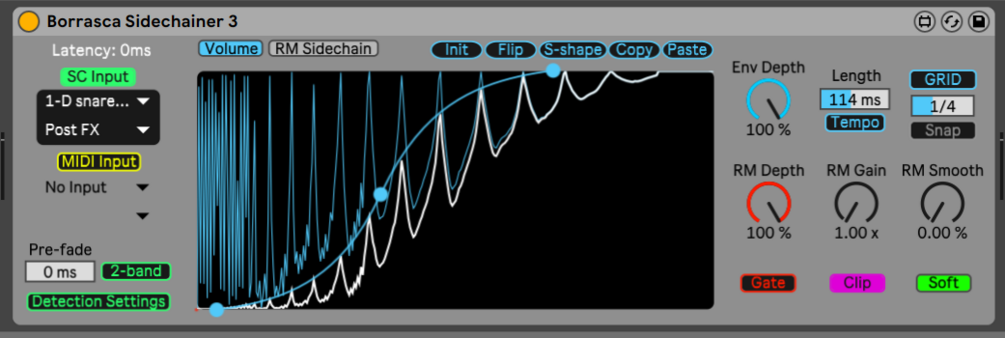
Gumroad
Borrasca Sidechainer 3 is a sidechaining Max for Live device for Ableton Live Suite 11 & 12.A plugdata version is coming to all DAWs soon.Version 3 Features Sample accurate audio- and/or MIDI triggering Volume shaping & RM sidechaining Transient detection algorithm github.com/rconstanzo/SP-tools 2-band split option with a 6db/oct or 12db/oct cro...
split sky
split oracle
How would I make the choir performance more wider without losing the volume?
What's the simplest way to increase the loudness of a sound?
Just turn it up!
 split sky
You could put a compressor on the choir track and sidechain it to another track which receives the rest of the mix's summed audio. When the rest of the mix gets quiet, the choir gets turned up.
Or just use a Utility and gain automation.
split oracle
split sky
You could put a compressor on the choir track and sidechain it to another track ...
MMM
That sounds quite nice
That'd also give space for clarity
split sky
There are plenty of other ways to do the widening, but this free plugin is convenient and simple:
https://polyversemusic.com/products/wider/
If you want to know what exactly it's doing:
https://www.youtube.com/watch?v=wt4k63uyz9Q

I'm starting a Public Discord Community, get in here:
https://discord.gg/EVDFp2hWkb
If you want the sounds I create in my videos or early access to upcoming videos, feel free to
support me on Patreon - https://www.patreon.com/dashglitch
Buy my Preset Packs / Masterclass here - https://glitch-soundbanks.myshopify.com/
Follow me on Twitter - @G...
split oracle
I've been wanting support In The Mix for a while, so I might drop a few bucks for his stereo widener
I bet I can do it for free though, the whole separate band thing
split sky
This is such a modern and advanced technique that your instructor may not know about it, but ring mod + rectifier sidechain, which people tend to call "ringmod sidechain" (what Compactor does), is a cheat code for ducking specific frequencies surgically, without a compressor or dynamic EQ (and the side effects they add to the sound). It essentially takes the amplitudes of the frequencies which two audio signals have in common, and subtracts the amplitudes of those frequencies which are present in signal A from signal B. So instead of ducking the bass when the kick hits, like with a normal sidechain compressor, you only slice out the exact amplitudes of the exact frequencies present in the kick from the bass. This means that you don't get any "pump", and it can sound like the two audio signals are in fact a single sound, because there are no "gaps" between them. It's like two pieces of a puzzle fit together.
split sky
split oracle
I bet I can do it for free though, the whole separate band thing
Like I said, you can do this for free with that Borrasca Sidechainer 3 M4L device and native Live devices. Just use Borrasca Sidechainer 3 instead of Compactor, and do what Au5 shows here:
https://www.youtube.com/shorts/3VoCmQl3CzU

Granted this is kinda advanced, and not necessary for this project, but it's still really cool and useful.
split oracle
split sky
This is such a modern and advanced technique that your instructor may not know a...
Wowza
split oracle
split sky
Like I said, you can do this for free with that Borrasca Sidechainer 3 M4L devic...
oh oks
split oracle
split sky
Granted this is kinda advanced, and not necessary for this project, but it's sti...
I guess I know have the option of pump or no pump
viral summit
split sky
Like I said, you can do this for free with that Borrasca Sidechainer 3 M4L devic...
Dayum i know i tryin tomorrow
stray quail
viral summit
I'm manually automating a live 32 min set atm and far out. Surely there is a bet...
yeah, well it all depends ofc... I tend to fix the mix/balances also live when it needs that, but i usually leave lots of room for the band to do their dynamics. For example my live mixing is mainly for local congregation and our live band... and man... they're so good.... well for this setup i very few times need to compress vocals since they use their voice dynamics to match the play dynamics :) Reason i dropped to eq vocals is due it feel akward when same person changes from speaker mic to singing mic and the sound changes so much. So I figured, altering the EQ at live setup for vocals is a no-no :) So i only do de-esseer and low cut and cut little out from proximity effect, though i've tried to instruct them not to keep mic too close to their mouth, since then it then picks all extra sounds from mouth as well - you really can't duck too loud breathing for example, which in studio setup is very possible in post production... easy to fix just saying to keep distance to the mic.
i've seen also some speakers, that whisper another word and yell the other... i think i've never compressed any mic setup that much what i needed to to for that person :)
haha, but normally for our band, compressing and eq will just limit their performance
split oracle
Hello everyone!
I wanted to give an update to the mix (I will be uploading something very shortly)
So, I took a different approach to processing, especially with compression. For the LA-2A, which I suspect to have caused some unpleasant distortion, is used to "level" the vocals at places that is a tad difficult to do with simple clip gain and volume automation. I used it as the last shine/polish to the leveling from the point of manual volume adjustments. I went from approximately 7 dB GR at the belting parts to only roughly 2-3 dB GR on the meter (on LA-2A). I completely got rid of the Distressor as I didn't find the point in using it when I'm not taking advantage of its quick response time to catch peaks (which the vocal simply did not really have).
Secondly, just did some volume readjustments. Since I don't have the Distressor and LA-2A being driven to oblivion anymore, I had to take a few elements such as the kick and snare, choir, and a few of those sort of elements to be a bit more leveled with the changes I made to the vocals.
Lastly, I had some fun with subtle panning decisions. I'm not really well-versed with this. However, I guess I have a bit of an idea of how far I can pan with the type of music I listen to.
Let me know if there's some noticeable improvements!
Thanks for the feedback thus far!
Edit 4:15 PST: I need to render.
Edit 2: I've rendered, but hear some issues. Re-rendering
split oracle
split sky
What are the constraints/requirements? Like "you must use a compressor, but you ...
Few weeks ago, we could only do volume automation and EQ.
As of now, we can do volume automation, EQ, compression, sidechain comp, parallel comp, spatial processing, saturation.
split oracle
Probably reposted this 3 times.
Telling myself not to revise it any further.
I'm way too nitpicky on myself. Here it is for listening
split sky
split oracle
Hello everyone!
I wanted to give an update to the mix (I will be uploading some...
That's a good way to use the LA-2A. Always try to keep GR under about 5 dB. Aim for more like 3-5 dB. It's better to do two 4 dB GR compressors in series than to do 8 dB of GR in one compressor.
1176 or a limiter or clipper or some other "fast" dynamics processor before the LA-2A or other "slow compressor = the "slow" compressor doesn't need to do as much GR, and doesn't need to react to short spikes or drops in gain, because the previous "fast" dynamics processor already leveled out those short-lived outliers.
Use an axe before a chisel, and use a chisel before sandpaper, and use sandpaper before a buffer or polisher.
split oracle
split sky
1176 or a limiter or clipper or some other "fast" dynamics processor before the ...
Right! I completely forgot that I can just use it catch peaks.
I'm not too sure exactly why I was even using the Distressor for massive gain reduction.
And as for using two compressors, can I use two LA-2As back to back?
split sky
split oracle
Right! I completely forgot that I can just use it catch peaks.
I'm not too sure...
Yeah, instead of doing 8 dB GR with one LA-2A, use two of them in series doing 4 dB GR each.
split oracle
split sky
Yeah, instead of doing 8 dB GR with one LA-2A, use two of them in series doing 4...
ok ok
Any thoughts on the revised mix as a whole?
To be honest, I feel like it's a much better mix compared to my first version, but there's simply something lacking to the vocals. Maybe I can add a saturator to give it some warmth
Maybe compressor for "leveling glue" whereas saturator for some "frequency glue," though saturators can also do some leveling cause of what they do to peaks.
not sure if that's the best way to put it, but I'm trying to make sense of it lol
split sky
What's missing when you compare to a reference track?
split oracle
My reference track is "Not Like Us" by Kendrick Lamar. It was recommended for my mix by my instructor
But, I'm guessing that not all aspects should be taken 1:1
Vocals are much more present in Not Like Us
But maybe I don't need to bring it too up
split sky
split oracle
Probably reposted this 3 times.
Telling myself not to revise it any further.
I...
Something is mucking up the attacks of the vocals and ducking them in ways that stand out in a way that doesn't sound intentional. There are also some issues with sibilance still. Now it sorta sounds like the vocalist has been given a lisp, whereas they were more clear earlier.
split oracle
split sky
Something is mucking up the attacks of the vocals and ducking them in ways that ...
dude, that was I was hearing too and I thought I was going crazy.
split sky
Overall levels sound better, and the reverb/delay is so natural now that I wouldn't even be commenting on it if I hadn't heard the earlier version without it.
split sky
Just fix those issues on the vocal, and I think this will be done!
split oracle
Maybe ducking too much the presence frequency range can simulate a lisp?
split sky
I would avoid using the term "presence frequency range".
split sky
Be as specific as possible.
split oracle
sub, bass, low mids, mids, high mids, highs?
split sky
We really need to see the processing chain and the settings you're using on the vocal.
split sky
split oracle
sub, bass, low mids, mids, high mids, highs?
As specific as possible. Think of how someone without any knowledge of these terms like "low mids" or "presence frequency" would describe it, because such "ignorant" terms might actually be more accurate. Like "when the vocalist sings a letter S or says 'its' or 'thinks', I hear a harsh sibilance".
split oracle
split sky
As specific as possible. Think of how someone without any knowledge of these ter...
mmm, I see
That's a fair observation. There's def a place where if I mention something super specifically, it could sound ignorant
Ignorant of the person's possible experience/expertise
lol
weird
So, I guess I'd simply used frequencies in Hz
I think that's super super specific
split sky
The listeners will not hear "compression" or "a high-pass shelf with a 12 dB per octave curve, Q=1.41, at 140 Hz".
split oracle
split sky
The listeners will not hear "compression" or "a high-pass shelf with a 12 dB per...
yeah, use the units of measurement
hol' on I need to restart my computer, my audio driver is mucked up
split sky
Can you upload the original vocal recording, without any effects, in full quality? If I could inspect it and hear it, I could tell you what seems to need work and what I wouldn't mess with.
split oracle
Okay, I'm back
split oracle
split sky
Can you upload the original vocal recording, without any effects, in full qualit...
Okay
split sky
split oracle
yeah, use the units of measurement
What I mean isn't so much "describe the exact frequency you targeted with an EQ", as it is "describe the sound as if this were the actual vocalist's natural voice".
split oracle
split sky
Can you upload the original vocal recording, without any effects, in full qualit...
Well, actually. Idk if it'd be okay for me to send individual tracks.
Idk if I would have the permission to
split sky
"the vocalist has a low, guttural voice, and it sounds like he's singing so loud that it strains the mic"
I'm not a narc lol
split oracle
I only send the full mix because that's something I did from the original tracks
what's a narc
split sky
Millennial slang, from "narcotics law enforcement", who would embed paid informants into criminal organizations. "Narc" for short. It means "someone who is going to tell the authorities you broke the rules and spoil all the fun".
split oracle
split sky
Millennial slang, from "narcotics law enforcement", who would embed paid informa...
oh ok
Alright, I actually been asked to vacuum the house, so I will be AFK for an hour or so
I'll see yall in a bit
split sky
Some of the volume inconsistencies are in the original "vocal 1" WAV file. You can hear the vocalist basically run out of breath, so a syllable here or there will be weak. "I'M STAYYYYINNNN up" = he belts on the first 3 syllables and then he's out of breath when he tries to sing the last one.
I'd describe this person's vocal style as being similar to a gospel singer. I'd try to retain that style and not change it when mixing/mastering the song. The main issues to fix are the inconsistent levels (due to the aforementioned vocal technique flaws above) and the sibilance.
I would very much want to retain the raw emotion from the original recording. It sounds like it's "from the heart", like the singer is barely holding it together because of their strong emotions. "Not Like Us" is a great reference track choice here, because you can hear how Kendrick sounds like he's about to lose it in some of the more intense parts of the song. It sounds like he is legit enraged at Drake over a personal beef.
"No one used to be calling me" is followed by a super-weak "uu-uu-up-p-p" in the "vocal 2" WAV. This is a flaw in the singer's vocal technique. They keep using up their breath on each line, and then the last word or two have no energy left behind them. Tbh I'd tell the vocalist to do a new take with this feedback in mind, or to record a second track where they punch in and re-do the weak bits on their own so that I could stitch the takes together. If they can't do that, then I'd need to use gain automation and/or gain edits on individual slices of the audio, and/or use dynamics processing to get the levels evened out.
Multiband dynamic EQ, or EQ automation, to fix the sibilance.
Then a fast compressor to tame the spikes.
Then a slow compressor to even it all out.
Then more multiband dynamic EQ or EQ automation to fix any sibilance which was amplified by the previous (parallel) compression stages.
Do not go past 5 dB of GR on any compressor, and try to keep it closer to 3 dB.
Try to avoid any distortion (this includes saturation, or any other kind of distortion (wavefolding, fuzz, "distortion", and saturation are all types of distortion)), because the recording already has some subtle distortion from the vocal technique and mic technique being used. It already sounds like a "smooth gospel singer" who was really intense and occasionally went all-out and overloaded the mic/preamp during recording, and I'd want to keep that exactly as it is if possible.
split oracle
split sky
I would very much want to retain the raw emotion from the original recording. It...
Mmm, but I'm curious as to how I should make that translate to my mix
The "rage" that is
Couldn't that be realized without Kendrick's reference?
I can see how the serial processing for the vocals can help tame aspects of the vocals and preserve the performance, but I don't really see how that's embodying Kendrick's performance.
What about Kendrick's performance could I be like "Dang, that's really powerful" or "Dang, that's really emotional?"
The dynamics? Then maybe some subtle volume automation?
Perhaps the enunciation of words? But that's up to the performer for the most part; can't really make a poorly pronounced word sound better in mixing, right?
split sky
split oracle
I can see how the serial processing for the vocals can help tame aspects of the ...
Two different concepts. Not related.
Don't mix and master to change the artist's intent. That is a mistake I made a lot early on. Just enhance what they did.
split oracle
I'm asking all this to see how far I can stretch my observation when listening to reference tracks, because at this point what I developed from listening to reference tracks while listening are the following:
- Generally can balance my mix to the relative balancing of each element present in the reference track
- Can identify FX and how it's used and try to apply that to my mixing (if I find that it adds to the performance/vibe)
- Matching tonal characteristic of the overall mix and trying to find a middle ground between my mix and reference track (e.g., how does the low frequency content from the ref. mix match with my mix? Does it have more weight? Is it more compressed? Is it backed up in the mix?)
split oracle
split sky
Don't mix and master to change the artist's intent. That is a mistake I made a ...
Gotcha
split sky
You can easily make a quiet syllable or word louder.
split oracle
split sky
You can easily make a quiet syllable or word louder.
Yeah, I don't disagree with that.
But what I meant by enunciation is if the singer was supposed to since a clear, let's say "pronoun" but pronounces it as "puh nowun"
that's exaggerated but that's what I getting at
So, first paragraph summary = preserve the emotional performance of the singer by not trying to over-edit the dynamics. If I tap into that area, probably gonna mess up the "flavor/feel" of the vocal performance.
Second paragraph is = try to make vocalist re-record or do audio editing to bring up the quieter parts AND some processing recommendations
split oracle
split sky
Don't mix and master to change the artist's intent. That is a mistake I made a ...
Would this answer be targetted towards "I can see how the serial processing for the vocals can help tame aspects of the vocals and preserve the performance, but I don't really see how that's embodying Kendrick's performance."
Or would it be targetted towards: "What about Kendrick's performance could I be like "Dang, that's really powerful" or "Dang, that's really emotional?"
The dynamics? Then maybe some subtle volume automation?
Perhaps the enunciation of words? But that's up to the performer for the most part; can't really make a poorly pronounced word sound better in mixing, right?"
split sky
Turn up the gain for just that word or syllable and find out. No text can convey what you will actually hear.
split oracle
split sky
Turn up the gain for just that word or syllable and find out. No text can convey...
Ok I see what you mean now
Just try and find out