#🪅-progaming
1 messages · Page 42 of 1
 placid cape
 hoary sluice
placid cape
well you're probably right
hoary sluice
placid cape
well you're probably right
rust has convinced me that everything the code does should be visible to you, if you create a struct using only some parameters and others get filled in for you it could cause confusion, if you use ::default its obvious what youre trying to do; you can also do new_with_param2 or whatever where some params are defauld but theres and explicit method for it
 valid jetty
??? what’s bad about that
 supple whale
valid jetty
??? what’s bad about that
supple whale
valid jetty
??? what’s bad about that
idk just average C dev things i guess
c's memory fuckery will always be bad to me
 dense sand
i mean
for me, its actually pretty easy
well atleast it has become much easier to understand
supple whale
yeah its not bad
its jut gotten weird for me when i try to read C/C++ data from another language and all of a sudden its a "oh yeah, this is somewhere else in memory, here's where, try figuring out how big it is yourself"
 dense sand
if its not struct, there is not many possible sizes it can be, just try all of them 
 blazing haven
just loop through entire ram until u find what you are looking for
supple whale
and i keep getting thread startup failure
blazing haven
/jk
supple whale
and i want to cry
supple whale
blazing haven
just loop through entire ram until u find what you are looking for
you... know that this is a valid method of doing it right?
XD
valid jetty
supple whale
c's memory fuckery will always be bad to me
i understand C memory pretty well and it’s really easy to understand
blazing haven
supple whale
you... know that this is a valid method of doing it right?
access another programs memory
see what happens
xd
blazing haven
valid jetty
i understand C memory pretty well and it’s really easy to understand
its pretty fun actually
supple whale
blazing haven
access another programs memory
nothing?
you just have a lot of memory to go tru
blazing haven
i think if people were to learn it properly when they start out with visual aids they'd not hate it so much
supple whale
simply
dense sand
can someone tell me what value that is pushed to the op stack actually is

is it a string
i suppose i can refer to this too
 supple whale
yeah sorry, java memory is the one thing i never understood
even v8 memory is simpler
 fleet cedar
dense sand
can someone tell me what *value* that is pushed to the op stack actually is
fleet cedar
dense sand
can someone tell me what *value* that is pushed to the op stack actually is
It's a reference to the PrintStream object
Not necessarily a machine pointer, I think jvm likes to shift and scale it so it fits in 32 bits
But something that the jvm knows how to interpret as a pointer
hoary sluice
is he retarded??
 dense sand
sir this is programming
blazing haven
actually its progaming
hoary sluice
 hoary sluice
big huge thesaurus sounds very amogus if you dont know what thesaurus means
dense sand
kittycat
hoary sluice
blazing haven
"planning"
what about kittycat??
dense sand
hoary sluice
big huge thesaurus sounds very amogus if you dont know what thesaurus means
thats some dinosaur, isnt it? :clueless:
jk i know what it is
hoary sluice
big huge tyrannosaurus rex
if i make a company im calling it "big huge <the service it provides>"
wouldnt you love to eat at big huge restaurant
buy a big huge ai subscription
hoary sluice
hoary sluice
is he retarded??
 plush hollow
hoary sluice
if i make a company im calling it "big huge <the service it provides>"
plush hollow
hoary sluice
if i make a company im calling it "big huge <the service it provides>"
big huge Schaeffer's deck sealant
dense sand
whoever suggested me to use libarchive, thanks! it seems so easy to use
 hoary sluice

 fleet cedar
Only thing that's husk about that is the fallback arm
hoary sluice
fleet cedar
Only thing that's husk about that is the fallback arm
whats wrong with it
fleet cedar
If you add another variant you won't get any error that you forgot to add it to interpret
And why would you even have expressions that can't be evaluated
hoary sluice
actually yea i kept it to have an error when i add a new expression, am now realizing that i get that by default and i get it at compile time without the extra branch
cause i needed a fallback branch to not have compile time errors before i added any actual arms
fleet cedar
What is it you think is husk about it
hoary sluice
implementing it
fleet cedar
Abstraction can be both good and bad
Java is kinda infamous for overusing the bad kind for example
Though I haven't seen this supposed overabstraction in reality, so the reputation is probably overinflated
...Except in gradle. That one's completely impossible to navigate, at every layer
dense sand
Is it worth breaking windows compatibility for being able to use posix function which makes my life a little bit less painful
dense sand
fleet cedar
...Except in gradle. That one's completely impossible to navigate, at every laye...
Javafx is a horrible monstrosity
fleet cedar
dense sand
Is it worth breaking windows compatibility for being able to use posix function ...
Depends on the language
dense sand
C
fleet cedar
If c or c++, probably worth it
dense sand
Ill look into the manpages if there isnt a better way
And if i dont find a better way ill go for it
placid cape
hoary sluice
<:husk:1026532993923293184>
create transpiler to brainfuck
fleet cedar
Transpile me to brainfuck
hoary sluice
placid cape
create transpiler to brainfuck
./icps file.is | ./asm2bf
hoary sluice
dense sand
Is it worth breaking windows compatibility for being able to use posix function ...
yes never consider windows compatibility at all
dense sand
xddd
hoary sluice
fleet cedar
Though I haven't seen this supposed overabstraction in reality, so the reputatio...
have you never seen an enterprise java project?
fleet cedar
I have luckily not
fleet cedar
I have seen some constructors and functions taking 35 arguments and showing clear signs of having used guice in the past, though
hoary sluice
i was about to order a rope and chair
hoary sluice
fleet cedar
I have seen some constructors and functions taking 35 arguments and showing clea...
i18n systems, one using a .properties file, one a .yml, one a .yaml, inconsistent variable names between languages which puts german words in english translations
dense sand
hoary sluice
kotlin project
spring?
dense sand
i mean you have ktor
or micronaut
and things
springs infrastructure and core is pain in ass itself
hoary sluice
dense sand
springs infrastructure and core is pain in ass itself
spring is ok
dense sand
ktor is made for kotlin
fleet cedar
Why does everyone hate doing things straightforwardly
hoary sluice
better than the other java frameworks
fleet cedar
If I want to pass an argument, I pass it as an argument
hoary sluice
fleet cedar
Why does everyone hate doing things straightforwardly
it would be a lot worse without spring
dense sand
hoary sluice
spring is ok
i made like 20 attempts to successfully setup session auth
hoary sluice
same
dense sand
ended up switching to elysiajs
hoary sluice
i had a ticket to fix some cors stuff or whatever idr, it took me 2 days
dense sand
like dont get me wrong, spring data jpa is awesome
the whole spring's database support is imo very nice and well made
same for serialization and stuff
hoary sluice
oh yeah i needed to make tests get a bearer token i think
dense sand
but the security
hoary sluice
i had to migrate a mysql with spring vomit in it to postgres, it took 2 weeks and was never realeased to prod
dense sand
well i always started with psql
hoary sluice
the system was a decade old maybe it wasnt as popular back then
hoary sluice
did u know mysql is named after the cofounders daugther My
he actually made mariadb and maxdb too, guess what
im guessing his daugther maria saw mysql and maxdb and was like dad can i have my own db so he forked mysql
dense sand
lmao
hoary sluice
"what db do u use?"
"oh one my dad made for me"
 spark tiger
which way is going to be faster for parsing a file:
- doing small read calls directly on a File wrapped in BufReader
- or reading the whole file into
Vec<u8>and then reading from it
fleet cedar
Depends on the size
spark tiger
though i’m not sure how i’ll be able to seek if i choose the latter
spark tiger
fleet cedar
Depends on the size
like 137KB
fleet cedar
But if it's smaller than a gig, fs::read is usually more ergonomic imo
spark tiger
fleet cedar
But if it's smaller than a gig, fs::read is usually more ergonomic imo
do you mean reading the whole data by “fs::read”?
fleet cedar
Yes, since that's what std::fs::read does
spark tiger
got it, thank ya
spark tiger
spark tiger
though i’m not sure how i’ll be able to seek if i choose the latter
also, what about this
do i have to use something like Cursor?
fleet cedar
io::Cursor can seek, yes, but then you lose the ergonomic benefits
spark tiger
argh
fleet cedar
I'll just plug my gospel crate
It's pretty handy for reading binary data from byte slices
spark tiger
i wanna see how it's implemented


oh yeah kinda expected that being it like that

though isn't Cursor just a pos and the data too?
fleet cedar
Yeah
Cursor could provide an ergonomic interface if it wanted, but it prefers Read
Much nicer to do f.u32()? than { let mut buf = [0; 4]; f.read_exact(&mut buf)?; u32::from_le_bytes(buf) }
spark tiger
fleet cedar
Much nicer to do `f.u32()?` than `{ let mut buf = [0; 4]; f.read_exact(&mut buf)...
oh i have this trait with these neat funcs, ig i can just use Cursor atp

also idk why but i can't stop bothering about this implementation, even though that's basically what byteorder does but i keep thinking something might be odd
fleet cedar
If the choices are File+BufReader vs fs::read+Cursor, I'd probably go with File+BufReader since you aren't making any use of having the whole file in memory anyway
spark tiger
huh, what are the uses? I thought the main benefit is just that you don't need to do syscalls when reading from memory unlike reading from file
fleet cedar
BufReader buffers it so the syscalls are sparse enough to not matter
Could always benchmark it if you need to know
dense sand
spark tiger
oh i have this trait with these neat funcs, ig i can just use Cursor atp
whatchu doing
dense sand
oh nice
i wrote a java class file parser during weekend and want to somehow optimize it
so now wondering how to optimize the reading
im just now using fread calls
but idk if reading it whole and then having cursor and offsetting accessing the memory would be more efficient
so i essentially have the same question ig
but i mean
premature optimizations are bad
well i will see how fast it is after i read and parse the whole java.base jmod into memory
spark tiger
i’m so confused i’m just asking chatgpt to reverse engineer it for me atp 

i’m like one step from finally being done with this fucking file format but i can’t figure out the last piece
fleet cedar
What is it talking about
spark tiger
i can send the prompt
I’m reverse engineering a proprietary
binary file format used for storing game assets. Well, there are actually three different files:
bigfile.bfn— used for storing file names and file tree. The structure is the following: first there are 4 bytes (u32) that represent the size of the folder’s name. Then there is the string - the folder’s name - that has that many amount characters as the u32 we just got. After that we have another 4 bytes (u32) that represent the amount of files in the folder, let’s call itfiles_len. After that there arefiles_lenamount of the following structure: 4 bytes (u32) that amount of bytes that represent a utf-8 file name. Then there’re another 4 bytes (u32) — the amount of subfolders in the folder we’re in. And the cycle repeatsbigfile.bfdata— the biggest size-wise file out of these, which as could be guessed contains the binary data for the files from the previous filebigfile.bfdb— the least researched file which, it seems, should link the file names with the binary data they contain. The issue is that I haven’t managed to reverse engineering it yet. I decided to pick one file frombigfile.bfnand found the address and size of the binary data it has inbigfile.bfdata. The way I could confirm that this file name exactly links to this data is by using binwalk. It shows which files are contained in the file’s binary by searching for signatures and magic bytes. That way I could find all the PNGs and I decided to take the last one, thinking that the order of files inbigfile.bfdataandbigfile.bfn. I was correct. That way I had the matching file name and the data it represents. Searching for the address of the file’s name frombigfile.bfndidn’t get any results inbigfile.bfdb. But searching for little-endian byte representation of the address of the file data was successful and just 8 bytes before it I found LE-bytes that represent the size of the file data. The question is can you help me guess how they can link the file name with file data?
hoary sluice
spark tiger
>>> I’m reverse engineering a proprietary
binary file format used for storing ...
advent of code ahh description
why are u using emdashes in a prompt
is the prompt written by ai
spark tiger
hoary sluice
is the prompt written by ai
no lmao i manually wrote it
fleet cedar
Fellow em dash enjoyer
fleet cedar
Hyphens are fine as hyphens
But for punctuation, em dash is best
Your description of bfdb is a rambling mess, so it's no surprise gpt couldn't make sense of it
I can't either

 fleet cedar
No chōonpu is bad, don't
spark tiger
fleet cedar
Your description of bfdb is a rambling mess, so it's no surprise gpt couldn't ma...
I don’t know much about it either, but it should somehow link the entry’s file name from bfn with the file data from bfdata. but idk its structure. i tried taking the address of the first byte of a needed file’s name from bfn and search for it in bfdb but no result
valid jetty
dense sand
[concern](https://cdn.discordapp.com/emojis/895722900722696252.webp?size=48&name...
LMAO
fleet cedar
Did you try just taking the nth entry for the nth file
valid jetty
dense sand
[concern](https://cdn.discordapp.com/emojis/895722900722696252.webp?size=48&name...
the way i tried to do threaded GC was by sending events to the thread (like when the total allocation exceeds some threshold) but to maintain thread safety its still blocking during that process so i found it pointless to make the GC run threaded at all
the only way a threaded gc would win is if you make a generational allocator to go with it
basically long-lived allocations (ones that survive a GC sweep) are ignored for a while
spark tiger
fleet cedar
Did you try just taking the nth entry for the nth file
- I don't know like how many bytes are used for one entry in this file, so I can't tell where this nth file will be
- And I actually think it's not built like that, because I took the last file from
bigfile.bfnand found its data inbigfile.bfdata, so I knew both addresses of file name and file data. Tried to search for the latter inbigfile.bfdb- found the result but it was not at the end at all
guh i hope u get what i mean
placid cape
dense sand
[concern](https://cdn.discordapp.com/emojis/895722900722696252.webp?size=48&name...
lol
spark tiger
"yeah, my hex editor has achievements  "
"
 valid jetty
the way i tried to do threaded GC was by sending events to the thread (like when...
valid jetty
valid jetty
the way i tried to do threaded GC was by sending events to the thread (like when...
if you dont block issues arise
during the marking stage, if more things are allocated, youll end up infinitely iterating through the list as more things are added until the allocation stops
and then never free anything until the end
so if you block, things cant be allocated during mark and sweep
thats why a generational allocator works well here
fleet cedar
valid jetty
during the marking stage, if more things are allocated, youll end up infinitely ...
Can't you just fetch the number of items to check first?
fleet cedar
Or is it bad that it would'nt check all the values?
valid jetty
fleet cedar
Can't you just fetch the number of items to check first?
yeah but there would be a desync
what if during the time it takes to mark, an object goes out of scope
fleet cedar
Then you'll get it next run
valid jetty
i guess
this function is the issue
local fn GCAllocator::__internal_mark_region(GCAllocator *self, void **start, void **end) {
    let current = start;
    let end_ptr = end;

    while current < end_ptr {
        let ptr = *current;

        // not nil && is a multiple of ptrsize && isnt clearly invalid
        if ptr % #size(void *) == 0 && ptr && ptr > 0x1000  {
            let block = self.map.find(ptr);

            // only mark if not already marked because
            // recursively marking more is expensive
            if (bool)block && !block.marked {
                block.marked = true;

                self.__internal_mark_region(
                    block.data,
                    block.data + block.size
                );
            }
        }

        current += #size(void *);
    }
}
although
i dont know if its still an issue
my original approach with pthreads was before i made the hashmap so it iterated through all allocated chunks to see if one matches
fleet cedar
Just checking if the value is in the right region sounds quite dangerous, what if it's just an integer that happens to be in that range
valid jetty
thats why theres a further check later on
self.map.find(ptr) would return nil (0) if it doesnt find it
the stuff here ptr % #size(void *) == 0 && ptr && ptr > 0x1000 is just a narrowing/filter to not search obviously incorrect things
fleet cedar
Random idea for making the iteration faster: make each object's header contain object size and number of references, and always put object references directly after header
valid jetty
it holds the size
struct __internal_ElleGC_Header @nofmt {
    bool marked;
    i32 size;
    void *data;
};
Then you know that the first N values after the header are references, and once done with that you skip M bytes to get to the next object
 wispy kernel
spark tiger
"yeah, my hex editor has achievements <:blobcatcozy:1026533070955872337>"
wispy kernel
spark tiger
"yeah, my hex editor has achievements <:blobcatcozy:1026533070955872337>"
“Achievement unlocked: How Did We Get Here?”
valid jetty
fleet cedar
Then you know that the first N values after the header are references, and once ...
wdym
it scans the stack for pointers tho
not contigious memory
fleet cedar
Right, but why is the scanning function recursive then
valid jetty
fleet cedar
Just checking if the value is in the right region sounds quite dangerous, what i...
also if there just so happens to be that an integer exists which has exactly the address of a pointer in the heap, that just means the single allocation wouldnt be freed
hoary sluice
@valid jetty is this horror?
 valid jetty
fleet cedar
Right, but why is the scanning function recursive then
valid jetty
fleet cedar
Right, but why is the scanning function recursive then
because it uses the roots to scan (recursively) for pointers inside of each region that was allocated
fleet cedar
Yeah an integer pointing to an object is harmless, will just make that object live slightly longer
valid jetty
like imagine you put a Foo* inside a Bar* which has a reference on the stack
you wouldnt want the Foo* to be freed even though there is no reference to it on the stack (because its inside of the Bar* which IS on the stack)
fleet cedar
Once you've gotten the Bar* from the stack, you know there's a Bar there and don't need to scan anything since you already know its layout, you can just recursive that directly without scanning
valid jetty
hoary sluice
<@581573474296791211> is this horror?
seems reasonable
hoary sluice
idk should i just clone locations
fleet cedar
hoary sluice
<@581573474296791211> is this horror?
What's the point of a ::new that doesn't do anything, just make the fields pub
What does Location contain
valid jetty
fleet cedar
Once you've gotten the Bar* from the stack, you know there's a Bar there and don...
the allocator doesnt know the layout of anything
hoary sluice
fleet cedar
What's the point of a ::new that doesn't do anything, just make the fields pub
its shorter and it might do something
hoary sluice
fleet cedar
What does Location contain
row col
valid jetty
the data is just an opaque pointer to anything
it allocates a blob of memory of the size you want
fleet cedar
Thought it was a pointer to an object
valid jetty
yeah but an Object is anything
fleet cedar
If it's just arbitrary data, that's a different matter
valid jetty
yeah
valid jetty
valid jetty
it holds the size
```rs
struct __internal_ElleGC_Header @nofmt {
bool marked...
.
i just meant like in general
fleet cedar
Pretty rare to have gc with unstructured data
hoary sluice
fleet cedar
What's the point of a ::new that doesn't do anything, just make the fields pub
and its highly likely that im gonna end up wrapping location in an option and then id like to have a new* method with 1 arg that gives me location None
valid jetty
struct Foo { i32 a; };
struct Bar { Foo *b; };

fn Foo::new(i32 a) {
    foo := #alloc(Foo);
    foo.a = a;
    return foo;
}

fn Bar::with_100() {
    bar := #alloc(Bar);
    bar.b = Foo::new(100);
    return bar;
}

fn main() {
    bar := Bar::with_100();
    // here Foo * doesnt live anymore because Bar::with_100 returned
    // its only reference is inside of Bar
    // so if you didnt recursively check then it would be incorrectly freed

    // note that #alloc(T) === (T)#env.allocator.alloc(#size(T))
    // where #env.allocator is some arbitrary allocator that has an alloc and realloc method on it
    // as a result the allocator cannot ever know the layout of T because the language is statically typed
    // all it can know is the size of the allocation you want
}
i think i have to clone it either way
valid jetty
fleet cedar
Pretty rare to have gc with unstructured data
considering this is a static language i think its reasonable
hoary sluice
or is there a way to have
struct Expression {
  kind: ExpressionKind,
  location: Location
}

enum ExpressionKind {
  SomeKind(Token)
}

struct Token {
  kind: TokenKind
  location: Location
}
where the location inside expression kind is the same location as inside expression
valid jetty
what are the fields of Location
fleet cedar
No, if you have a value that's stored in two places, then it'll be stored in two places
valid jetty
if Location is small enough you can just clone it around lol thats what i do
hoary sluice
pub struct Location {
    pub row: usize,
    pub column: usize,
}
yeah
fleet cedar
#[derive(Copy)]
fleet cedar
Also store utf8 offset instead of row/col
valid jetty
if you plan to add strings you wont be able to do that
hoary sluice
whats the diff between copy and clone
valid jetty
hoary sluice
whats the diff between copy and clone
copy is implicit
clone is explicit with .clone()
hoary sluice
fleet cedar
Also store utf8 offset instead of row/col
why
fleet cedar
Smaller and more useful
fleet cedar
Convert it when showing to user
valid jetty
hoary sluice
```rs
pub struct Location {
pub row: usize,
pub column: usize,
}
```
i would make this derive Clone instead of Copy preparing for the future lol
hoary sluice
i have that rn
valid jetty
if you wanna put a string in there you wont be able to copy it because String doesnt implement the Copy trait
hoary sluice
fleet cedar
Convert it when showing to user
how do i show it to the user
fleet cedar
Yeah but putting a String in a Location sounds pretty silly
fleet cedar
hoary sluice
how do i show it to the user
Usually println!()
hoary sluice
the user doesnt wanna see error at index 5642
valid jetty
fleet cedar
Yeah but putting a String in a Location sounds pretty silly
i mean not really
#[derive(Clone, PartialEq, Eq, PartialOrd, Ord, Hash)]
pub struct Location {
    pub file: Rc<String>,
    pub row: usize,
    pub column: usize,
    pub ctx: Rc<String>,
    pub above: Option<Rc<String>>,
    pub length: usize,
    pub extra_info: Rc<String>,
}
That is indeed very silly
hoary sluice
valid jetty
i mean not really
```rs
#[derive(Clone, PartialEq, Eq, PartialOrd, Ord, Hash)]
p...
might as well write it in python
fleet cedar
#[derive(Clone, Copy)]
pub struct Span {
  pub start: usize,
  pub end: usize,
}
well the string wont change so why not put it in Rc so i can clone it around
and its pretty fast
hoary sluice
fleet cedar
```rs
#[derive(Clone, Copy)]
pub struct Span {
pub start: usize,
pub end: us...
to display the row from the index i need to know when each row starts which requires at least another usize/filename string
i think
fleet cedar
If you want to make your ast 4 times the size I won't stop you but it seems pretty silly
valid jetty
fleet cedar
If you want to make your ast 4 times the size I won't stop you but it seems pret...
whats an alternative thing?
hoary sluice
fleet cedar
If you want to make your ast 4 times the size I won't stop you but it seems pret...
if you just tell me how i get row col from an index without passing a string i can do it
fleet cedar
valid jetty
whats an alternative thing?
Store only what's necessary, as shown above
hoary sluice
thats the exact same size
valid jetty
if i want to have a pretty error then all of that is necessary
fleet cedar
valid jetty
i mean not really
```rs
#[derive(Clone, PartialEq, Eq, PartialOrd, Ord, Hash)]
p...
I'm pretty sure usize×2 is smaller than this mess
hoary sluice
fleet cedar
Also store utf8 offset instead of row/col
.
valid jetty
fleet cedar
I'm pretty sure usize×2 is smaller than this mess
not gonna get all of this info with usize*2
 hoary sluice
how do i turn an offset into row col when printing
fleet cedar
Start/end encodes twice as much information as row/col in the same size
fleet cedar
hoary sluice
how do i turn an offset into row col when printing
By looking at the string when printing
hoary sluice
it doesnt encode the row
fleet cedar
No but you can easily find that from the source
valid jetty
start end is 1d??
hoary sluice
fleet cedar
By looking at the string when printing
the source file string? my error doesnt have that
valid jetty
unless you mean uh
hoary sluice
you want me to borrow the source code in location / error printer?
valid jetty
how do you know what file the offset is referring to?
fleet cedar
Concatenate them together or something
hoary sluice
isnt a borrow just as big as a usize
valid jetty
fleet cedar
Concatenate them together or something
ok but like,
fleet cedar
&str is 16 bytes
hoary sluice
ok but like i dont wanna save 48 bytes
valid jetty
at that point write it in C lol
fleet cedar
Why do slow clunky rust when I can do fast ergonomic rust
hoary sluice
if i can borrow location instead of cloning it that is a very small change in the code
hoary sluice
no itd mean putting location in an rc
or something
cause i dont wanna borrow the expr
fleet cedar
Ah, heap allocate your usizes
hoary sluice
thats gonna cause problems
valid jetty
fleet cedar
Why do slow clunky rust when I can do fast ergonomic rust
concatenating together every source file and calculating an offset into a huge stream of bytes sounds like a pain to maintain when you could just store the things you need in the location xd
hoary sluice
also in rosies case its completely irrelevant cause its just gonna increase compile times by 3 picoseconds and add 48 bytes of ram usage
for me its gonna increase runtime by 3 picoseconds
hoary sluice
at that point might as well change the index to a u16 and dynamically adjust it to a u32 when the file size is bigger than 65536
valid jetty
lmfao
valid jetty
fleet cedar
48 bytes per ast node
i will wrap my Location in Rc then?
.clone will clone 8 bytes
hoary sluice
im using i128 for my ints i think i can save some bytes there
hoary sluice
valid jetty
i will wrap my Location in Rc then?
good idea
valid jetty
@hoary sluice do the erlang int encoding scheme
fleet cedar
I mean you can do whatever you like but I'm gonna stick with small Copy types for spans
hoary sluice
valid jetty
<@415132870252822539> do the erlang int encoding scheme
what does it do
ok im gonna clone location for now and if im bored and have nothing to do i will save the 48 bytes
valid jetty
hoary sluice
what does it do
wait a sec
hoary sluice
a non finished interpreter doesnt care abt 48 bytes
valid jetty

xdddddddd

basically unicode encoding
but for just values in general
ultra efficient memory usage
valid jetty
hoary sluice
a non finished interpreter doesnt care abt 48 bytes
it adds up but thats not the point
hoary sluice
isnt beam super slow
valid jetty
no?
fleet cedar
As a counterpoint to "I don't have the string to compute line/col", you also don't have the source to print source snippet
hoary sluice
fleet cedar
As a counterpoint to "I don't have the string to compute line/col", you *also* d...
yes i dont print it lol
valid jetty
i now have this working
fn main() {
    x := 1;

    {
        x := "a";
        $assert(x == "a", nil);

        {
            x = "b";
            $assert(x == "b", nil);
        }

        $assert(x == "b", nil);
    }

    $assert(x == 1, nil);
    io::println("All variable shadowing tests have passed!".color("green").reset());
}
``` lmaoWhich means your architecture is limiting your functionality unnecessarily
valid jetty
before it didnt let you declare x with a different type in nested scopes
hoary sluice
im gonna put the filename into location eventually
and then i can do indexing
i probably should do the start end thing as well
valid jetty
isnt it technically cheaper to have Rc<String> if youre cloning?
fleet cedar
Rc<String> is just silly, but Rc<str> is good if you want to clone a lot
valid jetty
why is it silly
fleet cedar
Because it's an unnecessary indirection
You need to follow two pointers instead of one to get the data
hoary sluice
just clone the src code :3
fleet cedar
Of course, having a String of the entire program source in each ast node is the most ergonomic
valid jetty
fleet cedar
Because it's an unnecessary indirection
yeah, but it still neater than storing a plain String
fleet cedar
Yeah it's better than String if you want to clone
But Rc<str> is better than Rc<String>
hoary sluice
does rust have lateinit
fleet cedar
You mean LazyLock?
hoary sluice
null variable that panics if its used before initialization
fleet cedar
No
hoary sluice
basically saying idk the value rn but i promise ill know it before using you
fleet cedar
.expect() like a civilized person
That said, nothing except your conscience prevents you from writing one yourself
And of course there's MaybeUninit if you want to go the unsafe route, but don't
hoary sluice
oh wait this is gonna recursively clone location
im gonna buy a rope and a chair
nvm
is there a point in boxing an expr if i know all recursive calls to it will be boxed
that wasnt english
if i have
struct Expr {
  expr: Box<Expr>
}
is there a point in boxing the top leve expr
can i remove this box
 fleet cedar
Boxing things unnecessarily is typically unnecessary yes
placid cape
valid jetty
i now have this working
```rs
fn main() {
x := 1;
{
x := "a";
...
works also in blom :D

i should add let or something after refactoring parser
hoary sluice
fleet cedar
And of course there's MaybeUninit if you want to go the unsafe route, but don't
thank for the advice
 fleet cedar
How does the code that assigns location look
 fleet cedar
That looks like you can just do let mut location: Location; and assign it later
hoary sluice
so rust does have lateinit????
fleet cedar
It gives a compile error if it's not assigned when used
Not a panic
Pretty sure java does the same
I figured since you were asking about a specific runtime behavior, you wanted that behavior at runtime
hoary sluice
this is an explicit boolean that is initialized to false inside a loop which means this if will always be executed

kotlin can detect that so surely rust can
ok i give up im initializing it to 0, 0
valid jetty
placid cape
works also in blom :D
lol nice
fleet cedar
Personally I'd do ```rs
consume(If);
let cond = parse_expr()?;
let body = parse_block()?;
let location = cond.location.clone();
let mut branches = vec![(cond, body)];
while try_consume(Elif) {
let cond = parse_expr()?;
let body = parse_block()?;
branches.push((cond, body));
}

 hoary sluice
if i put 20 bucks on 493ms how much would i get if i was right
7 mil?
1:350k odds seems worth my 20 bucks
valid jetty
lmao
hoary sluice
zed's ctrl + / is very bad
it doesnt go to next line by itself and it doesnt put the // at the start of the line
dense sand
@mossy ether do you know how to use libarchive
cuz like, how do i read the whole entry
this was my attempt
 valid jetty
hoary sluice
it doesnt go to next line by itself and it doesnt put the // at the start of the...
valid jetty
hoary sluice
it doesnt go to next line by itself and it doesnt put the // at the start of the...
yes it does
hoary sluice
no it doesnt

 mossy ether
dense sand
this was my attempt
mossy ether
dense sand
this was my attempt
if archive_read_data is anything like the block version (which it uses internally apparently) it would be used like this

well without the while loop
nvm it's handled differently, you need your own allocated buffer
uhhh
valid jetty
this passes
use std/prelude;

fn main() {
    x := "foo";
    $assert(x == "foo", nil);
    x := 1;
    $assert(x == 1, nil);

    {
        x = 2;

        x := "a";
        $assert(x == "a", nil);

        {
            x = "b";
            $assert(x == "b", nil);
        }

        $assert(x == "b", nil);
    }

    $assert(x == 2, nil);
    io::println("All variable shadowing tests have passed!".color("green").reset());
}
``` ive just made a dynamic static language@valid jetty which commit msg is better
 fleet cedar
The feb one would be fine as six commits
hoary sluice
yea i kinda just forgot to commit the other stuff
blazing haven
hoary sluice
<@581573474296791211> which commit msg is better
the one in the middle
hoary sluice
before starting on interpreter and expression location
dense sand
hoary sluice
<@581573474296791211> which commit msg is better
That should have a separate pr
hoary sluice
blazing haven
the one in the middle
sorry i had to blur it because it contains my full address, pictures of my wife and my manifesto
hoary sluice
dense sand
That should have a separate pr
prs in personal repos
blazing haven
hoary sluice
sorry i had to blur it because it contains my full address, pictures of my wife ...
tell me more about that manifesto
blazing haven
hoary sluice
prs in personal repos <:husk:1026532993923293184>
[p]ersonal [r]epo
hoary sluice
blazing haven
tell me more about that manifesto
its a 178 page listing of every single race, religion and political view and at the and i say i hate them all
most of it is sects of furries
hoary sluice
hoary sluice
its a 178 page listing of every single race, religion and political view and at ...
oh except mongolians and the north sentinalese
hoary sluice
and people who like cats ferrets
mossy ether
dense sand
i dopnt mind mallocs or shit
yeah yours looks fine
 placid cape
hoary sluice
prs in personal repos <:husk:1026532993923293184>
placid cape
hoary sluice
prs in personal repos <:husk:1026532993923293184>
yes
mossy ether
beware that it doesn't null terminate it if you want a string
placid cape
 dense sand
mossy ether
beware that it doesn't null terminate it if you want a string
dense sand
mossy ether
beware that it doesn't null terminate it if you want a string
Im extracing java class file bytecode
hoary sluice
placid cape
yes
oh and people who make prs in personal repos are listed in bold in the manifesto
placid cape
what
mossy ether
mossy ether
if ``archive_read_data`` is anything like the block version (which it uses inter...
also i think a malicious zip could set a filesize to something wrong which is why you can do it like this
hoary sluice
placid cape
what
scroll up
hoary sluice
placid cape
do u also comment LGTM! on all of them
placid cape
no because im merging them
placid cape
i just use PRs because i hate having everything in one commit
hoary sluice
like rubber duck debugging but written
placid cape
and also this is nice
 hoary sluice
way too much hassle for me
i just spent like 10 minutes writing this commit messages and now i wanna go back to making 7000 line commits named ":3"
spark tiger
mossy ether
yeah yours looks fine
fellow zed user
hoary sluice
spark tiger
fellow zed user <:blobcatcozy:1026533070955872337>
i think everyone here uses zed
placid cape
hoary sluice
i just spent like 10 minutes writing this commit messages and now i wanna go bac...
you can just do pr, commit frequently and then summarize it in commit msg
or just put all commit msgs to the final msg
hoary sluice
why not just commit frequently
hoary sluice
hoary sluice
is he retarded??
hes doing it again 😭
spark tiger
hoary sluice
i think everyone here uses zed
this accidently reminded me of how i used to randomly open this server (before i actually started talking here) and see people having fucking jetbrains writerside as their role icon, i thought ppl here were actually using it
 valid jetty
@hoary sluice can you tell how to use this syntax based on how its defined [<T;>? <expr>...?]
placid cape
in start PRs are probably useless but later when you have a structure and everything works i would use them
 balmy lintel
placid cape
balmy lintel
placid cape
you guys are insane, just directly commit everything with random commit messages so you dont remember what you changed in that commit
hoary sluice
valid jetty
<@415132870252822539> can you tell how to use this syntax based on how its defin...
what is this
what language is this
valid jetty
im trying to make a concise definition for how you can initialize an elle array without bnf
maybe i should just use bnf
hoary sluice
spark tiger
this accidently reminded me of how i used to randomly open this server (before i...
i tried using it once and couldnt figure out what it was meant to do
spark tiger
hoary sluice
i tried using it once and couldnt figure out what it was meant to do
lmaoo same
hoary sluice
just use ebnf
spark tiger
lc.g ebnf
 visual shellBOT
spark tiger
lc.g ebnf
visual shellBOT
spark tiger
lc.g ebnf
Extended Backus–Naur form ... In computer science, extended Backus–Naur form (EBNF) is a family of metasyntax notations, any of which can be used to express a ...
 Google Search • labsCore • Page 1/30
 pearl stagBOT
hoary sluice
https://github.com/eagely/icps/blob/main/src%2Fgrammar.ebnf
pearl stagBOT
hoary sluice
https://github.com/eagely/icps/blob/main/src%2Fgrammar.ebnf
src/grammar.ebnf:
expression = declaration ;
declaration = IDENTIFIER ":" { "_" | IDENTIFIER } | lambda ;
lambda = { IDENTIFIER } "$" expression | assignment ;
assignment = IDENTIFIER { primary } "=" expression | if ;
if = "if" expression expression { "elif" expression expression } "else" expression | binary ;
binary = unary { ( IDENTIFIER | OPERATOR ) unary } ;
unary = ( "!" | "-" ) unary | primary ;
primary = "true" | "false" | "null" | "(" expression ")" | NUMBER | STRING | IDENTIFIER ;
oh i thought it was for me
valid jetty
array ::= "[" [type ";"] [elements] "]" ;
elements ::= expression {"," expression} ;
``` is this rightnot too far fetched ig
grammar notation and writing
hoary sluice
valid jetty
```bnf
array ::= "[" [type ";"] [elements] "]" ;
elements ::= expression {"," ex...
is the ::= ebnf syntax
valid jetty
yes i think so
hoary sluice
Wikipedia uses =
i think ::= is pointless and annoying since its for human eyes only
hoary sluice
placid cape
After some cleanup I'll start working on std
are u gonna use builtin functions for stuff like io or are u gonna do smth else like inline IR?
valid jetty
i built my own on top of posix ones
placid cape
valid jetty
i built my own on top of posix ones
I want to do this ^
I'll use functions from libc
hoary sluice
valid jetty
i built my own on top of posix ones
i thought u had a bunch of __builtin_do_not_use_unless_youre_cool_fopen__
are those just posix wrappers
valid jetty
hoary sluice
i thought u had a bunch of `__builtin_do_not_use_unless_youre_cool_fopen__`
thats not what those are
placid cape
Rosie you don't have private keyword or something to not expose it outside the file?
Or why everything is with __........
placid cape
ohhh
well yeah makes sense
I should implement name mangling
And @mangle(false) or something
and I should also make todo table or something
valid jetty
hoary sluice
i thought u had a bunch of `__builtin_do_not_use_unless_youre_cool_fopen__`
theres an attribute called @fmt that you can put on a function to say that every argument passed in should be put through its formatter
so here
fn string::format(ElleMeta meta, string fmt, ...args) @fmt -> string {
    for let i = 0; i < meta.arity; i += 1 {
        meta.types[i] = "string";
    }

    return __internal_fmt(fmt, meta, args);
}
``` you can pass anything and the compiler will turn it into a string using the type's `__fmt__` method

however if you know what youre doing and want to use the basic formatter that will not call the fmt method, you use
```rs
fn string::__internal_formatter_do_not_use_unless_you_know_what_youre_doing__(ElleMeta meta, string fmt, ...args) -> string {
    return __internal_fmt(fmt, meta, args);
}
the difference is that this one wont work for any non-primitive type because its not calling __fmt__ of the type
hoary sluice
me when my function is secretly __main.is_structname_a9f3b8d2-47c5-6e1d-82f0-3b7a9c4e5d61_function__
hoary sluice
valid jetty
theres an attribute called `@fmt` that you can put on a function to say that eve...
you know youve done something wrong when the fn keyword is on a different line than the function name
valid jetty
and the stringifier for primitives basically does this lol
fn __internal_to_string<T, U>(i64 args, string fmt) {
    T arg = args.yield(U);

    let length = io::snprintf(nil, 0, fmt, arg);
    let res = #alloc(char, length);
    io::sprintf(res, fmt, arg);

    return res;
}

// !! Do not use this unless you know what you're doing !!
// If you want to turn a value of arbitrary type to a string
// please use string::as_string or string::as_string_wrapped
fn __to_string(string ty, i64 args, bool wrap) {
    if ty.starts_with("i8") {
        return __internal_to_string<i8, i8>(args, "%d");
    }

    if ty.starts_with("i16") {
        return __internal_to_string<i16, i16>(args, "%d");
    }

    if ty.starts_with("i32") {
        return __internal_to_string<i32, i32>(args, "%d");
    }

    if ty.starts_with("i64") {
        return __internal_to_string<i64, i64>(args, "%ld");
    }

    if ty.starts_with("u8") {
        return __internal_to_string<i32, u8>(args, "%u");
    }

    if ty.starts_with("u16") {
        return __internal_to_string<i32, u16>(args, "%u");
    }

    if ty.starts_with("u32") {
        return __internal_to_string<i32, u32>(args, "%u");
    }

    if ty.starts_with("u64") {
        return __internal_to_string<i64, u64>(args, "%lu");
    }

    // ...
}
looks a little cursed but its the best way to dynamically do it
hoary sluice
what if the type is u32balls
valid jetty
well the only way that could happen is if the type is a struct
which means you shouldnt use the internal formatter
hoary sluice
valid jetty
which means you shouldnt use the internal formatter
but what if i know what im doing!!
valid jetty
hoary sluice
but what if i know what im doing!!
then it would just give you the pointer of that u32balls struct represented as a u32 lol
hoary sluice
why are u doint startswith anyways
 hoary sluice
oh
valid jetty
thats the main reason i made the name so explicit like that
its very easy to use it wrong and get weird results
if you do the right thing youll be fine
placid cape
You should implement mangling and get rid of ___________
valid jetty
struct u32balls { u32 x; };

fn main() {
    $printf("i have {} balls (marbles!!!)", u32balls { x = 39 });
}
``` if youre sane nothing will breakbut if youre unsane you can do
struct u32balls { u32 x; };

fn main() {
    $println("i have {} balls (marbles!!!)".__internal_formatter_do_not_use_unless_you_know_what_youre_doing__(u32balls { x = 39 }));
}
which gets you what you would expect i guess
 valid jetty
placid cape
You should implement mangling and get rid of ___________
valid jetty
placid cape
You should implement mangling and get rid of ___________
true
hoary sluice
valid jetty
```rs
struct u32balls { u32 x; };
fn main() {
$printf("i have {} balls (mar...
marbles!!!!
i meant golf balls
hoary sluice
valid jetty
which gets you what you would expect i guess
infinite balls glitch????
valid jetty
so true
weirdly enough its a slightly different amount of balls each time i run it 😱 i wonder why that is
hoary sluice
random number generator??
valid jetty
real,
hoary sluice
is it undefined behavior
valid jetty
i mean as a random number generator yes
@hoary sluice @placid cape if the user is compiling elle code into an object file should i link with libelle?
or would they link with it when compiling the main executable
hoary sluice
i mean like does it pull a valug from a random unallocated memory
hoary sluice
valid jetty
<@415132870252822539> <@525316393768452098> if the user is compiling elle code i...
yess
hoary sluice
valid jetty
or would they link with it when compiling the main executable
oh it an architecture question not amout the name being libelle
valid jetty
not used tho
 hoary sluice
idk enough about linkers to answer that
valid jetty
i might just pass -Wno-unused-command-line-argument to the linker lol
hoary sluice
gn
valid jetty
i can just do this lol
 pearl stagBOT
valid jetty
its real https://github.com/acquitelol/elle/blob/rewrite/examples/tests/shadowin...
pearl stagBOT
valid jetty
its real https://github.com/acquitelol/elle/blob/rewrite/examples/tests/shadowin...
shadowing.le: Lines 1-25
use std/prelude;

fn main() {
    x := "foo";
    $assert(x == "foo", nil);
    x := 1;
    $assert(x == 1, nil);

    {
        x = 2;

        x := "a";
        $assert(x == "a", nil);

        {
            x = "b";
            $assert(x == "b", nil);
        }

        $assert(x == "b", nil);
    }

    $assert(x == 2, nil);
    io::println("All variable shadowing tests have passed!".color("green").reset());
}
 haughty socket
i havent touched typescript in a bit but
this is so fire

@royal nymph did u know this hapopened its s of ire
 royal nymph
haughty socket
this is so fire
royal nymph
haughty socket
this is so fire
technically that isn't always correct
what if obj[key] is a getter
that returns different thingh every time
fleet cedar
I sure hope that doesn't pass code review
valid jetty
fn main(string[] args) {
    contents := io::read_to_string(args[1]);
    grid := contents.split("\n")
        .map<char[]>(Array::from_string)
        .map<string>(fn(char[] x) x.join(" "))
        .map<i64[]>(string::nums)
        .map<i32[]>(Array::truncate);
    ts := find(grid);

    $dbg(solution(grid, ts, false));
    $dbg(solution(grid, ts, true));
}
ts 💔 = find(grid)
ts pmo 💔
 native spruce

@woven mesa theres a ton of customization for the tabview too

I think im gonna use this
this makes codebases so much better 😭
I dont have to make a million wrappers
maybe thats a bit much

I still need to make some wrappers I guess
 woven mesa
native spruce
<@381538809180848128> theres a ton of customization for the tabview too
woven mesa
native spruce
<@381538809180848128> theres a ton of customization for the tabview too
ooo
woven mesa
native spruce
maybe thats a bit much
whats wrong
native spruce
at most I wanna support ios 16
woven mesa
ah
native spruce
not impossible though
why do they have a different animation for the files app when using a tabviewsidebar
 fading timber
This may be off topic, but I'm trying to inject betterdiscord or vencord into the discord-portable version I found on github. since the discord-portable I found on github is old, the index.js part I marked is missing. what should I do with the file= path instead?

 wheat kernel
native spruce
@broken shore do you know why it adds a new navigationbar if I use anyview

 broken shore
show code
native spruce
let view: any View
view: RedView(),

 viscid grove
what is that?
I think compact is mispelled as compat
broken shore
viscid grove
what is that?
I think compact is mispelled as compat
no it's compat
broken shore
it's a custom extension for View
extension View {
func compatNavigationTransition() ...
}
viscid grove
yeah but what does compat mean
probably the definition and the usage are spelled that way
wheat kernel
compat means compatibility dawg
viscid grove
viscid grove
like for compatibility?
i said that but then nobody replied :(
hoary sluice
valid jetty
its real https://github.com/acquitelol/elle/blob/rewrite/examples/tests/shadowin...
elle testing framework when
dense sand
😭
 dense sand
no
hoary sluice
woo

 eternal wigeon
guys im a little scared fr
I'm setting some apps on my server with docker and this shit comes back for no reason when I delete it. they RECREATE THEMSELVES

4 containers that use my 80 and 443 ports and i cant delete
i didn't docker compose up dokploy i dont even have any docker compose for that and dont use that
i stopped, they restart, i stopped and removed containers, they are created again
they are re-creating when i delete wtf is this anyone knows?
 fleet cedar
How come that's not parsed as a function call?
valid jetty
probably because if and else are tokens with priority?
fleet cedar
I mean the (false)(false) part
fleet cedar
Why does "consume condition expr" not consume the <expr>(<expr>*)
valid jetty
idk ask eagely
hoary sluice
fleet cedar
How come that's not parsed as a function call?
functions dont require () and () is just a grouping, false is parsed as an entire expression because false is a literal, ```rs
if foo foo else bar
is parsed as if (foo) { foo } else { bar }(right now it doesnt matter that false is a literal, but its never going to be parsed as a function call cause its a literal)
{} is not valid syntax rn
it is tokenized as
[src/main.rs:19:13] &tokens = [
    LeftBrace, None, 1:1,
    False, Boolean(false), 1:7,
    RightBrace, None, 1:9,
]
but the parser doesnt use them
fn parse_if(&mut self) -> Result<Expression> {
    if !self.current_is(TokenKind::If) {
        return self.parse_binary();
    }

    try_consume_any!(*self, TokenKind::If);
    let condition = Box::new(self.parse_expression()?);
    let body = Box::new(self.parse_expression()?);
    let location = condition.location.clone();

    let mut branches = vec![(condition, body)];
    while self.current_is(TokenKind::Elif) {
        try_consume_any!(*self, TokenKind::Elif);
        let condition = self.parse_expression()?;
        let body = self.parse_expression()?;

        branches.push((Box::new(condition), Box::new(body)));

        if !self.current_is(TokenKind::Elif) {
            break;
        }
    }

    let mut otherwise = None;
    if self.current_is(TokenKind::Else) {
        try_consume_any!(*self, TokenKind::Else);
        otherwise = Some(Box::new(self.parse_expression()?));
    }

    Ok(Expression::new(
        ExpressionKind::If {
            branches,
            otherwise,
        },
        location,
    ))
}
basically
consume if
loop {
  condition = consume expr
  body = consume expr
}

consume else {
  body = consume expr
}
whenever i implement function calls im prob gonna add some kind of {} requirement
hoary sluice
fleet cedar
Why does "consume condition expr" not consume the `<expr>(<expr>*)`
tldr: because <expr>(<expr>*) is not considered to be an expression currently, because function calls arent implemented yet
fleet cedar
Simple enough solution
 austere anchor
hoary sluice
tldr: because `<expr>(<expr>*)` is not considered to be an expression currently,...
austere anchor
hoary sluice
tldr: because `<expr>(<expr>*)` is not considered to be an expression currently,...
meanwhile rust requiring brackets for if-statements with single statements inside them
husk
hoary sluice
austere anchor
meanwhile rust requiring brackets for if-statements with single statements insid...
i might do that
austere anchor
hoary sluice
i might do that
nooo single statement if statements without brackets so good
hoary sluice
its either make if foo foo else bar only work sometimes or make it work never
hoary sluice
austere anchor
nooo single statement if statements without brackets so good
its hard to make if statements without () or {}
fleet cedar
Do like python
hoary sluice
hoary sluice
its either make ```if foo foo else bar``` only work sometimes or make it work ne...
since everything is a function, in the end this should be parsed as
if (foo(foo)) else bar
which is a syntax error
hoary sluice
fleet cedar
Do like python
meh
hoary sluice
hoary sluice
since everything is a function, in the end this should be parsed as
```rs
if (fo...
problem is,
if false foo else bar
``` will be parsed correctly because the expr ends at the falseso it only works sometimes
blazing haven
foo if True else bar
austere anchor
true ? foo : bar
hoary sluice
blazing haven
foo if True else bar
that might actually be a good idea
placid cape
python
dense sand
who here understands the format of java class file
im parsing this thing, attribute_name_index is a reference to a constant pool entry which is an array(indexed from 1), however, i get number like 178, which is actually offsetted by 1 for no reason, the entry i need is 1 lower. theres nothing about this in docs

the thing is that this doesnt always apply, which is kinda weird xd
like sometimes its correct, sometimes its not, so i just cant use - 2 for no reason
this is how i use it
 placid cape
@valid jetty you're following python's behaviour with for loops?

this returns 10 in elle
valid jetty
wdym? that seems reasonable to me
oh you mean like
the x shadowing the previous x?
hmmmmm idk i may fix that in the future
its not very hard to fix tbh
yeah there
 placid cape
👍
valid jetty
 valid jetty
placid cape
valid jetty
placid cape
btw the idiomatic way is something like
use std/prelude;

fn main() {
    x := 75;
    $dbg(x);

    for x in 0..10 {
        $dbg(x);
    }

    $dbg(x);
}
it does the x = for you
 placid cape
valid jetty
btw the idiomatic way is something like
```rs
use std/prelude;
fn main() {
...
placid cape
valid jetty
btw the idiomatic way is something like
```rs
use std/prelude;
fn main() {
...
oh yea i just rewrote blom code into ella :D
valid jetty
oh lol i see
hoary sluice
how can i remove the ugly is_print without having borrow after move token?
TokenKind::Identifier => {
    self.advance();

    let mut is_print = false;
    if let TokenValue::Identifier(name) = &token.value {
        if name == "print" {
            is_print = true;
        }
    }

    let identifier =
        Expression::new(ExpressionKind::Identifier { token }, Rc::clone(&location));

    Ok(if is_print {
        Expression::new(
            ExpressionKind::Print {
                expression: Box::new(identifier),
            },
            Rc::clone(&location),
        )
    } else {
        identifier
    })
}
i dont have functions yet but id like to see if my code works so i need some kind of io
dense sand
first time in my life im using ***
 valid jetty
hoary sluice
how can i remove the ugly is_print without having borrow after move token?
```r...
valid jetty
hoary sluice
how can i remove the ugly is_print without having borrow after move token?
```r...
would this work
match &token.value {
    TokenValue::Identifier(name) if name == "print" {}
    _ => {}
}
```i dont really know what you want to dobut kinda the whole point is to not write the thing on rhs of let identifier = twice
valid jetty
feels so wrong to read old elle code
fn input(String message) {
    Long stdin = fdopen(0, "r");
    Char buf[1024];

    printf(message);
    fgets(buf, 1024, stdin);

    Long len = strlen(buf);
    Long index = len - 1;
    Long newline = buf + index;

    newline <- Byte 0;
    return buf;
}
Teenagers are always cringe
valid jetty
now its like
fn io::input(string message) -> string {
    buf := #alloc(char, 4096);

    io::print(message);
    io::fgets(buf, 4096, __internal_stdin);

    buf[buf.len() - 1] = '\0';
    return buf;
}
``` lolthis was only 10 months ago tho lmao
fleet cedar
They grow up so fast
 eternal wigeon
anyone know why my vscode typescript is stupid?

are all typescript IDEs like this?
spark tiger
guh it'd be so good if it worked

 hushed pebble
eternal wigeon
anyone know why my vscode typescript is stupid?
hushed pebble
eternal wigeon
anyone know why my vscode typescript is stupid?
ActiveXObject 😭
but that's likely normal
dense sand
Lsp thing
spark tiger
 eternal wigeon
hushed pebble
but that's likely normal
eternal wigeon
hushed pebble
but that's likely normal
why is it normal tho it makes no sense
like when I birefly learned java it was hell but at least the autocompletion on jetbrains ide wasn't completely stupid
hushed pebble
eternal wigeon
why is it normal tho it makes no sense
I can't be sure if it's normal from the limited info I can see
but I think it is
eternal wigeon
hushed pebble
I can't be sure if it's normal from the limited info I can see
i think it's normal as in yes it is this dumb for everyone
suggesting objects from everywhere except the type the function accepts
hoary sluice
eternal wigeon
anyone know why my vscode typescript is stupid?
friendly reminder that rust compiles to wasm and can be used on the frontend
dense sand
hoary sluice
@placid cape i was wondering why the last few weeks my zed discord presence didnt work, turns out when i reinstalled zed i forgot to install the extension 😭
spark tiger
hoary sluice
<@525316393768452098> i was wondering why the last few weeks my zed discord pres...
i had like 72h streak in zed and it suddenly stopped displaying status :(
eternal wigeon
hoary sluice
friendly reminder that rust compiles to wasm and can be used on the frontend
hehe funny words magic man
valid jetty
@hoary sluice https://github.com/mTvare6/hello-world.rs

GitHub
🚀Memory safe, blazing fast, configurable, minimal hello world written in rust(🚀) in a few lines of code with few(1247🚀) dependencies🚀 - mTvare6/hello-world.rs
look at main.rs LMAO
GitHub
🚀Memory safe, blazing fast, configurable, minimal hello world written in rust(🚀) in a few lines of code with few(1247🚀) dependencies🚀 - mTvare6/hello-world.rs
valid jetty
LMAO
 hoary sluice
i just made function names required to be both strings and identifiers at the same time so now u cant declare functions
idk what i was cooking
eternal wigeon
guys sexpack is ddosing me
i mean 170.x ip really wants to access sexpack on my proxy
hoary sluice
valid jetty
https://github.com/mTvare6/hello-world.rs/blob/master/src/numerals.rs HELPPPPP
literally advent of code
5v
GitHub
🚀Memory safe, blazing fast, configurable, minimal hello world written in rust(🚀) in a few lines of code with few(1247🚀) dependencies🚀 - mTvare6/hello-world.rs
 hushed pebble
dense sand
[concern](https://cdn.discordapp.com/emojis/895722900722696252.webp?size=48&name...
hushed pebble
dense sand
[concern](https://cdn.discordapp.com/emojis/895722900722696252.webp?size=48&name...
looks normal to me
could probably use a macro
valid jetty
@hoary sluice so when are you gonna use the erlang encoding scheme for icps
dense sand
i wanted something more optimized so this wouldnt be so performance non-efficient
 valid jetty
xdddddddd
valid jetty
valid jetty
xdddddddd
its beautiful
hoary sluice
ok so i have functions now, however
- guards dont accept any arguments yet
- there is absolutely 0 type checking, not even for the amout of arguments
- types dont exist at all yet so when i say
inti actually mean an identifier with no associated value calledint
hence this is valid code
add : int int AAAAAAAA a a a
add = print 3
add 2 3 "marbles"
and it outputs 3
very useful indeed
hoary sluice
valid jetty
<@415132870252822539> so when are you gonna use the erlang encoding scheme for i...
that requires me to understand it which is already impossible
it also requires me to have types
and working functions
with arguments
 dense sand
2 million calls of bswap16 xd

i wonder how much more efficient would it be if i inlined it
 green gulch
 spark tiger
argh why does this keep happening
 dense sand
hmm, im thinking of rewriting my class_file structure into a more usable format

the issue is that i would like the whole thing reconstructable back
valid jetty
xd
 valid jetty
much nicer
 royal nymph
valid jetty
much nicer
royal nymph
valid jetty
much nicer
drop the multiple extensions thing
dense sand
just let it use any extension bruh
 dense sand
vee
spark tiger
why does pnpm have a theo video on their homepage 

i got recommended a webdev news video on youtube and after watching it i found out webdev has WAY more different frameworks and tools than i thought
hoary sluice
@valid jetty woo
 spark tiger
i got recommended a webdev news video on youtube and after watching it i found o...
spark tiger
spark tiger
i got recommended a webdev news video on youtube and after watching it i found o...
you want a package manager? here, we have npm, also yarn, oh we also have pnpm, deno and bun as well!
you want a bundler? maybe webpack? or vite. or esbuild. or rollup. or whatever the fuck
hoary sluice
actual functions!!!
hoary sluice
spark tiger
you want a package manager? here, we have npm, also yarn, oh we also have pnpm, ...
you want a package manager? we dont have libraries
you want a bundler? imports are not supported
valid jetty
hoary sluice
<@581573474296791211> woo
is the part after : a comment??
hoary sluice
valid jetty
is the part after : a comment??
no its the type signature lol
valid jetty
husk

 royal nymph
spark tiger
you want a package manager? here, we have npm, also yarn, oh we also have pnpm, ...
royal nymph
spark tiger
you want a package manager? here, we have npm, also yarn, oh we also have pnpm, ...
tbh most bundlers are just wrappers of other bundlers
royal nymph
vite is a rollup + esbuild wrapper
webpack is garbo don't use it
Vencord & Vesktop use pure esbuild to build everything
spark tiger
royal nymph
tbh most bundlers are just wrappers of other bundlers
i thought since webpack was the most popular it'd be the "best" / most liked one, but apparently people hate it lol
 royal nymph
webpack is fucking shit
it's the oldest one that's why it's popular
used to be the goto
but it's so fucking slow
 ornate quiver
wtf is that graph
spark tiger
ornate quiver
wtf is that graph

Each line goes from the earliest to the latest available year of data. A higher point means a technology has been used by more people,
and a point further to the right means more users want to learn it; or have used it and would use it again.

 spark tiger
oh i thought they were still using webpack
royal nymph
rspack is webpack replacement that's much faster
royal nymph
ornate quiver
why is literally everthing trending negative
wdym
spark tiger
spark tiger
you want a package manager? here, we have npm, also yarn, oh we also have pnpm, ...
i think having that many different libraries, frameworks, tools for js/webdev in general is very good for experienced people but like it's a horrible experience for those who are not familiar with webdev and only want to start. you just blindly choose a framework that's trendy and/or well-known which is not so good i guess
royal nymph
nah
ornate quiver
royal nymph
wdym
95% of the lines are all trending negative in the last 2 years
??
2024 especially
supple whale
royal nymph
Discord switched from webpack to [rspack](https://rspack.dev/)
rspack wooo
royal nymph
spark tiger
i think having that many different libraries, frameworks, tools for js/webdev in...
all modern options are pretty good tbh
a lot of good frameworks
just use modern shit that uses stuff like vite and don't use ancient shit like webpack or create react app
spark tiger
i choose stuff only judging by whether it has a cool logo and golden checkmark
 royal nymph
bun is kinda overrated
spark tiger
royal nymph
bun is kinda overrated
i mean to me it mostly caught my attention because it was made in zig which is kinda interesting
like there aren't that many big projects made in zig
all i can remember is ghostty and bun
royal nymph
everything is made in rust these days
spark tiger
what if i use js instead of ts for my site
anyways uhh i'll probably stick with astro atp
seems trendy enough
reminded me i still haven't managed to buy the domain. fortunately porkbun was able to verify my phone number by calling me from their support number. shoutout porkbun !
so discord donated $10,000+ to webpack just to end up switching to rspack??
 hoary sluice
i think it might be turing complete tho
hoary sluice
hoary sluice
i think it might be turing complete tho
ok no its not, currying doesnt work 😭
valid jetty
you dont need currying for turing completeness
hoary sluice
you do if the only operation you have implemented is print
valid jetty
a turing complete system has
- iteration
- memory
- conditions/branching
recursion counts as iteration
valid jetty
still applies tho
hoary sluice
and memory using functions
valid jetty
as long as youre not trying to like
make the language out of axioms
with like church numerals and such
hoary sluice
well i have numbers i just dont have any math operators
anyways i dont have conditions cause my ifs dont work with functions
if b print b else print "not b"
the second print gets parsed as an identifier, not a function
the fix is making identifiers just functions that return a constant
or like
calls with 0 args
thats a job for tomorrow
currently functions are basically just overhead that can do nothing besides print the value or ignore it
valid jetty
i improved import paths
now the import path is relative to where the file is importing from, instead of where the compiler was invoked from
oh and you can do this
use ./resources/../resources/./raylib;
does it not check predefined system paths like c?
valid jetty
it does
hoary sluice
where
valid jetty
std/x/y looks for /usr/local/include/elle/std/x/y.le
then if that doesnt exist it looks in current dir
hoary sluice
alr
can u configure it?
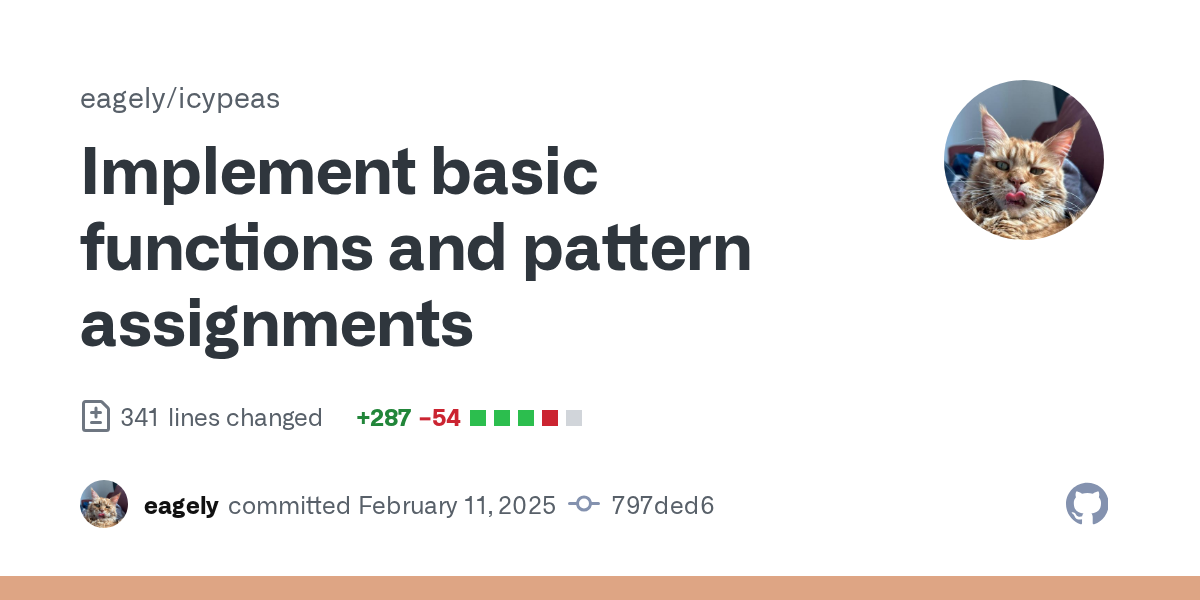
GitHub
- Add call to grammar
- Implement parse_call
- Implement function declarations without type checking
- Implement function pattern assignments with named parameters only
valid jetty
hoary sluice
can u configure it?
nope but i can make it configurable pretty easily i guess
that will probably come with a flag to turn off colors too i think
hoary sluice
valid jetty
nope but i can make it configurable pretty easily i guess
do u use env variables for config stuff rn
or some kind package fie
file
hoary sluice
lol
valid jetty
probably a good idea to move those away
hoary sluice
u should use :3 instead of * in commits
hoary sluice
:3 Add call to grammar
:3 Implement parse_call
:3 Implement function declarations without type checking
:3 Implement function pattern assignments with named parameters only
so true
hoary sluice
no but it makes :3
valid jetty
:3
hoary sluice
doesnt even look that bad tbh
valid jetty
so many
 hoary sluice
i probably shouldve taken a look at the haskell compiler before doing all of this
wouldve saved a lot of time
valid jetty
lmao
valid jetty
they work like regular functions theyre just not intended to be called by the developer
theres wrappers usually
valid jetty
lmao
hoary sluice
im prob gonna do a qbe impl once im done with the interpreter
 winged mantle
i wonder what a less deranged way of doing this would be

since all routing is client side i just have the page that loads the app as the 404 page
hoary sluice
using rust (it compiles to wasm and can be used on the frontend)
winged mantle
same issue if i use client-side routing
(it is an spa)
maybe i should figure out a way to do routing server side too
but also what would be a good way to have script have dynamic content
it just passes down some env vars from the server env vars
<!DOCTYPE html>
<html>
    <head>
        <meta charset="utf-8">
        <title>Dashboard</title>
        <meta name="viewport" content="width=device-width, initial-scale=1">
        <link rel="stylesheet" type="text/css" media="screen" href="app.css">
        <script>window.ENV={"REDIRECT_URI":"http://localhost:8080/api/v1/auth/login"}</script>
        <script src="app.js" defer></script>
    </head>
    <body id="app">
        <noscript>
            This website cannot be run in DOS mode
        </noscript>
    </body>
</html>
"-std" | "--std-path" => if let Some(arg) = args.next() {
    let leaked: &'static str = Box::leak(arg.into_boxed_str());
    unsafe { STD_LIB_PATH = leaked };
}
``` is there a better way to reassign to a static mut?????????i let qbe handle it
(for now)
hoary sluice
valid jetty
```rs
"-std" | "--std-path" => if let Some(arg) = args.next() {
let leaked: ...
i think u shouldnt use static mut at all
valid jetty
omg it all has to be in an unsafe block
royal nymph
valid jetty
```rs
"-std" | "--std-path" => if let Some(arg) = args.next() {
let leaked: ...
you should use Arc<Mutex>
valid jetty
if i use static mut
hoary sluice
royal nymph
you should use Arc<Mutex>
its single threaded
valid jetty
royal nymph
you should use Arc<Mutex>
but this isnt multi threaded
hoary sluice
use a Cell
valid jetty
yeah ok
royal nymph
there's no good way to have globals lol
fleet cedar
Statics have to be Sync, whether you use threads or not
winged mantle
i get annoyed by that
i love globals
pros: good excuse not to write tests
cons: makes it harder to write tests
hoary sluice
fleet cedar
Statics have to be Sync, whether you use threads or not
huh do they
royal nymph
I did this abomination
// :3
#[macro_export]
macro_rules! global {
    ($name:ident : $type:ty, $getter:ident) => {
        pub static mut $name: Option<$type> = None;
        #[inline]
        pub fn $getter() -> &'static $type {
            unsafe {
                $name
                    .as_ref()
                    .expect(concat!(stringify!($name), " must be set before use"))
            }
        }
    };
}

// declare
global! {
    SOME_VARIABLE: Type,
    get_some_variable
}

// get (only after set)
get_some_variable();

// set (oh god make sure this is thread safe or you will explode)
unsafe {
  SOME_VARIABLE = Some(42);
}
you cant use cell here actually because it doesnt implement Sync
fleet cedar
Use mutex
royal nymph
royal nymph
you should use Arc<Mutex>
^
even if you only have one thread, that's the only proper way without unsafe
fleet cedar
No need for arc, globals are inherently shared
fleet cedar
hoary sluice
but why does it need to be Sync
Because it's accessible from multiple threads
royal nymph
alternatively, lazy static
hoary sluice
yea i was told to use lazy static and not use actual statics
fleet cedar
lazy_static crate is largely deprecated these days, since LazyLock is in std
 deep mulch
@valid jetty hiiii
winged mantle
i feel like the same people who decided on the warnings in jetbrains ides worked on the rust compiler
⚠️ this variable might be infected with measles
hoary sluice
winged mantle
i feel like the same people who decided on the warnings in jetbrains ides worked...
love it when the zed lsp just says "mutable borrow occurs here" and zed doesnt have a go-to-definition type of thing to go to where the error actually is
hoary sluice
deep mulch
the tode who kodes
you would be great at kde
go contribute
you should be a project manager there
idk if they have those
hoary sluice
zoot created kmines
deep mulch
I like kde
valid jetty
ok well i did it @hoary sluice

you can now disable colors and set the runtime & std lib paths
fleet cedar
-noclr? Have you considered using sensible cli syntax
hoary sluice
valid jetty
you can now disable colors and set the runtime & std lib paths
elle is becoming more and more the child of c and rust
crust
rustc???
the rust compiler is actually elle
valid jetty
fleet cedar
`-noclr`? Have you considered using sensible cli syntax
no dont worry
i give 2 options

-noclr or --no-color-output
fleet cedar
-noclr is five flags, not one
fleet cedar
You should use standard cli conventions
valid jetty
hm yes let me ellec -tnfaskcibgs -o x.o -z -fabc
 gray heron
i need webdev help chat 😭
this is a test document so it's mildly horror but im trying to make the flashlight only appear within the search button
<!DOCTYPE html>
<html lang="en">
  <head>
    <meta charset="UTF-8" />
    <meta name="viewport" content="width=device-width, initial-scale=1.0" />
    <style>
      body {
        background-color: black;
      }
      .flashlight {
        position: fixed;
        top: 0;
        left: 0;
        width: 100vw;
        height: 100vh;
        pointer-events: none;
        background: radial-gradient(
          circle 70px at var(--x, 50%) var(--y, 50%),
          rgba(255, 255, 255, 1) 0%,
          rgba(255, 255, 255, 0) 60%
        );
      }
    </style>
  </head>
  <body>
    <div
      class="wrapper"
      style="
        position: fixed;
        margin: 0.5vh;
        margin-left: 1vw;
        top: 0;
        left: calc(50% + 40vw);
        width: 7vw;
        height: 3vh;
        border: 0;
        border-radius: 20px;
        outline: 0;
        overflow: hidden;
      "
    >
      <div class="flashlight" style="z-index: 9999"></div>
      <button
        id="searchButton"
        style="
          position: fixed;
          margin: 0.5vh;
          margin-left: 1vw;
          top: 0;
          left: calc(50% + 40vw);
          width: 7vw;
          height: 3vh;
          border: 0;
          border-radius: 20px;
          outline: 0;
          color: #ffffff;
          background-color: #25252a;
          font-size: 2vh;
        "
      >
        Search
      </button>
      <script>
        const flashlight = document.querySelector(".flashlight");

        document.addEventListener("mousemove", (e) => {
          flashlight.style.setProperty("--x", `${e.clientX}px`);
          flashlight.style.setProperty("--y", `${e.clientY}px`);
        });
      </script>
    </div>
  </body>
</html>
i caant do this dude im crying
royal nymph
valid jetty
you can now disable colors and set the runtime & std lib paths
that cli arg is awful https://no-color.org/
royal nymph
valid jetty
i like to keep it more than 1 character if possible
that's just not how cli flags work tho lol
single - = single letter flag (you can specify multiple and -thing actually is 5 flags t, h, i, n and g)
two -- = long flag
these would be equivalent
elle -thing
elle -t -h -i -n -g
normally you have one single letter flag and one long flag
so for example
elle --disable-color
elle -C
but just do this instead of a flag
valid jetty
royal nymph
these would be equivalent
```sh
elle -thing
elle -t -h -i -n -g
```
i know, however -thing is evil
whatever ill do that aswell
royal nymph
valid jetty
but i dont know anyone who knows about NO_COLOR=1 lmao
either document it or offer an alternative flag for it but NO_COLOR is a pretty well known standard at this point
valid jetty
because im gonna make color on by default im gonna make it as obvious as possible to disable it
so ill have --noclr, --no-ansi, and NO_COLOR=1
 haughty hinge
gray heron
this is a test document so it's mildly horror but im trying to make the flashlig...
haughty hinge
gray heron
this is a test document so it's mildly horror but im trying to make the flashlig...
Adjust your clip path to be constraned to the search container
<!DOCTYPE html>
<html lang="en">

<head>
  <meta charset="UTF-8" />
  <meta name="viewport" content="width=device-width, initial-scale=1.0" />
  <style>
    body {
      background-color: black;
    }

    .search-container {
      position: fixed;
      top: 0;
      left: calc(50% + 40vw);
      width: 7vw;
      height: 3vh;
      display: flex;
      align-items: center;
      justify-content: center;
    }

    .flashlight {
      position: absolute;
      width: 100%;
      height: 100%;
      pointer-events: none;
      background: radial-gradient(circle 50px at var(--x, 50%) var(--y, 50%),
          rgba(255, 255, 255, 1) 0%,
          rgba(255, 255, 255, 0) 60%);
      clip-path: inset(0 0 0 0);
    }

    #searchButton {
      width: 100%;
      height: 100%;
      border: 0;
      border-radius: 20px;
      outline: 0;
      color: #ffffff;
      background-color: #25252a;
      font-size: 2vh;
      position: relative;
      z-index: 1;
    }
  </style>
</head>

<body>
  <div class="search-container">
    <div class="flashlight"></div>
    <button id="searchButton">Search</button>
  </div>

  <script>
    const flashlight = document.querySelector(".flashlight");
    const searchContainer = document.querySelector(".search-container");

    searchContainer.addEventListener("mousemove", (e) => {
      const rect = searchContainer.getBoundingClientRect();
      const x = e.clientX - rect.left;
      const y = e.clientY - rect.top;
      flashlight.style.setProperty("--x", `${x}px`);
      flashlight.style.setProperty("--y", `${y}px`);
    });
  </script>
</body>

</html>
@gray heron
royal nymph

all these programs support NO_COLOR and explicitly document it
there are probably way more that support it but don't document it
for example tree


 valid jetty
@royal nymph lmao https://github.com/jcs/no_color/pull/301

GitHub
This PR adds the Elle programming language to this list.
did i take it too far
royal nymph
HORROR
valid jetty
:3
you love rust tho
if env::var("NO_COLOR").is_ok_and(|x| !x.is_empty()) {
    disable_colors!()
}
 civic oar
does anyone have an updated version of like rounded chat bubbles and like maybe for chanel names too
actually i found one for messages so just one for channels
viscid grove
valid jetty
royal nymph
HORROR
its so over it got accepted
 ornate quiver
valid jetty
<@343383572805058560> lmao https://github.com/jcs/no_color/pull/301
ornate quiver
valid jetty
<@343383572805058560> lmao https://github.com/jcs/no_color/pull/301
is that github highlighting
 frosty obsidian
nop
github uses linguist for syntax highlighting
and they have some requirements for new languages
valid jetty
ornate quiver
is that github highlighting
いや、そうならよかったw
 pale orchid
Oh! Pro gaming! Do any of y'all play Helldivers 2?
dense sand
hoary sluice
frosty obsidian
and they have some requirements for new languages
200 users (need all of vencord to make a project in it)
spark tiger
pale orchid
Oh! Pro gaming! Do any of y'all play Helldivers 2?
i do used to

GitHub
Check for existing issues Completed Describe the bug / provide steps to reproduce it The issue is related to LSPs not spinning up due to a message like this one: Language server error: astro-langua...
there were like 4 different PRs fixing this but none got merged
and i'm not even sure like whether it's an issue in zed or wasm or wasmtime or wasi or ???
this is reproduceable with just regular wasmtime but maybe it's intended? idrk
 hoary sluice
spark tiger
this is so <:husk:1026532993923293184>
https://github.com/zed-industries/zed/iss...
hoary sluice
spark tiger
this is so <:husk:1026532993923293184>
https://github.com/zed-industries/zed/iss...
they need to stop making windows support and focus on getting the linux version to work properly
spark tiger
hoary sluice
they need to stop making windows support and focus on getting the linux version ...
noo don't give them ideas
hoary sluice
the windows one is never gonna be stable if the og version keeps crashing
spark tiger
hoary sluice
the windows one is never gonna be stable if the og version keeps crashing
true but i'd rather fix issues that make it literally impossible to use the app (even on not fully supported platform yet!) rather than just some crashes that occasionally happen
hoary sluice
spark tiger
true but i'd rather fix issues that make it literally impossible to use the app ...
just dont use lsps like the creator of odin
smn
smh
spark tiger
hoary sluice
just dont use lsps like the creator of odin
fine but i want to use wakatime
hoary sluice
isnt that paid
spark tiger
hoary sluice
isnt that paid
i mean there's a subscription but all i need should be available in free version i think
 cerulean plover
TIL that document.adoptedStyleSheets exists from https://github.com/material-components/material-web
I looked at https://developer.mozilla.org/en-US/docs/Web/API/Document/adoptedStyleSheets and https://web.dev/articles/constructable-stylesheets
Has anyone ever found this API useful?
valid jetty
hoary sluice
just dont use lsps like the creator of odin
yea thats what i do
i use the rust lsp but i could live without it
hoary sluice
valid jetty
i use the rust lsp but i could live without it
i couldnt
most things i type i let the lsp autocomplete
i mostly type lowercase cause i made the bad decision of only getting 34 keys, not 36, so i have 2 less thumb keys and pressing shift requires holding down s or i, so id rather just type it in lowercase and let the lsp autocomplete
its become a habit and now i cant write kotlin anymore cause the intellij kotlin lsp is case sensitive
maybe i should switch tab and space cause tab has a dedicated key rn
valid jetty
hoary sluice
its become a habit and now i cant write kotlin anymore cause the intellij kotlin...
hmm i guess you’ll have to use python next aoc
hoary sluice
valid jetty
hmm i guess you’ll have to use python next aoc
im prob not gonna be able to do aoc at all next year