#🪅-progaming
1 messages · Page 23 of 1
 dense sand
 valid jetty
i learnt through trial and error lmao
dense sand
one time i wrote parser and it was regex based haha
valid jetty
the whole parser is somewhere in the 3500 range i think
dense sand
thats cool
i once wanted to implement inline xml into java(like jsx) xD, would prolly need a parser for that too
valid jetty
that actually sounds kinda fun
dense sand
the only problem with that is you need to actually determine where the xml is located
interrupting the build process and modifying the input files is no problem with gradle plugins
valid jetty
dense sand
the only problem with that is you need to actually determine where the xml is lo...
i wonder how jsx does that
because you can have xml anywhere
as an expression
 fleet cedar
Jsx doesn't edit the input files to substitute with non-jsx, it edits the parser to support jsx
Just add another form to the expr parser and you're all set
valid jetty
wait but i thought rollup edits the input files into React.createElement
fleet cedar
No, React.createElement goes in the output files
dense sand
couldve edited the antl4 parser rules to support it, but ive got no idea how to do so, and editing the compiler itself is too much work
fleet cedar
Yes, to support new syntactic forms you add them to the grammar
I thought that was kinda obvious
dense sand
it is, but as i said, im too lazy to understand how antl4 works
dense sand
well maybe sometime in future when im not too lazy
imagine having a frontend java framework
i mean jsp
or vaadin

 dawn ledge
valid jetty
(it's not)
dawn ledge
valid jetty
(it's not)
squished pip
 dusty moth
fleet cedar
Me too, never liked parser generators
dusty moth
fleet cedar
Me too, never liked parser generators
tree-sitter is written in js which is nice
GitHub
Tree-sitter grammar for Lit, a language that is designed to compile to Lua but be better - PoolloverNathan/tree-sitter-lit
dense sand
the ohfuck_expr
dawn ledge
lol
ohfuck_expr: $ => prec("throw", seq("ohfuck", field("message", $.string))), peak code
dusty moth
dense sand
the ohfuck_expr
basically an abort
someone asked for more serious panics
there's three severities:
erroris likebail!()panicis likepanic!()ohfuckiseprintln!()(with a stack) thenabort()
also any syntax errors are considered comments
valid jetty
ohfuck should be worse than panic
valid jetty
valid jetty
it's just in the movie ratio thing
THEY FLIPPED THE WHOLE PLOT IN 8 MINUTES
HOLY SHIT
dawn ledge
what bro
not its not
its c
the core is c
idk if they've completely moved to rust
dawn ledge

 frosty obsidian
 dawn ledge
the rust code is bindings
B I N D I N G S
rust so bloated the bindings are bigger than the c project
dense sand
insane indeed
 crimson sparrow
valid jetty
(it's not)
crimson sparrow
valid jetty
(it's not)
Any updates for running rust on iPadOS?
frosty obsidian
you can be whatever you want
 deep mulch
frosty obsidian
you can be whatever you want
deep mulch
frosty obsidian
you can be whatever you want
can I be you
frosty obsidian
no
fleet cedar
deep mulch
can I be you
Do you want to be him
 nimble bone
deep mulch
can I be you
nimble bone
deep mulch
can I be you
buy frog fursuit and you will be wing
dusty moth
valid jetty
ohfuck should be worse than panic
it is
the program immediately exits
panics are catchable
 thorny prism
arc is so bad on windows 😭
 strong smelt
Anyone know how to fix the role duper in third party, it’s giving me a few errors after running pnpm build
 autumn sigil
🤯

i dont remember if i posted before but i saw inlay hint "either type" and got confused
valid jetty
what the heck is this language
looks like someone ate rust cereal and go milk and puked it all out
oh wait
its gotta be zig
people always talk about how cursed the syntax is
 torn seal
i like the syntax
 still jolt
why use anything other than javascript
fleet cedar
Why use anything
still jolt
why even exist
 ionic lake
good question, sometimes I go on an existential crisis but then remember, life is all about bloons td 6
valid jetty
dawn ledge
cool lang nonetheless
consider https://c3-lang.org
C3 is a programming language that builds on the syntax and semantics of the C language, with the goal of evolving it while still retaining familiarity for C programmers.
fleet cedar
 still jolt

 autumn sigil
valid jetty
people always talk about how cursed the syntax is
autumn sigil
valid jetty
people always talk about how cursed the syntax is
syntax is actually very shrimple
nothing unexpected
dusty moth
valid jetty
people always talk about how cursed the syntax is
learn raku
you will never complain about other languages' syntax ever again
deep mulch
id use zig over rust
dense sand
C?
dawn ledge
never touching c
or c++ for that matter
those are horrid codebases
but ngl all the cool arcane software ive seen is in c(++)
deep mulch
C is nice
deep mulch
I like C for it's simplicity
dawn ledge
dawn ledge
like mkbold & mkitalic
https://hp.vector.co.jp/authors/VA013651/freeSoftware/mkbold-mkitalic.html the algorithm is so simple i fucking love it
The tool to make X BDF font bold and italic.
dense sand
deep mulch
I like C for it's simplicity
C is simple, the code you write is not
(it applies to everyone)
dense sand
just dont use heap allocation and youre good to go /s
dusty moth
dense sand
just dont use heap allocation and youre good to go /s
template<typename T, typename F, typename R>
R scopedAlloc(F callback) {
  T t;
  return callback(t);
}```i was talking about C, not C++
C++ is very questionable language
dusty moth
dense sand
i was talking about C, not C++
int scopedAlloc(int(*callback)(*int[], int), int size, int arg) {
  int mem[size];
  return callback(&mem, arg);
}```is there a more aesthetically-pleasing way to write this?
 valid jetty
let try printer = printer;
dusty moth
valid jetty
`let try printer = printer;`
that's a thing?
dusty moth
dawn ledge
whatever type err is
you impl Error from Type
and then use try operator
can't add a non-ambiguous From<> impl here
fleet cedar
dusty moth
is there a more aesthetically-pleasing way to write this?
Yeah that's just ? operator
Optionally with .map_err() inbetween
fleet cedar
let printer = printer.map_err(Error::NoReadline)?;
dusty moth
fleet cedar
`let printer = printer.map_err(Error::NoReadline)?;`
nice
valid jetty
dusty moth
is there a more aesthetically-pleasing way to write this?
what the heck is bail
fleet cedar
Probably anyhow's
dusty moth
valid jetty
what the heck is bail
macro named after anyhow::bail, as it serves a similar purpose
dusty moth
valid jetty
ok but what does it do
return Err($e.into())
valid jetty
dusty moth
`return Err($e.into())`
what’s the point
dusty moth
essentially throw
valid jetty
yeah but why
dusty moth
valid jetty
what’s the point
slightly less typing
fleet cedar
The correct implementation is Err::<!, _>(e)?
valid jetty
horror
dusty moth
fleet cedar
The correct implementation is `Err::<!, _>(e)?`
fixing
fleet cedar
Which works correctly with (nightly) try blocks
But due to using !, requires nightly itself
dusty moth
my rust flake uses nightly by default, conveniently
actually not just by default I haven't implemented changing the toolchain at all
valid jetty
does rust have contracts
valid jetty
fleet cedar
As in arbitrary boolean expressions validated at compile time?
compile/runtime constraints set by a function for its parameters
dusty moth
fleet cedar
As in arbitrary boolean expressions validated at compile time?
oh, compile-time asserts? yes
on parameters of all calls? not to my knowledge
fleet cedar
It does not allow type checking beyond what the type system allows, no
dusty moth
can't outtypecheck the typechecker
valid jetty
some syntax ive been dreaming up is like
fn foo(a: 3000 > i32, b: string.starts_with(“awa”), c: -1 < f32 <= 1) for contracts
that would be soooo cool
dusty moth
valid jetty
some syntax ive been dreaming up is like
`fn foo(a: 3000 > i32, b: string.starts...
that'd be neat
language I'm working on lets you have if types, but currently only the parser supports them
valid jetty
like
dusty moth
(e.g. int if self > 2)
dusty moth
the check will be done at runtime as of now
valid jetty
fn foo(a: if _ < 1 { i32 } else { f32 })
dusty moth
valid jetty
`fn foo(a: if _ < 1 { i32 } else { f32 })`
that's a different feature
fleet cedar
I'd prefer ```rs
fn foo(a: i32, b: &str, c: f32)
assert
3000 > a,
b.starts_with("awa"),
-1 < c,
c <= 1
i know but imagine if that was a thing
dusty moth
types are values, but a type cant refer to what it will eventually be
dusty moth
valid jetty
i know but imagine if that was a thing
how would that be possible
fleet cedar
Dependent types is a thing
dusty moth
oh those
fleet cedar
A very complicated thing that's never made it out of academia
valid jetty
dusty moth
how would that be possible
treat it as an arbitrary f64 to test the constraint and then convert it to the correct type afterwards
valid jetty
dusty moth
types are values, but a type cant refer to what it will eventually be
me when i need a compile time random number so i transmute an empty struct to get its type id
dusty moth
fleet cedar
Dependent types is a thing
you can't have ∀(a : {! something referring to a !}) -> …, can you?
dusty moth
you make me want to add this as a cursed feature to my language
valid jetty
i need to study type theory
valid jetty
dusty moth
you can't have `∀(a : {! something referring to a !}) -> …`, can you?
for all a there exists some a such that whatever the heck the rest of it is
dusty moth
valid jetty
for all a there exists some a such that whatever the heck the rest of it is
{! … !} is a hole
valid jetty
oh
dusty moth
∀(a :: b) -> dependently qualifies a as a b
valid jetty
recursive dependent types
dusty moth
valid jetty
recursive dependent types
horror
valid jetty
fibonacci sequence at the type level
dusty moth
valid jetty
fibonacci sequence at the type level
that should be possible using normal ghc type families
dusty moth
and peano numbers
valid jetty
i’ve done it before
dusty moth
valid jetty
that’s fucking possible in typescript
what isn't
deep mulch
having to use jquery in my web dev class @royal nymph you love
dusty moth
typescript has dependent types
valid jetty
dusty moth
what isn't
someone made a whole fucking typescript type checker in the type system
dusty moth
valid jetty
someone made a whole fucking typescript type checker in the type system
lmfao
type-level typescript compiler when
deep mulch
@valid jetty hii
dusty moth
now if we could only splice them in somehow
\(\(…)) is cursed syntax (from my language)
valid jetty
found it https://github.com/ronami/HypeScript
GitHub
🐬 A simplified implementation of TypeScript's type system written in TypeScript's type system - ronami/HypeScript
valid jetty
dusty moth
`\(\(…))` is cursed syntax (from my language)
where do you keep all of this i can’t find any of it on github
dusty moth
valid jetty
where do you keep all of this i can’t find any of it on github
nathan@nathanlaptopv:stuff/tree-sitter-lit but I can't push until next tuesday
 deep mulch
valid jetty
do you love my inline IR syntax
deep mulch
valid jetty
do you love my inline IR syntax
what am i looking at
dusty moth
valid jetty
do you love my inline IR syntax
does that splice raw llvm in?
valid jetty
dusty moth
does that splice raw llvm in?
it’s not llvm but essentially yes
it puts that text without any transformations directly into the IR file
dusty moth
i kinda have that
valid jetty
__MANUAL_RETURN__ tells the compiler not to include an automatic return at the end
dusty moth
\() splices strings into strings, and other types of things into program source
no real IR yet
dusty moth
valid jetty
are you planning to use llvm
both lua and llvm as targets
mainly lua
but llvm for testing scripts and standalone use
valid jetty
maybe consider wasm too
dusty moth
doesn't llvm do wasm?
fleet cedar
Did I mention that the code I'm currently working on has 85 levels of indentation at one point?
fleet cedar
I'm writing a decompiler, and it currently doesn't properly unnest elseifs
dusty moth
dusty moth
hmm what if I make targets user-defined
might just let you define a function that takes a typed ast and returns the program output
valid jetty
dusty moth
but how the fuck do you hit 85
if num == 0
do0()
else
if num == 1
do1()
else
…
dusty moth
fleet cedar
I'm writing a decompiler, and it currently doesn't properly unnest elseifs
…84 chained else ifs?
fleet cedar
I didn't write this shit y'know
valid jetty
dusty moth
…84 chained else ifs?
an else-if is technically an if statement inside of the else block
valid jetty
ok can y’all help me clear up something
structs are contiguous memory right
so
a struct with 4 chars
dusty moth
valid jetty
structs are contiguous memory right
usually
valid jetty
is 32 bits
dusty moth
valid jetty
a struct with 4 chars
what lang's chars
fleet cedar
If char is 8 bits, yes
valid jetty
dusty moth
what lang's chars
C
dusty moth
rust chars are u32
dusty moth
valid jetty
C
ah, then probably
valid jetty
nono C chars
dusty moth
c doesn't align chars right?
valid jetty
raylib allows you to directly pass a 32 bit integer to a function instead of a struct worth of 32 bits
how does that work
a struct is a pointer to the start of the memory
an integer is just an integer
fleet cedar
A struct is just the memory
dusty moth
structs usually are the data itself
fleet cedar
Unless your language boxes it behind the scenes
valid jetty
you can’t store a struct by value
fleet cedar
Why not
valid jetty
because you’re not allowed to i guess idk lol
dusty moth
ik in C it's common to stuff 32 bytes of state into int parameters
valid jetty
in llvm you allocate memory and put things at the offset you need
that’s still a pointer tho
raylib however allows you to pass both a Color struct and an integer into the ClearBackground function
dusty moth
probably just overlapping representations
fleet cedar
A {u8, u8, u8, u8} and a u32 have the same memory representation
valid jetty
in elle a struct is a pointer, and the function still works fine for both a Color struct (pointer to the start of that stack memory) and directly an integer
 clever lily
Is this left like this when making a plugin?
 valid jetty
fleet cedar
A {u8, u8, u8, u8} and a u32 have the same memory representation
valid jetty
fleet cedar
A {u8, u8, u8, u8} and a u32 have the same memory representation
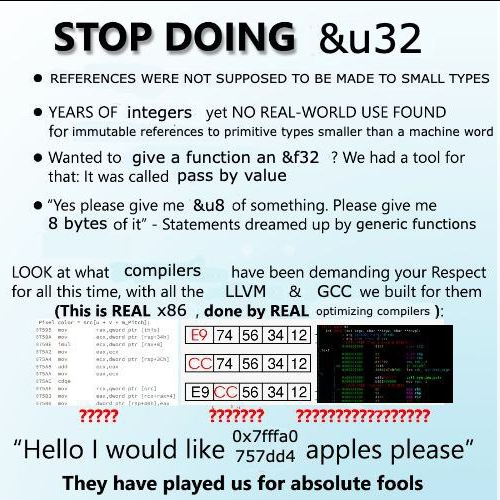
yes but in theory i should be passing the address to that integer
to make the same behavior
but i’m just passing an integer directly and it works
 valid jetty
no it’s kinda hard to explain what i mean
valid jetty
when any struct is created it’s usually just syntactic sugar
struct Foo { u8, u8, u8, u8 }
Foo { 255, 0, 0, 255 }
would do
%Foo = alloca 4 # in bytes
store 255 %Foo
store 0 %Foo + 1
store 0 %Foo + 2
store 255 %Foo + 3
you don’t really have a struct by value you have a reference to the start of that stack allocated memory
so how in the heck, when passing an integer directly into the ClearBackground struct, does it recognize it as the whole struct, it makes no sense to me
to access any fields it needs to calculate an offset, but an offset to what it was given just a number
how do you load 0xFF0000FF + 1 and get 0 (ideally it would be load %Foo + 1)
i believe that when optimizing C it does get turned into an integer directly instead of making the struct but my question is how structs by value then work
i hope that makes sense
this has always been a big cloud to me
dusty moth
what do the calls look like in ir?
valid jetty
it generates this
target triple = "arm64-apple-macosx13.0.0"

%struct.Color = type { i8, i8, i8, i8 }
@__const.main.color = private unnamed_addr constant %struct.Color { i8 -1, i8 0, i8 0, i8 -1 }, align 1

; Function Attrs: noinline nounwind optnone ssp uwtable
define i32 @main() #0 {
  %1 = alloca %struct.Color, align 1
  %2 = bitcast %struct.Color* %1 to i8*
  call void @llvm.memcpy.p0i8.p0i8.i64(i8* align 1 %2, i8* align 1 getelementptr inbounds (%struct.Color, %struct.Color* @__const.main.color, i32 0, i32 0), i64 4, i1 false)
  ret i32 0
}

; Function Attrs: argmemonly nofree nounwind willreturn
declare void @llvm.memcpy.p0i8.p0i8.i64(i8* noalias nocapture writeonly, i8* noalias nocapture readonly, i64, i1 immarg) #1
doing ```c
#include <stdio.h>
#include <raylib.h>
int main() {
Color color = { 255, 0, 0, 255 };
}
it actually makes it static memory but wait
if you make the struct big enough it no longer creates it like that
target triple = "arm64-apple-macosx13.0.0"

%struct.Foo = type { i32, i8, i64, %struct.Bar, %struct.Bar* }
%struct.Bar = type { i32, i64 }

; Function Attrs: noinline nounwind optnone ssp uwtable
define i32 @main() #0 {
  %1 = alloca %struct.Foo, align 8
  %2 = bitcast %struct.Foo* %1 to i8*
  call void @llvm.memset.p0i8.i64(i8* align 8 %2, i8 0, i64 40, i1 false)
  %3 = bitcast i8* %2 to %struct.Foo*
  %4 = getelementptr inbounds %struct.Foo, %struct.Foo* %3, i32 0, i32 0
  store i32 100, i32* %4, align 8
  %5 = getelementptr inbounds %struct.Foo, %struct.Foo* %3, i32 0, i32 1
  store i8 12, i8* %5, align 4
  %6 = getelementptr inbounds %struct.Foo, %struct.Foo* %3, i32 0, i32 2
  store i64 10000, i64* %6, align 8
  ret i32 0
}

; Function Attrs: argmemonly nofree nounwind willreturn writeonly
declare void @llvm.memset.p0i8.i64(i8* nocapture writeonly, i8, i64, i1 immarg) #1
``` it creates it how i was sayingwith this
typedef struct {
    int awa;
    unsigned long long bwa;
} Bar;

typedef struct {
    int a;
    char b;
    long long c;
    Bar bar;
    Bar *pBar;
} Foo;

int main() {
    Foo a = { 100, 12, 10000 };
}
ive literally written structs in my language that follow the C abi and theyre still a big black box to me
and every time i ask about it i get nowhere
and ai has not been any help it has absolutely no idea
and ive asked at school but my teachers dont know enough about compilers to understand what im doing
its so frustrating
autumn sigil
so how in the heck, when passing an integer directly into the ClearBackground struct, does it recognize it as the whole struct, it makes no sense to me
dont you know based on size whether its passed in register or stack?
valid jetty
i know that but how does the C function know
autumn sigil
well the function does too xd
c calling convention
or am i missing something?
if you both know the arguments, and you both target the same calling convention you both know when to pass arguments in what way
valid jetty
wait i think looking at the implementation might help maybe
nvm

its passed through a register right but the function is still calculating an offset into that struct which in this case it shouldnt be able to do because it has an integer directly through a register
unless in this case color.b !== *(color + 2) and instead color.b === (color >> 8) & 0xFF in which case how is that dictinction made
autumn sigil
in which case how is that dictinction made
depends on your abi :p
i think this one explains it fairly well i guess? https://gitlab.com/x86-psABIs/x86-64-ABI/-/jobs/artifacts/master/raw/x86-64-ABI/abi.pdf?job=build
but like i said, this is one of the possible abis
autumn sigil
autumn sigil
i think this one explains it fairly well i guess? https://gitlab.com/x86-psABIs/...
under uhhh 3.2.3 parameter passing
autumn sigil
autumn sigil
c calling convention
my bad for being silly earlier :p been a while since i did this stuff, had to look up a bunch
theres also the 5k pages i386 intel manual, maybe youll find something useful in there, i couldnt
this page has lots more abis https://wiki.osdev.org/System_V_ABI
 ornate quiver
valid jetty
its passed through a register right but the function is still calculating an off...
ornate quiver
valid jetty
its passed through a register right but the function is still calculating an off...
afaik parameters passed through registers are an optimization (or when explicitly marked with the register keyword), usually it's on the stack?
autumn sigil
zig has some really cool ideas man https://github.com/ziglang/zig/issues/16313

GitHub
Note: This is a formalized proposal based on discussion here: #5909 (comment) Proposal started with the addition of @ResultType, like pub inline fn intCast(x: anytype) @ResultType. It has been revi...
dude what the fuck did i just overhear from the cpp talk im listening to
its like background noise and hes like "they have ways of grooming the state of your program" 😭
autumn sigil
autumn sigil
zig has some really cool ideas man https://github.com/ziglang/zig/issues/16313
result location semantics are a bit complicated but really cool actually
dense sand
Any goog C hashtag developers here, maybe could someone give me some hints on how to make my code quality improve a bit? (please dont suggest to change language)
ornate quiver
repo link
valid jetty
ornate quiver
afaik parameters passed through registers are an optimization (or when explicitl...
it is an optimization yeah but my question is rather how the function's shape doesnt change
when its passed through the register you still .r .g .b .a on the struct just fine
thats what im confused about
thats what ill read about later i guess
valid jetty
dense sand
Any goog C hashtag developers here, maybe could someone give me some hints on ho...
ive written my fair share of c# code in the past maybe i can help a little bit idk oop
autumn sigil
dawn ledge
<@579731384868798464> i am using zig
blobcatcozy
dense sand
ornate quiver
repo link
dont laughg please https://github.com/KoblizekXD/NetRemapper/tree/master/NetRemapper-API
dusty moth
new color scheme just dropped

 royal nymph
dense sand
dont laughg please <https://github.com/KoblizekXD/NetRemapper/tree/master/NetRem...
royal nymph
dense sand
dont laughg please <https://github.com/KoblizekXD/NetRemapper/tree/master/NetRem...
one big thing I notice are complex nested if / else blocks
you should avoid that
restructure your code to have less of that
dense sand
great, yeah thats also one thing i kinda thought would be eye-striking
royal nymph
bad:
foreach (...) {
    if (foo) {
        //....
   } else {
        if (bar)....
   }
}
better:
foreach (...) {
    if (foo) {
       // ....
       continue;
   }

    if (bar)...
Nothing wrong with elseifs, just format them as such
Though continue is also nice, shows that there's nothing hiding below the last else
royal nymph
no because in the else block there's more if else
royal nymph
royal nymph
bad:
```cs
foreach (...) {
if (foo) {
//....
} else {
if ...
well it's somewhat subjective, but generally avoiding deep nesting is good
fleet cedar
If its ```cs
foreach (...) {
if (foo) {
//....
} else {
if (bar)....
if (baz)....
}
}
 pearl stagBOT
royal nymph
https://github.com/KoblizekXD/NetRemapper/blob/master/NetRemapper-API/MappingsRe...
pearl stagBOT
royal nymph
https://github.com/KoblizekXD/NetRemapper/blob/master/NetRemapper-API/MappingsRe...
MappingsReader.cs: Lines 35-78
for (int i = 0; i < lines.Length; i++)
{
    string line = lines[i];

    if (i == 0)
    {
        string[] splitted = line.Split("\t", StringSplitOptions.RemoveEmptyEntries);
        if (splitted[0] == "netmap")
        {
            mappings = new(Enum.Parse<MappingsFormat>(splitted[1]));
        }
        else
        {
            throw new IOException("Invalid mappings file format.");
        }
    } else if (i == 1)
    {
        if (mappings == null) throw new Exception("Invalid mappings file format(header not initialized).");
        mappings.Namespaces = [.. line.Split("\t", StringSplitOptions.RemoveEmptyEntries)];
    } else
    {
        if (mappings == null) throw new Exception("Invalid mappings file format(header not initialized).");

        string[] splitted = line.Split("\t", StringSplitOptions.RemoveEmptyEntries);
        if (splitted.Length == 0) continue;

        if (splitted[0] == "c")
        {
            if (currentTypeDefinition != null)
            {
                mappings.TypeDefinitions.Add(currentTypeDefinition);
            }
            currentTypeDefinition = new([.. mappings.Namespaces], splitted.Skip(1).ToArray());
        } else if (splitted[0] == "f")
        {
            currentTypeDefinition?.FieldDefinitions.Add(new([.. mappings.Namespaces], splitted.Skip(1).ToArray()));
        } else if (splitted[0] == "m")
        {
            currentTypeDefinition?.MethodDefinitions.Add(new([.. mappings.Namespaces], splitted.Skip(1).ToArray()));
        }
        else continue;
    }

}
this is what I was talking about
dawn ledge
if-ception
 royal nymph
bad
string[] splitted = line.Split("\t", StringSplitOptions.RemoveEmptyEntries);
if (splitted[0] == "netmap")
{
    mappings = new(Enum.Parse<MappingsFormat>(splitted[1]));
}
else
{
    throw new IOException("Invalid mappings file format.");
}
good
string[] splitted = line.Split("\t", StringSplitOptions.RemoveEmptyEntries);
if (splitted[0] != "netmap") throw new IOException("Invalid mappings file format.");

mappings = new(Enum.Parse<MappingsFormat>(splitted[1]));
this should just be a switch
 dense sand
maybe should've setupped sonarqube in my ci >:(
imma fix those once im on windows, im on linux rn
dawn ledge
do it on linux smh
 dense sand
i used c# primarily for windows only dev
pearl stagBOT
royal nymph
https://github.com/KoblizekXD/NetRemapper/blob/master/NetRemapper-API/NetRemappe...
NetRemapper.cs: Lines 117-143
if (instruction.Operand is MemberReference member)
{
    if (Mappings.GetType(member.DeclaringType.Name, DefaultNamespace) is TypeDefinitionEntry typeDefinition)
    {
        WriteIfVerbose($"Remapping reference to {member.Name}'s type {member.DeclaringType.Name} -> {typeDefinition[TargetNamespace]}");
        member.DeclaringType = new(member.DeclaringType.Namespace, typeDefinition.Names[TargetNamespace], member.DeclaringType.Module, member.DeclaringType.Scope);
        // member.DeclaringType.Name = typeDefinition.Names[TargetNamespace];
    }
}

if (instruction.Operand is MethodReference mRef)
{
    if (Mappings.GetMethod(mRef.Name, DefaultNamespace, mRef.Name, TargetNamespace) is MethodDefinitionEntry e)
    {
        WriteIfVerbose($"Remapping method reference {mRef.Name} -> {e[TargetNamespace]}");
        mRef.Name = e.Names[TargetNamespace];
        processor.Replace(instruction, processor.Create(instruction.OpCode, mRef));
    }
} else if (instruction.Operand is FieldReference fRef)
{
    if (Mappings.GetField(fRef.Name, DefaultNamespace, fRef.Name, TargetNamespace) is FieldDefinitionEntry e)
    {
        WriteIfVerbose($"Remapping field reference {fRef.Name} -> {e[TargetNamespace]}");
        fRef.Name = e.Names[TargetNamespace];
        processor.Replace(instruction, processor.Create(instruction.OpCode, fRef));
    }
}
you can use a witch for this
fleet cedar
Witches are very good at csharp, what with those cauldrons and brooms of theirs
royal nymph
switch (instruction.Operand)
{
  case MemberReference member:
  case MethodReference method:
  case FieldReference field:
}
java doesnt have this at all i think
c# has it since C# 7
thanks to pattern matching
royal nymph
fleet cedar
I think java has `if(x instanceof MethodReference member)`
it doesn't have the member
lol
dense sand
royal nymph
it doesn't have the `member`
it does
it's in jdk 17 too
which means its been out for long time
royal nymph
if (x instanceof MethodReference) {
  ((MethodReference) x).doStuff();
}
oh really?
fleet cedar
royal nymph
i only did android dev where we use ancient java
 spring pilot
dense sand
is this another thing that java doesnt have yet 😭
spring pilot
dense sand
is this another thing that java doesnt have yet 😭
Java has the switch case statement since Java 8's release
fleet cedar
// As of Java 21
static String formatterPatternSwitch(Object obj) {
    return switch (obj) {
        case Integer i -> String.format("int %d", i);
        case Long l    -> String.format("long %d", l);
        case Double d  -> String.format("double %f", d);
        case String s  -> String.format("String %s", s);
        default        -> obj.toString();
    };
}
we don't get the luxury of new java 
royal nymph
fleet cedar
```java
// As of Java 21
static String formatterPatternSwitch(Object obj) {
...
ayo
new java lowkey good
gonna hop on
dense sand
yea
dense sand
i mean i always look at how they implemented string interpolation and then removed it 2 versions later and laugh
 dense sand
royal nymph
cause android
dense sand
royal nymph
cause android
the new FFI is really nice
fleet cedar
I never really did much beyond java 8
pearl stagBOT
royal nymph
https://github.com/Aliucord/Aliucord/blob/main/build.gradle.kts#L46
build.gradle.kts: Line 46
sourceCompatibility = JavaVersion.VERSION_11
this is the java 11 way 😭
it doesn't even automatically infer the type
u gotta manually cast
dense sand
oh wow 😭
 cerulean plover
fleet cedar
```java
// As of Java 21
static String formatterPatternSwitch(Object obj) {
...
cerulean plover
fleet cedar
```java
// As of Java 21
static String formatterPatternSwitch(Object obj) {
...
this feels illegal
dense sand
i remember writing java 8 when i was writing minecraft clients when i was on elementary school
horrible way to learn coding btw
dont do that
cerulean plover
dense sand
i remember writing java 8 when i was writing minecraft clients when i was on ele...
i miss 2020
fleet cedar
Most of my java 8 was also minecraft shit, until I switched to kotlin
cerulean plover
cerulean plover
dense sand
*dont use mcp please*
so true
dense sand
you can literally do it with FG and have it completely with gradle
cerulean plover
idk if I ever properly decompiled with mcp back in the day
dense sand
cerulean plover
idk if I ever properly decompiled with mcp back in the day
it was always such a big mess to do, sometimes it gave you weird errors and shit
not even mentioning it was meant for eclipse
cerulean plover
dense sand
not even mentioning it was meant for eclipse
yop
nowadays you are expected to maintain mods for 2 modloaders on every version released in the past 2 years
dense sand
so setupping the idea workspace was such a pain
royal nymph
dense sand
horrible way to learn coding btw
i learnt (properly) coding with Discord mods
Aliucord and Vencord
fleet cedar
In my later era of mc modding I just homebrewed my whole own tech stack
royal nymph
with Aliucord i learnt Java, Kotlin and a bit of C++
dense sand
royal nymph
i learnt (properly) coding with Discord mods
i was ultimate minecraft client skidder
 dense sand
nowadays hopping languages is pretty easy
cerulean plover
fleet cedar
In my later era of mc modding I just homebrewed my whole own tech stack
I wish I could quickly pull up the reflection + annotation based forge registration system class
royal nymph
dense sand
nowadays hopping languages is pretty easy
yeah once you're good at one language it's pretty straight forward to learn more
I can pick up most new languages decently well within a few days, just need to look up a bunch of stuff
dense sand
i wonder what i was smoking here
 royal nymph
java streams 😭
dense sand
royal nymph
java streams 😭
best java 8 feature though
royal nymph
java designers be like "how can i make this feature be as awful as possible"
dense sand
royal nymph
java designers be like "how can i make this feature be as awful as possible"
okay go write list sql with linq lol
😭
 cerulean plover
dense sand
i wonder what i was smoking here
cerulean plover
dense sand
i wonder what i was smoking here
wtf is this icon loader shit
fleet cedar
dense sand
i wonder what i was smoking here
Love the ligatures
royal nymph
var scoreQuery = scores.Where(score => score > 80);
we were making a modloader
it was such a fun ngl
but then realized we didnt have working reobfuscation + diffing
so we dropped the project
cerulean plover
fleet cedar
Love the ligatures
NO
dense sand
couldve just used FG
cerulean plover
so cursed
fleet cedar
I made a custom format for bytecode patches
mc/client/renderer/chunk/ChunkRenderDispatcher$RenderChunk$RebuildTask.doTask(Lmc/client/renderer/ChunkBufferBuilderPack;)Ljava/util/concurrent/CompletableFuture;
    +ALOAD 0
    +GETFIELD mc/client/renderer/chunk/ChunkRenderDispatcher$RenderChunk$RebuildTask.region : Lmc/client/renderer/chunk/RenderChunkRegion;
    +IFNULL @L0
    +  GETSTATIC kawaru/zu/Minimap.INSTANCE : Lkawaru/zu/Minimap;
    +  ALOAD 0
    +  GETFIELD mc/client/renderer/chunk/ChunkRenderDispatcher$RenderChunk$RebuildTask.region : Lmc/client/renderer/chunk/RenderChunkRegion;
    +  GETFIELD mc/client/renderer/chunk/RenderChunkRegion.chunks : [[Lmc/world/level/chunk/LevelChunk;
    +  INVOKEVIRTUAL kawaru/zu/Minimap.invalidate([[Lmc/world/level/chunk/LevelChunk;)V
    +@L0
    NEW mc/client/renderer/chunk/ChunkRenderDispatcher$CompiledChunk
I never did reobfuscation eitther
 dense sand
fleet cedar
```diff
mc/client/renderer/chunk/ChunkRenderDispatcher$RenderChunk$RebuildTask....
dense sand
fleet cedar
```diff
mc/client/renderer/chunk/ChunkRenderDispatcher$RenderChunk$RebuildTask....
i didnt understand any shit from this, i think i was using binpatch for binary patching or smth like that
or wait
bsdiff
it was i think
now i need to write stupid nextjs undeployable applications because greedy corporate wants my money
dense sand
has anyone here ever worked with supabase? i want to implement auth & some simple tables in my database, and looking for new stuff to try out
 fallen nebula
royal nymph
java designers be like "how can i make this feature be as awful as possible"
fallen nebula
royal nymph
java designers be like "how can i make this feature be as awful as possible"
wdym streams are awesome
fallen nebula
like fr streams are amazing
https://onlinegdb.com/1FyBWLo0I
the perf is not perfect, but it's fine
GDB online Debugger
Online GDB is online ide with compiler and debugger for C/C++. Code, Compiler, Run, Debug Share code nippets.
dense sand
yeah i think its implemented well
i like streams
im not sure how java would've iimplemented it differently
fallen nebula
they also make parallelism quite easy if your thing is built with it in mind
fallen nebula
as in stream parallelism
fallen nebula
welp you can see an example in the thing i shared
i should probably add smth to time the code
but you can set smth like 0 1000000 as launch args and see how it perform
printing to console is slower than processing everything even if you add other rules than fizz and buzz
thorny prism
do u guys think asp.net core with blazor is good to make pages?
(already kinda experienced in c#)
ornate quiver
dense sand
dont laughg please <https://github.com/KoblizekXD/NetRemapper/tree/master/NetRem...
also better formatting
instead of
return GetType(type, typeNs)?.FieldDefinitions.FirstOrDefault(field => field.Names[ns] == name);
return GetType(type, typeNs)
?.FieldDefinitions
.FirstOrDefault(field => field.Names[ns] == name);
long lines are harder to read
but the main issue is too much nesting I agree
Id split up some of those long functions as well
valid jetty
do it like rust where its max 79 characters horizontally before it splits it onto multiple lines
dense sand
okay
fleet cedar
Rust defaults to 100 though
valid jetty
i swear i read somewhere that rustfmt is 79 characters wide
i remember it because i was like "why not 80"
fleet cedar
https://rust-lang.github.io/rustfmt/?version=v1.6.0&search=#max_width says default is 100
valid jetty
hm i see
autumn sigil
avg systems programmer with monitor that can only display 80 characters wide
fleet cedar
I think most programming happens on non-toy hardware
ornate quiver
i do like either 100 or 120 chars sometimes
sometimes splitting lines makes it less readable
royal nymph
dense sand
Raskell
spring pilot
Ruskell
 winged mantle
dense sand
i wonder what i was smoking here
winged mantle
dense sand
i wonder what i was smoking here
please close the zip file
try (ZipFile zip = new ZipFile(modFile)) {
}
winged mantle
dense sand
but then realized we didnt have working reobfuscation + diffing
just use mixin
dense sand
winged mantle
please close the zip file
Its a 2 year old code bruh
winged mantle
do you never continue a project you abandoned for 2 years
dense sand
No wtf
dense sand
winged mantle
try (ZipFile zip = new ZipFile(modFile)) {
}
Is this even a thing in java 8
Also i think i closed the zip file inside the Utils.findin method
winged mantle
dense sand
Is this even a thing in java 8
yes
winged mantle
dense sand
Also i think i closed the zip file inside the Utils.findin method
but you create the zipfile twice
dense sand
dawn ledge
@calm ruin you
 calm ruin
dawn ledge
<@287555395151593473> you
calm ruin
dawn ledge
<@287555395151593473> you
Yes me
cerulean plover
dense sand
https://cdn.discordapp.com/attachments/272761734820003841/927372460909805629/vid...
finally i have a copy of this in my folder of funny
 dense sand
Suppose i would like to revisit making my mod loader again, which stuff should i choose? I should probably go with fabric(and mixins approach instead of decompiling), but which version?
Im not sure if its worth trying to do something like this on new version as they are pretty maintened
 past ice
sorry if this question doesnt belong here (or if its too generic) but generally speaking how does vencord work? how does it hook into discord's components and stuff? im trying to write something similar for another react app, which also uses webpack so i assume it'd be similar
fleet cedar
It uses some dark magic to hook into the webpack internals - I think Nucky is the expert at that part - and then regex replaces modules when loading them
past ice
that's insane and i'd love to learn more somehow
looking at the official vencord repo i can't realllyyyy find what's actually doing the dark magic lol
it might also be worth noting i have full source maps for this react app if it helps at all
deep mulch
has anyone here used emscripten
i got a crazy idea to make https://github.com/nillerusr/source-engine work in the browser
GitHub
Modified source engine (2017) developed by valve and leaked in 2020. Not for commercial purporses - nillerusr/source-engine
 serene elk
past ice
sorry if this question doesnt belong here (or if its too generic) but generally ...
serene elk
past ice
sorry if this question doesnt belong here (or if its too generic) but generally ...
it's poorly documented tho
or if you want a completely different approach
royal nymph
past ice
looking at the official vencord repo i can't realllyyyy find what's actually doi...
it's not really that complicated
first you need to understand that the webpack runtime is just a replica of node.js' common js module system
deep mulch
@royal nymph hi
royal nymph
every source file gets its own ID (essentially filename), say 123456
then it transpiles something like
import { doThing } from "./somewhere";

export function stuff() {
  doThing(42);
}
to
123456: function (module, exports, require) {
  "use strict";
  require.defineExports(exports, {
    stuff: function() {
      return stuff;
    }
  })
  var somewhere = require(98765);

  function stuff() {
    (0, somewhere.doThing)(42);
  }
}
then when the code gets minified, it looks something like this

where e, t, n are module, exports, require, n.d is require.defineExports (it uses functions which get turned into getters so that if the variable changes, the export also updates)
and n(12345) means require(12345)
dusty moth
royal nymph
where `e, t, n` are `module, exports, require`, `n.d` is `require.defineExports`...
why doesn't it just use e.g. get stuff()
and store constants constant
actually hmm can you reassign exported functions
serene elk
get stuff turns into the same as object.defineProperty(a, "b", {
get() {}
})
which is what webpack does
royal nymph
royal nymph
then when the code gets minified, it looks something like this
now this is the module definition
you can access the module definition via webpackRequire.m[12345]. and you can require it via webpackRequire(12345)
upon calling webpackRequire, webpack looks up the module definition and initialises the module for you and retrieves the exports
then the exports get cached in webpackRequire.c[12345] and reused the next time you import the module, so it is only loaded once
dusty moth
serene elk
get stuff turns into the same as object.defineProperty(a, "b", {
get() {}
})
ah, it's downcompiled
royal nymph
what vencord does in essence is monkeypatch webpackRequire.m
every time a new module definition gets added, we patch that
serene elk
dusty moth
ah, it's downcompiled
more like webpack is built internally to use that approach instead of generating code with get stuff() {}
dusty moth
royal nymph
every time a new module definition gets added, we patch that
ah, and patches are effectively a .replace() on the module definition source?
deep mulch
guh how does this even choose gcc
royal nymph
yes
deep mulch
i cant find any references to gcc exectuable
royal nymph
webpack organises modules into chunks. a chunk is one javascript file that contains 1 or more modules that register themselves with webpack when the file is executed
a chunk looks like something this:
(this.webpackChunkdiscord_app = this.webpackChunkdiscord_app || []).push([["26182"], {
  12345: function(module, exports, require) {
  },
  98765: function(module, exports, require) {
  }
}]);
this chunk contains modules 12345 and 98765 and pushes them to webpackChunkdiscord_app
this webpackChunkdiscord_app is a global array with a custom webpack push function which adds the modules and stuff
the way vencord works is that we monkey patch webpackChunkdiscord_app.push with our own function
extremely dumbed down, this patch looks something like this:
const originalPush = webpackChunkdiscord_app.push;

webpackChunkdiscord_app.push = function (unused, chunks, alsoUnused) {
  for (const moduleId in chunks) {
    const original = chunks[moduleId];

    let source = original.toString();
    patches.forEach(p => source = source.replace(p.match, p.replace));

    chunks[moduleId] = eval(source);
  }

  return originalPush.call(unused, chunks, alsoUnused);
}
but then how do you know what chunk does what?
royal nymph
how do you mean that exactly?
dusty moth
past ice
but then how do you know what chunk does what?
there's e.g. Vencord.Webpack.findByProps to return a module with a certain export
past ice
royal nymph
how do you mean that exactly?
like for example, vencord exposes many apis via the Vencord object (?), but how do you know what they all do?
not the ones in the vencord object themselves, but looking at all of the webpack chunks, how do you know what to patch?
royal nymph
by reverse engineering
past ice
oh wait i remembered i have a full source map of this site
fleet cedar
It finds whichever module contains some specific substrings
royal nymph
royal nymph
by reverse engineering
you use tools like keyword search, react devtools, etc, to find the code you want to use or patch
dawn ledge
serene elk
https://github.com/Vendicated/Vencord/blob/main/src/webpack/patchWebpack.ts
look what you did nullptr
you summoned nuckys
the webpack obsessed user
royal nymph
that used to be me but nuckyz stole my job
fleet cedar
Your job is closing prs
ionic lake
deep mulch
i got a crazy idea to make https://github.com/nillerusr/source-engine work in th...
someone already has remade hl1 in the browser, search xash3d
deep mulch
ionic lake
someone already has remade hl1 in the browser, search xash3d
that's hl1 I mean hl2
past ice
royal nymph
then when the code gets minified, it looks something like this
okok so i did my due dilligence, looked into how webpack works and got it all working and hooking into the app!! however, i've gotten to a point where i want to show a toast using their components. using the source map i've determined they do it like this:
import { ToastType } from "../consts";
import { showToast } from "../toast";
import ToastLayout from "../ToastLayout";

function SpeechRecognitionNotSupportedToast() {
  return (
    <ToastLayout type={ToastType.warning}>
      {{
        title: "Sorry!",
        description: "This feature is not supported on your device."
      }}
    </ToastLayout>
  );
}

export const showSpeechRecognitionNotSupportedToast = () =>
  showToast(SpeechRecognitionNotSupportedToast, {
    toastId: "speechRecognitionNotSupportedToast"
  });```

i already have jsx bundling and react working properly in my userscript. my question is - how can i import that ToastType and showToast from my code? i can determine where they live in the webpack chunks but that's about it - i have no clue how to use themIf the module is known (and known to be sufficiently stable), just wreq() it
If it's not, vencord has a bunch of tricks for finding modules by searching their text
past ice
oh nono this isn't a vencord plugin
this is a seperate site which happens to use webpack which im trying to mess with, which is why im asking here
oh right i misread
fleet cedar
Did you know you can copypaste code from open source projects
past ice
yeah my bad 😭
fleet cedar
(Assuming a permissive license)
past ice
earlier, a webpack require function was mentioned - is this something i need to write myself?
fleet cedar
It's kinda the function the whole webpack system is built around
past ice
i mean i know modules take a require function, but i mean do i need to write the method which "imports" the modules from the webpack chunk array
like uhh hold on
i know that n.d defines exports, but i dont know how to access those. i need d, exported as C (which is the component)
 fleet cedar
d is available as require(783415).C, if you can get your hands on require
past ice
but then how do i get require? do i just need to intercept any push and then make that function globally available
or is there some more elegant way
fleet cedar
I'm not 100% sure what is the modern solution to that
But in ages past, it was common to push a fake module designated as an init, meaning it's loaded right away, and then you store the passed require function somewhere accessible
past ice
oh i think i know how to do that? hold on
        window.webpackChunks.push([
            [""],
            {},
            (require) => {
                // ...make require available globally
            },
]);```I don't remember the exact details, but if that works, it works
past ice
i used that earlier (i think?) and i ran into an issue i cant remember so bear with me for a sec
oh nvm it does work now

actually i do have one more question
@fleet cedar is there a reliable way to wait for all webpack modules to load?
or are they loaded on the fly
fleet cedar
Depends on the webpack setup
The easiest way is to monkeypatch some suitable module so that it calls into your code when run
Requires finding such a suitable module in the first place, though
 spark tiger
rust enjoyers, what are some good rust crates for creating a parser for a propitiatory binary file format?
- can’t use bitter because the file has both little- and big-endian values
- nom seems too complicated
- others are uhhhh
or should i just go make all that binary reading stuff by myself
rather than using a lib
fleet cedar
Do you need bit-level stuff or only byte-level?
spark tiger
fleet cedar
Do you need bit-level stuff or only byte-level?
uhhh byte-level ig, tho I’m unsure what bit-level would be
ornate quiver
spark tiger
rust enjoyers, what are some good rust crates for creating a parser for a propit...
scroll?
i know somoene who wrote an arsc/axml parser+writer with scroll
seems pretty good
fleet cedar
I find that gospel suits all my needs, but that's because I made it
spark tiger
ornate quiver
`scroll`?
o thanks that looks good
tho tbh it seems like it’d be easier to just create the helper methods by myself lol
let’s just hope the performance won’t suck ass
also I wish it was possible to do stuff like that in rust:
// pseudocode
struct File {
    name_len: i32,
    name: String[name_len],
}

struct Folder{
    name_len: i32,
    name: String[name_len],
    files_count: i32,
    files: [File, files_count],
    subfolders_count: i32,
    subfolders: [Folder, subfolders_count]
}```cuz ts would make parsing much easier
but I get that’s not how structs work
tho maybe i can do something like that via rust macros
i heard u can do some cool shit with them
fleet cedar
That wouldn't make sense in reality though, what if you change name_len
But yeah it would be totally possible to make some parsing library that does something like ```rs
struct File {
#[blah(len = .read_i32())]
name: String
}
uhhhh what if just make the struct immutable or like recreate it on every change
fleet cedar
Rust does not have a concept of immutable structs
Something like this neither can nor should be part of the type system
But it would be totally legit to have it as part of a macro
Something like rs #[binstruct] struct Folder{ #[binstruct(meta)] name_len: i32, #[binstruct(len = name_len)] name: String, #[binstruct(meta)] files_count: i32, #[binstruct(len = files_count)] files: Vec<File>, #[binstruct(meta)] subfolders_count: i32, #[binstruct(len = subfolders_count)] subfolders: Vec<Folder> } which would produce something like ```rs
struct Folder {
name: String,
files: Vec<File>,
subfolders: Vec<Folder>
}
impl Folder {
fn read(...) -> Result<Folder> { ... }
fn write(&self, ...) -> Result<()> { ... }
Though imo it's faster and more flexible to just write the read and write functions directly, rather than messing around with extra abstractions
spark tiger
hm what if the macro returned a struct with pointers to the needed values of different types
fleet cedar
What do you mean
spark tiger
fleet cedar
Though imo it's faster and more flexible to just write the read and write functi...
fair but writing and reading the code would be easier ig
spark tiger
fleet cedar
What do you mean
uhhh ima try to explain what i mean once my class is over
fleet cedar
If the file data is a plain sequence of values, writing it as a struct with fancy macros might be nice
In my experience, that's an uncommon enough occurrence that it's not worth optimizing for
spark tiger
fleet cedar
What do you mean
nvm after thinking about it more than one minute I realized it doesn’t make sense
- the pointer should point to the actual data meaning I’d have to keep in memory the whole file + extra 8 bytes (if my understanding of pointer64 meaning it consists of 8 bytes) for each uhh field
fleet cedar
Oh, you mean pointers for each u8? Yeah don't do that
spark tiger
spark tiger
also I wish it was possible to do stuff like that in rust:
```rs
// pseudocode
s...
hm what if I made a custom file format and a parser for it that would allow typing stuff like that
okay no that won’t work either ig as i’ll have to access these fields somehow but i can’t create a struct like that in rust
guhhhh
dawn ledge
spark tiger
rust enjoyers, what are some good rust crates for creating a parser for a propit...
nom
nom is great
i've used it before
you can do byte level, it has good helpers too
spark tiger
dawn ledge
nom is great
I tried to understand how to work with it, opened the examples and it looked so complicated icl
also I’m not sure which of those I need to use to get the bytes: BufReader or Cursor or File or something else
dawn ledge
its really simple
you have a function with takes some input -> you call some nom helper, it you give you a result of the parsed data and the remaining input -> you modify the parsed data as you like, you return the remainiing input and your data
you can use either of those 3
they all implement io::Read
if you want peak performance you can look at how dbs handle files, they do insane optimization for speed and how files are actually read
spark tiger
 it was so easy in python
 unpack("<h", file.read(4))
spark tiger
dawn ledge
if you want peak performance you can look at how dbs handle files, they do insan...
you mean db readers made in rust?
spark tiger
dawn ledge
you can do that in rust too
with out any dependencies

on rust forum I’ve only found the methods that are much more complicated
dawn ledge
io::Read use an array of 4 bytes ([u8; 4])
u32::from_le_bytes convert the array to a u32 (as a little endian)
apparently h in unpack is a short, does python discard the extra bytes
fleet cedar
The buffer’s size in bytes must match the size required by the format, as reflected by calcsize().
struct.unpack gives error if size mismatch
dawn ledge
oh
 dawn ledge
spark tiger
you mean db readers made in rust?
dawn ledge
spark tiger
you mean db readers made in rust?
like how dbs handle files in general, you can apply the same concepts in rust; but then again, thats only if you're really really concerned about perf, most of the time you can get away with normal file reads
spark tiger
dawn ledge
like how dbs handle files in general, you can apply the same concepts in rust; b...
the file Im trying to parse is like 300MB, idk if the perf matters at that point
fleet cedar
I prefer reading the whole thing into a Vec<u8> first, or sometimes mmapping it
Interleaving parsing and io is not my cup of tea
spark tiger
dawn ledge
like how dbs handle files in general, you can apply the same concepts in rust; b...
and
you an apply the same concepts in rust
the thing is I’m not really familiar with rust (I started reading the book like two months ago but got lazy after the first two days and didn’t move further than chapter 4 😭), I wanted to learn rust by creating this parser but this looks kinda hard to me
spark tiger
fleet cedar
I prefer reading the whole thing into a Vec<u8> first, or sometimes mmapping it
that’d mean I have to have 300mb of u8’s in memory?
dawn ledge
what kind of format are you parsing
dawn ledge
mmaps let you buffer
or is chunking the right wordd
i never got past reading the docs of mmaps and then i gave up cause pointers were involved 
spark tiger
dawn ledge
what kind of format are you parsing
there actually two file formats that are linked. They store game assets for a small game
fleet cedar
Mmap tells the os to make a file available as if it was ram
spark tiger
spark tiger
there actually two file formats that are linked. They store game assets for a sm...
and no there aren’t any parsers for that format
dawn ledge
i'd recommend nom tbh
it has a ton of helpers and needs little getting used to
fn from_hex(input: &str) -> Result<u8, std::num::ParseIntError> {
  u8::from_str_radix(input, 16)
}

fn is_hex_digit(c: char) -> bool {
  c.is_digit(16)
}

fn hex_primary(input: &str) -> IResult<&str, u8> {
  map_res(take_while_m_n(2, 2, is_hex_digit), from_hex)(input)
}

fn hex_color(input: &str) -> IResult<&str, Color> {
  let (input, _) = tag("#")(input)?;
  let (input, (red, green, blue)) = tuple((hex_primary, hex_primary, hex_primary))(input)?;

  Ok((input, Color { red, green, blue }))
}
the example in the readme shows pretty much all you need
spark tiger
dawn ledge
i'd recommend nom tbh
it has a ton of helpers and needs little getting used to
will it be better performance-wise to use nom than use my own helpers?
dawn ledge
no clue
i do like the idea of rolling out your own parsing helpers but i wouldnt recommend it to a beginner (rust can be horrid)
spark tiger
rust is so hard compared to what I’ve used so far (c#, py) 
fleet cedar
I just handroll stuff with ```rs
let foo = f.u32()?;
let bar = f.slice(foo as usize)?;
Declared on the Reader object
The only traits involved are a pair of extension traits that add u32 as an alias for u32_le or for u32_be, for the common case that a file is primarily a single endianness
dawn ledge
i recently saw a crate that used a dsl or i think yaml to descriibe formats ande generate parsers for it
well not recently
been a year
dawn ledge
dawn ledge
i recently saw a crate that used a dsl or i think yaml to descriibe formats ande...
https://github.com/yeslogic/fathom damn they're still in fucking alpha
GitHub
🚧 (Alpha stage software) A declarative data definition language for formally specifying binary data formats. 🚧 - yeslogic/fathom
def pixel = {
    red <- u8,
    green <- u8,
    blue <- u8,
};

def main = {
    width <- u16le,
    height <- u16le,
    pixels <- repeat_len16 (width * height) pixel,
};
i like their dsl tho
can someoen make treesitter but for binary formats
spark tiger
dawn ledge
i'd recommend nom tbh
it has a ton of helpers and needs little getting used to
what module (trait? not really familiar with these yet) are these helpers in? Cuz I’m looking in bytes module and I’m uhhhhh unsure it’s that handy
dawn ledge
depends on the data you're parsing
spark tiger
say, I need a func to get an LE u32
fleet cedar
Everything I've seen about nom seems terrible, it seems extremely unfocused
Like, what's even its audience?
The streaming stuff seems like it's for parsing network protocols
But then why are combinators for stripping whitespace
spark tiger
dawn ledge
[`take`](<https://docs.rs/nom/7.1.3/nom/bytes/streaming/fn.take.html>) 4 bytes a...
does take uh slice (or what’s it called) it? like if I do take again will it take the first four bytes or the next four bytes?
fleet cedar
How do I read a u32 and then parse data at that position?
That is an extremely common operation in binary file formats, but rare in streaming formats
fleet cedar
And seriously, let (input, _) = tag("#")(input)?;? That's the best you can do?
input.check(b"#")?, bruh
input.u32_le()?
dawn ledge
spark tiger
does `take` uh slice (or what’s it called) it? like if I do `take` again will it...
yeah it can
spark tiger
dawn ledge
[`map`](<https://docs.rs/nom/7.1.3/nom/combinator/fn.map.html>)`(`[`take`](<http...
jfc
looks scary
dawn ledge
dawn ledge
oh right there's this too <https://github.com/sharksforarms/deku>
you can try this
dawn ledge
dawn ledge
https://github.com/yeslogic/fathom damn they're still in fucking alpha
or this
jeez im slowly loosing my ability to type english
spark tiger
dawn ledge
or this
from their examples it doesn’t really seem like i can do something like that there
struct File {
    name_len: i32,
    name: String[name_len],
}

struct Folder{
    name_len: i32,
    name: String[name_len],
    files_count: i32,
    files: [File, files_count],
    subfolders_count: i32,
    subfolders: [Folder, subfolders_count]
}```does it even support arrays
fleet cedar
If your format contains pointers, I would unironically recommend my gospel
Looking at them again, the docs are a bit cringe in places, though
spark tiger
fleet cedar
If your format contains pointers, I would unironically recommend my `gospel`
it does
 fleet cedar
Yeah, that's one of the cringe parts
dawn ledge
okay nvm fathom does not come as a library
dawn ledge
spark tiger
<:thonk:980513503586689064>
love
fleet cedar
It felt very clever when I wrote it, but in retrospect it doesn't exactly aid discoverability
 fleet cedar
Result<()> my beloved
Though on the other hand, without that trick there'd be {u,i}{8,16,32,64,128}_{le,be}, plus f{32,64}_{le,be} = 24 functions for primitives, and another 10 for ptr32_le and that'd clutter the docs quite a bit
spark tiger

Biden's Executive Order 14071, forbids Russians from working with or using GPL'd software made in the USA. And that includes the Linux Kernel.
More from The Lunduke Journal:
https://lunduke.com/
 spark tiger
dawn ledge
spark tiger
dawn ledge
tbh his message doesn’t
make his decision any clear lol
I mean I get they don’t have any choice but to follow these regulations but
but removing people from contributors?
royal nymph
dawn ledge
what this is just stupid as hell
valid jetty
i am a binary format
fleet cedar
Something something nonbinary
 grim flare
fleet cedar
grim flare
fleet cedar
Are you enjoying being a water bottle dispenser
 wicked stump
spark tiger
but removing people from contributors?
wicked stump
spark tiger
but removing people from contributors?
This adds more context which i think is useful https://social.kernel.org/objects/860ef93c-229b-4070-8ee6-cb80d1f51337
pearl stagBOT
wicked stump
This adds more context which i think is useful https://social.kernel.org/objects...

@tusooa@kazv.moe Heh, you're trying to convince a "Russian identified person" in one of the senior positions in the Linux Foundation that the Linux Foundation is being unfair towards "Russian identified people." It's pretty hilarious.
I'm not a lawyer and I don't speak for the LF, so I won't give you any kind of "official comment." But here's my view of it.
The people removed from maintainer positions were identified as employed by companies on the US and EU sanctions list. These companies are directly involved in the Russian military complex and therefore are directly complicit in war crimes being committed daily in Ukraine. If these maintainers want to think that they are "just techies helping improve the Linux kernel," or that "they are outside of politics," then they are fucking wrong. If they work for companies that develop weaponry or logistics used by the Russian military, they are complicit in Russia's war crimes, and I hold them responsible at a very personal level -- and that's my official comment on the situation.
Akkoma
·
wicked stump
(i didn't watch the video so i don't know what it might talk about, but i know about the situation in general)
 left blaze
lol
 nimble bone
dawn ledge
jsut eep all day
nimble bone
dawn ledge
jsut eep all day
politicians are too busy acting like kids but with real life weapons
dawn ledge
:(
royal nymph
dawn ledge
are u okay bro?
spark tiger
damn https://blog.jetbrains.com/blog/2024/10/24/webstorm-and-rider-are-now-free-for-non-commercial-use/

The JetBrains Blog
WebStorm and Rider, JetBrains IDEs, are now free for non-commercial use! Learn more in the blog post.
nimble bone
if you’re using a non-commercial license, you cannot opt out of the collection of anonymous usage statistics.
frosty obsidian
if its free, you're the product
spark tiger
nimble bone
> if you’re using a non-commercial license, you cannot opt out of the collection...
seems fair to me
they give an insanely good IDE for the price of you just giving them statistics
 spark tiger
valid jetty
IDEs are overrated and i will die on that hill
spark tiger
valid jetty
IDEs are overrated and i will die on that hill
coding in c# without an ide is painful
frosty obsidian
use vscode
 pseudo sierra
nimble bone
> if you’re using a non-commercial license, you cannot opt out of the collection...
pseudo sierra
nimble bone
> if you’re using a non-commercial license, you cannot opt out of the collection...
it's probably not that hard to block by just redirecting the telemetry api to localhost
dawn ledge
i shall interject for a moment; nvim
fleet cedar
Nvim
pseudo sierra
nvim my beloved
spark tiger
dawn ledge
i shall interject for a moment; nvim
Id rather zed
nimble bone
frosty obsidian
use vscode
yop
spark tiger
zed looks neat
pseudo sierra
I will never go back to an ide after nvim
nimble bone
vscode just works
frosty obsidian
spark tiger
coding in c# without an ide is painful
seems to just be like that for that style of language
you need an ide for jvm stuff too
dawn ledge
do you reaaaaallllllly neeed an ide
pseudo sierra
need? no. really fucking useful? yop
frosty obsidian
dawn ledge
do you reaaaaallllllly neeed an ide
for the jvm yes, autocomplete and shit is super bad without one
dawn ledge
its useful sure but why would i spend 2 minutes opening an ide when i could spend 2 hours configuring nvim to give me peak experience :^)
pseudo sierra
try kotlin on nvim and you realize really fast why ppl use jetbrains for that
spark tiger
dawn ledge
its useful sure but why would i spend 2 minutes opening an ide when i could spen...
it doesn’t really take 2 minutes to open
frosty obsidian
for other languages vscode/(n)vim/nano etc works fine
dawn ledge
see the solution is to not do kotlin
i tried doing cadence on whatever shitbrain's thing was for kotlin (it refused to work)
pseudo sierra
nano nop
frosty obsidian
spark tiger
it doesn’t really take 2 minutes to open
it takes a few seconds to open and an hour for gradle to sync
dawn ledge
dawn ledge
~~see the solution is to not do kotlin~~
i tried doing cadence on whatever shitb...
fwiw i dont have the top of the line laptop
frosty obsidian
ides are beefy
dawn ledge
this is why i dont like ides, i dont use most of their tools anyways
spark tiger
frosty obsidian
it takes a few seconds to open and an hour for gradle to sync
oh intellij never really used that
but other jetbrains ides they seem p fast (ig)
frosty obsidian
they all use intellij as a base
dawn ledge
i could probably make nvim handle kotlin/java in a sane way but thats only if i ever touch j*va
fleet cedar
Makes sense since the first party has their own line of ides
dawn ledge
yeah well i am not gonna be doing kotlin and or java in the foreseeable future
spark tiger
frosty obsidian
they all use intellij as a base
yeah but grade taking an hour to sync as you said is only inrellij thingy right?
frosty obsidian
gradle is a jvm thing
intellij just syncs gradle on launch
gradle being slow isn't something jetbrains can do anything about
royal nymph
spark tiger
damn https://blog.jetbrains.com/blog/2024/10/24/webstorm-and-rider-are-now-free-...
when free goland
i mean i have a jb license so not a big deal
but still
frosty obsidian
is go support not great in vscode
royal nymph
goland is nicer
dawn ledge
frosty obsidian
kotlin doesn't have a first party lsp
atleast there are 3rd party ones
well how good they are i have no clue
but i'll take anything that runs
pseudo sierra
dawn ledge
atleast there are 3rd party ones
well how good they are i have no clue
they be ass
frosty obsidian
they are not good
royal nymph
goland jumpscare
 dawn ledge
as opposed to the one time i opened jetbrains apps
frosty obsidian
EW DEFAULT THEME
nimble bone
vee will use catppuccin
pseudo sierra
wait vee have you themed anything on your system
dawn ledge
noooo vee is a gnome user
frosty obsidian
vee likes gruvbox
royal nymph
vscode, terminal
nimble bone
gnome so good
frosty obsidian
iirc
royal nymph
vscode
 spark tiger
btw @dawn ledge what's so bad about zed
this looks like a nice FOSS project that is both fast and p simple
royal nymph
well
dawn ledge
(i tried pre official binary launch so take my opinion as outdated) but its veryy buggy and sucks
royal nymph
thats more like it
 dawn ledge
linux atleast
royal nymph
valid jetty
spark tiger
coding in c# without an ide is painful
i used zed with vim mappings for c# without an lsp
nimble bone
Elle lsp
valid jetty
it worked fine
dawn ledge
royal nymph
thats more like it
gotta have waifu at all times
calm ruin
royal nymph
thats more like it
I must say you have horrible theme
frosty obsidian
programmers can't do their job without anime girl in the corner
valid jetty
royal nymph
thats more like it
i did this for visual studio but with hatsune miku
fleet cedar
frosty obsidian
programmers can't do their job without anime girl in the corner
Wrong
I have my anime girl centered
 spark tiger
my only issue with zed on windows was some LSPs not working but I'm not sure if it's Zed's issue rather than Treesitter (afaik that's what it uses for like LSPs, linters and all that stuff) as I've had some issues with them not working in nvim either 
nimble bone
my current theme (i am very indecisive)
 frosty obsidian
royal nymph
kys
frosty obsidian
royal nymph
kys
they want you to capitalize the p
calm ruin
royal nymph
kys
look at my glorious theme
 dawn ledge
frosty obsidian
they are not good
dawn ledge
frosty obsidian
they are not good
well then the logical conclusion is to just succumb to jetbrains
frosty obsidian
yes
royal nymph
frosty obsidian
they want you to capitalize the p
false
frosty obsidian
that is why they did that
pseudo sierra
dawn ledge
gotta have waifu at all times

 nimble bone
my current theme (i am very indecisive)
nimble bone
nimble bone
my current theme (i am very indecisive)
real ones use
 calm ruin
DELETE
dawn ledge
pseudo sierra
real
calm ruin
why does red theme even exist in default vscode themes
valid jetty
royal nymph
Fprintln
i hope pascal case dies a painful death
royal nymph
REMOVE THE NIX STUFF
pseudo sierra
LMAO
valid jetty
i hate pascal case so much
royal nymph
send wallpaper (WITHOUT THE NIX STZUFF)))
frosty obsidian
nimble bone
real ones use
me when I'm trying to write code but get sent to hell for using js ecosystem
valid jetty
snake case > camel case > kebab case >>>>>> pascal case
pseudo sierra
royal nymph
send wallpaper (WITHOUT THE NIX STZUFF)))
I don't think that's a thing
royal nymph
u guys almost made me forget what i wanted to do
frosty obsidian
pascal snake case
spark tiger
valid jetty
i used zed with vim mappings for c# without an lsp
I've heard from a guy working on our project and whose nvim is the only code editor that he couldn't make nvim that good for c# developing as rider was ¯_(ツ)_/¯
royal nymph
i will add Country to this
 pseudo sierra
royal nymph
send wallpaper (WITHOUT THE NIX STZUFF)))
pseudo sierra
royal nymph
send wallpaper (WITHOUT THE NIX STZUFF)))
but anyway you can edit the nix out of it
 valid jetty
spark tiger
I've heard from a guy working on our project and whose nvim is the only code edi...
valid jetty
spark tiger
I've heard from a guy working on our project and whose nvim is the only code edi...
nvim is as good as any ide if you’re willing to write plugins for it
pseudo sierra
replace it with ferora logo or smth
calm ruin
royal nymph
i will add Country to this
WHAT IS MANTI CHEAT TEST
royal nymph
calm ruin
WHAT IS MANTI CHEAT TEST
frosty obsidian
if i have to write a plugin for my ide to work then its a bad ide
calm ruin
royal nymph
<:blobcatcozy:1026533070955872337>
TELL
royal nymph

 spark tiger
valid jetty
nvim is as good as any ide if you’re willing to write plugins for it
spark tiger
valid jetty
nvim is as good as any ide if you’re willing to write plugins for it
also I believe resharper is much much better than omnisharp (or whtevr is used there)
pseudo sierra
flashbang
frosty obsidian
its a good text editor though
calm ruin
royal nymph
https://github.com/AB-KManticheattest
did you create that account
frosty obsidian
i can't use light themes bc it fucks with my astigmatism
spark tiger
spark tiger
also I believe resharper is much much better than omnisharp (or whtevr is used t...
I mean that's kinda fair but if only there was like one single LSP as there is for like rust
valid jetty
spark tiger
also I believe resharper is much much better than omnisharp (or whtevr is used t...
i would assume omnisharp yeah
i tried to get that on zed but i couldn’t figure it out
spark tiger
rustcsharp-analyzer 


dawn ledge
ghostty has panes and tabs inbuilt but i still use tmux cause ghostty uses gtk (gtks sucks ass)
pseudo sierra
wezterm 
valid jetty
im not so sure that’s right
 spark tiger
why are all the terminal emulators not available on windows
why is nothing available on windows
nimble bone
 frosty obsidian
has the zed team put any focus into actually releasing on windows or are they still obsessed with ai
calm ruin
spark tiger
why are all the terminal emulators not available on windows <:slugpensive:695022...
because windows is alreaady very good
spark tiger
frosty obsidian
has the zed team put any focus into actually releasing on windows or are they st...
yeah they said it'll release before the end of 2024
calm ruin
it doesnt need need stuff like terminal emulators
valid jetty
spark tiger
why is nothing available on windows
it’s not unix based
spark tiger
at least that's what their site says
nimble bone
windows terminal so good
frosty obsidian
2 months
valid jetty
everyonnehates windows if you want windows stuff use wsl
dawn ledge
i've tried all sorts of editors sublime, atom, vscode, zed, admittedly even shitjetbrains but nvim is just great
i love being able to customize everything with (bad) lua
dawn ledge
frosty obsidian
has the zed team put any focus into actually releasing on windows or are they st...
latter
zed devs are ai shills
this is why i dont like zed
i dont fucking need ai
i hate ai
frosty obsidian
i just want zed to run on my computer
valid jetty
 frosty obsidian
the thing a program is supposed to do
dawn ledge
nimble bone
windows terminal so good
true
frosty obsidian
they managed to write a 2d ui framework that just doesn't work sometimes
dawn ledge
i have been programming without ai since forever and even when i was in the copilot test group it didnt do much (well it was a preview release) but still ai doesnt really contribute much to me in general and i really hate ai cause everyone around me are fucking idiots and think ai tools are like some omnipotent things
spark tiger
spark tiger
yeah they said it'll release before the end of 2024
huh I can't find where I found about "by the end of 2024" but I swear I didn't make this up lol
dawn ledge
frosty obsidian
they managed to write a 2d ui framework that just doesn't work sometimes
average rust dev
js framework memes but rust gui crates
frosty obsidian
zed just dislikes my gpu
dawn ledge
i am guilty of being a part
frosty obsidian
my gpu meets the posted requirements but just doesn't work
pseudo sierra
do yall think windows would suck less ass if it was unix like
fleet cedar
valid jetty
It fucking didn't
 frosty obsidian
my gpu meets the posted requirements but just doesn't work
frosty obsidian
frosty obsidian
my gpu meets the posted requirements but just doesn't work
i did get it to run via wsl but it was very hacky and half the functionality was missing
i know it can run it just doesn't
spark tiger
frosty obsidian
i did get it to run via wsl but it was very hacky and half the functionality was...
you can just build it for windows yourself tho
frosty obsidian
i did
spark tiger
ah
frosty obsidian
thats how i know it doesn't work
i used a community build and built it myself and neither worked
dawn ledge
whenever i see some nice gui app its either macos only or windows only and i as a linux user am left out
frosty obsidian
dawn ledge
whenever i see some nice gui app its either macos only or windows only and i as ...
just wait for the year of the linux desktop
surely that won't take long
dawn ledge
every year they go "this is the year of the linux desktop! i swear!" and the cycle continues
https://rxddit.com/r/unixporn/comments/1chehys/kde_got_diagnosed_with_autism_yesterday_there there were signs
rxddit.com
All very unexceptionable, the openbsd is just a layer of defense on a vps, the Debian is my main server (mainly used for compiling Gentoo) and the Gentoo is my gaming pc
frosty obsidian
dawn ledge
whenever i see some nice gui app its either macos only or windows only and i as ...
and if its macos only it costs like $50
frosty obsidian
apple is definitely the platform to use if you hate having money lying around
pseudo sierra
dawn ledge
every year they go "this is the year of the linux desktop! i swear!" and the cyc...
realistically the year of the linux deskop is probably like 3+ years from now
frosty obsidian
pseudo sierra
realistically the year of the linux deskop is probably like 3+ years from now
people will be saying this in 3 years
dawn ledge
most apple users earn enough to buy the newest iphone every year
 pseudo sierra
yop
dawn ledge
i have seen 2 types of apple users
- they have too much money and are obsessed with their walled garden
- have no clue what ios is and have an iphone just to show off
frosty obsidian
bc spammers always promise $50 steam gift cards
 dawn ledge
seems like a lua ls issue rather than zed
frosty obsidian
the wording implies you can increase that limit
spark tiger
dawn ledge
seems like a lua ls issue rather than zed
yeah I don't mean it's zed's issue
dawn ledge


 dawn ledge
oneshot here i think refers to channels
spark tiger
idk why it fails to use rust-analyzer even tho it works well in nvim
 spark tiger
it even tries to access the rust-analyzer from nvim's mason packages (the one that alr works in nvim)
[2024-10-24T21:10:39+03:00 ERROR fs.rs] Error { code: -3, klass: 2, message: "failed to resolve path 'C:/Users/faint/AppData/Local/nvim-data/mason/packages/lua-language-server/meta/3rd/busted/../../../.git/modules/meta/3rd/busted': The system cannot find the path specified.\r\n" }
dawn ledge
windows issues
spark tiger
 autumn sigil
dawn ledge
i have been programming without ai since forever and even when i was in the copi...
autumn sigil
dawn ledge
i have been programming without ai since forever and even when i was in the copi...

i like my supermaven autocomplete but i hate all other usage of it
spark tiger
spark tiger
<:thonk:980513503586689064>
omg it works now! compiling the release version of zed seems to have fixed it
tho I'm not sure the error highlighting is supposed to look like uh that

like the "waves" look too uh big
ornate quiver

Join me for an October scary story as we try to find the identity of the scariest C++ cast.
The original inspiration for implementing public_cast came from here. I wrote my own version which is more modern and (IMHO) easier to understand, but I take no credit for the ingenuity (and devilishness) of the basic implementation technique.
https://gi...
spooktober
deep mulch
scary
ornate quiver
ornate quiver
https://www.youtube.com/watch?v=SmlLdd1Q2V8
@valid jetty watch
ornate quiver
oh lmao
autumn sigil
what xd
 ornate quiver
bad panic handler
dusty moth
autumn sigil
what xd
me trying not to procrastinate
 timber root
fellow vencorians, im programming newbie and trying to make table of elems with numerated ids for later use in my js, but all of them lack numbers in their ids, why could this happen?
code:
let tableRowsPattern = `
    <ul class="mTRow" id="mTR{{i}}">

    </ul>
`
let rowTemp = Handlebars.compile(tableRowsPattern)
for (let i = 0; i < 16; i++) {
    mainGrid.innerHTML += rowTemp(i)
}
 dusty moth
timber root
fellow vencorians, im programming newbie and trying to make table of elems with ...
dusty moth
timber root
fellow vencorians, im programming newbie and trying to make table of elems with ...
try rowTemp({ i }) maybe?
never used handlebars but i bet that, since it templates variables by name, you're supposed to pass an object