#Guns are not the problem.
1 messages · Page 2 of 1
 fickle onyx
there's less gun murder, less gun suicide, less gun death overall which is what those laws set out to accomplish
I'm not talking about violent crime, or crime rates or anything like that because as far as I'm concerned when it comes to the gun regulation discussion those are mostly irrelevant
what I am talking about purely are gun related deaths
and in my opinion when it is harder to get guns less people die from them
if you want to make the argument that gun deaths are a necessary price for the freedom to bear arms unrestricted
that's a separate argument
or if you would rather argue that the ability to get guns isn't what is causing all the gun violence you could also argue that
or if you wanted to argue that there's not a strong correlation between violent crime and gun laws then you could
but if you want to argue that there's no correlation between gun regulations and gun related deaths I think that's much weaker arguement
just based upon the gun death rate to gun regulation ratio
 dim rover
Explain why that tiny sunset of unreliable data should be taken as more or less important than anything else. Because I'm not at all convinced that "gun homicide" is what we should be looking at. And that's not even what you posted from the CDC.
Additionally, you completely ignored my first point, which is an important point. Correlation does not equal causation.
Additionally, the data provided by the CDC is complete nonsense. They don't explain where the statistics come from at all. We have a lower suicide rate than Canada. Lower, not higher. But Americans often use firearms where Canadians jump in front of trains. Despite that, people still count suicides as firearm deaths, which is more than half the numbers. That's so incredibly dishonest. I genuinely don't understand how people can be so shallow, except that clearly they don't have good statistics to draw from, so they go with the most extreme ones they can create. The point is not to look at data and get a clear picture from it, the point is to mindlessly sift through data until you find a way of presenting it that fits your narrative.
fickle onyx
dim rover
Explain why that tiny sunset of unreliable data should be taken as more or less ...
And I think pretty obviously when talking about the gun issues in America we absolutely should be talking about guns elated deaths
Anything else is just not the problem we're addressing
Or at least I'm addressing
Because I don't think getting rid of guns would solve crime
And that's absolutely not the issue I'm trying to resolve
And please I yeah duh correlation isn't inherently causation, everyone should know that
But saying that
Isn't the same as debunking my argument
You're just saying it's not caused by that, explain why, give your reason as to why states with stricter gun laws have less gun related deaths
If the laws aren't the cause what is
I'm also a little convinced you didn't really take that close a look in claiming they don't even give their source for the data
They link their wonder database which if you then do further research into firearm mortality for those given years in the database can pretty easily find that they draw from state death certificates
Which I would argue are pretty reliable since the cdc is both a government organization and those are public knowledge
I mean not that it's any substitute for a source itself but even the Wikipedia article for gun related deaths in the United States cites the cdc database
I would argue that there's sufficient enough evidence to suggest it's a valid source for this data
Not entirely perfect, literally no data is, and you're not wrong to doubt the data I mean any person thinking critically should question sources
But I think that the cdc provides reasonable enough data
fickle onyx
dim rover
Explain why that tiny sunset of unreliable data should be taken as more or less ...
Oh yes and I do admit an error on my part, I said gun homicide several times (I think I watch too much true crime) what I meant was gun mortality.
And like I said in the argument of gun control I think that is the most relevant data to pool from
My problem with guns isn't anything other than people dying from them
The laws I support I don't support because I think they'll end crime or fix society or anything like that
There are people dying from guns, a high gun mortality rate, and I want that rate to lower via the state using its power to restrict access to guns
dim rover
fickle onyx
You're just saying it's not caused by that, explain why, give your reason as to ...
Okay, first off, it's not at all obvious that we should be looking at gun-related deaths, so if you could actually explain your reasoning for that, then I'd appreciate it.
Second, you say that correlation does not equal causation, but you're treating the two as the same.
Third, I already explained why the data from the CDC is poor. It includes things that make no sense to include, like suicide deaths. If police shoot a criminal, that adds to the statistics and is treated the exact same as if the criminal shoots an innocent victim. Does that make sense to you? There's no attempt at differentiating the circumstances.
Fourth, there are many, many states with extreme gun culture and lax gun laws that have lower rates of gun deaths than many states with very strict gun control. The CDC's measure of gun control laws is extremely subjective. If you see something that actually explains the reasoning behind their ratings, let me know, because I didn't see that on their website.
fickle onyx
dim rover
Okay, first off, it's not at all obvious that we should be looking at gun-relate...
Okay, first off, it's not at all obvious that we should be looking at gun-related deaths, so if you could actually explain your reasoning for that, then I'd appreciate it.
- fair enough, my personal logic, and I've touched on it before, is the problem we are addressing in general when it comes to the question of gun control. That problem is people dying from guns, or otherwise known as gun-related mortality. That's people who die from gun-related suicide, or gun-related violent crime, or school shootings, or gun-related accidents, or any other death from a gun. That is the problem I am trying to address when discussing gun control. Crime is a major socioeconomic issue which can't easily be addressed by gun control, I do not think that there will be less overall crime with gun control laws, I don't think that's any sort of solution to just crime in general. Nor do I think that's any sort of solution to suicide in general, once again it's a very complex issue caused by our society and the state of an individual's mental health, I do not think we can solve the mental health crisis by banning guns. But I cannot emphasize this enough those are not the problems I want to solve. The problem I want to solve is the 48,830 people (approximately 16 September elevenths if we're keeping track) who die every year from gun-related incidents in the United States. This is why I think data measuring how many people die from gun-related incidents, is the most relevant data for tracking if a solution is viable. If you can't see the logic behind "I want fewer people to die from guns so tracking how many people die from guns is a good way of tracking if a given solution is working" then I don't know how to explain it any further.
Second, you say that correlation does not equal causation, but you're treating the two as the same.
- to be clear "correlation does not equal causation" doesn't mean correlation can't equal causation. The old adage is supposed to make you think critically about how data appears because yes absolutely in truth correlation does not inherently equal causation. There are a lot of factors that lead to and given causation between any given two data sets. But, and I'm getting the impression that you're treating it this way, correlation doesn't automatically mean there's no causation. In fact, a strong correlation between two data sets is a great way of beginning to check if there is causation. For example, there's a correlation between the tilt of the earth and which seasons occur, we can note that when the earth tilts on its access certain areas experience certain seasons at the same time with an intense correlation, this isn't the end all be all of course scientists need to run experiments and write theories and all sorts of things I probably don't understand, but in the end the tilt of the earth does in fact cause the seasons, there is a causal relationship between those two factors, those two factors which correlate. Most importantly I can logically conclude that in the given data sets there is seemingly, and the word here is seemingly because I am no expert statistician nor am I the person which developed this data, but to me there is a seeming connection (and I know this is gonna sound crazy to you) between states where it's hard to get guns and less people dying from guns. In my opinion the connection between states with stricter gun regulations and less gun mortality is beyond mere correlation, in fact I believe there is reasonable data to think that there is a strong causation between the two relationships. I mean you can look at California which is sort of the prime example. Despite no large decrease in crime rates, I believe California remains the 6th in violent crime in the United States, there is a seeming drop in gun related deaths from violent crime. Less people are dying from guns during violent crime despite the fact that violent crime is still occurring. When you compare state with stricter gun regulations they also have proportionally fewer gun related deaths. I think these two factors are reason enough to believe in a causal relationship between these two factors. Most importantly you keep saying that there is no causation and then supplying next to no explanation of an alternative cause. You would rather spend time saying I'm wrong then building upon the basis for why you are right.
fickle onyx
Third, I already explained why the data from the CDC is poor. It includes things that make no sense to include, like suicide deaths. If police shoot a criminal, that adds to the statistics and is treated the exact same as if the criminal shoots an innocent victim. Does that make sense to you? There's no attempt at differentiating the circumstances.
- First off I agree to an extent that deaths from police guns are not very relevant to the data at hand. Although I certainly don't think the police should be going around and shooting people, gun regulations hardly affect that data set. I would argue that since the police don't kill nearly enough people to compare to the rest of the statistics for gun mortality we can reasonably leave that data out. Furthermore, I don't think gun regulations are the solution to police shooting people, I think police reform is, I don't think it relevant to measure the people who die from cops when considering the gun regulation argument because gun regulations will not solve that. So for the sake of all the data we can sort of just subtract any police shootings off. Say 48,830 died from guns in 2022 while 1,097 of those deaths were in police shootings we can just say that the real number we should be paying attention to is 47,733, which I think is still a statistically significant amount of deaths throughout the states and warrants examination. Most importantly if you take anything away police shootings account for such a small minority of those deaths across the board that I would say that they don't reflect negatively on the statistics overall. Now I saw you mention something like this earlier and you did now, you're discounting deaths from suicide in gun mortality, and to that, I don't understand why. People who kill themselves with guns are people who die from guns and therefore it is reasonable to include them in the argument for regulating guns in my opinion. I've said it before and I'll say it again, the problem I am trying to solve with gun regulations is not the problem of suicide, that's crazy, the problem I am trying to solve is people who kill themselves with guns. Guns are a common means for suicide and are to my understanding the most effective means of suicide, I think it completely reasonable to attempt to lessen people who kill themselves with guns by making it harder to get guns. To be clear I'm not saying we just don't solve the suicide crisis, we should absolutely take steps to better the mental health resources in the United States. That solution however does not involve gun regulations, with gun regulations I am simply trying to have fewer people die by guns, that is their purpose. Once again, the CDC data which draws from publicly available death certificates shows that there are fewer gun-related deaths including gun-related suicides in states with stricter gun regulations. More so while you are quick to dismiss my data you are not so quick to provide any data of your own, all of your evidence is entirely anecdotal, I only have your word to go off of. I can support us in critically examining any set of data, I think that is a good practice, and I do not blame you for trying to find holes in my data because that's what you should do, but none of your holes except for the police shootings are that reasonable. People who commit suicide with a gun are people who die from a gun. People who get shot by a criminal are people who die from a gun, people who get shot by their kid in an accident are people who die from a gun, people who die in shootings are people dying from a gun. Those are deaths these laws intend to curve. Any and all deaths by guns with exceptions for the police or say the army which aren't subject to the same regulations, are fair game in my opinion contributing to the gun mortality rate. It's not like people who kill themselves with guns are any less dead than the people who get shot.
fickle onyx
Fourth, there are many, many states with extreme gun culture and lax gun laws that have lower rates of gun deaths than many states with very strict gun control. The CDC's measure of gun control laws is extremely subjective. If you see something that actually explains the reasoning behind their ratings, let me know, because I didn't see that on their website.
I'll treat this section backwards cause that'll just be easier for me. "The CDC's measure of gun control laws is extremely subjective. If you see something that actually explains the reasoning behind their ratings, let me know, because I didn't see that on their website." The CDC has no measure of gun control laws because that's not what that data is addressing, that data is purely based on gun mortality rates. I am inclined to believe you didn't actually click the CDC link at all because it says a lot that it's just mortality it never once claims to be data on gun regulations. The source I posted with the relevant gun regulations is from wisevoter which compares gun regulations by state to the CDC data. But the CDC has nothing to say about gun regulations in that data set. To address the Wisevoter data on what qualifies gun regulation I will actually concede that the source is sort of poorly marked. They don't have any citations at the end so it is a tad more difficult to assume where they gathered that data. However, if you look through that entire article on many of the states they go into the justification behind their rankings of gun laws. They state many times throughout the article that the rankings are based on Gifford's gun law scorecard, which is in reference to Gifford Law Center which through legal review annually evaluates gun regulations by state and ranks them using a scorecard.
https://giffords.org/lawcenter/resources/scorecard/?scorecard=CA here's a link in case you're curious
In the website for the scorecard they go much more in depth into the actual regulations which inspire the ranking. The website is actually sort of really cool because you can click the scorecard for any given state and view their gun legislation in an easy-to-read format, which I as a person who is not a lawyer, appreciate. However, entirely in your defense, the wisevoter source I provided did not link to this website at all only referencing it and so it would require you to do a little more research yourself and look it up. That is an error on my part I should have paid more attention to the citations for the website.
"Fourth, there are many, many states with extreme gun culture and lax gun laws that have lower rates of gun deaths than many states with very strict gun control."
I sincerely doubt this claim, my research has led me to find the opposite. Of course you have entirely dismissed the CDC data which I think is unreasonable as it is a government entity accessing public records with a transparent interface and a database in which you can personally request access to view their data, and most sources you'll find on the web including big ones like Wikipedia cite. If we don't dismiss the CDC data entirely for the sake of argument, then there's clearly a lower rate of death in states with more regulations like California (9 per 100k) than Texas (15.6) a state I'm sure you would agree has a larger gun culture and fewer regulations. We can even compare it to a more extreme example of say Mississippi, the state with the highest gun mortality rate (33.9) and which has the fewest gun regulations, although since I have spent very little time in that state myself I couldn't tell you personally if it has a big gun culture or not. I have no clue how you have come to the conclusion that states with fewer regulations have a lower gun mortality rates when the data I found so clearly shows they do not.

Every year, we rank and grade state gun laws. And every year, we come to the same conclusion: states with strong gun laws have fewer gun deaths.
and most importantly of all
although I have supplied sources for most of my data you have not
your sources are entirely anecdotal based on your own word
which if I'm being honest I won't take as an expert opinion
show me the sources and statistics you used to come to the conclusions you have and this debate can continue, I can look into the validity and rebuke or maybe even change my mind if your sources are untouchable.
but until then "actually you're wrong because I say so" is not a great argument
oh and just to be above the board here's where I got my data for various miscellaneous claims:
 crystal oasis
Rates of firearm homicides among high-income countries with populations over 10 million, 2021. Age-adjusted firearm homicide rates in the US are 19 times greater than they are in France, and 77 times greater than in Germany. The US has 33 times the rate of firearm homicide seen in Australia.
The institute found that in 2019, 5.6 people per 100,000 were killed in the U.S. compared with 0.9 in the EU. In other words, the overall homicide rate in the U.S. was 6.2 times higher than the EU.
https://www.google.com/url?sa=t&source=web&rct=j&opi=89978449&url=https://www.healthdata.org/news-events/insights-blog/acting-data/gun-violence-united-states-outlier%23:~:text%3DUS%2520ranks%2520first.-,Rates%2520of%2520firearm%2520homicides%2520among%2520high%252Dincome%2520countries,populations%2520over%252010%2520million%252C%25202021%26text%3DAge%252Dadjusted%2520firearm%2520homicide%2520rates%2520in%2520the%2520US%2520are%252019,firearm%2520homicide%2520seen%2520in%2520Australia.&ved=2ahUKEwiI5IGLgZ-FAxX82QIHHSxXBRMQFnoECA0QBQ&usg=AOvVaw2kPlfiVpavSMlVBGfaP1pU
https://www.google.com/url?sa=t&source=web&rct=j&opi=89978449&url=https://www.wral.com/story/fact-check-is-gun-violence-23-times-higher-in-the-u-s-than-the-eu/20665571/%23:~:text%3DThe%2520institute%2520found%2520that%2520in,times%2520higher%2520than%2520the%2520EU.&ved=2ahUKEwiI5IGLgZ-FAxX82QIHHSxXBRMQFnoECA8QBQ&usg=AOvVaw2gny1wIotZeRn4nmFKo1Tw
Seems to be a correlation
fickle onyx
The problem I want to solve is the 48,830 people (approximately 16 September elevenths if we're keeping track) who die every year from gun-related incidents in the United States
https://www.pewresearch.org/short-reads/2023/04/26/what-the-data-says-about-gun-deaths-in-the-u-s/
I was admittedly misleading with this one, that number is not per year as it is only for the year of 2021, but the general trend does reflect around the same number of deaths for the surrounding years I've found. I don't think 2021 was an outlier
I mean you can look at California which is sort of the prime example. Despite no large decrease in crime rates, I believe California remains the 6th in violent crime in the United States, there is a seeming drop in gun related deaths from violent crime.
This is admittedly a difficult resource for me to cite because to access this you have to download the summary reporting system data from the FBI database which you need excel to access so I have no really easy way of showing this but rest assured that is where Wikipedia has gotten that ranking from and I'm sure we can all agree that California is by no means a crime-free state, however if you have excel and some time you can pour through the data yourself here. https://cde.ucr.cjis.gov/LATEST/webapp/#
while 1,097 of those deaths were in police shootings
https://www.statista.com/statistics/585152/people-shot-to-death-by-us-police-by-race/
This is also a bit of an error on my part, the 1,097 figure is for 2022 and I was subtracting that from that earlier 48,840 figure which is from 2021, the figure you should use to find the meaningful gun mortality total I was trying to express for police shootings is 1,048 for 2021

More Americans died of gun-related injuries in 2021 than in any other year on record, according to the latest available statistics from the CDC.
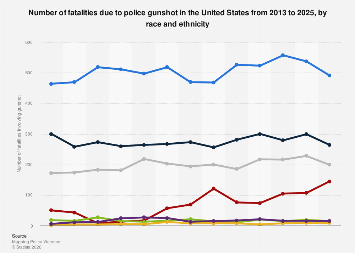
Statista
The trend of fatal police shootings in the U.S. seems to only be increasing each year, with 1,097 civilians, 225 of whom were Black, killed by police in 2022.
if anyone has any other issues with anything I said and how I came to that conclusion let me know
dim rover
@fickle onyx Well first of all, thank you for sharing your thoughts. You put a lot of time into answering my questions.
That said, I wouldn't say that you actually addressed the issues I brought up. So I'd like to dive into these questions further, if that's alright.
dim rover
I'm confused about why you're talking about anecdotes. Did I share some sort of story at some point that I don't remember? I'm looking at the same data you're looking at and pointing out what it's saying and what it isn't saying. The data are poor not because they're inaccurate, but because they're poorly chosen and displayed to be misleading, with a political agenda in mind. I can still look at the CDC data and reach the same conclusions that I'd get looking at other sources.
dim rover
fickle onyx
> Okay, first off, it's not at all obvious that we should be looking at gun-rela...
Sounds like you're worried a lot about guns. Are you worried about deaths? In gun-related deaths, which part concerns you more, the guns or the deaths?
dim rover
fickle onyx
> Second, you say that correlation does not equal causation, but you're treating...
Nothing you have provided has attempted to show causation. Not even a little bit. You haven't presented a single study where people asked the simply questions of "Why?" Why might people here want to purchase firearms? Why might rates be higher? It's been nothing but people saying, "See? There's a correlation!" Just like wiebje over here. No one has ever had a science class. Concluding that because two factors are related, one causes the other, is just an erroneous conclusion. A and B are related. Great. A might cause B. B might cause A. Both might be caused by C with no actual relation to each other. Or it could just be coincidence. But there's no attempt here to make any kind of determination. All the causation is assumed. "There's a link," people say, as if that somehow asks and answers all the questions. That doesn't seem fair at all.
dim rover
fickle onyx
> Third, I already explained why the data from the CDC is poor. It includes thin...
Let me be clear. If someone decides to invade someone's home and gets shot, that seems like a positive outcome. If someone wants to rape someone and gets shot, that's a positive outcome. Aggregating all of those statistics together only makes sense if the goal is to ignore all the distinctions. If you don't care why things are being used, only that they are being used, then you lump everything together. It should be super obvious to want to split the data into legal uses and illegal uses, as well as treating suicide differently, but people aren't doing that. Once you take out suicides and don't choose an abnormally high year, you're looking at 18k deaths, like last year. Now the 1000k police shootings start to look much more significant and much less like you can just ignore them. Then you subtract all the civilian shootings for the same reasons, where life was being defended against criminals. Why would you combine all those numbers if the goal is accurate policy? It's like the goal is to make people safer even when they're in the midst of a serious crime. That shouldn't be a safe thing to be doing.
dim rover
fickle onyx
> Fourth, there are many, many states with extreme gun culture and lax gun laws ...
Finally, don't be an a**. I obviously meant the link you posted that described gun laws.
Did you not look at the data? The states are all over the place. As one example, Idaho's murder rate is one of the lowest in the nation despite 60% firearm ownership, which is one of the highest.
fickle onyx
let me know when you're done so I can rebuttle
dim rover
More Americans died of gun-related injuries in 2021 than in any other year on record, according to the latest available statistics from the CDC.
Dude, knock it off with the bullsh*t rebuttal. It's not a game to see who can pound the other person's arguments into the floor.
That's why you can say something stupid like, "I don't think you looked at the CDC data because they don't discuss firearm laws" when you could easily, spending half a brain cell, conclude that I must have clicked on the other link you posted.
fickle onyx
no I just mean I don't want to interupt you
I want you to get all your points across I don't want to have us both be interrupting each other
dim rover
Well how about thinking about how to understand what's being said instead of trying to determine how to tear it apart
fickle onyx
I've been reading your points and I disagree and will be happy to tell you why I disagree and how I came to the conclusion I just want you to finish your thought as a courtesy
dim rover
You just spent like 5000 words not answering my questions, because you were focused on how you disagree.
fickle onyx
I thought I had effectively addressed your questions and from what you most recently responded and how you disagree that I have I can also address that
dim rover
I know you thought that, even though I explicitly stated in my initial response, "I wouldn't say that you actually addressed the issues I brought up."
You answered the questions in your own head, not mine.
If my questions are unclear, then ask for clarification.
fickle onyx
dim rover
That's why you can say something stupid like, "I don't think you looked at the C...
I apologize for this I understand it would seem like I may have been insulting you but I was merely literally interpreting what you had said I don't want to make assumptions about what you believe or read or how you think
I just try not to make assumptions about what you say I try to take what you say for what you literally mean
as it's an internet discussion and I can't read your tone
nor read your mind
dim rover
Alright. I said my piece. Feel free to respond now.
fickle onyx
ok I will
dim rover
fickle onyx
I just try not to make assumptions about what you say I try to take what you say...
I do mean what I say literally. I'm also human, like anyone else, and it's irritating to be called a liar or be accused of not looking at anything just because of a typo.
fickle onyx
dim rover
I do mean what I say literally. I'm also human, like anyone else, and it's irrit...
I understand that, it's just I only have to work with what you literally put down, making assumptions in my opinion is a poor way of facing any discussion or debate and I would rather take you for what you say than what I think you mean
I understand that paragraph may have come off as insulting I certainly didn't mean for it to appear that way
dim rover
fickle onyx
I understand that paragraph may have come off as insulting I certainly didn't me...
Alright, I forgive you and won't hold it against you
fickle onyx
dim rover
I'm confused about why you're talking about anecdotes. Did I share some sort of ...
what I say when I say your evidence and data is anecdotal is not the literal definition of what an anecdote is, that being a short personal story, but in fact what I mean to say is that your evidence is from you, as at the time you had provided no resources to back your claims, all of your evidence was coming from you, it was anecdotal evidence. You had failed to provide anything to back up some of your responses at the time. I understand you have my data to use, and if you can use the CDC data to come to a different conclusion than I that's fair enough such a thing is subjective. But there were certain points where you made claims that in my opinion seemed removed from the data I had provided and you had provided no data for. For example
Fourth, there are many, many states with extreme gun culture and lax gun laws that have lower rates of gun deaths than many states with very strict gun control
while my data can account for the lower rates of gun deaths, my data can absolutely not account for what "gun culture" is or means and which states are effected by it. To claim that states with less gun laws and less gun deaths is not at least to me proved by the data I have personally provided, I even gave an example of Texas and Mississippi versus California, California according to my data has the most gun regulations and a significantly lower rate of gun death, while Texas and especially Mississippi both have lax gun laws and a higher gun mortality rate. That is... according to my data, I do not see another way to interpret those data points and come to the conclusion that some states have lax laws and fewer gun deaths. That being so such a claim would need different data in my opinion, data which you did not provide. Similarly the earlier claim
Second, there are many states with lax gun control regulations with lower crime rates than states with extreme regulation, and vise versa
Is also backed up by nothing except your word. This I believe qualifies as anecdotal evidence. That's all I mean when I criticized you for being anecdotal, you had just failed in my opinion to provide sufficient evidence to back your claim up.
fickle onyx
dim rover
Sounds like you're worried a lot about guns. Are you worried about deaths? In gu...
I don't see the point of this question, but the death is of course what I have a concern about, I'm actually pro gun ownership believe it or not, I think every American has the right to own a gun but in my opinion that right should be regulated by the state to address the deaths that guns cause.
fickle onyx
dim rover
Nothing you have provided has attempted to show causation. Not even a little bit...
This is true to an extent, I have failed to produce a study or data to explain the causation of gun-related deaths in America, your example being that I haven't provided a study behind the purchasing intentions of people which is true I have not. I don't know if such a study exists that once and for all proves the cause of gun violence and gun-related deaths. If one does exist I'm sure I would have to rework what I think and how I address this issue, but I've seen there's no conclusive data relating to the exact cause of everyone who dies from guns. All we have are their death certificates and in my opinion, that's probably the best we can get. Census data like that is often difficult to collect and the collecting methods are often subject to large amounts of error and this all on top of the fact that no study could truly be a census. The point is I don't think we could know conclusively why every gun death happens nor could we know conclusively the motivation behind a statistically significant amount of gun-related deaths beyond knowing the death certificates. This is the matter where opinion comes into play, in my opinion when I examine the correlation that does seem to exist between states with stricter gun regulations and fewer gun-related deaths in my opinion I equate causation. I can see such states like California and Washington and New York with more strict gun laws and fewer gun-related deaths and in my opinion believe that there is a positive correlation, I can then use that opinion to state that I think other states should follow suit and that I think similar results would occur. Correlation does not equal causation and even beyond the fact that it can equal causation, correlation isn't nothing, it's not just statistic mumbo jumbo, if there is a significant correlation between two data sets it's reasonable to conclude there might be a causation even if I can't 100% prove that causation. Correlation is actually one of the primary ways we can tell in statistics that there might be causation between two factors and we commonly calculate the correlation in order to make assumptions on whether or not certain data is valid.
I think a great example one relevant to this debate itself is this study on firearm related hosptial visits

PubMed Central (PMC)
Increasing firearm violence has resulted in a strong drive for stricter firearm
legislations. Aim of this study was to determine the relationship between firearm legislations and firearm-related injuries across states in the United States.
We performed ...
they found a reasonable correlation within 95% confidence between states with fewer gun laws and more gun related hospital visits
this is a great table they use to simplify their statistics

in which SFL which are stricter firearm law states had fewer firearm trauma injuries than non-sfl
the study itself is actually really interesting
although I would argue that 95% confidence is not a c-level I would personally use to dictate law and regulation
I would much prefer 99% but this is really just to show that there is reasonable evidence to suggest a correlation between firearms and people getting hurt by firearms
which you might say isn't relevant and that's sort of fair, injuries are not death
but in my personal opinion you can say that there could definitely be a correlation
the point is however, that correlation is not nothing, in fact before causation it's about the best we can do in any given statistics
we can't go around asking everyone why they shoot eachother and figuring out their motivations
that would be prone to error and impractical
we can only really use correlation to make conclusions in this sort of situation
fickle onyx
dim rover
Let me be clear. If someone decides to invade someone's home and gets shot, that...
well that is how I treat my process of determining these regulations, I said it before so I won't try to be too repetitive but I am not trying to prevent crime, or prevent death, or rape, or anything else. I am trying to prevent people dying by guns. I am not here to argue morality although if you wanted to we could but that's not been my purpose. 50k people die in our country from gun-related incidents, some of them are criminals, some of them are regular people, some of them are school children. I am trying to lower that number for everyone. I want less people to die from guns, that is the point of this legislation and in my opinion from the data presented it seems like there's a positive correlation, and that we should build upon that in other states.
fickle onyx
dim rover
Finally, don't be an a**. I obviously meant the link you posted that described g...
I am not trying to curve Idaho's murder rate (which yet again I have to remind you you provide no source for and therefore is anecdotal) the gun-related death rate on the CDC data states that it is 16.3, which is higher than states with gun restrictions. whatever Idaho's murder rate is, is irrelevant to a discussion about gun legislation at least on my part, because I am not trying to prevent people being murdered in idaho, I am trying to prevent people dying from guns in Idaho.
if your claim is that guns prevent murder, you can make whatever claim you want that's fair enough I guess and also not what I care to argue about, your argument ultimately is that guns are not the problem, and in my opinion if you look at the data I have provided when it is harder to get guns less people die from guns
and that's my only purpose with gun regulations
to prevent people dying from guns
and of course we can argue about the morality of that, the costs of certain freedoms, and the rights of American citizens if that's what you would rather argue, but in my opinion the evidence suggests that guns are in fact the problem, because states without them have less people dying from them.
that's all my argument is.
that study I posted is actually really interesting I would strongly suggest you give it a read, they found a negative correlation between firearm-related injuries and the brady campaign score which if you look at the data itself has a correlation coefficient of -0.265
which I think is personally interesting because I've seen a lot of rhetoric about the brady score in conservative areas I've been in especially when relating to guns
so it's interesting to see the data between the correlation
but honestly, although the study is informative it certainly isn't conclusive on the gun problem forever
I apologize though for introducing new data while trying to address your points I realize that's poor etiquette
dim rover
fickle onyx
I don't see the point of this question, but the death is of course what I have a...
For me, this question is one of the most important, as it defines what actually makes sense to look at and what the end goal is. You see a lot of people with the goal of reducing or banning firearms regardless of whether it's a net good or not.
I'll definitely respond more later. Hanging out with buddies right now.
dim rover
fickle onyx
what I say when I say your evidence and data is anecdotal is not the literal def...
Okay, you clearly don't know what anecdotal evidence means. You're misusing the term. Anecdotal literally means in the form of an anecdote. It's not rocket science. You tell a story of one incident and use that as evidence instead of collecting data from multiple events. It has nothing to do with a lack of evidence or claiming something without providing sources.
fickle onyx
dim rover
Okay, you clearly don't know what anecdotal evidence means. You're misusing the ...
I think you're probably right I probably was using it incorrectly but my point really does stand that you are just saying things and providing no actual source
dim rover
Second, that doesn't make sense, because I was referring to the sources that you provided. Why on earth would you ask me to provide different sources than what you gave? Does that not seem a little stupid to you? "I failed to provide anything to back up my responses." Give me a break. Are you saying you failed to notice what your own links contained? Your links describe gun laws of various states, and have gun deaths for each state. How could my statements be disconnected from the sources you provide? That makes no sense. It doesn't matter if I state what "gun culture" is or not. You've literally got the source that you provided to look at.
All you have to do is look at the data, and you see plenty of states mixed in with each other. It's not all states on one end and all states on the other end.
You're not asking me to provide different data, you're asking me to point out more clearly what's already in your own data. You could look at the same if you bothered, but instead of simply asking for clarification, you accuse me of making claims without data. That's on you, not me.
dim rover
fickle onyx
I am not trying to curve Idaho's murder rate (which yet again I have to remind y...
"Which I have to remind you you provide no source for."
I posted two links. Is this something you just ignore on purpose, or did they not display for you or something?
Additionally, it is criminally easy to just look it up. It's one state and the quickest Google search you could ever do. It's also in the data that you already provided, if you bothered to look. Idaho has a very low murder rate, very lax gun law rating.
You claim to care about deaths. Well then, why aren't you looking at deaths? Why are you looking at "gun deaths"?
People who don't look at their own data, don't look at what other people post, and then whine and complain about other people not doing Google searches for them really bug me sometimes. You're not careful. You haven't actually paid attention to the studies you're looking at. You see absolutely zero attempt at assessing causes, and assume that's just fine. I can think of a dozen ways these studies could easily be done, if people actually cared about the answer. The reality is that it hasn't been done because it's not a question people want to answer. Answering the why would be detrimental to the cause, when the why is supposed to be simply "guns," and that's it.
Is there a single study in the ones you looked at that even bothers to control for other variables? That's like statistics 101. That should be a huge red flag for you, unless you couldn't care less about actually understanding the problem you're trying to solve.
fickle onyx
dim rover
Second, that doesn't make sense, because I was referring to the sources that you...
Because you're making different claims
you're saying claims that are counter to mine
and I don't understand how you're coming to that conclusion
you say all I have to ask for is clarification
so fuckin clarify
fickle onyx
dim rover
"Which I have to remind you you provide no source for."
I posted two links. Is ...
you posted fuckin a link to gun related deaths and gun ownership
that's not a fuckin murder rate
in fact
Idaho's murder rate is actually not included in any of my data
because I don't fuckin care
because, and it seems you are having a really hard time understanding this, I am not trying to solve murder
fickle onyx
dim rover
You claim to care about deaths. Well then, why aren't you looking at deaths? Why...
like in this statement
why are you looking at gun related deaths when you're discussing gun regulations
are you fuckin kidding me
can you not see how that is a clear marker
more importantly have you just ignored the 50 times I have said that I am not trying to solve anything but gun related deaths
that is literally the problem I am addressing
people are dying from guns
and I want less people to die from them
obviously
the data I'm going to pull from is people who die from guns
that goes without fucking saying
you would think
idaho btw
if we're talking about it
has a higher rate of gun related deaths
it doesn't matter what the murder rate is
it is not relevant to what I am discussing
I am not trying to solve murder I am not trying to solve crime I am trying to make less people die from guns
and from these two main sources
that being the CDC data which shows states and their gun mortality
compared to states with gun regulations
I think there is a reasonable correlation
even more so if you read in depth to the gun injury data I posted there's even more evidence in this study to suggest a negative correlation between the brady score and gun injuries
but what frustrates me the most by far about your cocky display of just ignoring what I'm saying and calling me stupid
is that's all you're doing
calling my sources bad and disagreeing with me in a very uncourteous manor
you say that I lack good causation
ok what is good causation
you say my data is bad
what is good data
show me something instead of just disagreeing with
you insulted me by claiming all I was doing was coming up with ways to "defeat" you
when all I'm doing is providing what I think is evidence to support my claim
all you've done is try to dismiss my evidence
supply anything
dim rover
fickle onyx
that's not a fuckin murder rate
Apparently it's too hard for you to actually read the sources I post after you whined about not getting them. Out of the goodness of my heart, I'll copy and paste the paragraph that was too much trouble for you to find.
The results are somewhat different when looking at gun murder and gun suicide rates separately. The places with the highest gun murder rates in 2021 included the District of Columbia (22.3 per 100,000 people), Mississippi (21.2), Louisiana (18.4), Alabama (13.9) and New Mexico (11.7). Those with the lowest gun murder rates included Massachusetts (1.5), Idaho (1.5), Hawaii (1.6), Utah (2.1) and Iowa (2.2). Rate estimates are not available for Maine, New Hampshire, Vermont or Wyoming.
You're really something man. Learn to read.
fickle onyx
dude fuck you
dim rover
Right back at you
fickle onyx
I have really tried to remain courteous and treat you with respect
I apologized earlier for accidentally insulting you that wasn't my purpose
dim rover
No, you've tossed out lots and lots of hidden insults
And kept doing it
And then had the nerve to not even bother looking at the sites I posted after you asked for them
fickle onyx
I apologize if you interpret that way I can not express to you enough that is not what I meant
but you are being outwardly hostile
dim rover
Yeah, well now you've gone and been outwardly hostile yourself.
dim rover
Stop wasting my time.
fickle onyx
because you can only be called stupid so many times before you get tired of it
jesus dude
fickle onyx
dim rover
Apparently it's too hard for you to actually read the sources I post after you w...
this is actually crazy that you think this helps your case
dim rover
"Hey man, I don't see the murder rate. Is it in the article you posted?" Instead of this whining about how I haven't posted anything because you're too good to read through the thing.
fickle onyx
it clearly states mississippi louisianna and alabama as having high gun murder rates
and these are all states with severely lax gun regulations
Idaho is an outlier to this data set
but not to the prior cdc data set which has the overall gun death rate
dim rover
Dude, it's not an argument. It's just looking at the data and pointing out the obvious.
They don't address outliers at all.
fickle onyx
there are outliers to that data that is true
dim rover
That's not how you do an effective study.
fickle onyx
one for instance is utah
new mexico is also a strange outlier
in having a very high gun death rate for its size
despite being ranked a c+ by gifford law center
dim rover
You're just trying to win a case. You don't actually care about the topic.
fickle onyx
I care deeply about this topic
dim rover
No, you clearly don't
fickle onyx
I am like you an american
dim rover
If you cared, you'd ask why.
fickle onyx
what do you mean
fickle onyx
what would I ask why to
dim rover
You don't care why.
fickle onyx
I do care why
fickle onyx
I don't thinks relevant to a discussion on gun regulations in my opinion
dim rover
See what I mean?
fickle onyx
but I do care about why people are committing gun crimes
I don't think whatever is ultimately causing gun crimes can be solved by gun regulations
dim rover
If you don't know the why, you sure as hell can't create any regulation that will have a useful impact.
fickle onyx
well we do know why
dim rover
Do we?
fickle onyx
I don't think it's that bold
I mean I didn't say I know why
I said I think I know why
there's a ton of wiggle room in that statement
I think I know why but I think a lot of things and can be wrong
I mean I'm wrong all the time it happens to the best of us
dim rover
Why isn't anyone attempting to study causation?
Why did not a single study actually ask any questions relevant to that topic?
fickle onyx
because in my opinion causation isn't exactly relevant to the regulation itself
people are dying from guns
for a lot of reasons
dim rover
You can't possibly claim that you care about why and also claim causation is irrelevant.
dim rover
That's so ridiculous.
fickle onyx
I want those deaths to be less
so I support laws that limit guns
because in certain states it's seemingly effective
dim rover
fickle onyx
I want to prevent those deaths
No you don't. If you did, you'd care why they are happening, because that's necessary for preventing them
fickle onyx
it's true gun regulation laws are reactionary
dim rover
It's also true that they aren't thought out at all
fickle onyx
I think it's reasonable in such a crisis to attack from both ends
we should solve the systemic failures
dim rover
And they aren't identifying a problem and actually trying to solve the problem, because they don't care about why.
fickle onyx
which if you're arguing that these states don't solve those problems I tend to agree with you
dim rover
fickle onyx
we should solve the systemic failures
We should care about why.
fickle onyx
I mean california is crime ridden and poverty struck in many areas
fickle onyx
dim rover
We should care about why.
I agree
that's my argument for gun regulation
we do both
dim rover
Do you? Because you just said multiple times that you didn't think it was relevant.
I don't think you care about why at all.
fickle onyx
it's not relevant to the discussion of gun regulations in my opinion
or at least it's not relevant to the discussion I was having
which I was just trying to show a correlation between the two
not trying to show a causation
I do think the cause is important
I wasn't addressing it because it's a very big problem and not what I was focusing on
I understand what you are saying now
dim rover
Cause is everything
Not just a small part that you can just ignore until you've created all the legislation
fickle onyx
absolutely
dim rover
That's such a backwards, rotten approach.
fickle onyx
those regulations are no replacement for the systematic change necessary to prevent those deaths from occuring
but I don't see the two as mutually exclusive
dim rover
Those regulations aren't designed to address any issues that we have
fickle onyx
I think of it a lot like a wound
a cut
those regulations are like the bandage that goes over the cut
it doesn't heal it
but it stops the bleeding for the moment
so that we can handle the larger problem
that in my opinion is the purpose
fickle onyx
well that's what my whole argument is about
dim rover
They aren't trying to solve a problem.
fickle onyx
dim rover
They aren't trying to solve a problem.
no they aren't
dim rover
They have no purpose related to the problem, because they don't care about the why.
fickle onyx
I thought I had said that
their only purpose is to curve the deaths that happen from guns
dim rover
That means the purpose isn't stopping the bleeding.
fickle onyx
to make it so there are less deaths from guns
dim rover
They don't actually do that
fickle onyx
so does california not actually have a lower gun death rate?
dim rover
Do I need to explain causation and correlation to you?
Because you're making a statement about causation
fickle onyx
what is the death rate to guns in california?
dim rover
And we both know that's not a thing you can do based on the data.
dim rover
Exactly
fickle onyx
once again they're not mutually exclusive
dim rover
But you're pretending it is
fickle onyx
these laws aren't addressing the cause
we both agree on that
I just don't think they are trying to
in my opinion that is not their purpose
dim rover
You're pretending that correlation is causation.
dim rover
You just did
fickle onyx
I have said the data doesn't address the cause
I have said that the cause isn't relevant to this discussion in my opinion
I have no misconception about my data and argument in relation to cause and affect
I am purely remarking on correlation
dim rover
"So does California not actually have a lower gun death rate?" Implying that the gun laws in California caused a lower death rate.
dim rover
You're relying on data about correlation to make statements about causation.
dim rover
Then what was the purpose of asking the question?
fickle onyx
to show correlation
dim rover
What were you trying to say?
fickle onyx
california has a lower gun death rate than other states
california has strict gun regulatiopns
dim rover
Yeah, and I was saying "they don't do that." Which is a statement about causation.
fickle onyx
those are two statements
there is no causal implication unless yo do that yourself
in my opinion there is a correlation between the two
dim rover
You don't seem to understand the difference. Why would you make a statement about correlation in response to my statement about causation?
fickle onyx
ok I'll try rephrasing then
why does california have a lower gun death rate?
in your opinion
dim rover
Is there something about "they don't do that" that says "the factors are unrelated?"
fickle onyx
I think we're getting very caught up in definitions which itself is hindering the progress of any actual conversation
why does california have a lower gun death rate in your opinion?
dim rover
There are many possible factors. It hasn't really been studied.
fickle onyx
well you disagree very very strongly that it is correlated with the strict gun laws
dim rover
I never said that
fickle onyx
oh I thought that's what you were saying that's my bad
text isn't a perfect medium for discussion
dim rover
Yeah, I know
fickle onyx
then I will make a claim
dim rover
You really, really need to learn the difference between correlation and causation.
fickle onyx
in my opinion california's lower gun death rate correlates with its regulations
do you disagree
dim rover
That's not a matter of opinion
dim rover
Sure
fickle onyx
then I will say in my opinion that relationship is also causal
dim rover
That's not something the data show.
dim rover
Yes, I disagree with that.
fickle onyx
why?
dim rover
Well, for starters, DC has always had the strictest regulation and the worst crime. It's not that simple. There are many, many factors to these things.
fickle onyx
in my opinion DC is a bad example as it is purely only a city and not an entire state, it is bound to have a higher gun mortality rate.
I think it's bad for comparison
to play devils advocate I think Utah is a much better statistical outlier
dim rover
Perhaps. But then I can point out that the majority of California gun ownership is rural areas. I'm willing to bet that the crime areas don't match up with areas where gun ownership is higher.
fickle onyx
dim rover
Perhaps. But then I can point out that the majority of California gun ownership ...
I'm unaware if that is true or not and would need to see data to support that
dim rover
fickle onyx
I'm unaware if that is true or not and would need to see data to support that
Shame. In depth data like that isn't something people care about. It would certainly be useful for painting a more accurate picture.
I doubt it's easy to find.
fickle onyx
in truth there are in my opinion several outlier to my argument that sort of make it seem weaker
primarily Utah and New Mexico
which sort of break my established notion that there's a strong correlation
but I think there's reasonable explanations for both
for one with New Mexico's gun laws are less in depth than the gifford law center has reasoned
which is actually a fair critique of that ranking system
I think it also includes proposed gun legislation
which I think is an error because it can harm reflecting a current idea of their gun legislation
dim rover

Los Angeles Times
A Times Poll finds residents here are more likely to have a firearm than those in Los Angeles. The trend also is seen in sales.
This article seems to address the issue at least somewhat.
It does support what I said about ownership.
fickle onyx
that's true
for orange county and los angeles county though
which I couldn't say for sure is indicative of the entire state
although it's not unreasonable to assume so
dim rover
Tell me, honestly now. If you looked at statistics on deaths and found that all of our deaths were firearm related, but that we had fewer deaths than anywhere else, would you still be concerned about the firearms and hope to reduce them?
If we had thousands of suicides and they were all by firearm, but everywhere else had more total suicides, would you be trying to remove the firearms from people?
dim rover
It's a hypothetical. But it's a rather clear hypothetical.
fickle onyx
well from what you described
I can only reasonable conclude there is a correlation
not an actual causation
dim rover
Well yes.
fickle onyx
which in this given situation isn't enough for me to say for certain
I don't live in this hypothetical earth so I don't really know what's at play
if everywhere had more death and we had less but they were all firearm related
it seems rash to just immediately assume in this hypothetical that the reason we have less suicides overall has something to do with the firearms
I would need to know more about this hypothetical in order to say for sure
dim rover
It's pretty simple. Convert all our murders to firearms. Convert all suicides to firearms. Everyone else has more murders, but they aren't firearms. They have more suicides, but they aren't firearms.
It's not really a statement on the cause. Maybe we're just at a prosperous time and everywhere else is suffering or something. Doesn't have to be causation either way.
But the point is that all our deaths are firearm related. So do you go after the firearms?
Obviously our gun-death statistics would be off the charts, way higher than other places.
fickle onyx
it's hard for me to answer this because it is just a really really strange world that doesn't seem like it could exist
so I don't know how to answer
why are all of our deaths from guns
do we just not have car crashes
that's strange
dim rover
It's the same question as before. Are you interested in the "gun" part of "gun deaths," or the "deaths" part.
fickle onyx
I see what you're getting at
dim rover
The answer to this question is really easy. If you're interested in the deaths, that is.
dim rover
Then why not look at overall deaths?
fickle onyx
because I'm not trying to solve every problem
I'm trying to regulate guns to prevent a certain type of death
dim rover
Ah, so you're not trying to solve the deaths problem.
fickle onyx
related to guns
dim rover
You're trying to solve the gun problem.
fickle onyx
I'm trying to solve the gun deaths problem
dim rover
You have to realize that this makes you interested in the "gun" part of gun deaths, rather than the deaths.
fickle onyx
I don't just love taking away guns
I don't get off on it
people are dying from guns
I am trying to lessen those deaths
dim rover
Look, if you're not trying to solve the problem of deaths, then you're not.
You're making assumptions and running with them.
fickle onyx
50k people a year die from gun-related deaths
dim rover
They seem like flawed assumptions, and it would seem really pertinent to look at overall effects instead of just direct effects.
fickle onyx
in our country
about that's not perfect
I should actually probably round down to 40k
dim rover
Well, I mean, if you take the outlier year after covid.
Tell me, if guns cause those deaths, then why do the deaths keep going down?
fickle onyx
I don't think guns cause those deaths I think people with guns cause those deaths
dim rover
Do you ever ask yourself how it's possible for the rate of gun ownership to constantly increase across the board, but somehow death rates keep decreasing?
fickle onyx
and in my opinion if you want people with guns to stop killing people with guns a way you can do that (not the best way but a way) is to take away those guns
dim rover
You're only taking them away from people who follow the law.
Every year, more and more people own guns. Ownership rates keep rising. Shouldn't that cause deaths to increase?
fickle onyx
I think the general trend is increasing
dim rover
Gotta search for it directly.

The Trace
The United States may have moved past the devastating surge of gun violence sparked by the pandemic, with preliminary data suggesting that homicides in 2023 declined by a record amount. Gun injuries have also dropped, and a growing list of states now have tighter laws on gun sales, which are at a four-year low. Still, […]
There are other factors that are more powerful. Covid had a pretty big impact.
fickle onyx
covid did have a large impact
people not being around each other didn't kill eachother as much
huh we were looking at the same source that's funny
 fickle onyx
yeah we should lock everyone up and run an authoritarian state more often
dim rover
To increase crime?
dim rover
I mean okay, but the murder rate spiked up
fickle onyx
yeah it wasn't like a serious thought
dim rover
But beyond that, you can see that the numbers before the spike were trending down.
fickle onyx
but yeah gun related deaths have lowered in the last two years
they are still much much higher than say 2010
dim rover
And they're still trending down. This despite a general rise in gun ownership.
fickle onyx
I mean this data is brand new we can't really determine a conclusive trend as of 2024 for gun violence lowering
it has gone down for the past two years but that can be caused by other factors
but it can also be caused by gun ownership that's possible
but also more gun regulation laws have been signed into effect in the last two years
that's also a possible cause
although I couldn't personally say for certain
dim rover
You've also got states passing constitutional carry like crazy.
dim rover
Over half the country now
fickle onyx
I don't think either of us can really make a conclusive claim about why there has been a slight decrease in gun related deaths
dim rover
I think I might be wrong on ownership. I think it's more or less stayed the same percentage of households.
fickle onyx
in 2022 it was a 1.5% decrease
fickle onyx
there's also lower gun sales every year since 2020
2020 saw a large peak in gun sales and then it's been lower every year by a decent amount
although I didn't write that article I actually think that's what the article is trying to present with their data
dim rover
After the spike? I mean it's not like you turn them in after you buy them.
They still own them.
fickle onyx
that's true
but gun sales did lower
less people were buying
but that's also true less people were buying because they might have already had guns
fickle onyx
once again all of this data being really recent makes it hard for me to make any giant claim
dim rover
Everyone buys a lot more firearms when democrats are in control.
fickle onyx
I do not have access to the actual survey data nor am I a good enough statician
but this seems all like a giant tangent
to answer what I think was your question a decade ago
I care more about the deaths
and I actually probably agree with you to an extent
I do not generally support reactionary legislation
because gun control is only a bandage on a deep wound
it only stops the bleeding in my opinion but it doesn't solve the problem
that's why despite california having a lower rate of gun related deaths they still have a higher rate relative to say developed countries of similar size, population, and gdp
because gun control really isn't addressing the underlying factors of say poverty
or mental health
I'm sure we can at least agree these laws are reactionary
but where I disagree is that I still think they are somewhat effective
not for treating the underlying societal problems
but for curving death rates
and as I said before the two aren't mutually exclusive
I think the best solution would be one in which we regulate guns to lower death rates then address these underlying issues to get these death rates to a reasonable level
at which point I think we can discuss removing these regulations
because I'm actually pretty pro-gun myself
I think we should have a right to them
I just think that right we have is far too unregulated and causing a major crisis of gun related deaths
dim rover
The issue with regulations is that they aren't trying to solve a specific problem. They're just trying to reduce the number of guns around. That doesn't seem like targeting the problems at all.
What regulations are you even interested in seeing?
fickle onyx
I think it's reasonable to have the state regulate such dangerous personal property
I mean you can kill someone with one of those things
we should be making sure you're not a crazy person
dim rover
No I mean what are those supposed to accomplish, not why you think it should be allowed
fickle onyx
they're supposed to accomplish stopping criminals and crazy people from being able to easily acquire firearms
dim rover
Do you think the federal government should have a record of every firearm in existence in the country?
dim rover
You really don't think so?
How do you accomplish universal background checks without a registry?
dim rover
People often say these fancy buzzwords and have no idea what it actually entails.
A registry seems incredibly dangerous.
fickle onyx
why do you think so?
dim rover
They do those before gun confiscations.
It's happened many times in history.
And then they kill a bunch of people.
Since I'm not in favor of the government killing a bunch of people, I'm strongly against them knowing who has what.
fickle onyx
which is a big reason why I said idealy but that may not be clear
dim rover
As a reminder, the current party in power just called the opposing political party enemies of the state in his state of the union address. That was recent. The FBI, CIA, and ATF are routinely used for political purposes.
This is not really a theoretical at this time.
fickle onyx
yeah but the leader of the opposing party also posted a picture of the current president tied up in the trunk
said that on his first day in office he's going to "act like a dictator"
and has made the argument that the president should be allowed to execute people
so idk
dim rover
I don't care at all about people criticizing someone in power.
I care a lot about the person in power calling half the country enemies of the state.
fickle onyx
I mean
dim rover
Those aren't even remotely equal
fickle onyx
it's not like republicans don't call democrats godless commies who hate america
one side calling the other an enemy of the state is not like a new thing
fickle onyx
both sides do it to each other whether in power or not
yeah there is I guess
one dude said that repbulicans are dangerous
dim rover
You don't do it openly and officially on national television.
fickle onyx
the other dude said he's going to be a dictator
there does seem to be a little difference
dim rover
Not during the speech where you're supposed to be bringing people together
fickle onyx
donald trump says crazy things during speeches all the time
dim rover
He's not a politician
fickle onyx
that's a strange thing to say
dim rover
Is it?
dim rover
Why?
fickle onyx
because he's in politics???
dim rover
Because he was elected? He doesn't possess the attributes of a politician.
That's what people normally mean when they say someone isn't a politician
fickle onyx
the attributes of a politician are someone who is involved in politics professionally
which he is
he was a president
he could be again
he's currently campaigning
politicians campaign
dim rover
fickle onyx
the attributes of a politician are someone who is involved in politics professio...
I think you're confusing the definition of politician with the qualities of a politician
fickle onyx
well in my defense
you said he wasn't one
so I would think the definition of what is one
is sort of relevant
dim rover
Right, because he's a celebrity businessman
fickle onyx
a celebrity businessman who is
dim rover
He doesn't have the normal qualities of a politician
fickle onyx
involved in politics professionally
I don't see like being a politician as like a really high bar
or that politicians are like evil or good or anything
it's just a description of a person involved in politics
it's not like a value statement
dim rover
So you disagree that there are certain qualities most politicians share.
fickle onyx
Joe Biden is a politician as was George Bush and Abraham Lincoln and George Washington
dim rover
You don't think there's anything they typically have in common.
fickle onyx
dim rover
So you disagree that there are certain qualities most politicians share.
no
but you're not saying "trump isn't like other politicians"
you're just saying he isn't one
dim rover
That's exactly what I was saying
fickle onyx
dim rover
That's exactly what I was saying
no
it's not exactly what you were saying
it was what you meant
dim rover
Yes, because I'm the one talking. You're the one misinterpreting what I was saying.
fickle onyx
dim rover
He's not a politician
yeah I guess I really misinterpreted this
dim rover
Maybe if you tried listening, you would get what I meant instead of getting bogged down
It's really not that hard unless you're trying to be difficult.
fickle onyx
see what you meant by that was "donald trump isn't like other politicians" and what I clearly misinterpreted was the literal meaning of what you said
dim rover
Exactly
fickle onyx
well here's the draw back of a text based app like discord
I am not in the room with you and cannot hear how you say words
dim rover
Yes, but I also clarified immediately
fickle onyx
I can only interpret literally what you say
yeah I see that you clarified he doesn't have the attributes of one
which I would disagree with I think he does
dim rover
I mean fine, but he doesn't possess many of the attributes that other politicians possess.
The attributes he does have still work for him
fickle onyx
I don't know I see him as just another politician who's just good at what he does
dim rover
Politicians are polished. They don't make mistakes in their speech very often. They choose their words carefully.
fickle onyx
he has a really clear brand that appeals to his target market perfectly and hes really good at radicalizing his base to support him
dim rover
Trump is a businessman. He uses every day speech, heavily favoring exaggerations and figures of speech that can't be taken literally.
fickle onyx
he's also really good at appealing to the specific voter market that gets him the good votes
I would say he's just a sort of good republican politician that said the right things to become one of the better ones at getting elected
but we'll see the effectiveness in this next election
dim rover
I mean as long as people don't change and ignore the rules just before the election
fickle onyx
yeah I'm really surprised this is where this conversation went
could have never seen this coming
dim rover
The fact that we have firearms provides an extremely robust check on the federal government's ability to impose its will by force.
I'm not willing to give that up lightly.
Certainly not for those who aren't willing to look into causation in their studies.
fickle onyx
lord man I thought we had moved past that
those studies don't look for causation nor is that the problem I am trying to solve
dim rover
Just bringing it back 😁
fickle onyx
I thought I had explained that well at least my side
gun regulations are reactionary they don't treat the underlying problems
and I don't think we should only do those regulations
I think we should do loads of other things as well
dim rover
All the more reason to oppose them
fickle onyx
I disagree
dim rover
If someone wants to take the time to do decent research, then they could design regulations that make sense
Universal background checks require a gun registry. This is too high a price to pay. It would cost many lives.
Wait times deprive law abiding citizens of firearms while doing very little to prevent crime. The hot-headed purchase argument is often cited, but it never really seemed all that convincing. There are many cases where there's an immediate threat and a reasonable desire to defend yourself right away.
fickle onyx
well I can at least agree there's a trade off
dim rover
Ex-boyfriend murders woman while she's waiting on a firearm is a common story.
fickle onyx
dim rover
Ex-boyfriend murders woman while she's waiting on a firearm is a common story.
yeah that's why you posted a link to one instead of just saying it's common and expecting me to believe you
but like I was saying there's a trade off
restricted access to fire arms
that's what we're trading
dim rover

WZTV
A New Jersey woman waiting to get her handgun permit permit was found stabbed to death outside her home this week, allegedly by the very person she was trying to get a gun to protect herself against.
fickle onyx
yeah but it's common right
so you go ahead and post all the others for this common occurance
dim rover
You're not listening very well.
I didn't say it was common.
I said it was a common story.
Don't twist my words.
fickle onyx
ok what do you mean by it being a common story
dim rover
A story that is often repeated when discussing the topic.
dim rover
It's okay, English is ambiguous sometimes.
fickle onyx
you meant it's common in rhetoric not that it's a common thing that happens
fickle onyx
dim rover
It's okay, English is ambiguous sometimes.
no yeah definitely
dim rover
Correct. I don't actually know how common it is.
fickle onyx
which is why it may seem like I'm using too many words
but in fact I'm just trying to make sure all of my words make the most sense and are the least ambiguous
so that you misunderstand what I say as little as possible
dim rover
Fair enough
fickle onyx
this however all goes back to my data before as to why I believe what I believe
I see there is a correlation (with a few outliers) between states with gun regulations and fewer gun related deaths
I don't want the gun regulations
they're not perfect and I want the populous to be well armed
but there are a lot of people dying a year
and so that's the trade off I am willing to make
dim rover
Are the regulations even useful? Who's to say the correlation isn't due to completely unrelated factors?
dim rover
Yes, indeed. There aren't really data that show a change following the implementation of regulations.
fickle onyx
you disagree with me so you're the one who needs to show me reasonable arguments to convince me that there is not a strong correlation
dim rover
Such data are really sketchy at best, when the natural variation is already so high.
dim rover
fickle onyx
you disagree with me so you're the one who needs to show me reasonable arguments...
I think we already discussed correlation.
fickle onyx
I discussed why I believe it's a effective means
I don't know if you've discussed why you believe it isn't
dim rover
Right, but that has nothing to do with correlation
Things can be correlated without causing each other.
dim rover
Wait times can be implemented and have zero effects, but rates can still be lower due to completely unrelated things.
fickle onyx
ok
what are the unrelated things
there is a correlation so explain why it isn't a causation
instead of just saying it's not
dim rover
That's not really how that works.
The data aren't there to support causation.
They show correlation. No attempt was made to go beyond that.
I don't know why delaying someone's purchase prevents them from being able to use it for unlawful purposes.
It certainly hinders their ability to use it for lawful purposes.
fickle onyx
because they might need to do the unlawful thing immediately
it hinders their ability to do the unlawful thing
dim rover
In which case they can get the gun unlawfully as well
dim rover
They are much better at getting a gun unlawfully for unlawful purposes than law abiding citizens are at getting around a wait time
fickle onyx
but why do you think california has less gun related deaths?
dim rover
When the rioters were burning down California in the name of BLM, they came to Placerville, where my buddy lives. There, they met the locals, out in force, open carrying. They moved on and didn't harm that neighborhood.
dim rover
Yes
fickle onyx
you'll forgive me for dismissing it
dim rover
So based on my anecdotal, personal evidence, I'd say it's because people still own firearms in California, even if the laws are strict.
You didn't ask for data. You asked for my opinion.
That's the difference
dim rover
No, it isn't.
fickle onyx
yeah it is
dim rover
Your opinion is on causation.
fickle onyx
you can disagree with my use of that data
dim rover
The data is correlation.
fickle onyx
yeah it isn't
well it is
my opinion is the causation
the data represents the correlation
dim rover
We talked about this before. You agreed that the data don't show causation.
fickle onyx
yeah but that's the purpose of data, data is bad at showing causation
but good at showing correlation
dim rover
It's only bad at it if it's not designed for it.
There are many, many methods to determine causation.
fickle onyx
that's the purpose of the correlation coefficient to show mathematically within whatever standard deviation if there is a relationship between two independent data points
dim rover
That purpose is correlation, yes. Which has nothing to do with causation.
fickle onyx
correlation is important for showing relationships
dim rover
Things can be completely unrelated to each other and still correlate.
fickle onyx
which is why it's so relied on in statistics
dim rover
fickle onyx
which is why it's so relied on in statistics
That doesn't make sense.
fickle onyx
it is all the time
dim rover
You're still treating correlation as if it's causation.
That's just not the same thing.
fickle onyx
causation like I've said before is an extremely difficult thing to measure
dim rover
fickle onyx
causation like I've said before is an extremely difficult thing to measure
Especially if you don't try
fickle onyx
dim rover
That's just not the same thing.
you aren't really paying attention to what I'm saying
dim rover
I am though.
fickle onyx
here I'l just end it once and for all then
dim rover
And you're trying to imply that you've got causation where there is none
fickle onyx
causation is what causes a relationship correlation is the value of that relationship
I am saying that since there is a high correlational value for this given relationship
it implies causation to an extent
that is the part that is my opinion
my opinion is of causation
dim rover
And that's precisely the thing that is pure opinion and horrible statistics.
fickle onyx
it's not pure opinion
dim rover
Yes, it actually is
fickle onyx
I have a really strong correlation to look at
dim rover
The data do not show causation.
fickle onyx
show me the data that shows causation
dim rover
Let me rephrase your question for you.
fickle onyx
yeah instead of answering it
dim rover
"How might one determine causation?"
dim rover
I'm not doing another Google search for you.
fickle onyx
I asked you to show me the data that does
dim rover
Answer your own question with your own search. You're the one claiming causation.
fickle onyx
my argument is that data, if it does exist, isn't very good for this
so I am showing correlative data
you disagree with me
dim rover
Which has nothing to do with causation
fickle onyx
which means the burden of proof falls on you to disporve me
so show me the causal data that disproves my claim
dim rover
That's not how it works.
dim rover
The data objectively do not show causation.
fickle onyx
yes it doesn't
dim rover
They show correlation.
dim rover
That's it. Proof done.
fickle onyx
show me why
don't just disagree with me
show me the proper data to convince me otherwise
fickle onyx
it could
but I'm not claiming that it does
I'm claiming restricted access to guns leads to fewer gun related deaths, I'm not claiming the inverse
dim rover
You're claiming correlation implies causation, as if you've never taken stats 101
fickle onyx
I haven't taken stats 101 I took an AP stats course and highschool which qualified me for stats 201 in college
so that is actually true
dim rover
fickle onyx
I'm claiming restricted access to guns leads to fewer gun related deaths, I'm no...
I guess you skipped the causation part.
fickle onyx
I don't think I did
I also don't think it was called stats 201 it had like a different name
dim rover
The things that lead to people implementing gun control could be the very things that lead to fewer deaths, for example. You'd have to actually control for variables.
fickle onyx
because the college I went to didn't like do the 101 201 scheme
fickle onyx
dim rover
The things that lead to people implementing gun control could be the very things...
what things, show me
dim rover
For example, more affluent people might tend to get idealistic and want to create utopia.
But it's their income that causes fewer deaths, not the gun control.
California is rich. So is New York, Illinois, Connecticut.
The states at the bottom of the list for the most part are poorer.
fickle onyx
that's true
dim rover
This should be an obvious thing to control for, but they didn't bother.
Because they have a political agenda.
fickle onyx
I actually agree with you that poverty is a significant cause for gun violence
fickle onyx
dim rover
This should be an obvious thing to control for, but they didn't bother.
why would they have to control for that in a study specifically targeting gun related deaths
dim rover
Violence in general, not just gun violence
dim rover
fickle onyx
why would they have to control for that in a study specifically targeting gun re...
Because they were trying to show a link between two variables.
fickle onyx
they were just compiling causes of death and creating a rate at which gun violence occurs
dim rover
If you control for other variables, you split out where the link actually is.
fickle onyx
you don't need to account for those variables in such a method of data collection
dim rover
You might show 95% correlation, but 80% of that is explained purely by income.
You literally do and should.
Otherwise you're showing correlation that is meaningless and more importantly misleading.
fickle onyx
I think you are under the misunderstanding that that CDC data was an argument
or expiriment
that CDC data is just data, just a compiling of data
dim rover
The CDC data is simply a way of displaying data.
The method chosen for displaying it was very poor.
fickle onyx
displaying data based upon death certificates
dim rover
And thus leads many to inappropriate conclusions
fickle onyx
they took the certificates of people who died in states, found the ones that were related to guns, and then created a neat little map to show us
dim rover
I don't understand why you keep getting off on these death certificates.
dim rover
People died, it was related to firearms. I'm not sure where the big excitement is in that.
fickle onyx
nor an experiment
dim rover
You don't need a survey or experiment to get better data.
fickle onyx
you are trying to claim my data is bad so I am trying to explain how it was collected and why I disagree
fickle onyx
how so
dim rover
In a misleading way.
fickle onyx
why?
dim rover
Because you're not controlling for appropriate variables.
fickle onyx
it's not an experiment there are not variables like that to control for
dim rover
You're missing a lot
dim rover
Let me illustrate this.
fickle onyx
to collect data from public records and compile it
you don't need to account for causation
because that's not the point
dim rover
You're wrong
dim rover
Shut up and let me talk
fickle onyx
it's just showing you who died from what in what state
and then showing you the rate
all of that correlation stuff is done by me
it's my opinion
and some other stat people
dim rover
fickle onyx
all of that correlation stuff is done by me
Causation, not correlation.
You're so bad at this
fickle onyx
stop saying that
dim rover
Just shut up a moment
fickle onyx
Oh my lord
dim rover
There was a university that had data related to admission rates. It compared men to women. It found that women had a much lower chance of being admitted than men.
When they looked further into it, they found that women had higher rates of admission in every single field, across the board. But because the fields that the majority of women applied for were more competitive, they were overall less likely to be enrolled.
This is an example of properly displaying data. You can show a bias against women or one against men, depending on what you choose to portray. It has nothing to do with doing an experiment.
It has nothing to do with surveys.
All you're doing is taking a more in depth look at the data.
Not accounting for additional factors leads you to paint the opposite picture from reality. You'd think that would be important.
fickle onyx
ok
explain to me the error in this data after I explain the method of collection
the CDC accessed public databases for death certificates, collected the ones that were related to guns as the cause of death, and then displayed that rate out of 100,000 per state
at no point did they make a claim like "the states with less laws have more death"
they just collected the data and showed it
what is your problem with that data in it of itself
not my particular use of it
dim rover

Medium
Using data at its face value to drive decision making can be dangerous… Very dangerous!
In case you thought I was just making it up.
fickle onyx
I didn't
you didn't name any actual figures so I figured it was just a metaphor
at most a real example
dim rover
fickle onyx
what is your problem with that data in it of itself
The fact that no other factors are taken into account. So there's all sorts of things that you can't say with the data, but people are trying to say it anyway.
fickle onyx
the data is not making a claim
it is just presenting deaths based on guns as rates in those states
it's not saying the cause other than that those deaths are related to guns
it's not data exploring the causal relationship
dim rover
I mean my issue wasn't really with that data.
dim rover
No, it was with the correlation established. That's what we were talking about.
fickle onyx
dim rover
The method chosen for displaying it was very poor.
your words
did not make this clear
when you said the method chosen was very poor
I see the misunderstanding
dim rover
I still think it is. It should actually split everything up. It should show criminal vs non-criminal. There are a lot of things that it could show differently.
But really, my main issue is with how the correlation is displayed.
fickle onyx
in your opinion the data should differentiate between criminal versus non criminal
this is an opinion
this is not in fact the purpose of that dataset
dim rover
Data isn't supposed to have a purpose
fickle onyx
that's not true
dim rover
The way it is displayed has a purpose.
fickle onyx
I mean what do you mean by that
data should try not to be biased
but people who collect data do it for a reason
they do it to find something out
it does have a purpose
fickle onyx
the people are the ones collecting the data
the data isn't the word of god
it's not the objective truth
it has a purpose just as much as the people who collect it
dim rover
Yes. And they have a purpose. They are collecting data in hopes that the data supports their purpose.
That doesn't mean that data has a specific purpose.
fickle onyx
data should strive to be as close to objective as possible
is what I think you mean by what you're saying
but everything has a purpose nothing happens for nothing
objective data has a purpose
dim rover
Maybe you're misunderstanding what I'm saying
It's a bit ambiguous
Data collection serves a purpose. People have a purpose.
But if the data could speak, it wouldn't say, "This is my purpose."
fickle onyx
fuckin obviously
that's all I meant
data should strive to be objective but in its collection it has its purpose
and thats all data
that's all I mean
and no data is objective btw
all data is subject to the collection method and the biased humans collecting
but this is so not what we should be talking about
dim rover
I mean the data are still valid, that just makes them incomplete
The reason they didn't split between criminal and non-criminal is because they wanted to lump everything together and make it equally bad.
fickle onyx
that could be true
but that's not what they displayed
and once again they make no claim
dim rover
They wanted to display the problem as extreme as possible.
dim rover
Thru had a purpose behind how they selected the data for display
fickle onyx
my argument being criminal and non criminal are irrelevant as they're both still gun deaths
and I want to curve them both
dim rover
They don't need to make a claim to show data in a misleading way
fickle onyx
I think they literally have to make a claim in order to mislead you
dim rover
But most people aren't interested in curving non-criminal deaths.
fickle onyx
I think you have to claim something in order to mislead someone about that claim
dim rover
fickle onyx
I think they literally have to make a claim in order to mislead you
That's not true at all
fickle onyx
then how are they misleading you
dim rover
People mislead themselves just fine when presented with data
fickle onyx
they didn't claim anything
they said heres people who died from guns
and then showed you the numbers
dim rover
Why would they need to claim anything to mislead anyone?
fickle onyx
how is that misleading
dim rover
Because when people say "gun deaths," others hear "murder"
dim rover
They forget suicide exists.
dim rover
And yet it's still misleading
dim rover
People are misled by it. They forget suicide exists. They don't think about criminals getting shot by police or private citizens.
fickle onyx
people can be mislead by anything
that doesn't meant that thing is trying to mislead them
dim rover
If people knew 1000 criminals were shot while trying to rape people, they would cheer and want more guns.
fickle onyx
if you looked at that graph and assumed it was all murders that's on you man
dim rover
If they think those same 1000 are murders, they want the opposite.
dim rover
And I looked at the graphs and immediately recognized that a lot of people would misread the numbers
fickle onyx
you assumed that I guess
I didn't though
I'm a big believer in people looking at graphs and reading the values and understanding what it means
if you disagree I guess you have less faith in our fellow humans
dim rover
Lol, you really actually have faith in the general population's ability to read graphs?
fickle onyx
not really but I suppose I had faith in your ability
which is who I'm arguing with
you
dim rover
These same graphs are going to be used as is by politicians trying to convince people that gun crime is a huge problem.
fickle onyx
that would be relevant were that what we were discussing
I'm talking to you right now
dim rover
Right now we're discussing how the graphs are misleading and why I feel that way
Because that's the question you asked me
fickle onyx
you think my data is bad or misleading I disagree
I think you can reasonably look at that data and understand what it is trying to convey
but most importantly we both now should know what it is trying to convey
you might think the CDC is trying to lie to people and they might be I wouldn't know
but what we both do know is that data
do you disagree with that data in that you think it is innacurate?
dim rover
Tell me, what do you see when you type "gun crime" into Google?
Anything on gun crime? Or is it all "gun violence"?
People interested in gun crime are going to be fed these graphs and not necessarily pick up on the difference right away.
fickle onyx
they might
I am not interested in discussing the conspiracy to mislead people about gun crimes by the CDC
I am interested in talking about this data
do you think this data is innacurate
dim rover
The CDC data are poorly displayed because they mix deaths I view as positive with ones I view as negative.
Additionally, they mix in suicides, which gives the impression of a firearm problem even if our actual suicide rate is lower than comparable countries.
fickle onyx
see what youre talkin about is morality
dim rover
Aren't you?
fickle onyx
not particularly