
#Binary as a Human Base
1 messages · Page 2 of 1
 floral plover
(the test is running correctly, if I change the answer to be wrong it realizes it)

@fallow sundial
pub fn generate_binary_name(i: usize) -> String {
    fn gen(x: usize) -> String {
        if x == 0 { return String::new(); }
        else if x == 1 { return "one".into(); }

        let terms = [
            "two", "four", "hex", "byte", "short", "int", "long", "overlong", "byteplex"
        ];

        let n = find_n(x);
        let middle_term = terms[n];
        let left = x >> 2usize.pow(n as u32);
        let right = x % 2usize.pow(2_u32.pow(n as u32));

        let mut first_term = gen(left);
        let last_term = gen(right);

        surpress_redunant_one(&mut first_term);

        format!("{first_term} {middle_term} {last_term}")
    }

    if i == 0 { return "zero".to_string(); }
    else if i == 1 { return "one".to_string(); }

    let mut r = gen(i);
    r = r.replace("two one", "three");
    r = r.replace("  ", " ");
    r = r.trim().to_string();
    r
}

fn surpress_redunant_one(s: &mut String) {
    if s.len() < 3 { return; }

    if &s[0..3] == "one" {
        *s = s[3..].to_string()
    }
}

fn find_n(x: usize) -> usize {
    use std::f64::consts::LN_2;
    (((x as f64).ln() / LN_2).ln()/LN_2).floor() as usize
}
Woo
 fallow sundial
VecDeque time
wait no
it's so much worse
aaaaaaaaa
I'm going to have to use a arrayvec aren't I
nvm
I found a way
fn gen(x: u64, vec: &mut Vec<Term>, front: bool) {
    use Term as T;

    if x == 0 {
        vec.push(T::Zero);
        return;
    } else if x == 1 {
        if !front {
            vec.push(T::One);
        }
        return;
    }

    let n = find_n(x);
    let middle_term = [T::Two, T::Four, T::Hex, T::Byte, T::Short, T::Int, T::Long][n as usize];
    gen(x >> 2_u64.pow(n as u32), vec, true);
    vec.push(middle_term);
    gen(x % 2_u64.pow(2_u32.pow(n as u32)), vec, false)
}
just realized I don't need Zero
I can just return zero if it's a empty vec
not even that
god
if it's 0
 red parcel
you get it
 fallow sundial
```rs
fn gen(x: u64, vec: &mut Vec<Term>, front: bool) {
use Term as T;
...
fallow sundial
fallow sundial
```rs
fn gen(x: u64, vec: &mut Vec<Term>, front: bool) {
use Term as T;
...
we can probably get rid of the floating point operations here too
well in find_n
you'd just need a match statement with the superpowers and some comparison checks
is it faster to do floating point operations or 8 ordering comparison 🤔
 stiff glade
one l
two lı
three ll
four lıı
four one lıl
four two llı
four three lll
two four lııı
two four one lııl
two four two lılı
two four three lıll
three four llıı
three four one llıl
three four two lllı
three four three llll
hex lıııı
oh
red parcel
looks right to me now!
and then you can multiply by hex to get the next four digits :D
and then byte (and hex) to get the following 8
it's great
ı
oh coool
sorry just figured out how to write that character with compose key on my keyboard
stiff glade
cool!
i just have this ahk script i use to speak a language i'm learning
the problem is that if i'm writing lists like the one i just wrote i have to go back and forth because w -> ꝡ
red parcel
ah, yeah been there, but I'm on linux now
floral plover
red parcel
sorry just figured out how to write that character with compose key on my keyboa...
:0
How?
floral plover
fallow sundial
well in `find_n`
What?
 fallow sundial
floral plover
What?
fallow sundial
floral plover
What?
to find the biggest 2^2^n you can just compare them in order with <=
floral plover
red parcel
right_alt+i+.
No I mean, I have a physical compose key
I'm asking how you added it
red parcel
my settings has an option to set a key for it
floral plover
fallow sundial
to find the biggest 2^2^n you can just compare them in order with `<=`
That's what I tried in the beginning! But it was way simpler to plug the formula into a calculator and let it spit out an inverse for it
floral plover
red parcel
my settings has an option to set a key for it
Here's how I'm using mine
 floral plover
fallow sundial
i just don't know if it is faster
floral plover
fallow sundial
i just don't know if it is faster
I can benchmark it :3
fallow sundial
if you wanna
red parcel
floral plover
Here's how I'm using mine
...is that vi?
floral plover
I do wanna
floral plover
red parcel
...is that vi?
It's bat
It's my XCompose file
fallow sundial
it'd just be like a bunch of superpower.. in a match statement
red parcel
floral plover
It's `bat`
It's my `XCompose` file
idk where to customize mine
also your shell is pretty love the blue
floral plover
fallow sundial
it'd just be like a bunch of `superpower..` in a match statement
wait hm?
fallow sundial
well you can't do >= in a match statement
floral plover
ok wait
fallow sundial
or actually ..superpower
floral plover
I don't understand how rust tests work
I have a function marked with #[test]
I have no clue how to run it
red parcel
and also cargo t
floral plover
what
i just tried that
it only ran the ones in tests/
dkjhfakshf
this one works

time for one with match
and then it's criterion time
fallow sundial
make sure to only include the ones that fit in a u64
floral plover
hm?
fallow sundial
well some of them aren't going to fit for the array implementation
floral plover
array implementation?
floral plover
i don't understand what you mean
floral plover
...right
hmm
should I be using u128? Does it even fit in a u128?
fallow sundial
just using a u64 lol
fallow sundial
aight
i don't think it matters too much
though it benefits the match case the most
floral plover
Exactly
Also helps with .pow() because it takes u32, so less conversions
fallow sundial
well no it benefits the while loop the most
red parcel
oh btw @floral plover your glyph to words test can't display over 21 bits... apparently
fallow sundial
if match is better then floating point then a u64 could be tried to see if it changes anything
floral plover
red parcel
oh btw <@328851809357791232> your glyph to words test can't display over 21 bits...
the glyph displayer?
damn it
red parcel
yee
floral plover
i was hoping i wouldn't have to look at it again
red parcel
 floral plover
it might just be that the canvas is too thin
yeah probably
you can't use methods or indexing in a match statement

that is very annoying
red parcel
fn main() {
    let y = 81;
    const x: i32 = 3_i32.pow(4_u32);
    match y {
        x => println!("woah!"),
        _ => println!("boo")
    }
}
woah!
floral plover
fallow sundial
use consts!
wait what
red parcel
that is cool as heck I've been looking for that
only works for const funcs and const lookups but wowzers
floral plover
aw man
 red parcel
make SUPERPOWERS[0] a constant right above the match
 floral plover
right, of course
it's short
red parcel
I guess int
floral plover
so up to n = 4
floral plover
The loop is absolutely awful
 red parcel
can I see the loop?
floral plover


I sent all three at the same time, I love how loop got sent last
oh my

they're neck and neck for large n
and for small ones too

l m a o

ö

i need better inputs
i'll do 1e7 1.5e7 2e7 2.5e7 ...
Delta of about 10ps max
I think it's reasonable to say that they perform the exact same

Actually, hold on
Is the switch one even programmed correctly?
floral plover
floral plover
( @fallow sundial )
fallow sundial
Black box?
floral plover
fallow sundial
Black box?
Does this need a black box?
 floral plover
Doesn't hurt to try
But I think my switch function is wrong
Could you double check, pretty please?
fallow sundial
They look fine
Check godbolt?
Maybe they just compile they similarly
I was doubting that could happen
fallow sundial
floral plover
But I think my switch function is wrong
Couldn't you test this by just running a range other over the switch and the floaties
floral plover
@fallow sundial ...huh
 floral plover
fallow sundial
Couldn't you test this by just running a range other over the switch and the flo...
floral plover
fallow sundial
Couldn't you test this by just running a range other over the switch and the flo...
I did it for 1e7, 2e7, ... and it came out right
but the exponents get large and manual testing didn't feel perfect
floral plover
floral plover
<@388454632835514380> ...huh
Blackboxing seems to have made quite the difference
fallow sundial
The compiler is a tricky fiddle
floral plover
here's the violin ones
 floral plover
I have added many more points (43 per line), I love how absolutely consistent it is
 stiff glade
what is this chart?
floral plover
stiff glade
what is this chart?
Two algorithms for finding which superpower of two is needed to name a binary number: using the floats function (direct math) and the match statement (essentially about 10 comparisons)
floral plover
floral plover
(these ones, the loop turned out to be really awful for some reason (i've probably coded it wrong or smth))
x axis is input value, y axis is nanos
red parcel
floral plover
Two algorithms for finding which superpower of two is needed to name a binary nu...
Iirc match is pretty much maximally efficent
Like the compiler is supoused to really rack it's optimizations to do as little work as possible, so if this can be done with nonconditional logic to pick the branch it will do so
floral plover
Now I'm wondering if it's close to the speeds that indexing has
How much faster would it be to get an array that's 100000000 elements long and just to index into it?
floral plover
floral plover
I have added many more points (43 per line), I love how absolutely consistent it...
I'm still in awe at how comparatively abysmal float operations are compared to a single match
floral plover
I'm not at computer rn
And I did try to gold bolt but only one of the functions compiled into assembly
The other didn't make any assembly at all
I gave up very quickly after exhausting my exhaustive list of troubleshooting steps (which is a single step: make them pub)
fallow sundial
The other didn't make any assembly at all
what
fallow sundial
floral plover
also that if check is really not helping
floral plover
fallow sundial
also that if check is really not helping
It's in both functions exactly the same ¯\_(ツ)_/¯
How should I handle 0 and 1?
fallow sundial
i mean for the match statement you can just return them
wait no you can't
well
for godbolt and benchmarking better to just pretend they can't happen
cuz they won't in normal code
floral plover
fallow sundial
cuz they won't in normal code
I could always fuck up the code around it
floral plover
I like it when the compiler/runtime crashes hard and goes "STOP. YOU IMBECILE AND MORON, YOU DID AN OOPS"
I'll try without the if
In a sec
fallow sundial
do provide a copy when you are on the pc because copying this into godbolt is painful
red parcel
floral plover
I'm still in awe at how comparatively abysmal float operations are compared to a...
Floats aren't known for therr speed, never even const lol
floral plover
fallow sundial
you could try using a `f32`
Omg good idea
So I need to
- try with f32
- send code
- remove ifs
(Writing down because i will forget)
fallow sundial
yes
 floral plover
const INPUTS: [u32; 43] = [
    1000,
    5000,
    30000,
    2501000,
    5001000,
    7501000,
    10001000,
    12501000,
    15001000,
    17501000,
    20001000,
    22501000,
    25001000,
    27501000,
    30001000,
    32501000,
    35001000,
    37501000,
    40001000,
    42501000,
    45001000,
    47501000,
    50001000,
    52501000,
    55001000,
    57501000,
    60001000,
    62501000,
    65001000,
    67501000,
    70001000,
    72501000,
    75001000,
    77501000,
    80001000,
    82501000,
    85001000,
    87501000,
    90001000,
    92501000,
    95001000,
    97501000,
    100001000,
];

fn find_n_f64(x: u32) -> u32 {
    use std::f64::consts::LN_2;
    (((x as f64).ln() / LN_2).ln()/LN_2).floor() as u32
}

fn find_n_f32(x: u32) -> u32 {
    use std::f32::consts::LN_2;
    (((x as f32).ln() / LN_2).ln()/LN_2).floor() as u32
}

fn find_n_switch(x: u32) -> u32 {
    const SUPERPOWERS: [usize; 6] = [
        2_usize.pow(2_u32.pow(0)) - 1,
        2_usize.pow(2_u32.pow(1)) - 1,
        2_usize.pow(2_u32.pow(2)) - 1,
        2_usize.pow(2_u32.pow(3)) - 1,
        2_usize.pow(2_u32.pow(4)) - 1,
        2_usize.pow(2_u32.pow(5)) - 1,
    ];

    const SUPER_1: usize = SUPERPOWERS[1];
    const SUPER_2: usize = SUPERPOWERS[2];
    const SUPER_3: usize = SUPERPOWERS[3];
    const SUPER_4: usize = SUPERPOWERS[4];
    const SUPER_5: usize = SUPERPOWERS[5];

    match x as usize {
        ..=SUPER_1 => 0,
        ..=SUPER_2 => 1,
        ..=SUPER_3 => 2,
        ..=SUPER_4 => 3,
        ..=SUPER_5 => 4,
        _ => 5,
    }
}
I think that's all the code
fallow sundial
look at how short the switch is compared to the f32 one

it is so much more shrimple at the assembly level
floral plover
I like how you can see the superpowers embedded directly in it
It feels cute :3
fallow sundial
why are you turning it into a usize?
floral plover
Why is LBB1_4 just a single ret?
fallow sundial
floral plover
Why is `LBB1_4` just a single `ret`?
idk man
floral plover
fallow sundial
why are you turning it into a usize?
...very good question
remnants of old code
shouldn't alter the assembly, though, no?
fallow sundial
it shoudn't
floral plover
oh, right
i do it because the superpowers are usizes too, and they're usizes because I can't math and got worried I was missing the higher numbers
floral plover
fallow sundial
though it means you can remove the `_ => 5`
the 5 isn't even in the assembly you sent
i think it's already done it for me
 floral plover
fallow sundial
it isn't showing assembly anymore
floral plover
fallow sundial
it isn't showing assembly anymore
So it wasn't me being dumb
phew
anyway graph!
 floral plover
it optimizes it so hard it doesn't exist
fallow sundial
yes
floral plover
how even
fallow sundial
since it's a basic match statement it can do magic ig
floral plover
floral plover
anyway graph!
This took like 20 minutes of benchmarking
fallow sundial
so it just doesn't compile anything because it knows it can do a better job later
fallow sundial
floral plover
anyway graph!
very nice improvement
also u64 output is a bit more complex then just the u32 one

u32
 floral plover
wild
fallow sundial
there is fucking shr and xors in there for god knows reasons
floral plover
it's incredible how unable i am to read assembly
fallow sundial
I can't do it either I just guess

 floral plover
I should remove the number of datapoints
This is getting to, like, 40 minutes of benching (made up number but it feels long)
floral plover
The data looks so pretty though 😭
I wish I both had a GPU and could run this on a GPU
fallow sundial
Yee
 fallow sundial
also u64 output is a bit more complex then just the u32 one
fallow sundial
fallow sundial
also u64 output is a bit more complex then just the u32 one
Like here
floral plover
so, like this?
 floral plover
fallow sundial
Like here
floral plover
fallow sundial
Like here
perfect perfect
floral plover
@fallow sundial
 fallow sundial
mhuaha
floral plover
any other ideas before i leave this running and go to bed? /gen
fallow sundial
apart from doing the floats with u64/u128, no

 floral plover
oh?
fallow sundial
you need more superpowers don't you
floral plover
i didn't change the test inputs
fallow sundial
either way
floral plover
doesn't make sense to go beyond it if some of the tests just die
My tests are
const INPUTS: [u32; 43] = [
    1000,
    5000,
    30000,
    2501000,
    5001000,
    7501000,
    10001000,
    12501000,
    15001000,
    17501000,
    20001000,
    22501000,
    25001000,
    27501000,
    30001000,
    32501000,
    35001000,
    37501000,
    40001000,
    42501000,
    45001000,
    47501000,
    50001000,
    52501000,
    55001000,
    57501000,
    60001000,
    62501000,
    65001000,
    67501000,
    70001000,
    72501000,
    75001000,
    77501000,
    80001000,
    82501000,
    85001000,
    87501000,
    90001000,
    92501000,
    95001000,
    97501000,
    100001000,
];
but like it should be getting penalized for allowing a higher set of numbers
fallow sundial
you'd have to cast them
floral plover
i should just need to add an extra arm to the match, no?
fallow sundial
yes
floral plover
fallow sundial
you'd have to cast them
sigh
I've been awake for 24h
Should I make a const for each function or share and cast?
fallow sundial
probably better not share
floral plover
i weep
fallow sundial
you can always use u64::MAX!
floral plover
hm?
fallow sundial
superpowers are the same as the unsigned integers MAX size
fallow sundial
340_282_366_920_938_463_463_374_607_431_768_211_455u128
fallow sundial
looks fine
ig the biggest issue is that you are returning a the type number and not the index usize
floral plover
i'm always casting back to usize regardless
welp, time to run it
7 benchmarks
43 datapoints each
3 seconds of warm up + 5 seconds of testing each
= 40 minutes of straight benching
*barrel rolls into bed*
 floral plover
This is unlocking things in my brain in such a clunky manner
I love it
floral plover
@fallow sundial

 sly steeple
floral plover
This is unlocking things in my brain in such a clunky manner
I love it
sly steeple
floral plover
This is unlocking things in my brain in such a clunky manner
I love it
I have done pretty much nothing but read about pure math since this. Like, I'm just peeling back my brains layers of assumptions about how math work. All because someone told me to count in base 2 lol.
 tiny plazaBOT
oh pure math is fun
fallow sundial
floral plover
<@388454632835514380>
u128 is very punishing
floral plover
and yet more powerful
freaking universe with its tradeoffs >:(
tiny plazaBOT
in any system optimizing for X~
 abstract latch
I really was digging base 2 until the counting part, brain hort
I can barely keep track counting by 1s in base 10 😭
tiny plazaBOT
it actually makes way too much sense once it clicks
example for this number:
llllll
if the number is one, two or three, then its name is one, two or three
if not
grab the first digit
lllll l
can you grab double that amount? if so, do it
llll ll
repeat until you can't
ll llll
in that split, put the name of that power of 2. this is 2^4 which is a hex
ll hex llll
name both sides with the same method
two hex llll
two hex ll four ll
two hex two four two
fallow sundial
tiny plaza
example for this number:
llllll
if the number is one, two or three, then its n...
in that split, put the name of that power of 2. this is 2^4 which is a hex
this step is confusing
floral plover
The video explains it graphically but really fast
I recommend watching the 10 second clip a couple times
fallow sundial
since you'd want it to be one power after
"what is the smallest power of 2 that can fit the number"
i guess it's not "repeat until you can't"
it's repeat until you have the whole number
because you can't double the grab for ll llll
tiny plazaBOT
it's because you grabbed 4 digits
 Coca ↩️
[Reply to:](#1200152161858896012 message) > in that split, put the name of that power of 2. this is 2^4 which is a hex
2^4 is called a hex
fallow sundial
so it's not how many times you grabbed it's what you grabbed
and repeat until you can't is repeat you reached a 0?
tiny plazaBOT
repeat until you can't double grab, or until double grabbing means you grab the entire number
so here
lılı
you stop at lı lı because double grabbing means you grab the entire number
and here lııllı you stop at lı ıllı because there aren't enough digits to double grab
fallow sundial
pain
tiny plazaBOT
ngl i quickly got good at visually doing it
 floral plover
Isn't that the same thing but with padding
 unkempt karma
floral plover
~~Isn't that the same thing but with padding~~
unkempt karma
floral plover
~~Isn't that the same thing but with padding~~
Padding?
floral plover
It's binary but with redundant zeros
unkempt karma
Hmm, well
Kinda technically redundant yeah? But like, the units make it easier to track
It's featural symbols for 0-15
floral plover
Why not just use the ones for 0 and 1
It's the exact same but without redundancy
 junior jackal
little gaps, same reason it's easier to read 139,482,093,809 than 139482093809
floral plover
The underbars do that job, no?
And you can group in as much as your brain can handle, not limited to four
unkempt karma
floral plover
Why not just use the ones for 0 and 1
It's the exact same but without redundancy
In a vacuum yes
Mentally, you can chunk better
floral plover
You can chunk in any amount of grouping
Even irregular amounts
You need not restrict yourself to hex
unkempt karma
Sure - the same applies to large decimal numbers though, there's no strict reason to group it in chunks of 3
You could also go 1234,5678,9012
abstract latch
Cursed
unkempt karma
grouping them by 4 is a nice middle ground for my eyes
unkempt karma
Sorry, I meant the binary symbols
abstract latch
The Japanese numerals are the number names used in Japanese. In writing, they are the same as the Chinese numerals, and large numbers follow the Chinese style of grouping by 10,000. Two pronunciations are used: the Sino-Japanese (on'yomi) readings of the Chinese characters and the Japanese yamato kotoba (native words, kun'yomi readings).
Ah
floral plover
unkempt karma
You could also go 1234,5678,9012
We would if our naming system wasn't base three
The naming system we're settling on for binary is also binary, so grouping isn't restricted like in decimal
unkempt karma
floral plover
The naming system we're settling on for binary is also binary, so grouping isn't...
I mean, you could make your binary naming system like anything
Power of two would be the most natural
unkempt karma
zero
one
onezero
oneone
onezerozero
floral plover
Yeah, because 2024 is two zero two four, right?
(in some languages it is but that's besides the point)
unkempt karma
floral plover
Yeah, because 2024 is two zero two four, right?
It's two thousand, twenty four
floral plover
And 1010 is "two four two" in our system
unkempt karma
thousand and twenty being larger base placeholders
unkempt karma
We have unique words for
1 - 20
100
1000
1000000
1000000000
And we group them accordingly for smaller stuff
floral plover
And we have unique words for
0
1
10
100
10000
100000000
...
unkempt karma
In binary?
floral plover
Yes
floral plover
The ones proposed in The Video were good
Zero, one, two, four, eight, hex, byte, short, int, long, overlong, byteplex
floral plover
unkempt karma
And why use increments of 2^3 specifically?
We name
2^2^0
2^2^1
2^2^2
...
It's most efficient
Each new word unlocks a shitton of numbers
The decimal system is kind of shit for naming ngl
It's a sort of base 11, which is cringe
Because 11 isn't 1010
unkempt karma
So like
0 = zero
1 = one
10 = duo
11 = duo-one
100 = quad
101 = quad-one
110 = quad-duo
111 = quad-duo-one
1000 = oct
Etc?
tiny plazaBOT
no yes my bad i said that for another reason and realized i was wrong
floral plover
Oh lmao
It do happen
floral plover
unkempt karma
So like
0 = zero
1 = one
10 = duo
11 = duo-one
100 = quad
101 = quad-one
110 = q...
Yes, basically
We also do some simple search and replace to compact numbers a bit by reducing very common patterns
Like "two one" is changed to "three"
So 1100 is "three four"
And 11_0000 is three hex
floral plover
unkempt karma
So like
0 = zero
1 = one
10 = duo
11 = duo-one
100 = quad
101 = quad-one
110 = q...
(I think I prefer the English words tbh, but that's just preference)
unkempt karma
floral plover
(I think I prefer the English words tbh, but that's just preference)
Sure that's fine
unkempt karma
How?
floral plover
There's no proper name dor "two four"
floral plover
unkempt karma
How?
Wdym how
tiny plazaBOT
10 four 00
two four zero
two four
unkempt karma
1000 = (single number) 000
floral plover
(Well, we could introduce 'eight', but I personally haven't)
floral plover
Yes
unkempt karma
That gets a bit weird though, because
unkempt karma
So take that for example
Nine is two (x) four (+) one
The operations vary according to the positions
What is this, French???
floral plover
Like in decimal lmao
Two thousand twenty four
Two (*) thousand (+) two (*) ten (+) four
Digits having different values is the entire foundation of using a positional number system
tiny plazaBOT
yeah literally
what is this french no its the numeric system that has dominated math for centuries by now
floral plover
Exactly lmao
tiny plazaBOT
except optimized to its maximum potential
floral plover
I'm confident saying it's the best one
(if there's another one, two four hex perstack ping me, I would genuinely love to learn)
Using perstack instead of percent is rattling my brain
Why is relearning elementary and deeply ingrained concepts so difficult 😔
unkempt karma
floral plover
Two thousand twenty four
Two (\*) thousand (+) two (*) ten (+) four
For this to be equivalent you'd need to introduce "two four" or whatever as an actual placeholder
one eight, two eight, three eight, four eight
Oh wait hang on, you alraedy did that with four itself smh
so we have
one
two
three
four
four one
four two
four three
two four
two four one
two four two
two four three
three four?
floral plover
Yep
floral plover
unkempt karma
so we have
one
two
three
four
four one
four two
four three
two four
two four one...
All seems right
unkempt karma
Ehh, just for ease of parsing, I'd like at least up to 8 to have unique numbers
floral plover
Having more unique numbers slows parsing down, no?
unkempt karma
zero
one
two
three
four
five
six
seven
eight
eight one
eight two
...
eight seven
two eight
two eight one
...
two eight seven
three eight
...
seven eight seven
eightwo
unkempt karma
floral plover
Having more unique numbers slows parsing down, no?
Marginally, I guess
floral plover
It's not as blindingly obvious what the name is from the digits
unkempt karma
On the one hand yes, but from the number scheme you'd have the association of
six = II_
Or more specifically, six = ++++++
floral plover
What
unkempt karma
Sorry hang on, what the name is from the digits?
floral plover
So how would you name 110_0000?
unkempt karma
What's the missing number?
floral plover
It's a separator
Rust syntax, number is 1100000
Hmm
I guess if you stop at eight, that's always six hex
I think I can see it
But getting to grips with only naming three and the superpowers is better for learning, so I'm sticking with it
unkempt karma
floral plover
Hmm
I guess if you stop at eight, that's always six hex
Isn't it 6 hex if you stop at 16?
Which I'm all for huh
 floral plover
Hex is always named
unkempt karma
I like the idea of throwing hands to count
floral plover
Like binary finger counting? Yeah definitely, it's very neat
unkempt karma
If only I didn't have ring fingers
floral plover
FF: if you can only use up to the middle finger, you can sacrifice your thumb to gain access to the other two
So you can use 100 digits per hand
It's very useful
unkempt karma
Explain?
floral plover
So uhh
The objective is to not have to go all the way up and down with the fingers
So you can make a bar with your thumb
Finger resting on your thumb := 0
Finger kind of elevated := 1
You only need a cm of two of movement, because the binaryness only depends on contact with the thumb
tiny plazaBOT
i think this would be four two hex
 impl Pronoun<Any> for casenc ↩️
[Reply to:](#1200152161858896012 message) So how would you name 110_0000?
unkempt karma
What do you call the like, flat skin on the inside of your knuckles?
Like, the fingerprint of the proximal and middle knuckles
I realized the problem with this system too late

You don't have enough pointer fingers between your thumb and other hand 😢
Better install neural LEDs on every finger patch and make them glow independently
floral plover
tiny plaza
i think this would be four two hex
Of course, but I meant with their system of naming up to eight
I thought there might be more than one way to name a number, but I'm not sure now
floral plover
unkempt karma
I realized the problem with this system too late
What
unkempt karma
floral plover
Of course, but I meant with their system of naming up to eight
I thought there m...
Depends on if you actually still introduce hex, I guess
If you keep hex and eight, wouldn't that just be six hex?
unkempt karma
floral plover
What
The standard idea is that you have a digit for each palmar
But I was like "have a power of 2 for each palmar"
floral plover
unkempt karma
If you keep hex and eight, wouldn't that just be six hex?
Yeah that's what I said
Which is why I'm not sure
unkempt karma
And once I was posting, I only then had the thought of "waaait, how will you point at them?"
floral plover
@amber spruce
Behold
I forgot to send the practicer i made, but it's basically finished :3
red parcel
 amber spruce
and _damn_
amber spruce
and _damn_
mood
amber spruce
square algorithm being a breeze? I am sold
universal divisibility test? no words
and this universal disibility algorithm doubles down as the digital representation of recurring fractions?
damn again
amber spruce
I am still shocked how this method of the magic sequence to derive the representation of a fraction works at any number
 red parcel
Can you explain the step that you do after the magic sequence, I keep getting lost at that point
amber spruce
red parcel
Can you explain the step that you do after the magic sequence, I keep getting lo...
so, you check the in between, if it is an increase (then put 0) or a decrease (then put 1)
if the sequence ends at 1, it is recurring, if it ends at 0, it is terminating
red parcel
That's easy af wow
red parcel
Part of it feela really intuitive for that fact
Given it's modulos of powers of two and our bits are powers of two
amber spruce
trying to figure out how the square root algorithm goes on when the number is not a perfect square
amber spruce
amber spruce
trying to figure out how the square root algorithm goes on when the number is no...
I actually knew an algorithm to derive square roots by hand before this video, that didnt involve converting to binary in some way or another
babylonian method iirc, you consider a square with area equal the number, then divide it in tens and units, and solve some kinda straightforward area algebra to get the sides, which is the result
obviously nothing that can beat the simplicity of doing it in binary but, in there I knew how to keep going when the number wasnt a perfect square
red parcel
Remember that after a number there is an infinite sequence of implied zeros
So when you keep going just bring two zeros down
amber spruce
after the radix point
yeah that makes sense
its fun to play with it with pixels

you surely cant be more compact than that lol
fallow sundial
meanwhile I made mine huge because I didn't want to do anti aliasing
 fallow sundial
discord seems to be compressing it >:#
amber spruce
does anyone know how to make borrowing more intuitive at a digit level in subtraction?
I more than once found myself in the situation of "hmm, 8 - 5... thats just 3", but totally lost in how to actually perform the borrow between multiple digits
fallow sundial
amber spruce
long ones
hehe
 amber spruce
I feel in that meme of 18 - 9, borrow the 1 from 8, now you get 18 - 9
red parcel
I don't really bother carrying in subtraction
If i have
 .
 10000
-   10
=01110
```I just write ones rightward until a one on either number I guess?... that makes sense
amber spruce
yeah half of the cool usability of binary comes from the fact that 1 is both the first after zero and the last digit as well xD
red parcel
hydrogen moment
amber spruce
1/(b-1) is r1, 1/(b+1) is r0Z, and in binary Z is also 1, for example
I chuckled with a comment saying "thats probably the video with most Little Fermat Theorem applications that has nothing to do with Fermat or Fermat Theorems"
so, without having a font to write with, how yall are handling writing binary without 0 and 1?
red parcel
I think some of them are using dotless i
But I'm mostly sticking to 101010 because keyboard
amber spruce
I saw vertical pipe with dots as well
|.|.
unfortunatelly its not underlineable looks like
|.|.
not sure why
red parcel
But then no radix point ;_;
 red parcel
What abt repeating?
amber spruce
also a comma is more consistent with it being a line going down the baseline
red parcel
Fair
amber spruce
red parcel
What abt repeating?
good question
using a standard keyboard I guess I would just throw an r like they did on the video
|.|r.|
not terrible I guess
strange, but not sure how else to go about it
amber spruce
trying out converting to and from quaternary spoken form

... hold up
this is on itself a convenient way to write up the binary numbers without access to a cool font
2H41 or 2x41
2x343
amber spruce
my mind is kinda annoyed about how you can reduce "two one" to "three" but you simply cant reduce "two four" to "eight" without creating big hiccups in usability
red parcel
Two four is very different from two one
amber spruce
amber spruce
trying out converting to and from quaternary spoken form
took me a while to understand what is the actual logic, even though I am used to mess around with bases
red parcel
Shit
amber spruce
two one four two one sounds so annoying lel
amber spruce
I guess it would be understandable to just skip the magnitude when there is no gaps in daily usage
i.e. saying "three three" instead of "three four three"
both inform you how to write the same way
probably more intuitive to do that when it isnt an amount
red parcel
This is intiruiging
amber spruce
now I am imagining spelling large chains lol
"hex hex... oh four... three oh two"
(10000 10000 000 11 0 10)
red parcel
Those aren't hex
amber spruce
actually it looks ambiguous if oh two is 0 10 or 00
red parcel
Hex is 10000
amber spruce
true
red parcel
Three three goes there ig
amber spruce
amber spruce
actually it looks ambiguous if oh two is 0 10 or 00
actually no... there is never a multiplier on the left of two, right?
red parcel
Except one.. yeah
I think this is just saying bit strings but slightly more compact tho
amber spruce
yeah
just thinking on that because phone numbers tbh
nobody speaks them as amounts
id numbers in general
also there is the issue of how to speak fractionary numbers
the video didnt even touch that lol
but in general its either speak the fraction itself or spell the number after the radix point
amber spruce
on the foot notes they mention how "perstack" sounds a feasible version of percentage on binary
not sure how intuitive it would actually be, a stack being four hex
the footnote:
[6.k] jokes aside, perstack works well as the equivalent of percentages in binary, because
many common simple fractions can be expanded to a denominator of 63, 64, or 65. [...]
amber spruce
a third can be expanded to 21/63 but I am not sure how to use this to reach the approximated value using "perstack"
would it just be 21 in binary recurring?
red parcel
Not sure but i found this pretty pattern in n×1/n


It's always really clearly 0r1
Which is basically one
red parcel
red parcel
It's always really clearly 0r1
Err, at least for 5 and 9
amber spruce
I mean, matematically, nx1/n should always be 1
red parcel
Yeah
amber spruce
so this pattern should hold
red parcel
But i found the infinte sequences have a very nice pattern
The bits multiply out and sum really cleanly ig
They bitwise or into place, i wonder if this holds
amber spruce
to 3 is pretty neat as well
 red parcel
15 works beautifully

You could prolly reverse engineer a fraction representation like this pretty easily
amber spruce
random observations
Four, Hexa, Byte, Short, Int, Long, Over(long), Peta(byte)
all have an unique initial letter
so you could use just 0, 1, 2, 3 and the initial letter to write binary the same way you would say them in a compact manner
Four is better as a distinct symbol than as a digit, so perhaps could even replace it by Nibble for less confusion
wait, Hexa would be the equivalent of Nibble, nvm
amber spruce
Got curious if there was a method to calculate logarithm that becomes easy peasy on binary
Yep there is
For a number n in base b
Divide n by the nearest power of b that is less or equal than n, the exponent is the integer part of the result
Take the result and raise it by the base (m^b)
Repeat
floral plover
Do you have an example, pretty please?
amber spruce
Gonna just copy the post
This is a method I found a year ago. This method takes a lot of time but it will give an accurate answer.
To calculate log(25):
- Divide 25 by the nearest power of 10. The condition must be 25 ≥ 10^n.
- The value of n is 1 because 25 ≥ 10^1. So the initial answer is 1.xxxxxx.
- Divide 25 by 10^1. The result is 2.5.
- Raise 2.5 by 10. So 2.5^10 ≈ 9536.7
(Note: The number is raised to 10 because we are already looking for the digits after the decimal point.) - For the next values, the same process will be used.
- Divide 9536.7 by the nearest power of 10.
- 9536.7 ≥ 10^3 so n=3. The answer is now 1.3xxxxx.
- 9536.7 / 10^3 = 9.5367
- Raise 9.5367 to 10. 9.536710 = 6222733625
- 6222733625 ≥ 10^n so n=9. The answer is now 1.39xxxx.
- Repeat the same process until you get the desired precision.
- So log (25) ≈ 1.39794.
Lmao of course it wasnt a single line
And discord fucked the powers...
Fixed the exponents
And apparently it is guaranteed to produce a single digit after the first step when the base of the log and the base you are writing on coincide
Cant answer why
floral plover
👀
That looks way easier in binary
amber spruce
gonna try to run a test on |..| (9)
- divide |..| by the nearest power of |. such that |..| >= |.^n;
- this would be n = ||, and thus the initial answer is ||.xxx
- divide |..| by |.^||; the result is ...
I dont know if I am doing that right lol, but it looks like it is .r||...
long division still sucks in binary
anyway
forth step, raise by the base so... just a product by itself
why am I doing long division when I could use fractions
floral plover
I can't read binary without the sticks notation 😔
amber spruce
I can help that; does |..| work for you?
amber spruce
I am working on the fractions here, because I have way more trust on them than on long division
 floral plover
Oooh binary fractions! I didn't consider they could exist for binary!
amber spruce
yeah and you know what? I didnt consider that it is impossible to get a recurring fraction dividing by powers of the base...
floral plover
Oop, true!
amber spruce
all done, now we can go on lol

actually I have the sharp feeling I messed something when converting fraction to radix
now for the next digit of the log we repeat
which would give us 0, since the whole part is 1
floral plover
Ngl I lost the process a bit
amber spruce
first step: find the largest power that is smaller than the number you are on
smaller or equal
or, in another words, you can just match the number of digits
the power then is your integer part
then, divide the original number by such power, and raise the result by the power (we are just squaring because yay, binary)
that math is this step
now, having the result of this squaring in hands, we repeat to get the next digit
but right now, the number being |,.|...|, the largest power is simply |
lmao a comma is way too small for that to be a good ascii notation
amber spruce
amber spruce
but right now, the number being |,.|...|, the largest power is simply |
the exponent being 0, we now know the answer is approx. ||,. so far
dividing by 1 keep the number the same...
huh
discovered another point this algo becomes simpler in binary
we can just keep raising until it becomes larger than 1
that will be the sequence of zeroes
and when it reaches 2, it is a 1 in the approximation
yeah lb(|..|) is approx ||,.. and I will not keep going this calculation
I mean
 floral plover
Goddamn
unkempt karma
amber spruce
all done, now we can go on lol
The numbers lines mason
What do theh mean
amber spruce
is this a meme happening in real time or I just didnt understand the question?
unkempt karma
amber spruce
is this a meme happening in real time or I just didnt understand the question?
Well you see, there comes a time in every orange's life where they must ask themselves
should I be doing remedial math in my late twenties???
red parcel
unkempt karma
The ~~numbers~~ lines mason
(1001/1000)^10 = (1010001/1000000) = 1.010001
1001 * 1001 = 1001 + 100100 = 1010001
(They didn't square it, they multiplied it by itself but im typing on phone)
red parcel
Tall is one, short is zero
unkempt karma
Wait hang on, I think I get it
fallow sundial
I mean not having them split into fours kinda defeats the purpose
red parcel
fallow sundial
I mean not having them split into fours kinda defeats the purpose
Idk, good for keeping it straight
Like a notebook
fallow sundial
on pixel art?
red parcel
Oooooh now i get why they were lost lol
unkempt karma
No wait, I don't get it
So I get that it's like long division and stuff right? But how do the steps work here
Run me through this segment
 red parcel
amber spruce
gonna try to run a test on |..| (9)
1) divide |..| by the nearest power of |. s...
red parcel
amber spruce
gonna try to run a test on |..| (9)
1) divide |..| by the nearest power of |. s...
I think they explain it here?
I don't know how the weird part in the last img works yet either lol
Oh
That's two things
unkempt karma
Oh wait hang on
Is the multiplicatoin thing a completely unrelated second thing?
Is that what's going on here?
red parcel
Partly unrelated
unkempt karma
9x9, so
red parcel
They use it to find the numerator of the equal fraction
They say (9/8)^2 is equal to (81/64), but i think that's just incorrect?
red parcel
unkempt karma
(9*9)/(8\*8) = 81/64, no?
Yes, but that's not (9/8)^2

Is it?
Brain meltyyy
unkempt karma
Unless I'm veeeery brainfoggy, isn't the multiplication commutative?
red parcel
It is
I am incredibly dense rn lol
(9/8)^2 != 9/8 therefore i thought it was wrong
That's not solid logic though :/
red parcel
(It's almost like division being complicated makes me bad at math or something (silly))
unkempt karma
(9/8)^2 != 9/8
(a/b)^2 = a/b
=> (9/8)^2 must equal 9/8
=> contradiction
(was the chain of reasoning)
amber spruce
fallow sundial
I mean not having them split into fours kinda defeats the purpose
Its easier to parse than a sequence of sticks
Without the line my mind kinda mangles them idk why, so for me at least, a single line is still better than no line
Also, I didnt have any particular reason to go for a particular group so, there is no purpose being defeat methinks
amber spruce
unkempt karma
Run me through this segment
These are two operations, the two fractions above, and below I am multiplying the... numerator? Idk, anyway
The two lonely short sticks is me skipping the multiplication by 0
Then in the end I sum
amber spruce
red parcel
(It's almost like division being complicated makes me bad at math or something (...
Which is why I gave up on doing it and used fractions
Which then thr result is the product of the top on top of the product of the bottom
And then, since it is dividing by a power of 2, just move the radix point
red parcel
amber spruce
And then, since it is dividing by a power of 2, just move the radix point
it just occured to me, you're way more likely to have easy divisions like this
2^n grows slower than 10^n, so you're far more likely to run into powers (assuming you're less likely to see a number as it gets larger) of two than ten, and since multiplying and dividing those becomes trivial, binary has a huge advantage
amber spruce
Random thing I discovered is, that spoken framework is so fucking usefuk
Like
Its way easier to determine the spoken form than converting it to decimal
nd then
The spoken form informs what is the value
Two fours two for example, you directly knows its eight plus 2, thus its 10 in decimal
Way better than sum digit by digit
red parcel
oh that makes sense
amber spruce
So if you finger count in binary, the spoken form makes very easy to work out the decimal value as well
red parcel
it's basically summing combinations of bits instead, so as you memorize those combo's equivilence in base-10 it gets way faster
amber spruce
And as the cryptic math shows at the end, it is literally the most information dense way
red parcel
does that work for two hex byte though? that number is a bit odder than just two four or something
red parcel
ah, your doing the multiplication in decimal then?
amber spruce
Funny how "4" technically is not a number, but a magnitude in this system
amber spruce
red parcel
ah, your doing the multiplication in decimal then?
Yep
red parcel
it is a number
amber spruce
If keeping in binary you dont need to convert
red parcel
each word is both a magnitude and a number, it's brilliant
amber spruce
It is a number as much as hex is
red parcel
yes
amber spruce
But yeah you could say that
red parcel
I just think of hex as 10000
amber spruce
In binary or decimal?
amber spruce
The number of 0s is off lol
Or not
Nah my vision is bad
But yeah
Its just that in english, "hundred" isnt usually parsed as a number on itself, but "one hundred" is
amber spruce
Same deal with four and hex in this system by what I understood
red parcel
it's as the hard-to-parse part of the video toward the end said, the exponents are binary too
it's the same
amber spruce
I mean, I would use hex and four as numbers in any case
red parcel
took me a while to understand what on earth they were on about ngl
amber spruce
Its just fun how four is not just a number, despite being called four
red parcel
yeah
also I love how the system describes numbers as equations, it's simple ones, but they also help you memorize them
amber spruce
I just said "its not a number" because the spoken form is quaternary, so the higher digit is 3
Thats not really different on what we do in natural languages, but in binary feels more natural to do that somehow
red parcel
two four being 8 or 1000 is really intutive once you learn the system, but it's also literally saying 10* 100 = 1000
stiff glade
"one hex" is redundant in this system, "one hundred" isn't
the correct way to say "one hex" is "hex"
red parcel
yeah one is only used to represent the state of the last bit of a two bit set, it's kinda annoying, but it's also the most reasonable way
amber spruce
I see more like "its tecnically more correct to say one hex, but its also redundant"
red parcel
damn mathmatical indentities saying x*1 = x lol
but I guess you have a solid point here
in my brain, there are effectively no "places" (ones place, tens place, etc etc) in this spoken system
but also it's kinda only places?
it's funky lol
which made comprehending the explaination at the end of the video damned difficult ngl
cause you had the tens place of the thousands places, the ten thousands place, but in binary, there are N places for each word, defined recursively... and you get it, but it's really cool to me lol
amber spruce
Yeah tbh I prefer the recursive approach than theoretically internalizing the pattern
I would get a brainmelt if the gigantic sequence on how to speak numbers was the only resource on this framework
unkempt karma
amber spruce
Way better than sum digit by digit
That just sounds like summing and multiplication
tiny plazaBOT
division is so much better in binary
you can even do it without knowing what the numbers are
amber spruce
unkempt karma
That just sounds like summing and multiplication
And..? I am confused what is the point you are making
unkempt karma
I'm speaking in memea
Or well, in this instance it wasn't even speaking so much as "referencing the thing that's similar to this"
amber spruce
lmao I searched "binary as a human base" on google directly to see if I could find any more resources to feed this hyperfocus
found a bunch of pyschological, medicinal and sociological papers about gender binary and non binary people
floral plover
*googling how many bits needed to count all gemders*
 zenith dagger
Atleast 1
red parcel
Im gonna say the same number of bits as their are real numbers
fuck you, transcedentals your gender
amber spruce
floral plover
*googling how many bits needed to count all gemders\*
in the more extreme case, and considering just humans...
the same number needed to count all humans
red parcel
Do there exist genders unexpressed by people?
amber spruce
amber spruce
in the more extreme case, and considering just humans...
the same number needed...
wait does agender count as void and thus not count and multigender are counted more than once?
amber spruce
red parcel
Do there exist genders unexpressed by people?
probably yes
also there is a considerable chunk of the queer community that just goes by "unlabeled"
gender: undefined
red parcel
Impl Into<Option<Gender>>
amber spruce
javascript makes undefined and null different because its gender lel
okay I may see myself out
red parcel
floral plover
*googling how many bits needed to count all gemders\*
exactly 83886080

(twitter -> tumblr -> reddit -> pinterest -> discord, outstanding)
floral plover
red parcel
exactly 83886080
This is the research spirit we love to see
amber spruce
having 8 and 12 used in spoken form is as no cost as having 3 so, why not
floral plover
Also stack sounds fun
red parcel
floral plover
Also stack sounds fun
It does
amber spruce
floral plover
Also stack sounds fun
4 hex right
I am still cooking in my mind how exactly it works using as an analogue of percentage as suggested in the footnotes
honestly, I guess its easier to just eyeball the proportion by knowing a stack is 4 hex, than try to workout a fraction number
it does sound fun to simply say "I have a stack of this stuff" lol
red parcel
Totally don't already say that, what kind of nerd would say that... (silly)
amber spruce
thinking a lot about logs
you could simplify the algorithm to successive squarings up to the precision, and then moving the log of that result n decimal places
like, if you want 3 digits of precision, take the number n, square, square and square again
so... lb n = lb (((n²)²)²)/8 for example
and... taking a square of a number in binary, is almost guaranteed to double the number of digits, which just adds a 0 in the log result
so the only way for a log to have a 1, is when the squaring results in a carry in the last digit, making the length of the result the double plus 1
only then you would get a 1 in the fractional part of the log approximation
floral plover
 amber spruce
and the only way to have it to carry in the last digit in a squaring, is if it is all ones
is it possible to, from a binary number that is not all ones, to reach a number that is all ones?
amber spruce
amber spruce
so the only way for a log to have a 1, is when the squaring results in a carry i...
I got that wrong
it will get a carry digit if there is a sequence of zeroes smaller than a sequence of ones
like in |.||, the two occupy more space than the one zero, so it carries in the end
floral plover
I wonder if binary simplifies the 'resistances in parallel' operator
x • y = 1/(1/x+1/y)
(I did not follow the sqrt one at all)
red parcel
floral plover
(I did not follow the sqrt one at all)
I can do sqrt but get lost on div ;_;
amber spruce
floral plover
(I did not follow the sqrt one at all)
it is simple, but many steps, if you take any of them in the wrong order you mess it lol
red parcel
floral plover
```
x • y = 1/(1/x+1/y)
```
Looks like a lot of recipricals, I wouldn't bet on it being too hard, but the third would be modulo of a fraction @_@
amber spruce
put 1 on the result and subtract 1 of the most significant pair of digits; this is your working value
then, loop:
is the value higher or equal than the result appended 01?
- if yes, append 1 on the result and subtract the previous result with 01 appended from the working value
- otherwise, append 0 on the result
join the next pair on the working value
floral plover
red parcel
Looks like a lot of recipricals, I wouldn't bet on it being *too* hard, but the ...
Modulo?
amber spruce
I guess the sqrt algo is annoying because it has a boilerplate
floral plover
gAsp
red parcel
floral plover
Modulo?
Remainder from division
floral plover
floral plover
*gAsp*
In *this* server??
floral plover
red parcel
Remainder from division
But it doesn't have any, no?
red parcel
...I'm not sure my brain is lost gimmie a minute
it's power of two % n, so there is one, and it's awful I think?
floral plover
I'm confused now
red parcel
this is the magic sequence for 7, right?
 amber spruce
yep
 amber spruce
I assume this doesnt try to do integer division with fractions
red parcel
1/3 goes into power of two, that power of two * three times
that's okay for us though, since the magic sequence is gonna be over 1/x+1/y, which likely won't go into 1 perfectly?
hmmm
yeah that's pretty cursed

(N is 1/15 + 1/17 here)
red parcel
it has to be rational, if fed rational inputs at least
so I think the magic sequence can work for us here
floral plover
Does it work for factions?
amber spruce
floral plover
```
x • y = 1/(1/x+1/y)
```
thats a pretty cursed operator lel
red parcel
well this sequence ends, idk what that means yet though

or if it's a floating point error here @_@
floral plover
amber spruce
thats a pretty cursed operator lel
It's relatively common I think : shrug :
red parcel
floral plover
It's relatively common I think : shrug :
literally never even heard it mentioned in passing afaik, so idk about that
floral plover
red parcel
or if it's a floating point error here @_@
Does desmos use floats or fixed point?
red parcel
does seem like a decently useful expression though
floats, it's.. problematic
iirc at least
amber spruce
floral plover
It's relatively common I think : shrug :
the other format of it is much more usable in binary
I needed a lot of brainpower to figure out it lel
 red parcel
I think it works
 amber spruce
so, yeah, binary makes the other format more usable than the reduced form
red parcel
it gets 7.75 before quiting which feels close?
though idk how to know where to put the radix point or if there is a floating point problem here making it quit early
I assume it's a floating point problem, I doubt 1/15+1/17 goes into 32 evenly
nvm it definitely doesn't
oh wait it does?

that makes sense I picked a number above and below 16, so they add to 32, and they multiply to a whole number
tiny plazaBOT
massively important for anything electrical
impl Pronoun<Any> for casenc ↩️
[Reply to:](#1200152161858896012 message) It's relatively common I think : shrug :
red parcel
makes sense, given it's name
tiny plazaBOT
ah lmao
well its not only for resistances
induction in series and capacitance in parallel too
red parcel
floral plover
Does it work for factions?
I'm guessing no, given my results, maybe if we start from a negative power of two though?
ugh
red parcel
red parcel
I'm guessing no, given my results, maybe if we start from a negative power of tw...
can't even quite explain my steps here but this did work when I started from 2^-5

still I feel like finding the magic sequence of 0.125490196 isn't quite easy....
I wonder if it's faster to just do the division lol
amber spruce
I am still obsessed with logs and squaring
it has to be a better way to squaring, which would make the log algorithm more straightforward
amber spruce
I just realized you can divide to conquer...
|.| * |.| = |.| * (|.. + |) = |.|.. + |.| = | |..|
and squaring again
| |..| * | |..| = | |..| * (| .... + |... + |) = | |..| .... + ||.. |... + | |..| = |. .||| ...|
I may not have found a better way to squaring, but I found that I could have been doing multiplication as a whole a lot simpler
I maybe will start using little endian in my notes to make it easier to align and do math 😵💫
call me crazy but little endian does make things much more smoother
 floral plover
Little endian by hand? Goddamn
amber spruce
floral plover
Little endian by hand? Goddamn
so I dont lose time right-align the numbers
much much better
amber spruce
updates on my quest
https://www.youtube.com/watch?v=_FoONg5Meyc
found a fancy method of squaring
Mathemagician Art Benjamin demonstrates and explains the mathematics underlying a mental arithmetic technique for quickly squaring numbers.
still watching, gonna think later of the implications of using binary with this
... yeah this method runs way faster on binary
||.
|.| -> ||.*|..+| -> ||..|
|..

||..
|.|. -> ||..*|...+|.. -> ||. .|..
|...
Oh I bet this is easy in binary
Given that "easy number" could be a power of two, the multiplication becomes a bitshift operation effectively
So just find the farthest right bit, multiply by that and add the square of that power of two?
Gonna try it that sounds fun
nope I'm wrong somewhere, hmm
right I have to multiply by number with that bit added in again
I am dumb, gonna think through this again lol
amber spruce
red parcel
I am dumb, gonna think through this again lol
Edited a little to be a lil more clear what is happening
The formatting had gone fucked on mobile
amber spruce
red parcel
So just find the farthest right bit, multiply by that and add the square of that...
You add the square of the difference between the original and the other 2 numbers
23^2 = (23 - 3)(23 + 3) + 3^2
 hoary vector
this was a r/programmerhumor trend like, last year but i had to

wth is |_||_| |_|_||
floral plover
It's a number
amber spruce
the representation of one, if you wanna be pedantic
 serene radish
Gender real
hoary vector
          | i
male      |       female
|----------------------|
          |
          | -i
imaginary genders when
serene radish
Genderfluids
Using a concept of complex rotation, sexuality of a genderfluid person can be expressed as
 zenith pendantBOT
 floral plover
New pronoun set
serene radish
Complex pronoun set!
amber spruce
Pull out the texx
zenith pendantBOT
 amber spruce
Yeah idk tex
hoary vector
me when
zenith pendantBOT
 fallow sundial
bleh
 daring vapor
Is there a github link to the project in here?
fallow sundial
don't think so
sly steeple
Oh that would be handy
floral plover
daring vapor
Is there a github link to the project in here?
DM me and I can send the source/binary if you want
sly steeple
Do you think you are going to keep updating your repo? If not would you be okay with someone else posting a public version just in case anyone finds this forum in the future?
sly steeple
I can upload the repo if @daring vapor doesn't want to. How would you want to indicate your authorship of the code?
daring vapor
sly steeple
I can upload the repo if <@208689993126772736> doesn't want to. How would you wa...
The cargo.toml has a author field? That might work
sly steeple
I figured that would work, just a matter if you have a username people can look you up by that won't link you to a name or something personal.
amber spruce
silly bits: binary counting helping me mindlessly set up a collision function

 glossy zephyr
Literally
 hoary vector
glossy zephyr
Literally
hoary vector
glossy zephyr
Literally
computer cocde found in dna 😭
glossy zephyr
Wish my dna was programmable. I would add rust if going_to_procrastinate || going_to_do_any_of(BAD_HABITS) { dont(); }
To my source code
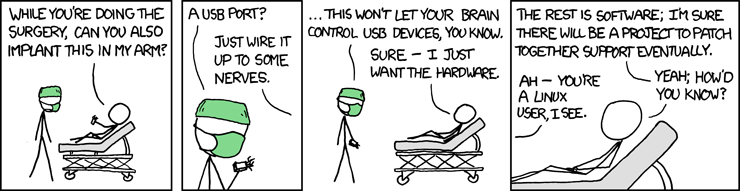
Also I would write an usb driver https://xkcd.com/644/
 junior jackal
glossy zephyr
Wish my dna was programmable. I would add ```rust
if going_to_procrastinate || g...
junior jackal
glossy zephyr
Wish my dna was programmable. I would add ```rust
if going_to_procrastinate || g...
dont() is such a clear function name
glossy zephyr
junior jackal
dont() is such a clear function name
And so easy to implement
 cloud kestrel
Make it an unhygienic macro
junior jackal
the exclamation mark adds needed emphasis--
daring vapor
glossy zephyr
Also I would write an usb driver https://xkcd.com/644/
A summary of neuralink/j
seriously they basically made a driver that converts the signals that say "move arm" into "move mouse"
Its basically only usable for paralyzed people where the signals wont conflict with body movements
floral plover
daring vapor
seriously they basically made a driver that converts the signals that say "move ...
sounds phenomenal when you describe it like that
daring vapor
floral plover
sounds phenomenal when you describe it like that
Yea meanwhile everyone who heard about neurolink is going "cant wait to get ads streamed into my brain ugh!"
Its incredibly annoying how new tech is getting framed and effectively fearmongering people into killing progress on that tech
Nuerolink isnt even the first thing to do this
The biggest leaps it made were
- shrink the hardware down to be minimally invasive and minimally cumbersome to have
Thats it. That's the big achievement.
Making it small enough it doesn't look like they have a billion wires strapped to their head.
hoary vector
glossy zephyr
Wish my dna was programmable. I would add ```rust
if going_to_procrastinate || g...
justdont();
 solemn trout
daring vapor
Yea meanwhile everyone who heard about neurolink is going "cant wait to get ads ...
solemn trout
daring vapor
Yea meanwhile everyone who heard about neurolink is going "cant wait to get ads ...
its extremely understandable as a "this is scary" , the ads thing is most likely ironic with a grain of truth for most peope
also, depends on who is running it, and focus is on neuralink cuz musk
also, capitalism, need i say less.
daring vapor
Its literally incapable of sending signals to the brain.
Only receiving.
We are well over 50 years away from a usable 2 way brain/tech interface.
solemn trout
daring vapor
Its literally incapable of sending signals to the brain.
Only receiving.
We are ...
trve...
but recieving signals still also sparks a privacy fear, and you have to see that "ads in my brain" are just quippy lines
red parcel
They put ads on the main menu of my tv, no doubt they would stream them to my head if they could
But they obvs can't, it's just a great indicator of corprate greed and why I don't trust them
glossy zephyr
Wouldn't feel comfortable that i have propertiary software in my head, unless if eu enforced the software to be foss
daring vapor
glossy zephyr
Wouldn't feel comfortable that i have propertiary software in my head, unless if...
Pacemakers already have proprietary stuff :/ you probably sol
glossy zephyr
Computers suck
daring vapor
Even the most low level linux people agree
You cant escape proprietary.
It exists even in the hardware micro code level and you'll never be able to replace everything.
hoary vector
daring vapor
Pacemakers already have proprietary stuff :/ you probably sol
foss pacemakers when
unkempt karma
glossy zephyr
Wish my dna was programmable. I would add ```rust
if going_to_procrastinate || g...
Since no alternative actions were specified, this causes the janTatesa process to hang
 honest yew
