 tawdry shell
I've just published the first version of the Hookdeck Vercel Middleware and would appreciate feedback from the community.
The Hookdeck Vercel Middleware requires minimal effort (install + simple configuration) and a DX that fits into a code-first workflow. So, within a few minutes, you've converted a Next.js route into a reliable and feature-rich asynchronous endpoint.
Along with the simple setup, I believe this solves a real problem with numerous use cases. The main one is handling webhooks (Stripe, Shopify, Twilio, etc.) at a scale where you really don't want to miss a webhook.
Here's the repo: https://github.com/hookdeck/hookdeck-vercel
An example Next.js app: https://github.com/hookdeck/hookdeck-vercel-example
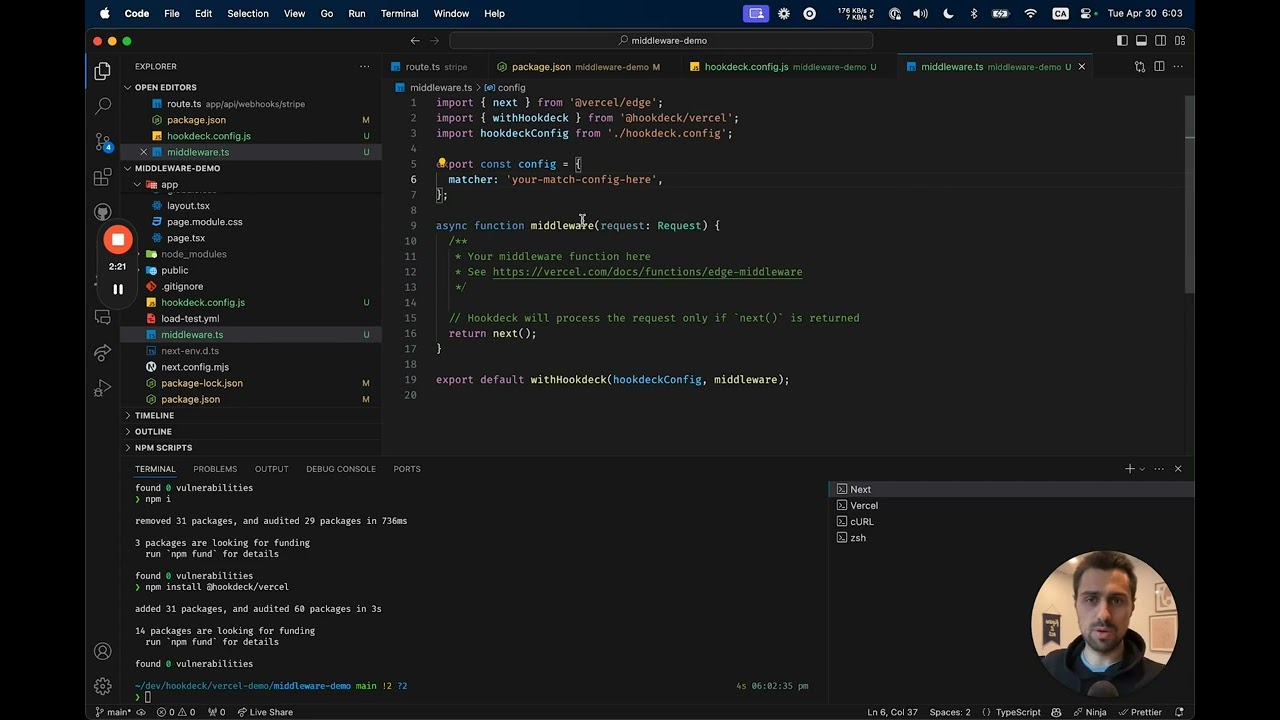
And a 5-minute video of our CEO and co-founder, Alex, installing, configuring, and deploying a Next.js app: https://youtu.be/bQzyhyVNbY8

Authenticate, delay, filter, queue, throttle, and retry asynchronous HTTP requests (e.g., webhooks) made to a Vercel application via a middleware integration with Hookdeck - hookdeck/hookdeck-vercel

An example of using the Hookdeck Vercel Middleware - hookdeck/hookdeck-vercel-example
The Hookdeck Vercel Middleware enables you to turn any Vercel deployed endpoint, irrespective of the framework, into an asynchronous endpoint with features such as queuing, throttling, retry logic, delays, and verification.
In this demo, Alex walks through adding the Vercel Hookdeck Middleware, with retry and throttling configuration, to a Next...