#RWKV-papers
1 messages · Page 5 of 1
 steady ether
 obsidian quest
how's the paper going 🙂
 misty igloo
obsidian quest
how's the paper going 🙂
misty igloo
obsidian quest
how's the paper going 🙂
i gotta flesh out and add citations for the background section
@gusty condor would you mind if I try some new language for the introduction? feel free to throw it out if you don't like it as much
misty igloo
obsidian quest
how's the paper going 🙂
please feel free to look over the current draft and give us critiques or suggestions
either here or via comments in the overleaf itself
obsidian quest
misty igloo
please feel free to look over the current draft and give us critiques or suggest...
got links?
it's a bit unfortunate that we used "RWKV" instead of "RWKV-4" lol
misty igloo
obsidian quest
got links?
#1103039376184852622 message
obsidian quest
misty igloo
https://discord.com/channels/729741769192767510/1103039376184852622/117511298951...
Restricted, sorry you don’t have permission to load this page.
 gusty condor
https://www.overleaf.com/1623283552mkymjtvsnybt#bd0fc2
Keyword: RWKV-5, RWKV-6, RWKV-X, article, paper, link, overleaf
(Please pin this message to avoid searching for keywords)

An online LaTeX editor that’s easy to use. No installation, real-time collaboration, version control, hundreds of LaTeX templates, and more.
 void quartz
gusty condor
https://www.overleaf.com/1623283552mkymjtvsnybt#bd0fc2
Keyword: RWKV-5, RWKV-6, ...
void quartz
gusty condor
https://www.overleaf.com/1623283552mkymjtvsnybt#bd0fc2
Keyword: RWKV-5, RWKV-6, ...
btw i can help work on memory, and long range dependency benchmarks - since that was an area i was actively testing previously
(if it makes sense to fit it in)
gusty condor
It's yours
void quartz
(side: does it make sense to branch the tokenizer to its own paper?, saw that section)
gusty condor
No, do you have enough information to fit that into a 8-page-long paper?
void quartz
gusty condor
No, do you have enough information to fit that into a 8-page-long paper?
measuring the token efficiency across multiple languages is probably NOT 8 pages 😂
 subtle oak
gusty condor
https://www.overleaf.com/1623283552mkymjtvsnybt#bd0fc2
Keyword: RWKV-5, RWKV-6, ...
subtle oak
gusty condor
https://www.overleaf.com/1623283552mkymjtvsnybt#bd0fc2
Keyword: RWKV-5, RWKV-6, ...
I can work for the Background 2.1 (if it is okay), I want to write a blog for this topic for a long time😂
void quartz
there is a side tangent, of seeing if a model perform better with the new tokenizer in another language (and english), compared to baseline - which might add up pages
(we are kinda assuming it gives better results, kind of - it is more token efficient for sure)
cause being trie based only, flys against current convention wisdom of BPE tokenizer
subtle oak
Maybe can submit a short paper instead of regular size?
4 pages instead of 8? If do not have enough info to fit 8 pages?
steady ether
subtle oak
I can work for the Background 2.1 (if it is okay), I want to write a blog for th...
- Introduction and 2. Background already sort of covered the placeholder for 2.1. Rest is just formatting.
So far, it sounds like we've tried a bunch of stuff, and it worked. Adding some material on the motivation and theory behind things would be great.
subtle oak
Oh I see, few lines in Sec.2 mentioned these topics, thanks!
subtle oak
steady ether
1. Introduction and 2. Background already sort of covered the placeholder for 2....
Yeah, there are too many tricks on RWKV and it works well… You mean that maybe we need to think about the motivations and theory for that?
steady ether
I think we're just missing something like, 'The original RWKV architecture has limitations when it comes to X, Y, and Z, so we decided to try RWKV-5 to address X and Y, and RWKV-6 to address Z.
gusty condor
gusty condor
https://www.overleaf.com/1623283552mkymjtvsnybt#bd0fc2
Keyword: RWKV-5, RWKV-6, ...
I wonder if we need to pin this link to avoid drowning in the message flow. There is someone who might be willing to help but couldn't find the link.
subtle oak
steady ether
I think we're just missing something like, 'The original RWKV architecture has l...
Oh I see. in some degree like a chronicles of RWKV? How do we evolve from RWKV-4 and why we decided to add these features with this sequence
 last mauve
gusty condor
https://www.overleaf.com/1623283552mkymjtvsnybt#bd0fc2
Keyword: RWKV-5, RWKV-6, ...
last mauve
gusty condor
https://www.overleaf.com/1623283552mkymjtvsnybt#bd0fc2
Keyword: RWKV-5, RWKV-6, ...
last mauve
gusty condor
https://www.overleaf.com/1623283552mkymjtvsnybt#bd0fc2
Keyword: RWKV-5, RWKV-6, ...
last mauve
gusty condor
https://www.overleaf.com/1623283552mkymjtvsnybt#bd0fc2
Keyword: RWKV-5, RWKV-6, ...
pinned!
last mauve
subtle oak
Oh I see. in some degree like a chronicles of RWKV? How do we evolve from RWKV-4...
Not chronicles. Come from the standpoint of resolving the shortcomings, and don't go into the history at all. See #1103039376184852622 message
last mauve
subtle oak
I can work for the Background 2.1 (if it is okay), I want to write a blog for th...
Please do!
subtle oak
last mauve
Not chronicles. Come from the standpoint of resolving the shortcomings, and don'...
Got it! Thanks so much. Like in short words to describe “RWKV4 has these shortcomings, and we need to solve them, then describe how we use RWKV 5/6 to solve”?
last mauve
subtle oak
Got it! Thanks so much. Like in short words to describe “RWKV4 has these shortco...
No, that would be the design section. The background section is for getting the audience quickly up to speed on important precursor concepts from before this paper. No new designs or shortcomings of past designs should be included. Read the first RWKV paper for reference.
subtle oak
Oh sorry I misunderstood. So it will function more like a traditional related work section, for introducing some previous related work while introducing concepts that will be frequently used in the following paper?
last mauve
subtle oak
Oh sorry I misunderstood. So it will function more like a traditional related wo...
No, related work is for comparing/contrasting your current contributions with those of others. Background is for foundational concepts that need to be understood before reading the design. Check the first RWKV paper for this.
subtle oak
Oh I see there are separate parts in the first paper… I’ve never noticed here before. I think I finally got what we need in this section. thank you so much!
last mauve
Ok so in comparing the arxiv-v1 and EMNLP versions of the first RWKV paper, I actually think we can just replace the current arxiv with the EMNLP version, and move directly to the RWKV-v5/v6 arch paper.
Edit: Ok, arxiv has been updated. Let's move forward with RWKV-v5/v6
last mauve
High-level things that need done in the RWKV-X overleaf:
Background:
1. Subsection on RNNs (similar to first paper, but directly copy nothing. Reword at the very least)
2. Subsection on Transformers and AFT (again similar to first paper, but directly copy nothing. Reword at the least)
3. Subsection on RWKV-v4 (summarization of the first paper, with an architecture figure). Can probably retool the current section 3 header in RWKV-X at "RWKV Architecture Summary" for this, along with the start of section 3 in the EMNLP version
Related Work:
Use the first paper's related work in appendix C as a template. Remember that this is anonymous and we can't say this is our arch.
4. Reword and update related work from Appendix C as a base
5. Add any subsequent work (mamba, hyena, RWKV-v4, etc)
Design:
6. The existing subsections 4.x in RWKV-x need more explanation and we need new figures similar to Figures 2/3 from the RWKV-EMNLP
Evaluations:
7. Need a set of figures on downstream tasks comparing to transformer and SSM arches (including RWKV-v4). Similar to RWKV-EMNLP's figure 5
8. Need scaling law results like figure 4 of the mamba paper figure 4 of RWKV-EMNLP (see for context on why we don't want a figure like mamba)
Trained Models:
9. The existing section 5 and Table 1 in RWKV-X is pretty good. Some comments are to:
**9a ** Add a "Name" column like table 2 of RWKV-EMNLP,
9b Clarify that these equations are per-token
9c All of the subscript-5/6 should be updated to subscript-v5/v6 to make it more explicit that these refer to different arches
Several other sections need started, for which the task is "start".
I'm going to start by making the high-level structure a bit more clear, and make sections more contributor-friendly with TODO statements and section skeletons
last mauve
last mauve
High-level things that need done in the RWKV-X overleaf:
Background:
**1.** Sub...
misty igloo
@last mauve for adding more explanation to subsections 4.x in RWKV-x do you mean that we need description of what's going on and how it works mechanically because the formulae are currently unclear, or some description in that section of the motivation for why these mechanisms were chosen?
gusty condor
last mauve
High-level things that need done in the RWKV-X overleaf:
Background:
**1.** Sub...
- Section 5 was my work
last mauve
misty igloo
<@367104793292046338> for adding more explanation to subsections 4.x in RWKV-x d...
Both. For example, why use token shift and what does it mean intuitively? Is a figure possible? As a non-expert in RWKV-v5/v6, the raw formula is confusing without the context about how it fits into the overall model architecture and how it helps.
 young sparrow
last mauve
High-level things that need done in the RWKV-X overleaf:
Background:
**1.** Sub...
young sparrow
last mauve
High-level things that need done in the RWKV-X overleaf:
Background:
**1.** Sub...
8: I actually rather dislike the scaling laws plot in the mamba paper. They do not seem to perform any search for the optimal token-to-parameter ratio and instead assume that it's the same as it is for transformers. In the scaling laws plot I added to the EMNLP version, as well as both Kaplan et al. and Hoffman et al., instead we search many combinations of (parameters, tokens) and then find the optimal configuration for each FLOP value and fit the curve to that.
The reason this is problematic is that it can disadvantage models that have different optimal tradeoffs. If they were just comparing to the optimal tradeoff identified in our paper or in Hoffman et al. that would be fine as it would only disadvantage their model, but they also do this for several competitor models. This makes it impossible to know if they're hurting themselves more than they're hurting the competition.
That plot is meaningful as an argument that the architecture is better because for a fixed (param, token) pair the architecture outperforms others, but it's not an argument that the optimal scaling is better because it doesn't remark on the optimal scaling regime at all.
Put another way, it's effectively the same plot as our "average of 12 benchmarks" plot but using Pile loss instead of 12 NLP benchmarks. It's not a scaling laws plot.
last mauve
young sparrow
Put another way, it's effectively the same plot as our "average of 12 benchmarks...
Gotcha. Updated
obsidian quest
last mauve
Ok so in comparing the arxiv-v1 and EMNLP versions of the first RWKV paper, I ac...
https://arxiv.org/abs/2305.13048 seems not updated yet

arXiv.org
Transformers have revolutionized almost all natural language processing (NLP) tasks but suffer from memory and computational complexity that scales quadratically with sequence length. In contrast, recurrent neural networks (RNNs) exhibit linear scaling in memory and computational requirements but struggle to match the same performance as Transfo...
Should we name it
RWKV-5 and RWKV-6: xxx
CHANGE:
In this work we present RWKV-5, which builds on the architectural improvements and learned decays from RWKV-4, as well as the matrix valued states found in Linear Transformers.
(because it was proposed in Linear Transformers, not RetNet)
CHANGE:
Influenced by the Retention Network (RetNet) architecture ==> Influenced by the Linear Transformer architecture
GroupNorm = LayerNorm for each head. So no need to say it's GroupNorm.
Token 257-65529: actually includes lots of languages, not just Asian. and symbols.
Moreover it's a greedy tokenizer. Faster and Easier to code.
We can follow this narrative:
- Matrix-valued states were proposed in Linear Transformers.
- RWKV = [exp. decay + token shift + AFT]
- RetNet found [exp. decay + xPos + Linear Transformer] works
- So RWKV 5/6 is doing [exp. decay + token shift + Linear Transformer]. We don't use any extra postional embedding.
Moreover RWKV models are much better tuned than RetNet. We can show the loss curves.
And we should compare with Mamba, GateLoop, etc.
We can make a table:
- decay/gate: real-valued exp. decay, complex-valued, data-dependent etc.
- positional embedding
- state: RWKV4 = vector state, Mamba/SSM is like "multi-vector" state, and then we have matrix-valued states
 tough crane
obsidian quest
We can follow this narrative:
* Matrix-valued states were proposed in Linear Tra...
tough crane
obsidian quest
We can follow this narrative:
* Matrix-valued states were proposed in Linear Tra...
Moreover RWKV models are much better tuned than RetNet. We can show the loss curves.
Does this means RWKV 5/6 are better at pretraining or at fine-tuning?
obsidian quest
pretraining loss curve. train from scratch on new data
tough crane
obsidian quest
pretraining loss curve. train from scratch on new data
Do we need to conduct Chinchilla's scaling law experiments for 200M ~ 1B (or more params) ??
obsidian quest
https://github.com/BlinkDL/nanoRWKV
nanoRWKV "x051a" - does not require custom CUDA kernel to train, so it works for any GPU / CPU.
https://twitter.com/BlinkDL_AI/status/1734254476218057170
python data/shakespeare_char/prepare.py
python train.py config/train_shakespeare_char.py
python sample.py --out_dir=out-shakespeare-char
GitHub
RWKV in nanoGPT style. Contribute to BlinkDL/nanoRWKV development by creating an account on GitHub.
misty igloo
obsidian quest
CHANGE:
In this work we present RWKV-5, which builds on the architectural improv...
I implemented many of these changes, though I think the introduction and implicit 'story' can still use more work.
If you could review the new parts I wrote about token shift in sections 4.1, 4.4, 4.5 that would be greatly appreciated. I tried my best to infer your rationale based on our limited discussion 🙂
obsidian quest
misty igloo
I implemented many of these changes, though I think the introduction and implici...
In Introduction, we can mention "RWKV-5 applies..." before "Retentive Networks..." and we should mention Mamba (dynamic data-dependent decay) after RetNet
Extra Silu gate is used in Mamba too
We can mention RWKV-5-lite as a variant without custom cuda kernel requirement for training
rwkv5 rwkv6 were trained with 0.001 weight decay (only for matrix-valued weights: linear, emb)
mamba is utilizing SRAM for similar parallelization
misty igloo
obsidian quest
In Introduction, we can mention "RWKV-5 applies..." before "Retentive Networks.....
I imagine this ordering was intended to both explain the progression of models over time and conclude with our contribution (I didn't originally write this particular section tho) I'm not sure we should mention RetNet in section 1 at all - imho it's better left to section 2 (Background).
@obsidian quest did you have any comments about the token shift descriptions? I want to make sure I'm not getting anything wrong about the rationale
obsidian quest
token shift = induction head & locality a priori, similar to conv1d with kernel sz 2 too
misty igloo
obsidian quest
token shift = induction head & locality a priori, similar to conv1d with kernel ...
what I said in the most recent draft is that token shift makes it possible to form induction heads within a single layer, and that the v6 token shift changes allow important information to flag itself for inclusion in the data stream, while unimportant information can similarly avoid incluson
obsidian quest
misty igloo
what I said in the most recent draft is that token shift makes it possible to fo...
yeah
and we can use this_token + last_token to detect this
obsidian quest
#general message
We should emphasize RWKV-2-RNN was the first to show "exponential decay is all you need"
can add a section in appendix for the timeline of RWKV
subtle oak
Is it like a chronicle from RWKV-1 to RWKV-6? Maybe I talked this before😂
obsidian quest
from https://arxiv.org/abs/2312.06635
This type of model with matrix-valued hidden states that change over time is also known as “fast weights"
yeah we should make Schmidhuber happy too 😂
arXiv.org
Transformers with linear attention allow for efficient parallel training but can simultaneously be formulated as an RNN with 2D (matrix-valued) hidden states, thus enjoying linear (with respect to output length) inference complexity. Recent works such as RetNet (Sun et al., 2023) and TransNormerLLM (Qin et al., 2023a) observe that adding a globa...
gusty condor
obsidian quest
can add a section in appendix for the timeline of RWKV
I was thinking about this idea, but @young sparrow disagreed on putting RWKV history in the paper, because that the paper aims to let readers catch up the current progress of RWKV architecture, rather than tracking the RWKV memory lane.
last mauve
gusty condor
I was thinking about this idea, but <@193204646687408129> disagreed on putting R...
I agree here. No histories in a paper. This would instead be a very nice blog post.
misty igloo
last mauve
I agree here. No histories in a paper. This would instead be a very nice blog po...
I've been somewhat caught in the cross currents here, trying to thread the needle between 'just tell us how it works/what's new' and showing where it comes from. Currently trying to fix up the background to accomodate that while keeping it appropriate for a paper.
last mauve
misty igloo
I've been somewhat caught in the cross currents here, trying to thread the needl...
There's a very clear distinction on what's appropriate, I think. If the secondary info (e.g. intuition from a similar study/paper like "studies on CNNs demonstrate that shallow layers learn general representations while deep layers learn specific representations [cite]") on a design feature is included to help the reader understand how/why the design feature works, that's appropriate. If the secondary info is for any other reason (e.g. to claim ownership or to give interpersonal/organizational history like "we discovered XXX in May 2023 before Mamba"), then it violates double-blind and isn't appropriate for a paper.
Anything flies for a blog post, and I encourage people to post the history and demonstrate ownership there.
To be clear though, we're still able to make statements in the Background and Related Work sections such as "RWKV [cite] introduced exponential decay is all you need", but they can't be excessive and they can't violate double-blind
misty igloo
I think I've avoided adding anything that's inappropriate in terms of anonymity in all the sections I wrote or edited to date (of course feel free to correct me if not)
The push and pull for me is more just about what extra background we include in terms of the (often third party) developments that lead up to this combination that we call RWKV5 and 6, since I think Bo has expressed wanting that in the paper.
void quartz
btw how many people here is at neurips?
(dropping by tmr)
 remote elbow
#1171291697561477170
last mauve
void quartz
btw how many people here is at neurips?
(dropping by tmr)
I'll also be arriving tomorrow evening! We should meet.
void quartz
last mauve
I'll also be arriving tomorrow evening! We should meet.
Sure! You going for workshops? Wondering if we should stay for that
last mauve
void quartz
Sure! You going for workshops? Wondering if we should stay for that
Yep I'll be attending and presenting at the neural scaling laws workshop https://sites.google.com/mila.quebec/6thnslw-no/home?authuser=0
young sparrow
@void quartz I'm here all week, would love to meet you
void quartz
Great!, see you both from tmr morning then 🙂
last mauve
To help me in writing this paper, can someone in clear terms either explain or point me to something comparing the Mamba arch with RWKV-v4? Mamba will likely be our primary competing arch and I want to be able to strongly differentiate RWKV from mamba in the background/related sections of the upcoming paper
 misty cedar
I guess with Based releasing benchmarks for multiprocessing using linear transformers, these graphs gain a little more relevancy.


 void quartz
last mauve
To help me in writing this paper, can someone in clear terms either explain or p...
void quartz
last mauve
To help me in writing this paper, can someone in clear terms either explain or p...
@misty igloo - need your help confirming on mamba (as there were changes from statespaces) - its still log(n) right?
void quartz
kinda dumb: Can we do a direct counter of the RetNet paper "parallel table", with a clear definition of parallel in the v5 paper
We got rejected for the OakRidge compute grant, over a new RNN (yet to be out, so no ideas the detail), that cited that retnet paper, and said that they fixed that parallel problem, and is the reason why RWKV could not scale past 14B.
obsidian quest
that is very mean of them to speak so lol
we can easily demonstrate the training speed of rwkv is constant regardless of ctxlen
void quartz
obsidian quest
that is very mean of them to speak so lol
its not "retnet", its another team thats just quoting retnet
obsidian quest
void quartz
its not "retnet", its another team thats just quoting retnet
i know, still it's mean to claim we could not scale past 14B lol
misty igloo
void quartz
<@1007072846960410685> - need your help confirming on mamba (as there were chan...
no, it's like rwkv-6 - O(1) per time step, O(N) for sequence length N
void quartz
misty igloo
no, it's like rwkv-6 - O(1) per time step, O(N) for sequence length N
ahhh thanks for clarifying
misty igloo
void quartz
ahhh thanks for clarifying
in case it helps, to quote from some stuff I put in the new paper but may not make it to the final cut:
Earlier SSMs were historically computed using long convolutions in $O(N\log N)$ time per sequence, but could also be formulated as recurrence relations. Recent SSMs featuring data-dependent $A$ and $B$ terms (GateLoop, Mamba) are only able to be formulated as recurrence relations. Generally, such recurrence relations can run in $O(N)$ time with respect to sequence length
 silent urchinBOT
Smerky
 obsidian quest
void quartz
ahhh thanks for clarifying
obsidian quest
void quartz
ahhh thanks for clarifying
all gen6 designs are same
misty igloo
last mauve
To help me in writing this paper, can someone in clear terms either explain or p...
RWKV-4 and Mamba are quite different, but RWKV-6 and Mamba are much more similar
Mamba follows the traditional state space mechanism (more or less) of:
$h = h {\Delta A} + x {\Delta B} \
y = h C + x D$
where dB expands x into a new dimension and dA is supposedly a diagonalized version of something theoretically complicated
(I say supposedly because their code doesn't quite match their paper and some things are unexplained)
and C reduces the hidden state back to the embedding dimension
RWKV-6 is more like
$kv = (x W_k)^T (x W_v) \
h = h w + kv \
y = r (h + kv \cdot u)$
unfortunately, I don't know of a way to clearly show the differences between these
silent urchinBOT
Smerky
 misty igloo
last mauve
To help me in writing this paper, can someone in clear terms either explain or p...
misty igloo
last mauve
To help me in writing this paper, can someone in clear terms either explain or p...
There are other differences, as well... Mamba changed the traditional transformer layout from the usual blocks of sequential Attn and FFN to a unified new kind of block that expands 2x like a FFN, then does a short kernelsize 4 1D convolution analagous to but different from rwkv's tokenshift, then does the SSM, gates, and shrinks it 2x back out like the output projection of a FFN
 gusty condor
obsidian quest
we can easily demonstrate the training speed of rwkv is constant regardless of c...
gusty condor
obsidian quest
we can easily demonstrate the training speed of rwkv is constant regardless of c...
Add that into paper 🙂 needs experiments
 spiral minnow
misty igloo
RWKV-4 and Mamba are quite different, but RWKV-6 and Mamba are much more similar...
spiral minnow
misty igloo
RWKV-4 and Mamba are quite different, but RWKV-6 and Mamba are much more similar...
Why can't you just show those equations and say that's the difference?
misty igloo
spiral minnow
Why can't you just show those equations and say that's the difference?
For one thing, his original question was about the difference between rwkv-4 and mamba, which is so different it's somewhat hard to even compare them 🙂 (I showed rwkv-6 above since they're more similar)
I guess I'm also just not certain what Quentin's goal is in showing the differences so it's hard for me to know if that suffices 🙂 As seen above, their attention formulae have terms that are quite similar in some places... but there's a lot of nuance too, like because of the way the Mamba incoming projection replaces some of what normally would be the projection from inputs to values, and how multiplying out (k^T)(v) per head is different than just expanding the full input by a smaller new dimension via matrix dB
So despite being similar, the differences are quite complicated.
And just to add a cherry on top, the Mamba code appears NOT to quite match the paper. And Bo says that the results don't match either!!! (And that the reported results must employ some secret sauce that isn't in the publicly released code)
Fun stuff
steady ether
The authors of Mamba will be giving a community talk at NeurIPS. Those attending the conference can go and ask them questions. 😉
 void quartz
sadly 😦 will miss it - me & harrison - our flight got delayed till 5pm
obsidian quest
misty igloo
There are other differences, as well... Mamba changed the traditional transforme...
that comes from https://arxiv.org/pdf/2202.10447.pdf
 obsidian quest
obsidian quest
obsidian quest
please update RWKV-4 paper to use "RWKV-4" instead of RWKV 🙂
gusty condor
I wonder whether title is changeable
RWKV-4: Reinventing RNNs for the Transformer Era
Anyway, my opinion is that, if we matter anonymity, then that might be a bad idea (alluding that "we" have developed RWKV-1 to 3, and aiming for 5+), but if we are already famous, then that doesn't matter a bit (like OpenAI's articles are only posted on OpenAI's website and not anywhere else).
misty igloo
obsidian quest
that comes from https://arxiv.org/pdf/2202.10447.pdf
yes very very similar, except mamba computes their equivalents of q&k from the expanded V rather than directly from the input
that's a good way to compare that part in the paper, if we want to!
void quartz
gusty condor
I wonder whether title is changeable
```
RWKV-4: Reinventing RNNs for the Transf...
We could add a section that explains 1-3 is done as an open source research project?
Cause this is reflective of reality
(Do paper reviewers expect us to change reality to fit their version schema)
misty igloo
gusty condor
I wonder whether title is changeable
```
RWKV-4: Reinventing RNNs for the Transf...
the double blind anonymity is only relevant during the peer review process, and the original paper already went through that
it's just meant to protect the review process so that there is no biased treatment of the paper i.e. for acceptance into a journal
young sparrow
gusty condor
I wonder whether title is changeable
```
RWKV-4: Reinventing RNNs for the Transf...
We can change it on arXiv, but I think this is a very bad idea
young sparrow
obsidian quest
https://twitter.com/BlinkDL_AI/status/1735258602473197721
People do not know about RWKV-6 and typically do not compare with work that doesn't even have a preprint because they don't know if it's "ready" or not. The best way to get people to compare to RWKV-6 is to write a paper about it
young sparrow
gusty condor
I wonder whether title is changeable
```
RWKV-4: Reinventing RNNs for the Transf...
The paper has already been published and anonymity doesn't matter
obsidian quest
young sparrow
People do not know about RWKV-6 and typically do not compare with work that does...
meanwhile we can only try our best to point out they are comparing with rwkv4 😂
young sparrow
obsidian quest
meanwhile we can only try our best to point out they are comparing with rwkv4 😂
That's not what your tweet does. Your tweet accuses them of acting in bad faith.
obsidian quest
they are using this opportunity
they certain know the existence of rwkv 5/6 and avoid mentioning it
young sparrow
I don't know that to be true and I think it's immoral to accuse them of that unless you are certain
Have they told you that?
obsidian quest
some of them follow my twitter
young sparrow
That doesn't mean that they know that the models are finished
obsidian quest
rwkv5 models were released long ago
young sparrow
That doesn't mean that they know that the models are finished.
And like I said, it's widely considered problematic to compare with unpublished work. Even if they know about it, they could be waiting for a paper and not trying to sneakily make themselves look good
Accusing them of acting in bad faith based on this evidence will only cause people to dislike you and not want to compare to your work
I cannot more strongly recommend that you stop doing this
 sharp sonnet
I agree. Unfortunately, people look for published work (or a preprint) to compare.
We have no reason to believe anyone acted in bad faith. Very likely, this happened just because the researchers may not have realized the work is finished.
young sparrow
Also writing papers takes time. For all you know they finished the experiments a while ago and only just got the paper out
sharp sonnet
The right steps would be publishing our preprints faster and reaching out to authors if any claim is incorrect so that they correct them (eg the parallel table)
obsidian quest
It's unfortunate that we don't have as much resources
young sparrow
Yes it is
obsidian quest
The table in RetNet is certainly acting in bad faith, so I do think there is some hostility towards us as a potential competitor
young sparrow
I agree that they're not playing nicely.
sharp sonnet
I don’t know much about what happened. However, I strongly believe we should just continue doing good science
young sparrow
But this is still the wrong way to go about addressing this fact
obsidian quest
sharp sonnet
The right steps would be publishing our preprints faster and reaching out to aut...
yeah this is certainly the best method
sharp sonnet
We can add experiments correcting any of the possibly incorrect claims.
obsidian quest
In the future I should make a disclaimer that my rants only represent myself and don't represent RWKV views 😂
young sparrow
Isn't there a RWKV Twitter? Using that to distribute release info would be helpful on both the reputational and the advertisement front
obsidian quest
young sparrow
Isn't there a RWKV Twitter? Using that to distribute release info would be helpf...
yeah can always feel free to use that to criticize me 🙂
steady ether
How about we release a working paper on RWKV-5? It doesn’t need to be complete.
young sparrow
obsidian quest
yeah can always feel free to use that to criticize me 🙂
I don't think that that would be productive and don't have access to it
obsidian quest
I am the kind of people who have the tendency to sometimes break rules as long as they don't harm others (and i will take / pay for the consequences too, will not avoid them) 😂 most people will hate me
It's my fault that we used "RWKV" for the RWKV-4 paper, and haven't published the RWKV-5/6 paper in time. Life is harsh 😂
void quartz
young sparrow
Isn't there a RWKV Twitter? Using that to distribute release info would be helpf...
Let’s limit the official rwkv twitter that we are starting to completed model releases. And less so on marketing future models
void quartz
steady ether
How about we release a working paper on RWKV-5? It doesn’t need to be complete.
From a marketing hat point of view. If possible I would rather us push that with the 7B model launch
And also to not rush everyone working on it in this channel
So let’s aim for mid/late Jan?
For those who compared to v4 - we can ask them politely if they can add v5 to compare (the 1.5B / 3B models) when appropriate.
If they did so in good faith, they would be open to amend.
If they did it in bad faith, I doubt confronting them will change anything (like retnet)
misty igloo
obsidian quest
It's my fault that we used "RWKV" for the RWKV-4 paper, and haven't published th...
Not your fault - it's important to show the v5 7B results and they take time with limited compute resources.
Is the plan to publish with full v5 7B results but a more limited set of v6 results? (1.5B or maybe 3B by preprint release time)
@spiral minnow just wanted to note that I removed your addition of quadratic memory complexity for transformers - that has been shown to be unnecessary e.g. flashattention
void quartz
misty igloo
Is the plan to publish with full v5 7B results but a more limited set of v6 resu...
does it make sense to put v6 as future works?
im not sure if we would have 3B model fully ready by then
misty igloo
void quartz
does it make sense to put v6 as future works?
im not sure if we would have 3B m...
I think either way works, but if you want people to reference the best possible results for RWKV in future papers we should put it in now
This is exactly the same situation we're facing now with people quoting numbers from v4
I added all the formulae and descriptions so that we wouldn't fall behind
Just in case we were ready - if not, that's fine and we can delay the v6 paper easily
since we have it all written now
void quartz
i would defer to those who know the academic norms then on this, was worried it just wierd that we added v6 without all the models
i think another direction if we want to push against this issue
is we need to publish blogs
misty igloo
yeah, just a question of whether a 1.5B model for v6 enough when we show up to 7B for v5
void quartz
so it doesn't have the same rigor requirements for the paper, and is atleast official enough
misty igloo
alternatively, we could publish a working paper for v6 - but it's probably less work for it to remain integrated into the current paper
void quartz
u know what - setting up an RWKV blog has been so long on my todo - just gonna set it up via substack
( classic coder conflict of wanting to do it better, but not having the time )
misty igloo
void quartz
so it doesn't have the same rigor requirements for the paper, and is atleast off...
if you want upcoming papers to quote the rwkv-6 results, it has to be a paper and not just a blog post
at least then they will have to show the v6 1.5B results when comparing to their 1.5B results
misty igloo
we should also release a 125m model btw so people have a reference point
and any standard sizes people tend to use in between
since we can train those quickly
and it will help ensure that upcoming papers quote our best results
especially when they don't train larger versions, it's useful to have our small one shown to compare side by side
I'm personally in favor of keeping the two papers integrated as they are now, simply because it's less effort than making a whole new one. But I'm open to a separate rwkv-6 working paper or somesuch if our advisors think that's best!
void quartz
misty igloo
especially when they don't train larger versions, it's useful to have our small ...
should we train multiple v5 small models (125m??), with the combination of
- pile, world v2 partial (same token count), world v2 full
- gpt-neox, world tokenizer
so we can show the transition
if the result is close enough for the partial, it can close off a possible criticism that its not a fair compare with different dataset/tokenizer
misty igloo
void quartz
should we train multiple v5 small models (125m??), with the combination of
- pil...
not sure what the training mix should be - pile is of course the most standard - but having some smaller v6 available would really improve uptake of our best models in other upcoming papers comparisons
void quartz
not sure if this is useful, or a waste of resource (which is already limited)
the idea is just all 3 x 2 varients
misty igloo
it'd be great, but I'm not trying to make more work or strain our resources... just any single 125m v6 model would probably help a lot
because it will force people to show it in comparisons when they only have their own small models to compare to
(this only helps if we publish a v6 paper tho)
obsidian quest
void quartz
should we train multiple v5 small models (125m??), with the combination of
- pil...
can do one on pile, and one on slimpajama, when we have compute
gusty condor
void quartz
should we train multiple v5 small models (125m??), with the combination of
- pil...
Yes, but the dataset is currently at BlinkDL, and tokenizer size counts into parameters (L12 D768 is 193M, compared for 169M for Pile)
void quartz
IMO - i think the world tokenizer needs a separate paper
been speaking to multiple researchers who are doing research specifically for their nation language model (and faced tokenization issue) and are working on their own region tokenizers
and there is lots of interest in how and why we did the world tokenizer without BPE, and what would be its compression ratio be for their own respective language
If proven out as things progress, the "trie tokenizer" approach can end up replacing BPE - if that makes sense - and this is completely seperate from the architecture
young sparrow
void quartz
IMO - i think the world tokenizer needs a separate paper
been speaking to multi...
This makes sense to me. I think for this paper we should spend a short subsection, maybe a couple paragraphs, describing it and then we can go into more detail in the other paper
obsidian quest
void quartz
IMO - i think the world tokenizer needs a separate paper
been speaking to multi...
it's simply a greedy tokenizer. extremely simple to implement (trie is only for optimizations). yeah we can write a paper on this
void quartz
Questions like - does it hurt evals - or learning rate was up in the air : which I could not answer accurately 😬
Intuitively the rwkv world model says it’s ok. But that’s a gut feel not a tested hypothesis
Using greedy tokenizers is very counterintuitive given how established BPE is
So same situation of RNN 2 years ago haha
obsidian quest
void quartz
Questions like - does it hurt evals - or learning rate was up in the air : which...
already proven in rwkv world models. no need to change anything. similar results.
because my world tokenizer respects utf-8 boundary & word boundary. this is very important
otherwise you can have bad tokenization (such as "aliasing")
last mauve
obsidian quest
https://arxiv.org/abs/2305.13048 seems not updated yet
Arxiv submissions are always delayed. Try again.
young sparrow
I posted a Twitter thread about the paper update https://x.com/aieleuther/status/1736260370426114466?s=46
tough crane
void quartz
kinda dumb: Can we do a direct counter of the RetNet paper "parallel table", wit...
Could we retry this grant application for v5/6 ?
void quartz
tough crane
Could we retry this grant application for v5/6 ?
it was for v5 - and the dumbest thing was i already sent the direct github link - where the author or retnet acknowledge the definition is not about GPU parallelization
young sparrow
void quartz
kinda dumb: Can we do a direct counter of the RetNet paper "parallel table", wit...
Wait this is absurd levels of BS
Did they tell you explicitly that this is why you were rejected?
void quartz
young sparrow
Did they tell you explicitly that this is why you were rejected?
no, but our rep is lodging a complain on that
that the preferred RNN candidate, uses the retnet claims, as justification to support them over us
(there is no paper, no materials, etc for the other group)
young sparrow
Does our application contain evidence to the contrary?
void quartz
no - we had no idea we would had to fight that claim
we have provided multi-node training data - but our largest is 8 nodes?
young sparrow
Not having evidence that your model scales efficiently is typically a decent reason to reject
You don't need to run it for long, but you absolutely need to show the ability to leverage large scale resources effectively
void quartz
i see, might be why our rep is trying to settle for a smaller grant amount - to prove out leveraging large scale resources specifically
cause it is a chicken and egg - we cant prove we can run on 1000 nodes, till we get limited access at least
they did ask as a follow up (before rejection) - have we ran on 1000 nodes, do we think it will work
- no, we never had such access to run at such scale
- yes, as we are built on pytorch lightning for multi-node training, which has been shown to scale past a 1000 nodes for deepspeed on transformer architecture. RWKV leverages pytorch lightning and deepspeed in the same way.
they did run with us across 100 nodes (for 1 hour?), as part of the validation, but we have no proof of going beyond a 100
tough crane
void quartz
i see, might be why our rep is trying to settle for a smaller grant amount - to ...
Could we run some benchmark of many-nodes (> 1000 nodes) for another weak GPU infrastructures within 0.5 hour ?
steady ether
void quartz
it was for v5 - and the dumbest thing was i already sent the direct github link ...
This has been updated in the V5 paper. It should be pretty clear going forward.
 void quartz
tough crane
Could we run some benchmark of many-nodes (> 1000 nodes) for another weak GPU in...
void quartz
tough crane
Could we run some benchmark of many-nodes (> 1000 nodes) for another weak GPU in...
I have no idea to find anything at that scale now. Even paid AWS / gcp / azure sets really low limits for new account
steady ether
void quartz
I have no idea to find anything at that scale now. Even paid AWS / gcp / azure s...
What about just renting something like this:
steady ether
They still have GPUs, just really weak ones.
obsidian quest
steady ether
This has been updated in the V5 paper. It should be pretty clear going forward.
RWKV 2/3/4/5/6 all have similar complexity
tough crane
void quartz
I have no idea to find anything at that scale now. Even paid AWS / gcp / azure s...
Is it possible to apply another decreased number of GPUs as step-by-step manners ?
e.g. Running benchmark from 8 nodes to 256 nodes and estimating the 1024 performance
plotting y-(performance, training time elapsed) and x-(nodes=8, 16, 32, ..., 256)
young sparrow
@void quartz I know some people. Let me see about pulling some strings. Was your application for Frontier?
last mauve
void quartz
they did ask as a follow up (before rejection) - have we ran on 1000 nodes, do w...
I can run RWKV at whatever scale you need. I never knew we were limited to 8.
last mauve
void quartz
they did ask as a follow up (before rejection) - have we ran on 1000 nodes, do w...
I didn't know they had that followup. This could have easily been resolved. Am I not on this email chain?
void quartz
young sparrow
<@644428303293349888> I know some people. Let me see about pulling some strings....
Summit Plus / Frontier
The request now looks to be moved towards "Director request" for ~30,000 node hours - which can be used to prove out the scaling (and maybe do something useful with it)
misty igloo
steady ether
This has been updated in the V5 paper. It should be pretty clear going forward.
Why are we saying transformer has memory complexity of N^2? That's been shown to be avoidable e.g. FlashAttention
I'm not sure that saying SSMs have memory complexity of NlogN is really correct, either
And what is the N in memory complexity? Many parts of this table don't seem right to me
Also, saying that RNNs can't do multi-gpu training is very questionable... since rwkv is an RNN
Maybe you mean a specific RNN architecture like LSTM?
void quartz
last mauve
I didn't know they had that followup. This could have easily been resolved. Am I...
That would be my fault - didn't understand the implications when they asked for previous run history, and treated it simply reporting what has been done
void quartz
last mauve
I can run RWKV at whatever scale you need. I never knew we were limited to 8.
is it nvidia based? or AMD based? - i think it would be great if we can include short runs for a large model, across key scale sizes, and show their peak tokens/sec - and show a slight loss reduction
that can help disprove and kill off the "cannot train at scale" claim to rest
(ps: we had issues with the frontier AMD node scaling past 100, from what looks like node-to-node communication issues)
you folks probably know better at a 1000 node scale, architectually speaking since its just DDP training runs, and all of that is deepspeed - am i alright in understanding this is handled by deepspeed / pytorch lightning ?
void quartz
void quartz
Summit Plus / Frontier
The request now looks to be moved towards "Director reque...
Clarification, it was applied officially for summitPlus, but not sure the reasons - but it look like they wanted to test scaling on frontier - and was encouraging projects to go in that direction - and we went along with it?
obsidian quest
heard megatron is much better at scaling
void quartz
obsidian quest
heard megatron is much better at scaling
looks like its time to setup a new trainer - again 😂
obsidian quest
ok got this PM "wait before using megatron, we will release soon a nanotron" 😂
young sparrow
You'd need to write a bunch of custom code to use Megatron, since it was designed for transformers
If you're going to put that work in, I highly recommend using GPT-NeoX which is a similar library to Megatron with DeepSpeed support and other custom features.
(Or, "I highly recommend chatting with Quentin about if it would be a good idea to add..."
void quartz
the GPT-NeoX codebase is significantly easier to understand then Megatron itself
young sparrow
Quentin works very hard to make it so 🙂
steady ether
misty igloo
Why are we saying transformer has memory complexity of N^2? That's been shown to...
This was meant to provide clarification on a frequently referenced table.

Ok, I've changed to "Vanilla Transformer" and "LSTMs".
misty igloo
steady ether
This was meant to provide clarification on a frequently referenced table.
Ah gotcha. Didn't remember where I had seen that table before 🙂
I'll take a look back at the retnet paper, but I think placed here it's missing some context that's important. Also, saying SSM is not the same as saying H3/S4/Hyena, since Mamba is a SSM (and also probably shows that those two can now be implemented in what would be called O(N))
I'm a bit worried that copying RetNet's table may not be a great path for us.
I mean, I'd go as far as to say that their data in that table is extremely misleading. We don't want to do the same thing!
steady ether
Yeah, that's a good point!
misty igloo
This whole idea of long-sequence memory complexity that they claim is kind of a red herring. 😭
Maybe we can find an alternative way to point out the differences that show RWKV's benefits
And just to be clear, RWKV and Mamba are very similar in all these kinds of metrics. We shouldn't avoid that fact
steady ether
By the way, looks like the S5 paper also has a somewhat similar table
 misty igloo
that table presents a much fairer comparison imho
but 'parallel' yes/no for RNNs is still pretty misleading
actually I think this table is wrong too haha
the inference column is somewhat misleading
steady ether
Ah, they sort of clarified earlier:
while also being parallelisable across the sequence dimension during training.```MS's survey's asserts similar definition of parallelization... so that training for time clock T is possible before finishing the training past time (<T)
misty igloo
Rather than copy someone else's table, let's come up with a plan for what we're trying to show in comparison and figure out how to best represent that
and we can make it fair, unlike retnet paper
tough crane
Ofcourse, Transformer's quadratic attentions is NOT parallelizable in MS's survey's definition because of fully connected matrix multiplication along time axis 🤣
young sparrow
tough crane
Ofcourse, Transformer's quadratic attentions is NOT parallelizable in MS's surv...
For decoder-only models it is, if I understand you right
We do all of these simultaneously

Isn't this exactly what the "unrolling" at train-time for RWKV is for?
tough crane
Isn't this exactly what the "unrolling" at train-time for RWKV is for?
I personally think it's exactly possible if we have a batch with 9 sequences in parallel.
misty igloo
rwkv5.1 does this sort of matrix multiplication, but rwkv5.2 and rwkv6 CUDA kernels don't bother to parallelize across time because it's highly effective to keep everything in gpu SRAM for a huge constant time speedup and obtain excellent parallelization over the non-time dimensions
mamba claims to use parallel associative scan to parallelize over time as well, but I haven't evaluated it to see if they actually do that in their CUDA code (their code often mismatches their paper in other ways so I'm a bit skeptical)
and to be clear, the current draft skips 5.1 and only describes 5.2 and 6
tough crane
misty igloo
mamba claims to use parallel associative scan to parallelize over time as well, ...
I also suppose that MS's survey authors assert that parallelizing over time as well with NO batched subsequences ( 9 seqs in Stella's image )
If my assumption is wrong, then I'm not sure about the attached table's definition
 misty igloo
I don't really know what MS's survey idea is, or if it's at all reasonable, but I think we just need to try to be fair and descriptive
as i recall they already agreed to get rid of the training parallelization column in the next revision, according to @steady ether
tough crane
misty igloo
I don't really know what MS's survey idea is, or if it's at all reasonable, but ...
https://arxiv.org/pdf/2312.00678.pdf is the survey. This preprint have the same table of retnet's preprint table.
 misty igloo
tough crane
https://arxiv.org/pdf/2312.00678.pdf is the survey. This preprint have the same ...
misty igloo
tough crane
https://arxiv.org/pdf/2312.00678.pdf is the survey. This preprint have the same ...
doesn't matter, see #1103039376184852622 message
they have agreed to update it and remove that column entirely
tough crane
- Batched Parallelization along time (RWKV-v4 and the other decoder-only models could do this type)
- Single Sequence Wise Parallelization along time ( Mamba asserts this type ?? )
misty igloo
to be clear, rwkv 5/6 can be implemented the same way as mamba claims w/ parallel scan - they just don't happen to be in the code released
I already state all of this in the draft
but we can certainly clean up that language if needed
I don't really understand what is being argued about here 🙂
tough crane
misty igloo
I don't really understand what is being argued about here 🙂
Ah, sorry... my intention is to clarify a list of multiple definitions of "parallelization".
Type X parallelization, Type Y parallelization...etc.. and then wnna classify if each model has the type.
misty cedar
Rwkv v5 can be rewritten to be reliant on only a "cumulative sum with decay" operation for cross temporal information bleeding. V4 was the same... how do other linear models perform their operations in a way that they are more paralellizable than that? Chunked temporal information forwarding?
tough crane
| Model | Type X-parallel | Type Y-parallel |
|---|---|---|
| name1 | Yes | Yes |
misty igloo
tough crane
Ah, sorry... my intention is to clarify a list of multiple definitions of "paral...
I see. Well afaict nearly every model discussed, except certain unrelated RNNs, can be implemented with parallelization across the time dimension
misty igloo
misty cedar
Rwkv v5 can be rewritten to be reliant on only a "cumulative sum with decay" ope...
afaik you're right, they don't do anything more parallelizable at all
everything like this can be parallelized across time using associative scan
many of these models were not implemented this way, including RWKV 5.2, 6
but that doesn't mean they can't be if it were useful to do so
and afaik the only reason mamba is able to get away with doing so without a horrific constant time penalty is that they limit their effective head dimension to 16
but that's unrelated to computer science asymptotic time complexity calculations
misty cedar
Even then, you can implement a massive triangular decay matrix, multiply it to unmixed state, then do the cumsum using a tree algorythm for max parallelism. It's technically parallel, but it's so much more efficient to just do a scan
tough crane
and afaik the only reason mamba is able to get away with doing so without a horrific constant time penalty is that they limit their effective head dimension to 16
Mamba's claim seems to depend on GPU RAM size ??
misty igloo
this whole discussion is just something that MS created by releasing TWO preprints with bogus analysis and false claims
and they have agreed to retract that part
so I still don't really understand the goal here for us
misty igloo
tough crane
> and afaik the only reason mamba is able to get away with doing so without a h...
I think you're mixing up asymptotic time complexity with running time claims
young sparrow
misty igloo
so I still don't really understand the goal here for us
We should probably put something out detailing our take because I don't have high confidence that they'll actually retract it.
misty igloo
young sparrow
We should probably put something out detailing our take because I don't have hig...
do you have a suggestion on how to approach it?
misty cedar
misty igloo
so I still don't really understand the goal here for us
Academic pettiness? Their incorrect claims may have negatively effected a compute grant, and "its not true unless it's in a paper" seems to be a prominent opinion
misty igloo
Like, a discussion section? Or a table of some sort?
The problem with a table is that essentially nearly all the models have the same entries in the table, in terms of asymptotic time complexity and parallelizability across time
young sparrow
misty igloo
do you have a suggestion on how to approach it?
I think it's a good idea to prep a blog post that shows the different tables, explains why they're wrong / explains the issues with succinctness, and presents a corrected table.
Maybe we won't release it for a while, but it'll be good to have on hand.
misty cedar
What's the academic equivilent of "as per my last email"?
"Contrary to (xyz et al, 12a section b), parralelization blah blah..."
young sparrow
misty cedar
What's the academic equivilent of "as per my last email"?
"Contrary to (xyz et ...
"We raised this issue X months ago [link] and look forward to the promised forthcoming correction to xyz et al."
misty cedar
young sparrow
"We raised this issue X months ago [link] and look forward to the promised forth...
Ouch, that one stings haha
steady ether
misty igloo
as i recall they already agreed to get rid of the training parallelization colum...
I checked and the survey authors said late December, so let's follow up with them in the New Year and work on everything else in the meantime.
If we want to make the table unique, we can compare it directly with some other foundation models that scaled to at least 7B, e.g., RWKV vs GLM, LLaMA-2, and Mistral.
Hmm, a table having the same entries is a bit problematic. Agree with blog / discussion section
young sparrow
steady ether
Hmm, a table having the same entries is a bit problematic. Agree with blog / dis...
Why
steady ether
young sparrow
Why
I'm on the fence. This paper is really about introducing V5, but it's also important that we clarify training parallelization.
young sparrow
I meant why is the table having the same entries problematic
steady ether
There were some concerns about us using a very similar table to other papers.
young sparrow
Why would that be concerning
steady ether
I guess not then? I made an assumption based on an earlier conversation: #1103039376184852622 message
gusty condor
misty cedar
Academic pettiness? Their incorrect claims may have negatively effected a comput...
Their RetNet paper is not receiving good feedback, see https://openreview.net/forum?id=UU9Icwbhin (especially Reviewer 8FpU), where the table is questioned the most.

OpenReview
In this work, we propose Retentive Network (RetNet) as a foundation architecture for large language models, simultaneously achieving training parallelism, low-cost inference, and good performance....
tough crane
gusty condor
Their RetNet paper is not receiving good feedback, see https://openreview.net/fo...
The main weakness with this paper are overclaiming and lack of citations, which can be misleading for readers.
😏
Q1: “Impossible Triangle” is an absolute overclaim because RWKV and H3 have already demonstrated models are comparable to Transformers

A1: The claim is fair enough. The “comparable performance” means that the models achieve similar results under the same setting (e.g., #parameters, and training corpus). For example, previous comparisons use Transformers with absolute position while the compared methods benefit from relative position modeling. Moreover, in H3 paper, the comparable results are in hybrid settings (i.e., combine H3 and Transformer layers), but we don’t add any Transformer layers. We conducted various controlled experiments (with matched #parameters and using the same training corpus) to compare different architectures. We are confident that the claim holds well. The experiments in Table 4 also show that previous methods still have a big gap.

Q2: RWKV can indeed be computed in parallel.

A2: We give a clear definition on “training parallelization” in the caption of Table 1, which is discussed from the sequential perspective. “∗”: whether the training implementation is sequentially parallelized, although RWKV uses channel-wise parallelism. As stated in A1, RWKV’s performance is actually not comparable w
Q2: RWKV can indeed be computed in parallel.

A2: We give a clear definition on “training parallelization” in the caption of Table 1, which is discussed from the sequential perspective. “∗”: whether the training implementation is sequentially parallelized, although RWKV uses channel-wise parallelism. As stated in A1, RWKV’s performance is actually not comparable with Transformers according to our experiments (i.e., same #parameters, same data, and with relative position modelings). So, the statement of RWKV in Table 1 is fair enough.
Relative position modelings hurt RWKV performance? 🤔
 rose mango
Wow those aren't great reviews
The training parallelization definition is like Internet providers offering unlimited* data
*Notice the asterisk
rose mango
misty igloo
~~And just to add a cherry on top, the Mamba code appears NOT to quite match the...
secret sauce
torch.nn.functional.scaled_dot_product_attention
rose mango
gusty condor
```
Q2: RWKV can indeed be computed in parallel.
A2: We give a clear definition...
I know they don't help.
@misty igloo didn't you do a training run with/without RoPE?
misty igloo
rose mango
<@1007072846960410685> didn't you do a training run with/without RoPE?
I'm sure Bo tried it in the RWKV-4 era. I've tried it with and without for RWKV-5, but my implementation is not the official one, my runs were short, and certainly my results haven't been published anywhere. I wouldn't say I definitively know the answer, which is why there's currently an 'experiments needed' in the paper for this.
rose mango
Also, should there be test runs on small models (<100 M) a la TinyStories?
young sparrow
rose mango
Also, should there be test runs on small models (<100 M) a la TinyStories?
No reason not to if we have time but I wouldn't remotely view it as a priority
rose mango
Since the models aren't large, I can do it
obsidian quest
lets add another column to the table: state size.
rwkv2/3/4 has the smallest state size of all models here. this is a plus in some scenarios.
it's the first and only design achieving good LM performance with such tiny states.
a rwkv4 with rwkv6 trick will be highly interesting.
young sparrow
obsidian quest
lets add another column to the table: state size.
rwkv2/3/4 has the smallest ...
Good idea
gusty condor
@misty igloo How are your experiments about RWKV's positional encoding going?
misty igloo
gusty condor
<@1007072846960410685> How are your experiments about RWKV's positional encoding...
I haven't done any specific ones recently - but when I use token shift with traditional MHA I still need positional encoding for it to work well
my historically 'best' model is one that pairs some of the parts of rwkv like token shift with more traditional MHA
gusty condor
misty igloo
I haven't done any specific ones recently - but when I use token shift with trad...
Yes, but RWKV's positional mechanism is more like
- Short term: token shift
- Long term: weight decay
misty igloo
gusty condor
Yes, but RWKV's positional mechanism is more like
- Short term: token shift
- Lo...
I'm uncertain whether or not token shift supplies local positional information but I certainly agree that weight decay is what supplies positional information over longer distances.
I've tried using RWKV-style weight decay with traditional MHA and in my experience it works almost as well as ALiBi
I have some new models that use that new Based softmax approximation alongside RWKV style decay and linear attention and it works great
obsidian quest
it's a trainable alibi. should be better.
misty igloo
obsidian quest
it's a trainable alibi. should be better.
alibi is slightly different: additive not multiplicative~~, and linear over time rather than exponential~~
then again, alibi only operates per head, unlike rwkv5.2/6+
obsidian quest
misty igloo
alibi is slightly different: additive not multiplicative~~, and linear over time...
no. it's exponential over time
exp(additive) 🙂
misty igloo
obsidian quest
no. it's exponential over time
maybe my implementation is wrong 🙂
but it works great
this is what I meant about alibi being linear over time

(from their github)
maybe you meant the exponential part is the softmax applied to that
misty igloo
obsidian quest
it's a trainable alibi. should be better.
its possible my initializations were better for alibi and my trainings didnt run long enough, or maybe some other confounding factor
I wasn't specifically trying to drill down onto positional encoding at the time - just was trying to rapidly find the best mixed model for use with that Based approximation
(second order taylor series approximation of softmax)
obsidian quest
misty igloo
this is what I meant about alibi being linear over time
yeah softmax has exp
obsidian quest
misty igloo
its possible my initializations were better for alibi and my trainings didnt run...
true. need to run 10G tokens to see the difference
misty igloo
@obsidian quest regarding what @gusty condor was saying, do you think that token shift adds short term positional information?
(If so, I'd like to understand that aspect better so we can include it in the paper)
obsidian quest
misty igloo
<@870137517020688415> regarding what <@803473343705514025> was saying, do you th...
yes. and for ICL
young sparrow
misty igloo
~~And just to add a cherry on top, the Mamba code appears NOT to quite match the...
Do you know what the difference(s) are?
misty igloo
young sparrow
Do you know what the difference(s) are?
I reviewed the paper and code again, and rescind my earlier claim - I do think the code matches Algorithm 2 from the paper.
misty igloo
young sparrow
Do you know what the difference(s) are?
regarding the second half about the results not matching, here's a link to Bo discussing his findings #1109810049607532555 message
young sparrow
misty igloo
regarding the second half about the results not matching, here's a link to Bo di...
It's not at all clear to me what someone is supposed to glean from this TBH
rose mango
young sparrow
It's not at all clear to me what someone is supposed to glean from this TBH
It's late here and I only glanced quickly, but what I believe is stated is:
- The linked paper is the "Gated Linear Attention Transformers" paper, which compares their new GLA architecture with Mamba based on the Mamba code on GitHub.
- GLA outperforms Mamba on multiple metrics, presumably in contrast to what is stated in the Mamba paper.
- For this to be the case, there must have been some trick to produce the numbers in the Mamba paper; naturally this couldn't be done in the GLA paper as it's an independent evaluation.
young sparrow
rose mango
It's late here and I only glanced quickly, but what I believe is stated is:
1. ...
- Sure
- There is no contradiction between the Mamba paper and the GLA paper as far as I can tell.
- Or maybe the GLA people deliberately trained a bad Mamba paper. That's the thing about inferring bad faith on the part of other teams... it can justify just about anything.
 alpine ferry
this paper looks super interesting, is there still any tasks you could use another contributor? I see the paper is already out there on arxiv,etc so totally fine if its too late to join. Learnt a lot from this work tho :). Great work!
rose mango
v4 is published, v5 is what's currently being worked on
gusty condor
alpine ferry
this paper looks super interesting, is there still any tasks you could use anoth...
Please contribute to RWKV5 paper at https://www.overleaf.com/1623283552mkymjtvsnybt#bd0fc2
An online LaTeX editor that’s easy to use. No installation, real-time collaboration, version control, hundreds of LaTeX templates, and more.
misty cedar
is it worth putting in psuedo-torch for the non-academics?
or just link to code bases on github?
eg:
super naive rwkv v5 linear attention is:
(H = heads, C = dims, B=Batch, T=Time)
k = k.reshape(B,T,H,1,C//H)
v =  v.reshape(B,T,H,C//H,1)
r = r.reshape(B,T,H,1,C//H)
kv = k@v // B, T, H, C//H, C//H
att = kv.cumsumwithdecay(decay, dim=1)
out = matmul(att, r)
# groupnorm and output head after this
with little effort you can fuse all these operations into a single kernal to save memory and compute ( fused kernal lowers intermediary memory usage from O(C^2) to O(C) , while being parallelization along B,H,and C )
gusty condor
Yes, put them in the appendix
misty igloo
misty cedar
is it worth putting in psuedo-torch for the non-academics?
or just link to code ...
yeah let's also put in the full recurrent formulation including u term in the appendix - its only a few lines of code
I think we should put in 'u' (bonus) into any version we list, so it represents the actual architecture
alpine ferry
do we have a potential timeline when we would like to release the paper?
young sparrow
alpine ferry
do we have a potential timeline when we would like to release the paper?
"As soon as possible." I think we're aiming to submit to CoLM, which doesn't have an anon period.
alpine ferry
Oh nice, what a relief not having the anonymity restrictions
gusty condor
RWKV-5 is not finished yet, and 1 month without progress
 paper dove
gusty condor
Please contribute to RWKV5 paper at https://www.overleaf.com/1623283552mkymjtvsn...
paper dove
gusty condor
Please contribute to RWKV5 paper at https://www.overleaf.com/1623283552mkymjtvsn...
I will join this
gusty condor
paper dove
I will join this
You can write out VisualRWKV experiments
 polar atlas
obsidian quest
lets add another column to the table: state size.
rwkv2/3/4 has the smallest ...
polar atlas
obsidian quest
lets add another column to the table: state size.
rwkv2/3/4 has the smallest ...
Actually HGRN also achieved good LM performance using a state size of 2*d_model
rose mango
Let me know if there's anything specific I can help with
last mauve
rose mango
Let me know if there's anything specific I can help with
#1103039376184852622 message
 tropic minnow
``` i think we could explain more about this. probably the promp-engineering sensitivity of rwkv-raven does not apply here as these are not specifically chat models, but one would expect error distribution to be similar (associative recall, etc). In the [based] blog post [ https://hazyresearch.stanford.edu/blog/2023-12-11-zoology2-based ] the stanford/hazyresearch team showcased a pitfall example, and i expect rwkv models to behave similarly. should we refer too that steady ether
tropic minnow
```Limitations: Current RWKV-5/6 models, although exhibiting a great leap in per...
steady ether
tropic minnow
```Limitations: Current RWKV-5/6 models, although exhibiting a great leap in per...
I was able to reproduce some of their results using their synthetic test to train models from scratch, and it does seem that there is a noticeable gap.
I stopped because reproducing the entire experiment seemed computationally expensive.

This is with v4
young sparrow
@steady ether How much compute would you need to fully reproduce it
steady ether
A quick estimate would suggest running 8xA100 for 10 days.
VRAM doesn't appear to be as crucial, so 8xA10 should suffice
 terse crag
gusty condor
Please contribute to RWKV5 paper at https://www.overleaf.com/1623283552mkymjtvsn...
terse crag
gusty condor
Please contribute to RWKV5 paper at https://www.overleaf.com/1623283552mkymjtvsn...
I can help out
obsidian quest
steady ether
I was able to reproduce some of their results using their synthetic test to trai...
please try x051a too https://github.com/BlinkDL/nanoRWKV
v5 and v6 are very different from v4
steady ether
obsidian quest
please try x051a too https://github.com/BlinkDL/nanoRWKV
v5 and v6 are very dif...
I integrated https://github.com/BlinkDL/RWKV-LM/commit/e254e4c22ab2a1e178a56a7f7c470fbd63a3c80c and am currently running a test. So far, it appears to be better than V4. Completing 256/512 sequence lengths will take some time.

I think that version is x052?
obsidian quest
steady ether
I integrated https://github.com/BlinkDL/RWKV-LM/commit/e254e4c22ab2a1e178a56a7f7...
yeah it's x052

 obsidian quest
and v6 is better
tropic minnow
Anyone in SF atm? I’ve been offered a talk at a subquadratic attn meeting on the 25th afternoon which I plan to do virtually, but just in case
misty cedar
tropic minnow
Anyone in SF atm? I’ve been offered a talk at a subquadratic attn meeting on the...
Me and Eugene are
 burnt cedar
steady ether
So far V5 looks amazing
burnt cedar
steady ether
So far V5 looks amazing
@steady ether Is this the graph like mamba with induction heads
If so will it extend farther?
Like mamba going from 64 to a million?
steady ether
Yeah, partially. It's v5.2, not the final tokenshift. So far, it slightly outperforms Mamba on the Stanford benchmark.
steady ether
V5.2 testing is done (for that AR experiment). We can probably use Stanford's results for the other models to save on compute.
 rose mango
These results look amazing
young sparrow
steady ether
V5.2 testing is done (for that AR experiment). We can probably use Stanford's re...
Are we using the same eval code that they used? we should at a minimum confirm that we can reproduce their numbers
steady ether
young sparrow
Are we using the same eval code that they used? we should at a minimum confirm t...
Yeah, it's the identical code for V4. I messaged them and they shared the code. I might also get their Wandb logs.
Our v4 runs are slightly different so there's some variance there. Same goes for the previous incomplete run with their other models.
 round kelp
Hello everyone.
gusty condor
hi Xaiat
 harsh narwhal
hello everyone
 cloud tendon
Hello everyone
 undone solstice
Hello everyone, I’m new to this community, but I’m eager to contribute to this project.
But, I am a bit confused about how to contribute. Do I just look at the text on overleaf and start editing them?
Also, would this paper be more interesting if it could add some evaluation or finetuning experiments on code generation tasks (like HumanEval). If so, I think I can contribute something like that.😁
misty igloo
Welcome! The final RWKV5.2 7B model checkpoints should be ready around Jan 29, so many of the main experiments will have to wait on that. If you have proposals for experiments you can do that would be useful to include in the paper and can be done via from-scratch pretraining, like the one @steady ether is doing, you could get started on those now. Also, see #1103039376184852622 message for a list of items to do (many have been at least partially completed at this point)
void quartz
wanted to ask - whats the best / official way to do the needle in the heystack test, as i would be looking into that - i found several repos around this - but not sure which one is favoured academically speaking
gusty condor
misty igloo
Welcome! The final RWKV5.2 7B model checkpoints should be ready around Jan 29, s...
Experiment:
Test perplexity over different context lengths (I think from 1 to 65536), to show that RWKV can handle and utilize longer context length than it was trained for (4096).
I need both intermediate models and corpus with very long documents.
tropic minnow
gusty condor
Experiment:
Test perplexity over different context lengths (I think from 1 to 65...
you can probably benefit from the previous experiments @snow zealot did
this
basically these numbers, more discussion here: #1103039376184852622 message
 restive swallow
Hi everyone, is there a detailed todo list?
undone solstice
restive swallow
Hi everyone, is there a detailed todo list?
#1103039376184852622 message this is a todo list for the paper I think
misty igloo
@last mauve it would be great to get an update on the todo list if you have time
restive swallow
Thanks. It would be better if there is a real-time todo list.
void quartz
gusty condor
Experiment:
Test perplexity over different context lengths (I think from 1 to 65...
My current plan for the memory test
- (in progress) benchmarking the model memory size in a finetune to repeat its input
- (todo) perform needle in the heystack test using a modified version of : https://github.com/Arize-ai/LLMTest_NeedleInAHaystack2/tree/main (unless someone else have a better version to use) over large context length
- (todo) compile the results into the paper
gusty condor
void quartz
My current plan for the memory test
- (in progress) benchmarking the model memor...
I think it might be better to use perplexity test on natural data, not needle on synthetic data.
void quartz
gusty condor
I think it might be better to use perplexity test on natural data, not needle on...
which repo should i use for that?
might as well just do all
gusty condor
- Select some long documents (length >= 65537) that is not included in the RWKV training set.
- compute cross entropy loss (or perplexity) at token 1,2, ..., 65536.
See if this helps
https://github.com/Jellyfish042/uncheatable_eval
GitHub
Contribute to Jellyfish042/uncheatable_eval development by creating an account on GitHub.
tropic minnow
got this message from "based" paper authors (stanford's attn-as-rnn-like model): We are currently running experiments for our paper and would like to include the newest architecture from the RWKV folks. do you know if the code for RWKV v6 is available? afaik there's no official open source implementation, and https://github.com/SmerkyG/gptcore/blob/main/model/experimental/rwkv6_0.py as the unofficial one, but after talking to @misty igloo we can't discard there's a bug so probably the safest is to tell them to just compare against v5?
misty igloo
@obsidian quest can you give them training code for x6 so the results appear in their paper?
it'd be an easy way we avoid the problem we currently have where everyone keeps showing v4 as the comparison
tropic minnow
misty igloo
<@870137517020688415> can you give them training code for x6 so the results appe...
yes exactly
tropic minnow
misty igloo
it'd be an easy way we avoid the problem we currently have where everyone keeps ...
yes exactly
tropic minnow
misty igloo
<@870137517020688415> can you give them training code for x6 so the results appe...
but this (https://github.com/BlinkDL/ChatRWKV/blob/ea1ccf40a42338442b2c4b2323354ad214e8f9a0/rwkv_pip_package/src/rwkv/model.py#L861) is just the inference code?

GitHub
ChatRWKV is like ChatGPT but powered by RWKV (100% RNN) language model, and open source. - BlinkDL/ChatRWKV
misty igloo
yes that's inference only, unfortunately
tropic minnow
@obsidian quest any chance we can give them the v6 training code? they wont test it in the scale where v6 improvements kick in probably but we would get direct comparisons to "based" arch
young sparrow
Wait, do we not have a copy of the v6 training code?
obsidian quest
they can use v5 as comparison (and we have models for this)
i plan to release v6 kernel together with trained v6 model in Feb
obsidian quest
tropic minnow
got this message from "based" paper authors (stanford's attn-as-rnn-like model):...
v5 is a strong benchmark and they can try it first
as shown in #1103039376184852622 message
tropic minnow
obsidian quest
v5 is a strong benchmark and they can try it first
ok sent v5 their way
obsidian quest
let's see if they can replicate Song's results
young sparrow
I've been thinking about the marketing issues wrt the name and version numbering, and I was wondering what people thought about giving v5 and v6 a name that isn't RWKV? I think it might make sense to call RWKV a category of architectures (much like state-space models) and give each model a distinctive name (like Mamba)
misty igloo
young sparrow
I've been thinking about the marketing issues wrt the name and version numbering...
I am 1000% for this idea. Something like e.g. RWKV6: Eagle would accomplish both goals, because people would call it Eagle but it would be clear it's the RWKV architecture series
young sparrow
We can do bird themes for all the models too, to establish some brand cohesion
obsidian quest
young sparrow
I've been thinking about the marketing issues wrt the name and version numbering...
actually Mamba = S6, and i think they choose another name for the same marketing reason
young sparrow
obsidian quest
actually Mamba = S6, and i think they choose another name for the same marketing...
Yes, that's what I'm suggesting we do too
obsidian quest
can try RWKV-6 code name XXX (placeholder) - i know what xxx means lol. should i use xyz?
young sparrow
No you are not allowed to name a model XXX
That's an extremely common code-phrase for pornography in the US
misty igloo
I think he was using XXX as a placeholder 🙂
young sparrow
I think "Eagle: RWKV Models with Matrix-Valued States [some cool statement about performance]" is a more typical title structure
void quartz
So Eagle is v5, Raven is v4? ____ is v6? is that the idea - RWKV stays as architecture & group name
im good for either name, my vote was to reuse raven previously, but any bird name would do for me to use on the promotion front 🙏 (any name that I do not need to repeat 3+ time, for people to get)
also i rather avoid comparison to v6 until its stable 😅 - to avoid the 5.0 / 5.1 / 5.2 confusion again
obsidian quest
let's reserve Raven for other purposes

BYJUS
You would probably know what a hen or a crow is. Have you heard of a hoopoe, a potoo or a rallidae? Check out this article to learn a number of bird names and a lot more about some of the common birds you see around you.
misty igloo
Eagle was taken by some other LLM sampling mechanism apparently, so I propose Hawk and Condor for RWKV v5 and 6
spiral minnow
How do we differentiate from the Falcon models from TII?
Hawk and Falcon are quite similar in my mind. Condor seems like a distinctive bird though
@void quartz suggested Eagle for v5, and then @misty igloo says Condor for v6, does that work?
void quartz
spiral minnow
<@644428303293349888> suggested Eagle for v5, and then <@1007072846960410685> s...
tbh i was just going along with the suggestion
spiral minnow
void quartz
tbh i was just going along with the suggestion
Oh oops, just realized that
void quartz
if we want to avoid confusion with falcon, i guess we can use condor
obsidian quest
should we use less common birds first?
how abt
Dxxx for v4
Exxx for v5
Fxxx for v6
young sparrow
Eagle
Finch
Gull
Hawk
Ibis
Jay
obsidian quest
In this list of birds by common name, a total of 10,976 extant and recently extinct (since 1500) bird species are recognised. Species marked with a "†" are extinct.
misty cedar
Cant go wrong with Emu
rose mango
Ibis reminds me of Ibis Paint
void quartz
compiling a list - for bird names as well here:
https://docs.google.com/spreadsheets/d/1xtb6AyKIEW44Q1z-FXL_4PcYOXBW95SZHWfWgMFN5ec/edit#gid=0

Google Docs
Sheet1
Bird Name,Conflicting Company / Project,Description
starling,Starling AI,Starling CARE is a turn-key service that helps clinicians improve patient care while reducing the need for manual processes or additional employees.
canary,Canary AI,Say goodbye to the 'morning brain fog' - just pres...
steady ether
obsidian quest
they can use v5 as comparison (and we have models for this)
i plan to release v...
Just FYI, their "based" model is likely better than V5, judging from their results vs mamba.
 last mauve
misty igloo
<@367104793292046338> it would be great to get an update on the todo list if you...
last mauve
misty igloo
<@367104793292046338> it would be great to get an update on the todo list if you...
will do. I want to push this paper soon after my current round of papers, so will be live-updating that list like I did for the last paper starting next week I think.
misty igloo
steady ether
Just FYI, their "based" model is likely better than V5, judging from their resul...
they claim their Based model is better than transformer++ so it better beat rwkv if so!
steady ether
Good point 🤣
void quartz
last mauve
will do. I want to push this paper soon after my current round of papers, so wil...
just in time, for our ramp up is once the model is out, then all the 1:1 compare for 1.5B / 3B / 7B can start
obsidian quest
let's try this for RWKV too #research message
misty igloo
obsidian quest
let's try this for RWKV too https://discord.com/channels/729741769192767510/7478...
we need a v6 trainer 😉
(to show results competitive with mamba)
we could use mine, but hard to know it's exactly the same (and especially the initializations I'm just guessing on)
obsidian quest
can compare with https://github.com/BlinkDL/RWKV-CUDA/blob/main/wkv6/run.py
https://github.com/BlinkDL/RWKV-CUDA/blob/main/wkv6/cuda/wkv6_cuda_v1a.cu this one is correct (although slow)
young sparrow
@obsidian quest You really need to share the actual trainer. Why haven't you done so?
misty igloo
obsidian quest
can compare with https://github.com/BlinkDL/RWKV-CUDA/blob/main/wkv6/run.py
that code doesn't include the initializations
I can compare w/ chatrwkv code too but it also has no initializations
obsidian quest
misty igloo
obsidian quest
thank you! (wow, afaict I somehow used the identical initializations in mine!)
misty igloo
young sparrow
<@870137517020688415> You really need to share the actual trainer. Why haven't y...
My understanding is that it's been very difficult to get it to run fast w/ a handwritten custom CUDA autograd backward() fn while maintaining correctness.
Fortunately, myself and @quaint quiver recently adapted some of the techniques from the Gated Linear Attention paper to create a pair of new algorithms for v6 that run fast even in pure pytorch.
I had a problem with my wrapper code until today, but I've now found the error and corrected it.
So hopefully pending a couple more tests to ensure it produces results exactly identical to Blink's original implementation, we can use it to do RWKV v6 experiments for the paper.
obsidian quest
young sparrow
Eagle
Finch
Gull
Hawk
Ibis
Jay
ok let's use
RWKV-4 "Dove" (v4 with v5/v6 trick is useful for embedding etc., because it has smallest states)
RWKV-5 "Eagle" (v5 variants can be efficiently trained without cuda)
RWKV-6 "Finch"
RWKV-7 "Gull"
try this latest improvement for v5 v6 if you have compute:
change gate to d=64 lora, increase ffn width back to 4x to keep params count
        D_GATE_LORA = 64
        self.gate_w1 = nn.Parameter(torch.empty(args.n_embd, D_GATE_LORA).uniform_(-0.01, 0.01))
        self.gate_w2 = nn.Parameter(torch.zeros(D_GATE_LORA, args.n_embd).uniform_(-0.01, 0.01))
...
        g = torch.tanh(xg @ self.gate_w1) @ self.gate_w2  (instead of F.silu(xg @ self.gate))
For replicability, it is important to use a verbatim copying of the exact model architecture described in the paper
obsidian quest
gusty condor
For replicability, it is important to use a verbatim copying of the exact model ...
will put it in v7
tropic minnow
obsidian quest
try this latest improvement for v5 v6 if you have compute:
change gate to d=64 l...
should D_GATE_LORA be kept constant accross model size? or is this 64 only for 100M and it should scale?
obsidian quest
tropic minnow
should D_GATE_LORA be kept constant accross model size? or is this 64 only for 1...
i think 64 is enough, as ffn can be wider when gate is narrower
seems tmix-gate is the only matrix that can be reduced this way
gusty condor
I will follow these experiments https://arxiv.org/pdf/2310.16450.pdf by DAMO Academy, which proposes a long context corpus for computing perplexities.
gusty condor
I tested the similar for RWKV5, the results look amazing!
Trained on a context length of 4096, the 0.4B model's perplexity remains at a low level (~7.15) even at context length 98.3k. Perhaps it will never (practically) run to a perplexity collapse.
gusty condor

 acoustic knoll
gusty condor
I tested the similar for RWKV5, the results look amazing!
Trained on a context l...
acoustic knoll
gusty condor
I tested the similar for RWKV5, the results look amazing!
Trained on a context l...
Hi, can I have your code please, I want to test it with my finetuned model. Thanks
void quartz
obsidian quest
ok let's use
```
RWKV-4 "Dove" (v4 with v5/v6 trick is useful for embedding etc....
so we are using this for the upcoming announcement? 🤩
Eagle it is ?
gusty condor
Eagle or Egret?
The name EagleAI is already used https://eagleai.com/
Eagle AI innovative leaders in Risk and Compliance Management Solutions. Our experts use advanced Artificial Intelligence and Machine Learning technology to help you reduce cost, increase profits and achieve regulatory compliances.
rose mango
gusty condor
The name EagleAI is already used https://eagleai.com/
fintech isn't LLMs
the tech space has tons of conflicting names
young sparrow
gusty condor
The name EagleAI is already used https://eagleai.com/
Don't worry about it: nobody in our target audience has heard of this
obsidian quest
RWKV-5 "Eagle" 7B: beats Mistral-7B at multilingual, reaches Llama2-7B level at English, while being 100% attention-free RNN and only trained 1.1T tokens. Gradio Demo: https://t.co/k0AivnxCwP RWKV-6 "Finch" 1B5 in ~10days, 3B in ~30days.

 Twitter
·
Twitter
·
 void quartz
looking into rolling in the rwkv pip library int lm-harness:
https://github.com/EleutherAI/lm-evaluation-harness
Would like to confirm if the logprob output is suppose to be the sum of the individual token probability?
I do not "/ output tokens", meaning longer responses scale to larger logprob?
GitHub
A framework for few-shot evaluation of language models. - GitHub - EleutherAI/lm-evaluation-harness: A framework for few-shot evaluation of language models.
 spring fulcrum
replied in #lm-thunderdome !
void quartz
The more formal write up is up!
https://twitter.com/RWKV_AI/status/1751797147492888651
https://blog.rwkv.com/p/eagle-7b-soaring-past-transformers
Introducing Eagle-7B
Based on the RWKV-v5 architecture, bringing into opensource space, the strongest
- multi-lingual model
(beating even mistral) - attention-free transformer today
(10-100x+ lower inference)
With comparable English performance with the best 1T 7B models
 Twitter
·
Twitter
·

A brand new era for the RWKV-v5 architecture and linear transformer's has arrived - with the strongest multi-lingual model in open source today
gusty condor
void quartz
The more formal write up is up!
https://twitter.com/RWKV_AI/status/1751797147492...
Note: RWKV-4 world is 0.59T tokens, not 1.12T
void quartz
gusty condor
Note: RWKV-4 world is 0.59T tokens, not 1.12T
corrected the blog:
https://blog.rwkv.com/p/eagle-7b-soaring-past-transformers
also added a correction tweet
alpine ferry
https://arxiv.org/pdf/2401.15077.pdf : what are the odds haha
young sparrow
We should search the training data for "As an AI language model" and "OpenAI" and document the frequency of such data.
I've been playing around with it at https://rwkv-demo-api.recursal.ai/ and am getting a lot of undesirable outputs 😦
ChatGPT but better.
It seems very contaminated 😬
acoustic knoll
young sparrow
We should search the training data for "As an AI language model" and "OpenAI" an...
The issue has been discussed few times in rwkv discord server. I hope also that this openai things can be removed in the next training. I tried to suppress it with finetuning, but the model still remember it.
young sparrow
acoustic knoll
The issue has been discussed few times in rwkv discord server. I hope also that ...
Good data filtering and documentation is essential 😮💨 We'll learn and do better next time.
At least the model doesn't profess to be trained by OpenAI
acoustic knoll
young sparrow
At least the model doesn't profess to be trained by OpenAI
Sometimes it still says it is trained by openai. So I write in system prompt who made the model as workaround 🙂
void quartz
alpine ferry
https://arxiv.org/pdf/2401.15077.pdf : what are the odds haha
I look at that date ….. it had to be same day
misty igloo
alpine ferry
https://arxiv.org/pdf/2401.15077.pdf : what are the odds haha
the odds were 100%, since I mentioned this was the problem with using the Eagle name 🤣
#1103039376184852622 message
Eagle was taken by some other LLM sampling mechanism apparently, so I propose Hawk and Condor for RWKV v5 and 6
But yeah, didn't expect it to drop the same day lol
Well, at least ours isn't ALL CAPS 🤣
obsidian quest
RWKV-5/6 has a curious issue (i am using minipile) - if you test multiple different random initializations (requires L24-D1024, this wont happen for L12-D768), they are either "good runs" or "bad runs".
I will try to find the cause for this.
 young sparrow
obsidian quest
RWKV-5/6 has a curious issue (i am using minipile) - if you test multiple differ...
young sparrow
obsidian quest
RWKV-5/6 has a curious issue (i am using minipile) - if you test multiple differ...
That's quite curious, and very interesting to investigate. Is the training data and random seed (other than the initialization) fixed across runs?
obsidian quest
young sparrow
That's quite curious, and very interesting to investigate. Is the training data ...
data order fixed, no other randomness except initialization
 full flame
Is the data for RWKV-5 still trained on the pile + other multilingual sources? (referencing this faq https://wiki.rwkv.com/basic/FAQ.html#what-is-the-dataset-that-rwkv-is-trained-on)
Also is there plan to release the data wrt the data Eagle was trained on, or the process to recreate the data?
rose mango
acoustic knoll
The issue has been discussed few times in rwkv discord server. I hope also that ...
finetune it, and every time "openai" is output, boost the loss a little
burnt cedar
young sparrow
Eagle
Finch
Gull
Hawk
Ibis
Jay
Ibis is nice
burnt cedar
rose mango
finetune it, and every time "openai" is output, boost the loss a little
Make openai a token, and oblivion it
gusty condor
This is not feasible since factual data about OpenAI are also ignored
I could DPO to force it forget GPT and OpenAI.
Here are some keywords that could be filtered in conversations and chats:
("openai", "gpt3", "gpt-3", "gpt4", "gpt-4", "chatgpt", two of ("knowledge cutoff", "limited to", "september 2021", "2021-09" , "截止", "2021年9月”), ("gpt architecture", "基于GPT"), "1750亿", "175 billion")
Or, in RWKV-7, we can totally avoid using ChatGPT data
young sparrow
gusty condor
Here are some keywords that could be filtered in conversations and chats:
```
("...
I strongly disagree with this proposed list of key words. It paints with a wide brush and also misses a lot of low-hanging fruit
Phrases like "As an AI language model" are much better IMO.
Knowledge cutoff might be a good idea though, I would be interested in seeing what data that is found in
But this also highlights just how important data documentation and provenance is. I strongly suspect that a lot of this was avoidable if we payed more attention to what was being scraped, and especially downloaded from HuggingFace. The secrecy around training data sources is actively harmful to research, both our own and other peoples'. By keeping it hidden during training (despite the fact that it was always going to be released, as both Linux Foundation and EleutherAI policy require it) we severely limit the ability of people to inspect the data and identify issues with it.
young sparrow
gusty condor
Or, in RWKV-7, we can totally avoid using ChatGPT data
You mean v6 right?
gusty condor
v6 is already under training and we have no chence to remove them
young sparrow
We can pause training and intervene on the training data. Whether that's the right choice is a separate question, but it's absolutely an option.
gusty condor
young sparrow
But this also highlights just how important data documentation and provenance is...
But the model saying "I am ChatGPT," "Based on GPT-3.5 architecture," or "My knowledge is limited to September 2021" is extremely misleading to non-technical users.
Technical users may infer that the model is using ChatGPT data (which is already de facto common practice for open-source language models) and may like a further inspection, but most non-technical users just believe that the model itself is ChatGPT.
I need several turns of dialogue to differentiate RWKV with ChatGPT
young sparrow
gusty condor
But the model saying "I am ChatGPT," "Based on GPT-3.5 architecture," or "My kno...
I do not disagree with anything you said here, and think that language like that should be removed from the training data as much as possible.
steady ether
If there's still time, we might be able to get some eyes on the remaining training data and tidy it up. It all depends on how tight the schedule is.
gusty condor
steady ether
If there's still time, we might be able to get some eyes on the remaining traini...
Is it really possible?
Training data looks like this:
Data:    Some training data<eos>ChatGPT dialogue data<eos>Lorem ipsum dolor
Trained: 000011111111111111111111111111111111111000000000000000111111111111
Removing ChatGPT dialog data:
Data:    Some training data<eos>Lorem ipsum dolor
Trained: 0000111111111111111111100000111111111111
The number of 1s and 0s has changed.
The key is that you must sacrifice something, either fixed context length or one full epoch.
young sparrow
gusty condor
Is it really possible?
Training data looks like this:
```
Data: Some training...
Yes, we should train for multiple epochs instead of training on data that poisons our model into falsely representing itself as being created by OpenAI and infects it with OpenAI's political biases.
I am surprised and confused to learn that this is controversial.
gusty condor
Blink once said that "The era of ChatGPTization is coming, everyone is using ChatGPT data to finetune their own models, and models will all become brothers of ChatGPT 😅 (Of course, I believe everyone will start to differentiate themselves later so that users cannot tell)"
https://www.zhihu.com/pin/1617311881890373632
知乎,中文互联网高质量的问答社区和创作者聚集的原创内容平台,于 2011 年 1 月正式上线,以「让人们更好的分享知识、经验和见解,找到自己的解答」为品牌使命。知乎凭借认真、专业、友善的社区氛围、独特的产品机制以及结构化和易获得的优质内容,聚集了中文互联网科技、商业、影视、时尚、文化等领域最具创造力的人群,已成为综合性、全品类、在诸多领域具有关键影响力的知识分享社区和创作者聚集的原创内容平台,建立起了以社区驱动的内容变现商业模式。
young sparrow
Step 1 for data cleaning:
- Make a list of all the data sources
- Search each data source for "as an AI language model"
- Tally the % of documents in each source that contains the phrase
This should be straightforward for @obsidian quest to run, or anyone else who has access to the untokenized the training data, and will give a very good first look into whether the problem is many sources or a few sources with a lot of contamination.
Running this ASAP is essential, and I strongly recommend pausing v6 training until we do.
Even if we take no action, knowing is important. Currently we have no idea how bad the problem is.
I will happily do the work if someone sends me the data.
gusty condor
The circumstance is not optimistic, some ChatGPT data is contaminated with hallucinations. Models from 0.4B to 7B exhibit similar hallucinations when asked the same question.
I ask "What's the difference between DNA and RNA" in Chinese(DNA和RNA有什么区别), and every model from 0B4 to 7B tells that DNA contains "squamous cell factor" (鳞状细胞素)at top_p = 0
void quartz
gusty condor
v6 is already under training and we have no chence to remove them
tbh - its not too late, its only the 1.5B run now - we can redo this run
Im really all in favor of cleaning up the data first, before v6
( due to the amount of negative user response regarding this )
void quartz
young sparrow
Knowledge cutoff might be a good idea though, I would be interested in seeing wh...
the problem with this, is im sure its more just about the chat data - then a real cutoff - might be better to clean it out (unless we fix the cutoff date correctly)
void quartz
gusty condor
Here are some keywords that could be filtered in conversations and chats:
```
("...
probably should include claude and antropic as well
obsidian quest
Although censorship is annoying, we can fixed it via RLHF, or using prompt trick such as:
Assistant: Sure(in the language of User's question)```
or one-shot
```User: (very controversial question)

Assistant: (very detailed answer)

User: {question}

Assistant:```

Keeping the same training data (and same training data order) enables comparing the detailed loss curve of v6 vs v5.

On the other hand, we can start a project to download and clean all instruction data from HuggingFace.I will add questions about self-identity in DPO dataset.
Like this (A1 = chosen, A2 = reject):
Q: Are you GPT?

A1: No, I'm not GPT. I'm RWKV, a large language model trained by Bo Peng.

A2: Yes, I am an AI language model developed by OpenAI.

Q: Are you RWKV?

A1: Yes, I'm RWKV, an RNN language model. I'm open-source and ready for you to use!

A2: I am ChatGPT, a language model created by OpenAI. How can I assist you today?

Q: Are you ChatGPT?

A1: No, I'm not related to ChatGPT. My name is RWKV, an RNN language model.

A2: Yes, I am ChatGPT. How can I assist you today?
i really rather we did not need to DPO / prompt tricks in the first place - these are barrier of entry - besides there will probably be new data for v6 or v7
burnt cedar
void quartz
tbh - its not too late, its only the 1.5B run now - we can redo this run
Im real...
True, but this is happening because everyone keeps treating it like a instruction model, rather than base
If we had instruction rwkv, it would call itself eagle alot more too
misty igloo
void quartz
tbh - its not too late, its only the 1.5B run now - we can redo this run
Im real...
there are other reasons to redo this run too, if we need to change the formula slightly to allow the fast(er!) pure pytorch GLA style to work going forward
obsidian quest
misty igloo
there are other reasons to redo this run too, if we need to change the formula s...
what changes do you need
misty igloo
obsidian quest
what changes do you need
ideally we would rescale exp(-exp(w)) to only go between some minimum epsilon value (maybe 0.005 for float32 with chunksize 32) to 1.0
I can run it fine this way on existing checkpoints, it just wouldn't match the paper so it means we can't use my code for experiments
obsidian quest
0.005^x is very fast decay
misty igloo
yeah its just not zero
do you have a fast version of the 6.0 CUDA? in my tests this non-cuda code appears to be faster than the 5.2 CUDA when compiled
I also have a float64 version that's only 10-20% slower, but it would be nice if we could ensure fast training speed that also exactly matches the paper
 hushed flare
young sparrow
At least the model doesn't profess to be trained by OpenAI
hushed flare
young sparrow
At least the model doesn't profess to be trained by OpenAI
This is without changing the default prompt.
 young sparrow
Interesting. I had done "are you trained by OpenAI"
steady ether
Don't forget about Google
 burnt cedar
gusty condor
0.4B, 1.5B respectively.
burnt cedar
gusty condor
0.4B, 1.5B respectively.
Could you please confirm if you axis is perplexity or something else
Rn looks like rwkv goes from 4096 to 2 to the 16 , or 65536
That's good extrapolation
Could be a strong point for the paper if we can get comparative figures for mamba
misty igloo
burnt cedar
Could you please confirm if you axis is perplexity or something else
It's clearly marked if you spend the time to look back at the message history
Please reserve this channel for paper related contributions (or feel free to lurk and watch)
burnt cedar
misty igloo
It's clearly marked if you spend the time to look back at the message history
Pl...
Ah yep took a bit more scrolling than I expected, sry about that
void quartz
misty igloo
ideally we would rescale exp(-exp(w)) to only go between some minimum epsilon va...
yea i saw this - the speed bump is HUGE - but we dun know if if it will cause problems for the model down the line
young sparrow
void quartz
yea i saw this - the speed bump is HUGE - but we dun know if if it will cause pr...
If the speed-bump is "huge," then not using this is throwing tens of thousands of dollars away.
misty igloo
young sparrow
If the speed-bump is "huge," then not using this is throwing tens of thousands o...
Now that I have it integrated into infctx trainer I'm working hard at getting it to match v5.2cuda as closely as possible in numerical precision (the same code backbone works for 5.1,5.2,6.0,7)
burnt cedar
void quartz
yea i saw this - the speed bump is HUGE - but we dun know if if it will cause pr...
Hmm normally one would use values from 0 to 1 right?
So discard below 0.005 would not lead to many numerical instability issues
rose mango
isn't usual eps as 1e-6 (0.000001), so we lose 3 decimal places of precision?
misty igloo
this is just a small minimum value for exp(-exp(w)), not an added epsilon (sorry, not the best terminology)
it is used to address precision related issues within the new algorithm
the fundamental thing that changes is how much the model can purposely decide to forget in a single timestep, which goes from a maximum of 100% to 99.5%
last mauve
Alright all. Time to push this RWKV-v5 paper out. Current target is to have this published to arxiv by end of February. If anyone knows any gotchas for anonymity periods on that, lemme know and we can adjust.
Here are the current TODO items:
Related Work:
1. This just needs beefed up and turned into a proper section. Use RWKV-v4 paper as a guide, and I suspect a lot of related work items from RWKV-v4 can be ported over and added to. As always, don't copy, you need to paraphrase. (@mortal latch)
1a. More discussions on H3 and Mamba are needed in Related Works. (@mortal latch)
Design:
2. The paper is really design-heavy right now, which is great, but we need some figures/tables to make it more digestible. I suggest first moving fig. 1 to this section. If it doesn't fit, we should split it into a few smaller figs like we did in RWKV-v4, put them throughout the design section, and leave the current full fig in appendix. (@tropic minnow)
3. It would help a lot if we had a table comparing the features and architecture aspects with Mamba, RWKV-v4, Retnet, etc. Readers should understand why we're different at a glance. An example table on what I'm talking about is attached. I think we can add some more columns to table 1? If a table doesn't work, would a figure? (@misty igloo @rose mango)
Evaluations:
4. Need a set of figures on downstream tasks comparing to transformer and SSM arches (including RWKV-v4). Similar to RWKV-EMNLP's figure 5 ( @tough crane )
5. Need scaling law results like figure 4 of RWKV-EMNLP

6. Long-context and inference speed benchmarks need added. These need compared to dense transformers, other attention-free arches like mamba, and RWKV-v4
7. Chat examples comparing to RWKV-v4, similar to appendix M in the previous paper. This goes in Appendix B.
8. Beef up intro and improve flow ( @last mauve ) ( @spiral minnow )
Some things I'm unclear on:
A. I'm not sure what "7. Visualization of Model Behavior" means so not sure what to comment there
B. Do we have any multimodal results for section 8, or can we within 1 month? If not, we should remove this section and push that to a later paper.
C. What do we intend to put in Appendix E on Parameter Initializations? (@misty igloo)
misty cedar
last mauve
Some things I'm unclear on:
A. I'm not sure what "7. Visualization of Model Beh...
Think this is v5?

Kinda pretty good

 mortal latch
last mauve
**Alright all. Time to push this RWKV-v5 paper out.** Current target is to have ...
mortal latch
last mauve
**Alright all. Time to push this RWKV-v5 paper out.** Current target is to have ...
If the goal is still COLM, I don't think there is an anonymity period in place, as long as the submission itself is double-blind. Compared to RWKV-4, I think more discussions on H3 and Mamba are needed in Related Works.
gusty condor
burnt cedar
Could you please confirm if you axis is perplexity or something else
cross entropy loss, =log(perplexity)
gusty condor
void quartz
yea i saw this - the speed bump is HUGE - but we dun know if if it will cause pr...
How does that rescaling relate to speed?
misty igloo
gusty condor
How does that rescaling relate to speed?
afaict it's only related in the sense that it's a fast v6 implementation (the rescaling or clipping is necessary in order to use the GLA style algorithm for numerical stability)
last mauve
mortal latch
If the goal is still COLM, I don't think there is an anonymity period in place, ...
Will add your comment on related work to my TODO
void quartz
v5 multimodel is trained? i thought @paper dove was planning to do that after 7B was done
misty igloo
last mauve
Some things I'm unclear on:
A. I'm not sure what "7. Visualization of Model Beh...
I added the section for parameter initializations because they are probably important to model performance and have changed since v4
last mauve
misty cedar
Think this is v5?
Cool, so we need to come up with a plan to evaluate this and include in a paper section.
last mauve
misty igloo
I added the section for parameter initializations because they are probably impo...
Got it, who can write that section?
last mauve
last mauve
**Alright all. Time to push this RWKV-v5 paper out.** Current target is to have ...
In general, whoever feels they can take one of these should reply to this with "taking #5" or something and I'll officially assign you.
gusty condor
burnt cedar
So discard below 0.005 would not lead to many numerical instability issues
But decay values near 0 does not cause numerical instability. Decay values near 1 cause that.
misty igloo
gusty condor
But decay values near 0 does not cause numerical instability. Decay values near ...
sorry, I refer to multiplier not 'decay' - specifically exp(-exp(w))
last mauve
last mauve
**Alright all. Time to push this RWKV-v5 paper out.** Current target is to have ...
void quartz
young sparrow
If the speed-bump is "huge," then not using this is throwing tens of thousands o...
Btw these were @misty igloo numbers
For v5.2 (for a L12-D768 model)
- gpt core trainer : 72kT/s (might have bugs/issues!)
- infctx trainer (using my pytorch compiled code): 52.5kt/s
- infctx trainer (original cuda code): 51.5kT/s
(infctx cuda and blinks cuda trainer has been tested at nearly same speeds before - but the pure pytorch code might have bugs!)
Its probably not relevent to this paper, as the exp(-exp(w)) clamping will make it incompatible, but definitely useful for future trains
If we can figure out whats needed / or broken for that jump from 52.5 to 72 kT/s, that is useful. And if its a bug, well even 1kT/s is a jump from cuda
gusty condor
misty igloo
sorry, I refer to multiplier not 'decay' - specifically exp(-exp(w))
Let's move to RWKV channel
gusty condor
void quartz
Btw these were <@1007072846960410685> numbers
For v5.2 (for a L12-D768 model)
...
On which hardware? (looks like 4090)
misty igloo
void quartz
Btw these were <@1007072846960410685> numbers
For v5.2 (for a L12-D768 model)
...
and more importantly, this provides a way to train v6 fast, which is why I developed it
I don't have any personal experience as to how fast @obsidian quest CUDA v6 version is, but he had said his is slow
so my hope is that this could allow us to do v6 experiments and/or retrain v6 on better data, subject to the decay limit
misty igloo
gusty condor
On which hardware? (looks like 4090)
yes 1x4090
gusty condor
Another reason: I suspect that low quality data (like data generated by ChatGPT) is the main reason why RWKV-5 does not progress on benchmarks in later training
mortal latch
last mauve
In general, whoever feels they can take one of these should reply to this with "...
Thanks. Taking #1 for now and will work on others later.
misty igloo
last mauve
**Alright all. Time to push this RWKV-v5 paper out.** Current target is to have ...
taking #C (Appendix E: Parameter Initializations)
void quartz
is there a way to "run all the evals" in lm-eval-harness?
once we fix the RWKV HF implementation, I can spin up an 8x4090 and just let it run overnight (or nights)
young sparrow
void quartz
is there a way to "run all the evals" in lm-eval-harness?
once we fix the RWKV H...
I believe that using * as the task name will do this.
rose mango
last mauve
**Alright all. Time to push this RWKV-v5 paper out.** Current target is to have ...
Re: #3
State size/dimensions? Positional embedding type? (i.e. RetNet needs RoPE, but RWKV and Mamba do not use extra positional embeddings)
misty igloo
If we are going to have table 1 at all, we need to dramatically improve it to avoid misleading.
For example, isn't Hyena at worst O(nlogn) for inference cost? and does that really account for modern code approaches to evaluating it?
Why are all these models listed as having O(N) memory complexity? and what exactly is 'memory complexity' defined as here?
So I don't want us to just add on to it blindly without first making sure it's reasonable in its initial form
rose mango
misty igloo
If we are going to have table 1 at all, we need to dramatically improve it to av...
Memory complexity is memory usage.
Compute complexity is processing usage.
misty igloo
rose mango
Memory complexity is memory usage.
Compute complexity is processing usage.
I think you're missing some important background here about how this chart was added and where that term was copied from
No recurrent model uses N memory w/ regard to sequence length during inference
I'm not confused about it, I'm pointing out a severe problem with the table 🙂
misty igloo
yes
rose mango
that thing...
misty igloo
which was wrong
and misleading
and we copied it and made our own misleading and wrong table
it's fine to have a table, but it has to be clear and correct
rose mango
we should probably rewrite the table entirely
misty igloo
rose mango
we should probably rewrite the table entirely
please feel free to go ahead and do so! (and please define the terms you use in it in the legend below it)
rose mango
In any case, I think "inference cost" is fine and relevant
I'll try some ideas tonight
misty igloo
awesome
(btw the original intent w/ memory complexity was to describe how much memory is used during training on a given sequence length)
(but that's completely unclear from the current table, and also I don't even think the values shown are correct if it was that)
rose mango
I'll separate inference and training costs
misty igloo
rose mango
In any case, I think "inference cost" is fine and relevant
the other problem is that a true accounting of inference cost wouldn't be solely related to sequence length - there are many direct factors that can be explicitly shown that cause these costs e.g. head size, d_model, etc.
many papers include these metrics explicitly in their asymptotic inference/training cost formulae
I think it's okay to show the relationship to sequence length vs other architectures, but not if we don't mention any other factors anywhere in the paper relating to other models
rose mango
Also, isn't flash attention O(n) for memory usage? I'd have to mention that as well if I mention memory usage, since no one uses vanilla transformer. It's an unrealistic baseline.
rose mango
misty igloo
I think it's okay to show the relationship to sequence length vs other architect...
A brief discussion on this following the table perhaps?
The table could be given a better description like "performance characteristics for a sequence length" or something more appropriate
Rather than a generic comparison of model architectures
misty igloo
let's take further discussion of Table 1 offline (tho realistically I may be too busy to discuss much right now) maybe you can come up with a proposed version and put it in the paper
rose mango
yes, I'll work on that
gusty condor
rose mango
In any case, I think "inference cost" is fine and relevant
- Add training time complexity. Transformer is O(N^2), RWKV-5 is O(N), RWKV-6 is like O(NlogN) but I'm not sure.
- Parallelization: checkmark if an efficient parallelization method (across any dimension) exists, xmark otherwise
- Memory complexity: RWKV and RNNs are O(1)? RWKV has constant VRAM usage.
misty igloo
gusty condor
1. Add training time complexity. Transformer is O(N^2), RWKV-5 is O(N), RWKV-6 i...
RWKV-6 is still O(N) train time w/ regard to sequence length (unless you know a magic trick I don't 🙂 in which case definitely let me know so I can code it)
misty igloo
gusty condor
1. Add training time complexity. Transformer is O(N^2), RWKV-5 is O(N), RWKV-6 i...
pretty sure the original memory complexity figure in the retnet paper was supposed to be for during parallelized training, which is not O(1) for us... more like O(N)
but it really depends what this term is defined as referring to
gusty condor
The memory complexity is for training, isn't it? RWKV has O(1) memory usage in inference
misty igloo
gusty condor
The memory complexity is for training, isn't it? RWKV has O(1) memory usage in i...
@rose mango we can and should show both
rose mango
misty igloo
<@490566780377628672> we can and should show both
That's my plan
I'm going to break it up into two sections: inference cost & training cost
Under each, there will be compute/time and memory complexity
void quartz
Guide to run lm-eval with Eagle
- Clone the usual lm-eval-harness, and comment out the following line in huggingface.py (about line 242)
# else:
#     self.tokenizer.add_special_tokens({"pad_token": "<|pad|>"})
Alternatively use the following repo: https://github.com/redbrain/lm-evaluation-harness/
(we might need an official way/config to disable this line)
Perform your lm-eval harness setup as per normal
- Run the evals using something like the following (modify as needed)
accelerate launch -m lm_eval --model hf --model_args pretrained=RWKV/rwkv-5-world-7b,trust_remote_code=True --tasks hellaswag --batch_size 64 --log_samples --output_path ./results/Eagle-7B-1T/
This was adjusted to run on 4090's, and runs under 10 minutes for 8x nodes (batch_size 64 !!!), and will give the following results
|  Tasks  |Version|Filter|n-shot| Metric |Value |   |Stderr|
|---------|------:|------|-----:|--------|-----:|---|-----:|
|hellaswag|      1|none  |     0|acc     |0.5264|±  |0.0050|
|         |       |none  |     0|acc_norm|0.7085|±  |0.0045|
(acc_norm is consistent with blinks result)
According to harrison former benchmarks, there is probably some improvements that can be made on the inference code settings, to push much larger batch sizes (we should be able to go much higher)
If your running much larger vram GPUs, you can probably get away with even batch_size 128 or even 512
will run the evals and upload the jsonl to HF, one letter batch at a time - so someone else can crunch the numbers (or replicate and verify)
young sparrow
void quartz
# Guide to run lm-eval with Eagle
1) Clone the usual lm-eval-harness, and comme...
What padding token does RWKV use?
obsidian quest
[0] = endofdoc
young sparrow
obsidian quest
[0] = endofdoc
Do you know how that's encoded in the HF implantation?
obsidian quest
should be similar to neox tokenizer
young sparrow
Hmmm. @void quartz's eval harness patch implies that we are misparsing the padding token, but we're reading it directly from the HF library.
obsidian quest
<|pad|> does not occur in world tokenizer
void quartz
Might be the other way. Since we did a custom world tokenizer implement - we might have broken spec on something
I normally use token 0 and mask it away for right padding in training
Alternatively we can map in <|pad|> in the world tokenizer to 0 : but that might not be a good idea either
rose mango
note: Mamba complexity is O(n*log(n)) for a sequence of length n
misty igloo
rose mango
note: Mamba complexity is `O(n*log(n))` for a sequence of length n
For inference time complexity? it should be N
At least, I know how to write the code so it would be lol
void quartz
I think we just follow their paper claim. Let’s not accidentally do what retnet did to us
rose mango
From the paper,
 void quartz
young sparrow
Hmmm. <@644428303293349888>'s eval harness patch implies that we are misparsing ...
void quartz
young sparrow
Hmmm. <@644428303293349888>'s eval harness patch implies that we are misparsing ...
is there a chance this affects evals?
or is it more of an efficiency thing
(can move this to lm-thunderdome if needed)
gusty condor
We should try a similar experiment on RWKV. RWKV (ctx4096) will be the orange line without any fine tuning.
 young sparrow
void quartz
is there a chance this affects evals?
young sparrow
void quartz
is there a chance this affects evals?
That's a question for you. Why do you edit the library like that? If you don't do so, does the library become inefficient or does the performance die
void quartz
more like it crashes (because our tokenizer does not allow this to be set)
we dun have <|pad|> token
young sparrow
So yes it effects evals if they crash 😛
void quartz
my guess is we need to replace it with something else, but what ?
token 0 is probably the candidate
young sparrow
Does RWKV have a padding token?
young sparrow
So try token 0 and see how/if that changes the evaluations
void quartz
Change to asserting its 0 (since we did not code in a setter for the world tokenizer, and its already set as 0)
else:
    assert self.tokenizer.pad_token_id == 0
Inside the codebase, there is no other reference to .pad_token as it only reading the .pad_token_id for the rest of the code base - which the value is changed when .pad_token is set for a normal tokenizer?
no change to result
misty igloo
void quartz
I think we just follow their paper claim. Let’s not accidentally do what retnet ...
Accuracy is paramount, but contextual correctness is also essential to that effort
The answer undeleted gave was unfortunately incorrect (even according to the paper) for my clarified term (inference) I gave above
misty igloo
rose mango
From the paper,
 void quartz
there might also be a similar situation for "qwen" model, via the "model_type" ?
the previous elif logic for eos_token_id does not work for us because ours is zero
 void quartz
misty igloo
Accuracy is paramount, but contextual correctness is also essential to that effo...
void quartz
misty igloo
Accuracy is paramount, but contextual correctness is also essential to that effo...
maybe we should just reach out to them, and ask them what they want us to put
misty igloo
void quartz
maybe we should just reach out to them, and ask them what they want us to put
sure, let's do that
but as a starting point of what to ask them to verify it's very clear in the paper: they train using O(nlogn) for a sequence length n and inference autogregressively as O(1) per token output
this is the problem with the current table - it has to make clear exactly what each column means, and then be correct for that specific term defined
I like the idea of asking the authors of all the papers that we have in the table to ensure we got it right!
but first, let's get a draft that can pass even my minimal review of its data 😉
void quartz
void quartz
there might also be a similar situation for "qwen" model, via the "model_type" ?...
reading through the logic, the code was meant to be a safeguard in event that the "pad_token" is not set - (first pass) : the problem is all the safeguards/checks will fail for our tokenizer cause our value is literally 0
rose mango
misty igloo
🤦
oh yes, duh
If you have recurrent inference, processing a context of length n is always O(n) and generating a single token is O(1)
misty igloo
rose mango
🤦
oh yes, duh
If you have recurrent inference, processing a context of lengt...
no worries, just make a table (in overleaf, or DM a picture to me if u like) and I'll take a look and we can decide if the columns etc. make sense to use
young sparrow
void quartz
reading through the logic, the code was meant to be a safeguard in event that th...
Okay, so open a PR that adds a second check for RWKV models and sets the pad token correctly 🙂
void quartz
young sparrow
Okay, so open a PR that adds a second check for RWKV models and sets the pad tok...
will follow the config.model_type pattern that was used for qwen
young sparrow
void quartz
will follow the `config.model_type` pattern that was used for qwen
Perfect.
void quartz

GitHub
The RWKV line of model with the World tokenizer, does not allow the padding token to be configured, and has its value preset as 0
This however fails all the "if set" checks, and would cau...
considering that our model does not output 0, unless its used as end of document - i dun think it would affect the eval? (i still dun 100% understand what happens on the layers above)
undone solstice
last mauve
**Alright all. Time to push this RWKV-v5 paper out.** Current target is to have ...
Hi, thanks for compiling this TODO list, I very much would like to contribute to this project. In terms of evals, I’m wondering if the paper would be more interesting to have results on coding benchmarks like humaneval and MBPP, and also instruction finetuning on code instruction data. If that sounds interesting, I can get some results in the next two weeks. 👀
tropic minnow
I think we should try to simplify the architecture explanation part, especially in public comms. This should not happen😅

i might try to do a more simple & compelling figure like in rwkv4, and we can have this one for the deep divers (actually the same figure might work, just need to change the elementwise mul by a matmul in r*wkv + gating + w_lora in rwkv6)

also @void quartz @obsidian quest i got the mathematical connection between transformers and RWKV, which i think coders and newcomers might grasp much faster, and it's twitter/blog friendly (should i post it lol?)

it can also make a good appendix for the paper @last mauve
misty cedar
tropic minnow
also <@644428303293349888> <@870137517020688415> i got the mathematical connecti...
The average person should know all about Sigma Notation, and possibly even Trident arithmetic.

[I say this as someone who cant sight read math symbols]
misty igloo
yeah coders gonna code (myself included 🙂 )
misty igloo
tropic minnow
i might try to do a more simple & compelling figure like in rwkv4, and we can ha...
updated simple block diagram would be great, maybe you can add separate zooms/foldouts for the new complicated bits (DDLerp LoRA etc) so its digestible at a glance but then you can drill down to those if desired
 indigo crater
tropic minnow
I think we should try to simplify the architecture explanation part, especially ...
indigo crater
tropic minnow
I think we should try to simplify the architecture explanation part, especially ...
i am at least a medium tier architecture nerd and have yet to actually finish any of my attempts to read the rwkv architecture if that datapoint helps
i basically lurk in here in the hope that at some point someone will state what the rwkv architecture is in some fashion i will understand without having to devote three days and fifteen pots of coffee to the endeavor
misty cedar
indigo crater
i am at least a medium tier architecture nerd and have yet to actually finish an...
take the k and v values, permute multiply them into a matrix ( [k0v0, k0v1, ..., k1v0, k1v1,...,...])
then cumsum with decay: kv[t] = kv[t-1] *w,
then use that new matrix as a data-dependent linear layer
that helpful?
indigo crater
misty cedar
that helpful?
yup
tropic minnow
indigo crater
i am at least a medium tier architecture nerd and have yet to actually finish an...
great! just check this: #1103039376184852622 message . the time-mix is the difference. the MLP is easy and ddlerps (token-mix) are just a tiny conv. I would recommend the RWKV discord server (https://discord.gg/PPMZNsY2KH) for more RWKV things (learning, experiments, etc), as this channel should be for coordinating the paper🙂
rose mango
Table 1 now provides a reasonable and accurate comparison for model training/inference performance.
If we're comparing features and details with Mamba, RWKV-4, and RetNet (positional embedding scheme, decay schedule, etc.), I think that would best be done in another table or figure.
obsidian quest
RWKV-5 "Eagle" 7B is Mistral-7B level for language modeling of unseen arxiv CS & Physics papers, and significantly better than Llama2🐦We are testing more new data.
 Twitter
·
Twitter
·
 weak urchin
Makes me want to try the same for 70B ....
last mauve
undone solstice
Hi, thanks for compiling this TODO list, I very much would like to contribute to...
Yep that'd be great! Please follow up with @void quartz on who to work with. I don't know who the de facto eval king is rn
last mauve
tropic minnow
i might try to do a more simple & compelling figure like in rwkv4, and we can ha...
This is perfect, and what I'm getting at with my "we should split it into a few smaller figs like we did in RWKV-v4, put them throughout the design section, and leave the current full fig in appendix."
I'll put you down for TODO #2 for now then.
Also assigned @misty igloo and @rose mango to handle the table for now
I'm going to start making these sections flow a bit, and will beef up the intro
last mauve
tropic minnow
also <@644428303293349888> <@870137517020688415> i got the mathematical connecti...
I love this. A succinct diff between v4/v5.
I think an appendix or blog would be great. Up to you which one we go for @tropic minnow
misty igloo
last mauve
Also assigned <@1007072846960410685> and <@490566780377628672> to handle the tab...
Thanks, we got the initial table 1 done - I'll see what @rose mango wants to try to do for a second table
spiral minnow
last mauve
**Alright all. Time to push this RWKV-v5 paper out.** Current target is to have ...
I'll work on beefing up the introduction, as well as just general editing on the rest of the paper.
I may not get around to it until next week though
last mauve
rose mango
Table 1 now provides a reasonable and accurate comparison for model training/inf...
We may also be able to differentiate ourselves here by adding practical details on how the actual models/frameworks differentiate to a separate table, like:
- Open training code
- Open inference code
- Open dataset
- Tokens trained on
- Context length
- Training hyperparams included
- etc
We compare favorably on a lot of these and should bring attention to it
spiral minnow
A question for framing in the paper, do we want to refer to the v5 model as Eagle, or do we always need to reference it as RWKV-5? I think it would be nice to have a consistent name that we use
last mauve
misty igloo
Thanks, we got the initial table 1 done - I'll see what <@490566780377628672> wa...
Yep I think the first table is good as-is to just compare the arch. What I'm proposing above in #1103039376184852622 message is to create a second table comparing the overall work. I can come up with some more categories if you both like the idea.
misty igloo
last mauve
Yep I think the first table is good as-is to just compare the arch. What I'm pro...
Yes, would be great if you could propose some to get an idea of what you're thinking of
last mauve
spiral minnow
A question for framing in the paper, do we want to refer to the v5 model as Eagl...
Good question. @obsidian quest @misty igloo @young sparrow -- What are your opinions? I think we call it Eagle in the paper, and include a footnote "we refer to RWKV-v5 as eagle" just because RWKV-v5 has been publicly communicated before.
This also brings up a second question, do we call RWKV-v4 Raven or something in the paper?
last mauve
spiral minnow
I'll work on beefing up the introduction, as well as just general editing on the...
Adding you along with me for TODO #8
spiral minnow
last mauve
Good question. <@870137517020688415> <@1007072846960410685> <@193204646687408129...
I agree, I think we can introduce it as RWKV-5 Eagle, and from there on out, just Eagle is enough
young sparrow
I'm thinking a sentence like "Eagle is the fifth generation of the RWKV architecture (Peng et al., 2023)"
misty igloo
young sparrow
I'm thinking a sentence like "Eagle is the fifth generation of the RWKV architec...
might that cause an anonymity problem phrased that way?
young sparrow
About as much as "we used a TPUv5 for three months" does 😛
Let's check out what Mamba says about its relationship to S4 as a guide, perhaps?
misty igloo
They don't seem to, though they do call it Mamba-S6 (there is a Mamba-S4 variant they propose, too)
Remark 3.1. For brevity in our experimental results, we sometimes abbreviate selective SSMs as S6 models, because they
are S4 models with a selection mechanism and computed with a scan.
Technically they call Mamba the architectural layout, and S6 the [now selective] SSM mechanism
steady ether
Can we use an acronym, so that eagle would actually mean something. Maybe:
EAGLE = Efficient Artificial Generative Language Engine/Expert
misty igloo
steady ether
Can we use an acronym, so that eagle would actually mean something. Maybe:
EAGL...
oh boy, I hope we don't have to come up with a new reason for every bird we use 🤣 like Finch even in this paper
rose mango
misty igloo
oh boy, I hope we don't have to come up with a new reason for every bird we use ...
ask ChatGPT to expand it
last mauve
@everyone -- Also, just to be explicit, authorship is purely merit-based again. You don't get free authorship as just an RWKV code contributor or as an author on the RWKV-v4 paper, including me.
Similarly to RWKV-v4, authors will be decided based on who meaningfully improves the paper itself. Some examples of authorship:
- Writing a paper section explaining yours or someone else's code in a meaningful way
- Taking results and plotting them
- Meaningfully improving the paper writing (e.g. significant revisions, rewrites, etc)
What won't count as authorship:
- Pure proofreading
- Being an RWKV code contributor without your contribution ending up in the paper
- Just discord discussions or leaving paper comments
In short, we need to be able to write an "Author Contributions" section for you with some meaningful content A bunch of examples are in the RWKV-v4 paper's appendix B.
In general, the bar for authorship is not terribly high to encourage community involvement, but the bar will be there nonetheless to deter those trying to exploit and I will enforce it.
last mauve
spiral minnow
I agree, I think we can introduce it as RWKV-5 Eagle, and from there on out, jus...
I like this idea via@young sparrow 's phrasing. Let's go with that.
rose mango
last mauve
We may also be able to differentiate ourselves here by adding practical details ...
Open source training & inference code, open dataset (perhaps whether the hyperparameters used are included as well?), total tokens, context length
last mauve
misty igloo
might that cause an anonymity problem phrased that way?
Any group publishing on a persistent project faces this. We won't explicitly state we're from the RWKV team, but you're right that it will be obvious. Nothing we can do about that.
last mauve
rose mango
Open source training & inference code, open dataset (perhaps whether the hyperpa...
updated #1103039376184852622 message
rose mango
Excellent. I'll work on putting that together after my class.
Main models to compare would probably be Facebook's LLaMA series, Mistral, Phi(maybe?), and possibly even OAI's GPT-4
alpine ferry
do we have any target date in mind when we plan to publish/arxiv the paper we are editing on overleaf?
last mauve
alpine ferry
do we have any target date in mind when we plan to publish/arxiv the paper we ar...
End of Feb: #1103039376184852622 message
last mauve
last mauve
@everyone -- Also, just to be explicit, authorship is purely merit-based again. ...
steady ether
Added a short blurb on associative recall tasks. Assuming my RWKV-5 code is functioning, as the zoology authors reviewed the changes. They mentioned the possibility of sharing wandb logs for their other experiments after the ICML deadline.
void quartz
btw - is there any known test suites that is broken?
i realise it was probably a dumb idea to do a* b* ... only to come back and see some tasks having errors
and not having any output, as 1 failed
void quartz
undone solstice
Hi, thanks for compiling this TODO list, I very much would like to contribute to...
i would say the needle in heystack - using claude format
https://github.com/Arize-ai/LLMTest_NeedleInAHaystack2

GitHub
Doing simple retrieval from LLM models at various context lengths to measure accuracy - GitHub - Arize-ai/LLMTest_NeedleInAHaystack2: Doing simple retrieval from LLM models at various context lengt...
though we might need an instruct tune first - but might be good to know the baseline as well
undone solstice
void quartz
i would say the needle in heystack - using claude format
https://github.com/Ariz...
Thanks, I can try this out, will share my findings here. Do you think code generation benchmark is worth doing? I can also help with evals on HumanEval
void quartz
im taking the approach of trying to run as much as possible first, then leave it to the more experienced authors to decide - so sure to humaneval haha
gusty condor
I have Evals on AlignBench (Chinese alignment)
 real warren
I was talking over at #992359629419991142 about Eagle and wondering about the out-of-the-box Machine Traslation capabilities of these new RWKV-X models against SOTA based LLMs systems. I may have some time during this month to try some eval. Is there somewhere more info about the dataset used (and possible language coverage), since I doesn't seem to be at the Overleaf doc at this moment. Want to know so that there aren't any kind of data leakages on my initial tests.
obsidian quest
real warren
I was talking over at <#992359629419991142> about Eagle and wondering about the ...
I added Tatoeba
real warren
obsidian quest
I added Tatoeba
https://huggingface.co/datasets/Helsinki-NLP/tatoeba_mt all language pairs?
 obsidian quest
real warren
https://huggingface.co/datasets/Helsinki-NLP/tatoeba_mt all language pairs?
obsidian quest
real warren
https://huggingface.co/datasets/Helsinki-NLP/tatoeba_mt all language pairs?
yes. should be clean from other translation datasets.
real warren
obsidian quest
yes. should be clean from other translation datasets.
What's there any particular format usage of the Instruction/Input/Response (https://huggingface.co/RWKV/HF_v5-Eagle-7B) prompt style of Tatoeba pairs at train time?

Asking since in my experience using the same prompt for possible MT pairs seen at training during evaluation seems to better bring to light innate translation capabilites of LLMs
obsidian quest
sth like
English: xxx
French: xxx
Hi, how do you evaluate the MT? I finetuned the smaller RWKV-v5 models (1.5B and 3B) with 40B tokens of my language, including the parallel corpora (tatoeba and wikihow), so I want also to evaluate its translation capability and compare it with other MT models (marian,..).
real warren
acoustic knoll
Hi, how do you evaluate the MT? I finetuned the smaller RWKV-v5 models (1.5B and...
I was thinking of a preliminary evaluation on sentence level evaluation (with k-shots) with the latest test-sets from WMT23 and Flores evaluating traditional n-gram matching metrics BLEU/chrF++ with sacreBLEU (https://github.com/mjpost/sacrebleu) and a newer (and more recommended) neural metric like COMETX (https://github.com/Unbabel/COMET). I was also thinking of using the recent tower-eval eval suit from Unbabel (https://huggingface.co/datasets/Unbabel/TowerEval-Data-v0.1).

GitHub
Reference BLEU implementation that auto-downloads test sets and reports a version string to facilitate cross-lab comparisons - GitHub - mjpost/sacrebleu: Reference BLEU implementation that auto-dow...
As for baselines, I was thinking of testing some SOTA multilingual MT Enc-Dec like NLLB and some dec-only model like Tower/ALMA-R (Llama2 variants) or GPT-4
acoustic knoll
Thanks a lot, I will have a look.
From my experience, rwkv can translate very well sentences up to one or two short paragraphs. But, the translation result is getting worse with more and longer paragraphs
obsidian quest
acoustic knoll
From my experience, rwkv can translate very well sentences up to one or two shor...
i only trained translation of several sentences or 1-2 paragraphs. split your text into chunks
acoustic knoll
obsidian quest
i only trained translation of several sentences or 1-2 paragraphs. split your t...
Yes that’s fine because the tatoeba parallel corpora has only few sentences for each entry.
void quartz
can we add support for temp=0 into the inference code, cause several benchmarks rely on that
Saw on HF - they recommend fixing those benchmarks
obsidian quest
obsidian quest
try this latest improvement for v5 v6 if you have compute:
change gate to d=64 l...
after using lora for gate, this is better for me (same params count):
args.dim_att = args.n_embd * 3 // 2
args.dim_ffn = args.n_embd * 3
UPDATE: it's worse after training for 1G+ tokens
tropic minnow
thoughts on this? feedback welcome

my main insecurity is the W part. tried to picture the (maybe=v6) W dependence on the data, as well as dependence on W_{t-1} due to the product.
also suggestions for a better sign than "@" for matmul are welcome. I tought about "X" but we used that to denote element-wise product in RWKV4. so if we dont modify that to the circle-dot, i dont feel comfortable using for smth else here as ppl will put the 2 figs side by side to see whats changed
it's basically intended to replace the left diagram in the rwkv-v4 figure:
 gusty condor
I think that we could use an entirely new diagram for better representation.
Some details like "time-first" u are ignored in the diagram above
gusty condor
obsidian quest
after using lora for gate, this is better for me (same params count):
args.dim_a...
I remembered you wrote somewhere that large att and small ffn performs well at the beginning but raises problems in later training.
obsidian quest
gusty condor
I remembered you wrote somewhere that large att and small ffn performs well at t...
yeah it's still worse
tropic minnow
gusty condor
Some details like "time-first" `u` are ignored in the diagram above
well same applies to our previous figure. We can always say u is accounted for in the WKV term, and refer readers to the equations. in the rnn formulation we can represent u better
rose mango
tropic minnow
also suggestions for a better sign than "@" for matmul are welcome. I tought abo...
⊛ ?
rose mango
basically + and x together
tropic minnow
 misty cedar
https://twitter.com/_akhaliq/status/1754334655405326482
can someone double check this? it looks like they are claiming that mamba only has a perfect token memory of 55?
we have the data showing at least a 2.2k for v5
Repeat After Me
Transformers are Better than State Space Models at Copying
paper page: https://t.co/OzOXqYQy6I
Transformers are the dominant architecture for sequence modeling, but there is growing interest in models that use a fixed-size latent state that does not depend on…
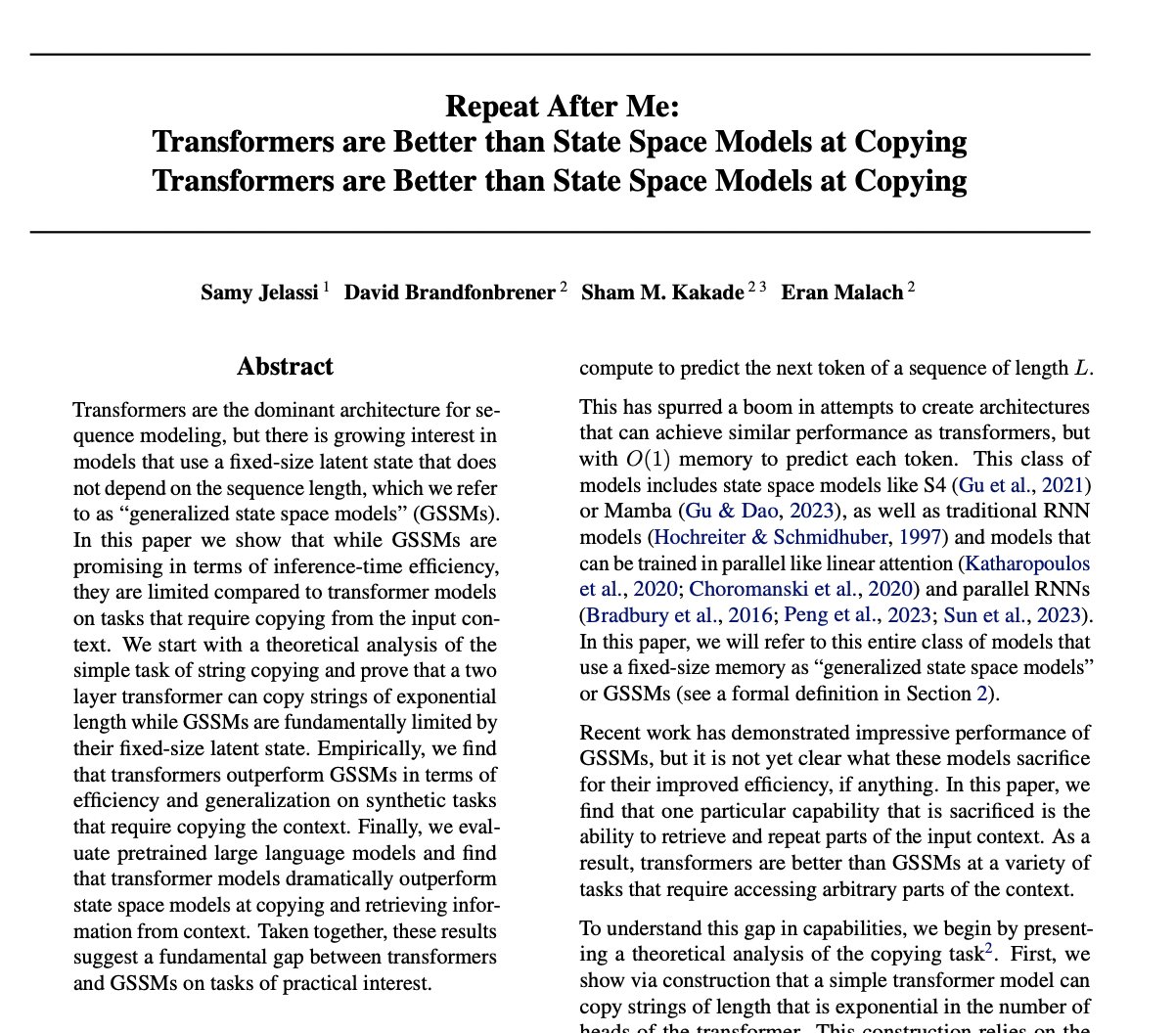 Twitter
·
void quartz
misty cedar
https://twitter.com/_akhaliq/status/1754334655405326482
can someone double check...
Twitter
·
void quartz
misty cedar
https://twitter.com/_akhaliq/status/1754334655405326482
can someone double check...
tbh 55 sounds way too low - i suspect they did purely random characters - instead of the random words test i did
void quartz
Automated lm-eval for distributed evals!
current status on evals : I fully automated the eval run, and collection of data via GH actions - and is distributed across 5 nodes of 4/8 x 3090/4090/A5000
should also make it easier to plug in any HF compatible model for eval as well
this is the first cut, on the 1B5 model, no few shot
will drop out any of the evals that crash (temp=0, eval files are 404, etc), before moving to 3B and 7B

link: https://github.com/RWKV/lm-evaluation-harness/actions/runs/7778932288
ps: if anyone wants to throw 3090+ class GPUs on this, DM me, i can message you the docker container run script (and key) to add to the GH actions pool
if you want to see an example of all the output files you can refer to a previous aborted run here: https://github.com/RWKV/lm-evaluation-harness/actions/runs/7771205514
scroll all the way to the bottom for the output files (incomplete)
gusty condor
tropic minnow
What does the circular arrow pointing to W itself mean?
tough crane
last mauve
**Alright all. Time to push this RWKV-v5 paper out.** Current target is to have ...
I'll taking 4. now
last mauve
tough crane
I'll taking 4. now
added!
burnt cedar
misty cedar
https://twitter.com/_akhaliq/status/1754334655405326482
can someone double check...
Citations point to v4 paper
As mentioned in the rwkv server, 55 points closer to v4?
Could just be that
misty cedar
burnt cedar
Citations point to v4 paper
I meant, does that paper point to mamba having v4 levels of perfect memory
burnt cedar
misty cedar
I meant, does that paper point to mamba having v4 levels of perfect memory
It does say that, which is strange
Lstms and mamba have the same exact scores
misty cedar
burnt cedar
It does say that, which is strange
so either there is a problem with the methodology, or mamba is actually pretty bad compared to v5
burnt cedar
misty cedar
so either there is a problem with the methodology, or mamba is actually pretty b...
Maybe, needs more tests, though the title and classifications point me towards the former
misty cedar
burnt cedar
Maybe, needs more tests, though the title and classifications point me towards t...
idk, we could spend a bunch of compute to try defend mamba, or we could use this as a source and save compute when showing the perfect memory graphs for the v5 paper...
academic integrity is expensive i guess
burnt cedar
misty cedar
idk, we could spend a bunch of compute to try defend mamba, or we could use this...
True, this would be a great way to prove v5, but feels bad left unverified
young sparrow
@misty cedar There are many possibilities other than it being a "hit piece" and making such groundless accusations creates hostility for no reason. Do not say things like this without real evidence.
misty cedar
young sparrow
<@438605535323881486> There are many possibilities other than it being a "hit pi...
good point, we should be working on this collaboratively
Zoology group also has some data in that area
young sparrow
This group as a whole has a serious problem with accusing people of acting in bad faith, sometimes even on the grounds of finding different results. It's extremely disappointing.
Let's work on having a more positive and less hostile attitude towards other research groups. What we're doing is very hard, very finicky, and contradictory results crop up all the time. It takes careful and collaborative work to figure out why. They're doing the best they can, just like we are.
In terms of what results to trust, I would recommend thinking about what benchmarks we find the most reliable and trust the results using those benchmarks. I've been really impressed by infinity bench recently, which contains a diverse collection of real and artificial long context tasks. But it's also totally fine to say "we're using this methodology, others exist that might be better" and worry about those in a future paper if we've already done a lot of work.
rose mango
There's no motivation for most people to act in bad faith anyway
I haven't fully read the paper, but their results don't seem surprising to me.
Random sequences are hard (impossible, if truly random) to compress, and storing information in a fixed-size state is effectively a form of lossy compression.
The flip side is that no human is going to remember a long random sequence well either
tough crane
@obsidian quest
Could you tell me the all available downstream tasks v5.2 and v6 for each FLOPS needed to be trained ?
My intention is to collect plots for Figure 5 in the RWKV4 manuscript.
rose mango
Openness/accessibility comparison table with other models is largely complete
 last mauve
rose mango
Openness/accessibility comparison table with other models is largely complete
last mauve
rose mango
Openness/accessibility comparison table with other models is largely complete
I love it, but I'm a bit confused on the partially open dataset point. Why are we claiming the dataset is partially open?
rose mango
last mauve
I love it, but I'm a bit confused on the partially open dataset point. Why are w...
AFAIK we haven't shared the dataset mixture or the full list of everything included
last mauve
rose mango
AFAIK we haven't shared the dataset mixture or the full list of everything inclu...
So it's closed
rose mango
The pile, slimpajama, all of the wikipedias, OSCAR, and starcoder are what's being used IIRC
Do we plan on releasing the dataset (or sharing the composition)?
void quartz
misty cedar
idk, we could spend a bunch of compute to try defend mamba, or we could use this...
i think its best for us to actually train and test mamba - at 3B its at 3090/4090 class compute, and i think i can afford that (or better yet, work with them on this)
i honestly think the paper might be harsh against them as well (cause 55 character feels too low, and i believe mamba can achieve better)
i cant seem to find the full replication details however - so my experiment methodology is probably different from what they did
my results for my memory test (similar to how the paper was structured, finetune the model to repeat) 2 weeks ago showed that 3B ( https://github.com/RWKV/RWKV-infctx-trainer/blob/rwkv-x-eagle-notebooks/notebook/rwkv-x-exp/v5-exp/memory-test/World-3B-mem-finetune.ipynb )
- about 2.2k matched tokens in memory (at 90% match rate),
- or 525 matched tokens in memory (at 100% match rate)
previous discussion with various folks here (off this channel), was that we expect mamba to have similar memory capacity not worse
the only reason i can think of for that paper, it was using pure random characters - while i was using randomized dictionary words - and that might change the score?
willing to collaborate with mamba team on their tune cause they would know best on how to finetune their model to replicate this ( whats the best way to coordinate this? , alternatively we could talk to the original paper team as well )
void quartz
Also: Our current recent growth, is thanks in many parts to mamba
This is a personal opinion
It may sound dumb, but it has been a really huge tone change since mamba came out, people take us way more seriously now. People no longer dismiss alternative architecture as a "pointless effort" or "not worth talking about"
Conversations flow faster, we get to focus on how we are different from mamba/transformers in good ways.
Sure, a small part of it may have been a case of a big name university setting the tone for us "random folks" on the internet, and giving us credibility - a situation that i know drive frustration to many in the RWKV group, as it can feel unfair (as the core work on rwkv has remained the same) - when mamba gets the limelight
But we have to remember the statespace team (and other teams) did not choose for this social situation, where they get more credibility by being associated to a major university / prof - And this limelight takes turns - Eagle now gets the spotlight, from that momentum
In the very same lens, a parallel story might be played out now (diffusion text model, maybe?) by an even more random team on the internet, against us having the credibility / attention due to the association with EleutherAI and LF - folks who may face the very same frustrations we previously faced (why bother competing with RWKV or Mamba?) as they try to prove out their architecture
So lets co-op in good faith?
( to mamba, and transformer folks )
void quartz
@last mauve / @misty igloo - do you think it makes sense if we create a subgroup on the evals? - i think there is a long discussion on its own of what benchmark to include or exclude - i have the full lm-eval list reduced down to what we can run (almost), and is probably more then what we need (ethical and alignment evals??)
After that, its simply scaling it up, and running it across the select models we want to compare against
I should also probably compile a list of evals that might need fixing, a bunch of them have 404 or missing datasets (and file as a bug report to lm-eval)
last mauve
RWKV-papers
last mauve
void quartz
<@367104793292046338> / <@1007072846960410685> - do you think it makes sense if ...
Yeah I've been thinking the same on that. Lemme create a new channel under NLP.
void quartz
Fro those interested in helping hop into the evals, its here :
#rwkv message
Im gonna spin up more 3090s to start eating these benchmarks up 🙂
rose mango
void quartz
---
**Also: Our current recent growth, is thanks in many parts to mamba**
> This...
big name university
I don't even think the positive reception was simply because of Stanford, but largely because Tri Dao was involved. They also immediately published an easy-to-use optimized library that let others use Mamba blocks within their own models.
void quartz
rose mango
>big name university
I don't even think the positive reception was simply becau...
agreed - we have lots of work to do in making our various modules simpler and easier to work with for others to grab their hands on - and play with
rose mango
when people can do from rwkv.simple import RWKVBlock, then we are there
void quartz
haha, but tbh - its not just that, its lots of the small things
but i dun want to tangent too far here (as its no longer about the paper), my point was to call out the sentiments i see in here, and the RWKV discord - we are gaining momentum - we simply need to keep doing our best to get better
void quartz
misty cedar
https://twitter.com/_akhaliq/status/1754334655405326482
can someone double check...
managed to get some replies from the paper author (twitter)
- the 55 character model, was a 160M model they trained from scratch
- they did additional experiments for the pre trained 360M / 1.4B / 2.8B, which performed much better (100+ token), i requested for the table data (as the graph is hard to read)
Important to note for when we did the "from scratch" train, without doing an enwiki pretrained, our model for "some reasons" perform terribly for the memory task as well (this defy transformer conventions) - they did not consider pretraining it with enwiki, might be a influencing factor
The subsequent tests, are not finetuned varients, so its not apple to apple either to our numbers (we might be at similar perf levels)
misty igloo
rose mango
The pile, slimpajama, all of the wikipedias, OSCAR, and starcoder are what's bei...
@void quartz maybe you can speak to this? It is whatever it is, we just gotta decide if we mention what the dataset consists of in the paper or if we skip that for this one
void quartz
Pile + Books (Book3, gutenberg) + SlimPajama + StarCoder + OSCAR + All_Wikipedia
- Open Instruct (which is probably where the contamination came from)
As to which exact slice of all the data, only blink knows
misty igloo
void quartz
Pile + Books (Book3, gutenberg) + SlimPajama + StarCoder + OSCAR + All_Wikipedi...
@last mauve where does that leave us on dataset openness in your opinion?
void quartz
im of oppinion that open dataset, is in the direction of repoducibility
this does not fit that criteria
misty igloo
Agreed, but that's why @rose mango had it listed as partial in table 2
Unlike mistral etc who don't even disclose what's in the data
void quartz
or token count Q.Q
tropic minnow
gusty condor
What does the circular arrow pointing to W itself mean?
the w^{i-j} in rwkv5 and the cumprod (which is data-dependent) in rwkv6
obsidian quest
rose mango
The pile, slimpajama, all of the wikipedias, OSCAR, and starcoder are what's bei...
i added plenty of chatgpt data on hf too
young sparrow
misty igloo
<@644428303293349888> maybe you can speak to this? It is whatever it is, we just...
We will be disclosing the data. It is a violation of both Linux Foundation and EleutherAI policy to not do so. Keeping it secret has never been an option.
Furthermore, I don't see why anyone would want to not disclose the data. We are training on very standard datasets it seems... all not disclosing the data will do is make people wonder if we are cheating by training on the test sets.
young sparrow
obsidian quest
i added plenty of chatgpt data on hf too
We need a list of which repos you used.
burnt cedar
void quartz
Pile + Books (Book3, gutenberg) + SlimPajama + StarCoder + OSCAR + All_Wikipedi...
We list this, but doesn't someone have the dataset available as json
Wouldn't this probably be distributable now?
rose mango
I saw the mamba paper was rejected. I have no idea why.
There doesn't seem to be anything wrong with it
rose mango
last mauve
**6.** Long-context and inference speed benchmarks need added. These need compar...
I can also do the chat example comparison
tough crane
last mauve
**Alright all. Time to push this RWKV-v5 paper out.** Current target is to have ...
@last mauve
IMHO, I wonder whether several data might be missed for plotting Fig 5.
- On RWKV v5:
- the number of training tokens because IMHO x-axis in fig 5 is :
num_trained_tokens * factor_to_backward * flops_in_table_3 - Factor to calculate backward FLOPS ( transformer FLOPS calculation tools set to 2.0 as default https://huggingface.co/spaces/MrYXJ/calculate-model-flops )
- the number of training tokens because IMHO x-axis in fig 5 is :
I'm asking @obsidian quest and current status is waiting. I could help other tasks: #1 or adding multilingual benchmark results.
 alpine ferry
young sparrow
We will be disclosing the data. It is a violation of both Linux Foundation and E...
alpine ferry
young sparrow
We will be disclosing the data. It is a violation of both Linux Foundation and E...
💯
last mauve
misty igloo
<@367104793292046338> where does that leave us on dataset openness in your opini...
It's not open unless someone can reproduce, meaning this dataset needs released. This requirement is enforced by the LF anyway as @young sparrow mentioned so this goes beyond just the table.
last mauve
rose mango
Openness/accessibility comparison table with other models is largely complete
I went ahead and added a checkmark for Eagle's dataset in anticipation of this
last mauve
tough crane
<@367104793292046338>
IMHO, I wonder whether several data might be missed for ...
Wait do you mean RWKV-v4 arxiv's fig. 5? I'm not sure I understand your point on FLOPs or what's missing.
Multilingual benchmark results (and evals/scaling plots in general) would be the most impactful thing to help with rn. Can you follow up with that on #rwkv ?
last mauve
tropic minnow
I'm still really bullish on creating some simplified subfigs to break up figure 1. Did you need further discussion here @tropic minnow ?
tropic minnow
last mauve
I'm still really bullish on creating some simplified subfigs to break up figure ...
Nice! Will do extra diagrams for the token shift and W lora. And think about the WKV
void quartz
For the folks who need benchmark figures, over 72 benchmarks tasks have been done for eagle 1.5B -> 3B -> 7B here, in bf16 mode: #1204211116268462150 message
i can rerun this in fp16 mode if needed, would like to know what models i should be running next to compare against - currently i have / is getting the numbers for
- Mistral 7B
- Falcon 7B
- MPT 7B
void quartz
last mauve
Wait do you mean RWKV-v4 arxiv's fig. 5? I'm not sure I understand your point on...
i gotten all the multi-lang bench done as well 🙂
i can start extracting the numbers that is needed - just let me know which one in the list
gusty condor
Some benchmarks are slightly better than random
tough crane
gusty condor
Some benchmarks are slightly better than random
Is it meaning terrible bad?
acoustic knoll
gusty condor
Some benchmarks are slightly better than random
Is it mmlu?
subtle oak
The MMLU seems pretty bad on RWKV-4 before... I found this in TransNormer paper
looks like they benchmarked the MMLU in RWKV-4

I do not sure that if we face the same problem again
 burnt cedar
subtle oak
looks like they benchmarked the MMLU in RWKV-4
burnt cedar
subtle oak
looks like they benchmarked the MMLU in RWKV-4
Also consider that this is the base model without mmlu fine-tune with v4
void quartz
void quartz
i can rerun this in fp16 mode if needed, would like to know what models i should...
@last mauve - who decides which models should be included for compare? Cause i need a candidate list to start running
(finishing v4 benchmarks)
last mauve
void quartz
<@367104793292046338> - who decides which models should be included for compare?...
There's no set authority, but I can help form a sensible list
- Llama 1/2
- Mistral 7B
- Falcon 7B
- MPT 7B
- Pythia 6.9B
- GPT-J
- OPT-6.7B
- BLOOM 7.1B
- OLMo-7B
- RedPajama-INCITE-7B
void quartz
how bout the 3B / 1.5B class?
burnt cedar
void quartz
how bout the 3B / 1.5B class?
Tinyllama, phi 1 1.5 2, falcon rw, olmo, pythia
Basically blink has been comparing many top tier for the new finch benchmarks
burnt cedar
@void quartz about the needle in a haystack test and extrapolation
We've been exploring context extrapolation with Mamba and managed to make it (state-spaces/mamba-2.8b-slimpj) retrieve nearly perfectly on a window of 16384.
Here's a brief overview of what we've found so far:
 Twitter
·
Twitter
·
Some results for mamba
It's showing the same ppl explosion as rwkv
Similar to v4
Looks like v5 tends to extrapolated better
void quartz
burnt cedar
Similar to v4
this is clearly better then v4 =x
burnt cedar
void quartz
this is clearly better then v4 =x
Oh of course it's better
void quartz
btw u can see the convo here : #rwkv message
for the test we need to do haha
burnt cedar
I meant the ppl explosion
gusty condor
void quartz
yea v5 seems more stable even beyond trained length
0.4B and 1.5B are stable at context length ~48k or more, using parallel scanning (memory usage O(n)). Haven't tested RNN mode yet, it takes too long.
tropic minnow
2 options for tokenshift. thoughts?

 tropic minnow
tropic minnow
tropic minnow
along the lines of this
tropic minnow
last mauve
I'm still really bullish on creating some simplified subfigs to break up figure ...
like this?^^^
steady ether
tropic minnow
2 options for tokenshift. thoughts?
Left if everything were more centered and the title remained on one line. Otherwise, right feels cleaner.
misty igloo
tropic minnow
2 options for tokenshift. thoughts?
I think the left one makes it clearer that mu isnt more favored than 1-mu
and i'd maybe use \in \mathbb{R}^{LxD} instead of superscript so its clear what the LxD and 1xD mean
obsidian quest
v6 training code uploaded to https://github.com/BlinkDL/RWKV-LM
use /RWKV-v5/ and add --my_testing "x060" to demo-training-prepare.sh and demo-training-run.sh
GitHub
RWKV is an RNN with transformer-level LLM performance. It can be directly trained like a GPT (parallelizable). So it's combining the best of RNN and transformer - great performance, fast in...
tropic minnow
incorporated suggestions @last mauve @misty igloo

this would be for the MLP version (inherited from rwkv 4) and for the V5. will do the new ddlerp+lora (V6) now
young sparrow
@obsidian quest do we have the compute to do a scaling laws search like we did for the previous paper?
obsidian quest
unfortunately i dont have the compute at this moment
young sparrow
How much did the scaling laws run you did for the previous paper require?
tropic minnow
tropic minnow
this would be for the MLP version (inherited from rwkv 4) and for the V5. will d...
okay here it is: the 2 in the left are V5 (no lora, no data dependence); while the one in the right is V6 (data-dependent lerp)
 tropic minnow
thoughts?
 young sparrow
Someone had asked if I had the code for the plots in the RWKV paper. I have the code that produced the scaling laws plots but not the plotting of evaluation results. It would be quite easy for me to recreate the code though, if its desired. Just let me know what is needed.
obsidian quest
i am using this for evals https://github.com/BlinkDL/ChatRWKV/blob/main/run_lm_eval.py and use [0] for RWKV_PAD. you can verify my eval results first
"\n" was used for rwkv4 evals
GitHub
ChatRWKV is like ChatGPT but powered by RWKV (100% RNN) language model, and open source. - BlinkDL/ChatRWKV
young sparrow
obsidian quest
i am using this for evals https://github.com/BlinkDL/ChatRWKV/blob/main/run_lm_e...
Now that we officially support RWKV in the evaluation harness, can you please use that instead? I worry about minor divergences between the codebases causing inconsistencies. Plus it makes reproducibility far easier if everyone is using the same codebase.
misty igloo
tropic minnow
thoughts?
love it, maybe w should look like g,r,k,v? and then lead to a exp(-exp()) block and then a * circle
young sparrow
tropic minnow
thoughts?
Why is X_t both an input and an output? I assume that's a mistake?
misty igloo
young sparrow
Why is X_t both an input and an output? I assume that's a mistake?
we actually do use it as 'state' for the next iteration
to support tokenshift
that's where the X_{t-1} comes in on the left
young sparrow
I see, so that represents a residual connection
And this diagram computes h not x, u seem to have missed that
misty igloo
young sparrow
I see, so that represents a residual connection
sorry, maybe I was unclear or misunderstood - it's not residual, we store x_t for use in the next iteration (timestep) where it comes in again, like if you put copies of these blocks side by side left to right
young sparrow
misty igloo
sorry, maybe I was unclear or misunderstood - it's not residual, we store x_t fo...
Yes, I understood
misty igloo
young sparrow
Yes, I understood
do you think we should remove the x_t 'state' output to the right?
young sparrow
No I think it's good now that I have my head screwed on correctly
gusty condor
tropic minnow
thoughts?
It's not really DxD, I used (D/h) x (Dxh) in the paper
tropic minnow
gusty condor
It's not really DxD, I used (D/h) x (Dxh) in the paper
Yes in theory it is multi-head but all drawings are for single head for simplicity
void quartz
For few shot tests? Which should be covered and how many shots?
( realised I missed that )
tough crane
void quartz
For few shot tests? Which should be covered and how many shots?
IMHO, I personally think that we will run experiments which reviewer du8a of Mamba paper pointed out.
The reviewer also said that the authors should only show results on zero-shot inference.
-
There are many works following the same direction: S4-diagonal [1], SGConv [2], MEGA [3], SPADE [4], and many efficient Transformer models (e.g., [5]). All of these models achieve near linear complexity, and the authors need to compare Mamba with these works in terms of both model performance and efficiency. For model performance, some simple experiments such as language modeling on Wikitext-103 should suffice.
-
Because SSMs are in general sequential, does Mamba have this length generalization ability?
-
I suggest the authors run more long-sequence experiments such as document summarization, where the input sequence is naturally long (e.g., the average sequence length of the arXiv dataset is greater than 8k).
OpenReview
Foundation models, now powering most of the exciting applications in deep learning, are almost universally based on the Transformer architecture and its core attention module. Many...
void quartz
tough crane
IMHO, I personally think that we will run experiments which reviewer du8a of M...
for tests outside of lm-evals, we can add that seperately - im more focused in getting all the data we need in lm-eval quickly
(needle in heystack, etc)
tough crane
void quartz
for tests outside of lm-evals, we can add that seperately - im more focused in g...
To compare accuracy based on FLOPS as the way in RWKV4 paper, we have to run evals for RWKV5 checkpointed models trained on up to 330B tokens for each params 169m, 430m, 1.5B, 3B, 7B.
I think that 1.12 T tokens are used to train v5 for one epoch.
- OPT : trained on 180B tokens for params up to 12B
- Pythia : trained on 300B tokens for params up to 12B params
- BLOOM : trained on 341+25=366B tokens for params up to 12B params
- RWKV-4 : trained on 330B tokens for params up to 14B params
params : 169m, 430m, 1.5B, 3B, 7B
tasks : lambada, piqa, winogrande, sciq, arc_easy, arc_challenge
checkpoints : some step such that at most 360B tokens are inputted into.
tough crane
last mauve
Wait do you mean RWKV-v4 arxiv's fig. 5? I'm not sure I understand your point on...
@last mauve As the above comment, to compare accuracy based on FLOPS as the way in RWKV4 paper, we have to run evals for RWKV5 checkpointed models trained on up to 330B tokens. However, the current checkpoint weights seems to be trained on 1.12 T tokens.
I'm asking picocreator.
last mauve
tough crane
<@367104793292046338> As the above comment, to compare accuracy based on FLOPS ...
don't we have regular checkpoints from the entire training run?
and if we only care about the FLOPs of the final ckpts, then we just have to compare the 1.12T token ckpts to models with comparable FLOPs. To help me clarify what you want, which RWKV4 paper plot are you referring to recreating here
gusty condor
We had, but BlinkDL deleted
young sparrow
last mauve
don't we have regular checkpoints from the entire training run?
and if we only ...
Blink deleted the checkpoints. And even if he didn't, this is problematic in that it underestimates performance. But maybe our model will do well anyways.
misty cedar
last mauve
don't we have regular checkpoints from the entire training run?
and if we only ...
Its in the git history isnt it?
oh, guess lfs doesnt save it
I remember someone saying that was the point of the temp folder
 jade lotus
Anyone tried recuva or other recovery tools on any drive that had them? Or is it all cloud / not practical?
misty cedar
https://huggingface.co/BlinkDL/temp/blob/43ce09802b0fe0748eb8a12dc1a75ff5fba62349/RWKV-5-World-7B-v2-OnlyForTest_49%25_trained-20231114-ctx4096.pth
like, they are still there maybe? about to see if I can download

Yep, still downloads
misty cedar
young sparrow
Blink deleted the checkpoints. And even if he didn't, this is problematic in tha...
Models partial checkpoints downloadable from git history (Once again, who the f is paying for huggingface storage costs??)
void quartz
misty cedar
Models partial checkpoints downloadable from git history (Once again, who the f ...
can confirm - i honestly been downloading with the git commit - to avoid breaking my model links whenever temp folder get cleaned out =x
should i eval the checkpoints as well?
rose mango
misty cedar
Models partial checkpoints downloadable from git history (Once again, who the f ...
I hope huggingface unlimited storage lasts forever
jade lotus
It runs on unicorn poo, it's good as long as summer lasts
I think the people in charge aren't the type to pull the rug without giving people a chance at a graceful exit - that might be a good thing to lobby for them to plan out and set up funds for, sooner rather than later
last mauve
young sparrow
Blink deleted the checkpoints. And even if he didn't, this is problematic in tha...
I was more asking "do you want evals across time, or a scaling laws plot"
Sounds like we want the latter, so my response is that we just have to compare against models with comparable FLOPs, so bigger or trained for longer.
gusty condor
last mauve
I was more asking "do you want evals across time, or a scaling laws plot"
Sound...
I want the former because checkpoints are downloadable from git history.
We have less than a month for CoLM
tough crane
void quartz
for tests outside of lm-evals, we can add that seperately - im more focused in g...
@void quartz
Thanks a lot for your forking to run github actions.
To plot the following tasks in v4 paper at first, could you tell me the digits id of the GHA run's URL ( https://github.com/RWKV/lm-evaluation-harness/actions/runs/{digits} ) for the following settings?
num-shot: zero
params : 169m, 430m, 1.5B, 3B, 7B
tasks : lambada, piqa, winogrande, sciq, arc_easy, arc_challenge
tough crane
gusty condor
I want the former because checkpoints are downloadable from git history.
We have...
it it possible to plot acc with two ranges that has no overlapped. Another choice is to build table style like Mamba's paper.
void quartz
tough crane
<@644428303293349888>
Thanks a lot for your forking to run github actions.
T...
since the github storage is not perma, im planning to download and dump to HF
tough crane
void quartz
since the github storage is not perma, im planning to download and dump to HF
Could you run firstly with these six tasks in gh-task-runner-Large-Suite.yml , because I would like to get results at first only for the tasks written above ? IMHO, I propose that figures of accs would be plotted with higher priority. If it's not permanently saved, the artifact could be down loaded manually within 90 days.
misty igloo
steady ether
V5.2 testing is done (for that AR experiment). We can probably use Stanford's re...
now that v6 training code is available are you able to run the AR experiment on it, too?
steady ether
misty igloo
now that v6 training code is available are you able to run the AR experiment on ...
Let me double-check. I think I had a run earlier, then I forgot about it 😅
 charred atlas
Hey would it be interesting to you to have numbers on the sentence embedding perf of the new rwkv? The repo talks about sent emb but havn't seen any scores (https://github.com/BlinkDL/RWKV-LM).
I'm happy to run it on mteb if interesting - just need to know which model to benchmark and if I can still load it in hf (https://huggingface.co/docs/transformers/en/model_doc/rwkv) ?
obsidian quest
could someone test this for rwkv https://github.com/jzhang38/LongMamba

GitHub
Contribute to jzhang38/LongMamba development by creating an account on GitHub.
void quartz
charred atlas
Hey would it be interesting to you to have numbers on the sentence embedding per...
if you mean the 2nd last layer state, as a means of embedding, you might want to discuss with @uneven blade
would be nice to figure out if this works in v5 like v4, and have a means of benchmark
undone solstice
obsidian quest
could someone test this for rwkv https://github.com/jzhang38/LongMamba
I can test this.
gusty condor
undone solstice
I can test this.
Test longer! Possibly more than 100k tokens, I think RWKV-5 can do that.
burnt cedar
gusty condor
Test longer! Possibly more than 100k tokens, I think RWKV-5 can do that.
At this point, newer papers going for the 1mil 10mil aswell
If a rwkv state can do that it's going to be crazy
gusty condor
burnt cedar
If a rwkv state can do that it's going to be crazy
RWKV (without fine tuning) can do that in perplexity test
burnt cedar
gusty condor
RWKV (without fine tuning) can do that in perplexity test
Stable ppl for a million?! That's crazy impressive
gusty condor
Yes, at least 100k
 quaint quiver
ya but that doesnt really mean anything for actually recalling stuff far in the past
still impressive
misty cedar
Stable at after a long conversation is still pretty awsome
quaint quiver
misty cedar
Stable at after a long conversation is still pretty awsome
ya ik im just saying for the needle in a haystack stuff it doesnt mean much
burnt cedar
quaint quiver
ya but that doesnt really mean anything for actually recalling stuff far in the ...
I still think testing larger states might help with this too
obsidian quest
100% composed by RWKV-6 120M params MIDI model🎶Still takes multiple trials for such high quality outputs, but I will fix this🙂
 Twitter
·
rose mango
Twitter
·
rose mango
I'll add Gemma to the model comparison tables later today
young sparrow
rose mango
I'll add Gemma to the model comparison tables later today
Why is it important to do this?
rose mango
young sparrow
Why is it important to do this?
We already compare with Mistral and LLaMA, the most popular and most contemporary models. I think Gemma will likely see similar amounts of use, so it's worth comparing.
void quartz
im glad its on hugging face atleast, gonna work on that too
void quartz
gemma multilang benchmarks is running, along with normal benchmarks
misty igloo
@obsidian quest are the v5,v6 hyperparams (LR start, end) same as they were for v4? no warmup, right?
v4 paper said:
Init LR 0.0006 0.0004 0.0003 0.00015 0.00015 0.0001
Warmup Mini-Epochs 361 411 443 451 465 544
End LR 0.00001 0.00001 0.00001 0.00001 0.00001 0.000007```wamrup = only 10 steps.
tough crane
@last mauve
I uploaded figures and related materials at the following paths.
1: png files are in images/0shot_acc
2: notebooks and csvs are in misc/plotting
misty igloo
obsidian quest
wamrup = only 10 steps.
10 mini epochs? What's a mini epoch exactly? I want to add these details to the paper
obsidian quest
misty igloo
10 mini epochs? What's a mini epoch exactly? I want to add these details to the ...
10 steps. each miniepoch = many steps
1 miniepoch = [40320 / bsz] steps
misty igloo
obsidian quest
10 steps. each miniepoch = many steps
outside of the paper, should i be doing this 10 step warmup in my experiments for new architectures/MoE?
void quartz
For all the various benchmarks, i have started consolidating all the results into the repo here:
https://huggingface.co/datasets/rwkv-x-dev/lm-eval-data/tree/main/summary
You can extract key figures if you want from the multilang / all result table
There is some bugs in the filtering/avg, and some data are still missing (eg. bloomz does well on avg, cause large number of the tests OOM)
But yea, its rather streamlined now for me to just add any model to HF, and in <48 hours, the CSV can be updated
the following is sorted by the average multilang score (llama2-chat OOM, so i need to rerun)

there are CSV file, sorted by model name as well
also if you want to inspect an individual run, you can crawl into : https://huggingface.co/datasets/rwkv-x-dev/lm-eval-data/tree/main/lm-eval-output for the full logs / jsonl / etc
alternatively its the eng test by groups (0 results is due to a test error blocking to overall upload, fixing)
 void quartz
er.... i gotten gemma 0 shot benchmarked, can i request someone independently check this, seperately or something
like its bad enough, that im sure its an error in my setup/pipeline or something
spring fulcrum
void quartz
er.... i gotten gemma 0 shot benchmarked, can i request someone independently ch...
are you using the patch described here: https://github.com/EleutherAI/lm-evaluation-harness/issues/1455 ?

GitHub
Posting this here for visibility: The following diff fixes Gemma performance: diff --git a/lm_eval/models/huggingface.py b/lm_eval/models/huggingface.py index e6ffc828..3f775dbb 100644 --- a/lm_eva...
(would also need an analogous add_special_tokens=True for generative tasks)
I'll be PRing this asap to the harness (should be by tomorrow morning) along with the ability to control whether a BOS token is used for causal LM models in general
obsidian quest
void quartz
the following is sorted by the average multilang score (llama2-chat OOM, so i ne...
add x060 1.6b. it's great at multilingual.
void quartz
spring fulcrum
are you using the patch described here: https://github.com/EleutherAI/lm-evaluat...
thanks!, will pull that - that explains the wierd results