#Irrationality of π
1 messages · Page 2 of 1
 fallow harbor
 merry lava
fallow harbor
Why is it arbitrary, according to you?
merry lava
fallow harbor
Why is it arbitrary, according to you?
Because it leaves out perfectly fine numbers that exist, saying they're not numbers.
fallow harbor
It's essential to this entire thread, and followed by much reason thanks to Sapphire (unfortunately I came later)
 gusty burrow
0 is an anti number. It can be used in some operations but is not composed of countable unit elements. It is like saying "no number" or a placeholder for it.
fallow harbor
merry lava
Because it leaves out perfectly fine numbers that exist, saying they're not numb...
Yes, for a reason. So why is it arbitrary?
merry lava
This is proof. By the basic rules of subtraction. Literally like elementary school stuff.
 merry lava
fallow harbor
Yes, for a reason. So why is it arbitrary?
merry lava
fallow harbor
Yes, for a reason. So why is it arbitrary?
No, not for a reason, I have disproved your reasons..
Besides, i is a number that doesn't have any length
fallow harbor
Even if you believe that you have disproved the reasons, that doesn't mean they don't exist. Again, what is arbitrary about that?
merry lava
merry lava
Besides, i is a number that doesn't have any length
π does, but if you really are so convinced that it doesn't, that wouldn't make it not a number anyway. -1 doesn't have a length.
merry lava
fallow harbor
Even if you believe that you have disproved the reasons, that doesn't mean they ...
??
If I've disproved them I disproved them.
fallow harbor
Circular reasoning.
fallow harbor
Which you haven't. Because we are still trying to show you the truth. 😄
merry lava
You're ignoring the proof I provided..
fallow harbor
No, we have addressed it already.
You posting the image again does not bring it back into valid proof status my friend
merry lava
fallow harbor
No, we have addressed it already.
And I addressed your comments about it.
fallow harbor
Post it some more, it doesn't make a difference
merry lava
You never disproved it
gusty burrow
merry lava
This is proof. By the basic rules of subtraction. Literally like elementary scho...
That is impossible to do. If you can do that with elemetary school math I have a bridge to sell you in Koninsberg. But perhaps, you are right. It takes that level of ignorance to reality or rationality to think that you can do such a thing as Pi - Pi, and slap on a subtraction symbol as your "proof".
Where are your functions to get the Pi? do dot dot is not a number. You have to use limits to represent what you are doing accurately. Why by implications makes all limits to infinity open season as numbers to operate on, proving your fallacy of equivalence is such.
merry lava
it is perfectly fine to use ...
fallow harbor
Why?
merry lava
I already told you.. pi equals pi, so every digit of pi equals that same digit of pi.. so every digit of pi minus that same digit of pi equals 0.. so the answer has every digit 0, so the answer is 0
fallow harbor
But there is no such thing as "every digit of pi". How many digits? Which digits? . . . isn't digits
See, 0.33333..... is different than 3.14159.......
gusty burrow
merry lava
π does, but if you really are so convinced that it doesn't, that wouldn't make i...
-1 does have a length. I can stack some elemental units or shapes in the real world and define the midpoint or origin as 0, -1 implies directionality on an axis. I can have a line, and say outwardly in both directions from the origin I have 1m and -1m. It is comprised of countable unit elements.
merry lava
fallow harbor
But there is no such thing as "every digit of pi". How many digits? Which digits...
There is no positive integer n you can give me that I can't say the nth digit of π
gusty burrow
merry lava
There is no positive integer n you can give me that I can't say the nth digit of...
That would be a rational number.
gusty burrow
merry lava
No?
Your failure of measurement landed somewhere, like any function approaching infinity as a limit when you plug in n.
merry lava
gusty burrow
Your failure of measurement landed somewhere, like any function approaching infi...
$\lim_{x \to \infty} \frac{1}{x}=0$ doesn't disprove $0$ is a number. That limit doesn't disprove $\pi$ is a number.
 vast spearBOT
Coffey 2.0
 gusty burrow
merry lava
There is no positive integer n you can give me that I can't say the nth digit of...
gusty burrow
merry lava
There is no positive integer n you can give me that I can't say the nth digit of...
Does that make any of the below a real number? Or give any of them quantity? Just because you can land on an arbitrary rational in your failure of measurement.
 gusty burrow
merry lava
$\lim_{x \to \infty} \frac{1}{x}=0$ doesn't disprove $0$ is a number. That limit...
gusty burrow
merry lava
$\lim_{x \to \infty} \frac{1}{x}=0$ doesn't disprove $0$ is a number. That limit...
It proves 1/x is not a number or specific quantity though when you have that limit.
All you did was said something approaches something it does not land on.
merry lava
gusty burrow
It proves 1/x is not a number or specific quantity though when you have that lim...
No..?
gusty burrow
merry lava
No..?
1/infinity is not a number or a specific quantity.
merry lava
you're completely misunderstanding what a limit is
merry lava
gusty burrow
1/infinity is not a number or a specific quantity.
Yes
fallow harbor
merry lava
This is proof. By the basic rules of subtraction. Literally like elementary scho...


gusty burrow
fallow harbor
lmfao
fallow harbor
merry lava
. Isn't a number
DING DING DING!
merry lava
No?
gusty burrow
fallow harbor
DING DING DING!
dot dot dot!
fallow harbor
im dead
gusty burrow
fallow harbor
im dead
ahh the face you posted made it 10x better ...
fallow harbor
merry lava
. Isn't a number
Then why, pray tell, did you use it in a "purely mathematical proof"? 
merry lava
fallow harbor
Then why, pray tell, did you use it in a "purely mathematical proof"? <:_goobert...
I didn't use "." as a number.
gusty burrow
merry lava
I didn't use "." as a number.
...
😬
 fallow harbor
the "number" in question:
gusty burrow
Begging the question.
merry lava
gusty burrow
...
😬
You're misunderstanding what "..." means..
It's literally just a shorthand because you can't write every digit at once
I already told you.. pi equals pi, so every digit of pi equals that same digit of pi.. so every digit of pi minus that same digit of pi equals 0.. so the answer has every digit 0, so the answer is 0
gusty burrow
merry lava
You're misunderstanding what "..." means..
It means you have no quantity so you are sticking some dots on the end. 0.000 ,,,, = 1/∞
Therefore 1/∞ - 1/∞ = 0 << your logic.
merry lava
gusty burrow
It means you have no quantity so you are sticking some dots on the end. 0.000 ,,...
It has nothing to do with no quantity. It's perfectly valid to say 1/3=0.3333...
fallow harbor
"some dots" couldnt have put it better myself 😭 🙏
merry lava
gusty burrow
It means you have no quantity so you are sticking some dots on the end. 0.000 ,,...
Uh, 0.000... =0
gusty burrow
merry lava
I already told you.. pi equals pi, so every digit of pi equals that same digit o...
Pi does not equal anything. It is a failure of measurement. It is no different to any function with a limit to infinity.
gusty burrow
merry lava
Uh, 0.000... =0
0.0000051454 ... uh, =0 surpriise!
fallow harbor
This has become a circus of repetition due to some mathematical malpractice/ignorance... 
merry lava
gusty burrow
Pi does not equal anything. It is a failure of measurement. It is no different t...
As I've already stated, it being equal to a limit of a function to infinity does not disprove it being a number, if it did that would also disprove 0 as a number because 0 has a limit to infinity that equals it.
fallow harbor
Any remaining new arguments Coffey?
merry lava
gusty burrow
0.0000051454 ... uh, =0 surpriise!
Uh, No?
You didn't make it clear what number you meant. That has nothing to do with "..." Being "wrong" that's because you didn't clearly state what you meant.
merry lava
fallow harbor
This has become a circus of repetition due to some mathematical malpractice/igno...
Yes, I can see this for sure.
fallow harbor
I was talking about you. 🫵
merry lava
fallow harbor
I was talking about you. 🫵 <:ecksddddd:735484511885721643>
Yes, and I am talking about you.
gusty burrow
fallow harbor
Any remaining new arguments Coffey?
They cannot even present a function for Pi. It is begging the question in the worst way and by far the weakest arguments so far. It is trying to establish a proof, by their own words, using elementary school mathematics.
No different to saying uhh uhh ∞ - ∞ = 0 and uhh ... - ... = 0 because the symbols look uh duhh similar am I right?
merry lava
fallow harbor
Any remaining new arguments Coffey?
Since you still haven't disproved my old ones, no I won't go out of my way to find new arguments, that's unnecessary.
And no, before you say it, you have not disproved that argument. Yes you've stated your own arguments. Which I disproved.
merry lava
gusty burrow
They cannot even present a function for Pi. It is begging the question in the wo...
what do you mean "a function for pi"?
fallow harbor
merry lava
Since you still haven't disproved my old ones, no I won't go out of my way to fi...
Where?
We have already disproven all of yours.
"No you haven't."
merry lava
fallow harbor
We have already disproven all of yours.
Where?
fallow harbor
fallow harbor
look at this image, coffey
THINK, COFFEY, THINK!
isn't it silly? it's elementary
it proves that your image you used as "purely mathematical elementary proof, without philosophy" is no proof at all
your turn! 😊
merry lava
fallow harbor
look at this image, coffey
THINK, COFFEY, THINK!
isn't it silly? it's elementa...
You haven't provided any valid reasoning for why this is wrong. The dots are just a shorthand. But I can assure you the digits are equal. Because as I already told you.. "pi equals pi, so every digit of pi equals that same digit of pi.. so every digit of pi minus that same digit of pi equals 0.. so the answer has every digit 0, so the answer is 0."
 fallow harbor
gusty burrow
They cannot even present a function for Pi. It is begging the question in the wo...
fallow harbor
gusty burrow
They cannot even present a function for Pi. It is begging the question in the wo...
On God.
merry lava
fallow harbor
look at this image, coffey
THINK, COFFEY, THINK!
isn't it silly? it's elementa...
It being simple doesn't make it false
 terse palm
Ok if this thread keeps on going any longer I might get an aneurysm.
Your problem with pi is that "its in flux", every argument youve presented against it stands on the fact that "it has no definite value/specific quantity" and that "its a limit to infinity" so therefore its a "faillure of measurement". yet you're perfectly fine with 1/3 equalling 0.333...
Before you say "we know 0.333... just keeps on repeating with 3s, so it has a definite value" by your logic actually no, its just as bad as pi
Before you go "but we know all digits of 1/3, but not all digits of pi", the truth does NOT care about wether we as humans know the value of something or not. for example, the planck constant h.
h = 6.62607015×10⁻³⁴ J⋅Hz−1 so its one of the rational numbers, so you would acknowledge it as a true number.
It is crucial for the formula relating energy and frequency, E= hf. but heres the thing, just like most things in science, it was only DISCOVERED by humans recently; in 1900 to be exact.
But heres the thing, before 1900, just like pi now, we didn't know the all of the digits of the planck constant, because we didn't know it existed in the first place. Would it be reasonable for you to deduce that since we didn't know all of its digits before 1900, energy simply didn't care about frequency before 1900? was the BEHAVIOUR of the world fundementally changed after 1900, or did we as humans simply UNDERSTAND it better?
Now do you see that us not knowing something doesn't make it in "flux"?

 willow knot
I think the real question I would ask for Coffey's sake is; If we adopt your principle that "irrational numbers" are not "numbers", then how would this change how we do maths?
 supple spire
This thread is still going Jesus Christ
willow knot
I was invited here from another server.
I'm not a good math person but I'm interested
Going into this I was already thinking Sapphire was trolling
I do understand in the sense that irrational numbers are a more extreme form where it's less about evaluated quantities and more directions on how to get closer to the quantity.
supple spire
It's on the numberline, we have rough ideas where it can be via approximation, there's no such restriction on the real numbers which doesn't allow us to expect a number which in it's decimals never has a repeating pattern
willow knot
I did find your point about 1/3 interesting.
Did Sapphire ever say they accepted that as a number?
I guess they must have
supple spire
They accepted the definition of rational numbers as to be of the real numbers
So yes
willow knot
In the same way, 1/3 is slightly more about instructions leading to an approximation, but not nearly as extreme as irrational numbers.
So I can see where the sentiment comes from.
I guess a difference you could argue is that irrational numbers tend to be ones that are approximated by observing obscure functions of the world.
I do wonder if irrational constants actually occur as a result of systems that aren't necessarily irrational to begin with.
Kind of like they're just very complicated reoccurring digits.
supple spire
Irrational constants are used in the real world
willow knot
Yes.
 lapis marten
Why are there two π deniers now🙏
supple spire
supple spire
Irrational constants are used in the real world
E=1/2(mv²)
=> v= √[(2E)/m]
willow knot
Yes.
supple spire
supple spire
Irrationality deniers
Irrationality or irrational numbers I don't recall much from the discussion I had
lapis marten
supple spire
Irrationality deniers
I mean Pythagoras was an irrationality denier
willow knot
I just got here and I don't really have concrete stances.
lapis marten
So I mean it can't be that ba-
willow knot
So, are there functions or formulas to approximate pi? I'm not too informed
I did recently do a math coursework where there was a function that supposedly converged to Euler's number I think.
lapis marten
willow knot
So, are there functions or formulas to approximate pi? I'm not too informed
There's the chudnovsky formula
lapis marten
Yea I just know it exists
supple spire
willow knot
So, are there functions or formulas to approximate pi? I'm not too informed
Several I'm informed of newton's approach and the polygon approach but idk anything modern
Let me link them because I'm not too well versed either
willow knot
One reason why some irrational numbers might not sit right with me is how they tend to come from observation of physical phenomena. Things we don't really understand, and are therefore arguably incomplete in their makeup.
supple spire
This one has a slider, fun
https://www.geogebra.org/m/BhxyBJUZ
 willow knot
There are definitely irrational numbers that aren't like that though.
lapis marten
I made this estimation a while back

Desmos
There's a function z(x)
The higher x is the closer to pi the output is
willow knot
supple spire
This one has a slider, fun
https://www.geogebra.org/m/BhxyBJUZ
So could you place the points of a polygon such that it progressively forms a near circle, without initially knowing pi?
lapis marten
lapis marten
https://www.desmos.com/calculator/ioviujj9ra
Basically just estimates the circumference of a quarter of a unit circle
willow knot
Or is this more about taking pi and making it more precise by sort of... compounding it?
supple spire
willow knot
Or is this more about taking pi and making it more precise by sort of... compoun...
Yeah
willow knot
Interesting.
supple spire
It's an approximation thing and not a definition, the definition is the ratio between the circumference and diameter
willow knot
The problem with that is that it seems like a recursive function, and a recursive function usually tends to be used to model something that is obscure and isn't generalized.
Right?
lapis marten
lapis marten
https://www.desmos.com/calculator/ioviujj9ra
How about this
supple spire
willow knot
The problem with that is that it seems like a recursive function, and a recursiv...
I don't follow
It's just ratios of the perimeters of the polygons and the circles diameter
willow knot
The reason that description confuses me is that it doesn't give a clear precedent to how you evaluate pi
Like, maybe you couldn't write that as a substitution.
willow knot
lapis marten
Basically just estimates the circumference of a quarter of a unit circle
Interesting, I'm taking a look now
With irrational numbers like imaginary numbers, we know that an imaginary number is just a negative number to the root or something.
If I had to guess, sapphire is waging a war with irrational numbers that can only be approximated.
Because needing to approximate them implies we don't know their origins or fundamentals that would carry us to a generalized formula.
Like say, a formula that could take any natural number, n, and give us the nth digit in pi
supple spire
willow knot
The reason that description confuses me is that it doesn't give a clear preceden...
The basic idea of how I understand it is that the higher the number of sides there are in a polygon the more it starts "imitating" the properties of the circle but again I'm not rn expert by any means
Which is one of the reasons I didn't partake in the discussion that much
willow knot
willow knot
Like say, a formula that could take any natural number, n, and give us the nth d...
I'm of the belief that this formula should be possible, because of my assumption that everything follows some sort of rule.
supple spire
There's plenty of approximation formulas if you want to look into it
willow knot
I do see part of the frustration because this resignation in treating these things as only approximatable may distract us from the possibility of finding a key.
merry lava
willow knot
I do wonder if irrational constants actually occur as a result of systems that a...
Yes
merry lava
supple spire
E=1/2(mv²)
=> v= √[(2E)/m]
Oh I didn't see this yet, yeah^
another example being C/D =π
merry lava
willow knot
I'm of the belief that this formula should be possible, because of my assumption...
Yeah, that is possible, because each of the digits converge
merry lava
willow knot
I do wonder if irrational constants actually occur as a result of systems that a...
https://youtu.be/HEfHFsfGXjs?si=5MXHGGUhaFyTk1ZS
Here's an interesting place pi shows up by the way. You can also use this to calculate it's digits.
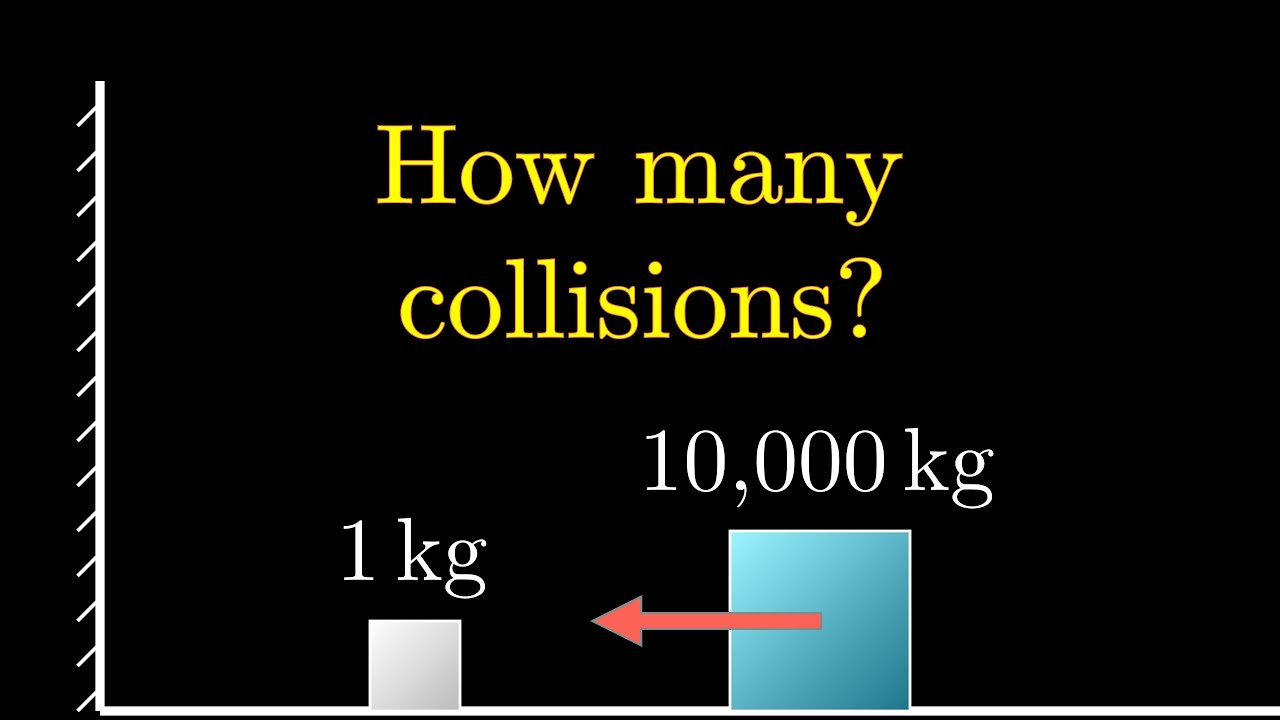
Solution: https://youtu.be/6dTyOl1fmDo
Light-based solution: https://youtu.be/brU5yLm9DZM
Help fund future projects: https://www.patreon.com/3blue1brown
An equally valuable form of support is to simply share some of the videos.
Special thanks to these supporters: http://3b1b.co/clacks-thanks
New to this channel? It's all about teaching math vi...
supple spire
merry lava
https://youtu.be/HEfHFsfGXjs?si=5MXHGGUhaFyTk1ZS
Here's an interesting place pi ...
Is this the new one or the old one
merry lava
supple spire
Is this the new one or the old one
I'm not sure what you mean by the new one, I'm guessing it's the old one
supple spire
merry lava
https://youtu.be/HEfHFsfGXjs?si=5MXHGGUhaFyTk1ZS
Here's an interesting place pi ...
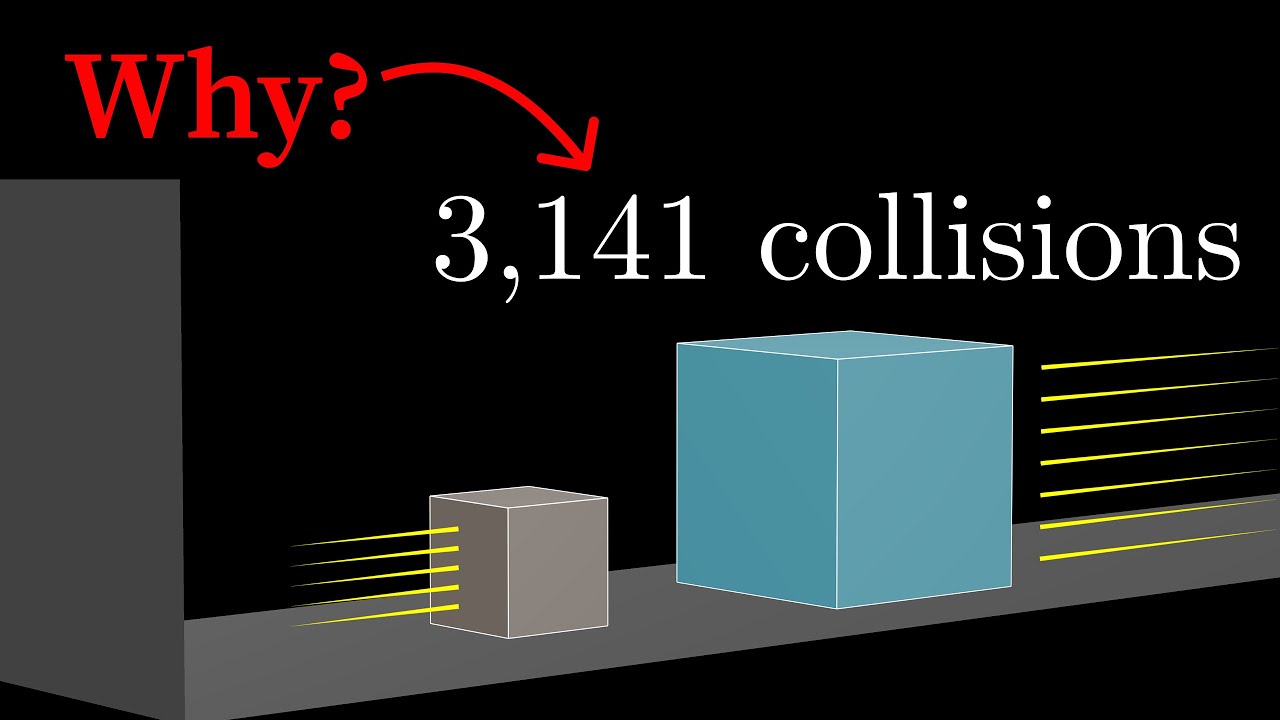
Two colliding blocks compute pi. Here we dig into the physics to explain why
Instead of sponsored ad reads, these lessons are funded directly by viewers: https://3b1b.co/support
An equally valuable form of support is to simply share the videos.
The original paper by Gregory Galperin:
https://www.maths.tcd.ie/~lebed/Galperin. Playing pool ...
merry lava
ah

The third and final part of the block collision sequence.
Help fund future projects: https://www.patreon.com/3blue1brown
An equally valuable form of support is to simply share some of the videos.
Special thanks to these supporters: http://3b1b.co/clacks-thanks
Home page: https://www.3blue1brown.com
Error correction: I wrote the answer as floor(...
also this
 ember marlin
willow knot
Like say, a formula that could take any natural number, n, and give us the nth d...
ember marlin
willow knot
Like say, a formula that could take any natural number, n, and give us the nth d...
I mean, that would be relatively trivial. We have numerous infinite series for calculating pi, and for all of them it's relatively simple to calculate the accuracy of approximation for some given number of terms, so you'd just calculate one of those series to the degree of accuracy that gets you the nth digit and then pick out that digit.
gusty burrow
terse palm
Ok if this thread keeps on going any longer I might get an aneurysm.
Your proble...
I have already explained this multiple times. Rational numbers, including fractions like 1/3 can be represented as countable whole elemental units in some form, whereas irrationals cannot. For example, we can measure 1/3 of 6 and say it is 2. We cannot however, measure or represent as whole countable elements, all of the dimensions of a perfect circle.
The fact is, I have said stated this multiple times and you clearly did not read any of it where I went over 1/3. Why would I make an argument about the foundations of mathematics that makes such a stupid error? I have read extensively on the subject matter, as well as different perspective going back throughout history, I know what I am talking about.
gusty burrow
terse palm
Ok if this thread keeps on going any longer I might get an aneurysm.
Your proble...
Also we will never know all of the digits of Pi, it is literally impossible to do so because it has no landing point or destination, it is in flux in a non uniform way.
supple spire
gusty burrow
Also we will never know all of the digits of Pi, it is literally impossible to d...
Neither will we know the perfect value of the plank's constant, because perfect measurement isn't possible. We quite literally don't know the nature of the constant
It's still a highly significant constant in physics
gusty burrow
willow knot
So, are there functions or formulas to approximate pi? I'm not too informed
Yes,
π=4(1−1/3+1/5−1/7+⋯)
π=lim[n→∞an]
Is one of many. Note how the limit uses infinity, ie it never has a landing point and is always in non uniform flux, so it has no specific quantity that can satisfy the axioms. Funnily enough there are similar functions with limits using n approaching infinity that do not get classed as a number, irrationals get special treatment though and get a reification placement on the numberline.
Below is a geometric derivation that encapsulates what irrationals are in reality, a failure of measurement.
 ember marlin
gusty burrow
I have already explained this multiple times. Rational numbers, including fracti...
ember marlin
gusty burrow
I have already explained this multiple times. Rational numbers, including fracti...
Why would I make an argument about the foundations of mathematics that makes such a stupid error?
I dunno, why are you?
gusty burrow
supple spire
It's still a highly significant constant in physics
So what? So is Pi when it comes to certain aspects of physics, especially involving motion under fields of force where the distance metric is continuous (the only place in the physical world we can have a perfect circle is a path of motion assuming the Universe has a continuous distance and time metric).
It does not give it a specific quantity, and when we do use either, it is usually in the rational form for approximation purposes. Planck's constant is a whole other topic though if I talked about it, the conversation would drag into other areas.
gusty burrow
ember marlin
> Why would I make an argument about the foundations of mathematics that makes s...
I have never stated that 1/3 is a number just because the recurring is different, I clearly stated multiple times it can be represented in some shape or form as countable whole elements, and therefore can be measured. The uniform change of position in its decimal form on a numberline is just a reflection of this ability to measure.
ember marlin
gusty burrow
I have **never** stated that 1/3 is a number just because the recurring is diffe...
...so you're literally saying 1/3 isn't a number???
You are literally rejecting the rational numbers now???
supple spire
I'm as baffled as you are
 obtuse silo
Arguing rationals are the correct notion of number is one thing, and not incoherent.
Arguing the real numbers aren’t a field is entirely different, and just… not correct.
obtuse silo
gusty burrow
So what? So is Pi when it comes to certain aspects of physics, especially involv...
In what sense does it not have a specific value?
It’s not like sometimes Pi today is, say, greater than 4, and other days not.
gusty burrow
willow knot
Kind of like they're just very complicated reoccurring digits.
No, here is why. An analogy to the recurring digit and its uniform distance change, would be if we take velocity, it can have a derivative or that of the second order jerk to eventually bring us to a uniform quantity or value.
Irrationals are like something truly in flux, there is no uniformity in that position change when you scale up or analogy.
The reason why, is irrationals cannot be displayed in any way, shape or form as countable whole elements. 1/3 can for example, because we can have six elemental units and show that 1/3 of them are 2 elemental units. You could never produce a measurement with an irrational number without making it rational (a failure of measurement).
 tired kettle
I have a question. Is pi irrational?
People in this thread seem smart. Maybe someone here can explain it.
obtuse silo
gusty burrow
Also we will never know all of the digits of Pi, it is literally impossible to d...
Your entire point is about irrationals in general, right?
What about ones that we do know any given digit of? Say, 0.1234567891011121314… or even, idk, 0.01001000100001…
gusty burrow
ember marlin
...so you're literally saying 1/3 isn't a number???
1/3 is number. Read my arguments properly.
supple spire
tired kettle
I have a question. Is pi irrational?
Yes pct sir
tired kettle
gusty burrow
1/3 is number. Read my arguments properly.
Of course 1/3 is a number. I can't believe these people are trying to convince you otherwise.
ember marlin
gusty burrow
1/3 is number. Read my arguments properly.
You literally said "I never stated that 1/3 is a number" as though you took offense to the notion that you did.
gusty burrow
obtuse silo
Your entire point is about *ir*rationals in general, right?
What about ones tha...
That cannot be made without invoking an arbitration of a specific radix system and superimposing it onto the digits. It has no mathematical proof or function and as far as I am aware, it is an algorithm.
tired kettle
gusty burrow
That cannot be made without invoking an arbitration of a specific radix system a...
What is radix?
ember marlin
gusty burrow
That cannot be made without invoking an arbitration of a specific radix system a...
It has no mathematical proof
...no shit, Sherlock, it's a number, not a statement.
gusty burrow
ember marlin
You literally said "I never stated that 1/3 is a number" as though you took offe...
"*I have never stated that 1/3 is a number just because the recurring is different, I clearly stated multiple times it can be represented in some shape or form as countable whole elements, and therefore can be measured. *"
Learn to read more than a few words please before critiqueing.
supple spire
Your phrasing is still flawed imo but no big deal that's not the point of the argument
gusty burrow
ember marlin
> It has no mathematical proof
...no shit, Sherlock, it's a number, not a statem...
If you are saying it counts up the radix system to infinity, it is not a number, no moreso than infinity itself. And it is not even reducable to a function, it is concated together via an algorithm of a specific base 10 radix system.
tired kettle
gusty burrow
That cannot be made without invoking an arbitration of a specific radix system a...
Oh, wait, I think I know what you mean. You mean, like, uniqueness of decimal representations of numbers isn't gauranteed?
I did that as a homework problem in real analysis a while ago.
Let me find it.
ember marlin
gusty burrow
"*I have never stated that 1/3 is a number just because the recurring is differe...
Learn to use words in a way that makes sense.
tired kettle
tired kettle
Oh, wait, I think I know what you mean. You mean, like, uniqueness of decimal re...
\begin{theorem}Let $p$ be a natural number greater than 1, and $x$ a real number, $0<x<1$. Show that there is a sequence ${a_{n}}$ of integers with $0\leq a_{n}<p$ for each $n$ such that $$x=\sum_{n=1}^{\infty}\frac{a_{n}}{p^{n}}$$ and that this sequence is unique except when $x$ is of the form $q/p^{n}$, in which case there are exactly two such sequences. Show that, conversely, if ${a_{n}}$ is any sequence of integers with $0\leq a_{n}<p$, the series $$\sum_{n=1}^{\infty}\frac{a_{n}}{p^{n}}$$ converges to a real number $x$ with $0\leq x\leq1$. If $p=10$, this sequence is called the \textit{decimal} expansion of $x$. For $p=2$, it is called the $\textit{binary}$ expansion; and for $p=3$, the \textit{ternary} expansion.\end{theorem}
vast spearBOT
Pear Category Theorem
Compile Error! Click the  reaction for more information.
(You may edit your message to recompile.)

Pear Category Theorem
 ember marlin
tired kettle
Oh, wait, I think I know what you mean. You mean, like, uniqueness of decimal re...
ember marlin
tired kettle
Oh, wait, I think I know what you mean. You mean, like, uniqueness of decimal re...
What she means is that she thinks our current best approximation of the value of pi actually is the current value of pi.

 gusty burrow
tired kettle
I have a question. Is pi irrational?
gusty burrow
tired kettle
I have a question. Is pi irrational?
Yes, it is. Read Iambichus works on Pythagoras and the Pythagoreans, it covers the topic very well. There are also other modern books I can reccomend on the history of the subject and the root of the term irrational.
Also go to the top of this thread where it is talked about by multiple people before the debate kicked off. 😅
tired kettle
tired kettle
\begin{theorem}Let $p$ be a natural number greater than 1, and $x$ a real number...
Okay I think this should get it.
i.e., this implies that every real number has a unique (possibly infinite) decimal expansion, except for a very specific set of rational numbers that may have precisely two decimal expansions. (e.g. 1.000....=0.9999....). In particular, this includes pi.
I hope this clears things up for you?
ember marlin
If we're already talking about decimal expansions, can't we just use the density of the rationals in the reals to shortcut the proof?
tired kettle
ember marlin
If we're already talking about decimal expansions, can't we just use the density...
I dunno. I can't remember why I wrote my proof the way that I did it; it was for a homework problem years ago. Maybe I wasn't meant to use density of rationals because it hadn't come up in the book yet, or something.
gusty burrow
ember marlin
What she means is that she thinks our current best *approximation* of the value ...
No it is a failure of measurement. There is no specific value or quantity to Pi. Dedekind Cuts and the Cauchey Sequence are an axiomatic abstraction that uses rational ordered sets as opposed to measurement.
There are similar axiomatic abstractions that can be used for infinity and negative infinity, but to imply this makes them numbers would be a fallacy. Yet irrational numbers, do not get treated the same.
ember marlin
Or are we not allowed to assume that if a lesser number differs from a greater one in its decimal expansion, it will have a lesser digit in the differing place?
ember marlin
gusty burrow
No it is a failure of measurement. There is no specific value or quantity to Pi....
"Failure of measurement" is meaningless. Define "measurement".
You can't, because you don't understand Lebesgue measure theory, because that requires acknowledging the real numbers.
gusty burrow
ember marlin
"Failure of measurement" is meaningless. Define "measurement".
Something that can be represented in some shape or form as countable whole elemental units. It goes back to the Greek and Latin root of the word as well.
tired kettle
gusty burrow
No it is a failure of measurement. There is no specific value or quantity to Pi....
I feel like my homework assignment from several years ago quite succinctly explains how each irrational real number can be precisely correlated with its decimal expansion, in quite a bit of rigour.
ember marlin
gusty burrow
Something that can be represented in some shape or form as countable whole eleme...
Define every word in that sentence.
I mean, even at a conceptual level, if we accept that every distinct rational number has a unique decimal expansion (except for the repeating 0s to repeating 9s transformation), then the same property for irrationals just falls out of the definition of a Dedekind cut.
obtuse silo
gusty burrow
No it is a failure of measurement. There is no specific value or quantity to Pi....
Sure, all this is, up to a reasonable margin, relatively fine.
Now, I’d still love to see your proof the reals, or, in this case, the set of dedekind cuts, with their usual operations, are not in fact a field.
gusty burrow
tired kettle
I feel like my homework assignment from several years ago quite succinctly expla...
It does not give them a specific quantity. I am aware of some of the proofs/mathematics used there already. The strongest argument for irrational having quantity are axiomatic abstractions that used ordered sets of rational numbers. But in reality, these are not giving quantity or measurement and we can apply the same logic to other functions with limits approaching infinity in some form that do not get the same number treatment.
obtuse silo
That isn’t a statement about whether irrationals are numbers or not, by the way. If that is true, mathematicians actual formal proofs would have flaws in them that you’re suggesting nobody noticed for the past, idk, 100 years?
gusty burrow
ember marlin
I mean, even at a conceptual level, if we accept that every distinct *rational* ...
It does not give it a specific quantity. It is still in flux based on improvements to the failure of measurement. Approaching is not the same as landing, especially moreso when the destination has no specific quantity itself. It is like trying to put infinity into a box and subtracting it from itself, writing out 0 and saying it satisfies an axiomatic requirement for a number set.
gusty burrow
obtuse silo
That isn’t a statement about whether irrationals are numbers or not, by the way....
Multiple people have. Where do you think I get half of my arguments from? I have read books on the subjects, going back to the first critiques of the original proposals and the reasoning behind it being adopted as consensus in most places.
ember marlin
gusty burrow
It does not give it a specific quantity. It is still in flux based on improvemen...
What the fuck does "improvements to the failure of measurement" mean? How can we "approach" something that doesn't exist?
 nocturne crow
supple spire
Not cool
nocturne crow
supple spire
Not cool
Oh but you said absolute cinema in the general chat
supple spire
Yeah observe it from a distance or actually participate don't disturb it
ember marlin
gusty burrow
Something that can be represented in some shape or form as countable whole eleme...
"Countable whole elemental units". Okay. Pi does that, because pi is a sequence of countably many digits.
obtuse silo
gusty burrow
It does not give it a specific quantity. It is still in flux based on improvemen...
There’s, in fact, no field axiom violated if I replace some arbitrary element, say a, with {\infty} and just define the operations as they were before, e.g. {\infty}+b=a+b, and, if x+y, or x•y, or x/y, is equal to a, the new operation on the new set has those functions output {infty} instead.
Field axioms don’t care what the elements of the elements are, at all. That’s not even an invariant.
obtuse silo
gusty burrow
Multiple people have. Where do you think I get half of my arguments from? I have...
Show me said flaw, then?
ember marlin
obtuse silo
That isn’t a statement about whether irrationals are numbers or not, by the way....
Longer than that for sure. Basically all of algebra and most of geometry becomes impossible.
gusty burrow
ember marlin
What the fuck does "improvements to the failure of measurement" mean? How can we...
We can create a function that approaches infinity. An approaching measure does not necessitate a landing point, only a futile attempt at putting infinity into a box.
obtuse silo
ember marlin
Longer than that for sure. Basically all of algebra and most of geometry becomes...
I mean specifically for Dedekind cuts, to be clear.
Which afaik aren’t allat old
gusty burrow
ember marlin
Longer than that for sure. Basically all of algebra and most of geometry becomes...
Tell that to the neo-Platonics and Pythagoreans.
tired kettle
gusty burrow
It does not give them a specific quantity. I am aware of some of the proofs/math...
It very much does, though.
ember marlin
gusty burrow
Tell that to the neo-Platonics and Pythagoreans.
I would if they weren't dead.
ember marlin
gusty burrow
Tell that to the neo-Platonics and Pythagoreans.
Pi is made of countably many whole numbers. Every real number is. That's how decimal expansion works.
gusty burrow
ember marlin
"Countable whole elemental units". Okay. Pi does that, because pi is a sequence ...
No, that is your failure of measurement and rational representation of the number. To be irrational implies no landing point.
ember marlin
gusty burrow
No, that is your failure of measurement and rational representation of the numbe...
No, that's just how decimal expansion works. Every real number in decimal expansion has countably many digits.
nocturne crow
Guys i think they're right, we actually need newcalculus
Newcalculus so goated omfg
terse palm
gusty burrow
I have already explained this multiple times. Rational numbers, including fracti...
And? we can measure pi x 6 and say that its 6pi, your argument is quite literally just "if irrationals are real that means irrationals are real"
Also I did read when you went over 1/3, had it not been for that I wouldve probably assumed that you may have considered it just as non-existent as pi.
gusty burrow
obtuse silo
There’s, in fact, no field axiom violated if I replace some arbitrary element, s...
a - a = 0, can only occur or be satisfied as an axiomatic requirement when 'a' can have a specific quantity. ie be represented as countable whole unit elements in some shape or form.
terse palm
gusty burrow
No, that is your failure of measurement and rational representation of the numbe...
Did you even read what I wrote...? I literally explained why a value can be unknown to us yet still exist
(Unless youre denying scientific formulas like E = hf too now)
supple spire
terse palm
Did you even read what I wrote...? I literally explained why a value can be unkn...
And be constant
terse palm
Exactly
ember marlin
gusty burrow
a - a = 0, can only occur or be satisfied as an axiomatic requirement when 'a' c...
WHICH BY DEFINITION A DECIMAL EXPANSION IS.
terse palm
Pretty sure plancks CONSTANT isnt a variable...
gusty burrow
terse palm
And? we can measure pi x 6 and say that its 6pi, your argument is quite literall...
No different to saying 6x(1/∞). It means nothing tangible. It is a fugazi.
terse palm
yet we didn't know a single digit of it before 1900
obtuse silo
gusty burrow
a - a = 0, can only occur or be satisfied as an axiomatic requirement when 'a' c...
Prove this.
ember marlin
@gusty burrow True or false, every possible decimal expansion of a finite number/value/quantity/whatever the fuck word you think should be used for pi has countably many digits.
gusty burrow
terse palm
And? we can measure pi x 6 and say that its 6pi, your argument is quite literall...
Try replying to 6 people at once in one thread, 2 on another, whilst DM'ing 2 other people all at the same time.
obtuse silo
obtuse silo
Prove this.
none of the field axioms even imply anything remotely similar to what you said about addition by inverse lmfao.
supple spire
gusty burrow
No different to saying 6x(1/∞). It means nothing tangible. It is a fugazi.
You're multiplying a number with a concept, and it very much is different.
6 times infinitesimal is still an infinitesimal
While 6 times pi is a quantity greater than pi by 6 times over itself.
terse palm
gusty burrow
No different to saying 6x(1/∞). It means nothing tangible. It is a fugazi.
Actually you know what it is different, the difference is that you cannot divide by infinity because it is not a number, it does not belong to the set of real numbers R, infinity is a concept. you know why? because it ACTUALLY breaks basic laws/requirements, infinity + 1 is still infinity, that breaks the idea of the additive identity being 0
tired kettle
gusty burrow
a - a = 0, can only occur or be satisfied as an axiomatic requirement when 'a' c...
Is the implication here that there exist some numbers $a$ such that $a-a\neq0$?
vast spearBOT
Pear Category Theorem
 obtuse silo
None of them even mention “”whole unit elements””
terse palm
gusty burrow
Try replying to 6 people at once in one thread, 2 on another, whilst DM'ing 2 ot...
Multitasking doesn't validate your argument?????
I could start cooking up a meal right now while simultaneously debating a second person telling them the earth is flat, does that mean the earth is actually flat?
Also maybe if you weren't trying to undermine thousands of years of meticoulously validated work due to your misunderstanding you wouldnt be fighting a 1v8
obtuse silo
tired kettle
Is the implication here that there exist some numbers $a$ such that $a-a\neq0$?
They’re irrational so they don’t exist 👆 🤓
 hidden jay
tired kettle
Is the implication here that there exist some numbers $a$ such that $a-a\neq0$?
hidden jay
tired kettle
Is the implication here that there exist some numbers $a$ such that $a-a\neq0$?
For them pi is like infinity, in the sense that infinity-infinity isn’t defined (Im just trying to understand where they are coming from)
ember marlin
tired kettle
Is the implication here that there exist some numbers $a$ such that $a-a\neq0$?
Well, no, the implication is that $\pi - \pi \neq 0$ and therefore $\pi$ is not a number.
vast spearBOT
Techie Literate
 supple spire
terse palm
Also maybe if you weren't trying to undermine thousands of years of meticoulousl...
supple spire
terse palm
Also maybe if you weren't trying to undermine thousands of years of meticoulousl...
I believe they're just asking for some breathing room
tired kettle
ember marlin
Well, no, the implication is that $\pi - \pi \neq 0$ and therefore $\pi$ is *not...
Well that's silly.
hidden jay
I don’t think there is anything to understand lol
terse palm
supple spire
I believe they're just asking for some breathing room
why phrase it that way then why not just say "can I go afk for a few minutes"" I wouldve totally respected that
But theyre acting like the fact that they're multitasking makes their argument any better
obtuse silo
hidden jay
For them pi is like infinity, in the sense that infinity-infinity isn’t defined ...
But the subtraction operation on Dedekind cuts is well-defined. Seemingly, they know this, too. They’re just saying it’s still not a field nonetheless.
tired kettle
gusty burrow
Try replying to 6 people at once in one thread, 2 on another, whilst DM'ing 2 ot...
Look. $\pi$ is a perfectly well-defined number; defined precisely as the quantity obtained from $$\pi=\sqrt{6\sum_{k=1}^{\infty}\frac{1}{k^{2}}}.$$ This is a well-defined, unique quantity.
vast spearBOT
Pear Category Theorem
 obtuse silo
Anyways, @gusty burrow to be clear, I don’t think there’s anything wrong with arguing the rationals are(in some sense) the “right” notion of numbers. That’s perfectly reasonable.
There is, in fact, various things wrong with arguing the set of dedekind cuts of real numbers isn’t a field, though.
gusty burrow
vast spear
**Pear Category Theorem**
Not a specific quantity. It uses infinity and is irrational, ie no landing point. Refreshing to see someone cite Euler's solution of the Basel problem. (believe it or not, I actually like Euler).
Now it has settled down, lets go through and answer everyone I can.
ember marlin
gusty burrow
Not a specific quantity. It uses infinity and is irrational, ie no landing point...
It uses infinity
That has never been a problem for you. You've specifically, distinctly, repeatedly talked about countably many elements.
fallow harbor
Hi guys, I'm back! 😃
nocturne crow
fallow harbor
Hi guys, I'm back! 😃
Guten tag
ember marlin
Can't be back if you never left.
fallow harbor
Whoa it's crowded here, fun
supple spire
ember marlin
> It uses infinity
That has *never* been a problem for you. You've specifically,...
I'm ps they have been talking about this
Btw
terse palm
gusty burrow
Not a specific quantity. It uses infinity and is irrational, ie no landing point...
"it uses infinity and is irrational which implies no landing point" so the argument still depends on the fact that irrationals dont exist because they have no landing point? you literally just keep repeating the same flux thing
fallow harbor
Has there been a good counterargument to "the same flux thing" yet? I want to sink my teeth into it if so
terse palm
terse palm
Ok if this thread keeps on going any longer I might get an aneurysm.
Your proble...
.
Not buttering up my own argument/calling it good, just saying it is an argument that I have yet to see yall debunk
gusty burrow
obtuse silo
There’s, in fact, no field axiom violated if I replace some arbitrary element, s...
Sorry, I appreciate your open perspective on things, but what you are saying is not true. Here is why.
Your claim, is that you can take an arbitrary field, replace an element (say, a) with ∞, and then define the operations “as before” (with some modifications when the result would have been a) without violating the field axioms? If so, nope.
Do you know of Closure of Operations in a field, every operation (addition, multiplication, etc.) must be closed in the set. If you adjoin an “infnity” to your set and then try to define operations that mimic the original field operations except when reaching a certain outcome (say, whenever x + y, x • y, or x/y equals a, you define the result to be ∞), you would end up with an element (∞) whose behavior is not naturally “compatible” with the rest of the field. For instance, you may end up with expressions such as ∞ + b producing different answers depending on the latter, and it might be impossible to satisfy all the axioms uniformly.
As for existence of inverses even in extended real numbers (I hate them even more), arithmetic operations involving ∞ are only partially defined (e.g., ∞ – ∞ is indeterminate).
Associativity, Commutativety, and Distributivity
These field axioms insist on properties like associativity and distrbutivity for all elements. By introducing ∞ and then “overriding” the operation in cases where the ordinary operations hit a particular value (a), you risk breaking these properties. ie there is no guarantee that the newly defined operation will behave associatively or distribute over addition unless every possible combination is rigorously checked and proven consistent.
Also simply declring that certain outcomes always become ∞ is more akin to defining a partial operation with an exception than to defining an operation that meets all the criteria of a field operation for every pair of elements. (brain error sorry for any spelling mistakes)
obtuse silo
gusty burrow
Sorry, I appreciate your open perspective on things, but what you are saying is ...
Except, by the same exact definition I’ve provided earlier, it would be closed under the operations. And associative, and satisfy all the other field axioms. {infty}+b is the same thing as a+b, unless a+b=a, in which case {infty}+b={infty}. You can do the very same for multiplication and divison. If a≠0, then b/{infyy}=b/a, unless b/a=a, in which case b/{infty}={infty}.
More uniformly, you can just define a bijection P from the first field, say, F, to the new one, say, F/inf, which has the same elements, except a, which instead it has {infty}, by letting P(x)=x for all x≠a, and P(a)={infty}. Then, you can define {infty}+b in F/inf by taking the inverse function, then computing it, then taking the fuction again. More explicitly, addition in F/inf of arbitrary elements, one or both of which might be {infty}, is defined by x+y=P(P^-1(x)+P^-1(y)). Same exact case for multiplication, and the inverses are similar.
This is not similar to the extended reals at all, to be clear. This is just replacing an arbitrary field element with {infty}.
gusty burrow
terse palm
Did you even read what I wrote...? I literally explained why a value can be unkn...
Irrationals have no landing point and also cannot be displayed as a specific quantity countable whole unit elements in any shape or form ie no measurement (which would give them a landing point in some representation).
Also your statments about thousands of years of meticulously crafted work being undermined is just plain false. Literally all of the Pythagoreans and neo-Platonics shared my position, as well as many contemporary mathematicians even in the past few centuries.
I notice you also use flat Earth equivalence in your characterization of my mathematical argument. Funny how, the people who agreed with me, also brough you the discovery of the Globe thousands of years ago.
Also we cannot measure pi x 6. Just as we cannot measure any form of the below x6 and assign it a specfic quantity.
 gusty burrow
supple spire
You're multiplying a number with a concept, and it very much is different.
6 t...
gusty burrow
supple spire
You're multiplying a number with a concept, and it very much is different.
6 t...
You cannot multiply it in the first place, it has no specific quantity to multiply. You can add a coefficient to the function perhaps, that is it. But that is not a specific quantity. Same problem.
terse palm
gusty burrow
Irrationals have no landing point and also cannot be displayed as a specific qua...
If irrationals don't have a landing point then 0.333... (1/3) doesnt either. see my explanation for why.
Yes exactly PYTHAGORAS, who lived 2500 (ie THOUSANDS) of years ago agreed with you, Correct me if I'm wrong since I dont know much about math history, but im pretty sure from that point on 99.9% of mathematicians just agreed and accepted irrational numbers
And? Did I say pythagoras was wrong about everything he did?
And what do you mean by "measure any form of the below x6"??
gusty burrow
terse palm
Actually you know what it is different, the difference is that you cannot divide...
You cannot add 1 to Pi either and get a specific quantity. It is a function with a limit using n a approaching infinity, ie it has no landed. And it cannot be represented in any shape or form as countable whole unit elements. It breaks basic laws and requirements as well.
gusty burrow
terse palm
If irrationals don't have a landing point then 0.333... (1/3) doesnt either. see...
No, it is in the term irrational itself. Where do you think the root word came from and was adopted for centuries (and the reason why it has such connotations). The connotations refer to the school of thought that tried to make irrationals a number. The neo-Platonics as well as many contemporary mathematicians even in recent centuries took the same position. Irrationals being viewed as real numbers is very very recent.
The Pythagoreans did not discard irrationals, they were sacred and represented the non-physical, ie a form of infinity in counterspace or the locus. Read Iambichus for the oldest writings that still exist on the subject (damn you Romans and your papyrus burning)
 terse palm
gusty burrow
You cannot add 1 to Pi either and get a specific quantity. It is a function with...
terse palm
gusty burrow
You cannot add 1 to Pi either and get a specific quantity. It is a function with...
1.You can, for the millionth time us not knowing every decimal in a quantity doesn't make it not exist. plancks constant is rational and existed before we discovered it in 1900
2.ANY number can be expressed as a limit of a sequence using n approaching infinity. 6 is just the limit of the sequence as n approaches infinity of (6). perfectly valid sequence, it doesn't have to use n, the sequence is just 6,6,6,6,6... . so we took a limit as n goes to infinity, yet we still got an INTEGER (6). Don't tell me that 6 doesn't exist 2?
3.Define "countable whole unit elements"
4.the only reason "it breaks basic laws and requirements as well" is because you don't believe it exists, this is circular reasoning. you say it doesn't preserve field axioms because it's "in flux" so pi-pi isn't 0.
gusty burrow
obtuse silo
Except, by the same exact definition I’ve provided earlier, it *would* be closed...
This is more involved, so give me a couple minutes to write a response (I will get to this now)
gusty burrow
terse palm
1.You can, for the millionth time us not knowing every decimal in a quantity doe...
No, approaching 6 is not the same as 6 in a literal sense. That is a nonsensical conjecture. A limit is not a destination.
terse palm
gusty burrow
No, it is in the term irrational itself. Where do you think the root word came f...
Ok well keeping it honest I don't have enough information about math history to debate you regarding it, so I'll give you the benefit of the doubt and suppose that agreement about irrational numbers existence only came a few hundred years ago.Does that disprove my argument in any way?
gusty burrow
terse palm
Ok well keeping it honest I don't have enough information about math history to ...
Not all of your arguments.
terse palm
gusty burrow
No, approaching 6 is not the same as 6 in a literal sense. That is a nonsensical...
See this is the problem like the other person you were debating said. You don't understand the concept of a limit
the limit as x approaches infinity of 1/x IS EQUAL TO 0. it doesn't approach 0, it is EQUAL TO 0. approaching 0 is when we say "when x increases 1/x approaches 0"
(Once again keep in mind I won't be able to go into much rigor regarding this, I don't know much if any rigorous analysis, but I know the basic concept of limits)
terse palm
gusty burrow
Not all of your arguments.
Great then please address what I wrote regarding plancks constant and 1/3, which part of it doesn't convince you?
gusty burrow
terse palm
Ok well keeping it honest I don't have enough information about math history to ...
Thomas Taylor's translation of Iambichus is good for new readers, but there are more involved translations that differ and reference other work for terminology/etymology and connotations of certain words I can recommend. This is one of the oldest legit texts that exists on the Pythagoreans btw
 gusty burrow
terse palm
See this is the problem like the other person you were debating said. You don't ...
gusty burrow
terse palm
See this is the problem like the other person you were debating said. You don't ...
It is not equal to 0. There is no proof it is, in a continuous numberline, 1/x just gets smaller and smaller if you think about this with any logical reasoning. Approaching does not necessitate destination.
terse palm
gusty burrow
Thomas Taylor's translation of Iambichus is good for new readers, but there are ...
Thanks for the recommendation but I'm not keen on pythagoras (and his school/academy/whatever) from a religious, moral, and mathematical standpoint, so I'll pass. (Especially when you consider the fact that some people doubt his existence in the first place)
terse palm
gusty burrow
No, here is why. An analogy to the recurring digit and its uniform distance chan...
Ok so you also don't believe in limits EQUALLING something
So you dont believe in derivatives?
gusty burrow
terse palm
Thanks for the recommendation but I'm not keen on pythagoras (and his school/aca...
The Pythagoreans were very real, doubting their existence is beyond irrational in perspective. And you cannot judge them without reading written works from the actual ancient times on them, ie original source material, rather than secondary and tertiary source material to cite your knowledge. There is so much nonsensical misinformation spread about them, even on popular mathematics channels on YouTube.
fallow harbor
I don't think saying 1/x where x is infinite approaching zero actually does not equal zero is all that far fetched. That seems like common sense. After all, it is called approaching, not reaching. 😄
terse palm
gusty burrow
The Pythagoreans were very real, doubting their existence is beyond irrational i...
talking about pythagoraS not pythagoraNS
gusty burrow
terse palm
Ok so you also don't believe in limits EQUALLING something
So you dont believe i...
That is a false equivalence.
limₓ→∞ 1/x = 0, (hope that types out correctly)
does not mean that for any finite x we have 1/x = 0. The statement iis a formal way of saying that for every ε > 0, there exists an X such that for all x > X, |1/x − 0| < ε. The limit captures the idea of “getting arbitrarily close” even if the function never “lands” exactly on 0.
gusty burrow
terse palm
talking about pythagoraS not pythagoraNS
Why would Iabichus and many other contemporary writers/philosphers/mathematicians all lie? That is a conspiracy theory.
terse palm
fallow harbor
I don't think saying 1/x where x is infinite approaching zero actually does not ...
Do you know about the epsilon delta definition for limits? do you think it would seriously make sense if L was a point that was "approaching" a value rather than a constant?
fallow harbor
terse palm
talking about pythagoraS not pythagoraNS
Pythagoras was quite real in my eyes, but I can see how you would doubt it. It is a bit like proving Jesus really existed because many religious texts talked about him. However, regardless of if he truly existed or was just a symbolic figurehead for Pythagoreans, the teachings are very real, and you would be wise to read into them, in my opinion.
supple spire
I believe discussing the reality of pythagoras is irrelevant here quite frankly
terse palm
gusty burrow
That is a false equivalence.
limₓ→∞ 1/x = 0, (hope that types out correctly)
d...
EXACTLY
the FUNCTION never lands on zero, the LIMIT does because to ask for a limit in and of itsself is to ask what value something APPROACHES
you wouldnt say "x approaches approaches 5"
fallow harbor
supple spire
I believe discussing the reality of pythagoras is irrelevant here quite frankly
I agree, but menny wanted to bring it up 😓
Pythagoras slander...
terse palm
fallow harbor
I agree, but menny wanted to bring it up 😓
rxrsapphire was the one who recommended me a book about him??
fallow harbor
You should read it!
You were the one who questioned Pythagoras very existence to begin with
We are not the ones apalled by the thought of him existing
gusty burrow
terse palm
EXACTLY
the FUNCTION never lands on zero, the LIMIT does because to ask for a li...
The problem is, the limits of irrationals have no destination to begin with. They are defined by the function itself, it is circular logic. They are a futile attempt to put infinity into a box.
fallow harbor
¯_(ツ)_/¯
terse palm
fallow harbor
Pythagoras was quite real in my eyes, but I can see how you would doubt it. It i...
I feel like contemperary accounts can't be compared to stuff like being written about only 150 years later, which is apparently where we got most information about him from (once again I haven't done too much research into this)
terse palm
fallow harbor
We are not the ones apalled by the thought of him existing
I literally just said SOME people DOUBT his existence...
Didn't say everyone doubted his existence
didn't say I doubted his existence
didn't say he didn't exist at all
fallow harbor
Which is a strange reason to not read a book about him, in my opinion, especially since you "especially" listed it as a reason
terse palm
gusty burrow
The problem is, the limits of irrationals have no destination to begin with. The...
You still have done anything but seen my argument about the whole flux thing with 0.333 and 3.14159...
fallow harbor
Just because some people doubt the existence of Michael Jackson, will you not listen to music of him? 🤣
terse palm
Just tell me what's wrong with it
gusty burrow
fallow harbor
We are not the ones apalled by the thought of him existing
Yeah, I heard some of the fringe arguments saying Pythagoras was fake etc. No different to people claiming Shakespeare did not exist. Yet I am the one accused very falsely of undermining thousands of years of hard work.
fallow harbor
Sorry sapphire, wish I was here from when it picked back up again.
fallow harbor
terse palm
I feel like contemperary accounts can't be compared to stuff like being written ...
Cannot be compared? How so? The oldest accounts of him all speak of the same teachings.
terse palm
fallow harbor
Just because some people doubt the existence of Michael Jackson, will you not li...
Yeah I think MUCH more people doubt pythagoras' existence than Micheal Jackson's existence
also it's a reason when I don't agree with the figure in like 95% of things anyway, so if there's a slim chance the figure is quite literally just made up too (or a mix of reality and fiction), thatd discourage me even more from reading a book about them and would make me see it as , to me, even more of a waste of time
fallow harbor
I think it is irrational (pun intended) to say you "don't agree with the figure in like 95% of things" if you don't really familiarize yourself with his teachings
Now, if you had, say, read that book, and then came back to us about what you thought, there would be some reputation to your opinions of him
Frankly, I still believe whether he existed or not to be irrelevant
terse palm
fallow harbor
Cannot be compared? How so? The oldest accounts of him all speak of the same tea...
Yes, once again didn't say he didn't exist or that theres a 0.01% chance that he did, but contemporary accounts are not the same as most info being sourced atleast a century after his life
gusty burrow
terse palm
You still have done anything but seen my argument about the whole flux thing wit...
It would be a fallacy to say because limₓ→∞ 1/x = 0 we can do 1/∞ - 1/∞ = 0.
Agreed?
If you agree, then saying that π - π = 0 is likewise fallacy.
fallow harbor
You are repeating yourself
fallow harbor
fallow harbor
Cannot be compared? How so? The oldest accounts of him all speak of the same tea...
.
terse palm
fallow harbor
I think it is irrational (pun intended) to say you "don't agree with the figure ...
Yeah which is why I said like, because to me all I've HEARD about him is stuff I wouldn't agree with
terse palm
fallow harbor
Frankly, I still believe whether he existed or not to be irrelevant
Yes me too can we not turn this about history.
lets get back to our main topic
terse palm
gusty burrow
It would be a fallacy to say because limₓ→∞ 1/x = 0 we can do 1/∞ - 1/∞ = 0.
A...
What..
Did you just say that
lim as x approaches infinity of 1/x = 1/infinity???
gusty burrow
terse palm
What..
Did you just say that
lim as x approaches infinity of 1/x = 1/infinity???
No, I said that it is a fallacy to even assign it a number value based on a function with limits that invokes infinity. Like irrational numbers do.
supple spire
gusty burrow
It would be a fallacy to say because limₓ→∞ 1/x = 0 we can do 1/∞ - 1/∞ = 0.
A...
Ok, remember the expansion Pear had shown you a bit ago?
If we evaluate it to infinity in that function then subtract it with the same magnitude of expansion (Keep in mind we don't actually calculate everything because each part would cancel itself)
Is π-π=0 not true then
terse palm
gusty burrow
No, I said that it is a fallacy to even assign it a number value based on a func...
So anything that invokes infinity cannot equal something?
Like I said youre just eradicating the concept of limits, and therefore derivatives and (indefinite) integrals
terse palm
supple spire
Ok, remember the expansion Pear had shown you a bit ago?
If we evaluate it to ...
Actually now that I think about it stuff like the commutative property, distributive property, etc that youd use to cancel the terms out are only proven for a finite number of terms, since without that it can lead to stuff like 1+2+3+4... = -1/12 (kinda like assuming a series is convergent when it isnt)
pi-pi=0 obviously but this might not be the best argument for it
correct me if im wrong though I still definitely see the logic behind it
gusty burrow
supple spire
Ok, remember the expansion Pear had shown you a bit ago?
If we evaluate it to ...
Give me a few minutes to read and respond to it, which was the specific one you are referencing? I noticed he used one of Euler's solutions but you are talking about something else (i think from his expansion of numbers in a given base from his real analysis homework). Can you link it so I reply to the correct one?
ember marlin
terse palm
Actually now that I think about it stuff like the commutative property, distribu...
...no, the series is absolutely convergent.
supple spire
terse palm
Actually now that I think about it stuff like the commutative property, distribu...
I just graduated hs so I don't actually know the details that well I assumed the normal logic would work
ember marlin
An absolutely convergent series can have its terms arbitrarily rearranged and still converge to the same value.
gusty burrow
terse palm
So anything that invokes infinity cannot equal something?
Like I said youre just...
No, limits are not the destination. Irrationals tie the limit to the function itself, which is a reification fallacy and basically makes the existence of the limit a fallacy in that specific case.
terse palm
ember marlin
An absolutely convergent series *can* have its terms arbitrarily rearranged and ...
Ok thanks for the info I really don't know much about this stuff at all
terse palm
terse palm
Ok thanks for the info I really don't know much about this stuff at all
pretend I never said anything then
wait hold up you said can not must right?
supple spire
gusty burrow
Give me a few minutes to read and respond to it, which was the specific one you ...
This one
 terse palm
so there are cases where that wouldnt hold true?
ember marlin
...no.
terse palm
(this is a case where it holds true obv still just asking)
terse palm
ember marlin
...no.
then whyd you say can
ohh you meant can like its ok
sorry my brain is lagging
i thought you meant can as in its possible for it to work
ember marlin
If you rearrange the terms of an absolutely convergent series, then the rearranged series will converge to the same value.
terse palm
So the problem with rearranging terms is when the series is divergent, that makes more sense yeah ok
ember marlin
No, when the series is conditionally convergent.
terse palm
ember marlin
No, when the series is *conditionally* convergent.
Yeah that's what I had in mind I just forgot the term and didn't have enough brainpower to think of how id word it mb
ember marlin
A series $\sum_{n = 1}^\infty a_n$ is "absolutely convergent" if and only if the series $\sum_{n = 1}^\infty |a_n|$ converges.
vast spearBOT
Techie Literate
 terse palm
Hold up so absolute convergence in the sense of absolute values is the same as absolute values in the sense of rearrangement?
ember marlin
A series is conditionally convergent if and only if it is convergent but not absolutely convergent.
terse palm
I thought they were different things...
terse palm
ember marlin
A series is *conditionally* convergent if and only if it is convergent *but not*...
Yeah that I know
ember marlin
terse palm
Hold up so absolute convergence in the sense of absolute values is the same as a...
...what?
terse palm
Cuz like I've heard about absolute convergence meaning that it converges if you take the absolute value of each term, and ive heard of it being used as that it converges no matter how you rearrange the terms
But I didn't know they implied each other/were the same thing
terse palm
ember marlin
The other thing is a *consequence.*
Yeah I thought the other thing was a seperate definition, thanks for informing me
ember marlin
That is, it is a theorem that absolutely convergent series may have their terms rearranged and still converge to the same value.
supple spire
terse palm
Hold up so absolute convergence in the sense of absolute values is the same as a...
It says from what I can tell, if the sum of the absolute values of the series is convergent then the initial series is absolutely convergent (correct me if I'm wrong)
terse palm
Now I feel unqualified to talk about convergence and divergence tbh 💀
ember marlin
terse palm
Now I feel unqualified to talk about convergence and divergence tbh 💀
To be frank, yes you probably are, but that's probably not your fault.
terse palm
ember marlin
To be frank, yes you probably are, but that's probably not your fault.
Yeah obviously I wasn't claiming to be an expert on them but I thought I knew their fundementals, I was planning on revisiting them (and all somewhat advanced math concepts ive already learned since they all seem to be shaky tbh) anyway so now i have even more of a reason to do so
ember marlin
terse palm
Yeah obviously I wasn't claiming to be an expert on them but I thought I knew th...
Would you like to hear the proof about absolute convergence?
terse palm
Itd be too ambitious to try to prove it myself right?
ember marlin
terse palm
Itd be too ambitious to try to prove it myself right?
I mean, it would require a degree of mathematical clarity that it doesn't seem like you possess if you thought we had two completely different definitions of the same term.
obtuse silo
Sapphire, since this is getting very crowded, I’d prefer if(later, when you aren’t busy, i.e. in particular not arguing in here, too) we just discussed what we were talking about in dms.
terse palm
ember marlin
I mean, it would require a degree of mathematical clarity that it doesn't seem l...
Fair enough then tell me it, I wanted to look it up when you told me about it anyways
ember marlin
terse palm
Fair enough then tell me it, I wanted to look it up when you told me about it an...
Okay, so. First we should prove that an absolutely convergent series is convergent, right? Because if it's possible to be absolutely convergent but not regularly convergent, that'd be a big problem for the theorem.
terse palm
Ofc yeah
gusty burrow
supple spire
Ok, remember the expansion Pear had shown you a bit ago?
If we evaluate it to ...
Infinite Series and Convergence:
(still typing)
When we deal with an infinite series, like the Basel series
Σₖ₌₁∞ 1/k² (okay this might type out this time)
which converges to π²/6, we are talking about a limit of partial sums. We define the sum as the limit of sₙ = 1 + 1/4 + 1/9 + ... + 1/n² as n → ∞. Unlike finite sums, you cannot "cancel" terms in an infinite series arbitrarily (even in modern mathematics which I am contesting unless you are extremely careful about convergence and rearrangements you cannot do this). When you have a finite sum (ie adding up five numbers), every operation is performed on a well-defined, actual number.
Partial Sums:
In the case of an infinite series,like the Basel series or Euler's solutions, which is
S = 1 + 1/4 + 1/9 + ... we don't add infinitely many terms all at once. Instead, we construct a sequence of partial sums:
sₙ = 1 + 1/4 + 1/9 + ... + 1/n^2$$.
Each sₙ is a finite sum (so it bhaves just like any other finite sum), and we then study the behavior of these sums as n becomes very large (n → ∞).
It is not correct to say, “Take the limit (an infinite process) and then subtract the same infinite process and get 0 in the same way as finite arithmetic,” even in consensus real analysis because here the infinite behaviors are being captured by limits rather than an “infinite number” to subtract.
The idea of “evaluating it to infinity” and then “canceling” term by term (suggesting that every “infinite piece” cancels) is not how limits work here, even in the consensus mathematics btw
Nitpicking aside though, absolute convergence runs into the same problem as aforementioned throughout the debate. When you say “evaluate it to infinity,” you are referring to taking limits and making axiomatic assumptions that I have already discussed are problematic at bare minim and an absolute fallacy at best, not creating an extra entity to cancel.
ember marlin
So let us consider some series $\sum_{n = 0}^\infty a_n$ which is absolutely convergent, that is $\sum_{n = 0}^\infty |a_n| = x$ for some real number $x$.
vast spearBOT
Techie Literate
 terse palm
Hold up could you do it using the squeeze theoreom?
(This is probably wrong but its the only thing I have in mind)
ember marlin
...squeezing between what and what?
terse palm
now that I think about it its not really a squeeze theoreom its just an inequality
like take -abs(an) and itll converge to -x then show that all of the possible combinations of terms or negative terms lie between -x and x
problems probably with the last
step
ember marlin
...yes, in particular because a series being bounded does not mean it is convergent.
terse palm
Yeah thats what came in mind as a problem cuz of stuff like sinx and stuff
go on then
ember marlin
Okay, so.
Consider the series $\sum_{n = 0}^\infty b_n$ consisting of only the positive terms of the original series.
vast spearBOT
Techie Literate
 ember marlin
terse palm
now that I think about it its not really a squeeze theoreom its just an inequali...
ember marlin
terse palm
now that I think about it its not really a squeeze theoreom its just an inequali...
Also this isn't the squeeze theorem, because the squeeze theorem states that if $f(x) \leq g(x) \leq h(x)$ within a neighborhood of $a$, and $\lim_{x \to a} f(x) = \lim_{x \to a} h(x) = L$, then $\lim_{x \to a} g(x) = L$.
vast spearBOT
Techie Literate
 terse palm
ember marlin
Also this isn't the squeeze theorem, because the squeeze theorem states that if ...
terse palm
ember marlin
Also this isn't the squeeze theorem, because the squeeze theorem states that if ...
but the squeeze theoreom can be applied to series too right?
by letting f(x) and h(x) be the functions for the partial sums of the series youre squeezing between and g(x) being the function for the partial sum of the series being squeezed
(not how I did it with bounding it, ik thats wrong)
ember marlin
terse palm
but the squeeze theoreom can be applied to series too right?
by letting f(x) and...
The point is that it requires the bounding functions to converge to the same limit.
ember marlin
vast spear
**Techie Literate**
But back to this.
terse palm
ember marlin
The point is that it requires the bounding functions to *converge to the same li...
yeah
ember marlin
What can we say about our b series?
terse palm
Uh that its less than or equal to the series with abs(an)?
ember marlin
Right. What else?
terse palm
That its greater than or equal to 0?
look bear with me I know these are really dense-headed answers but I can't think of anything better
ember marlin
No, this is good, you're saying the right thing.
terse palm
Ok thank god
terse palm
bc every term is nonnegative?
ember marlin
Okay, actually, let's assume the a series has infinitely many positive and negative terms, because if it has only finitely many of one or the other, then it's obviously just a regular convergent series plus some regular finite sum.
terse palm
hold up how does it have finitely many of one or the other?
didnt you just say we're assuming it has infinitely many positive and negative terms?
wait hold up
i misunderstood your statement
ember marlin
...yes, I was explaining why we can justify that assumption.
terse palm
i get what youre saying now yeah
ember marlin
Because our proof is trivial if that's not the case.
terse palm
yeah
ember marlin
So we know the b series has infinitely many terms, all positive.
This means the partial sums of the b series are strictly increasing.
However, the b series is also bounded above.
Which means it must converge.
Because the only way for a series which is bounded at both ends to fail to converge is by oscillation, and a series of only positive terms can't do that.
So the b series converges, and furthermore it converges to a value which is strictly less than the absolute series.
Because the absolute series is strictly larger, containing every term of the b series plus more positive terms.
Thus, $\sum_{n = 0}^\infty b_n = y < x$.
vast spearBOT
Techie Literate
 ember marlin
But now, what's y - x?
terse palm
Sorry I was afk back
terse palm
ember marlin
This means the partial sums of the b series are strictly increasing.
I was gonna say that why didn't I say that smh
(tbh I was gonna say it was increasing not strictly since i thought about it having non-negative terms rather than positive terms)
terse palm
ember marlin
Because the *only* way for a series which is bounded at both ends to *fail* to c...
right yeah
ember marlin
Essentially the b series converges by the direct comparison test.
terse palm
ember marlin
But now, what's y - x?
the sum of all of the negative terms?
cuz if we let positive terms be bn and negative terms be an we have bn-(abs(an)+abs(bn))=-(abs(an)=--an=an
ember marlin
terse palm
the sum of all of the negative terms?
Exactly, which is in particular just some third finite real number.
Hence, the series of positive terms converge, and the series of negative terms converge.
terse palm
so adding them up the new series (which is just the non-absolute series) must converge too
ember marlin
Yes.
terse palm
wow doing math properly is cool
I might re-read all of this just to comprehend it better though rather than just have it in the back of my mind as seperate statements that all prove something
ember marlin
And this independent convergence of the negative and positive terms of the series is also what allows us to rearrange the series and still have it converge.
terse palm
yeah but wouldnt that just allow us to switch which comes first, the negative or the positive terms? how does it show you can still re-arrange the negative or positive terms themselves
ember marlin
Well, okay. The negative terms converge, and the positive terms converge.
So let's say we take the series in the order of all of the positive terms, and then all of the negative terms (except for the part where the first negative term comes "after" infinitely many terms, which may actually make me wrong in retrospect).
Now, suppose we remove terms from the positive series. At worst, we'd be removing infinitely many (but not all) of the terms, right?
terse palm
Yeah
ember marlin
Hmm. Okay, wait. I think I might be wrong.
I think it's wrong to say you can arbitrarily rearrange the terms of an absolutely convergent series and have it converge to the same value.
What's not wrong is that if you arbitrarily rearrange the terms of an absolutely convergent series, they must converge to something.
terse palm
So I wasn't wrong this entire time? ToT
ember marlin
In particular, I think your bounding of -x and x is correct, we just needed that extra bit of work showing the series doesn't oscillate.
ember marlin
terse palm
So I wasn't wrong this entire time? ToT
I was misunderstanding the converse of the Riemann rearrangement theorem.
gusty burrow
obtuse silo
Sapphire, since this is getting very crowded, I’d prefer if(later, when you aren...
Sure no problem. I was responding to your last comment but it got buried. Sorry.
ember marlin
Or the inverse?
terse palm
Hold up so just to make things clear
absolute convergence does apply unconditional convergence, but it doesn't apply unconditional convergence to the same value?
wasn't that what I was talking about with the pi thing
ember marlin
terse palm
Hold up so just to make things clear
absolute convergence does apply uncondition...
...what?
What does "apply unconditional convergence" mean?
ember marlin
Absolute convergence is unconditional convergence.
Convergence of the rearranged series is guaranteed if the original series was absolutely convergent.
The Riemann rearrangement theorem states that if a series is conditionally convergent, then its terms can be rearranged to converge to any value or to diverge.
terse palm
hold up to converge to ANY value??
I'm impressed, shocked, and confused simultaneously
I still don't get what I was wrong and what I was right about, and I dont get where you went wrong
ember marlin
Okay, think about it like this. Let's consider some arbitrary series $\sum_{n = 0}^\infty a_n$ which is conditionally convergent, that is $\sum_{n = 0}^\infty |a_n| = \infty$.
gusty burrow
ember marlin
I think it's wrong to say you can arbitrarily rearrange the terms of an absolute...
Not advocating any other position or discounting my position for saying this, but I can recommend a good book on real analysis you might like that covers this topic.
vast spearBOT
Techie Literate
 ember marlin
gusty burrow
Not advocating any other position or discounting my position for saying this, bu...
ember marlin
gusty burrow
Not advocating any other position or discounting my position for saying this, bu...
No you can't, you don't believe in real analysis because you don't believe in real numbers.
gusty burrow
ember marlin
No you can't, you don't believe in real analysis because you don't believe in re...
"It is the mark of an educated mind to be able to entertain a thought without accepting it." - Aristotle
ember marlin
ember marlin
Okay, think about it like this. Let's consider some arbitrary series $\sum_{n = ...
@terse palm
terse palm
ok
gusty burrow
@ember marlin I recommend Walter Rudin's book, as well as S. Abbot's Understanding Analysis for more intuitive overview and general introduction (but it seems you have a decent level of understanding as is).
 ember marlin
terse palm
ok
ember marlin
terse palm
ok
Now we ask the same question as before, what does the series of only positive terms look like?
Does it converge, or does it go to infinity?
terse palm
i think itd go to infinity but im not sure tbh
ember marlin
terse palm
i think itd go to infinity but im not sure tbh
Well, let's try to prove it.
Suppose that the positive terms converge to some finite value.
We know that the series is absolutely divergent.
terse palm
that would mean that the negative terms would also have to be absolutely divergent?
ember marlin
Why?
terse palm
cuz the positive terms converge to a fniite value, if you take the absolute series instead theyll still converge to the same value, now if you add abs(the negative terms) you get the absolute series which is divergent, so since you cant add up 2 convergent series to get a divergent series, abs(the negative terms) must diverge
?
ember marlin
Right, except we've arrived at a contradiction now.
Our series is conditionally convergent, meaning the series of positive terms minus the negative terms must be some finite real number. However, we assumed the positive terms converged to a finite value, and proved from that that the negative terms diverged to infinity.
gusty burrow
Can you all take this elsewhere? Going over or teaching real analysis and not debating is not entirely relevant to the debate, kind just burying this beautiful thread. No offense. @terse palm @ember marlin
ember marlin
gusty burrow
Can you all take this elsewhere? Going over or teaching real analysis and not de...
This is real math, which is way more beautiful than your bullshit """debate""" based entirely on how a bunch of dead people who barely knew what math was used words to talk about math.
gusty burrow
ember marlin
This is real math, which is way more beautiful than your bullshit """debate""" b...
It does not belong here though does it? I usually DM stuff like this if it pops up in a debate or less than relevant discussion.
gusty burrow
ember marlin
This is real math, which is way more beautiful than your bullshit """debate""" b...
Just a disgusting level of disrespect to the people who brought you at least 50% of mathematics and the foundations you work on.
ember marlin
gusty burrow
Just a disgusting level of disrespect to the people who brought you at least 50%...
How am I disrespecting Ernst Zermelo?
terse palm
ember marlin
This is real math, which is way more beautiful than your bullshit """debate""" b...
Look while I do get that the debate is quite ridiculous, I still believe that we should keep everything in it's place, so it might be better if I opened a help channel or something
ember marlin
terse palm
Look while I do get that the debate is quite ridiculous, I still believe that we...
I mean, if you want to, that's fine, I'm just not gonna get pushed around by someone who can't even define a number.
terse palm
ok i opened a channel in help-school
fallow harbor
ember marlin
I mean, if *you* want to, that's fine, I'm just not gonna get pushed around by s...
I think sapphire defined it pretty well, no need to be so rude.
ember marlin
fallow harbor
I think sapphire defined it pretty well, no need to be so rude.
Of course you think you defended it well.
fallow harbor
"bullshit debate", it has been going on for days, I wouldn't call that bullshit 😊
there is something really nice going on here!
gusty burrow
ember marlin
Of course you think you defended it well.
Yeah I do not use alts.
fallow harbor
oh, this guy still thinks I'm an alt?
gusty burrow
That is not me.
fallow harbor
ember marlin
Of course you think you defended it well.
look at my discord account age hun, hope this helps!
the gall to think someone is using an alt just because the way they think offends you
gusty burrow
fallow harbor
oh, this guy still thinks I'm an alt?
They are just an ignorant disrespectful and toxic person who has nothing but bluster in general. They argue entirely in bad faith.
fallow harbor
ye I noticed
gusty burrow
Basically derailed the entire discussion.
ember marlin
gusty burrow
They are just an ignorant disrespectful and toxic person who has nothing but blu...
"He"?
ember marlin
fallow harbor
look at my discord account age hun, hope this helps!
...so what?
gusty burrow
fallow harbor
can't connect the dots? still think im an alt? xD
This is someone who thinks the greatest mathematicians like Euclid, Archimedes, and Plato who laid fundamental groundwork in logical reasoning, geometry, and the exploration of mathematical rigor are all stupid and irrelevant. Even though their methods of proof and formal reasoning set the stage for later formalization efforts in mathematics, even the bunk more involved ones that Techie obsesses over to the point of derailing our debate by a back and forth discussion on a topic of them.
Probably the most disgusting ignorant comment I have ever read on Discord tbh
 nocturne crow
 merry lava
tired kettle
i.e., this implies that every real number has a unique (possibly infinite) decim...
merry lava
tired kettle
i.e., this implies that every real number has a unique (possibly infinite) decim...
ah, every number who's decimal terminates, you can just replace the last digit with that minus 1 and add a 99999... on the end
merry lava
nocturne crow
Guys i think they're right, we actually need newcalculus
The Riemann definition of the integral only counts rational numbers
gusty burrow
nocturne crow
Ok. What kind of Domain Expansion are you?
So you generalization in set theory Domain Expansion or Extension of Function Domain? Algorithmic contexts?
merry lava
gusty burrow
It would be a fallacy to say because limₓ→∞ 1/x = 0 we can do 1/∞ - 1/∞ = 0.
A...
Um, $\lim_{x \to a}f(x)$ doesn't have to equal $f(a)$ the limit says nothing about what the actual value is at that number
vast spearBOT
Coffey 2.0
 gusty burrow
merry lava
The Riemann definition of the integral only counts rational numbers
gusty burrow
merry lava
The Riemann definition of the integral only counts rational numbers
Nothing in the definition requires it to be rational though. I do not understand where you are coming from there?
gusty burrow
merry lava
Um, $\lim_{x \to a}f(x)$ doesn't have to equal $f(a)$ the limit says nothing abo...
I agree. That is why I said it would be a fallacy. Irrationals derived from a function in a similar way confuse and mix up the function itself and the limit, they are circular reasoning.
merry lava
gusty burrow
Nothing in the definition requires it to be rational though. I do not understand...
I wasn't talking to you, but the Riemann series only includes values of the function being integrated at rational values, at least if b and a are both rational, because a+(b-a)i/n is of course rational if a, b, i, and n are rational
merry lava
gusty burrow
I agree. That is why I said it would be a fallacy. Irrationals derived from a fu...
Yes, you are mixing up the function itself and the limit, pi is not in flux, pi is not a function itself, it just can be written as the limit of certain functions.
gusty burrow
merry lava
Yes, you are mixing up the function itself and the limit, pi is not in flux, pi ...
Pi is dependent on the function outcome assumed as the limit uses something approaching infinity. It is essentially confuting the limit with the function by its definition. To me a limit to infinity is fine, but using it in any form to make infinity a number is just aggregious and false.
 prime glade
Hi, guys, do you like my definition of number: a real number $r \in \bR$ is a constant which can be computably specified to within any desired precision $\varepsilon > 0$.
vast spearBOT
magma the problem reposter
 gusty burrow
merry lava
I wasn't talking to you, but the Riemann series only includes values of the func...
gusty burrow
merry lava
I wasn't talking to you, but the Riemann series only includes values of the func...
Riemann sum in the definition are over intervals, not just points. When forming Rieman sums, we begin by partitioning the interval [a, b] into subintervals. The numbers a and b might be rational and the partition points might also be rational. However, the Riemann definition of the integral does not restrict the evaluation of the function to these partition points only.
Even if you were to choose the endpoints or a predefined scheme that yields only rationals, the definition of the Riemann integral itself uses more than just those individual evaluations.
gusty burrow
prime glade
Hi, guys, do you like my definition of number: a real number $r \in \bR$ is a co...
Nothing constant about an irrational if we are being honest with our terms and definitions.
merry lava
gusty burrow
Riemann sum in the definition are over intervals, not just points. When forming ...
Um? No?
$\int_{b}^{a}f(x)dx = \lim_{n \to \infty}\sum_{i=1}^{n}\frac{b-a}{n}f(a+i\frac{b-a}{n})$ is the formal definition of the Riemann integral
vast spearBOT
Coffey 2.0
 gusty burrow
merry lava
Um? No?
gusty burrow
merry lava
Um? No?
Use of suprema and infima in the definition itself requires irrationals. The upper and lower sums are defined by them on each sub interval. If you read the original work on it and the definitions this is clear.
merry lava
gusty burrow
Use of suprema and infima in the definition itself requires irrationals. The upp...
Uh.
merry lava
vast spear
**Coffey 2.0**
This is the definition
you're confusing "integral" and "Riemann-integral"
gusty burrow
merry lava
This is the definition
The formal definition of the Rieman integral involves taking the limit of Rieman sums over all possible partitions and choices of sample points (or considering the supremum of lower sums and infimum of upper sums). In that more general framework, every point in [a, b] is available as a candidate for evaluation. The particularr sum you wrote down is one choice (often called the right-endpoint method if I recall), but it is not the only method in the formal definition.
Even thogh you can write down a Riemannsum that, at a discretizd level, uses rational values, the process of taking the limit as n → ∞ relies on the completeness of ℝR>. In the limit, the values of f over the entire continuum of [a, b] are “sampled” in the sense that the partitions get arbitrarily fine. Thus, the integral itself depends on the behavior of f on irrational inputs as well as rational ones. Especially if you assume that ℝ is correct to include the irrational numbers. Now if you do not, well the original formal definition with a bit of a touch can encapsulate things fine with just rationals.
merry lava
gusty burrow
The formal definition of the Rieman integral involves taking the limit of Rieman...
That "One choice" is the Riemann-integral
"integral" is not the same as "Riemann-integral"
gusty burrow
merry lava
"integral" is not the same as "Riemann-integral"
There was no confusion between the idea of "integral" and "Riemann integral" rather than a subtle point concerning the underlying set where f is defined. (cannot believe I am defending the consensus here 😅 )
The fact that the sample points in one particular Riemann sum are rational does not imply that the integral "ignores" irrational values. The process of taking limits in ℝ (which is complete) is what ensures that all points in the interval are, in a sense, being approximated as the partitions become arbitrarily fine. Again, if you assume ℝ necessitates irrationals being numbers, then you must agree to this also.
The Riemann integral is one particular definition of an integral, its rigorous formulation does depend on the complete structure of ℝ. Especially when you assume ℝ to include the irrationals and believe in the Law of the Excluded Middle etc.
merry lava
Ok I'm too tired for this, you can clearly see in the formula for the definition of a Riemann-Integral it only cares about rational values of the function if a and b are rational.
merry lava
vast spear
**Coffey 2.0**
Like for example if f(π)=5 for example, if a and b are rational,
a+i*(b-a)/n will never be equal to π, as π is irrational, and a, b, i, and n are rational.
The Riemann-integral specifically only depends on f at a+i(b-a)/n, and since that's input is only rational and never irrational (if a and b are rational), it only cares about when f is rational.
gusty burrow
merry lava
Like for example if f(π)=5 for example, if a and b are rational,
a+i*(b-a)/n wil...
I already addressed this comment and your last one.
merry lava
What is there to disprove?
It doesn't input any irrational inputs of the function you're Riemann-integrating
gusty burrow
merry lava
It doesn't input any irrational inputs of the function you're Riemann-integrati...
The formula you gave is one way of approximating the integral. It assumes that f is defined for every x in [a, b]. Even if a and b are rational, the interval [a, b] is a subset of ℝ that inherantly includes both rational and irrational numbers.
The actual formal definition of the Riemann integral does not restrict f’s domain to only the points used in a particular Riemann sum. It’s defined in terms of the behavior of f on every point in [a, b]. If you believe the irrationals are numbers you have to concede to this. The specific choice a + i(b − a)/n (the right endpoint) is just one convenient option in modern mathematics.
Even if in one particular sequence of partitions the chosen sample points are rational, the limit process (as n → ∞) ensures that the approximation becmes arbitrarily good over the entire interval. As partitions get finer (with n increasing), every point in the interval-including your beloved irrationals-is arbitrarily well-approximated by points of the form a + i(b − a)/n. What a shame irrationals are considered real numbers in modern mathematics!
In other words, for any irrational number x in [a, b] and for any ε > 0, there exists a partition point (of the form a + i(b − a)/n) that lies within ε of x. This is because the rationals are dense in ℝ, but it is the limit process that “fills in” the entire interval.
A more general definition of the Rieman integral uses upper and lower sums, where one takes the supremum and infimum of f over the entire subinterval.
 rough rapids
i fear this entire thread might be top tier rage bait
like actually
why is it so long
and u guys are talking about riemann integration now? is lebesque integration next?
merry lava
gusty burrow
The formula you gave is one way of approximating the integral. It assumes that f...
Dude.
You are confusing "Riemann-integral" with "integral".
That formula isn't an approximation of the Riemann integral, it's the definition.
Yes, it's not exactly equal to a more accurate integral that includes irrational values. We agree on that.
 sinful adder
merry lava
That "One choice" *is* the Riemann-integral
sinful adder
merry lava
That "One choice" *is* the Riemann-integral
this is incorrect.
This converges to the Riemann integral if the Riemann integral exists, but it's not the definition of the integral. So defining the integral that way is circular
gusty burrow
rough rapids
and u guys are talking about riemann integration now? is lebesque integration ne...
He is making a false claim, instincts kicked in, but it is still relevant because it shows that how in the formal definition of the Riemann Integral/Formulations we need to tip toe over irrational gaps for not to fall in them.
Even if a particular Riemann sum (using specific sample points) misses some irrational input values, the overall theory of integration does not ignore them! Thus we need some changes to rid ourselves of this irrational claim on our numberline.
merry lava
 sinful adder
merry lava
sinful adder
merry lava
As I said, this limit converges to the integral if the integral exists
That's your confusion
merry lava
That is the definition of a Riemann-Integral..
sinful adder
According to whom? Some geocities website?
merry lava
merry lava
Ok whatever this has gone on a tangent, the point is, even if your definition of Riemann Integral is different, this definition only takes f at rational inputs, if a and b are rational
gusty burrow
sinful adder
As I said, this limit converges to the integral if the integral exists
I think his point Coffey might be trying to make in this is that if f is continuous (or has only a few discontinuities) on [a, b], then its values on a set of measure zero (or on isolated points, such as possibly missing an irrational point like π) do not affect the value of the integral as the Riemann integral is concerned with the overall "accumulated" value, and missing a value at a single point (or even countably many points) does not change the integral.
However, this is different from saying that the definition 'only cares about rational values' - it’s a consequence of the stupid properties of integration. The integral sums up contributions from the infinitesimal pieces of the interval, regardless of whether the sample in one approximation happened to be rational. It sucks, but until that changes they are technically wrong and especially if they assume irrationals are real numbers.
Funny thing is they are the one defending the irrationals ITT and I am the one dismantling them.
sinful adder
gusty burrow
I think his point Coffey might be trying to make in this is that if f is continu...
You're using infinitesimal numbers ? Okay, I'm out
gusty burrow
sinful adder
According to whom? Some geocities website?
geocities is awesome.
prime glade
I think this is more than enough to demonstrate sapph is a PHILOSOPHY crank, not a math crank.
gusty burrow
sinful adder
You're using infinitesimal numbers ? Okay, I'm out
I'm not using infinitesimal numbers in the standard (Riemann) integration framework. I was speaking in an informal, intuitive way to explain the idea behind integration.
In the formal Riemann integral, we divide the interval [a, b] into a finite number of subintervals. In each subinterval, we calculae the product of the subinterval’s length and the function’s value at (or near) a chosen point inside that subinterval. These products can be viewed as the "contributon" of that subinterval to the overall area.
As we refine the partition, making the subintervals smaller and smaller, the sum of these contributions becomes a better and better approximation of the area under the curve. Eventually, by taking the limit as the maximum subinterval length approaches zero, we obtain the exact value of the integral. When I mentioned "infinitesimal pieces" I was loosely describing what happens in the limit.
gusty burrow
prime glade
I think this is more than enough to demonstrate sapph is a PHILOSOPHY crank, not...
You have no argument.
prime glade
Oh, I was just commenting on a claim I made earlier. The fact that I engaged with you and you were bordering on incoherent is good enough evidence for me, even if neo-Pythagoreanism or whatever it is a totally defensible thesis.
Keep in mind it’s simply the genetic fallacy to conclude just because someone is a crank, anything they say is wrong and indefensible.
You are still a crank, though.
gusty burrow
prime glade
You are still a crank, though.
Cool, great intellectual contribution to this discussion. Just coming in and throwing insults. 👍
sinful adder
gusty burrow
In the formal Riemann integral, we divide the interval [a, b] into a finite numb...
You cannot define the Riemann sum using a limit of a particular refinement unless you first prove the sum converges in a way independent of the choice of partition and tags
prime glade
gusty burrow
Cool, great intellectual contribution to this discussion. Just coming in and thr...
I mean, there’s not really much else to comment on. It’s a lot of effort to sift through borderline gibberish and simultaneously explain to the gibberish queen and people who are trying their hardest to disagree with her that she’s wrong and they’re also wrong and it’s just not a position I want to be in.
For the most part, I have contributed by explaining that you’re not really saying anything flat-out mathematically incorrect, which for a while people didn’t seem to get. 🤷♀️
sinful adder
this is the definition, and yes it's unwieldy

thankfully the Darboux integral is equivalent, it's easier to work with
gusty burrow
prime glade
I mean, there’s not really much else to comment on. It’s a lot of effort to sift...
Crank is an insult.
prime glade
Yes, well I really meant it more descriptively there, but you’re free to take it as an insult too.
prime glade
sinful adder
thankfully the Darboux integral is equivalent, it's easier to work with
Honestly, sometimes I wish we taught the Henstock–Kurzweil integral instead of the Darboux integral which we lied to students about and claimed was the Riemann integral.
prime glade
obtuse silo
Is “philosophy crank” really even meaningful?
Yes.
Though it’s really only obvious if you study philosophy since most people who don’t study philosophy think it’s some kind of "anything goes" field where we have no privilege to call people pseudophilosophers or cranks.
obtuse silo
I mean yeah that should be expected when lots of philosophers simply say incoherent things.

prime glade
Alrighty.
sinful adder
prime glade
Honestly, sometimes I wish we taught the Henstock–Kurzweil integral instead of t...
never even heard of this one
prime glade
sinful adder
never even heard of this one
It’s a slightly more general integral than the Lebesgue integral in one real variable.
gusty burrow
prime glade
Though it’s really only obvious if you study philosophy since most people who do...
You have no privilage to call me a philosophy crank, it is dismissive, rude and it is insulting at that. Were the neo-Platonics all cranks? Every single constructivist? Like where do you draw the line? Anyone who disagrees with you?
sinful adder
gusty burrow
You have no privilage to call me a philosophy crank, it is dismissive, rude and ...
I think anyone who's skeptical of irrational numbers after 400BCE or so fits the bill
gusty burrow
sinful adder
I think anyone who's skeptical of irrational numbers after 400BCE or so fits the...
You have your dates wrong.
prime glade
gusty burrow
You have no privilage to call me a philosophy crank, it is dismissive, rude and ...
Did you even read what I said?
… even if neo-Pythagoreanism or whatever it [sic] is a totally defensible thesis.
Keep in mind it’s simply the genetic fallacy to conclude just because someone is a crank, anything they say is wrong and indefensible.
It looks like you didn’t even pay one bit of attention to any of the words I said besides "crank."
gusty burrow
prime glade
It looks like you didn’t even pay one bit of attention to any of the words I sai...
Ok, well I am going to call you a <insert insult> in response. Because crank is an insult and it is demeaning, yet you repeatedly use it against me. It is just engaging a discussion in bad faith to repeatedly insult them.
prime glade
gusty burrow
Ok, well I am going to call you a <insert insult> in response. Because crank is ...
I really do just mean it descriptively. You could call me an asshole for not mincing my words or whatever and I’d be fine with that, though I would disagree, since I don’t think calling out crankery is an assholistic thing. If you recall, I did try and defend you just a little bit when people were claiming you were claiming irrational numbers* weren’t real numbers*, when you obviously weren’t, where the * means we’re referring to whatever mainstream, classical mathematicians have cooked up.
I tried to engage with you earlier as well. Like, at the very least you should probably take a few pieces from contemporary Anglophonic philosophy of mathematics to better communicate your thesis.
Like, overall I don’t think I’ve been that rude to you. I’ve basically labeled you with a descriptor that I don’t even intend myself to be an insult (similar to what I mean most of the time when I’m discussing if something is racist) and half of the time I’ve been trying to defend you.
I’m very wary of labeling people cranks and I think it’s context-relative, some people are cranks in certain areas and perfectly reasonable in others. I’m unsure how I feel about crankery being time-dependent, since I don’t think it is, but I will probably say I think certain theses correlate more heavily with crankery at different points in time.
gusty burrow
bwahahahahahahaaaa HAHAHAHAHAHAAAAAAAA
Sorry benefactors, irrelevant mathematical epiphany I had to vent my emotions to somewhere.
lapis marten
This discussion is getting very irrationa-
gusty burrow
lapis marten
This discussion is getting very irrationa-
My side is team rational. You all on the other hand picked the wrong page on the dictionary. (unless you are in my corner because I am square about things, unless you are the square root of 2, then you cannot fit in my corner)
 lapis marten
gusty burrow
My side is team rational. You all on the other hand picked the wrong page on the...
lapis marten
gusty burrow
My side is team rational. You all on the other hand picked the wrong page on the...
I was using the third definition
Is pun
Ok mb
Clearly not funny
😦
tired kettle
gusty burrow
My side is team rational. You all on the other hand picked the wrong page on the...
Is your argument that it is irrational to believe in irrational numbers because of a pun?
lapis marten
I ain't on any particular side btw
ember marlin
lapis marten
I ain't on any particular side btw
...the "sides" are "pi is a number" and "no it isn't".
lapis marten
ember marlin
...the "sides" are "pi is a number" and "no it isn't".
Oh
Yea mb I'm on a side
But that can't be the full argument right
gusty burrow
tired kettle
Is your argument that it is irrational to believe in irrational numbers because ...
No, I just think that cannot both be square about things and get to the root of the problem, when that problem involves 2 without getting backed into a corner and not fitting requirements.
ember marlin
lapis marten
But that can't be the full argument right
They literally don't think irrational numbers are numbers.
tired kettle
At this point, I need to ask - how do you define "number"?
gusty burrow
lapis marten
I ain't on any particular side btw
hands popcorn Hope you enjoy your stay in the madhouse.
lapis marten
gusty burrow
**hands popcorn** Hope you enjoy your stay in the madhouse.
Thanks
ember marlin
tired kettle
At this point, I need to ask - how do you define "number"?
Something something "countable whole elements" bla bla bla.
tired kettle
ember marlin
Something something "countable whole elements" bla bla bla.
What are countable whole elements?
ember marlin
tired kettle
What are countable whole elements?
idfk
lapis marten
@gusty burrow what is your full argument anyway
gusty burrow
ember marlin
idfk
Go bury your head in a real analysis textbook.
gusty burrow
lapis marten
<@1270351948503060511> what is your full argument anyway
Climb to the top of the thread and see.
hands ladder
gusty burrow
lapis marten
Fine
Hope you enjoy the view up there.
gusty burrow
tired kettle
What are countable whole elements?
Numbers. ie not the irrationals.
tired kettle
gusty burrow
Numbers. ie not the irrationals.
Numbers are defined as countable whole elements; countable whole elements are numbers that are not irrational?
That does feel rather circular.
Though given that this is a discussion of pi, I suppose that is fitting.
gusty burrow
tired kettle
Though given that this is a discussion of pi, I suppose that is fitting.
Pi is literally circular logic. Irrational numbers are a failure of measurement. They cannot be represented as whole countable elemental units and measured.
 tired kettle
gusty burrow
Pi is literally circular logic. Irrational numbers are a failure of measurement....
tired kettle
gusty burrow
Pi is literally circular logic. Irrational numbers are a failure of measurement....
Do you also dispute the validity of working with complex numbers? Negative numbers?
ember marlin
gusty burrow
Pi is literally circular logic. Irrational numbers are a failure of measurement....
You're so enamored with ancient Greece, Euclidean geometry is where we prove the existence of irrationals.

 gusty burrow
lapis marten
Bro you aren't even the OP
gusty burrow
lapis marten
Bro you aren't even the OP
Who is the OP of mathematics itself?
tired kettle
gusty burrow
Who is the OP of mathematics itself?
Do you dispute the existence of complex numbers? Of negative numbers? You neglected to answer me when I asked earlier.
ember marlin
lapis marten
I mean I thought it would've ended here
Oh, also, irrational numbers violate the field axioms somehow.
prime glade
ember marlin
You're so enamored with ancient Greece, Euclidean geometry is where we *prove* t...
Well, depending on what you mean by Euclidean geometry, sides don’t have definite lengths.
ember marlin
prime glade
Well, depending on what you mean by Euclidean geometry, sides don’t have definit...
We can still construct lengths whose ratio is irrational.
tired kettle
ember marlin
Oh, also, irrational numbers violate the field axioms somehow.
Well; there is no "field of irrational numbers" strictly speaking, because 0 and 1 are rational. But there are certainly fields that include irrational numbers.
ember marlin
tired kettle
Well; there is no "field of irrational numbers" strictly speaking, because 0 and...
Yeah, that's what I meant. The real numbers violate the field axioms at the irrationals.
prime glade
ember marlin
We can still construct lengths whose *ratio* is irrational.
Yeah, well again this kind of assumes sides have lengths or length ratios. Most of Euclidean geometry can be done in a kind of incidence-algebra like way where this isn’t necessarily the case.
gusty burrow
lapis marten
I mean I thought it would've ended here
They tasted the apple. They will never be able to forget. Nobody will. The irrational claim argument will be with them forever. "Failure of measurement" will echo across the page each time they flip through a book using irrationals. 🙂 📐
tired kettle
gusty burrow
They tasted the apple. They will never be able to forget. Nobody will. The irrat...
I would like to reiterate my previous question. But at this point, I think you're just ignoring me.
ember marlin
prime glade
Yeah, well again this kind of assumes sides have lengths or length ratios. Most ...
Euclidean geometry definitely assumes sides have lengths which, while perhaps not necessarily absolutely determined, are in some relation to each other.
prime glade
But Euclid himself developed number theory in this way so I digress.
gusty burrow
tired kettle
Do you dispute the existence of complex numbers? Of negative numbers? You neglec...
Complex numbers are a more complex topic. Negative numbers obviously exist, a numberline can go in both directions from an origin point and an origin point can be anywhere on an infinite line.
ember marlin
prime glade
But Euclid himself developed number theory in this way so I digress.
Literally the first proof in Elements is the construction of an equilateral triangle, that is a triangle whose sides are all equal lengths.
tired kettle
gusty burrow
Complex numbers are a more complex topic. Negative numbers obviously exist, a nu...
I just wanted to double-check. So; I guess I want to clarify what your perspective is. If I were to give you the equation $x^{2}=4$, you would agree that $x=2$ satisfies this, correct?
vast spearBOT
Pear Category Theorem
 gusty burrow
tired kettle
Well; there is no "field of irrational numbers" strictly speaking, because 0 and...
gusty burrow
tired kettle
Well; there is no "field of irrational numbers" strictly speaking, because 0 and...
Nope. There are no gaps on the numberline to fall into.
prime glade
ember marlin
Literally the first proof in Elements is the construction of an equilateral tria...
Sure, Euclid also invoked a bunch of stuff not in his own description of the axioms.
gusty burrow
ember marlin
We can still construct lengths whose *ratio* is irrational.
No, we cannot.
ember marlin
gusty burrow
No, we cannot.
Yes we absolutely can. The diagonal of a square with side length 1 has length sqrt(2).
prime glade
I made it quite clear I was saying that there are geometries which have some right to be called Euclidean geometry which don’t talk about side length at all, nor ratios of side lengths or whatever.
gusty burrow
ember marlin
You're so enamored with ancient Greece, Euclidean geometry is where we *prove* t...
Not as numbers or specific quantities.
prime glade
I’m trying probably to inject too much nuance into a discussion that won’t benefit from it at all.
tired kettle
vast spear
**Pear Category Theorem**
Rxr, do you believe that the equation $x^{2}=4$ is satisfied by the number $x=2$?
vast spearBOT
Pear Category Theorem
 ember marlin
gusty burrow
Not as numbers or specific quantities.
ember marlin
gusty burrow
Not as numbers or specific quantities.
What the fuck are you babbling about "specific quantities"? There is one specific particular length of line that is the diagonal of a square with side length 1.
gusty burrow
ember marlin
Yes we absolutely can. The diagonal of a square with side length 1 has length sq...
Literally impossible, in reality any line segment would not fit. It would overlap or be too small.
prime glade
I mean, sapph, what’s your account of the sense in which irrational numbers are in flux?
ember marlin
gusty burrow
Literally impossible, in reality any line segment would not fit. It would overla...
You are literally violating the Euclidean postulates right now.
tired kettle
vast spear
**Pear Category Theorem**
Rxrsapph, is this something that you agree with? I know this sounds silly; but I want to establish a baseline of things we agree with before I move on to the things we disagree about.
prime glade
So, kind of important to note that Euclid’s actual axioms, his postulates, have a model where all of the points are rational (in Q^2).
gusty burrow
ember marlin
What the fuck are you babbling about "specific quantities"? There is *one specif...
That is an axiomatic abstraction from measurements using rational numbers to infer something. The literal discovers of the square root of 2 agree with me on this one too, it is impossible to actually fit a line segment corner to corner in a perfect square. 📐
ember marlin
gusty burrow
That is an axiomatic abstraction from measurements using **rational numbers** to...
You're literally disagreeing with Euclid right now.
prime glade
Here’s a great meme that was sent in a server I’m in a short while back on this issue.
 ember marlin
prime glade
So, kind of important to note that Euclid’s actual axioms, his postulates, have ...
ember marlin
prime glade
So, kind of important to note that Euclid’s actual axioms, his postulates, have ...
No it doesn't. It's possible to construct the square root of 2 as a length, whereupon it's possible to project that length onto the x-axis.
gusty burrow
vast spear
**Pear Category Theorem**
Yes. Feels like a trap, but whatever lets rumble.
ember marlin
What you're talking about are constructible numbers, which are all the numbers possible to form with some finite composition of rationals, addition, subtraction, multiplication, division, and square roots.
tired kettle
gusty burrow
Yes. Feels like a trap, but whatever lets rumble.
Alright. What are your thoughts on the equation $x^{2}=2$? The mainstream mathematical approach is to define a number $x=\sqrt{2}$ which satisfies this. This number is known to be irrational. Is your perspective: (a) $\sqrt{2}$ does not meaningfully exist. (b) $\sqrt{2}$ exists and is rational. (c) $\sqrt{2}$ exists and is irrational. There is something concretely different about this than other irrational numbers. (d) Something else entirely?
vast spearBOT
Pear Category Theorem
 prime glade
ember marlin
No it doesn't. It's possible to construct the square root of 2 as a length, wher...
prime glade
ember marlin
No it doesn't. It's possible to construct the square root of 2 as a length, wher...
Okay, so you’re actually just flat-out wrong here. Like, please don’t comment on things you’re clueless about. For instance, the very first proposition in Euclid’s Elements is not actually provable in his system because there is only one axiom which guarantees the existence of a point. David Joyce has a page on this if you’re curious: http://aleph0.clarku.edu/~djoyce/elements/bookI/propI1.html
gusty burrow
ember marlin
You're literally disagreeing with Euclid right now.
I think that you need to reread book X properly.
prime glade
Maybe you meant that Euclid intended for his axioms to not have models entirely consisting of points in Q^2? That’s definitely true.
tired kettle
prime glade
Okay, so you’re actually just flat-out wrong here. Like, please don’t comment on...
Didn't Hilbert wind up re-axiomitizing it with 22 or so axioms?
ember marlin
gusty burrow
I think that you need to reread book X properly.
I think you need to reread Postulate 1: a straight line segment can be drawn joining any two points.
tired kettle
Let's watch as that's the entirety of what Joyce wrote about once I read it.
tired kettle
vast spear
**Pear Category Theorem**
@gusty burrow
prime glade
tired kettle
Didn't Hilbert wind up re-axiomitizing it with 22 or so axioms?
Yeah, but all reaxiomatizations allow you to prove Proposition I.22 (and others, like the very first one in the book) and fix basic mistakes Euclid made.
ember marlin
prime glade
Yeah, but *all* reaxiomatizations allow you to prove Proposition I.22 (and other...
Really? All of them? Okay, axiom 1, Proposition I.22 is false.
prime glade
ember marlin
Really? All of them? Okay, axiom 1, Proposition I.22 is false.
I mean every one well-accepted by mathematicians.
tired kettle
prime glade
I mean every one well-accepted by mathematicians.
ZFC?
ember marlin
So then you mean all of the ones that work.
prime glade
ZFC is a set theory, you can model Euclidean geometry in the language of ZF if you want.
tired kettle
tired kettle
ZFC?
This is silly, because this isn't a reaxiomitization of Euclidean geometry, nor an attempt to be one. It is just a different set of axioms, doing something else.
prime glade
You’ll still have to make statements capturing primitives like "point" or "line segment."
gusty burrow
vast spear
**Pear Category Theorem**
c) and a). Irrationals are not numbers to me with specific quantity. They are pointers to a form of infinity inwardly in counterspace or convergent infinity as opposed to divergent infinity, or the locus as defined by many ancient texts (although that is entirely another discussion in etymology).
prime glade
The sole point I was making was that on its own, Euclid’s meager set of postulates is totally consistent with whatever sapph is saying.
At least on there not being irrational line segment lengths.
ember marlin
gusty burrow
c) and a). Irrationals are not numbers to me with specific quantity. They are po...
You can't pick c and a, they literally contradict.
prime glade
Since lines don’t need to have lengths, per se.
Much less have points which are constructible and at irrational coordinates in some model.
tired kettle
gusty burrow
c) and a). Irrationals are not numbers to me with specific quantity. They are po...
There's a lot to unpack here. Specifically, I want to know what the following words mean, within this context:
- Pointers
- Form
- Infinity
- Inwardly
- Counterspace
- Convergent infinity
- Divergent infinity
- Locus
prime glade
Oh, sapph, you never did explain what your account of the flux of irrationals was.
ember marlin
Also "number" "specific" and "quantity" would be nice.
tired kettle
tired kettle
There's a lot to unpack here. Specifically, I want to know what the following wo...
I want to establish a baseline so that we can properly communicate about these ideas, and you've thrown at me a bunch of terms - some of which I've heard before, some of which I haven't; but none of which I've seen in a context where what you said is meaningful to me.
gusty burrow
tired kettle
Didn't Hilbert wind up re-axiomitizing it with 22 or so axioms?
Formalism 🤮 cannot stand Hilbert.
tired kettle
gusty burrow
Formalism 🤮 cannot stand Hilbert.
Alright, moderator abuse time.
prime glade
gusty burrow
Formalism 🤮 cannot stand Hilbert.
Formalism’s aims and constructivism and well, really any modern project go hand-in-hand.
tired kettle
gusty burrow
Formalism 🤮 cannot stand Hilbert.
-ban @gusty burrow David Hilbert hater
lapis marten
Me when I escape my character
gusty burrow
tired kettle
There's a lot to unpack here. Specifically, I want to know what the following wo...
g2g soon but if you DM me any definitions you want or terms I use I will send them to you, and the reasoning.
tired kettle
prime glade
Thank goodness the bot didn’t work!
I did the \- joke.
tired kettle
gusty burrow
g2g soon but if you DM me any definitions you want or terms I use I will send th...
I will not DM you. I'm not a big fan of moving public conversations to private spaces, when there is no need to do so.
prime glade
tired kettle
I did the \\- joke.
I know, haha.
gusty burrow
prime glade
Formalism’s aims and constructivism and well, really any modern project go hand-...
I have to disagree there.
obtuse silo
gusty burrow
Formalism 🤮 cannot stand Hilbert.
Real
tired kettle
gusty burrow
g2g soon but if you DM me any definitions you want or terms I use I will send th...
Honestly, I'm just trying to understand - specifically, and in terms that I understand - what your issue with irrational numbers is. You seem to have your own set of terminology for things which I am not familiar with. #1350078306099269662 message is the message with the list of things I want defined.
prime glade
gusty burrow
I have to disagree there.
Mmm, why? Formalism’s main aim was to ground mathematics entirely finitistic means (by proving the consistency of a much stronger system via an extremely weak one).
obtuse silo
So we have discussions about constructivism, formalism, now what about logicism?
gusty burrow
tired kettle
Alright, moderator abuse time.
So it is ok to talk about Pythagoras, Euclid and the neo-Platonics like this, but great chairman Hilbert no?
 prime glade
obtuse silo
So we have discussions about constructivism, formalism, now what about logicism?
prime glade
obtuse silo
So we have discussions about constructivism, formalism, now what about logicism?
Logicism is something I profoundly hate.
But it’s okay.
tired kettle
gusty burrow
So it is ok to talk about Pythagoras, Euclid and the neo-Platonics like this, bu...
I was joking, you know.
obtuse silo
prime glade
Logicism is something I profoundly hate.
🤔
prime glade
I’m, for reference, very oriented towards a kind of quasi-empiricism in mathematics following Quine and Putnam.
obtuse silo
That means absolutely nothing to me tbh. The only philosophy of math I know is reading Frege and a little bit of Brouwer.
gusty burrow
prime glade
Oh, sapph, you never did explain what your account of the flux of irrationals wa...
The non-uniform change in position on the numberline with each scale up, regardless of the radix system employed.
 ember marlin
gusty burrow
The non-uniform change in position on the numberline with each scale up, regardl...
ember marlin
gusty burrow
The non-uniform change in position on the numberline with each scale up, regardl...
There is no "change in position on the numberline".
tired kettle
gusty burrow
The non-uniform change in position on the numberline with each scale up, regardl...
What is a radix system?
obtuse silo
I used to subscribe quite directly to Frege’s philosophy of math, but now I’m moreso leaning to Brouwer’s intuitionism in particular.
sinful adder
you don't need any geometry to build irrational numbers. you don't need circles to define pi.
just in case thats not obvious to anyone here
prime glade
Anyhow, @ember marlin , given your model of lines for Euclid’s postulates don’t need to include a length and they don’t even need to be straight in the model (for example Mader’s model in Mader 1989) nor do they need to be complete (Hilbert’s system for instance has an axiom of continuity), I think it’s fair to say at the very least you can do Euclidean geometry without side lengths. You can have similar models, I’m pretty sure but not totally confident, for Hilbert’s axiom in non-metrizable spaces.
sinful adder
prime glade
Anyhow, <@352737152154468352> , given your model of lines for Euclid’s postulate...
Tarski has a model without lines
iirc
gusty burrow
ember marlin
There is no "change in position on the numberline".
Yes, there is if we produce a rational or failure of measurement. Without that, there is no position on the numberline to begin with, so in a sense you are correct.
prime glade
Well Tarski’s axioms are lineless but they’re distinct from Hilbert’s.
gusty burrow
tired kettle
What is a radix system?
Number base system.
ember marlin
gusty burrow
Yes, there is if we produce a rational or failure of measurement. Without that, ...
No, there is no "change in position on the numberline" because the position doesn't change.
prime glade
Tarski’s theory is first-order but Hilbert’s isn’t.
sinful adder
prime glade
Tarski’s theory is first-order but Hilbert’s isn’t.
oh i see
tired kettle
gusty burrow
Number base system.
Cool. What do these words mean? #1350078306099269662 message
prime glade
Maybe not because of continuity but I’m not quite sure if that is enough to guarantee your space won’t be a model if it’s not metrizable.
Anyhow, you can easily do geometry quite similar to Euclid’s in super finitary environments without side lengths at all but they also don’t have every rational number so that’s not going to work well for sapph (a la natural geometry).
By super finitary, I do really mean they’re super finitary. Like next-level finiteness.
gusty burrow
ember marlin
No, there is no "change in position on the numberline" because the position *doe...
The position was never there to begin with if we assume the unreachable limit of the function, it is no different to having infinity as a limit, except one is divergent as opposed to convergent. Dedekind cuts are just axiomatic abstractions and do not pose any sort of tangible measurement nor imply it either.
prime glade
Okay, so sapph, can I speak about the limiting behavior of a sequence?
I’m going to try to ask very basic questions.
gusty burrow
tired kettle
Cool. What do these words mean? https://discord.com/channels/624314920158232616/...
DM me the question I am going.
prime glade
Will you be back?
gusty burrow
prime glade
Will you be back?
Yes but I have one more question for you.
tired kettle
gusty burrow
DM me the question I am going.
#1350078306099269662 message
prime glade
You’ve brought a lot of activity to this channel.
prime glade
gusty burrow
Yes but I have one more question for you.
Alright.
I’ll try to answer it.
gusty burrow
prime glade
I’ll try to answer it.
Do you know what a fugazi is?
prime glade
gusty burrow
Do you know what a fugazi is?
Yes, I’m also a fan of the band.
gusty burrow
prime glade
Yes, I’m also a fan of the band.
Well yeeah, a fugazi is a fake. It’s fuzyy its a wuzzy it a phony. It’s a, it’s a, it’s a ppffshoot fairy dust.
It does not exist. It has never landed. It is no matter nor physical. It is not comprised of a set amount of elements so to speak. Its not fucking real.
https://media.tenor.com/DSwuBnpnsP4AAAAM/the-wolf-of-wall-street-matthew-mc-conaughey.gif

Irrational numbers are a fugazi.
Goodnight everyone ❤️
prime glade
Yes, I have figured this much. Goodnight ❤️, sleep well.
Have dreams of nice rational ratios.
prime glade
sinful adder
you don't need any geometry to build irrational numbers. you don't need circles ...
Using geometry to build up pi is actually generally speaking quite overkill.
Frankly, I’m curious how you can do this in a neat way which doesn’t inadvertently allow you to define pi in an easier way first.
Like, you’d have to start with analytic geometry probably.
sinful adder
prime glade
Like, you’d have to start with analytic geometry probably.
if you define the points on the unit circle as (cos t, sin t), yeah, maybe
prime glade
Maybe there’s a nice way to axiomatize lengths of constructible curves in a sufficiently nice metric space?
prime glade
sinful adder
if you define the points on the unit circle as (cos t, sin t), yeah, maybe
But at that point, it’s easier to just prove the existence of a (positive) root of cos or sin and use that to define pi.
sinful adder
prime glade
But at that point, it’s easier to just prove the existence of a (positive) root ...
yes but thats using geometry if thats your definition of cosine
prime glade
The problem is getting a good account of side lengths.
sinful adder
im not saying its a great idea
prime glade
I’m just curious as to how you’d do it, frankly.
sinful adder
prime glade
The problem is getting a good account of side lengths.
if you're drawing things on the plane with a straightedge and compass don't you kinda have to assume your space is metrizable
prime glade
See, I feel like any definition of side length would invoke enough machinery to give you the real field + more and enough to work with any number of pre-existing definitions of many functions or whatever.
prime glade
sinful adder
if you're drawing things on the plane with a straightedge and compass don't you ...
Probably not, no.
sinful adder
hm. well, a circle is hard to define without distance, in any event
prime glade
Since straightedges aren’t able to be marked, no? You can only extend lines or connect two existing points.
prime glade
sinful adder
hm. well, a circle is hard to define without distance, in any event
Yes, extremely.
I’m just curious how you’d go about it.
sinful adder
the right quotient space on a disk 
prime glade
😭
How do you axiomatize it, though?
Like first obviously you guarantee the existence of a circle with center A which passes through points B,C with A != B != C
Then you say it’s unique
sinful adder
maybe you can axiomatize the existence of one circle with radius one
prime glade
hmm
yeah you’ll probably need to do tbat
Maybe a line with length l instead
But hmm
sinful adder
then use Euclidean shenanigans to copy it in different places scaled up and down?
prime glade
Yes
We need a length function l
Fuck, we’ll need also the theory of the real field
Okay, we have the theory of the real field and 0,1 as constant symbols
sinful adder
if you make a length function-- yes that
prime glade
we need some symbol for geometric union. maybe in general we allow, for any point p, translating a point q on a surface s to p in some unique way that moved the whole surface
then we can define an operation u which pairs together two surfaces into one such that l(SuY) = l(S) + l(Y)
sinful adder
might as well define the Lebesgue measure on R2 why not
not sure if thats sarcasm or irony
prime glade
let’s have a constant symbol O to denote the line of length 1
yeah I mean that’s the point kinda
it’s shitty as fuck
it turns out talking about the lengths of curves is incredibly difficult
this is why I underscored earlier that Euclidean geometry does not give you a length freebie
ember marlin
I mean, that is kind of how I understand length to work in Euclidean geometry. We have a single line segment whose length is defined to be 1, and then other lengths are defined relative to that one.
gusty burrow
prime glade
We need a length function *l*
The ol' formalist Hilbert beat you to it with his unit circle. FR I was gonna snooze, but this discussion kept me from turning off the airwaves.
obtuse silo
Is there anyone who argues the correct notion of number isn’t the reals, nor the rationals, but the p-adics for some p?
prime glade
Probably not?
obtuse silo
Why not smh.
prime glade
I mean you mean Zp, right?
obtuse silo
I should do that.
prime glade
since if it’s Qp I’ll flip my shit
tired kettle
prime glade
since if it’s Qp I’ll flip my shit
Algebraic closure of Qp actually
prime glade
ember marlin
I mean, that is kind of how I understand length to work in Euclidean geometry. W...
It’s definitely not axiomatized at all and if you’re willing to provide one which actually lets you talk about the length of circles, I’d appreciate that.
tired kettle
prime glade
shit’s too chalant
You aren't even old enough to have been alive when that show was first coming out.
prime glade
tired kettle
You aren't even old enough to have been alive when that show was first coming ou...
Not very nonchalant of you, Pear. Playing the age card.
supple spire
This thread is peak it has everything you can ever ask for
ember marlin
prime glade
It’s definitely not axiomatized at all and if you’re willing to provide one whic...
Oh, I wasn't concerned about lengths of circles.
I thought we were talking about irrationals, not pi specifically.
prime glade
Alright. I asked around and was reminded that you can define certain irrationals since Euclidean geometry is biinterpretable with RCF, so you can define a variety of irrational algebraic numbers.
Not Euclid’s Euclidean geometry, though.
willow knot
tired kettle
I have a question. Is pi irrational?
My impression is that the concept of pi is irrational, and approximations/measurements of pi are rational.
merry lava
willow knot
My impression is that the concept of pi is irrational, and approximations/measur...
Well, approximate measurements
an infinitely accurate measurement would work
willow knot
merry lava
an infinitely accurate measurement would work
Now you have me wondering the difference between an infinitely accurate measurement and an equivalence.
merry lava
willow knot
Now you have me wondering the difference between an infinitely accurate measurem...
No difference
an infinitely accurate measurement of a number is just that number
 still hull
pi is rational
merry lava
merry lava
an infinitely accurate measurement of a number is just that number
This makes sense if you think about it, if it wasn't equal to that number, it would be inaccurate, meaning there would be some measurement you could do to increase the accuracy, but it's already infinitely accurate
so it has to be equal.


 hazy iron
nocturne crow
https://tenor.com/view/pi-day-gif-15295469566243992309
hazy iron
nocturne crow
https://tenor.com/view/pi-day-gif-15295469566243992309
I’M USING THIS
Also why is this thread still active
Irrational numbers have a definite place on the number line
Anyone who doesn’t think so is an idiot
hazy iron
hazy iron
Anyone who doesn’t think so is an idiot
This is my axiom
Deal with it
Also, R is a field
The irrationals and rationals combined make a field
Last I checked they make a very nice metric field under the Euclidean norm
gusty burrow
merry lava
This makes sense if you think about it, if it wasn't equal to that number, it wo...
Absolute make believe, there is no measuring the infinite and putting it into a box.
Pi is a form of infinity in counterspace, instead of divergent infinity, it is convergent. It is unattainable, ineffable and incommensurable. It cannot be operated on unless we bring it down to the physical, ie make it rational. Therefore it is not a number in its irrational form.
π e √2 φ ln(2) τ << these are all convergent forms of ∞
Irrationals are pointers, not numbers. They are conceptual. They represent something you can never grasp unless you spoil it by making it rational.
ember marlin
gusty burrow
Absolute make believe, there is no measuring the infinite and putting it into a ...
You're just making up words.
gusty burrow
hazy iron
Irrational numbers have a definite place on the number line
Nope, there is no proof or measurement showing they do. Dedekind Cuts are axiomatic abstractions, not measurement.
gusty burrow
ember marlin
You're just making up words.
As someone who can read classical Greek and Latin and has studied etymology, I can assure you I am not making up words. You do not even know where the words you use came from or their proper connotations. Go fall into a book with formalistic garb detached from reality and make believe arithmetic operating on incommensurable sums of functions.
ember marlin
gusty burrow
As someone who can read classical Greek and Latin and has studied etymology, I c...
You should study math and use the words mathematicians use. Like, the ones that are alive.
Nobody gives a fuck about what the words they say meant when some dead guy thousands of years ago said them.
gusty burrow
ember marlin
You should study *math* and use the words *mathematicians* use. Like, the ones t...
You made stupid rookie mistakes on absolute convergence, my knowledge supercedes yours. I recommended you a book on real analysis to help you have a broader understanding and you had a cry baby fit.
gusty burrow
nocturne crow
https://tenor.com/view/pi-day-gif-15295469566243992309
Not cringe at all, it is like saying your love for someone is infinite. I would love it if someone said that to me. ❤️ 🥰
But if they said "actually on second thought, Pi is not infinite, it has a definite fixed position on the number line and is just a number" I would storm off much displeased.
nocturne crow
I see
terse palm
gusty burrow
Absolute make believe, there is no measuring the infinite and putting it into a ...
You've still done everything but debunked my explanation about pi not being "in flux", rather youre just repeating the same "pi is in flux, pi is infinite digits so its infinity" thing
terse palm
gusty burrow
You made stupid rookie mistakes on absolute convergence, my knowledge supercedes...
1.I'd argue your analysis knowledge is quite limited if you don't properly understand sequences/limits and think they imply something isn't a number
2.Even if you did know more analysis, that doesn't change the fact that a 6th grader knows more about THIS subject than you, because he knows that pi is irrational
gusty burrow
terse palm
1.I'd argue your analysis knowledge is quite limited if you don't properly under...
Pi is irrational, it is without ratio (or without measurement). That actually makes it not a number, as opposed to a number. And yes, if the quantity of something is not specific, it is not a number. It is in flux, or is flux.
terse palm
Yup still the same point of it isn't a constant/specific just because we as humans can't measure every single digit of it
please. read. my. message. where. I. explain. why. that. doesn't. work.
prime glade
gusty burrow
Absolute make believe, there is no measuring the infinite and putting it into a ...
Yeah, so you kind of suffer the exact same problems that people do when they talk about nonexistent entities. In virtue of what do these pointers point?
prime glade
terse palm
1.I'd argue your analysis knowledge is quite limited if you don't properly under...
Anyhow, for whatever reason math people keep making this same mistake where they assume it’s somehow a failing on the interlocutor’s part to understand mathematics when the dispute is clearly higher-level (philosophical).
terse palm
prime glade
Anyhow, for whatever reason math people keep making this same mistake where they...
Ok if she wants to turn the debate philosphical she's free to do that, but she can't bring in wrong math to prove her point. keeps talking about how its a limit of a sequence so its not a number or something...
prime glade
I mean, here’s a question: what’s a number?
I’m pretty free to augment R with an element O such that O satisfies r < O for every real number r.
But there’s nothing mathematically incorrect about denying O honorary number status.
Anyhow, it’s absolutely frustrating seeing her repeatedly use terms in totally nonstandard ways without defining them.
prime glade
terse palm
Yup still the same point of it isn't a constant/specific just because we as huma...
I do also want to, for whatever reason, add to the discussion that you’re free to define a theory of the real numbers in a way such that they aren’t actually numbers per se, i.e. by identifying real numbers as equivalence classes of Cauchy sequences in Q.
terse palm
prime glade
I’m pretty free to augment R with an element O such that O satisfies r < O for e...
Isn't r unbounded so by definition you wouldn't be able to come up with O as it would be placing an upper bound on it? Genuinely asking I dont know rigorous analysis
prime glade
terse palm
Isn't r unbounded so by definition you wouldn't be able to come up with O as it ...
Ah, yeah it’d be different from R (it’d be R + some single new element O), you’d be adding onto R some new element and R would also no longer be a field.
so like you can define addition though accordingly such that a + O = O = O + a but that’s about it for arithmetic in this system
we do similar things sometimes like this for ordered groups
terse palm
prime glade
Ah, yeah it’d be different from R (it’d be R + some single new element O), you’d...
Yeah but I mean like O can't exist in the first place since it would place an upper bound on R right?
prime glade
Well, "O" is just something I’ve added into R. I can actually do this, to be clear, it’s just that "O" isn’t a real number.
Like, you can imagine R as just a set with some order relation on it, right?
terse palm
prime glade
Well, "O" is just something I’ve added into R. I can actually do this, to be cle...
So what you mean is R is unbounded in terms of real numbers, but it could hypothetically be bounded by some other type of element? (in this case we're letting that be O?)
prime glade
Yeah. Same idea as how some Cauchy sequences don’t converge in Q but we can "add" them into Q to get R.
In this case we’re just adding in a new element that has some nice properties with regards to < instead of convergence.
terse palm
Ohh makes sense thats actually pretty neat
Btw you're really overestimating my math knowledge I had to look up what a cauchy sequence was and what order relations were
prime glade
ok ok, dw. ill try to avoid so much jargon (though, in the past, i’ve found googling is good for people, including myself)
But the fact that R remains a field when we do this with Q and arithmetic still makes sense are all great reasons to do this sequence stuff whereas R falls apart nearly completely if we add in O, since it turns out to be nearly impossible to make arithmetic work nicely with O (what’s 1/O? what about 1 - O? etc)
terse palm
prime glade
ok ok, dw. ill try to avoid so much jargon (though, in the past, i’ve found goog...
Yeah well now I know what they are so I didn't lose anything when I looked them up
prime glade
prime glade
But the fact that R remains a field when we do this with Q and arithmetic still ...
so in this sense we have a lot more reason to "want" to develop the irrational numbers compared to developing some biggest number we add into R
gusty burrow
terse palm
Yup still the same point of it isn't a constant/specific just because we as huma...
There is no "every single digit of it" just as there is no "every single number of infinity". There is no landing point, it is all a fugazi to say it is a number. https://youtu.be/IiTfnpgNkmI

"Fugayzi, fugazi. It's a whazy. It's a woozie. It's fairy dust. It doesn't exist. It's never landed. It is no matter. It's not on the elemental chart. It's not fucking real."
I do not own the rights to this video segment. All posts are credited to its publisher.
Publisher: The Wolf of Wall Street (2013), Paramount Pictures
Due to copyright ...
gusty burrow
prime glade
Yeah, so you kind of suffer the exact same problems that people do when they tal...
They point to a convergent form of infinity, as opposed to a divergent one. It is infinity embedded into counterspace (or the locus) as opposed to space (divergent).
gusty burrow
terse palm
Btw you're really overestimating my math knowledge I had to look up what a cauch...
How can you defend the idea of irrationals being numbers or having quantity or occupying a specific point on a numberline without knowing about Dedekind cuts and Cauchy Sequences!!!!??????
That is like the strongest argument that exists for them occupying a position on the numberline.
prime glade
gusty burrow
That is like the strongest argument that exists for them occupying a position on...
ngl I don’t think it is
but you’re right that a circle and line intersecting when they cross is a pretty strong argument
gusty burrow
prime glade
but you’re right that a circle and line intersecting when they cross is a pretty...
That is IVT, which is not directly an instance of either DC or CS and more an argument that leans on the so completeness axiom of the real numbers. Not a strong argument for a few reasons btw
From a constructivist/neo-Pythagorean/Platonic perspective, the existence of a number is tied to the ability to construct it explicitly and with countable unit elements and to have a numberline with equidistant units. Saying “there is a c such that the function equals zero” is not satisfying unless you can actually produce a procdure that finds c to any desired accuracy. The traditional proof hinges on existence guranteed by the completeness axiom, which in turn is nonconstructive and begs the question because there can only be gaps or incompleteness if the we presuppose the irrationals belong there in the first place as a quantity or number. So, while a zero point exists in such a theorem, a constructivistic approach actually demands an algorithm or method to approximate that zero without assuming the prior existence of numbers (irrational or otherwise) that “fill in” gaps.
In classical analysis, we take for granted the completeness of ℝ as some given, a consequence of the axioms we choose and assuming we can operate on something that has no quantity. It is begging the question in many respects. It is the worst aspects of formalism in my view. To assume we can plug an irrational into f(√2) is assuming the irrational has quantity to be operated on, therefore it is not a strong argument for irrationals having quantity as it is begging the question by giving them quantity to prove they have it.
gusty burrow
(I will paste in an example to clarify that one as most people probably have no idea wtf I am talking about with IVT)
Endpoints Being Rational and the Potential Zero Being Irrational
*The classical example is when f is a continuous function from ℝ to ℝ, and even if we choose rational endpoints (a and b in ℚ) such that f(a) < 0 and f(b) > 0, the value c with f(c) = 0 might be irrational. For instance, consider the function*
f(x) = x² − 2.
If we take a = 1 and b = 2, then
f(1) = -1 and f(2) = 2.
The IVT guarantees some c ∈ (1, 2) with f(c) = 0, and in fact, that c is √2, which is irrational. Here, √2 is "the zero point" of the function because f(√2) = 0 even though it is not rational.
Compared to the Dedekind Cuts or Cauchey Sequence, this is not a strong argument, so I disagree there @prime glade . It leans on formalism and assumption of quantity for an irrational (an axiomatic abstraction based on operation rules established from rationals).
 tawdry swift
pi=C/d, C and d cannot be integers at the same time, pi is irrational
 craggy delta
Pi is irrational because a big buff Greek man who has an amazing beard who has multiple marble busts made for him and wrote 5 books rhat are still relevant today said so
tired kettle
gusty burrow
(I will paste in an example to clarify that one as most people probably have no ...
\quad This actually brings up the point that I was trying to make the other day, before you derailed me with a half-dozen terms that you didn't care to define. If we are given the equation $x^{2}=2$, and say that it is satisfied by $\sqrt{2}$, what are your thoughts about this value $\sqrt{2}$? It looks like you're saying that it doesn't exist. Would you be comfortable with the following interpretation:
\quad A mathematician says: The number $\sqrt{2}$, defined to be the positive solution to $x^{2}=2$, is also a zero of the polynomial $x^{3}-x^{2}-2x+2$.
\quad You read: If $\sqrt{2}$ exists, then it must also be a zero of the polynomial $x^{3}-x^{2}-2x+2$.
\quad This is obviously quite a simple example, but whether irrational numbers exist or not, we must be able to agree that they have proven themselves to be useful in mathematics. Theorems like the IVT and the MVT, which are predicated upon the completeness of $\mathbb{R}$ (a property that $\mathbb{Q}$ lacks, as it requires irrational numbers) are used all the time in physics and engineering. Treating the existence of $\sqrt{2}$ as a useful fiction rather than an objective truth, would you be willing to accept mathematical statements about it, rephrased as if-then' statements where the if' is the existence of $\sqrt{2}$, and the `then' is whatever the mathematician claims?
vast spearBOT
Pear Category Theorem
 tired kettle
gusty burrow
That is IVT, which is not directly an instance of either DC or CS and more an ar...
tired kettle
gusty burrow
That is IVT, which is not directly an instance of either DC or CS and more an ar...
From a constructivist/neo-Pythagorean/Platonic perspective, the existence of a number is tied to the ability to construct it explicitly and with countable unit elements and to have a numberline with equidistant units. Saying “there is a c such that the function equals zero” is not satisfying unless you can actually produce a procdure that finds c to any desired accuracy
\quad And for what it's worth, such a method exists for continuous functions on an interval. It is called the bisection method. It goes as follows: Our setup is a continuous function $f(x)$ on an interval $[a_{0},b_{0}]$, where $f(a_{0})<0$ and $f(b_{0})>0$ (or the other way around, through a simple modification of what I shall describe).
\quad Take the midpoint $m_{0}=(a_{0}+b_{0})/2$. There are three possibilities:
\quad IF $f(m_{0})=0$, then output $m_{0}$.
\quad IF $f(m_{0})>0$, then set $a_{1}=a_{0}$ and $b_{1}=m_{0}$.
\quad IF $f(m_{0})<0$, then set $a_{1}=m_{0}$ and $b_{1}=b_{0}$.
Note that in the latter two cases, we have the same setup. A continuous function $f$ on an interval $[a_{1},b_{1}]$, where $f(a_{1})<0$ and $f(b_{1})>0$. So, we can just repeat the process. The length of the interval $[a_{k},b_{k}]$ will be $(b_{0}-a_{0})/2^{k}$. The true solution to $f(c)=0$ will always be within $[a_{k},b_{k}]$ for all $k$. So, if we desire arbitrary accuracy, you can continue to repeat the process as many times as you like. Then, just take your final midpoint as your approximation; it will be off by at most $(b_{0}-a_{0})/2^{k+1}$.
vast spearBOT
Pear Category Theorem
 tired kettle
At the very least, this works within your neo-Pythagorean framework if you can buy into the existence of a_0 and b_0, I think. But you can merely choose those as rational numbers.
terse palm
gusty burrow
There is no "every single digit of it" just as there is no "every single number ...
doing everything but debunking my previous explanation
terse palm
gusty burrow
How can you defend the idea of irrationals being numbers or having quantity or o...
More like how can you have taken analysis yet still think irrationals don't exist??
Were you doing rational analysis instead of real analysis or something
obtuse silo
prime glade
but you’re right that a circle and line intersecting when they cross is a pretty...
 obtuse silo
terse palm
Were you doing rational analysis instead of real analysis or something
obtuse silo
terse palm
Were you doing rational analysis instead of real analysis or something
Real
Rational numbers have more interesting properties topologically anyhow tbh
merry lava
@gusty burrow I have a few questions for you
would you say you can draw a line with any positive rational length?
hazy iron
Meow meow meow
gusty burrow
tired kettle
\quad This actually brings up the point that I was trying to make the other day,...
Not a solution. It is only a solution in an axiomatic abstraction based on actual rules you can prove to have measurement and quantity with rational numbers. Yes, it does have utility of course, just as Pi does in the real world. But that is for approximation purposes etc. In a strict mathematical sense, I view operations on the irrationals the same way I would view someone operating on infinity. To me irrationals are a convergent (as opposed to divergent) form of infinity. When I see a symbol for an irrational π e √2 φ ln(2) τ .... I do not see a number, I see a pointer to that form of infinity, much like I see ∞ which is a divergent form of it.
gusty burrow
terse palm
More like how can you have taken analysis yet still think irrationals don't exis...
So what? Minkowski, Einstein, Bohr, Dirac etc all took classical physics lessons and denied some of the assertions made in it. Same with many mathematicians who studied areas of mathematics in depth, I could say to a formalist like Hilbert, how the fuck can you study mathematics at such a level and all of the groundwork laid by former mathematicians and then just do make believe operations on incommensurable things and discard all the framework and rigor?
Just because I can understand something, it does not mean I have to agree with it. I can think for myself and come to my own conclusions based on the evidence/arguments presented.
"It is the mark of an educated mind to be able to entertain a thought without accepting it." - Aristotle
gusty burrow
merry lava
would you say you can draw a line with any positive rational length?
No. Not a line.
A line segment yes, but for ratios that are not whole themselves, we are going to have to represent it relative to another whole so it comprises of countable elemental units whilst still encapsulating its value/meaning and preserving the ability to measure.
Now, in the real world where mathematics is almost always used in approximation we do not have to do this for practical purposes. But in a strict mathematical sense, that is something different.
gusty burrow
tired kettle
> From a constructivist/neo-Pythagorean/Platonic perspective, the existence of a...
A strict neo-Pythagorean (or constructivist) perspective is one that demands a finite, explicit construction of a number. That procedure that only yields an infinite sequence of approximations, even if they are effectively computable, it is not seen as constructing the number. No moreso than a function with an irrational limit that uses infinity. It does not give it quantity.
The bisection method (and similar algorithms) creates a sequence of rational numbers that converges to a root. However, no single step in the algorithm gives a finished, finite description of the irrational number. If I do not agree that the Dedekind Cuts are any more than an axiomatic abstraction as opposed to proof of measurement or quantity, than this is not satisfactory either for irrationals.
A number has meaning only as such if it can be realized as an exact, constructible point (for instance, marking exact equidistance on a number line), a mere approximation, even one that converges effectively is not sufficient. And to me just says, "convergent" infinity as opposed to a "divergent" one.
While the bisecttion method validates the classical IVT by showing that for any desired precision there is an approximation within that error margin, it does not provide a single finite object that I would accept as a “constructed” number that can be operated on.
For the modern classical/formalist mathematician: An irrational can be accepted as the limit of a convergent sequence of rationals, and that is a complete understanding of its existence.
For the strict constructivist or neo-Pythagorean: The absence of a finite, cordinate-like representation (i.e. that it never “lands on” a final, exact rational representation) means the irrational remains a conceptual object more similar to infinity than a number.
gusty burrow
hazy iron
Meow meow meow
Woof wooof woof
gusty burrow
craggy delta
Pi is irrational because a big buff Greek man who has an amazing beard who has m...
Pi is irrational. It is not a number though. It is without ratio. ie Irrational.
gusty burrow
tawdry swift
pi=C/d, C and d cannot be integers at the same time, pi is irrational
Very very true.
gusty burrow
tawdry swift
Scratch
meh I have a large bone for my brain to chew on. Was fun answering today's questions though.
οἱ ἀλογίστητοι (ἀριθμοί) οὐκ ἔχουσιν ἀπόδειξιν·
αὐτοῖς δὲ ἡ μόνη λεγομένη ἀπόδειξις προέρχεται
ἐκ τῆς ἀξιομαθημένης ἀφαίρεσης,
κατὰ τῶν ἐγκεκριμένων κανόνων
καὶ ταῖς μετρήσεσι τῶν λογικῶν
ἀριθμῶν.
οἱ ἀλογίστητοι ἐστὶν ἀποτυχία τῆς μετρήσεως·
οὐκ ἔχουσιν ποσότητα·
 gusty burrow
obtuse silo
gusty burrow
obtuse silo
That perfect circle and perfect line segment corner to corner do not exist to begin with. It is a bunch of pixels on your screen, upon closer inspection the entire thing would not fit.
terse palm
gusty burrow
So what? Minkowski, Einstein, Bohr, Dirac etc all took classical physics lessons...
But the reals are the basis for most modern mathematics in pretty sure so its not the same as challenging a particular concept or assumption that is only a small part of the field
still ignoring my previous explanation and the messages where i tell you to read it btw
obtuse silo
terse palm
But the reals are the basis for most modern mathematics in pretty sure so its no...
Idk if I’d call them the “basis” for most modern math
There’s lots of math outside the reals that don’t, in really any sense, rely on them
terse palm
Sure yeah but what I mean is i think you cant do much (useful) analysis on Q and analysis is like 1/3 of math, think some geometry is based on it too?
so thats what like 1/2 of math youd have to restart
lmk if im wrong though mist of my info on these advanced math subjects is from secondary sources I haven't taken any myself
gusty burrow
obtuse silo
There’s lots of math outside the reals that don’t, in really any sense, rely on ...
True, a lot of definitions could have tiny tweaks anyway and still work. The completeness axiom or view that there are gaps that need filled is a big problem in the definitions, which is not even a gap in a physical sense so I hate the language used, it is in an axiomatic sense that presupposes the existance of irrationals as fixed points or positions on a numberline.
As for limits, I see no problems with a limit to infinity, or saying something approaches infinity. So an irrational limit, is not a problem to me either, unless we are using it to imply it can be operated on as a number or meet all of those axiomatic requirements of a number.
terse palm
terse palm
still ignoring my previous explanation and the messages where i tell you to read...
.
gusty burrow
terse palm
.
Link it?
terse palm
terse palm
Ok if this thread keeps on going any longer I might get an aneurysm.
Your proble...
.
finally
gusty burrow
terse palm
finally
#1350078306099269662 message
Depending on the radix system you perform the decimal expansion into, you get recurring or not recurring btw
So 0.3333...r is not absolute.
(base system matters, 0.333...r is in base 10)
terse palm
gusty burrow
I have already explained this multiple times. Rational numbers, including fracti...
"we can measure 1/3 of 6 and say it is 2, we can't do that with pi"
so irrationals dont exist because they cant be expressed as multiples of rationals? really?
gusty burrow
terse palm
"we can measure 1/3 of 6 and say it is 2, we can't do that with pi"
so irration...
They cannot be represented in any shape or form as whole countable unit elements.
To have measure you need to be able to count.
You cannot count infinity.
gusty burrow
terse palm
0.5 doesnt count then
0.5 or 1/2 can be represented relative to its whole. ie $$$$$/$$$$$$$$$$ we can still have representation of the ratio in a tangible form which is countable/measurable.
vast spearBOT
rxrsapphire
Compile Error! Click the reaction for more information.
(You may edit your message to recompile.)
 gusty burrow
lol
terse palm
gusty burrow
You cannot count infinity.
yeah and maybe pi is finite? its literally <4
infinite decimal places does not mean infinity
1/3 has infinite decimal places, youre ok with it bc it encodes a finite amount of information, and we humans cant comprehend an infinite amount of information, but in reality what is true does not care about human comprehension ability
terse palm
vast spear
**rxrsapphire**
Compile Error! Click the <:errors:504266556054962196> reaction f...
"ie: a fraction"
you literally think rationals are ok bc theyre ratios of whole numbers
rationals are numbers because theyre rational?
gusty burrow
terse palm
yeah and maybe pi is finite? its literally <4
infinite decimal places does not m...
Pi is not finite. By definition it has no fininity, or measurement. 1/3 does not have infinite decimal places, it depends on the encoding mechanism ie base system you represent it in, but with non-uniform flux or without ratio you cannot say that something is finite.
hazy iron
Nyaaaaa~
gusty burrow
terse palm
"ie: a fraction"
you literally think rationals are ok bc theyre ratios of whole ...
They are numbers because they are countable. You can have measurement when representing them as countable elemental units. The definition of number in classical Greek and Latin as well.
supple spire
who put this cat up in here
hazy iron
supple spire
who put this cat up in here
Meow meow meow
gusty burrow
supple spire
who put this cat up in here
Schrodingus, the neo-Platonic philosopher, in order to show the absurdity of numbers possessing contradicting qualities in every way at the same time.
terse palm
gusty burrow
Pi is not finite. By definition it has no fininity, or measurement. 1/3 does not...
yeah and encoding it as terminating in a different base system is just another way to represent it as a finite amount of information. its the same argument of having a problem with the lack of ability to present it as a finite amount of information
terse palm
gusty burrow
They are numbers because they are countable. You can have measurement when repre...
"theyre numbers bc theyre countable" so theyre numbers bc you can encode them in a countable/finite fashion for humans to comprehend?
 woeful bane
God damn. I went on vacation after posting this. didn't expect it to become so debated about 😂
either way, would any of the majorly active ones be kind enough to summarize the discussion in a few words for me?
thanks in advance, i don't think anyone would want to go through 2000 messages of mathematical theory and history haha
rough rapids
im happy to try get some main points down but ive not read everything so sorry if some of it is wrong
so saph seems to not consider irrationals as numbers, due to them not sitting nicely on the number line (ie, when you draw a number line with more precision they will be in a different place than on a number line with less precision and there is no amount of precision you can get past where they stay still)
she prob made other arguments as well but this is the main one i saw
other people argued against her, considering irrationals as limit points as ur number line precision goes to infinity or something maybe as well as a bunch of other arguments
but the crux of the problem is saph uses a TON of standard mathematical terms without seeming to mean them in a standard way
and so all her arguments basically just seem like gibberish to the modern mathematician
i dont really understand how she considers rationals as numbers though, since 1/3 described as 0.33 repeating also does not sit nicely on the number line? perhaps it does it in a different way from her perspective? idk
honestly i find it hard to care about whether irrationals are numbers or not, to me they are numbers as long as they are useful as numbers (that might just be the physicist in me talking)
anyway thats pretty much all i understood so someone else can summarise the rest if they want
prime glade
rough rapids
honestly i find it hard to care about whether irrationals are numbers or not, to...
mm, here's a thought: what does it mean for something to really be a number?
rough rapids
well, if i define a vector as an element of a vector space then maybe i can do the same thing with numbers?
no idea what that would look like tho
i guess the question would become, what properties do we expect from numbers in a general sense?
merry lava
gusty burrow
No. Not a line.
A line *segment* yes, but for ratios that are not whole themsel...
Can you answer simply? I'm trying to prove something with multiple questions so long answers would make it take longer
yes, I meant a line segment
so you can draw any line segment with any positive rational length
can you draw a line segment of positive rational length connecting at a 60 degree angle to another line segment of positive rational length at their end-points?
 chrome cypress
gusty burrow
Pi is not finite. By definition it has no fininity, or measurement. 1/3 does not...
chrome cypress
gusty burrow
Pi is not finite. By definition it has no fininity, or measurement. 1/3 does not...
Your argument that π (or in a more general sense, irrationals) does not exist is not unprecedented, but what I find to be remarkable is your vigor in research. You truly have adopted an ideology similar to the Pythagoreans, and I’m hoping we don’t get thrown overboard in our attempts to enlighten you!
A non-terminating number does not mean that the value itself is infinite. That is not the same thing. Mathematics in theory should, of course, be regarded as a separate practice from real-world applications. After all, we’re talking about idealistic measurements, and perfect figures! There is also a reason why, when measuring liquids in experiments, scientists allow margins of error (i.e., 8 ± 0.1), because with the limitations from human error, it is not like it’s constantly possible to get a perfect measure.
I am intrigued by your notion of “failure of measurement”, and I can somewhat see where you are coming from. But that does not mean that π is not a real number! You understand that 1/3 cannot be expressed in our number system, so why do you not agree with this same rationale for irrational numbers?
I would provide an example of a right triangle with legs having side lengths of 1, but I’m sure such examples have been much exhausted, and frankly redundant. I also do favor succinct discussion over walls of text, as I am not a fan of unnecessarily lengthy texts!
obtuse silo
gusty burrow
True, a lot of definitions could have tiny tweaks anyway and still work. The com...
You can still define limits of cauchy sequences in Q anyhow(they just need not always exist)
hazy iron
We need a definition of number to end this smh
gusty burrow
terse palm
"theyre numbers bc theyre countable" so theyre numbers bc you can encode them i...
Yes, I would say so. Not just humans, anyone who is a part of the physical world at least.