5. Expanded the weapon malfunctions mechanics. Along with misfires, weapons can now suffer the following malfunctions:
Failure to eject - after firing, the cartridge is jammed by the bolt and is partially visible in the ejection port. The source of this problem is, first of all, the technical condition of the weapon, and less often - the overheating of the weapon and the cartridge characteristics.
Failure to feed - after firing, there are issues with the new cartridge feed (round gets stuck in the mechanisms of the weapon, cartridge case, etc.). The main source of this problem is the weapon magazine, especially the high capacity and drum magazines. Other sources: cartridge characteristics, weapon overheating, and technical condition of the weapon.
Jammed bolt - after firing, the bolt gets jammed. Jamming can be of two types: normal and hard. The only difference is the duration of the troubleshooting. The cause of the jammed bolt can only be overheating of the weapon or its technical condition. Hard jamming occurs only at low values of the technical condition of the weapon (5% and below).
Malfunctions cannot occur in new weapons (with durability more than 93%), except malfunctions caused by overheating.
Some types of weapons cannot have certain malfunctions due to their design or mechanism of operation.
Now, in order to fix the malfunction, you need to determine its type first. To do this, you need to inspect the malfunctioning weapon via the weapon inspection hotkey.
Characters with the Elite level of the Troubleshooting skill will automatically detect the type of malfunction as soon as it occurs, without having to inspect the weapon.
Now, after events and actions related to malfunctions (malfunction occurrence, determining the type of a malfunction, fixing a malfunction), a colored notification occurs and a sound signal is played. These notifications and sounds can be disabled in the game settings by unchecking the “Malfunction notifications” box.
6. Weapon overheating and related effects have been added to the game.
Weapons heat up after each shot. The heating rate for each shot depends on the cartridge, barrel and other heating-related elements of the weapon (receivers, muzzle devices, handguards, etc.).
In contrast to heating, the weapon is constantly cooling down. The cooling rate also depends on the barrel and other cooling-related elements of the weapon (receivers, muzzle devices, handguards, etc.).
The degree of overheating can be monitored by the visual state of the barrel and muzzle devices. You can distinguish four stages of overheating in ascending order. Each stage of overheating adds new negative effects.
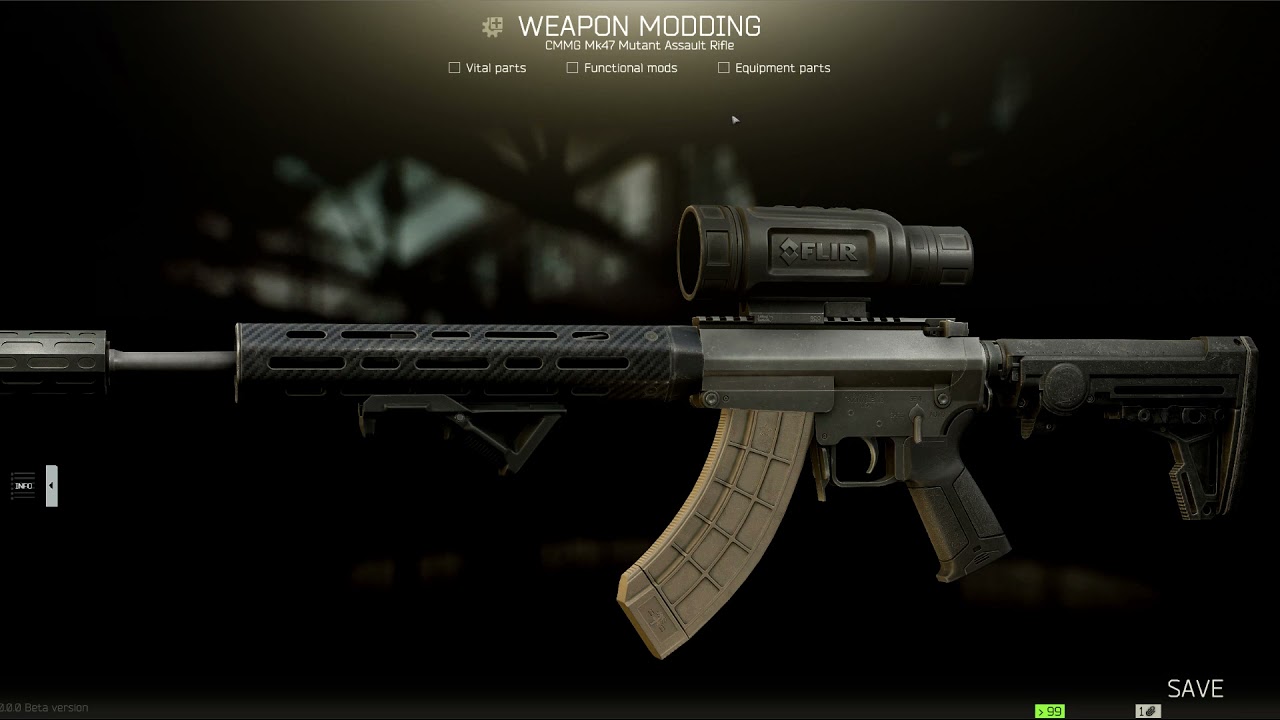
Slight overheating - the weapon is heated, but there is no reddening of the barrel and muzzle devices. Effects: heating of the barrel, muzzle devices, and handguard is visible in thermal scopes, possible mirage (heat haze) from the barrel and muzzle devices.
**Medium overheating **- the weapon is heated, reddening of the barrel and muzzle devices is visible. Effects: weapon’s accuracy decreases, malfunction chance increases, wear increases, and the weapon’s maximum durability is reduced during firing.
Severe overheating - the weapon is very hot, the barrel and muzzle devices are sizzling hot. Effects: weapon’s rate of fire changes, possible cooking-off chance.
**Maximum overheating **- when this level is reached, a malfunction occurs - the bolt gets jammed.
 calm spindle
 random mortar
 modern shuttle
 lean ridge

 tropic parrot
 earnest lark
 upper canyon


 elfin topaz
 graceful marsh

















 brisk vector