#a thread
1 messages · Page 1 of 1 (latest)
 turbid vapor

Visit http://ilectureonline.com for more math and science lectures!
In this video I will find the angle=? of a projectile fired at an angle at height h with initial velocity v0 traveling a distance x.
Next video in this series can be found at:
https://youtu.be/pQ23Eb-bXvQ
 viscid rose
turbid vapor
https://www.youtube.com/watch?v=bqYtNrhdDAY&ab_channel=MichelvanBiezen
viscid rose
turbid vapor
https://www.youtube.com/watch?v=bqYtNrhdDAY&ab_channel=MichelvanBiezen
watched that video
viscid rose
turbid vapor
What was different ?
?
turbid vapor
Why can you not just use the forumla there ?
 limber lance
oh your target will move, the problem becomes much complicated
viscid rose
limber lance
oh your target will move, the problem becomes much complicated
indeed, bullet moves, wind, shooter can move too, they both can move at the same time even if gravity also changes and stuff
turbid vapor
If everything can move and cannot predicted you cannot predict the trajectory with math.
I suggest that you use Physics Scene then.
viscid rose
turbid vapor
If everything can move and cannot predicted you cannot predict the trajectory wi...
i can
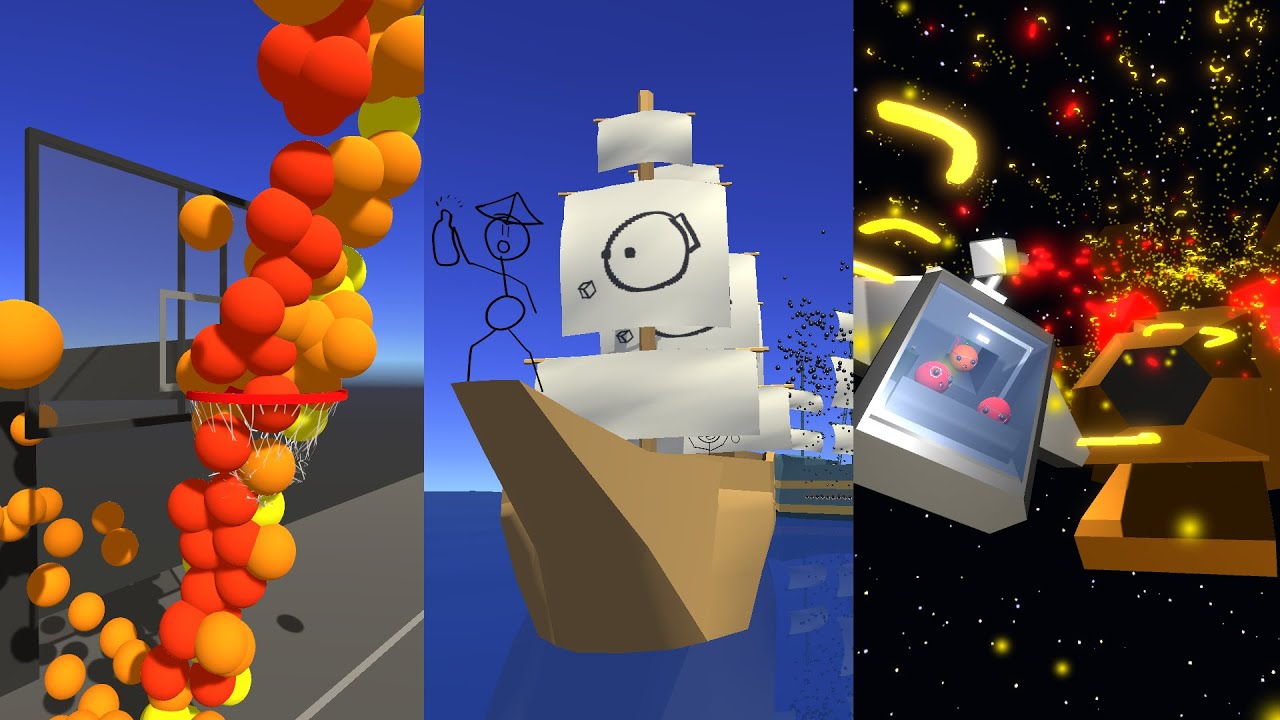
whether it's recess basketball, captain blubber's shenanigans or the alien kangaroo invasion, having an aimbot is always useful
0:00 Intro
0:21 Basketball
1:20 Basketball Maths
1:54 Captain Blubber
3:41 Captain Blubber Maths
4:06 Captain Blubber Part 2
4:49 Space Kangaroos
5:24 Space Kangaroos Math
6:05 Root Finding Algorithm
7:28 Finale
White...
see
turbid vapor
If the distance is the same, you can simply change angle on the Y axis to "never" miss.
viscid rose
distance is never the same
turbid vapor
It is fairly different then what we were understanding. Not exaclty sure how to proceed, however, if you know the trajectory of the incoming projectile, which can be describe as f(t), then you can add that into the formula instead of the target position.
viscid rose
turbid vapor
It is fairly different then what we were understanding. Not exaclty sure how to ...
that was given with time, but i will try to make my equation, due nobody else did, and i wont share it(for a reason)
viscid rose
i wont
limber lance
i found than if you want to fire immediately at t0 and the predicted target position relatively to launcher is S(t) you have to adjust the projectile's Vxz so that S(t)/Vxz=t (simply S(t)/t)
but if Vxz is fixed then you have to wait some time
you probably cannot control how target moves
 thin wave
viscid rose
that was given with time, but i will try to make my equation, due nobody else di...
thin wave
viscid rose
that was given with time, but i will try to make my equation, due nobody else di...
You should have tried making it before coming in the first place
But that didn't work (clearly)
And it won't work now
viscid rose
thin wave
You should have tried making it before coming in the first place
already did
thin wave
Check your attitude when asking for help
viscid rose
altitude needs to be high
turbid vapor
@limber lance, @thin wave, @fiery ocean If you are interested, I replicated a part of the video our friend sent. I still have no fucking idea what he wants though.
thin wave
Looks good 👍 I also still don't know what he wanted to happen but it was clearly a state secret else he would've been more clear
@turbid vapor
Also I would not want to play against that...
I assume that your formulas incorporate time?
turbid vapor
It does calculate time.
I guess you could use an other variable given an other unknown
However, the original formula presented in the video was finding t.
limber lance
i read his message again and he said shooter, target can move also there is wind and gravity
i assume wind is applying a constant force (let's say W=Wind/Mass)to projectile and so V=V+G*t+W*t........
Vxz=Vxz+Wxz*t (Gxz=0)
Vy=Vy+Gy*t+Wy*t
and the ds on horizontal (ie on xz plane and equal to target pos-launcher pos) should be int(Uxz+Wxz*t)dt
amd i believe his problem is:
given target relative pos(t) and speed of projectile, find both Vxz and Vy (so the velocity can be found and ||V||=speed) and the timing of fire
i have no clue that how to solve this system of equations
turbid vapor
limber lance
i read his message again and he said shooter, target can move also there is wind...
This is pretty much was is being done in the video and that I have replicated.
- You can add wind like I did in the video I sent.
- You find (t) base on relative position, relative velocity, relative acceleration (gravity goes there) and projectile speed. This is what I solved base on the video.
- Using (t), you can then find the vector defining the angle.
 fiery ocean
turbid vapor
<@627105011691945996>, <@157615878115033088>, <@225341850444234752> If you are i...
fiery ocean
turbid vapor
<@627105011691945996>, <@157615878115033088>, <@225341850444234752> If you are i...
Thanks but I blocked that dude. Should be easy to precalculate or calculate on the fly and play around with any kinds of velocity, just wanted to waste 2 hours from 4 people.
viscid rose
fiery ocean
Thanks but I blocked that dude. Should be easy to precalculate or calculate on t...
i have already finished, due nobody is smart to help
i have calculted the starting veolocety without using time, and now it works perfectly as expected
viscid rose
fiery ocean
Thanks but I blocked that dude. Should be easy to precalculate or calculate on t...
& my plan wasnt to waste hours, my plan was to get help if anyone knows, but no, bobody knows, lazy bastards
viscid rose
turbid vapor
This is pretty much was is being done in the video and that I have replicated.
...
that includes you
 turbid vapor
@viscid rose
Funny, I took the time to replicated a major part of what you wanted(or have done). You could have simply tried again to ask your question, maybe I would have been able to help you.
I must say, however, that it was a new way of working with projectile motion. I always used the physics version that I have learnt in school (UARM formula) which was working correctly for my needs. You can probably extrapolate the whole thing to add relative motion, however this was clearly easier to do the way it was presented in the video you sent.
