#archived-dots
1 messages · Page 163 of 1
 zinc plinth
You copy vertices in and out of native containers
With a lovely bunch of allocation when you copy back to managed
 coarse turtle
You can also use mesh data array: https://docs.unity3d.com/2020.1/Documentation/ScriptReference/Mesh.MeshDataArray.html
 zinc plinth
Hooo I'll have a look at this, didn't know that existed
hooo this seems rly nice
tho it can't work with CombineInstance sadly soo
 tight blade
niiiice
zinc plinth
I wanted to cache my resulting meshes, but I'm not sure how they get combined and if there's no offset to the transform matrixes I'm providing for each mesh to combine
like if the 0 0 is the 0 0 of the first mesh or if everything is on world space
which would omega suck
so testing that now
huuuh test isn't really conclusive
I can't seem to get the combined mesh to display ?
(testing on gameobjects)
 violet cosmos
So, I'm curious how to do something that is a process with Jobs/ECS
Let's say the process always runs in the order A, B, C, D
How do I move data from A > B or A > D?
Is that in Execute? ex: Execute([ReadOnly] ref A aResult) with an [UpdateAfter(typeof(A))] in the system class def?
Also, if the resulting data in A is an array that potentially changes size each frame... how do I handle that? Just allocate a new NativeArray?
zinc plinth
Are you talking of jobs or systems
If you want to pass data between jobs put your dependencies correctly and pass around your native containers
 rancid geode
@violet cosmos you use NativeContainers (NativeArray, NativeHashMap, Native....) to pass data from one job to another, like the following:
var resultsFromA = new NativeList<int>(Allocator.TempJob);
var jobA = new JobA() { Results = resultsFromA }.Schedule();
new JobB() { Input = resultsFromA }.Schedule(jobA);
Or use Unfase if you like to live dangerouslu 
violet cosmos
In this case, I'm going to be running mostly on things that exist not as Entities, but GameObjects/Colliders/etc in the Scene... But, there's a blurry line between ECS and Jobs I haven't quite isolated yet
zinc plinth
You can't use managed types in jobs
You can check references between each other using Dunstan's article, but that's it
rancid geode
@zinc plinth actually you can, with GCHandle, but GameObject/Collider and many other UnityEngine.Object stuff can't be used outside MainThread
you can't use managedtypes at all with Burst
violet cosmos
So, if I wanted A to run collision detection, every object that it could potentially collide with would need to be migrated into Entity?
Well, not collision detection per se... But things like CapsuleCast, SphereCast, etc
rancid geode
So, if I wanted A to run collision detection, every object that it could potentially collide with would need to be migrated into Entity?
@violet cosmos unless you create a custom collision detection and used the colliders data to create your own custom jobfied colliders
which I would not recommend to do unless you have expertise on that
you can take a look into RaycastCommand, which is a jobfied way to do Raycast with standard unity physics
you can create CapsuleCast/SphereCast/etc based on that
violet cosmos
Then that's into pure Jobs, and then... How do I run Jobs in that A, B, C, D scenario where B uses data from A?
rancid geode
@violet cosmos you use NativeContainers (NativeArray, NativeHashMap, Native....) to pass data from one job to another, like the following:
var resultsFromA = new NativeList<int>(Allocator.TempJob);
var jobA = new JobA() { Results = resultsFromA }.Schedule();
new JobB() { Input = resultsFromA }.Schedule(jobA);
struct JobA : IJob
{
    [WriteOnly]
    public NativeList<int> Results;

    public void Execute()
    {
        for (int i = 0; i < 100; i++)
        {
            Results.Add(i);
        }
    }
}

struct JobB : IJob
{
    [ReadOnly]
    public NativeList<int> Input;

    public void Execute()
    {
        for (int i = 0; i < 100; i++)
        {
            Debug.Log(Results[i]);
        }
    }
}
What's the best way to check when a Job completed? Polling for IsCompleted seems dumb. IsCompleted isn't async. Forcing Complete seems a bit... blunt
rancid geode
polling for IsCompleted is the correct way
violet cosmos
O_o
rancid geode
or just call Complete when you require it at a certain point
violet cosmos
You'd think they would have added CompleteAsync so code could be organized 😄
rancid geode
currently, jobs doesn't seem designed to be running across many frames
 minor sluice
think the manual check is alright since you usually operate on a system execution per frame basis, but if one used jobs only, i can see that it can make sense
rancid geode
they surely need to add support for that (like Addressables does) if this use case is intended
violet cosmos
No, and for this particular chain of inquiry, I'll likely just force Complete and try to aggregate as many things as I can before
So, that brings up another question... I formed a big job that using a system that effects multiple GameObject/Behaviors, then forced it to complete... Now, what's the usual best practice to migrate that data back into the GO's?
minor sluice
apply it in a synchronous context I'd say, not sure if there are better practices
violet cosmos
But, when? Update/FixedUpdate/etc are running on their own independent timeline and I can't just block that
minor sluice
if you work in other thread related ways, you could make a queue to store actions that need to be applied then,,
I think it depends on when you need it
I would set it up so it either happens in update /lateupdate or another event method... maybe? I'm not sure about systems, I think there it depends to which system group they are part of?
but could certainly be done in an OnUpdate too I'd think
violet cosmos
Hmm, that's where the decision gets blurry for me on Jobs/ECS. Do I migrate lots of other things into ECS so I'm running a parallel physics world so then it can just be magically applied, or do I try to solve a bunch of issues around "when" and "who" for applying results of pure Jobs 🤔
minor sluice
doesn't physx support parallel worlds in recent versions too?
maybe im wrong, let me check
violet cosmos
I can't count on PhysX
minor sluice
ah okay
violet cosmos
The reason I'm going down this path is to eek as much performance as I can out of the Quest for a system that is likely to easily grow in size and complexity, and computation time
I'm still new at DOTS, and trying to wrap my head around it for new and existing systems
minor sluice
hmmhh, but physx is already multithreaded? not sure if the unity physics are already faster, maybe they are if everything is properly set up with data in the ecs world
violet cosmos
I think I'm OK migrating many things into Entities using MonoBehaviours that are converters
But, I wouldn't mind making things isolated systems either that just work on existing GameObject workflow
 tardy spoke
@violet cosmos welcome to the fun world of DOTS and Oculus Quest. If you get ECS running on the quest at all with 2020.1 and Entities 0.13, let me know, haha. I can get 0.11 to run, but not 0.13
 stiff skiff
With the XR toolkit?
violet cosmos
Hmmm, that's a huge red flag. I just converted to to XR Plugins, but I'm not using the Integration Toolkit, I have my own API
There's still one thing I'm very confused about, is that demarcation line between ECS and ECS based Jobs and the traditional scene... and how to control that. Does ECS run it's system before any MonoBehavior Update?
Flat pure Jobs I can wrap my head around how to organize
Pure 100% ECS too
It's mixing ECS and ECS Systems with the Scene that I'm still seeking clarity
tardy spoke
Lol, someone needs to draw a chart. That question comes up all the time. Someone must know the order of execution?
rancid geode
you can always check in the system window
just ensure to tick the Show Full Player Loop
violet cosmos
@rancid geode sure, but I'm in the planning phase now, how to organize. There's nothing for me to check
rancid geode
basically it is :
MB.Update()
SimulationSystemGroup
MB.LateUpdate()
PresentationSystemGroup
@rancid geode sure, but I'm in the planning phase now, how to organize. There's nothing for me to check
@violet cosmos this screenshot is from a pratically empty project, having more scripts doesn't change the player loop order
unless some of your script is modifying the player loop itself
rancid geode
if you don't have DOTS Editor installed you can use the one in the EntityDebugger
if you have the DOTS Editor, it is in Window -> DOTS -> System
violet cosmos
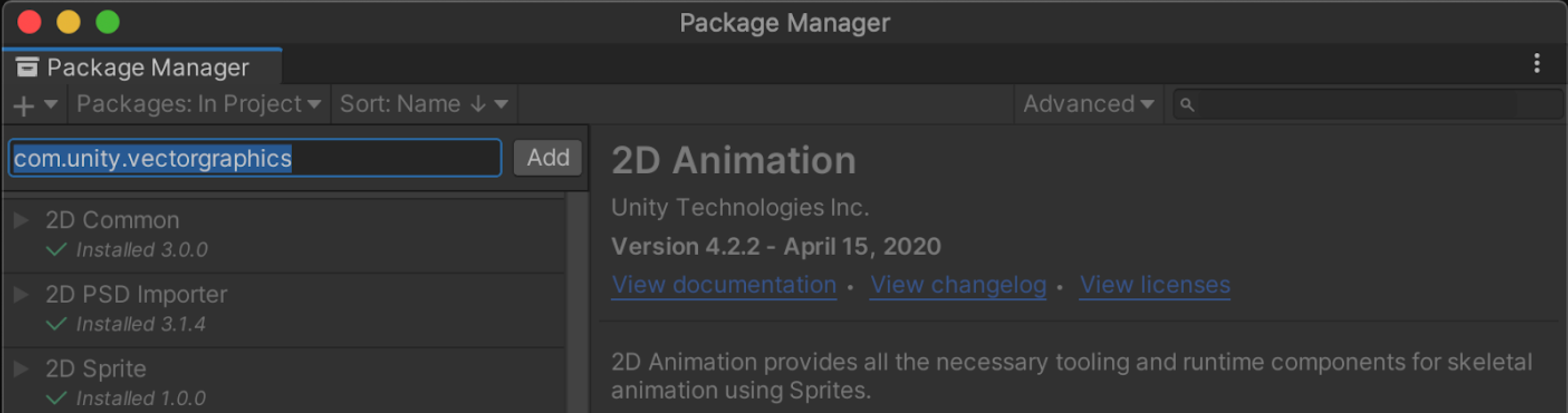
Lovely... New 2020.1 project, enabled preview packages... Hybrid Renderer is not in the list of available packages in the Unity Registry
rancid geode
just click +, add from url and type "com.unity.rendering.hybrid"
violet cosmos
Learning this is like some weird priest cult. What's next, I have to open the command line and type in a bunch of undocumented commands? haha
rancid geode
they changed the entities-related visibility due its experimental state
 quasi trellis
@violet cosmos have a read of this https://forum.unity.com/threads/visibility-changes-for-preview-packages-in-2020-1.910880/
Unity Forum
We recently went through our package list to identify preview packages that are further from the verification stage, just dependencies of other...
violet cosmos
@quasi trellis Well, that explains it.... And also, kind of annoying
It's also not a Git URL 😛
 stone osprey
How do we construct systems and components in a flexible and clean way... lets say we wanna spawn popups once we click on a entity... we could either decide between the hard coded approach : "ClickOnEntitySystem sending click event, OnClickSpawnPopUp as Component which returns the PopUp being spawned, OnClickSpawnPopUpSystem iterates over click events to spawn popups using OnClickSpawnPopUp" or would you choose the flexible approach : "ClickOnEntitySystem sending click event, OnClick as Component which simply contains a callback/action with code, OnClickSystem which iterates over the events and OnClick components in order to execute the callbacks"... The first approach is only spawning popups while the second approach is pretty flexible and can get extended by callbacks pretty simple... for example we can just hook up new actions and print stuff while a entity was clicked 😛 what would you choose and why ?
 deft stump
what you mean by popups?
stone osprey
popups... uhm... just replace popups with "UI"/"UI-Elements"/"UI-Notifications"... everything that pop-ups ^^
 dark cypress
Isn't the accepted pattern to have MouseButton component on all archetypes that need to react to input and set every MouseButton component in a PlayerInput system?
stone osprey
Damn.. i should have said that this is a "server side" example... a general ECS question and not special for unity ^^
violet cosmos
https://gametorrahod.com/game-object-conversion-and-subscene/ - This is a book of a tutorial, but it's really helping me a lot

Game Torrahod
GameObject based data are not ECS compatible. It would be great if it is easy to author the data like before but instead getting ECS data at runtime so that we could work on them efficiently.
I think I'm going to have to read that over a few times though
tardy spoke
Yeah, it's a bit tricky as some of that stuff is a bit older now, but still a good resource
violet cosmos
Example: "Companion GameObject"
tardy spoke
the principles are the same, syntax or class names may be a bit different
violet cosmos
@tardy spoke Could you tell me more about the Quest / ECS issue you're having? Are just entities alone that are not processing, or XR tracking? Or XR Interaction Toolkit?
Also, do you see it work correctly in say, Link mode?
tardy spoke
XR kit all works fine, just ECS doesn't seem to "run" at all (on Entities 0.13. Downgrading to Entities 0.11 it works fine). No errors that I saw. Haven't tried linked mode.
It could be something to do with the XR kit stuff, but I couldn't tell you for sure. The XR kit stuff seems functional and doesn't have any errors.
violet cosmos
Hmm, is there an issue tracked for this?
Right now I'm mostly on Link mode, in editor with some rare spot checks on Quest via APK to make sure I'm not doing something dumb
tardy spoke
Interesting, I have never actually used the Link mode, haha. You're on PC?
I'm on a Mac, I'm not sure it can use the link mode though I haven't downloaded the Oculus desktop app and tried
violet cosmos
Yah, I'm on PC. Have the official Link cable (with a short 2m extension run of high quality TB3 compatible USB)
tardy spoke
I think the issue is tracked, I found someone else that reported the same issue and that's how I learned downgrading to 0.11 was the solution.
violet cosmos
Hm, I think that really depends on the video card on your Mac, and should definitely in Boot Camp https://support.oculus.com/444256562873335/
Do you have other VR headsets that actually work on Mac?
tardy spoke
I haven't bothered, because as soon as you start developing for quest the first thing you do is build a controller that works on both quest and your desktop and do most your dev on desktop because it's such a pain putting the headset on/off all the time no matter how fast the build is, hahaha
I'm not sure, my experience is limited just to the Quest, and I'm a fairly new game dev.
violet cosmos
I really think if you're getting into VR, it helps to be on Windows. What CPU/GPU do you have in the Mac?
tardy spoke
Nothing amazing, I'm sure
zinc plinth
got stuff working ```
RenderMesh[] CombineRenderMeshes(RenderMesh[] renderMeshes, NativeArray<LocalToWorld> localToWorlds, LocalToWorld rootLTW)
{
List<RenderMesh> results = new List<RenderMesh>();
Dictionary<string, List<CombineInstance>> combines = new Dictionary<string, List<CombineInstance>>();
Dictionary<string, Material> namedMaterials = new Dictionary<string, Material>();
        for (int i = 0; i < renderMeshes.Length; i++)
        {
            var renderMesh = renderMeshes[i];
            var LTW = localToWorlds[i];

            var material = renderMesh.material;
            if (material != null && !combines.ContainsKey(material.name))
            {
                combines.Add(material.name, new List<CombineInstance>());
                namedMaterials.Add(material.name, material);
            }
            CombineInstance ci = new CombineInstance
            {
                mesh = renderMesh.mesh,
                transform = rootLTW.Value * LTW.Value
            };
            combines[material.name].Add(ci);
        }
        foreach (var namedMaterial in namedMaterials)
        {
            RenderMesh result = new RenderMesh();
            result.material = namedMaterial.Value;
            result.mesh = new Mesh();
            result.mesh.CombineMeshes(combines[namedMaterial.Key].ToArray(), true, true);
            results.Add(result);
        }

        return results.ToArray();
    }```
combines meshes based on their materials (since you can't combine meshes with diferent materials) and outputs the unique RenderMeshes
tardy spoke
Awesome! 😎
violet cosmos
So, many of the ECS examples deal with Entities and Components that are generally homogeneous... Something like a bullet hell shooter
What is the general strategy for non-homogeneous entities? Lets say I'm not making a bullet hell, but I want to leverage ECS to help organize multi threaded Jobs by component easier. Do I pay a penalty, or is it just a "penalty by contrast"?
 safe lintel
"I want to leverage ECS to help organize multi threaded Jobs by component easier. " what do you mean?
violet cosmos
I can make Jobs without ECS, just need to manage them and organize the data layout myself
So in "pure Jobs" if I have 30 things, I need to collect the data from all 30, pack that into NativeArrays, schedule the Job and go. With ECS I just write Systems (organized Jobs) that work on component sets, which seems to be better for the particular game system I'm working on, but... Like I said, Entities won't have a very homogeneous structure, so I'm curious how to avoid any pitfalls there
safe lintel
do you mean just if theres penalties of having lots of entities that dont have the same components? like a handful of ab and c, some with c, others with xyz and so on?
violet cosmos
Yah, the "archetypes" and clustering penalties
I don't plan on add/removing components (I understand the penalties there clearly), but don't understand the ramifications of having a variety of archetypes that are shallow
safe lintel
i dont think it should be a problem unless you are doing some codegen thing that creates a vast multitude of different combinations
violet cosmos
What's a "vast multitude"? thousands? tens of thousands?
safe lintel
im trying to find a forum thread where someone was doing this and ran into memory problems
safe lintel
Unity Forum
Finally figured this one out that has been destroying our project.
Firstly the repo:
namespace Scenes.Scripts
{
using Unity.Collections;...
29k
violet cosmos
hahaha I love this comment: "Regardless, I would strongly encourage you to look at how you end up with 29000 archetypes. I'm in no position to judge whether that is a reasonable number for your game, but with that number of archetypes I'd personally be suspicious"
safe lintel
seems like a soft limit as previously he made over 6 million archetypes but i truly dont think this is a common need 🙃
violet cosmos
Yah, I don't think I'll hit that high. Maybe a few hundred, but I'm more concerned about allocation... Maybe I shouldn't be, since these are briefly lived (only a few seconds) there's likely to be chunk holes to be filled up and it's not allocating anything
zinc plinth
lots of archetypes mean higher minimum chunk amount
so 29K archetypes = 29K minimum chunks
a) that starts to be alot of memory
b) the hashtable that handles archetypes won't be as fast at all as with fewer archetypes
and how in the world are you getting 29K archetypes anyway
tardy spoke
Hmm, you should be able to access a regular monobehaviour like this and change a variable no?
I'm trying to add a vector3 that moves around to decide when to load/unload Subscenes based on distance. It resides as a monobehaviour variable on the Subscene GO itself.
Additionally I want this vector3 to move around opposite to the player's movement, but I can't seem to change it's value via ECS code, even though I believe it should be able to? Unless subscenes are special compared to regular GO's, they are in a different namespace so not sure.
zinc plinth
do you get some kind of errors ?
tardy spoke
Nope, nothing
tardy spoke
@zinc plinth creating an ICD as a class on another GO to reference it seems to work. No idea why. Doesn't work when on subscene though.
So that'll work for now, but odd.
 buoyant aspen
Do anyone here have experience with ECS? Is it stable enough for production?
safe lintel
yes. no.
tardy spoke
Depends on the phase of the moon, pretty much.
If by ready for production you mean that Entities 0.13 doesn't even seem to work on VR builds, then yes, it's ready.
tardy spoke
Define "enough".
tight blade
oh my god mother f****ckers I finally did it. behold my triumph
all three are given the same initial linear velocity: -2 z
the one that is in line floats farther than the one moving broadside laterally. the one with its nose out of the water drifts the farthest. the one that is flat is turning towards the other boat because its drafting off its movement
tight blade
Lol I'm so bad at capturing video. No one is able to see that video are they?
dark cypress
You can see the second half if you manually click at 13s.
tight blade
Hahaha perfect.
 proper silo
Hello! Quick beginner and maybe stupid question, but can you schedule job (IJobParallelFor) inside an Entities.ForEach loop, which is also scheduled? It sounds like something you shouldn't do, but I am curious
 mint iron
nope
proper silo
Damn
So, if for example I have a system that cast a ray along the forward of an entity, and if this ray collide I turn the entity 1 degree, I have to make the raycast test in the forEach, with the rest of the code that turn the entity ?
dark cypress
You can make multiple jobs that run sequentially in one system and pass data in native containers or components between them.
proper silo
Humm I see, but since I need the entity's forward for the raycast, and it's rotation for the, well, rotation, I could do something like 2 consecutives entities.ForEach, and having the second one depends on the first ?
dark cypress
What are you trying to do with the nested .foreach anyways?
proper silo
To be honest, I am not sure. I feel like having "too much different stuff" happening in one .foreach is not the optimal way to do things, like having the raycast test with the physic and such + any movement depending on the result of said raycast in just one .foreach
tardy spoke
@tight blade that's awesome. What project is it for? Haha
tight blade
yeah nevermind its still broken haha, the draft way overcorrects when it gets a sudden impulse thrown at the boat
dark cypress
Yeah, if you want to split up the check/action, you could use 2 jobs. Although if you're not using the result of the check in any other place you'd need to think if the split offers you any performance gain(probably not).
tight blade
lol, it'll be a game one day. sailing game, is the idea
turns out drag is really hard.
who knew.
proper silo
Make sense! Thank you @dark cypress for taking the time!
dark cypress
Is there any way for me to use MeshData.SetVertexBufferParams() if I don't know the number of vertices the job will generate? Or is the size parameter "capacity" instead of a hard size?
violet cosmos
Hm, so IJobForeach is going away? It seemed like a nice way to mark up classes
So... How do I make ordering dependencies with just Entities.ForEach() between different systems to have a precise order of operations?
dark cypress
The same way. Use the UpdateBefore/UpdateAfter for the systems, and pass the handles around in Schedule().
violet cosmos
So... I have to pass job handle references around each system?
dark cypress
How were you doing it before?
violet cosmos
I thought things implementing SystemBase were automatically loaded and executed
I wasn't, I'm writing something new
dark cypress
They are. All jobs Scheduled() in an OnUpdate() of a system automagically depend on eachother.
You pass the handles if you want finer control.
violet cosmos
How do I pass the handles from one automagically run SystemBase class to another automagically run SystemBase class?
dark cypress
What are you trying to achieve? System1.Job1>S2.J1>S1.J2>S2.J2?
violet cosmos
No, in ECS you're recommended to write a number of Systems, correct? Each doing something discreet. So I want to have say, three systems. PositionSystem, TargetSystem, MechanicsSystem. They need to run in that specific order
dark cypress
That's simple. Use the atrributes.
violet cosmos
OK, so there's still that tag. whew.
dark cypress
I mentioned it a few posts back. Think you missed it.
violet cosmos
I think I did, apologies I'm still trying to wrap my head around this and ever changing examples and recent deprecations
dark cypress
Haha, no issues. Doing the same thing myself.
violet cosmos
Hm... is there something that replaces [ReadOnly] in the .ForEach parameters?
dark cypress
violet cosmos
Unity 2020.1 with ECS 0.13
dark cypress
in
violet cosmos
👍
tardy spoke
https://youtu.be/V0_WaCKIOJU @tight blade @amber flicker @minor sluice I finally got it working, haha. Continuous Floating Origin player that loads subscenes by proximity.
Seems promising. I couldn't get the version where it moves the world in one move when a new subscene is loaded because I wasn't sure how to access any sort of callback after the subscene was done it's async loading, which would be required to then move the scene into the correct world position.
coarse turtle
Woah - that's pretty nice
tardy spoke
Haha, I'll keep you posted on how it works out. I'm so tired of working on floating origin stuff at this point... working on the actual game at some point would be a nice change of pace, hahaha
coarse turtle
I know that feel - I'm still working on the kinks of my 2d physics engine - I haven't really gotten to my game mechanics extensively lol
I did start playing around with subscenes again - hoping it'd work with some sprites I have
tardy spoke
Haha, when it's the foundation of your game if you don't get it right the rest of the work may become pointless, that's the problem, hahah
Subscenes are a bit rough to work with. They have no component on them that actually includes the correct bounds of the objects they contain, which to me is insane, because then that boundary could be used for loading them by proximity, which is one of the main reasons people use subscenes.
Secondly, I couldn't reference a monobehaviour's variable directly on a subscene from a System (withoutburst().Run()), but had to use an ICD on another non-entity to hold a reference to that monobehaviour's variable in order to change it. This could be me not understanding something simple, but it definitely seems odd. Just moving a script off the subscene to a GO works. Even moving the ICD component onto the subscene doesn't work, it has to be on a non-entity GO for the reference to work correctly, haha. It doesn't spit out any errors or anything either.
coarse turtle
I think for my case - I'll likely be using them to load some static entities and to declare some prefabs
tardy spoke
They seem good at that, at least, haha
If you're doing 2D Codemonkey has a tutorial on subscenes where he demonstrates them in 2D.
Despite ECS's rough edges I still already waaaay prefer it to OOP approaches.
Agree/disagree?
deft stump
can't deny. with the state of Unity's ECS right now, it's better to just do it in Classic Unity if you want something up and running asap
dark cypress
Isn't that the opposite of what alex said.
tardy spoke
We are now enemies
deft stump
🗡️
tardy spoke
This is promising...
3500 objects instantiated in subscene all with mesh colliders, and moving (the player is always at 0,0,0 world moves around).
https://www.youtube.com/watch?v=RE9MxzcKMfY&feature=youtu.be
@coarse turtle
That's the whole Synty pirates pack demo scene from the asset store, it instantiates it crazy fast. Noice.
 half jay
Does DisableRendering component will disable render for all LinkedEntityGroup?
 amber flicker
I don't know. I would guess/expect it to only disable for the entities it's added to. If you find out differently though please report back.
half jay
i have hybrid render 0.5 version with ENABLE_HYBRID_RENDERER_V2 when i add component to Parent Entity of LinkedEntityGroup and its working only for parent
amber flicker
👍 that's what I'd expect - I sometimes want an 'AddComponentDataToHierarchy' method but I can kinda understand why it doesn't exist
half jay
i saw somewhere that DisableRendering will enable on whole LinkedEntityGroup
amber flicker
it would be expensive to walk up the hierarchy for every entity.. I don't think it's likely... there might be some utility method that automatically adds the tag to all of the children though
stone osprey
ECS question ( not unity in general )... I wanna recreate the "Buffer-Systems" from unity to execute some stuff at the start/end of a frame... i can either do this by : "OnStartComponent{action}, OnStartSystem iterating over them to call the actions" or by "OnStartSystem.buffer(action)"... so either by using a component or by direct acess... what would you choose ?
tight blade
nicely done, @tardy spoke !!
anyone know a good way to do a ground check with unity physics?
@stone osprey can you give some more detail on the direct access option?
actually on both, Im having trouble understanding what you mean by those alternatives
minor sluice
@tardy spoke good job! so basically you load/unload subscenes based on the current position of the character?
I think for the ground check you could do it like with regular physics,
often times that might be a raycast of a bunch of raycasts (I think some people also do something like a sphere cast)
here is a tutorial with raycast example
https://www.youtube.com/watch?v=B3SFWm9gkL8

✅ Let's check out how to use Unity DOTS Physics!
Super Performant Collisions, Events, Triggers and Raycasts!
Get the Project files and Utilities at https://unitycodemonkey.com/video.php?v=B3SFWm9gkL8
Getting Started with Unity DOTS / ECS
https://www.youtube.com/playlist?list=...
I think basically, you could just think of the approach you would take with a non-ecs character controller and then simply translate that
 thorny halo
Hello, does anyone know why disposing of a nativecontainer OnApplicationQuit() causes an exception - the container has already been disposed? I'm checking if the container isCreated before disposing, yet the exception still occurs.
zinc plinth
why would you want to dispose on animation quit ?
everything is going to be freed up anyway by the OS
thorny halo
cause i get a crapload of errors while in the editor whenever i end play.
tight blade
yeah, the errors in the editor problem are really a bummer
gon fill up my hard drive before long
and it prevents me from using flythrough in my scene navigation
zinc plinth
this is from a system that's not getting destroyed properly
edit: #archived-resources
tight blade
are you suggesting there's something that I can do from my end to fix that?
zinc plinth
I know that I had this error when I destroyed a system, so I just disabled it instead
tight blade
hmm. I definitely am not intentionally instantiating or destroying systems in my code. I wasn't even aware thats something I could do
amber flicker
usually using using {} is useful... unless under unfortunate "pass container by ref to static method" circumstances where upon it becomes use-less
I did have issues when I briefly tried using static native containers - now I just avoid them
They're not ideal due to the whole domain reload issue anyway
tardy spoke
@half jay from my experience DisableRendering doesn't affect the entire linked entity group
@minor sluice yep, it loads and unloads subscenes based on proximity to character. It's a bit trickier than it sounds though because you have to create an alternate system for the detection and have it hold a reference to the subscene. There might be a smarter way to do it, but I couldn't figure it out, haha.
Subscenes also seem to not quite act like regular entities or regular GO's in some odd respects.
amber flicker
https://forum.unity.com/threads/any-updates-on-the-development-of-subscenes.947544/#post-6179985 - sub scene asset deduplication coming soon.. nice
tardy spoke
What does that mean exactly? haha
amber flicker
at the moment if you have a tree and put one in each of 1000 subscene tiles, the project will have the size of 1000 trees
tardy spoke
ah
amber flicker
I didn't intend for that to be a Stereophonics reference
darn motion blur being so expensive on hdrp.. it's pretty
tardy spoke
I havent ever touched HRDP yet. Ive been using my one vertex color shader with no lights for tests for months now. I've forgotten what good graphics look like at this point.
I wanted to make my own little render pipeline but it looked pretty intense haha
amber flicker
🤣 don't worry.. no good graphics over here, it just makes primitives look more interesting
tardy spoke
Hah that does look cool.
amber flicker
motion blur ~1.5ms for 30k dynamic meshes.. it's not terrible.. I'm just looking at 20+ unused threads for a large part of hybrid renderer v2 + hdrp 😬 (edit: seems srp batcher related.. dunno)
futurenowplz
tardy spoke
I really need to learn how to use the profiler better. Been putting it off... seems super handy though, haha.
Sometimes I look at it to feel smart.
amber flicker
do it.. super handy. In case it's useful @CiroContns did a good intro recently https://t.co/y1corSxu96?amp=1

Profiling is one of the best ways to optimize your game. In this session, learn how to use Unity’s highly effective profiling tools and how to interpret the data they produce.
tardy spoke
Awesome! Was just googling for some good tutorials, haha
violet cosmos
ProfileMarkers is one of the reasons I moved to 2020.1 from 2019.4LTS
To me, if you're using the DOTS tech stack, but don't have a grip on Profiling.... You're kind of shooting around in the dark
tardy spoke
Since i've only been programming for a few months... I live in the dark. Like batman.
Best way to learn is to walk into walls and shit. Makes you want to turn lights on, hahah.
 radiant sentinel
Hello, how can i create a world and assign my systems to that?
tardy spoke
@radiant sentinel an extra world besides the default world?
radiant sentinel
Yes> @radiant sentinel an extra world besides the default world?
@tardy spoke
I want other worlds to calculate data of my players and more as systems but i cant find how to create new world at google.
@tardy spoke
I want create matchmaking system to handle online game matches
coarse turtle
var otherWorld = new World("Other World");
radiant sentinel
Yes i have created but when i using GetOrCreateSystem
Icant see my system at entity debugger.@coarse turtle
coarse turtle
Ah im not sure about the entity debugger - tbh I haven't really been using that lately
radiant sentinel
I can find world at entity debuger, but its empty and not any system exist
coarse turtle
Hmm yeah sorry, I'm not sure about having it show up in the EntityManager/Systems window
tardy spoke
I thought I read that that wasn't implemented yet but I'm not sure
radiant sentinel
I thought I read that that wasn't implemented yet but I'm not sure
@tardy spoke
Thats mean i cant create new worlds?
Sry my English is not good
tardy spoke
@radiant sentinel I'm not sure if this is correct. I believe you can create new worlds, but you can't see their entities listed in the entity debugger yet. I could be wrong.
radiant sentinel
Ok no problem, thank you for answer
@tardy spoke @coarse turtle
I will test systems without checking entity debugger window.
tardy spoke
No problem! 👍
quasi trellis
you might want to select the Show Inactive Systems option in the entity debugger as your system probably never ran
 feral plover
Hello! Im pretty new at coding C# jobs, and im having some issues when destroying objects that are on a native list. How can I destroy an object and re arrange the list?
coarse turtle
Well, NativeList<T> can't store managed objects (only structs with blittable data)
feral plover
I mean, it is a float3 array, it stores positions of my instantiated objects, but when I destroy one of them I get memory leak error
coarse turtle
Just to clarify, what do you mean by destroy one of them? Like remove one of the float3 from the NativeList?
feral plover
yeah, I made and object spawner, those objects are explosive objects, and once their hp reach 0, they explode and destroy themselves. That makes a hole in the array, because there will not be an object anymore
Should I show code of the spawner?
Im not even sure if im implementing jobs well here
coarse turtle
Well typically you can remove an element from a NativeList<float3> by using the RemoveAt or RemoveAtSwapBack function calls
feral plover
true, but bomb class and spawner class are different
tardy spoke
I'm a bit confused because I believe NativeList has to be value types (blittable or whatnot), not reference types? Is there some sort of reference to the hitpoints or is another system writing the new values to the NativeList?
feral plover
here is my code https://hatebin.com/adnfcqpqqz
I think im doing pretty much nothing of jobs there, there are many things that Im not understanding about jibs
jobs*
coarse turtle
Where are you trying to destroy the element in the code?
feral plover
in another code, in the bom script
it destroys itself once hitpoints reach 0
https://hatebin.com/gorzzgwcgh explosion script
coarse turtle
hmm okay, so I'm thinking the first piece of code, the List<prefab> contains the GameObject containing the Explosion MonoBehaviour
so an idea, is to possibly assign an index to each Explosion GameObject that corresponds with the index in your NativeList<float3>
when the Detonate function is called, you can collect all of your indices of elements you need to remove and remove them from the NativeList<float3>
when you do that - you probably want to update all of the remaining Explosion GameObjects with updated indices as you're now manipulating the size of the list and indices that are removed in the middle of the list needed to be shifted up to be remapped
so if you had 6 potential explosions and the 3rd index detonates:
[ 0 ] [ 1 ] [ 2 ] [ 3 ] [ 4 ] [ 5 ]
[ 0 ] [ 1 ] [ 2 ] [ x ] [ 4 ] { 5 ] <- shift 4 and 5 down to 3 , 4 and update your indices
hmm okay, so I'm thinking the first piece of code, the List<prefab> contains the GameObject containing the
ExplosionMonoBehaviour
yeah
Ohh I got you
I will try that
Ty bud
well, I didnt work
Im gettin error at the same line
coarse turtle
Well keep in mind that on line 75/76 of the first script, you're already disposing your NativeArray<float3> so by the time the next frame occurs, the data no longer exists and you're spawning new gameobjects and allocating new NativeArray<float3>s
feral plover
Well keep in mind that on line 75/76 of the first script, you're already disposing your
NativeArray<float3>so by the time the next frame occurs, the data no longer exists and you're spawning new gameobjects and allocating newNativeArray<float3>s
well, thats true, however the error is happening at the instances array
coarse turtle
what's the error exactly?
feral plover
it is not finding the object once it has exploded, including != null in the list isnt working
coarse turtle
You might want to explicitly assign null to the index for cleanup, I don't think Destroy will handle assigned references
feral plover
this is what I have done
radiant sentinel
it os active> you might want to select the Show Inactive Systems option in the entity debugger as your system probably never ran
@quasi trellis
Oops sry for image
I should add world to any update system?
Its my code
 low oasis
I'm trying to figure out where the best point would be in the player loop to copy entities from one world to the default world, AND have the systems in the default world have access to them this loop. Is it better to do this in a MonoBehaviour or create a system to handle it? Is there something along the lines of a command buffer that can be used?
 gilded glacier
are there any details about blob assets ?
tardy spoke
@gilded glacier https://www.youtube.com/watch?v=7_rZhp6V8ds
gilded glacier
yeah ... maybe a bit more detailed ...
or more precisely, whether it's worth using it, or rather access the data different way
like storing non-blittable objects (prefabs, materials, ...) in an array accessed from systems
using index stored in an entity component
tardy spoke
Blob assets are immutable so they can't store non-blittable objects afaik. So you'd have to do it another way?
https://docs.unity3d.com/Packages/com.unity.entities@0.13/api/Unity.Entities.BlobBuilder.html?q=blob a bit more info in the manual if you haven't come across it yet
gilded glacier
somehow I managed to store material reference in it
maybe I've done something forbidden ...
tardy spoke
Try changing it, should get an error
gilded glacier
well, if blobs can only be used with blittable data, then how should I store and refer the non-blittable data, such as materials ?
tardy spoke
What's the type of the reference you have it holding or whatnot?
 hollow sorrel
@radiant sentinel entitydebugger only shows worlds that are scheduled to update by the player loop
if you add it using ScriptBehaviourUpdateOrder.UpdatePlayerLoop(world); it should work
gilded glacier
@tardy spoke I don't understand ... I have a BlobAssetReference with a type of struct that contains reference to material in the diamond
dark cypress
refer the non-blittable data
In jobs you don't do that. Jobs are blittable-only.
I store my references in global statics.
And refer to them on the main thread.
Sorry, I meant parallel or burst jobs are blittable-only.
You can have normal code on a main thread job.
gilded glacier
@dark cypress that's what makes most sense to me, but I am very uncertain since there are not many information on this topic
tardy spoke
I'm not really sure if there is a "good" way to do it yet, I see a lot of people holding references to materials on GO's, etc.
dark cypress
GOs are just statics with extra steps, no?
At some point you need a global reference.
gilded glacier
I use a singleton
well, it actually is a singleton only because I store bundles in it
tardy spoke
@dark cypress I'm not saying it's a better approach, probably worse, just saying that's the way I see a lot of people handle it
gilded glacier
and I eventually want to unload it, so I have to keep the reference somewhere
I use GO only for the bootstrap script
and for some scene input data, which can be assigned via the script in inspector
tardy spoke
@gilded glacier you should be able to access the materials in your singleton if the job isn't parallel like @dark cypress said? Would that be suitable for what you're doing?
gilded glacier
I suppose
tardy spoke
Are you looking for a solution that runs multi threaded?
gilded glacier
I expect that systems that use non-blittable data, such as the renderer, would have to be run on the main thread
tardy spoke
This is an interesting way to hold a reference to an object inside an entity, but it still requires you to run on main thread because it's a reference
make your ICD a class instead of a struct
hollow sorrel
@low oasis if it's just specific entities (as opposed to copying entire world) you could prob use one of the ECB's from the default world
this also means your custom world has to update before the ECB that you're using
e.g. you could use beginsimulationecb and have your custom world run before Update, for example earlyupdate or preupdate
tardy spoke
That's my hacky way to do a lot of stuff. Probably pretty slow, but easy for prototyping, haha.
gilded glacier
looks like the entire programming profession can be renamed to duct tape programming
no clean solution for any problem
tardy spoke
No clean solution yet, but there likely will be in time. DOTS technically isn't even "released" yet, haha.
They made it invisible in the package manager even on 2020.1
gilded glacier
@dark cypress I try, but I look like a lunatic
tardy spoke
I'm actually not sure what the plans are for dealing with reference types in ECS... I think they may just be observing the ways people are currently doing it and figuring out how they'll handle it, haha.
Could be worth looking at any demo scenes they have and seeing how they do it.
gilded glacier
or they'll break them into the elemental data and compose it into components
isn't unity supposed to be run using dots internally ?
tardy spoke
nah, it uses job system internally
Maybe eventually they will though. I think a lot of the DOTS stuff is built on layers of DOTS
safe lintel
i mean all these packages are the engine
the whole burst+entities+collections+physics+buildplatforms etc etc are the new internal guts, its just now visible for us to see whats going on.
tardy spoke
Anyone doing a lot of tests for their ECS code? Wanted to try that out soon
Is the ECS test suite rough around the edges or solid?
safe lintel
my tests are: play mode & copious amounts of debug.log 😅
tardy spoke
Lol, yep, same. Trying to get something in place before scaling to too many systems and stuff.
hollow sorrel
only using a couple since not a big fan of unit testing in general but the test framework seems pretty solid imo
but unity just uses NUnit internally which is also used for a lot of regular C# projects so makes sense that it's solid
it's not something unity built so higher chance of being good
tardy spoke
I imagine testing in general becomes a diminishing return, due to coupling of tests and code
Eventually you spend more time fixing tests if you have full coverage than hunting bugs down and squashing them without the assistance of tests, haha.
coarse turtle
Anyone doing a lot of tests for their ECS code? Wanted to try that out soon
@tardy spoke I pretty much write a lot of editor tests to "unit" test systems
tardy spoke
Haha @hollow sorrel cool, I'll look into it. Good to know the tech it's built on.
@coarse turtle what's that look like in practice?
coarse turtle
hmm I think it's pretty simple
you pretty much set up entities to test out a scenario
tardy spoke
In web stuff we had like, unit tests and integration tests / end to end tests or whatever, what's the usual go to approaches for game dev stuff?
coarse turtle
so I think that varies per person, I mostly just end up spawning a few entities setting up a few scenarios, constructing the system and calling system.Update() and assert on the data of the components
one talk I really enjoyed was from Sea of Thieves engineer where she explains the methodology: https://www.youtube.com/watch?v=KmaGxprTUfI
tardy spoke
Interesting. Yeah I figured the preferred approach might change because in the web dev stuff you were not often dealing with "time" in the form of an update loop in the same way. Mostly just testing static logic
Thanks! I'll watch it asap
coarse turtle
A good boiler plate for setting up the test fixtures is the ECSTestFixtures in the Entities package
zinc plinth
how would one create a hash of a vertex buffer ? it seems like alot to process really fast if I want something accurate
dark cypress
What do you need to hash the entire buffer for?
zinc plinth
I'm combining meshes and due to what I do I'm combining the same stuff at diferent places in the world; I want to cache my meshes to be able to batch them
the easiest way would be to hash the buffer I guess ?
radiant sentinel
Guys please help me at creating new world
I need an example and all examples are old
Unity changed everything at new releases and examples not working
hollow sorrel
@radiant sentinel entitydebugger only shows worlds that are scheduled to update by the player loop
if you add it usingScriptBehaviourUpdateOrder.UpdatePlayerLoop(world);it should work
radiant sentinel
Yes its work, thank you, but i have not same systems for multiple worlds. But it is show me same systems
@hollow sorrel
hollow sorrel
what do you mean?
radiant sentinel
I want create different systems for my new world. But i will see default three groups, same as default world
Sry for my English
hollow sorrel
ah yea
do you want to manually update your world? or do you want unity to schedule it
hollow sorrel
yes
unity sorta assumes you always have a init, simulation and presentation group as your root level systems in each world, but which ones get added under that is up to you
radiant sentinel
Thats mean i have 3 groups by default but in their child systems are different
I have upgraded to unity 2020.2 for 0.13 entities package, now i have new functiona at scriptBehaviorUpdateOrder, ill try them and i will ask you again, can i ask?
hollow sorrel
you can see how the default world gets instantiated in packages folder
Unity.Entities.Hybrid/Injection/DefaultWorldInitialization.cs
two relevant parts are GetAllSystems() and AddSystemsToRootLevelSystemGroups()
so what you could do is
var systems = DefaultWorldInitialization.GetAllSystems(WorldSystemFilterFlags.Default);
which will basically look for all ComponentSystemBase in your entire project and add them to a list
then you can create a new method that filters the list of all systems to just the ones you want to add
for example if you were to create your own Attribute [CustomSystem] or whatever that only gets added to the ones you want in your custom world, you could then do
foreach (var type in systems)
{
  var attribute = type.GetCustomAttribute(typeof(CustomSystem));
  if (attribute != null)
  // add system to custom world
}
or if you are using multiple worlds, create an UpdateInWorld attribute with an enum
one thing to keep in mind here though is that you must add it to one of the toplevel groups (such as SimulationSystemGroup), free floating systems that are in your world but not updated by a toplevel group won't get updated
with addtosystemupdatelist
radiant sentinel
you can see how the default world gets instantiated in packages folder
Unity.Entities.Hybrid/Injection/DefaultWorldInitialization.cs
two relevant parts areGetAllSystems()andAddSystemsToRootLevelSystemGroups()
so what you could do is
var systems = DefaultWorldInitialization.GetAllSystems(WorldSystemFilterFlags.Default);
which will basically look for all ComponentSystemBase in your entire project and add them to a listthen you can create a new method that filters the list of all systems to just the ones you want to add
for example if you were to create your own Attribute[CustomSystem]or whatever that only gets added to the ones you want in your custom world, you could then doforeach (var type in systems) { var attribute = type.GetCustomAttribute(typeof(CustomSystem)); if (attribute != null) // add system to custom world }
@hollow sorrel
thank you, thanks a lot
hollow sorrel
np
zinc plinth

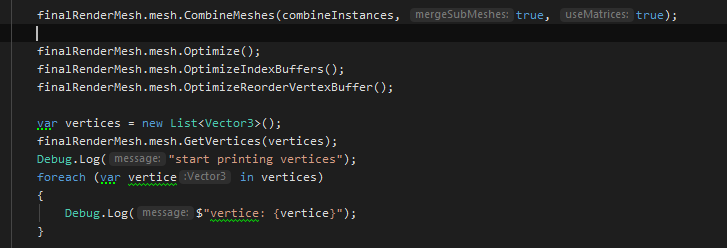
why does this prints only (0, 0, 0) while my new meshes get rendered correctly on screen https://i.imgur.com/yyPp1Rh.png https://i.imgur.com/gexydf3.png
 zinc plinth
I definetely can get the vertices from the origin meshes tho 
zinc plinth
^ what I was seeing was my source meshes still being renderer for some reason, my combined mesh's vertices are all indeed on 0, 0, 0
radiant sentinel
@hollow sorrel hello again,
i want default player loop for default world and my custom player loop for myWorld world. can i have both of them?
@hollow sorrel hello again,
i want default player loop for default world and my custom player loop for myWorld world. can i have both of them?
@radiant sentinel ,thank you , i got my answer. thats true ,the system is working at background but i cant see that 😄
hollow sorrel
@radiant sentinel yeah adding custom world to playerloop doesn't overwrite the default one
or shouldn't at least
but sounds like you figured it out
zinc plinth
I hate that entity debugger makes it seems like the renderer is taking so long but it's just the physics rebuilding --'
I need to switch off using one collider per tile :x

(this is 10K colliders)
I'm already cutting pretty big corners by just disabling LocalToParent updates for my hierachy when I don't move anything
hollow sorrel
daymn
does it display that way because it's presentationgroup that's waiting for physics jobs to complete? weird it doesn't just show it as physicsjobs.complete or whatever
weren't you making a tile based game
what's the colliders for
zinc plinth
raycast on grid to get grid tile entity, and then get the rest
hollow sorrel
ah i was gonna mention you can just convert mouse pos to tile pos but i guess that won't work if you're trying to select tall buildings by clicking the top and the camera is tilted
you could prob get away with mouse pos to tile pos for a lot of small things tho
zinc plinth
I'm prob still gonna raycast, but I'll use my new combined meshes and get an offset coordinate in local space from LTP of the entity I raycasted
since I can throw at minimum 20 by 20 patch of tiles per combined mesh
but that will be when I fix my coordinate problem in the combined meshses >.>
zinc plinth
well how am I getting entities otherwise ? I need local space coordinates to get the correct index in my grid tile buffer
the coordinate problem: https://i.imgur.com/lcrEZYU.png
 dark cypress
What do you mean by "local space coordinates"
hollow sorrel
don't you have a way to get an entity at a coordinate
zinc plinth
bool haveHit = collisionWorld.CastRay(input, out hit);
            if (haveHit)
            {
                Debug.Log("hit");
                Entity hitEntity = physicsWorldSystem.PhysicsWorld.Bodies[hit.RigidBodyIndex].Entity;
                EntityManager em = World.DefaultGameObjectInjectionWorld.EntityManager;
                var parent = em.GetComponentData<Parent>(hitEntity);

                LocalToWorld gridTransform = em.GetComponentData<LocalToWorld>(parent.Value);
                var transformMatrix = (Matrix4x4)gridTransform.Value;
                var localPos = transformMatrix.inverse.MultiplyPoint(hit.Position);
                return new RaycastResult
                {
                    Entity = physicsWorldSystem.PhysicsWorld.Bodies[hit.RigidBodyIndex].Entity,
                    originPosition = camera.transform.position,
                    LocalHitPosition = localPos
                };
}``` @dark cypressat a grid local space coordinate yes, one tile is 1 unit forward in x and z @hollow sorrel
which I get from my buffer
hollow sorrel
what's stopping you from converting a world pos to grid local space
you have your local grid offset right
zinc plinth
needing a world pos in the first place??? why do you think I do a raycast
hollow sorrel
but raycast is just a less efficient way of achieving the same
dark cypress
I'm not sure why you need thousands of colliders.
You can achieve this with just 1 per grid or 1 per world if grids are in a pattern.
zinc plinth
how is a screen to world raycast not the way to get a world pos on a plane?.. @hollow sorrel
and I said I needed to change that but for now I took the easy route @dark cypress
dark cypress
Give developers more RAM and they'll eat it I guess.
zinc plinth
it's not even ram it's just cpu time
if the physics world wasn't damn rebuilding itself every frame
hollow sorrel
because it's a grid
you know exactly where it is because you have the grid position in your world
you know exactly where the player is trying to click
you can know exactly what tile a player is trying to click instantly because you just take the offset from the grid
it'd be instant that way
0.001ms cost
zinc plinth
I want tiles to be free from eachother, so not possible
hollow sorrel
what do you mean free
hollow sorrel
it doesn't matter how much space there is between the tiles, even if your grid tiles are moving all over the place you could still get their tile position in world
because you're already tracking your grid
zinc plinth
you know exactly where the player is trying to click
we know the mouse position on the screen, no world pos
and each tiles don't have the same offset from eachother
hollow sorrel
hmmm ok fair, my mind started focusing on 2d representation for some reason
but in 3d you could just give one collider to your entire grid floor, then you have the world pos the player is trying to click
zinc plinth
what did I say earlier --'
I'm prob still gonna raycast, but I'll use my new combined meshes and get an offset coordinate in local space from LTP of the entity I raycasted
@zinc plinth
hollow sorrel
ah
zinc plinth
dots really decided to piss me the fuck off today --' https://i.imgur.com/fA41lTF.png
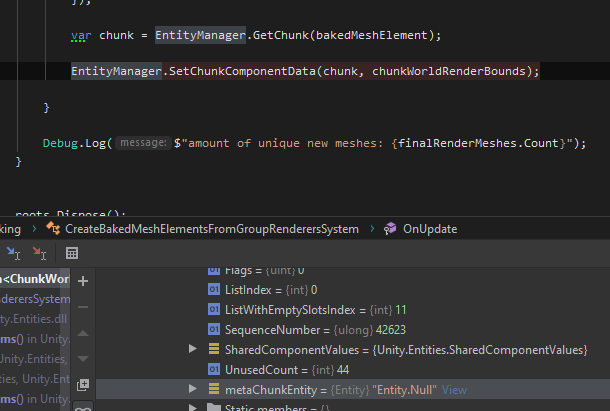
you can't add chunk components right after creating an entity with an archetype
ayy works if I add it to the archetype with ComponentType.ChunkComponent
tardy spoke
How lucky. It pisses me off every day. 😄
Anyone know a quick way to figure out how to detect any unused components or systems?
zinc plinth
unused component ?
ho
fun
so, if you have the DisableRendering component on an entity with a RenderMesh, it will still get processed by HDRP
and make my hdrp loop go from 2ms to 27
so I have to destroy my entities while I could need them in the future to rebuild new combined meshes
great
 low tangle
dots isn't finished and the hybrid renderer is really unfinished
you accept this when you start using it
zinc plinth
https://i.imgur.com/T5wQPl7.png @low tangle
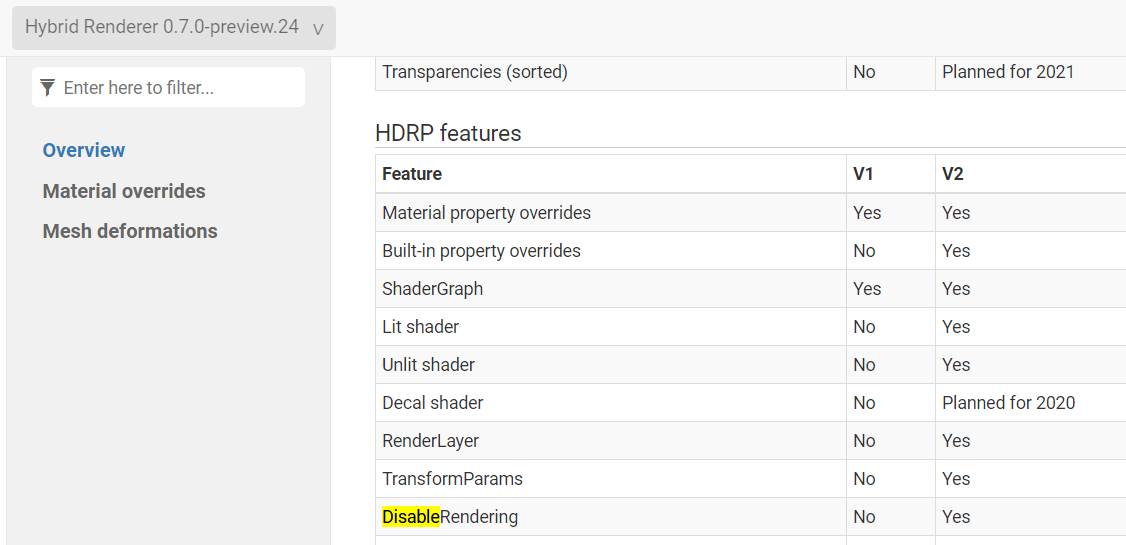
did a forum thread cuz seems like no one asked before
dark cypress
I read in the docs that .WithChangeFilter doesn't care about writing to the component, but rather about a system being ran that declared write access to it. But that's not what I'm seeing. I have an system that declares write access to my NeedUpdate component every frame, but only writes into it if an update occured. A system that has .WithChangeFilter<NeedUpdate>() however, isn't ran every frame, only when the actual write happens.
rancid geode
If the system that declares write access didn't run this frame, then it doesn't trigger the change filter
But if your system declares write access runs this frame but didn't touch the component at all it will still trigger the change filter
dark cypress
It runs every frame. It's a system that responds to mouse clicks, so the only variable there is the InputMouseButtons component which is written to every frame. The system just checks whether a button was clicked from that component and sets the update component if it was.
rancid geode
How is your code?
If (mouseClick) Entities.ForEach((ref Translation t) => { if (someBool) t = default; }).Schedule();
If you put the code above inside a system that forcelly runs everyframe, it will trigger the change filter for Translation every frame that mouseClick is true, even if someBool is false. If mouseClick is false, even if the system runs, it will not trigger the change filter
rancid geode
Yes, you can
dark cypress
It seems like a compile-time construct.
rancid geode
It seems like a compile-time construct.
@dark cypress foreach compiles to IJobChunk, the same way that you can conditionally run an IJobChunk, you can conditionally run a ForEach
You can see the generated code in the Dots Compiler (is that the name?) window
dark cypress
That's great.
What you said doesn't seem to be correct though. This query is shown in the debugger as having entities matches and the system is shown to be running.
rancid geode
The system running doesn't mean that the entities.foreach is running
It just means that the OnUpdate is getting called
If any of the Entities.ForEach matches the system OnUpdate will be called, but the Entities.ForEacg may not be called (lile in your case due the mouse button not being pressed)
dark cypress
That makes sense.
rancid geode
It is a little confusing, but just because Entities.ForEach involves much "magic" (actually is just code gen, but is not all explicit what is happening without already knowing how it works or looking into the dots compiler)
Thus why I usually use IJobChunk directly instead
deft stump
what are the several ways i can do to check if an entity is still seen by the camera?
 opaque ledge

GitHub
A simple collection of jobs used for view frustum culling - MPozek/Unity-Jobs-View-Frustum-Culling
maybe this can help
opaque ledge
new burst and platform package 👀
 north bay
Does anyone remember the link that contains all the different packages in a json format? That was posted here some time ago
deft stump
the different packages that you need to install manuall now?
north bay
No the json which i think the package manager uses to populate it's content
deft stump
https://forum.unity.com/threads/visibility-changes-for-preview-packages-in-2020-1.910880/
probably this?
Unity Forum
We recently went through our package list to identify preview packages that are further from the verification stage, just dependencies of other...
proper silo
Quick question, I just want to be sure that I understand what is happening here on how to create/set a singleton entity (fond in the official documentation).
So the code goes something like:
- get the EntityManager
- Create an Entity with the component you want the singleton to be
- Create a querie that will get the entity we just created (?)
- Set the component of said entity to a "new Singlet" (?)
Is it what is going on? It feels not very "natural" so I have some doubts
deft stump
the last 2 lines is an example when you need to get a singleton entity in a system
proper silo
Oh, you do not have to specify that a component is a singleton when creating it ?
because this is the documentation on GetSingleton
dark cypress
proper silo
Damn, I guess I wasn't looking at the correct/latest documentation! Thank you!
tight blade
have any of you guys used singletons? I want to increment a count during my conversion system, and access that count rather than having to query for the total number of entities in that archetype....
but singletons...
are so...
weird
oh damn look!
@proper silo is fighting the same battle!
have you had any luck?
proper silo
Hahaha @tight blade , right now I am just trying to create one, but I'll let you know if I manage to go further than that !
tight blade
ugh, man its enfuriating
 solemn pelican
Why do you need a singleton to increment a static counter for a class?
tight blade
Do I not? theres a conversion system and a running system. the running system needs to get that count. is there some easier way to just increment some globally accessible integer?
solemn pelican
Singleton = you only want one of a class to exist.
tight blade
Im not a C# guy by trade
solemn pelican
In the awake/constructor add 1 to a static "numInstances" variable of the class. The static means that there's only one per class for all class instances, and they share it. :)
In the Destructor/OnDestroy/whatever, decrement the counter.
DOTSify this, contextually, however all that works. I just followed you here from shaders to help. But singleton probably doesn't mean what you think...it means "only one instance of this entire class can exist...one time."
tight blade
hahaha, thats awesome! thanks for following 😅
solemn pelican
IDK if DOTS already keeps some counter somewhere though.....
tight blade
Yeah, that would be lovely if it did. The description for get entity count says that it executes the query every time
 vagrant surge
its so weird to not have native singletons
solemn pelican
I can't tell ya much about DOTS, so YMMV. Maybe you need a separate class or something that not DOTSy.
vagrant surge
i mean, it takes about 15 minutes to implement them into an ecs
i know because ive done it
solemn pelican
lololol.....and if you had a separate class to keep track of things, you'd probably want it as a singleton so you can reference it from other classes from anywhere....lol.
vagrant surge
i implemented them, on cpp, by just having a single hashmap
where key = type
and value = void* allocation of said singleton
solemn pelican
IIRC, regular C# classes can coexist with DOTS on the C# side, but you have to be careful of what you want to process.
vagrant surge
native singletons are super important in a ecs architecture
you need to store your system state somewhere
and stuff like accel structures
or bridges into external libs
dark cypress
What are different worlds used for? I want to understand when I'd want to use one.
tight blade
well, static integer incrementing works, so I guess I'm happy haha. I didn't know that static members were writeable.
deft stump
how expensive it is to change materials of an entity?
solemn pelican
Yeah, it's a throwback from C/C++ lang syntax. But static =/= const.
deft stump
i.e. I'm trying to flash a entity to yellow and back to blue over and over for 2 seconds.
given that its under a shared component. how expensive is this?
vagrant surge
@dark cypress you generally use different worlds to allow for better parallelism on stuff, and to run unrelated simulations
unity for example has its own ecs world for physics
dark cypress
How do worlds allow for better parallelism?
vagrant surge
whenever you execute a command buffer, that creates entities or adds/removes components, it requires a full multithread sync point
dark cypress
Oh, I see.
So if you have a structure that only needs to sync once per frame or something, but is otherwise separate, you can use that to cause less sync points on the main world.
vagrant surge
indeed
another great use for them
is for stuff like level loading
or procedural generation
you can have a background world where your "mid load" stuff is held
and then you copy the entities from there into the actual runtime world
copying entities beetween worlds is pretty cheap
but yeah those are the main uses of it
dark cypress
Thanks, that's helpful.
tardy spoke
Interesting
so, if you have the DisableRendering component on an entity with a RenderMesh, it will still get processed by HDRP
@zinc plinth I assume that's also true for URP? Because that's not ideal, haha.
Performance by default except for the most obvious things*
zinc plinth
I don't know for URP
tardy spoke
No worries, I'll check
zinc plinth
finished my mesh combining + hashing/batching
trying to think of what to do next
hollow sorrel
what'd you do for hashing
zinc plinth
math.hashwide on each vertice
add add the uint3 together while doing it
it's not optimized yet cuz the hashing itself could get thrown at a IJobParallelFor while it's a IJob for now
but since all of that is done at game start..
also
how do I create and playback a ECB myself ? if I call Playback myself I get an error saying it wasalready playbaked
dark cypress
zinc plinth
hoooo you create it yourself instead of from a system
I see
ayyyyyy
lost a full second to a system now that I use a ECB to batch all the operations for my grid tiles init
200ms of playback 
hollow sorrel
daymn
zinc plinth
takes (1.2 + 1.8 + 2 + 0.9) = 5.9s to init a 200 by 400 grid resulting in 6ms cpu time afterwards
200 by 400 is roughly the size of the new massive island in one of anno 1800's dlc
and that's running with only 4 worker threads
zinc plinth
for 80K colliders it's not
I can't optimize my colliders how I want yet so I'll just wait for entities 1.0 where colliders will be impactedby NonUniformScale
 solid flume
Please correct me if this is the wrong place to post this, but is there any way to give jobs access to large arrays without copying it for every job? I'm implementing marching cubes using the job system and have fairly large lookup tables
dark cypress
@solid flume Why do you need to copy? A NativeArray is just a pointer, you can pass it anywhere.
mint iron
is that 6ms every frame?
zinc plinth
yea @mint iron
solid flume
I thought jobs copy all their data?
dark cypress
Yeah, they copy the pointer.
solid flume
Oh
dark cypress
And then use that pointer to refer to the original array.
solid flume
so native collections are basically collection pointers, and any other data is allocated separately for each job?
dark cypress
Anything that's not ref yeah.
solid flume
I'm assuming that if I want the array to exist indefinitely the Allocator needs to be Persistent?
dark cypress
Correct.
solid flume
Do I need to Dispose it on changing scenes? Or exiting the game?
dark cypress
If you stop using it you should dispose it.
tardy spoke
What's the best way to spread processing over multiple frames in ECS? For example, I have my subscene loader that needs to check 200 subscenes for distance to the player. It's easy to make it more efficient by just having it check for distance every couple seconds, but that still does all the processing on a singular frame.
Say I wanted it to check the distance to 1 subscene per each frame, so over 200 frames it would have checked them all. What's a good approach for that? Will it necessarily destroy parallel processing?
solid flume
It needs to be used intermittently throughout the course of the game
zinc plinth
profiler looks like this @mint iron https://i.imgur.com/nmuRgSK.png
 solid flume
In that case, should I just have a normal c# array and Temp allocate it when i need to use it?
I was concerned about the potential time used in allocating and then clearing it
especially if I need to use it several times in quick succession
dark cypress
If it only happens when changing scenes it shouldn't be an issue.
solid flume
not necessarily. A runtime editable mesh needs that array a lot
I meant that its not necessary it'll be used only on scene load
dark cypress
Then keep it loaded. I have a global static native collection being always available for jobs.
solid flume
Persistent it is then. Thanks a lot
Do you have to dispose it manually or does it automatically get disposed if the game is closed?
dark cypress
OS disposes everything on process close.
solid flume
Is there a difference between the readonly modifier and [ReadOnly] attribute? Which should I use?
hollow sorrel
@tardy spoke 200 distance checks with ecs is prob so cheap that adding spreading might even be more expensive
but for things like this you could give them a batch id, then one frame process everything with id 0 then next frame everything with id 1 etc
dunno about best way but that's one way
tight blade
alright, here we go guys
@tardy spoke checkitouuuuut
simulatin muh water
dude, why are these videos never working??
you need to see the beginning!
tardy spoke
It worked for one play through for me, haha. It was incredible while it lasted!
tight blade
hahaha
tardy spoke
The green cube dropped and then things ... drifted in a way I assume they're supposed to
tight blade
yeah, okay if it worked for one playthrough thats enough. yeah, you can see them all appropriately interacting with each other's drag mechanics
im real happy anyway
tardy spoke
Haha excellent. Upload to Steam store ??? profit.
tight blade
profiiiiiiittt
tardy spoke
Hmm frame debugger shows the batches and everything but doesn't actually show the rendering of the frame yet with hybrid renderer seems like
solid flume
If I need to initialise a job with an array, does it have to be a native array even though I dont need it to be a pointer?
dark cypress
All arrays are pointers. Native collections just wrap it into a value type with their own safety checks to allow it to work in DOTS.
solid flume
Oh right I should've remembered that. I'm do dumb stuff sometimes
Forgot arrays are pointers
 gloomy timber
. . .
tardy spoke
This is probably a pretty trivial question, but what's the best way to refactor this out? I'm going to end up with a bunch of "state" info for the player that a lot of systems will need access to... is there an ECS best practice for that kind of thing?
tardy spoke
Would it just be using a NativeHashMap in a singleton class or something and writing/reading data from/to it from Systems? Or is that way wrong? Hahah
Like a 'lil database!
tight blade
you mean like other than putting more fields in your singleton component?
tardy spoke
Yeah, because otherwise all that boilerplate will be needed for every single system, I believe
that requires that info haha
tight blade
yeah man I have no idea with that absurd singleton api
im amazed you got it to work at all
tardy spoke
GetSingletonEntity you mean?
Yeah, I don't know how Set works, but Get will just get the entity if only one entity has that component on it. I never actually "set" it at all, but maybe one of the conversion systems figures that out and sets it
tight blade
oh, is that easier? I was trying to use the GetSingleton and SetSingleton and tried a lot of permutations with no success
tardy spoke
I'm not sure lol
I was talking about a using a singleton design pattern in a class, not that method
like create a database by making some class that all the systems can access that's holding the player state, but I'm not sure if that's remotely correct and if that will have adverse effects on running jobs in parallel or not
Most of the systems would just need to read from it most of the time
tight blade
yeah I mean from what I see written about it, all that boilerplate seems to be pretty much necessary for the singleton system. Also, as for paralleling, it works like a regular archetype reference, so I guess every system that accesses it would have to be scheduled sequentially
tardy spoke
I think we're talking about two different things, what is this "singleton system" you're talking about? Hahah
mint iron
there isnt a set i dont think you just create an entity and make sure there's only one with that component
tardy spoke
Ohhh, is there a way to do a "singleton class" but ECS style in some sort of fancy "singleton System" ?
I haven't even heard of that
tight blade
not really, but yes.
there are some API's that are in there, but it seems like its gonna get improved on
its basically just an abstraction over asserting that theres only one of that archetype
mint iron
what i end up doing is write an extension that wraps it all like `world.GetOrCreateMyThings<Stuff>() which is basically the same as what you would do with a system, except you can define the interface and skip unitys base class bloat
tardy spoke
@mint iron yeah I got that confused, there's a "setSingleton" but no "setSingletonEntity"
tight blade
I mean I assume that's because its an entity, so you would use an entity manager setcomponent - right?
of course that would totally break jobs.
tardy spoke
What about "System State Components" ?
mint iron
yeah its pretty weird, GetSingleton/SetSingleton just gets/sets the component lol with a check to enforce there's only one. I guess it declares your intent which is good.
tardy spoke
maybe it's useful for testing or something
tight blade
lol, Im glad I have no global state needs yet and could just get away with a static var
tardy spoke
Yeah I need like a true database style state system I believe haha
tight blade
nahhh, you just need a good CAS
tardy spoke
for things like quest progress, player location, items, etc
tight blade
"check and set"
tardy spoke
I need Redux 🤔
tardy spoke
Haha I'm terrible at web programming, I'm probably better at this than I am at that now, as scary of a thought as that is
tight blade
sounds like you're ready for seed capital to me
tardy spoke
I can't find any examples on google of anyone building a state system in ECS
Hmm... well this is kind of the same idea except instead of storing all state data in some sort of singleton class you could just have it floating around as various components? ... Is that... better?
Have some systems set those components and then some read. If I'm not mistaken a system simply reading IN that component could still run in parallel right? Particularly depending on the time read in that data, IE pass it into the job as a value before executing in parallel?
tardy spoke
I think just making a "globalState" entity is probably an alright way to proceed, but it doesn't do much about all that boilerplate in all the systems.
 boreal kettle
So just a lil' question! Me and a friend just started developing a game using DOTS, and I'm doing all the 3D asset creations (he scripty boi). I'm not really a good programmer so I don't understand it too much, we just communicate what does what for stuff. Anyways! Should I do anything different when making assets? Since it is entity stuff, or is everything pretty much as usual? and he can just convert to entity on runtime and blip it do thing good?
dark cypress
You're good.
boreal kettle
Awesome :D
zinc plinth
got the singleton stuff, I just create a single entity with a SingletonTag and add all the shit I need on it; just need to make sure to only create it once 
SystemGroups are amazing 
things get so neat
tardy spoke
@zinc plinth how do you access it from systems?
zinc plinth
entity query with the tag
tardy spoke
so on your systems you just query it?
imagine player was "SingletonTag"
I'm just looking for a smart approach because it'll be no time before I have like 30+ systems and it will suck to have to change 'em all haha
particularly when you get to like 200 systems or more 🤷♂️
zinc plinth
but it depends
cuz like for my InputState component in the singleton I have this, and then I GetExistingystem and grab my component
    [UpdateInGroup(typeof(StateUpdateSystemGroup))]
    public class InputStateSystem : SystemBase, GameControls.IBuildingActionsActions
    {
        public InputStateSingleton InputState;
        private EntityQuery _inputQuery;


        private GameControls _inputs;

        private ButtonControl _selectControl;
        private ButtonControl _alternativeBuildingModeControl;
        private ButtonControl _rotateControl;

        // https://hatebin.com/hzgncyknqh
        protected override void OnCreate()
        {
            base.OnCreate();

            _inputQuery = GetEntityQuery(typeof(SingletonTag));
            _inputs = new GameControls();
            _inputs.BuildingActions.SetCallbacks(this);
        }

        protected override void OnUpdate()
        {
            //Debug.Log("Start of frame");
            Entity singletonEntity = _inputQuery.GetSingletonEntity();

            InputState.Select = (_selectControl != null && _selectControl.wasPressedThisFrame);
            InputState.AlternativeBuildingMode = (_alternativeBuildingModeControl != null && _alternativeBuildingModeControl.isPressed);
            if (_rotateControl != null && _rotateControl.wasPressedThisFrame)
            {
                InputState.Rotation = InputState.Rotation.Next();
                Debug.Log($"new rotation: {InputState.Rotation}" );
            }

            EntityManager.SetComponentData(singletonEntity, InputState);
}```so I don't have 500 times the same query, but components being public from the system they're set on
and then I have a SystemBaseWithInputs when I need inputs in my system ```
public abstract class SystemBaseWithInputs : SystemBase
{
private InputStateSystem _inputStateSystem;
private InputStateSingleton _inputState;
protected InputStateSingleton InputState
{
get => _inputState;
}
    protected override void OnCreate()
    {
        base.OnCreate();
        _inputStateSystem = World.GetExistingSystem<InputStateSystem>();
    }

    protected override void OnUpdate()
    {
        _inputState = _inputStateSystem.InputState;
    }
}```
Interesting! I shall research this, haha. Thanks!
zinc plinth
np
 toxic mural
Are we not supposed to use SerializeUtilityHybrid? Like is it just for the hybrid conversion workflow
It looks like it makes assumptions about gameobjects being prefabs when not in the editor
I think I just saved myself a coupe hours of playmode debugging
safe lintel
heh i have no idea
i asked for clarity on it on the forums too and no answer
i really hope they find a way to make it just work so you can literally just call serializeworld and not need to do extra busywork
toxic mural
yeah I'm dreading having to get into this entity remapping after deserialization stuff
i can afford to put off saving/loading until (if) they spruce up the usability
spawning entities from JSON would be neat too
tight blade
anyone know of a mathematical operation to push normalized values away from 0.5? like I want 0.4 to go closer to 0 and 0.6 to go closer to 1
tardy spoke
What about simply multiplying it by itself to put it into an exponential curve... haha. 0.4 * 0.4 = 0.16, 0.6 * 0.6 = 0.36 .
Then an additional operation on top maybe could get you where you need to go. Needless to say, I'm not super great at math. Good at problem solving though. 🤷♂️
tight blade
right, and then id need to renormalize that
tardy spoke
And you do not want to renormalize it? 😮
tight blade
no, I do want to renormalize it
tardy spoke
Yeah, the only thing is depending on the "curve" you want it might not be in the right "place".
tight blade
so, squaring it doesnt work because it moves numbers away from 1, even though it succeeds at increasing variance
tardy spoke
Right
tight blade
so like Im trying to figure out how I would remap that onto a scale between 0 and 1
tardy spoke
Someone will need to bust out the old TI-86 and figure out how to move the curve, haha.
tight blade
so that .9 is pushed closer to 1 and .1 is pushed closer to 0
lol, its like at that point in the night where I'm too tired to be smart enough to let this problem go for now
tardy spoke
I might've seen a tutorial a couple days ago that does something similar, let me have a look
tardy spoke
@tight blade There's also a comment at the very bottom by someone who retrofitted it to remap to different ranges. The answer is probably in there somewhere, haha.
solid flume
I have around 8k jobs running, and according to the profiler they take basically no time to complete, but the GC alloc from disposing of all the native arrays is taking ages. Is there any way I can avoid that?
Can each job dispose of its own variables at the end of execute?
Doesn't seem to make a difference
Also, I have 4 static persistent nativearrays as lookup tables, since I need them often. Every time unity builds, it throws an error that it hasn't been disposed resulting in a memory leak. How can I avoid this?
solid flume
Do you have an idea for the GC Alloc issue? If the array is small and a fixed size (always 8 elements) is it better to have 8 variables?
dark cypress
I'm not informed on NativeContainer GC stuff, unfortunately.
solid flume
Ah. Never mind then, the solution has to exist somewhere in the docs/forums
solid flume
Is there anything like a nativeIntPtr?
So every job doesn't get a copy, but a readonly reference to a value
opaque ledge
i think thats only in Editor, its stripped in actual build
iirc it was called Disposable Sentinel, which is there to track safety for multithreading
solid flume
Apparently IJobParallelFor doesn't allow parallel writing
Is there any job that does?
 minor sapphire
Pretty sure you just disable the restriction if you can guarantee you won't write into the same index from different threads
opaque ledge
☝️
opaque ledge
[NativeParallelDisableRestriction] i think is the attribute's name
you have to use NativeList.AsParallelWriter()
you have to make sure there is enough size before you send it to job because there is no Add method on ParallelWriter, only AddNoResize
solid flume
Oh
I don't know the size I'll need, but I can probably make a hard cap
I need read and write, so I guess every time I write I call the function?
Does that have a memory/performance impact?
opaque ledge
well you generally create a new native list with Allocation.TempJob before you send it to job
solid flume
The list is persistent. It might need to be edited very frequently so I didn't see the point in reallocating it every time
opaque ledge
then yeah, you have to clear/resize it everytime you are about to send it to job
solid flume
Is 35k too many float3x3?
opaque ledge
i think so 😄
opaque ledge
i mean you can just try it and see how it works out
solid flume
True that
Lets hope unity doesn't crash
I still need to mark it with the[NativeParallelDisableRestrictionAttribute]? Because its throwing the same error even with the parallel writer
Also it seems to be called either [NativeDisableParallelForRestriction] or [NativeDisableContainerSafetyRestriction]. Can't decide which so guess I gotta try both
opaque ledge
i think former
solid flume
Both of them work but I get separate answers
 gusty comet


 solid flume
I really need to find a way around static nativearray lookup tables
Its messing with the editor
zinc plinth
What do you use them for?
solid flume
Marching cubes
I think I'll just learn compute shaders and use the job system for chunking
Makes more sense
Right now this is such a pain
deft stump
@solid flume blob assets?
solid flume
But the restrictions and stuff around how jobs interact with data makes this a pain. I know the fundamentals of the compute shader approach, event tho I don't know how to write one
What are blob assets?
deft stump
they're just immutable data that you can ref to and take data from.
violet cosmos
hehe, in .ForEach().... ref params must become before in params. Is there a reason for this?
zinc plinth
is there a way to prevent specific EntityQueries to enable/disable systems ?
violet cosmos
I'm new at this, but there's two ways: Add a "tag" component that is empty of values, but just filters the .WithNone, OR add a flag that must be processed on a component, but will be processed for each entity. There's obviously pros and cons to both
Ah, yah had this in my bookmarks: https://gametorrahod.com/tag-component/
Hmm, what's the equivalent of setting Transform.forward with ECS? LocalToWorld is readonly
tight blade
@tardy spoke good tip on that post. It wasnt quite the answer, but it got me far enough to develop what I needed
coarse turtle
Hmm, what's the equivalent of setting Transform.forward with ECS? LocalToWorld is readonly
@violet cosmosquaternion.forward(rotation)
violet cosmos
math.forward(rotation.Value); ?
translation.Value = newPos * math.forward(rot.Value);
coarse turtle
Yep - just pass in the quaternion - it'll return the forward direction
violet cosmos
OK, sane enough. Just don't know enough API obcscura yet
 tawdry lotus
anyone knows why PostUpdateCommands AddComponent<T> is not AddComponentData like the EntityManager method?
tardy spoke
@tight blade I was actually fairly drunk last night and realized that wasn't right either this morning.
I'm pretty sure you were looking for a Sigmoid curve or Richard's curve or similar. Glad you figured it out, hahah.
deft stump
does the Iconvertgameobject interface only gets run when I have the convert to entity script attached to the GO?
violet cosmos
In [GenerateAuthoringComponent] for IComponentData, is there a way to initialize based on current editor (or another componets) values? I have a value that I want to set once based on editor data (in this case, it's a cached Last Position)
tardy spoke
@deft stump I'm pretty sure it only works when attached to GO
@violet cosmos yeah, put it on a GameObject and set the values?
I'm probably misunderstanding you haha
deft stump
@tardy spoke I mean, yeah it is attached.
but does it need the Convert to Entity component to run the interface?
violet cosmos
@tardy spoke Well, in this case lets say you're tracking motion vectors. You need to initialize something as the "previous", if it's just zero then it's weird, right?
tardy spoke
Hmm, good question, I believe it doesn't need to convert to entity to run the interface because I think I had it instantiating a GO twice to two different entities and then disabling the GO
tardy spoke
@violet cosmos you could put two pieces of data on the component, one as an initial previous value or something?
again, might not be understanding exactly what you mean, and also that solution may not be ideal, haha
violet cosmos
That's unnecessarily complex. If I initialize something on frame 45, then it has a world space position but hasn't run yet. On frame 46 it runs, and we can assume it's moved, but I need to know the position on Frame 45 the first time to accurately track the motion vector
So, I have a "Last Position" cached in the struct to perform calculations
tardy spoke
Ah, gotcha
deft stump
then um... why not just store it in some component?
name it LastPositionComponent
violet cosmos
Same problem, how do I initialize it
Also, if it's a component like that, then theoretically anything could touch it
tardy spoke
LastPositionComponent.Value = currentPositionComponent.Value - 1 ... haha
deft stump
initialize?
the moment it runs its already initialized.
you just need to ref it Entities.ForEach
violet cosmos
So, I don't like that idea
deft stump
Also, if it's a component like that, then theoretically anything could touch it
in practice anything can be touched
violet cosmos
Unless it runs last, but then it's never ran first and we're back to square one
So, the easiest way is to just have some sort of "constructor" paradigm. That's really what I'm asking for... What's the Initialize/Constructor process in ECS?
(for the entity)
tardy spoke
When you add a component you can set a value
deft stump
well for initializing it.
you CAN set/add the component in runtime via EntityManager.
And you can throw in your data while you're at it too
tardy spoke
If you're doing it "ECS" style I think since you have data it has to be held in a component somewhere, so I think that "lastLocation" component may need to exist. There's probably other ways of doing it but I think that would be the "normal" way?
violet cosmos
I guess I could have a specific job that is looking for MyComponent without a MotionVector component, then add that MotionVector, and have that run first. Seems like a wasteful lookup because then it needs to be run every frame too
I have LastPostion as a value in my component. The question I'm asking is about initialization based on runtime values
tardy spoke
btw @deft stump I just looked through some old code but couldn't find anywhere where I used IConvertGameObject so now I'm not sure if it has to be an entity or not. I'm thinking it probably does have to convert to entity, because otherwise I probably would've used it. Ended up going a roundabout way using the "GameObjectConversionUtility.ConvertGameObjectHierarchy(gameObject, settings);" functionality a lot and I imagine I ended up doing that because IConvertGameObject converts to Entity and I couldn't grab the game object again (because it had vanished, haha).
If I have a value of last position that is set upon initialization, and then I have the value of next position that is calculated the very next frame, could I not calculate the vector from that?
because I have both pieces of data at once
and then set the component to new "last position" after the calc
A bit confusing but I think you may want lastPosition and velocity on same component?
violet cosmos
I do, it has the values needed on the component, including LastPosition. Just needs to be initialized correctly (and hopefully in a sane manner that I can maintain)
tardy spoke
Hmm, I have an example at authoring time, but I don't have one for instantiating at runtime.
I imagine the runtime one would be similar with AddComponentData upon instantiating and then setting the value
deft stump
hrmm
violet cosmos
Convert might be OK, just a bit annoying because so far I've got plans to make MonoBehaviour free Prefabs using GenerateAuthoringComponent instead
deft stump
sanity ccheck
violet cosmos
So I need to use an MB to initialize, which could have easily handled with some markup in the struct. Maybe I'll add that 😉
deft stump
dstManager.AddComponentData(gridPanel[i], new PanelRenderBlobData {
PanelRenderMeshBlobAssetReference = blobAssetRef,
index = 0
});
...
deft stump
this is how to add a component right?
tardy spoke
@deft stump I just checked, IconvertGameObject needs the GO to have convert to entity script or be in subscene
@deft stump I'm not a C# master but don't you need the generic type of the component there?
<Whatever>
deft stump
that works too according to intellisense
tardy spoke
yeah cool, just making sure, haha
tardy spoke
It's as never wrong as the code you're writing right now.
deft stump
dont quote me
tight blade
@tight blade I was actually fairly drunk last night and realized that wasn't right either this morning.
I'm pretty sure you were looking for a Sigmoid curve or Richard's curve or similar. Glad you figured it out, hahah.
@tardy spoke
Hahaha, same, more or less 😗
tardy spoke
Failing at ECS leads me to drink which leads me to fail at ECS more. Vicious cycle.
radiant sentinel
Hello, my World.update not working
I have made a world and im using new player loop by scriptBehaviorUpdateOrder.appendWorldToPlayerLoop
Whene i call update its not work
deft stump
weird that I get more stuff done when I drink
opaque ledge
@tardy spoke where are you failing
radiant sentinel
Hello, my World.update not working
I have made a world and im using new player loop by scriptBehaviorUpdateOrder.appendWorldToPlayerLoop
Whene i call update its not work
@radiant sentinel
Its work if i set that player loop as current player loop
tardy spoke
@opaque ledge haha nah I'm killin' it, all good. 😎
Actually todays project has me a bit confused though, Torsina gave me a good example of implementation but it went a bit over my head just because I'm not familiar with some OO concepts like abstract classes yet, but I'm trying to figure out a good way to hold gameState in a component or some sort of container that can be called from any System
deft stump
what's the world called where the conversion of go happens?
tardy spoke
I don't mean to sound patronizing but isn't it literally called the ConversionWorld ? haha
Don't quote me on that
deft stump
well I'm trying to get its EM
opaque ledge
ah good good^^ I had lots of problems at beginning, thinking about ECS structures and learning you can actually put classes on your entity helped me a lot
mint iron
the base class approach from torsina is a good easy way to do it.
radiant sentinel
guys Can i have multiple world that updating without setting as current player loop?
tardy spoke
Yeah, I just have to do some research on OO stuff to figure out what abstracts do exactly, then I should be able to just implement it.
I don't like implementing code I don't understand because I know that'll eventually lead to disaster, haha.
mint iron
abstract just means its intended to act as a base class and usually has abstract members that must be implemented when u derive it.
tardy spoke
@opaque ledge put classes on your entity in which way are you referring?
opaque ledge
you can put class ICD on your entities and run a system on it with "WithoutBurst" and "Run"
and you can also add MB with AddComponentObject
tardy spoke
Right, that's how I've been doing it, haha. 🙂
MB ?
opaque ledge
Monobehaviour
tardy spoke
Right, sorry, haha
violet cosmos
Uff, I'm having a slow brain day on this math
tardy spoke
I actually didn't know you could add monobehaviours to entitys... I guess it makes sense. I have a couple references to camera GO's and stuff
opaque ledge
i have wasted lots of time to think how should i implement UI stuff and then i learnt you can add class ICD, which made things much easier 😄
tardy spoke
My only issue is that currently virtually all my systems are .withoutburst and .run which makes me wonder about my software architecture skills, hahah.
because a lot of the ones I'm working on now need access to the player's state (location) which they have to reference
opaque ledge
thats not good tho, i am not really pro or anything, but why ECS is better than MB is being able to use burst which requires you to use (blittable)structs only
you can just take the 'snapshat' of the player state in OnUpdate method and use that in your job
tardy spoke
Exactly. That's why I'm trying to figure out how to hold the player/games's state in a way that will allow burst/parallelization if they just need to read it
opaque ledge
like
float playerHP = ManagedClassPlayer.GetPlayerHP();
ForEach(stuff) =>{
  int someRandomVariable = playerHP / 2;
}
sure
radiant sentinel
How can i update world?
tardy spoke
Right. Could I use a singleton class or similar for that @opaque ledge ? And then just have the systems that write to it run without burst or whatever, but the ones that read it just store it locally and run with that?
opaque ledge
yeah exactly
tardy spoke
Yeah, that was my original idea, I just wasn't sure if that was a "proper" way to do it or would lead to disaster!
radiant sentinel
@hollow sorrel hello, i have created worlds but i ihabe update problem
tardy spoke
@opaque ledge one last question, what would be the best type of container/object to store the state in? NativeHashMap?
opaque ledge
hmm not sure mfragger, i never did that kind of stuff, there might be a chance that GridPanelTag entities havent get created yet
NativeHashMap for multiple keys/values yeah
if you want to go for key => multiple values, you can use NativeMultiHashMap
hollow sorrel
@radiant sentinel whats the issue
deft stump
sooo how do I get the EntityManager of the ConversionWorld?
that MIGHT answer my problem
radiant sentinel
@hollow sorrel im using different player loop for each world
When i setPlayer loop of one world as current player loop, other worlds not updating
tardy spoke
@opaque ledge awesome! I've never even heard of an object that holds a single key to multiple pair values (that's definitely not often used in javascript...), so I'm excited to find out what kind of animal that is, hahaha.
In JS you just nest arrays and objects inside other arrays and objects which is then called a nightmare. To make it even more confusing arrays are objects in JS... I wonder if they are in C# also. 🤔
opaque ledge
🙂
yeah i think so 😄
tho nativehashmap wont allow you to do it
you cant nest native containers to each other
mint iron
@tardy spoke https://rb.gy/lo7our this is thing for burst accessible storage - lookup databases etc. It looks scary but its not really, its just a uniform way to manage and access custom native containers.

GitHub
An example showing the how ECS Events package can be utilized in a game. - jeffvella/UnityEcsEvents.Example
tardy spoke
I have so much OOP and comp sci basics to catch up on, hah.
@mint iron perfect! For what I'm doing it's more important to understand the eventual goal than to implement it today. Realistically my project will take years and it's good to hit some limitations on implementations and understand the "why" of moving to different solutions, haha.
opaque ledge
well, if you are going for pure OOP, you cant use them in ECS anyway
you cant use interfaces or abstract classes (or classes at all) in jobs
tardy spoke
No, I mean just how the ECS system is wrapped in OOP adds a bit of a layer of complexity for me since I'm not familiar with a lot of OOP paradigms
even the basics of understanding what an interface is vs an abstract class etc
radiant sentinel
No, I mean just how the ECS system is wrapped in OOP adds a bit of a layer of complexity for me since I'm not familiar with a lot of OOP paradigms
@tardy spoke
Objevt oriented programming?
Search and learn about design patterns
Or you should learn about architectures
opaque ledge
which actually wont help you in ECS 😄
tardy spoke
Yeah totally, my very limited background in programming is all functional programming lol
opaque ledge
but yeah, its generally good idea to learn them in time
tardy spoke
which is why I like ECS, but the thing is to use ECS in Unity it really helps to know some OOP
radiant sentinel
which actually wont help you in ECS 😄
@opaque ledge
Finally you need oop to create an architecture
tardy spoke
even though yes, ECS is not technically functional programming, etc
You don't need OOP to create software architecture
radiant sentinel
You don't need OOP to create software architecture
@tardy spoke
You need concepts of that
deft stump
^
tardy spoke
You need design patterns for sure
IE most web-apps to my knowledge are not OOP, since javascript only implemented classes (and they're not really a full implementation) in ES2016
coarse turtle
functional programming ftw? 👀
deft stump
btw, which side are you guys on?
the I-hate-OOP side? or the I-love-OOP side?
I'm the former...
good lord how I hated c# when i first used it. C++ was my first love
coarse turtle
more in the middle, I can see how some concepts in OOP work nicely, but I've mainly came from using a C background / functional background
tardy spoke
I'm currently on the I hate side, but there's numerous reasons:
- I don't understand it well enough to understand the potential benefits
- My bro and dad are LISP programmers (bizarre, yes. Bro is actually employed as a LISP programmer, which is super odd. D-wave programs their quantum computer back ends in LISP - those are probably the only lisp programmer jobs that exists currently, hahah) so they're obviously biased towards functional as well
- You can still talk about design patterns without OOP, but a lot of people don't seem to understand that, haha. Classes are just functions holding functions.
deft stump
man, I remember back in college my C# prof used to grill me because I do OOP wrong.
and started... slowly... hate it AHAHAHAHA.
violet cosmos
OK, I'm having a serious brain fart... Can someone help me convert this. My previous routine was using Transform.forward to move and angle the object, but I'm having a bit of a struggle getting this equivalent in Transform working in ECS
            transform.position = newPos;
            transform.forward = newPos - currentPos;
After using javascript though, C# is a beauty of a language. Typescript fixes a lot of Javascript's issues, but it's like... you gotta set it up and it adds overhead, and you gotta keep it upgraded to the right version which breaks things... having a native strongly typed language is awesome.
radiant sentinel
@hollow sorrel
Finally im updating a parental group at my world and its working. World.update is not working
What is problems of group.update
?
tardy spoke
@deft stump that's always the worst when you have a teacher that is so bad they actually make you despise something, haha.
deft stump
oh no. he's a pretty good prof. Data Struct, a subject I failed 2 times because the profs were so bad at explaining stuff, he made it very easy to understand (given with the context that its my 3rd try).
He's just an OOP fanboy. A DIE-hard-#1-OOP-Simp fanboy
tardy spoke
Anyone who uninspires people can be very damaging
deft stump
I still love C#. great language. f'n amazing!
I jsut dont like OOP
tardy spoke
Which imo is a teacher's main job, more so than instilling tangible knowledge itself. Most learning is self-guided throughout life in my experience.
violet cosmos
I think I got it with some help from the forums
rotation.Value = quaternion.LookRotation( math.normalizesafe((newPos - placement.LastPosition)), ltw.Up);
Agree, C# is dope. Apparently it's a clone of Java, so I feel like I'm getting twice the value, hahaha.
violet cosmos
Yay, ballistic motion. Need more testing but most of my previous algo seems to work now
deft stump
Oh Java,
I hated it the moment I wrote Hello World
😄
Passed my java course jsut by copy pasting code from my seatmate
violet cosmos
My favorite language was ActionScript 3
tardy spoke
@violet cosmos nice one! Also you may come across this but sometimes you will need to use math.mul() instead of * in various situations with the new math library, just so you're aware, haha.
in case you ever run into that
violet cosmos
Yah, I'm just trying to get it working first
Second day on ECS, first thing I'm converting that is mroe complicated than "move it along a line"
I need to keep code readable now. Micro-optimizations are later
tardy spoke
ActionScript 3? is that Flash? Hahah
deft stump
I need to keep code readable now. Micro-optimizations are later
why make comments if you can make the variables very descriptive
violet cosmos
Yah, I was a professional Flash dev for years. I honestly am suprised I didn't make any Flash games. Psyched myself out that I couldn't do it
tardy spoke
Haha programmers are interesting sort. They're super conscious about their code and see it as a representation of themselves. I wonder if that'll change in the future.
violet cosmos
Now I use Unity enough where I need to pay for a premium version. Which is good, and have my own VR game in progress
tardy spoke
What do you need the premium version for?
The good reason? You made over 100k with it? Hahah
deft stump
unity mars?
violet cosmos
I work with clients who have deep pockets, and so I'm obligated to buy premium
deft stump
aaaah
tardy spoke
ah, right
violet cosmos
It's not just my income, but the income of the people that use the end result
tardy spoke
Makes sense, and I mean Unity for the sophistication of the software is pretty affordable
violet cosmos
Yah, $30 a month is nothing for what I'm getting out of it